Archive
What would a data-driven Congress look like?
Recently I’ve seen two very different versions of what a more data-driven Congress would look like, both emerging from the recent cruddy Cromnibus bill mess.
First, there’s this Bloomberg article, written by the editors, about using data to produce evidence on whether a given policy is working or not. Given what I know about how data is produced, and how definitions of success are politically manipulated, I don’t have much hope for this idea.
Second, there was a reader’s comments on this New York Times article, also about the Cromnibus bill. Namely, the reader was calling on the New York Times to not only explore a few facts about what was contained in the bill, but lay it out with more numbers and more consistency. I think this is a great idea. What if, when Congress gave us a shitty bill, we could see stuff like:
- how much money is allocated to each thing, both raw dollars and as a percentage of the whole bill,
- who put it in the omnibus bill,
- the history of that proposed spending, and the history of voting,
- which lobbyists were pushing it, and who gets paid by them, and ideally
- all of this would be in an easy-to-use interactive.
That’s the kind of data that I’d love to see. Data journalism is an emerging field, and we might not be there yet, but it’s something to strive for.
Fairness, accountability, and transparency in big data models
As I wrote about already, last Friday I attended a one day workshop in Montreal called FATML: Fairness, Accountability, and Transparency in Machine Learning. It was part of the NIPS conference for computer science, and there were tons of nerds there, and I mean tons. I wanted to give a report on the day, as well as some observations.
First of all, I am super excited that this workshop happened at all. When I left my job at Intent Media in 2011 with the intention of studying these questions and eventually writing a book about them, they were, as far as I know, on nobody’s else’s radar. Now, thanks to the organizers Solon and Moritz, there are communities of people, coming from law, computer science, and policy circles, coming together to exchange ideas and strategies to tackle the problems. This is what progress feels like!
OK, so on to what the day contained and my copious comments.
Hannah Wallach
Sadly, I missed the first two talks, and an introduction to the day, because of two airplane cancellations (boo American Airlines!). I arrived in the middle of Hannah Wallach’s talk, the abstract of which is located here. Her talk was interesting, and I liked her idea of having social scientists partnered with data scientists and machine learning specialists, but I do want to mention that, although there’s a remarkable history of social scientists working within tech companies – say at Bell Labs and Microsoft and such – we don’t see that in finance at all, nor does it seem poised to happen. So in other words, we certainly can’t count on social scientists to be on hand when important mathematical models are getting ready for production.
Also, I liked Hannah’s three categories of models: predictive, explanatory, and exploratory. Even though I don’t necessarily think that a given model will fall neatly into one category or the other, they still give you a way to think about what we do when we make models. As an example, we think of recommendation models as ultimately predictive, but they are (often) predicated on the ability to understand people’s desires as made up of distinct and consistent dimensions of personality (like when we use PCA or something equivalent). In this sense we are also exploring how to model human desire and consistency. For that matter I guess you could say any model is at its heart an exploration into whether the underlying toy model makes any sense, but that question is dramatically less interesting when you’re using linear regression.
Anupam Datta and Michael Tschantz
Next up Michael Tschantz reported on work with Anupam Datta that they’ve done on Google profiles and Google ads. The started with google’s privacy policy, which I can’t find but which claims you won’t receive ads based on things like your health problems. Starting with a bunch of browsers with no cookies, and thinking of each of them as fake users, they did experiments to see what actually happened both to the ads for those fake users and to the google ad profiles for each of those fake users. They found that, at least sometimes, they did get the “wrong” kind of ad, although whether Google can be blamed or whether the advertiser had broken Google’s rules isn’t clear. Also, they found that fake “women” and “men” (who did not differ by any other variable, including their searches) were offered drastically different ads related to job searches, with men being offered way more ads to get $200K+ jobs, although these were basically coaching sessions for getting good jobs, so again the advertisers could have decided that men are more willing to pay for such coaching.
An issue I enjoyed talking about was brought up in this talk, namely the question of whether such a finding is entirely evanescent or whether we can call it “real.” Since google constantly updates its algorithm, and since ad budgets are coming and going, even the same experiment performed an hour later might have different results. In what sense can we then call any such experiment statistically significant or even persuasive? Also, IRL we don’t have clean browsers, so what happens when we have dirty browsers and we’re logged into gmail and Facebook? By then there are so many variables it’s hard to say what leads to what, but should that make us stop trying?
From my perspective, I’d like to see more research into questions like, of the top 100 advertisers on Google, who saw the majority of the ads? What was the economic, racial, and educational makeup of those users? A similar but different (because of the auction) question would be to reverse-engineer the advertisers’ Google ad targeting methodologies.
Finally, the speakers mentioned a failure on Google’s part of transparency. In your advertising profile, for example, you cannot see (and therefore cannot change) your marriage status, but advertisers can target you based on that variable.
Sorelle Friedler, Carlos Scheidegger, and Suresh Venkatasubramanian
Next up we had Sorelle talk to us about her work with two guys with enormous names. They think about how to make stuff fair, the heart of the question of this workshop.
First, if we included race in, a resume sorting model, we’d probably see negative impact because of historical racism. Even if we removed race but included other attributes correlated with race (say zip code) this effect would remain. And it’s hard to know exactly when we’ve removed the relevant attributes, but one thing these guys did was define that precisely.
Second, say now you have some idea of the categories that are given unfair treatment, what can you do? One thing suggested by Sorelle et al is to first rank people in each category – to assign each person a percentile in their given category – and then to use the “forgetful function” and only consider that percentile. So, if we decided at a math department that we want 40% women graduate students, to achieve this goal with this method we’d independently rank the men and women, and we’d offer enough spots to top women to get our quota and separately we’d offer enough spots to top men to get our quota. Note that, although it comes from a pretty fancy setting, this is essentially affirmative action. That’s not, in my opinion, an argument against it. It’s in fact yet another argument for it: if we know women are systemically undervalued, we have to fight against it somehow, and this seems like the best and simplest approach.
Ed Felten and Josh Kroll
After lunch Ed Felton and Josh Kroll jointly described their work on making algorithms accountable. Basically they suggested a trustworthy and encrypted system of paper trails that would support a given algorithm (doesn’t really matter which) and create verifiable proofs that the algorithm was used faithfully and fairly in a given situation. Of course, we’d really only consider an algorithm to be used “fairly” if the algorithm itself is fair, but putting that aside, this addressed the question of whether the same algorithm was used for everyone, and things like that. In lawyer speak, this is called “procedural fairness.”
So for example, if we thought we could, we might want to turn the algorithm for punishment for drug use through this system, and we might find that the rules are applied differently to different people. This algorithm would catch that kind of problem, at least ideally.
David Robinson and Harlan Yu
Next up we talked to David Robinson and Harlan Yu about their work in Washington D.C. with policy makers and civil rights groups around machine learning and fairness. These two have been active with civil rights group and were an important part of both the Podesta Report, which I blogged about here, and also in drafting the Civil Rights Principles of Big Data.
The question of what policy makers understand and how to communicate with them came up several times in this discussion. We decided that, to combat cherry-picked examples we see in Congressional Subcommittee meetings, we need to have cherry-picked examples of our own to illustrate what can go wrong. That sounds bad, but put it another way: people respond to stories, especially to stories with innocent victims that have been wronged. So we are on the look-out.
Closing panel with Rayid Ghani and Foster Provost
I was on the closing panel with Rayid Ghani and Foster Provost, and we each had a few minutes to speak and then there were lots of questions and fun arguments. To be honest, since I was so in the moment during this panel, and also because I was jonesing for a beer, I can’t remember everything that happened.
As I remember, Foster talked about an algorithm he had created that does its best to “explain” the decisions of a complicated black box algorithm. So in real life our algorithms are really huge and messy and uninterpretable, but this algorithm does its part to add interpretability to the outcomes of that huge black box. The example he gave was to understand why a given person’s Facebook “likes” made a black box algorithm predict they were gay: by displaying, in order of importance, which likes added the most predictive power to the algorithm.
[Aside, can anyone explain to me what happens when such an algorithm comes across a person with very few likes? I’ve never understood this very well. I don’t know about you, but I have never “liked” anything on Facebook except my friends’ posts.]
Rayid talked about his work trying to develop a system for teachers to understand which students were at risk of dropping out, and for that system to be fair, and he discussed the extent to which that system could or should be transparent.
Oh yeah, and that reminds me that, after describing my book, we had a pretty great argument about whether credit scoring models should be open source, and what that would mean, and what feedback loops that would engender, and who would benefit.
Altogether a great day, and a fantastic discussion. Thanks again to Solon and Moritz for their work in organizing it.
Liz Warren nails it
I don’t have enough time for a full post today, but if you haven’t already, please watch Liz Warren’s speech from last Friday. She lays out the facts about Citigroup in an uncomplicated way. Surprising and refreshing coming from a politician.
Aunt Pythia’s advice
Aunt Pythia has something in the works for you dear people, but it’s not quite ready yet, and you’ll have to wait another week. Rest assured, it will be worth it. And apologies to mathbabe.org subscribers who received an errant test post this week.
In the meantime, Aunt Pythia is going to write a quick column today from a Montreal hotel room after an amazing workshop yesterday which she will comment on later in the week.
So quick, get some tea and some flannel-lined flannel, because damn it’s wintery outside, all snowy and shit. Aunt Pythia’s about to spew her usual unreasonable nonsense!

From earlier this week in Montreal.
LET’S DO THIS PEOPLES!!! And please, even if you’ve got nothing interesting to say for yourself, feel free to make something up or get inspired by Google auto complete and then go ahead and:
ask Aunt Pythia your question at the bottom of the page!
By the way, if you don’t know what the hell Aunt Pythia is talking about, go here for past advice columns and here for an explanation of the name Pythia.
——
Dear Aunt Pythia,
This may not really be an “Aunt Pythia” question. But could either you or Mathbabe comment on this article on sexism in academic science?
I can imagine many ways they could be misrepresenting the statistics, but I don’t know which.
No Bias, Really?
Dear No Bias,
I was also struck by the inflammatory tone and questionable conclusions of this article. But you know, controversy sells.
So, here are a couple of lines I’ll pull out. First:
Our country desperately needs more talented people in these fields; recruiting more women could address this issue. But the unwelcoming image of the sexist academy isn’t helping. Fortunately, as we have found in a thorough analysis of recent data on women in the academic workplace, it isn’t accurate, either.
And second:
Many of the common, negative depictions of the plight of academic women are based on experiences of older women and data from before the 2000s, and often before the 1990s. That’s not to say that mistreatment doesn’t still occur — but when it does, it is largely anecdotal, or else overgeneralized from small studies.
I guess right off the bat I’d ask, how are you collecting data? The data I have personally about sexist treatment at the hands of my colleagues hasn’t, to my knowledge, been put in any database. The sexist treatment I’ve witnessed for pretty much all of my female mathematics colleagues has, equally, never been installed in a database to my knowledge. So yeah, not convinced these people know what they are talking about. It’s famously hard to prove something doesn’t exist, especially when you don’t have a search algorithm.
One possibility for the data they seem to have: they interviewed people after the fact, perhaps decades after the fact. If that’s the case, then you’d expect more and better data on older women, and that’s what we are currently seeing. There is a lag on this data collection, in other words. That’s not the same as “it doesn’t exist.” A common mistake researchers make. They take the data as “objective truth” and forget that it’s a human process to collect it (or not collect it!). Think police shootings.
The article then goes on to talk about how the data for women in math and other science fields isn’t so bad in terms of retention, promotion, and other issues. For there I’d say, the women have already gone through a mighty selection process, so in general you’d expect them to be smarter than their colleagues, so in general their promotion rates should be higher, but they aren’t. So that’s also a sign of sexism.
I mean, whatever. That’s not actually what I claim is true, so much as another interpretation of this data. My overall point is that, they have some data, and they are making strong and somewhat outrageous claims which I can dismiss without much work.
I hope that helps!
Aunt Pythia
——
Dear Aunt Pythia,
In his November “Launchings” column, David Bressoud has presents some interesting data on differences between male and female college calculus students. As much as I’ve appreciated all of Bressoud’s careful explorations of mathematics education, I find I’m a bit irritated by his title, “MAA Calculus Study: Women Are Different,” because it appears to take the male experience as the norm.
Perhaps I was already annoyed because of a NYTimes op-ed, “Academic Science Isn’t Sexist”, in which Wendy Williams and Steven Ceci claim that “[w]e are not your father’s academy anymore,” and that the underrepresentation of women in math-intensive fields is “rooted in women’s earlier educational choices, and in women’s occupational and lifestyle preferences.” Here, too, the message seems to be “don’t worry about changing the academy — women are different from the norm, which is (naturally) that which works for men.”
My question for you, Aunt Pythia, is this: am I overreacting here?
I received my PhD in mathematics in 1984, and I’ve seen significant change for the better in the academy since then. Child care at AMS meetings? A crowd in the women’s rest room at same? Unthinkable when I started. But if women are still disproportionately “choosing” to go into other fields, might we look a little more closely at the environments in which girls and women are making their educational and “lifestyle” choices?
I welcome your thoughts. If you’re eager for more data analysis, I’d also love to hear your take on the paper by Williams, Ceci, and their colleagues.
Still One of the Underrepresented After All These Years
Dear SOotUAATY,
Without even reading that article, I can say without hesitation that yes, it’s a ridiculous title, and it’s infuriating and YOU ARE NOT OVERREACTING. To be clear, that is bold-faced, italicized, and all caps. I mean it.
The word “different” forces us to compare something to a baseline, and given that there is no baseline even mentioned, we are forced to guess at it, and that imposes the “man as default” mindset. Fuck that. I mean, if the title had been, “There are differences between male and female calculus students,” I would not have been annoyed, because even though “male” comes first, I’m not a stickler. I just want to acknowledge that if we mention one category, we mention the other as well.
To illustrate this a bit more, we don’t entitle a blog post “Whites are different” and leave it at that, because we’d be like, different from whom? From blacks? From Asians? From Asian-Americans? See how that works? You need to say different from some assumed baseline, and the assumed baseline has to be a cultural norm. And right now it’s white male. Which is arguable one reason that calculus students act differently when they are men (har!).
As for the other article, I already shit on that in the previous answer but I’m happy to do it once again. It’s bullshit, and I’m disappointed that the Times published it.
As for the article, I don’t have time now but I’ll take a look, thanks!
Aunt Pythia
——
Dear Aunt Pythia,
I am twenty years old, near the halfway point in my senior year of a mathematics BS at a large, well-regarded public university in the Northeast. I’ve been aiming my energies at graduate school, and I am now looking at PhD program applications. Most apps ask for two or three letters of recommendation from a faculty member who is familiar with your work. This poses a very big problem, because all of my professors hate me.
Okay, maybe it’s not quite like that. But I’ve had a really lousy time in the math department at LWRPUN. My fellow students are dispassionate, unresponsive, and unfriendly. My professors are dry, uncommitted to their students, and the ones who aren’t mathematically incompetent are lousy teachers. On top of all this, a crippling bureaucracy has prevented me countless times from taking classes I’m interested in (few as they are in this catalog), substituting instead ANOTHER REQUIRED SEMESTER OF ANALYSIS.
So I haven’t made any personal connections of the sort that might benefit me in the form of a letter of rec. My work hasn’t even been that good; my depression and anxiety (in general as well as re all this) have increasingly prevented me from completing even easy homework assignments. Nobody here has seen my best mathematical work, and for that matter, nobody anywhere else has either*.
And for four years, everyone I’ve come to with this gathering creeping progressively life-eating concern has given me the same old BS about You should really put yourself out there! and It’s just so important to go to your professor’s office hours! without considering maybe — I’ve tried, I really have.
What can I do, Aunt Pythia? I’m really passionate about mathematics, but I’m worried I won’t be able to pursue my studies without these magic papers.
Anxiously,
Reports Embargoed by Crummy Lecturers, Earnestly Seeking Solace
*I thankfully have a professor from an outside experience willing to write about my teaching credentials, but that one letter is surely not sufficient to show my potential as a graduate student and researcher.
Dear RECLESS,
I am afraid I will have to call bullshit on you, RECLESS. Plus your sign-off doesn’t actually spell anything.
Here’s the thing, there are no mathematically incompetent lecturers at large, well-regarded public universities. There are, in fact, mathematically very competent people who can’t get jobs at such places. Such is the pyramid-shaped job market of mathematics. So whereas I believe you when you say your lecturers have been uninspired, and uncommitted to their students, the fact that you added “mathematically incompetent” just makes me not believe you at all, in anything.
Here’s what I think is happening. You think you’re really into math, but you’ve never really understood your classes, nor have you understood that you’ve never understood your classes, because your self-image is that you’re already a mathematician, and that people have just not acknowledged your brilliance.
But that’s not how math actually works. Math is a social endeavor, where you have to communicate your ideas well enough for others to understand them, or else you aren’t doing math.
I’m not saying you haven’t had bad luck with teachers. It’s a real possibility. But there’s something else going on as well, and I don’t think you can honestly expect to go to the next level without sorting stuff out. In other words, even if you don’t love the teacher, if you loved the subject, got into it, and did the proofs, you’d still be getting adequate grades to ask for letters. The thing about writing letters, as a math prof, is that you don’t have to like the student personally to write a good letter, you just need to admire their skills. But since you can’t do that either, you won’t get good letters, and moreover I don’t think you’d deserve good letters. And therefore I don’t think you should go to grad school.
Suggestion: look carefully at your own behavior, figure out what it is you are doing that isn’t working. Maybe think of what you love about math, or about your own image of being a mathematician, and see if there’s something you really know you’re good at, and other people know it to, and develop that.
Good luck,
Aunt Pythia
——
Dearest Aunt Pythia,
I have a sex question for you! Kind of. You have to get through the boring back story first…I’m a 19 year old female physics major. I’m quiet, rather mousy, and awkward. A lot of the time I feel like I have more to prove than the boys do, because I’m a girl, and because of the aforementioned shyness.
People seem to automatically assume I’m unintelligent. I think I’m just as intelligent as the boys in my program, but I don’t come off that way! Point is, I want to be this cool, strong, independent, successful, respectable girl who doesn’t take shit from misogynistic people who assume I’m inferior.
However, I feel extremely guilty about my sexual preferences. I’m pretty submissive. I’d like power exchange in my relationships…hair pulling, bondage, spanking, being bossed around, the whole bit. I like to be dominated by men. Older men. Smart older men. Hopefully I’ve successfully conveyed my dilemma. I want to be respected by the men (and women, and others) I’m surrounded by in my academic life, but taken control of as a girlfriend.
Why does what I despise happening to me in an academic setting please me so much in a romantic/sexual one? Agh, I feel like such a bad girl! (and not in the arousing way…)
Help!
Much Love,
Conflicted
Dear Conflicted,
This is such a relief – finally, a sex question! – and it’s honestly one of the best questions I’ve ever gotten, ever, in Aunt Pythia or elsewhere. I’m so glad I can answer this for you.
It is absolutely not in conflict to want something in a sexual context that is abhorrent to you in normal life. It is in fact a well-known pattern! You shouldn’t feel at all weird about it! Lots – LOTS – of the submissives I’ve met are, in their day jobs, the boss, literally. They have companies and are extremely fancy and in control. And then they love to be bossed around and spanked. Seriously. If anything, my feeling is that your sexual proclivities point to being alpha in real life, but maybe I’m going overboard.
So yeah, no problem here. You are killing it. And in 3 or 4 years I want you to write back and explain to me how you’ve found an amazing lover who gives you what you want in the bedroom and worships your physics prowess outside it. There will, in fact, be people lining up for this role.
And those people in your program? Do your best to ignore them. Men are just impossibly arrogant at that age, but time will humble them somewhat even as your confidence will rise as you learn more. I’m not saying it ever evens out entirely but it does improve.
Also: find other women (and super cool men) to study with. Surround yourself with supportive people. Take note of obnoxious people and avoid them. Trade up with friends whenever possible.
Love always,
Aunt Pythia
——
Well, you’ve wasted yet another Saturday morning with Aunt Pythia! I hope you’re satisfied! Please if you could, ask me a question. And don’t forget to make an amazing sign-off, they make me very very happy.
Click here for a form or just do it now:
Join Occupy the SEC in Pushing Congress to Reject Dodd-Frank Deregulation
There’s some tricky business going on right now in politics, with a bunch of ridiculous last-minute negotiations to roll back elements of Dodd-Frank and aid Wall Street banks in the current budget deal. Hell, it’s the end of the year, and people are distracted, so the public won’t mind if the banks get formal government backing for their risky trades, right?
Occupy the SEC has a petition you can sign, located here, which is opposed to these changes. You might remember Occupy the SEC for their incredible work in public comments on the Dodd-Frank bill in the first place. I urge you to go take a look at their petition and, if you agree with them, sign it.
After you sign the petition, feel free to treat yourself to some holiday satire and cheer, namely The 2014 Haters Guide To The Williams-Sonoma Catalog.
Video cameras won’t solve the #EricGarner situation, but they will help
As many thoughtful people have pointed out already, Eric Garner’s case proves that video evidence is not a magic bullet to combat and punish undue police brutality. The Grand Jury deemed such evidence insufficient for an indictment, even if the average person watching the video cannot understand that point of view.
Even so, it would be a mistake to dismiss video cameras on police as entirely a bad idea. We shouldn’t assume no progress could be made simply because there’s an example which lets us down. I am no data evangelist, but neither am I someone who dismisses data. It can be powerful and we should use its power when we can.
And before I try to make the general case for video cameras on cops, let me make one other point. The Eric Garner video has already made progress in one arena, namely public opinion. Without the video, we wouldn’t be seeing nationwide marches protesting the outrageous police conduct.
A few of my data nerd thoughts:
- If cops were required to wear cameras, we’d have more data. We should think of that as building evidence, with the potential to use it to sway grand juries, criminal juries, judges, or public opinion.
- One thing I said time after time to my students this summer at the data journalism program I directed is the following: a number by itself is usually meaningless. What we need is to compare that number to a baseline. The baseline could be the average number for a population, or the median, or some range of 5th to 95th percentiles, or how it’s changed over time, or whatnot. But in order to gauge any baseline you need data.
- So in the case of police videotapes, we’d need to see how cops usually handle a situation, or how cops from other precincts handle similar situations, or the extremes of procedures in such situations, or how police have changed their procedures over time. And if we think the entire approach is heavy handed, we can also compare the data to the police manual, or to other countries, or what have you. More data is better for understanding aggregate approaches, and aggregate understanding makes it easier to fit a given situation into context.
- Finally, the cameras might also change their behavior when they are policing, knowing they are being taped. That’s believable but we shouldn’t depend on it.
- And also, we have to be super careful about how we use video evidence, and make sure it isn’t incredibly biased due to careful and unfair selectivity by the police. So, some cops are getting in trouble for turning off their cameras at critical moments, or not turning them on ever.
Let’s take a step back and think about how large-scale data collection and mining works, for example in online advertising. A marketer collects a bunch of data. And knowing a lot about one person doesn’t necessarily help them, but if they know a lot about most people, it statistically speaking does help them sell stuff. A given person might not be in the mood to buy, or might be broke, but if you dangle desirable good in front of a whole slew of people, you make sales. It’s a statistical play which, generally speaking, works.
In this case, we are the marketer, and the police are the customers. We want a lot of information about how they do their job so when the time comes we have some sense of “normal police behavior” and something to compare a given incident to or a given cop to. We want to see how they do or don’t try to negotiate peace, and with whom. We want to see the many examples of good and great policing as well as the few examples of terrible, escalating policing.
Taking another step back, if the above analogy seems weird, there’s a reason for that. In general data is being collected on the powerless, on the consumers, on the citizens, or the job applicants, and we should be pushing for more and better data to be collected instead on the powerful, on the police, on the corporations, and on the politicians. There’s a reason there is a burgeoning privacy industry for rich and powerful people.
For example, we want to know how many people have been killed by the police, but even a statistic that important is incredibly hard to come by (see this and this for more on that issue). However, it’s never been easier for the police to collect data on us and act on suspicions of troublemakers, however that is defined.
Another example – possibly the most extreme example of all – comes this very week from the reports on the CIA and torture. That is data and evidence we should have gotten much earlier, and as the New York Times demands, we should be able to watch videos of waterboarding and decide for ourselves whether it constitutes torture.
So yes, let’s have video cameras on every cop. It is not a panacea, and we should not expect it to solve our problems over night. In fact video evidence, by itself, will not solve any problem. We should think it as a mere evidence collecting device, and use it in the public discussion of how the most powerful among us treat the least powerful. But more evidence is better.
Finally, there’s the very real question of who will have access to the video footage, and whether the public will be allowed to see it at all. It’s a tough question, which will take a while to sort out (FOIL requests!), but until then, everyone should know that it is perfectly legal to videotape police in every place in this country. So go ahead and make a video with your camera when you suspect weird behavior.
FATML and next Saturday’s Eric Garner protest
At the end of this week I’ll be heading up to Montreal to attend and participate in a one-day workshop called Fairness, Accountability, and Transparency in Machine Learning (FATML), as part of a larger machine learning conference called NIPS. It’s being organized by Solon Barocas and Moritz Hardt, who kindly put me on the closing panel of the day with Rayid Ghani, who among other things runs the Data Science for Social Good Summer Fellowship out of the University of Chicago, and Foster Provost, an NYU professor of Computer Science and the Stern School of Business.
On the panel, we will be discussing examples of data driven projects and decisions where fairness, accountability, and transparency came into play, or should have. I’ve got lots!
When I get back from Montreal, late on Saturday morning, I’m hoping to have the chance to make my way over to Washington Square Park at 2pm to catch a large Eric Garner protest. It’s actually a satellite protest from Washington D.C. called for by Rev. Al Sharpton and described as “National March Against Police Violence”. Here’s what I grabbed off twitter:

Aunt Pythia’s advice
It’s been a tough week, friends. Aunt Pythia is both excited and anxious for the future of the country. What with the Ferguson situation, and the Eric Garner protests, there’s very little time to knit. I’ve got nothing of my own to show you today, so instead I’ll just post this:
OK now let’s get to your questions! And don’t forget to
ask Aunt Pythia your question at the bottom of the page!
By the way, if you don’t know what the hell Aunt Pythia is talking about, go here for past advice columns and here for an explanation of the name Pythia.
——
Dear Aunt Pythia,
What are your thoughts on the push to eliminate the algebra requirement for college students (see the AMATYC statement on “Alternative Pathways”)? This is different from simply beefing up statistics education, I’ve looked fairly closely at several of these alternative pathways (Quantway and Statway and the Math Lit textbooks of Almy and Mercer) and they are mathematically very weak. This appears to be a cynical ploy to keep pushing students through the (very expensive) process of getting a degree without actually completing worthwhile work.
I think that Algebra is the grammar of mathematics and that it should be a prerequisite for any course in statistics that is at all useful.
ES
Dear ES,
I couldn’t find that statement, so I don’t really know what’s at stake. The problem – or maybe it’s not a problem, because I’ve used it when developing curriculum myself – is that two people probably wouldn’t agree on what “algebra” means.
For example, I was at a talk recently where a woman from Microsoft was advocating a new way of teaching computer science in high school, and she made a point of saying it wouldn’t involve algebra but would introduce students to formalized thinking and, in particular, formal manipulation of symbols. For me, that was a ridiculous statement, because that’s what algebra is. But I say that knowing there are probably a huge number of things being stuffed into an “Algebra” course that have little to do with my definition.
There’s another problem, which is pinpointing exactly what is useful and what isn’t useful for a non-mathematician to understand later in life. It’s a fuzzy issue, and honestly I’m probably someone who would rather see people be able to read, understand, and dissect statistical statements about medical research than solve the quadratic equation from scratch, on the grounds that it’s more important to their actual health and well-being to understand accuracy than to understand square roots, especially of negative numbers.
Not sure that helped, but if you want more explicit opinions, please write back with links.
Aunt Pythia
——
Dear Aunt Pythia,
My wife and I have been married 5 years (no children). Last year she changed jobs. She became friendly with a girl at her new job, “Janet.” Janet has since been over to our house several times and she and my wife have a “girl’s night out” (GNO) once or twice a month.
Last week after another GNO my wife was subdued. The next night after dinner, my wife told me that Janet had made a pass at her. She had turned Janet down but now wanted my permission to pursue Janet.
When I asked if she was suggesting a threesome, she said that she wanted it to be just the two of them. When I asked if that meant I could find a girl on the side, she became angry and said that this was different.
I had no previous indication of my wife’s bisexuality. What should I do?
Not Open to Sharing With Individuals Nor Groups
Dear NOSWING,
Nice sign off!
So wait, let me get this straight. Would you have been into a threesome? Would you have been OK with the Janet stuff if you also got to play outside? I mean, I am seeing your sign-off as a signal of unhappiness, but I’m not sure what the flavor of the unhappiness is.
Look, every marriage figures out its own way in these things. The good marriages are the ones that figure out ways that work for them, and the bad marriages are the ones that don’t. As far as I know there is no lasting marriage that never gets tested at all. Contrary to modern opinion, most marriages don’t instantly dissolve when someone has a fling or even an affair. Good marriages take things in stride, at least if things don’t get too intense and both parties actually want things to work out and stay in the marriage.
In other words, there is no absolute answer, there is only the negotiation you come up with with your partner. And the definition of “it’s working” is “it’s working for us.”
So basically, my advice is to not take any advice. But if you want my advice, it would be to spend more time asking why your wife gets to try out Janet and you don’t get to look around as well. It’s not obvious to me why Janet is “different”; after all, she’s a person, and she’s not in your marriage, and as such she’s a potential threat to you, and a potential cause of jealousy. If you are willing to put up with those things, your wife should be too.
Which is not to say your negotiation should end there, where neither of you get to do anything, but that there should be some sense of equity. Otherwise you will feel resentful, and resentment kills relationships.
Good luck!
Aunt Pythia
——
Dear Aunt Pythia:
I am a mom. My daughter is a first year at a women’s college (let’s call it B) affiliated with an Ivy league institution (let’s call it C) in a major metropolitan market.
My daughter has always appeared to have a very strong aptitude for patterns and puzzles. Yet given the nature of our home school district (not good), she probably did not have the quality of math prep that kids at other schools benefited from. In general, she has always been a very good student, though not a extraordinary standardized test taker, i.e. SATs.
She is showing a strong interest in math and computer science. However, the women’s college (B) does not seem to be the place where the MAT and SCI stuff occurs. Instead, the B students are required to go to the neighboring co-ed institution (C) where male students with 800s on their math SATs likely dominate those classes in their potentially intimidating manner.
My question is rather vague: But what is your advice about how I can help her navigate this challenge? I am wondering if it’s not true that many students who would be excellent math students in many environments will be scared away from this one?
(And I know you can’t answer this one but: In an era when B is touting female empowerment and the world is conscious of the need to get women involved in MAT and CompSCI, wouldn’t it be great to see B offer more math and csi?)
Thanks
Wants a Girl to Code or Do Math
Dear WaGtCoDM,
When I was at Barnard, I started a course called “Introduction to Higher Mathematics” which was exactly addressing the problem that most male math majors came in with lots of experience from high school math camps and math competitions in how to write proofs, but most women interested in math came in just interested and excited about math, but very little background in writing proofs.
The course was a huge success, and was mainly attended by women, although there were men of course, since both Barnard and Columbia classes are open to everyone (except Barnard first year seminars). I wrote about it here, go take a look.
Some good news: the class is still offered. I’d suggest you tell your daughter about it, or about a class like it, if I’m wrong about where she goes to college.
Go nerd girls!!
Auntie P
——
Dear Aunt Pythia,
I am in a quandary. My Ph.D. supervisor is a lazy man. Sometimes when I go to him he starts talking to me about non-thesis related topics. Commenting on Politics is his favorite job. We have diametrically opposite ideologies.
Listening to his right wing rants takes a serious toll on my well-being. I am not a very articulate speaker so I do not think I would go very far if I decided to have a political argument with him. I am quite happy if he would discuss only maths with me. I don’t know how to bear his diatribes about morality and meritocracy. I feel like taking a shower every time I come back from visiting his office.
Please help me or I shall have to drop the idea of PhD completely.
Politically Against Thesis Supervisor
Dear PATS,
Get another advisor! I’m sure the other professors in the department know all about this guy and his evasive, lazy, right-wing ways. Go to another professor whose work you admire and whose field you find interesting, and tell him that things are not working out with your current advisor, and ask for advice. She or he They will give you good advice, and if they don’t, go to yet another professor in the department and ask for advice.
This is your life and your career, you have to advocate for yourself. Don’t give up before you’ve tried everything.
Aunt Pythia
——
Please submit your well-specified, fun-loving, cleverly-abbreviated question to Aunt Pythia!
Click here for a form.
White progress
It’s pretty hard to find solace in the Eric Garner situation, but since I have been thinking almost exclusively about this stuff, and since by nature I don’t like to be consistently hopeless (it’s too exhausting), I have come up with some positive thinking around it.
Namely, basically what Chris Rock has been saying: it’s exposing white progress, and it’s been a long time coming. The number of Facebook friends I have, who are very comfortably upper middle class and white, and who are outspoken, ashamed, and disgraced by the Eric Garner decision is meaningful. The protests are widespread and are multiracial. It is not a black person’s problem anymore.
In my Occupy group, which meets weekly on Sunday afternoons, we’ve been talking a lot about white privilege, and whether that phrase is appropriate, and whether we can come up with a better one. Because for the most part, “white privilege” really refers to the rights white people have, which everyone should have, but which not everyone has.
For example, it is my white privilege not to worry about my three sons getting shot by the police. But that’s not a privilege, it’s a right. I’m entitled to that security. Everyone is, but not everyone gets to have it. Maybe we should call it “white entitlement.”
[There’s a problem with that name too, of course, which is that the Republicans stole the word “entitlement” away from us and made it a dirty word. So, Social Security is an “entitlement”, for example, which we should maybe be ashamed of. But not really, since we pay for it. So we should take that word back anyway, so let’s just kill two birds with one stone.]
But every now and then “privilege” is exactly appropriate, and no better examples exist than what we are now seeing on Twitter under the hashtag #crimingwhilewhite, which was also covered in the Times. Examples:

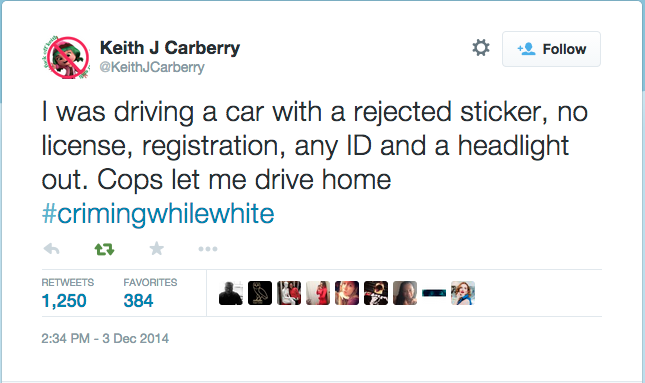
So yeah, white progress. I’m looking for a way to be proud to live in this country, and white progress might be the way I can do it.
Neil deGrasse Tyson at NJPAC
Last night I went to the New Jersey Performing Arts Center (NJPAC) with my 12-year-old son to see Neil deGrasse Tyson, whom we both love from the Cosmos series. I also loved this rant on women and blacks in science:
So here’s what he talked about last night, which was stimulating and interesting. I’m not covering absolutely everything, of course, and I am doing my best to summarize what he said:
- You can follow scientific progress by who gets to name things, because naming follows discovery.
- For example, looking at the history of the discovery of the periodic table, you learn a lot. Except for Sweden, which just had a lucky break with some weird cave.
- By this token, from 800 AD to around 1100 AD, mathematical and scientific advancements were happening in the Middle East (see for example the history of algebra and mathematician Muḥammad ibn Mūsā al-Khwārizmī, who invented the terms algebra and algorithm). Then some imam decided it was anti-religious to do anything like that, and progress – scientific and otherwise – stopped.
- Cultures that embrace science have more growth.
- In the U.S., about half of the people don’t acknowledge evolution, and that’s a bad sign for our future.
- In fact we are a hugely prolific scientific force, like Europe and Japan, but unlike them, our power is shrinking rather than expanding.
- We should go back to the 1960’s, at least in terms of the way we promoted and dreamed about scientific progress, and bottle up the energy and enthusiasm, and bring it back to today.
- Space flight is a great thing and we should reinvest in it as an inspiration for science in this country and in the world.
- We should stay curious, and investigate things we don’t understand, and talk to people about their beliefs even if we don’t agree. Childlike and insatiable curiosity and wonderment is the goal.
Educational feedback loops in China and the U.S.
Today I want to discuss a recent review in New York Review of Books, on a new book entitled Who’s Afraid of the Big Bad Dragon? Why China Has the Best (and Worst) Education System in the World by Yong Zhao (hat tip Alex). The review was written by Diane Ravitch, an outspoken critic of No Child Left Behind, Race To The Top, and the Common Core.
You should read the review, it’s well written and convincing, at least to me. I’ve been studying these issues and devoted a large chunk of my book to the feedback loops described as they’ve played out in this country. Here are the steps I see, which are largely reflected in Ravitch’s review:
- Politicians get outraged about a growing “achievement gap” (whereby richer or whiter students get better test scores than poorer or browner students) and/or a “lack of international competitiveness” (whereby students in countries like China get higher international standardized test scores than U.S. students).
- The current president decides to “get tough on education,” which translates into new technology and way more standardized tests.
- The underlying message is that teachers and students and possibly parents are lazy and need to be “held accountable” to improve test scores. The even deeper assumption is that test scores are the way to measure quality of learning.
- Once there’s lots of attention being given to test scores, lots of things start happening in response (the “feedback loop”).
- For example, widespread cheating by students and teachers and principals, especially when teachers and principals get paid based on test performance.
- Also, well-off students get more and better test prep, so the achievement gap gets wider.
- Even just the test scores themselves lead to segregation by class: parents who can afford it move to towns with “better schools,” measured by test scores.
- International competitiveness doesn’t improve. But we’ve actually never been highly ranked since we started measuring this.
What Zhao’s book adds to this is how much worse it all is in China. Especially the cheating. My favorite excerpt from the book:
Teachers guess possible [test] items, companies sell answers and wireless cheating devices to students, and students engage in all sorts of elaborate cheating. In 2013, a riot broke out because a group of students in Hubei Province were stopped from executing the cheating scheme their parents purchased to ease their college entrance exam.
Ravitch adds after that that ‘an angry mob of two thousand people smashed cars and chanted, “We want fairness. There is no fairness if you do not let us cheat.”’
To be sure, the stakes in China are way higher. Test scores are incredibly important and allow people to have certain careers. But according to Zhao, this selection process, which is quite old, has stifled creativity in the Chinese educational system (so, in other words, test scores are the wrong way to measure learning, in part because of the feedback loop). He blames the obsession with test scores on the fact that no Chinese native has received a Nobel Prize since 1949, for example: the winners of that selection process are not naturally creative.
Furthermore, Zhao claims, the Chinese educational system stifles individuality and forces conformity. It is an authoritarian tool.
In that light, I guess we should be proud that our international scores are lower than China’s; maybe it is evidence that we’re doing something right.
I know that, as a parent, I am sensitive to these issues. I want my kids to have discipline in some ways, but I don’t want them to learn to submit themselves to an arbitrary system for no good reason. I like the fact that they question why they should do things like go to bed on time, and exercise regularly, and keep their rooms cleanish, and I encourage their questions, even while I know I’m kind of ruining their chances at happily working in a giant corporation and being a conformist drone.
This parenting style of mine, which I believe is pretty widespread, seems reasonable to me because, at least in my experience, I’ve gotten further by being smart and clever than by being exactly what other people have wanted me to be. And I’m glad I live in a society that rewards quirkiness and individuality.
The re-emergence of debtors’ prisons
Yesterday at my weekly Occupy meeting we watched videos called To Prison For Poverty by Brave New Films (Part I and Part II) before discussing them. Take a look, they are well done:
It’s not the first time this issue has come up recently; the NPR investigations into court fees from last May, called Guilty and Charged, led to a bunch of reports on issues similar to this. Probably the closest is the one entitled Unpaid Court Fees Land The Poor In 21st Century Debtors’ Prisons.
A few comments:
- Ferguson is now famous for having a basically white police force patrolling a basically black populace. But it also has this fines-and-fees-and-jails problem: fines and fees associated to mostly traffic violations accounted for 21% of the city’s budget in 2013. And there were more arrest warrants than people in Ferguson last year, mostly for non-violent offenses.
- But the debtors’ prison problem isn’t just a racial issue. The people profiled in the above video were white, which could have been a documentarian’s decision, but in any case is a fact: the poverty-to-prison system is screwing all poor people, not just minorities. This is in spite of the fact that the Supreme Court found it unconstitutional in the landmark 1983 case, Bearden v. Georgia.
- This sense that “everyone is screwed” creates solidarity among poor whites and poor blacks, and especially young people. The Ferguson protests have been multi-racial, for example. And if you’ve read The New Jim Crow by Michelle Alexander, you’ll recognize a historical pattern whereby political change happens when poor whites and poor blacks start working together.
- One interesting and scary question to emerge from the above stories is, how did so many fees and fines get attached to low-level misdemeanors in the first place? It seems like privatized probation and prison companies have a lot to do with it.
- In some cases, they are putting people in jail for days and weeks, which costs the government hundreds of dollars, in order to capture a small fee. That makes no sense.
- In other cases, the fees accumulate so fast that the poor person who committed the misdemeanor ends up being responsible for an outrageous amount of money, far surpassing the scale of the original misdeed, and all because they are poor. That also makes no sense.
- It’s not just for prisons either; all sorts of functions that we consider governmental functions have been privatized, like health and human services: child welfare services, homeless services, half-way houses, and more.
- In the worst cases, the original intent of the agency (“putting people on probation so they don’t have to be in jail”) has been perverted into an entirely different beast (“putting them in jail because they can’t pay their daily $35 probation fees”). The question we’d like to investigate further is, how did that happen and why?
How to ignore your family on Thanksgiving
There has been lots of advice lately on how to have a civil conversation at Thanksgiving – NPR ran a piece yesterday on “topics both Democrats and Republicans enjoy”, for example, which made me slightly annoyed and amused – perhaps because I am neither – and inspired this somewhat alternative list of ways to enjoy or otherwise ignore your family today.
- Football, obviously. Few people actually know the rules of this game, never mind the names of the various positions of the players on the field. I personally have been watching football for more than 20 years and I still really don’t know what a tackle or a tight end is, nor exactly how to recognize a blitz. No matter, that’s not the point. The point is to choose a team and root for them blindly. Ignore the long-term brain damage.
- If you don’t like football, may I suggest An Idiot Abroad, a ridiculous travel show from Britain created by Ricky Gervais. It’s embarrassing and awkward, obv, so relative to those situations dinner with your family will seem seamless and well-meaning. I say this even though The Office, also developed by Ricky Gervais, was on NPR’s list. Also, having a The Office marathon is really not a bad idea either.
- Drinking. Adults can go for beer and spiked eggnog, but kids can get totally spaced out with just the normal eggnog. I’ve seen it before, it has a crazy high, especially if you add nutmeg. Buy tons.
- The above suggestions should keep you busy up to and including the beginning of dinner. Be sure you don’t actually talk before dinner, because then you’d run out of things to say during the eating part.
- For the actual dinner conversation, may I suggest keeping things light. For example, I plan to provoke a fun-loving conversation on who thinks the Ferguson grand jury’s lack of indictment serves justice and who thinks it exposes a broken system. It comes down to who trusts the system and who the system works for.
- If that seems awkward, move on to white privilege in general. If there’s a denier at the table, throw out some data: black teenagers are 21 times more likely to be killed by a cop than white teenagers, for example, or if that seems hyperbolic, move on to the social mobility matrices for blacks versus whites in Figures 8 and 9 of the appendix of this paper. Nice and aggregate. I plan to use a projector.
- Hahaha, just kidding! We don’t want to scare the kids. Instead, we’ll stick to the usual, where we enormously overconsume and simultaneously discuss upcoming diet plans, and/or vivaciously and competitively plan our impending holiday shopping whilst worrying about money.
- For a nice surprise, sign up your whole family for spots on the bus to participate in a Black Friday Walmart protest tomorrow morning in North Bergen, New Jersey. Bus leaves at 8am. Come one, come all!
Is tourism in Haiti inherently exploitative?
I recently returned from Haiti, where I was a tourist traveling around the country for 6 days with my friends Jamie and Becky. As I spent time there, I felt increasingly aware of the difficult if not miserable spot that the country as a whole finds itself in, even though there are of course wonderful and incredibly beautiful and creative things happening too: art is everywhere.
Everyone knows about the 2010 earthquake which devastated the capital Port Au Prince – which was indeed terrible and its ramifications are still being felt – that natural disaster is really only one more thing for the Haitians to deal with, on top of a long and excruciating history of manmade, political and human disasters.
I read the book Mountains Beyond Mountains while I was traveling, upon the recommendation of a bunch of my friends. It’s putatively the story of a white doctor from Boston, Paul Farmer, who is trying his best to enlist a growing group of doctors and philanthropists to help the deeply impoverished town of Cange in Haiti achieve state-of-the-art healthcare. It’s an impressive book, and beautifully written, and doesn’t shy away from frank discussions of how the United States has meddled with and manipulated the politics of Haiti to its own advantage. You should all read it.
One of the most memorable scenes from the book, at least for me, is when the writer discusses the juxtaposition of spending one day in Cange in Haiti and then flying directly to New York, or maybe Paris, but in any case a glamorous, rich, first-world city, and how it seems like two bizarrely separate worlds. Farmer says that no, in fact, it’s exactly what you’d expect – that there’s a direct line between the poverty of Haiti and the richness of New York. New York is rich in part because Haiti is poor, and we New Yorkers depend, even if invisibly, on exploitation of places like Haiti to stay rich. When you concentrate wealth in one place, you are concentrating poverty as well.
That brings me to my question today. Is it inherently exploitative to be a tourist in Haiti?
Reasons it is:
- First and foremost, as Americans we can choose to visit Haiti, and then return after 6 days. Haitians cannot choose to visit us for 6 days, even if they had the money to do it. And again, that discrepancy is directly due to U.S. foreign policy.
- American tourists like myself are impossibly rich and powerful compared to the people we interact with in Haiti. That creates a weird and deep distance between people. It means that everyone on the street is aware of me and nobody fucks with me because the consequences for them would be dire. That’s what power looks like. As a result, t may be impossible to actually have a normal human relationship with a native Haitian.
- As a white person, you pay something like 10 times the normal costs of anything, which is both strange and totally understandable, but in any case it means that you are seen as a piggy bank by anyone with a service or a good to sell, which is pretty much almost anyone you meet.
- There aren’t very many tourists in Haiti. All the white people we met there were there on religious or charitable missions, or worked for the UN, or were trying to set up businesses along the lines of Etsy for Haitian folk art, or are themselves art collectors. That adds to the uncomfortable sense of dependency you feel as a tourist.
- When you are at a hotel, you are being served by Haitians. It’s impossible not to see the historical racial symbolism of this, given that Haitians were brought from West Africa as slaves to the French, and not to mention the more recent history which has made American influence so undermining.
- There’s a reverse sex tourism industry in Haiti, which is to say that middle-aged white women are known to go to Haiti as well as the Dominican Republic to pay for sex with young men. That fact further clouds the possibility, at least for me, of even having a single conversation in which the goal is non-transactional. How do you know if your joke is actually funny? Or if the cultural exchange you are happily engaged in is truly reciprocal? How could it be?
- Conclusion: it is in fact inherently exploitative to be a tourist in Haiti, and it’s not something you can choose not to participate in.
On the other hand, here are a few reasons I’d argue against my own conclusion:
- First and foremost, you are what you are as an American, even if you’re not in Haiti. You are just more aware of what that means to Haitians when you are in Haiti. In other words, if the decadence of ample food, and wifi, and excellent health care is in part due to the impoverished state of Haiti, maybe it’s good you are made aware of that.
- Haitians desperately need money, and tourists have money. If lots of tourists went to Haiti, it might be better for Haiti than a bunch of money coming in the form of aid.
- My friend Becky came with us to Haiti, and she stayed a few extra days and connected with a Haitian biologist and nerded out completely in a national park (she’s a huge biology nerd and nature photographer). It seems to me that, if it is possible to cross the human divide, and get out of a transactional conversation and into another place, it might happen in the context of a scientific discussion.
- I’m not a biology nerd, but I love music. I felt like the closest I came to normal human interaction was through discussing and enjoying live music.
- It’s really fun to travel, even if you learn sad things. You become more aware and more grateful, and you bring that back to your community and your family. There’s something to be said for simple cultural awareness. Plus, now I really care about Haiti, which maybe is irrelevant, but may someday become relevant, who knows.
I’d love to hear your thoughts.
Update. A comment from Jamie:
Fundamentally, I do and always have agreed to your point of exploitation. I knew we would be weird voyeurs going in to the trip, and as we discussed on the last day, Cathy, we were both acutely aware of how it would look if we started taking pictures of Haitians and the streets from inside of our fancy 4-by-4. It’s a complicated dynamic. And I think you’re right that it is nearly impossible to have a normal, balanced relationship there; I felt similarly while traveling around West Africa. It’s like we have a bank account and a green card attached to our foreheads, and it can be difficult to trust that someone is seeing us beyond that. Even if they have no ulterior motives other than being our friend, that trust is hard to grasp and hang on to.All of that said, however, I do believe that it is incredibly important to spend time in countries and cultures that are different from our own. And I believe even more fervently that we should visit those countries with a mind to experience and enjoy rather than “save” it through mission-based organizations. That’s not to say that all aid is bad aid (on the contrary, many aid orgs and NGOs are very, very important!), but I do push back against the notion that one should always attach a mission to a visit. I’ve found that going somewhere as a volunteer or aid worker puts an even bigger wall between cultures (“I am here to help you because I have the means to help you and it is clear you can’t help yourself”). I strongly believe that just sitting, listening, and learning without the motive to “save” is one of the only ways of conducting a fair and balanced cultural exchange. I want to listen first, not fix first. Once I listen, and begin to understand (as if I ever could…), only then do I feel comfortable enough to think about working in/for a country.Additionally, on the notion of choosing to vacation in a non-traditional spot that is so clearly economically and politically struggling, is it better to only travel to first world, highly developed countries and ignore that others exist? Should we blindly trust the media (and all of our friends, relatives, etc) that constantly tells us that a country is “bad” and avoid them? How will we change the discourse surrounding cultural and economic imbalances without having any first-hand experience? Are we perpetuating a notion that we are “too good” to visit a country that is struggling to stand on solid ground?It’s all a complicated notion. And on a specific note, I’d love to open the floor a little on your #5 exploitative point (“When you are at a hotel, you are being served by Haitians. It’s impossible not to see the historical racial symbolism of this, given that Haitians were brought from West Africa as slaves to the French, and not to mention the more recent history which has made American influence so undermining.”). True. I think it’s important that we are aware of that dynamic. On the other hand, what would it look like if we were being served by ex-pats? Would we not be rebelling that we are not supporting Haitians and the native economy? That the ex-pats are just making a place for other ex-pats to work and remove all Haitians from the operation? Tricky. I’m interested in hearing both of your thoughts on that.
P-values and power in statistical tests
Today I’m going to do my best to explain Andrew Gelman’s recent intriguing post on his blog for the sake of non-statisticians including myself (hat tip Catalina Bertani). If you are a statistician, and especially if you are Andrew Gelman, please do correct me if I get anything wrong.
Here’s his post, which more or less consists of one picture:

I decided to explain this to my friend Catalina, because she asked me to, in terms she could understand as a student of midwifery. So I invented a totally fake set-up involving breast-fed versus bottle-fed babies.
Full disclosure: I have three kids who were both breast fed and bottle fed for various lengths of time and, although I was once pretty opinionated about the whole thing, I could care less at this point and I don’t think the data is in either (check this out as an example). So I’m not actually trying to make any political point.
Anyhoo, just to make things super concrete, I want to imagine there’s a small difference in weight, say at 5 years of age, between bottle fed and breast fed children. The actual effect is like 1.7 pounds at 5 years. Let’s assume that, which is why we see a blue line in the graph above at 1.7 with the word “assumed” next to it. You can decide who weighs more and if that’s a good thing or not depending on your politics.
OK, so that’s the underlying “truth” in the situation, but the point is, we don’t actually know it. We can only devise tests to estimate it, and this is where the graph comes in. The graph is showing us the distribution of our estimates of this effect if we have a crappy test.
So, imagine we have a crappy test – something like, we ask all our neighbors who have had kids recently how they fed their kids and how much those kids weighed at 5 years, and then we averaged the two groups. That test would be crappy because we probably don’t have very many kids overall, and the 5-year check-ups aren’t always exactly at 5 years, and the scales might have been wrong, or clothes might have been confusing the scale, and people might not have reported it correctly, or whatever. A crappy test.
Even so, we’d get some answer, and the graph above tells us that, if our tests are at a certain level of crappiness, which we will go into in a second, then very likely our estimate of the difference will come in between something like -22 pounds and +24 pounds. And the “most likely” answer would be the correct one, sure, but that doesn’t mean it’s all that likely to even come close – say within 2 pounds – of the “true effect”. In fact, if you make a band of width 4 centered around the “true effect” level, you’d definitely capture a smallish percentage of the total area under the curve. In fact, it looks like a good 45% of the area under the curve is in negative territory, so the chances are really very good that the test estimate, at this level of crappiness, would give you the wrong sign. That’s a terrible test!
Let’s be a bit more precise now about what we mean by “crappy.” The crappiness of our test is measured by its power, which is defined as “the probability that it correctly rejects the null hypothesis – i.e. the hypothesis that the “true effect” is zero – when it is false.” In other words, power quantifies how well the test can distinguish between the blue line above and the line at zero. So if the bell curve were really really concentrated at the blue line, then more of the total area under the curve would be on the positive side of zero, and we’d have a much better test. Alternatively, if the true effect were much stronger, say at 25 instead of 1.7, then even with a test this imprecise, the power would be much much higher because the bulk of the bell curve would be to the right of zero.
On the one hand, power estimates are done by researchers, and they are attempting to achieve a power of at least 0.80, or 80%, so the above power of 0.06 is indeed extremely low and our test is indeed very crappy by researching standards. But on the other hand, since researchers are expected to estimate their power to be at least 0.80, there’s probably fudging going on and we might be trusting tests to be less crappy than they actually are. Also, I am no expert on how to accurately estimate the power of a test, but there’s an example here, and in general it depends on your sample size (how many kids) and the actual effect size, as we have already discussed. In general it requires way more data to produce evidence of a small effect.
OK so now we have some general sense of what “crappiness” means. But what about the red parts?
Those are the “statistically significant” parts of the distribution. If we did our neighborhood kids test and we found an effect of 20 or -20, we’d be totally convinced, even though our test was crap. There are two take-aways from this. First, that “statistically significant” in the presence of a small actual effect and a crappy test means that we are wildly overestimating the effect. Second, that the red part on the left is about a third of the size of the red part on the right, which is to say that when we get a result that seems “statistically significant,” in the presence of a crappy test, it still has a one in four chance of being totally wrong.
In other words, when we have crappy tests, we just shouldn’t be talking about statistical significance at all. But of course, nobody can publish their results without statistical significance, so there’s that.
Aunt Pythia’s advice
Greetings, friends! I’ve missed you all!
Since returning from her travels, Aunt Pythia has been continuously marveling in the wonders of flannel and wool, and has decided to knit up something along these Celtic lines:

Is that not gorgeous? I love the tangled-upedness of the center. And, of course, the doubly rainbow-ic aspects.
Here’s the thing, though: the pattern comes from the excellent book Celtic Charted Designs that Aunt Pythia is absolutely sure she has somewhere in her house, but can’t find. in fact she’s spent the good part of the morning searching her house. So if the column is a wee bit short and/or frustrated today, you’ll know why.
On to business! Aunt Pythia has lots of questions to answer, given that she was away last week, and she’s eager to get through some. But before she forgets,
please think of something Celtic
to ask Aunt Pythia at the bottom of the page!
By the way, if you don’t know what the hell Aunt Pythia is talking about, go here for past advice columns and here for an explanation of the name Pythia.
——
Dear Aunt Pythia,
What are your thoughts on this 401k article?
Another Potential Pass At Legalizing Longterm Investments Not Going (well)
Dear APPALLING,
Wow, your sign off is longer than the body of you letter. Well done. OK so let me quote the heart of the problem fingered in the article:
Millions of people are clearly not using 401(k) plans as retirement accounts at all, and it’s a threat to their financial health.
I’d phrase it differently, namely:
In this day and age, working people need all their money, and 401(k) plans have proven to be saving strategies which are only realistic for well-off people, which entirely misses the point of how to deal with the older middle class in our country. Instead of relying on such wishful thinking, we should scrap the whole system, which by the way only serves to expand Wall Street’s power and give tax breaks to the rich, and we should instead expand Social Security.
Love,
Aunt Pythia
——
My Dearest Aunt Pythia,
In mid-90’s I completed class work on an MA in Applied Economics/Econometrics at a state school in California. Stupidly did not complete thesis (things got busy on political campaigns and such, and never got back to it). Like many I fell in love with economics, public policy, and their interrelations.
Now, many years later, my econometric/data/statistical modeling skills have aged with me and have become lost from my mind.
My first question is: What would you recommend as a refresher of data skills? I’m certain I don’t need to redo all I’ve done before- the skills are there but need to be refreshed and awakened (I assume/hope).
My second question is: Assuming the skills can be reawakened, what is my fastest and least costly method to enter data work? For programming many people create apps or small programs to be able to show code samples to prospective employers. Is there something analogous in data work? Should I build a model of aggregate demand changes from quantitative easing/M2 changes and shrinking consumer credit (from institutional rule changes) and post it online to show skills? I’ve also been looking at the data science certificate from Coursera/Johns Hopkins, but don’t know that it would matter on a resume. My old university requires restart for the old M.S. (which I understand), so should I pursue a new M.S. in current state school (UMUC has a Masters Data Analytics, which I think I would enjoy anyway, but is pretty pricy).
Anyway, hoping you, my dear Aunt, will have some advice for a data enthusiast with dusty data skills to freshen skills and move into analysis. Oh, I should mention that I am taking a lot of computer programming classes lately to get skills in that area as well.
Dusty Skills
Dear Dusty Skills,
Please don’t take this the wrong way, but the very first thing you need to do when applying for any data job is to use a spell-checker. I must have corrected 5 words in your letter.
Next, although I agree that a Coursera certificate might not be considered all that important, the skills you hopefully acquire with such a certificate would be. And yes, I do suggest you build something with your skills, although tackling QE seems both onerous and unlikely. I’d do something less abstract if I were you, and set up a website portfolio so everyone can see your mad skillz. Oh, and you might want to take a look at my book, Doing Data Science, although you might be past that stuff already.
Good luck!
Aunt Pythia
——
Aunt Pythia,
I’m a father whose daughter is applying to colleges. I also work at a college, as does my wife. And like many employees in academia, I’ve been following with horror the reports of college rape: the under-reporting, the Judicial review boards, the administrators eager to downplay the problem, etc.
As a father the horror easily spills over into terror. I want my daughter to grow into the challenges of living away from home; I want her to learn in a enlightening, and encouraging environment; and I want her to have fun. I also want her to be safe.
I am outraged at the clueless administration officials and public safety officers who say “girls should not go to parties, or drink,” all the while wanting to scream at my daughter “don’t go to parties or drink.”
How can I have a meaningful conversation about going off to college, learning, having fun, but be safe, without sounding like *those* administrators?
Worried In Academia
——
Dear Worried,
I went to college in the early 1990’s at UC Berkeley. My first year there was the scene of multiple Gulf War protests, and about 3 or 4 street riots, streaming by my dorm near Telegraph Ave, during which me and my two roommates didn’t dare leave our room. In my sophomore year we heard the Rodney King verdict and it was chaos in the streets for a few days.
I guess what I’m saying is that, due to the obviously volatile and threatening mood of the campus and neighboring towns back then, I was always on alert, and defensive. All of my friends took self-defense classes, and I carried around pepper spray, in my right hand, and my keys in my left, whenever I walked home at night. I biked places so I could get away more quickly. It was my assumption that I would need to protect myself and that there were people who would hurt me if I didn’t. I’m not saying there weren’t people who drank too much and got themselves vulnerable – in fact while I was there, there were multiple burning deaths in fraternities that did crazy things with couches – but that I personally would never have been involved with such stuff. For that matter there was a lot of campus rapes, which we knew about, and the police knew about, and kept us going to our self-defense classes.
Nowadays, we have a very different notion, and also a different reality, which is mostly a good thing, but has weird consequences. One of them is a sense that colleges are safe places, which they most certainly are not. College administrations have come a long way on marketing their campuses as attractive and safe, but it’s just a marketing thing, and it sends confusing and deeply mixed messages to parents and kids, which pisses me off. At the end of the day, when you go to college, you are an adult, and you need to be responsible for your safety, which means not getting out of hand, and keeping trustworthy friends close to you to make sure you don’t, and to make sure they don’t.
So, and I know this is a tough issue, but my advice is to tell your daughter to learn to size up the energy of a party, and see if dangerous things are happening, and to have a group of friends at all times that are looking out for you, and who you are looking out for, and to take self-defense classes, and to carry mace or at least a siren for when you travel alone at night.
Also, and this is actually the most important piece of advice: get your daughter to drink with you a few times, before she goes to college, so she’ll know what it feels like to have too much. The most educational night of my life was a night in the summer before college, when my dad got me and my friend Becky puking drunk. I never let that happen again, because I knew when I’d had too much. I think far too many kids get to college never having been allowed to go overboard with drinking, so they do it for the first time with strangers. Bad idea!
One last thing. I think that in the next couple of decades, the police will learn how to adequately and sensitively deal with rapes, and when that happens we won’t need to worry as much about campus police forces, which are totally inadequate and rife with conflicts of interest. But obviously you don’t have two decades to wait for that to happen, since your daughters are going to college now. Plus, I may be just being unrealistic about the progress we could make.
I hope that helps!
Aunt Pythia
——
Dear Aunt Pythia,
I keep hearing about how rampant sexism is in STEM fields, particularly in tech workplaces, where I can see myself heading toward after college. It’s really discouraging, especially since I think I experience some sort of sexism in my classes here in college (in computer science way more than in math), and even worse, I can’t seem to speak up because this kind of sexism is really subtle (i.e. a guy got angry with me for his incompetence with a certain technology. I would’ve spoke up but the assignment was worth so little.)
These hurtful incidences just build up over time, and whenever I vent to my friends, some “brush it off” as it not being serious. My parents told me that what I experience here in college won’t be any different in the workplace.
So as I search for summer internships, I carry this cloud of insecurity and doubt. Should I go forward? What’s the point? Breaking gender barriers sounds great, but my God, there are so many women out there who choose to leave because the barrier is so high and strong. I can easily see myself leaving the tech industry because its stubborn lack of support toward women and its more harmful PR farces showing that they do “support women.” Is it ever worth it? How do I reconcile with this?
Unsure of the future
Dear Unsure,
My motto is, celebrate the victories and ignore the defeats. Where by “victories” we mean “getting a computer program to work” and by “defeats” we mean “some insecure guy took out his frustration on me because I’ve got boobs.”
In other words, don’t think about yourself or your actions as A Woman In STEM. Instead, think about what your personal goals are, and what interests you, and what you’d like to learn about or accomplish. Make it an internal conversation about your wants and needs and passions, rather than an external conversation about how you look to other people. And if your internal voice is telling you to leave STEM, then by all means do it, but if not, don’t let those fuckers get you down. Do it because it’s cool and you love it, not because some assholes do or do not have an agenda for you or an ego riding on what and how you do things. Separate the two issues and it will help, because math and computer science are really cool.
And because it’s not always possible to totally ignore the defeats, I’d also encourage you to find better friends who will let you vent and will vent along with you. What’s up with them?!
Good luck, for reals! Keep me posted!
Aunt Pythia
——
Please submit your well-specified, fun-loving, cleverly-abbreviated question to Aunt Pythia!
Click here for a form.
Guest Post: What does it mean to “create jobs”?
This is a guest post by FogOfWar.
The phrase is used constantly by politicians and economists, but what does it actually mean to “create jobs”?
Here’s an example: I open a coffee shop and hire two people. So I’ve created three jobs (counting myself), right? Really? Let’s assume for the moment that I’m no more or less efficient at making and distributing coffee than my competitors and also that the total amount of coffee required in the world is constant. Then my coffee shop must be taking customers away from another coffee shop, and at a frictionless level, there are three coffee jobs lost for the three coffee jobs I just created.
Yet no politician, and indeed no economist quoted on TV or newspaper, will go into the distinction between gross job creation (3) and net job creation (0). For politicians this makes sense because they want the appearance of good results to be reelected (and often nothing more than that). For economists, or at least economists dealing with journalists, it may well be that it just gets too fuzzy to make a simple point, and a story without a simple and strong hook is killed by your editor.
Another point: I can think of a specific example of something that really did “destroy jobs”–it’s the invention of the EZ Pass. When I was growing up (yes, I’m ancient), there were dozens of people working at each of the toll collection booths on the highways, each counting out miserable hours collecting change from surly passengers and inhaling vast amounts of carbon monoxide. Now there are a handful at each on ramp and a row of EZ-Pass computers.
There’s no question in my mind that EZ-Pass destroyed jobs, but this seems like a good thing rather than a bad thing. Should we strive to keep really crappy jobs that are obsolete by technology just so that people have something awful to do with themselves all day, instead of doing something equally unproductive like watching TV all day, or maybe even spending time with their families and community? I think this is a variation of the “broken window fallacy” if I remember my intro economics correctly.
Lastly, I’ve assumed a closed system, but let’s relax that assumption. Here are two things that definitively will create jobs: (1) start manufacturing cell phones in the US; and (2) have 20% of the US consumers buy American when they have a choice. Both of these actions will move actual jobs from overseas to the US and thus will “create [US] jobs” in a very real sense of the word.
One other thing that must be true: I’m not the first person to think of this and suspect there are people who have dedicated more serious time and attention to the question than my casual observations. Thoughts?
I am old in Haiti
I am old in Haiti. This fact dawns on me slowly over the six days I am there, because there is so much to take in. Mostly I figure it out because I am constantly amazed by how beautiful and healthy everyone looks. But then again, I keep finding myself thinking, people who are 24 often look healthy and beautiful. It’s when you’re 54 that you begin to show signs of wear and tear. I will reserve judgment until I see older folks.
But then, after a while, I realize how few people I’ve seen that are 54, or even 44, or even 39. Almost nobody, in fact. Every now and then a very old person will cross the street slowly, hobbling with a stick for support. On my 6th day there I tried to figure out exactly how old such people were. Maybe not much older than me, in fact.
The statistics, which I don’t look at until afterwards, back up my observation. A third of the population is below the age of 15, half of the population is below the age of 20, and 70 percent of the population is below the age of 30. Probably the places I went, the cities, skew even younger. It looks like about 25% of the women of childbearing age are pregnant, and all of the women are of childrearing age. The population has tripled in Haiti since 1950 and it isn’t slowing down. If anything it’s bumping up because of the devastating 2010 earthquake – women tend to replace their lost babies by even more babies after such events.
This matters because the Haitian land is overpopulated. In fact it’s worse than that: the land suffers from a severe erosion of its topsoil, due to deforestation over the years. In part – get this – Haiti was deforested to repay the debt to France for letting them be free back in the early 1800’s after the (world’s only successful) slave revolt. But it’s continued since then, and when you chop down all your trees, the rains take away your topsoil, which means your land slowly becomes desert. For the most part that’s what it looks like when you drive through. The result is not very much agriculture, and when you combine that with a fast-growing population, you get an horribly unsustainable situation.
In spite of all these problems, and in part because of them, the Haitians I came across seem incredibly nice to me and to each other. Trucks, people, motorcycles, cars, and 4-by-4’s compete for space in the one-lane roads in Port Au Prince but everyone stops dead when a young child needs to cross the street. It is a society that cherishes safety and looking out for one another.
When the water and soda sellers come to our public bus window to offer us drinks, and someone wants a cake instead, or to buy minutes for their cell phone, there’s a scramble by the nearby vendors to find the cake seller or the roaming Digicelwoman. The sellers at each stop form a collective that look out for each other, because if they didn’t look out for each other they’d all be screwed.
The same is true for with any resource. A UN worker we met explained that microfinance researchers are frustrated by Haitians when they try to estimate the impact of their loans, because they keep finding that a family has borrowed money and given it to another family. But if they didn’t share resources locally, all the families in a given neighborhood would be risking too much. It is better to be known as a generous person so that in a time of scarcity people will be generous to you. Your reputation is your most valuable asset.
When I think about how we live here in New York – where I don’t know most of my neighbors’ names, and nobody can see what happens behind closed doors, and we hoard resources except in our most immediate family – I feel like we’re missing out on something valuable. At the same time, privacy is nice, and I don’t think most Haitians have much of that. Not to mention a healthy middle age.
What the fucking shit, Barbie?
I’m back from Haiti! It was amazing and awesome, and please stand by for more about that, with cultural observations and possibly a slide show if you’re all well behaved.
Today, thanks to my math camp buddy Lenore Cowen, I am going to share with you an amazing blog post by Pamela Ribon. Her post is called Barbie Fucks It Up Again and it describes a Barbie book entitled Barbie: I Can Be a Computer Engineer

The other book is called “I Can Be an Actress”
Just to give you an idea of the plot, Barbie’s sister finds Barbie engaged on a project on her computer, and after asking her about it, Barbie responds:
“I’m only creating the design ideas,” Barbie says, laughing. “I’ll need Steven and Brian’s help to turn it into a real game!”
What the fucking shit, Barbie?


