Archive
The market for your personal data is maturing
As everyone knows, nobody reads their user agreements when they sign up for apps or services. Even if they did, it wouldn’t matter, because most of them stipulate that they can change at any moment. That moment has come.
You might not be concerned, but I’d like to point out that there’s a reason you’re not. Namely, you haven’t actually seen what this enormous loss of privacy translates into yet.
You see, there’s also a built in lag where we’ve given up our data, and are happily using the corresponding services, but we haven’t yet seen evidence that our data was actually worth something. The lag represents the time it takes for the market in personal data to mature. It also represents the patience that Silicon Valley venture capitalists have or do not have between the time of user acquisition and profit. The less patience they have, the sooner they want to exploit the user data.
The latest news (hat tip Gary Marcus) gives us reason to think that V.C. patience is running dry, and the corresponding market in personal data is maturing. Turns out that EBay and PayPal recently changed their user agreements so that, if you’re a user of either of those services, you will receive marketing calls using any phone number you’ve provided them or that they have “have otherwise obtained.” There is no possibility to opt out, except perhaps to abandon the services. Oh, and they might also call you for surveys or debt collections. Oh, and they claim their intention is to “benefit our relationship.”
Presumably this means they might have bought your phone number from a data warehouse giant like Acxiom, if you didn’t feel like sharing it. Presumably this also means that they will use your shopping history to target the phone calls to be maximally “tailored” for you.
I’m mentally tacking this new fact on the same board as I already have the Verizon/AOL merger, which is all about AOL targeting people with ads based on Verizon’s GPS data, and the recent broohaha over RadioShack’s attempt to sell its user data at auction in order to pay off creditors. That didn’t go through, but it’s still a sign that the personal data market is ripening, and in particular that such datasets are becoming assets as important as land or warehouses.
Given how much venture capitalists like to brag about their return, I think we have reason to worry about the coming wave of “innovative” uses of our personal data. Telemarketing is the tip of the iceberg.
Fingers crossed – book coming out next May
As it turns out, it takes a while to write a book, and then another few months to publish it.
I’m very excited today to tentatively announce that my book, which is tentatively entitled Weapons of Math Destruction: How Big Data Increases Inequality and Threatens Democracy, will be published in May 2016, in time to appear on summer reading lists and well before the election.
Fuck yeah! I’m so excited.
p.s. Fight for 15 is happening now.
Review: The New Prophets of Capital
Last night I finished reading Nicole Aschoff’s new book, The New Prophets of Capital, which was published as part of the Jacobin series of books. Here’s a description from their website of their book series:
The Jacobin series features short interrogations of politics, economics, and culture from a socialist perspective, as an avenue to radical political practice. The books offer critical analysis and engagement with the history and ideas of the Left in an accessible format.
And by the way, if you don’t know what Jacobin magazine is, you should take a look. I recently signed up to receive the paper versions of all of their magazines and books, which was my version of a donation to a good and very thoughtful cause.
Aschoff’s book explores the storytelling nature of modern capitalism and neoliberalism, and focuses on the underlying assumptions, as seen through four larger-than-life figures: Sheryl Sandberg, Whole Foods founder John Mackey, Oprah, and Bill (and Melinda) Gates.
She does a good job of explaining, in plain, non-academic English, what’s wrong with these people’s messages. If you’re wondering what exactly bothers you about the Lean In movement, for example, take a look at the chapter on Sandberg, the book is worth it just for that.
The book is short, only 6 chapters. The first chapter gives reasoning for the book, describing how storytelling matters when we think about how culture works, and then the heart of the book follows with a chapter on each person listed above – the “prophets” – with their particular flavor. There’s also a concluding chapter, which is the least convincing, as it was extremely condensed and left too much reasoning unexplained.
The unifying theme throughout the four chapters devoted to the prophets is how these four people manage to be both public critics and private protectors of the current economic system, with an emphasis on protection.
So when Sandberg tells us to lean in, she’s telling us to conform to the way things are, not to threaten it in any way. When Oprah tells us that we have it in ourselves to live fantabulous lives, she’s giving us personal responsibility to be happy and fulfilled, and structural inequality is not acknowledged or recognized. When John Mackey or Bill Gates sees a problem, they set up a “free market solution” to that problem, even though, by definition, poor people don’t have money to pay for what they need.
While none of the book’s material was entirely new to me, it was interesting to see the connections deliberately made between the prevalent high-level business mindset and the individual choices we make for ourselves based on how we imagine the world works. If I really believed the Sandberg line, I’d still be working at a hedge fund, doing my best to please my colleagues and ignore my kids. If I had bought into Oprah’s context-free attitude, I’d blame people for their poverty and think it amounts to bad decision making.
The book isn’t entirely consistent. It maintains both that Bill Gates believes entirely in a free market and that he undemocratically influences education reform in this country with his money. Maybe those are consistent claims but it’s not obvious to me (although I agree with the undemocratic nature of his mega-philanthropy).
It’s a good book. I’d like a bunch of people to read it so we can have a discussion group. I also get the impression that Aschoff could write one of these a year, and I plan to follow her work.
Songs about mothers
I have a soft spot for sensitive singer songwriting men talking about their mothers, even when it’s a fraught relationship. After all, I’ve got three sons, and it’s nice to imagine they won’t forget about me once they leave. And hey, I’d rather have hate than nothing!
This morning I’m all about that. I started out with Sufjan Stevens (who has a new album coming out, by all accounts his best) singing For the Widows in Paradise, For the Fatherless in Ypsilanti:
Next I moved on to another incredibly emo heartfelt band called Iron and Wine, one of my favorites when I’m in this pineful mood. Here they are singing Upward Over the Mountain, a song I credit with the internal efforts I’ve made (so far) to let my sons someday leave me:
Next, now that I’m thoroughly in the mood, I’ll just go ahead and – brace myself and – listen to John Lennon’s Mother:
And to top that off, I’ll finish with something hopeful, Conor Obersts You Are Your Mother’s Child:
I felt warm and relaxed
When I was a kid, being the child of nerd atheists, I spent more time watching Star Trek, Animal House, and Monty Python than in church.
Scratch that, I spent no time at all in church, and quite a bit of time at sci-fi conventions, where my father was a sci-fi book dealer. In fact it was a yearly ritual to carry a bunch of boxes of books to the car to tote them to Boskone, where we’d have a table in the big book room.
Sometimes I’d be in charge of selling, at least once I was old enough to make change. When I wasn’t on duty I’d wander around the room and wish I had enough money to buy sparkly purple crystals from weird women wearing scarves.
Sometimes I’d even read the books, out of boredom. They weren’t my thing, and I didn’t know why back then, but now I think I do.
Most of the time, the set-up seemed along these lines: some extremely macho guy, misunderstood and brilliant, gets into some kind of jam and uses his brilliant mind to find his way out of it. On the way he meets stupid men and even stupider – but gorgeous – women, who trick and finagle him, distracting him from his high-minded goals. Every now and then he’d get back at the women by fucking them. And yes, I’m thinking about Heinlein here, which my dad absolutely worships. Probably Larry Niven isn’t quite as bad.
In other words, it was mostly an adolescent male fantasy, with a side order of scientifically flavored situational crisis. Too much getting laid and proving yourself to other men, too little science. Waaay too little science.
Fast forward about 30 years, and I’m married to a man who reads sci-fi for fun (don’t tell him I said this, he denies being a fan). But progress has been made, because he can laugh at the ridiculous posturing.
About 10 years ago, in fact, he laughed out loud at a particularly ridiculous line from Heinlein’s “Puppet Masters.” I will show it to you so you can appreciate how much this explains to me about my childhood:
I felt warm and relaxed, as if I had just killed a man or had a woman.
I mean, for fuck’s sake. Oh, and if you want more context, please go ahead and read this excerpt, which taken as a whole is even worse than I remember. Oh, and here’s the cover:

Also, here’s another thing that I now (finally!) understand. Namely, when a boy reads this stuff, he actually might identify with it. I know this because my husband admitted this to me, and although I was momentarily stunned, it makes sense when you think about it.
Whereas, when I read it, I naturally concluded that it wasn’t about me at all, that it was in fact alien to me. If I wanted to force myself into that universe, where the women were so vile and dumb, then I’d have to decide between:
- not admitting I’m female, or
- admitting it, but trying to prove that, unlike those bimbos who couldn’t even fix a broken warp drive, I would be different. I’d have deep thoughts too, just like men.
Either of these attitudes, both of which I tried on at different times, were and are fucked up. I shouldn’t be surprised then that sci-fi never held sustained interest for me.
Anyway, it’s all good, because in our house nowadays, when we want to be funny, one of us mentions that they feel “warm and relaxed,” and then the other says, “holy crap, did you just kill a man??”
Earth’s aphelion and perihelion
Sometimes the stuff I think about gets me down. I mean, jeez, I think about cynical stuff all the time, and I need to rest my brain sometimes.
When that happens, I sometimes fantasize about really long-term things that happen in the solar system or even the universe. It gives me perspective.
One of my favorite videos to watch at these moments is this one, which always blows my mind. The take-away: nothing is permanent unless there is actually a physical law forcing it to be. Here it is:
p.s. I vote for “tropical year” because I love analemmas.
p.p.s. Looking forward to Vega being the pole star once again.
p.p.p.s. This came up because my husband and I got into a conversation about earth’s aphelion and perihelion and we were wondering if it’s just by chance that perihelion happens near the beginning of winter. The answer is yes, because [take-away above].
p.p.p.p.s. How cool is the name “invariable plane”? And how amazing that the period of the orbiting plane of the earth and the period of the axial tilt are different? There’s really nothing that we can rely on, is there?
Tomtown Ramblers killing it
Last night my bluegrass band, the Tomtown Ramblers, was killing it at band practice. Here’s a picture of us learning a song:
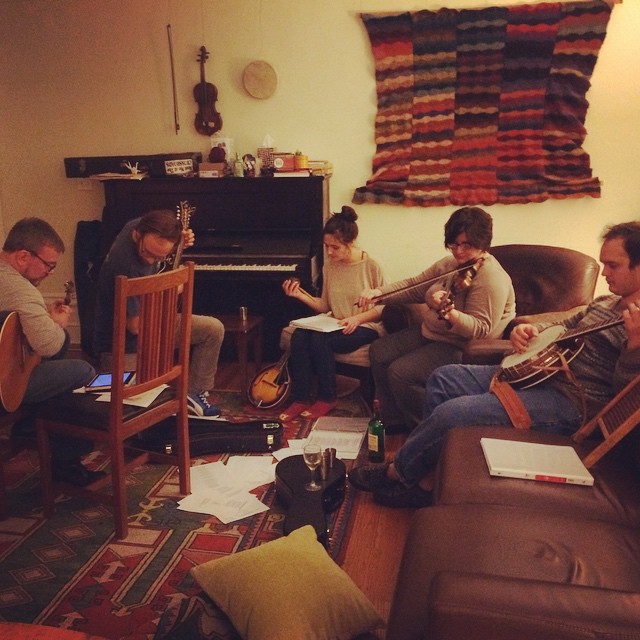
When we sing in 3 part harmony we get all squeezed together.
As for what song it was, probably this one:
What we lacked in talent we made up for in numbers.
If you’re a musician and want to jam with us, come to Clearwater at the end of June, we’ll (mostly all) be there!
Vacation in Utrecht
Please ignore this post if you are at all squeamish or otherwise appropriate. I fully intend to offend people like you.
OK, so here’s the thing about family vacations, at least for me. They make you lose your genitals.
Seriously, I’ve misplaced my vagina, and for the life of me I can’t find it, or even remember when I last had it. I can barely remember anything at all about it.
This has happened to me before, on numerous occasions. It’s nothing new. It happened a couple of days after I landed in Orlando with the family for spring break a few years ago, and it happened within seconds of entering Great Wolf Lodge about a year ago.
Have you been there? It’s an indoor waterpark, and something about the chlorinated air and hundreds of dripping wet and screaming children made me instantaneously lose contact with my genitals. I know I’m not the only one, I polled the other grownups there and I got serious resonance with this sentiment.
In fact, I walked around for a day and a half (in order to get the most out of my one expensive overnight room) asking people if they’d seen my vagina anywhere. The reactions were mixed and were not always good. In fact once or twice the stares I got were so weird and intense that I was forced to blurt out, “Oh, here it is! In my purse! Just where I left it.” True story.
Conclusion: family vacations are the ultimate birth control.
Honestly, there should be a law that anyone who is thinking of getting pregnant should spend a couple of days at Great Wolf Lodge. If they are still horny after that experience then they deserve whatever they get.
Why, oh why, did we decide to have so many kids? And how can it be so incredibly expensive to pay for them to complain about every moment of the day that doesn’t contain wifi?
Here’s another reason there’s no physical joy in family vacations. The food. The disgusting food you end up eating when with your entire family prevents you from feeling sexy. Never mind sexy, it makes you borderline suicidal.
Yesterday we had pannekoeken for lunch, poffertjes as a snack, and sausage wall frikandels, loompjes, and french fries for dinner. Just in case you are wondering if anything I just listed isn’t fried, the answer is no.
Seriously, it was hugely disgusting, although temporarily delicious. I now know exactly why people declare diets for New Years, it’s because of the food situation in the week beforehand. It’s not that you want to lose weight, it’s that you never want to eat again.
And yes, I know that you can technically eat better food here in Utrecht, but not, as it turns out, if you’re traveling with a 6-year-old. In that case, you have a tiny little hunger striker on your hands, and the longer the strike goes on, the more crying and whining you’ve got, which, since you’re sharing a small hotel room, is a huge hassle. It’s a cost benefit analysis, and the costs always outweigh the benefits. In other words, you decide to forgo actual food for one more day and give in to warmed up waffles with smeared nutella. Breakfast this morning, thankyouverymuch. Kill me now.
Dear readers, please do not judge me. Or at least, if you judge me, then be compassionate. Or at least, if you’re not feeling compassionate, keep an eye out for my vagina, I know it’s around here somewhere.
How to ignore your family on Thanksgiving
There has been lots of advice lately on how to have a civil conversation at Thanksgiving – NPR ran a piece yesterday on “topics both Democrats and Republicans enjoy”, for example, which made me slightly annoyed and amused – perhaps because I am neither – and inspired this somewhat alternative list of ways to enjoy or otherwise ignore your family today.
- Football, obviously. Few people actually know the rules of this game, never mind the names of the various positions of the players on the field. I personally have been watching football for more than 20 years and I still really don’t know what a tackle or a tight end is, nor exactly how to recognize a blitz. No matter, that’s not the point. The point is to choose a team and root for them blindly. Ignore the long-term brain damage.
- If you don’t like football, may I suggest An Idiot Abroad, a ridiculous travel show from Britain created by Ricky Gervais. It’s embarrassing and awkward, obv, so relative to those situations dinner with your family will seem seamless and well-meaning. I say this even though The Office, also developed by Ricky Gervais, was on NPR’s list. Also, having a The Office marathon is really not a bad idea either.
- Drinking. Adults can go for beer and spiked eggnog, but kids can get totally spaced out with just the normal eggnog. I’ve seen it before, it has a crazy high, especially if you add nutmeg. Buy tons.
- The above suggestions should keep you busy up to and including the beginning of dinner. Be sure you don’t actually talk before dinner, because then you’d run out of things to say during the eating part.
- For the actual dinner conversation, may I suggest keeping things light. For example, I plan to provoke a fun-loving conversation on who thinks the Ferguson grand jury’s lack of indictment serves justice and who thinks it exposes a broken system. It comes down to who trusts the system and who the system works for.
- If that seems awkward, move on to white privilege in general. If there’s a denier at the table, throw out some data: black teenagers are 21 times more likely to be killed by a cop than white teenagers, for example, or if that seems hyperbolic, move on to the social mobility matrices for blacks versus whites in Figures 8 and 9 of the appendix of this paper. Nice and aggregate. I plan to use a projector.
- Hahaha, just kidding! We don’t want to scare the kids. Instead, we’ll stick to the usual, where we enormously overconsume and simultaneously discuss upcoming diet plans, and/or vivaciously and competitively plan our impending holiday shopping whilst worrying about money.
- For a nice surprise, sign up your whole family for spots on the bus to participate in a Black Friday Walmart protest tomorrow morning in North Bergen, New Jersey. Bus leaves at 8am. Come one, come all!
Is tourism in Haiti inherently exploitative?
I recently returned from Haiti, where I was a tourist traveling around the country for 6 days with my friends Jamie and Becky. As I spent time there, I felt increasingly aware of the difficult if not miserable spot that the country as a whole finds itself in, even though there are of course wonderful and incredibly beautiful and creative things happening too: art is everywhere.
Everyone knows about the 2010 earthquake which devastated the capital Port Au Prince – which was indeed terrible and its ramifications are still being felt – that natural disaster is really only one more thing for the Haitians to deal with, on top of a long and excruciating history of manmade, political and human disasters.
I read the book Mountains Beyond Mountains while I was traveling, upon the recommendation of a bunch of my friends. It’s putatively the story of a white doctor from Boston, Paul Farmer, who is trying his best to enlist a growing group of doctors and philanthropists to help the deeply impoverished town of Cange in Haiti achieve state-of-the-art healthcare. It’s an impressive book, and beautifully written, and doesn’t shy away from frank discussions of how the United States has meddled with and manipulated the politics of Haiti to its own advantage. You should all read it.
One of the most memorable scenes from the book, at least for me, is when the writer discusses the juxtaposition of spending one day in Cange in Haiti and then flying directly to New York, or maybe Paris, but in any case a glamorous, rich, first-world city, and how it seems like two bizarrely separate worlds. Farmer says that no, in fact, it’s exactly what you’d expect – that there’s a direct line between the poverty of Haiti and the richness of New York. New York is rich in part because Haiti is poor, and we New Yorkers depend, even if invisibly, on exploitation of places like Haiti to stay rich. When you concentrate wealth in one place, you are concentrating poverty as well.
That brings me to my question today. Is it inherently exploitative to be a tourist in Haiti?
Reasons it is:
- First and foremost, as Americans we can choose to visit Haiti, and then return after 6 days. Haitians cannot choose to visit us for 6 days, even if they had the money to do it. And again, that discrepancy is directly due to U.S. foreign policy.
- American tourists like myself are impossibly rich and powerful compared to the people we interact with in Haiti. That creates a weird and deep distance between people. It means that everyone on the street is aware of me and nobody fucks with me because the consequences for them would be dire. That’s what power looks like. As a result, t may be impossible to actually have a normal human relationship with a native Haitian.
- As a white person, you pay something like 10 times the normal costs of anything, which is both strange and totally understandable, but in any case it means that you are seen as a piggy bank by anyone with a service or a good to sell, which is pretty much almost anyone you meet.
- There aren’t very many tourists in Haiti. All the white people we met there were there on religious or charitable missions, or worked for the UN, or were trying to set up businesses along the lines of Etsy for Haitian folk art, or are themselves art collectors. That adds to the uncomfortable sense of dependency you feel as a tourist.
- When you are at a hotel, you are being served by Haitians. It’s impossible not to see the historical racial symbolism of this, given that Haitians were brought from West Africa as slaves to the French, and not to mention the more recent history which has made American influence so undermining.
- There’s a reverse sex tourism industry in Haiti, which is to say that middle-aged white women are known to go to Haiti as well as the Dominican Republic to pay for sex with young men. That fact further clouds the possibility, at least for me, of even having a single conversation in which the goal is non-transactional. How do you know if your joke is actually funny? Or if the cultural exchange you are happily engaged in is truly reciprocal? How could it be?
- Conclusion: it is in fact inherently exploitative to be a tourist in Haiti, and it’s not something you can choose not to participate in.
On the other hand, here are a few reasons I’d argue against my own conclusion:
- First and foremost, you are what you are as an American, even if you’re not in Haiti. You are just more aware of what that means to Haitians when you are in Haiti. In other words, if the decadence of ample food, and wifi, and excellent health care is in part due to the impoverished state of Haiti, maybe it’s good you are made aware of that.
- Haitians desperately need money, and tourists have money. If lots of tourists went to Haiti, it might be better for Haiti than a bunch of money coming in the form of aid.
- My friend Becky came with us to Haiti, and she stayed a few extra days and connected with a Haitian biologist and nerded out completely in a national park (she’s a huge biology nerd and nature photographer). It seems to me that, if it is possible to cross the human divide, and get out of a transactional conversation and into another place, it might happen in the context of a scientific discussion.
- I’m not a biology nerd, but I love music. I felt like the closest I came to normal human interaction was through discussing and enjoying live music.
- It’s really fun to travel, even if you learn sad things. You become more aware and more grateful, and you bring that back to your community and your family. There’s something to be said for simple cultural awareness. Plus, now I really care about Haiti, which maybe is irrelevant, but may someday become relevant, who knows.
I’d love to hear your thoughts.
Update. A comment from Jamie:
Fundamentally, I do and always have agreed to your point of exploitation. I knew we would be weird voyeurs going in to the trip, and as we discussed on the last day, Cathy, we were both acutely aware of how it would look if we started taking pictures of Haitians and the streets from inside of our fancy 4-by-4. It’s a complicated dynamic. And I think you’re right that it is nearly impossible to have a normal, balanced relationship there; I felt similarly while traveling around West Africa. It’s like we have a bank account and a green card attached to our foreheads, and it can be difficult to trust that someone is seeing us beyond that. Even if they have no ulterior motives other than being our friend, that trust is hard to grasp and hang on to.All of that said, however, I do believe that it is incredibly important to spend time in countries and cultures that are different from our own. And I believe even more fervently that we should visit those countries with a mind to experience and enjoy rather than “save” it through mission-based organizations. That’s not to say that all aid is bad aid (on the contrary, many aid orgs and NGOs are very, very important!), but I do push back against the notion that one should always attach a mission to a visit. I’ve found that going somewhere as a volunteer or aid worker puts an even bigger wall between cultures (“I am here to help you because I have the means to help you and it is clear you can’t help yourself”). I strongly believe that just sitting, listening, and learning without the motive to “save” is one of the only ways of conducting a fair and balanced cultural exchange. I want to listen first, not fix first. Once I listen, and begin to understand (as if I ever could…), only then do I feel comfortable enough to think about working in/for a country.Additionally, on the notion of choosing to vacation in a non-traditional spot that is so clearly economically and politically struggling, is it better to only travel to first world, highly developed countries and ignore that others exist? Should we blindly trust the media (and all of our friends, relatives, etc) that constantly tells us that a country is “bad” and avoid them? How will we change the discourse surrounding cultural and economic imbalances without having any first-hand experience? Are we perpetuating a notion that we are “too good” to visit a country that is struggling to stand on solid ground?It’s all a complicated notion. And on a specific note, I’d love to open the floor a little on your #5 exploitative point (“When you are at a hotel, you are being served by Haitians. It’s impossible not to see the historical racial symbolism of this, given that Haitians were brought from West Africa as slaves to the French, and not to mention the more recent history which has made American influence so undermining.”). True. I think it’s important that we are aware of that dynamic. On the other hand, what would it look like if we were being served by ex-pats? Would we not be rebelling that we are not supporting Haitians and the native economy? That the ex-pats are just making a place for other ex-pats to work and remove all Haitians from the operation? Tricky. I’m interested in hearing both of your thoughts on that.
I am old in Haiti
I am old in Haiti. This fact dawns on me slowly over the six days I am there, because there is so much to take in. Mostly I figure it out because I am constantly amazed by how beautiful and healthy everyone looks. But then again, I keep finding myself thinking, people who are 24 often look healthy and beautiful. It’s when you’re 54 that you begin to show signs of wear and tear. I will reserve judgment until I see older folks.
But then, after a while, I realize how few people I’ve seen that are 54, or even 44, or even 39. Almost nobody, in fact. Every now and then a very old person will cross the street slowly, hobbling with a stick for support. On my 6th day there I tried to figure out exactly how old such people were. Maybe not much older than me, in fact.
The statistics, which I don’t look at until afterwards, back up my observation. A third of the population is below the age of 15, half of the population is below the age of 20, and 70 percent of the population is below the age of 30. Probably the places I went, the cities, skew even younger. It looks like about 25% of the women of childbearing age are pregnant, and all of the women are of childrearing age. The population has tripled in Haiti since 1950 and it isn’t slowing down. If anything it’s bumping up because of the devastating 2010 earthquake – women tend to replace their lost babies by even more babies after such events.
This matters because the Haitian land is overpopulated. In fact it’s worse than that: the land suffers from a severe erosion of its topsoil, due to deforestation over the years. In part – get this – Haiti was deforested to repay the debt to France for letting them be free back in the early 1800’s after the (world’s only successful) slave revolt. But it’s continued since then, and when you chop down all your trees, the rains take away your topsoil, which means your land slowly becomes desert. For the most part that’s what it looks like when you drive through. The result is not very much agriculture, and when you combine that with a fast-growing population, you get an horribly unsustainable situation.
In spite of all these problems, and in part because of them, the Haitians I came across seem incredibly nice to me and to each other. Trucks, people, motorcycles, cars, and 4-by-4’s compete for space in the one-lane roads in Port Au Prince but everyone stops dead when a young child needs to cross the street. It is a society that cherishes safety and looking out for one another.
When the water and soda sellers come to our public bus window to offer us drinks, and someone wants a cake instead, or to buy minutes for their cell phone, there’s a scramble by the nearby vendors to find the cake seller or the roaming Digicelwoman. The sellers at each stop form a collective that look out for each other, because if they didn’t look out for each other they’d all be screwed.
The same is true for with any resource. A UN worker we met explained that microfinance researchers are frustrated by Haitians when they try to estimate the impact of their loans, because they keep finding that a family has borrowed money and given it to another family. But if they didn’t share resources locally, all the families in a given neighborhood would be risking too much. It is better to be known as a generous person so that in a time of scarcity people will be generous to you. Your reputation is your most valuable asset.
When I think about how we live here in New York – where I don’t know most of my neighbors’ names, and nobody can see what happens behind closed doors, and we hoard resources except in our most immediate family – I feel like we’re missing out on something valuable. At the same time, privacy is nice, and I don’t think most Haitians have much of that. Not to mention a healthy middle age.
Inflation for the rich
I’m preparing for my weekly Slate Money podcast – this week, unequal public school funding, Taylor Swift versus Spotify, and the economics of weed, which will be fun – and I keep coming back to something I mentioned last week on Slate Money when we were talking about the end of the Fed program of quantitative easing (QE).
First, consider what QE comprised:
- QE1 (2008 – 2010): $1.65 trillion dollars invested in bonds and agency mortgage-back securities,
- QE2 (2010 – 2011): another $600 billion, cumulative $2.25 trillion, and
- QE3 (2012 – present): $85 billion per month, for a total of about $3.7 trillion overall.
Just to understand that total, compare it to the GDP of the U.S. in 2013, at 16.8 trillion. Or the federal tax spending in 2012, which was $3.6 trillion (versus $2.5 trillion in revenue!).
Anyhoo, the point is, we really don’t know exactly what happened because of all this money, because we can’t go back in time and do without the QE’s. We can only guess, and of course mention a few things that didn’t happen. For example, the people against it were convinced it would drive inflation up to crazy levels, which it hasn’t, although of course individual items and goods have gone up of course:
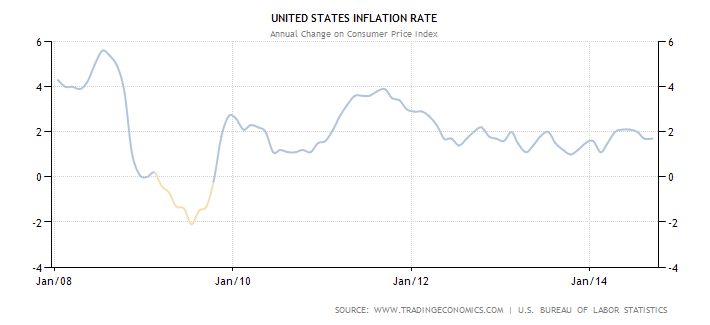
Well but remember, the inflation rate is calculated in some weird way that economists have decided on, and we don’t really understand or trust it, right? Actually, there are a bunch of ways to measure inflation, including this one from M.I.T., and most of them kinda agree that stuff isn’t crazy right now.
So did QE1, 2, and 3 have no inflationary effect at all? Were the haters wrong?
My argument is that it indeed caused inflation, but only for the rich, where by rich I mean investor class. The stock market is at an all time high, and rich people are way richer, and that doesn’t matter for any inflation calculation because the median income is flat, but it certainly matters for individuals who suddenly have a lot more money in their portfolios. They can compete for New York apartments and stuff.
As it turns out, there’s someone who agrees with me! You might recognize his name: billionaire and Argentinian public enemy #1 Paul Singer. According to Matt O’Brien of the Washington Post, Paul Singer is whining in his investor letter (excerpt here) about how expensive the Hamptons have gotten, as well as high-end art.
It’s “hyperinflation for the rich” and we are not feeling very bad for them. In fact it has made matters worse, when the very rich have even less in common with the average person. And just in case you’re thinking, oh well, all those Steve Jobs types deserve their hyper-inflated success, keep in mind that more and more of the people we’re talking about come from inherited wealth.
Going to Haiti next week
I’m off to Haiti next week, for a week, with my buddie and bandmate Jamie Kingston. I was trying to figure out what to do with the blog while I was gone, and so I asked sometimes-guest blogger Becky Jaffe to cover for me (some of you may remember her Hip Hop’s Cambrian Explosion series which to this day gets traffic) but by the time I’d explained my trip, she’d decided to come along too! Which is awesome. We’re staying at the Hotel Oloffson in Port au Prince:

It has a room called “the Mick Jagger room”.
So two things. First, if you know of fun stuff to do in the Port au Prince area, please tell me. I tend to like talking to people, and music and crafts, and Becky and Jamie are more into nature and insects.
Second, if you have a lovely or inspiring suggestion for what should happen to mathbabe next week while we’re away, please tell me!
Workplace Personality Test for the NY Fed
I’ve got a list of things to write about here on mathbabe, and they include the Carmen Segarra secret tapes as well as workplace personality tests. I’ve decided to do a mash-up just for fun, imagining what Carmen had to go through to get her job.
Update: you can send someone the link to this personality test here.
People hate me, I must be doing something right
Not sure if you’ve seen this recent New York Times article entitled Learning to Love Criticism, but go ahead and read it if you haven’t. The key figures:
…76 percent of the negative feedback given to women included some kind of personality criticism, such as comments that the woman was “abrasive,” “judgmental” or “strident.” Only 2 percent of men’s critical reviews included negative personality comments.
This is so true! I re-re-learned this recently (again) when I started podcasting on Slate and the iTunes reviews of the show included attacks on me personally. For example: “Felix is great but Cathy is just annoying… and is not very interesting on anything” as well as “The only problem seems to be Cathy O’Neill who doesn’t have anything to contribute to the conversation…”
By contrast the men on the show, Jordan and Felix, are never personally attacked, although Felix is sometimes criticized for interrupting people, mostly me. In other words, I have some fans too. I am divisive.
So, what’s going on here?
Well, I have a thick skin already, partly from blogging and partly from being in men’s fields all my life, and partly just because I’m an alpha female. So what that means is that I know that it’s not really about me when people anonymously complain that I’m annoying or dumb. To be honest, when I see something like that, which isn’t a specific criticism that might help me get better but is rather a vague attack on my character, I immediately discount it as sexism if not misogyny, and I feel pity for the women in that guy’s life. Sometimes I also feel pity for the guy too, because he’s stunted and that’s sad.
But there’s one other thing I conclude when I piss people off: that I’m getting under their skin, which means what I’m saying is getting out there, to a wider audience than just people who already agree with me, and if that guy hates me then maybe 100 other people are listening and not quite hating me. They might even be agreeing with me. They might even be changing their minds about some things because of my arguments.
So, I realize this sounds twisted, but when people hate me, I feel like I must be doing something right.
One other thing I’ll say, which the article brings up. It is a luxury indeed to be a woman who can afford to be hated. I am not at risk, or at least I don’t feel at all at risk, when other people hate me. They are entitled to hate me, and I don’t need to bother myself about getting them to like me. It’s a deep and wonderful fact about our civilization that I can say that, and I am very glad to be living here and now, where I can be a provocative and opinionated intellectual woman.
Fuck yes! Let’s do this, people! Let’s have ideas and argue about them and disagree! It’s what freedom is all about.
Friday morning reading
I’m very gratified to say that my Lede Program for data journalism at Columbia is over, or at least the summer program is (some students go on to take Computer Science classes in the Fall).
My adorable and brilliant students gave final presentations on Tuesday and then we had a celebration Tuesday night at my house, and my bluegrass band played (didn’t know I have a bluegrass band? I play the fiddle! You can follow us on twitter!). It was awesome! I’m hoping to get some of their projects online soon, and I’ll definitely link to it when that happens.
It’s been an exciting week, and needless to say I’m exhausted. So instead of a frothy rant I’ll just share some reading with y’all:
- Andrew Gelman has a guest post by Phil Price on the worst infographic ever, which sadly comes from Vox. My students all know better than this. Hat tip Lambert Strether.
- Private equity firms are buying stuff all over the country, including Ferguson. I’m actually not sure this is a bad thing, though, if nobody else is willing to do it. Please discuss.
- Bloomberg has an interesting story about online PayDay loans and the world of investing. I am still on the search for someone who knows exactly how those guys target their ads online. Hat tip Aryt Alasti.
- Felix Salmon, now at Fusion, has set up a nifty interactive to help you figure out your lifetime earnings.
- Felix also set up this cool online game where you can play as a debt collector or a debtor.
- Is it time to end letter grades? Hat tip Rebecca Murphy.
- There’s a reason fast food workers are striking nationwide. The ratio of average CEO pay to average full-time worker pay is around 1252.
- People lie to women in negotiations. I need to remember this.
Have a great weekend!
Aise O’Neil at Gotham Comedy Club
I don’t usually blog about my kids, but my 14-year-old son has explicitly given me his blessing to post his recent stand-up performance at the Gotham Comedy Club:
The look he gives the audience at the end is my favorite part.
Advice for anxious sleepers
When I was young I used to suffer from depression from time to time, sometimes pretty badly. But ever since I had kids, I suffer much more from anxiety. It’s never been paralyzing but it means I have trouble falling asleep about once or twice a week because I can’t stop fretting. I’m jealous of people that can wander off into fantasy land and imagine landing on the moon or walking across a grassy plain in a magical land, but that’s not me. I basically have no imagination and spend my brain cycles trying to solve really concrete problems, and if there’s something out of my control then it bugs me and I have trouble letting go.
I’m sure I’m not the only one with this problem, and maybe I should be learning to meditate or something so I’m better at flexing my imagination muscles. Bring on the advice. In the meantime I’ve developed intense and complicated coping mechanisms. Here are a few in the form of friendly advice to all who suffer from anxiety at night:
- First of all, don’t worry about being worried. Chances are the next night you will be super exhausted and catch up on sleep, no harm done. Important to keep in mind!!
- Second, I really like to listen to the radio. Sports radio is almost always soothingly boring (although lately, what with all the wife beating talk, it has been less than helpful), and of course an actual baseball game is perfect, because nothing ever happens.
- But my husband can only sleep in total silence. Here’s the solution to this problem, which helps a LOT:

Product motto: “This pillow speaker has saved a marriage or two …”
- If that isn’t enough, then I usually go to the living room and watch boring movies on Netflix.
- I found the best, most boring movie EVER yesterday which I wanted to share with you. Namely, Nature’s The Private Life of Deer. That was seriously boring, and yet funny and nice too, especially when the “ghost deer photographer” was whispering to the camera about his strategies in tracking the ever-elusive albino deer in the northern woods.
- The video for that is available here, but I urge you to save it for when you have trouble sleeping and are trying not to think of something anxiety-provoking, it’ll be perfect.

The app effect
I have a theory which I’m slightly embarrassed about but whatever, that’s what blogs are for, I’m going to talk about it. And I have no data for this whatsoever, although I’d be interested to hear thoughts on how to collect some.
Namely, I think a sizable amount of social change we’ve seen in the past few decades, for better and for worse, can be ascribed to what I call “the app effect,” namely the tendency for everyone, but young men in particular to be playing games on their phones or their xbox360’s or whatever rather than interacting with each other.
Look at crime rates. I am not claiming that crime rates have fallen solely because of the app effect over other reasonable effects, like the availability of abortions, or less lead paint, or people having more air conditioning.
But, let’s face it, when I was growing up in Boston in the 1980’s, you’d just see way more people out on the streets on summer evenings because it was too freaking hot to do anything inside and people were damn bored. That’s when the trouble would start. Nowadays you just don’t see that nearly as much. What are people doing? My guess is that they’re playing a shit load of video games. Tell me if I’m wrong.
Here’s another example. People are less politically engaged. Partly it’s because Congress sucks, but partly – yes – it’s because people are playing Candy Crush! They used to maybe spend time going to work reading the paper and otherwise doing the civic duty thing but nowadays they’re just trying to pass level 187. I’ve been there so I know about it.
Also, when the train stops? In the tunnel? And it’s dark and really hot? Everyone just plays their games even harder, where you used to maybe start talking, or shouting, or freaking out. It is a pacifier for grown-ups, a nationwide babysitting service that keeps people in line.
It’s good and bad. Sometimes getting out of line serves a purpose, sometimes it’s just destructive and the wrong thing to do. My worry, as a person who wants to see political engagement, is that we have trained an entire population to take refuge in a pointless activity that doesn’t serve any real purpose except to distract us and to mollify us, not to mention collect our data for later marketing purposes.
Another way to imagine this is, if all the apps and all the video games stopped working for a few weeks, what would happen? What would people do with themselves?
Unsolicited advice about having kids
You know how it’s better to have a discussion with someone when you’re calm and they haven’t just done something that drives you absolutely nuts? Well I’m going to generalize to the parenting advice realm: best time to give parenting advice is not when you’ve just seen a kid get poorly parented or a parent stress out about stupid stuff. Best time is when you’re alone in your pajamas, nowhere near other people’s kids. That way those of you who have kids won’t feel defensive.
Also, here’s another rule about parenting advice: never take parenting advice from anyone, because the people who are actually eager to give it are usually super weird. Look at Tiger Mom as Exhibit A.
In spite of that very wise second rule, I’ma go ahead and give some advice that’s pretty good, if I do say so myself in my own weird way.
- Before having kids, think of all the reasons not to. They’re loud, expensive, and they weigh you down immensely. You will never be able to stay up with friends after 10pm again if you do it. So don’t do it.
- Unless… unless you just absolutely cannot help it because of all those freaking hormones and how cute they look in summer dresses (boys included, yes, they don’t care, they’re babies). Then do it, but think hard and plan well for the noise, the expense, and the inconvenience.
- In terms of how you parent a baby: think long-term about stuff. Are you gonna want to get up a million times every night for the rest of your life? No, you’re not. So figure out how to get the damn baby to sleep through the night. This cannot be forced until the kid is 6 months or so, and the moment you can manipulate their sleep is characterized by the moment they can try to manipulate their sleep and stay awake to hang out with you. That’s when you start the 6pm bedtime ritual, including songs and books and 6:30 lights out. They will cry for like 10 minutes three nights in a row and after that you will be golden. Long term thinking, remember. Even if they cry for an hour, it’s an investment for a lifetime, namely yours.
- In terms of how you parent a little kid: think super long-term about stuff. Don’t raise your voice unless they are doing something actually dangerous, like walking into traffic or sticking a fork into an outlet. Make sure you let them get really dirty and try to eat weird things, too – their tongues are like extra hands at this age, it helps them explore the world. The only thing a little kid really needs is regular meals and a 6 or maybe 7pm bedtime ritual. They can spend 2 hours ripping up a newspaper for entertainment. Once a week baths would be good.
- In terms of how you parent a school age kid: think super duper long-term about stuff. If you do their homework for them, they will never do it themselves. So let them figure that out, but do remind them to do it if they’re forgetful. If you structure all their time, they will never figure out what they love to do, so make sure they get bored sometimes. Keep lots of good books and nerdy puzzles and interesting people around the house but don’t make them “do math” with you unless they ask for it. Don’t make them take music lessons. Instead, wait for them to beg for music lessons, and then say no for a while until you’re really sure they want them. Don’t just tell them to be nice, exhibit nice behavior to them and to others in front of them. Reward them for pointing out your hypocrisies, and make them watch Star Trek: The Next Generation (or equivalent) with you for its moral education and for the popcorn, and have fun listening to them pointing out the bad physics. And the most important of all: enjoy them and have fun with them, because that’s the best kind of way to role model for your kids, plus it’s fun, and they’re people who will move away pretty soon and you’ll miss them.
- In terms of how you parent an older kid, I have no idea because my oldest kid is 14. But so far we’re having a blast. I’m pretty sure they’re already mostly raised in terms of my role anyway by the time they’re 12.
One last, general thing for today’s anxious parents: don’t feel guilty, you’re doing your best. Guilt is a waste of time and gets in the way of enjoying the popcorn.


 mathbabe