Monday morning links
First, if you know and love the Statistical Abstract as much as I do, then help save it! Go to this post and follow the instructions to appeal to the census to not discontinue its publication.
Next, if you want evidence that it sucks to be rich, or at least it sucks to be a child of rich people, then read this absolutely miserable article about how rich people control and manipulate their children. Note the entire discussion about “problem children” never discusses the possibility that you are actually a lousy, money-obsessed and withholding parent.
Next, how friggin’ cool is this? Makes me want to visit Mars personally.
And also, how cool is it that the World Bank is opening up its data?
Finally, good article here about Bernanke’s lack of understanding of reality.
Working with Larry Summers (part 3)
Previously I’ve talked about the quant culture of D.E. Shaw as well as the tendencies of people working there. Today I wanted to add a third part about the experience of being “on the inside looking out” during the credit crisis.
I started my quant job in June 2007, which was perfect timing to never actually experience unbridled profit and success; within two months of starting, there was a major disruption in the market which caused enough momentary panic and uncertainty that the Equities group decided to liquidate their holdings. This was a big deal and meant they lost quite a bit of money on transaction costs as well as losing money because other investors were pulling out of similar trades at the same time.
The August 2007 market disruption was referred to internally as “the kerfuffle”. I’ve grown to think that this slightly dismissive term, which connotates more of an awkward misunderstanding than any real underlying problem, was indicative of a larger phenomenon. Namely, there was a sense that nothing really bad was afoot, that the system couldn’t be at risk, and that as long as we kept our trades on balance market neutral, we would be fine, except for possibly bizarre moments of exception. The tone would be something like, if an upper class man went to a restaurant and his credit card was denied- the waiter would return the credit card with almost an apology, assuming that it must have expired or something, that surely it is a mistake more than an exposure of underlying bankruptcy.
This framing of the world around us, as individual exceptional moments, as mysterious, almost amusing singularities in an otherwise smooth manifold, continued throughout the credit crisis (I left in May 2009), with the exception of the days after Lehman collapsed (Lehman was a 20% owner of D.E. Shaw at the time of its collapse, as well as a one of our major brokers).
But Lehman fell kind of late in the game, actually, for those in the industry. In other words there were months and months of disturbing signs, especially in the overnight lending market (where banks lend to each other for just the night or over the weekend) leading up to the Lehman moment. I remember one experience during those times that still baffles me.
It was a company-wide event, an invitation to see Larry Summers, Robert Rubin, and Alan Greenspan chat with each other and with us at the Rainbow Room in Rockefeller Center. It started with a lavish spread, fit for the dignitaries that were visiting, as well as introductory remarks wherein David Shaw described Larry Summer’s appointment as managing director at D.E. Shaw a “promotion” from being President at Harvard (just to be clear, this was a joke – even David Shaw isn’t that arrogant). In incredibly collegial terms, each of the three spoke for some time and reminisced about working together in the Clinton administration. Whatever, that’s not the important part, although it is kind of strange to think about now.
The important part, in retrospect, was later, near the end, when Alan Greenspan started talking about CMO‘s and how worried he was that anybody investing in them was in for a world of hurt. When I had gotten to D.E. Shaw, one of the first presentations I’d ever gone to was by a guy describing how he thought the same thing, and how we had divested ourselves of any such holdings, at least for the high-risk kind. So when Greenspan asserted these warnings, I sensed quite a bit of smugness in the crowd around me. It made me imagine us investors as a bunch of people playing illegal poker in the back of a club, where the smartest ones in the game get told a few minutes before the cops come and they leave out the back (except in this case it wasn’t actually illegal, and it was retired cops- Greenspan left the Fed at the end of 2006).
I wish I could remember when exactly that Rainbow Room event was, because I specifically remember Rubin saying absolutely nothing and looking uncomfortable when Greenspan was going on about CMOs and the danger in their future. Way later, it was revealed that Rubin, who was being paid obscene amounts by Citigroup at the time, claimed not to know about how toxic those mortgage-backed securities were (nor did he claim to know how much Citibank had invested in them- which begs the question of what he actually did for Citigroup) back when he could do something about it. He was booted in January 2009.
I wanted to mention one other specific thing I remember about this attitude of bemused nonchalance in the face of the world crumbling. When Lehman fell, and the overnight lending market froze for some weeks leading to government intervention, there was a term for this at D.E. Shaw, attributed (perhaps wrongly) to Larry Summers. Namely, the term was “magic liquidity dust”, implying that all we needed, to solve the problems around us and the apparent irrational panic of the markets, was for a fairy to come down to us and shake her wand, spreading this liquidity dust generously in our otherwise functional and robust system.
The saddest part of all of this is that, in a very real sense, these guys were essentially right not to worry. There has been no real restructuring of the system that led to this, just its continuation and backing.
In my next installation I’ll talk about why I think people in finance were, and to some extent still are, so insulated from reality.
Meetups
I wanted to tell you guys about Meetup.com, which is a company that helps people form communities to share knowledge and techniques as well as to have pizza and beer. It’s kind of like taking the best from academics (good talks, interested and nerdy audience) and adding immediacy and relevance; I’ve been using stuff I learned at Meetups in my daily job.
I’m involved in three Meetup groups. The first is called NYC Machine Learning, and they hold talks every month or so which are technical and really excellent and help me learn this new field, and in particular the vocabulary of machine learners. For example at this recent meeting, on the cross-entropy method.
The second Meetup group I go to is called New York Open Statistical Programming Meetup, and there the focus is more on recent developments in open source programming languages. It’s where I first heard of Elastic R for example, and it’s super cool; I’m looking forward to this week’s talk entitled “Statistics and Data Analysis in Python with pandas and statsmode“. So as you can see the talks really combine technical knowledge with open source techniques. Very cool and very useful, and also a great place to meet other nerdy startuppy data scientists and engineers.
The third Meetup group I got to is called Predictive Analytics. Next month they’re having a talk to discuss Bayesians vs. frequentists, and I’m hoping for a smackdown with jello wrestling. Don’t know who I’ll root for, but it will be intense.
Debt
So I’ve been reading David Graeber’s book about debt. He really has quite a few interesting and, I would say, wonderful points in his book, among them:
1) Debt came before money, often in the form of gift giving (you can read about this in his interview with Naked Capitalism)
2) In ancient cultures, and even in more recent cultures before the introduction of money, there were typically two separate spheres of accounting: the first was for daily goods like food and goats, which worked on the credit system, and the second for rearranging human relationships. Here there were things like dowries and symbolic exchanges of gold, meant to acknowledge the changing human relationship, but not as a “price” per se – because it was understood that you couldn’t put a price on a human.
3) Money as we know it is intricately tied in with slavery because it was when a person became a thing that could be sold for profit that we had a sense of price and when these two separate spheres were united. In particular the existence of money also implies the existence of a threat of violence. Moreover, it is this “decontextualizing” of people from their homes, their communities, and families who are forced into slavery that allows us to measure them with a dollar value, and in general it is only through pure decontextualizing that we can have a money system. It is this paradigm, where everyone and everything has no context, that economists rely on to describe the standard game theory of economics.
4) There are three social structures that people come into contact with in their daily lives and in which they give each other things: communistic, reciprocal, and hierarchical. For example, among parents and children, it is communistic; among a CEO and his workers it is often hierarchical, and among two strangers at a market it is reciprocal.
Even though I could (and might) write a post on any of the above points, because I find them each rich with stimulating and challenging concepts (and I haven’t even finished the book yet!), I want to first describe something Graeber mentions about the last one. Also, if someone is reading this that thinks I’ve misrepresented Graeber’s points then please comment.
Namely, Graeber mentions that, although we each have experience, and maybe lots of experience, in the three different social structures, when we tell the story of economics and exchange we invariably talk about reciprocal exchange. So, for example, I have three sons and I spend way more time hanging out with my sons, attending to their needs and making sure their infected toes are treated and helping them find their raincoats, then I spend at any market. In other words, if I were tallying up my contributions to things, my kids would be a far greater drain on my resources than groceries. But our “story” of how we give things and take things is inevitably about buying stocks or negotiating for a house price. In other words, we have been trained (by economists?) or we have trained ourselves to define exchange as a reciprocal, Austrian schoolish, “be selfish and take advantage whenever possible” endeavor, even when in the face of it we can’t claim to be like that.
Since I’m unwaveringly interested in how one tells the story of oneself, this fascinates me. It’s a really excellent example of how we are blind to the most obvious things. It also makes me think that economic theory has a loooong way to go before it can really explain meaningful things about “how things work”. After all, when you allow yourself to include “personal feelings” in your definition of giving and receiving, you realize that the reciprocal exchange part of your life is actually pretty insignificant, and in fact if that’s all that economists can even hope to explain (and it’s not clear they can), then there is more left unexplained than explained.
Moreover, the fact that we don’t see this as a failing (or at least a major hole) in the economic theory, because we are blind to it in ourselves, also immediately points to the possibility that we have overemphasized this aspect, the reciprocal exchange sphere, in our current economic system. In other words, if we had a healthy understanding of how the other two systems work (communistic and hierarchical) we may have developed them in parallel with the reciprocal system, and we may well be better off for it. We may even have an economics system that doesn’t reward rich people and punish poor people, who knows.
By the way, ridiculous and ignorant critique of Graeber’s book here (as in he didn’t read the book) with rebuff in comments by Graeber himself. Thanks to a commenter for that link!
Some cool links
First, right on the heels of my complaining about publicly available data being unusable, let me share this link, which is a FREAKING cool website which allows people to download 2010 census data in a convenient and usable form, and also allows you to compare those numbers to the 2000 census. It allows you to download it directly, or by using a url, or via SQL, or via Github. It was created by a group called Investigative Reporters and Editors (IRE) for other journalists to use. That is super awesome and should be a model for other people providing publicly available data (SEC, take notes!).
Next, I want you guys to know about stats.org, which is a fantastic organization which “looks at major issues and news stories from a quantitative and scientific perspective.” I always find something thought-provoking and exciting when I go to their website. See for example their new article on nature vs. nurture for girls in math. Actually I got my hands on the original paper about this and I plan to read it and post my take soon (thanks, Matt!). Also my friend Rebecca Goldin is their Director of Research (and is featured in the above article) and she rocks.
Along the same lines, check out straightstatistics.org which is based in the UK and whose stated goal is this: “we are a campaign established by journalists and statisticians to improve the understanding and use of statistics by government, politicians, companies, advertisers and the mass media. By exposing bad practice and rewarding good, we aim to restore public confidence in statistics. which checks the statistics behind news and politics.” Very cool.
Guest post: The gold standard
FogOfWar kindly wrote a guest post for me while I was on vacation:
First off, for anyone who hasn’t seen the first or second round of “Keynes vs. Hayek” in hip-hop style, please check them out, they’re hilarious.
There’s an economic crisis going on around us, and periodically one hears people suggesting that we go back to the gold standard. It’s a pretty complicated issue, and I don’t really have an answer to the “gold standard debate”–just probing questions and a lingering feeling that the chattering class has been dismissive when they should be seriously inquisitive. I think this dismissiveness is driven by the fact that Ron Paul is the leading political proponent of the gold standard and competing currencies, and he’s (1) a traditional conservative libertarian (a bit in the Goldwater vein); and (2) a bit of a wingnut.
Aristotle would be ashamed— the validity of an argument does not depend upon the person making the argument, but upon whether the ideas contained are valid or invalid. Andrew Sullivan recently linked to this article by Barry Eichengreen, claiming that it’s “a lucid explanation of why calls to go back to the gold standard are so misguided.” In fact, it’s a fairly serious examination of the gold standard (ultimately coming down “nay”), which is a welcome relief from the flippant and arrogant dismissiveness one usually sees from economic pundits.
As with many edited articles, I recommend skipping the first page and a half (begin from the paragraph starting “For this libertarian infatuation with the gold standard…”). Here’s how I think the article should have begun:
[T]he period leading up to the 2008 crisis displayed a number of specific characteristics associated with the Austrian theory of the business cycle. The engine of instability, according to members of the Austrian School, is the procyclical behavior of the banking system. In boom times, exuberant bankers aggressively expand their balance sheets, more so when an accommodating central bank, unrestrained by the disciplines of the gold standard, funds their investments at low cost. Their excessive credit creation encourages reckless consumption and investment, fueling inflation and asset-price bubbles. It distorts the makeup of spending toward interest-rate-sensitive items like housing.
But the longer the asset-price inflation in question is allowed to run, the more likely it becomes that the stock of sound investment projects is depleted and that significant amounts of finance come to be allocated in unsound ways. At some point, inevitably, those unsound investments are revealed as such. Euphoria then gives way to panic. Leveraging gives way to deleveraging. The entire financial edifice comes crashing down.
This schema bears more than a passing to the events of the last two decades.
First, I would reword that last sentence as follows: This schema bear a striking resemblance to the events of the last two decades. Moreover, I would add, in light of this data, one might ask not why fringe candidate Ron Paul is calling for examination of a return to the gold standard, but rather why this view is considered to be on the fringe rather than at the center of debate. There are a number of reasons to believe that a return to the gold standard might not have the desired effect, although that certainly begs the question of what can be done to prevent future crisis on the order of 2008.
I’d place myself in the camp of “not convinced that the gold standard is the answer, but think it would be really hard to fuck up the economy as bad as the Fed did over the last 20 years even if you were trying, so maybe it’s an idea that deserves some real thought.”
Here’s another key paragraph:
Society, in its wisdom, has concluded that inflicting intense pain upon innocent bystanders through a long period of high unemployment [by allowing bubbles to work themselves out as Austrians advocate] is not the best way of discouraging irrational exuberance in financial markets. Nor is precipitating a depression the most expeditious way of cleansing bank and corporate balance sheets. Better is to stabilize the level of economic activity and encourage the strong expansion of the economy. This enables banks and firms to grow out from under their bad debts. In this way, the mistaken investments of the past eventually become inconsequential. While there may indeed be a problem of moral hazard, it is best left for the future, when it can be addressed by imposing more rigorous regulatory restraints on the banking and financial systems.
This gets to the crux of Eichengreen’s argument, but consider the following points:
- The “help” proposed by Keynsians in fact might make things worse in the long term (not out of malice, but the road to hell is paved with good intentions) by dragging out the inevitable consequences of misallocation during the bubble. In essence, this is a ‘rip the band-aid’ off argument. I think I’ve seen some historical analysis that the total damage done from a bank-solvency driven recession is, in fact, worse over time if extended rather than allowing banks to fail and recapitalize (Sweden vs. Japan).
- “… nor is precipitating a depression…” It’s taken as an article of faith that we would have been in a depression if not for the stimulus package, but I’m skeptical. This is and will always be a theoretical “what if” analysis, conducted by economists who have a cognitive bias in favor of a certain answer (and, for those working in government, a President who needs to juke the stats to get reelected).
- “While there may indeed be a problem of moral hazard it is best left for the future, when it can be addressed by imposing more rigorous regulatory restraints on the banking and financial system.” Whaaaaaaaaat? This is where Keynesians lose me. The sentence is so hopelessly naïve that it undermines the entire argument. Take your nose out of your input-driven models for a minute and take a look around and ask yourself how good a track record bank regulators have at imposing “more rigorous regulatory restraints” during boom times; major new regulatory changes only have political will during a crisis (Securities Act of ’33, Exchange Act of ’34, Glass-Steagall in ’34). I’m not going to argue the relative benefits of economic models when the theory is premised on a factual event that’s very likely not going to happen.
Here’s a paragraph I liked:
Bank lending was strongly procyclical in the late nineteenth and early twentieth centuries, gold convertibility or not. There were repeated booms and busts, not infrequently culminating in financial crises. Indeed, such crises were especially prevalent in the United States, which was not only on the gold standard but didn’t yet have a central bank to organize bailouts.
The problem, then as now, was the intrinsic instability of fractional-reserve banking.
This is a really good point; I don’t have an answer and it ties in to a lot of deep questions about the structure of the banking system and “what is money”. I do like that it’s being discussed, and I’d love to hear views (educated and layman alike) on “so if the gold standard won’t work and the Fed fucked things up so bad, what do you suggest?”
Lastly, here’s the end of the piece:
For a solution to this instability, Hayek himself ultimately looked not to the gold standard but to the rise of private monies that might compete with the government’s own. Private issuers, he argued, would have an interest in keeping the purchasing power of their monies stable, for otherwise there would be no market for them. The central bank would then have no option but to do likewise, since private parties now had alternatives guaranteed to hold their value.
Abstract and idealistic, one might say. On the other hand, maybe the Tea Party should look for monetary salvation not to the gold standard but to private monies like Bitcoin.
Um, for the record that’s long been the position of Paul. See for example this. Moreover, I think the author isn’t aware that there may be significant legal obstacles to create a competing currency.
I don’t have an answer to the many questions raised here, but they’ve been on my mind a lot. Any thoughts?
FoW
What is “publicly available data”?
As many of you know, I am fascinated with the idea of an open source ratings model, set up to compete with the current big three ratings agencies S&P, Moody’s, and Fitch. Please check out my previous posts here and here about this idea.
For that reason, I’ve recently embarked on the following thought experiment: what would it take to start such a thing? As is the case with most things quantitative and real-world, the answer is data. Lots of it.
There’s good news and bad news. The good news is there are perfectly reasonable credit models that use only “publicly available data”, which is to say data that can theoretically gleaned from quarterly filings that companies are required to file. The bad news is, the SEC filings, although available on the web, are completely useless unless you have a team of accounting professionals working with you to understand them.
Indeed what actually happens if you work at a financial firm and want to implement a credit model based on “publicly available information” is the following: you pay a data company like Compustat good money for a clean data feed to work with. They charge a lot for this, and for good reason: the SEC doesn’t require companies to standardize their accounting terms, even within an industry, and even over time (so the same company can change the way it does its accounting from quarter to quarter). Here‘s a link for the white paper (called The Impact of Disparate Data Standardization on Company Analysis) which explains the standardization process that they go through to “clean the data”. It’s clearly a tricky thing requiring true accounting expertise.
To sum up the situation, in order to get “publicly available data” into usable form we need to give a middle-man company like Compustat thousands of dollars a year. Wait, WTF?!!? How is that publicly available?
And who is this benefitting? Obviously it benefits Compustat itself, in that there even is a business to be made from converting publicly available data into usable data. Next, it obviously benefits the companies to not have to conform to standards- easier for them to hide stuff they don’t like (this is discussed in the first section of Compustat’s whitepaper referred to above), and to have options each quarter on how the presentation best suits them. So… um… does it benefit anyone besides them? Certainly not any normal person who wants to understand the creditworthiness of a given company. Who is the SEC working for anyway?
I’ve got an idea. We should demand publicly available data to be usable. Standard format, standard terminology, and if there are unavoidable differences across industries (which I imagine there are, since some companies store goods and others just deal in information for example), then there should be fully open-source translation dictionaries written in some open-source language (python!) that one can use to standardize the overall data. And don’t tell me it can’t be done, since Compustat already does it.
SEC should demand the companies file in a standard way. If there really are more than a couple of standard terms, then demand the company report in each standard way. I’m sure the accountants of the company have this data, it’s just a question of requiring them to report it.
The reckoning
There’s been lots of talk lately about how people are not having sufficient clarity of thought to be really creative any more; the argument is that they’re constantly interrupting themselves by reading tweets or their email, or of course crappy blogs, and never think about the big picture like they used to.
First, doesn’t it seem like every generation thinks that the kids of today are lazy? Doesn’t it just make us old fuddy-duddies to say stuff like this? Just because it’s a cliche doesn’t mean it’s not true.
Instead of complaining about young people, how’s this: a new way of having ideas is emerging, which is less individualistic and is therefore less recognizable to people who like to worship at the feet of “great thinkers.” There are more ad hoc communities being formed to explore ideas (like the Linux movement) and fewer larger-than-life personalities, but innovation and creativity are definitely taking place.
Okay, now that I’ve given those lazy-asses their due, I can complain about the obvious kinds of brain rot going on, mostly versions of lack of discipline and patience. I’m going to focus on a nerdy kind: the capacity for old-school reckoning (note how I’m even inserting fuddy-duddiness into the name).
Here’s the thing. It’s just too easy to google something when you don’t know it off the top of your head. There’s even some amount of feeling virtuous for bothering to scan wikipedia for, say, the population of the world or the prevalence of religions by number of worshipers. However, my claim is that it is better to delay the googling for at least half an hour.
Yes, I’m that guy who closes people’s laptops on their fingers and says, “hey let’s figure it out! Let’s not google it!!” Perhaps this explains why people don’t come to my house very often (please come back, you guys!). So yes, it’s come down to this: I torture my kids.
When my family has dinner, we have a rule that nobody can ‘use electricity,’ which includes watching TV or computers. We are also (obviously) super nerdy so we end up having pretty cool conversations (at least I think so!) in which we reckon.
Our reckoning skills, and our kids’ reckoning skills, have been getting honed this summer with the introduction of the daily ‘bonus question,’ which was our attempt to keep our kids’ brains from completely rotting over the summer while keeping things fun.
At first we would give them puzzles but later on they started asking us questions too. If the questions end up interesting enough (judged essentially by whether we all got genuinely into the discussion) then the kids win the prize of getting to watch TV after dinner until bedtime (don’t tell them but they’d get to watch TV anyway; and yes, they actually watch Netflix).
Turns out it is really fun to reckon with kids. For example one question our nine-year-old asked us is how thick a cylinder would be if it had to reach from the earth to the sun and was the same mass and density as the earth. We ended up googling something for that, I think the distance to the sun, but then again you can’t be crazy rigid!
The whole point is to realize you know more than you think, and you can figure out more than you thought you could based on estimates and a few facts. That, and to see how your biases steer you wrong. For example, when we were trying to figure out the number of people in each religion, we WAY overestimated the number of Jewish people. Then again, we live in New York.
One question I asked them which I thought was pretty cool, because they had such different and interesting answers to it, was how they could build the lightest bridge from our apartment to their school. There was no correct answer and that made it even neater, and it didn’t keep it from being a classic reckoning conversation.
So here’s my challenge: wait half an hour before googling something, and see how much you can figure out about the answer before you find it.
Back!
I’m back from vacation, and the sweet smell of blog has been calling to me. Big time. I’m too tired from Long Island Expressway driving to make a real post now, but I have a few things to throw your way tonight:
First, I’m completely loving all of the wonderful comments I continue to receive from you, my wonderful readers. I’m particularly impressed with the accounting explanation on my recent post about the IASP and what “level 3” assets are. Here is a link to the awesome comments, which has really turned into a conversation between sometimes guest blogger FogOfWar and real-life accountant GMHurley who knows his shit. Very cool and educational.
Second, my friend and R programmer Daniel Krasner has finally buckled and started a blog of his very own, here. It’s a resource for data miners, R or python programmers, people working or wanting to work at start-ups, and thoughtful entrepreneurs. In his most recent post he considers how smart people have crappy ideas and how to focus on developing good ones.
Finally, over vacation I’ve been reading anarchist David Graeber‘s new book about debt, and readers, I think I’m in love. In a purely intellectual and/or spiritual way, of course, but man. That guy can really rile me up. I’ll write more about his book soon.
I don’t want to live forever
Every now and then I meet someone who tells me they want to live forever. Whaaa? First of all, even if I were somehow forced to live forever, I simply don’t want to be around other people who have been living way too long. Haven’t they noticed that as people get older they tend to get more rigid and set in their ways? If we had to live with a bunch of 1000 year olds, how would we ever move past the weird issues they have about how women shouldn’t work or gays in the military? It’s a crucial fact that our culture is replenished by youth. Don’t want to lose that!! Eww!
Second of all, and more to the point I want to make, there really are people interested in this idea, and it always seems to me they are typically people that really should be focusing on living more now. What is actually going to be their plan if they suddenly were told, “hey, you’ll live forever starting now”? And if they have some awesome plan, why not just go for it? What is keeping them from making those decisions?
I have always had a great deal of admiration for people who do make those interesting and brave moves in their lives. Just this week an old friend of mine, who is a successful artist, told me she’s going back to school (at Columbia, so good for me!) to become a full time student in Narrative Medicine. If you don’t know what that means, then I don’t blame you, because I didn’t either, but what matters is that she is totally into it and that fucking rocks that she’s doing that.
Another good friend of mine is getting her Ph.D. in the ethics of nursing, after careers in energy and publishing. On the one hand I think she’s addicted to school, but on the other hand, how cool is that? To see so many different parts of the world? And by the way, if you think I’m disregarding things like money and kids, let me say that she is a single mom with two kids, and is still making this work. It’s just that she never decides not to do something because it’s hard – she’s all about intellectual curiosity and trying new things. Love her.
What would you study if you were to go back to school right now? How would you reinvent yourself?
Personally, I’ve always made my big decisions by asking myself, how will I feel on my death bed if I did or didn’t do this? It’s closely related to the other question I dwell on constantly, who am I and what is the story of my life? And it goes along with my advice post, where I pretty much always tell people to go for it or to do what they’d do if they weren’t insecure – good advice for oneself as well. I’ve actually gotten to the point of looking forward to my death bed, so I can swap stories with the people around me about the crazy shit I’ve tried. I know the chances of that working out are about zero, but it’s a nice thing to think about.
Going back to the idea of living forever: if I didn’t have a death bed to look forward to, how could I ever motivate myself to get my ass off the couch and try something new? It’s precisely because we have a finite amount of time to try things that it’s really exciting to be alive.
Good for the IASB!
There’s an article here in the Financial Times which describes how the International Accounting Standards Board is complaining publicly about how certain financial institutions are lying through their teeth about how much their Greek debt is worth.
It’s a rare stand for them (in fact the article describes it as “unprecedented”), and it highlights just how much a difference in assumptions in your model can make for the end result:
Financial institutions have slashed billions of euros from the value of their Greek government bond holdings following the country’s second bail-out. The extent to which Greek sovereign debt losses were acknowledged has varied, with some banks and insurers writing down their holdings by a half and others by only a fifth.
It all comes down to whether the given institution decided to use a “mark to model” valuation for their Greek debt or a “mark to market” valuation. “Mark to model” valuations are used in accounting when the market is “sufficiently illiquid” that it’s difficult to gauge the market price of a security; however, it’s often used (as IASB is claiming here) as a ruse to be deceptive about true values when you just don’t want to admit the truth.
There’s an amusingly technical description of the mark to model valuation for Greek debt used by BNP Paribas here. I’m no accounting expert but my overall takeaway is that it’s a huge stretch to believe that something as large as a sovereign debt market is illiquid and needs mark to model valuation: true, not many people are trading Greek bonds right now, but that’s because they suck so much and nobody wants to sell them at their true price since then they’d have to mark down their holdings. It’s a cyclical and unacceptable argument.
In any case, it’s nice to see the IASB make a stand. And it’s an example where, although there are two possible assumptions one can make, there really is a better, more reasonable one that should be made.
That reminds me, here’s another example of different assumptions changing the end result by quite a lot. The “trillion dollar mistake” that S&P supposedly made was in fact caused by them making a different assumption than that which the White House was prepared to make:
As it turns out, the sharpshooters were wide of the target. S&P didn’t make an arithmetical error, as Summers would have us believe. Nor did the sovereign-debt analysts show “a stunning lack of knowledge,” as Treasury Secretary Tim Geithner claimed. Rather, they used a different assumption about the growth rate of discretionary spending, something the nonpartisan Congressional Budget Office does regularly in its long-term outlook.
CBO’s “alternative fiscal scenario,” which S&P used for its initial analysis, assumes discretionary spending increases at the same rate as nominal gross domestic product, or about 5 percent a year. CBO’s baseline scenario, which is subject to current law, assumes 2.5 percent annual growth in these outlays, which means less new debt over 10 years.
Is anyone surprised about this? Not me. It also goes under the category of “modeling error”, which is super important for people to know and to internalize: different but reasonable assumptions going into a mathematical model can have absolutely huge effects on the output. Put another way, we won’t be able to infer anything from a model unless we have some estimate of the modeling error, and in this case we see the modeling error involves at least one trillion dollars.
Strata data conference
So I’m giving a talk at this conference. I’m talking on Monday, September 19th, to business people, about how they should want to hire a data scientist (or even better, a team of data scientists) and how to go about hiring someone awesome.
Any suggestions?
And should I wear my new t-shirt when I’m giving my talk? Part of the proceeds of these sexy and funny data t-shirts goes to Data Without Borders! A great cause!
Why log returns?
There’s a nice blog post here by Quantivity which explains why we choose to define market returns using the log function:

where 

I mentioned this question briefly in this post, when I was explaining how people compute market volatility. I encourage anyone who is interested in this technical question to read that post, it really explains the reasoning well.
I wanted to add two remarks to the discussion, however, which actually argue for not using log returns, but instead using percentage returns in some situations.
The first is that the assumption of a log-normal distribution of returns, especially over a longer term than daily (say weekly or monthly) is unsatisfactory, because the skew of log-normal distribution is positive, whereas actual market returns for, say, S&P is negatively skewed (because we see bigger jumps down in times of panic). You can get lots of free market data here and try this out yourself empirically, but it also makes sense. Therefore when you approximate returns as log normal, you should probably stick to daily returns.
Second, it’s difficult to logically combine log returns with fat-tailed distributional assumptions, even for daily returns, although it’s very tempting to do so because assuming “fat tails” sometimes gives you more reasonable estimates of risk because of the added kurtosis. (I know some of you will ask why not just use no parametric family at all and just bootstrap or something from the empirical data you have- the answer is that you don’t ever have enough to feel like that will be representative of rough market conditions, even when you pool your data with other similar instruments. So instead you try different parametric families and compare.)
Mathematically there’s a problem: when you assume a student-t distribution (a standard choice) of log returns, then you are automatically assuming that the expected value of any such stock in one day is infinity! This is usually not what people expect about the market, especially considering that there does not exist an infinite amount of money (yet!). I guess it’s technically up for debate whether this is an okay assumption but let me stipulate that it’s not what people usually intend.
This happens even at small scale, so for daily returns, and it’s because the moment generating function is undefined for student-t distributions (the moment generating function’s value at 1 is the expected return, in terms of money, when you use log returns). We actually saw this problem occur at Riskmetrics, where of course we didn’t see “infinity” show up as a risk number but we saw, every now and then, ridiculously large numbers when we let people combine “log returns” with “student-t distributions.” A solution to this is to use percentage returns when you want to assume fat tails.
We didn’t make money on TARP!
There’s a pretty good article here by Gretchen Morgenson about how the banks have been treated well compared to average people- and since I went through the exercise of considering whether corporations are people, I’ve decided it’s misleading yet really useful to talk about “treating banks” well- we should keep in mind that this is shorthand for treating the people who control and profit from banks well.
On thing I really like about the article is that she questions the argument that you hear so often from the dudes like Paulson who made the decisions back then, namely that it was better to bail out the banks than to do nothing. Yes, but weren’t there alternatives? Just as the government could have demanded haircuts on the CDS’s they bailed out for AIG, they could have stipulated real conditions for the banks to receive bailout money. This is sort of like saying Obama could have demanded something in return for allowing Bush’s tax cuts for the rich to continue.
But on another issue I think she’s too soft. Namely, she says the following near the end of the article:
As for making money on the deals? Only half-true, Mr. Kane said. “Thanks to the vastly subsidized terms these programs offered, most institutions were eventually able to repay the formal obligations they incurred.” But taxpayers were inadequately compensated for the help they provided, he said. We should have received returns of 15 percent to 20 percent on our money, given the nature of these rescues.
Hold on, where did she get the 15-20%? As far as I’m concerned there’s no way that’s sufficient compensation for the future option to screw up as much as you can, knowing the government has your back. I’d love to see how she modeled the value of that. True, it’s inherently difficult to model, which is a huge problem, but I still think it has to be at least as big as the current credit card return limits! Or how about the Payday Loans interest rates?
I agree with her overall point, though, which is that this isn’t working. All of the things the Fed and the Treasury and the politicians have done since the credit crisis began has alleviated the pain of banks and, to some extent, businesses (like the auto industry). What about the people who were overly optimistic about their future earnings and the value of their house back in 2007, or who were just plain short-sighted, and who are still in debt?
It enough to turn you into an anarchist, like David Graeber, who just wrote a book about debt (here’s a fascinating interview with him) and how debt came before money. He thinks we should, as a culture, enact a massive act of debt amnesty so that the people are no longer enslaved to their creditors, in order to keep the peace.
I kind of agree- why is it so much easier for institutions to get bailed out when they’ve promised too much than it is for average people crushed under an avalanche of household debt? At the very least we should be telling people to walk away from their mortgages or credit card debts when it’s in their best interest (and we should help them understand when it is in their best interest).
What is the mission statement of the mathematician?
In the past five years, I’ve been learning a lot about how mathematics is used in the “real world”. It’s fascinating, thought provoking, exciting, and truly scary. Moreover, it’s something I rarely thought about when I was in academics, and, I’d venture to say, something that most mathematicians don’t think about enough.
It’s weird to say that, because I don’t want to paint academic mathematicians as cold, uncaring or stupid. Indeed the average mathematician is quite nice, wants to make the world a better place (at least abstractly), and is quite educated and knowledgeable compared to the average person.
But there are some underlying assumptions that mathematicians make, without even noticing, that are pretty much wrong. Here’s one: mathematicians assume that people in general understand the assumptions that go into an argument (and in particular understand that there always are assumptions). Indeed many people go into math because of the very satisfying way in which mathematical statements are either true or false- this is one of the beautiful things about mathematical argument, and its consistency can give rise to great things: hopefulness about the possibility of people being able to sort out their differences if they would only engage in rational debate.
For a mathematician, nothing is more elevating and beautiful than the idea of a colleague laying out a palette of well-defined assumptions, and building a careful theory on top of that foundation, leading to some new-found clarity. It’s not too crazy, and it’s utterly attractive, to imagine that we could apply this kind of logical process to situations that are not completely axiomatic, that are real-world, and that, as long as people understand the simplifying assumptions that are made, and as long as they understand the estimation error, we could really improve understanding or even prediction of things like the stock market, the education of our children, global warming, or the jobless rate.
Unfortunately, the way mathematical models actually function in the real world is almost the opposite of this. Models are really thought of as nearly magical boxes that are so complicated as to render the results inarguable and incorruptible. Average people are completely intimidated by models, and don’t go anywhere near the assumptions nor do they question the inner workings of the model, the question of robustness, or the question of how many other models could have been made with similar assumptions but vastly different results. Typically people don’t even really understand the idea of errors.
Why? Why are people so trusting of these things that can be responsible for so many important (and sometimes even critical) issues in our lives? I think there are (at least) two major reasons. One touches on things brought up in this article, when it talks about information replacing thought and ideas. People don’t know about how the mortgage models work. So what? They also don’t know how cell phones work or how airplanes really stay up in the air. In some way we are all living in a huge network of trust, where we leave technical issues up to the experts, because after all we can’t be experts in everything.
But there’s another issue altogether, which is why I’m writing this post to mathematicians. Namely, there is a kind of scam going on in the name of mathematics, and I think it’s the responsibility of mathematicians to call it out and refuse to let it continue. Namely, people use the trust that people have of mathematics to endow their models with trust in an artificial and unworthy way. Much in the way that cops flashing their badges can abuse their authority, people flash the mathematics badge to synthesize mathematical virtue.
I think it’s time for mathematicians to start calling on people to stop abusing people’s trust in this way. One goal of this blog is to educate mathematicians about how modeling is used, so they can have a halfway decent understanding of how models are created and used in the name of mathematics, and so mathematicians can start talking about where mathematics actually plays a part and where politics, or greed, or just plain ignorance sometimes takes over.
By the way, I think mathematicians also have another responsibility which they are shirking, or said another way they should be taking on another project, which is to educate people about how mathematics is used. This is very close to the concept of “quantitative literacy” which is explained in this recent article by Sol Garfunkel and David Mumford. I will talk in another post about what mathematicians should be doing to promote quantitative literacy.
Lagged autocorrelation plots
I wanted to share with you guys a plot I drew with python the other night (the code is at the end of the post) using blood glucose data that I’ve talked about previously in this post and I originally took a look at in this post.
First I want to motivate lagged autocorrelation plots. The idea is, given that you want to forecast something, say in the form of a time series (so a value every day or every ten minutes or whatever), the very first thing you can do is try to use past values to forecast the next value. In other words, you want to squeeze as much juice out of that orange as you can before you start using outside variable to predict future values.
Of course this won’t always work- it will only work, in fact, if there’s some correlation between past values and future values. To estimate how much “signal” there is in such an approach, we draw the correlation between values of the time series for various lags. At no (=0) lag, we are comparing a time series to itself so the correlation is perfect (=1). Typically there are a few lags after 0 which show some positive amount of correlation, then it quickly dies out.
We could also look at correlations between returns of the values, or differences of the values, in various situations. It depends on what you’re really trying to predict: if you’re trying to predict the change in value (which is usually what quants in finance do, since they want to bet on stock market changes for example), probably the latter will make more sense, but if you actually care about the value itself, then it makes sense to compute the raw correlations. In my case, since I’m interested in forecasting the blood glucose levels, which essentially have maxima and minima, I do care about the actual number instead of just the relative change in value.
Depending on what kind of data it is, and how scrutinized it is, and how much money can be made by betting on the next value, the correlations will die out more quickly. Note that, for example, if you did this with daily S&P returns and saw a nontrivial positive correlation after 1 lag, so the next day, then you could have a super simple model, namely bet that whatever happened yesterday will happen again today, and you would statistically make money on that model. At the same time, it’s a general fact that as “the market” recognizes and bets on trends, they tend to disappear. This means that such a simple, positive one-day correlation of returns would be “priced in” very quickly and would therefore disappear with new data. This tends to happen a lot with quant models- as the market learns the model, the predictability of things decreases.
However, in cases where there’s less money riding on the patterns, we can generally expect to see more linkage between lagged values. Since nobody is making money betting on blood glucose levels inside someone’s body, I had pretty high hopes for this analysis. Here’s the picture I drew:

What do you see? Basically I want you to see that the correlation is quite high for small lags, then dies down with a small resuscitation near 300 (hey, it turns out that 288 lags equals one day! So this autocorrelation lift is probably indicating a daily cyclicality of blood glucose levels). Here’s a close-up for the first 100 lags:
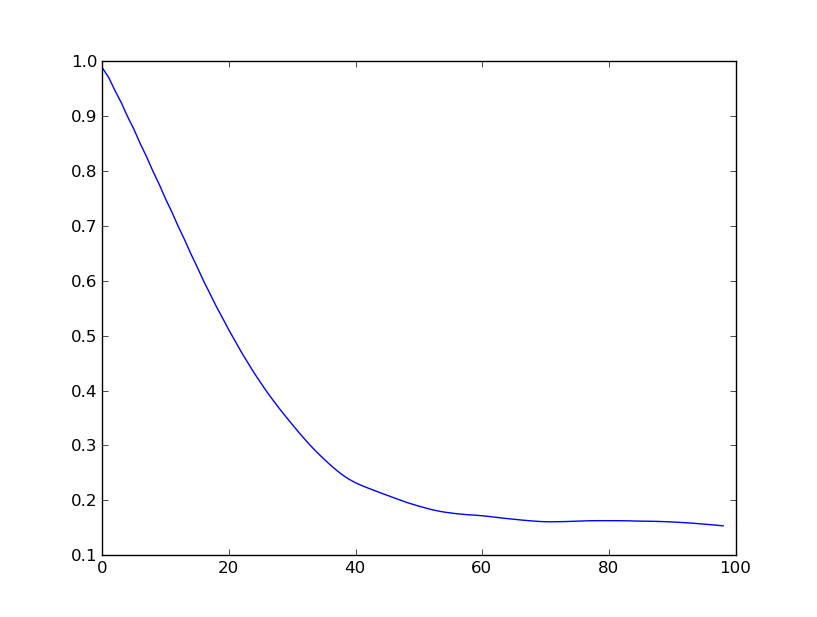
We can conclude that the correlation seems significant to about 30 lags, and is decaying pretty linearly.
This means that we can use the previous 30 lags to predict the next level. Of course we don’t want to let 30 parameters vary independently- that would be crazy and would totally overfit the model to the data. Instead, I’ll talk soon about how to place a prior on those 30 parameters which essentially uses them all but doesn’t let them vary freely- so the overall number of independent variables is closer to 4 or 5 (although it’s hard to be precise).
On last thing: the data I have used for this analysis is still pretty dirty, as I described here. I will do this analysis again once I decide how to try to remove crazy or unreliable readings that tend to happen before the blood glucose monitor dies.
Here’s the python code I used to generate these plots:
#!/usr/bin/env python

import csv
from matplotlib.pylab import *
import os
from datetime import datetime

os.chdir('/Users/cathyoneil/python/diabetes/')

gap_threshold = 12

dataReader = csv.DictReader(open('Jason_large_dataset.csv', 'rb'), delimiter=',', quotechar='|')
i=0
datelist = []
datalist = []
firstdate = 4
skip_gaps_datalist = []
for row in dataReader:
    #print i, row["Sensor Glucose (mg/dL)"]
    if not row["Raw-Type"] == "GlucoseSensorData":continue
    if firstdate ==4:
        print i
        firstdate = \
         datetime.strptime(row["Timestamp"], '%m/%d/%y %H:%M:%S')
    if row["Sensor Glucose (mg/dL)"] == "":
        datalist.append(-1)
    else:
        thisdate = datetime.strptime(row["Timestamp"], '%m/%d/%y %H:%M:%S')
        diffdate = thisdate-firstdate
        datelist.append(diffdate.seconds + 60*60*24*diffdate.days)
        datalist.append(float(row["Sensor Glucose (mg/dL)"]))
        skip_gaps_datalist.append(log(float(row["Sensor Glucose (mg/dL)"])))
    i+=1
    continue

print min(datalist), max(datalist)
##figure()
##scatter(arange(len(datalist)), datalist)
##
##figure()
##hist(skip_gaps_datalist, bins = 100)
##show()

def lagged_correlation(g):
    d = dict(zip(datelist, datalist))
    s1 = []
    s2 = []
    for date in datelist:
        if date + 60*5 in datelist:
            s1.append(d[date])
            s2.append(d[date + 60*5])
    return corrcoef(s1, s2)[1, 0]

figure()
plot([lagged_correlation(f) for f in range(1,900)])
Should short selling be banned?
Yesterday it was announced that the short selling ban in France, Italy, and Spain for financial stocks would be continued; there’s also an indefinite short selling ban in Belgium. What is this and does it make sense?
Short selling is mathematically equivalent to buying the negative of a stock. To see the actual mechanics of how it works, please look here.
Typically people at hedge funds use shorts to net out their exposure to the market as a whole: they will go long some bank stock they like and then go short another stock that they are neutral to or don’t like, with the goal of profiting on the difference of movements of the two – if the whole market goes up by some amount like 2%, it will only matter to them how much their long position outperformed their short. People also short stocks for direct negative forecasts on the stock, like when they detect fraud in accounting of the company, or otherwise think the market is overpricing the company. This is certainly a worthy reason to allow short selling: people who take the time to detect fraud should be rewarded, or otherwise said, people should be given an incentive to be skeptical.
If shorting the stock is illegal, then it generally takes longer for “price discovery” to happen; this is sort of like the way the housing market takes a long time to go down. People who bought a house at 400K simply don’t want to sell it for less, so they put it on the market for 400K even when the market has gone down and it is likely to sell for more like 350K. The result is that fewer people buy, and the market stagnates. In the past couple of years we’ve seen this happen in the housing market, although banks who have ownership of houses through foreclosures are much less quixotic about prices, which is why we’ve seen prices drop dramatically more recently.
The idea of banning short-selling is purely political. My favorite quote about it comes from Andrew Lo, an economist at M.I.T., who said, “It’s a bit like suggesting we take heart patients in the emergency room off of the heart monitor because you don’t want to make doctors and nurses anxious about the patient.” Basically, politicians don’t want the market to “panic” about bank stocks so they make it harder to bet against them. This is a way of avoiding knowing the truth. I personally don’t know good examples of the market driving down a bank’s stock when the bank is not in terrible shape, so I think even using the word “panic” is misleading.
When you suddenly introduce a short-selling ban, extra noise gets put into the market temporarily as people “cover their shorts”; overall this has a positive effect on the stocks in question, but it’s only temporary and it’s completely synthetic. There’s really nothing good about having temporary noise overwhelm the market except for the sake of the politicians being given a few extra days to try to solve problems. But that hasn’t happened.
Even though I’m totally against banning short selling, I think it’s a great idea to consider banning some other instruments. I actually go back and forth about the idea of banning credit default swaps (CDS), for example. We all know how much damage they can do (look at AIG), and they have a particularly explosive pay-off system, by design, since they are set up as insurance policies on bonds.
The ongoing crisis in Europe over debt is also partly due to the fact that the regulators don’t really know who owns CDS’s on Greek debt and how much there is out there. There are two ways to go about fixing this. First we could ban owning CDS unless you also own the underlying bond, so you are actually protecting your bond; this would stem the proliferation of CDS’s which hurt AIG so badly and which could also hurt the banks holding Greek bonds and who wrote Greek CDS protection. Alternatively, you could enforce a much more stringent system of transparency so that any regulator could go to a computer and do a search on where and how much CDS exposure (gross and net) people have in the world. I know people think this is impossibly difficult but it’s really not, and it should be happening already. What’s not acceptable is having a political and psychological stalemate because we don’t know what’s out there.
There are other instruments that definitely seem worthy of banning: synthetic over-the-counter instruments that seem created out of laziness (since the people who invented them could have approximated whatever hedge they wanted to achieve with standard exchange-traded instruments) and for the purpose of being difficult to price and to assess the risk of. Why not ban them? Why not ban things that don’t add value, that only add complexity to an already ridiculously complex system?
Why are we spending time banning things that make sense and ignoring actual opportunities to add clarity?
Want my advice?
For whatever reason I find myself giving a lot of advice. Actually, it’s probably because I’m an opinionated loudmouth.
The funny thing is, I pretty much always give the same advice, no matter if it’s about whether to quit a crappy job, whether to ask someone out that you have a crush on, or which city to move to. Namely, I say the following three things (in this order):
- Go for it! (this usually is all most people need, especially when talking about the crush type of advice)
- Do what you’d do if you weren’t at all insecure (great for people trying to quit a bad job or deciding between job offers)
- Do what a man would do (I usually reserve this advice for women)
I was reminded of that third piece of advice when I read this article about mothers in Germany and how they all seem to decide to quit their jobs and stay home with their kids, putatively because they don’t trust their babysitter. I say, get a better babysitter!
As an aside, let me say, I really don’t have patience for the maternal guilt thing. Probably it has something to do with the fact that my mom worked hard, and loved her job (computer scientist), and never felt guilty about it: for me that was the best role model a young nerd girl could have. When the PTA asked my mom to bake cookies, she flat out refused, and that’s what I do now. In fact I take it up a notch: when asked to bake cookies for a bake sale fund-raiser at my kids’ school (keeping in mind that this is one of those schools where the kids aren’t even allowed to eat cookies at lunch), I never forget to ask how many fathers they’ve made the cookies request to. I’m never asked a second time by the same person (however I always give them cash for the fund raising, it should be said).
It’s kind of amazing how well these three rules of thumb for advice work. I guess people usually know what they want but need some amount of help to get the nerve up to decide, to make the leap. And people consistently come back to me for advice, probably because the discussion ends up being just as much a pep talk as anything else. I’m like that guy in the corner of the ring at a fight, squirting water into the fighter’s mouth and rubbing his shoulders, saying, “You can do it, champ! Go out and get that guy!”
There may be something else going on, which is that, although I’m super opinionated, I’m also not very judgmental. In fact this guy, the “ex-moralist,” is my new hero. In this article he talks about people using their religious beliefs to guide their ethics, versus people using their moralistic beliefs (i.e. the belief in right and wrong), and how he was firmly in the second camp until one day when he lost faith in that system too – he becomes amoral. He goes on to say:
One interesting discovery has been that there are fewer practical differences between moralism and amoralism than might have been expected. It seems to me that what could broadly be called desire has been the moving force of humanity, no matter how we might have window-dressed it with moral talk. By desire I do not mean sexual craving, or even only selfish wanting. I use the term generally to refer to whatever motivates us, which ranges from selfishness to altruism and everything in between and at right angles. Mother Theresa was acting as much from desire as was the Marquis de Sade. But the sort of desire that now concerns me most is what we would want if we were absolutely convinced that there is no such thing as moral right and wrong. I think the most likely answer is: pretty much the same as what we want now.
He goes on to say that, when he argues with people, he can no longer rely on common beliefs and actually has to reason with people who disagree with him but are themselves internally consistent. He then adds:
My outlook has therefore become more practical: I desire to influence the world in such a way that my desires have a greater likelihood of being realized. This implies being an active citizen. But there is still plenty of room for the sorts of activities and engagements that characterize the life of a philosophical ethicist. For one thing, I retain my strong preference for honest dialectical dealings in a context of mutual respect. It’s just that I am no longer giving premises in moral arguments; rather, I am offering considerations to help us figure out what to do. I am not attempting to justify anything; I am trying to motivate informed and reflective choices.
I’m really excited by this concept. Am I getting fooled because he’s such a good writer? Or is it possible that he’s hit upon something that actually helps people disagree well? That we should stop assuming that the person we are talking to shares our beliefs? This is something like what I experience when I go to a foreign country- the expectation that I will meet people who agree with me is sufficiently reduced that I end up having many more interesting, puzzling and deep conversations than I do when I’m in my own country.
I’m thinking of starting to keep a list of things that encourage or discourage honest communication- this would go on the side of “encourage,” and Fox news would go on the side of “discourage.”
What about you, readers? Anything to add to my list on either side? Or any advice you need on quitting that job and finding a better one? Oh, and that guy you think is hot? Go for it.
Demographics: sexier than you think
It has been my unspoken goal of this blog to sex up math (okay, now it’s a spoken goal). There are just too many ways math, and mathematical things, are portrayed and conventionally accepted as boring and dry, and I’ve taken on the task of making them titillating to the extent possible. Anybody who has ever personally met me will not be surprised by this.
The reason I mention this is that today I’ve decided to talk about demographics, which may be the toughest topic yet to rebrand in a sexy light – even the word ‘demographics’ is bone dry (although there have been lots of nice colorful pictures coming out from the census). So here goes, my best effort:
Demographics
Is it just me, or have there been a weird number of articles lately claiming that demographic information explain large-scale economic phenomena? Just yesterday there was this article, which claims that, as the baby boomers retire they will take money out of the stock market at a sufficient rate to depress the market for years to come. There have been quite a few articles lately explaining the entire housing boom of the 90’s was caused by the boomers growing their families, redefining the amount of space we need (turns out we each need a bunch of rooms to ourselves) and growing the suburbs. They are also expected to cause another problem with housing as they retire.
Of course, it’s not just the boomers doing these things. It’s more like, they have a critical mass of people to influence the culture so that they eventually define the cultural trends of sprawling suburbs and megamansions and redecorating kitchens, which in turn give rise to bizarre stores like ‘Home Depot Expo‘. Thanks for that, baby boomers. Or maybe it’s that the marketers figure out how boomers can be manipulated and the marketers define the trends. But wait, aren’t the marketers all baby boomers anyway?
I haven’t read an article about it, but I’m ready to learn that the dot com boom was all about all of the baby boomers having a simultaneous midlife crisis and wanting to get in on the young person’s game, the economic trend equivalent of buying a sports car and dating a 25-year-old.
Then there are countless articles in the Economist lately explaining even larger scale economic trends through demographics. Japan is old: no wonder their economy isn’t growing. Europe is almost as old, no duh, they are screwed. America is getting old but not as fast as Europe, so it’s a battle for growth versus age, depending on how much political power the boomers wield as they retire (they could suck us into Japan type growth).
And here’s my favorite set of demographic forecasts: China is growing fast, but because of the one child policy, they won’t be growing fast for long because they will be too old. And that leaves India as the only superpower in the world in about 40 years, because they have lots of kids.
So there you have it, demographics is sexy. Just in case you missed it, let me go over it once again with the logical steps revealed:
Demographics – baby boomers – Bill Clinton – Monica Lewinsky – blow job under the desk. Got it?
Karaoke
When I woke up this morning the sun was unreasonably bright and the song “Wonderwall” was running in a loop in my head.
It’s not so bad working at a startup.


 mathbabe