The next time I’m a criminal
Next time I’m tried for a criminal act, I think I’d like to be tried as a big bank.
Then I can pay a smallish fine for my misdeeds – pocket change for me, a cost of doing business really – and be assured that none of my business partners will stop hanging out with me or stop doing business with me, and in fact all punishments will likely be waived.
In any case, I’d prefer not to be tried as a poor person, where I’d likely be charged money I don’t have for my free lawyer, for any time I spend in jail, and possibly extra for a full jury. And if I didn’t have the money I’d have to spend extra time in jail, until I came up with the money I don’t have.
And since all people are equal under the law, even corporations, it shouldn’t matter who I choose to be, so I choose to be a big bank.
Ignore data, focus on power
I get asked pretty often whether I “believe” in open data. I tend to murmur a response along the lines of “it depends,” which doesn’t seem too satisfying to me or to the person I’m talking about. But this morning, I’m happy to say, I’ve finally come up with a kind of rule, which isn’t universal. It focuses on power.
Namely, I like data that shines light on powerful people. Like the Sunlight Foundation tracks money and politicians, and that’s good. But I tend to want to protect powerless people, like people who are being surveilled with sensors and their phones. And the thing is, most of the open data focuses on the latter. How people ride the subway or how they use the public park or where they shop.
Something in the middle is crime data, where you have compilation of people being stopped by the police (powerless) and the police themselves (powerful). But here as well you’ll notice an asymmetry on identifying information. Looking at Stop and Frisk data, for example, there’s a precinct to identify the police officer, but no badge number, whereas there’s a bunch of identifying information about the person being stopped which is recorded.
A lot of the time you won’t even find data about powerful people. Worker bees get scored but the managers are somehow above scoring. Bloomberg never scored his lieutenants or himself even when he insisted that teachers should be scored. I like to keep an eye on who gets data collected about them. The power is where the data isn’t.
I guess my point is this. Data and data modeling are not magical tools. They are in fact crude tools, and so to focus on them is misleading and distracting from the real show, which is always about power (and/or money). It’s a boondoggle to think about data when we should be thinking about when and how a model is being wielded and who gets to decide.
One of the biggest problem we face is that all this data is being collected and saved now and the models haven’t even been invented yet. That’s why there’s so much urgency in getting reasonable laws in place to protect the powerless.
How do we prevent the next Tim Geithner?
When you hate on certain people and things as long as I’ve hated on the banking system and Tim Geithner, you start to notice certain things. Patterns.
I read Tim Geithner’s book Stress Test last week, and instead of going through and sharing all the pains of reading it, which were many, I’m going to make one single point.
Namely, Tim was unqualified for his jobs and head of the NY Fed, during the crisis, and then as Obama’s Treasury Secretary. He says so a bunch of times and I believe him. You should too.
He even is forced at some point to admit he had no idea what banks really did, and since he needed someone or something to blame for his deep ignorance, he somehow manages to say that Brooksley Born was right, that derivatives should have been regulated, but that since she was at the CFTC everybody (read: Geithner’s heroes Larry Summers and Robert Rubin) dismissed her out of hand, and that as a result he had no ability to look into the proliferating shadow banking or stuff going on at all the investment banks and hedge funds. So it was kind of her fault that he wasn’t forced to understand stuff, even though she warned people, and when shit got real, all he could do was preserve the system because the alternative would be chaos. And people should fucking thank him. That’s his 600 page book in a nutshell.
Let’s put aside Tim Geithner’s mistakes and his narrow outlook on what could have been done better, and even what Dodd-Frank should accomplish, for a moment. It’s hard to resist complaining about those things, but I’ll do my best.
The truth is, Tim Geithner was a perfect product of the system. He was an effect, not a cause.
When I dwell on the fact that he got the NY Fed job with no in-the-weeds knowledge or experience on how banks operate, there’s no reason, not one single reason, to think it’s not going to happen again.
What’s going to prevent the next NY Fed bank head from being as unqualified as Tim Geithner?
Put it another way: how could we possibly expect the people running the regulators and the Treasury and the Fed to actually understand the system, when they are appointed the way they are? In case you missed it, the process currently is their ability to get along with Larry Summers and Robert Rubin and to look like a banker.
Before you go telling me I’m asking for a Goldman Sachs crony to take over all these positions, I’m not. It’s actually not impossible to understand this system for a curious, smart, skeptical, and patient person who asks good questions and has the power to make meetings with heads of trading floors. And you don’t have to become captured when you do that. You can remember that it’s your job to understand and regulate the system, that it’s actually a perfectly reasonable way to protect the country. From bankers.
Here’s a scary thought, which would be going in the exact wrong direction: we have Hillary Clinton as president and she brings in all the usual suspects to be in charge of this stuff, just like Obama did. Ugh.
I feel like a questionnaire is in order for anyone being considered for one of these jobs. Things like, how does overnight lending work, and what is being used for collateral, and what have other countries done in moments of financial crisis, and how did that work out for them, and what is a collateralized debt obligation and how does one assess the associated risks and who does that and why. Please suggest more.
Aunt Pythia’s advice
Aunt Pythia is sad this morning, folks. You see, she just found out that her favorite show, Psych, was canceled after its eighth season. What is Aunt Pythia going to do, folks? Besides rewatching old episodes, that is. And don’t say watch the Mentalist, the premise of that show is absurd.
I am also pissed that the rapture index is so damn high. Suck it, rapture index!
In spite of her funk, Aunt Pythia is going to muddle through for her readers. Anything for you people!
Please, after reading her advice,
think of something to ask Aunt Pythia at the bottom of the page!
By the way, if you don’t know what the hell Aunt Pythia is talking about, go here for past advice columns and here for an explanation of the name Pythia.
——
Dear Aunt Pythia,
Why don’t we spend more time naked?
People seem to enjoy their bodies a lot more when they spend a lot of time naked, by confronting themselves to being judged, they free themselves from the general canons of beauty that are imposed on them. Yet nowadays most people who show their bodies are the ones matching those canons of beauty- or you have to join one of those creepy nude beaches.
There’s also something very primal and aesthetic about being (even partly) naked, both of which I’d argue we all need more of.
While I understand that we need to come to work with clothes on, that even inside we can’t spend all day juggling about the pendents, there’s surely something we can do. What practical measure would you suggest to expose more of everyone’s skin without having to move further south or joining a sauna club?
Thanks for your enlightenment,
Dekan
Dear Dekan,
You had me until you mentioned “creepy nude beaches.” Can’t have it both ways. Anyway, there are plenty of nice nude beaches, like the one close to the math department at the University of Vancouver.
As for how we can all be naked more and accept our bodies in all their glories and pendants, I think about it this way. It’s not the clothes that are the barrier, it’s our mindset. And we can change our mindsets without touching our clothes, or anyone else’s. Finding beauty in everyone’s body, including our own, is a kind of mindset challenge that is both entertaining and uplifting. And clothes do not pose much of a barrier here, they’re generally speaking very thin.
Aunt Pythia
——
Hi, Aunt Pythia!
Mother Jones has just published an article called, “Is New Mexico Gov. Susana Martinez the Next Sarah Palin?”. The article is reasonable—obviously not positive about Governor Martinez, but it seems like an acceptable piece of partisan journalism—but the title bothers me.
Nobody would have thought to say, “Is [Man in Politics] the Next Sarah Palin?” If the article were in fact about Chris Christie, I wouldn’t have a problem with the comparison to Palin.
Clearly it is relevant that Governor Martinez is a woman, insofar as Republicans are madly scrambling to find someone, anyone, who isn’t a white man to run for national office. People are allowed to note that she’s a she, and maybe there’s an interesting article and headline in there. But I don’t think this Palin headline is OK. It bothers me that the media (Mother Jones, of all publications!) finds it so easy to make fun of women for being women. Am I supposed to find it funny?
So I ask: do you think Mother Jones screwed up here?
Extremely Sensitive Liberal
Dear ESL,
First of all, the article itself is good. It talks about things Martinez has in common with Palin, Bush, and Christie. It has insane audio recordings (how did they get those?). And the truth is – of course! – politicians do have profiles, and it’s an important part of their draw. I don’t think the writer of the article, Andy Kroll, over-emphasized it.
Second, the title is often chosen to get clicks, even without consulting the writer. I’ve heard more than one journalist complain about their title being changed on them to something less than appropriate for their article. So we can blame Mother Jones but not necessarily Andy Kroll if we think the title is terrible.
But, is the title terrible? I think not. There are lots of commonalities between Martinez and Palin. They are both vindictive, narcissistic, and uninformed. They are also both women and being used in a cynical way by the Republican Party for their gender. Not that the Democratic Party doesn’t also do that.
I guess what I’m saying is that you can be offended, but I advise to instead be a bit more realistic about how politics actually works.
Aunt Pythia
——
Dear Aunt Pythia,
I’d like to apply, please.
- Approx 8/10 (but sometimes only 2/10, and occasionally 11/10)
- In the right company, this can reach 4/10
- Only about 3/10, I’m afraid, but I could scrub up a bit
- Neither – both bore me
- I’d rather things stay polite?
- Politics, just
- The Antarctic
- No
- A cat person
- Yes
Best Regards,
Male And Deluded
Dear MAD,
It took me a second but I figured out you are answering my “new matchmaking questions” from this Aunt Pythia column. Let me provide a more complete conversation for myself and my readers (your answers are italicized):
- How sexual are you? (super important question)
- Approx 8/10 (but sometimes only 2/10, and occasionally 11/10)
- How much fun are you? (people are surprisingly honest when asked this)
- In the right company, this can reach 4/10
- How awesome do you smell? (might need to invent technology for this one)
- Only about 3/10, I’m afraid, but I could scrub up a bit
- What bothers you more: the big bank bailout or the idea of increasing the minimum wage?
- Neither – both bore me
- Do you like strong personalities or would you rather things stay polite?
- I’d rather things stay polite?
- What do you love arguing about more: politics or aesthetics?
- Politics, just
- Where would you love to visit if you could go anywhere?
- The Antarctic
- Do you want kids?
- No
- Dog person or cat person?
- A cat person
- Do you sometimes wish the girl could be the hero, and not always fall for the hapless dude at the end?
- Yes
You had me until cat person. Wrong answer!!
Auntie P
——
Dear Aunt Pythia,
What’s the deal with casual sex?
As a society, we tend to both condemn it and desire it. It sounds good to be free spirited and enjoy our bodies, but at the same time we are usually scared (and excited) to share that level of intimacy with a stranger.
Common wisdom seems to suggest that there’s not that much to be gained from it, especially if you are already in a working relationship. So why does everyone (you included?) keep coming back to it all the time? Is it just a way to talk about sex? I don’t get it.
Currently Amused, Slightly Under Aroused Level.
Dear CASUAL,
Nothing to be gained from casual sex? What common wisdom manual have you been reading? Have you never watched Up In The Air?
My theory is that certain things are hugely important but you’re not supposed to talk about them. Or rather, you can talk about them in the abstract but not admit you’re involved personally. For women, casual sex is in this category, and for men it isn’t. The mismatch is borne out by the lying statistics we see all the time when (straight) men and women estimate the number of their partners and the averages do not match, a mathematical impossibility unless a bunch of men had sex with a bunch of old ladies that just died.
Also, I don’t think the fear of sharing intimacy with strangers holds too many people back. In fact I don’t think anything holds people back as a general rule. There’s a whole bunch of casual sex happening all the freaking time, all around us.
Finally, yes, it is just an excuse to talk about sex. Thanks for providing it.
Aunt Pythia
——
Please submit your well-specified, fun-loving, cleverly-abbreviated question to Aunt Pythia!
The Future of Data Journalism, I hope
I’m really excited about the Lede Program I’ve been working on at the Journalism School at Columbia. We’ve just now got a full and wonderful faculty and a full pilot class of 16 brilliant and excited students.
So now that we’ve gotten set up, what are we going to do?
Well, the classes are listed here, but let me say it in a few words: for the first half of the summer, we’re going to to teach the students how to use data and build models in context. We’ll teach them to script in python and use github for their code and homework. We’ll teach them how to use API’s, how to scrape data when there are no API’s, and by the end of the first half of the summer they will know how to build their own API. They will submit projects in iPython notebooks to meet the highest standard of reproducibility and transparency.
In the second half of the summer, they will learn more about algorithms, on the one hand, and how deeply to distrust algorithms, on the other. I’ll be teaching them a class invented by Mark Hansen which he called “the Platform”:
This begins with the idea that computing tools are the products of human ingenuity and effort. They are never neutral and they carry with them the biases of their designers and their design process. “Platform studies” is a new term used to describe investigations into the relationships between computing technologies and the creative or research products they help generate. How do you understand how data, code and algorithm affect creative practices can be an effective first step toward critical thinking about technology? This will not be purely theoretical, however, and specific case studies (technologies) and project work will make the ideas concrete.
In order to teach this I’ll need lots of guest lecturers on bias and in particular the politics behind modeling. Emanuel Derman has kindly offered to give one of the first guest lectures. Please suggest more!
Now, it’s easier to criticize than it is to create, and I don’t want to train a whole generation of journalists that they should just swear off mathematical modeling altogether. But I do want to make sure they are skeptical and understand the need for robustness and transparency. For that reason I’m also looking for great examples of reproducible data journalism (please provide them!).
For example, this is a great video, but where are the calculations that have been made that support it? And what assumptions went into it?
In other words, to make this a truly great video, we would need to be able to scrutinize those calculations and for that matter the data sources and the data. Then we could have a conversation about under what conditions private companies should be allowed to rely on food stamp programs for their workers.
Now I’m not claiming that all journalism is necessarily data journalism. Sometimes we’re simply talking about one person with one set of facts around them, and that’s also hugely important. For example, and in the same vein as the above video, take a look at this Reuters blog post written by Danish McDonalds worker and activist Louis Marie Rantzau who earns $21 per hour and has great benefits. Pretty much all you need to know is that she exists.
So here’s what I hope: that we start having conversations that are somewhat more based on evidence, which relies crucially on a separate discussion about what constitutes evidence. I’m hoping that we stop hiding misleading arguments behind opaque calculations and start talking about which assumptions are valid, and why we chose one model or algorithm over another, and how sensitive the conclusions are to different reasonable assumptions. I hope that, as we share our code and try out different approaches, we find ourselves acknowledging certain ground-level truths that we can agree on and then – not that we’ll stop arguing – but we might better understand why we disagree on other things.
Was Jill Abramson’s firing a woman thing?
Need to be both nerdy and outraged today.
I’ve noticed something. When something shitty happens to me, and I’m complaining to a group of friends about it, I sometimes say something like “that only happened to me because I’m a woman.”
Now, first of all, I want to be clear, I’m no victim. I don’t let sexism get me down. In fact when I say something like that it usually is a coping mechanism to separate that person’s actions from my own actions, and to help me figure out what to do next. Usually I let it slide off of me and continue on my merry way.
But here’s where it’s weird. If I’m with a bunch of women friends, their immediate reaction is always the same: “hell yes, that bitch/ bastard is just a sexist fuck.” But if I’m with a bunch of man friend of mine, the reaction is very likely to be different: “oh, I don’t think there’s any reason to assume it was sexist. That guy/ girl is just an asshole.”
What it comes down to is priors. My prior is that there is sexism in the world, and it happens all the fucking time, especially to women with perceived power (or to women with no power whatsoever), and so when someone treats me or someone else badly, I do assume we should look into the sexism angle. It’s a natural choice, and Occam’s razor suggests it is involved.
So when Jill Abramson got fired, a bunch of the world’s women were like, those fuckers fired her because she is a powerful, take-no-bullshit woman, and if she’d been a man she would have been expected to act like a dick, but because she’s a woman they couldn’t handle it.
And a bunch of the world’s men were like, wow, I wonder what happened?
So, yes, now I have a prior on people’s priors on sexism, and I think men’s and women’s sexism priors are totally different. I can even explain it.
Men are men, so they don’t experience sexism. So they don’t update their priors like women do. Plus, because there is rarely a moment when an event or reaction is officially deemed “sexist,” men even categorize events differently than women (as discussed above), so even when they do update their prior, it is differently updated, partly because their prior is that nothing is sexist unless proven to be, since it’s so freaking unlikely, according to their prior.
Ezra Klein isn’t speculating, for example, but Emily Bell is, and I’m with her. That just strengthened my priors about other people’s priors.
Reading Geithner’s Stress Test
I’m reading Tim Geithner’s new book Stress Test: Reflection on Financial Crises in preparation for a discussion in this week’s Slate Money podcast. I also plan to write a review here.
I don’t want to say too much because I’m not even halfway through but here’s one thing: Geithner is surprisingly honest about certain things and predictably dishonest, or at least misleading, about other things.
And although at first I thought it would be purely painful to read this book, since I don’t have any respect for the guy, now I’m glad I’m doing it, because it exposes so much about how the old boys network operates. It’s material.
Google-Nest.org
I am unfortunately too late to show you the google-nest.org website itself (hat tip Ernest Davis) but luckily Forbes has a good article on the recent parody of the combination of Google and Nest, created by by German activist organization Peng Collective.
The putative products for Google-Nest included:
- Google Trust: Data insurance, because accidents will always happen, and we at Google won’t protect your data but we will do our best to protect you after the fact. “Opt in for total protection”
- Google Hug: An app about connections. It always knows where you are and how you feel at any given moment, and it crowdsources hug matches nearby. “There for one another”
- Google Bee: A personal drone equipped with livestreaming video capacity, to watch over your home and family. Also takes out the garbage. “Your little friend in the sky”
- Google Bye: Sustaining your digital life after you die. Plus informing your friends of your death by text. Google takes the best quotes of the dead one’s emails and puts it up on their wall. “Be remembered”
Here’s the video of the Germans (including a supposed Google “data security evangelist”) spoofing on Google and pretending to be from Google at the conference re:publica in Germany. And it’s pretty convincing:
Text laundering
This morning I received this link on plagiarism software via the Columbia Journalism School mailing list – which is significantly more interesting than most faculty mailing lists, I might add.
In the article, the author, Neuroskeptic, describes the smallish bit of work one has to go through to “launder” text in order for the standard plagiarism detector software to deem it original. The example Neuroskeptic gives us is, ironically, from a research ethics program in Britain called PIE which Neuroskeptic is accusing of plagiarizing text:
PIE Original: You are invited to join the Publication Integrity and Ethics (herein referred to as PIE) as one of its founding members. PIE, a not-for profit organisation, offers free membership to all interested individuals. Please join us and become part of this exciting new movement in the world of publishing ethics; it is the professional home for authors, reviewers, editorial board members and editors-in-chief.
Neuroskeptic: You are invited to join Publication Integrity and Ethics (herein referred to as PIE) and become one of its founding members. PIE, a not-for profit organisation, offers interested individuals free membership. Please join this exciting new movement in the publishing ethics world; PIE is the professional home for reviewers, editorial board members, authors, and editors-in-chief.
This second, laundered piece of text got through software called Grammarly, and the first one didn’t.
Neuroskeptic made his or her point, and PIE has been adequately shamed into naming their sources. But I think the larger point is critical.
Namely, this is the problem with having standard software for things like plagiarism. If everyone uses the same tools, then anyone can launder their text sufficiently to jump through all the standard hoops and then be satisfied that they won’t get caught. You just keep running your text through the software, adding “the’s” and changing the beginning of sentences, until it comes out with a green light.
The rules aren’t that you can’t plagiarize, but instead that you can’t plagiarize without adequate laundering.
This reminds me of my previous post on essay correction software. As soon as you have a standard for that, or even a standard approach, you can automate writing essays that will get a good grade, by iteratively running a grading algorithm (or a series of grading algorithms) on your piece and adding big words or whatever until you get an “A” on all versions. You might need to input the topic and the length of the essay, but that’s it.
And if you think that someone smart enough to code this up deserves an A just for the effort, keep in mind that you can buy such software as well. So really it’s about who has money.
Far from believing in MOOC’s destroying the college campus and have everything online, in my cynical moments I’m starting to believe we’re going to have to talk to and test people face to face to be sure they aren’t using algorithms to cheat on tests.
Of course once our brains are directly wired into the web it won’t make a difference.
Aunt Pythia’s advice
Aunt Pythia is super excited to have you on her nerd advice bus this morning.
And readers, you knew the time would come that Aunt Pythia would be saying this, but the time is now, peoples: we’re talking about female penes. I’m saving it for the end, but for those of you who are too impatient, you can go ahead and jump to the bottom of the page.
That is, as long as you remember to:
think of something to ask Aunt Pythia at the bottom of the page!
By the way, if you don’t know what the hell Aunt Pythia is talking about, go here for past advice columns and here for an explanation of the name Pythia.
——
Dear Aunt Pythia,
De Blasio recently released his tax return, he had over 200K in income but paid only 8.3% in taxes. How does that work?
Guy who actually pays taxes in NYC
Dear Guy,
I’m no accountant but I suspect is has to do with “taking a loss” on the value of their home – which is pretty much a one-time accounting trick – as the article you provided described. Also, mortgage payments are tax deductible, which is a regressive tax and should be slowly phased out starting immediately.
By the way, if you’re getting all huffy about de Blasio, pardon me if I get much huffier about Bloomberg.
Aunt Pythia
——
Dear Aunt Pythia,
I am a female physics PhD student. A colleague once said to me that “If women want to be respected, they should not show cleavage.” What do you think?
Breasts of Oppression
Dear Breasts,
I’ve always thought quite the reverse. Namely, if men had boobs, they’d be showing them off all the time.
Different people can disagree about this, but my feeling is that cleavage is a kind of power, and some men and women find that threatening and/or distracting, and they don’t like feeling threatened or distracted so they make up nonsense about respectability (people in general don’t like to acknowledge threats).
That doesn’t mean women shouldn’t do use that power, it just means they should be aware of it and make sure they are in control of their power. I think it’s like men and muscles or height. You see tall men standing up to make a point and to use their height to their advantage. And you never hear a woman tell a man not to show off their height if they want to be respected. In fact, that sounds ridiculous.
My response to someone who said that would be to laugh in their face, honestly.
That’s not to say one can’t go too far. It’s not a linear, “cleavage is good so more cleavage is better” situation. At a certain point it can go too far, just as a man who wears muscle shirts and is constantly flexing his biceps in meetings – yes I’ve seen that happen – would be ridiculous.
Aunt Pythia
——
Dear Aunt Pythia,
Why can’t their be a different “shadow” banking system that’s only casting shadows because it’s out in broad day light and is transparent? Why can’t groups of ordinary people pool their money and lend it to each other at market rates via a community oriented savings bank? Did these types of banks ever exist? If not, shouldn’t we be able to create them today with all of our cleverness and technology?
RobFromAvon
Dear RobFromAvon,
First, it’s a great thought experiment. What are the obstacles to having a bunch of people create a network of loans? Mostly it’s trust: if someone doesn’t pay back their loan, or someone in charge of holding money just goes missing or spends it, the community needs a recourse. That’s where the government comes in with its legal and justice system. Not to mention FDIC insurance in case the banking entity somehow can’t give you back your deposits.
In other words, banks really do something, at least in conjunction with the threat of jailtime, and you might not want to depend on your neighbor for that function.
That said, there is a growing movement afoot to simplify banking down to very basic functions as you describe, namely through Public Banks, although sometimes the customers are businesses and municipalities rather than individual consumers. Also don’t forget credit unions.
Aunt Pythia
——
Hi Aunt Pythia,
My husband (a mathematician) and I (a stay-at-home-mom once employed in **cough** finance) love reading your blog.
My husband is a manic-depressive. When we got married 8 years ago, we didn’t know that. And believe me, it sucked.
We made it for 3 years but that’s probably because my job had me away from home 14 hours a day. When I took him to the doctor, the diagnosis became life-changing. Now when he has a relapse, we usually see it coming and I am rooting for him instead of wondering who I’m married to.
That is, up until we had a baby last year. Our doctor is worried that emotional changes and the disruption to our schedule increases the risk of a relapse. He started a higher dosage combined with an additional daily pill.
This new level of prophylactic medication is impacting his work.
If it were just me and him, I would say, bring it, relapse! Now that we understand the relapses, they aren’t confusing or hurtful, at least not to _me_. But we are both worried about how it might affect our new family.
There must be lots of people doing research math with a variety of mental illnesses and different family arrangements, but it hasn’t been easy talking about it in his department. It doesn’t help that the relationship between mental illness and math is sometimes made out to be somewhat glamorous. What is your take on the relationship between mental illness and math research? Our other question is: what can we do so that he can work? I personally am in the locking the werewolf in his office on full moons camp, but we will run any thing that could help by our psychiatrist. A big thanks from both of us!
Hoping it’s a nonexclusive decision, life or work
Dear Hoping,
Sometimes I worry that I am unqualified to give advice in certain situations. In this case I’m not worried because I am absolutely sure that I’m unqualified to give you advice. So instead of advice, I’ll make some observations and leave it at that.
First observation: kids are resilient. They don’t need their families to be happy and perfect all the time. In fact some strife and tension is good for kids, especially when that strife is resolved and the love is there. So I’d make sure that you two explain to your child or children, even before you are sure they can understand it, that things will be all right and that you love each other and that you’re rooting for daddy to get through this tough time and that you’re sure he will. Give kids the message not that disturbances will never occur, but that they will blow over. The fact that you’ve figured out why this stuff happens is critical and revelatory, and I’m sure that as much as it helps you it will also help your family.
Second observation: math communities are not much more likely than other communities to understand or accept people with mental health problems. Math people have their quirks, and it’s possible that they are somewhat more likely to have mental health problems – and if you believe Hollywood depictions of us, we are much more likely – but when it comes to compassion and empathy I don’t think we’re there. In fact I might argue that we are a bit more on the Aspy spectrum than your usual crowd, and that makes us less empathetic in general about other kinds of mental health issues. I guess what I’m saying is that I’m not surprised your husband is having trouble talking about this at work.
My final, very very practical observation is that if you keep close track of the dosage, and the environment, and various life events, then you might be able to track the illness and find patterns that will help you balance the symptoms with the ability to do research. Another approach might be to research ways to help him realize his research potential while fully dosed – after all, his intelligence is still there. Maybe it would help to go for a brisk walk first thing in the morning and then spend 3 hours alone with a notepad? You probably already tried that, but I’m just saying you can optimize within any given set of constraints.
Again, I have no qualifications for this advice, so talk to professionals. I’m just a practical-minded person.
Finally, good luck! I’m really proud of you guys, and you in particular for leaving finance.
Aunt Pythia
——
Dear Aunt Pythia,
I just read this article about a group of insects with “female penes.” This question is two-fold: First, how would human sexuality be different if women penetrated men and forcibly extracted their sperm to impregnate themselves? Secondly, what sort of ramifications will this have on porn? (Is there already female + penis, male + vagina porn out there?)
Also, please feel free to give a scathing remark to the researcher who comments that females with penes are more “macho” than other females. Ugh.
Person Of Random News
Dear PORN,
I deeply love this article, and your sign-off, and you as a person. You have made me happy, PORN.
Readers! You now have a standard to live up to! Please take note of the perfect Aunt Pythia question.
My favorite line in the article is where a researcher describes the findings as “really, really exciting.” Also, this on the side of the article:

Pretty much everything about this article is a hoot.
And look, I realize that human females typically don’t have penises – at least until they buy them (update! by this I meant strap-ons! I had no intention of being cissexist and apologies if that’s how it came off) – but in terms of sucking sperm out of the men in order to get pregnant, that’s pretty much what all my girlfriends do once they want kids. Tell me if I’m wrong, ladies. It’s a matter of perspective of course, but there you have it. There are really more commonalities than differences here.
As for the macho comment, I think that’s kind of dumb and/or tautological. Macho just means manly, and for most people, manliness is at least confounded with, if not defined by, the presence of a penis. So if a woman has a penis, people are going to say she’s macho, especially if said penis has been built to last 70 hours and has spikes. HOLY SHIT! Tell me that’s not “really, really exciting.”
Bring it on, PORN! More articles, please!
Aunt Pythia
——
Please submit your well-specified, fun-loving, cleverly-abbreviated question to Aunt Pythia!
On Slate Money Podcast starting Saturday
There has been very little press that I can find but if you look reeeeally closely you’ll see this recent article from the New York Times, with the following line:
The digital magazine Slate will start two new podcasts in the next week: The Gist, with the former NPR reporter Mike Pesca, its first daily podcast intended to deliver news and opinion to afternoon drive-time listeners, and Money, hosted by the financial writer Felix Salmon.
And moreover, here’s a suggestion, if you squint your eyes a wee bit, you might notice that I’m actually working with Felix Salmon and Jordan Weissman on the Money podcast, starting this Saturday.
And look, I don’t listen to podcasts – yet – but maybe you do, so I thought you might like to know. I’m looking forward to doing this because it’s fun and forces me to think about various interesting topics.
Inside the Podesta Report: Civil Rights Principles of Big Data
I finished reading Podesta’s Big Data Report to Obama yesterday, and I have to say I was pretty impressed. I credit some special people that got involved with the research of the report like Danah Boyd, Kate Crawford, and Frank Pasquale for supplying thoughtful examples and research that the authors were unable to ignore. I also want to thank whoever got the authors together with the civil rights groups that created the Civil Rights Principles for the Era of Big Data:
- Stop High-Tech Profiling. New surveillance tools and data gathering techniques that can assemble detailed information about any person or group create a heightened risk of profiling and discrimination. Clear limitations and robust audit mechanisms are necessary to make sure that if these tools are used it is in a responsible and equitable way.
- Ensure Fairness in Automated Decisions. Computerized decisionmaking in areas such as employment, health, education, and lending must be judged by its impact on real people, must operate fairly for all communities, and in particular must protect the interests of those that are disadvantaged or that have historically been the subject of discrimination. Systems that are blind to the preexisting disparities faced by such communities can easily reach decisions that reinforce existing inequities. Independent review and other remedies may be necessary to assure that a system works fairly.
- Preserve Constitutional Principles. Search warrants and other independent oversight of law enforcement are particularly important for communities of color and for religious and ethnic minorities, who often face disproportionate scrutiny. Government databases must not be allowed to undermine core legal protections, including those of privacy and freedom of association.
- Enhance Individual Control of Personal Information. Personal information that is known to a corporation — such as the moment-to-moment record of a person’s movements or communications — can easily be used by companies and the government against vulnerable populations, including women, the formerly incarcerated, immigrants, religious minorities, the LGBT community, and young people. Individuals should have meaningful, flexible control over how a corporation gathers data from them, and how it uses and shares that data. Non-public information should not be disclosed to the government without judicial process.
- Protect People from Inaccurate Data. Government and corporate databases must allow everyone — including the urban and rural poor, people with disabilities, seniors, and people who lack access to the Internet — to appropriately ensure the accuracy of personal information that is used to make important decisions about them. This requires disclosure of the underlying data, and the right to correct it when inaccurate.
This was signed off on by multiple civil rights groups listed here, and it’s a great start.
One thing I was not impressed by: the only time the report mentioned finance was to say that, in finance, they are using big data to combat fraud. In other words, finance was kind of seen as an industry standing apart from big data, and using big data frugally. This is not my interpretation.
In fact, I see finance as having given birth to big data. Many of the mistakes we are making as modelers in the big data era, which require the Civil Rights Principles as above, were made first in finance. Those modeling errors – and when not errors, politically intentional odious models – were created first in finance, and were a huge reason we first had the mortgage-backed-securities rated with AAA ratings and then the ensuing financial crisis.
In fact finance should have been in the report standing as a worst case scenario.
One last thing. The recommendations coming out of the Podesta report are lukewarm and are even contradicted by the contents of the report, as I complained about here. That’s interesting, and it shows that politics played a large part of what the authors could include as acceptable recommendations to the Obama administration.
Podesta’s Big Data report to Obama: good but not great
This week I’m planning to read Obama’s new big data report written by John Podesta. So far I’ve only scanned it and read the associated recommendations.
Here’s one recommendation related to discrimination:
Expand Technical Expertise to Stop Discrimination. The detailed personal profiles held about many consumers, combined with automated, algorithm-driven decision-making, could lead—intentionally or inadvertently—to discriminatory outcomes, or what some are already calling “digital redlining.” The federal government’s lead civil rights and consumer protection agencies should expand their technical expertise to be able to identify practices and outcomes facilitated by big data analytics that have a discriminatory impact on protected classes, and develop a plan for investigating and resolving violations of law.
First, I’m very glad this has been acknowledged as an issue; it’s a big step forward from the big data congressional subcommittee meeting I attended last year for example, where the private-data-for-services fallacy was leaned on heavily.
So yes, a great first step. However, the above recommendation is clearly insufficient to the task at hand.
It’s one thing to expand one’s expertise – and I’d be more than happy to be a consultant for any of the above civil rights and consumer protection agencies, by the way – but it’s quite another to expect those groups to be able to effectively measure discrimination, never mind combat it.
Why? It’s just too easy to hide discrimination: the models are proprietary, and some of them are not even apparent; we often don’t even know we’re being modeled. And although the report brings up discriminatory pricing practices, it ignores redlining and reverse-redlining issues, which are even harder to track. How do you know if you haven’t been made an offer?
Once they have the required expertise, we will need laws that allow institutions like the CFPB to deeply investigate these secret models, which means forcing companies like Larry Summer’s Lending Club to give access to them, where the definition of “access” is tricky. That’s not going to happen just because the CFPB asks nicely.
Aunt Pythia’s advice
You know how sometimes when you wake up, your back hurts and you’re still pissed at the guy who shoved you on the subway when it rained and service was slow, but then other days you wake up and you just want to hug everyone you see and make the world some chocolate chip cookies? Well Aunt Pythia is in the chocolate chip cookie kind of a place today, so welcome in, and tell me if you’d prefer gluten free.

Aunt Pythia is here for you, my friends, and she’s listening to your complaints and questions with a sympathetic ear and an empathetic heart. She wants to help and to nurture, and she hopes she does both.
Please, after enjoying today’s Aunt Pythia post and cookies and advice:
think of something to ask Aunt Pythia at the bottom of the page!
By the way, if you don’t know what the hell Aunt Pythia is talking about, go here for past advice columns and here for an explanation of the name Pythia.
——
Dear Aunt-Mama-Dr.-Professor-Occupier-Quant Pythia,
My question is: how do you do it? Are there more hours in your day than there are in my day? More days in your week? Do you have extra fingers? Seriously; do you have a schedule you keep? Wing it? What’s the deal?
Awed Observer
Dear AO,
Awww.
First of all, some of it is illusory. I am no longer a quant, nor a professor. Although I work at Columbia again, I am now officially part of the administrative bloat, as a Program Director: staff, not faculty. So the first trick is to switch jobs a lot. That makes you seem really diverse.
Next, here are my tricks for avoiding ever wasting time. First of all, I am creative and I squeeze stuff into corners and spaces in time. I blog before anyone else wakes up, for example. I absolutely have a calendar, and the best part about it is saving space for my own thoughts and writing on it.
In other words, I use my calendar as a device to avoid scheduling stuff. Actually putting stuff on my calendar is a regrettable and final option. And that means I say no to almost everything that I can. I have not once gone to an event at my kids’ school that I didn’t have to, and I’ve also skipped the majority of required events, which makes me a huge asshole but also saves an asston of time. Plus my kids don’t like organized sports, bless their hearts, so I never go to soccer games and such. Huge time sink. I don’t even have a car, so I never get stuck in traffic.
I also rarely exercise or shower. My biggest luxury is sleep, which I do whenever I can. I am, in short, a disgusting human being.
Finally, a few odds and ends: it helps that I am a neglectful parent, and that I have a great coffee machine. The former allows me to ignore my kids whenever they want to ignore me, which is to say blissfully often, and the latter allows me to start writing almost immediately after waking up.
Love,
Aunt Pythia
——
Dear Aunt Pythia,
You have provided advice to a reader about the custom of giving tips to service sector workers. I confess that I sometimes inadvertently forget this, usually when patronising a restaurant or salon staffed by migrants from my homeland, because we are all in there speaking our own language and I forget that I am in a different country.
Can you think of any other unusual/unique customs calling for special vigilance on the part of newcomers?
Thank you!
Always be Courteous
Dear AbC,
Thanks for giving me an excuse to get people to see these NYC Subway Etiquette cartoons, they are a hoot! And so wise and true. Here’s an important one:

The only unrealistic thing about this is that there’d be an empty seat in the first place.
And here’s a funny one:
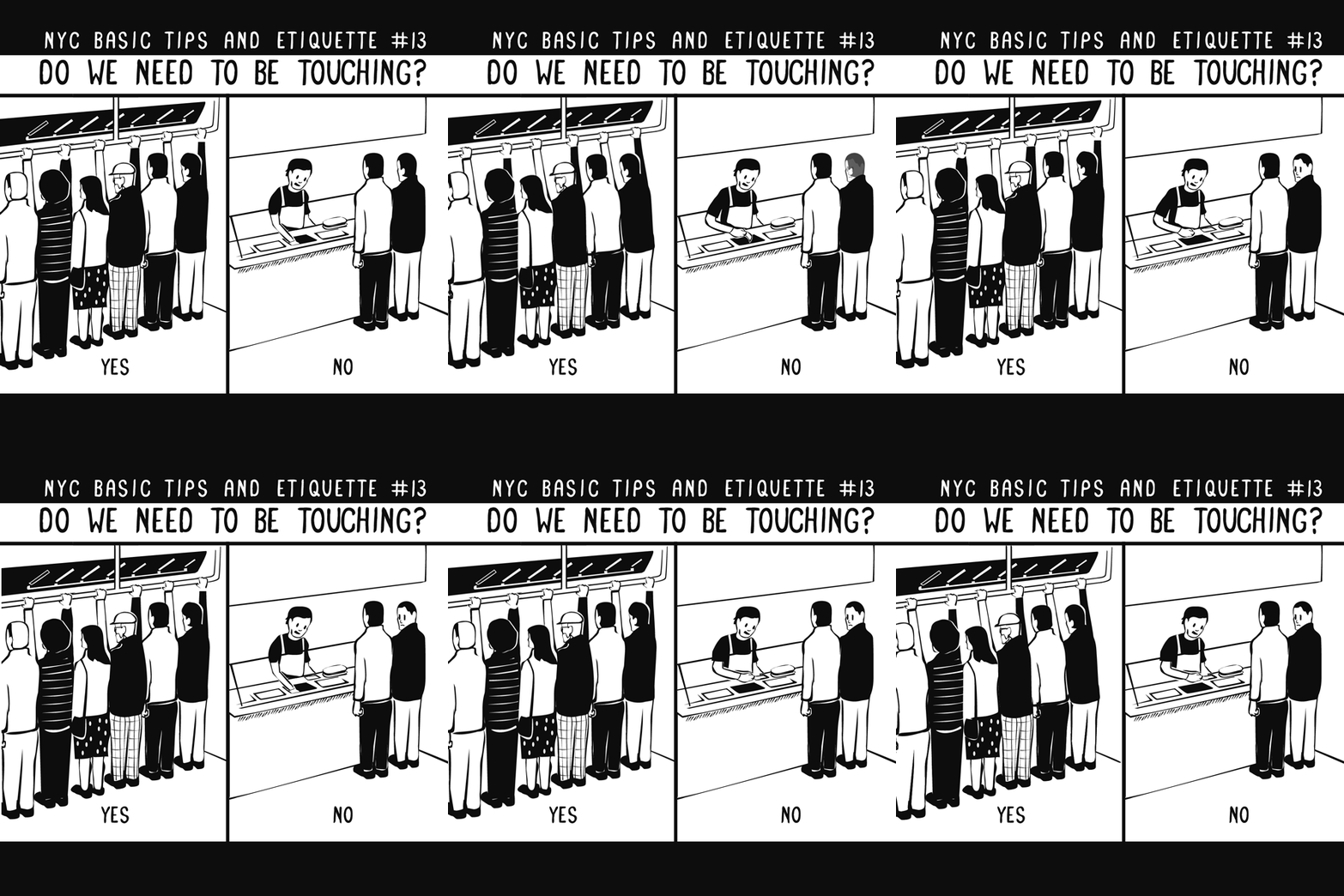
There are more here.
Aunt Pythia
——
Dear Aunt Pythia,
I came across this description of Barnard here, and it contained the following:
Because of its relationship with Columbia, Barnard has in effect no ability to govern itself. It cannot and/or will not support its own faculty. Its faculty go through two tenure processes, the first at Barnard, the second at Columbia. Columbia gets the final say. This means that even if Barnard votes to grant a beloved faculty member tenure, Columbia can still turn the person down, and the person will be fired. There have been a number of shocking well-publicized cases of this kind, and also of the type where the Barnard tenure committee will deny a faculty member tenure in anticipation or fear of a rejection by Columbia. This points to the pervasive, utterly depressing inferiority complex and Columbia-loathing (which has nothing to do with Columbia and everything to do with Barnard) which characterizes the Barnard faculty and administration as a whole. Barnard faculty have to meet Columbia’s standards for tenure, yet Barnard faculty are paid less, teach more, and do not have access to benefits including housing and access to the school for faculty children. Finally, the crowning insult: Barnard tenures fewer women than Columbia–more evidence of the institution’s crippling self-loathing complex. It doesn’t help that the place is stacked with “spousal hires,” the less-qualified wives of Columbia profs. A nice place to teach for a few years, but don’t go anywhere near the tenure process, and don’t expect any kind of collegiality.
I can’t remember, but weren’t you at Barnard for a while? Any comments on the above description?
Milly
Dear Milly,
I really liked Barnard personally. I did notice people assuming that I was only hired because they wanted my husband at the Columbia math department, but I don’t blame Barnard for that, I blame those people. And wait, I didn’t assume it exactly, they told me that with their own mouths. Assholes.
I’ll speak for myself when I say that there is a weird relationship between the two schools, and probably weirder still in the math department because it’s a combined Barnard/ Columbia department, housed at Columbia. But I never felt self-loathing personally. Even so, it’s a personality thing: if someone treats you bad, do you blame them or do you blame yourself? I blame them.
This is honestly a much bigger conversation, but the whole thing about access to Columbia resources can be traced to the relative sizes of Columbia’s endowment versus Barnard’s, which itself can be traced to the sexist practices of alums back in the day, where Columbia was male-only and a Columbia man would marry a Barnard girl, they’d get rich, and then they’d give money to Columbia. The end result is that Barnard is relatively poor.
There are various ways to address this, but sadly Barnard’s current approach is horrible and includes taking Ina Drew as a trustee in order to whore themselves for more endowment. Ew.
Auntie P
——
Aunt Pythia,
The BK from this Aunt Pythia column is almost surely not the real BK. The story sounds too close to the Belle Knox story that made CNN several weeks ago. A student at Duke who didn’t want to go into debt and feels that this society is too prudish and went into porn. Outed by classmates Duke thankfully said it has no rules about outside employment. Good for them. But I doubt she is writing mathbabe because she is going into law.
It’s a wonderful story and I do believe our views are changing about sex and porn in the USA. Albeit slowly. Yes it’s objectifying, that’s the point. Like the point of finance is to make money. But there can be morals in both industries there is just too little of them now.
You may have been punked
Dear Ymhbp,
Yes I was totally fooled, although I don’t care at all, and I stand by my advice. As for the true BK, I still worry about her, especially now that I’ve googled her name and seen how much shit she’s had to go through. I gotta say, I’m not very impressed with our views here in the USA.
Aunt Pythia
——
Please submit your well-specified, fun-loving, cleverly-abbreviated question to Aunt Pythia!
No, Sandy Pentland, let’s not optimize the status quo
It was bound to happen. Someone was inevitably going to have to write this book, entitled Social Physics, and now someone has just up and done it. Namely, Alex “Sandy” Pentland, data scientist evangelist, director of MIT’s Human Dynamics Laboratory, and co-founder of the MIT Media Lab.
A review by Nicholas Carr
This article entitled The Limits of Social Engineering, published in MIT’s Technology Review and written by Nicholas Carr (hat tip Billy Kaos) is more or less a review of the book. From the article:
Pentland argues that our greatly expanded ability to gather behavioral data will allow scientists to develop “a causal theory of social structure” and ultimately establish “a mathematical explanation for why society reacts as it does” in all manner of circumstances. As the book’s title makes clear, Pentland thinks that the social world, no less than the material world, operates according to rules. There are “statistical regularities within human movement and communication,” he writes, and once we fully understand those regularities, we’ll discover “the basic mechanisms of social interactions.”
By collecting all the data – credit card, sensor, cell phones that can pick up your moods, etc. – Pentland seems to think we can put the science into social sciences. He thinks we can predict a person like we now predict planetary motion.
OK, let’s just take a pause here to say: eeeew. How invasive does that sound? And how insulting is its premise? But wait, it gets way worse.
The next think Pentland wants to do is use micro-nudges to affect people’s actions. Like paying them to act a certain way, and exerting social and peer pressure. It’s like Nudge in overdrive.
Vomit. But also not the worst part.
Here’s the worst part about Pentland’s book, from the article:
Ultimately, Pentland argues, looking at people’s interactions through a mathematical lens will free us of time-worn notions about class and class struggle. Political and economic classes, he contends, are “oversimplified stereotypes of a fluid and overlapping matrix of peer groups.” Peer groups, unlike classes, are defined by “shared norms” rather than just “standard features such as income” or “their relationship to the means of production.” Armed with exhaustive information about individuals’ habits and associations, civic planners will be able to trace the full flow of influences that shape personal behavior. Abandoning general categories like “rich” and “poor” or “haves” and “have-nots,” we’ll be able to understand people as individuals—even if those individuals are no more than the sums of all the peer pressures and other social influences that affect them.
Kill. Me. Now.
The good news is that the author of the article, Nicholas Carr, doesn’t buy it, and makes all sorts of reasonable complaints about this theory, like privacy concerns, and structural sources of society’s ills. In fact Carr absolutely nails it (emphasis mine):
Pentland may be right that our behavior is determined largely by social norms and the influences of our peers, but what he fails to see is that those norms and influences are themselves shaped by history, politics, and economics, not to mention power and prejudice. People don’t have complete freedom in choosing their peer groups. Their choices are constrained by where they live, where they come from, how much money they have, and what they look like. A statistical model of society that ignores issues of class, that takes patterns of influence as givens rather than as historical contingencies, will tend to perpetuate existing social structures and dynamics. It will encourage us to optimize the status quo rather than challenge it.
How to see how dumb this is in two examples
This brings to mind examples of models that do or do not combat sexism.
First, the orchestra audition example: in order to avoid nepotism, they started making auditioners sit behind a sheet. The result has been way more women in orchestras.
This is a model, even if it’s not a big data model. It is the “orchestra audition” model, and the most important thing about this example is that they defined success very carefully and made it all about one thing: sound. They decided to define the requirements for the job to be “makes good sounding music” and they decided that other information, like how they look, would be by definition not used. It is explicitly non-discriminatory.
By contrast, let’s think about how most big data models work. They take historical information about successes and failures and automate them – rather than challenging their past definition of success, and making it deliberately fair, they are if anything codifying their discriminatory practices in code.
My standard made-up example of this is close to the kind of thing actually happening and being evangelized in big data. Namely, a resume sorting model that helps out HR. But, using historical training data, this model notices that women don’t fare so well historically at a the made-up company as computer programmers – they often leave after only 6 months and they never get promoted. A model will interpret that to mean they are bad employees and never look into structural causes. And moreover, as a result of this historical data, it will discard women’s resumes. Yay, big data!
Thanks, Pentland
I’m kind of glad Pentland has written such an awful book, because it gives me an enemy to rail against in this big data hype world. I don’t think most people are as far on the “big data will solve all our problems” spectrum as he is, but he and his book present a convenient target. And it honestly cannot surprise anyone that he is a successful white dude as well when he talks about how big data is going to optimize the status quo if we’d just all wear sensors to work and to bed.

Great news: InBloom is shutting down
I’m trying my hardest to resist talking about Piketty’s Capital because I haven’t read it yet, even though I’ve read a million reviews and discussions about it, and I saw him a couple of weeks ago on a panel with my buddy Suresh Naidu. Suresh, who was great on the panel, wrote up his notes here.
So I’ll hold back from talking directly about Piketty, but let me talk about one of Suresh’s big points that was inspired in part by Piketty. Namely, the fact that it’s a great time to be rich. It’s even greater now to be rich than it was in the past, even when there were similar rates of inequality. Why? Because so many things have become commodified. Here’s how Suresh puts it:
We live in a world where much more of everyday life occurs on markets, large swaths of extended family and government services have disintegrated, and we are procuring much more of everything on markets. And this is particularly bad in the US. From health care to schooling to philanthropy to politicians, we have put up everything for sale. Inequality in this world is potentially much more menacing than inequality in a less commodified world, simply because money buys so much more. This nasty complementarity of market society and income inequality maybe means that the social power of rich people is higher today than in the 1920s, and one response to increasing inequality of market income is to take more things off the market and allocate them by other means.
I think about this sometimes in the field of education in particular, and to that point I’ve got a tiny bit of good news today.
Namely, InBloom is shutting down (hat tip Linda Brown). You might not remember what InBloom is, but I blogged about this company a while back in my post Big Data and Surveillance, as well as the ongoing fight against InBloom in New York state by parents here.
The basic idea is that InBloom, which was started in cooperation with the Bill and Melinda Gates Foundation and Rupert Murdoch’s Amplify, would collect huge piles of data on students and their learning and allow third party companies to mine that data to improve learning. From this New York Times article:
InBloom aimed to streamline personalized learning — analyzing information about individual students to customize lessons to them — in public schools. It planned to collect and integrate student attendance, assessment, disciplinary and other records from disparate school-district databases, put the information in cloud storage and release it to authorized web services and apps that could help teachers track each student’s progress.
It’s not unlike the idea that Uber has, of connecting drivers with people needing rides, or that AirBNB has, of connecting people needing a room with people with rooms: they are platforms, not cab companies or hoteliers, and they can use that matchmaking status as a way to duck regulations.
The problem here is that the relevant child data protection regulation, called FERPA, is actually pretty strong, and InBloom and companies like it were largely bypassing that law, as was discovered by a Fordham Law study led by Joel Reidenberg. In particular, the study found that InBloom and other companies were offering what seemed like “free” educational services, but of course the deal really was in exchange for the children’s data, and the school officials who were agreeing to the deals had no clue as to what they were signing. The parents were bypassed completely. Much of the time the contracts were in direct violation of FERPA, but often the school officials didn’t even have copies of the contracts and hadn’t heard of FERPA.
Because of that report and other bad publicity, we saw growing resistance in New York State by parents, school board members and privacy lawyers. And thanks to that resistance, New York State Legislature recently passed a budget that prohibited state education officials from releasing student data to amalgamators like inBloom. InBloom has subsequently decided to close down.
I’m not saying that the urge to privatize education – and profit off of it – isn’t going to continue after a short pause. For that matter look at the college system. Even so, let’s take a moment to appreciate the death of one of the more egregious ideas out there.
Warning: extremely nerdy content, harmful if taken seriously
Today I’d like to share a nerd thought experiment with you people, and since many of you are already deeply nerdy, pardon me if you’ve already thought about it. Feel free – no really, I encourage you – to argue strenuously with me if I’ve misrepresented the current thinking on this. That’s why I have comments!!
It’s called the Fermi Paradox, and it’s loosely speaking a formula that relates the probability of intelligent life somewhere besides here on earth, the probability of other earth-like planets, and the fact that we haven’t been contacted by our alien neighbors.
It starts with that last thing. We haven’t been contacted by aliens, so what gives? Is it because life-sustaining planets are super rare? Or is it because they are plentiful and life, or at least intelligent life, or at least intelligent life with advanced technology, just doesn’t happen on them? Or does life happen on them but once they get intelligent they immediately kill each other with atomic weapons?
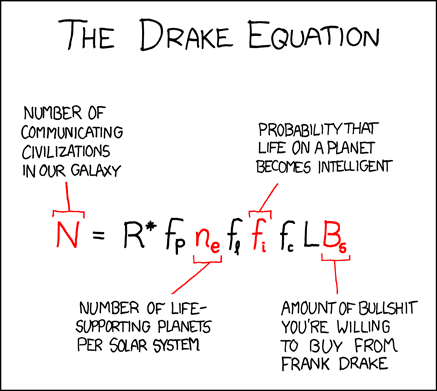
There is a supremely nerdy underlying formula to this thought experiment, which has a name – the Drake Equation. I imagine it comes in various forms but here’s one:

where:
- N = the number of civilizations in our galaxy with which radio-communication might be possible (i.e. which are on our current past light cone)
- R* = the average rate of star formation in our galaxy
- fp = the fraction of those stars that have planets
- ne = the average number of planets that can potentially support life per star that has planets
- fl = the fraction of planets that could support life that actually develop life at some point
- fi = the fraction of planets with life that actually go on to develop intelligent life (civilizations)
- fc = the fraction of civilizations that develop a technology that releases detectable signs of their existence into space
- L = the length of time for which such civilizations release detectable signals into space[8]
So the bad news (hat tip Suresh Naidu) is that, due to scientists discovering more earth-like planets recently, we’re probably all going to die soon.
Here’s the reasoning. Notice in the above equation that N is the product of a bunch of things. If N doesn’t change but our estimate of one of those terms goes up or down, then the other terms have to go down or up to compensate. And since finding a bunch of earth-like planets increases some combination of R*, fp, and ne, we need to compensate with some combination of the other terms. But if you look at them the most obvious choice is L, the length of time civilizations release detectable signals into space.
And I say “most obvious” because it makes the thought experiment more fun that way. Also we exist as proof that some planets do develop intelligent life with the technology to send out signals into space but we have no idea how long we’ll last.
Anyhoo, not sure if there are actionable items here except for maybe deciding to stop looking for earth-like planets, or deciding to stop emitting signals to other planets so we can claim other aliens didn’t obliterate themselves, they were simply “too busy” to call us (we need another term which represents the probability of the invention of Candy Crush Saga!!!). Or maybe they took a look from afar and saw reality TV and decided we weren’t ready, a kind of updated Star Trek first contact kind of theory.
Update: I can’t believe I didn’t add an xkcd comic to this, my bad. Here’s one (hat tip Suresh Naidu):
Aunt Pythia’s advice
Beep, beep! The nerd advice column bus is here, and impatient to start. Aunt Pythia is driving that nerd advice column bus. Cool? Are we getting the imagery? Also, the bus is painted in bright colors and has plastic flowers glued on to it in all sizes and fashions. It’s kind of a psychedelic hippy nerd advice column bus. And it’s rarin’ to go. There might be tinted windows too, not sure. Wait, yes there are, a few, in the back. Who knows what’s going on in there. I hear there’s a mini fridge and a couch back there too, but that was just a rumor.
After riding in – and exploring – Aunt Pythia’s spacious bus, please:
think of something to ask Aunt Pythia at the bottom of the page!
By the way, if you don’t know what the hell Aunt Pythia is talking about, go here for past advice columns and here for an explanation of the name Pythia.
——
Aunt Pythia,
How do I deal with the possibility that my skills as a scientist will become less hot?
I just defended and got an awesome technical staff gig. There is some grinding, and some research. I’m trying to stay published although I don’t want to ever be a professor. But there were hot spots of research I could see coming up as I was writing my dissertation, and neat projects underway with the new grad students using techniques I never practiced. We could hire some of them soon.
I’m afraid of being pigeon-holed to do exactly what I did in grad school, but I also don’t know how wide to spread myself; especially since I am now working with other professionals who (although not in my field) have spent years doing what I would be learning, and might more reasonably be assigned much of the task.
If I am a smart, capable researcher with good connections now, will I always be? Will I be discarded in 5y for some young, hot thang? Will my salary always beat inflation?
Crisis Of Narcissism
Dear CON,
Stay connected, go to interesting talks, don’t be an asshole, ask good questions, be generous to others, prevent yourself from stewing in jealousy, and you’ll be fine. Or else you won’t be fine because the whole economy blows up, but then it’s a crisis for everyone. I’m not worried about you in particular.
Aunt Pythia
——
Dear Aunt Pythia,
Please excuse my bad manners when I addressed you by your first name sans the kinship relation. I vow to be a better nephew in the future! 🙂
Glad my reply to your reply about fairness rankings provided a good rant opening for you (on America’s outrageous prison system). Yes, I think the relative chance of not being incarcerated for an action that under law can bring incarceration, and other probabilities like it, would make a great start towards an overall fairness measure. If possible I’d also like to measure how fair the laws and legal system are to begin with. The sheer number of laws on the books would probably play a role in this, but since this number is partly just a reflection of societal complexity, there would need to be more.
Yours,
Elvis Von Essende Nicholas Friedrich Lester Otto Widener IV
Dear EVENFLOW IV,
Do you know what you (and everyone else on the bus) need(s) to do? Read The New Jim Crow. I just finished it. Devastating.
One of her major points is that the rules and laws are often colorblind or otherwise written to be fair, but they are not deployed in a fair manner. Specifically low-level drug charges are hugely discriminatory and largely responsible for the mass incarceration of so many black men that we’ve grown accustomed to during the last 25 year of the so-called War on Drugs.
In other words, the official rulebooks are rarely on their face unfair. The system has grown smarter than that. It’s an argument for understanding effective racism rather than deliberate racism, for example, by measuring outcomes.
Of course there are other ways to be unfair as well besides race, but I’m fairly convinced this is the biggie.
Aunt Pythia
——
Dear Aunt Pythia,
I am a undergrad in mathematics and want want to pursue research in pure mathematics. I claim no evidence for any exceptional ability in math and I wanna do it because I like it.
First of all the choice of Math as a major was rather criticized from where I come from (they are more into engineering). So I looked up for the opportunities for a math grad and realized that they are immense. But rather alarmingly I came to know that the recent opportunities in math are almost exclusively in Applied Math.
I would like to know if indeed there exist a place for someone average (in contrast to the math geniuses out there) to do pure math research and get a well-to-do job?
I never wanted a very high paying and demanding job. Just a simple one where I could be happy and free and won’t have to worry about my employment in near future.
Hoping that you would understand,
Thanking you,
A math undergrad
Dear math undergrad,
Very few people get paid to simply think about pure math. It’s a fact. Even professors are expected to teach. The exceptions are the faculty at the Institute for Advanced Study. There aren’t very many of those.
So, I’m glad you like math, but the chances that you’re going to get a well-to-do job thinking about pure math when you’re not particularly talented at math are slim. Of course, you might be wrong, and you might be super talented at math. People are notoriously bad at knowing that kind of thing because they get distracted with things like social expectations and shitty timed math tests.
But let me take your word for it for the sake of the argument, that you’re into math but not very good at it. Actually I’ll assume you’re pretty good at it but not super top-notch. In that case I suggest you think about getting a job that allows you to pair your love for pure math research with something else, like teaching (of course you have to be quite good at math to teach it but there are different levels), or doing basic analysis in industry (i.e. applied math). There are lots of jobs that fall into this category, so don’t despair. Check them out with an open mind, many of them are very interesting. And good luck!
Aunt Pythia
——
Dear Aunt Pythia,
What is this preoccupation with size? There’s any number of baseless articles, in silly magazines, implying (or worse, stating) some link between hand – genital – finger – brain – height – etc, with some aspect of sexual prowess – desirability – ability – intention – inclination.
And now the silliness has spread, zombie-like, to your readers!
So, how would one go about showing a correlation between gullibility and inconsequential ideas?
Satisfied in Melbourne
Dear SiM,
I think of this stuff as pure entertainment. People just want to talk about sex because they like sex and, although they can’t just have sex with random people (or so they think), they can strike up a ridiculous conversation about the relationship between hands and genitals. I’ll speak for myself when I say that I do that because I actually just want to talk about genitals. There, I said it, my secret’s out. Everybody knew that already. That’s why I blog.
It reminds me of the debate on pubic hair and shaving (or not shaving: Bush is Back, Baby). At the worst moment this seems like yet another oppressive patriarchal scheme to infantilize women. On the other hand, I’ve never heard of a man who, when actually confronted with copious hair, has refused to go along with it. So I’m tempted to think that for most men, and most of the time, it’s just an excuse to think about genitals rather than an oppressive scheme.
I mean, it’s both, but this morning I’m feeling generous.
In terms of the relationship between gullibility and inconsequential ideas, I think that’s the wrong question. We should really be thinking about the relationship between insecurity and inconsequential ideas, and we should use as the prime example the beauty industry. First they make us insecure, then we obsess over trivial and inconsequential things. But it’s insecurity that makes us gullible.
Aunt Pythia
——
Please submit your well-specified, fun-loving, cleverly-abbreviated question to Aunt Pythia!
Is math an art or a science?
I left academic math in 2007, but I still identify as a mathematician. That’s just how I think about the world, through a mathematician’s mindset, whatever that means.
Wait what does that mean? How do I characterize the mathematician’s mindset? I’ve struggled in the past to try, but a few days ago, a part of it got a little bit easier.
I was talking to my friend Matt Jones – an historian of science, actually – about the turf wars inside computer science surrounding functional versus object oriented programming. It seems like questions about which one is better or when is one more appropriate than the other have become so political that they are no longer inside the scientifically acceptable realm.
But that kind of reminded me of the turf war of the bayesian versus frequentist statisticians. Or the fresh water versus salt water economists. Or possibly the string theorists versus the non-string theorists in physics.
What’s going on in all of those fields, as best I can understand, is that different groups within the field have different assumptions about what the field may assume and what it’s trying to accomplish, and they fight over the validity of those sets of assumptions. The fights themselves, which are often emotional and brutal, expose the underlying assumptions in certain ways. Matt told me that historians often get at a fields assumptions through these wars.
Here’s the thing, though, math doesn’t have that. I’m not saying there are no turf wars at all in math, there certainly are, but they aren’t political in nature exactly. They are aesthetic.
In the context of mathematics, where nothing can be considered truly inappropriate as long as the assumptions are clear, it’s all about whether something is beautiful or important, not whether it is valid. Validity has no place in mathematics per se, which plays games with logical rules and constructs. I could go off an build a weird but internally logical universe on my own, and no mathematician would complain it’s invalid, they’d only complain it’s unimportant if it doesn’t tie back to their field and help them prove a theorem.
I claim that this turf war issue is a characterizing issue of the field of mathematics versus the other sciences, and makes it more of an art than a science.
To finish my argument I’d need to understand more about how artistic fields fight, and in particular that their internally hurled insults focus more on aesthetics than on validity, say in composition or painting. I can’t imagine it otherwise, but who knows. Readers, please chime in with evidence in either direction.


 mathbabe