#Occupy Wall Street course at Columbia University: update
I wrote this post a few days ago after I found an announcement of a Columbia University course on Occupy Wall Street. Unfortunately it looks like the course is not going to be held (according to Bwog).
However, it does look like NYU is going to offer an #OWS course, according to this article in the Gothamist.
Who the hell is buying European debt?
I’m a bit confused about the “successful” European sovereign debt auctions we’ve been hearing about lately.
If I’m a European bank, say in Italy, Spain, or Portugal, or maybe even France, then about 10 months ago or so I’d be buying all the sovereign debt of my own country that I can get or that my country wants me to, because I’d figure, hey we’re in the same boat- if my country defaults then we’re going down, probably exorcised from the Euro zone.
But nowadays, because of Greece’s example, it seems increasingly likely that a country could default on its bonds, and if orderly (and “voluntary”), the country gets to stay in the Euro zone and the banks get to live on- if they can.
So if I’m a European bank now in a peripheral country, I’m going to try to stay solvent in the case of my country’s default. And I don’t even need to be completely solvent, I just need to be more solvent than most of the other banks in my country, because, especially if the Euro zone does stay intact, they probably won’t allow all the banks to fail, but they might easily let the weakest banks fail.
Wouldn’t that reasoning mean I’d avoid buying my country’s crappy debt? So why is crappy debt bought at all anymore? I realize that the yields are high, but I don’t think they’re high enough, and I just don’t get it. Maybe I’m being dumb. Here are the possibilities as I see them:
- I’m exaggerating the problem altogether, and the debt is actually fairly priced and not so risky. In answer to this let me quote Princeton economist Alan Blinder, a former U.S. Federal Reserve vice chairman, in this Wall Street Journal article about what to worry about in 2012: “Europe is absolutely my No. 1 concern. It is so far in the lead I can’t think of what my No. 2 concern is.”
- The governments are putting backroom pressure on the banks to buy their debt. This seems quite probable. I definitely get the impression that there’s real politics behind the accumulation of Greek debt in French banks, for example, because otherwise the enormous holdings in BNP Paribas and others is frankly impenetrable, and certainly not in the interest of the bank itself.
- There is some short or medium term gaming of the system going on right now, using the ECB’s recent action to restore “liquidity” in order to look better. Specifically, we have this quote from Bill Gross of PIMCO: “Amazingly, Italian banks are now issuing state guaranteed paper to obtain funds from the European Central Bank (ECB) and then reinvesting the proceeds into Italian bonds, which is QE by any definition and near Ponzi by another.”
- Actually, the next time peripheral countries issue debt nobody will show up to buy it.
I’d love to hear comments from people who have different theories.
It takes imagination to be boring
I suffer from a lack of imagination.
I have been so inculcated in the necessary complexity of finance and banking, that I’ve lost touch with some basic, simple realities. I have been brainwashed by the half-assed and lame attempts at regulation by the elements of the Dodd-Frank bill, losing myself in the details of the Volcker Rule for example, and I’ve lost the forest for the trees. I’m spending my time furiously figuring out how to allow banks to have all of their goodies (CDS, derivatives, repos, etc.), but not let them eat so much they get themselves (and us) sick.
Sometimes you need imagination to be boring.
Luckily, there was an op-ed article in the New York Times yesterday which served as a wake-up call. The article is called “Bring Back Boring Banks” and it’s written by Amar Bhide. I kind of feel like quoting the entire article, since it’s all so good, but I’ll make do with this part (emphasis mine):
Guaranteeing all bank accounts would pave the way for reinstating interest-rate caps, ending the competition for fickle yield-chasers that helps set off credit booms and busts. (Banks vie with one another to attract wholesale depositors by paying higher rates, and are then impelled to take greater risks to be able to pay the higher rates.) Stringent limits on the activities of banks would be even more crucial. If people thought that losses were likely to be unbearable, guarantees would be useless.
Banks must therefore be restricted to those activities, like making traditional loans and simple hedging operations, that a regulator of average education and intelligence can monitor. If the average examiner can’t understand it, it shouldn’t be allowed. Giant banks that are mega-receptacles for hot deposits would have to cease opaque activities that regulators cannot realistically examine and that top executives cannot control. Tighter regulation would drastically reduce the assets in money-market mutual funds and even put many out of business. Other, more mysterious denizens of the shadow banking world, from tender option bonds to asset-backed commercial paper, would also shrivel.
This is what we need to do. Thank you Amar Bhide, for having the clarity to say it.
Politics of teacher pay disguised as data science
I am super riled up about this report coming out of the Heritage Foundation. It’s part of a general trend of disguising a political agenda as data science. For some reason, this seems especially true in education.
The report claims to prove that public school teachers are overpaid. As proof of its true political goals, let me highlight a screen shot of the “summary” page (which has no technical details of the methods in the paper):
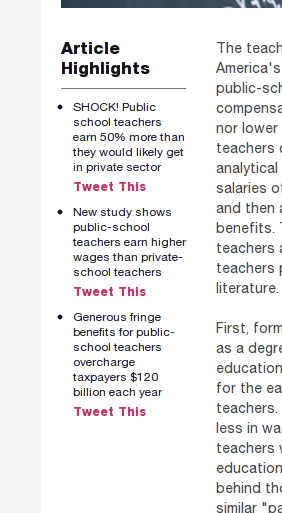
I’m sorry, but are you pre-writing my tweets for me now? Are you seriously suggesting that you have investigated the issue of public school teacher pay in an unbiased and professional manner with those pre-written tweets, Heritage Foundation?
If you read the report, which I haven’t had time to really do yet, you will notice how few equations there are, and how many words. I’m not saying that you need equations to explain math, but it sure helps when your goal is to be precise.
And I’d also like to say, shame on you, New York Times, for your coverage of this. You allow the voices of the authors, from the American Enterprise Institute and the Heritage Foundation, as well as another political voice from the Reason Foundation. But you didn’t ask a data scientist to look at the underlying method.
The truth is, you can make the numbers say whatever you want, and good data scientists (or quants, or statisticians) know this. The stuff they write in their report is almost certainly not the whole story, and it’s obviously politically motivated. I’d love to be hired to research their research and see what kind of similar results they’ve left out of the final paper.
Ken Ribet’s love note from Serge Lang
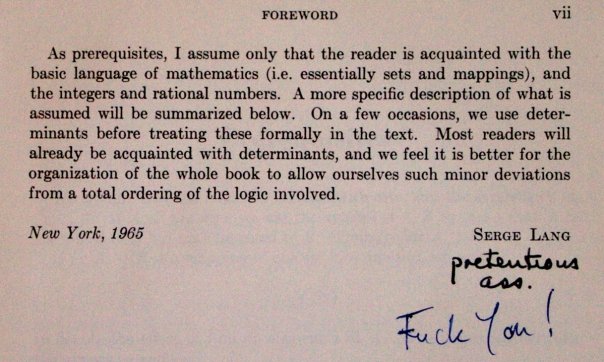
I took at graduate algebra course at Brown when I was an undergraduate. I bought a copy of Lang’s “Algebra,” 3rd edition around that time. It was the bible of graduate algebra, and I suppose that it still is. When I was at Harvard, I studied very hard for the written qualifying exam that we sat for at the end of our first year of graduate work. I spent months mastering the core material in algebra, topology and analysis. I got a little frustrated by Lang’s style and wrote the comment that you see in black ink. Years later, Serge had my office in Princeton while I was away in Paris. As usual, he consulted his own books, and he found my comment. He added his own (bottom of the page) and told me about it when I returned to the US. We both had a good laugh.
I was amazed, years later, when a German mathematician asked me about this page when we were at the Canadian number theory meeting in Vancouver — this must have been 20 years ago. How did the guy know? Serge or I must have talked, and word had gotten around.
—-
I made this image in July, 2001 by pointing my first digital camera at the page and pressing the shutter. Serge was in town, and I told him that I wanted to link this image to the web page for the graduate algebra course (Math 250A) that I was about to teach. That way the students could see it. “Of course!” As the semester progressed, mathematicians around the world found out about the link on my web page and began forwarding the URL to their friends. One day Serge phoned me in my office: “You mean anyone in the world can see this? Take it down!!” So I did.
Differential privacy
Do you know what’s awesome about writing a blog? Sometimes you’re left with a technical question, and someone with the technical answer comes right along and comments. It’s like magic.
That’s what happened to me when I wrote a post about privacy vs. openness and suggested that the world needs more people to think about anonymizing data. Along comes Aaron Roth who explains to me that the world is already doing that. Cool!
He sent me a few links to survey articles (here and here) on a concept called differential privacy. The truth is, though, I got confused and ended up just reading the wikipedia entry on it anyway.
The setup is that there is some data, stored in a database, and there’s some “release mechanism” that allows outside users to ask questions about the data- this is called querying for a statistic. Each row of the data is assumed to be associated with a person, so for example could contain their test scores on some medical test, as well as other private information that identifies them.
The basic question is, how can we set up the mechanism so that the users can get as much useful information as possible while never exposing an individual’s information?
Actually the exact condition posed is even a bit more nuanced: how can we set up the mechanism so that any individual, whether they are in the database or not, is indifferent to being taken out or added?
This is a kind of information theory question, and it’s tricky. First they define a metric of information loss or gain when you take out exactly one person from the database- how much do the resulting statistics change? Do they change enough for the outside user to infer (with confidence) what the statistics were for that lost record? If so, not good.
For example, if the user queries for the mean test score of a population with and without a given record (call the associated person the “flip-flopper” (my term)), and gets the exact answer both times, and knows how many people were in the population (besides the flip-flopper), then the user could figure out the exact test score of the flip-flopper.
One example of making this harder for the user, which is a bad one for a reason I’ll explain shortly, is to independently “add noise” to a given statistic after computing it. Then the answers aren’t exact in either case, so you’d have a low confidence in your resulting guess at the test score of the flip-flopper, assuming of course that the population is large and their test score isn’t a huge outlier.
But this is a crappy solution in the sense that I originally wanted to use an anonymization method for, namely to set up an open source data center to allow outside users (i.e. you) go query to their hearts’ content. A given user could simply query the same thing over and over, and after a million queries (depending on how much noise we’ve added) would get a very good approximation of the actual answer (i.e. the actual average test score). The added noise would be canceled out.
So instead, you’d have to add noise in a different way, i.e. not independently, to each statistic. Another possibility is to add noise to the original data, but that doesn’t feel as good to me, especially for the privacy of outliers, unless the noise is really noisy. But then again maybe that’s exactly what you do, so that any individual’s numbers are obfuscated but on a large enough scale you have a good sense of the statistics. I’ll have to learn more about it.
Aaron offered another possibility which I haven’t really understood yet, namely for the mechanism to be stateful. In fact I’m not sure what that means, but it seems to have something to do with it being aware of other databases. I’ve still got lots more to learn, obviously, which is exactly how I like to feel about interesting things.
#Occupy Wall Street course at Columbia University
Columbia University’s Anthropology department is offering a course on #Occupy Wall Street. You can see clever announcements in this Gothamist article and this Bwog post.
I’ve already contacted the instructor, Hannah Appel, and invited her students to join the Alternative Banking Working Group on Sunday afternoons. She seems very psyched to join us and have her students join us. Here’s the syllabus for her course.
Please spread the word about our working group. We are working on lots of different projects around reforming the current financial system. You don’t need to be an expert in finance to come.
The sin of debt (part 3)
I wrote here about the way normal people who are in debt are imbued with the stigma of immorality, whereas corporations are applauded for debt (and even for declaring bankruptcy). I admit that my second post, which contained outrageous examples of the ideas in the first post, was rather frustrated, because I had little in the way of solutions. I like to propose solutions rather than just point out problems.
First, I’ve got some good news. Namely, as described in this Wall Street Journal article, a judge has ruled that the debt collection agency harassing an elderly woman for her dead husband’s debt was indeed harassment. From the article:
The case could set a precedent across the U.S. and discourage lenders from using collectors to get money from surviving relatives on debts left behind by the deceased, according to other state-court judges.
That’s something!
Next, I’ve been discussing the language of debt with various people and we’ve come up with a plan. This language issue was the main point of my first post: the words we use make individuals feel dirty when they are indebted, but sanitizes the concept of debt for corporations (“restructuring”).
Let’s turn this around. Let’s come up with our own vocabulary to separate the issues and also to point out what brings people into debt in the first place. We’ve come up with three proposed vocabulary terms to add to the discourse:
- Poisonous debt: this is debt that comes from actually fraudulent lenders, or who lent to vulnerable people under false pretenses. Actually existing laws should be taking care of these things, but the problem is of course that people who are in massive amounts of debt typically don’t have good lawyers.
- Debt under duress: this term should refer to debt that people incur in emergency situations, like medical emergencies, divorces, or funerals. Elizabeth Warren has done a lot of work describing how many families in serious money trouble got there with exactly this kind of situational debt.
- School system debt: the school system in this country is inconsistent, which causes enormous competition for families to buy a house in a good school district, often buying houses they can’t quite afford for the sake of their childrens’ educations. This is well-documented and, for any individual, totally understandable.
What I like about the above terms is that they separate the people who take on the debt from the reasons they take on the debt. Anyone can relate to the above reasons, and when that happens, a sympathy, rather than a moral judgement, emerges. If I hear someone has taken on debt under duress, I immediately want to know if they’re ok.
They also provide a much-needed balance to the typical argument you hear against people who bristle at the idea of debt amnesty, namely the concept of free-loaders milking the system for cheap cash to spend on unnecessary trinkets and then not paying it back.
If you understand the extent to which people are in debt because of health issues, your response may be something more like, hey we should really make the health care system in this country more reasonable. In other words, it starts a much more interesting and potentially useful conversation than mere finger wagging.
A New Year’s resolution you can keep
Ladies, I know what you’re thinking. But don’t do it. If you need any more proof of the impossibility of losing weight, look no further than this New York Times article which describes it in excruciating, painful detail.
But that’s not even my angle. I’m not going to argue that you shouldn’t try to lose weight because it’s so hard. In fact, it’s possible for some people, as the article describes, as long as they are willing to think about nothing else for the rest of their life. But in fact, even if it wasn’t hard, even if it was an achievable goal, I’d still be arguing against it.
My angle is this: it’s just not interesting enough. You have better things to do than devote yourself to vanity. And plus, I’ve said it before and I’ll say it again, sexy is something you do, not something you look like.
Do you know how boring those people must be who think about food all the time? Have you ever spent time, real time, with someone who is singularly obsessed with food or exercise? I got news for you, if you haven’t, it’s insanely boring. They can only talk about their plan and how it’s going. And I’ve got news for you if you’re one of those people: you are insanely boring.
Get a hobby that involves other people, that gives you a higher sense of purpose. If you’re a lefty, join your local Occupy Wall Street group. Start writing a blog. Start a book club. Read stuff.
Do you know, I’ve heard this story, that some pollster asked a bunch of people what they’d do if they could do anything. It was left as an open question like that, if you could do anything, what would you do? And the majority of women said they’d lose weight (on average 10 pounds). WHAT?! They could have mentioned closing the income gap? Stopping wars? Improving climate change? Making sure people everywhere had access to clean water? And they chose to lose freaking 10 pounds, are you kidding me?
Actually it’s probably a myth, but it doesn’t really matter, because I believe it. And looking around at the world we live in, with all of the ridiculous assumptions of vanity and, what gets me even more riled up, time spent on crap like that, I can believe that women are typically so bombarded with self-image issues that they can’t think beyond them to bigger issues like wars and clean water and global warming. WTF, culture??
So my New Year’s resolution this year is to fight back against that crap. I’m starting today, one day early, by writing this post. Can I get a fuck yeah?!
I am officially out of the fat ladies’ closet, in full armor, ready to fight against that idea that we have any time to waste with vanity. We have way too much to do, ladies (and gentlemen), and not enough time to do it all. Let’s start now. For starters, I’m going to start to emulate a woman I read about a few years ago on Overheard in New York: “Mom, yeah, I got a Ph.D., I live in my own apartment in Manhattan, and I’ve got a fat ass. How about it?”
I am not ranting against humanity here. I think humanity can be great. But not when our culture is encouraging us to gaze at our navels. We need to actively create greatness, which we can do, but it takes thinking beyond ourselves and asking, what do I really want to do this year?
Matt Stoller explains politics
I’ve never understood politics, partly because they’re complicated, partly because the people who do understand politics are so heavily involved they don’t know how to contextualize for people like me. I’ve come to think of it as a lot like finance, where there’s power to be had by withholding information, and part of that power is wielded simply by inventing a new vocabulary that makes people on the outside feel tired and hopeless. You really need a tour guide, a translator, to walk you through stuff to achieve a decent level of understanding.
I now consider Matt Stoller my personal translator. Matt regularly contributes to Naked Capitalism, my go-to blog for informed, vitriolic insights into the corrupt world of finance. His recent post on Naked Capitalism concerning Ron Paul and liberals beautifully explains how confused modern liberals are when confronted by someone like Ron Paul, who is both unattractive and on their side for a number of reasons. I confess that I’ve been that confused liberal myself at many an #OWS Alternative Banking Working Group meeting, when the Ron Paul fans come and talk about Fed transparency.
But Matt doesn’t just tell a good story, although he does that. He also give you insight into the process of politics. He peppers his story with helpful, nerdy explanations like this:
An old Congressional hand once told me, and then drilled into my head, that every Congressional office is motivated by three overlapping forces – policy, politics, and procedure. And this is true as far as it goes. An obscure redistricting of two Democrats into one district that will take place in three years could be the motivating horse-trade in a decision about whether an important amendment makes it to the floor, or a possible opening of a highly coveted committee slot on Appropriations due to a retirement might cause a policy breach among leadership. Depending on committee rules, a Sub-Committee chairman might have to get permission from a ranking member or Committee Chairman to issue a subpoena, sometimes he might not, and sometimes he doesn’t even have to tell his political opposition about it. Congress is endlessly complex, because complexity can be a useful tool in wielding power without scrutiny. And every office has a different informal matrix, so you have to approach each of them differently.
Another recent Stoller post that really blew my mind was How the Federal Reserve Fights, which explained Matt’s experiences as a Senior Policy Advisor to Alan Grayson, a congressman on the Financial Services Committee in 2009-2011. Grayson teamed up with Ron Paul to force more transparency at the Fed. It’s an awesome story, but my favorite part, because I’m such a nerd and I love my nerd heroes, is the following:
When it gets down to crunch time, as a staffer going up against a big force of lots of lawyers, you get really tired and cut corners. One obstacle in legislating is that it is really hard to tell what bills do, because they have multiple provisions like “In Section 203, delete “do” and replace with “shall”. You have to constantly reference pieces of the code and compare changes, which gets confusing. It’s like doing “track changes”, but on paper and with multiple versions. This is a problem software could easily solve and I’ve heard that agencies and (probably the Fed) have such software. But I didn’t. So the Fed thought we would do nothing more than cursory reading of Watt’s amendment, and rely on their validators who told us the amendment would increase transparency. And this is where Grayson showed legislative genius. We were exhausted, but he got all the difference pieces of the law, and spent a few hours deciphering exactly what this amendment meant. And he figured out that not only did the amendment not open up the Fed facilities to independent inspection, it actually increased the secrecy of the Fed. If you want the gory details, here’s Grayson’s argument during the markup.
I’m kind of wishing Matt Stoller would write a book about “How Politics Works,” but then again does anybody read books anymore? Is it better for him to just continue to write timely blog posts? I’ll take what I can get.
Information loss
When people ask me why the financial system is so complicated, I always say the same thing: because it benefits the insiders of the financial system to make it that way. The more complicated and opaque something is, the more opportunities to extract fees and withhold information. Or rather, to withhold information in order to extract fees.
In some sense you can think of the financial system as a huge “information loss” system, where people get paid based on how much more information they know than you do. Incidentally, this theory flies in the face of most economic assumptions of transparency, and explains the origin of the phrase “dumb money.” And it’s not my idea, it’s kind of an elemental fact for insiders; I’m bringing it up because I want to make sure people are aware of it.
As an analogy, think of the situation when you buy a used car from someone. They tell you some things, like its make and model, and they may let you test drive it, but you end up not knowing how many accidents it’s been in, and stuff like that. Your partial information in general lets them make money.
It’s kind of understandable why there’s so much insider trading going on. Insider trading is the ultimate and most efficient way to profit from information.
Another good example of information loss is with mortgages, and mortgage-backed securities. The original idea behind securitizing mortgages was that investors get to buy pieces of pools of mortgages, which “behave better” than individual mortgages: whereas an individual can refinance (and often does, when interest rates go down) or default, it’s less likely that a majority of the people in a pool refinance or default.
[Let’s ignore for now the issue that the banks got so high on the profits of securitization that the assumption of better behavior of pools got thrown out the window as the underlying mortgages became worse and worse – a gleaming example of information loss.]
In selling these pools, the banks were charging fees so that you, the investor, wouldn’t have to “deal with the details” of all of the individual mortgages in the pool. This is one way that people withhold information and charge a fee for it, by calling it a chore.
And it is a chore, if you actually do it. However, in the case of mortgages, lots of banks charged that fee for that chore and then never actually did the chore– they kept terrible accounts of the mortgages, and when they started to default in large numbers, started illegally pretending their papers were in order, through “robo-signing,” in order to foreclose quickly.
Here’s something you can do if you have a mortgage. Demand to see your mortgage note. It turns out there’s a legal way for you to ask your bank to trace the ownership of your mortgage through the securitization system, and you can do it for fun, you don’t need to be late on your mortgage payments or anything.
There does seem to be a risk associated with asking to see your note, however, namely to your credit score, which is bullshit. There’s also a form letter of complaint if your bank somehow doesn’t come up with the answer.
Economist versus quant
There’s an uneasy relationship between economists and quants. Part of this stems from the fact that each discounts what the other is really good at.
Namely, quants are good at modeling, whereas economists generally are not (I’m sure there are exceptions to this rule, so my apologies to those economists who are excellent modelers); they either oversimplify to the point of uselessness, or they add terms to their models until everything works but by then the models could predict anything. Their worst data scientist flaw, however, is the confidence they have, and that they project, in their overfit models. Please see this post for examples of that overconfidence.
On the other hand, economists are good at big-picture thinking, and are really really good at politics and influence, whereas most quants are incapable of those things, partly because quants are hyper aware of what they don’t know (which makes them good modelers), and partly because they are huge nerds (apologies to those quants who have perspective and can schmooze).
Economists run the Fed, they suggest policy to politicians, and generally speaking nobody else has a plan so they get heard. The sideline show of the two different schools of mainstream economics constantly at war with each other doesn’t lend credence to their profession (in fact I consider it a false dichotomy altogether) but again, who else has the balls and the influence to make a political suggestion? Not quants. They basically wait for the system to be set up and then figure out how to profit.
I’m not suggesting that they team up so that economists can teach quants how to influence people more. That would be really scary. However, it would be nice to team up so that the underlying economic model is either reasonably adjusted to the data, or discarded, and where the confidence of the model’s predictions is better known.
To that end, Cosma Shalizi is already hard at work.
Generally speaking, economic models are ripe for an overhaul. Let’s get open source modeling set up, there’s no time to lose. For example, in the name of opening up the Fed, I’d love to see their unemployment prediction model be released to the public, along with the data used to train it, and along with a metric of success that we can use to compare it to other unemployment models.
Is Stop, Question and Frisk racist?
A few weeks ago I was a “data wrangler” at the first Data Without Borders datadive weekend. My group of volunteer data scientists was exploring the NYPD “Stop, Question and Frisk” data from the previous few years. I blogged about it here and here.
One thing we were interested in exploring was the extent to which this policy, whereby people can be stopped, questioned, and frisked for merely looking suspicious (to the cops) is racist. This is what I said in my second post:
We read Gelman, Fagan and Kiss’s article about using the Stop and Frisk data to understand racial profiling, with the idea that we could test it out on more data or modify their methodology to slightly change the goal. However, they used crime statistics data that we don’t have and can’t find and which are essential to a good study.
As an example of how crucial crime data like this is, if you hear the statement, “10% of the people living in this community are black but 50% of the people stopped and frisked are black,” it sounds pretty damning, but if you add “50% of crimes are committed by blacks” then it sound less so. We need that data for the purpose of analysis.
Why is crime statistics data so hard to find? If you go to NYPD’s site and search for crime statistics, you get really very little information, which is not broken down by area (never mind x and y coordinates) or ethnicity. That stuff should be publicly available. In any case it’s interesting that the Stop and Frisk data is but the crime stats data isn’t.
I still think it is outrageous that we don’t have open source crime statistics in New York, where Bloomberg claims to be such a friend to data and to openness.
And I also still think that, in order to prove racism in the strict sense of the above discussion, we need that data.
However, my overall opinion has changed about whether we have enough data already to say if this policy is broadly racist. It is. My mind changed reading this article from the New York Times a couple of weeks ago. It was written by a young black man from New York, describing his experiences first-hand being stopped, questioned, and frisked. The entire article is excellently written and you should take a look; here’s an excerpt:
For young people in my neighborhood, getting stopped and frisked is a rite of passage. We expect the police to jump us at any moment. We know the rules: don’t run and don’t try to explain, because speaking up for yourself might get you arrested or worse. And we all feel the same way — degraded, harassed, violated and criminalized because we’re black or Latino. Have I been stopped more than the average young black person? I don’t know, but I look like a zillion other people on the street. And we’re all just trying to live our lives.
The argument for this policy is that it improves crime statistics. For some people, especially if they aren’t young and aren’t constant targets of the policy, it’s probably a price worth paying to live in a less crime-ridden area.
And we all want there to be less crime, of course, but what we really want is something even more fundamental, which is a high quality of life. Part of that is not being victimized by crooks, but another part of that is not being (singled out and) victimized by authority either.
I think a good thought experiment is to consider how they could make the policy colorblind. One obvious way is to have cops in every neighborhood performing stop, question and frisk to random people. The argument against this is, of course, that we don’t have enough cops or enough money to do something like that.
Instead, to be more realistic about resources, we could have groups of cops randomly be assigned to neighborhoods on a given day for such stops. If you think the policy is such a good crime deterrent, than you can even weight the probability of a given neighborhood by the crime rate in that neighborhood. (As an aside, I would love to see whether there’s statistically significant reason to believe that this policy does, in fact, deter crime. So often mayors and policies take credit for lowered crime rates in a given city when in fact crime rates are going down all over the country in a kind of seasonality way.) So in this model the cops are more likely to land in a high-crime area, but eventually by the laws of statistics they will visit every neighborhood.
My guess is that, the very first time the Upper East Side is chosen randomly, and a white hedge fund manager is stopped, questioned, and frisked by a cop, who takes away his key and enters his apartment, terrorizing his family while he’s handcuffed in the back of a cop car, is the very last day this policy is in place.
A good data scientist is hard to find
As a data scientist at an internet start-up, I am something of a quantitative handyman. I go where there is need for quantitative thinking. Since the business model of my company is super quantitative, this means I have lots of work. I have recently categorized the kind of things I do into 4 bins:
- I visualize data for business people to digest. This is a kind of fancy data science-y way of saying I design reports. It’s actually a hugely critical part of the business, since our clients are less quantitative than we are and need to feel like they understand the situation, so clear, honest, and easily digestible visuals is a priority.
- I forecast behavior using models. This means I forecast what users on a website will do, based on their attributes and historical precedent for what people who shared their attributes did in the past, and I also do things like stress test the business itself, in order to answer questions like, what would happen to our revenue stream if one of our advertisers jumped out of the auction?
- I measure. This is where the old-school statistics comes in, in deciding whether things are statistically significant and what is our confidence interval. It’s related to reporting as well, but it’s a separate task.
- I help decide whether business ideas are quantitatively reasonable. Will there be enough data to answer this question? How long will we need to collect data to have a statistically significant answer to that? This is kind of like being a McKinsey consultant on data steroids.
So why is it so hard to find a good data scientist?
Here’s why. Most data scientists don’t really think that 3 and 4 above are their job. It is far less sexy to try to honestly find the confidence interval of a prediction than it is to model behavior. Data scientists are considered magical when they forecast behavior that was hitherto unknown, and they are considered total downers when they tell their CEO, hey there’s just not enough data to start that business you want to start, or hey this data is actually really fat-tailed and our confidence intervals suck.
In other words, it’s something like what the head of risk management had to face at a big bank taking risks in 2007. There’s a responsibility to warn people that too much confidence in the models is bad, but then there’s the political reality of the situation, where you just want to be liked and you don’t actually have the power to stop the relevant decisions anyway. And there’s the added issue in a start-up that they are your models, and you want them to be liked (and to be invincible).
It’s far easier to focus on visualizing and modeling, or to stay even sexier and more mystical, just modeling itself, and let the business make decisions that could ultimately not work out, or act on data that’s pure noise.
How do you select for a good data scientist? Look for one that speaks clearly, directly, and emphasizes skepticism. Look for one that is ready to vent about how people trust models too much, and also someone who’s pushy enough to speak up at a meeting and be that annoying person who holds people back from drinking too much kool-aid.
Steam queen
I’m writing today for all those people who are about to receive, or who have just received, fancy espresso machines with milk steaming functionality but who have no idea how to actually steam milk. You too can become a steam queen (or king)! A little background first.
When I wrote earlier about my friend the coffee douche, I mentioned that in high school I worked as a barista at Coffee Connection in Lexington center (Massachusetts). At the time I was considered kind of fancy (or at least I considered myself kind of fancy) because I knew the difference between a cappuccino (just foam) and a cafe au lait (foam and steamed milk). Just to be clear, there was no such thing back then as a “latte”, and the sizes were, “small”, “medium”, and “large,” and nobody used the word “barista”.
It was a pretty repetitive job, but I liked it. I liked the hustle and bustle and meeting all the strange people who would be grumpy or friendly, who would talk to me like a human or order me about. I got to know lots of people that way whom I never would have met otherwise. I enjoyed explaining the different roasts and beans, and asking people about their tastes to try to match it their coffee beans. I was a kind of coffee douchy matchmaker.
To make things more interesting for myself and the customers, I’d compute people’s bills in my head, to the penny. Massachusetts sales tax back then was 5% so it’s not as hard as it sounds (now it’s 6.25%, what a pain). As long as you can add things up in your head, and know the cutoffs for rounding that the cash register uses, then it’s a piece of cake. I did enjoy every now and then telling people that if they bought their two cappuccinos separately, instead of together, then they’d save a penny. If they asked me how I figured it out I’d say, after all it is a step function, so it stands to reason!
I also enjoyed the manual labor of it, and on a wet day, when the light grey stone floor would get filthy with mud people had tracked in, I enjoyed mopping clean it after everyone had left, listening to Allman Brothers, Tracy Chapman, and Sinead O’Connor mixed tapes really loud.
Now to the point of this post: I got really good at steaming milk. In fact I formally designated myself the Steam Queen of Coffee Connection, and as far as I know nobody has ever challenged me on that. Let me tell you the secret to awesome steamed milk. It’s essentially an interplay between fat content and temperature.
First, use really cold milk, and please don’t let it be skim. Yes, we all think you look really good in your size 2 leather pants, but if you want steamed milk with those leather pants then you should just go for lowfat and spend an extra hour at the gym or something (or whatever it is you do). Because the crucial yumminess of excellently steamed milk bubbles is, you guessed it, butter fat.
If you can go with whole milk, you won’t even need these instructions because whole milk will practically steam itself if left near a steaming apparatus. Come to think of it, steaming half and half should probably be left to small children exclusively as an ego booster.
So I hope I’ve made my point: lowfat milk, at least, and super cold. Now put it into one of those silver cans. For some reason you really do need a silver metallic can, it doesn’t work as well with ceramic cups, probably because you are less aware of the internal temperature. Fill it up between halfway and two third of the way. So, like 60% full. The process of steaming will expand it to be full.
They key is that it’s easier to make excellent bubbles when the milk is cold. So do that first: put the steaming nozzle, which is on full blast, just below the surface of the milk, as high as possible without it spitting milk out of your can. You want to create a hydrodynamical feedback loop, where the milk is rotating below and around the nozzle tip, luxuriating in its steaming process. As the milk get steamed, it expands, so be sure to lower the can to keep the nozzle just below the top.
You want small bubbles, but don’t worry about a few large bubbles, we will deal with them later. Focus on creating that feedback loop, until the expansion is done, and the can is full.
A huge mistake I commonly see is that people think they’re done at this point. You’re not done! The milk below the bubbles is still relatively cold, and nobody wants to drink a cold latte. This is the time to put the nozzle to the very bottom of the can and use your fingers on the can to determine when the milk is sufficiently hot. People are way too impatient at this stage. Wait til it’s hot (by the way, contrary to the advice you may receive from various sources, you don’t need a thermometer for this if you can use your sense of touch)!
Finally, one more thing. Take out the nozzle and let the can sit for between 30 seconds and 2 minutes next to the coffee machine, and in the meantime get the coffee cup and espresso ready. When everything is ready, pick up the can of steamed milk an inch, and drop it to the counter once, firmly. This pops the big bubbles that haven’t popped themselves, and leaves you only delicious little scrumptious bubbles for your delicious latte. Yum!
Crappy modeling
I’m here to vent today about crappy modeling I’m seeing in the world of finance. First up is the 14% corrections of home sales from 2007 to 2010 we’ve been seeing from the National Association of Realtors. From the New York Times article we see the following graph:
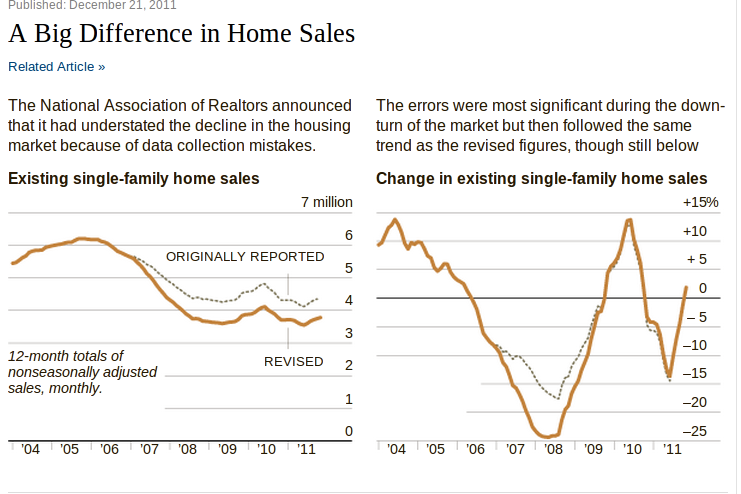
Supposedly the reason their models went so wrong was that they assumed a bunch of people were selling their houses without real estate agents. But isn’t this something they can check? I’m afraid it doesn’t pass the smell test, especially because it went on for so long and because it worked in their favor, in that the market didn’t seem as bad as it actually was. In other words, they had a reason not to update their model.
Here’s the next on our list, namely unemployment projections from the Fed versus actual unemployment figures, brought to us by Rortybomb:
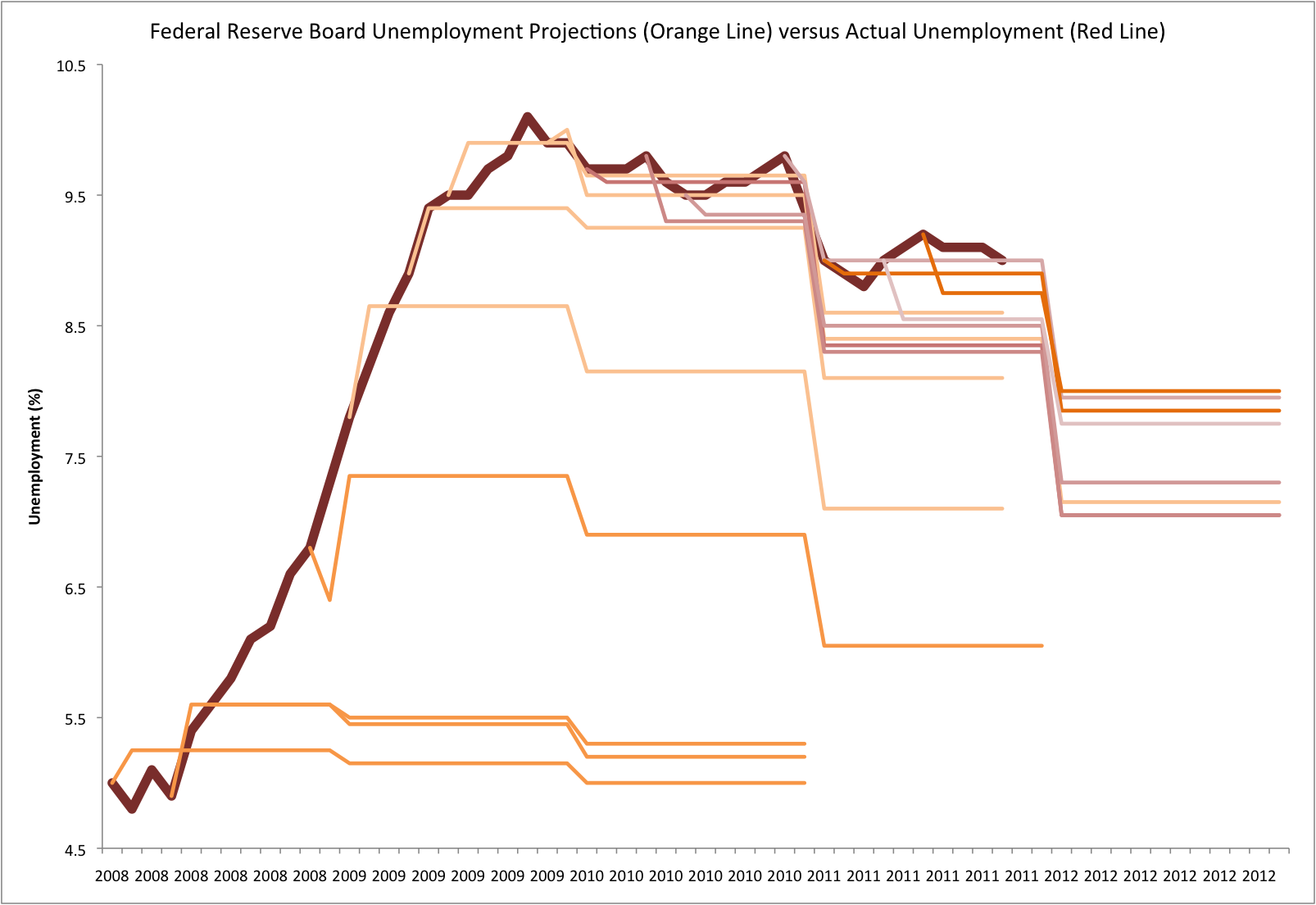
Again we see outrageously bad modeling, which is always and consistently biased towards good news. Is this better than having no model at all? What kind of model is this biased? At the very least can you shorten your projection lengths to make up for how inaccurate they are, kind of like how weather forecasters don’t predict out past a week?
Finally, I’d like to throw in one last modeling complaint, namely about weekly unemployment filings. It seems to me that every December for the past few years, the projected unemployment filings have been “surprising” economists with how low they are, after seasonal adjustment.
First, seasonal adjustment is a weird thing, and was the subject of one of my earliest posts. We effectively don’t really know what the numbers mean after they are seasonally adjusted. But even so, we can imagine a bit: they look at past years and see how much the filings typically dip or surge (sadly it looks like they typically surge) at the end of the year, and assume the same kind of dip or surge should happen this year.
Here’s my thing. The fact that the filings surge less than expected the fourth or fifth year of an economic slump shouldn’t surprise anyone. These are real people, losing their real jobs with real consequences, right before Christmas. If you were a boss, wouldn’t you have made sure to have already fired someone in the early Fall or be willing to wait til after the holidays, especially when they know the chances of getting hired again quickly are very slim? Bosses are people too. I do not have statistically significant evidence for this by the way, just a theory.
Need your vote
Footnoted needs your vote on the most outrageous handout to executives in 2011. Here are the candidates:
- MF Global agreeing to pay then-CEO Jon Corzine a $1.5 million retention bonus months before the company imploded.
- Clear Channel Media Holdings paying $3 million a year to a company controlled by Bob Pittman so that Pittman can fly in a Mystere Falcon 900 that Pittman owns for both business and personal use.
- Leo Apotheker collecting around $25 million in severance and other benefits from Hewlett-Packard, including relocation back to France or Belgium after less than a year on the job.
- IBM’s outgoing CEO Samuel Palmisano becoming eligible for as much as $170 million in retirement benefits, just by waiting until he was past 60 to announce his retirement.
- Nabors Industries agreeing to pay outgoing CEO Eugene Isenberg $100 million in severance on his way out the door.
Vote here.
Also, please read a letter to Jamie Dimon that I enjoyed, from the Reformed Broker blog. From the letter:
So please, do us all a favor and come to the realization that the loathing you feel from your fellow Americans has nothing to do with your “success” or your “wealth” and it has everything to do with the fact that your wealth and success have come at a cost to the rest of us. No one wants your money or opportunities, what they want is the same chance that their parents had to attain these things for themselves. You are viewed, and rightfully so, as part of the machine that has removed this chance for many – and that is what they hate.
Why work?
In his recent Vanity Fair article, Joseph Stiglitz puts forth the following theory about why the Great Depression was inevitable (and in particular wouldn’t have been prevented by the Fed loosening monetary policy). Namely, that our society was transitioning from an agrarian society to something else- which turned out to be a manufacturing society, kicked off in earnest at the beginning of World War II. He goes on to say that we are now going through another great transition, from manufacturing to something else- he calls it service. And he also says there’s no way monetary policy will fix this trauma either- we need to invest heavily in infrastructure in order to prepare ourselves for the coming service society we will be.
Take a few steps back, and we see this picture: a hundred years ago we got so efficient at farming that we didn’t need everyone to farm to be well fed. Then we figured out how to make things so efficiently that we don’t need to worry about having enough stuff. So now, what are we all working for exactly? If service means we take care of each other (medical stuff) and we educate each other, that is fine, but not everyone is a doctor or a teacher. If service means we spend all our time making video games and entertaining each other, than it seems like we need to rethink this plan.
There are two essays I’ve read about the nature of this change that I think will help us rethink work and how our society values work and how it doles it out. First, there’s this highbrow essay on the language of work. From the essay:
Work deploys a network of techniques and effects that make it seem inevitable and, where possible, pleasurable. Central among these effects is the diffusion of responsibility for the baseline need to work: everyone accepts, because everyone knows, that everyone must have a job. Bosses as much as subordinates are slaves to the larger servomechanisms of work. In effect, work is the largest self-regulation system the universe has so far manufactured, subjecting each of us to a panopticon under which we dare not do anything but work, or at least seem to be working, lest we fall prey to a disapproval all the more powerful for its obscurity. The work idea functions in the same manner as a visible surveillance camera, which need not even be hooked up to anything. No, let’s go further: there need not even be a camera. Like the prisoners in the perfected version of Bentham’s utilitarian jail, workers need no overseer because they watch themselves. When we submit to work, we are guard and guarded at once.
What is less clear is why we put up with this demand-structure of a workplace, why we don’t resist more robustly. As Max Weber noted in his analysis of leadership under capitalism, any ideology must, if it is to succeed, give people reasons to act. It must offer a narrative of identity to those caught within its ambit, otherwise they will not continue to perform, and renew, its reality. As with most truly successful ideologies, the work idea latches on to a very basic feature of human existence: our character as social animals forever competing for relative advantage.
The author Mark Kingwell makes a pretty convincing case that people have bought into work just as they buy into other cultural norms. It underlines the real audacity of the #Occupy Wall Streeters who dared to do something with their time than be baristas at Starbucks.
Paired with the Stiglitz view of our culture and its future, though, it makes me think about the extent to which we’ve synthesized work. Mark Kingwell points out that one of the major outputs of workplaces is more work, a kind of purely synthetic made-up idea which we all need to believe in as long as we are all convinced about this work-as-cultural imperative.
The quintessential example of work-creating-work comes from finance, of course, where there isn’t even really a product at the end of the day. It’s essentially all completely made up, pushing around numbers on a spreadsheet.
What happens when people question this industry and its associated maniacal belief in work as moral? I say “maniacal” based on the number of hours people put in at most financial firms, sacrificing their families and even their internal lives, not to mention their associated martyred attitudes at having worked so hard.
This article from Bloomberg addresses the issue indirectly. In it, Richard Sennett talks about what bonds people to their colleagues and their workplace. He compares manufacturing jobs in 1970’s Boston to the recent financial services industry, and notes that people nowadays in finance have no loyalty to each other or to their workplace, and also have very little respect for the bosses. He blames this on unthoughtful hierarchical structures and the fact that bosses are essentially incompetent and everybody knows it. He concludes his article as follows:
These employees were relentless judges of their bosses, always on the lookout for details of conversation or behavior to suggest that the executives didn’t deserve their powers and perks. Such vigilance naturally weakened the bosses’ earned authority. And it didn’t make the people judging feel good about themselves either, as they were stuck in the relationship. On the contrary, it was more likely to be embittering than a cause for secret satisfaction.
Even for those workers who have recovered quickly, the crash isn’t something they are likely to forget. The front office may want to get back as quickly as possible to the old regime, to business as usual, but lower down the institutional ladder, people seem to feel that during the long boom something was missing in their lives: the connections and bonds forged at work.
Although those are fine reasons to dismiss loyalty, as I know from experience, I’d like to suggest another reason we are seeing so much disloyalty, namely that people see through the meaningless of their job, and are wondering why the system has even been set up this way in the first place.
In other words, I don’t think a better hierarchy and super smart bosses in finance is going to make back office people gung-ho. I think that the credit crisis has clearly exposed what people already suspected, namely that they are working hard but not accomplishing much. If we want people to feel fulfilled, wouldn’t it make more sense to work less, and spend more time off with their families and their thoughts? Could we as a society imagine something like that?
How to challenge the SEC
This is a guest post by Aaron Abrams and Zeph Landau.
No, not the Securities and Exchange Commission. We are talking about the Southeastern Conference, a collection of 12 (or so) college football teams.
College football is a mess. Depending on your point of view, you can take it to task for many reasons: universities exploiting student athletes, student athletes not getting an education, student athletes getting special treatment, money corrupting everybody’s morals . . .
Putting those issues aside, however, there is virtually unanimous discontent with an aspect of the sport that is very quantitative, namely, how the season ends. Fans hate it, coaches hate it, players hate it, and there is a substantial controversy almost every single year. Only a few people who make lots of money off the current system seem to like it. (Never mind that anyone with a brain thinks there should be a playoff … perhaps that’s the subject of another post.)
Here’s how it works. There are roughly 120 major college football teams and each team plays 12 or 13 games in the fall. Almost all the teams belong to one of eleven conferences — these are like regional leagues — and most of the games they play are against other teams in their conference. (How they schedule their out-of-conference games is an interesting issue that we may write about another day.) At the end of the season, teams are invited to play in bowl games: games hosted at big stadiums with names like the Rose Bowl, the Orange Bowl, etc., that have long traditions. The problem centers around how teams are chosen to compete in these bowl games.
Basically, a cartel comprised of six of the eleven conferences (those that historically have been the strongest, including the SEC) created a system, called the BCS, that favors their own teams to get into the 5 most prestigious (and lucrative) bowl games, including the so called “national championship game” that claims to feature the top two teams in the country. The prestige gained by the 10 teams that compete in these games is matched by large amounts of money, coming mainly from television contracts and ticket sales. For each of these teams, we are talking about 10-20 million dollars that goes to a combination of the team and their conference. This is not a paltry sum for schools facing major budget cuts.
The most blatant problem with this system is that is it literally unfair: the rules of the system are written in such a way that at the beginning of the season, before any games are played and regardless of how good the teams are, the teams from the six “BCS conferences” have a better chance of getting into one of the major bowls than a team from a non-BCS conference. (You can read the rules, but notably, each of the conference champions of the six BCS conferences automatically gets to play in a BCS bowl game; whereas the other conference champions only get to play in a BCS bowl game if various other conditions are met, like they’re highly ranked in the polls).
There are lots of other problems, too, but we’re not really going to talk about those. For instance the method for choosing the top two teams (which is based on both human and computer polls) is deeply and fundamentally flawed. These are the teams that play for the “BCS championship”, so it matters who the top two are. But again, that’s the subject of a different post.
Back to the inherent unfairness. Colleges in the non-BCS conferences are well aware of this situation. Led by Tulane, they filed a lawsuit several years ago and essentially won; the rules used to be even worse before that. But in the face of the continued lack of fairness, colleges from non-BCS conferences have lately taken to responding by trying to get into the BCS conferences, jockeying for opportunity at big money. It has gotten so bad that a BCS conference called the Big East now includes teams from Idaho and California. Realignment has caused the Big 12 to have only 10 teams, while the Big 10 has 12.
But realignment takes a lot of work to pull off, and it only benefits the teams that get into the major conferences. The minor conferences themselves are still left behind. So here is a better idea. If you’re a non-BCS conference, do what any good red-blooded american corporation would do: find a loophole.
Here is one we thought of.
The current rules force the BCS to choose a team from one of the 5 non-BCS conferences if:
(a) a team has won its conference AND is ranked in the top 12, or
(b) a team has won its conference AND is ranked in the top 16 AND is ranked higher than the conference champion from one of the BCS conferences.
What they don’t say is what it means for a team to “win its conference.” Some conferences determine their champion by overall record, and others have a championship game to decide the champion. This is the chink in the armor.
This year two interesting things happened: (1) in the Western Athletic Conference (WAC), Boise State ended up ranked #7, but did not win their conference. The WAC doesn’t have its own championship game, and the conference winner was TCU by virtue of beating Boise State in a game in the middle of the season. However, TCU also lost a game to a team outside their conference, and they ended up ranked only #18. As a result, neither team satisfied condition (a) or (b) above.
And (2) in Conference USA, Houston was undefeated and ranked #6 in the country before the final game of the season, when it lost its conference championship game to USM. The loss dropped Houston to #19 in the rankings, whereas USM, the conference champion, finished with a final ranking of #21. Thus neither of these teams met (a) or (b), either.
Here is what we noticed: if the Western Athletic Conference had a conference championship game, then either Boise St would have won it, been declared the champion, and qualified for a BCS bowl, or else TCU would have won it and would almost surely have ended up with a high enough rank to qualify for a BCS bowl. (As it was, TCU finished the season at #18, but one more victory against a top ten team would very likely have gained them at least two spots. This would have been good enough for (b) to apply, since the champion of the Big East (a BCS conference) was West Virginia, who finished ranked #23.)
On the other hand, if Conference USA hadn’t had a championship game, Houston would have been declared the conference champion (by virtue of being undefeated before the championship game) and they would easily have been ranked highly enough to get into a BCS bowl. Indeed, it has been estimated that their loss to USM cost Conference USA $17 million.
So, what should these non-BCS conferences do? Hold a conference championship game . . . if, and only if, it benefits them. They can decide this during the last week of the season. This year, with nothing to lose and plenty to gain, the WAC would clearly have chosen to have a championship game. With nothing to gain and plenty to lose, Conference USA would have chosen not to.
Bingo. Loophole. 17 million big ones. Cha ching.
Bloomberg engineering competition goes to Cornell
This just in. Pretty surprising considering we were supposed to hear the results January 15th. I wrote about this here and here.
I wonder what Columbia is going to do with their plans?? I guess there may be two winners, so still exciting.


 mathbabe