Interactive scoring models: why hasn’t this happened yet?
My friend Suresh just reminded me about this article written a couple of years ago by Malcolm Gladwell and published in the New Yorker.
It concerns various scoring models that claim to be both comprehensive (which means it covers the whole thing, not just one aspect of the thing) and heterogeneous (which means it is broad enough to cover all things in a category), say for cars or for colleges.
Weird things happen when you try to do this, like not caring much about price or exterior detailing for sports cars.
Two things. First, this stuff is actually really hard to do well. I like how Gladwell addresses this issue:
At no point, however, do the college guides acknowledge the extraordinary difficulty of the task they have set themselves.
Second of all, I think the issue of combining heterogeneity and comprehensiveness is addressable, but it has to be addressed interactively.
Specifically, what if instead of a single fixed score, there was a place where a given car-buyer or college-seeker could go to fill out a form of preferences? For each defined and rated aspect, the user would fill answer a question about how much they cared about that aspect. They’d assign a weight to each aspect. A given question would look something like this:
For colleges, some people care a lot about whether their college has a ton of alumni giving, other people care more about whether the surrounding town is urban or rural. Let’s let people create their own scoring system. It’s technically easy.
I’ve suggested this before when I talked about rating math articles on various dimensions (hard, interesting, technical, well-written) and then letting people come and search based on weighting those dimensions and ranking. But honestly we can start even dumber, with car ratings and college ratings.
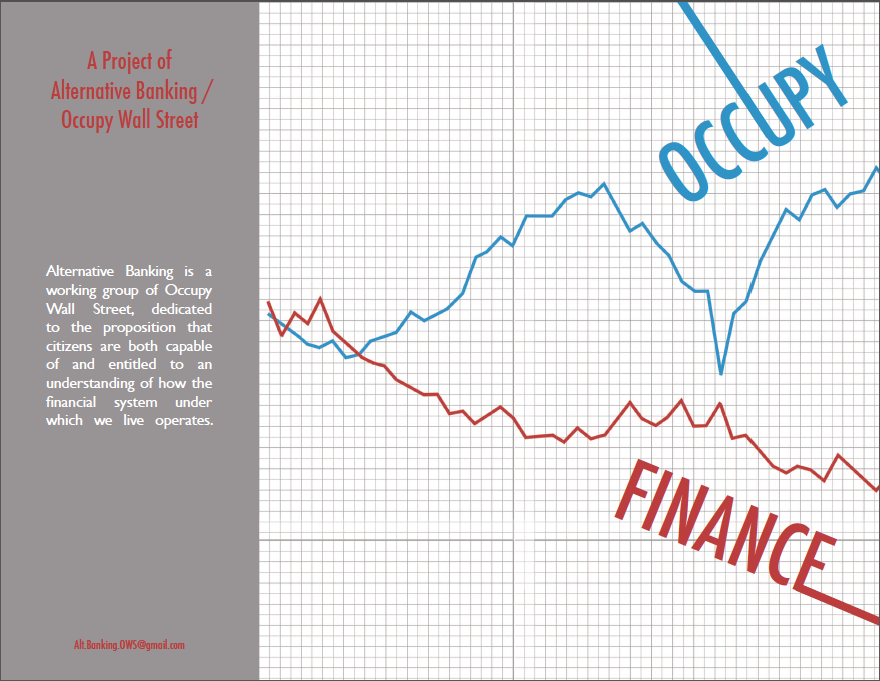
Occupy Finance the book, coming out next Tuesday (#OWS)
Holy shit I’m just about bursting with pride to announce that my Occupy group’s book, Occupy Finance, is coming out Tuesday and is at the printer right now.
This is thanks in large part to all of you awesome people who sent contributions for the printing. You guys totally rock.
Our plan is to meet in Zuccotti Park Tuesday morning, September 17th, which is the 2nd anniversary of the occupation, give a wee press conference at 10am or so, and then hand out hundreds of copies of the book to whomever shows up.
Here’s the wrap-around cover to give you just a taste:
See you guys on Tuesday! The event is also on Facebook.
Working in the NYC Mayor’s Office
I recently took a job in the NYC Mayor’s Office as an unpaid consultant. It’s an interesting time to be working for the Mayor, to be sure – everyone’s waiting to see what happens this week with the election, and all sorts of things are up in the air. Planning essentially stops at December 31st.

Note the expiration date.
I’m working in a data group which deals with social service agency data. That means Child Services, Homeless Services, and the like. Any agency where there there is direct contact with lots of people and their data. The idea is for me to help them out with a project that, if successful, I might be able to take to another city as a product. I’m still working full-time at the same job.
Specifically, my goal is to figure out a way to use data to help the people involved – the homeless, for example – get connected to better services. As a side effect I think this should make the agency more efficient. Far too many data studies only care about efficiency – how to make do with fewer police or fewer ambulances – with no thought or care about whether the people experiencing the services are being affected. I want to start with the people, and hope for efficiency gains, which I believe will come.
One thing that has already amazed me about this job, which I’ve just started, is the conversations people have about the ethics of data privacy.
It is a well-known fact that, as you link more and more data about people together, you can predict their behavior better. So for example, you could theoretically link all the different agency data for a given person into a profile, including crime data, health data, education and the like.
This might help you profile that person, and that might help you offer them better services. But it also might not be what that person wants you to do, especially if you start adding social media information. There’s a tension between the best model and reasonable limits of privacy and decency, even when the model is intended to be used in a primarily helpful manner. It’s more obvious when you’re attempting something insidious like predictive policing, of course.
Now, it shouldn’t shock me to have such conversations, because after all we are talking about some of the most vulnerable populations here. But even so, it does.
In all my time as a predictive modeler, I’ve never been in that kind of conversation, about the malicious things people could do with such-and-such profile information, or with this or that model, unless I started it myself.
When you work as a quant in finance, the data you work with is utterly sanitized to the point where, although it eventually trickles down to humans, you are asked to think of it as generated by some kind of machine, which we call “the market.”
Similarly, when you work in ad tech or other internet modeling, you think of users as the targets of your predatory goals: click on this, user, or buy that, user! They are prey, and the more we know about them the better our aim will be. If we can buy their profiles from Acxiom, all the better for our purposes.
This is the opposite of all of that. Super interesting, and glad I am being given this opportunity.
The art of definition
Definitions are basic objects in mathematics. Even so, I’ve never seen the art of definition explicitly taught, and I have rarely seen the need for a definition explicitly discussed.
Have you ever noticed how damn hard it is to make a good definition and yet how utterly useful a good definition can be?
The basic definitions inform the research of any field, and a good definition will lead to better theorems than a bad one. If you get them right, if you really nail down the definition, then everything works out much more cleanly than otherwise.
So for example, it doesn’t make sense to work in algebraic geometry without the concepts of affine and projective space, and varieties, and schemes. They are to algebraic geometry like circles and triangles are to elementary geometry. You define your objects, then you see how they act and how they interact.
I saw first hand how a good definition improves clarity of thought back in grad school. I was lucky enough to talk to John Tate (my mathematical hero) about my thesis, and after listening to me go on for some time with a simple object but complicated proofs, he suggested that I add an extra sentence to my basic object, an assumption with a fixed structure.
This gave me a bit more explaining to do up front – but even there added intuition – and greatly simplified the statement and proofs of my theorems. It also improved my talks about my thesis. I could now go in and spend some time motivating the definition, and then state the resulting theorem very cleanly once people were convinced.
Another example from my husband’s grad seminar this semester: he’s starting out with the concept of triangulated categories coming from Verdier’s thesis. One mysterious part of the definition involves the so-called “octahedral axiom,” which mathematicians have been grappling with ever since it was invented. As far as Johan tells it, people struggle with why it’s necessary but not that it’s necessary, or at least something very much like it. What’s amazing is that Verdier managed to get it right when he was so young.
Why? Because definition building is naturally iterative, and it can take years to get it right. It’s not an obvious process. I have no doubt that many arguments were once fought over whether the most basic definitions, although I’m no historian. There’s a whole evolutionary struggle that I can imagine could take place as well – people could make the wrong definition, and the community would not be able to prove good stuff about that, so it would eventually give way to stronger, more robust definitions. Better to start out carefully.
Going back to that. I think it’s strange that the building up of definitions is not explicitly taught. I think it’s a result of the way math is taught as if it’s already known, so the mystery of how people came up with the theorems is almost hidden, never mind the original objects and questions about them. For that matter, it’s not often discussed why we care whether a given theorem is important, just whether it’s true. Somehow the “importance” conversations happen in quiet voices over wine at the seminar dinners.
Personally, I got just as much out of Tate’s help with my thesis as anything else about my thesis. The crystalline focus that he helped me achieve with the correct choice of the “basic object of study” has made me want to do that every single time I embark on a project, in data science or elsewhere.
Sunday morning musing: is sexism an addiction?
I’ve been reading articles about cultures of sexism at Harvard Business School and in philosophy, both articles published in the New York Times this past week. The two of them have gotten me to speculate about the different ways that men and women experience sexist behavior.
Namely, very differently. Women, being the targets of sexist remarks and behavior, are sensitive to its barbaric nature and status-oriented putdowns – they are aware of it because it so obviously stings. Men – some men, not all – consistently seem baffled by all the fuss, and if they acknowledge the behavior, it is, in their opinion, more like having fun than being mean.
“Why would people want me to stop having fun?” they ask.
It makes me wonder if sexism is addictive. Let me explain my Sunday morning theory.
Assume that, when men perform an act of sexism, they get rewarded in their pleasure center similar to when someone takes a street drug or has sex.
So for example, say some male Harvard Business School (HBS) student encounters a female HBS colleague who is a potential competitor. To establish his dominance, he puts her down publicly on the basis of her looks. As mentioned in the article, the HBS population is obsessed with status, and this is a standard way of keeping her status low and simultaneously making her anxious and distracted.
My question is, what happens inside that man’s brain when he does that? For that matter, what happens to the brains of the other men in that group who witness that? My theory is that they all experience a kind of pleasure center stimulation, whereby their entire group is nudged up in rank over some “other,” which happens to be that woman. In some sense it’s kind of irrelevant who they put down in order to be rewarded, though, which is why they don’t think of what they did as a bad thing, just something that they vaguely enjoyed.
Go back to how differently the men and women describe their experiences after the fact of sexist environments. Men consistently don’t remember it as a negative event. From the article about sexism in philosophy:
I’m always hearing from stressed-out men, worrying aloud what “all this fuss” about sexual harassment means for them. I’ve heard it at training sessions on university sexual harassment policy: “Does this mean I can’t even tell a woman that she looks nice?” I’ve heard it in coffee lounges: “Make sure you keep your door open when you’re talking to a woman student — you never know what she might say later.” And I’ve had it confided to me, with a sigh of regret, at conference happy hours: “I’m afraid now to form any relationships with female students — they might take it the wrong way.”
I don’t think men are lying. I think they actually experience sexist events as positive and benign.
It also makes sense how men react when sexism is addressed by the higher authorities in the form of sensitivity training. When men are forced into a room to talk about sexism and norms of appropriate behavior, they’re super uncomfortable and don’t seem to know why they’re there (again, not all men). They for whatever reason don’t think discussions about sexism apply to them, like it’s a women’s issue.
On the other hand, as we saw in the HBS article, forcing men to talk about it at length does seem to actually help, in spite of their protests. The article focuses on women’s behavior, I think overly much, but it’s just as much about men as it is about women. True, women undermine themselves by competing with each other to be perfect and sexy and brilliant (but not too brilliant), etc., but really it’s about getting them men to stop with their nonsense, right?
And what might be happening is that, along with the positive feedback which stimulates the pleasure center, through this training they might also be developing a second, negative feedback around sexist comments, which would mean that eventually, if that second feedback grew strong enough, it would no longer feel so good to be sexist.
I mean, how do you break someone of their addictive habits? I guess you could destroy the pleasure center altogether, but that seems extreme except for the really most annoying HBS folks. Probably what you’d want to do is counteract the effect with an opposing effect. Thus sensitivity training.
Of course, this theory applies equally well to other forms of discrimination. And it’s not obvious how to address it even if it’s true. But at least, if we thought about it this way, it would throw light on the baffling disconnect whereby such problems are glaringly obvious to some while remaining utterly invisible to others.
Ask Aunt Pythia
Aunt Pythia’s mailbox has been satisfyingly full this week, and she thanks you all for your questions. Please keep them coming, she looks forward to Saturdays ever so much.
Go here for past advice columns and here for an explanation of the name Pythia.
And please, Submit your question for Aunt Pythia at the bottom of this page!
——
Dear Aunt Pythia,
I want to pursue a career as a data scientist. I am very comfortable with maths and statistics and love spending time with large data sets. However, I don’t have any background in programming. I am wondering what all I can do in the next 12-18 months to be a pro in this field and whether a degree is data science the way to go about it.
Future Data Scientist
Dear FDS,
First of all, I feel like I’m being set up by Miss Disruption on this question, whose answer is always “learn to code” and who came out with another hilarious advice column this past week (best line: “Instead of putting your trust in what you think looks like Mark Zuckerberg, put your trust in numbers. Numbers that will tell you how much someone looks like Mark Zuckerberg.”).
Second of all, I think you need to learn to code. It’s fun, and the number of resources available nowadays is outrageous. Plus you don’t have to be a really good coder to be a data scientist (I know, I’ve just offended a bunch of people). You just need to be able to get the data into usable format, which is tricky, and then you need to know what to do with it – it’s much more about questions of what to do than it is about questions of whether your code looks great, at least when you’re working on your own projects.
Depending on your preferred learning style, I’d say get a classic CS text and read it, or take some free courses online, or just start on a project and refer to examples to learn how to do specific tasks.
Oh, and first install Anaconda.
Good luck!
Cathy
——
Dear Aunt Pythia,
A decade ago I had a bad breakup with my first girlfriend (in which I felt I was largely at fault). After a while, she wanted to continue being friends, but I found this too difficult and told her never to contact me again. Over the years, I made peace with myself, and periodically thought of contacting her to apologize, but always held back (note: I never once had any intention of getting back with her romantically).
Now, I’ve been married for years, and it’s also been years since she’s been married with a kid (I know only because of a mutual friend), and for some reason she sent me a friend request on Facebook.
- Because of our mutual friends on Facebook, both our existences on Facebook are clear; I have never sent her a friend request, however.
- This a violation of my old request not to be contacted.
- I’m over that old request and don’t have a problem with resuming some minimal contact in the form of “Facebook friend”.
- I asked my wife if it’s OK, and she got weird about it, and we concluded that therefore it’s not OK.
- I was considering sending her a message that my wife said it’s not OK.
- My wife thinks that would be weird and I should ignore her.
- I don’t want to just ignore her but want to at least finally say I’m sorry for the things I said in the last communication we had a decade ago.
What is Facebook Etiquette?
Dear What,
This has nothing to do with Facebook, except in that it happens to be the medium for your potential exchange with your ex. It’s really about your regrets about your past behavior to this woman.
I’m going to respond to your points in turn.
- If I’m her, I think it’s super safe to ask to be your friend since we’re both married now.
- Who the hell thinks a decade-old request like that still holds? That’s just plain weird.
- How kind and generous of you! Not really.
- Sounds to me like you’re trying to make your wife take responsibility here for your stuff.
- That’s super ridiculous. Either man up and be her friend or leave her alone.
- Again with what the wife thinks. Think for yourself!
- If you really want to apologize, just do it.
This is something you either need to own, and do it right, either on Facebook or by email, since you presumably could get her email via a common friend, or you need to put to bed and forget about. I’m sure she’d prefer the former (and I’m guessing that you would too, at least once you got yourself to do it) but is already making do with the latter. What you don’t do is send her some crapola about how you “can’t be Facebook friends with her” because of your wife. That’s nuts.
Aunt Pythia
——
Dear Auntie P,
I think sex is awesome. How do I have more of it?
I am in a very stable, loving relationship for over a decade, with all the kids and stuff that happens when you spend so long with someone (and I love all it). We have good sex, sometimes great sex, but we only rarely have amazing sex. Here are some specific questions for you:
1. I want sex a lot more often than my partner. That’s a bit frustrating, what should I do?
2. I’d love to try something different. Not too crazy, but different. We know each other too well and are more often than not following into the routine of “efficient sex”, going for the kill. What do I do?
3. With kids, a busy job, lots of hobbies and other stuff, and not enough sleep, how do you make time for long sex sessions? I’ve never tried cocaine, should I begin?
Thanks for the tips,
Perverse Bundle
——
Dear PB,
First of all, you are not alone. This is about the most common complaint I hear from my friends in happy marriages. First, be proud that it’s as good as it is!
Next, the truth is, no two people have exactly the same sex drive, and over time the mismatch of desire gets worse due to the natural form of complementary schismogenesis which exists in practically every sexual relationship.
That is to say, the man or woman who wants more sex, even if it’s just a little bit more, starts to feel rejected, and has moments of aggressiveness and hostility surrounding their unmet desire, which makes the man or woman who wants less sex feel even less like it, and the ante gets upped, and the cycle continues. It’s a feedback loop that often spirals out of control.
It doesn’t even sound like that’s where you are, but it’s a danger because it’s always a danger.
How does one build a dampening effect to counteract this schismogenesis? Maybe it would be possible to explicitly funnel your unmet desires into some other activity where you get attention, though possibly not sexual attention.
So, you could have friends over regularly for parties with your partner, or you could go out with your friends regularly, or you could get ambitious and start playing the guitar and go out to do open mics, or you could even join a band. The point is that you get fun stuff to do and not enough time to dwell on being rejected, and moreover your partner will find you irresistibly cute and brave and sexy once you’re up on stage.
Next, when you’re super busy with kids and national tours from your new music career, long sex sessions don’t happen by themselves. You need to make time for them, in the form of date nights. And dates can happen inside bedrooms, but even so, call them “date nights” since that sounds better than “scheduled sex”.
Finally: say no to cocaine, but do buy sex toys.
Good luck!
Auntie P
——
Dear Auntie,
I’m not always as good a parent as I’d like myself to be. I’m trying to reason with my 3 kids who are all younger than 4, but they always go too far and I end up yelling too often. I NEVER yell at anyone else, though. I know exactly the kind of situations that trigger the yelling, but they’re unavoidable. What should I do?
Uncle Stach
Dear Uncle Stach,
First, I have an enormous amount of sympathy for anyone dealing with even one kid, never mind three. So give yourself a break, and try try again, every morning. It’s a life-long job and it’s totally possible to slowly improve your techniques over time.
Second, I think I know what your problem is: namely, there’s no reasoning with kids under 4 years old. There’s ritual and rules, and depending on how old they are and how consistently you proceed with those rituals and rules, they might or might not be familiar with how things are going to work out. My advice is to choose a ritual (going to bed seems to be a good one) and make sure it is incredibly consistent and early (say 6:30 or 7:00 pm, no kidding) and do the exact same thing every day for two weeks with all your kids. Getting a good night’s sleep is absolutely vital for being able to handle the next day. Once you’ve got that ritual down, introduce other rituals and slowly create a world for them which is embedded with rituals, which kids totally adore.
As for reasoning: you can start reasoning with kids once they’re in school. Before that, just give them the choice of two options: drawing or jigsaw puzzle, playground or sprinklers, do what I want or do what I really want.
Third, there’s yelling and then there’s yelling. What you absolutely cannot do is get abusive when you yell. Stuff like “you’re stupid” or “you’re lazy” has been shown to be as damaging for teenagers as physical abuse, so don’t do it. Don’t shame kids or insult them, ever. If you find yourself tempted to make blanket negative statements, take five and go to the bathroom. When they do nasty things, by all means make them apologize for those actions, but never let those actions define them.
On the other hand, a stern tone of voice when you tell your 3-year-old to sit in her chair until dinner is over it totally appropriate, as long as it doesn’t turn into a screaming match. As for screaming: my advice is to ignore screams, and if they don’t dissipate, put kids in their rooms so at least it’s not as loud. Never give in to a screaming kid, that’s like asking them to scream.
Finally, here’s a book I really got a lot out of: Healthy Sleep Habits, Happy Child. Explained to me how to get my babies to sleep 12 hours a night, which they pretty much still do.
Good luck! And enjoy them!!
Aunt Pythia
——
Please submit your well-specified, fun-loving, cleverly-abbreviated question to Aunt Pythia!
Simons Center for Data Analysis
Has anyone heard of the new Simons Center for Data Analysis?
Neither had I until just now. But some guy named Leslie Greengard, who is a distinguished mathematician and computer scientist, just got named its director (hat tip Peter Woit).
Please inform me if you know more about this center. I got nothing except this tiny description:
As SCDA’s director, Greengard will build and lead a team of scientists committed to analyzing large-scale, rich data sets and to developing innovative mathematical methods to examine such data.
Experimentation in education – still a long way to go
Yesterday’s New York Times ran a piece by Gina Kolata on randomized experiments in education. Namely, they’ve started to use randomized experiments like they do in medical trials. Here’s what’s going on:
… a little-known office in the Education Department is starting to get some real data, using a method that has transformed medicine: the randomized clinical trial, in which groups of subjects are randomly assigned to get either an experimental therapy, the standard therapy, a placebo or nothing.
They have preliminary results:
The findings could be transformative, researchers say. For example, one conclusion from the new research is that the choice of instructional materials — textbooks, curriculum guides, homework, quizzes — can affect achievement as profoundly as teachers themselves; a poor choice of materials is at least as bad as a terrible teacher, and a good choice can help offset a bad teacher’s deficiencies.
So far, the office — the Institute of Education Sciences — has supported 175 randomized studies. Some have already concluded; among the findings are that one popular math textbook was demonstrably superior to three competitors, and that a highly touted computer-aided math-instruction program had no effect on how much students learned.
Other studies are under way. Cognitive psychology researchers, for instance, are assessing an experimental math curriculum in Tampa, Fla.
If you go to any of the above links, you’ll see that the metric of success is consistently defined as a standardized test score. That’s the only gauge of improvement. So any “progress” that’s made is by definition measured by such a test.
In other words, if we optimize to this system, we will optimize for textbooks which raise standardized test scores. If it doesn’t improve kids’ test scores, it might as well not be in the book. In fact it will probably “waste time” with respect to raising scores, so there will effectively be a penalty for, say, fun puzzles, or understanding why things are true, or learning to write.
Now, if scores are all we cared about, this could and should be considered progress. Certainly Gina Kolata, the NYTimes journalist, didn’t mention that we might not care only about this – she recorded it as unfettered good, as she was expected to by the Education Department, no doubt. But, as a data scientist who gets paid to think about the feedback loops and side effects of choices like “metrics of success,” I have a problem with it.
I don’t have a thing against randomized tests – using them is a good idea, and will maybe even quiet some noise around all the different curriculums, online and in person. I do think, though, that we need to have more ways of evaluating an educational experience than a test score.
After all, if I take a pill once a day to prevent a disease, then what I care about is whether I get the disease, not which pill I took or what color it was. Medicine is a very outcome- focused discipline in a way that education is not. Of course, there are exceptions, say when the treatment has strong and negative side-effects, and the overall effect is net negative. Kind of like when the teacher raises his or her kids’ scores but also causes them to lose interest in learning.
If we go the way of the randomized trial, why not give the students some self-assessments and review capabilities of their text and their teacher (which is not to say teacher evaluations give clean data, because we know from experience they don’t)? Why not ask the students how they liked the book and how much they care about learning? Why not track the students’ attitudes, self-assessment, and goals for a subject for a few years, since we know longer-term effects are sometimes more important that immediate test score changes?
In other words, I’m calling for collecting more and better data beyond one-dimensional test scores. If you think about it, teenagers get treated better by their cell phone companies or Netflix than by their schools.
I know what you’re thinking – that students are all lazy and would all complain about anyone or anything that gave them extra work. My experience is that kids actually aren’t like this, know the difference between rote work and real learning, and love the learning part.
Another complaint I hear coming – long-term studies take too long and are too expensive. But ultimately these things do matter in the long term, and as we’ve seen in medicine, skimping on experiments often leads to bigger and more expensive problems. Plus, we’re not going to improve education overnight.
And by the way, if and/or when we do this, we need to implement strict privacy policies for the students’ answers – you don’t want a 7-year-old’s attitude about math held against him when he of she applies to college.
Entrepreneurship versus the state
I really like this Slate article written by Mariana Mazzucato and entitled It’s a Myth That Entrepreneurs Drive New Technology.
In it she makes the point that lobbyists for tech companies have overemphasized the role of the entrepreneur in our nation’s technological advances, and likewise underemphasized the role of the state. From the article:
Whether an innovation will be a success is uncertain, and it can take longer than traditional banks or venture capitalists are willing to wait. In countries such as the United States, China, Singapore, and Denmark, the state has provided the kind of patient and long-term finance new technologies need to get off the ground. Investments of this kind have often been driven by big missions, from putting a human on the moon to solving climate change. This has required not only funding basic research—the typical “public good” that most economists admit needs state help—but applied research and seed funding too.
One of her examples was the internet itself, which brings me back – my mom was involved with that project.
Some of my earliest memories are going with my mom to fix something at BBN where she had superuser access on the internet back when it was populated by very few people – the president and some army generals. And no, she didn’t have any kind of clearance, they didn’t think very hard about computer security back then, but on the other hand my mom is scrupulously honest and would never read anyone else’s mail. And it was all done through DARPA or other Department of Defense funding.
Funny story. When I was little, my mom was in charge (with some other people, on a rotation) of keeping the internet running, which she would refer to as “being on call”. She’d leave, sometimes in the middle of the night, to get these massive computers booted back up. I’d go with her if nobody else was around to watch me, and I remember she’d sometimes get underneath these massive metal boxes, and I’d just see her feet sticking out at the bottom, not unlike a mechanic under a car at a garage.
Anyway, the story is that one time she was on call on Christmas Eve and got called in on an emergency, and in my stocking the next morning I got “IOU” notes. That makes for a pretty crappy Christmas morning when you’re 8! My personal sacrifice for the internet.
Going back to the “state vs. entrepreneur” debate. One thing Mazzucato didn’t mention, but that I will, is the issue of waste. People talk all the time about how wasteful the state is – how there are too many people, and they don’t do much, and they never get fired – but they don’t appreciate how very wasteful the world of start-ups is. Most new companies fail entirely and never do anything at all constructive. I personally have seen hundreds of people working on projects for years in the realm of “entrepreneurs” that everyone knows will do nothing. Talk about waste!
Next, let’s go to why this all happens. It’s all about taxes. From the article:
In this era of obsession with reducing public debt—and the size of the state more generally—it is vital to dispel the myth that the public sector will be less innovative than the private sector. Otherwise, the state’s ability to continue to play its enterprising role will be weakened. Stories about how progress is led by entrepreneurs and venture capitalists have aided lobbyists for the U.S. venture capital industry in negotiating lower capital gains and corporate income taxes—hurting the ability of the state to refill its innovation fund.
Totally agreed. It’s a beautiful story aimed at confusing people about whether Apple or Google or GE should pay any taxes at all.
But here’s where I don’t follow her, when she suggests a possible solution:
It is time for the state to get something back for its investments. How? First, this requires an admission that the state does more than just fix market failures—the usual way economists justify state spending. The state has shaped and created markets and, in doing so, taken on great risks. Second, we must ask where the reward is for such risk-taking and admit that it is no longer coming from the tax systems. Third, we must think creatively about how that reward can come back.
There are many ways for this to happen. The repayment of some loans for students depends on income, so why not do this for companies? When Google’s future owners received a grant from the NSF, the contract should have said: If and when the beneficiaries of the grant make $X billion, a contribution will be made back to the NSF.
It’s not that I don’t like the idea in principle. But a problem with the corporation/ people debate is that one critical way that corporations are not like people is in terms of long-term liability. People work at corporations, and when it’s convenient for them, they leave and go somewhere else or start a new company (whereas it’s harder to change bodies). That makes sense in many situations, but it wouldn’t be consistent with her tax-me-when-you-get-rich plan.
In other words, say I form a company that gets NSF funding, comes up with something brilliant, and starts to make huge profits. Then, in order to avoid losing any of my hard-earned dough, I dissolve my company, fire most of the workers, and then start up a new company that doesn’t owe anything to the NSF. I can’t see how this doesn’t happen, and I can’t see how the NSF fights back against it. Lawyers, please explain why I’m wrong.
Personally, I think the real solution is to stop listening to lobbyists and raise taxes, or at the very least make the tax rates effective rather than nominal.
Short your kids, go long your neighbor: betting on people is coming soon
Yet another aspect of Gary Shteyngart’s dystopian fiction novel Super Sad True Love Story is coming true for reals this week.
Besides anticipating Occupy Wall Street, as well as Bloomberg’s sweep of Zuccotti Park (although getting it wrong on how utterly successful such sweeping would be), Shteyngart proposed the idea of instant, real-time and broadcast credit ratings.
Anyone walking around the streets of New York, as they’d pass a certain type of telephone pole – the kind that identifies you via your cell phone and communicates with data warehousing services and databases – would have their credit rating flashed onto a screen. If you went to a party, depending on how you impressed the other party go-ers, your score could plummet or rise in real time, and everyone would be able to keep track and treat you accordingly.
I mean, there were other things about the novel too, but as a data person these details certainly stuck with me since they are both extremely gross and utterly plausible.
And why do I say they are coming true now? I base my claim on two news stories I’ve been sent by my various blog readers recently.
[Aside: if you read my blog and find an awesome article that you want to send me, by all means do! My email address is available on my “About” page.]
First, coming via Suresh and Marcos, we learn that data broker Acxiom is letting people see their warehoused data. A few caveats, bien sûr:
- You get to see your own profile, here, starting in 2 days, but only your own.
- And actually, you only get to see some of your data. So they won’t tell you if you’re a suspected gambling addict, for example. It’s a curated view, and they want your help curating it more. You know, for your own good.
- And they’re doing it so that people have clarity on their business.
- Haha! Just kidding. They’re doing it because they’re trying to avoid regulations and they feel like this gesture of transparency might make people less suspicious of them.
- And they’re counting on people’s laziness. They’re allowing people to opt out, but of course the people who should opt out would likely never even know about that possibility.
- Just keep in mind that, as an individual, you won’t know what they really think they know about you, but as a corporation you can buy complete information about anyone who hasn’t opted out.
In any case those credit scores that Shteyngart talks about are already happening. The only issue is who gets flashed those numbers and when. Instead of the answers being “anyone walking down the street” and “when you walk by a pole” it’s “any corporation on the interweb” and “whenever you browse”.
After all, why would they give something away for free? Where’s the profit in showing the credit scores of anyone to everyone? Hmmmm….
That brings me to my second news story of the morning coming to me via Constantine, namely this TechCrunch story which explains how a startup called Fantex is planning to allow individuals to invest in celebrity athletes’ stocks. Yes, you too can own a tiny little piece of someone famous, for a price. From the article:
People can then buy shares of that player’s brand, like a stock, in the Fantex-consumer market. Presumably, if San Francisco 49ers tight end Vernon Davis has a monster year and looks like he’s going to get a bigger endorsement deal or a larger contract in a few years, his stock would rise and a fan could sell their Davis stock and cash out with a real, monetary profit. People would own tracking or targeted stocks in Fantex that would depend on the specific brand that they choose; these stocks would then rise and fall based on their own performance, not on the overall performance of Fantex.
Let’s put these two things together. I think it’s not too much of a stretch to acknowledge a reason for everyone to know everyone else’s credit score! Namely, we can can bet on each other’s futures!
I can’t think of any set-up more exhilarating to the community of hedge fund assholes than a huge, new open market – containing profit potentials for every single citizen of earth – where you get to make money when someone goes to the wrong college, or when someone enters into an unfortunate marriage and needs a divorce, or when someone gets predictably sick. An orgy in the exact center of tech and finance.
Are you with me peoples?!
I don’t know what your Labor Day plans are, but I’m getting ready my list of people to short in this spanking new market.
Ask Aunt Pythia
Every week, I look into Aunt Pythia’s official Google spreadsheet (it’s true she lives a super glamorous life) and every week I expect it to be my last, since at the end of the day I have fewer leftover questions than will last a week.
And yet… and yet. Somehow questions wander in, over the week, one on Tuesday, one on Friday, and when I open it up again, voila! I have a columns-worth of bad advice to spew forth once again. It’s like a tiny, possibly negative miracle.
That is not to say, dear readers, that you shouldn’t be worried about the rate of question asking!! Please do take it upon yourself to be involved!
And just in case it wasn’t clear, anything’s fair game. From “How do I get my kids to eat broccoli?” to “How do I stop fantasizing about living forever and focus on enjoying my life now?” I’m prepared to give step-by-step, humorous and mostly irrelevant suggestions.
By the way, if you don’t know what the hell I’m talking about, go here for past advice columns and here for an explanation of the name Pythia.
And please, Submit your question for Aunt Pythia at the bottom of this page!
——
Dear Aunt Pythia,
I am single and I rely on masturbating to satisfy my sexual urges, but it feels kind of heartless and empty. Could porn help? Or, do I actually need to go out and find a partner?
Really Sad
Dear Really Sad,
It depends on what you mean by “help”. If you mean, “can porn make my solo masturbation sessions more efficient?”, I’d have to say “yes, for sure.” I’d also say that if you managed to figure out how to ask Aunt Pythia a question but haven’t figured out how to experiment with porn, then I can understand why you’re sad.
In terms of avoiding heartless emptiness, meeting a real life person is probably key. Plus they might like watching porn with you.
Aunt Pythia
——
Dearest Auntie P,
I just started having great sex with one of my best friends, and although we both have other sexual partners, we’re both digging this new fling. Do you have any suggestions for sex positions or other things we can throw in to make our sexual relations even more exciting? (We’re both math nerds, so we already have the nerd pillow talk thing going on, but suggestions there would also be awesome.)
Nerdelicious
Dear Nerdilicious,
Oooh oooh!! I got something!
Go on a date at the Museum of Math. I went there the other week over my lunch break, since I work about 2 blocks away, and I was like, what is this museum good for except maybe school field trips and nerd dates?
I couldn’t come up with anything, and since I saw lots of field trips I think it’s high time we cue you cuties. Momath.org, check it out. Please take pics of yourselves making out in every single exhibit, that place could use some sexing up. The gift shop’s great, though, lots of puzzles.
Wait, what if you don’t live in New York? Turns out there are plenty of people with that attribute, especially people who live in Guangzhou China, which as I’ve recently learned is absolutely massive.
In that case, I’d say that, to stay with the theme of sexing it up in public, I’d encourage you to look around for a straight-up puzzle store, some place that sells D&D starter kits with lots of different colored dice possibilities. Look, we need to give young nerds hope that someday they’ll get laid, and you guys are now their role models, including perhaps the guy above who asked the first question.
Good luck!
Aunt Pythia
——
Dear Aunt Pythia,
A question from a person who is realizing a bit too late that academia is not gonna do it for him:
What kind of non-academic jobs are there for mathematicians (beyond PhD, even postdoc) that do not involve a lot of coding/programming, but otherwise do involve their problem solving abilities?
If you have discussed this question at length in your blog already, I am sorry for not reading regularly, and I’d appreciate a link to the relevant posts.
Thanks a lot!
Lost Academic
Dear Lost,
I’d say, learn to code! After all, coding is just a specific way of formally solving problems in a language that computers can understand. I’d say if you’re really a mathematician with a Ph.D. then learning to code should be pretty easy. Don’t be afraid of it, and for sure don’t be thinking you’re above it.
As far as how to learn to code, pick up a book or take an online class or just pick a project and a language (python) and a start puzzling it out. There are so many resources nowadays, you get to decide what works for you. What doesn’t work for you or your job prospects, though, is refusing to learn to code.
Good luck,
Auntie P
——
Dear Aunt Pythia,
This isn’t a question, rather an experience.
I had the most fulfilling dream last night: I bought a pair of pants from a thrift shop that once belonged to you, Aunt Pythia, and discovered after purchasing them that you left some rather important mail in the pockets (there was also an old package in there too… I don’t remember the precise geometry of these pants).
So anyway, I had to get in touch with you and you agreed to meet me in person. So I could return to you the mail. That you left in your old pants. That you gave away to a thrift store. The point being that I got to ask you all my nerdy Aunt Pythia questions over a beer while giving it back. The end.
Love,
Dreamer
Dear Dreamer,
Holy shit, I had that same dream!
No, just kidding, I didn’t. But if that was a bizarre way of asking me to have a beer with you, then I think I’ll have to say yes. But I fully expect you to return my mail as well as my package, thanks.
Lovey dovey,
Aunt Pythia
——
Please submit your well-specified, fun-loving, cleverly-abbreviated question to Aunt Pythia!
When to go on the record with email at work
I hear lots of people, mostly young, saying they’re not going to say something by email, as a default condition, in order to avoid documenting something awkward. If it’s controversial or if the subject makes them at all uncomfortable, they’re prone to trying to have that conversation by phone or in person. They avoid email.
I get that. After all, in this age of digital records, nothing ever goes away. If they’re going to say something they don’t want to be held to, then it’s only natural they’d not want to do it in a permanent way. On the other hand, if you’re saying something you want other people held to, that’s another story.
More than half the time, when I’m witness to this issue, I’ve noticed it’s actually the wrong decision, and it ends up protecting the wrong person’s interest. People should realize that documenting sensitive issues is often just as important, and often to your advantage, as not documenting sensitive issues. It also clarifies things and avoids prolonged misunderstandings.
Two made-up examples to demonstrate how to use email.
So, say you feel like your contributions to a long-term project are being ignored, and other people are starting to jockey for credit for your work. Here’s my advice. Write an email to everyone in the project and mention that you’ve done A, B, and C, and are planning to work on D. Don’t complain or whine about how much work you’ve done, but mention specifics, along with the number of hours you’re putting in.
It might seem slightly weird, but feel free to make some excuse for it like you “just want to check in and see where people are on the project or something, since there hasn’t been much of a formal effort to keep track of stuff”, and invite other people to also document their work. Force clarity. It’s good for you, not bad, to have clarity. If people don’t want to give you credit for something, they’ll have to write back and explain themselves, which is unlikely.
Second example, the opposite of the first. Say someone has written an email which documents something which you don’t agree with that involves you. Say, for example, that someone writes to a group of people saying they agreed with you on such-and-such a deal (“Cathy has agreed to work on A”), which didn’t actually happen.
Instead of going to talk to that person, just write back to the entire group saying what the actual deal is (“Actually, there’s been a misunderstanding, and I am not planning to work on A”). You should clarify quickly and often, because you need to realize that other people use email as a way of documenting stuff too. If you ignore that email, people will assume you actually did agree to that.
I don’t want to sound like a lawsuit waiting to happen – I’ve never actually been involved in a lawsuit. But by thoughtfully documenting stuff before it becomes an issue I definitely think I’ve consistently avoided problems becoming worse, especially problems related setting expectations.
Finally, if someone has done something really inappropriate, like sexual misconduct or harassment or something, document it, even just to yourself. Send yourself an email saying exactly what happened, like a journal entry. You might need that documentation later, and now you have an exact timestamp on how things went down.
Summers’ Lending Club makes money by bypassing the Equal Credit Opportunity Act
Don’t know about you, but for some reason I have a sinking feeling when it comes to the idea of Larry Summers. Word on the CNBC street is that he’s about to be named new Fed Chair, and I am living in a state of cognitive dissonance.
To distract myself, I’m going to try better to explain what I started to explain here, when I talked about the online peer-to-peer lending company Lending Club. Summers sits on the board of Lending Club, and from my perspective it’s a logical continuation of his career of deregulation and/or bypassing of vital regulation to enrich himself.
In this case, it’s a vehicle for bypassing the FTC’s Equal Credit Opportunities Rights. It’s not perfect, but it “prohibits credit discrimination on the basis of race, color, religion, national origin, sex, marital status, age, or because you get public assistance.” It forces credit scores to be relatively behavior based, like you see here. Let me contrast that to Lending Club.
Lending Club also uses mathematical models to score people who want to borrow money. These act as credit scores. But in this case, they use data like browsing history or anything they can grab about you on the web or from data warehousing companies like Acxiom (which I’ve written about here). From this Bloomberg article on Lending Club:
“What we’ve done is radically transform the way consumer lending operates,” Laplanche says in his speech. He says that LendingClub keeps staffing low by using algorithms to screen prospective borrowers for risk — rejecting 90 percent of them – – and has no physical branches like banks. “The savings can be passed on to more borrowers in terms of lower interest rates and investors in terms of attractive returns.”
I’d focus on the benefit for investors. Big money is now involved in this stuff. Turns out that bypassing credit score regulation is great for business, so of course.
For example, such models might look at your circle of friends on Facebook to see if you “run with the right crowd” before loaning you money. You can now blame your friends if you don’t get that loan! From this CNN article on the subject (hat tip David):
“It turns out humans are really good at knowing who is trustworthy and reliable in their community,” said Jeff Stewart, a co-founder and CEO of Lenddo. “What’s new is that we’re now able to measure through massive computing power.”
Moving along from taking out loans to getting jobs, there’s this description of how recruiters work online to perform digital background checks for potential employees. It’s a different set of laws this time that is subject to arbitrage but it’s exactly the same idea:
Non-discrimination laws prohibit employers from asking job applicants certain questions. They’re not supposed to ask about things like age, race, gender, disability, marital, and veteran status. (As you can imagine, sometimes a picture alone can reveal this privileged information. These safeguards against discrimination urge employers to simply not use this knowledge to make hiring decisions.) In addition to protecting people from systemic prejudice, these employment laws intend to shield us from capricious bias and whimsy. While casually snooping, however, a recruiter can’t unsee your Facebook rant on immigration amnesty, the same for your baby bump on Instagram. From profile pics and bios, blog posts and tweets, simple HR reconnaissance can glean tons of off-limits information.
…
Along with forcing recruiters to gaze with eyes wide shut, straddling legal liability and ignorance, invisible employment screens deny American workers the robust protections afforded by the FTC and the Fair Credit Reporting Act. The FCRA ensures that prospective employees are notified before their backgrounds and credit scores are verified. Employees are free to decline the checks, but employers are also free to deny further consideration unless a screening is allowed to take place. What’s important here is that employees must first give consent.
When a report reveals unsavory information about a candidate, and the employer chooses to take what’s called “adverse action,”—like deny a job offer—the employer is required to share the content of the background reports with the candidate. The applicant then has the right to explain or dispute inaccurate and incomplete aspects of the background check. Consent, disclosure, and recourse constitute a straightforward approach to employment screening.
Contrast this citizen-empowering logic with the casual Google search or to the informal, invisible social-media exam. As applicants, we don’t know if employers are looking, we’re not privy to what they see, and we have no way to appeal.
As legal scholars Daniel Solove and Chris Hoofnagle discuss, the amateur Google screens that are now a regular feature of work-life go largely unnoticed. Applicants are simply not called back. And they’ll never know the real reason.
I think the silent failure is the scariest part for me – people who don’t get jobs won’t know why.
Similarly, people denied loans from Lending Club by a secret algorithm don’t know why either. Maybe it’s because I made friends with the wrong person on Facebook? Maybe I should just go ahead and stop being friends with anyone who might put my electronic credit score at risk?
Of course this rant is predicated on the assumption that we think anti-discrimination laws are a good thing. In an ideal world, of course, we wouldn’t need them. But that’s not where we live.
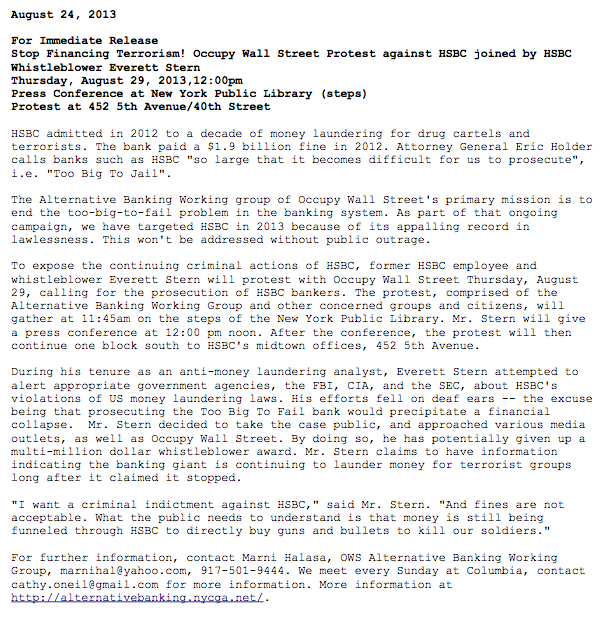
HSBC protest tomorrow at noon with Alternative Banking (#OWS)
I’m helping organize a protest against HSBC with my Alternative Banking group. We’re going to be joined by Everett Stern, an HSBC whistleblower. You can learn more about that guy by reading Matt Taibbi’s Rolling Stones article on him.
Here’s the press release, I hope I see you there!
I don’t want you to be happy
I was giving unwanted advice to my friend the other day, complaining to him about how he’s this absolutely fantastic, wonderful young person – all true – and he’s wasting his time feeling like he’s wasting his time.
Look, he’s obsessed over time. He’s always complaining about being late, or being too slow, or being rushed, and he never thinks he has time to do anything. He’s too old to embark on something.
He’s on tenure track, so that might be part of the problem, but on the other hand he’s gonna get tenure, even he admits that, so not really.
I was telling him to stop worrying about time and just enjoy being awesome. Here I am, quite a few years older, and I’m not at all rushed when it comes to accomplishment. Maybe it’s because I’m a woman and many of my favorite role models are women who change their careers at the age of 75, become potters or writers or poets or what have you. I don’t think I’ll ever need to feel like it’s too late to do something I really want to do. If I’m still alive there’s still time.
“Anyway,” I end my speech, “I’m just saying this because I want you to be happy.”
“Happy?” he says, “please don’t say that. You don’t actually want me to be happy. Come on, you can do better than that.”
And that’s when it hit me. I don’t want him to be happy. I just want him to have better suffering. Instead of suffering about the amount of time he has to do things, which is a self-produced drama, I want him to strive for goals and accomplishments without the noise of crappy I’m-too-late suffering.
I want him to have meaningful suffering, not happiness.
I mean, it depends on what you mean by happiness, but in that conversation he made me realize that wishing happiness on someone is a pretty bland goal. Maybe even an unkind goal.
In fact, it’s the goal I say I wish for my kids when I really hope they’re safe. I’m not so sure “happy” is all that different from “doesn’t get involved in the world too much, stays out of trouble, and is safe”. If you don’t believe me, check out this guy (hat tip Chris Wiggins), whose stated goal is to be happy but whose practice is to ignore all things that interrupt his world view and to make silly lists.
Example from my life. If a friend of mine got his college savings, bought an apartment in Paris, and spent his days combing the catacombs of Paris, I’d want to hang out with that guy. If my son did the same thing, I’d want to convince him not to do it, and to go to college instead. After all, I’d argue, it’s for his own good, he should get an education. I’d tell him I was urging this because I want him to be happy.
Two conclusions.
First, as a parent I’ll strive to spend less time protecting my children from harm and more time letting them seek their own adventures. I want more for them, frankly, than that they’re happy/safe.
Second, I want to start urging my friends to find meaningful suffering. Strive for something and be temporarily miserable when you don’t get it. Hate the world enough to never be satisfied with how shitty things are, love the world enough to stay engaged with it anyway.
College ranking models
Last week Obama began to making threats regarding a new college ranking system and its connection to federal funding. Here’s an excerpt of what he was talking about, from this WSJ article:
The president called for rating colleges before the 2015 school year on measures such as affordability and graduation rates—”metrics like how much debt does the average student leave with, how easy is it to pay off, how many students graduate on time, how well do those graduates do in the workforce,” Mr. Obama told a crowd at the University at Buffalo, the first stop on a two-day bus tour.
Interesting! This means that Obama is wading directly into the field of modeling. He’s probably sick of the standard college ranking system, put out by US News & World Reports. I kind of don’t blame him, since that model is flawed and largely gamed. In fact, I made a case for open sourcing that model recently just so that people would look into it and lose faith in its magical properties.
So I’m with Obama, that model sucks, and it’s high time there are other competing models so that people have more than one thing to think about.
On the other hand, what Obama is focusing on seems narrow. Here’s what he supposedly wants to do with that model (again from the WSJ article):
Once a rating system is in place, Mr. Obama will ask Congress to allocate federal financial aid based on the scores by 2018. Students at top-performing colleges could receive larger federal grants and more affordable student loans. “It is time to stop subsidizing schools that are not producing good results,” he said.
His main goal seems to be “to make college more affordable”.
I’d like to make a few comments on this overall plan. The short version is that he’s suggesting something that will have strong, mostly negative effects, and that won’t solve his problem of college affordability.
Why strong negative effects?
What Obama seems to realize about the existing model is that it’s had side effects because of the way college administrators have gamed the model. Presumably, given that this new proposed model will be directly tied to federal funding, it will be high-impact and will thus be thoroughly gamed by administrators as well.
The first complaint, then, is that Obama didn’t address this inevitably gaming directly – and that doesn’t bode well about his ability to put into place a reasonable model.
But let’s not follow his lead. Let’s think about what kind of gaming will occur once such a model is in place. It’s not pretty.
Here are the attributes he’s planning to use for colleges. I’ve substituted reasonably numerical proxies for his descriptions above:
- Cost (less is better)
- Percentage of people able to pay off their loans within 10 years (more is better)
- Graduation rate (more is better)
- Percentage of people graduating within 4 years (more is better)
- Percentage of people who get high-paying jobs after graduating (more is better)
Cost
Nobody is going to argue against optimizing for lower cost. Unfortunately, what with the cultural assumption of the need for a college education, combined with the ignorance and naive optimism of young people, not to mention start-ups like Upstart that allow young people to enter indentured servitude, the pressure is upwards, not downwards.
The supply of money for college is large and growing, and the answer to rising tuition costs is not to supply more money. Colleges have already responded to the existence of federal loans, for example, by raising tuition in the amount of the loan. Ironically, much of the rise in tuition cost has gone to administrators, whose job it is to game the system for more money.
Which is to say, you can penalize certain colleges for being at the front of the pack in terms of price, but if the overall cost is rising constantly, you’re not doing much.
If you really wanted to make costs low, then fund state universities and make them really good, and make them basically free. That would actually make private colleges try to compete on cost.
Paying off loans quickly
Here’s where we get to the heart of the problem with Obama’s plan.
What are you going to do, as an administrator tasked with making sure you never lose federal funding under the new regime?
Are you going to give all the students fairer terms on their debt? Or are you going to select for students that are more likely to get finance jobs? I’m guessing the latter.
So much for liberal arts educations. So much for learning about art, philosophy, or for that matter anything that isn’t an easy entrance into the tech or finance sector. Only colleges that don’t care a whit about federal money will even have an art history department.
Graduation rate
Gaming the graduation rate is easy. Just lower your standards for degrees, duh.
How quickly people graduate
Again, a general lowering of standards is quick and easy.
How well graduates do in the workforce
Putting this into your model is toxic, and measures a given field directly in terms of market forces. Economics, Computer Science, and Business majors will be the kings of the hill. We might as well never produce writers, thinkers, or anything else creative again.
Note this pressure already exists today: many of our college presidents are becoming more and more corporate minded and less interested in education itself, mostly as a means to feed their endowments. As an example, I don’t need to look further than across my street to Barnard, where president Debora Spar somehow decided to celebrate Ina Drew as an example of success in front of a bunch of young Barnard students. I can’t help but think that was related to a hoped-for gift.
Obama needs to think this one through. Do we really want to build the college system in this country in the image of Wall Street and Silicon Valley? Do we want to intentionally skew the balance towards those industries even further?
Building a better college ranking model
The problem is that it’s actually really hard to model quality of education. The mathematical models that already exist and are being proposed are just pathetically bad at it, partly because college, ultimately, isn’t only about the facts you learn, or the job you get, or how quickly you get it. It’s actually a life experience which, in the best of cases, enlarges your world view, and gets you to strive for something you might not have known existed before going.
I’d suggest that, instead of building a new ranking system, we on the one hand identify truly fraudulent colleges (which really do exist) and on the other, invest heavily in state schools, giving them enough security so they can do without their army of expensive administrators.
Ask Aunt Pythia
Peoples!! Peoples!!
I know you came for Aunt Pythia (thank you very much!) but today I must insist that, first, you go read my new hero’s advice column, Dear Miss Disruption, who has been quite the twitter celebrity this week.
Written by a law student named Sarah Jeong from Oakland, Miss Disruption has super awesome advice for the budding entrepreneur – or, in fact, anyone at all. She even took on my favorite topic, namely how people lie when counting their previous lovers! Here’s a tasty excerpt:
I sympathize. You and I both know, learning to code is the best way to pull oneself up by one’s bootstraps. Hell, look at me. Other than my affluent Orange County family, my Stanford bachelor’s degree, and the $10 million that my uncle invested as seed capital for my innovative advice column start-up, I have nothing but my ability to code.
I’ll admit that Miss Disruption is a tad more sarcastic than Aunt Pythia, but she’s super funny and smart just like Aunt Pythia, so I know you guys will love her.
After you go read her stuff, please come back here, read my stuff, and, by all means,
Submit your question for Aunt Pythia at the bottom of this page!
——
Dear Aunt Pythia,
I am 26, and I presently work in education. I studied history as an undergrad, but I would like to pursue a master’s degree in statistics. I need to learn some lower division math and programming. There are online courses and resources out there. Would it be better to pursue the courses with instructors and peers to the extent possible, or do you think it makes little difference?
Depressed in the Burbs
Dear Depressed,
It depends. In terms of what you might learn, I could see it making very little difference. But you have another goal too, namely getting into a masters program in statistics. It might be more convincing to the admissions people to see an official set of courses in math and programming with official grades than for you to tell them you learned it on your own, although perhaps online courses do offer quasi-official grades, and also it might depend on the masters program – some of them are just cash cows.
But then there’s also the issue of sticking it out and being invested. Have you considered taking these courses at some kind of extension school or community college? The community part of it might end up helping a lot.
Good luck,
Aunt Pythia
——
Dearest Aunt Pythia,
A beloved friend of mine recently came to visit and spent two sweet days singing with me, laughing at nothing/everything, gorging ourselves on waffles, and otherwise squandering time in shared luxurious idleness. In sum, fun was had.
The day after she left, I discovered a fat wad of cash underneath my pillow, which she hid there for me to find in a characteristic act of willful generosity. The thing is, I did nothing to earn this money and in fact feel quite indebted to her for her lifelong friendship and general camaraderie. My dilemma is: should I keep the money or send it back? If the former, how can I possibly thank her for her disproportionate magnanimity? I’m verklempt over here.
Grateful Gal Pal
Dear GGP,
Money is a funny thing, especially between friends. But sometimes it actually isn’t. Here’s my wild guess as to the circumstances.
Your good friend was incredibly grateful for your sanctuary and your luxurious idleness, which is exactly what she needed at that moment and perhaps even saved her sanity and her life, and was in particular an almost offhand bounty naturally stemming from your lifestyle. She wanted to give you something in return that was her kind of offhand bounty that she thought might help you with your life – at the very least to sustain you for some time in the heaven in which you currently reside.
So ask yourself this: is this an amount of money she can afford? Can it give you pleasure in some small way? If so, then please accept it as it was meant, namely as a thank you and a gift, and go buy ingredients for some more waffles.
Love always,
AP
——
Dear Aunt Pythia,
I had a very weird dream today. I dreamed that, to support Snowden, all couples in the world made a porn video and uploaded it in the Internet. Did I already surpass the limits of madness?
Crazy Lazy
Dear CL,
I for one think Chelsea Manning is hot. That’s what I got for this question.
AP
——
Dear Aunt Pythia,
I have recently discovered my partner of 2 years had sexual relations with his aunt not long before we began our relationship. He claimed to be a virgin when I started seeing him and now I know he lied. I love him and we have children together, I would like some advice and opinions thank you.
A
Dear A,
First of all I’m getting a bit confused thinking about how you can have multiple children together given that you have only been together 2 years. I’m guessing you got started quick and you had twins, or you got started immediately, squeezed out a pup, and then immediately got pregnant again, which is super unlikely.
Or you made up this whole thing, which is always a possibility that advice columnists need to consider. It’s probably even more likely given the incest theme. But whatever, I’m almost out of questions.
Second, I think it really depends on the circumstances. Was he a kid? Was it sexual abuse perpetrated on him by a trusted loved one? If so, by all means forgive him immediately, but also have him seek counseling if he’s willing.
The tough one is if he was an adult when he got involved with the Aunt. I’m no expert on human sexuality but I’d guess that someone who doesn’t have taboos about incest with Aunts might not have taboos with other kinds of things either. That would creep me out as the mother of this guy’s kids.
In any case, my advice to you is to go seek counseling yourself with an expert on sexual abuse.
Good luck!
Aunt Pythia
——
Please submit your well-specified, fun-loving, cleverly-abbreviated question to Aunt Pythia!
Don’t Fly During Ramadan
Crossposted from /var/null, a blog written by Aditya Mukerjee. Aditya graduated from Columbia with a degree in CS and statistics, was a hackNY Fellow, worked in data at OkCupid, and on the server team at foursquare. He currently serves as the Hacker-in-Residence at Quotidian Ventures.
A couple of weeks ago, I was scheduled to take a trip from New York (JFK) to Los Angeles on JetBlue. Every year, my family goes on a one-week pilgrimage, where we put our work on hold and spend time visiting temples, praying, and spending time with family and friends. To my Jewish friends, I often explain this trip as vaguely similar to the Sabbath, except we take one week of rest per year, rather than one day per week.
Our family is not Muslim, but by coincidence, this year, our trip happened to be during the last week of Ramadan.
By further coincidence, this was also the same week that I was moving out of my employer-provided temporary housing (at NYU) and moving into my new apartment. The night before my trip, I enlisted the help of two friends and we took most of my belongings, in a couple of suitcases, to my new apartment. The apartment was almost completely unfurnished – I planned on getting new furniture upon my return – so I dropped my few bags (one containing an air mattress) in the corner. Even though I hadn’t decorated the apartment yet, in accordance with Hindu custom, I taped a single photograph to the wall in my bedroom — a long-haired saint with his hands outstretched in pronam (a sign of reverence and respect).
The next morning, I packed the rest of my clothes into a suitcase and took a cab to the airport. I didn’t bother to eat breakfast, figuring I would grab some yogurt in the terminal while waiting to board.
I got in line for security at the airport and handed the agent my ID. Another agent came over and handed me a paper slip, which he said was being used to track the length of the security lines. He said, “just hand this to someone when your stuff goes through the x-ray machines, and we’ll know how long you were in line.’ I looked at the timestamp on the paper: 10:40.
When going through the security line, I opted out (as I always used to) of the millimeter wave detectors. I fly often enough, and have opted out often enough, that I was prepared for what comes next: a firm pat-down by a TSA employee wearing non-latex gloves, who uses the back of his hand when patting down the inside of the thighs.
After the pat-down, the TSA agent swabbed his hands with some cotton-like material and put the swab in the machine that supposedly checks for explosive residue. The machine beeped. “We’re going to need to pat you down again, this time in private,” the agent said.
Having been selected before for so-called “random” checks, I assumed that this was another such check.
“What do you mean, ‘in private’? Can’t we just do this out here?”
“No, this is a different kind of pat-down, and we can’t do that in public.” When I asked him why this pat-down was different, he wouldn’t tell me. When I asked him specifically why he couldn’t do it in public, he said “Because it would be obscene.”
Naturally, I balked at the thought of going somewhere behind closed doors where a person I just met was going to touch me in “obscene” ways. I didn’t know at the time (and the agent never bothered to tell me) that the TSA has a policy that requires two agents to be present during every private pat-down. I’m not sure if that would make me feel more or less comfortable.
Noticing my hesitation, the agent offered to have his supervisor explain the procedure in more detail. He brought over his supervisor, a rather harried man who, instead of explaining the pat-down to me, rather rudely explained to me that I could either submit immediately to a pat-down behind closed-doors, or he could call the police.
At this point, I didn’t mind having to leave the secure area and go back through security again (this time not opting out of the machines), but I didn’t particularly want to get the cops involved. I told him, “Okay, fine, I’ll leave”.
“You can’t leave here.”
“Are you detaining me, then?” I’ve been through enough “know your rights” training to know how to handle police searches; however, TSA agents are not law enforcement officials. Technically, they don’t even have the right to detain you against your will.
“We’re not detaining you. You just can’t leave.” My jaw dropped.
“Either you’re detaining me, or I’m free to go. Which one is it?” I asked.
He glanced for a moment at my backpack, then snatched it out of the conveyor belt. “Okay,” he said. “You can leave, but I’m keeping your bag.”
I was speechless. My bag had both my work computer and my personal computer in it. The only way for me to get it back from him would be to snatch it back, at which point he could simply claim that I had assaulted him. I was trapped.
While we waited for the police to arrive, I took my phone and quickly tried to call my parents to let them know what was happening. Unfortunately, my mom’s voicemail was full, and my dad had never even set his up.
“Hey, what’s he doing?” One of the TSA agents had noticed I was touching my phone. “It’s probably fine; he’s leaving anyway,” another said.
The cops arrived a few minutes later, spoke with the TSA agents for a moment, and then came over and gave me one last chance to submit to the private examination. “Otherwise, we have to escort you out of the building.” I asked him if he could be present while the TSA agent was patting me down.
“No,” he explained, “because when we pat people down, it’s to lock them up.”
I only realized the significance of that explanation later. At this point, I didn’t particularly want to miss my flight. Foolishly, I said, “Fine, I’ll do it.”
The TSA agents and police escorted me to a holding room, where they patted me down again – this time using the front of their hands as they passed down the front of my pants. While they patted me down, they asked me some basic questions.
“What’s the purpose of your travel?”
“Personal,” I responded, (as opposed to business).
“Are you traveling with anybody?”
“My parents are on their way to LA right now; I’m meeting them there.”
“How long is your trip?”
“Ten days.”
“What will you be doing?”
Mentally, I sighed. There wasn’t any other way I could answer this next question.
“We’ll be visiting some temples.” He raised his eyebrow, and I explained that the next week was a religious holiday, and that I was traveling to LA to observe it with my family.
After patting me down, they swabbed not only their hands, but also my backpack, shoes, wallet, and belongings, and then walked out of the room to put it through the machine again. After more than five minutes, I started to wonder why they hadn’t said anything, so I asked the police officer who was guarding the door. He called over the TSA agent, who told me,
“You’re still setting off the alarm. We need to call the explosives specialist”.
I waited for about ten minutes before the specialist showed up. He walked in without a word, grabbed the bins with my possessions, and started to leave. Unlike the other agents I’d seen, he wasn’t wearing a uniform, so I was a bit taken aback.
“What’s happening?” I asked.
“I’m running it through the x-ray again,” he snapped. “Because I can. And I’m going to do it again, and again, until I decide I’m done”. He then asked the TSA agents whether they had patted me down. They said they had, and he just said, “Well, try again”, and left the room. Again I was told to stand with my legs apart and my hands extended horizontally while they patted me down all over before stepping outside.
The explosives specialist walked back into the room and asked me why my clothes were testing positive for explosives. I told him, quite truthfully, “I don’t know.” He asked me what I had done earlier in the day.
“Well, I had to pack my suitcase, and also clean my apartment.”
“And yesterday?”
“I moved my stuff from my old apartment to my new one”.
“What did you eat this morning?”
“Nothing,” I said. Only later did I realize that this made it sound like I was fasting, when in reality, I just hadn’t had breakfast yet.
“Are you taking any medications?”
The other TSA agents stood and listened while the explosives specialist and asked every medication I had taken “recently”, both prescription and over-the-counter, and asked me to explain any medical conditions for which any prescription medicine had been prescribed. Even though I wasn’t carrying any medication on me, he still asked for my complete “recent” medical history.
“What have you touched that would cause you to test positive for certain explosives?”
“I can’t think of anything. What does it say is triggering the alarm?” I asked.
“I’m not going to tell you! It’s right here on my sheet, but I don’t have to tell you what it is!” he exclaimed, pointing at his clipboard.
I was at a loss for words. The first thing that came to my mind was, “Well, I haven’t touched any explosives, but if I don’t even know what chemical we’re talking about, I don’t know how to figure out why the tests are picking it up.”
He didn’t like this answer, so he told them to run my belongings through the x-ray machine and pat me down again, then left the room.
I glanced at my watch. Boarding would start in fifteen minutes, and I hadn’t even had anything to eat. A TSA officer in the room noticed me craning my neck to look at my watch on the table, and he said, “Don’t worry, they’ll hold the flight.”
As they patted me down for the fourth time, a female TSA agent asked me for my baggage claim ticket. I handed it to her, and she told me that a woman from JetBlue corporate security needed to ask me some questions as well. I was a bit surprised, but agreed. After the pat-down, the JetBlue representative walked in and cooly introduced herself by name.
She explained, “We have some questions for you to determine whether or not you’re permitted to fly today. Have you flown on JetBlue before?”
“Yes”
“How often?”
“Maybe about ten times,” I guessed.
“Ten what? Per month?”
“No, ten times total.”
She paused, then asked,
“Will you have any trouble following the instructions of the crew and flight attendants on board the flight?”
“No.” I had no idea why this would even be in doubt.
“We have some female flight attendants. Would you be able to follow their instructions?”
I was almost insulted by the question, but I answered calmly, “Yes, I can do that.”
“Okay,” she continued, “and will you need any special treatment during your flight? Do you need a special place to pray on board the aircraft?”
Only here did it hit me.
“No,” I said with a light-hearted chuckle, trying to conceal any sign of how offensive her questions were. “Thank you for asking, but I don’t need any special treatment.”
She left the room, again, leaving me alone for another ten minutes or so. When she finally returned, she told me that I had passed the TSA’s inspection. “However, based on the responses you’ve given to questions, we’re not going to permit you to fly today.”
I was shocked. “What do you mean?” were the only words I could get out.
“If you’d like, we’ll rebook you for the flight tomorrow, but you can’t take the flight this afternoon, and we’re not permitting you to rebook for any flight today.”
I barely noticed the irony of the situation – that the TSA and NYPD were clearing me for takeoff, but JetBlue had decided to ground me. At this point, I could think of nothing else but how to inform my family, who were expecting me to be on the other side of the country, that I wouldn’t be meeting them for dinner after all. In the meantime, an officer entered the room and told me to continue waiting there. “We just have one more person who needs to speak with you before you go.” By then, I had already been “cleared” by the TSA and NYPD, so I couldn’t figure out why I still needed to be questioned. I asked them if I could use my phone and call my family.
“No, this will just take a couple of minutes and you’ll be on your way.” The time was 12.35.
He stepped out of the room – for the first time since I had been brought into the cell, there was no NYPD officer guarding the door. Recognizing my short window of opportunity, I grabbed my phone from the table and quickly texted three of my local friends – two who live in Brooklyn, and one who lives in Nassau County – telling them that I had been detained by the TSA and that I couldn’t board my flight. I wasn’t sure what was going to happen next, but since nobody had any intention of reading me my Miranda rights, I wanted to make sure people knew where I was.
After fifteen minutes, one of the police officers marched into the room and scolded, “You didn’t tell us you have a checked bag!” I explained that I had already handed my baggage claim ticket to a TSA agent, so I had in fact informed someone that I had a checked bag. Looking frustrated, he turned and walked out of the room, without saying anything more.
After about twenty minutes, another man walked in and introduced himself as representing the FBI. He asked me many of the same questions I had already answered multiple times – my name, my address, what I had done so far that day. etc.
He then asked, “What is your religion?”
“I’m Hindu.”
“How religious are you? Would you describe yourself as ‘somewhat religious’ or ‘very religious’?”
I was speechless from the idea of being forced to talk about my the extent of religious beliefs to a complete stranger. “Somewhat religious”, I responded.
“How many times a day do you pray?” he asked. This time, my surprise must have registered on my face, because he quickly added, “I’m not trying to offend you; I just don’t know anything about Hinduism. For example, I know that people are fasting for Ramadan right now, but I don’t have any idea what Hindus actually do on a daily basis.”
I nearly laughed at the idea of being questioned by a man who was able to admit his own ignorance on the subject matter, but I knew enough to restrain myself. The questioning continued for another few minutes. At one point, he asked me what cleaning supplies I had used that morning.
“Well, some window cleaner, disinfectant -” I started, before he cut me off.
“This is important,” he said, sternly. “Be specific.” I listed the specific brands that I had used.
Suddenly I remembered something: the very last thing I had done before leaving was to take the bed sheets off of my bed, as I was moving out. Since this was a dorm room, to guard against bedbugs, my dad (a physician) had given me an over-the-counter spray to spray on the mattress when I moved in, over two months previously. Was it possible that that was still active and triggering their machines?
“I also have a bedbug spray,” I said. “I don’t know the name of it, but I knew it was over-the-counter, so I figured it probably contained permethrin.” Permethrin is an insecticide, sold over-the-counter to kill bed bugs and lice.
“Perm-what?” He asked me to spell it.
After he wrote it down, I asked him if I could have something to drink. “I’ve been here talking for three hours at this point,” I explained. “My mouth is like sandpaper”. He refused, saying
“We’ll just be a few minutes, and then you’ll be able to go.”
“Do you have any identification?” I showed him my drivers license, which still listed my old address. “You have nothing that shows your new address?” he exclaimed.
“Well, no, I only moved there on Thursday.”
“What about the address before that?”
“I was only there for two months – it was temporary housing for work”. I pulled my NYU ID out of my wallet. He looked at it, then a police officer in the room took it from him and walked out.
“What about any business cards that show your work address?” I mentally replayed my steps from the morning, and remembered that I had left behind my business card holder, thinking I wouldn’t need it on my trip.
“No, I left those at home.”
“You have none?”
“Well, no, I’m going on vacation, so I didn’t refill them last night.” He scoffed. “I always carry my cards on me, even when I’m on vacation.” I had no response to that – what could I say?
“What about a direct line at work? Is there a phone number I can call where it’ll patch me straight through to your voicemail?”
“No,” I tried in vain to explain. “We’re a tech company; everyone just uses their cell phones”. To this day, I don’t think my company has a working landline phone in the entire office – our “main line” is a virtual assistant that just forwards calls to our cell phones. I offered to give him the name and phone number of one of our venture partners instead, which he reluctantly accepted.
Around this point, the officer who had taken my NYU ID stormed into the room.
“They put an expiration sticker on your ID, right?” I nodded. “Well then why did this ID expire in 2010?!” he accused.
I took a look at the ID and calmly pointed out that it said “August 2013” in big letters on the ID, and that the numbers “8/10” meant “August 10th, 2013”, not “August, 2010”. I added, “See, even the expiration sticker says 2013 on it above the date”. He studied the ID again for a moment, then walked out of the room again, looking a little embarrassed.
The FBI agent resumed speaking with me. “Do you have any credit cards with your name on them?” I was hesitant to hand them a credit card, but I didn’t have much of a choice. Reluctantly, I pulled out a credit card and handed it to him. “What’s the limit on it?” he said, and then, noticing that I didn’t laugh, quickly added, “That was a joke.”
He left the room, and then a series of other NYPD and TSA agents came in and started questioning me, one after the other, with the same questions that I’d already answered previously. In between, I was left alone, except for the officer guarding the door.
At one point, when I went to the door and asked the officer when I could finally get something to drink, he told me, “Just a couple more minutes. You’ll be out of here soon.”
“That’s what they said an hour ago,” I complained.
“You also said a lot of things, kid,” he said with a wink. “Now sit back down”.
I sat back down and waited some more. Another time, I looked up and noticed that a different officer was guarding the door. By this time, I hadn’t had any food or water in almost eighteen hours. I could feel the energy draining from me, both physically and mentally, and my head was starting to spin. I went to the door and explained the situation the officer. “At the very least, I really need something to drink.”
“Is this a medical emergency? Are you going to pass out? Do we need to call an ambulance?” he asked, skeptically. His tone was almost mocking, conveying more scorn than actual concern or interest.
“No,” I responded. I’m not sure why I said that. I was lightheaded enough that I certainly felt like I was going to pass out.
“Are you diabetic?”
“No,” I responded.
Again he repeated the familiar refrain. “We’ll get you out of here in a few minutes.” I sat back down. I was starting to feel cold, even though I was sweating – the same way I often feel when a fever is coming on. But when I put my hand to my forehead, I felt fine.
One of the police officers who questioned me about my job was less-than-familiar with the technology field.
“What type of work do you do?”
“I work in venture capital.”
“Venture Capital – is that the thing I see ads for on TV all the time?” For a moment, I was dumbfounded – what venture capital firm advertises on TV? Suddenly, it hit me.
“Oh! You’re probably thinking of Capital One Venture credit cards.” I said this politely and with a straight face, but unfortunately, the other cop standing in the room burst out laughing immediately. Silently, I was shocked – somehow, this was the interrogation procedure for confirming that I actually had the job I claimed to have.
Another pair of NYPD officers walked in, and one asked me to identify some landmarks around my new apartment. One was, “When you’re facing the apartment, is the parking on the left or on the right?” I thought this was an odd question, but I answered it correctly. He whispered something in the ear of the other officer, and they both walked out.
The onslaught of NYPD agents was broken when a South Asian man with a Homeland Security badge walked in and said something that sounded unintelligible. After a second, I realized he was speaking Hindi.
“Sorry, I don’t speak Hindi.”
“Oh!” he said, noticeably surprised at how “Americanized” this suspect was. We chatted for a few moments, during which time I learned that his family was Pakistani, and that he was Muslim, though he was not fasting for Ramadan. He asked me the standard repertoire of questions that I had been answering for other agents all day.
Finally, the FBI agent returned.
“How are you feeling right now?” he asked. I wasn’t sure if he was expressing genuine concern or interrogating me further, but by this point, I had very little energy left.
“A bit nauseous, and very thirsty.”
“You’ll have to understand, when a person of your… background walks into here, travelling alone, and sets off our alarms, people start to get a bit nervous. I’m sure you’ve been following what’s been going on in the news recently. You’ve got people from five different branches of government all in here – we don’t do this just for fun.”
He asked me to repeat some answers to questions that he’d asked me previously, looking down at his notes the whole time, then he left. Finally, two TSA agents entered the room and told me that my checked bag was outside, and that I would be escorted out to the ticketing desks, where I could see if JetBlue would refund my flight.
It was 2:20PM by the time I was finally released from custody. My entire body was shaking uncontrollably, as if I were extremely cold, even though I wasn’t. I couldn’t identify the emotion I was feeling. Surprisingly, as far as I could tell, I was shaking out of neither fear nor anger – I felt neither of those emotions at the time. The shaking motion was entirely involuntary, and I couldn’t force my limbs to be still, no matter how hard I concentrated.
In the end, JetBlue did refund my flight, but they cancelled my entire round-trip ticket. Because I had to rebook on another airline that same day, it ended up costing me about $700 more for the entire trip. Ironically, when I went to the other terminal, I was able to get through security (by walking through the millimeter wave machines) with no problem.
I spent the week in LA, where I was able to tell my family and friends about the entire ordeal. They were appalled by the treatment I had received, but happy to see me safely with them, even if several hours later.
I wish I could say that the story ended there. It almost did. I had no trouble flying back to NYC on a red-eye the next week, in the wee hours of August 12th. But when I returned home the next week, opened the door to my new apartment, and looked around the room, I couldn’t help but notice that one of the suitcases sat several inches away from the wall. I could have sworn I pushed everything to the side of the room when I left, but I told myself that I may have just forgotten, since I was in a hurry when I dropped my bags off.
When I entered my bedroom, a chill went down my spine: the photograph on my wall had vanished. I looked around the room, but in vain. My apartment was almost completely empty; there was no wardrobe it could have slipped under, even on the off-chance it had fallen.
To this day, that photograph has not turned up. I can’t think of any “rational” explanation for it. Maybe there is one. Maybe a burglar broke into my apartment by picking the front door lock and, finding nothing of monetary value, took only my picture. In order to preserve my peace-of-mind, I’ve tried to convince myself that that’s what happened, so I can sleep comfortably at night.
But no matter how I’ve tried to rationalize this in the last week and a half, nothing can block out the memory of the chilling sensation I felt that first morning, lying on my air mattress, trying to forget the image of large, uniformed men invading the sanctuary of my home in my absence, wondering when they had done it, wondering why they had done it.
In all my life, I have only felt that same chilling terror once before – on one cold night in September twelve years ago, when I huddled in bed and tried to forget the terrible events in the news that day, wondering why they they had happened, wondering whether everything would be okay ever again.
Update: this has been picked up by Village Voice and Gawker and JetBlue has apologized over twitter.
Staples.com rips off poor people; let’s take control of our online personas
You’ve probably heard rumors about this here and there, but the Wall Street Journal convincingly reported yesterday that websites charge certain people more for the exact thing.
Specifically, poor people were more likely to pay more for, say, a stapler from Staples.com than richer people. Home Depot and Lowes does the same for their online customers, and Discover and Capitol One make different credit card offers to people depending on where they live (“hey, do you live in a PayDay lender neighborhood? We got the card for you!”).
They got pretty quantitative for Staples.com, and did tests to determine the cost. From the article:
It is possible that Staples’ online-pricing formula uses other factors that the Journal didn’t identify. The Journal tested to see whether price was tied to different characteristics including population, local income, proximity to a Staples store, race and other demographic factors. Statistically speaking, by far the strongest correlation involved the distance to a rival’s store from the center of a ZIP Code. That single factor appeared to explain upward of 90% of the pricing pattern.
If anyone’s ever seen a census map, race is highly segregated by ZIP code, and my guess is we’d see pretty high correlations along racial lines as well, although they didn’t mention it in the article except to say that explicit race-related pricing is illegal. The article does mentions that things get more expensive in rural areas, which are also poorer, so there’s that acknowledged correlation.
But wait, how much of a price difference are we talking about? From the article:
Prices varied for about a third of the more than 1,000 randomly selected Staples.com products tested. The discounted and higher prices differed by about 8% on average.
In other words, a really non-trivial amount.
The messed up thing about this, or at least one of them, is that we could actually have way more control over our online personas than we think. It’s invisible to us, typically, so we don’t think about our cookies and our displayed IP addresses. But we could totally manipulate these signatures to our advantage if we set our minds to it.
Hackers, get thyselves to work making this technology easily available.
For that matter, given the 8% difference, there’s money on the line so some straight-up capitalist somewhere should be meeting that need. I for one would be willing to give someone a sliver of the amount saved every time they manipulated my online persona to save me money. You save me $1.00, I’ll give you a dime.
Here’s my favorite part of this plan: it would be easy for Staples to keep track of how much people are manipulating their ZIP codes. So if Staples.com infers a certain ZIP code for me to display a certain price, but then in check-out I ask them to send the package to a different ZIP code, Staples will know after-the-fact that I fooled them. But whatever, last time I looked it didn’t cost more or less to send mail to California or wherever than to Manhattan [Update: they do charge differently for packages, though. That’s the only differential in cost I think is reasonable to pay].
I’d love to see them make a case for how this isn’t fair to them.
You people freaking rock: Occupy Finance officially funded
Yesterday I told people about the book my Occupy group is coming out with. I said I needed $350 to cover the printing costs, and I asked for small donations. Anything beyond that means more books get printed (still true!).
Today I’m super happy to say I’ve collected pledges summing to $596, which means we’ll be able to make many more copies of the book than expected, and distribute them to many more people. And it’s really been a group effort: 15 different people pitched in with amounts between $20 and $100. It means they’re all part of the project.
What was particularly awesome for me about the “Crappy Kickstarter” was the personal emails I got with words of encouragement for the blog and the book.
You guys seriously rock, and I feel very lucky to be your friend. Thanks!


 mathbabe