Judge Rakoff explains why no banker is in jail #OWS
United States District Judge Jed S. Rakoff is already kind of a hero to me, given that he’s the guy who rejected a “do not admit wrongdoing” settlement between Citigroup and the SEC over mortgage-backed securities fraud because, according to Rakoff, the proposed settlement was “neither fair, nor reasonable, nor adequate, nor in the public interest.”
More recently Rakoff has written a fine essay in the New York Review of Books entitled The Financial Crisis: Why Have No High-Level Executives Been Prosecuted? which I will summarize below but is well worth your time to read.
Rakoff’s essay
First Rakoff made the point that if there was no intentional fraud we should not scapegoat people and put them to jail. But on the other hand, if there was intentional fraud, then it’s a reflection on a dysfunctional justice system that nobody has gone to jail.
Then he examined that first possibility and found it unlikely, given that “… the Financial Crisis Inquiry Commission, in its final report, uses variants of the word “fraud” no fewer than 157 times in describing what led to the crisis…” In fact, fraud permeated at every level.
The Department of Justice (DOJ) has focused on explaining why nobody has gone to jail in spite of the existence of fraud. They have three reasons.
First, the DOJ claims it’s hard to prove intent for high-level management. But Rakoff demurs on this point, explaining that in cases of accounting fraud, “willful blindness” or “conscious disregard” is a well-established basis on which federal prosecutors have asked juries to infer intent.
Second, since many counterparties were “sophisticated,” it’s difficult to prove “reliance“. Again Rakoff demurs, pointing out that “In actuality, in a criminal fraud case the government is never required to prove—ever—that one party to a transaction relied on the word of another.”
Third, because of the “Too Big To Jail” problem, namely that prosecuting fraud would kill the economy. To this, Rakoff points out what that means in terms of class: that poor people can be prosecuted but the rich are protected.
Next, Rakoff says what he thinks is actually happening. First he discounts the revolving door: he thinks lawyers are thoroughly incentivized to make a name for themselves. Then what? He’s got three reasons.
Well, first, people were distracted. The FBI was distracted by terrorists, and the SEC was focused on Ponzi schemes and insider trading. The DOJ was inexperienced and the Southern District US Attorney’s Office was also focused on insider trading. And given the complexity and incentives, it’s hard for a given lawyer to decide to go with an MBS case instead of insider trading.
Second, the government had direct conflict in the fraud, given that the Fed and the regulators had deregulated everything in sight and then kept interest rates low to keep the mortgage machine going. They also meddled a lot during the crisis, deciding which failing bank should be taken over by whom. It made it hard for them to admit shit went wrong.
Finally, it’s because it’s now in vogue to prosecute corporations instead of people, but that really doesn’t work. Here’s Rakoff on this prosecutorial method:
Although it is supposedly justified because it prevents future crimes, I suggest that the future deterrent value of successfully prosecuting individuals far outweighs the prophylactic benefits of imposing internal compliance measures that are often little more than window-dressing. Just going after the company is also both technically and morally suspect. It is technically suspect because, under the law, you should not indict or threaten to indict a company unless you can prove beyond a reasonable doubt that some managerial agent of the company committed the alleged crime; and if you can prove that, why not indict the manager? And from a moral standpoint, punishing a company and its many innocent employees and shareholders for the crimes committed by some unprosecuted individuals seems contrary to elementary notions of moral responsibility.
And then his final conclusion:
So you don’t go after the companies, at least not criminally, because they are too big to jail; and you don’t go after the individuals, because that would involve the kind of years-long investigations that you no longer have the experience or the resources to pursue.
Comments
First, I am super grateful for Judge Rakoff’s essay, because as an experienced lawyer he has way more ammunition than I do to explain this stuff from the perspective of what is actually done in law. The “willful blindness” issue is particularly ridiculous. I’m glad to hear that courts have a way to deal with that problem, even if they aren’t using their tools against Jamie Dimon.
I am also grateful to hear him make the point that widespread fraud, unprosecuted, is not simply a theoretical issue. It exposes the dysfunctionality of our justice system and it exposes basic unfairness in society, where depending on how rich you are and how complicated your crime is, you can avoid going to jail. Personally, in the past few months I’ve gone from being angry at the bankers to being angry at the prosecutors.
Finally, I disagree with Rakoff on one point. Namely, his argument against the negative effect of the revolving door. His argument, I stipulate, only works for lawyers in a US Attorney’s office. I don’t think the average SEC lawyer or economist, or for that matter an employee at any captured regulator, has that much incentive to take on a big MBS case and be hard-assed. I think we would have seen more cases if that were true.
Parents fighting back against sharing children’s data with InBloom
There is a movement afoot in New York (and other places) to allow private companies to house and mine tons of information about children and how they learn. It’s being touted as a great way to tailor online learning tools to kids, but it also raises all sorts of potential creepy modeling problems, and one very bad sign is how secretive everything is in terms of privacy issues. Specifically, it’s all being done through school systems and without consulting parents.
In New York it’s being done through InBloom, which I already mentioned here when I talked about big data and surveillance. In that post I related an EducationNewYork report which quoted an official from InBloom as saying that the company “cannot guarantee the security of the information stored … or that the information will not be intercepted when it is being transmitted.”
The issue is super important and timely, and parents have been left out of the loop, with no opt-out option, and are actively fighting back, for example with this petition from MoveOn (h/t George Peacock). And although the InBloomers claim that no data about their kids will ever be sold, that doesn’t mean it won’t be used by third parties for various mining purposes and possibly marketing – say for test prep tools. In fact that’s a major feature of InBloom’s computer and data infrastructure, the ability for third parties to plug into the data. Not cool that this is being done on the downlow.
Who’s behind this? InBloom is funded by the Bill & Melinda Gates foundation and the operating system for inBloom is being developed by the Amplify division (formerly Wireless Generation) of Rupert Murdoch’s News Corp. More about the Murdoch connection here.
Wait, who’s paying for this? Besides the Gates and Murdoch, New York has spent $50 million in federal grants to set up the partnership with InBloom. And it’s not only New York that is pushing back, according to this Salon article:
InBloom essentially offers off-site digital storage for student data—names, addresses, phone numbers, attendance, test scores, health records—formatted in a way that enables third-party education applications to use it. When inBloom was launched in February, the company announced partnerships with school districts in nine states, and parents were outraged. Fears of a “national database” of student information spread. Critics said that school districts, through inBloom, were giving their children’s confidential data away to companies who sought to profit by proposing a solution to a problem that does not exist. Since then, all but three of those nine states have backed out.
Finally, according to this nydailynews article, Bill de Blasio is coming out on the side of protecting children’s privacy as well. That’s a good sign, let’s hope he sticks with it.
I’m not against using technology to learn, and in fact I think it’s inevitable and possibly very useful. But first we need to have a really good, public discussion about how this data is being shared, controlled, and protected, and that simply hasn’t happened. I’m glad to see parents are aware of this as a problem.
Aunt Pythia’s advice
Aunt Pythia is on her yearly retreat to her favorite yarn store in the world, otherwise known as Webs in North Hampton, MA. It’s a nice town but very cold. In that spirit, and as you are enjoying today’s column,
please, think of something warm to ask Aunt Pythia at the bottom of the page!
By the way, if you don’t know what the hell Aunt Pythia is talking about, go here for past advice columns and here for an explanation of the name Pythia.
——
Dear Aunt Pythia,
Being a divorced father of three lovely grown daughters, two of whom who live in AK, I have decided to be with them over the holidays. Now according to them and most other women there, “it is where the odds are good, but the goods are odd.” That of course reflects the fact that there are many more men than there are women in Alaska, but the men are a bit kooky.
Anyway, I have three questions for you. First, will I be viewed as being “odd” because of my two year involvement with Occupy? I mean, there are not a lot of enlightened people in the red state of Alaska, women or men. You do remember Sarah Palin, right?!
Now considering myself an ‘enlightened man’, my second question is this: if I do have the chance to have a tryst with an un-enlightened woman, should I go for it, and talk politics afterward?
And the third question is if, I do go for it, how do I get out of my daughter’s home without raising suspicion? I mean… I cannot tell them that I am going out to the ‘deli’ because having been raised in the East, they know there are no such things in Alaska, so this would automatically make them become suspicious.
Soon To Be Bewildered In AK
Dear Soon,
First, do you mind if I change your name to “Recently”?
Second, I know there was an Occupy Anchorage arm of the movement, so please go find those guys.
Next, always talk politics afterwards. If then.
Finally, you’re a grown man, I’d expect you can just tell your daughters you’re sneaking out to get lucky and ask them to keep their fingers crossed.
Good luck!
Auntie P
——
Dear Aunt Pythia,
For the last 2.5 years I have been the care taker for my seriously ill elderly parents of whom one died over a year ago. I only now feel free to apply for full time faculty positions, but I am worried how to explain this situation on my job applications. I know I can’t just ignore it as my last paper was published in 2011. I have though continued to do some research and have backlog of seven papers that are at least half finished. Other than getting those papers out, what other advice do you have?
Thank you
JAA is Another Acronym
Dear JAA,
I honestly think you just tell them straight up that you were taking care of your seriously ill elderly parents. Mathematicians are people too and they have sympathy.
And yes, get the papers out, and talk about how much you love teaching and doing research. When you think about it, 2.5 years isn’t really that long, if you can still demonstrate that you’re active in research. I’d probably try to go to a conference in your field as well to be on top of things.
Good luck,
Aunt Pythia
——
Hello Aunt Pythia,
I am really fascinated by your acceptance of your body. However, I don’t have that. Is that something that one can develop?
One thing that is an obstacle is that being overweight increases my chances of developing type II diabetes like my parent and grandparent. My doctor would like me to lose weight, I want to lose weight, which makes it hard to accept my current weight.
The second issue is that my mental image of attractiveness involves not having rolls of fat. I don’t care about size so much as about the body not being lumpy. I find it very difficult to accept that I am sexually attractive.
Unhappily Overweight
Dear Unhappily,
I’m not sure how easy it is to develop acceptance of your own body, but it’s definitely worth a try and even small improvements will be worthwhile. Here are some tips.
- Think long and hard about what actually looks and feels attractive to you in terms of clothing, and do what you can to wear clothing that emphasizes parts of your body that you like. I go through phases of this, sometimes it’s “fit and flare” dresses that avoid the tent problem, sometimes it’s jeans and flannel shirts with funky shoes that just make me feel badass.
- Make a list of activities that leave your body feeling good and that you enjoy doing, and make a daily high-priority appointment with yourself to do one of those things – block out some time and don’t make appointments then. Taking a brisk walk works for me, and so does swimming and biking. Try to do something like that once or twice a day, but forgive yourself immediately if you don’t, so you’ll try again the next day.
- Keep in mind that nobody really knows how to lose weight, including doctors, so a doctor telling you to deal with it is kind of useless and promotes guilt in you without solving the problem. Fuck that.
- Which is not to say you should ignore your risk of diabetes. If you are taking unavoidable naps a couple of hours after meals, and if coffee doesn’t help but sugar does, that’s a bad sign, which I experienced when I was 39. What helps for me is to religiously avoid “fast carbs,” and I encourage you to experiment.
- But in any case keep in mind that other people are at risk for diseases too, and that doesn’t make them question their attractiveness. Try to separate the two issues.
- Next, stop watching TV or whatever media is convincing you that you cannot be attractive. Just turn it off. I’m in a hotel this week, so I’m exposed to TV in ways that I’m normally not (we don’t have TV at home) and I really can’t believe how many ads there are for weight loss – probably timed for New Year’s resolutions. I’m getting carpal tunnel syndrome from all the turning off I’m doing here. What does that mean? It means there’s an industry out there trying to make you feel bad so you will pay for their products. Fuck that.
- Finally, I suggest denial of small imperfections (or large ones, what the hell). Some people have body dysmorphia, but I’ve invented another condition which I’ve termed “body eumorphia” and which consists of believing I’m pretty much irresistibly attractive, at least to people who are wise enough to acknowledge it. It is achieved through following the above advice and just willing it to be true.
Good luck!
Aunt Pythia
——
Dear Aunt Pythia,
I was recently reading about 23andMe’s plan to collect all of our genomes, merge them with Google’s don’t-worry-your-privacy-is-totally-protected data stash (a founder of 23andMe is married to Sergei Brin), and create some orgasmic data analysis of Hitachi Magic Wand proportions. I’d like to ask your advice on how to design my own virus genome to irretrievably corrupt their system.
If that isn’t possible, what’s the best way to knock delivery drones out of the sky?
I’m glad Reagan is dead
Dear IgRid,
Wow, no offense, but you’re kind of evil. And I like you. I don’t think you really need my advice though, since you have much better ideas than I do. Instead I’ll ask you some questions.
First, when drones deliver our goods in the future, what’s gonna stop us from stealing those drones and repurposing them to our own benefit? I mean besides the video cameras and other surveillance mechanisms that will tip off Amazon and its private army about what we’re up to?
Second, have you seen this article about how shitty the current generation of genetics testing is? That’s not to say that it will be shitty in the future, especially when they sequence our entire genomes instead of looking for tiny little markers.
In fact, the whole industry has an incredible potential for creepiness, and I’m glad you’re thinking about ways to push back. Please keep me updated with your progress.
Love,
Auntie P
——
Please submit your well-specified, fun-loving, cleverly-abbreviated question to Aunt Pythia!
10 Worst things about Wall Street in 2013 (and 5 Silver Linings) #OWS
Written by the Alternative Banking group of Occupy Wall Street.
Compiling a list of the 10 Worst Wall Street Actions of 2013 should be easy–there are so many to choose from! The problem is, it often takes years to see which financial activities and innovations have been the most destructive and destabilizing. Therefore, the following should be considered merely a sample of the ways Wall Street has maneuvered, manipulated, defrauded and deceived us during the past year.
Bottom 10 things we found out about Wall Street in 2013
-
In Washington, It’s a Wash
One of the most obvious examples of Wall Street influence on Congress was HR 992 to roll back some of the derivatives restrictions on banks. The NY Times discovered that Citigroup had drafted most of the language, some of which was accepted almost word-for-word. The House passed it with bipartisan support. Meanwhile, bank lobbyists had excessive influence on the agencies writing and enforcing the Volcker rule. -
Still Too Big to Jail
The financial system in general, and the mammoth banks in particular, are still just too damn big. In 2013, JP Morgan Chase was the poster child for this problem, with its numerous legal problems, for which they set aside on the order of $28 billion dollars just to pay legal fees. The London Whale debacle, which involved Dimon lying to shareholders and Congress, showcased both how banks make their biggest money from pure speculation, and how they are enabled by lawmakers and regulators through their “Too Big To Fail” status. -
Banks Manipulate Commodities, Fed OKs It
Banks like JP Morgan Chase and Goldman Sachs have manipulated access to commodities such as aluminum and electricity in order to increase their profits. The Federal Reserve has permitted the biggest banks to postpone complying with such regulations as still exist to limit banks’ involvement in commodities, or to ignore them altogether. Minimal fines the banks have paid are simply the cost of doing business and are far outweighed by the money they’ve made. -
Zombie Foreclosures
The banks continued to exploit underwater homeowners. One of the worst abuses is called “zombie foreclosures” where the bank pretended to foreclose — evicting the owner — but then didn’t file legal papers. This allowed the banks to continue to rack up interest, fees and penalties because the homeowners, reasonably, stopped making payments because they thought the homes were no longer theirs. To add insult to injury, when the banks sent out checks to homeowners in restitution for past misdeeds, they bounced. -
Pillaging of Detroit
Detroit’s largest creditors, UBS and Bank of America, made it clear just how far they’re willing to go to collect on debts from highly-risky interest rate swap deals they made with Detroit’s leaders before the 2008 financial collapse: they’re coming for the art! Creditors, led by Detroit’s imposed “Emergency Manager” Kevyn Orr, sent Christie’s auction house to the Detroit Institute of Arts to valuate the works, which are all held tightly in public trust by the city. It still remains to be seen whether the approximately $900 million works – we think they’re priceless! – will be sold off to pay off debts or in some hostage deal to pay threatened but constitutionally-protected city worker pensions. -
Killing Credit Unions
According to MSN.com, credit unions offer low rates on loans, higher rates on savings, better credit cards deals, and lower fees. Perhaps because of these competitive benefits, the American Banking Association ran an ad campaign to revoke the tax exempt status for America’s credit unions. -
Court Evasion
There’s a familiar yet still outrageous lack of criminal prosecution for (pick your favorite settlement). But let’s concentrate on an exception that proved the rule, specifically what has been termed the “Bank of America/ Countrywide hustle”. Here Countrywide deliberately and desperately gamed underwriting standards to dump loans on Fannie and Freddie, and got caught. Worst of all, jury found defendants guilty in about 3 hours. If only more cases had been brought to trial: juries are chomping at the bit to find banks guilty. Which is probably why more weren’t. -
Never on Hold
U.S. Attorney General Eric Holder was an egregious case study in how Washington kowtows to Wall Street. When JPMorgan Chase wanted to settle their many legal difficulties, CEO Jamie Dimon had a private meeting with Holder to negotiate; the final settlement involved admission of illegal activity by JPMorgan but no criminal charges — just fines mainly paid by shareholders. Holder also admitted to Congress in March that the megabanks were too big to prosecute. While he later retracted the statement, his actions — never bringing criminal charges despite admitted criminal activities — speak louder than his words. -
Writing the Rules
The banks, among other corporations, pushed for the Trans Pacific Partnership (TPP) treaty that will greatly constrain efforts by the U.S. and other countries to regulate. For instance, it would prevent the imposition of a “Robin Hood Tax” on stock trading, it would roll back some of Dodd-Frank and prevent a return to Glass-Steagall. TPP would also forbid public banks such as the Bank of North Dakota or a return of the Post Office Bank. No wonder we aren’t hearing more details. -
Ongoing cultural confusion
AIG’s President and CEO Robert Benmosche compared criticism of AIG bonuses to lynchings in the Jim Crow South. Mistaking a papercut for a crucifixion is the inevitable delusion of a pampered and under-prosecuted criminal upper class.
5 Silver Linings
-
Occupy the SEC Gains Ground
Occupy the SEC‘s impact on the Volcker Rule (which originally aspired to banning proprietary trading and ownership of hedge funds by banks) could not be more evident. When the Volcker Rule was finalized in December, the hard work Occupy the SEC did writing a 325-page comment letter on paid off. The letter was cited 284 times by the regulators. In some cases, the final rule adopted their recommendations while in others the rule was modified in the direction of Occupy’s suggestions. -
Radical Eminent Domain
Richmond, California Mayor Gayle McLaughlin ignited a fury on Wall St and in Washington by employing an eminent domain threat to force intransigent banks to renegotiate – and reduce principal – for underwater homeowners. The move has sparked everything from lawsuits and threats of mortgage lenders leaving town to copycat actions in other underwater cities as far away as Irvington and Newark, New Jersey. Supporters of the promising tactic are calling it the Reverse Eminent Domain Movement and even Occupy 2.0. -
No Highchair for Larry
Larry Summers did not become the new Fed Chair in 2013. It was a close call but Larry Summers may finally have made too many obvious and ridiculous mistakes – deregulating financial derivatives to pave the way for the financial crisis, for one, and aiding criminal fraud in Russia for another – to be made, once again, one of the most powerful people in the world. -
Journalists Expose the Banks
Several journalists deserve extra praise this year for their coverage of Wall Street’s illegal and undemocratic behavior:: Matt Taibbi, Bill Moyers, Yves Smith, Gretchen Morgenson, the International Consortium of Investigative Journalism, ProPublica and Wikileaks. Taibbi alerted us to the HSBC settlement proving the drug war is a joke, Moyers highlighted how people can provoke change and, with Smith, exposed the dangers of the Trans-Pacific Partnership. Morgenson skewered payday lending and many other unsavory financial practices. The International Consortium of Investigative Journalism and WIkileaks exposed documents that the banks want to keep secret — for good reason — about enormous amounts held off-shore and TPP drafts.. -
Occupy Finance and Strike Debt
-
The OWS Alternative Banking Working group released Occupy Finance, a 100-page book explaining the financial crisis in layman’s terms on the second anniversary of Occupy, and supplies of the book were quickly exhausted (a new printing has been ordered for January 2014).
-
In the past two months alone, Strike Debt’s Rolling Jubilee has collected and abolished $14.7 million in debt, as a means of raising awareness about the personal debt crisis, and a step towards building a debt resistance movement.
Dallas Fed’s Richard Fisher talks TBTF on EconTalk (#OWS)
Yesterday Russ Roberts had Dallas Federal Reserve President Richard Fisher as his guest on his podcast EconTalk to talk about Too-Big-To-Fail (TBTF) banks and the Fed’s monetary policy. It was a fantastic discussion and I’m grateful to Roberts for continuing to discuss this important and nonpartisan issue.
We in Alt Banking have been impressed by Fisher’s stance on TBTF and have thought about trying to get him to come visit us to talk, so this was a great opportunity to get a preview of what he’d likely say if he ever made it over. Given that he’s an active central banker, he’s refreshingly open and honest about stuff, even if every now and then he deliberately makes it seem like everything that happened was a mistake rather than a criminal act.
Fisher and Roberts on TBTF
You should listen to the entire podcast, it’s about an hour long but well worth the time. I will submit a short summary of their conversation here:
- First they discuss the problem of TBTF banks, that instead of failing, large banks were merged into even larger banks during the crisis, and now we have institutions that are too big to manage and are being backed by an implicit government guarantee that the Dodd-Frank regulation isn’t removing.
- Next, the discuss a takeaway in terms of community banks. Is it a problem that it’s not a level playing field for community banks? Or is it primarily a problem that any bank that should fail is being propped up?
- Roberts makes the point that he doesn’t care so much that the system isn’t fair, he cares only that this banking system isn’t effective. If the threat is that France might overtake us in an ineffective field such as finance, then so be it.
- Then Fisher started talking solutions. He has a two-part plan. The first part is to make very explicit which parts of a bank have deposit insurance and access to the Fed window, namely only the commercial bank part that accepts deposits, not any special investment vehicles or insurance subsidiaries etc.
- The second part is to hold a ritual signing of a contract among every bank customer, creditor, investor, and counter-party (but not depositor!) which states that they know their investment is not protected by a government guaranteed. Roberts suggested this might be done in a public ceremony and include a statement that people will refuse government support, so that there will be an added element of public shaming if people go back on this promise. Here’s an example of such a covenant available at the Dallas Fed webpage:

- Next Roberts pushes back: the institutions that got bailed out in 2008 didn’t have insurance, so why will this work?
- To this Fisher acknowledges that it’s all about beliefs and expectations of market participants, but he thinks that the simplicity of this, as well as the signing of the covenant, might be convincing enough. By contrast he mentions that the current system, where we have a Financial Stability Oversight Council that decides which institutions need closing, has a very low probability of working. In particular, Fisher points out that it will take 24 million man hours to simply interpret current law to break down a bank.
- Roberts then asks, what about larger capitalization requirements of banks, or capping the size of the banks? Turns out that Fisher wants to minimize government intervention and maximize “market driven approaches.” He’s a real free market lover. He also says that, in the case of a liquidity run, capital cushions, even big ones, will be insufficient if you’re dependent on short-term funding.
- One last thing. They both mention that TBTF will only be solved when a president wants it to be solved. But they also both agree that no politician wants to lose the money they get from Wall Street lobbyists.
- Next, on to monetary policy. Fisher points out that the dual mandate of the Fed is supposed to focus on long term issues, and that QE’s policy of cornering the market on treasuries and mortgage-backed solutions (MBS) is both unsustainable and doesn’t work well in a long term way.
- Fisher mentions that the Fed has made money on its enormous, $4.2 trillion portfolio, to the tune of $300 billion in the past few years, but on the other hand that’s partly because interest rates are so low. What will happen when that changes?
- He’s worried long-term about inflation, since the Fed is basically printing money, which is being stored by the banks (and hedge funds and private equity) and not lent out, at least for now.
- Finally, and this is where I care the most, this is a policy that benefits rich people and doesn’t do much at all for the rest of Americans. The balance sheets of big US companies look great now because of QE, but they largely don’t hire people because they’ve realized they don’t really need to – they’ve harnessed IT. So actually there’s less need for credit in the system altogether. Conclusion: we should reduce QE sooner rather than later.

A couple of comments
I’m not as much of a fan of “free market solutions” as Fisher and Roberts. In particular I don’t think the influence of the Fed is going to be immediately forgotten, even if we scale it down, and the bailouts will take a while to forget as well. In other words I don’t think it will be realistic to think of our system as a free market any time soon. Plus I believe in good strong rules for the market to work well.
Having said that, I love the idea of implementing these two steps to end TBTF and then seeing how well they work. By all means protect only deposits and let everyone else risk their money. See if we can at least make a dent in the implicit government subsidy.
In terms of QE, there’s something to be said for everyone suffering together, and this policy is the opposite of that. Right now we see the GDP decoupled from the fate of the working man, and QE is a primary cause of that decoupling. Even so, we still use GDP as proxy for growth and success for our economy, even though the benefits are almost exclusively going to rich people. Here’s a chart showing what I mean, which I got here:
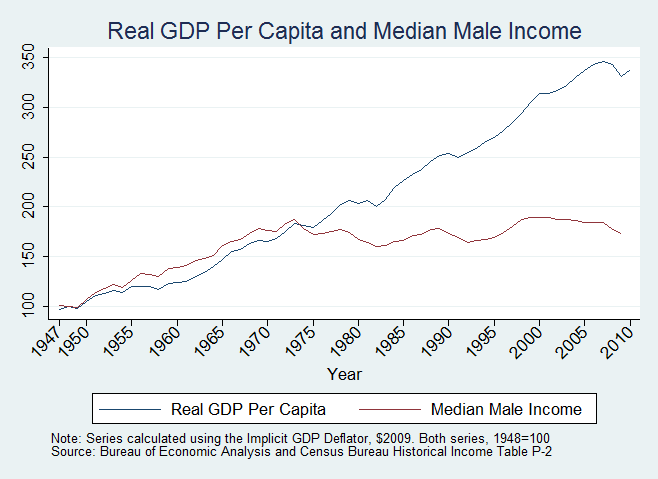
So in other words I’m basically agreeing with Fisher, except I’m a little more impatient for this craziness to end. If we’re going to spend $85 billion a month to save our economy, how about making state college tuition go down with that money?
Lean in to what?
Women are underrepresented in businesses like Goldman Sachs and JP Morgan Chase, especially in the upper management. Why is that?
Many women never go into finance in the first place, and of course some of them do go in but leave. Why are they leaving, though? Is it because they don’t like success? Or they don’t like money? Are they forgetting to lean in sufficiently?
Here’s another possibility, which I dig. They’re less willing to sacrifice their ethics than their male colleagues for the sake of money and business success.
Last Friday I read this paper entitled Who Is Willing to Sacrifice Ethical Values for Money and Social Status? Gender Differences in Reactions to Ethical Compromises and written by Jessica A. Kennedy and Laura J. Kray. It offers ethical distaste problems as at least one contributing reason we don’t see as many women as we might otherwise.
The paper
Please read the paper for details, I’m only giving a very brief overview without figures of statistical significance. They have three experiments.
First they saw who were interested in jobs that had major ethical compromises. Turns out that women were way less interested than men.
Second, to check whether that was because of the ethical compromises or because of the “job” part, they had different kinds of job descriptions and found that, in the presence of a culture of good ethics, women were just as interested in a job as men.
Third, they checked on the existing assumptions about the connection between ethics and various kinds of jobs, like the law, medicine, and “business”. Turns out woman associate compromised ethics with business but less so with law and medicine.
Conclusion: we can attribute some of the lack of women in business to a combination of assumed and real ethical compromises.
Some thoughts
First, I love that this paper was written by two women. Maybe that’s what it took for such an common sense idea to be tested.
Secondly, I think this paper should be kept in mind when we read things about how companies that are diverse are more successful. It’s probably because they are nice places to be that women and others are there, which in turn makes them more successful. It also explains why, when companies set out to be diverse, they often have so much trouble. They want to achieve diversity without changing their underlying culture.
Thirdly, I’m going to have to admit that men are under enormous pressure to succeed at all costs, which could explain why they’re more willing to become ethically compromised to be successful. That says something about our crazy expectations of men in this culture which I think we need to address. I say that as a mother of three sons.
Finally, whenever I hear someone talking about “leaning in” from now on, I will ask them, “lean in to what?”.
Aunt Pythia’s advice
Aunt Pythia is almost embarrassed today by how much fun it is to be her. Almost. But honestly she doesn’t embarrass easily.
So in case you don’t get a kick out of today’s column, especially by the end, then please take comfort in the fact that Aunt Pythia got a huge kick out of writing this stuff. It was really a pleasure, thanks. Oh, and please
think of something to ask Aunt Pythia at the bottom of the page!
By the way, if you don’t know what the hell Aunt Pythia is talking about, go here for past advice columns and here for an explanation of the name Pythia.
——
Aunt Pythia,
I’m a math undergrad at a large state school working on the side as a tutor at my university’s campus learning center. There are 2 flavors of tutoring that I do: “drop-in” tutoring (which is essentially an emergency room for lower division math students doing homework) and “group” tutoring (which is a course-specific, supplemental problem solving session). I don’t care much for the “drop-in” part, but I really, really love the group tutoring, mostly because I have control over how to run the class.
Every week I TeX up a nice little sheet of practice problems for my kids and they get to come up to the board one-by-one to work on them while I sit on their shoulder being a snarky, spiritual math-guide. I’m very passionate about involving the kids directly and consider it my moral duty as a math tutor to create an environment where that can happen. However about half of the students dropped after hearing that they would be required to directly participate. The ones who stayed though have stuck it out like champs and they’ve all reported an improvement in their course grade as a result of doing the extra problems.
But here’s the problem: my supervisor keeps criticizing the low attendance (which is about 50% of the average group size) and either wants me to change my style of teaching or give me fewer group hours next quarter (which means more icky drop-in hours) if I keep things the same.
What should I do? I asked my students if I should change things up and (surprisingly) they all emphatically said “no,” adding that despite being initially intimidated they were able to overcome their confusion more quickly by being put on the spot and having the instant feedback from myself and the rest of the class (it was a touching moment).
On the other hand, I can understand where my supervisor is coming from because the learning center gets funded based on how many students are using its services, and tutors who solve more example problems at the board for free get more students. Am I too low on the food-chain to be this principled about how to run a supplementary problem solving session for a single lower division math class? Working out problems at the board has always been the most effective way for me to learn math. But maybe it’s not for everyone?
Won’t Oppose Modifying my Perspective
Dear WOMmP,
It’s definitely not for everyone. But on the other hand, it is very effective for the students that have chosen to stay with your class, and I think you should be proud of the work you’re doing with them.
In terms of advice, I think it depends on your situation. If you’re not desperate for this job, you can just tell your supervisor that this is how you work, and the results for your students will be excellent, and you will refuse more drop-in hours, and that you will quit if you are not appreciated for your efforts.
If you are desperate for this job, then you probably want to find a compromise. Maybe it can be something like, for the first half (or more) of the hour you will not do the work for them but in the last part you will answer questions. That way people will be coaxed into thinking for themselves but they will know they have the option to be lazy.
Good luck, and thank you for being such a devoted math teacher!
Aunt Pythia
——
Dear Aunt Pythia
In online discussions – and in real life – what is the best response to someone who calls me or infers something inappropriate about me?
On blogs it can be easy to spot the offenses, though in general I find it aggravating how humor cloaks a lot of sexist and generally demeaning comments in life.
I tend to be the kind of person to let bygones be bygones, and chalk it up as a sign of victory in the preceding debate; however, I am uncertain. Does my continuing to talk (obviously not right after the blow up) to that person somehow justify or encourage their methods?
I hate to leave these conversation spaces altogether (sometimes they are good dorky fun) but I noticed that though I keep my cool with the aggressors, residual bits of negativity stick in my mind and sometimes ooze into my other interactions. I appreciated your niece’s advice that “it’s not about me” but sometimes I wonder if by being present and vocal I am making it about me.
One more bit of color, the last straw attack was a sexually offensive name. And though several comments, some coming to my defense, were deleted from the thread the comment attacking me stayed up. When I complained to a friend about the incident, he suggested (jokingly, of course) that I enjoyed being called nasty names.
In public? On a blog some of my colleagues read? Exactly what is it with men? Sorry that’s a larger, near rhetorical question. Thanks.
No Offense To All’s Cool Until Negates Truth
Dear NOTACUNT,
First of all, it’s not about you, and any guy who calls you a cunt because you don’t agree with them has problems.
Second, what are you doing on discussion forums that allow such comments? Surely there are better things for you to do with your time. Like even just taking a nap would be a better use of your time.
And if you tell me I’m being sexist because men still have the option to be on such forums without being called a cunt, I’d argue that anyone there is wasting their time.
It’s a sad fact about anonymity of the web that there are weird, sad people who spend their time being hateful, as hateful as they can be, to as many people as they can be, via comments. I’ve had to go from allowing comments to moderating all mathbabe comments because of this problem, and it’s a total pain in the ass, but the only other option is frankly to forbid all comments. And since I cherish good thoughtful comments, I don’t want to do that. But keep in mind it’s a real investment of time to moderate comments!
My advice is to find a place to talk to people that’s either in the real world, or in an online forum where the comments are well curated and hateful speech is removed.
And one last thing. If someone has identified themselves as an asshole, by saying something hateful and sexist to you after you try to make an intellectual point, please ignore them forever after. That way your quality of life has improved and, as a bonus, assholes are not being encouraged to continue with their asshole tactics.
Aunt Pythia
——
Aunt Pythia,
What do you think is the sexiest knitwear? (Assuming, of course, that the set of sexy knitwear is nonempty.)
Asking for a friend
Dear Asking,
Great question! Lots of knitting is sexy. In fact anything is sexy that either a) shows off people’s bodies or b) is so incredibly scrumptiously comfortable that you just want to get inside it with the person wearing it.
In terms of the first category, let’s start with a corset-ish (but not actually one of those crazy freaking shapewear things) that shows off women’s curves, kinda like this (which happens to have been designed by a friend of mine):

Not at all constricting.
Next, we have the skin-baring type of sexiness that everyone can get behind:

Technically this is crochet. But nobody cares.
Next we’ve got some examples from the latter category, of scrumptiously sexy:

This is my favorite design, I’ve made it 3 times, and it’s super simple. Top down. I usually make it with REALLY BIG BUTTONS.
and for the man-loving crowd:

Who doesn’t love a man in an Irish sweater?
Did I mention there are sexy things you can knit?

Lipstick cosy. Seriously.
Finally, I want to mention that it’s of course also possible to be sexy while knitting, which is kind of different but also makes the final product titillating, at least for those in the know:

I’m seriously hoping I’m not sued for putting this picture here.
Did I answer your question? What was your question, anyway? I’m completely distracted.
Love,
Aunt Pythia
——
Hi Aunt P,
Porn. I’m tired of the options for women. I don’t want the traditional hetero porn and I’m not into lesbian porn. Where can I find sexy, thoughtful, and maybe even *nerdy* porn (on or off) the internet? Even well-written erotica would be a nice diversion.
Upstate Upstart
Dear UU,
Look I’m as nerdy and as horny as the next girl, or maybe I’m off the spectrum for each, but even I’m not looking for thoughtful porn. If anything I’m looking for totally thoughtless porn, as long as it’s not nasty (in a bad way). And I agree that there’s not enough of it for us.
Here’s an idea, which I totally haven’t tried but I want to, and I learned about through this amazing article (thank you Business Insider!) which talks about Amazon banning smut like “Cum for Bigfoot” by Virginia Wade (not her real name!) and which contains the following unbelievable line:
“‘It’s f—ing Bigfoot,’ hissed Shelly. ‘He’s real, for f—‘s sake.’ Horror filled her eyes. ‘With a huge c—.’”
Yes! What!? Go here for more. I’m thinking New Year’s resolution.
Auntie P
——
Please submit your well-specified, fun-loving, cleverly-abbreviated question to Aunt Pythia!
How do opinions and convictions propagate?
Yesterday I read an interesting paper entitled Social influence and the collective dynamics of opinion formation, written by Mehdi Moussaïd, Juliane E. Kämmer, Pantelis P. Analytis, and Hansjörg Neth, about how opinions and strength of conviction spread in a crowd with many interactions, and how consensus is reached. I found the paper on Twitter through Steven Strogatz’s feed.
The paper
First they worked on individuals, and how they might update their opinion on some topic upon hearing of someone else’s opinion. They chose super unpolitical questions like, “what is the melting point of aluminum?”.
The interesting thing they did was to track both the opinion and the conviction – how sure someone was.
As expected, people did update their opinion if they heard someone else had a somewhat similar opinion, especially if that other person had a stronger conviction. They tended to ignore opinions that were super different, especially if the convictions were weaker. Sometimes they even adopted the other person’s opinion, if it wasn’t too different and if their original conviction was very low. But most of the time they ignored stuff:

What was also interesting, and what we will get back to, is that when they heard other people had similar opinions to their own, their conviction went up without their opinion changing.
Next they used a computer simulation to see how opinions would propagate if no new information was introduced but many interactions occurred, if everyone acted the same in terms of updating opinions, and if they did so time after time.
So what were the results? I’ll explain a couple, please read the paper for more details, it’s short.
The most interesting to me was that, at the end of the day, after many interactions, the convictions of the group always ended up high even if the answer was wrong. This is because, when people heard similar opinions, their convictions rose, but if they heard differing opinions their convictions didn’t lower. But the end result is that, although high conviction correlated with being correct at the start, it had no correlation with being correct by the end.
In fact, conviction correlated to consensus rather than correctness after a few interactions. The takeaway is that, in the presence of not much information, strong convictions might just imply lots of local agreement.
The next result they found was that the dynamical system that was the opinion making soup had two kinds of attractors. Namely, small groups of “experts,” defined as people with very strong convictions but who were not necessarily correct (think Larry Summers), and large groups of people with low convictions but who all happen to agree with each other.
The fact that these two populations are attractors was named by the authors as “the expert effect” and “the majority effect” respectively. And if fewer than 15% of the population were experts, in the presence of a majority, the majority effect dominated.
Finally, the presence of random noise, which correspond to people with random opinions and random conviction levels, weakened both of the above effects. If 70% or more of the population was noise, then the two effects described above vanished.
Thoughts on the paper
- One thing I’ve thought about a lot from working with my Occupy group is how opinions form on a given issue. Since we’re going for informed opinions, we very deliberately start out with a learning phase, which could last a long time depending on the complexity of the subject. We also have a thing against experts, although we do have to trust our sources when we read up on a topic. So it’s kind of balancing act at all times.
- Also, of course, most opinions are not 1-dimensional. I can’t say my opinion on the Fed on a scale between 1 and 100, for example.
- Also, it’s not clear that I update my opinion on issues in exactly the same way each time I hear someone else’s. On the other hand I do continually revise my opinion on stuff.
- The study didn’t look at super political issues. I wonder if it’s different. I guess one of the big differences is in how often someone is truly neutral on a political topic. Maybe you could even define a topic as political in this context somehow, or at least build a test for the politicalness of a topic.
- Let’s assume it also works for political topics. Then the “I heard this so many times it must be true” effect seems to be directly in line with the agenda of Fox News. Also there’s the expert effect going on there as well.
- In any case it’s interesting to note that, if you’re trying to effect opinions, you might either go with “informing and educating the general public” on something or “building up a sufficient squad of experts” on that same thing, where experts are people with super strong opinions and have the ability to interact with lots of people.
How do we encourage empathy?
Usually I spend a lot of time reading stuff, and then I get outraged or otherwise respond internally to something I read. I take notes on the article, in an email to myself, and that later becomes a blog post.
But since all I’ve been doing lately is hanging out with the family, cooking, and watching Psych and Star Wars: Enterprise marathons, I have less to react to and therefore less to write about.
[Aside: if you haven’t seen Psych yet, please take a look, especially if you like hilarious and snarky references to the 1980’s, but even if you don’t. Season 4 episode 1 is a great starting point. Netflixxable.]
Even so, here we are, friend, and I wanted to write this morning, and you’re here already.
So I will share some thoughts I had when I took a brisk walk last night, to try to get rid of the big Christmas dinner feeling. Big dinner, not big feeling, although the feeling was pretty big too.
I was thinking about gratitude, for even having the opportunity to have such a nice meal to share with my family, and then I started thinking about what I consider the flip side of gratitude, namely empathy. I was wondering, how do we encourage empathy and gratitude in ourselves and in others? In, say, our children?
First, who cares?
Lots of people have been writing about empathy lately, how rich people have less empathy, and the failure of technical fields to encourage empathy. We also seem to have connected gratitude with happiness.
Personally I’m pretty convinced these are both critical feelings both for relating to others on an individual basis and on thinking about public policy and income inequality, which I think about quite a bit. So I’m game.
Second, why those two things?
It occurred to me as I was walking that maybe other people don’t think of gratitude and empathy together. But for me there’s a pretty straight line from empathy to gratitude, and it’s not all that easy to get to gratitude some other way.
Some people write about how to raise your kids to be grateful, for example, and they often suggest that we ask our kids to think of things for which they are grateful, say before bed every night.
This strikes me as hollow. I don’t think people can just conjure up gratitude. Instead they will learn to list things which they are lucky to have, but being fortunate is not the same as feeling grateful. And listing a bunch of things you are fortunate to have can backfire, I’d imagine. I’m not into this plan.
But maybe I’m wrong, or maybe I misunderstood the plan. Readers, is there a connection for you too between empathy and gratitude, and is there a way to engender gratitude directly?
So, what about empathy?
Do you remember how much you hated your father growing up? I do. And I also remember the time, or times, that I realized I had the same tendencies inside myself. I could be just like that guy, I realized. FUCK.
And that’s when I realized I had a choice. I could either hate myself as much as I hated him, or I could forgive both of us. Or actually there are more options, including things like continuing to hate him and ignoring those same qualities in myself, but I try not to be too hypocritical.
Anyhoo, the point is that I forgave both of us. I empathized with his weaknesses, which were mine as well. And that is how I empathize with people in general, because I realize I am one mistake away from fucking up, or having too much debt, or being homeless or jobless.
And by the way, I even have made those mistakes, or many of them anyway, but I’ve been bailed out because of friends, or because I’m educated, or because I’m white. I am largely insulated from my bigger mistakes, but when I see someone in pain, it’s my pain, because it could be me.
And of course we have empathy for people because they are unlucky, like if someone they love gets sick, or if they themselves get sick and this ridiculous health system lands them in deep debt, or if they are at the wrong place at the wrong time, like if someone gets into an accident or if they are born into poverty.
But we also have empathy in recognition of making super shitty decisions and even of being cruel. Because cruelty is a weakness of ours too.
For me at least, gratitude comes right after that. It’s actually just a continuation of the feeling of empathy. I am grateful to my friends, and I am grateful for my freedom, and I am grateful I have not been in a situation recently where I’ve been overly tempted to wield my personal arsenal of evil weapons.
So, how do we encourage empathy and/or gratitude?
That’s the thing, I don’t know. The truth is, I’m not sure how it can be done without going through this whole process of hating something, then recognizing it inside yourself, and then coming to terms with it kindly. That’s pretty much all I got.
And so instead of asking my kids to be grateful, I just try to do my best to role model empathy and gratitude myself, in my words and actions and especially in my inactions.
What does a really efficient market look like?
The raison d’être of hedge funds is to make the markets efficient. Or at least that’s one of the raisons d’être, the others being 1) to get rich and 2) to leave early on Fridays in the summer (resp. winter) to get a jump on traffic to the Hamptons (resp. ski area, possibly in Kashmir).
And although having efficient markets sounds like a great thing, it makes sense to ask what that would look like from the perspective of a non-insider.
This recent Wall Street Journal article on high-tech snooping does a pretty good job setting the tone here. First, the kind of thing they’re doing:
Genscape is at the vanguard of a growing industry that employs sophisticated surveillance and data-crunching technology to supply traders with nonpublic information about topics including oil supplies, electric-power production, retail traffic and crop yields.
Next, who they’re doing it for:
The techniques, which are perfectly legal, represent the latest advance in the longtime Wall Street practice of searching for every possible trading advantage. But the high cost of much of the new information—Genscape’s oil-supply report costs $90,000 a year—means that some forms of trading are becoming even more the province of firms with substantial resources.
Let’s put these two things together from the perspective of the public. The market is getting information from hidden cameras and sensors, and all that information is being fed to “the market” via proprietary hedge funds via channels we will never tap into. The end result is that the prices of commodities are being adjusted to real-world events more and more quickly, but these are events that are not truly known to the real world.
[Aside: I’m going to try to avoid talking about the “true price” of things like gas, because I think that’s pretty much a fool’s errand. In any case, let me just say that, in addition to the potentially realtime sensor information that goes into a commodity’s price, we also have people trading on it because they are adjusting their exposure to some other historically correlated or anti-correlated instrument, or because they’ve decided to liquidate their books, or because they’ve decided the Fed has changed its macroeconomic policy, or because Spain needs to deal with its bank problems, or because someone wants to take money out of the market to rent their summer house in the Hamptons. In other words, I’m not ready to argue that we’re getting close to the “true price” of gas here. It’s just tradable information like any other.]
I am now prepared, as you hopefully are as well, to question what good this all does for people like us, who are not privy to the kind of expensive information required to make these trades. From our perspective, nothing happens, the price fluctuates, and the market is deemed efficient. Is this actually an improvement over the alternative version where something happens, and then the price adjusts? It’s an expensive arms race, taking up vast resources, where things have only become more opaque.
How vast are those resources? Having worked in finance, I know the answer is a shit-ton, if it is profitable in a short-term edgy kind of way. Just as those guys dug a hole through mountains to make the connection between New York to Chicago a few nanoseconds faster, they will go to any length to get the newest info on the market, as long as it is deemed to have a profitable edge in some time frame – i.e. the amount of time it will take a flood of competitors to do the same thing.
Just as there’s a kind of false myth that most of the web is porn, I’d like to perpetuate a new somewhat false myth that most data gathering and mining happens for the benefit of trading. And if that’s false now, let’s talk about it again in 100 years, when the market for celebrities is mature, and you can make money shorting a bad marriage.
Aunt Pythia’s advice
Aunt Pythia had a late start today, because for some reason knowing she has two weeks of staying at home with the kids made her want to doze a bit longer.
But Aunt Pythia has not forgotten you! And she’s here to give you some pretty great questions and what she thinks are pretty great answers! She hopes you agree! And remember, as you enjoy today’s column:
please, think of something to ask Aunt Pythia at the bottom of the page!
By the way, if you don’t know what the hell Aunt Pythia is talking about, go here for past advice columns and here for an explanation of the name Pythia.
——
Dear Aunt Pythia,
I’ve managed to achieve a modicum of notoriety in my career, which means I sometimes get interviewed. And in those interviews, I sometimes get asked questions which people who meet me in other professional and even most personal contexts don’t ask me, like, “Were you ever married” (“No”). “Were you ever asked/Did you ever think about it” (“No”).
Now the convention is for single women to at least profess an interest in being married, and not doing so reveals you to be seriously maladjusted. But honest answers to this line of questioning (or the related one, “Do you regret not having children?”) would reveal me to have seriously deviant attitudes and have the potential to undermine my hard-won professional credibility.
I regard this type of questioning as inappropriate, but somehow interviewers think it’s OK to probe the personal lives of women the way they never would men. Do you have any suggestions as to how to politely tell them this is off limits?
Nina from Argentina
Dear Nina,
By some amazing coincidence – or possibly not – this question came up recently in a Bloomberg article about Swedish CEO and “Banker of the Year” Annika Falkengren. In her case it was questions about what kind of mom she could possibly be considering her very busy job. From the article:
Gender bias is still a hurdle for women trying to reach the top, Falkengren said. Her own encounters with sexism came from unexpected places: When she became CEO with a baby at home, she said, reporters repeatedly asked how often she took her daughter to daycare and how much time she had for traditional mothering.
When Lars Nyberg, the former CEO of phone company TeliaSonera AB “had two kids below the age of 2, he was never asked that question,” Falkengren said. “I was still getting that question when my daughter was 8.” Former Volvo AB CEO Leif Johansson “was running Volvo with five kids, and he never got the question.”
Next, I wanted to mention this BBC article which describes how the new German defence minister Ursula von der Leyen was hyper-sexualized, depicted as a Lara Croft-type character on a German TV station.
Finally, take a look at this Wall Street Journal article on the reactions men have to the presence of women. Turns out when they are in a war-mongering environment they get more so, and when they’re in a peace-loving environment they perform exaggerated good deeds. And women, in the presence of men, don’t change their behavior.
My conclusions from the above as well as my personal experience in a “man’s world”:
- Some men are deeply threatened by women and want to put them into one of two boxes: sex object or mother.
- If you are neither it makes them very confused. They want that confusion to be your problem, not theirs.
- In general people want to make it your problem to explain your deviance from “normal”.
- In general it’s the people who deviate from normal that make life worth living. Abnormal people should be celebrated, not reprimanded.
In terms of advice for you, I’d try to turn it back on them (“them” refers to anyone asking you this kind of thing, not just journalists). This can be done with various levels of aggression and activism. If you’re really annoyed, ask the interviewer how often they’ve asked a male scientist that question. And then wait for an answer. If you’re feeling less aggressive, mention that many mathematicians you know don’t get married. In other words, make it deliberately ungendered. Also consider asking why they chose that question for you. Make them aware of how inappropriate it is.
In general, though, keep in mind that you don’t have to be polite with journalists. They have super thick skins. And don’t forget the magic phrase, “this is off the record”. It’s totally fine to respond with, “this is off the record, but your question is totally inappropriate and I won’t agree to finish this interview until you agree to remove it from this interview.” You can be sure that they’ve heard worse.
Good luck,
Aunt Pythia
——
Dear Aunt Pythia,
I’m a CS Babe that tends to end up involved with men who are also into some kind of technical nerdery. While they know how to stimulate me intellectually, they tend to lack expertise physically. I like to think of myself as having a healthy and full social life, and that’s involved a pretty good amount of sex with a number of different partners and situations.
Most of the men I end up with, however, have a lot less experience than me. I think they’ve mostly watched a lot of porn, and while they probably recognize that real life sex isn’t like that, they still have that as kind of a baseline model for a sexual encounter. They want to give me a satisfying experience, but that can be hard to do. Eventually, the fact that I’m not getting off eclipses any amount of interest I have in a guy. I’ve tried dating men where our physical compatibility outweighs our capability for interesting conversation, but that ends in frustration too.
I don’t mind helping them out and trying to teach them what I want, but I’m looking for an equal partner when it comes to sex, not a pupil. Do you have recommendations to help me get what I want from less-experienced partners without feeling like I’m TA-ing Orgasms 101? Any ideas of how to seek out and identify people that I can click on multiple levels with- or should I just find someone I like intellectually and invest my time into developing his sex skills?
Thanks,
Sex Life: Unending Training
Dear SLUT,
I’m going to go with the latter. Find an awesome guy and teach him how to pleasure you. Do it super deliberately and honestly, and really really often, and within about two weeks you will be getting seriously good sex if the guy is a diligent student. Who knows, you might be with that guy for a long time, and it’ll be worth the investment. In any case you’ll be improving the world for other future nerd girls.
The key point here is, if you’re going to be a TA, then you might as well make that explicit. Don’t pretend, ever, to enjoy something that isn’t actually good. Bad sexual habits can be learned within nanoseconds when it comes to inexperienced and insecure men. And then, once learned, they are much harder to break, because it immediately becomes a matter of ego. This requires you being super encouraging with all the requisite grunts and groans, so get used to doing that.
And if you want to go easy on the guy in becoming his sex teacher, then tell him you’ve got a special kind of clitoris, or something, and make it seem totally OK that he doesn’t know how to deal with this special thing. And then tell him exactly what to do.
Also, don’t forget to tell him how to talk dirty. I’m sure there must be some kind of online resource you can find that will give him advice on this front. In fact, after googling for one second I found a billion places he could go.
One last thing. It’s not clear that any man actually knows what they’re doing, so count your blessings that you get to start from scratch and get it right. It actually might be worse to start with someone who is 80% good and who thinks they don’t need any tutoring (but if you do find yourself in that situation, don’t forget the “special clitoris” approach).
Good luck, and may all of your students be bright!
Auntie P
——
Dearest Aunt Pythia,
I am studying algebra, specifically algebraic number theory, and my friends try really hard to be supportive of my work. But our conversations always go something like this:
Friend: What are you working on now?
Me: Investigating abelian extensions in generalized Dedekind domains (or whatever other really nerdy part of algebra I’m thinking about that day).
Friend: Is that more algebra?
Me: Yeah.
Friend: Didn’t I take algebra in like, 9th grade?
I understand my work is not very accessible to most non-math people, but do you have suggestions for fun/creative ways of describing abstract algebra versus high school “algebra”?
Friendly Algebraist Nerd (of you!)
Dear FAN,
Just say, yes, it’s the same field. But whereas in high school we learn how to think about abstracting away numbers to become variables, in my field we build up interesting structures with sets of abstract variables and see what kind of patterns we can detect. For example, we all know about addition on integers or real numbers, but it turns out that you can create sets of abstract things that have an “addition law”. They’re called “groups” and sometimes the sets are finite, like with clock arithmetic, and sometimes they pop out of nowhere, like the points on an elliptic curve. Oh and by the way, you can think of an elliptic curve topologically as a donut with sprinkles, and you’ve chosen one of those sprinkles as the “0” of the addition law.
Anyway, if you start with something like that you might end up with a new algebra fan. Or at least someone who kind of gets how algebra is both like high school algebra and much much cooler.
Good luck!
Aunt Pythia
——
Please submit your well-specified, fun-loving, cleverly-abbreviated question to Aunt Pythia!
Citigroup is the real reason we need the Volcker Rule
This is a guest post by Tom Adams, who spent over 20 years in the securitization business and now works as an attorney and consultant and expert witness on MBS, CDO and securitization related issues. Jointly posted with Naked Capitalism.
Volcker Rule
Last week, the rules for the Volcker Rule – that provision of the Dodd-Frank Legislation that was intended to prevent (reduce?) proprietary trading by banks – were finalized. As a consequence, there has been a lot of chatter among financial types around the internet about what the rule does and doesn’t do and how it is good or bad, etc. Much of the conversation falls into the category of noise and distraction about unintended consequences, impacts on liquidity and broad views of regulatory effectiveness.
Citigroup
I call it noise, because in my view the real purpose of the Volcker Rule is to prevent another Citigroup bailout and therefore the measure of its effectiveness is whether the rule would accomplish this.
As you may recall, Citigroup required the largest bailout in government history in 2008, going back to the government well for more bailout funds several times. The source of Citigroup’s pain was almost entirely due to its massive investment in the ABS CDO machine. Of course, at the time of Citi’s bailout, there was a lot of noise about the potential financial system collapse and the risk posed by numerous other banks and institutions, so Citi as the main target of the TARP bailout, and ABS CDOs as the main cause of Citi’s pain, often gets lost in the folds of history.
The CDO market
In the years leading up to the financial crisis, Citi was an active underwriter for CDO’s backed by mortgage backed securities. Selling these securities was a lucrative business for Citi and other banks – far more lucrative than the selling of the underlying MBS. The hard part of selling was finding someone to take the highest risk piece (called the equity) of the CDO, but that problem got solved when Magnetar and other hedge funds came along with their ingenious shorting scheme.
The next hardest part was finding someone to take the risk of the very large senior class of the CDO, often known as the super-senior class (it was so named because it was enhanced at levels above that needed for a AAA rating).
For a time, Citi relied on a few overseas buyers and some insurance companies – like AIG and monoline bond insurers – to take on that risk. In addition, the MBS market became heavily reliant upon CDOs to buy up the lower rated bonds from MBS securitizations.
As the frenzy of MBS selling escalated, though, the number of parties willing to take on the super-seniors was unable to match the volume of CDOs being created (AIG, for instance, pulled back from insuring the bonds in 2006). Undeterred, Citi began to take down the super-senior bonds from the deals they were selling and holding them as “investments” which required very little capital because they were AAA.
This approach enabled Citi to continue the vey lucrative business of selling CDOs (to themselves!), which also enhanced their ability to create and sell MBS (to their CDOs), which enabled Citi to keep the music playing and the dance going, to paraphrase their then CEO Chuck Prince.
The CDO music stopped in July, 2007 with the rating agency downgrades of hundreds of the MBS bonds underlying the CDOs that had been created over the prior 24 months. MBS and CDO issuance effectively shut down the following month and remained shut throughout the crisis. The value of CDOs almost immediately began to plummet, leading to large mark-to-market losses for the parties that insured CDOs, such as Ambac and MBIA.
Citi managed to ignore the full extent of the declines in the value of the CDOs for nearly a year, until AIG ran into its troubles (itself a result of the mark-to-market declines in the values of its CDOs). When, in the fall of 2008, Citi finally fessed up to the problems it was facing, it turned out it was holding super-senior CDOs with a face value of about $150 billion which were now worth substantially less.
How much less? The market opinion at the time was probably around 10-20 cents on the dollar. Some of that value recovered in the last two years, but the bonds were considered fairly worthless for several years. Citi’s difficulty in determining exactly how little the CDOs were worth and how many they held was the primary reason for the repeated requests for additional bailout money.
Citi’s bailout is everyone’s bailout
The Citi bailout was a huge embarrassment for the company and the regulators that oversaw the company (including the Federal Reserve) for failing to prevent such a massive aid package. Some effort was made, at the time TARP money was distributed, to obscure Citi’s central role in the need for TARP and the panic the potential for a Citi failure was causing in the market and at the Treasury Department (see for example this story and the SIGTARP report). By any decent measure, Citi should have been broken up after this fiasco, but at least some effort should be made from a large bank ever needing such a bailout again, right?
Volcker’s Rule is Citi’s rule
So the test for whether the Volcker Rule is effective is fairly simple: will it prevent Citi, or some other large institution, from getting in this situation again? The rule is relatively complex and armies of lawyers are dissecting it for ways to arbitrage its words as we speak.
However, some evidence has emerged that the Volcker Rule would be effective in preventing another Citi fiasco. While the bulk of the rules don’t become effective until 2015, banks are required to move all “covered assets” from held to maturity to held for sale, which requires them to move the assets to a fair market valuation from… whatever they were using before.
Just this week, for example, Zions Bank announced that they were taking a substantial impairment because of that rule and moving a big chunk of CDOs (trust preferred securities, or TRUPS, were the underlying asset, although the determination would apparently apply to all CDOs) to fair market accounting from… whatever valuation they were using previously (not fair market?).
Here’s the key point. Had Citi been forced to do this as they acquired their CDOs, there is a decent chance they would have run into CDO capacity problems much sooner – they may not have been able to rely on the AAA ratings, they might have had to sell off some of the bonds before the market imploded, and they might have had to justify their valuations with actual data rather than self-serving models.
As a secondary consequence, they probably would have had to stop buying and originating mortgage loans and buying and selling MBS, because they wouldn’t have been able to help create CDOs to dump them into.
Given the size of Citi’s CDO portfolio, and the leverage that those CDOs had as it relates to underlying mortgage loans (one $1 billion CDO was backed by MBS from about $10 billion mortgages, $150 billion of CDOs would have been backed by MBS from about $1.5 trillion of mortgage loans, theoretically), if Citi had slowed their buying of CDOs, it might have had a substantial cooling effect on the mortgage market before the crisis hit.
Insulin level tracking?
I’m wondering something kind of stupid this morning, which is why we don’t track people’s insulin levels. Or maybe we do and I don’t know about it? In which case, how do I get myself a Quantified Self insulin tracker?
Here’s a bit of background to explain why I’m asking this. Insulin levels in your blood regulate the speed at which sugar in your blood is turned into fat, and similarly they regulate how quickly fat cells release fat into the bloodstream.
If someone without diabetes eats something sweet their insulin levels shoot up to collect all the blood so the blood sugar levels doesn’t get toxic. Because what’s really important, as diabetics know, is that blood sugar levels remain not too high nor too low. Type I diabetics don’t make insulin, and Type II diabetics don’t respond to insulin properly.
OK so here’s the thing. I’m pretty sure my insulin levels are normally a bit high, and that when I eat sugar or bread they spike up dramatically. And although that might sound like the opposite of diabetes, it’s actually the precursor to diabetes, where my body goes nuts making insulin and then my organs become resistant to it.
But first of all, I’d like to know if I’m right – are my insulin levels elevated? – and second of all, I’d like to know how much my body reacts, insulin-wise, to eating and drinking various things. For instance, I drink a lot of coffee, and I’d like to know what that does to my insulin levels. And what about Coke Zero?
I am probably going to be disappointed here. I know that the critical level to keep track of for diabetics, blood sugar, is still pretty hard to do, although recent continuous monitors do exist and are helping. So if anyone knows of a “continuous insulin monitor” please tell me!
One last word about why insulin. I am fairly convinced that the insulin levels – combined with a measure of their insulin resistance – would explain a lot about why certain people retain fat where others don’t with the same diet. And it would be such a relief to stop arguing about willpower and start understanding this stuff scientifically.
One last thing. Please do not comment below telling me how to lose weight or talking about how to have more willpower: I will delete such comments! Please do comment on the scientific issues around the mechanisms of insulin, data collection, and potentially modeling with that data.
Maybe I have an Irish mind
I’m only a quarter Irish but something about the way Conan O’Brien (love that guy!) describes “the Irish mind” in this 2012 speech to the University Philosophical Society at Trinity College Dublin makes me want to claim a full Irish heritage.
According to O’Brien, Irish minds cause people never follow rules, and not because they’re brave but because they are just not wired to do so. I can definitely relate to that. Hearing rules listed has always made me want to immediately rebel. Just a reaction I have.
Also, there’s the storytelling aspect to my personality, which I definitely inherited from my dad (who’s fully half Irish).
According to this personality trait, if you’ve had an experience, it doesn’t really count until you’ve told the story to a friend, or maybe 6 close friends, and then it doesn’t really get good until you’ve embellished it and generally perfected the story. Many of my actual experiences have been enhanced and even gone from pleasant to unpleasant (or vice versa) through this process.
And I’ve also done lots of crazy things just in anticipation of telling the story later. It’s a constant little Irish voice in my head urging me on with things like, “think of how awesome this story is gonna be!” and “especially after you embellish it!” I pretty much listen to that voice every time.
It’s not always pleasant having an Irish mind, especially for the people around me. My husband, who is Dutch, is much more literal and unembellished than I am. It took me about 15 years of our marriage to train him out of correcting me when I’d say something like “We waited in that line for 4 and a half hours!” and he’d say, “Actually it was more like 15 minutes.”
People, does that help the story? I think not. Therefore we do not do that.
Someday I gotta go back to the mother country and get really into the foggy alcoholic brew of it all. And I’m sure that those guys won’t mind me claiming my heritage once they see how I can knit a faux-traditional Irish fisherman sweater and play Irish jigs (really slowly) on my fiddle. I’ll come back with some incredible stories, I just know it.
Do we really want elite youth to get more elite?
I don’t know if you guys read this recent New York Times editorial entitled Even Gifted Students Can’t Keep Up: In Math and Science, the Best Fend for Themselves.
In it, they claim there’s some kind of crisis going on in this country for smart kids (defined as good test-takers). Mostly their evidence for this is that, among other countries, our super good test takers aren’t as prevalent as in other countries. Turns out we’re in the middle of the pack in terms of super scorers. From the article:
On the 2012 Program for International Student Assessment test, the most recent, 34 of 65 countries and school systems had a higher percentage of 15-year-olds scoring at the advanced levels in mathematics than the United States did.
Why is this a problem? As far as I can see they’ve come up with two reasons.
First, it’s “bad for American competitiveness,” whatever that means. Last time I checked we were still pretty dominant in various ways in terms of technology and science, and there are still plenty of very well-educated young people trying desperately to get visas to enter or stay in this country.
As an aside: it’s a super interesting question to think about how we, as a country, are increasingly ignorant about how our technology works, because so much technical knowledge has been off-shored. But that’s not the crisis these guys are addressing.
Second, it’s bad for the smart kids in this country, because “when the brightest students are not challenged academically, they lose steam and check out.”
I’ll pause in my summary of their article to make the following point. If that’s true, if bright kids who aren’t academically challenged at school start checking out more and more, then it makes just as much sense to me to see if there’s something they can check out towards.
In other words, what else is there for bright teenagers to do besides school? I’ll speak as a former bright teenager. When I lost interest in school, I got a lot of odd jobs in town cleaning houses and raking lawns, and then I used the money to buy lots of softcover books from a local bookstore. I don’t know why I didn’t just take them out of the library, where I also worked. It just didn’t seem as cool as owning my very own Brother Karamazov.
I learned a lot with my odd jobs in high school, which included being a part-time secretary, a barista, a math tutor, and working on a truck at the New England Produce Center. In fact I learned way more about how the world worked than I would have if I’d followed the advice of this editorial, which was to take lots more AP classes and then enter college when I was 14.
My theory is that, instead of obsessing over math scores in standardized tests, we concentrate on allowing our children to enrich their lives with adventures and experiences that they come up with and that are reasonably safe. So let’s start by encouraging widespread internships for younger kids, and not just minimum wage jobs at fast food joints. And not just for super test-takers either. Enrichment happens when kids learn about stuff that’s outside their usual rhythm and when there are no adults scripting their activities and telling them what to do or how many laps to swim.
Notice my emphasis on letting kids choose stuff. What drives me nuts just as much as the idea of further separating and isolating and venerating great test-takers, which as far as I’m concerned is the opposite way you should treat future successful people, is the idea that there should be such a well-defined funnel for children at all.
Yes, kids should all go to school and learn basic things. But the idea that, just because someone’s good at tests they should be treated as if they’re already running the Fed only increases the weird worshippy aspect of how our culture treats math nerds.
Plus, it’s a bizarre time to come up with this idea, considering how many online and live resources there are for nerd kids now compared to when I was a kid. If I’m a nerd teenager now, I can find plenty of ways to share nerdy questions and learn nerdy things online if I decide not to work in a coffee shop.
Finally, let me just take one last swipe at this idea from the perspective of “it’s meritocratic therefore it’s ok”. It’s just plain untrue that test-taking actually exposes talent. It’s well established that you can get better at these tests through practice, and that richer kids practice more. So the idea that we’re going to establish a level playing field and find minority kids to elevate this way is rubbish. If we do end up focusing more on the high end of test-takers, it will be completely dominated by the usual suspects.
In other words, this is a plan to make elite youth even more elite. And I don’t know about you, but my feeling is that’s not going to help our country overall.
Aunt Pythia’s advice, flannel version
Aunt Pythia aint gonna lie, she’s all about flannel this week. Right now she’s wearing flannel pajamas and snuggled underneath a flannel sheet. She’s looking forward to taking a warm bath and then getting into flannel lined pants and a flannel shirt, also lined.
[Aside: it’s all about the lining.]
It’s been a particularly good year in flannel fashion, just in case you’re wondering. And, the clothes horse that Aunt Pythia is, she’s been sampling the various wares.
Conclusion: LLBean knows from comfy warmth.
Now that we’ve addressed the theme of the day, it’s time for some serious advice distribution. And remember, as you enjoy today’s column:
please, think of something flannelly to ask Aunt Pythia at the bottom of the page!
By the way, if you don’t know what the hell Aunt Pythia is talking about, go here for past advice columns and here for an explanation of the name Pythia.
——
Dear Aunt Pythia,
I have two (much) younger brothers, aged 4 and 5. Can you recommend any books/youtube videos/games I can read/play/do with them to help them learn about and enjoy math?
Rapt in Flatland
Dear RiF,
I really think that age range is too young to explicitly learn math from a book. But it’s not too young to have discussions (it’s incredibly important to make this an interactive Socratic dialog, not a monologue from an adult!) about, say,
- the number line (where’s 0? What’s on the other side of 0?)
- why the earth spins
- what the solar system looks like (talking first without pictures or models)
- why the moon looks different on different days
If that all seems cool, you can move on to
- why there are seasons
- why daylight is shorter in the winter
- what really defines a “pattern”
In other words, super concrete things that require mind-expanding 3-dimensional visualizations and/or questioning of basic assumptions and definitions. You’d be surprised how many weeks these conversations can last with a 4- or 5-year old.
Also, please keep in mind that jigsaw puzzles, while not strictly logical exercises, are super awesome. And the Tower of Hanoi puzzle is super mathematical as well, the solution being a coded way to count in binary.
Good luck!
Aunt Pythia
p.s. Just gave my yearly contribution to wikipedia. Love that site.
——
Dear Aunt Pythia,
My girlfriend has a genuinely very complicated family life, and, though she definitely loves me, has much much less time to be with me than I would like. I do love her, but now I’m increasingly irritated at being alone so much even while I nominally have a girlfriend, and it’s affecting my feelings and even my desire for her. But this is absolutely not something we can discuss. She is doing her best and that’s it, and gets upset at any discussion, sometimes even hostile. It may end badly.
Suggestions?
Increasingly Irritated
Dear II,
Yes, I do have a suggestions. Discuss it with her. It’s the only way you’re going to get relief and get to a relationship that works for both of you.
I think it might help to ask her to make an appointment with you to discuss the arrangement between you two, and it might also help to imply that it’s very important to your future as a couple. Give her some time to prepare for this discussion but not an arbitrary amount of time.
To be super explicit, here are some phrases you might want to use. “I’d really like to sit down with you and discuss our relationship and its future. It would be great to have a discussion in the next two weeks. Here are some times that work for me, and where we have as much time as we need to finish the first part of the conversation, which I know will be difficult for both of us.”
That way you’re both respectfully demanding a discussion and giving her the emotional credit that it’s going to be tough on her.
A bit more advice: don’t conflate why it’s difficult with your request for a discussion. Then she’ll ignore the request and focus on how difficult it is for her.
Now, you didn’t ask this, and I don’t know much about your situation, but can we spend just a moment wondering what’s really going on here? I don’t want to sound negative, but whatever it is that’s going on, she’s not spending much time with you and is not even really willing to explain why. Those two things in combination make me want to advise you to just break up with her now, and forget the discussion.
In fact, in breaking up with her, you might get a discussion for free, if she really wants to keep you. And if she doesn’t, you should be the hell out of there anyway and with someone who’s making time to be with you.
Good luck!
Aunt Pythia
——
Dear Aunt Pythia,
As 50 approaches and work opportunities seem to be disappearing, do you really think it is possible to reinvent yourself and move into a different field?
I have applied my expertise in various quantitative and analytical fields to move from number cruncher (and forecasting) to more policy-based analysis roles. Is management the only answer? Every other role seems to be eaten by the progression of technology into various fields.
Grumpy Old Dude
Dear GOD,
My guess is that your salary and experience has made the lower-level analyst jobs both unappealing and out of reach for you. If you’re going to cost that much, the reasoning goes, you need to be doing more. Thus management.
Can I just make one argument in favor of management? If someone with your experience is in charge of telling people with very little or no experience how to do number crunching and analysis well, then things would be much more efficient. In an ideal world, that would be your role as manager – doling out sage advice to inexperienced analysts. So see if that makes sense and excites you.
But, to answer your question, it’s never too late to reinvent yourself. Some of my favorite people did so when they were 75.
Good luck!
Auntie P
——
Dear Aunt Pythia,
I’m a Libertarian. I find it pretty much impossible to have an intelligent discussion with liberals about anything even remotely related to politics. The same is not true with conservatives, even though I disagree with them just as much. Consequently I just don’t participate in such conversations. Unfortunately I both love a good debate and live in a very liberal state, so this has lead me to feel somewhat isolated and starved for good conversation.
I’ve talked to other libertarian minded people and they’ve had similar experiences. Conservatives can be infuriating in some of their beliefs, but at least you can reason with them on most issues. With liberals it’s impossible, unless you already pretty much agree and are just quibbling over details.
You’re about as liberal as people come. Do you have any advice on how one could have a civil discussion with a liberal on issues where you have relatively fundamental disagreements?
Lonely Libertarian
Dear LL,
Yes. Discuss what your commonalities are first, and move cautiously and carefully outwards from there. Suggestions here include: Too Big to Fail banks are not OK, Google and the NSA stealing our private data is not OK, and other currently shitty things about the world.
Next, before going to the inevitable argument about how to fix these problems, talk about exactly why these things are not OK. Then start talking about the concept of fixing them – what characteristics would a solution enjoy? What is not acceptable, and why?
That should take enough time to get through lunch.
Good luck! And don’t forget, liberals make great lovers! They’re really into massages.
Auntie P
——
Dear Aunt Pythia,
So, after all the turkey and pie and so forth, was the ratio of time spent agonising in the kitchen to time spent going ‘Yay, Thanksgiving’ a good one? And how would you determine a metric for Thanksgiving enjoyment?
(Asking in contemplation of what’s likely to happen at Christmas…)
Strange Oblivious Briton
Dear SOB,
I could totally tell you were British from your weird spelling of “agonizing!”.
For me, Thanksgiving was a success if 1) the turkey didn’t make anyone sick and 2) nobody threw plates frisbee-style at each others’ heads in the heat of an argument.
A particularly good sign is when people are still willing to hug each other when they finally leave the building, assuming anyone’s actually still there at all and hasn’t stormed off in a huff.
Haha just kidding, kind of. The truth is these big meals are just so so difficult, I honestly think you should keep standards as low as possible and be pleasantly surprised at every moment of happiness.
And whatever you do, stop agonizing in the kitchen, nobody will appreciate your effort anyway!! Just throw a bird into the oven and come back 6 hours later, seriously.
Merry Christmas,
Aunt Pythia
——
Please submit your well-specified, fun-loving, cleverly-abbreviated question to Aunt Pythia!
International trade agreements and big money bullying #OWS
The New York Times just put out an amazing and outrageous story, entitled Tobacco Industry Tactics Limit Poorer Nations’ Smoking Laws and written by Sabrina Tavernise.
In it she describes the bullying tactics of tobacco companies to small countries over their internal health regulations aiming to protect their citizenry from cancer. From the article:
In Africa, at least four countries — Namibia, Gabon, Togo and Uganda — have received warnings from the tobacco industry that their laws run afoul of international treaties, said Patricia Lambert, director of the international legal consortium at the Campaign for Tobacco Free Kids.
“They’re trying to intimidate everybody,” said Jonathan Liberman, director of the McCabe Center for Law and Cancer in Australia, which gives legal support to countries that have been challenged by tobacco companies. In Namibia, the tobacco industry has said that requiring large warning labels on cigarette packages violates its intellectual property rights and could fuel counterfeiting.
A few comments about this outrage, only tangentially mathematical:
- This happens because, in order to protect companies from being taken over by foreign nations, and in the name of free trade, it’s now possible for companies to sue countries directly. That’s what the tobacco industry is doing to small countries without the means to fight back.
- This is exactly the kind of thing that some people like Yves Smith have warned the TPP is going to do with financial regulation and other stuff. So imagine large companies or industries suing the United States or other nations for regulation that would “harm trade” or “violate their intellectual property rights.”
- In fact, it’s not going too far to say that the proliferation of these kinds of treaties are a serious threat to national sovereignty. Yves makes this case here.
- Think about it this way. It’s kind of a supernational Citizen’s United, in that only companies and industries that have enough lawyer power can get their way. And many companies easily have more resources than many countries. Think about Facebook and Google and their lobbying efforts on behalf of data privacy laws in Europe already. Now think how that battle might look when it’s against Namibia.
- Already, from the article, we saw that Uruguay was only able to fight back against Philip Morris because Bloomberg’s foundation helped them with the legal battle. And I’m glad Bloomberg helped, but if you count up all the money that will go to bullying and compare that to all the money available to help out the bullied, you quickly come to a sad conclusion.
- Once again, we have to remember that the TPP is being negotiated in secret, among a bunch of nations many of whom claim to be democratic.
Occupy the SEC shows us all how to occupy
Today is a remarkably cold day in New York but that’s done nothing to dampen the spirits of the members and supporters of Occupy the SEC, which had a real influence on the final Volcker Rule, as reported by the Wall Street Journal and The Washington Post, among others.
I’m not saying the Volcker Rule is perfect – in fact Occupy the SEC gave it a C- grade overall. And it was maddeningly delayed. As I’ve mentioned before, Occupy the SEC sued the regulators for the delay, or tried to, but the judge found that they had no standing.
Even so, there’s a clear victory here for Occupy the SEC. The final rule, or at least its preamble, references Occupy the SEC’s public commenting letter 284 times. The rule could have been way worse, and probably would have been without OSEC’s contribution.
Just to get some idea of the other voices in this debate – i.e. the lobbyists – take a look at this graphic on access to the rule-writers by parties interested in influencing the final rule:

I remember those guys in the early days of Occupy, meeting in the cold, drafty, and noisy chambers of 60 Wall Street after work and sitting in a circle going through the proposed Volcker Rule line by line. Nothing could have been more workmanline or hopeful. It was a great example of an Occupy group that was all work and no talk. People who wanted to talk just left them alone. I talked to them briefly about some risk model details for the rules because of my background in portfolio risk.
I even remember talking to them about the chances anybody would even read their letter, never mind take it seriously. They knew the rules, though, and the rules were that the regulators would have to read all the letters, although how seriously they took them was a different matter. They were doing it because they knew it was one of the best shots at having their voices heard. It was an incredible commitment to that ideal.
My conclusions:
- Those guys are awesome.
- Public commenting is a critical tool.
- This wouldn’t have worked without a receptive set of regulators.
- This is inspiring and will hopefully help my Occupy group, Alt Banking, plan our next project.
- I particularly like the idea of report cards, which Occupy has created for regulation.
Computer, do I really want to get married?
There’s a new breed of models out there nowadays that reads your face for subtle expressions of emotions, possibly stuff that normal humans cannot pick up on. You can read more about it here, but suffice it to say it’s a perfect target for computers – something that is free information, that can be trained over many many examples, and then deployed everywhere and anywhere, even without our knowledge since surveillance cameras are so ubiquitous.
Plus, there are new studies that show that, whether you’re aware of it or not, a certain “gut feeling”, which researchers can get at by asking a few questions, will expose whether your marriage is likely to work out.
Let’s put these two together. I don’t think it’s too much of a stretch to imagine that surveillance cameras strategically placed at an altar can now make predictions on the length and strength of a marriage.
Oh goodie!
I guess it brings up the following question: is there some information we are better off not knowing? I don’t think knowing my marriage is likely to be in trouble would help me keep the faith. And every marriage needs a good dose of faith.
I heard a radio show about Huntington’s disease. There’s no cure for it, but there is a simple genetic test to see if you’ve got it, and it usually starts in adulthood so there’s plenty of time for adults to see their parents degenerate and start to worry about themselves.
But here’s the thing, only 5% of people who have a 50% chance of having Huntington’s actually take that test. For them the value of not knowing that information is larger than knowing. Of course knowing you don’t have it is better still, but until that happens the ambiguity is preferable.
Maybe what’s critical is that there’s no cure. I mean, if there was therapy that would help Huntington’s disease sufferers delay it or ameliorate it, I think we’d see far more people taking that genetic marker test.
And similarly, if there were ways to save a marriage that is at risk, we might want to know on the altar what the prognosis is. Right?
I still don’t know. Somehow, when things get that personal and intimate, I’d rather be left alone, even if an algorithm could help me “optimize my love life”. But maybe that’s just me being old-fashioned, and maybe in 100 years people will treat their computers like love oracles.
Predictive risk models for prisoners with mental disorders
My friend Jordan Ellenberg sent me an article yesterday entitled Coin-flip judgement of psychopathic prisoners’ risk.
It was written by Seena Fazel, a researcher at the department of psychiatry at Oxford, and it concerns his research into the currently used predictive risk models for violence, repeat offense, and the like, which are supposedly tailored to people who have mental disorders like psychopathy.
Turns out there are a lot of these models, and they’re in use today in a bunch of countries. I did not know that. And they’re not just being used as extra, “good to know” information, but rather as a tool to assess important decisions for the prisoner. From the article:
Many US states use such tools to assess sexual offending risk and to help decide whether to exercise their powers to detain sexual offenders indefinitely after a prison term ends.
In England and Wales, these tools are part of the admission criteria for centres that treat people with dangerous and severe personality disorders. Outside North America, Europe and Australasia, similar approaches are increasingly popular, particularly in clinical settings, and there has been a steady growth of research from middle-income countries, such as China, documenting their use.
Also turns out, according to a meta-analysis done by Fazel, that these models don’t work very well, especially for the highest risk most violent population. And what’s super troubling is, as Fazel says, “In practice, the high false-positive rate probably means that some offenders spend longer in prison and secure hospital than their true risk would suggest.”
Talk about creepy.
This seems to be yet another example of a mathematical obfuscation and intimidation that gives people a false sense of having a good tool at hand. From the article:
Of course, sensible clinicians and judges take into account factors other than the findings of these instruments, but their misuse does complicate the picture. Some have argued that the veneer of scientific respectability surrounding such methods may lead to over-reliance on their findings, and that their complexity is difficult for the courts. Beyond concerns about public protection, liberty and costs of extended detention, there are worries that associated training and administration may divert resources from treatment.
The solution? Get people to acknowledge that the tools suck, and have a more transparent method of evaluating them. In this case, according to Fazel, it’s the researchers who are over-estimating the power of their models. But especially where it involves incarceration and the law, we have to maintain an adherence to a behavior-based methodology. It doesn’t make sense to put people in jail an extra 10 years because a crappy model said so.
This is a case, in my opinion, for an open model with a closed black box data set. The data itself is extremely sensitive and protected, but the model itself should be scrutinized.


 mathbabe