I burned my eyes reading the Wall Street Journal this morning
If you want to do yourself a favor, don’t read this editorial from the Wall Street Journal like I did. It’s an unsigned “Review & Outlook” piece which I’m guessing was written by Rupert Murdoch himself.
Entitled Telling Students to Earn Less: Obama now calls for reforming his bleeding college loan program, it’s a rant against Obama’s Pay As You Earn plan, and it’s vitriolic, illogical, and mean. It makes me honestly embarrassed for the remaining high-quality journalists working at the WSJ who have to put up with this. An excerpt:
Pay As You Earn allows students under certain circumstances to borrow an unlimited amount and then cap monthly payments at 10% of their discretionary income. If they choose productive work in the private economy, the loans are forgiven after 20 years. But if they choose to work in government or for a nonprofit, Uncle Sugar forgives their loans after 10 years.
Uncle Sugar? Is this intended to make us think about the Huckabee birth control debate?
Here’s the thing. I’m not someone who always wants people to talk about the President in hushed and solemn terms or anything. The president is fair game, as are his policies. And in Obama’s case, I am not a big fan. For that matter, I don’t think his education policy has any hope, even if it’s well-intentioned. But I just don’t understand how an article like this can be published in a respectable newspaper. It does not advance the debate.
For the record, college tuition has been going up for a while, way before Obama:
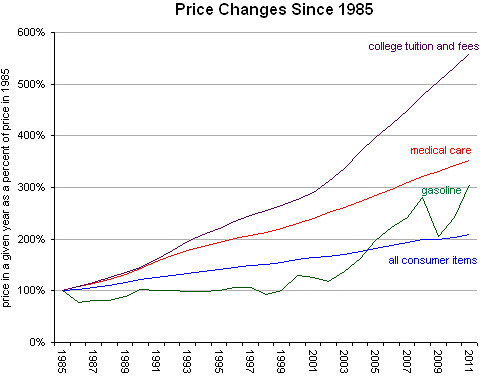
And it’s not just that tuition has been going up, at least at state school. It’s that state funding has been going down:

Next, it’s true that just supplying more loans to federal students doesn’t cut it: tuition rises to meet that ability to pay. In fact that’s part of what’s going on in the above picture.
What we have here is a feedback loop, and it’s hard to break. My personal approach would be to make state schools free to make the overall field competitive for college costs. And yes, that would mean the state pays the schools directly instead of handing out money to students in the form of loans. It’s called an investment in our future, and it also would help with the mobility problems we have. At some point I’m sure it seemed like a terrible idea to form a public elementary school system for free, but we don’t think so now (or do we, Rupert?).
The biggest gripe, if you can get through the article, is that Obama’s plan will allow students to pay off their loans with at most 10% of their salaries after college, and that certain people can stop paying after 10 years instead of 20. If you read from the excerpt above, this is an outrage and those unfairly entitled people are characterized as government and nonprofit workers, but the truth is the exemptions include people who work as police officers, as healthcare workers, in law, or in the military as well.
The ending of the article, which again I suggest you don’t read, is this:
The consequences for our economy are no less tragic than for the individual borrowers. They are being driven away from the path down which their natural ambition and talent might have taken them. President Obama keeps talking about reducing income equality. So why does he keep paying young people not to pursue higher incomes?
All I can say is, what? I get that Rupert or whoever wrote this likes private industry, but the claim that by encouraging a bunch of people to go into super high paying private jobs we will reduce income inequality is just weird. Has that person not understood the relationship between inequality and CEO pay?
I say if you are so gung-ho about private high-paying jobs, then you also need to embrace rising inequality. Do it in the name of free-market capitalism or something, but please stay logical.
Interview with a middle school math teacher on the Common Core
Today’s post is an email interview with Fawn Nguyen, who teaches math at Mesa Union Junior High in southern California. Fawn is on the leadership team for UCSB Mathematics Project that provides professional development for teachers in the Tri-County area. She is a co-founder of the Thousand Oaks Math Teachers’ Circle. In an effort to share and learn from other math teachers, Fawn blogs at Finding Ways to Nguyen Students Over. She also started VisualPatterns.org to help students develop algebraic thinking, and more recently, she shares her students’ daily math talks to promote number sense. When Fawn is not teaching or writing, she is reading posts on mathblogging.org as one of the editors. She sleeps occasionally and dreams of becoming an architect when all this is done.
Importantly for the below interview, Fawn is not being measured via a value-added model. My questions are italicized.
——
I’ve been studying the rhetoric around the mathematics Common Core State Standard (CCSS). So far I’ve listened to Diane Ravitch stuff, I’ve interviewed Bill McCallum, the lead writer of the math CCSS, and I’ve also interviewed Kiri Soares, a New York City high school principal. They have very different views. Interestingly, McCallum distinguished three things: standards, curriculum, and testing.
What do you think? Do teachers see those as three different things? Or is it a package deal, where all three things rolled into one in terms of how they’re presented?
I can’t speak for other teachers. I understand that the standards are not meant to be the curriculum, but the two are not mutually exclusive either. They can’t be. Standards inform the curriculum. This might be a terrible analogy, but I love food and cooking, so maybe the standards are the major ingredients, and the curriculum is the entrée that contains those ingredients. In the show Chopped on Food Network, the competing chefs must use all 4 ingredients to make a dish – and the prepared foods that end up on the plates differ widely in taste and presentation. We can’t blame the ingredients when the dish is blandly prepared any more than we can blame the standards when the curriculum is poorly written.
Similary, the standards inform testing. Test items for a certain grade level cover the standards of that grade level. I’m not against testing. I’m against bad tests and a lot of it. By bad, I mean multiple-choice items that require more memorization than actual problem solving. But I’m confident we can create good multiple-choice tests because realistically a portion of the test needs to be of this type due to costs.
The three – standards, curriculum, and testing – are not a “package deal” in the sense that the same people are not delivering them to us. But they go together, otherwise what is school mathematics? Funny thing is we have always had the three operating in schools, but somehow the Common Core State Standands (CCSS) seem to get the all the blame for the anxieties and costs connected to testing and curriculum development.
As a teacher, what’s good and bad about the CCSS?
I see a lot of good in the CCSS. This set of standards is not perfect, but it’s much better than our state standards. We can examine the standards and see for ourselves that the integrity of the standards holds up to their claims of being embedded with mathematical focus, rigor, and coherence.
Implementation of CCSS means that students and teachers can expect consistency in what is being in taught at each grade level across state boundaries. This is a nontrivial effort in addressing equity. This consistency also helps teachers collaborate nationwide, and professional development for teachers will improve and be more relevant and effective.
I can only hope that textbooks will be much better because of the inherent focus and coherence in CCSS. A kid can move from Maine to California and not have to see different state outlines on their textbooks as if he’d taken on a new kind of mathematics in his new school. I went to a textbook publishers fair recently at our district, and I remain optimistic that better products are already on their way.
We had every state create its own assessment, now we have two consortia, PARCC and Smarter Balanced. I’ve gone through the sample assessments from the latter, and they are far better than the old multiple-choice items of the CST. Kids will have to process the question at a deeper level to show understanding. This is a good thing.
What is potentially bad about the CCSS is the improper or lack of implementation. So, this boils down to the most important element of the Common Core equation – the teacher. There is no doubt that many teachers, myself included, need sustained professional development to do the job right. And I don’t mean just PD in making math more relevant and engaging, and in how many ways we can use technology, I mean more importantly, we need PD in content knowledge.
It is a perverse notion to think that anyone with a college education can teach elementary mathematics. Teaching mathematics requires knowing mathematics. To know a concept is to understand it backward and forward, inside and outside, to recognize it in different forms and structures, to put it into context, to ask questions about it that leads to more questions, to know the mathematics beyond this concept. That reminds me just recently a 6th grader said to me as we were working on our unit of dividing by a fraction. She said, “My elementary teacher lied to me! She said we always get a smaller number when we divide two numbers.”
Just because one can make tuna casserole does not make one a chef. (Sorry, I’m hungry.)
What are the good and bad things for kids about testing?
Testing is only good for kids when it helps them learn and become more successful – that the feedback from testing should inform the teacher of next moves. Testing has become such a dirty word because we over test our kids. I’m still in the classroom after 23 years, yet I don’t have the answers. I struggle with telling my kids that I value them and their learning, yet at the end of each quarter, the narrative sum of their learning is a letter grade.
Then, in the absence of helping kids learn, testing is bad.
What are the good/bad things for the teachers with all these tests?
Ideally, a good test that measures what it’s supposed to measure should help the teacher and his students. Testing must be done in moderation. Do we really need to test kids at the start of the school year? Don’t we have the results from a few months ago, right before they left for summer vacation? Every test takes time away from learning.
I’m not sure I understand why testing is bad for teachers aside from lost instructional minutes. Again, I can’t speak for other teachers. But I do sense heightened anxiety among some teachers because CCSS is new – and newness causes us to squirm in our seats and doubt our abilities. I don’t necessarily see this as a bad thing. I see it as an opportunity to learn content at a deeper conceptual level and to implement better teaching strategies.
If we look at anything long and hard enough, we are bound to find the good and the bad. I choose to focus on the positives because I can’t make the day any longer and I can’t have fewer than 4 hours of sleep a night. I want to spend my energies working with my administrators, my colleagues, my parents to bring the best I can bring into my classroom.
Is there anything else you’d like to add?
The best things about CCSS for me are not even the standards – they are the 8 Mathematical Practices. These are life-long habits that will serve students well, in all disciplines. They’re equivalent to the essential cooking techniques, like making roux and roasting garlic and braising kale and shucking oysters. Okay, maybe not that last one, but I just got back from New Orleans, and raw oysters are awesome.
I’m excited to continue to share and collaborate with my colleagues locally and online because we now have a common language! We teachers do this very hard work – day in and day out, late into the nights and into the weekends – because we love our kids and we love teaching. But we need to be mathematically competent first and foremost to teach mathematics. I want the focus to always be about the kids and their learning. We start with them; we end with them.
A simple mathematical model of congressional geriatric penis pumps
This is a guest post written by Stephanie Yang and reposted from her blog. Stephanie and I went to graduate school at Harvard together. She is now a quantitative analyst living in New York City, and will be joining the data science team at Foursquare next month.
 Last week’s hysterical report by the Daily Show’s Samantha Bee on federally funded penis pumps contained a quote which piqued our quantitative interest. Listen carefully at the 4:00 mark, when Ilyse Hogue proclaims authoritatively:
“Statistics show that probably some our members of congress have a vested interested in having penis pumps covered by Medicare!”
Ilya’s wording is vague, and intentionally so. Statistically, a lot of things are “probably” true, and many details are contained in the word “probably”. In this post we present a simple statistical model to clarify what Ilya means.
First we state our assumptions. We assume that penis pumps are uniformly distributed among male Medicare recipients and that no man has received two pumps. These are relatively mild assumptions. We also assume that what Ilya refers to as “members of Congress [with] a vested interested in having penis pumps covered by Medicare,” specifically means male member of congress who received a penis pump covered by federal funds. Of course, one could argue that female members congress could also have a vested interested in penis pumps as well, but we do not want to go there.
Now the number crunching. According to the report, Medicare has spent a total of $172 million supplying penis pumps to recipients, at “360 bucks a pop.” This means a total of 478,000 penis pumps bought from 2006 to 2011.
45% of the current 49,435,610 Medicare recipients are male. In other words, Medicare bought one penis pump for every 46.5 eligible men. Inverting this, we can say that 2.15% of male Medicare recipients received a penis pump.
There are currently 128 members of congress (32 senators plus 96 representatives) who are males over the age of 65 and therefore Medicare-eligible. The probability that none of them received a federally funded penis pump is:

In other words, the chances of at least one member of congress having said penis pumps is 93.8%, which is just shy of the 95% confidence that most statisticians agree on as significant. In order to get to 95% confidence, we need a total of 138 male members of congress who are over the age of 65, and this has not happened yet as of 2014. Nevertheless, the estimate is close enough for us to agree with Ilya that there is probably someone member of congress who has one.
Is it possible that there two or more penis pump recipients in congress? We did notice that Ilya’s quote refers to plural members of congress. Under the assumptions laid out above, the probability of having at least two federally funded penis pumps in congress is:

Again, we would say this is probably true, though not nearly with the same amount of confidence as before. In order to reach 95% confidence that there are two or moreq congressional federally funded penis pump, we would need 200 or more Medicare-eligible males in congress, which is unlikely to happen anytime soon.
Note: As a corollary to these calculations, I became the first developer in the history of mankind to type the following command: git merge --squash penispump.
Guest rant about rude kids
Today’s guest post was written by Amie, who describes herself as a mom of a 9 and a 14-year-old, mathematician, and bigmouth.
Nota bene: this was originally posted on Facebook as a spontaneous rant. Please don’t miscontrue it as an academic argument.
Time for a rant. I’ll preface this by saying that while my kids are creative, beautiful souls, so are many (perhaps all) children I’ve met, and it would be the height of arrogance to take credit for that as a parent. But one thing my husband and I can take credit for are their good manners, because that took work to develop.
The first phrase I taught me daughter was “thank you,” and it’s been put to good use over the years. I’m also loathe to tell other parents what to do, but this is an exception: teach your fucking kids to say “please” and “thank you”. If you are fortunate to visit another country, teach them to say “please” and “thank you” in the native language.
After a week in paradise at a Club Med in Mexico, I’m at some kind of breaking point with rude rich people and their spoiled kids. And that includes the Europeans. Maybe especially the Europeans. What is it that when you’re in France everyone’s all “thank you and have a nice day” but when these petit bourgeois assholes come to Cancun they treat Mexicans like nonhumans? My son held the door for a face-lifted Russian lady today who didn’t even say thank you.
Anyway, back to kids: I’m not saying that you should suppress your kids’ nature joie de vivre and boisterous, rambunctious energy (though if that’s what they’re like, please keep them away from adults who are not in the mood for it). Just teach them to treat other people with basic respect and courtesy. That means prompting them to say “please,” “thank you,” and “nice to meet you” when they interact with other people.
Jordan Ellenberg just posted how a huge number of people accepted to the math Ph.D. program at the University of Wisconsin never wrote to tell him that they had accepted other offers. When other people are on a wait list!
Whose fault is this? THE PARENTS’ FAULT. Damn parents. Come on!!
P.S. Those of you who have put in the effort to raise polite kids: believe me, I’ve noticed. So has everyone else.
Aunt Pythia’s advice
Great to be here, and glad you came.
Please hop on the nerd advice column bus for another week of ridiculous if not damaging guidance from yours truly, Aunt Pythia.
And please, after enjoying today’s counsel to other poor, unsuspecting fools:
think of something to ask Aunt Pythia at the bottom of the page!
By the way, if you don’t know what the hell Aunt Pythia is talking about, go here for past advice columns and here for an explanation of the name Pythia.
——
Aunt Pythia,
I’m so SORRY. When I asked your opinion about conference sex the other week I thought I had pasted the link to the article: Will you still medal in the morning? It’s all about the behind the scenes sex at the Olympics.
ORR
Dear ORR,
Let me remind readers of your original question (after giving them a chance to read the article). You (thought you) gave me the link and then made the comment:
If conferences like JMM were to have bowls of condoms at the end of the tables where you pick up your badge do you think people would get the idea and pocket a hand full, then use them?
Answer: no. And that’s a good thing. As much as I’m sex positive, and I truly am, I don’t think what’s going on there in the Olympic Village is really about sex. I mean, that’s super dumb for me to say, because obviously tons of sex is happening, but it’s really about freedom and control and conquests.
So, for example, when you go to college, you notice that the kids who had controlling parents and no freedom in high school are particularly prone to spending too much money, drinking too hard, and fucking anything that moves, even relative to the kids whose upbringing was more relaxed and free. It’s about asserting control over their destiny and their freedom, and it lasts a couple of months and then calms down, hopefully in time for them to pass their classes. I’m absolutely sure of this phenomenon but come to think of it I’ve never seen statistics, which is probably a good thing.
Now think about Olympic athletes. They have lives utterly controlled by their coaches and parents and practices, and between you and me it’s often a neglectful if not abusive situation for those kids. Don’t get me wrong, I’m not saying they hate every minute of it, especially the ones we hear from who win the medals, but if you account for the selection bias for a minute and just think about the childhoods these kids have, your heart breaks for them.
So when they finally get to be somewhere away from their coaches, and this ridiculous pressure is off after their events, they need to somehow assert their freedom to themselves, and the most obvious way to do that is to party hard and fuck anything that moves. Plus it’s even better if they have a long list of conquests, because they’ve been trained to be super competitive.
Now think about math people to contrast this. I’m not saying no condoms are used at a math conference, but generally speaking math people have agency over their own lives, time to have sex when they want and so on, so when they get to a math conference, they just have more of the same. There’s some tension built up before one’s talk, and so in that sense there’s some blowing off of steam, but it’s not Olympic level.
Aunt Pythia
——
Dear Aunt Pythia,
I wrote to you a while ago ranting about how my boss sold me a middle-office IT job as a front-office quant role. Anyways, just wanted to let you know that I did manage to land a quant research role at another buy-side firm, and even though you can’t tell if it’s a scam without being there, it seems promising (I’ll start in about a month). I asked smarter questions this time and the pieces seem to be lining up. I want to thank you for providing a voice of sanity, which is always welcome but especially crucial in trying times where one needs to cut through cognitive dissonance.
Perennial Employee
Dear PE,
Awesome!
Auntie P
——
Dear Aunt Pythia,
Reading about people who are trying to find love or a companion at various places (via online dating or in physical environments) at Aunt Pythia’s Saturday column, why do not you consider creating an online dating site for these high-profile intellectuals?
I considered doing this myself during graduate school when I had many smart and single people around who wanted to have a girl or boy friend but for some reason could not, I did not have the courage or time to invest in this.
How about Aunt Pythia, who has so many followers? I personally checked out some online dating environments, but it was so hard to find really sophisticated people and I did not feel like talking to all those people with the hope that one of them was the good looking nerd I was after.
Idea
Dear Idea,
I like your idea (har har!), but here’s the thing. If I started an online matchmaking thing, I’d first of all not restrict to “high-profile intellectuals,” and second of all it would be very very different from the stuff that already exists.
So for example I’m definitely of the opinion that knowing someone’s age, race, height, and weight and seeing a picture of them makes 99% of all people unfairly unattractive.
It’s a case of knowing the wrong thing about someone. I mean, I’m not saying that you don’t eventually know those things about someone you’re into, but you don’t focus on them if it’s an organic meeting. It’s just the wrong information to provide and makes things less sexy and painfully judgmental.
Let me say it this way. Some woman going online for a date might think she needs the man to be taller than she is, and filter stuff out that way, but in real life she’ll meet someone at a party and be really into him and later realize he’s probably a couple inches shorter than she is and she won’t care at all.
So what information would I ask people to provide instead? That’s a toughie, and I’d love your help, readers, but here’s a start:
- How sexual are you? (super important question)
- How much fun are you? (people are surprisingly honest when asked this)
- How awesome do you smell? (might need to invent technology for this one)
- What bothers you more: the big bank bailout or the idea of increasing the minimum wage?
- Do you like strong personalities or would you rather things stay polite?
- What do you love arguing about more: politics or aesthetics?
- Where would you love to visit if you could go anywhere?
- Do you want kids?
- Dog person or cat person?
- Do you sometimes wish the girl could be the hero, and not always fall for the hapless dude at the end?
That’s a start. Again, looking for more. I think there should be about 20. Also people should answer in sentences.
Aunt Pythia
——
Dear Aunt Pythia,
I’m a graduate student in a STEM field who happens to also be of the male inclination….oh, and I’m gay.
Now, this normally isn’t so much of an issue (though it has been!) with my social circle/friends outside of the academia, but I’m a bit concerned about disclosing this sort of information to the department, my advisor, and other STEM graduate peers, because, well
- in my humble opinion, STEM departments are not the most gay friendly. I mean, if you’re a gay male, surely you should be studying creative writing or writing your thesis about continental philosophy’s role in post-WWII imperialism (honestly, the former has been said to me….though the latter sounds like an interesting blog post or two), and
- my main concern is the future of my academic career. Who are we kidding here, people making hiring decisions in the future may not be that cool with the whole “I’m here and queer!” thing. It could affect my career, negatively. (Ever been to Princeton btw?)
Please feel free to straightsplain to me that I’m being paranoid (though I won’t think I was being paranoid, would I?)
Best,
Sardonic Albeit Distinctly Fearful About Gay-friendliness
Dear SADFAG,
First of all, I have been to Princeton, thanks for asking.
Second of all, I don’t think you’re being at all paranoid. In fact it warms the cockles of my heart that you might even feel like you’re being paranoid asking about this, and it’s a testament to how far this country has come since I was a graduate student. Progress!
But only partial progress, to be sure. One of the weirdest things about the academic math market is how you’re expected to up and move to just about anywhere for a one year post-doc or what have you. And many people, especially outside of math, don’t actually want to do that, even if those places are nice places. When you add to that the fact that many of those places aren’t particularly nice, and are still crazy backwards when it comes to accepting gay people, then your job search is getting narrower.
Even so, you might want to take that job in that no-so-nice place, especially if it’s only for one year. I get that.
My short-term advice to you is to do what you need to do to keep your options wide, and if that includes coming out because you’re fed up with this bullshit, then definitely keep that in mind. My long-term advice is to end up eventually in a nice place where you can be accepted. Such places exist and the great news is they are increasing in number.
Love,
Aunt Pythia
——
Please submit your well-specified, fun-loving, cleverly-abbreviated question to Aunt Pythia!
The Lede Program has awesome faculty
A few weeks ago I mentioned that I’m the Program Director for the new Lede Program at the Columbia Graduate School of Journalism. I’m super excited to announce that I’ve found amazing faculty for the summer part of the program, including:
- Jonathan Soma, who will be the primary instructor for Basic Computing and for Algorithms
- Dennis Tenen, who will be helping Soma in the first half of the summer with Basic Computing
- Chris Wiggins, who will be helping Soma in the second half of the summer with Algorithms
- An amazing primary instructor for Databases who I will announce soon,
- Matthew Jones, who will help that amazing yet-to-be-announced instructor in Data and Databases
- Three amazing TA’s: Charles Berret, Sophie Chou, and Josh Vekhter (who doesn’t have a website!).
I’m planning to teach The Platform with the help of a bunch of generous guest lecturers (please make suggestions or offer your services!).
Applications are open now, and we’re hoping to get amazing students to enjoy these amazing faculty and the truly innovative plan they have for the summer (and I don’t use the word “innovative” lightly!). We’ve already gotten some super strong applications and made a couple offers of admission.
Also, I was very pleased yesterday to see a blogpost I wrote about the genesis and the goals of the program be published in PBS’s MediaShift.
Finally, it turns out I’m a key influencer, according to The Big Roundtable.
The US political system serves special interests and the rich
A paper written by Martin Gilens and Benjamin Page and entitled Testing Theories of American Politics: Elites, Interest Groups, and Average Citizens has been recently released and reported on (h/t Michael Crimmins) that studies who has influence on policy in the United States.
Here’s an excerpt from the abstract of the paper:
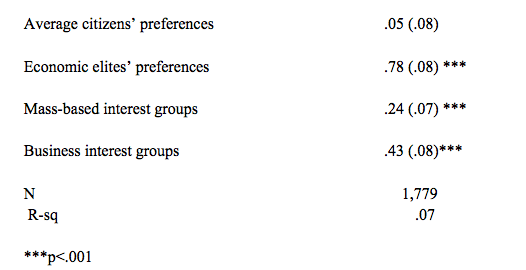
Multivariate analysis indicates that economic elites and organized groups representing business interests have substantial independent impacts on U.S. government policy, while average citizens and mass-based interest groups have little or no independent influence.
A word about “little or no independent influence”: the above should be interpreted to mean that average citizens and mass-based groups only win when their interests align with economic elites, which happens sometimes, or business interests, which rarely happens. It doesn’t mean that average citizens and mass-based interest groups never ever get what they want.
There’s actually a lot more to the abstract, about abstract concepts of political influence, but I’m ignoring that to get to the data and the model.
The data
The found lots of polls on specific issues that were yes/no and included information about income to determine what poor people (10th percentile) thought about a specific issue, what an average (median income) person thought, and what a wealthy (90th percentile) person thought. They independently corroborated that their definition of wealthy was highly correlated, in terms of opinion, to other stronger (98th percentile) definitions. In fact they make the case that using 90th percentile instead of 98th actually underestimates the influence of wealthy people.
For the sake of interest groups and their opinions on public policy, they had a list of 43 interest groups (consisting of 29 business groups, 11 mass-based groups, and 3 others) that they considered “powerful” and they used domain expertise to estimate how many would oppose or be in favor of a given issue, and more or less took the difference, although they actually did something a bit fancier to reduce the influence of outliers:
Net Interest Group Alignment = ln(# Strongly Favor + [0.5 * # Somewhat Favor] + 1) – ln(#
Strongly Oppose + [0.5 * # Somewhat Oppose] + 1).
Finally, they pored over records to see what policy changes were actually made in the 4 year period after the polls.
Statistics
The different groups had opinions that were sometimes highly correlated:

Note the low correlation between mass public interest groups (like unions, pro-life, NRA, etc) and average citizens’ preferences and the negative correlation between business interests and elites’ preferences.
Next they did three bivariate regressions, measuring the influence of each of the groups separately, as well as one including all three, and got the following:
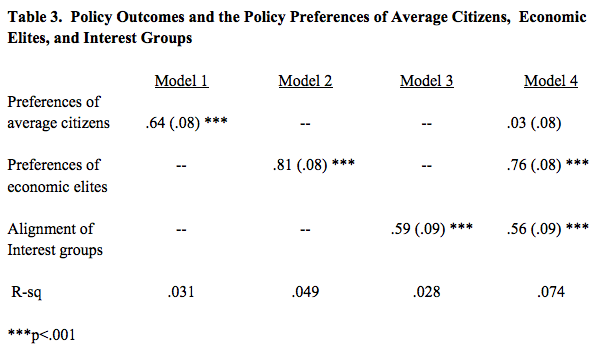
This is where we get our conclusion that average citizens don’t have independent influence, because of this near-zero coefficient in Model 4. But note that if we ignore elites and interest groups, we do have 0.64 in Model 1, which indicates that preferences of the average citizens are correlated with outcomes.
The overall conclusion is that policy changes are determined by the elites and the interest groups.
We can divide the interest groups into business versus mass-based and check out how the influence is divided between the four defined groups:
Caveats
This stuff might depend a lot on various choices the modelers made as well as their proxies. It doesn’t pick up on smaller special interest groups. It doesn’t account for all possible sources of influence and so on. I’d love to see it redone with other choices. But I’m impressed anyway with all the work they put into this.
I’ll let the authors have the last word:
What do our findings say about democracy in America? They certainly constitute troubling news for advocates of “populistic” democracy, who want governments to respond primarily or exclusively to the policy preferences of their citizens. In the United States, our findings indicate, the majority does not rule — at least not in the causal sense of actually determining policy outcomes. When a majority of citizens disagrees with economic elites and/or with organized interests, they generally lose. Moreover, because of the strong status quo bias built into the U.S. political system, even when fairly large majorities of Americans favor policy change, they generally do not get it.
How recently have you experienced democracy? #OWS
A few weeks ago Omar Freilla came to talk to my Occupy group. Omar is a founder of the Green Worker Cooperatives and shared his experience as an organizer.
He is a well-spoken guy and talked passionately about forming community cooperatives, where workers “have a direct role in decision-making and a share of all profits, build community wealth and help make a democratic economy real.”
At one point in his presentation, Omar asked us was how recently we’d “experienced democracy.”
On the face of it I didn’t think it was a fair question, especially when he compared it to experiencing anger or happiness. After all, democracy isn’t an emotion and I can’t experience democracy, say, by myself in a room, but of course I can conjure up emotions by myself in a room, especially if I have a laptop, wifi, and Netflix to help me.
But since his visit, I have to admit I have dwelled on that question and it’s become more and more reasonable in my mind, although I made two decisions on how to interpret it.
First of all, I chose to interpret it not as a formal gesture of democracy, like asking how recently have you voted in a formal election. Instead, it’s a local decision-making process question: how recently has your vote mattered in a local decision that affects a group?
Second, it’s not really about me. It’s about looking around and deciding who around me gets to participate in democratic decisions and who doesn’t.
For example, it might be at work. Although I personally get to make a lot of decisions at work, that fact clearly separates me from tons of people who simply get told what to do by some kind of authority. And there is an important distinction between people who have a manager but get to make decisions internal to their projects and people who have every decision laid out for them.
And that latter workplace anti-democratic situation is, I imagine, maximally soul-crushing, and is the audience that Omar is worried about and is reaching out to. And that’s why his question turns out to be a really good question after all.
I also consider democracy inside my own family. Since I’m the mom of the family, I tend to make more decisions that affect my little group than other people, but now I’m more sensitive to sharing that power there when I can. Turns out my kids love making decisions, it makes them gleeful in fact, even if it’s just what to eat for dinner. And they make good decisions too, which I’m consistently proud of.
My final example is Occupy, which is by construction a direct democracy, and I know how good participating and experiencing democracy actually feels there, and it’s a big part of why it works.
What about you? How recently have you experienced democracy?
Let’s experiment more
What is an experiment?
The gold standard in scientific fields is the randomized experiment. That’s when you have some “treatment” you want to impose on some population and you want to know if that treatment has positive or negative effects. In a randomized experiment, you randomly divide a population into a “treatment” group and a “control group” and give the treatment only to the first group. Sometimes you do nothing to the control group, sometimes you give them some other treatment or a placebo. Before you do the experiment, of course, you have to carefully define the population and the treatment, including how long it lasts and what you are looking out for.
Example in medicine
So for example, in medicine, you might take a bunch of people at risk of heart attacks and ask some of them – a randomized subpopulation – to take aspirin once a day. Note that doesn’t mean they all will take an aspirin every day, since plenty of people forget to do what they’re told to do, and even what they intend to do. And you might have people in the other group who happen to take aspirin every day even though they’re in the other group.
Also, part of the experiment has to be well-defined lengths and outcomes of the experiment: after, say, 10 years, you want to see how many people in each group have a) had heart attacks and b) died.
Now you’re starting to see that, in order for such an experiment to yield useful information, you’d better make sure the average age of each subpopulation is about the same, which should be true if they were truly randomized, and that there are plenty of people in each subpopulation, or else the results will be statistically useless.
One last thing. There are ethics in medicine, which make experiments like the one above fraught. Namely, if you have a really good reason to think one treatment (“take aspirin once a day”) is better than another (“nothing”), then you’re not allowed to do it. Instead you’d have to compare two treatments that are thought to be about equal. This of course means that, in general, you need even more people in the experiment, and it gets super expensive and long.
So, experiments are hard in medicine. But they don’t have to be hard outside of medicine! Why aren’t we doing more of them when we can?
Swedish work experiment
Let’s move on to the Swedes, who according to this article (h/t Suresh Naidu) are experimenting in their own government offices on whether working 6 hours a day instead of 8 hours a day is a good idea. They are using two different departments in their municipal council to act as their “treatment group” (6 hours a day for them) and their “control group” (the usual 8 hours a day for them).
And although you might think that the people in the control group would object to unethical treatment, it’s not the same thing: nobody thinks your life is at stake for working a regular number of hours.
The idea there is that people waste their last couple of hours at work and generally become inefficient, so maybe knowing you only have 6 hours of work a day will improve the overall office. Another possibility, of course, is that people will still waste their last couple of hours of work and get 4 hours instead of 6 hours of work done. That’s what the experiment hopes to measure, in addition to (hopefully!) whether people dig it and are healthier as a result.
Non-example in business: HR
Before I get too excited I want to mention the problems that arise with experiments that you cannot control, which is most of the time if you don’t plan ahead.
Some of you probably ran into an article from the Wall Street Journal, entitled Companies Say No to Having an HR Department. It’s about how some companies decided that HR is a huge waste of money and decided to get rid of everyone in that department, even big companies.
On the one hand, you’d think this is a perfect experiment: compare companies that have HR departments against companies that don’t. And you could do that, of course, but you wouldn’t be measuring the effect of an HR department. Instead, you’d be measuring the effect of a company culture that doesn’t value things like HR.
So, for example, I would never work in a company that doesn’t value HR, because, as a woman, I am very aware of the fact that women get sexually harassed by their bosses and have essentially nobody to complain to except HR. But if you read the article, it becomes clear that the companies that get rid of HR don’t think from the perspective of the harassed underling but instead from the perspective of the boss who needs help firing people. From the article:
When co-workers can’t stand each other or employees aren’t clicking with their managers, Mr. Segal expects them to work it out themselves. “We ask senior leaders to recognize any potential chemistry issues” early on, he said, and move people to different teams if those issues can’t be resolved quickly.
Former Klick employees applaud the creative thinking that drives its culture, but say they sometimes felt like they were on their own there. Neville Thomas, a program director at Klick until 2013, occasionally had to discipline or terminate his direct reports. Without an HR team, he said, he worried about liability.
“There’s no HR department to coach you,” he said. “When you have an HR person, you have a point of contact that’s confidential.”
Why does it matter that it’s not random?
Here’s the crucial difference between a randomized experiment and a non-randomized experiment. In a randomized experiment, you are setting up and testing a causal relationship, but in a non-randomized experiment like the HR companies versus the no-HR companies, you are simply observing cultural differences without getting at root causes.
So if I notice that, at the non-HR companies, they get sued for sexual harassment a lot – which was indeed mentioned in the article as happening at Outback Steakhouse, a non-HR company – is that because they don’t have an HR team or because they have a culture which doesn’t value HR? We can’t tell. We can only observe it.
Money in politics experiment
Here’s an awesome example of a randomized experiment to understand who gets access to policy makers. In an article entitled A new experiment shows how money buys access to Congress, an experiment was conducted by two political science graduate students, David Broockman and Josh Kalla, which they described as follows:
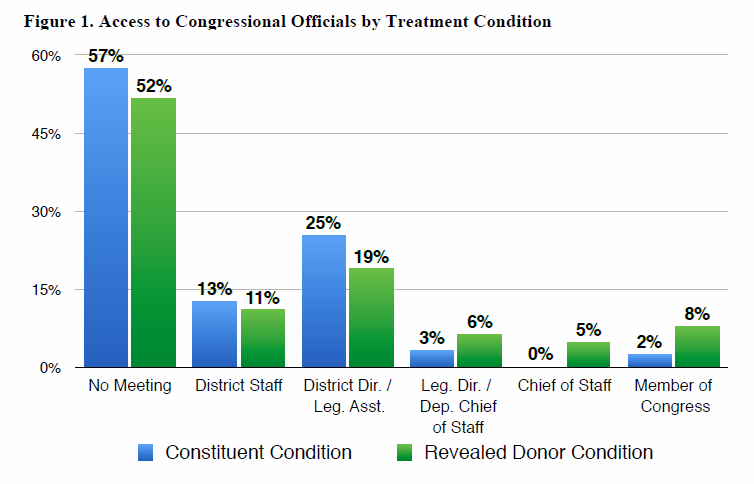
In the study, a political group attempting to build support for a bill before Congress tried to schedule meetings between local campaign contributors and Members of Congress in 191 congressional districts. However, the organization randomly assigned whether it informed legislators’ offices that individuals who would attend the meetings were “local campaign donors” or “local constituents.”
The letters were identical except for those two words, but the results were drastically different, as shown by the following graphic:
Conducting your own experiments with e.g. Mechanical Turk
You know how you can conduct experiments? Through an Amazon service called Mechanical Turk. It’s really not expensive and you can get a bunch of people to fill out surveys, or do tasks, or some combination, and you can design careful experiments and modify them and rerun them at your whim. You decide in advance how many people you want and how much to pay them.
So for example, that’s how then-Wall Street Journal journalist Julia Angwin, in 2012, investigated the weird appearance of Obama results interspersed between other search results, but not a similar appearance of Romney results, after users indicated party affiliation.
Conclusion
We already have a good idea of how to design and conduct useful and important experiments, and we already have good tools to do them. Other, even better tools are being developed right now to improve our abilities to conduct faster and more automated experiments.
If we think about what we can learn from these tools and some creative energy into design, we should all be incredibly impatient and excited. And we should also think of this as an argumentation technique: if we are arguing about whether a certain method or policy works versus another method or policy, can we set up a transparent and reproducible experiment to test it? Let’s start making science apply to our lives.
People who obsessively exercise are boring
I’m not saying anything you don’t know already. I’m just stating the obvious: people who obsessively exercise are super boring. They talk all the time about their times, and their workout progress, and their aching muscles, and it’s like you don’t even have to be there, you could just replace yourself with a gadget that listens, nods, and then says encouraging things like, “Way to go!” at the very end. Excruciating.
Look, don’t get me wrong. I’ve gone through bouts of obsessive exercise myself, and those bouts sometimes were pretty lengthy. And no, it didn’t ever make me skinny, just incredibly fit. I remember I trained for a sprint triathlon once, and man was I fit by the time it finally happened in the spring on 2004.
But then, when I got to the starting line, and there I was wishing I could reorder the events so the the beginning swim would 5 kilometers and the run at the end were a quarter mile – I’ve never been much of a runner – and I just looked around at myself and everyone else there, and I wondered how I’d become so incredibly boring and self-obsessed that I had paid good money and driven miles and miles just to obsessively exercise in front of other people.
What was going on with me? I became increasingly disgusted by my own boringness throughout the race. I think the worst part was how many people said “You go, girl!” when I jogged by. They were trying to encourage the fat girl, I get it, but it made it even more obvious that I was doing something that I honestly didn’t need to be getting public response to.
Look, I’m not against exercise, and I love doing it, or at least I love having done it because it makes you feel good, and I encourage everyone to be fit and happy. But I’m serious when I say I will no longer tolerate hanging out with people who obsess over it and want to talk to me about their obsession. Too frigging boring, people!
So if someone mentions that they went biking over this gorgeous spring weekend, then awesome, I’ll be happy for them. But if they want to talk about which bike they used, and what their time around Central Park was, and how they’re training for this or that event, then no. I will tell them “sorry but can we talk about something not incredibly boring now?”
Why do I mention this today? Because I finally figured out what my hostility towards the Quantified Self crowd is, and it’s this same thing. All those gadgets and doodads are essentially props to pull out and use to have that same boring conversation that I’ve already refused to give into. So please, don’t show me your sleep tracker or your step monitor and expect me to care. I don’t care.
And don’t get me wrong – again – I know some people will benefit from that kind of thing. And some people actually have illnesses or physical therapy and exercise and particularly quantified exercise might particularly help them keep track of their health! I get it!
But let’s face it, most people are not doing this for health. They are doing it for some other weird, narcissistic and anxiety-shielding coping-mechanistic self-competitive (or outright competitive) reason. And again, I’m not hating on them exactly, because I get it, and I’ve been there. But I don’t want to talk about it with them.
Aunt Pythia’s advice
Readers, readers!
Aunt Pythia rarely does this, and really has never ever made up a question, but she absolutely needs to share a couple of things that nobody even came close to asking about this week. And yes, they’re about sex, or at least about genitals. Please skip this next section, and possibly all Aunt Pythia columns ever, if you are not interested in vulgar discussions of dirty topics. And yes, she’s taking this as an excuse to use the plural forms.
Clitorides
First, it might not surprise people to learn that Aunt Pythia talks about sex with her girlfriends. A lot. And she’s noticed a pattern in those conversations: some women can orgasm during intercourse, others cannot. And when I say cannot, I don’t mean cannot without help from, say, hands or a toy (Aunt Pythia does not often meet women who are in the alleged 15% of the population who cannot orgasm). I mean women who cannot through intercourse alone, with only a partner’s pelvic bone as tool.
Such an intriguing and natural categorization of women does not leave Aunt Pythia cold! She wants to get to the bottom of this! Why is this not one of the most basic conundrums of human existence, she wonders? Well, it is, and it has been (possibly! hopefully!) solved, in this article. It’s all about measuring distances, and once you say it like that, it makes perfect sense. Mystery revealed.
Penes
Aunt Pythia has been thinking a lot about objectification lately, and wondering why it happens so much more to women. One slightly philosophical approach to this question is understanding the extent to which men’s genitals are, to put it delicately, ripe for objectification versus, say, women’s breasts.
And the thing is, dear readers, they are not. Not as a general rule. And that is why, in my opinion, this video is so deeply radical. Warning! Please do not watch this video unless you are ready to have your mind blown! And please don’t say I didn’t warn you about this video.
Addendum: I feel like there should be a phrase invented for that video. Something like, hey man, don’t make me robocop your dick, or hey dude, don’t robocop your own dick. Suggestions welcome.
Back to our regularly scheduled advice column
After enjoying (or not!) today’s Aunt Pythia post and advice:
think of something to ask Aunt Pythia at the bottom of the page!
By the way, if you don’t know what the hell Aunt Pythia is talking about, go here for past advice columns and here for an explanation of the name Pythia.
——
Dear Aunt Pythia,
Inspired by the PDF Hackathon, I was wondering if anyone has scraped any of the sites where things like NECAP and MCAS scores are posted ala Wikileaks. Are these things publicly available, and I just haven’t looked in the right places?.
I’m working on a letter to the chair of a committee in the state legislature that is considering a bill that would exempt teachers rated “highly effective” or “effective” from being evaluated the next three years. The link you posted to the six articles on VAM in New York have provided me with a lot of material. Mandatory inclusion of test scores in teacher evaluations is scheduled to be implemented this year in RI and I’m hoping that if we can drag our feet in RI until the negative effects in early adoption states become widely known maybe we can avoid making some of those mistakes. Unfortunately our education commissioner is one of Jeb Bush’s infamous “chiefs for change” and has a lot of clout.
Confused in RI
Dear Confused,
First, I feel your pain. And I’m not sure which link of mine you were referring to but it might as well be Eugene Stern’s guest post on his fears of a VAM-like model being implemented in New Jersey, which he wrote about a year ago, when it was being pushed by Chris Christie (I wonder what happened to that initiative? Eugene?). In fact please feel free to write your letter with many of the same points Eugene was making.
Second, there’s no way we want student test scores leaked ever, and for this purposes especially. The models themselves are secret, and the amount of details and information necessary to reconstitute even one teacher’s VAM score would expose many innocent people to scrutiny that they don’t deserve and is outright illegal and rightly so.
I’m afraid you will have to play this out politically, not using data. The whole point of it is that they control the data and are using the model as an opaque and threatening weapon.
Aunt Pythia
——
Dear Aunt Pythia,
My best friend and I used to talk often on the phone (like once a week for an hour, over the course of 5 years) but gradually over the past year, the frequency and length has declined, and also now she never initiates the calls or texts. She’s pretty busy – she is overworked at a job she hates, and has had various boyfriends, and recently moved in with one, and hangs out with friends who live close to her (I don’t). A few times lately she has failed to return my phone calls.
I am a really lonely guy … I have tried basically the kitchen sink at finding a girlfriend, but haven’t been successful yet and so she is who I typically turn to for emotional support. Anyways, I love talking with her, but often times lately I have been feeling sad because I feel so ignored by her, and I kind of feel that I am not valued as a friend. Do you think I should I stop initiating calls and texts? Not because I want to stop being friends with her, but because it’s a bit unfair of me to ask for so much support from her, and I should try to finding an actual girlfriend instead?
Lonely in New York(?!)
Dear Lonely,
I love it when my job is easy and the tough answer has already been provided. Yes, you need to go find your own girlfriend and stop asking one friend for that much support and love. She probably loves you and knows you need to disconnect from her in order to connect with others. Once you have a real live woman to talk to in New York I bet she’ll be psyched for you and more willing to return your (less frequent and less pathetic) calls.
Plus, according to this interactive love map created by Jonathan Soma, you should count your statistically lucky stars that there are 5 extra single women per 100 single men in New York.
And by the way, you definitely should start hanging out with friends first. Making friends is easier than finding a girlfriend and often helps.
Auntie P
——
Dear Aunt Pythia,
I’m an undergraduate woman at a well-regarded (and presumably well-endowed) university in the South, in fact it once had the winning Putnam team and the winning NCAA basketball team in the same year, or some such nonsense.
Tuition is exorbitant, and in order to afford it, I have turned to some financially rewarding but controversial, um, artistic endeavors, let’s say, in which I exhibit my natural beauty and enhance my acting skills.
Some say these gigs are demeaning to or objectify women, others say they are a freedom of expression of things our culture tends to repress. Anyways, what would your advice to me be? Should I stay in the industry?
BK
Dear BK,
Let’s think about this pragmatically and long-term. Besides the risk of STD’s, which I assume you’re taking care of, I think the main question is the extent to which you are putting your future goals at risk by taking these gigs now, rather than a more standard, presumably lower-paying evening job.
So, how easily identifiable will you be to later potential employers? And what kind of employment are you interested in? In the extreme case, where you want to be a politician and you’re a huge internet porn star, I think we have a problem. On the other extreme, where you want to be a lab scientist and you are stripping at a local bar with no recordings, I don’t think there’s a major risk.
Your actual case is probably in the middle, and although I don’t know what it is, I’d venture to guess that you also don’t know exactly what it is, because you’re probably 19 or 20 or so and don’t know exactly what you’re doing with your life.
So my advice for staying or leaving hinges on this concern, that your options are being at least somewhat narrowed without you really knowing it. Or even if your options are not explicitly being narrowed, I’m hoping you gird yourself for assholes and assumptions, and I hope you can push back.
And when I say that, I’m also saying “fuck this society” under my breath. We are super prudish in the best of times and at less good time we are freaky and hostile towards women. That’s not your fault.
As to whether the industry is demeaning and objectifying, I’d say it’s objectifying almost by definition, and whether it’s demeaning is probably something you will not be able to fully answer until you live with the ramifications of having been in it. So get back to me in 10 years and tell me what you think.
Good luck,
Aunt Pythia
——
Please submit your well-specified, fun-loving, cleverly-abbreviated question to Aunt Pythia!
Envy, greed, and the American Dream #OWS
I was sent this Falkenblog post entitled Why Envy Dominates Greed a while back (hat tip David Murrell). The post suggests an interesting thought experiment which I’d like to discuss this morning.
Namely, it asks us to examine the extent to which our economic assumption that “everyone is working in their own self-interest” can be replaced by the assumption that “everyone is working to improve their relative ranking” and whether you’d get more clarity from economics that way.
I’ve done myself the favor of ignoring everything author Eric Falkenstein actually says about the economic theory, because he’s focusing on investing in the stock market, which honestly only a minority of people ever do even once. Even so I’d like to consider this idea of envy versus greed and try to make sense of it.
First of all, I do think that a certain kind of relativity combined with proximity is deeply important to humans. When members of my Occupy group talk about living on $2 a day while sleeping at homeless shelters in New York City, surrounded by men in suits with chauffeurs, it is very relevant that the privations described are combined with with a deep sense of humiliation of their understanding of their relative position. These are highly intelligent people who know how things look and they feel it keenly.
Similarly, when I think about poor people in other countries, it’s a different level of destitution than we see here, and yet it doesn’t make me want to drop everything and work in India. There’s something about proximity that we all respond to, and which has been well examined by social scientists.
Going back to my New York friend: is that envy being displayed, exactly? I don’t think so. I think it’s something more like dispossession and despair. And it’s honestly something I believe our natures would rather avoid, but sometimes just slaps us in our face, especially in places like New York City.
I’m not throwing envy out altogether. In fact, I do think envy is strongly at work, but only at a local level. I am working at Columbia now, so it’s natural and proper that I am envious of my colleague’s slightly-larger office. I ignore the stuff I don’t see like how the trustees are chosen and treated. A person in a given town is envious of their neighbor’s house or car or job or wife, but they don’t think about what’s happening in a different neighborhood. In fact they might obsess over such things. It happens. But again, it’s local.
Evidence that people only think very locally about wealth and inequality is everywhere; so when people are polled and asked to describe income or wealth inequality, they always think it’s much less skewed than it is. Why? I’ll guess. It’s because they extrapolate from their very local experience, where there the outliers are not so very outlying at all. It’s a safe kind of assumption that doesn’t boil the blood.
So envy is there, it’s powerful, but it biases us enormously. If anything, I’m starting to think envy is something to distract us from something more dangerous, which is that sense of privation and dispossession, which runs deeper and is more anarchic. By contrast, envy seems like a myopic feeling that keeps us acting safely inside the system, where if we follow the rules but we’re a little bit better at them, we will get that bigger office or bigger car.
In the end, I reject envy as a unifying glue that describes our world, at least in times of severe inequality like now. It just doesn’t address the growing hostility that I’m sensing, which is that second kind of feeling, which exists beyond envy.
Moreover, I think the assumption that everyone is feeling something as small as envy, or rather the projection of envy onto the entire population, is damaging.
So, for example, there was an New York Times Op-Ed recently entitled Capitalize Workers! that suggested we get more people involved for saving for their retirement by investing in the stock market with “minimum pensions”.
I think the idea here is that everyone wants a piece of that amazing stock market return. But if you think about where people actually are financially, it’s such a weirdly out-of-touch plan, the idea that everyone is a Wall Street trader or wants to be.
For most people I meet and talk to, at this point retirement is not at all about the thrill of risk-taking, but rather the avoidance of risk altogether. If you asked those people, they’d rather just have their Social Security benefits doubled. They are not trying to take their chances to double their money, but rather trying to eke out a retirement without severe pain.
Why is this happening? Why are the authors of this piece, who both work at the think tank Third Way, making such bizarre assumptions about how poor people want to retire? My first guess was that they are just working with the funds on Wall Street who would reap (even more) profits if more people invested.
But another less suspicious possibility is given by my above observation. Namely, they are projecting their myopic envy, that makes sense in their world, onto the poor and middle class worrying about retirement.
In their neighborhood, the way envy works is about trading and making big gains with extra money, but of course to do that you have to have extra money to start out with. In other words, the distance between the authors and the people they claim to be trying to help is too large for their system of envy to translate meaningfully.
Does OpenSSL bug prove that open source code doesn’t work?
By now most of you have read about the major bug that was found in OpenSSL, an open source security software toolkit. The bug itself is called the Heartbleed Bug, and there’s lots of information about it and how to fix it here. People are super upset about this, and lots of questions remain.
For example, was it intentionally undermined? Has the NSA deliberately inserted weaknesses into this as well? It seems like the jury is out right now, but if I’m the guy who put in the bug, I’m changing my name and going undercover just in case.
Next, how widely was the weakness exploited? If you’re super worried about stuff, or if you are a particular target of attack, the answer is probably “widely.” The frustrating thing is that there’s seemingly no way to measure or test that assumption, since the attackers would leave no trace.
Here’s what I find interesting the most interesting question: what will the long-term reaction be to open source software? People might think that open source code is a bust after this. They will complain that something like this should never have been allowed to happen – that the whole point of open software is that people should be checking this stuff as it comes in – and it never would have happened if there were people getting paid to test the software.
First of all, it did work as intended, even though it took two years instead of two days like people might have wanted. And maybe this shouldn’t have happened like it did, but I suspect that people will learn this particular lesson really well as of now.
But in general terms, bugs are everywhere. Think about Knight Capital’s trading debacle or the ObamaCare website, just two famous recent problems with large-scale coding projects that aren’t open source.
Even when people are paid to fix bugs, they fix the kind of bugs that cause the software to stop a lot sooner than the kind of bug that doesn’t make anything explode, lets people see information they shouldn’t see, and leaves no trace. So for every Knight’s Capital there are tons of other bugs in software that continue to exist.
In other words it’s more a question of who knows about the bugs and who can exploit them. And of course, whether those weaknesses will ever be exposed to the public at all.
It would be great to see the OpenSSL bug story become, over time, a success story. This would mean that, on the one hand the nerds becoming more vigilant in checking vitally important code, and learning to think like assholes, but also the public would need to acknowledge how freaking hard it is to program.
Let’s stop talking about HFT for a little while
It’s unusual that I find myself in the position of defending Wall Street activities, but here goes.
I just don’t think HFT is that big of a deal relative to other Wall Street evils. I have written a couple of times about HFT and I’m not a huge fan, and I don’t buy the “liquidity is good and more liquidity is better” argument: at some point enough is enough. I do think that day-to-day investors have largely benefitted from it but that people whose money is in massive funds which are regularly traded have seen their money get skimmed every month. Overall it’s a smallish negative tax on the average person, I’d expect.
Here’s why HFT deserves some of our hatred: there’s way too much human resources going into this stuff and it’s embarrassing, what with the laying of cables and blasting through mountains and such. And it’s a great sociological look into the absolutely greed-led mindset of the Wall Street trader, but honestly I think we already had that. It’s really business as usual at a microscopic scale, and nobody should really be surprised to learn that people will do anything to make money that’s technically possible and technically legal, and that they will brag about how they’re making the world a better place while they do it. Same old same old.
So I’m not saying HFT is awesome and we should encourage more of it. I’m all for thinking about how to slow down trading to once a second and make it “more fair” for more players (although that’s hard to do even as a thought experiment), or taxing transaction to make things slow down by themselves, which would be easy.
But here’s the thing, it’s not some huge awful thing we should focus on, even though Michael Lewis is a really good and engaging writer.
You wanna focus on something? Let’s talk about money laundering in HSBC and now Citi that is not under control. Let’s talk about ongoing mortgage fraud and robo-signing and the ongoing bailout/ taxpayer subsidy and people still losing their homes, and the poor still being the targets of illegal and predatory loans, and Too-Big-To-Fail getting worse, and the direct line between the bailout and the broken pension promises for civil servants and the overall price list for fraud that has been built.
Let’s talk about the people who created the underlying fraud still at work in places like Bank of America, and how few masterminds have gone to jail and how the SEC and the Obama administration has made that happen through inaction and passivity and how Congress is sitting on its hands because of the money coming in from lobbyists. Let’s talk about the increasing distance between the justice system for the poor and the justice system for the rich in this country.
Tell me what I missed.
The HFT noise is misplaced and a distraction from the ongoing real story.
An Interview And A Notebook
Interview on Junk Charts
Yesterday I was featured on Kaiser Fung’s Junk Charts blog in an interview where he kindly refers to me as a “Numbersense Pro”. Previous to this week, my strongest connection with Kaiser Fung was through Andrew Gelman’s meta-review of my review and Kaiser’s review of Nate Silver’s book The Signal And The Noise.
iPython Notebook in Data Journalism
Speaking of Nate Silver, Brian Keegan, a quantitative social scientist from Northeastern University, recently built a very cool iPython notebook (hat tip Ben Zaitlen), replete with a blog post in markdown on the need for openness in journalism (also available here), which revisited a fivethirtyeight article originally written by Walt Hickey on the subject of women in film. Keegan’s notebook is truly a model of open data journalism, and the underlying analysis is also interesting, so I hope you have time to read it.
Defining poverty #OWS
I am always amazed by my Occupy group, and yesterday’s meeting was no exception. We decided to look into redefining the poverty line, and although the conversation took a moving and deeply philosophical turn, I’ll probably only have time to talk about the nuts and bolts of formulas this morning.
The poverty line, or technically speaking the “poverty threshold,” is the same as it was in 1964 when it was invented except for being adjusted for inflation via the CPI.
In the early 1960’s, it was noted that poor families spent about a third of their money on food. To build an “objective” measure of poverty, then, they decided to measure the cost of an “economic food budget” for a family of that size and then multiply that cost by 3.
Does that make sense anymore?
Well, no. Food has gotten a lot cheaper since 1964, and other stuff hasn’t. According to the following chart, which I got from The Atlantic, poor families now spend about one sixth of their money on food:

Rich people spend even less on food.
Now if you think about it, the formula should be more like “economic food budget” * 6, which would effectively double all the numbers.
Does this matter? Well, yes. Various programs like Medicare and Medicaid determine eligibility based on poverty. Also, the U.S. census measures poverty in our country using this yardstick. If we double those numbers we will be seeing a huge surge in the official numbers.
Not that we’d be capturing everyone even then. The truth is, in some locations, like New York, rent is so high that the formula would likely be needing even more adjustment. Although food is expensive too, so maybe the base “economic food budget” would simply need adjusting.
As usual the key questions are, what are we accomplishing with such a formula, and who is “we”?
Aunt Pythia’s advice
Aunt Pythia is psyched to be writing today after missing a couple of days of regular posts. Aunt Pythia loves you people and understands how much you rely on her ridiculous advice, so she really goes out of her way to get up on Saturdays, stretch out on the couch in her underwear and armed only with a laptop and copious coffee, and spout utter nonsense. She knows you love it to, and want it to continue indefinitely. So please, after enjoying today’s bilge:
think of something to ask Aunt Pythia at the bottom of the page!
By the way, if you don’t know what the hell Aunt Pythia is talking about, go here for past advice columns and here for an explanation of the name Pythia.
——
Dear Aunt Pythia,
I am an undergraduate at a liberal arts college applying to REUs. If I don’t get into any, I won’t have any opportunities to do research before applying to PhD programs. Would that mean I won’t get into grad school either? What options do I have to prove I am research-ready?
Possibly Not Research Ready
Dear PNRP,
I’m just blown away by the list of REU’s that have sprung up since I was a wee lass. I mean, I went to one, it was at Duluth and run by the incomparable Joe Gallian, but I’m more or less sure it was the only one around back then. He’s been doing it since 1977, and although I wasn’t at the very first one, I was early enough so that all the participants names could fit on one shirt. Holy crap there’s a picture of me from this page at my REU:
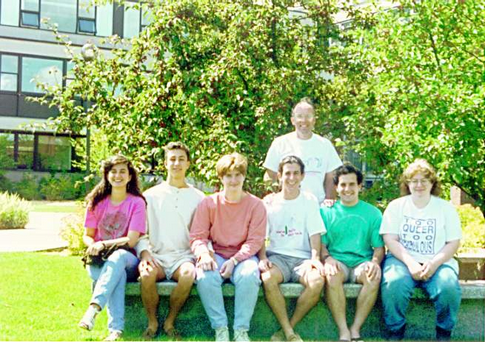
Man, we played a lot of bridge that summer.
OK sorry for the nostalgic stream of consciousness. I will now attempt to answer your question.
First of all, given that very few people used to do REU’s before grad school, I obviously don’t think that it’s strictly necessary. On the other hand, given how many now exist, I’m guessing it’s become a common if not vital signaling device for getting into grad school (readers, weigh in!). It’s also probably gotten easier to get into. Definitely apply to many of them.
If you somehow didn’t apply to enough and it’s too late and you don’t get in anywhere, don’t despair. Look around for a teacher at your school or a nearby school, or even online, that is willing to do a reading course with you and develop some kind of senior thesis type project, or open problem to solve.
I feel that I need to add that most of these programs don’t actually ask you to solve open problems. It’s more like a peek at graduate school math and a mindset of research rather than an expectation that you will publish a paper. I know because I’ve taught at a couple since my college years.
Good luck!
Aunt Pythia
——
Dear Aunt Pythia,
What kind of skills/classes do I need to break into data science as an undergrad? It seems like a really interesting field and I don’t know whether I’m qualified to jump into an internship or not. Currently a math major without any stats classes under my belt.
Data Internship Youngster
Dear DIY,
First steps: take a CS class in a scripting language like python, take probability and statistics, and read my recent book or at least skim it at the bookstore.
Second steps, if you have time: take classes on machine learning, Bayesian statistics, and ethics.
Third steps, if you have even more time: take an advanced programming class, an optimization or information theory class, and become an anthropologist.
In the meantime, keep an eye on the curriculums for the industry data science camps not popping up everywhere, for example at the Microsoft Research Center.
Good luck!
Aunt Pythia
——
Dear Pythia,
Thank you for answering my question about “fairness” rankings by mentioning the Gini coefficient and upward mobility study, both of which I found interesting and hadn’t seen before.
Though obviously major, money wasn’t the only thing I had in mind. Judicial systems that imprison unfairly – possibly due to unfair laws to begin with – unfair job and housing discrimination, unfair environmental conditions and situations (Bhopal comes to mind), reasonable access to medical care, or lack thereof – all of these could be tossed into a fairness score as well.
I guess that in the end though, “fairness” may be a little too vague and subjective a term to be attached to any meaningful objective ranking. Fortunately the world already has lots of watchdog organizations that observe and report on objectively measurable facets of human life. OWS is one such organization.
Thanks again,
EVENFLOWIV
Dear EVENFLOWIV,
First of all, that’s Aunt Pythia to you. Har har.
Actually, even though it doesn’t appear that you’ve asked another question, I want to thank you for giving me an opening to my favorite recent rant.
In the context of my weekly Occupy meetings, I’ve been thinking more and more about the outrageous prison system in our own country and the multitude of mostly minority young men in that system. It’s a truly disgusting and predatory big business. As one of my co-occupiers said, if you’re too poor for us to make money off of you directly, we will throw you in prison and make money off of your incarceration.
Which brings me to your idea of measuring that kind of unfairness, even within our own country, and indeed even within the city of New York. Here’s the idea I’ve been tossing around inside my head.
It’s been long tossed around that the rate of marijuana use is similar for whites and blacks but blacks are going to jail way more for possession, essentially because of Stop & Frisk. In other words, blacks are more likely to get caught and to not have a fancy lawyer to get them out of trouble when they find themselves in trouble.
It brings up a host of questions, but I’ll focus on one: what is the relative chance that someone can get away with a mistake?
In other words, think about it this way. We all make mistakes, and young men (and women) are especially impulsive and judgment-lacking. So instead of asking whether they make mistakes, ask instead what the chances are that such mistakes will land them in jail or prison. I feel like those probabilities might be a good start at what you’re getting at. Do you agree?
Love,
Aunt Pythia
——
Dear Aunt P,
My question may appear a little blunt but it’s one that’s troubled me for ages and I can’t think of any other way to ask it, so here goes: Does clitoris size reflect sexuality?
I mean, might larger be associated with more dominant or further along the hetero/homo-sexual scale, for example?
My follow-up question is, how would one go about assessing this? No, I don’t mean you to say ‘with warm hands and a micrometer’ but a suggestion of the mathematic parameters and procedures.
Jenny Taylor
Dear …umm… Jenny,
I’m going to say no. I have the following reasons for this answer, with exactly zero evidence gathered and assessed. Namely, it’s patently untrue of penises, which we all think about all the time in this society, so why should it be true of clitorides? Yes, that’s the plural of clitoris, I looked it up.
Now it’s true that a given woman’s clitoris ebbs and flows depending on how sexually stimulated she is, but other than that I think you just assume randomness.
As far as follow up, I’m gonna have to say: none needed, but if you want to turn this into a weird pick-up line at a bar then the more power to you.
Aunt Pythia
——
Please submit your well-specified, fun-loving, cleverly-abbreviated question to Aunt Pythia!
What Monsanto and college funds have in common
College
I recently read this letter to the editor written by Catharine Hill, the President of Vassar College, explaining why reducing family contributions in college tuition and fees isn’t a good idea. It was in response to this Op-Ed by Steve Cohen about the onerous “E.F.C.” system.
Let me dumb down the debate a bit for the sake of simplicity. Steve is on one side basically saying, “college costs too damn much, it didn’t used to cost this much!” and Catharine is on the other side saying, “colleges need to compete! If you’re not willing to pay then someone else will!”
Here’s the thing, there’s an arms race of colleges driving up costs. In some perverse combination of US News & World Reports model gaming and in responding to the Federal loan support incentive system, not to mention political decisions methodically removing funding from state colleges, college costs have been wildly rising.
And when you have an arms race, as I’ve learned from Tom Slee, the only solution is an armistice. In this case an armistice would translate into something like an agreement among colleges to set a maximum and reasonable tuition and fee structure. Sounds good, right? But an armistice won’t happen if the players in question are benefitting from the arms race. In this case parents are suffering but colleges are largely benefitting.
Monsanto
This recent Salon article detailing the big data approach that Monsanto is taking to their massive agricultural empire is in the same boat.
The idea is that Monsanto has bought up a bunch of big data firms and satellite firms to perform predictive analytics on a massive scale for farming. And they are offering farmers who are already internal to the Monsanto empire the chance to benefit from their models.
Farmers are skeptical of using the models, because they are worried about how much data Monsanto will be able to collect about them if they do.
But here’s the thing, farmers: Monsanto already has all your data, and will have it forever, due to their surveillance. They will know exactly what you plant, where, and how densely.
And what they are offering you is probably actually a benefit to you, but of course the more important thing for them is that they are explicitly creating an arms race between Monsanto farmers and non-Monsanto farmers.
In other words, if they give Monsanto farmers a extra boost, it will lead other farmers into the conclusion that, without such a boost, they won’t be able to keep up, and they will be forced into the Monsanto system by economic necessity.
Again an arms race, and again no armistice in sight, since Monsanto is doing this deliberately towards their profit bottom line. Assuming their models are good, the only way to avoid this for non-Monsanto farmers is to build their own predictive models, but clearly that would require enormous investment.
Navigating sexism does not mean accepting sexism
Not enough time for a full post this morning, but I’d like people to read a New York Times article ironically entitled Moving Past Gender Barriers to Negotiate a Raise (hat tip Laura Strausfeld). It has amazing and awful tidbits like the following:
“It’s totally unfair because we don’t require the same thing of men. But if women want to be successful in this domain, they need to pay attention to this.”
If you read on you realize that what they mean by “pay attention to” is “roll over and conform to stereotypes”. Super gross, and fuck that.
I feel like this is a more subtle, New York Times version of Susan Patton’s terrible advice for young women in snaring husbands. What happened to the feminists?!!
Lobbyists have another reason to dominate public commenting #OWS
Before I begin this morning’s rant, I need to mention that, as I’ve taken on a new job recently and I’m still trying to write a book, I’m expecting to not be able to blog as regularly as I have been. It pains me to say it but my posts will become more intermittent until this book is finished. I’ll miss you more than you’ll miss me!
On to today’s bullshit modeling idea, which was sent to me by both Linda Brown and Michael Crimmins. It’s a new model built in part by the former chief economist for the Commodity Futures Trading Commission (CFTC) Andrei Kirilenko, who is now a finance professor at Sloan. In case you don’t know, the CFTC is the regulator in charge of futures and swaps.
I’ll excerpt this New York Times article which describes the model:
The algorithm, he says, uncovers key word clusters to measure “regulatory sentiment” as pro-regulation, anti-regulation or neutral, on a scale from -1 to +1, with zero being neutral.
If the number assigned to a final rule is different from the proposed one and closer to the number assigned to all the public comments, then it can be inferred that the agency has taken the public’s views into account, he says.
Some comments:
- I know really smart people that use similar sentiment algorithms on word clusters. I have no beef with the underlying NLP algorithm.
- What I do have a problem with is the apparent assumption that the “the number assigned to all the public comments” makes any sense, and in particular whether it takes into account “the public’s view”.
- It sounds like the algorithm dumps all the public comment letters into a pot and mixes it together to get an overall score. The problem with this is that the industry insiders and their lobbyists overwhelm public commenting systems.
- For example, go take a look at the list of public letters for the Volcker Rule. It’s not unlike this graphic on the meetings of the regulators on the Volcker Rule:
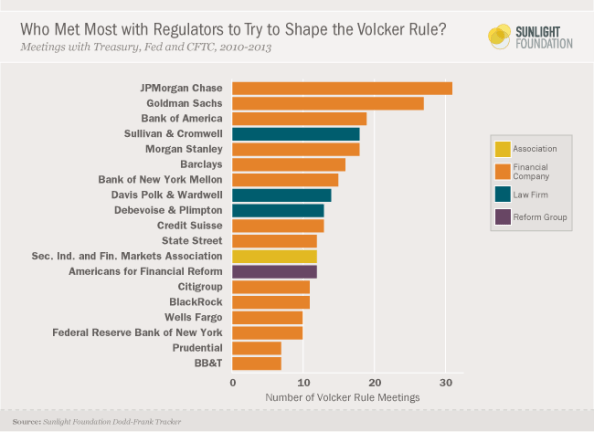
- Besides dominating the sheer number of letters, I’ll bet the length of each letter is also much longer on average for such parties with very fancy lawyers.
- Now think about how the NLP algorithm will deal with this in a big pot: it will be dominated by the language of the pro-industry insiders.
- Moreover, if such a model were to be directly used, say to check that public commenting letters were written in a given case, lobbyists would have even more reason to overwhelm public commenting systems.
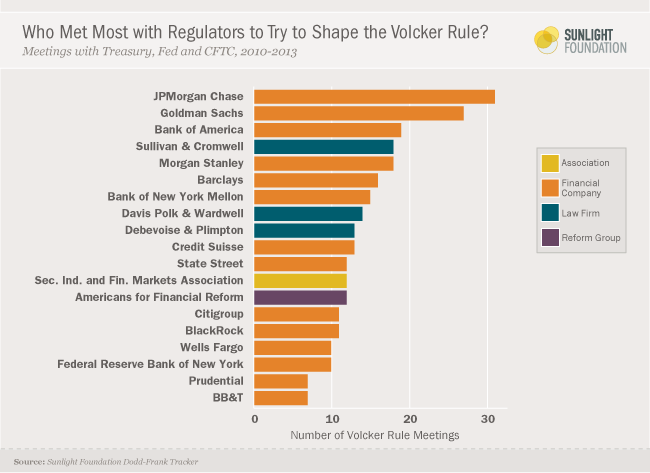
The take-away is that this is an amazing example of a so-called objective mathematical model set up to legitimize the watering down of financial regulation by lobbyists.
Update: I’m willing to admit I might have spoken too soon. I look forward to reading the paper on this algorithm and taking a deeper look instead of relying on a newspaper.


 mathbabe