Marc Andreessen and Al3x Payne
My friend Chris Wiggins just sent me this recent letter by Alex “Al3x” Payne in response to this recent post by Marc Andreessen. Andreessen’s original post is entitled This is Probably a Good Time to Say That I Don’t Believe Robots Will Eat All the Jobs… and the rebuttal is entitled simply Dear Marc Andreessen.
To get a flavor of the exchange, we’ll start with this from Andreessen:
What never gets discussed in all of this robot fear-mongering is that the current technology revolution has put the means of production within everyone’s grasp. It comes in the form of the smartphone (and tablet and PC) with a mobile broadband connection to the Internet. Practically everyone on the planet will be equipped with that minimum spec by 2020.
versus this from Payne:
If we’re gonna throw around Marxist terminology, though, can we at least keep Karl’s ideas intact? Workers prosper when they own the means of production. The factory owner gets rich. The line worker, not so much.
Owning a smartphone is not the equivalent of owning a factory. I paid for my iPhone in full, but Apple owns the software that runs on it, the patents on the hardware inside it, and the exclusive right to the marketplace of applications for it.
…
You spent a lot of paragraphs on back-of-the-napkin economics describing the coming Awesome Robot Future, addressing the hypotheticals. What you left out was the essential question: who owns the robots?
Please read both the original post and the rebuttal in their entireties. At it’s heart, their conversation strikes me as a somewhat more contentious version of the argument I’ve had with myself about the utopia envisioned in Star Trek.
Namely, at some point we’ll have all these robots doing stuff for us, but how are we going to spread that wealth around? Who owns the robots and when are they going to learn to share? In this vision of the distant future, that critical “singularity of moral enlightenment” (SME) is never explained. I wish I could ask Captain Picard how it all went down.

It’s one thing to lack an explanation for the SME, and to consider it an aspirational quasi-religious utopian goal, but it’s another thing entirely to fail to acknowledge it.
That someone as powerful and famous as Mark Andreessen, who is personally involved in the development and nurturing of so many technology platforms, has trouble seeing the logical inconsistency of his own rhetoric can only be explained by the fact that, as the controller of such platforms, it is he who reaps their benefits. It’s yet another case of someone thinking “this system works for me therefore it is super awesome for everyone and everything, amen.”
I’m hoping Al3x’s fine response will get Marc to consider how SME is gonna happen, and when.
Correlation does not imply equality
One of the reasons I enjoy my blog is that I get to try out an argument and then see if readers can 1) poke holes in my arguement, or 2) if they misunderstand my argument, or 3) if they misunderstand something tangential to my argument.
Today I’m going to write about an issue of the third kind. Yesterday I talked about how I’d like to see the VAM scores for teachers directly compared to other qualitative scores or other VAM scores so we could see how reliably they regenerate various definitions of “good teaching.”
The idea is this. Many mathematical models are meant to replace a human-made model that is deemed too expensive to work out at scale. Credit scores were like that; take the work out of the individual bankers’ hands and create a mathematical model that does the job consistently well. The VAM was originally intended as such – in-depth qualitative assessments of teachers is expensive, so let’s replace them with a much cheaper option.
So all I’m asking is, how good a replacement is the VAM? Does it generate the same scores as a trusted, in-depth qualitative assessment?
When I made the point yesterday that I haven’t seen anything like that, a few people mentioned studies that show positive correlations between the VAM scores and principal scores.
But here’s the key point: positive correlation does not imply equality.
Of course sometimes positive correlation is good enough, but sometimes it isn’t. It depends on the context. If you’re a trader that makes thousands of bets a day and your bets are positively correlated with the truth, you make good money.
But on the other side, if I told you that there’s a ride at a carnival that has a positive correlation with not killing children, that wouldn’t be good enough. You’d want the ride to be safe. It’s a higher standard.
I’m asking that we make sure we are using that second, higher standard when we score teachers, because their jobs are increasingly on the line, so it matters that we get things right. Instead we have a machine that nobody understand that is positively correlated with things we do understand. I claim that’s not sufficient.
Let me put it this way. Say your “true value” as a teacher is a number between 1 and 100, and the VAM gives you a noisy approximation of your value, which is 24% correlated with your true value. And say I plot your value against the approximation according to VAM, and I do that for a bunch of teachers, and it looks like this:
 So maybe your “true value” as a teacher is 58 but the VAM gave you a zero. That would not just be frustrating to you, since it’s taken as an important part of your assessment. You might even lose your job. And you might get a score of zero many years in a row, even if your true score stays at 58. It’s increasingly unlikely, to be sure, but given enough teachers it is bound to happen to a handful of people, just by statistical reasoning, and if it happens to you, you will not think it’s unlikely at all.
In fact, if you’re a teacher, you should demand a scoring system that is consistently the same as a system you understand rather than positively correlated with one. If you’re working for a teachers’ union, feel free to contact me about this.
One last thing. I took the above graph from this post. These are actual VAM scores for the same teacher in the same year but for two different class in the same subject – think 7th grade math and 8th grade math. So neither score represented above is “ground truth” like I mentioned in my thought experiment. But that makes it even more clear that the VAM is an insufficient tool, because it is only 24% correlated with itself.
Why Chetty’s Value-Added Model studies leave me unconvinced
Every now and then when I complain about the Value-Added Model (VAM), people send me links to recent papers written Raj Chetty, John Friedman, and Jonah Rockoff like this one entitled Measuring the Impacts of Teachers II: Teacher Value-Added and Student Outcomes in Adulthood or its predecessor Measuring the Impacts of Teachers I: Evaluating Bias in Teacher Value-Added Estimates.
I think I’m supposed to come away impressed, but that’s not what happens. Let me explain.
Their data set for students scores start in 1989, well before the current value-added teaching climate began. That means teachers weren’t teaching to the test like they are now. Therefore saying that the current VAM works because an retrograded VAM worked in 1989 and the 1990’s is like saying I must like blueberry pie now because I used to like pumpkin pie. It’s comparing apples to oranges, or blueberries to pumpkins.
I’m surprised by the fact that the authors don’t seem to make any note of the difference in data quality between pre-VAM and current conditions. They should know all about feedback loops; any modeler should. And there’s nothing like telling teachers they might lose their job to create a mighty strong feedback loop. For that matter, just consider all the cheating scandals in the D.C. area where the stakes were the highest. Now that’s a feedback loop. And by the way, I’ve never said the VAM scores are totally meaningless, but just that they are not precise enough to hold individual teachers accountable. I don’t think Chetty et al address that question.
So we can’t trust old VAM data. But what about recent VAM data? Where’s the evidence that, in this climate of high-stakes testing, this model is anything but random?
If it were a good model, we’d presumably be seeing a comparison of current VAM scores and current other measures of teacher success and how they agree. But we aren’t seeing anything like that. Tell me if I’m wrong, I’ve been looking around and I haven’t seen such comparisons. And I’m sure they’ve been tried, it’s not rocket science to compare VAM scores with other scores.
The lack of such studies reminds me of how we never hear about scientific studies on the results of Weight Watchers. There’s a reason such studies never see the light of day, namely because whenever they do those studies, they decide they’re better off not revealing the results.
And if you’re thinking that it would be hard to know exactly how to rate a teacher’s teaching in a qualitative, trustworthy way, then yes, that’s the point! It’s actually not obvious how to do this, which is the real reason we should never trust a so-called “objective mathematical model” when we can’t even decide on a definition of success. We should have the conversation of what comprises good teaching, and we should involve the teachers in that, and stop relying on old data and mysterious college graduation results 10 years hence. What are current 6th grade teachers even supposed to do about studies like that?
Note I do think educators and education researchers should be talking about these questions. I just don’t think we should punish teachers arbitrarily to have that conversation. We should have a notion of best practices that slowly evolve as we figure out what works in the long-term.
So here’s what I’d love to see, and what would be convincing to me as a statistician. If we see all sorts of qualitative ways of measuring teachers, and see their VAM scores as well, and we could compare them, and make sure they agree with each other and themselves over time. In other words, at the very least we should demand an explanation of how some teachers get totally ridiculous and inconsistent scores from one year to the next and from one VAM to the next, even in the same year.
The way things are now, the scores aren’t sufficiently sound be used for tenure decisions. They are too noisy. And if you don’t believe me, consider that statisticians and some mathematicians agree.
We need some ground truth, people, and some common sense as well. Instead we’re seeing retired education professors pull statistics out of thin air, and it’s an all-out war of supposed mathematical objectivity against the civil servant.
Getting rid of teacher tenure does not solve the problem
There’s been a movement to make primary and secondary education run more like a business. Just this week in California, a lawsuit funded by Silicon Valley entrepreneur David Welch led to a judge finding that student’s constitutional rights were being compromised by the tenure system for teachers in California.
The thinking is that tenure removes the possibility of getting rid of bad teachers, and that bad teachers are what is causing the achievement gap between poor kids and well-off kids. So if we get rid of bad teachers, which is easier after removing tenure, then no child will be “left behind.”
The problem is, there’s little evidence for this very real achievement gap problem as being caused by tenure, or even by teachers. So this is a huge waste of time.
As a thought experiment, let’s say we did away with tenure. This basically means that teachers could be fired at will, say through a bad teacher evaluation score.
An immediate consequence of this would be that many of the best teachers would get other jobs. You see, one of the appeals of teaching is getting a comfortable pension at retirement, but if you have no idea when you’re being dismissed, then it makes no sense to put in the 25 or 30 years to get that pension. Plus, what with all the crazy and random value-added teacher models out there, there’s no telling when your score will look accidentally bad one year and you’ll be summarily dismissed.
People with options and skills will seek other opportunities. After all, we wanted to make it more like a business, and that’s what happens when you remove incentives in business!
The problem is you’d still need teachers. So one possibility is to have teachers with middling salaries and no job security. That means lots of turnover among the better teachers as they get better offers. Another option is to pay teachers way more to offset the lack of security. Remember, the only reason teacher salaries have been low historically is that uber competent women like Laura Ingalls Wilder had no other options than being a teacher. I’m pretty sure I’d have been a teacher if I’d been born 150 years ago.
So we either have worse teachers or education doubles in price, both bad options. And, sadly, either way we aren’t actually addressing the underlying issue, which is that pesky achievement gap.
People who want to make schools more like businesses also enjoy measuring things, and one way they like measuring things is through standardized tests like achievement scores. They blame teachers for bad scores and they claim they’re being data-driven.
Here’s the thing though, if we want to be data-driven, let’s start to maybe blame poverty for bad scores instead:
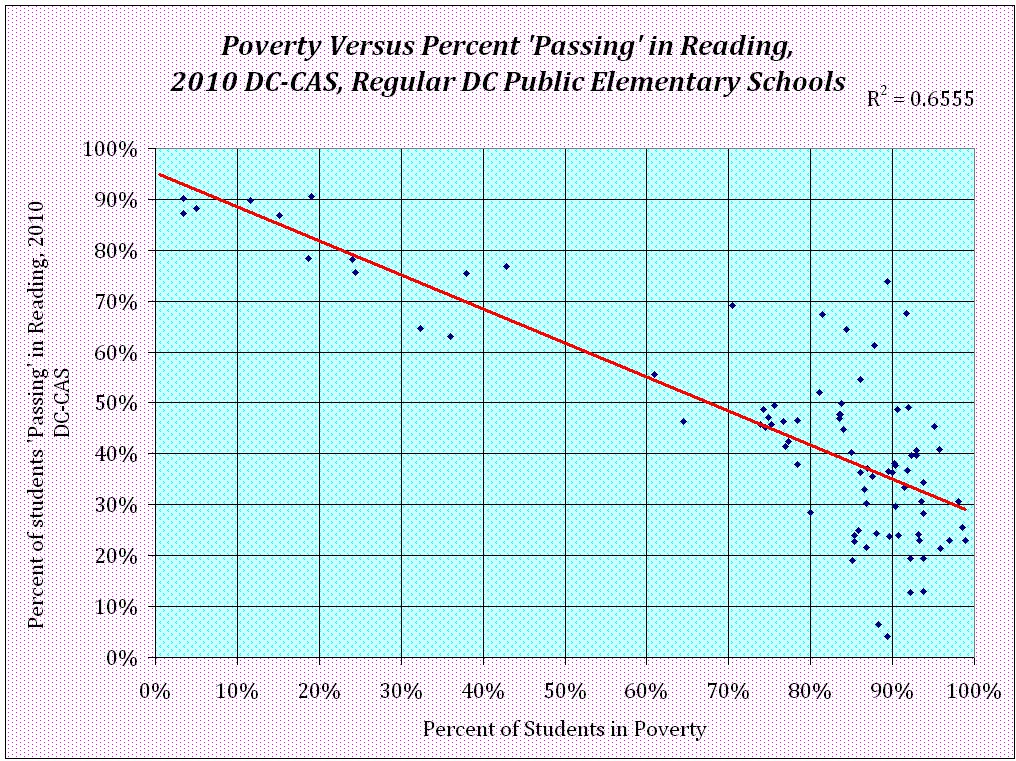
I’m tempted to conclude that we should just go ahead and get rid of teacher tenure so we can wait a few years and still see no movement in the achievement gap. The problem with that approach is that we’ll see great teachers leave the profession and no progress on the actual root cause, which is very likely to be poverty and inequality, hopelessness and despair. Not sure we want to sacrifice a generation of students just to prove a point about causation.
On the other hand, given that David Welch has a lot of money and seems to be really excited by this fight, it looks like we might have no choice but to blame the teachers, get rid of their tenure, see a bunch of them leave, have a surprise teacher shortage, respond either by paying way more or reinstating tenure, and then only then finally gather the data that none of this has helped and very possibly made things worse.
Review: House of Debt by Atif Mian and Amir Sufi
I just finished House of Debt by Atif Mian and Amir Sufi, which I bought as a pdf directly from the publisher.
This is a great book. It’s well written, clear, and it focuses on important issues. I did not check all of the claims made by the data but, assuming they hold up, the book makes two hugely important points which hopefully everyone can understand and debate, even if we don’t all agree on what to do about them.
First, the authors explain the insufficiency of monetary policy to get the country out of recession. Second, they suggest a new way to structure debt.
To explain these points, the authors do something familiar to statisticians: they think about distributions rather than averages. So rather than talking about how much debt there was, or how much the average price of houses fell, they talked about who was in debt, and where they lived, and which houses lost value. And they make each point carefully, with the natural experiments inherent in our cities due to things like available land and income, to try to tease out causation.
Their first main point is this: the financial system works against poor people (“borrowers”) much more than rich people (“lenders”) in times of crisis, and the response to the financial crisis exacerbated this discrepancy.
The crisis fell on poor people much more heavily: they were wiped out by the plummeting housing prices, whereas rich people just lost a bit of their wealth. Then the government stepped in and protected creditors and shareholders but didn’t renegotiate debt, which protected lenders but not borrowers. This is a large reason we are seeing so much increasing inequality and why our economy is stagnant. They make the case that we should have bailed out homeowners not only because it would have been fair but because it would have been helpful economically.
The authors looked into what actually caused the Great Recession, and they come to a startling conclusion: that the banking crisis was an effect, rather than a cause, of enormous household debt and consumer pull-back. Their narrative goes like this: people ran up debt, then started to pull back, and and as a result the banking system collapsed, as it was utterly dependent on ever-increasing debt. Moreover, the financial system did a very poor job of figuring out how to allocate capital and the people who made those loans were not adequately punished, whereas the people who got those loans were more than reasonably punished.
About half of the run-up of household debt was explained by home equity extraction, where people took out money from their home to spend on stuff. This is partly due to the fact that, in the meantime, wages were stagnant and home equity was a big thing and was hugely available.
But the authors also made the case that, even so, the bubble wasn’t directly caused by rising home valuations but rather to securitization and the creation of “financial innovation” which made investors believe they were buying safe products which were in fact toxic. In their words, securities are invented to exploit “neglected risks” (my experience working in a financial risk firm absolutely agrees to this; whenever you hear the phrase “financial innovation,” please interpret it to mean “an instrument whose risk hides somewhere in the creases that investors are not yet aware of”).
They make the case that debt access by itself elevates prices and build bubbles. In other words, it was the sausage factory itself, producing AAA-rated ABS CDO’s that grew the bubble.
Next, they talked about what works and what doesn’t, given this distributional way of looking at the household debt crisis. Specifically, monetary policy is insufficient, since it works through the banks, who are unwilling to lend to the poor who are already underwater, and only rich people benefit from cheap money and inflated markets. Even at its most extreme, the Fed can at most avoid deflation but it not really help create inflation, which is what debtors need.
Fiscal policy, which is to say things like helicopter money drops or added government jobs, paid by taxpayers, is better but it makes the wrong people pay – high income earners vs. high wealth owners – and isn’t as directly useful as debt restructuring, where poor people get a break and it comes directly from rich people who own the debt.
There are obstacles to debt restructuring, which are mostly political. Politicians are impotent in times of crisis, as we’ve seen, so instead of waiting forever for that to happen, we need a new kind of debt contract that automatically gets restructured in times of crisis. Such a new-fangled contract would make the financial system actually spread out risk better. What would that look like?
The authors give two examples, for mortgages and student debt. The student debt example is pretty simple: how quickly you need to pay back your loans depends in part on how many jobs there are when you graduate. The idea is to cushion the borrower somewhat from macro-economic factors beyond their control.
Next, for mortgages, they propose something the called the shared-responsibility mortgage. The idea here is to have, say, a 30-year mortgage as usual, but if houses in your area lost value, your principal and monthly payments would go down in a commensurate way. So if there’s a 30% drop, your payments go down 30%. To compensate the lenders for this loss-share, the borrowers also share the upside: 5% of capital gains are given to the lenders in the case of a refinancing.
In the case of a recession, the creditors take losses but the overall losses are smaller because we avoid the foreclosure feedback loops. It also acts as a form of stimulus to the borrowers, who are more likely to spend money anyway.
If we had had such mortgage contracts in the Great Recession, the authors estimate that it would have been worth a stimulus of $200 billion, which would have in turn meant fewer jobs lost and many fewer foreclosures and a smaller decline of housing prices. They also claim that shared-responsibility mortgages would prevent bubbles from forming in the first place, because of the fear of creditors that they would be sharing in the losses.
A few comments. First, as a modeler, I am absolutely sure that once my monthly mortgage payment is directly dependent on a price index, that index is going to be manipulated. Similarly as a college graduate trying to figure out how quickly I need to pay back my loans. And depending on how well that manipulation works, it could be a disaster.
Second, it is interesting to me that the authors make no mention of the fact that, for many forms of debt, restructuring is already a typical response. Certainly for commercial mortgages, people renegotiate their principal all the time. We can address the issue of how easy it is to negotiate principal directly by talking about standards in contracts.
Having said that I like the idea of having a contract that makes restructuring automatic and doesn’t rely on bypassing the very real organizational and political frictions that we see today.
Let me put it this way. If we saw debt contracts being written like this, where borrowers really did have down-side protection, then the people of our country might start actually feeling like the financial system was working for them rather than against them. I’m not holding my breath for this to actually happen.
Update on the Lede Program
My schedule nowadays is to go to the Lede Program classes every morning from 10am until 1pm, then office hours, when I can, from 2-4pm. The students are awesome and are learning a huge amount in a super short time.
So for instance, last time I mentioned we set up iPython notebooks on the cloud, on Amazon EC2 servers. After getting used to the various kinds of data structures in python like integers and strings and lists and dictionaries, and some simple for loops and list comprehensions, we started examining regular expressions and we played around with the old enron emails for things like social security numbers and words that had four or more vowels in a row (turns out that always means you’re really happy as in “woooooohooooooo!!!” or really sad as in “aaaaaaarghghgh”).
Then this week we installed git and started working in an editor and using the command line, which is exciting, and then we imported pandas and started to understand dataframes and series and boolean indexes. At some point we also plotted something in matplotlib. We had a nice discussion about unsupervised learning and how such techniques relate to surveillance.
My overall conclusion so far is that when you have a class of 20 people installing git, everything that can go wrong does (versus if you do it yourself, then just anything that could go wrong might), and also that there really should be a better viz tool than matplotlib. Plus my Lede students are awesome.
String Telephone
We moved to our apartment in New York almost exactly 9 years ago. I know that in part because I remember the date we moved in – June 4th, 2005 – but also because that first weekend we lived here, when we decided to try to buy some furniture for our nearly empty living room, we had to cross the Puerto Rican parade to get to Crate & Barrel on the east side of 5th Avenue. It was one of the most characteristic New York moments of my existence, and it made me feel like a real New Yorker.
About two days after moving in I figured out with my friend Michael Thaddeus (who has guest blogged hugely successfuly before) that his apartment was within direct sight of mine. We could wave to each other from our windows across both 116th and Claremont! For a suburban girl like me this was a hoot. We decided to build a string telephone at some point.
Well, we finally got around to doing it yesterday.
I live on the 9th floor, and Thads lives on the 5th floor of his apartment, so there was no chance we could throw anything up to the window on the outside. Instead Thads came over with two balls of string and two cans. For each window we lowered the string to the street with the help of someone on the street who could guide the person in the window. I actually only saw the first half of this procedure because I was tasked with holding the string after the first window and waiting for the second string to be lowered. Then the idea was we’d tie the two strings together.
So here I am, outside my building, holding a string in my hand that goes all the way up to a 9th floor building across the street. I’m also wearing my cowboy hat because it’s sunny outside, but for some reason the combination made everyone walking by stop and ask me what the hell I’m doing.
You see, there aren’t many things that can make New Yorkers talk to each other on the street, but I’ve found that holding on to very very long strings whilst wearing a ridiculous hat does the trick.
My favorite was when this middle aged Greek guy comes up to me and asks me what I’m doing, but he’s clearly hoping it’s mischievous, so I asked him to guess, and he says “You’re pulling someone’s tooth!!”.
After a while my neighbors noticed the string outside their window and got involved. And I noticed the security guard on the corner paying close attention, especially when we had both strings on the street and we were trying to tie them together, which took a while because they barely reached.
There was even a cop car silently observing that part of the experiment, but it disappeared as soon as we got it connected and Johan pulled the string taut so it was above the tree line.
After poking the strings into the cans, we tried our our string telephone. It was incredibly fun.

My 11-year-old straining to hear his little brother. Note his nerdy t-shirt.

My husband screaming to Thads

CAN YOU HEAR ME?!?!

I HEARD SOMETHING!!!
Aunt Pythia’s advice
Peoples! Peoples!!
Aunt Pythia is super glad to be here. It’s a gorgeous day, Aunt Pythia has super fun plans that involve this place in Morristown, New Jersey, and the world is looking bright and colorful and happy. Aunt Pythia’s usual skeptical gloom has given way to rainbows and puppies (Aunt Pythia is a dog person).
Are you with me peoples?! Give it up for life! Give it up for humanity!!
Having said that, Aunt Pythia has more than her usual number of slapdowns to administer today, as you will soon see below.
Don’t be intimidated, though, folks! After watching the abuse, do your best to
think of something to ask Aunt Pythia at the bottom of the page!
By the way, if you don’t know what the hell Aunt Pythia is talking about, go here for past advice columns and here for an explanation of the name Pythia.
——
Dear Aunt Pythia,
Have you seen this, combining two blog interests?
Huh
Dear Huh,
So yeah, shortest Aunt Pythia question ever. Turns out “this” is an article about yet another person who “hacked” OKCupid to find the love of their life. A male mathematician who dove headlong into the data mining of love. Ho hum.
Please also see [another earlier article], where it was a woman instead of a man. I can’t find it now because this article became so popular that it’s cockblocking my google searches. Wait, I think she gave a TED talk as well. Oh yeah here she is! And she reverse-engineered the algorithm, too. And honestly she’s telling her own story which is way more engaging than that article.
Anyhoo, here’s the thing. First of all, ew. He went on way too many dates too quickly. I’m glad he found love eventually, but let’s face it, he was making himself less receptive, not more receptive, by going on all those dates. Plus he was posing artificially based on his “mathematical research,” which came down to a clustering algorithm. Plus the woman he eventually proposed to FOUND HIM. Plus ew.
I think this reaction post said it best:
“…the idea that math (or, more broadly, “formulas”) can be used as a dating tactic is a surprisingly popular belief based on a number of very flawed premises, many of which reveal pickup artist-flavor misogynist attitudes among the nerdy white guys who champion them.”
Now given that I also have an example of a woman doing this, I’m not gonna claim it’s all about sexism (although there’s more than a veneer of nerdiness!). Rather, it’s all about the weird non-human mindset. Here’s another stab at what I’m talking about:
“But much of the language used in the story reflects a weird mathematician-pickup artist-hybrid view of women as mere data points anyway, often quite literally: McKinlay refers to identity markers like ethnicity and religious beliefs as “all that crap”; his “survey data” is organized into a “single, solid gob”; unforeseen traits like tattoos and dog ownership are called “latent variables.” By viewing himself as a developer, and the women on OkCupid as subjects to be organized and “mined,” McKinlay places himself in a perceived greater place of power. Women are accessories he’s entitled to. Pickup artists do this too, calling women “targets” and places where they live and hang out “marketplaces.” It’s a spectrum, to be sure, but McKinlay’s worldview and the PUA worldview are two stops along it. Both seem to regard women as abstract prizes for clever wordplay or, as it may be, skilled coding. Neither seems particularly aware of, or concerned with, what happens after simply getting a woman to say yes.”
So, again, it’s not just men who do this. Women who are ABSOLUTELY OBSESSED WITH FINDING MR. RIGHT also do this. They stop thinking about men as people and start thinking of them as bundles of attributes. You have to be tall! And weigh more than me! And culturally Jewish!
If you want to think about this more, and how deeply damaging it is to society and our concepts of ourselves and our expectations of the future, not to mention how we perceive children, then take a look at the book Why Love Hurts: A Sociological Explanation. It’s super fascinating.
So there you go, a long answer to a short question.
One last thing: I’m not saying that you should give up on your own algorithms and trust OKCupid’s algorithms. Far from it! I just think that the key thing is to stay human. Plus all online dating sites are asking the wrong questions, as I mentioned here.
Auntie P
——
Dear Aunt Pythia,
I’m about to start a PhD in Math at a top-ranked place. I’m pretty sure I won’t end up in academia for a variety of personal reasons (mostly that my partner is a non-academic with a job that needs to be in New York, SF, or DC). What should I be doing my first year/summer to make sure I’m in a reasonably good place for a non-academic job hunt 5 or 6 years from now?
(And to make matters more complicated, both finance and government creep me out morally, but I really want to end up somewhere with some fun, interesting mathematics.)
Higher Education, Less Professionalism
Dear HELP,
Nice sign-off!
Make sure you know how to code, make sure you know how it feels to work in a company, make sure you keep your eye on what makes you feel moral and useful and interested. Oh, and read my book! I wrote it for people like you.
By the way, I’m hoping that, by the time you finish your Ph.D., there are better non-academic jobs out there for morally centered people with math skills. I’m just feeling optimistic today, I can’t explain it.
Aunt Pythia
——
Dear Aunt Pythia,
With data science hype at an all-time high (and rising), I’ve been hearing of more and more people who are deciding to make a career change to data science. These acquaintances are smart, science-minded people, but without any background in advanced math, statistics, or computer science. An example background would be a bachelors degree in Chemistry. They are planning to take a few online courses, or a semester-long course or two, and then enter the job market.
My question is, do you think there’s a place for “data scientists” like these? Who’ve learned all the programming/machine learning/statistics they can in 3 months part-time but nothing beyond that? As someone with a strong technical background, I am skeptical that data scientists can be successfully churned out so quickly. Then again, if the hype is all it’s hyped up to be, maybe they’ll all get great jobs. Wondering what your take is.
Sincerely,
Some Kooky Elitist Person Trying to Intuit Climate
Dear SKEPTIC,
Niiiiice sign-off! I am super proud.
Two things. First, I certainly believe that anyone who has a high general level of intelligence and works hard can learn a new field diligently. So I don’t doubt the intentions or efforts of our chemist friends.
On the other hand, do data science jobs allow for follow-up training and – even more importantly – thinking? I’m guessing some do but most don’t. So yes, I agree that for many of these people, it’s a disappointment waiting to happen. And yes, certainly 3 months training does very little. At best you can start thinking a new way, but it’s up to you to actually make things happen with that new mindset.
They might find out their job is really nothing like the job they thought they had. They might end up being excel or SQL database monkeys, or they might find out their job is a front so that the company can claim to be doing “data science.” Worst case they’re asked to audit and approve models they don’t understand which are being used in a predatory manner so they’re on the hook when shit gets real.
On the other hand, what are the options really? It’s a new field and there’s no major for it (UPDATE: there are post-bacc programs popping up everywhere, for example here and here). This is what new fields look like, a bunch of amateurs coming together trying to figure out what they’re doing. Sometimes it works brilliantly and sometimes it produces frauds who ride the hype wave because they’re good at that.
In short, stay skeptical but don’t presume that your friends and acquaintances have bad intent. Ask them probing questions, when you see them, about which above scenario they’re in, it might help them figure it out for themselves. Unless that’s creepy and/or obnoxious.
Aunt Pythia
——
Dear Aunt Pythia,
How useful do you think “generate-and-test” results are? I am searching for good parameter settings using recent history from the last twelve days. For example, I just checked the report that is being generated and saw successful results eight times out of twelve. I actually could run a check against history, not including the last result and see how often the next result is good. Is this crazy or what?
Sleepless in Mesquite
Dear Sleepless,
I have never heard of “generate and test” so I googled it and found this, which honestly seems ridiculous for the following reason: how will you ever know your “solution” works?
So there is an example where it will work that illustrates my overall point. If you know that you have a line (“the solution”) and you know two (different) points that are on that line, then once you find a line with those points you know you’ve found the solution, because it’s unique.
Similarly, if you know your solution is a quadratic equation, then all you need to do is test it on three (different) points and you know you’re good.
But in general, how do you “test” a solution? Unless you are given, a priori, the form of the solution, to test your solution in general you’d need to try it on every point in the universe where you care about the solution working. That doesn’t sound like a useful approach.
I know I’m talking abstractly here, but you gave me very little to work with. In any case 8 out of 12 doesn’t sound very convincing, and 12 doesn’t sound big enough for much of anything. That is, even if you got 12 out of 12 I still wouldn’t be convinced you’re done unless I know more information.
I hope that was helpful!
Aunt Pythia
——
One more thing which didn’t come up in my questions but I wanted to mention (hat tip David Opela): this article, entitled There’s No Such Thing As A Slut, which I also posted recently on mathbabe. Most important excerpt, as noted by a commenter, is this:
Armstrong notes that midway through their college experience, none of the women had made any friendships across the income divide.
Take a look!
——
Please submit your well-specified, fun-loving, cleverly-abbreviated question to Aunt Pythia!
Stuff I’m reading
I’m too busy this morning for a real post but I thought I’d share a few things I’m reading today.
- Matt Stoller just came out with a long review of Timmy Geithner’s book: The Con Artist Wing of the Democratic Party. I like this because it explains some of the weird politics around, for example, the Mexican currency crisis that I only vaguely knew about.
- New York Magazine has a long profile of Stevie Cohen of SAC Capital insider trading fame: The Taming of the Trading Monster.
- The power of Google’s algorithms can make or break smaller websites: On the Future of Metafilter. See also How Google Is Killing The Best Site On The Internet.
- There is no such thing as a slut.
Organizing Walmart Workers: Summer for Respect #OWS
This coming Sunday my friend Adam Reich is coming to Alternative Banking to talk about his work as the faculty director of a collaborative project this summer between Columbia’s INCITE and the OUR Walmart campaign.

The plan involves twenty students to scatter across the country, organizing and conducting oral history interviews alongside Walmart workers in five regions.
It is also, not coincidentally, the 50th anniversary of the Freedom Summer of 1964, when a bunch of volunteers including students helped register black Mississippians to vote.
Adam is an activist and a sociologist professor at Columbia. He is also an author of three books including Selling Our Souls: The Commodification of Hospital Care in the United States.
Details are as follows, and I hope you can come:
Where: Room 409 of the International Affairs Building at 118th and Amsterdam.
When: Sunday, June 8th, 2-3pm.
Me & My Administrative Bloat
I am now part of the administrative bloat over at Columbia. I am non-faculty administration, tasked with directing a data journalism program. The program is great, and I’m not complaining about my job. But I will be honest, it makes me uneasy.
Although I’m in the Journalism School, which is in many ways separated from the larger university, I now have a view into how things got so bloated. And how they might stay that way, as well: it’s not clear that, at the end of my 6-month gig, on September 16th, I could hand my job over to any existing person at the J-School. They might have to replace me, or keep me on, with a real live full-time person in charge of this program.
There are good and less good reasons for that, but overall I think there exists a pretty sound argument for such a person to run such a program and to keep it good and intellectually vibrant. That’s another thing that makes me uneasy, although many administrative positions have less of an easy sell attached to them.
I was reminded of this fact of my current existence when I read this recent New York Times article about the administrative bloat in hospitals. From the article:
And studies suggest that administrative costs make up 20 to 30 percent of the United States health care bill, far higher than in any other country. American insurers, meanwhile, spent $606 per person on administrative costs, more than twice as much as in any other developed country and more than three times as much as many, according to a study by the Commonwealth Fund.
Compare that to this article entitled Administrators Ate My Tuition:
A comprehensive study published by the Delta Cost Project in 2010 reported that between 1998 and 2008, America’s private colleges increased spending on instruction by 22 percent while increasing spending on administration and staff support by 36 percent. Parents who wonder why college tuition is so high and why it increases so much each year may be less than pleased to learn that their sons and daughters will have an opportunity to interact with more administrators and staffers— but not more professors.
There are similarities and there are differences between the university and the medical situations.
A similarity is that people really want to be educated, and people really need to be cared for, and administrations have grown up around these basic facts, and at each stage they seem to be adding something either seemingly productive or vitally needed to contain the complexity of the existing machine, but in the end you have enormous behemoths of organizations that are much too complex and much too expensive. And as a reality check on whether that’s necessary, take a look at hospitals in Europe, or take a look at our own university system a few decades ago.
And that also points out a critical difference: the health care system is ridiculously complicated in this country, and in some sense you need all these people just to navigate it for a hospital. And ObamaCare made that worse, not better, even though it also has good aspects in terms of coverage.
Whereas the university system made itself complicated, it wasn’t externally forced into complexity, except if you count the US News & World Reports gaming that seems inescapable.
A neat solution to the high class jerk problem
You might have heard about the recent study entitled Higher social class predicts increased unethical behavior. In it, the authors figure out seven ways to measure the extent to which rich people are bigger assholes than poor people, a plan that works brilliantly every time.
What they term “unethical behavior” comes down to stuff like cutting off people and cars in an intersection, cheating in a game, and even stealing candy from a baby.
The authors also show that rich people are more likely to think of greed as good, and that attitude is sufficient to explain their feelings of entitlement. Another way of saying this it that, once you “account for greed feelings,” being rich doesn’t make you more likely to cheat.
I’d like to go one step further and ask, why do rich people think greed is good? A couple of things come to mind.
First, rich people rarely get arrested, and even when they are arrested, their experiences are very different and much less likely to end up with a serious sentence. Specifically, the fees are not onerous for the rich, and fancier lawyers do better jobs for the rich (by the way, in Finland, speeding tickets are on a sliding scale depending on the income of the perpetrator). It’s easy to think greed is good if you never get punished for cheating.
Second, rich people are examples of current or legacy winners in the current system, and that feeling that they have won leaks onto other feelings of entitlement. They have faith in the system to keep them from having to deal with consequences because so far so good.
Finally, some people deliberately judge that they can afford to be assholes. They are insulated from depending on other people because they have money. Who needs friends when you have resources?
Of course, not all rich people are greed-is-good obsessed assholes. But there are some that specialize in it. They call themselves Libertarians. Paypal founder Peter Thiel is one of their heroes.
Here’s some good news: some of those people intend to sail off on a floating country. Thiel is helping fund this concept. The only problem is, they all are so individualistic it’s hard for them to agree on ground rules and, you know, a process by which to decide things (don’t say government!).
This isn’t a new idea, but for some reason it makes me very happy. I mean, wouldn’t you love it if a good fraction of the people who cut you off in traffic got together and decided to leave town? I’m thinking of donating to that cause. Do they have a Kickstarter yet?
Aunt Pythia’s advice, hungover edition
You might notice that Aunt Pythia’s advice is getting posted later than usual. That’s because Aunt Pythia is a wee bit slow on the uptake this morning due to a mighty exciting and exhausting week followed by celebrations of said week. Please bear with her as she gives groggy, possibly irrelevant suggestions to your lovely, deeply and heartfelt questions.
And please, after reading her worse-than-usual advice this morning/ afternoon,
think of something to ask Aunt Pythia at the bottom of the page!
By the way, if you don’t know what the hell Aunt Pythia is talking about, go here for past advice columns and here for an explanation of the name Pythia.
——
Dear Aunt Pythia,
I seriously consider the “Ask Aunt Pythia” series on mathbabe.org as the greatest and bloggiest thing on the blogging planet (granted, I explored only a part of it, and this is only an individual opinion).
Is this the right place to say it?
Mount Trouillet With Love
Dear MTWL,
Why yes, yes it is. Thank you darling.
Aunt Pythia
——
Dear Aunt Pythia,
As a grad student, I feel guilty constantly. Guilty that I am probably not spending enough time on my research, guilty that I don’t spend enough time on teaching, guilty that I sleep too much… You get the idea.
To have a successful academic career, how much should one be working, assuming average intelligence? Also, how should one avoid feeling guilty all the time?
A Grad Student Who Loves To Sleep
Dear AGSWLTS,
Sleep sounds like a gooooooood idea right about now, I think I will.
One of the things I don’t miss about being an academic is the constant guilt I imposed upon myself. It was all me, and I can’t blame anyone else. I can blame nothing except possibly the intense and competitive environment, which again, I chose to live in.
It was, I guess, the internal drive to write papers and stay abreast of my field, and without it I might never have done those things, but it sucked. I don’t even think I could summon up guilt feelings like that if I tried nowadays. Instead I do things out of sheer excitement about the ideas. I guess sometimes I feel frustrated that I haven’t had time to do the stuff I want to, but that frustration is definitely preferable to the old guilt. And come to think of it, a much more efficient way to work too.
My advice to you is to give yourself one day a week to do stuff that you just totally love, and banish guilt from your life. You might end up getting more done that way, and then you could expand it to two days a week, who knows. Tell me how that works for you!
Auntie P
p.s. Please work on your sign-offs. “AGSWLTS” means nothing to me.
p.p.s. Never skimp on sleep. Skimp on reading Aunt Pythia, but never skimp on sleep.
——
Dear Aunt Pythia,
I have lived in a different country in each decade of my life and currently use three different languages on an every day basis. No language do I master well, especially in speaking and listening. The doctor says that I am healthy, and I try to study and practice as much as possible. But, I have communication difficulties in any language. Should a more drastic action be taken? For example, find a job that requires more oral communication. Or, move back to my mother tongue country and try to reactivate my native language ability?
Regards,
Smurf, or Schtroumpf
Dear Smurf/Schtroumpf,
I just wanna start this out by saying how very much I enjoyed the smurfs as a child. It was weird, the show was never very good but I always ascribed to those little blue creatures much more interesting lives than they seemed to have. At the end of each episode I remember thinking, “and now they’ll go back to even more interesting things they do in their village in the woods with mushroom houses.”
I think that was their magic, in fact, to seem more interesting than they are. Smallish confession for Aunt Pythia readers: I have been doing my best to summon up a similar more-interesting-than-she-seems cachet pretty much all my life. That’s right, everything I’ve ever done or ever will do goes back to my fascination with the smurfs, and especially papa smurf, who always seemed wiser than even Alan Greenspan back in the day (“NOT LONG NOW!”).
As for your question, I’m of the opinion that people get good at what they focus on and what they are patient for. If you really want to focus on getting good at a given language, then you’ll need to stop moving countries and just forgive yourself for not already knowing stuff you don’t know, it will come with time. My husband, who is not particularly good with languages, has gotten really good at English since I met him 20 years ago.
Stay blue!
Aunt Pythia
——
Dear Aunt Pythia,
Your thoughts on the mathematical community being possibly less empathetic than average really hit home for me, because my experiences of being trans and attempting to do math have been really pretty miserable.
So with that said, let’s confront some cissexism:
Plenty of human females have penises. Trans women are female.
Plenty of human males have vaginas. Trans men are male.
(and of course such porn exists)
Talking about sexism in science is interesting. But we can (and should!) do it without erasing the experiences and existence of trans people, whose gender and sex are valid and real.
Further reading here.
Thanks,
Cisnormativity Is Silly
Dear CIS,
Thanks for the corrections, CIS! You are totally correct that I ignored trans women in my recent piece about female penes.
And although I strive to be empathetic, ignoring someone is a common way to be the opposite. And so I apologize, and I’ll try to be more thoughtful in the future. Thanks for writing!
Aunt Pythia
——
Please submit your well-specified, fun-loving, cleverly-abbreviated question to Aunt Pythia!
I am boycotting Amazon
I have been doing some reading about the Amazon/ Hachette battle and I have come to the conclusion that Amazon has become a huge bully. I also wasn’t impressed by how they treat employees, how they monitor and surveil them, and a host of other problems. For that reason I’m boycotting Amazon for my shopping as well as my blogging habits, so no more direct links.
Update: I’m actually still going to use their EC2 services as part of the Lede Program. Not sure how to avoid that actually, and I’d welcome suggestions.
How Not To Be Wrong by Jordan Ellenberg
You guys are in for a treat. In fact I’m jealous of you.
I had a little secret about my survival in grad school, and that secret has a name, and that name is Jordan Ellenberg. We used to meet every Tuesday and Thursday to study schemes at the CallaLily Cafe a few blocks from the Science Center on Kirkland Street, and even though that sounds kind of dull, it was a blast. It was what kept me sane at Harvard.
You see, Jordan has an infectious positivity about him, which balances my rather intense suspicions, and moreover he’s hilariously funny. He’s really somewhere between a mathematician and a stand-up comedian, and to be honest I don’t know which one he’s better at, although he is a deeply talented mathematician.
 The reason I’m telling you this is that he’s written a book, called How Not To Be Wrong, and available for purchase starting today, which is a delight to read and which will make you understand why I survived graduate school. In fact nobody will ever let me complain again once they’ve read this book, because it reads just like Jordan talks. In reading it, I felt like I was right back at CallaLily, singing Prince’s “Sexy MF” and watching Jordan flirt with the cashier lady again. Aaaah memories.
So what’s in the book? Well, he talks a lot about math, and about mathematicians, and the lottery, and in fact he has this long riff which starts out with lottery math, then goes to error-correcting codes and then to made-up languages and then to sphere packing and then arrives again at lotteries. And it’s brilliant and true and beautiful and also funny.
I have a theory about this book that you could essentially open it up to any page and begin to enjoy it, since it is thoroughly enjoyable and the math is cumulative but everywhere so well explained that it wouldn’t take long to follow along, and pretty soon you’d be giggling along with Jordan at every ridiculous footnote he’s inserted into his narrative.
In other words, every page is a standalone positive and ontological examination of the beauty and surprise of mathematical discovery. And so, if you are someone who shares with Jordan a love for mathematics, you will have a consistently great time with this book. In fact I’m imagining that you have an uncle or a mom who loves math or science, in which case this would be a seriously perfect gift to them, but of course you could also give that gift to yourself. I mean, this is a guy who can make nazi jokes funny, and he does.
Having said that, the magic of the book is that it’s not just a collection of wonderful mathy tidbits. Jordan also has a point about the act of scrutinizing something in a logical and mathematical fashion. That act itself is courageous and should be appreciated, and he explains why, and he tells us how much we’ve already benefited from people in the past who have had the bravery to do so. He appreciates them and we should too.
And yet, he also sends the important message that it’s not an elitist crew of the usual genius suspects, that in fact we can all do this in our own capacity. It’s a great message and, if it ends up allowing people to re-examine their need for certainty in an uncertain world, then Jordan will really end up doing good. Fingers crossed.
That’s not to say it’s a perfect book, and I wanted to argue with points on basically every other page, but mostly in a good, friendly, over-drinks kind of way, which is provocative but not annoying. One exception I might make came on page 256: no, Jordan, municipal bonds do not always get paid back, and no, stocks do not always go up, not even in expectation. In fact to the extent that both of those statements seem true to many people is the result of many cynical political acts and is damaging, mostly to people like retired civil servants. Don’t go there!
Another quibble: Jordan talks about how public policy makers make proclamations in the face of uncertainty, and he has a lot of sympathy and seems to think the should keep doing this. I’m on the other side on this one. Telling people to avoid certain foods and then changing stances seems more damaging than helpful and it happens constantly. And it’s often tied to industry and money, which also doesn’t impress.
Even so, even when I strongly disagree with Jordan, I always want to have the conversation. He forces that on the reader because he’s so darn positive and open-minded.
A few more goodies that I wanted to adore without giving too much away. Jordan does a great job with something he calls “The Great Square of Men” and Berkson’s Fallacy: it will explain to many many women why they are not finding the man they’re looking for. He also throws out a bone to nerds like me when he almost proves that every pig is yellow, and he absolutely kills it, stand-up comedian style, when comparing Ross Perot to a small dark pile of oats. Holy crap he was on a roll there.
So here’s one thing I’ve started doing since reading the book. When I give my 5-year-old son his dessert, it’s in the form of Hershey Drops, which are kind of like fat M&M’s. I give him 15 and I ask him to count them to make sure I got it right. Sometimes I give him 14 to make sure he’s paying attention. But that’s not the new part. The new part is something I stole from Jordan’s book.
The new part is that some days I ask him, “do you want me to give you 3 rows of 5 drops?” And I wait for him to figure out that’s enough and say “yes!” And the other days I ask him “do you want me to give you 5 rows of 3 drops?” and I again wait. And in either case I put the drops out in a rectangle.
And last night, for the first time, he explained to me in a slightly patronizing voice that it doesn’t matter which way I do it because it ends up being the same, because of the rectangle formation and how you look at it. And just to check I asked him which would be more, 10 rows of 7 drops or 7 rows of 10 drops, and he told me, “duh, it would be the same because it couldn’t be any different.”
And that, my friends, is how not to be wrong.
The Lede Program has started!
Yesterday was the first day of the Lede Program and so far so awesome. After introducing ourselves – and the 17 students are each amazing – we each fired up an EC2 server on the Amazon cloud (in North Virginia) and cloning a pre-existing disc image, we got an inspiration speech from Matt Jones about technological determinism and the ethical imperative of reproducibility. Then Adam Parrish led the class in a fun “Hello, world!” exercise on the iPython notebook. In other words, we rocked out.
Today we’ll hear from Soma about some bash command line stuff, file systems, and some more basic python. I can’t wait. Our syllabi are posted on github.
Obama has the wrong answer to student loan crisis
Have you seen Obama’s latest response to the student debt crisis (hat tip Ernest Davis)? He’s going to rank colleges based on some criteria to be named later to decide whether a school deserves federal loans and grants. It’s a great example of a mathematical model solving the wrong problem.
Now, I’m not saying there aren’t nasty leeches who are currently gaming the federal loan system. For example, take the University of Phoenix. It’s not a college system, it’s a business which extracts federal and private loan money from unsuspecting people who want desperately to get a good job some day. And I get why Obama might want to put an end to that gaming, and declare the University of Phoenix and its scummy competitors unfit for federal loans. I get it.
But unfortunately it won’t fix the problem. Because the real problem is the federal loan system in the first place, which has grown a shitton since I was in school:

and in the meantime, our state and private schools are getting more and more expensive relative to the available grants:
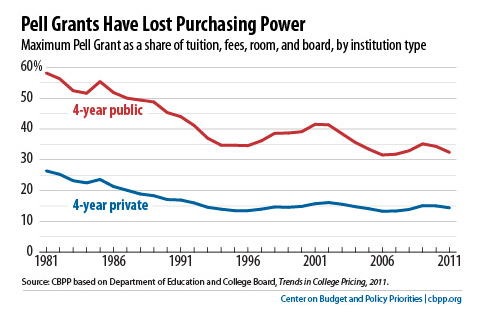
And state funding for public schools has decreased while tuition has increased especially since the financial crisis:
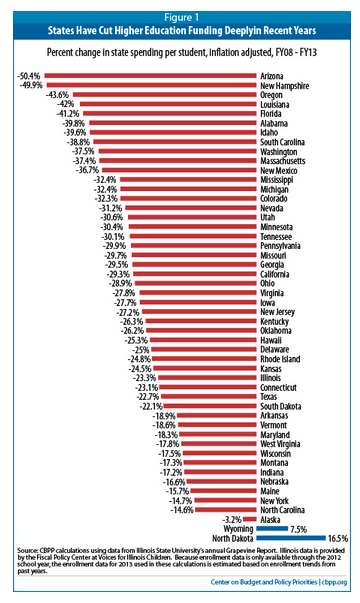

The bottomline is that we – and especially our children – need more state school funding much more than we need a ranking algorithm. The best way to bring down tuition rates at private schools is to give them competition at good state schools.
Weekly Slate Money podcast
Aunt Pythia is bowing out today from an exhausting week, and she extends her apologies.
But if you are looking for opinionated advice, please feel free to try out my recent Slate Money podcast with Felix Salmon and Jordan Weissmann. This week I complain about Ben Bernanke, I talk reparations, and complain about white collar crime going unpunished. Last week was also great, because I got to complain about Tim Geithner. And two weeks ago we started the podcast talking Alibaba and the minimum wage.
If you enjoy listening, please subscribe via iTunes and also, please rate the podcast on iTunes so we get more traffic.
The business of big data audits: monetizing fairness
I gave a talk to the invitation-only NYC CTO Club a couple of weeks ago about my fears about big data modeling, namely:
- that big data modeling is discriminatory,
- that big data modeling increases inequality, and
- that big data modeling threatens democracy.
I had three things on my “to do” list for the audience of senior technologists, namely:
- test internal, proprietary models for discrimination,
- help regulators like the CFPB develop reasonable audits, and
- get behind certain models being transparent and publicly accessible, including credit scoring, teacher evaluations, and political messaging models.
Given the provocative nature of my talk, I was pleasantly surprised by the positive reception I was given. Those guys were great – interactive, talkative, and very thoughtful. I think it helped that I wasn’t trying to sell them something.
Even so, I shouldn’t have been surprised when one of them followed up with me to talk about a possible business model for “fairness audits.” The idea is that, what with the recent bad press about discrimination in big data modeling (some of the audience had actually worked with the Podesta team), there will likely be a business advantage to being able to claim that your models are fair. So someone should develop those tests that companies can take. Quick, someone, monetize fairness!
One reason I think this might actually work – and more importantly, be useful – is that I focused on “effects-based” discrimination, which is to say testing a model by treating it like a black box and seeing how it works on different inputs and gives different outputs. In other words, I want to give a resume-sorting algorithm different resumes with similar qualifications but different races. An algorithmically induced randomized experiment, if you will.
From the business perspective, a test that allows a model to remain a black box feels safe, because it does not require true transparency, and allows the “secret sauce” to remain secret.
One thing, though. I don’t think it makes too much sense to have a proprietary model for fairness auditing. In fact the way I was imagining this was to develop an open-source audit model that the CFPB could use. What I don’t want, and which would be worse than nothing, would be if some private company developed a proprietary “fairness audit” model that we cannot trust and would claim to solve the very real problems listed above.
Update: something like this is already happening for privacy compliance in the big data world (hat tip David Austin).
The next time I’m a criminal
Next time I’m tried for a criminal act, I think I’d like to be tried as a big bank.
Then I can pay a smallish fine for my misdeeds – pocket change for me, a cost of doing business really – and be assured that none of my business partners will stop hanging out with me or stop doing business with me, and in fact all punishments will likely be waived.
In any case, I’d prefer not to be tried as a poor person, where I’d likely be charged money I don’t have for my free lawyer, for any time I spend in jail, and possibly extra for a full jury. And if I didn’t have the money I’d have to spend extra time in jail, until I came up with the money I don’t have.
And since all people are equal under the law, even corporations, it shouldn’t matter who I choose to be, so I choose to be a big bank.


 mathbabe