The definition of “opting in” has become strained
It strikes me that the concept of “opting in” to some service or society has become strained, even more than usual.
We have become more or less used to the idea that we’ll check on agreement boxes, written in inscrutable legalese, in order to get free stuff. We will do that without ever reading the box or understanding what we’ve gotten ourselves into. That’s a form of passive opting in, which depends on us barely noticing things.
But there’s a new, even more ridiculous usage of the term “opt in” that has been popping up. It’s gone beyond passive action to what you could only describe as inaction. Two examples.
The first one comes from Belgium, where they’ve decided that people have not, in fact, opted in to Facebook’s tracking and surveillance mechanism by clicking on a link that brings them to Facebook. They want people to actually click the legalese box before being tracked. Of course, their concepts of privacy are much stronger than ours, but they have an important point: opting in requires doing something, and it doesn’t count if the “doing something,” which is in this case clicking on an innocuous link, has nothing to do with terms of service.
Second example. When I was getting prepared to give my Personal Democracy Forum talk the other day (the link for the talk is here), the speaker before me, who was talking about microtargeting in politics, mentioned to me that what they do isn’t so bad. She suggested that, when they send specific political messages to certain people and not others, they only even have that information about those voters because, after all, they provided it.
I was confused, so I asked her, “Are you saying that you only send messages to people that have somehow opted in to political messaging?”
“Yes,” she responded, “they opted in by registering to vote.”
Again, that’s a severe misuse of the term “opting in.” Registering to vote is simply a part of being a citizen, and does not even indirectly imply a willingness to be tracked. We should all be automatically registered anyway, although now I’m worried about what that might mean we’re signing up for.
Clearwater Festival this weekend!
I know it’s almost summer, not because of the sticky heat but because it’s almost time to go to Clearwater, the music festival started by Pete Seeger in 1969 to organize around cleaning up the Hudson River. It takes place in the beautiful Croton Point Park, outside the town of Croton-on-Hudson.
I’m going to be a volunteer this weekend, along with three other members of my band, and my first shift is serving dinner in the volunteers’ kitchen on Friday from 5 to 9pm. That means I have to pitch my tent in the volunteer’s camping area before I start, because it will be dark and confusing after that. But that means I have to get there super early, and I’m likely traveling on the train with my tent, sleeping bag, sleeping roll, pillow, clothes, bathroom bag, and of course my fiddle. That a lot of stuff to haul so I’m hoping it’s not 90 degrees or something on Friday.
But of course the really exciting thing, besides jamming with my bandmates in the evenings, is the music itself. The performers are listed here, and I’m super excited about The Lone Bellow and The Felice Brothers, but of course learning about new talent is what summer music festivals is all about.
Aunt Pythia’s advice
Aunt Pythia is in a rush this morning, people! She is going to see Jurassic Wold, in Imax 3D no less, and she needs to finish this here advice column quickly in order to make time for the Saturday New York Times crossword puzzle (har har). So here goes.

This is a D Rex. It’s a genetically modified T Rex, because those guys are wimpy.
So read, enjoy, comments, and before you leave,
ask Aunt Pythia any question at all at the bottom of the page!
By the way, if you don’t know what the hell Aunt Pythia is talking about, go here for past advice columns and here for an explanation of the name Pythia.
——
Dear Aunt Pythia,
I’ve noticed a bunch of Masters’ in Data Science programs have been launched at various reputable universities lately. Can you vouch for the usefulness/value of any of them? Or would you say they are largely the product of big-name schools wanting to make a few bucks off the “Big Data” hype train?
Don’t Wanna Get Scammed!
Dear DWGS,
Yeah, my guess is both. I mean, I think most of them would teach you something, but I’m pretty sure these programs are also cash cows. As to their usefulness, one thing I’ve noticed is how few of the programs want to hire someone who has actually worked as a data scientist in a company. That doesn’t mean there is not internal person, in the academic institution, who knows a given skill, but it probably means that there’s not much direct advice for people going into this field.
To be any more specific, you’d have to name a program for me to look into.
Aunt Pythia
——
Hmm. Gotta think of a sex question for Aunt Pythia.
I’m a guy and I feel really guilty that I have sexual thoughts in a professional setting (although I do keep them to myself). For example, when women give math talks, I notice I am analyzing their sexiness – are they thin or at least quasi-thin, how ideal their boobs and curves look, how revealing and/or form-fitting their coverings, how well is their boob support functioning, and speaking of curves and forms, I imagine relating my pole to their their holes, after removing our pairs of pants and busting out my canonical divisor (ya know, the thing that kind of rhymes with genus) I’m at the cusp of an, um, singularity. More thoughts follow: Are they on their period, are their periods irregular? I compare their height in their heels, the depth of their voice, and the dimensions of their bust. When the latter two match up, i’ve found it possible to reverse a variety of positions, even if things aren’t completely smooth. My thoughts are quite wild and perverse and I feel somewhat ashamed for thinking these thoughts. Are these concerns rational, irrational? Do you think respectable, upstanding “nice-to-women” male members of the math profession have these thoughts, or is it just dirty minded guys like myself? Do you think lesbians have these thoughts?
Umm, this started out as a totally real question, but then my love of math super-seeded my love for women’s bodies. I think the same thing happens in the talk … eventually I’m able to pay attention to the math.
Do women check out guys while they are giving math talks? What might their thoughts be like?
Perverse Chief
Dear PC,
I think mostly everyone, or at least every adult, has thoughts along these lines. The question is, how long does it take for someone to “eventually” pay attention to the math? I think that’s critical, and it might depend on how much interaction they have with the opposite sex in their regular life, or how well they’ve been sleeping, or whether they’ve gotten exercise lately, or any number of things.
Obviously it’s better for both audience members and the speaker at a math talk if the math is the center of attention, but there’s no way to remove our humanness entirely; at the end of the day it’s a person, in front of other people, explaining some beautiful thing, and there’s bound to be human interactions.
And that’s not a bad thing. I remember concocting a crush on the speaker, male of female, of most talks I went to in order to enjoy their talk more. It worked!
So, if there’s advice to give, I’d say stop feeling guilty about checking out women, do keep your deeper desires to yourself, and enjoy the math. And if possible, try to crush out on the men too.
Aunt Pythia
——
Dear Aunt Pythia,
I love your answer to Porn Not Scorn. Have you seen Erika Lust’s TED talk? Enjoyed any of her films?
Intersecting Feminism and porn To overcome objectification
Dear IFapToo,
Wow, no I hadn’t heard of her, but I love her talk! I’ll check her out. I hope others do too.
Aunt Pythia
——
Hi Aunt Pythia,
I wrote to you about a year ago when I realized that I wanted to leave my PhD program for a data science job (‘Slightly Hyperventilating’). You gave encouraging advice–thanks! I ended up taking a job a little too prematurely into my search, but it’s allowed me to improve my programming skills and rub shoulders with internet user behavior datasets which is awesome. But now I’m on the job market again and excited to find a new team!
Here’s my question: at my current company, there’s a ton of tension between the engineers and the analytics people. It’s really weird and gross and counter-productive and stops me from learning from them which is what I want to do. How common is it that engineering teams look down their noses at stats-leaning, data analyzing folks? And what questions do I ask in the interview to find this out? What other indicators should I look for?
Seeking Nice Engineers
Dear SNE,
Oh my god, you were on the luxury winnebago edition of Aunt Pythia. I remember it well. Sigh.
So, great! You did everything right. The thing about data science jobs is that they don’t last forever. People are expected to jump ship once they get the basic idea of stuff and the learning curve decelerates, or when the politics of the office get annoying. In your case the latter has occurred, so go for it.
And no, I don’t have experience with nasty programmers. Most of the people I’ve worked with have been incredibly sweet. I mean, there’s some macho brogrammer posturing every now and then, but I have never seen that dominating. Just find a new job, and keep in touch!
Love,
Aunt Pythia
——
People, people! Aunt Pythia loves you so much. And she knows that you love her. She feels the love. She really really does.
Well, here’s your chance to spread your Aunt Pythia love to the world! Please ask her a question. She will take it seriously and answer it if she can.
Click here for a form or just do it now:
Growler Shops
I’m visiting my good friend Aaron in Atlanta, Georgia, this week, with my youngest son. So far we’ve gone swimming twice in an incredibly large pool (100 meter lanes), had ridiculously delicious barbeque (Daddy D’z), and checked out the local “growler shop” to prepare for last night’s NBA finals game.
Don’t know what a growler shop is? Neither did I, but if you like beer, you’re going to want to learn. It’s basically a take-away bar, with an enormous number of beers that you can sample and of course purchase, at great prices. The growler shop we went to is called My Friend’s Growler Shop, and two very adorable and friendly sommeliers named Camric and John:

Can you see all those beers in the background? Yum. Camric is wearing the light blue shirt.
We ended up tasting a bunch of beers but taking home Eventide Kölsh, which comes from a local brewery and is a variation of Grolsh, and Left Hand Milk Stout, which is as close to a meal in a drink as you can get if you’ve been weaned.
Why doesn’t New York have growler shops? As Camric and John explained to me, each state has different interpretations of a federal law that prohibits reselling of beers in anything other than their original containers. Law is weird, but what it means is that New York State laws would only allow a shop to sell beer from a single brewery, which is super disappointing.
Also, if you don’t love beer, there are also such things as growler wine shops, but also in Georgia and not New York.
The market for your personal data is maturing
As everyone knows, nobody reads their user agreements when they sign up for apps or services. Even if they did, it wouldn’t matter, because most of them stipulate that they can change at any moment. That moment has come.
You might not be concerned, but I’d like to point out that there’s a reason you’re not. Namely, you haven’t actually seen what this enormous loss of privacy translates into yet.
You see, there’s also a built in lag where we’ve given up our data, and are happily using the corresponding services, but we haven’t yet seen evidence that our data was actually worth something. The lag represents the time it takes for the market in personal data to mature. It also represents the patience that Silicon Valley venture capitalists have or do not have between the time of user acquisition and profit. The less patience they have, the sooner they want to exploit the user data.
The latest news (hat tip Gary Marcus) gives us reason to think that V.C. patience is running dry, and the corresponding market in personal data is maturing. Turns out that EBay and PayPal recently changed their user agreements so that, if you’re a user of either of those services, you will receive marketing calls using any phone number you’ve provided them or that they have “have otherwise obtained.” There is no possibility to opt out, except perhaps to abandon the services. Oh, and they might also call you for surveys or debt collections. Oh, and they claim their intention is to “benefit our relationship.”
Presumably this means they might have bought your phone number from a data warehouse giant like Acxiom, if you didn’t feel like sharing it. Presumably this also means that they will use your shopping history to target the phone calls to be maximally “tailored” for you.
I’m mentally tacking this new fact on the same board as I already have the Verizon/AOL merger, which is all about AOL targeting people with ads based on Verizon’s GPS data, and the recent broohaha over RadioShack’s attempt to sell its user data at auction in order to pay off creditors. That didn’t go through, but it’s still a sign that the personal data market is ripening, and in particular that such datasets are becoming assets as important as land or warehouses.
Given how much venture capitalists like to brag about their return, I think we have reason to worry about the coming wave of “innovative” uses of our personal data. Telemarketing is the tip of the iceberg.
Guest Post: What Is Happening With Tenure In Madison?
J Doe is a [something ranked] Professor in STEM. S/he chooses to write this post anonymously, in part to make a point about the value of tenure and the protection it affords faculty from becoming political targets.
Many of us in Madison are getting questions about what is happening with tenure, and the national media hasn’t adequately captured the reasons why there is a controversy. Cathy asked me if I could provide some insight, which I will do sort of “politifact” style. I choose to do so anonymously, in part to make a point about the value of tenure and the protection it affords faculty from becoming political targets.
——
CLAIM: What is happening in Wisconsin is the end of tenure as we know it.
RATING: Maybe
FACT: The authority to define the terms of tenure is being moved from state law to the Board of Regents. Depending on how this authority is applied, tenure could change dramatically or not at all. The worst case scenario (see below) would indeed end tenure as we know it on campus.
——
CLAIM: The tenure protections given to the Board of Regents are the same as what is in state law. The change merely moves tenure from state law to the Regents.
RATING: Mostly false
FACT: The terms of tenure as they relate to dismissal for cause remain exactly the same. However, some care was taken to define the difference between dismissal, termination and indefinite layoff. Other than dismissal for cause, most schools only allow for termination of tenured faculty for reasons of financial exigency. The proposed new tenure guidelines for Wisconsin include language such as “program redirection” and other vague terminology, and this is what has people up in arms.
——
CLAIM: This is a dangerous situation
RATING: True
FACT: The addition of language related to program redirection is not the only change happening. Other language weakening shared governance makes faculty “subordinate to” the Chancellor on matters of programs and curricula. The faculty will also now have weakened influence in selecting new Chancellors. The Regents are appointed by the Governor, with the most recent appointee being the son of a Bradley Foundation member. In most states, the Regents set the terms of tenure, but they are not effectively political appointees.
Add these things up, and the Regents could appoint a Chancellor with the authority to unilaterally make program changes and terminate tenured faculty. That is a worst-case scenario.
——
CLAIM: This is a great time to raid the UW for faculty
RATING: True, if you are an asshole
FACT: Some faculty will be looking to move on as the result of this situation. If you have previously talked about hiring a UW faculty member or are approached by UW faculty interested to make a change, by all means continue the discussion.
On the other hand, if you are suddenly strategizing on how to poach UW faculty, this makes you an opportunistic asshole. Rubbing your hands together with glee as we fight to ensure our ability to maintain a world class university is a nasty way to be. If someone’s house was on fire, would you grab a bucket of water, or would you think about stealing their TV? Make no mistake that your university could be next, so do onto others as you would have them do onto you.
Student loans and moral outrage
This week I’m fascinated by the issue of where student loans live on the spectrum of moral outrage versus sympathy, which I’ve been discussing with my friend Martha Poon recently. It’s also a very timely issue.
Let’s start on the sympathy side of things. The Corinthian 100 students, who were largely sympathetic figures organized by the group Strike Debt, decided to refuse to pay back student debt they accrued from going to Corinthian College, which was charged with all kinds of false advertising and fraud by, among others, the California Attorney General. I wrote about these protesters back when the group was only 15 large.
Just yesterday Education Secretary Arne Duncan announced that their debt would be forgiven, with certain caveats, that the organizers complained about. Indeed the forgiveness is not automatic, and the paperwork looks to be onerous, or even undoable, for the ex-Corinthian students. Even so, what’s interesting to me is Arne Duncan’s comments to the New York Times:
“You’d have to be made of stone not to feel for these students,” he said. “Some of these schools have brought the ethics of payday lending into higher education.”
On the other side of the spectrum, we have Lee Siegel’s recent New York Times opinion piece, where he explains his decision to default on his student debts. My Slate Money co-host Jordan Weissmann called him an “unrepentant leech” on his Slate response piece, noting that Siegel got a B.A., an M.A., and a masters of philosophy from Columbia University before deciding that his goal of being a writer didn’t jibe with his student debt, so why not just default.
This is a general trend when you talk to most people about student debt: the moral obligation is generally there, you need to pay it back or be considered a bad person, unless the circumstances are extreme, which means you can give evidence that the debt itself is fraudulent.
But there’s a third way of thinking about these things, which I picked up from finance (where, I like to say, you “learn to think like an asshole”). Namely, that there’s no morality attached to debt at all. I saw bankers and hedge funders defaulting and “renegotiating” debt contracts – especially things like long-term rental agreements – when things changed. It wouldn’t even be fair to say that they did it when they “couldn’t” pay the money they owed, because the accounting is so slippery in large companies. It was more like, they knew their lawyers were good, and they knew the other side knew that, and therefore they simply wouldn’t pay more than a certain amount that the other side would get in a dirty lawsuit that everyone wanted to avoid.
In other words, debt contracts, in the context of high finance, have been entirely removed from their moral roots. By contrast, the moral weight that individual consumers attach to what are tiny little contracts in comparison seem kind of random and quaint. Or are they?
It makes me want to conduct a thought experiment. Namely, what would it look like if we consumers thought of our debt in non-moralistic terms, like they do in finance? Would we even be able to do that? A test case is this guy, a failed condo developer profiled by the New York Times. Here are a couple of critical details:
The lender, Bank of America, had tried to foreclose after Mr. Rath stopped paying, but amid the craziness of the mortgage meltdown, it could not prove it was entitled to the property. Despite the bank’s pleas that Mr. Rath was seeking a “windfall,” a judge nullified the debt last year.
Mr. Rath has been renting out the condo for $10,000 a month since moving his family in 2010 to Connecticut, where they have taken up sailing full time. After spending this past winter in the Caribbean, the family is planning to sail to Europe this summer on a 55-foot Hanse 545 racing cruiser, before circumnavigating the globe.
Yeah, so, in other words, I’m not sure we can do it.
Even so, I’m interested in pushing ourselves to take a few steps towards it. I think it would be interesting to consider the effects of a widespread student debt strike, even if a bunch of those who would be involved are less than perfectly sympathetic. As Lee suggested, such a movement could result in more affordable college tuitions, a much more skeptical Department of Education, and a less commodified concept of social mobility.
Moreover, I think burdening young people with extreme debt is bad for the country, and especially bad for their ability to make good decisions about what to do with their lives. I’m all for a national discussion on this with the debt morality taken out.
Michelle Rhee’s legacy
Lately, as background research for my book, I’ve been looking into the 2008 cheating scandal associated with Michelle Rhee’s high stakes Value-Added Model regime in the D.C. area,
Specifically, I’m talking about the high erasure rates associated to certain standardized tests that had cash bonuses attached to large improvements, and the consequential investigation that was smothered.
Let me break it down. Certain high poverty schools weren’t doing so well. Michelle Rhee came in as chancellor and suggested that the teachers and principals simply needed some more incentives to achieve better student learning. Her theories got boosted by various academics. Teachers would get $8,000 for really great scores, and principals $10,000.
In addition to Rhee giving certain teachers bonuses, she fired hundreds of others, sometimes for bad scores, sometimes without explaining why.
Against this backdrop, you might not be surprised to hear, there was widespread cheating, or at least suspiciously high scores and suspiciously high erasure marks on student tests (12.7 erasures on average, compared to the average of less than 1).
An investigation followed but came up pretty empty. Compare that to the Atlanta cheating scandal, where a bunch of teachers were sent to jail for cheating. They were also working under a high-stakes testing regime of bonuses and firings.
I’m not suggesting we want more jailings, by the way. I’m suggesting that the original high-stakes regime was fundamentally flawed and naturally gave rise to the cheating in the first place.
Moreover, I’m suggesting that Michelle Rhee’s legacy was one were she was very happy to fire people but very reluctant to admit that her educational reform successes were based on lies.
Aunt Pythia’s advice
Readers!
Due to a long bike ride complete with a flat tire, a surprise rain shower, and a pit stop at a diner, things have been rather slow this morning. But Aunt Pythia has been called to duty, finally! She’s so very glad to be here.
Let’s get started! And before you leave,
ask Aunt Pythia any question at all at the bottom of the page!
By the way, if you don’t know what the hell Aunt Pythia is talking about, go here for past advice columns and here for an explanation of the name Pythia.
——
Hi Aunt Pythia,
I’ve got this hopeless problem. I’ve developed an on-line crush.
Here’s the thing. I’m a well-to-do, middle-aged quant. I’m of the generation where people thought math & mathy things were totally uncool. But I love em. And I love those who love em. Stuff that norms love (e.g., sports, TV) I care nothing about. But talk about QE, I’m in rapture. “Kleptocracy” is part of my vocabulary. NC is a must-read morning website. But. I’ve been widowed for several years (yes, yes, insert appropriate maunderings here). And I miss … wimmen. I miss the pairing of stochastic systems and, well, … boobies. I miss intellectual debate combined with olive oil, al dente pasta, and a cold glass of Fresca.
Anyway, I’ve developed this crush on an on-line persona. She seems to like math. She shares my socioeconomic outlook and, inferentially, status. IDGAF about looks, etc. (fwiw, I’m an exemplar of “successfully-middle-aged-prosperous”). And I’d like to learn more.
How do I do this? Any suggestions? Any help? Any clue?
Hopeless Or Randomly Nascent Yob
Dear HORNY,
First of all, I love Fresca, and I am so glad you mentioned it. An entirely underappreciated soft drink. Second, I’d never heard of the word “maunderings” before but it’s a great word. And also, great sign-off.

I prefer the classic look.
So, what’s the problem here? You’re saying she’s awesome and (inferred to be) single? Have you also inferred that’s she’s horny? Are you asking me how to ask out a woman?
Here’s what you do, assuming you are in consistent and direct contact with her. You tell her you’ve developed a wonderful and delightful crush on her and you think she’s smart, funny, and wonderful in many ways. You say you don’t want to be at all pushy, but you’re wondering if she’s free for a light-hearted meal, at a location of her choice. It doesn’t have to be a date if she doesn’t wish it to be, but it could be if she wants.
There’s really nothing objectionable about flattery combined with a unimposing dinner invitation. You’ve got nothing to lose. Even if she says no she will be charmed.
If you’re still worried, write back with the proposed email invitation and I’ll take a look.
Aunt Pythia
——
Dear Aunt Pythia,
I’m going back to school to improve on my quantitative skills. Since learning advanced Maths requires a solid foundation in the basics, I am finding it very difficult to appreciate the long-term process, when in the short-term I have tests to pass. I’m afraid that I am just passing the tests, without gaining deeper knowledge. Perhaps this feeling of existential dread will pass and everything will become more clear down the road, but what advice do you have for remaining more “present” and not too outcome oriented?
As a side note, I had a similar conversation with a professor of chemistry during my undergraduate education and he had this shocking advice for minorities (I am hispanic, btw): “don’t go into science.” His argument was that a career in math/science is lonely and costly in the short-term, compared to careers in law/business. As John Maynard Keynes says: “In the long run we are all dead.”
Impatiently Waiting
Dear IW,
Wow, what terrible advice. Did he really say that was his advice “for minorities”? Crazy racist.
Here’s my advice. When you get your problem sets, read them right away. Think about why the professor asked them. Ask yourself what you’re learning from them. Start working on them right away. In a word, stay a few steps away from panic in the local sense.
In a more global sense, have a plan for which classes you’re taking, what you’ll need to know them, and how you’re going to feel comfortable with the prerequisites. Be flexible if things don’t work out longer term, but take on challenges and be a bulldog in the short term. Keep your options open and grow them at every turn.
Good luck!
Aunt Pythia
——
Aunt Pythia,
Do you hear the lyrics to “Uptown Funk” as “straight masturbate” like I do, or “straight masterpiece” as written?
I’m using you in a test: if you hear it correctly, then I have to conclude that I’m sex-obsessed. If you hear it like I do, can’t draw a conclusion.
What are your favorite lyrics to mishear or intentionally mis-sing, especially with a sexy twist?
Thanks!
Like I Might Sometimes Understand Poorly
Dear LIMSUP,
OK here’s the song, so other readers can weigh in:
Yeah, I get you. I mean, I hear “masterpiece,” so yes you’re sex-obsessed, but I see why you get that wrong. They totally emphasize the “MAStur” part of the word, so it gets one kind of excited.
Also, speaking of excited, your sign-off made me excited, because it totally seemed planned, but I don’t get why it means anything. To be clear, limsup is a mathematical concept, but I’m not sure how it fits in with your question. But then again it’s not a criticism because sometimes I seem planned but I don’t end up meaning anything.
Aunt Pythia
p.s. I had to pause my Star Trek viewing with my teenagers in order to do this important investigative work. My 13-year-old says he hears “masterbeast.” Just wanted to thank you for that special moment with them.
——
Aunt Pythia,
Is there a term for sex that is intended to lead to pregnancy? I was talking with one of my friends and she just called it unprotected sex. That jarred, maybe because too many public health warnings make me equate unprotected sex with unsafe sex. Even putting that aside, unprotected sex misses the sense of work and obligation that seems to accompany intentionally trying to get pregnant.
Baby Making Welcome
Dear BMW,
What?! Work and obligation?! I always thought it should be called “the most excellent sex”. Because it was so excellent. It was so real, stakes were high. Loved that sex. A personal opinion.
But enough about Aunt Pythia, what do other people call it?
I’ve heard “raw sex,” “raw dog,” and of course “bareback.” I prefer raw dog, obviously. I’m a dog person.
Aunt Pythia
——
Dear Aunt Pythia,
I am a gay man in my mid-thirties. Recently I entered a relationship with a man, “Tim”. To my delight, things are going well with Tim. I’m writing you because there is some potential friction between us: my past.
Tim and I have both been what you would call promiscuous, with many dozens of sexual partners for each of us. But Pythia, did you know there are different kinds of promiscuity? Outside of his past relationships, which were monogamous, Tim has only had brief affairs and one-night stands with strangers. My past relationships were also monogamous, but while single, I tend to sleep with my friends (some of whom are themselves coupled). In fact I’ve been single for some years now, and during that time I’ve built up a loving network of friends that borders on polyamory.
Tim doesn’t pass moral judgments on my behavior, nor would he ever forbid me from seeing my friends. And we agree that we will be a monogamous couple. The only problem is, Tim really doesn’t want to meet my “close” friends. He is not interested in being reassured that I won’t sleep with them anymore — in his view they are my exes. But you see, Pythia, those friends are really important to me, whether or not sex is involved. To me, friendship is one of life’s principal blessings, and I have been extraordinarily blessed. Sex seems so petty in comparison!
So we agree to disagree, right? No double dates with the couple I used to three-way with. This might be fine in the short term, but I find it hard to imagine integrating Tim into my life without disintegrating my friend network in equal measure. Besides, in our little gay universe, we will inevitably run into people in social events that I have a history with. I’m not going to want to give them the cold shoulder.
Does Tim need to open his mind and be more sex-positive? Or do I need to set some boundaries with my friends in order to build a serious relationship of my own?
Love,
Ready to Settle
Dear Ready,
I don’t think it’s OK for Tim to separate you from your community because of a bizarre principle of “no seeing any exes.” That it too bullying, especially since you are ready to be trustworthy about not sleeping with them.
If I were you I’d talk to Tim about this abstractly, when there are no exes in the vicinity making him feel jealous. Tell him how important your community is to you, and how much you care for him, but how it’s not fair to have to choose between the two.
Having reread your question, though, it seems like maybe Tim is comfortable with you hanging out with your friends but doesn’t want to join in on the social stuff. If that’s the case, I’d say that’s possibly workable, as long as he doesn’t give you guilt trips when you do regularly go out with them. After all, nobody can be everything to someone. Plenty of happy couples I know don’t socialize in the same circles.
Aunt Pythia
——
People, people! Aunt Pythia loves you so much. And she knows that you love her. She feels the love. She really really does.
Well, here’s your chance to spread your Aunt Pythia love to the world! Please ask her a question. She will take it seriously and answer it if she can.
Click here for a form or just do it now:
Update on insurance issues at Uber
A couple of weeks ago I suggested that the sharing economy is actually sharing something, namely insurance costs. In particular, I was concerned about the gaps in insurance coverage represented by Uber drivers and AirBnB hosts at certain times. Here’s a cheat sheet:
- Personal insurance covers Uber drivers when their Uber app is off, so they are simply driving around.
- Uber covers them when they have passengers, although their deductibles are sometimes high.
- But what about when they have their app on, so are looking for customers, but those customers are not in the car? There’s apparently no coverage for this.
- This actually matters; a child got killed by an Uber driver in exactly this situation. Actually more than one child.
- Also, there are chat boards of Uber drivers suggesting how to hide the fact that their app was on in case of an accident; clearly this only applies to minor accidents, not major ones, but it supports my original theory that all of our car insurance policies will be going up because of Uber drivers.
Well the news this week is that Allstate has created a new insurance policy for Uber drivers which will cover them when their app is on, so they’re “commercial,” but before a customer has been picked up. This leaves me with a few questions.
- They said it will cost $15 to $20 on average, per year, which seems very very small. Does that include the asston of registered Uber drivers that don’t drive very much at all? Will it cost an arm and a leg to cover a heavy user of Uber?
- Who pays for this, Uber or the drivers? According to reports, Uber was working very very hard to avoid this insurance from existing, or rather they were pushing very very hard against regulations in California that would insist on separate insurance coverage to fill the gap.
- That makes me think this is a big deal for Uber, and it’s way more expensive than it sounds, and that Uber doesn’t want to pay for it.
- If the drivers are expected to pay for it, and if it’s more expensive like I suspect it is, then their hourly wages are going down, maybe to shitty levels.
- That’s kind of what happens when you create a business models that make money in part by bypassing regulations, and then the regulations catch up with you: your profit margins fall.
Uber is somewhat threatened in NYC
There have been a couple of moves recently that make Uber slightly more threatened in NYC than I had thought would be possible.
First, last week de Blasio made Uber and other “hail a ride” companies very annoyed when he suggested a plan that would require them to get city approval and pay $1000 every time they want to change their app’s user interface.
If you know anything at all about how tech companies work, you know this would be a serious friction if it goes through; user interfaces are changed on a weekly basis, to add features or even just test them. In response, an angry letter was sent to de Blasio from Twitter, Facebook, Google, Yahoo, and a bunch of other tech companies. Kind of a tech posse wielding its power.
In a different story, Uber has been attacked by four credit unions who loan money to taxi medallion purchasers. They argue that taxi medallions come with contracts that promise the owners exclusive rights over hailing, but that Uber, with its hailing app, has taken over their business. In particular, the definition of “hail” is coming under scrutiny.
On the one hand, it does seem to be a different act to raise your hands on Broadway versus using an app on your phone. But by the time we have chips implanted into our heads, just thinking the words “hail a taxi” might do the trick, and that’s where the grey area lives. Or, put it another way, yellow taxis might also want to have hailing apps, and in fact they really should.
What do you think? Is de Blasio simply a pawn of the taxi commission? Should we feel sorry for tech companies? I’m conflicted myself, especially because I still don’t understand the way insurance works with these things.
If you redefine “performance,” magical things happen
Crossposted on nakedcapitalism.com.
There is a study out, entitled The Best and The Rest: Revisiting the Norm of Normality of Individual Performance, written by two business school professors, that has been bothering me recently. I’ll explain why soon, but first a thought experiment.
——
Imagine a group of people competing for something. They’re all driven, talented people, who have put serious resources into getting good at this particular thing. They’ve also all had help of some form, and encouragement from their community to compete in this arena. At the very least they have to have deep confidence in their own abilities to even compete in this particular area.
At the end of the competition, that particular one, these people are ranked according to how they’ve done. By luck, by skill, depending on previous practice, resources, or direct support from external advisors, some of them have achieved impressively high rankings, while others, in spite of their hard work and efforts, are falling behind.
Next, there’s a community feedback element. This group of people are not done – they’re hoping to become famous worldwide, or at least in this arena, for being highly ranked, maybe even the best. And the community has direct influence on what happens next, in future rounds of competition. So, individuals can vote for certain people to win, or directly give them more time or resources to do so, or even help them in their next round.
In subsequent rounds, the ranking gets more defined and the community becomes increasingly certain that the winners deserve to be there and that they are truly fabulous at this particular skill, even though the original native differences in talent are not enormous. Luck, resources, and self-confidence were all important indicators of success in that first round, some just as important as native skill.
This continues for years. At retirement, the highly ranked individuals have produced a massive amount compared to the ones that did poorly in the early rounds. In fact, the distribution is highly skewed, and seems to serve as proof that the original ranking was warranted.
——
I didn’t specify what field the above story took place in, so let me suggest a few that might work. First, there’s the music industry. Lots of would-be rock stars vie to be the next Taylor Swift. Heck, even Taylor Swift vied, once upon a time, to become herself. Of course, it helped that she was able to persuade her wealthy parents to move to Nashville when she was 14 to pursue her career. And – not to say she isn’t talented, because she most definitely is – we all know that once you have a hit, your career is much more likely to go well after that, with contracts, money, support, and great musicians flocking to you.
Or, it could be academics. If you stand out as an undergrad, especially at the right college, you get into a good grad school, and if you have enough confidence, determination, and the good luck to get a nice thesis problem, you might have a thesis that stands out, which leads to NSF grants, reduced teaching loads, opportunities to speak at conferences, semesters off of teaching to pursue research, and a host of co-authors who are increasingly willing to do the work to write up joint results. Again, none of this happens without determination, drive, and talent, but it definitely happens more and faster with the help of a supportive community. It’s all about the feedback loop of success.
Or, here’s another arena: sales. If you are known as a successful salesman, if you have a slightly better reputation than the next salesperson, then you’ll get the dibs on the jobs in a typical organization. That means you can be choosy, and take the easy pickings, and pass over the harder jobs. Over time your likability and personal network grows, and you become the go-to person in the organization for success, partly because of your hard work ethic, but partly because of the way success breeds success.
Or how about basketball? All professional basketball players are amazingly good at what they do. How much better does one have to be to get more playing time? Which leads, of course, to more points, more double doubles, or what have you.
——
Now to the paper. It talks about the distribution of performance, and notes that in arenas above, performance, which they equate with output of songs for musicians, or papers for academics, or sales figures for salesmen, are distributed more as a power law probability distribution than as a bell curve. Of course, that is true, and I think we know why, from above. It even has a name: the Matthew Effect, which is even referred to in the paper, on page 112.
The primary goal of the paper is to make the case that “performance” is not normally distributed. It is distributed with a much fatter tail. They suggest using the Pareto distribution:
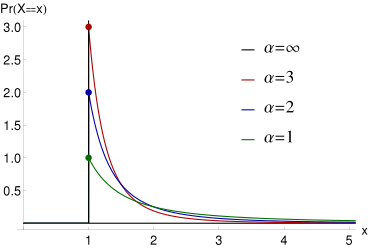
Before I go on, let me mention that their examples are restricted to researchers, entertainers, politicians, and amateur and professional athletes. They never mention secretaries, computer programmers, marketers, cashiers, or data analysts. In fact most of the people who work at regular jobs are completely excluded from this study.
So it’s really more accurate to say that the primary goal of the paper is to redefine the word “performance”. They switch from one definition to the other without explanation, so their studies on pro athletes somehow magically refer to average workers.
That brings us to the second goal of this paper. Namely, the conclusion that we should use this “performance isn’t normally distributed” rule to focus even more on elite actors.
Here’s one version of the elitism argument (page 108):
Leadership theories that avoid how best to manage elite workers will likely fail to influence the total productivity of the followers in a meaningful way. Thus, greater attention should be paid to the tremendous impact of the few vital individuals. Despite their small numbers, slight percentage increases in the output of top performers far outweigh moderate increases of the many. New theory is needed to address the identification and motivation of elite performers.
What’s particularly irksome is this kind of logic (page 112):
For selection, this means that there are real and important differences between the best candidate and the second best candidate. Superstars make or break an organization, and the ability to identify these elite performers will become even more of a necessity as the nature of work changes in the 21st century (Cascio & Aguinis, 2008b)
If you think back to our original thought experiment, there is actually very little difference between good candidates at the beginning. Second, this “we absolutely need to keep our talent” mentality is exactly the argument we see time and time again excusing pay raises for CEO’s. And now there’s a “mathematical” reason for it.
That brings us to the third and final goal of the paper, the “CEO pay is not exorbitant” argument, (page 112):
Likewise, compensation systems such as pay for performance and CEO compensation are an especially divisive issue, with many claiming that disproportionate pay is an indicator of unfair practices (Walsh, 2008). Such differences are seen as unfair because if performance is normally distributed then pay should be normally distributed as well.
Let me rephrase: since “performance” isn’t normally distributed, there’s no way pay should be either, when we define it for everyone. So let’s just go ahead and overpay CEO’s.
It might be a good moment to remind people that even in academics, the top performers don’t make 100 times what the lower performers get. Compare that to McDonalds, where the burger flippers would have to work 1 million hours to get one year of CEO pay.
In pop music and pro sports, there is a crazy pay differential, but that’s not something to be proud of or something we want to replicate.
Aunt Pythia’s advice
Aunt Pythia is very sorry to be late, and especially since last week she was away on vacation (in the woods! no wifi! many bugs!).
She knows her readers misses her tremendously, and the feeling is mutual. In order to make up for her tardiness, Aunt Pythia has made everyone banana chocolate chip pancakes:

Got a fork and a knife? And milk and coffee and syrup and strawberries too? Good, let’s eat up. And, before you leave,
ask Aunt Pythia any question at all at the bottom of the page!
By the way, if you don’t know what the hell Aunt Pythia is talking about, go here for past advice columns and here for an explanation of the name Pythia.
——
Dear Aunt Pythia,
I like that Malties cereal in the mornings: I’m sure you have them over there too – little rectangular lattices of about 18x21mm side length. For convenient pouring in my bleary morning state, as I open a fresh box, I transfer the as much of the contents as possible to a large plastic dispenser, from which I pour a serving each morning. The container I use has a rectangular base of about 80x205mm.
What troubles me is this: when I pour the cereal in, it of course tumbles randomly into the container. A boxful never quite fits. Would it make much difference if the lattices were neatly stacked in nice horizontal strata?
If I wasn’t so hung up about this from the moment I wake each day, I’m sure I’d be more receptive to my partner’s early morning advances, too!
Yours in desperation,
Get A Bigger Server, OR Get All Malties Stacked
Dear GABS OR GAMS,
I keep thinking your sign-off means something, but I can’t figure out what.
Also, I keep thinking there’s some deeper meaning to your question, but I can’t figure that out either. I mean, if you wanted me to estimate how much space you’d save by stacking your cereal carefully in a storage box, at the very least you’d have to tell me how tall each little Maltie is and how tall your storage container is. I suppose I could try to eyeball a solution to the problem using those measurements as variables, but then you’d be overestimating how much work I’m willing to do here.
In fact, without knowing the height of a Maltie, I wouldn’t even know how to neurotically arrange them to save space; lying them in rows, flat on the bottom, would leave space along the edges, and I don’t know how many more you can fit by arranging them on their side without knowing more.
Anyhoo, I think it’s sufficient to say that yes, you can definitely save space by doing this. And at this point, I think you own me a picture of your perfectly arranged storage box. After that, by all means, be receptive to your partner’s advances.
Aunt Pythia
——
Dear Aunt Pythia,
I am a PhD student in physics, where I am pretty much the only person who wears a dress – between men and a few women that there is at the department. I am telling this to emphasize that I like being girly. But, I realized last weekend that I am not girly enough. I had a get-together with my long-time girlfriends (we all live in different continents now), and was judged on pretty much every piece of my appearance from not-plucking-my-facial-hair-good-enough to why-am-I-not-doing-something-about-my-misshapen-teeth.
Another thing was when we were discussing birth control: they are dead against pills, or IUD, because these things directly control your hormones which then controls your periods and a woman having her period is the most natural thing on Earth. And what if you can’t have children because of that, how would I forgive myself knowing that I could’ve just used condoms and prevented that?
I find these people very beautiful, fun, and actually strong women because they can pose for a picture and not worry about opening their mouths too much not to show their teeth.
Anyhoo, my question is: Knowing that I shouldn’t conform deep inside, how do I actually feel neutral about having all these not-so-beautiful stuff about my body? Or is it just easier to wax every week?
Have An Influence pRoblem
Dear HAIR,
This is a seriously great question. Plus, nice sign-off. I even know what it means.
Here’s the thing about rules. Rules often exist for a purpose. But I like to challenge rules, and to do so I try to backtrack to their original purpose, and then decide whether:
- the rule was a good one given the purpose, and
- whether the purpose matters to me at all, and
- whether it matters more to me than it bothers me to follow the rules.
Let’s use this approach for the stuff you’re dealing with pertaining to the rules around personal grooming and general “girliness” or “womanliness.”
Hair
Women are supposed to keep their hair off of everything except their head. That is to say, they get pushback for having hairy armpits, hairy legs, and even hairy private parts. Conversely, they get push-back if they shave their heads. Those are the rules. Oh, and they’re only supposed to have hair on the part of their heads away from the face. Hair on the face is to be shaved or plucked.
What’s the purpose behind this? It’s a tricky one, but I think it basically boils down to looking young. Men, we are told, are attracted to young women, so women have pressure to appear young. Young people’s hair is very fine, and almost invisible, so to appear super young we should appear hairless.
What’s strange about this purpose is that men are actually attracted to women, not girls, so they should be comfortable with at least a certain amount of hair, unless they’ve been talked out of it somehow. It’s clearly at least somewhat a cultural fad, perhaps even created by shaving and grooming companies that want to make more money off of selling products to women.
So, going back to my approach, I feel like the rule that we have to remain hairless-looking (except for some parts of our head) is kind of random and maybe even commercial. It’s a bad rule. Also, the purpose doesn’t matter much to me, because although I like men being attracted to me well enough, I’m okay with self-selected “I like hair” men.
I do have an exception, however, for facial hair, perhaps because it is so closely associated with oldness and therefore unsexiness. To be honest, I don’t feel completely happy with my own chin-hair issues, and I wish I could transcend them. I strive to be that old lady with a beard, wearing purple hats and poking young people on the subway with my umbrella when they misbehave.
Teeth
Good teeth have historically been a very important signal of nutrition. Read Adam Smith’s The Wealth of Nations and you’ll see how incredibly obvious terrible nutrition was in Europe in the mid-1700’s. Very poor women had no teeth, and the saying “a tooth for every child” was very real.
Nowadays, not so much, but we still rate each other’s health and wealth on how many and how straight our teeth are. Oh, and how white they are, which is again a marketing miracle. So the purpose behind giving you shit about your teeth is that people will judge your health and your wealth badly if you don’t.
Is this a good rule? Should you care? I think it depends on how crooked your teeth really are, and how much it matters to the people you’re trying to impress. If you’re an actress, it matters a lot. But if, in your profession, you are somewhere in the average range, give it no further thought. And I’d wager that, in physics, standards are pretty low.
Hormones
They want you to not take hormones because “having your period is natural” and “you might not be able to conceive afterwards. To be honest neither of those reasons sound convincing, first because first I have never heard of the pill making it harder to conceive, except maybe the copper IUD but it doesn’t sound like you mean that one, and second because historically women have had far fewer periods due to a combination of more pregnancies, longer breastfeeding, and poorer nutrition.
However, I personally have reasons I’d never take hormones, so I will mention them here. I have experience both with pills, which I’ve been on three times in my life, and the Mirena IUD, which I also used for 2 years. In all of these hormonal experiments, I have been more easily depressed, less ambitious, and generally uninterested in everything. Whenever I get off the hormones, I get incredibly energized, horny, and ambitious. I know things affect women differently, so I won’t speak for everyone, but my experiences have convinced me never to do it again.
And of course, the convenience of not having to worry about getting pregnant is pretty great, so you have to weigh things against each other. There is no perfect solution to anything.
Friends
One last thing, although you didn’t ask. What’s the purpose of a bunch of women getting together and criticizing each other? Not to say they didn’t also support you, I’m sure they did.
But it’s a general “rule” that women do this, so their must be an associated purpose. I think it has something to do with reinforcing the sense that they aren’t wasting their time plucking their facial hair, getting their teeth straightened, and posing for pictures whilst having their natural periods. And that reinforced sense also feeds into why they give off a sense of being “strong” women.
The truth is, though, that it is kind of a waste of time, often, but it’s a difficult subject to breach in certain company. In any case I wanted to let you know that you’re probably doing it right – you’re enjoying your girliness in your own way and at your own level, but not at the level that your friends expect. In my book, that means you’re enjoying it but not wasting time on it, so well done!
Aunt Pythia
p.s. Update: just saw this related Times Opinion piece.
——
Dear Auntie P,
So I’ve recently started sleeping and developing emotional bonds with someone. All great, everything clicking the way it should, so much so that we both feel half our age, which would put us back in the heady days of high school – read “we were unprepared for what we both knew was going to happen and did the rumpus unprotected.” To be clear, pregnancy protection is in place but barriers were not.
My question isn’t “how do you go to the other person and say that we’re going to go back to using condoms”, because the answer is to look the other person in the eye and say “I think we need to go back to using condoms”. No, the question is, when my partner probes my thinking on this matter, how do I navigate the undercurrent of not being sure that my partner isn’t possibly a carrier of an STI, and/or saying that they should not feel secure that I amn’t? Going barrier-less functions in the modern world, I’d say, as a fairly high-trust-threshold signal, but is there a better way to answer the question “why should we use condoms” than “because I don’t fully trust you yet, or because you shouldn’t fully trust me yet, or some nonlinear combination of these”?
Complicating factor: hubby has in the past experimented with non-monogamy, though they found it not to their liking; and I’d like at least the option of non-monogamy to be open to both of us going forward. These are matters we’re working out, but aren’t urgently crying for final resolution. Let’s just say that at the moment, we’re occupying each other’s time quite capably.
Trusty Lusty
Dear Trusty,
I’ve read this letter a bunch of times, and I’m still a bit confused.
Let me start with what I think – think – is happening.
- You are married.
- You are also having an affair.
- You are sexually active with both your husband and your lover.
- You recently didn’t use a condom with your lover.
- You are wondering how to “go back to using condoms” without having an awkward conversation about trust.
If the above is all correct, you have put yourself and your husband at risk of STD’s. I’m not sure your sign-off is entirely warranted.
As for advice, yes I have some: an awkward conversation, pronto. Tell your lover that you would love to go with him to a testing facility to make sure you haven’t exchanged any STD’s. Feel free to mention that an STD could have come from you, and that he’s not the only suspect. If you feel like it would be an easier conversation, suggest that your husband has experimented with non-monogamy in the past and so there’s yet a fourth person, who neither of you know, in the mix.
But in any case, even if you never convince your lover to get tested, go get tested yourself, and be sure to use condoms from now on. Also, get tested again in 6 months.
Aunt Pythia
——
Dear AP,
What do you think about hacking ethics? In particular, I’m thinking of this article, which details how some students sneaked a peak at their admission results by hacking a website.
I’m tempted to side with the students against the B-schools because, y’know, business schools. But, then I realize that these applicants, if successful, will become business school students. So, have to be against them, too.
At the root of it, though, hacking things is such a great part of nerdy engineering culture and the best way to learn how things really work (maybe?). Feels like hacks should be celebrated when they aren’t being used for nefarious purposes. And what harm comes to the business schools if applicants know the decisions early? Weigh that against the benefit to the applicants of being able to plan their lives, like buying a Duke sweatshirt and renting an apartment in Durham (maybe?).
Crotchety in Seattle
Dear Crotchety,
I am OK with them getting kicked out of B-School because this wasn’t really hacking, this was cheating. They didn’t even figure it out, for god’s sake, they just followed instructions! That’s not hacking. Plus it’s also a sign of dumbness that they thought they could get away with it.
I’m with you that hacking is a fun side of nerdy engineering culture, but I much prefer hacks that have mischievous or even higher goals attached to them for me to defend the hackers. Aaron Schwartz I’ll defend, a disappointed Sloan School student I won’t.
Auntie P
——
People, people! Aunt Pythia loves you so much. And she knows that you love her. She feels the love. She really really does.
Well, here’s your chance to spread your Aunt Pythia love to the world! Please ask her a question. She will take it seriously and answer it if she can.
Click here for a form or just do it now:
Speaking next week at the Personal Democracy Forum
I’ve been invited to give a short presentation at the Personal Democracy Forum, which will be held next Thursday and Friday at NYU Skirball Center, 566 LaGuardia Place.
The bad news is my talk is 12 minutes. That’s super short. The good news is I’m speaking in the big room, along with other interesting speakers including Cory Doctorow.
The theme of this year’s PDF is “civic tech.” And since I really don’t know what that term means, I’m looking forward to learning. For my part, I’m interpreting it to mean “how technology and data usage affects the public.” I have a lot to say about that subject, and it’s mostly skeptical.
The title of my talk, like my book, is Weapons of Math Destruction, and they did a little interview of me in advance of the conference, which you can read here.
Tickets to the Personal Democracy Forum are still available but are expensive. If they do what they did last year, they will eventually have the talks available on video.
Why not a ravelry for people who work out?
Do you know about ravelry? If you’re a knitter or crocheter (or weaver or spinner) you probably do.
It’s kind of like a Facebook for knitters, but much less creepy, because it’s the exact kind of information you want to be sharing, and the exact kind of showcasing of others that you want to be peering at.
It’s an amazing success story. Started in 2007 by a husband and wife team, it now boasts more than 4 million users worldwide, representing 5 billion kilometers of yarn. Each person who is registered gets to create a profile consisting of their projects, complete with notes or even a blog about their trials and tribulations making it, and of course lots of fantastic pictures of their work in progress.
A user can also show off their “stash,” which is to say their backup yarn, which they can trade with others, and they can have a list of favorite projects or designs of others, and even a library list of books and patterns that they have. There’s ample opportunity to comment on how beautiful other people’s projects are – and knitters are very generous with praise – and there are forums for general discussions.
One last thing. There are group projects, where knitters do projects together, often led by a designer who “surprises” them with little pieces of the pattern at a time. It’s a fun idea called a “knit-along.”
OK, so here’s the idea. Why doesn’t someone start a ravelry for people who work out?
I’m convinced that people who work out are almost like knitters. They have little projects that they like to obsess over, they plan them extensively, they like to keep track of progress, they love talking to other worker-outers about their plans, and they like to do stuff in groups led by a master worker-outer.
I’m sure there currently are discussion forums for people who love keeping track of their miles or whatever, but I’m pretty sure nothing as extensive and as thoughtful as ravelry exists. I’m talking about a place where you create a “workout profile” and upload your fitbit data if you want, to create graphs of your cumulative miles, and your friends who are also training for that triathlon can also put their graphs up, and you can discuss workout clothes and which weighted vests are the best.
I know a little bit about this world because once I competed in a sprint triathlon and it was definitely as obsessive as my lifelong knitting hobby. Plus, now a good friend of mine works out a lot and constantly wants to talk to me about weighted vests, and I’m always thinking to myself, “there must be a community somewhere for this guy to talk about weighted vests!? Why not a ravelry for workouters?”.
Just think: instead of knit-alongs, you’d have surprise workout regiments (that sounds kind of fun!). Instead of pictures of half-done works in progress, you’d have graphs and pictures of sweaty t-shirts (that sounds kind of gross, but I still think people would dig it). And instead of completed projects where the knitted sweater is showcased on the cute kid, you’d have a little electronic badge saying, “Amy completed the New York City Triathlon!”
In terms of business model, it would be a lot like ravelry: free for users, funded by incredible ad opportunities for things that obsessive people actually really want, when they want them. Although it’s fair to say that the ads I see for silk/cashmere blend yarns that appear on ravelry are kind of predatory. But they definitely work.
Free business idea for y’all, I hope you like it.
Left Forum this weekend
The annual Left Forum conference is this weekend, Friday to Sunday, at the John Jay College of Criminal Justice, located on 59th at 10th. Formerly the Socialist Scholars Conference, the Left Forum brings together lefty scholars like Noam Chomsky and Cornel West as well as organizers and activists.
The theme for this year’s conference is “No Justice, No Peace: Confronting the Crises of Capitalism and Democracy.” There’s also an emphasis on the #BlackLivesMatter movement and understanding what happened in Ferguson, as well as stuff going on in Greece.

I’ll be participating in two panels. First, a Saturday panel (3:15pm-5:00pm) called What is Occupy Up To?, to be held in room1.100, with the following description:
The occupation is over but groups with roots in Zuccotti Park are working actively in many ways. Representatives of some of these groups will discuss their current efforts and we will look for a participatory discussion of how the movement can be effective. Committed at this time: OccuEvolve – Sumumba Sobukwe, Occupy the SEC – Neil Taylor, OWS Alternative Banking – Cathy O’Neil, Debt Collective / Strike Debt — Luke Herrine Copies of the book Occupy Finance will be available free to attendees while supplies last.
Second, a regular Alt Banking meeting on Sunday from 10am-noon, to be held in room 1.119, which has the following description:
Occupy Alternative Banking proposes to run one of its typical weekly Sunday meetings as a Left Forum workshop, as it did the last two years. You can learn about us at http://altbanking.net/. But in brief, we grew out of Open University sessions at the Occupy protests, and have been meeting ever since. We are open to all comers, and meet every Sunday afternoon at Columbia University to discuss current events and theory related to the dysfunction of the financial system, develop strategies, and endeavor to implement them. Our meeting-structure involves listing some topics for possible discussion, allowing attendees to add others, and then voting on two or three to discuss (in assembly-style format) during the meeting. We believe our two previous appearances at the Left Forum were very successful, both in terms of how they were received, and in their bringing some wonderful new consistent members to our weekly meetings and community. We propose to run a similar workshop this year. Other presenters will include Natasha Blakely and Thessy Mehrain, both of Occupy Alternative Banking.
Algorithms And Accountability Of Those Who Deploy Them
Slate recently published a piece entitled You Can’t Handle the (Algorithmic) Truth, written by Adam Elkus, a Ph.D. student in computational social science at George Mason University (hat tip Chris Wiggins).
In it, Elkus criticizes those who criticize unaccountable algorithms. He suggests that algorithms are simply the natural placeholders of bureaucracy, and we should aim our hatred at bureaucracy instead of algorithms. In his conclusion he goes further in defending the machines:
If computers implementing some larger social value, preference, or structure we take for granted offends us, perhaps we should do something about the value, preference, or structure that motivates the algorithm. After all, algorithms can be reprogrammed. It is much harder—but not impossible—to recode social systems and institutions than computers. Perhaps the humans who refuse to act for what they believe in while raising fear about computers are the real ones responsible for the decline of our agency, choice, and control—not the machines. They just can’t handle the (algorithmic) truth.
I’ve read this paragraph a few times and it’s still baffling to me. I think he’s suggesting that people complaining about the use of unaccountable algorithms are causing a problem by “refusing to act.” And since I count myself as one of the people in question, I’m having difficulty understanding what it is exactly that I’m refusing to do.
I’ve never met anyone in this field who imagines that algorithms sprung up out of the computers themselves, ready to act in an unaccountable way. No: it is well understood that algorithms were designed, implemented, and deployed by human beings. The unaccountability of algorithms is moreover a feature, not a bug, for such people, and is often entirely deliberate – the algos represent new ways of punishing and rewarding people without having to do it in person and without taking responsibility.
For example, think about the Value-Added Model for teachers, which I have written about extensively, or evidence-based sentencing and paroling. In the first case, the algorithms conveniently, if randomly, assesses teachers with an “objective” tool that the teachers do not understand and cannot question, in the ironic name of teacher accountability. In the case of evidence-based sentencing, the judges can use and then point to the models without fear of being held personally responsible for decisions.
Now, here’s where I’ll agree with Elkus. We can’t pretend that it’s the “algorithm’s fault.” it is most definitely the fault of the people who decide to trust the algorithm and act automatically on the basis of the algorithm’s output [1].
Where I disagree with Elkus is the idea that there’s nothing new here. Algorithms have given bureaucrats a new set of tools for their arsenals, ones that are naturally intimidating, opaque, and which carry a false sense of objectivity. We should absolutely question their use and, to be sure, the underlying goals and assumptions of the people in power who deploy them.
1. So, if we found that the Google search algorithm were racist, it would not be the algorithm’s fault. It would instead be the fault of Google employees to continue to deploy its flawed algorithm. I would add that, given the various ways that Google algorithms can go wrong, and their widespread use and impact, it is the responsibility of Google to monitor its algorithms for such flaws.
Kansas redistributes money from the poor to the banks
Take a look at this article (hat tip Felix Salmon), which has me absolutely raging this morning, about new legislation in Kansas that prevents poor people on welfare from taking out more than $25 per day using their state-issued debit cards.
To be clear, you have to round up to the nearest $20 if you want to take out money from an ATM, so that’s really the limit.
And to be clear, there’s a $1 fee to take out money, and then typically an extra $2.50 fee if you don’t have a bank account, which many of the affected people do not.
So altogether, they’re giving $3.50 for every $20 of their welfare benefits, which I’d characterize as a bank tax of 17.5%. Because poor people don’t need that money, never mind the convenience of paying their actual bills.
For fuck’s sake, Kansas.
Nobody can keep track of all the big bank fraud cases #TBTF #OWS
If you’re anything like me, this week’s announcement that 5 banks – JP Morgan, Citigroup, Barclays, RBS, and UBS – have pleaded guilty to manipulating foreign exchange markets is both confusing and more than vaguely familiar.
It was a classic price fixing cartel, and it went along these lines: these big banks had all the business, being so big, and the traders got on a chat room and agreed to manipulate prices to make more money. The myth of the free market was suspended, and eventually they got caught, in large part because of leaving stupid messages like “If you aint cheating, you aint trying”.
But hold on, I could have sworn that these same banks, or a similar list of them, got in trouble for this already. Or was that LIBOR interest rate manipulation? Or was that for mortgage fraud? Or was that for robosigning?
Shit. I mean, here I am, someone who is actively taking an interest in financial reform, and I actually can’t remember all the fines, settlements, and fake guilty pleas to criminal charges.
I say “fake” because – yet again – nobody has gone to jail, and the banks found guilty have immediately been given waivers by the SEC to continue business as usual. According to this New York Times article, the Justice Department even delayed announcing the charges by a week so those waivers could be granted in time so that business wouldn’t even be disrupted. For fuck’s sake.
But again, same thing as all the other “big bank events” that we’ve grown tired of in the last few years. What it comes down to is fines, but then again, the continued quantitative easing has essentially been a gift of cash to those same banks, so I wouldn’t even count the fines as meaningful.
In fact I’d call this whole thing theater. And really repetitive, boring theater at that, where we all nod off because every scene is the same and they’ve turned up the heat too high.
The saddest part is that, given how very little we’ve improved about the integrity of the markets – I’d argue that we’ve actually gone backwards on incentives not to commit fraud, since now everything has been formalized as pathetic – we are bound to continue to see big banks committing fraud and then not getting any actual punishment. And we will all be so bored we won’t even keep track, because nobody can.
Gender And The Harvard Math Department
This is a guest post by Meena Boppana, a junior at Harvard and former president of the Harvard Undergraduate Math Association (HUMA). Meena is passionate about addressing the gender gap in math and has co-lead initiatives including the Harvard math survey and the founding of the Harvard student group Gender Inclusivity in Math (GIIM).
I arrived at Harvard in 2012 head-over-heels in love with math. Encouraged to think mathematically since I was four years old by my feminist mathematician dad, I had even given a TEDx talk in high school declaring my love for the subject. I was certainly qualified and excited enough to be a math major.
Which is why, three years later, I think about how it is that virtually all my female friends with insanely strong math backgrounds (e.g. math competition stars) decided not to major in math (I chose computer science). This year, there were no female students in Math 55a, the most intense freshman math class, and only two female students graduating with a primary concentration in math. There are also a total of zero tenured women faculty in Harvard math.
So, I decided to do some statistical sleuthing and co-directed a survey of Harvard undergraduates in math. I was inspired by the work of Nancy Hopkins and other pioneering female scientists at MIT, who quantified gender inequities at the Institute – even measuring the square footage of their offices – and sparked real change. We got a 1/3 response rate among all math concentrators at Harvard, with 150 people in total (including related STEM concentrations) filling it out.
The main finding of our survey analysis is that the dearth of women in Harvard math is far more than a “pipeline issue” stemming from high school. So, the tale that women are coming in to Harvard knowing less math and consequently not majoring in math is missing much of the picture. Women are dropping out of math during their years at Harvard, with female math majors writing theses and continuing on to graduate school at far lower rates than their male math major counterparts.
And it’s a cultural issue. Our survey indicated that many women would like to be involved in the math department and aren’t, most women feel uncomfortable as a result of the gender gap, and women feel uncomfortable in math department common spaces.

Source: Harvard Math Survey
The simple act of talking about the gender gap has opened the floodgates to great conversations. I had always assumed that because no one was talking about the gender gap, no one cared. But after organizing a panel on gender in the math department which drew 150 people with a roughly equal gender split and students and faculty alike, I realized that my classmates of all genders feel more disempowered than apathetic.
The situation is bad, but certainly not hopeless. Together with a male freshman math major, I am founding a Harvard student group called Gender Inclusivity in Math (GIIM). The club has the two-fold goal of increasing community among women in math, including dinners, retreats, and a women speaker series, and also addressing the gender gap in the math department, continuing the trend of surveys and gender in math discussions. The inclusion of male allies is central to our club mission, and the support from male allies at the student and faculty level that we have received makes me optimistic about the will for change.
Ultimately, it is my continued love for math which has driven me to take action. Mathematics is too beautiful and important to lose 50 percent (or much more when considering racial and class-based inequities) of the potential population of math lovers.


 mathbabe