Archive
Using retirement money now
This is a guest post by Micah Warren.
A few weeks ago the Census Bureau reported that more than half of all births in the US are non-white. The social implications are more widely discussed and reported, but the more interesting and worrisome fact is that overall births are sharply declining, especially among whites, ever since the recession hit.
My best guess is that the declines are mostly among the middle class, who are feeling squeezed by student loans, mortgage debt or inability to buy a home, stagnant incomes and employment uncertainty.
Since middle class Americans typically prefer to buy a house before popping out children, it’s fairly simple math: Years ago when the median house price to median income was a little above 2, and nobody was drowning in student loans, and you didn’t have to obtain advanced degrees to make a reasonable wage, most families could comfortably start having children by their late twenties.
Nowadays, the median house is 3 times the median income, people are finishing college/grad school later, have students loans which take a large chunk of what would otherwise be discretionary income, setting the time-line back 5-15 years. To most people, this means less kids. I took a different path, and am learning the hard way that I might have made a choice between a home and children in my (relative) youth.
I wanted to buy a house in my thirties, but savings has been hard to come by with three kids (including twins), student loans, high rent, on one income. I had planned on using retirement funds, until my benefits office, said, “sorry, you can’t touch that money.”
Why?
In their own words, “paternalistic reasons.” They don’t want me to jeopardize my retirement. My retirement has been growing at a very healthy rate, with employer contributions much higher than our discretionary income.
I griped around a bit and the common response seems to be that I would never be so foolish as to mess with the magic money in my retirement funds, to spend today. After all, if had invested $10,000 in Berkshire Hathaway in 1965, my holdings would be worth more than $50 million today, right?
Now I have two points in response to this.
- Pulling money out of retirement to put on a house may actually be a good idea for an individual.
- Individuals collectively pulling money out of retirement plans to put on houses is a good idea for the economy as a whole.
The individual
- Retirement funds are in for a tough road. Firstly, the global economy has hit the skids and will take a while to rebuild. Secondly, the aging population: as these guys from the Fed pointed out, the P/E ratio appears to be linked to the ratio of retirees to people in their prime earnings years. This report seems widely ignored and/or downplayed. About $18 trillion is in retirement funds which will be coming out of the market as baby boomers retire and age. Note that those in the financial services industry have a vested interest in convincing people their retirement funds will grow at a 10.8%, which is bats. Most retirement funds are in managed funds, which means that they are being eaten away by the typical 1.5% fees that fund managers take. That takes an optimistic 6% underlying growth rate down to 4.5% which is in the range of most mortgages
- Private mortgage insurance is expensive.
- Rent money is not equity in your home: 5-10 years rent saving for a down payment is a lot of money.
- Tax is tax. Your money will be taxed. Yes, it may be at a lower marginal rate when you retire, but you don’t know that. Further, because compounding is nonlinear, a small change in returns makes a much bigger difference than a difference in tax rates.
The economy
On the other hand, if we do pull money from retirement and put in on homes,
- Home prices may find a bottom sooner. Clearly, if more people like myself have money to spend on houses, more houses will be sold at better prices.
- Finance will have less money and markets will be more stable. (OWS rant ommitted)
- More young middle class people will have more babies. Healthier, well-fed, well-educated children will support the economy in the future. This is the main point here. The greatest investment in our future economy is children today. Money in an account does nothing, unless you still believe in trickle-down theory. The middle class is being depleted, and this will be made much worse in the future due to the simple reason that there will be less middle class children to squeeze. Things could get much uglier years down the road if the population continues to age and retire and expect the money they dumped in the retirement funds to be there without the economy to support it.
Bottom line: A large chunk of younger American couples/families are not able to buy homes and participate in the real economy (rather than just as debtors) and we are in danger of losing out on a whole generation of economic output. This spells a much bigger disaster for our retirement funds than the loss of $20K to home equity.
Instead of choosing a better living standard when our children are young, we are expected to (somewhat selfishly) leave money in a fund that has no guarantee of growth rate, which we have no guarantee will be alive to use, and while optimistically may be spent on glorious retirement, it is also quite likely these funds will be depleted in a few short months by end-of-life care. In the meantime, Wall Street plays puff-puff-give with the money.
I personally would gladly accept financial comfort while my children are young in exchange for a smaller chunk of money later, which gives me little comfort at all, because there is no earthly way to discern what this money will mean to me when I am 70. On the other hand, I can tell you exactly how much a 20% down payment on a $300,000 house is, today.
Questions for Jamie Dimon
Jamie Dimon is meeting with Congress today. Occupy the SEC and the Alternative Banking Working Group jointly wrote a bunch of questions for the Senators to ask him. Please read the letter and some interesting facts about the Senators scheduled to talk to Dimon today on this Naked Capitalism post.
I don’t trust politicians more than I trust bankers
There are certain people who are obsessed with the way money is created in the U.S. – I call them “money creationists”. Some of these people are friends of mine from Occupy, and I really enjoy and like them.
But I don’t agree with them, and here’s why. Because I don’t trust politicians more than I trust bankers. I mean, don’t get me wrong, I don’t trust bankers. But I really don’t trust politicians.
The reason this comparison comes up is this. The way money is created through the Fed lending window is described here, in an article that could have been written by my friends, although I don’t think I’ve met Gar. Pay attention to the following concept which the writer is proposing:
Why, you might ask, doesn’t the Federal Reserve Board simply “create” money (as it does all the time) and lend it at 0.75 percent to the government (rather than let the banks do it) to pay for important public goods and to settle its debts? (Our bridges are falling down; not a bad thing in which to invest.)
As soon as I hear this I think, holy fuck let’s not even go there! The image of unlimited cash machines directly bankrolling the whims of Congress is just too much. But wait, here’s where the money-creationists get really confused – they give themselves away in fact:
… if a “public bank” were set up that operates just the way private banks are run today, including making profits for the owners – who in this case would obviously be the public – i.e. the government.
What? When was the last time the public is the same thing as the government? In this universe, for whatever reason, politicians have been wished away and all we have left are well-meaning would-be bridge builders facing off against evil venal bankers. But that’s not the world I live in.
To my money-creationist friends: there are stewards of the government, and they’re called politicians, and they love money. They are just as corrupt as bankers. It’s not a good idea to give them a printing press. Let’s instead think of a way to persuade them to require reasonable capital requirements of the banks so they don’t get to do crazy shit, if they can get their hands off of financial lobbyist money for more than fifteen minutes.
Happy Birthday to me!
The mathbabe blog is one year old today. I want to thank all of you guys for making this such a wonderful and thoughtful year for me. I totally love and adore you readers, and commenters, and guest bloggers, and yes, right now I even have room in my heart for you trolls.
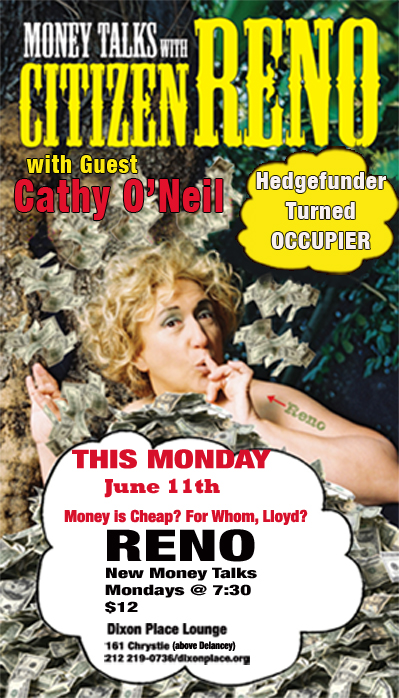
Tonight I’ll be performing again with Reno, which promises to be a hoot. Please come!
The fake problem of fake geek girls, and how to be a sexy man nerd
My friend Rachel Schutt recently sent me this Forbes article by Tara Tiger Brown on the so-called problem of too many fake geek girls stealing the thunder and limelight from us true geek girls.
The working definition of geek seems to be someone who is obsessively interested in something (I would argue that you don’t get to be a geek if your obsession is art, for example, I’d like to define it to be an obsession with something technical). She also claims that “true geeks” don’t do something for airtime. From the article:
Girls who genuinely like their hobby or interest and document what they are doing to help others, not garner attention, are true geeks. The ones who think about how to get attention and then work on a project in order to maximize their klout, are exhibitionists.
I kind of like this but I kind of don’t too. I like this because, like you, I have run into many many people (men and women) who loudly claim technical knowledge that they don’t seem to actually have, which is annoying and exhibitionistic. And yes, it’s annoying to see people like that doing things like giving things like Ted talks on “big data” when you seriously doubt they know how to program a linear regression. But again, men and women.
At the same time, there’s no reason someone can’t be both a true geek and an exhibitionist, and it seems kind of funny for a Forbes magazine writer to be claiming the authentic rights to the former but not the latter.
If there’s one thing I’d like to avoid, it’s peer pressure that, as a girl geek, I have to have a certain personality. I like the fact that girl geeks are sometimes shy and sometimes outspoken, sometimes humble and sometimes arrogant, sometimes demure and sometimes slutty. It makes it way more interesting during technical chats.
What’s the asymmetry between men and women here? According to Tara Tiger Brown, women think they’ll get attention from men by acting like a geek but my experience is that men don’t think they’ll get attention from women by acting like a geek.
I think this is a mistake that man geeks are making. For me, and for essentially all my female friends, being really fucking good at some thing is extremely sexy. Man geeks are, therefore, very sexy, if they are in fact really fucking good at something and not just posing. Maybe they just need to realize that and own it a bit more.
Next time, instead of apologizing for doing something nerdy, I suggest you (a man geek I’m imagining talking to right now) figure out how to describe what skill you mastered and talk about it as an accomplishment.
No: I’m kind of tired today, sorry. I stayed up all night playing with my computer. Should we reschedule?
Yes: Last night I implemented dynamic logistic regression and managed to get it to converge on 30 terabytes of streaming data in under 3 hours. And it’s all open source, I just checked in into github. That was awesome! But now I need to sleep. Wanna take a nap with me?
Personal Democracy Hackathon today
This Morning I’m going to the CUNY Graduate School of Journalism to pitch the Credit Union Findr Webapp to a bunch of developers at today’s Personal Democracy Hackathon. Hopefully they’ll be interested enough to work on our geo-problem of credit union eligibility, namely taking in an address and finding the credit unions you become eligible for through your address. All open source of course.
Update: We’ve got two teams working, one on our webpage and our geo-locator project. Woohoo!
Hangover cure
After a long night of vodkas and karaoke, there’s one sure method for feeling brand new once again, namely listening to Empire State of Mind, really loud, over and over.
At least I hope so.
p.s. The first year anniversary of mathbabe.org is coming up next Monday, please come up with suggestions for how to celebrate!
What if the bond markets priced in actual risk?
A friend sent me this article written by Daniel Gross, which talks about how taxpayers in Europe and in the U.S. are paying for the mistakes of bondholders. First he starts with Ireland:
When Ireland’s large private banks collapsed spectacularly a few years ago, the Irish government formally assumed the debts of the private banks. To ensure that bondholders of Irish banks would remain whole, the government undertook a massive bailout. To pay for it, it has inflicted vicious austerity on its populace.
He moves on to Greece:
As Liz Alderman and Jack Ewing reported in the New York Times this week, about two-thirds of the $177 billion in European aid to Greece given since May 2010 has been used to make payments to bondholders and other lenders. The upshot: Greece is imposing significant austerity on its citizens for the sake of preserving the value of bondholders.
And the U.S.:
Yes, it’s true that the U.S. in 2008 and 2009 acted to keep bondholders from taking big losses. The taxpayers formally assumed the debt of Fannie Mae and Freddie Mac without insisting bondholders take any haircut, just as the Irish taxpayers formally assumed the debts of their large banks. That was a big and expensive mistake. In a time of austerity, the U.S. government is channeling tax payer funds to make interest payments on bonds that were first issued by for-profit entities.
He points out that Spain appears to be taking the same approach, and that the actual people of Ireland and Greece are having second thoughts about paying all these bills, expressed through who they are voting for. I believe it’s left to the reader to wonder what’s going to happen to Spain.
Gross suggests a different tact for governments to use, namely to ignore old debt and to provide insurance for new debt issued by the banks and other private companies. The U.S. did this during the crisis, it was called the Temporary Liquidity Guarantee Program. His point is that we’ve made money off this program and we’ve let lots of really insolvent banks fail as well.
On the other hand, I’d argue, we haven’t let the big banks fail, so there’s a limit to its effectiveness (but I won’t blame this program for that, because that’s a problem of political will). And it’s of course not altogether clear that the insurance it sold was sold at market value, since if it had been, I’m guessing it wouldn’t have been such a boon to a given company to issue debt and pay for insurance versus just issuing debt at a higher risk premium. In other words, I think the “Liquidity” in “Temporary Liquidity Guarantee Program” is key.
But he’s got it basically right- taxpayers are definitely on the hook for risky bets other people took. And backups and guarantees by governments definitely skews the bond market. Specifically, big companies end up paying less than they should given their risk, and the taxpayers foot the bill in situations of default (which aren’t allowed to actually be defaults with respect to the bondholders).
So sufficiently big companies are paying too little for debt. That’s about half the story though. The other half is how normal people are paying too much for debt.
For example, with student debt, Bloomberg recently reported that private issuers of student debt are charging as much as credit card companies:
Tovar, who lives with her parents in the Chicago suburb of Blue Island, owes $55,600 to Chase Student Loans, a unit of JPMorgan, according to a May 17 statement provided by her. A loan for $24,794 carries an interest rate of 10.25 percent, as does a second loan for more than $2,619. A third for $28,187 has a rate of 8.97 percent. She has a balance of $42,326 in loans from a different lender.
Given that these loans are effectively undischargable through bankruptcy, what is the real risk for private issuers in getting their money back? What would a fair market price be for these loans? And why don’t we have a fair market?
Who will Regulate the Superheroes on Wall Street?
This is a guest post by Elizabeth Friedrich, a member of Occupy the SEC.
Wall Street has grown to celebrate superheroes like Lloyd Blankfein and Jamie Dimon for their superior management skills and keen business sense. We have come to praise and applaud reckless risk-takers on the assumption that the markets always know best.
Insider Wall Street leaders like Jamie Dimon are viewed to possess special powers. In fact, many believe that Dimon, who led JP Morgan out of the financial crisis, is a banking prodigy who could do no wrong. But even Dimon is helpless in the face of reckless risk-taking behavior by his employees, as shown by the trader Bruno Iksil who lost $3 billion dollars and counting as part of JP Morgan’s CIO office. “Star traders” like Iksil structure their trades in such a complicated way that the average person could never understand them. We have no way of knowing whether the hedges that the CIO office put on actually “hedged” the original position. Such complexity, conveniently, can also serve as a powerful tool to refute public outcry.
The question here is this: Why create such risk in the first place? Or, more importantly: Why create the type of transactions that require a superman to oversee them?
Since the Volcker Rule is still being finalized, banking institutions will continue to take on these risks as long as they are allowed or exempted to do so. However, banks should face the same consequences as the rest of society. The “London Whale” trades created massive disruptions in an already fragile market and, ironically, they have caused unrest and disgust in the hedge fund community – the very community that loves unregulated market competition. Why don’t we hold banks to their own standards and stop giving them a pass when they fail?
Occupy the SEC will be marching today calling for the S.E.C. to investigate Jamie Dimon for violation of the disclosure requirements of Sarbanes-Oxley Act. We will also recommend that the S.E.C. make a criminal referral to the Department of Justice. Many people are frustrated with the slap-on-the-wrist treatment that Wall Streeters enjoy; random petty criminals are sentenced to hard jail time but the trader who loses billions of dollars is told not to do that again. The JP Morgan Chase debacle is symptomatic of a broken regulatory system.
Even if there are no criminal charges against Jamie Dimon, the American public would have been well-served to see Wall Street have its day in court. The S.E.C. has to uphold its foundational principles: 1) public companies offering securities to investors must tell the truth about their business, the securities, and the risks involved in investing; and 2) people who sell and trade securities must treat investors fairly and honestly, putting their investors’ interests first.
It is fairly simple: if S.E.C. officials find out that a company has done wrong they have the power to investigate, issue civil penalties, and refer the case to the Department of Justice for criminal prosecution. As many financial experts and white-collar crime lawyers have said, the S.E.C. has not fully utilized its authority, as demonstrated by the treatment of Dick Fuld and Jon Corzine.
The function of a financial institution is not merely to manage risk, but to act primarily as the steward of society’s assets and smart allocation of capital. We hope that the S.E.C will help re-examine the priorities of Too Big To Fail financial institutions. Finally, the current culture corrodes and disrupts sound business practices and stunts the rehabilitation of our current financial system. The S.E.C. is an imperfect vehicle (as evidenced by its lackluster approach to its duties leading up and during the financial crisis) but it’s the only vehicle we have. If they don’t do their job – who will?
Occupy the SEC is a group of concerned citizens, activists, and financial professionals with decades of collective experience working at many of the largest financial firms in the industry. Occupy the SEC filed a 325-page comment letter on the Volcker Rule NPR, which is available at http://occupythesec.org.
Regulation is not a dirty word
Regulation has gotten a bad rap recently. It’s a combination of it being associated to finance, or big business, and it being complicated, and involving lobbyists and lawyers – it’s sleazy and collusive by proxy, and there are specific regulators that haven’t exactly been helping the cause. Most importantly, though, the concept of regulation has been slapped with a label of “bad for business = bad for the struggling economy”.
But I’d like to argue that regulation is not a dirty word – it’s vital to a functioning economy and culture.
And the truth is, we are lacking strong and enforced regulation on businesses in this country. Sometimes we don’t have the regulation, but sometimes we do and we don’t enforce it. I want to give three examples from yesterday’s news on what we’re doing wrong.
First, consider this article about data and privacy in the internet age. It starts out by scaring you to death about how all of your information, even your DNA code, is on the web, freely accessible to predatory data gatherers. All true. And then at the end it’s got this line:
“Regulation is coming,” she says. “You may not like it, you may close your eyes and hold your nose, but it is coming.”
What? How is regulation the problem here? The problem is that there’s no regulation, it’s the wild west, and a given individual has virtually no chance against enormous corporate data collectors with their very own quant teams figuring out your next move. This is a perfect moment for concerned citizens to get into the debate about who owns their data (my proposed answer: the individual owns their own data, not the corporation that has ferreted it out of an online persona) and how that data can be used (my proposed answer: never, without my explicit permission).
Next, look at this article where Bank of America knew about the massive losses on Merrill after agreeing to acquire them in September 2008 but its CEO Ken Lewis lied to shareholders to get them to vote for the acquisition in December 2008. The fact that Lewis lied about Merrill’s expected losses is not up for debate. From the article:
… Mr. Singer declined to comment on the filing. But the document submitted to the court said that Mr. Lewis’s “sworn admissions leave no genuine dispute that his statement at the December 5 shareholder meeting reiterating the bank’s prior accretion and dilution calculations was materially false when made.”
What I want to draw your attention to is the following line from the article (emphasis mine):
…the former chief executive did not disclose the losses because he had been advised by the bank’s law firm, Wachtell, Lipton, Rosen & Katz, and by other bank executives that it was not necessary.
Just to be clear, Lewis didn’t want to tell bad news to shareholders about the acquisition, because then he’d lost his shiny new investment bank, and he checked with his lawyers and they decided he didn’t need to admit the truth. That is a pure case of unenforced regulation. It is actually illegal to do this, but the lawyers were betting they could get away with it anyway.
Finally, consider this video describing what was happening inside MF Global in the days leading up to its collapse. Namely, the borrowing of customer money is hard to track because they did it all by hand. No, I’m sorry. Nobody does stuff with money without using a computer anymore. The only reason to do this by hand is to avoid leaving a paper trail because you know you’re about to do something illegal. I’m no accounting regulation expert but I’m sure this is illegal. Another case of unenforced regulation, or at worst, regulation that should exist.
Why do people think regulation is bad again? Does it really stifle business? Is it bad for the economy? In the above cases, consider this. The fact that we don’t have clear rules will cause plenty of people to avoid using all sorts of social media at all for fear of their data being manipulated. We have plenty of people avoiding investing in banks because they don’t trust the statements of bank CEO’s. And we have people avoiding becoming customers of futures exchanges for fear their money will be stolen. These facts are definitely bad for the economy.
The truth is, business thrives in environments of clear rules and good enforcement. That means strong, relevant, and enforced regulation.
Combining priors and downweighting in linear regression
This is a continuation of yesterday’s post about understand priors on linear regression as minimizing penalty functions.
Today I want to talk about how we can pair different kinds of priors with exponential downweighting. There are two different kinds of priors, namely persistent priors and kick-off priors (I think I’m making up these terms, so there may be other official terms for these things).
Persistent Priors
Sometimes you want a prior to exist throughout the life of the model. Most “small coefficients” or “smoothness” priors are like this. In such a situation, you will aggregate today’s data (say), which means creating an 


Kick-Off Priors
Other times you just want your linear regression to start off kind of “knowing” what the expected answer is. In this case you only add the prior terms to the first day’s
Example
This is confusing so I’m going to work out an example. Let’s say we have a model where we have a prior that the 1) 

Then on the first day, we find the 


How should we choose 


On the second day, we downweight data from the first day, and thus we also downweight the
However, we still want to remind the model to make the coefficients small – in other words a separate prior on the size of coefficients. So in fact, on the first day we will have two priors in effect, one as above and the other a simple prior on the covariance term, namely we add 


And just to be really precise, of we denote by 

![\gamma[X(1)^\tau X(1) + N(1) \cdot \lambda^2 I + N(1) \cdot (\lambda')^2 I]](https://s0.wp.com/latex.php?latex=%5Cgamma%5BX%281%29%5E%5Ctau+X%281%29+%2B+N%281%29+%5Ccdot+%5Clambda%5E2+I+%2B+N%281%29+%5Ccdot+%28%5Clambda%27%29%5E2+I%5D&bg=ffffff&fg=555555&s=0&c=20201002)

![+ \gamma[X(1)^\tau y(1) + N(1) \cdot \lambda^2 r]](https://s0.wp.com/latex.php?latex=%2B+%5Cgamma%5BX%281%29%5E%5Ctau+y%281%29+%2B+N%281%29+%5Ccdot+%5Clambda%5E2+r%5D&bg=ffffff&fg=555555&s=0&c=20201002)

An easy way to think about priors on linear regression
Every time you add a prior to your multivariate linear regression it’s equivalent to changing the function you’re trying to minimize. It sometimes makes it easier to understand what’s going on when you think about it this way, and it only requires a bit of vector calculus. Of course it’s not the most sophisticated way of thinking of priors, which also have various bayesian interpretations with respect to the assumed distribution of the signals etc., but it’s handy to have more than one way to look at things.
Plain old vanilla linear regression
Let’s first start with your standard linear regression, where you don’t have a prior. Then you’re trying to find a “best-fit” vector of coefficients 

Here the various 
How do we find the minimum of that? First rewrite it in vector form, where we have a big column vector of all the different 



Now we appeal to an old calculus idea, namely that we can find the minimum of an upward-sloping function by locating where its derivative is zero.
Moreover, the derivative of 



Adding a prior on the variance, or penalizing large coefficients
There are various ways people go about adding a diagonal prior – and various ways people explain why they’re doing it. For the sake of simplicity I’ll use one “tuning parameter” for this prior, called 
In other words, we can think of trying to minimize the following more complicated sum:

Here the 

When we minimize this, we are simultaneously trying to find a “good fit” in the sense of a linear regression, and trying to find that good fit with small coefficients, since the sum on the right grows larger as the coefficients get bigger. The extent to which we care more about the first goal or the second is just a question about how large 

How do we minimize that guy? Same idea, where we rewrite it in vector form first:

Again, we set the derivative to zero and ignore the factor of 2 to get:

Since 


which of course can be rewritten as

If you have a prior on the actual values of the coefficents of
Next I want to talk about a slightly fancier version of the same idea, namely when you have some idea of what you think the coefficients of 

We vectorize as

Again, we set the derivative to zero and ignore the factor of 2 to get:

so we can conclude:

which can be rewritten as

A low Fed rate: what does it mean for the 99%?
I’m no economist, so it always takes me quite a bit of puzzling to figure out macro-economic arguments. Recently I’ve been wondering about the Fed’s promise to keep rates low for extended periods of time. Specifically, I’ve been wondering this: whom does that benefit?
[As an aside, it consistently pisses me off that the people trading in the market, who claim to be all about “free markets” and against “interference” from regulators, also are the ones who whine for a Fed intervention or quantitative easing when bad economic data comes out. So which is it, do you want freedom or do you want a babysitter?]
Here’s the argument I’ve gleaned from the St. Louis Fed’s webpage. When the Fed lowers (short-term) rates, it makes it easier to borrow money, it makes it easier for banks to profit from the difference between long-term and short-term rates, and it potentially can cause inflation (and bubbles) since, now that everyone has borrowed more, there’s more demand, which raises prices. And inflation is good for debtors, because over time their debts are worth less.
One thing about the above argument stands out as false to me, at least for the majority of the 99%. Namely, many of them are already indebted up their eyeballs, so who is going to give them more money? And what would they buy with that money?
In other words, if the assumption is that everyone is getting easy loans, I haven’t seen evidence of this. Wouldn’t we be hearing about people refinancing their homes for awesome rates and thereby avoiding foreclosure? How many stories have you heard like that?
If not everyone is getting easy loans, and if in fact only the 1% and banks are getting those gorgeously low-interest loans, then it’s not clear this will be sufficient to spur demand and cause inflation. And inflation really would help the 99%, but only of course if wages kept up with it. Instead we have not seen high inflation and wages haven’t even been keeping up with what inflation we do see.
So let’s re-examine who is benefiting from low Fed rates. I’m gonna guess it’s mostly the banks, and a few private equity firms that are borrowing tons of money to buy up great swaths of foreclosed homes so they can turn around and profit on renting them out to the people who were foreclosed on.
I’m not necessarily advocating that we raise the Fed rates. But next time I hear someone say, “low Fed rates benefit debtors” I’m going to clarify, “low Fed rates benefit banks.”
One language to rule them all
Right now there seems to be a choice one has to make in languages: either it’s a high level language that a data scientist knows or can learn quickly, or it’s fast and/or production ready.
So as the quant, I’ve gotten used to prototyping in matlab or python and then, if what I have been working on goes into production, it typically needs to be explained to a developer and rewritten in java or some such.
This is a pain in the ass for two reasons. First, it takes forever to explain it, and second if we later need to change it it’s very painful to work with a different developer than the one who did it originally, but people move around a lot.
Now that I’m working with huge amounts of data, it’s gotten even more complicated – there are three issues instead of two. Namely, there’s the map-reducing type part of the modeling, where you move around and aggregate data, which, if you’re a data scientist, means some kind of high-level language like pig.
Actually there are four issues – because the huge data is typically stored in the Amazon cloud or similar, there is also the technical issue of firing up nodes in a cluster and getting them to run the code and return the answers in a place where a data scientist can find it. This is kinda technical for your typical data scientist, at least one like me who specializes in model design, and has been solved only in specific situations i.e. for specific languages (Elastic-R and Mortar Data are two examples – please tell me if you know more).
Is there a big-data solution where all the modeling can be done in one open source language and then go into production as is?
People have been telling me Clojure/ Cascalog is the answer. But as far as I know there’s no super easy way to run this on the cloud. It would be great to see that happen.
Best case/ worst case: Medicine 50 years from now
Best Case
The scientific models and, when possible, the data have been made available to the wider scientific community for vetting. Incorrect or non-robust results are questioned and thrown out by that community, interesting and surprising new results are re-tested on larger data sets under iterative and different conditions to test for universality.
The result is that a person, with the help of their doctor and thorough exams and information-gathering session, and with their informed consent to use this data for their benefit, will have a better idea of what to watch out for in terms of health risks, how to prevent certain diseases that they may be vulnerable to, and how the tried-and-true medicines would affect them.
For example, in spite of the fact that Vioxx gives some people heart attacks, it also really helps other people with joint pain that aspirin or ibuprofen can’t touch. But which people? In the future we may know the answer to this through segmentation models, which group people by their attributes (which could come under the category of daily life conditions, such as how much someone exercises, or under the category of genetic profile).
For example, we recently learned that exercise is not always good for everyone. But instead of using that unlikely possibility as an excuse not to do any exercise, we could be able to look at a given profile and tell a person if they are in the clear and what kind of exercises would be most beneficial to their health.
It wouldn’t solve every problem; people would still die, after all. But it could help people live happier and healthier lives. It depends on the open exchange of ideas among scientists as well as strong regulation about who owns personal data and how it can be used.
Worst Case
The scientific community continues its practice of essentially private data collection and models. Scientific journals become more and more places where, backed by pharmaceutical companies and insurance companies, paid Ph.D.’s boast about their latest breakthrough with no cultural standard of evidence.
Indeed there is progress in segmentation models for disease and medicine, but the data, models, and results are owned exclusively by corporations, specifically insurance companies. This leads to a death spiral in modeling, where the very people who are vulnerable to disease and need medicine or treatment the most are priced out of the insurance system and no longer have access to anything resembling reasonable medical care, even for chronic diseases such as diabetes.
And you won’t need to give your consent for those insurance companies to use your data – they will have already bought all the data that they need to know about you from data collectors, which have been gleaning information about you from your online presence since birth. These companies will know everything about you; they control and sell your data for extra profit. To them, you represent a potential customer and a potential cost, a risk/return profile like any other investment.
How to talk conservative
I finished reading “The Righteous Mind: Why Good People are Divided by Politics and Religion” and I have to say, I got a lot out of it. Even if they are just approximations to the truth, it’s interesting to consider his various positions. Near the end he talks about religion and “groupishness,” and how people are too focused on the technical aspects of religious beliefs rather than what a religion accomplishes in a community, which he claims is its main benefit.
But what I found more interesting is the beginning of the book when he discusses the different moral make-up of liberals and conservatives (and libertarians) in this country. Namely, he claims that liberals care primarily about the following three things:
- caring for the vulnerable or victimized,
- the concept of oppression from bullies – or conversely the concept of liberty, and
- the concept of proportional fairness (you deserve a part of the pie since you helped make it, but you wouldn’t deserve any if you hadn’t helped).
By contrast, conservatives care about a larger set of six things, the above three as well as:
- the concept of sanctity,
- the concept of authority – when it’s just and those in power take proper responsibility, and
- the concept of loyalty.
I took away three points. First, liberals are bad at guessing what conservatives think, because they are somewhat blind to these last three things, and when they see conservatives go on about them, they assume conservatives don’t care about the first three, which is wrong, although it’s true that they care about them differently (especially proportional fairness: whereas liberals emphasize leaving nobody out, conservatives emphasize not letting people get extra, especially if it comes from their stuff). Second, if I, as a liberal, want to communicate with a conservative, I have to talk about all six of these with some level of understanding. Finally, statistics and other rational arguments only work if the person you’re talking to already agrees with you or if they are exceptionally open-minded – in any case you have to appeal to their morals before going into stats.
With that in mind, here are two rants against the Stop, Question, and Frisk policy, one written for a liberal audience, one for a conservative audience.
Liberal version First, the stop, question, and frisk policy targets minority men almost exclusively. Second, almost 90% of the events end up without an arrest, which means it’s unwarranted intrusion and bullying- typically the reason given for the stop is a “furtive movement”, which could be absolutely anything. Finally, there is a quota system in the police department which forces each officer to perform these unwarranted searches whether or not there is cause, which inevitably leads them to target the “least likely to complain,” namely young, poor minorities. We need to stop the police abusing their privileges in this way immediately.
Conservative version What is the difference between a police force and a gang of men who walk around with guns? The answer, in the best of worlds, is authority, intentionality, and the rule of law. Police have an important job to do, which is to protect us, and to keep the streets safe. And when they do a good job, we admire them for that and count on them for their protection. But imagine if, instead of seeing your neighborhood cop as someone you can count on, he instead consistently stops you on your way home from school or work and asks you suspicious questions, and sometimes even takes your keys from your pocket, and, while you’re locked in the police car, enters your apartment and terrorizes your family. This makes you feel like you are the bad guy, even though you did nothing wrong. After a while, it would make you and your neighborhood less trusting of the authority of the cops, which would lead to reckless behavior and lawlessness, because your rights are no longer being protected. We need to stop the policy of Stop, Question, and Frisk in order to make sure the police never become just a bunch of bullies with guns.
When “extend and pretend” becomes “delay and pray”
When banks have non-performing loans, they sometimes don’t want to admit it. So instead of calling it a loss, because the debtor can’t pay, they simply rewrite the contract so that it has been extended. This way the debtor is not technically behind in payments and the creditor can pretend that the corresponding debt on their books is worth something. It’s called extend and pretend, and it’s not new.
And actually, this ploy sometimes works. After all, sometimes the debtor just needs a bit more time – they could be temporarily unable to pay for whatever reason. Indeed it would be a convenient option for people who are just in need of a few more months to get back on their feet and not lose their house (typically this offer is not extended to individuals, since their loans are too small to fret over).
Make no mistake: there is a real incentive for the banks to do this. Currently the worst example of this method is in Spain, where the banks are finding it politically impossible to admit their losses. The government doesn’t want to hear it, because they will need to bail them out, and their borrowing costs are already precariously high. The Eurozone leaders don’t want to think Spain is as bad off as Greece, because they can’t handle that kind of problem. The investors don’t want to hear it because their investments will be worth less once the news comes out (an example of asymmetric information if there ever was one – shouldn’t investors already know how much extending and pretending is really going on?). And of course the lenders themselves don’t want to admit they are working at an insolvent institution, especially when they probably each know other institutions that are even more insolvent.
What are the chances that this method of delay and pray will work for Spain? With an enormous housing bubble and 24% unemployment, not good. Most of the bad loans that have been extended after non-payment are housing market related. Half of the lenders are zombie, which means insolvent but still technically open for business. Essentially the numbers are just too high and now everybody knows it (see this Bloomberg article for the low-down on Spain).
So what should Spain be doing?
I like to point to the example of Iceland, which admitted its debts early on (although it has to be admitted they didn’t have much of a choice), defaulted on a bunch of international debt, bailed out their citizens from onerous home debt, and is recovering nicely (see this Bloomberg article for more on Iceland).
Oh, and let me add that they (Iceland) are indicting and jailing the bankers who got them into the mess, to the tune of 200 indictments. Considering the U.S. has a population 981 times as large, that would be equivalent to us indicting 196,341 bankers. In fact we’ve indicted no top bank executive, although everyone will be relieved to know the SEC “sanctioned” 39 people for the housing market debacle. Phew!
Unfortunately, it would be tough for Spain to repeat that act- it depended on the fact that Iceland has control over its economic choices, but Spain is part of the Eurozone and as such is embedded in a huge network of agreements and debts and currency with the other Eurozone nations.
In some sense, Spain is being forced into the zombie bank situation by a lack of options. Unless I’m missing something – would love to be wrong!
Biking in New York City
I’m a huge fan of biking around the city. I like to commute to work, from the Columbia University neighborhood up at 116th and Broadway to just below Houston on Varick. Since both my house and my work are within blocks from the west side of Manhattan, I can bike the whole way along the west side bike path (see, for example, this map).
It’s a gorgeous ride along the Hudson River, and there’s not one day I ride it without appreciating not being stuck in the traffic next to me on the West Side Highway. Okay, actually, last Monday was one, when I got caught in a huge thunderstorm. Luckily I had dry clothes, but for some reason no dry socks (note to self: bare feet with wet leather boots is gross). I’m also happy not to be on the subway (1 line) on Monday mornings when people are extra grumpy about going to work.
I don’t bike when it’s (already) raining, or when it’s icy, and it’s always a bummer when daylight savings starts, because it means it’s already dark by the time I leave work. But otherwise I am on the lookout for great biking days and opportunities.
A few weeks ago, on the first really gorgeous day of spring, I biked from one Occupy meeting to another, the first one up at Columbia and the second in Union Square (to see my friend Suresh Naidu speak about Radical Economics 101). I biked through Central Park, which was bursting with spring joy, and then all the way to Union Square down Broadway, which now has a beautiful bike lane. The only annoying part was Times Square, which is so full of tourists you have to walk your bike. So that’s a good sign, when the pedestrians are more dangerous than the cars.
And I also bike on other streets, although after being doored a few times and breaking someone’s windshield with my head (a long time ago in Berkeley but still) I am hugely defensive- I pretty much assume every moving car is trying to hit me and every parked car’s door is about to open. Even so, there are quite a few quiet streets I can feel safe biking down, in the middle, and although it’s not very fast, it’s certainly faster than walking. A great way to explore the city.
And I’m not alone, here’s a great essay by David Byrne in a recent New York Times Opinion column entitled “This is How We Ride”. It’s a beautifully written piece, and he describes the joys of biking in the city perfectly. He mentions that there’s a new bike-share initiative starting this summer, where there will be 10,000 bikes for rent at 420 bike stations in Manhattan, Long Island City, and Brooklyn.
That’s awesome, even if I will have to share the bike lane with even more enthusiasts. The rides are limited to 30 minutes, so not a full commute for me, but it means that if I’m already downtown and want to get to the East Side (which is always hard – I like to say that going to the East Side is like going to L.A. in terms of logistical difficulties) I will be able to hop on a bike and cross town. Cool!
Everybody lies (except me)
There’s an interesting article in the Wall Street Journal from yesterday about lying. In the article it explains that everybody lies a little bit and, yes, some people are serious liars, but the little lies are the more destructive because they are so pervasive.
It also explains that people only lie the amount they can get away with to themselves (besides maybe the out-and-out huge liars, but who knows what they’re thinking?).
When I read this article, of course, I thought to myself, I don’t lie even a little bit! And that kind of proved their point.
So here’s the thing. They also explained that people lie a bit more when they are in a situation where the consequences of lying are more abstract (think: finance) and that they lie more when they are around people they perceive as cheating (think: finance). So my conclusion is that finance is populated by liars, but that’s because of the culture that already exists there: most people just amble in as honest as anyone else and become that way.
Of course, every field has that problem, so it’s really not fair to single out finance. Except it is fair to single out any place where you can cheat easily, where there are ample opportunities to lie and profit off of lies.
One cool thing about the article is that they have a semi-solution, namely to remind people of moral rules right before the moment of possible lying. This can be reciting the ten commandments or swearing on a bible, which for some reason also works for atheists (but wouldn’t stop me from lying!), or could be as simple as making someone sign their name just before lying (or, even better, just before not lying) on their auto insurance forms.
Can we use this knowledge somehow in setting up the system of finance?
The result where people are more likely to lie when they know who the victim of their lie is may explain something about how, back when banks lent out money to people and held the money on their books, we had less fraud (but not zero fraud of course). The idea of personally knowing who the other person is in a transaction seems kind of important.
The idea that we make people swear they are telling the truth and sign their name seems easy enough, but obviously not infallible considering the robo-signing stuff. I wonder if we can use more tricks of the honesty trade and do things like make sure each person signing is also being videotaped or something, maybe that would also help.
Unfortunately another thing the article said was that having been taught ethics some time in the past actually doesn’t help. So it’s less to do with knowledge and more to do with habit (or opportunity), it seems. Food for thought as I’m planning the ethics course for data scientists.
All the good data nowadays is private – what’s the point of having a data science Ph.D.?
I go back and forth on whether there should be an undergrad major or Ph.D. program on data science. On the one hand, I am convinced it’s a burgeoning field which will need all the smart people it can get in the next few years or decades. On the other hand, I’m just not sure how capable academics really are at teaching the required skills. Let me explain.
It’s not that professors aren’t super smart and great at what they do. But the truth is, they typically don’t have access to the kind of data that’s now available to data scientists working in Google or Facebook or other tech companies (see this recent New York Times article on the subject). Even where I work, which is a medium sized start-up, I have access to data which many academics would kill for. This means I get to play with an incredibly rich resource, assuming I have built up the toolset to do so.
So while academics are creating (unrealistic) models of “influence” based on weird assumptions about how information gets propagated through networks, nerds at Facebook and Google and Foursquare just get to see it happen in real time. There’s an enormous advantage to having the data at your fingertips – you get good results fast. But then since it’s all proprietary you can’t publish it (a topic for another post).
Another thing: since academics typically don’t have this kind of big data, they also don’t have to create tools or methods for taming huge data. Sometimes I hear statisticians say that data science is just statistics, but they are typically missing the point of this “taming” aspect of data science. Namely, if we use state-of-the-art proven statistical methods on 15 terabytes of data and it takes 50 years to come up with an answer, then guess what, it doesn’t work.
At the same time, data science isn’t purely algorithmic time considerations either, and a computer scientist without a good statistical background would be equally wrong if they said that data science is just machine learning.
For that matter, data science also isn’t purely speculative research – there’s a bottomline business aspect to it, and the intention is (usually) to make profit. But there’s no way someone with a business degree that doesn’t know how to model can be a data scientist either.
End result: To teach data science for reals, you’d need to form a inter-disciplinary department across business, computer science, applied math, and statistics. Even so, I’m not sure how well strictly academic departments can really teach the nitty gritty of data science if they do collaborate across departments because they just don’t have good enough data (and by the way, this is a huge “if” – it seems politically impossible in some of the universities I’ve talked to).
On the other hand, I think it’s a good idea to try, because it is a great opportunity to teach at least some basic stuff and to instill a code of ethics in young data scientists.
The way things work now, the tech industry takes in former mathematicians, physicists, computer scientists, and statisticians and puts them on projects creating models of human behavior (I’ll include finance in that category) that are infinitely scalable and sometimes nearly infinitely scaled. Nobody is ever taught to stop and think about how their models are going to be used and how to think about the long-term effects of their models.
In spite of all the data problems and political obstacles, I feel that for the sake of this conversation, i.e. of personal responsibility of a modeler, we should go ahead and make a program, because it’s important and it isn’t gonna happen in your typical finance firm or tech startup.


