Archive
Favorite bands
My 9-year-old’s favorite bands (and favorite songs):
- Queen (Bohemian Rhapsody)
- AC/DC (Back in Black)
- ABBA (Fernando)
- Green Day (American Idiot)
- Weird Al Yankovic (Canadian Idiot)
The engaged skeptic
Last night I read this article by Jane Brody in the New York Times, which was about staying optimistic and the various benefits of a can-do attitude, including health benefits.
At one point in her essay she defines optimism like this:
She wrote, “People can learn to be more optimistic by acting as if they were more optimistic,” which means “being more engaged with and persistent in the pursuit of goals.”
If you behave more optimistically, you will be likely to keep trying instead of giving up after an initial failure. “You might succeed more than you expected,” she wrote. Even if the additional effort is not successful, it can serve as a positive learning experience, suggesting a different way to approach a similar problem the next time.
But in another part of her essay it has been transformed:
Avoid negative self-talk. Instead of focusing on prospects of failure, dwell on the positive aspects of a situation.
In college, I would approach every exam, even those I had barely studied for, with the thought that I was going to do well. Time after time, this turned out to be a self-fulfilling prophecy.
So which is it? Does being optimistic mean I’ll be more engaged with an persistent in the pursuit of goals, or does it mean I’ll barely study for an exam and then talk myself into thinking I’ll do well? Because those two ways sound pretty different, if not downright opposite. And who wants to be around a lazy optimist?
I don’t want to quibble, but I think there’s a common and important conflation of the two ideas of engagement and naivety, and I’d like to separate them.
It’s possible, and very possibly more interesting, to have a can-do attitude but not be optimistic, or in other words to be an engaged skeptic.
Just because I work hard and devote myself to something doesn’t mean I’ve fooled myself into thinking it will be a piece of cake. But it does mean I don’t think it’s impossible, and it will only work if I try to make it work. It’s not likely to work but it’s worth trying. Many very hard and very worthwhile things are like that.
Finally, when Brody says “Focus on situations that you can control, and forget those you can’t”, I’d argue that’s often code for letting yourself off too easy.
I claim that, as an engaged skeptic, you shouldn’t really forget anything, because you should figure out how you can maybe affect it after all, or in some small way, or the system it lives in, even if it’s in the future, and even if the chances are it won’t work.
An open source credit rating agency now exists!
I was very excited that Marc Joffe joined the Alternative Banking meeting on Sunday to discuss his new open source credit rating model for municipal and governmental defaults, called Public Sector Credit Framework, or PCSF. He’s gotten some great press, including this article entitled, “Are We Witnessing the Start of a Ratings Revolution?”.
Specifically, he has a model which, if you add the relevant data, can give ratings to city, state, or government bonds. I’ve been interested in this idea for a while now, although more at the level of publicly traded companies to start; see this post or this post for example.
His webpage is here, and you will note that his code is available on github, which is very cool, because it means it’s truly open source. From the webpage:
The framework allows an analyst to set up and run a budget simulation model in an Excel workbook. The analyst also specifies a default point in terms of a fiscal ratio. The framework calculates annual default probabilities as the the proportion of simulation trials that surpass the default point in a given year.
On May 2, we released the initial version of the software and two sample models – one for the US and one for the State of California – which are available on this page. For PSCF project to have an impact, we need developers to improve the software and analysts to build models. If you care about the implicatiions of growing public debt or you believe that transparent, open source technology can improve the standard of rating agency practice, please join us.
If you are a developer interested in helping him out, definitely reach out to him, his email is also available on the website.
He explained a few things on Sunday I want to share with you. They are all based on the kind of conflict of interest ratings agencies now have because they are paid by the people who they rate. I’ve discussed this conflict of interest many times, most recently in this post.
First, a story about California and state bonds. In the 2000’s, California was rated A, which is much lower than AAA, which is where lots of people want their bond ratings to be. So in order to achieve “AAA status,” California paid a bond insurer which was itself rated AAA. That is, through buying the insurance, the ratings status is transferred. In all, California paid $102 million for this benefit, which is a huge amount of money. What did this really buy though?
At some point their insurer, which was 139 times leveraged, was downgraded to below A level, and that meant that the California bonds were now essentially unbacked, so down to A level, and California had to pay higher interest payments because of this lower rating.
Considering the fact that no state has actually defaulted on their bonds in decades, but insurers have, Marc makes the following points. First, states are consistently under-rated and are paying too much for debt, either through these insurance schemes, where they pay questionable rates for questionable backing, or directly to the investors when their ratings are too low. Second, there is actually an incentive for ratings agencies to under-rate states, namely it gives them more business in rating the insurers etc. In other words they have an eco system of ratings rather than a state-by-state set of jobs.
How are taxpayers in California not aware of and incensed by the waste of $102 million? I would put this in the category of “too difficult to understand” for the average taxpayer, but that just makes me more annoyed. That money could have gone towards all sorts of public resources but instead went to insurance company executives.
Marc then went on to discuss his new model, which avoids this revenue model, and therefore conflict of interest, and takes advantage of the new format, XBRL, that is making it possible to automate ratings. It’s my personal belief that it will ultimately be the standardization of financial statements in XBRL format that will cause the revolution, more than anything we can do or say about something like the Volcker rule. Mostly this is because politicians and lobbyists don’t understand what data and models can do with raw standardized data. They aren’t nerdy enough to see it for what it is.
What about a revenue model for PCSF? Right now Marc is hoping for volunteer coders and advertising, but he did mention that there are two German initiatives that are trying to start non-profit, transparent ratings agencies essentially with large endowments. One of them is called INCRA, and you can get info here. The trick is to get $400 million and then be independent of the donors. They have a complicated governance structure in mind to insulate the ratings from the donors. But let’s face it, $400 million is a lot of money, and I don’t see Goldman Sachs in line to donate money. Indeed, they have a vested interest in having all good information kept internal anyway.
We also talked about the idea of having a government agency be in charge of ratings. But I don’t trust that model any more than a for-profit version, because we’ve seen how happy governments are at being downgraded, even when they totally deserve it. Any governmental ratings agencies couldn’t be trusted to impartially rate themselves, or systemically important companies for that matter.
I’m really excited about Marc’s model and I hope it really does start a revolution. I’ll be keeping an eye on things and writing more about it as events unfold.
Buying organic doesn’t make you better than me
There was a recent study published here which described how people who viewed organic foods with annoyingly self-righteous names actually behave more selfishly than people who viewed “comfort food” or other, bland categories of food. The abstract:
Recent research has revealed that specific tastes can influence moral processing, with sweet tastes inducing prosocial behavior and disgusting tastes harshening moral judgments. Do similar effects apply to different food types (comfort foods, organic foods, etc.)? Although organic foods are often marketed with moral terms (e.g., Honest Tea, Purity Life, and Smart Balance), no research to date has investigated the extent to which exposure to organic foods influences moral judgments or behavior. After viewing a few organic foods, comfort foods, or control foods, participants who were exposed to organic foods volunteered significantly less time to help a needy stranger, and they judged moral transgressions significantly harsher than those who viewed nonorganic foods. These results suggest that exposure to organic foods may lead people to affirm their moral identities, which attenuates their desire to be altruistic.
I read the original study (and also a hilarious post riffing on it from jezebel.com), and found it interesting that the experimenters at least claimed to be unsure of the outcome of the study in advance (although they did cite another study in which people were more likely to cheat and steal after purchasing “green” products).
Specifically, they thought one of two things could happen: that the sense of elevation cause by staring at the organic labels could make them feel like part of a larger community and therefore more willing to volunteer, or else the “moral piggybacking” on a perceived good deed (i.e. organic food is good for the environment) would make them feel like they’d already done enough, and be less likely to be nice. It turns out the latter.
[As an aside, another study cited was one in which people assumed there were fewer calories in chocolate which was described as “fair trade”, which explains something to me about why those kinds of labels are so popular and also so ripe for fraud.]
The results of this study resonates with me: ever since Whole Foods opened I’ve had the impression that the people shopping there thought they’d done enough for the world simply by paying too much for produce and not being able to buy Cheerios (a pet peeve of mine). Haven’t you noticed how rude Whole Foods shoppers are? I’d rather be in a Stop and Shop check-out line any day.
In other words, I’m going through a major case of confirmation bias here. I’ve been a huge skeptic about the organic food movement since it began when I was in college at Berkeley. I’ve challenged a whole bunch of my friends on this (yes I’m an asshole) and I’ve noticed there are essentially two camps. One camp defends organic as good for the environment, the other camp defends organic as more nutritious.
For the environmentalists, my argument is that local produce is better than California organic produce, given that it’s been shipped across the country. It seems silly to me to be able to purchase organic blueberries imported from somewhere instead of locally grown blueberries. In fact I’m not sure where there’s good evidence that organic, locally grown produce is better for the environment than just locally grown produce.
The other camp defends organic as more nutritious, but that really drives me completely nuts, because if you flip that around the message is that we can let the poor people eat the toxic vegetables while we rich people eat the healthy stuff. It’s crazy! If there really is toxicity in our standard produce, then this is a huge problem for the country and we need to address it directly, rather than making a certain class of very expensive food.
Stop, Question, and Frisk policy getting stopped, questioned, and frisked
I’m happy to see that Federal District Court Judge Shira A. Scheindlin has granted class-action status to a lawsuit filed in January 2008 by the Center for Constitutional Rights which challenged the New York Police Department’s stop-and-frisk tactics.
The practice has been growing considerably in the last few years by way of a quota system for officers: an estimated 300,000 people have been stopped and frisked in New York City so far this year.
From the New York Times article on the class-action lawsuit:
In granting class-action status to the case, which was filed in January 2008 by the Center for Constitutional Rights on behalf of four plaintiffs, the judge wrote that she was giving voice to the voiceless.
“The vast majority of New Yorkers who are unlawfully stopped will never bring suit to vindicate their rights,” Judge Scheindlin wrote.
The judge said the evidence presented in the case showed that the department had a “policy of establishing performance standards and demanding increased levels of stops and frisks” that has led to an exponential growth in the number of stops.
But the judge used her strongest language in condemning the city’s position that a court-ordered injunction banning the stop-and-frisk practice would represent “judicial intrusion” and could not “guarantee that suspicionless stops would never occur or would only occur in a certain percentage of encounters.”
Judge Scheindlin said the city’s attitude was “cavalier,” and added that “suspicionless stops should never occur.”
I feel pretty awesome about this progress, since I was the data wrangler on the Data Without Borders datadive weekend and worked with the NYCLU to examine Stop, Question, and Frisk data. Some of that analysis, I’m guessing, has helped give ammunition to people trying to stop the policy – here is the wiki we made that weekend, and here’s another post I wrote a few weeks later.
For example, if you look at this editorial from the New York Times from a few days ago, you see a similar kind of analysis:
Over time, the program has grown to alarming proportions. There were fewer than 100,000 stops in 2002, but the police department carried out nearly 700,000 in 2011 and appears to be on track to exceed that number this year. About 85 percent of those stops involved blacks and Hispanics, who make up only about half the city’s population. Judge Scheindlin said the evidence showed that the unlawful stops resulted from “the department’s policy of establishing performance standards and demanding increased levels of stops and frisks.”
She noted that police officers had conducted tens of thousands of clearly unlawful stops in every precinct of the city, and that in nearly 36 percent of stops in 2009, officers had failed to list an acceptable “suspected crime.” The police are required to have a reasonable suspicion to make a stop. Only 5.37 percent of all stops between 2004 and 2009, the period of data considered by the court, resulted in arrests, an indication that a vast majority of people stopped did nothing wrong. Judge Scheindlin rebuked the city for a “deeply troubling apathy toward New Yorkers’ most fundamental constitutional rights.” The message of this devastating ruling is clear: The city must reform its abusive stop-and-frisk policy.
Woohoo! This is a great example of data analysis where it’s actually used to protect people instead of exploit them, which is pretty rare. It’s also a cool example of how open source data has been used to probe shady practices- but note that there was a separate lawsuit to force the NYPD to open source this Stop, Question, and Frisk data. They did not do it willingly, and they still don’t have the first few years of it publicly available.
Here’s another thing we could do with such data. My friend Catalina and I were talking yesterday about one of the consequences of the Stop, Question, and Frisk data as follows. From a Time Magazine article on Trayvon Martin:
in the U.S., African Americans and whites take drugs at about the same rate, but black youth are twice as likely to be arrested for it and more than five times more likely to be prosecuted as an adult for drug crimes. In New York City, 87% of residents arrested under the police department’s “stop and frisk” policy are black or Hispanic.
I’d love to see a study that breaks this down in a kind of dual way. If you’re a NYC teenager walking down the street in your own neighborhood with a joint in your pocket, what are your chances of getting put in jail a) if you’re white, b) if you’re black, c) if you’re hispanic, or d) if you’re asian?
I think those numbers would really bring home the kind of policy that we’re dealing with here. Let’s see some grad student theses coming out of this data set.
WTF with girdles?!?
The post today has absolutely nothing to do with math, finance, data science, or Occupy Wall Street. I’ll get back to that stuff after venting.
Can I just say, as a bounteous 3-time mother, that I absolutely positively don’t understand the new-found popularity of girdles?
I was going to not mention it because it seems like the girdle-pushing crowd may get more attention than they deserve simply by being thought about, but it seems like it’s hit a certain crest of popularity that forces my hand.
So here’s what happened. For whatever reason I received a SPANX catalog in the mail, and just out of sheer disbelief that there could be a whole catalog of such nonsense, I took a look inside.
And do you know what I found out? I found out that many of the things in the catalog don’t even come in my size! That’s because they go down to like size 4. No, I’m not kidding. Plus, they also have girdles for men, no shit.
Then I came across this NYT article about corsets. From the article:
At Aishti, his store in Jackson Heights, Queens, Moussa Balaghi has begun carrying girdles in size “extra small,” because, to his shock, so many teenagers and even younger girls were coming in to request them. “Only chubby fat girls used to use this; now, everybody is,” he said, shaking his head. “If she has the smallest little thing at her waist, she wants to use this.”
WTF?!
May I ask, what is a young skinny woman doing thinking about crap like this? What is the point of them? I am honestly confused. Is the point to have something strapped around you, keeping you from breathing correctly, keeping you from biking around town or bending over, and generally confirming that you’re imperfect?
I actually object to all girdles, because I like to see people love and accept their bodies, which seems kind of hard when you’re wearing an ace bandage all over your body.
Something is going on here and it smells bad.
Google’s promotion policy sucks for women
I’m going to start this post with an excerpt from a comment of reader JoanDelilah from a couple of weeks ago, commenting on my post The meritocracy myth:
And at the end of the day, this also assumes that it is right and proper for a structure to be in place which requires you to *grab* tough/interesting work to prove yourself, as opposed to it being given to you. There is competition inherent in the foundational world-view behind that statement. Why so much competition? We are supposed to be on the same team and competing with other businesses, right? What about the woman who is happy to crush any assignment she is given but simply doesn’t want to have to compete for the assignments that will “prove” her abilities? Why must she step so far out of her comfort zone just in order for the company that pays her to make use of the talents they are paying her to use?
This really nails down what I see all the time with respect to women getting promoted or even just getting recognized for their achievements.
To paraphrase it, women tend not to compete for recognition as much as men, for whatever reason. Maybe they’ve been socialized not to, maybe it is a simple question of testosterone. I will go into why I think this happens below. But for now let me just say I get super pissed when a system has been set up to diminish the success of people simply because of this personality issue.
Google is one such system. At Google, one must self-promote. I believe the rule is that, after two quarters or so of getting good reviews, you are eligible to self-promote, but you don’t have to.
And guess what? That policy sucks for women. Women don’t do it as often. I’ll bet this is statistically significant, even though I don’t have the numbers. Hey Google, do the math on this policy! And then change it!
Here’s the first part of my theory of why this happens. Women are not as secure in their accomplishments. By the way, note I am not saying women are insecure and men are secure. I think it’s more like men are over-secure and women are realistic, kind of like those studies that shows that depressed people are realists and non-depressed people are optimists. I definitely have seen men who actually think they (individually) accomplished something which clearly took a team effort. Women are less likely to “forget” the help they received in making something happen. See this amazing blog rant on the subject from a professor at NYU.
Here’s the second part. Women tend to choose mentors (i.e. bosses or advisors) that are brilliant, thoughtful, and approachable. Typically this also means that those mentors are not the kind of bullying personalities that are best suited to promote their team. Even when one doesn’t have a choice in who your boss is, I claim this approach to pairing still happens in a business when that business decides who should be the boss of a woman.
Example in pure math: Yau at Harvard is famously dynasty-building with his students, but he’s probably not someone who has a tissue box in his office (to be fair I haven’t checked). I didn’t even consider taking Yau as my advisor, in part because he was super intimidating and seemed to challenge grad students with a ring of fire.
The reward for being brave in a situation like that are that he is fiercely loyal to his students once he accepts them, and helps them get great jobs. My point is that fewer women choose Yau-like personalities as their advisor (although it has to be said that Yau has had women students, including Columbia’s Melissa Liu). And thus fewer women end up with advisors that will land them jobs and give them good advice on how to get ahead. I just don’t think women are thinking about that aspect of a mentor the way men do (it’s also possible than men don’t think about it either but are less likely to shy away from rings of fire in general due to their “optimistic” egos).
I am not saying this is an easy problem to fix, because it’s not, and the best self-promoters will always do well no matter where they work. But I do think Google can do better than this; maybe they could think of something a bit more double-blind like the orchestra auditions.
Recovery begins when addiction ends: an open letter to Jamie Dimon (#OWS)
Posted here on Naked Capitalism, written by the Alternative Banking group of Occupy Wall Street.
Please spread widely!
Stop with the man-diets already, coffee is good for you.
Every now and then my husband goes on a “man-diet”, which is a term I’ve coined meaning a restriction that has absolutely no reasonable goal except the very last event, namely breaking the diet and thus having an awesome moment of relapse.
His favorite man-diet is the coffee man-diet. He’ll suddenly decide that his two espressos in the morning and two more during the day is too much and he “needs to cut down”. He’ll make it one coffee in the morning and one in the afternoon, and he’ll stare wistfully at my second (or third) morning espresso, complain vaguely of headaches, and generally be a space cadet (by which I mean more than usual).
This will go on for about 5 days or so, until one morning where he’ll wake up in an addict’s rage and rebelliously suck down two coffees whilst raving about the magical properties of caffeine.
This happens about once a year. Every time it happens I remind him that coffee is actually good for you and there’s no reason to try to break an addiction that’s doing you good- we don’t try to go off oxygen, do we?
Well here’s more evidence of that. And in case you’re wondering, yes I do ignore all negative evidence of any one of my theories, but in this case I’m pretty sure the evidence I collect on my side is quite a bit stronger than the stuff I ignore. From the Bloomberg article:
The study found that men who drank 2 to 3 cups a day had a 14 percent lower risk of dying from heart disease, 17 percent lower risk of dying from respiratory disease, 16 percent decreased chance of dying from stroke and a 25 percent lower risk of dying from diabetes than those who drank no coffee.
…
Women who consumed 2 to 3 cups of coffee a day had a 15 percent lower chance of dying from heart disease, 21 percent lower risk of dying from respiratory disease, 7 percent decreased chance of dying from stroke and a 23 percent lower risk of dying from diabetes.
The modeling death spiral for public schools
There was recently a New York Times article about how the public schools have become super segregated by race.
I’m wondering how much of this can be explained by income rather than by race in combination with the obsession we all have with test scores. Let me explain.
If I’m living in a neighborhood with a neighborhood school and the school seems pretty good, then depending on how picky I am I might just stay living there and let my kids go there.
Now assume that suddenly there are test scores available for all the schools in the area, and it turns out my neighborhood school doesn’t do as well as a surrounding neighborhood. Then, depending on how much I think those test scores matter to my childrens’ futures, and how much resources I have, I will be tempted to move to that neighborhood for the “better schools” (read: better test scores).
Over time, people with good resources will move to the new neighborhood, which will become more expensive because there’s competition to get it, which in turn will make it easier for that town to raise local taxes to improve the school, and will also attract parents who really care about the quality of the schools, which will improve the school and presumably the test scores of that school, exacerbating the original difference of test scores.
And of course that’s just what’s happened in this country. My parents moved to Lexington Massachusetts for the schools, and they paid a premium for their house for the location and the school system. So I went to a public school but one that increasingly was attended by richer and richer kids.
Income segregated public schools are the new private schools.
In New York City, where there is more to consider than just your neighborhood, because you can get your kids into schools in other neighborhoods, and there’s a whole network of gifted and talented schools as well, it’s a much more complicated dynamic, but the underlying reasons are the same, and they again have to do with segmentation modeling: we know which schools do well on tests and we avoid poorly testing schools if we can.
The availability of the test scores is huge- if I’m thinking of moving to a new city I can just look up the SAT scores of the high schools in the area and try to find a place to live which is in one of the highest-scoring towns.
This is what I call a death spiral of modeling, and it’s the same idea I described here when insurance companies have too much information about you and deny you coverage because you need insurance so bad. And it’s very difficult to get out of a death spiral, because to do so you need to reset the whole system and re-pool resources but in this case people have already moved out of town.
Questions I am thinking about:
- Is it dumb to care so much about test scores? On the one hand I don’t want to take chances on my kids, so I will opt for the conservative route, which is to think they should be surrounded by kids who test well, because certainly in extreme cases that kind of thing is likely to be contagious behavior. But maybe we have exaggerated ideas about how contagious these things are or how important test scores really are to our kids futures. How would we test that and how would we disseminate the results? And what if we found out that everybody has been acting totally rationally?
- Which begs the other question, namely how can we get this system to work better overall for the average student that would be realistic?
- Note that in the above discussion I haven’t talked about the teachers at all, which is strange. But from my perspective, our system is all about concentrating kids who test well together, and it’s not all that clear that the teachers matter, although I’m sure they do actually. What am I missing? Is there a way of solving this death spiral problem through awesome teachers?
Tech firm mindset to avoid like the plague
There was recently an article entitled “Silicon Valley Avoids ‘B Players’ Like the Plague” which got my attention. Go ahead and read it, it’s pretty short. Here’s the heart of the story:
And not only are companies able to achieve more with less people, they’re also wary of hiring anyone but the best engineers. This is sometimes called the “bozo factor.” The late Steve Jobs often talked about the importance of hiring nothing but “A players.”
The former Apple chief executive said to an interviewer in 1998: “You’re well advised to go after the cream of the cream. That’s what we’ve done. You can then build a team that pursues the A+ players. A small team of A+ players can run circles around a giant team of B and C players.”
To avoid hiring less than A players, companies can go to extremes. At Violin Memory, managers can spend up to half of their time on screening and interviewing candidates. Reference checking alone can eat up large portions of the day. Candidates typically provide three references, but hiring managers will then tap their own networks to make contact with up to five people who have worked with the person. “Your reputation follows you,” said Vice President of Marketing Matt Barletta.
First, you know it’s going to be dripping with compassion and thoughtfulness if it’s a Steve Job’s quote. Second, I’m sure those managers who spend half their day stalking candidates think they’re super productive, when all it says to me is that the more time you spend spinning your creative genius in an environment like this the better – not a good incentive in an industry that probably needs less spin and more skepticism.
Okay, so they have some nutty ideas about hiring people. You might want to consider how they go about firing people as well. From the article:
Jay Fulcher, chief executive of online video technology start-up Ooyala, says he’s “never fired someone fast enough. By the time you know that it’s time for them to go, it’s already too late.”
Ummm… okay, but maybe the work is amazing? From the article:
“It sucks people in, and it takes away from your family life,” says Vice President of Engineering Kevin Rowett. “We have to figure out, can people tolerate that level of intensity?”
Ummm… sure, okay. But maybe this is some kind of super creative environment where you’re expected to be quirky and spontaneous, and you’re not expected to follow rules? From the article (emphasis mine):
Landing a position at Kaggle, a San Francisco-based start-up that crowdsources data analysis problems, is considered such a score that the company is able to have potential candidates move to San Francisco for one to two weeks and audition for a job.
People, people. What the fuck? Are we still wondering why there aren’t enough women engineers in Silicon Valley?
Caveats: 1) the comments on that article are scathing and worth reading, and 2) this toxic mindset is also apparent in New York.
Who wants Jamie Dimon’s job?
It’s Jamie Dimon day for me today, I’ve offered to write a first draft of a Alternative Banking piece on the JP Morgan $2,000,000,000 “hedging loss” that he announced last week and which resulted in a 12% stock price loss in the past 5 trading days. There are many sordid details to wade through to prepare, but here’s the question I’d like you to think about for a minute.
Who would want to take that job once he resigns or gets booted?
I’m thinking the world is divided into people who are realistic about how ridiculously large and unmanageable any too-big-to-fail bank actually is, and the psychopaths that think they are the guy who can tame the beast. Jamie Dimon was definitely one of the most psychopathic of the original crowd of CEO’s left over from before the credit crisis, and honestly he played his part so well it was amazing. It didn’t hurt that JP Morgan was never the worst example of any kind of underhanded and outrageous risk-taking, until now.
For example: Dimon consistently and vehemently complained about any regulation as “strangulation” for his industry, and as anti-american. He was so adamant that people (read: regulators, politicians, and the Fed) took him very very seriously and he was on the verge of fatally weakening the Volcker Rule. We’ll see how that pans out now, but I’m hopeful for something a bit less pathetic.
Is there anyone left who can take that over? Who has the required psychopathic balls?
Ideas for two thesis problems in data science
Natural Language Processing on math overflow
You know about math overflow? It’s a site where grad students in math (or anyone) go and pose questions, and other people can answer them. There are lots of uninteresting, unanswered questions (like questions that are too easy and the person should be able to look up) and there are some really popular ones and some really dumb ones. Sometimes there are interesting ones.
Here’s a thesis idea, come up with a metric for “interestingness” and try to forecast the interestingness of a question from its language. Might as well also try to forecast its popularity while you’re at it. That way, if you make a good model, some of the more interesting questions will get higher in the queue and people will have a better time at the site.
Genealogy graphs in different fields
You know about the mathematics genealogy project? It shows everyone with a Ph.D. in math and considers them to be “descended” from their advisor in a family-tree like structure. For example, I’m here, and if I got up through my ancestors in 7 steps I get to Jacobi. Actually there are lots of ways to go up since a bunch of people have more than one advisor – I’m also 7 steps away from Poisson, 8 from Lagrange and Laplace, and 9 from Euler. This is probably not because I’m so cool but because there just weren’t many mathematicians back then- probably most people descended from Euler. And because we have this cool data set we can see if that’s true!
Here’s what I think someone should do, besides visualizing this graph in an awesome way (which by itself would be really cool, has anyone done that?). They should draw the graph for other fields as well and try to see if there are graph properties that characterize mathematics as distinct from other disciplines like Physics or Law or History.
Conspiracy theorists may be right but they can’t explain why
I’m still reading Haidt’s “The Righteous Mind: Why Good People Are Divided by Politics and Religion,” very slowly, because I have approximately 15 spare minutes a week set aside for free reading.
The part I read last night had to do with how we use our brain as a press secretary for what we believe, arguing for that policy using all the persuasiveness we can muster, no matter how weak our evidence is.
Specifically, if we see evidence for our point of view, we jump on it. If we see evidence against our point of view (oh shit!), we wrinkle our foreheads and feel stressed out, causing us to search and search until we finally find evidence for our point of view again (whew!).
This all seems right to me, although I may just be excited about it because it was already my point of view.
Haidt then goes on to explain that our pleasure centers are directly stimulated when we go through this process of confirming our view, especially when it was somewhat challenged by contrary evidence, and especially if our view is pretty hardline. Finally, he explains that conspiracy theorists are addicted to that pleasure center stimulation moment like a heroin addict.
Assuming this is correct, it explains something I’ve been super puzzled by with conspiracy theorists. And I should say that, being part of OWS, you get to interact with more than your fair share of such people.
Namely, they can never explain their position. In fact I’d say that this is their characterizing feature: one is dubbed a conspiracy theorist not by the unreasonableness of one’s position but by the way one tries to communicate it to other people. If you just had a strong opinion but could explain it well and persuasively, then you’ll never be considered a conspiracy theorist, although of course you could be considered an asshole (depending on what hardline opinion you harbor).
Example: when I try to engage my conspiracy theorist friends (because I do think they are for the most part dear people), they very often get into the tangential loops where they concentrate on one of the following:
- They don’t explain this to anyone/ it’s a secret
- It’s too hard to understand
- There’s a small group of people who have all the power
In spite of trying to convince them that you are listening, you are smart, and you understand that we don’t live in a perfectly fair system, it’s really hard (but not necessarily impossible) to get them to settle down and tell you why they believe these things. I think their pleasure centers must also get stimulated when they go over these three points, because as I said they get totally distracted and it’s difficult to interrupt them.
And by the way, they are willing to try to explain their theory to you. I think one thing Haidt forgot to mention is that it must be a huge thrill to convert other people to your point of view when you are a conspiracy theorist, because often that seems to be a very serious goal.
When it comes to our current financial system especially, I’m starting to believe that many of these points are overall valid, but it’s kind of tragic how poorly my friends explain them. Maybe part of my blog can be devoted to explaining the “why” of the conspiracy once I think I’ve got a good argument.
One last thing which Haidt mentioned and that I’ve noticed too (but which I’m wary of exclaiming as his key point since, again, I already believed it). Namely, scientists are trained to look at evidence and admit when they are wrong. In the realm of mathematics this is certainly so: if you see something disproved it’s a simple waste of time to keep thinking it’s true, even if you previously fervently believed it.
But of course this only holds in the context of theorems and proofs- I’m not sure mathematicians are any better than anyone else in admitting they’re wrong outside of the context of theorems and proofs. Haidt mentioned that there’s no evidence that moral philosophers are any more moral than other philosophers, for example.
Evil finance should contribute to open source
This is a guest post from an friend who wishes to remain anonymous.
I’ve been thinking lately that a great way for “evil finance” to partially atone for its sins is to pay a lot of money to improve open source libraries like numpy/scipy/R. They could appeal to the whole “this helps cancer research” theme, which I honestly believe is true to some extent. For example, if BigData programs ran 10% faster because of various improvements, and you think there’s any value to current medical research, and the cancer researchers use the tools, then that’s great and it’s also great PR.
To some extent I think places like Google get some good publicity here (I personally think of them as contributing to open source, not sure how true it really is), and it seems like Goldman and others could and should do this as well — some sliver of their rent collection goes into making everybody’s analysis run faster and some of that leads to really important research results.
Personally I think it’s true even now; Intel has been working for years on faster chips, partially to help price crazy derivatives but it indirectly makes everybody’s iPhone a little cheaper. Contributing directly to open source seems like a direct way to improve the world and somewhat honestly claim credit, while getting huge benefit.
And it simultaneously has nice capitalist and socialist components, so who wouldn’t be happy?
There are actual problems banks care about solving faster, a lot of which uses pretty general purpose open source libraries, and then there are the maintainers of open source libraries doing this nice altruistic thing but I’m sure could do even better if only they didn’t have a “day job” or whatever.
And if the banks don’t want to give away too much information, they can just make sure to emphasise the general nature of whatever they help fund.
Privacy concerns

The theme of the day yesterday here at the IMA in Minnesota was privacy. There was a talk on privacy and information as well as a discussion later in the afternoon with the participants.
The talk, given by Vitaly Shmatikov, was pretty bad news for anyone who is still hoping to keep private info out of the hands of random internet trolls. Vitaly explained how de-identifying data is a relatively hopeless task, at least if you want to retain useful information in the data, because of the sparseness of most human data.
An example he gave was that the average Netflix user rates 200 films but can be identified on just 4 ratings, at least if you include timestamps. He also pointed out that, even though Netflix doesn’t directly expose its users’ movie preferences, you can infer quite a bit just by looking at how recommendations by Netflix (of the form “people who like House also like Friends”) evolve over time.
And never mind Facebook or other social media, which he explained people can crawl directly and infer the graph structure of; even without any labels for the nodes, which refer to people, one can infer an outrageous amount if you have a separate, labeled graph with overlap on the first.
Conclusion: when people think they’ve de-identified data they haven’t, because other people can collect lots of such data sets, and on top of that some small amount of partial private, identified information about individual users, and piece it together to get creep amounts of stuff.
An example I heard later that day is that someone has figured out how to take pictures of people and give them a large part of their social security number.
The conversation later that day focused more on how companies should protect their client data (through a de-indentifying algorithm), and how for the most part they do absolutely nothing right now. This is perhaps because the problem “isn’t solved” so people don’t see the reason to do something that’s not a perfect solution even though some basic procedures would make it a lot harder. My suspicion is that if they do nothing they are betting they’re more protected from litigation than if they do something that turns out to be too weak. Call me a skeptic but it’s always about litigation.
My contribution to both the talk and the conversation was this: why don’t we stop worrying about data getting out, since it’s kind of a done deal (no data ever disappears and our algorithms are only getting better). Why don’t we assume that all historical information about everyone is out there.
So, besides how to get into my bank account (I haven’t sorted that one out yet, maybe I’ll just have to carry all my money in physical form) I’ll assume everyone knows everything about me, including my DNA.
Then the question becomes, how can we live in a reasonable world given that? How can we, for example, prevent private insurance companies from looking up someone’s DNA or HIV status in order to deny coverage?
This is not an idle concern. As someone pointed out yesterday, 15 years ago nobody would have believed someone who described how much information about the average Facebook user is available now. We have no idea what it will look like in another 15 years.
To my Libertarian friends
First, I’d like to say thank you to the people who have been writing me very nice comments about the PBS Frontline special. It’s cool that people dug it, and it makes me really glad I did it. Thanks!
Second, I had a blast with Reno the other night doing her “Money Talks” show. You should definitely check her out soon.
Also, I’m on my way to the third day of a modeling conference at the IMA (which is part of the University of Minnesota) called User-Centered Modeling. I’ll be speaking tomorrow and I expect to be blogging quite a bit on the other talks between now and Friday.
And with that, I’d like to use the rest of my GoGo Inflight Internet service to start a conversation about the libertarian mindset.
By the way, in spite of my annoyingly opinionated personality, I actually love having friends I disagree with. It feels much more comfortable to be around people who give me friction and challenge my opinions than to be around people who all think similarly to me.
Why? Because it’s a lot easier to spot other people’s hypocrisies than it is to spot one’s own hypocrisies. So if I’m around people who agree with me, we are all very likely being totally blind to something obviously flawed in our mindset, but nobody’s there to point it out.
With that in mind, I really do want this to be a conversation about why libertarians think the way they do- so please comment if you have something to say (and feel free to tell me not to post your comment). I’ll start with what I see as an hypocrisy of the libertarian perspective.
Namely, the cry I hear over and over from the libertarian in the room (whichever one happens to be there) is that big government and welfare and socialized programs are helping people out who should be able to make shit work on their own, whereas they never asked anyone for any help.
This myth of the “pulled myself up by the bootstrap” kind of drives me nuts. It’s like they completely ignore the system in which they lived and (usually) thrived, and how advantaged they are in that system.
When people go into that riff where they talk about how they never owe anybody any money, and they put themselves through college and don’t see why they should feel bad for the students nowadays who owe a collective $1,000,000,000,000 in student loans because they managed to be successful without extra help, here’s what I ask them: do you think you could have been as successful as you are if you’d been born a female subsistence farmer in Africa?
That’s kind of an easy one (and I go from there) but what it does it contextualize the idea of what it means to not ask for help. Namely, when you have a good infrastructure set up with a good education, available health care, etc, then you don’t need to ask for help, because you can help yourself. But it doesn’t mean you’re doing it all by yourself!
So, if you were born into an honest family with a good work ethic and strong skills and intelligence, then yes it’s possible to work really hard and do well, and I’m always proud of people who work really hard and do well, but it needs to be understood that anyone who is a success in our culture is a success partly because our culture allows for such success – and then there’s the individual contribution component which is much much much smaller.
Did you ever notice in the Ayn Rand novel that there aren’t any kids in them? Or for that matter any disabled people, old people, or sick people? It’s a grownup world where you’re either brilliant and yearn to be free from the shackles of petty people trying to repress your innovation, or you’re one of those petty people.
But actually our world isn’t like that at all. We have a community of humans, and like it or not we each contribute to our culture and do our part in defining success or failure.
I always like to point out that I hate laziness, and I have no patience for laziness. It’s a distraction to talk about how lazy whiny entitled kids expect us to pay for their college and then also expect to be given a cushy job afterwards (because libertarians tend to start talking about such symbols of what is wrong with social programs).
Even if there are examples of such people, there are plenty of other examples of people who genuinely worked hard but needed to take out lots of loans and didn’t understand their terms and now are desperately looking for work but can’t find anything. If the conversation is going well I’ll even talk about how if, as a culture, we are raising a generation of entitled kids (which is an exaggeration), then maybe it’s our fault and not the kids’ fault. Because it is.
How are you a narcissist?

A few months ago I took a narcissist test on Oprah’s website (see here). I scored exactly average overall, meaning I’m not a narcissist, or rather I’m exactly in the middle for the population for the narcissistic traits, but if I looked at the actual categories I didn’t score average in each category.
In particular, I maxed out in the categories “Authority” and “Exhibitionism” but scored quite low on “Vanity,” “Exploitativeness,” and “Entitlement”.
I think about says it all for why I blog. It’s because I love you all so much and want the world to be a better place, and I know exactly how it should be and I seriously need you guys to listen to me.
Performing tomorrow night with Reno
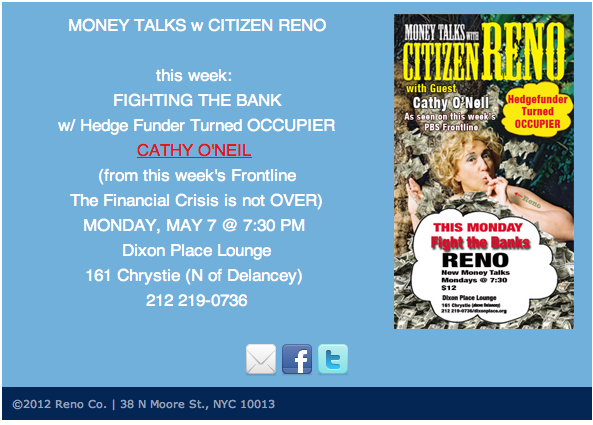
I’ll be in the Lower East Side tomorrow night, at the Dixon Place Lounge, talking finance with Reno, who some of you may know. Here’s more info:
The meritocracy myth
Jack and Larry
Recently a Wall Street Journal article described what I’ll call a “Larry Summers” moment for women in business. Namely, Jack Welch, the former CEO of General Electric, spoke to a bunch of women about how if they work hard enough they’ll be appreciated and get ahead. From the article:
He had this advice for women who want to get ahead: Grab tough assignments to prove yourself, get line experience, and embrace serious performance reviews and the coaching inherent in them.
“Without a rigorous appraisal system, without you knowing where you stand…and how you can improve, none of these ‘help’ programs that were up there are going to be worth much to you,” he said. Mr. Welch said later that the appraisal “is the best way to attack bias” because the facts go into the document, which both parties have to sign.
Just as in the case of Larry Summer’s now-famous 2005 speech about women in science and math, a bunch of women left Welch’s talk in frustration.
There is no such thing as a meritocracy
Having been in academic mathematics and a quant in a hedge fund, I’d guess I’ve experienced what comes closest in many people’s minds as the closest to a meritocratic system. But my experience is that it’s anything but, even in these highly quantitative settings.
Instead, as it probably is everywhere, the job environment is a huge social game where it matters, a lot, what kind of priorities you demonstrate and what kind of other signals you give off or respond to. We don’t expect people to play golf and smoke cigars in academia but caring about teaching, or worse, getting a teaching award, can be the kiss of death.
I’m not saying that your personal efforts don’t matter at all, because they do, and you do need to produce stuff, and at a certain rate, but even “personal efforts” are first of all received in the context of a social order (i.e. the perceived importance of your efforts at the very least is a social invention), and second of all they’re are not really personal – one frames the questions one answers with the help of the community, so it’s important you have a good connection and social acceptance in that community (i.e. access to the experts).
Business in more generality is even less meritocratic- there’s a specific requirement that you must “play well with others,” which is absent from academics (mercifully). This means that instead of being an implicit social game, it’s been made very explicit. This is where people promote their work, take credit for others’ work, learn to say what people want to hear, etc. The performance review is a circle-jerk event for such empty-headed manipulations, which makes it particularly ironic that Welch suggested women take the criticism in an appraisal so seriously.
In my experience, it is unbelievably useful for these social games to have an alpha personality, which just kind of means you assume you’re in charge even when it’s not explicitly a situation where someone’s in charge. People respond to such personalities on a chemical level and there’s really nothing a so-called meritocratic system can do about that.
In other words, I’m not holding my breath for a truly meritocratic system. It’s just not what humans evolved for. Let’s acknowledge that and work on how to make the system responsive to good ideas anyway (whatever the system is).
Successful people want to believe that there is such a thing as meritocracy
This begs the question, why do people like Jack Welch and Larry Summers hold on so tight to the myth of meritocracy? My theory is that it serves a two-fold goal: as advertisement for new people and as a validation of the winners in the system.
People want to feel like they are entering a level playing field then the best thing you can do is advertise it as a meritocracy, because it’s human nature to think that you’re better than average. So everyone wants to enter such a field, assuming they will rise to the top.
At the same time, the `winners’ of the social game want desperately to think they did amazing stuff in order to be so successful. They hold on to the myth of meritocracy as a religious belief, and it is pure dogma by the time they reach upper management. This plays into another part of human nature where we discount luck and the infrastructure that led to our success and take it as a sign of our personal choices. Lots of people in finance in general suffer from this diseased mindset but actually anyone who is high enough up in their respective `meritocratic system’ does too.
That’s my simple explanation for why these guys can go in front of a bunch of women and be so unbelievably tone-deaf. They are true believers, because their entire egos are built on this belief, and it doesn’t matter how much counter-evidence is presented to them, even in the form of humans in the room with them.
One last thought. If I saw people leaving a room in disgust when I was giving a talk, I imagine I’d be slightly aghast- I might even pause and ask them what’s wrong. But I guess that’s because I’m not alpha enough.


