Archive
Do what I want or do what I really want
I’m on my way out to a picnic in Central Park on this glorious Sunday morning, and I plan to write a much more thorough post in response to this New Yorker article on overparenting that my friend Chris Wiggins sent me, but today I just wanted to impart one idea I’ve developed as a mother of three boys.
Namely, kids don’t ever want to do what you want them to do, especially when they’re tired, and it’s awful to feel helpless to get them to something without ridiculous, possibly empty threats, or something worse.
What to do?
My solution is pretty simple, and it works great, at least in my experience. Namely, if I’m getting no response from a reasonable request from my, say, 4-year-old, then I form a separate request which is easier for me and less good for them. And then I offer him a choice between doing what I want or doing what I really want.
Example: it’s bedtime (i.e. 7pm, which we will come back to in further post, which I’m considering calling “In defense of neglectful parenting”) and my kid doesn’t want to stop watching Star Wars Lego movies on Youtube. I’ve asked repeatedly for him to pause the movie so he can brush his teeth, get into his pajamas, and have me read his favorite bedtime story (currently: “Peter and the Shadow Thieves”).
Instead of screaming, picking him up and dragging him to the bathroom, which is increasingly difficult since he’s the size of a 6-year-old, I simply make him an offer:
Either you come brush your teeth right now and I read to you, or you come brush your teeth now and I don’t read to you, and you’ll have to go to bed without a bedtime story. I’m going to count to five and if you don’t come to the bathroom to brush your teeth when I get to “5” then no story.
Here’s the thing. It’s important that he knows I’m serious. I will actually not read to him if he doesn’t hurry up. To be fair, I only had to follow through with this exactly once for him to understand the seriousness of this kind of offer.
What I like about this is the avoidance of drama, empty threats, and physical coercion, or what’s just as annoying, a wasted evening of arguing with an exhausted child about “why there are bedtimes”, which happens so easily without a strategy in place.
Aunt Pythia’s advice – nose rings, breakups, itchy fingers, and data science
Aunt Pythia is yet again gratified to find a few new questions in her inbox this morning, but as usual, she’s running quite low. After reading and enjoying the column below, please consider making some fabricated, melodramatic dilemma up out of whole cloth and, more importantly:
Please submit your fake question for Aunt Pythia at the bottom of this page!
——
Dear Aunt Pythia,
Can I have a nose piercing and still be taken seriously as an academic in Mathematics?
Math Dyke
Dear Math Dyke,
Actually, I think you can. Mathematicians may be elitist snobs about some things, but it’s not about the way they’re dressed. They tend to be pretty open-minded about physically presented strangeness. Plus they’ll probably just think it’s some kind of cultural signifier that they don’t understand.
Don’t let this fear hold you back from getting your nose pierced if that’s what you wanna do! It’ll look fabulous!
Auntie P
——
Hi Aunt Pythia,
I was recently dating this girl, and thought I had no feelings towards her other than enjoying her company and being attracted to her. Recently, after dating for a month or so, she wanted to have a “talk” and make things serious. I confessed that I did not love her, but told her that I did not expect these feeings at this point. She dumped me. What could I have done? Should I lie? Thanks 😦
Adones
Dear Adones,
First of all, I’m sympathetic to your viewpoint. But I’m also sympathetic to hers – and I’m much more like her myself.
People just move at different paces, and yours was too slow for her. I think the conversation you two had was probably the best thing, and I’m glad you didn’t lie.
My guess is that, from her perspective, you guys had been dating for a full six weeks (I’m interpreting your “or so” broadly), that you were pleasant yet tepid, and that she just wanted more from her love life than that. She didn’t get the impression, based on your conversation, that passion was around the corner, so why bother? From her vantage point, she deserves an interesting and exciting love life.
But don’t despair: there are other women who want to move slowly, especially if they’re not interested in having kids any time soon. My advice is to go find someone with a slower pace that matches yours!
Aunt Pythia
——
Dear Aunt Pythia,
I love to twiddle my fingers . . . but I never took up knitting, for example, because I figured you have to have the mind of an accountant to keep track of the pattern. I supposed I could crank out a scarf or two …. Plus, wool is so itchy. (I note that linen is an option?). Should I be discouraged?
ItchyFingers
Dear Itchy,
One possibility is to have the “mind of an accountant” (I put this in quotes because I know a few accountants that may be offended by the assumptions) and count out each stitch as you go. Or you could instead have the mind of an artist, and not worry about imperfections in stitch count, since they add texture and individuality to your project. Or, you could do what I do, and have the mind of a mathematician, and choose or design patterns that allow you every now and then think, but mostly just happily knit whilst watching Star Trek or something.
The real reason I love knitting is that I love color and I love the touch of yarn. I just can’t get enough of touching it. And most luxury wool yarn is not itchy at all. My suggestion is to go to a yarn store and touch everything in sight. It’s what people do, don’t worry, nobody will be surprised.
Aunt P
p.s. if you live in New York, try Knitty City on 79th near Broadway.
——
Dear Aunt Pythia,
I don’t have a math background. I studied Political Science in college. But I’m fascinated by data science and want to learn more. If I keep chugging along, teaching myself things, do you think this is a viable career? I’m teaching myself programming right now (JavaScript, Ruby), a bit of R, a bit of SAS.
Don’t Always Take Advice
Dear DATA,
I do think you need to understand the math behind the algorithms in order to really be a good data science (as I explained in this post). But that doesn’t mean you have to have a math background – you can give yourself a math foreground right now. So yes, if you are willing to really go deep and understand these algorithms from top to bottom, of course you can become a data scientist. There’s no secret property of college learning that makes it somehow better, after all. And there are tons of online resources that you can use for this stuff, as well as the book I’m writing which will be out soon.
One more piece of advice: get yourself a github account and store your code for projects in that, as well as written descriptions of what problems you’ve solved with your code. Since you don’t have a standard background in math and stats and CS, you’ll have to have evidence that you really can do this stuff.
Good luck!
Aunt Pythia
——
Please submit your question to Aunt Pythia!
What does it mean that our public square is a private place?
I just read this opinion piece written by Jillian York and published by Aljazeera.com. York discusses “How social network policies are changing speech and privacy norms” and she makes the point that there’s a big difference between our legal rights as citizens and the way Facebook has defined its policies, and by extension our “rights” inside Facebook.
So, for example, there’s the question of whether we can show pictures of breastfeeding our children on Facebook. The policy on this has changed – nowadays they say yes, but they used to remove such pictures.
Another example might be more important: whether you can be anonymous. As York points out, Facebook might have an opinion about this, and Zuckerberg seems to – she quotes him as having said “having two identities for yourself is an example of a lack of integrity” – and yet their vested interest in this question is related to making sure they’ve accurately targeted you for advertisements.
I want to make the case that the “real-life” version of anonymity in Facebook is really just privacy in the simplest sense.
If I am even half-aware of the extent of the surveillance and tracking that goes on when I log into Facebook under my real name, which I don’t even think I am, then I’d tend to use a separate browser, with cleared cookies, and an anonymous Facebook account in order to do absolutely anything without it being tracked. In other words, anonymity is what it takes to do anything privately on Facebook.
Now, you might argue that I can just not go to Facebook at all if I want to do private things, and I’m sure that’s Facebook position as well. But the truth is, Facebook is the world’s public square. Some enormous fraction of the world visits Facebook at least once a week. Exclusion from this would be a big deal.
In any case, it’s weird that decisions like this, that affect our notions of privacy, are being decided by some dude who’s probably thinking more about ad revenue than anything else, under pressure from shareholders.
Not that it’s a new problem. When I was growing up in Lexington, MA, over the cold winters we’d hang out in the Burlington Mall. It was the public square of its time, and yes it was utterly commercial and private, and of course they excluded anyone who they didn’t like the looks of, with security guards. Even so, they didn’t check ID’s at the door.
The rise of big data, big brother
I recently read an article off the newsstand called The Rise of Big Data.
It was written by Kenneth Neil Cukier and Viktor Mayer-Schoenberger and it was published in the May/June 2013 edition of Foreign Affairs, which is published by the Council on Foreign Relations (CFR). I mention this because CFR is an influential think tank, filled with powerful insiders, including people like Robert Rubin himself, and for that reason I want to take this view on big data very seriously: it might reflect the policy view before long.
And if I think about it, compared to the uber naive view I came across last week when I went to the congressional hearing about big data and analytics, that would be good news. I’ll write more about it soon, but let’s just say it wasn’t everything I was hoping for.
At least Cukier and Mayer-Schoenberger discuss their reservations regarding “big data” in this article. To contrast this with last week, it seemed like the only background material for the hearing, at least for the congressmen, was the McKinsey report talking about how sexy data science is and how we’ll need to train an army of them to stay competitive.
So I’m glad it’s not all rainbows and sunshine when it comes to big data in this article. Unfortunately, whether because they’re tied to successful business interests, or because they just haven’t thought too deeply about the dark side, their concerns seem almost token, and their examples bizarre.
The article is unfortunately behind the pay wall, but I’ll do my best to explain what they’ve said.
Datafication
First they discuss the concept of datafication, and their example is how we quantify friendships with “likes”: it’s the way everything we do, online or otherwise, ends up recorded for later examination in someone’s data storage units. Or maybe multiple storage units, and maybe for sale.
They formally define later in the article as a process:
… taking all aspect of life and turning them into data. Google’s augmented-reality glasses datafy the gaze. Twitter datafies stray thoughts. LinkedIn datafies professional networks.
Datafication is an interesting concept, although as far as I can tell they did not coin the word, and it has led me to consider its importance with respect to intentionality of the individual.
Here’s what I mean. We are being datafied, or rather our actions are, and when we “like” someone or something online, we are intending to be datafied, or at least we should expect to be. But when we merely browse the web, we are unintentionally, or at least passively, being datafied through cookies that we might or might not be aware of. And when we walk around in a store, or even on the street, we are being datafied in an completely unintentional way, via sensors or Google glasses.
This spectrum of intentionality ranges from us gleefully taking part in a social media experiment we are proud of to all-out surveillance and stalking. But it’s all datafication. Our intentions may run the gambit but the results don’t.
They follow up their definition in the article, once they get to it, with a line that speaks volumes about their perspective:
Once we datafy things, we can transform their purpose and turn the information into new forms of value
But who is “we” when they write it? What kinds of value do they refer to? As you will see from the examples below, mostly that translates into increased efficiency through automation.
So if at first you assumed they mean we, the American people, you might be forgiven for re-thinking the “we” in that sentence to be the owners of the companies which become more efficient once big data has been introduced, especially if you’ve recently read this article from Jacobin by Gavin Mueller, entitled “The Rise of the Machines” and subtitled “Automation isn’t freeing us from work — it’s keeping us under capitalist control.” From the article (which you should read in its entirety):
In the short term, the new machines benefit capitalists, who can lay off their expensive, unnecessary workers to fend for themselves in the labor market. But, in the longer view, automation also raises the specter of a world without work, or one with a lot less of it, where there isn’t much for human workers to do. If we didn’t have capitalists sucking up surplus value as profit, we could use that surplus on social welfare to meet people’s needs.
The big data revolution and the assumption that N=ALL
According to Cukier and Mayer-Schoenberger, the Big Data revolution consists of three things:
- Collecting and using a lot of data rather than small samples.
- Accepting messiness in your data.
- Giving up on knowing the causes.
They describe these steps in rather grand fashion, by claiming that big data doesn’t need to understand cause because the data is so enormous. It doesn’t need to worry about sampling error because it is literally keeping track of the truth. The way the article frames this is by claiming that the new approach of big data is letting “N = ALL”.
But here’s the thing, it’s never all. And we are almost always missing the very things we should care about most.
So for example, as this InfoWorld post explains, internet surveillance will never really work, because the very clever and tech-savvy criminals that we most want to catch are the very ones we will never be able to catch, since they’re always a step ahead.
Even the example from their own article, election night polls, is itself a great non-example: even if we poll absolutely everyone who leaves the polling stations, we still don’t count people who decided not to vote in the first place. And those might be the very people we’d need to talk to to understand our country’s problems.
Indeed, I’d argue that the assumption we make that N=ALL is one of the biggest problems we face in the age of Big Data. It is, above all, a way of excluding the voices of people who don’t have the time or don’t have the energy or don’t have the access to cast their vote in all sorts of informal, possibly unannounced, elections.
Those people, busy working two jobs and spending time waiting for buses, become invisible when we tally up the votes without them. To you this might just mean that the recommendations you receive on Netflix don’t seem very good because most of the people who bother to rate things are Netflix are young and have different tastes than you, which skews the recommendation engine towards them. But there are plenty of much more insidious consequences stemming from this basic idea.
Another way in which the assumption that N=ALL can matter is that it often gets translated into the idea that data is objective. Indeed the article warns us against not assuming that:
… we need to be particularly on guard to prevent our cognitive biases from deluding us; sometimes, we just need to let the data speak.
And later in the article,
In a world where data shape decisions more and more, what purpose will remain for people, or for intuition, or for going against the facts?
This is a bitch of a problem for people like me who work with models, know exactly how they work, and know exactly how wrong it is to believe that “data speaks”.
I wrote about this misunderstanding here, in the context of Bill Gates, but I was recently reminded of it in a terrifying way by this New York Times article on big data and recruiter hiring practices. From the article:
“Let’s put everything in and let the data speak for itself,” Dr. Ming said of the algorithms she is now building for Gild.
If you read the whole article, you’ll learn that this algorithm tries to find “diamond in the rough” types to hire. A worthy effort, but one that you have to think through.
Why? If you, say, decided to compare women and men with the exact same qualifications that have been hired in the past, but then, looking into what happened next you learn that those women have tended to leave more often, get promoted less often, and give more negative feedback on their environments, compared to the men, your model might be tempted to hire the man over the woman next time the two showed up, rather than looking into the possibility that the company doesn’t treat female employees well.
In other words, ignoring causation can be a flaw, rather than a feature. Models that ignore causation can add to historical problems instead of addressing them. And data doesn’t speak for itself, data is just a quantitative, pale echo of the events of our society.
Some cherry-picked examples
One of the most puzzling things about the Cukier and Mayer-Schoenberger article is how they chose their “big data” examples.
One of them, the ability for big data to spot infection in premature babies, I recognized from the congressional hearing last week. Who doesn’t want to save premature babies? Heartwarming! Big data is da bomb!
But if you’re going to talk about medicalized big data, let’s go there for reals. Specifically, take a look at this New York Times article from last week where a woman traces the big data footprints, such as they are, back in time after receiving a pamphlet on living with Multiple Sclerosis. From the article:
Now she wondered whether one of those companies had erroneously profiled her as an M.S. patient and shared that profile with drug-company marketers. She worried about the potential ramifications: Could she, for instance, someday be denied life insurance on the basis of that profile? She wanted to track down the source of the data, correct her profile and, if possible, prevent further dissemination of the information. But she didn’t know which company had collected and shared the data in the first place, so she didn’t know how to have her entry removed from the original marketing list.
Two things about this. First, it happens all the time, to everyone, but especially to people who don’t know better than to search online for diseases they actually have. Second, the article seems particularly spooked by the idea that a woman who does not have a disease might be targeted as being sick and have crazy consequences down the road. But what about a woman is actually is sick? Does that person somehow deserve to have their life insurance denied?
The real worries about the intersection of big data and medical records, at least the ones I have, are completely missing from the article. Although they did mention that “improving and lowering the cost of health care for the world’s poor” inevitable will lead to “necessary to automate some tasks that currently require human judgment.” Increased efficiency once again.
To be fair, they also talked about how Google tried to predict the flu in February 2009 but got it wrong. I’m not sure what they were trying to say except that it’s cool what we can try to do with big data.
Also, they discussed a Tokyo research team that collects data on 360 pressure points with sensors in a car seat, “each on a scale of 0 to 256.” I think that last part about the scale was added just so they’d have more numbers in the sentence – so mathematical!
And what do we get in exchange for all these sensor readings? The ability to distinguish drivers, so I guess you’ll never have to share your car, and the ability to sense if a driver slumps, to either “send an alert or atomatically apply brakes.” I’d call that a questionable return for my investment of total body surveillance.
Big data, business, and the government
Make no mistake: this article is about how to use big data for your business. It goes ahead and suggests that whoever has the biggest big data has the biggest edge in business.
Of course, if you’re interested in treating your government office like a business, that’s gonna give you an edge too. The example of Bloomberg’s big data initiative led to efficiency gain (read: we can do more with less, i.e. we can start firing government workers, or at least never hire more).
As for regulation, it is pseudo-dealt with via the discussion of market dominance. We are meant to understand that the only role government can or should have with respect to data is how to make sure the market is working efficiently. The darkest projected future is that of market domination by Google or Facebook:
But how should governments apply antitrust rules to big data, a market that is hard to define and is constantly changing form?
In particular, no discussion of how we might want to protect privacy.
Big data, big brother
I want to be fair to Cukier and Mayer-Schoenberger, because they do at least bring up the idea of big data as big brother. Their topic is serious. But their examples, once again, are incredibly weak.
Should we find likely-to-drop-out boys or likely-to-get-pregnant girls using big data? Should we intervene? Note the intention of this model would be the welfare of poor children. But how many models currently in production are targeting that demographic with that goal? Is this in any way at all a reasonable example?
Here’s another weird one: they talked about the bad metric used by US Secretary of Defense Robert McNamara in the Viet Nam War, namely the number of casualties. By defining this with the current language of statistics, though, it gives us the impression that we could just be super careful about our metrics in the future and: problem solved. As we experts in data know, however, it’s a political decision, not a statistical one, to choose a metric of success. And it’s the guy in charge who makes that decision, not some quant.
Innovation
If you end up reading the Cukier and Mayer-Schoenberger article, please also read Julie Cohen’s draft of a soon-to-be published Harvard Law Review article called “What Privacy is For” where she takes on big data in a much more convincing and skeptical light than Cukier and Mayer-Schoenberger were capable of summoning up for their big data business audience.
I’m actually planning a post soon on Cohen’s article, which contains many nuggets of thoughtfulness, but for now I’ll simply juxtapose two ideas surrounding big data and innovation, giving Cohen the last word. First from the Cukier and Mayer-Schoenberger article:
Big data enables us to experiment faster and explore more leads. These advantages should produce more innovation
Second from Cohen, where she uses the term “modulation” to describe, more or less, the effect of datafication on society:
When the predicate conditions for innovation are described in this way, the problem with characterizing privacy as anti-innovation becomes clear: it is modulation, not privacy, that poses the greater threat to innovative practice. Regimes of pervasively distributed surveillance and modulation seek to mold individual preferences and behavior in ways that reduce the serendipity and the freedom to tinker on which innovation thrives. The suggestion that innovative activity will persist unchilled under conditions of pervasively distributed surveillance is simply silly; it derives rhetorical force from the cultural construct of the liberal subject, who can separate the act of creation from the fact of surveillance. As we have seen, though, that is an unsustainable fiction. The real, socially-constructed subject responds to surveillance quite differently—which is, of course, exactly why government and commercial entities engage in it. Clearing the way for innovation requires clearing the way for innovative practice by real people, by preserving spaces within which critical self-determination and self-differentiation can occur and by opening physical spaces within which the everyday practice of tinkering can thrive.
Why we should break up the megabanks (#OWS)
Today is May Day, and my Occupy group and I are planning to join in the actions all over the city this afternoon. At 2:00 I’m going to be at Cooper Square, where Free University is holding a bunch of teach-ins, and I’m giving one entitled “Why we should break up the megabanks.” I wanted to get my notes for the talk down in writing beforehand here.
The basic reasons to break up the megabanks are these:
- They hold too much power.
- They cost too much.
- They get away with too much.
- They make things worse.
Each requires explanation.
Megabanks hold too much power
When Paulson went to Congress to argue for the bailout in 2008, he told them that the consequences of not acting would be a total collapse of the financial system and the economy. He scared Congress and the American people to such an extent that the banks managed to receive $700 billion with no strings attached. Even though half of that enormous pile of money was supposed to go to help homeowners threatened with foreclosures, almost none of it did, because the banks found other things to do with it.
The power of megabanks doesn’t only exert itself through the threat of annihilation, though. It also flows through lobbyists who water down Dodd-Frank (or really any policy that banks don’t like) and through “the revolving door,” the men and women who work for Treasury, the White House, and regulators about half the time and sit in positions of power in the megabanks the other half of their time, gaining influence and money and retiring super rich.
It is unreasonable to expect to compete with this kind of insularity and influence of the megabanks.
They cost too much
The bailout didn’t work and it’s still going on. And we certainly didn’t “make money” on it, compared to what the government could have expected if we had invested differently.
But honestly it’s too narrow to think about money alone, because what we really need to consider is risk. And there we’ve lost a lot: when we bailed them out, we took on the risk of the megabanks, and we have simply done nothing to return it. Ultimately the only way to get rid of that costly risk is to break them up once and for all to a size that they can reasonably and obviously be expected to fail.
Make no mistake about it: risk is valuable. It may not be quantifiable at a moment of time, but over time it becomes quite valuable and quantifiable indeed, in various ways.
One way is to think about borrowing costs and long-term default probabilities, and there the estimates have varied but we’ve seen numbers such as $83 billion per year modeled. Few people dispute that it’s the right order of magnitude.
They get away with too much
There doesn’t seem to be a limit to what the megabanks can get away with, which we’ve seen with HSBC’s money laundering from terrorists and drug cartels, we’ve seen with Jamie Dimon and Ina Drew lying to Congress about fucking with their risk models, we’ve seen with countless fraudulent and racist practices with mortgages and foreclosures and foreclosure reviews, not to mention setting up customers to fail in deals made to go bad, screwing municipalities and people with outrageous fees, shaving money off of retirement savings, and manipulating any and all markets and rates that they can to increase their bonuses.
The idea of a financial sector is to grease the wheels of commerce, to create a machine that allows the economy to work. But in our case we have a machine that’s taken over the economy instead.
They make things worse
Ultimately the best reason to break them up right now, the sooner the better, is that the incentives are bad and getting worse. Now that they live in a officially protected zone, there is even less reason for them then there used to be to rein in risky practices. There is less reason for them to worry about punishments, since the SEC’s habit of letting people off without jailtime, meaningful penalties, or even admitting wrongdoing has codified the lack of repercussions for bad behavior.
If we use recent history as a guide, the best job in finance you can have right now is inside a big bank, protected from the law, rather than working at a hedge fund where you can be nabbed for insider trading and publicly displayed as an example of the SEC’s new “toughness.”
What we need to worry about now is how bad the next crash is going to be. Let’s break up the megabanks now to mitigate that coming disaster.
Mathbabe, the book
Thanks to a certain friendly neighborhood mathbabe reader, I’ve created this mathbabe book, which is essentially all of my posts that I ever wrote (I think. Note sure about that.) bundled together mostly by date and stuck in a huge pdf. It comes to 1,243 pages.
I did it using leanpub.com, which charges $0.99 per person who downloads the pdf. I’m not charging anything over that, because the way I look at it, it’s already free.
Speaking of that, I can see why I’d want a copy of this stuff, since it’s the best way I can think of to have a local version of a bunch of writing I’ve done over the past couple of years, but I don’t actually see why anyone else would. So please don’t think I’m expecting you to go buy this book! Even so, more than one reader has requested this, so here it is.
And one strange thing: I don’t think it required my password on WordPress.com to do it, I just needed the url for the RSS feed. So if you want to avoid paying 99 cents, I’m pretty sure you can go to leanpub or one of its competitors and create another, identical book using that same feed.
And for that matter you can also go build your own book about anything using these tools, which is pretty cool when you think about it. Readers, please tell me if there’s a way to do this that’s open source and free.
Guest post: Kaisa Taipale visualizes mathematics Ph.D.’s emigration patterns
This is a guest post by Kaisa Taipale. Kaisa got a BS at Caltech, a Ph.D. in math at the University of Minnesota, was a post-doc at MSRI, an assistant professor at St. Olaf College 2010-2012, and is currently visiting Cornell, which is where I met here a couple of weeks ago, and where she told me about her cool visualizations of math Ph.D. emigration patterns and convinced her to write a guest post. Here’s Kaisa on a bridge:

Math data and viz
I was inspired by this older post on Mathbabe, about visualizing the arXiv postings of various math departments.
It got me thinking about tons of interesting questions I’ve asked myself and could answer with visualizations: over time, what’s been coolest on the arXiv? are there any topics that are especially attractive to hiring institutions? There’s tons of work to do!
I had to start somewhere though, and as I’m a total newbie when it comes to data analysis, I decided to learn some skills while focusing on a data set that I have easy non-technical access to and look forward to reading every year. I chose the AMS Annual Survey. I also wanted to stick to questions really close to my thoughts over the last two years, namely the academic job search.
I wanted to learn to use two tools, R and Circos. Why Circos? See the visualizations of college major and career path here – it’s pretty! I’ve messed around with a lot of questions, but in this post I’ll look at two and a half.
Graduating PhDs
Where do graduating PhDs from R1 universities end up, in the short term? I started with graduates of public R1s, as I got my PhD at one.

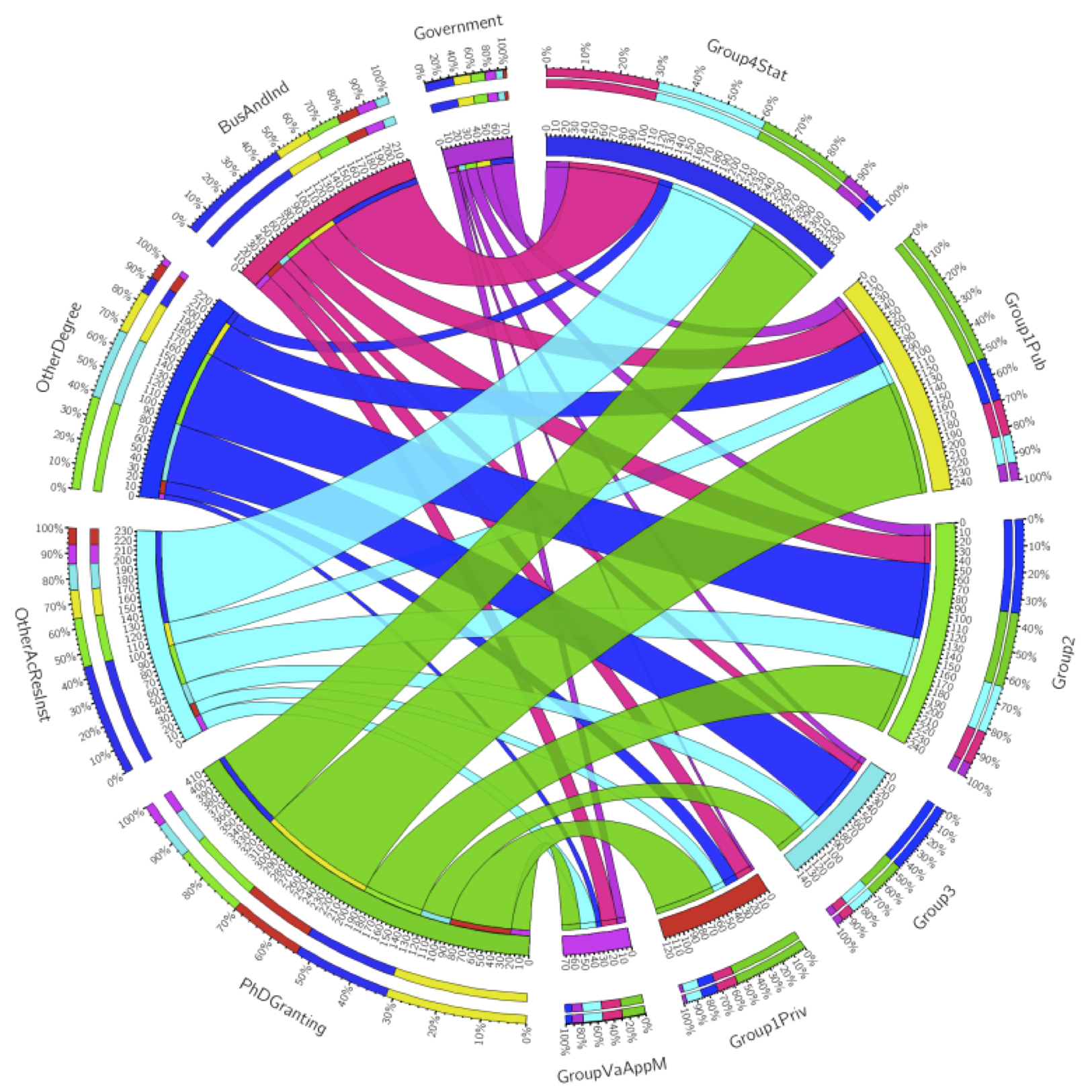
The PhD-granting institutions are colored green, while academic institutions granting other degrees are in blue. Purple is for business, industry, government, and research institutions. Red is for non-U.S. employment or people not seeking — except for the bright red, which is still seeking. Yellow rounds things out at unknown. Remember, these figures are for immediate plans after graduation rather than permanent employment.
While I was playing with this data (read “learning how to use the reshape and ggplot2 packages”) I noticed that people from private R1s tend to end up at private R1s more often. So I graphed that too.

Does the professoriate in the audience have any idea if this is self-selection or some sort of preference on the part of employers? Also, what happened between 2001 and 2003? I was still in college, and have no idea what historical events are at play here.
Where mathematicians go
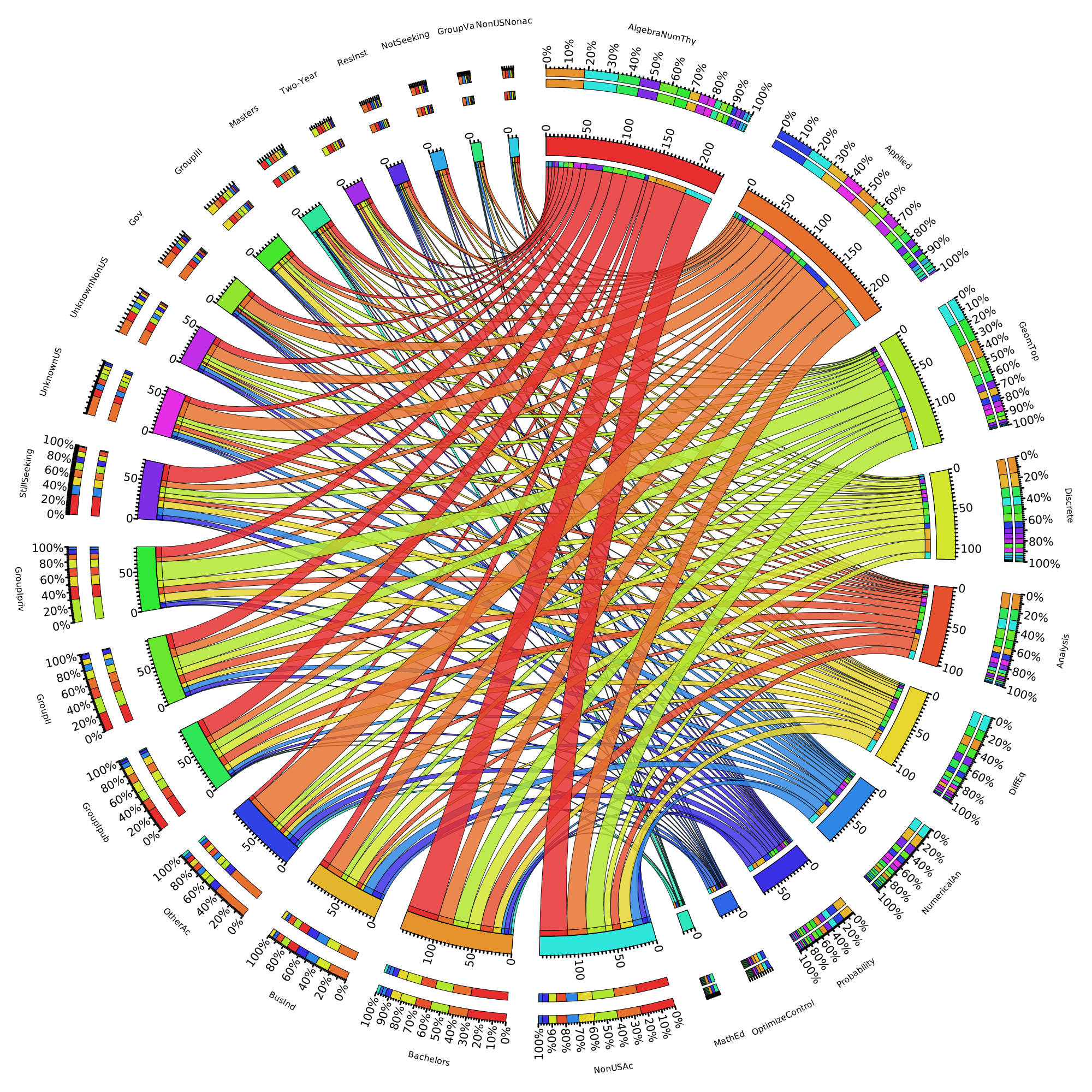
For any given year, we can use a circular graph to show us where people go. This is a more clumped version of the above data from 2010 alone, plotted using Circos. (Supplemental table E.4 from the AMS report online.)
The other question – the question current mathematicians secretly care more about, in a gossipy and potentially catty way – is what fields lead to what fate. We all know algebra and number theory are the purest and most virtuous subjects, and applied math is for people who want to make money or want to make a difference in the world.
[On that note, you might notice that I removed statistics PhDs in the visualization below, and I also removed some of the employment sectors that gained only a few people a year. The stats ribbons are huge and the small sectors are very small, so for looks alone I took them out.]
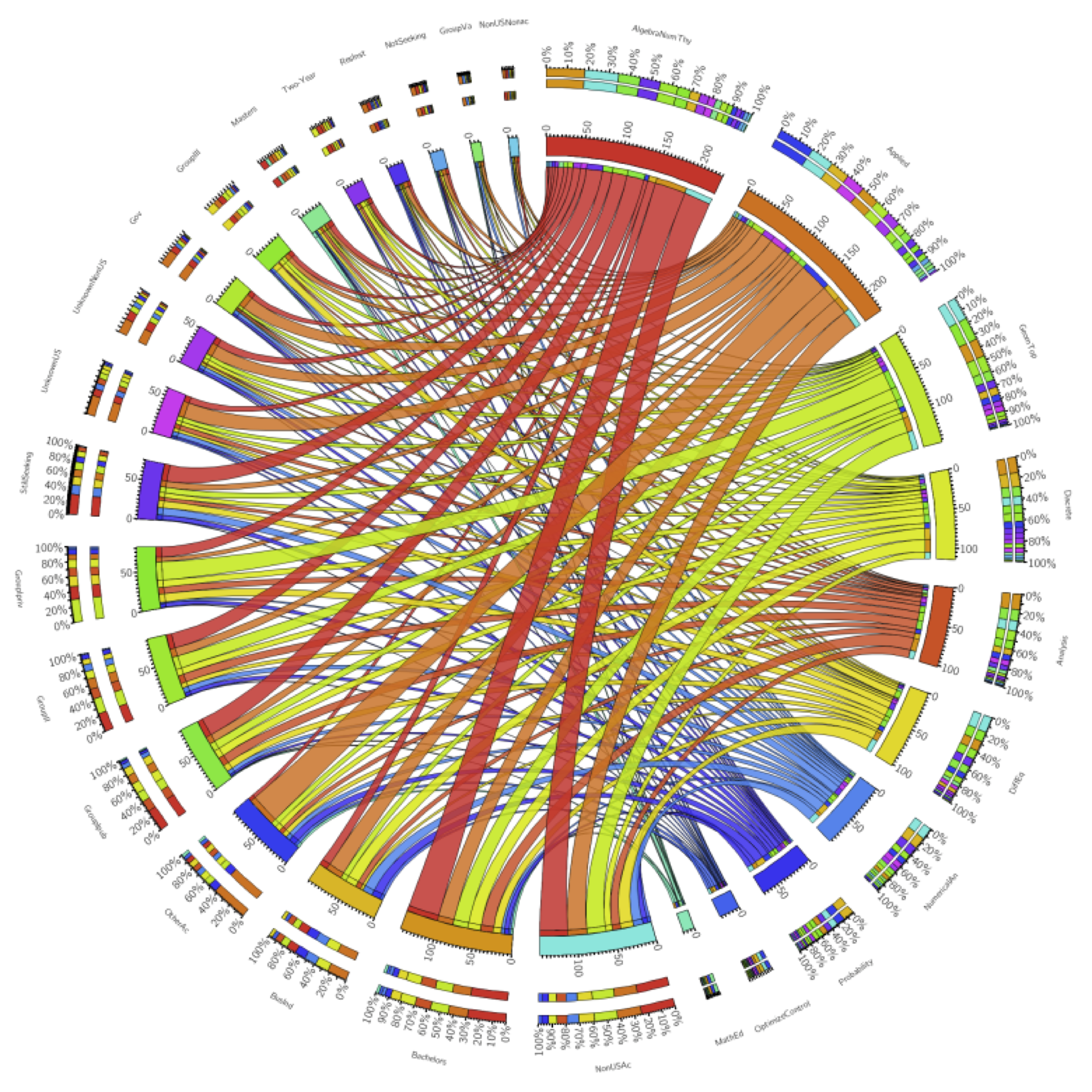 Higher resolution version available here.
Wish list
I wish I could animate a series of these to show this view over time as well. Let me know if you know how to do that! Another nice thing I could do would be to set up a webpage in which these visualizations could be explored in a bit more depth. (After finals.)
Also:
- I haven’t computed any numbers for you
- the graphs from R show employment in each field by percentage of graduates instead of total number per category;
- it’s hard to show both data over time and all the data one could explore. But it’s a start.
I should finish with a shout-out to Roger Peng and Jeff Leek, though we’ve never met: I took Peng’s Computing for Data Analysis and much of Leek’s Data Analysis on Coursera (though I’m one of those who didn’t finish the class). Their courses and Stack Overflow taught me almost everything I know about R. As I mentioned above, I’m pretty new to this type of analysis.
What questions would you ask? How can I make the above cooler? Did you learn anything?
Good news Sunday
Sunday mornings tend to provoke me to write the most whimsical posts of the week. I’ve usually gotten enough sleep for the first time in seven days, unless I’m hung over from Saturday late-night karaoke (but I usually like to do that on Fridays), and I can actually remember some of my dreams.
Especially on a glorious sunny Spring morning like today, I can’t abide any bad news or ranting. So today it’s only gonna be good news. Here goes.
1) Chocolate Fondue
Did you know that you can buy chocolate fondue machines for like $9.00? I found this out because at some point I realized my kids hadn’t had chocolate fondue in ages (trust me, it was all about the kids), and I wanted to find a place in New York City where we could go eat fondue, but the only places offering it were like $300 meals for a family of five. So I went on Amazon instead, and paid for the whole shebang for under $30, including the little sticks, and that silly little machine still works. It’s like a happiness machine.
2) Star Trek
There’s a new Star Trek movie, Into Darkness, coming out starting on May 15th. Do not beware the ides of May.
3) TBTF
Sherrod Brown and David Vitter introduced an “end too-big-to-fail” bill this week and they wrote about it in an Op-Ed for the New York Times. It doesn’t mean it’ll be passed, or that it’s perfect, but the momentum is gaining, which is good.
4) Knitting
This is in the category of “good news for me” and you might not care, but after years of worrying that it would be too twine-y, I’ve taken the plunge into knitting with linen and I love it. I’m making this sweater in black linen, and I’ve already finished the back panel:

Ask Aunt Pythia
I’m gratified to find a few new questions in Aunt Pythia’s in box this morning – I really thought I’d have to retire her persona, since I plumb ran out of questions last week, and that was making me sad. Thanks for the questions, friends! And please don’t forget to:
Submit your question for Aunt Pythia at the bottom of this page!
——
Dear Aunt Pythia,
I was recently on a flight where the person sitting next to me found it appropriate to hit on me. Now, he was a reasonably intelligent and nice person (up until the time that he mentioned that most of his recent dates were “short fat pigs” and asked me if I was single, despite previously indicating in his conversation that he thought I was 20 yers younger than he is).
However, now he has hunted down my email address and started contacting me. Is there anything wrong with getting my friends to anonymously pay him back for his objectification and slight harrassment of me (putting him on spam email lists, sending him fake magazine subscriptions, etc.), and if not, can you recommend things for us to try?
Sexy, If Not Going for Lame Extra-masculine-creeps
Dear SINGLE,
I have to ask a couple of things here for the sake of clarity.
First, I need to assume you expressed a lack of interest in this guy when he started hitting on you – either by saying “I’m not interested, thanks” or something along those lines, or by lying outright when he asked you whether you’re single (“I’m married with 14 kids, if it’s you who’s asking the question”). I would include the possibility of an evasion of all things romantic/sexual, but if he didn’t ask enough of a direct question to have you respond like that, then I’m not sure I’d call it hitting on you. And if he did hit on you and you didn’t say no thanks, then maybe he felt like your signals weren’t negative, so why not give it a shot.
As for hunting down your email address, if you mentioned you work at a certain math department, say, and he found your email address on that website, and then wrote to you, that’s a different level of hunt then if you have a private email address which he found god knows how. I’m not saying there’s no creep factor at all in emailing you, but if he felt a connection that he didn’t want to assume was only him, than this whole thing might be kind of sweet and explainable and not really creepy (from his perspective).
I guess my point is that you do have to say no at some point for someone’s wishful thinking to get on track. I realize this isn’t exactly fair, since you never asked for the attention in the first place, but a lot of people, especially men, are trained to assume they’re right unless they’ve been explicitly told they’re wrong.
On the other hand, if you did say “no thanks” in one way or another, and/or if he really hunted for your email address, then I’d agree that it’s too much. I hope the very first time he wrote to you you responded by saying, “I’m not interested. Please do not write to me again.”
Now, assuming that the above happened, and he still wrote a second and third time, pressing his case, I’d say you and your friends definitely sign him up for all sorts of stuff. Especially Viagra stuff. Plus, one of your other friends should write to him telling him to back the fuck off. And then block his emails using a filter.
Hope that helps,
Aunt Pythia
——
Dear Aunt Pythia,
I recently heard your interviews on Econ Talk and Frontline and enjoyed them VERY much. Thank you. I was wondering … in light of your experiences, how do you invest your money?
Warren Buffett
Dear Warren,
Thanks for the kind words!
I don’t invest my money in an active way. And it annoys me to think about how much the managers of retirement accounts get paid to do nothing with people’s money, but on the other hand I sympathize with people who don’t change that set-up, because it would require some real research, and in the end the retirement industry isn’t set up to let people invest in things they actually care about – instead we’re supposed to think that the only thing we care about is when we retire, which is supposed to translate magically into a risk appetite.
One more thing: I’m not regretting any of this. I never, ever want to become one of those people who check their stocks all the time.
BORING!! You people are BORING!!!
Almost as boring as people who talk about exercise and/or dieting all the time!!!!
Instead I am grateful that I have a job that helps me pay my bills and allows me to not think about money very much.
This might mean I don’t have enough money at retirement, but first of all I’m not planning to retire, and second of all there are a hell of a lot of people in this country way worse off than I am, and we’re all going to have to figure this out somehow (expand Social Security!).
Auntie P
——
Dear Aunt Pythia,
I am in my late twenties and have begun thinking about saving for retirement.
I am a public school teacher and I make around 35k/year. I currently have a small amount of money in a generic target-year retirement Roth IRA. I would like to do so in a way that helps my money grow but also is not supporting unethical banks or other companies that contribute to social/environmental degradation. Is this possible?
Now that I am looking into “socially responsible investing,” it seems like a rabbit hole. For example, I found a Vanguard fund that was billed as “socially responsible” that avoided oil company and tobacco company holdings, but that meant that most of its top holdings were in financial institutions that have been in the headlines for their mismanagement of money and power.
Other funds I have found (Domini), require a larger up-front contribution that I can make at this time. I have also heard that investing (as I would do it) is value-neutral because you’re not actually buying the company or benefitting directly from their profits, but I am suspicious of this reasoning. Anyhow, as someone with background in finance and an eye towards making money decisions that take a broad view of “cost benefit analysis”, do you have any insight into so-called “ethical investing”?
Investigating
Dear Investigating,
You already know way more than I do about this stuff (see previous answer). I’d love to hear from readers who have even more knowledge of “ethical investing”, specifically if it’s a scam to take advantage of people who want to consider themselves environmentally conscious (probability: 99.3%).
As you can see I don’t have a lot of faith in this industry. I don’t even think it should be an industry – I think we should provide for retired people directly through Social Security and stop feeding all these funds to the market.
Speaking of this question, has anyone seen the new Frontline called “The Retirement Gamble”? Producer Marcela Gaviria told me my previous Frontline interview inspired her to make it (I’m so fucking proud!), and the questions today inspired me to watch it just now. It contains a really great explanation of why I don’t trust the assholes in this industry, nor do I have much hope for it to change any time soon. Everyone should watch it! Caveat: a bit too much of an advertisement for Vanguard, but otherwise excellent.
I wish I could be more encouraging.
Best,
Aunt Pythia
——
Dear Aunt Pythia,
Have you seen this crazy letter from a sorority member to the rest of her sorority? Is this your typical sorority? If so I really missed something in college but that was so long ago that reptiles walked the earth.
John Doe
Dear John,
Oh my god I was hoping someone would ask me about that. For those of you who haven’t read the letter, here’s the critical part:
I do not give a flying fuck, and Sigma Nu does not give a flying fuck, about how much you fucking love to talk to your sisters. You have 361 days out of the fucking year to talk to sisters, and this week is NOT, I fucking repeat NOT ONE OF THEM. This week is about fostering relationships in the Greek community, and that’s not fucking possible if you’re going to stand around and talk to each other and not our matchup. Newsflash you stupid cocks: FRATS DON’T LIKE BORING SORORITIES. Oh wait, DOUBLE FUCKING NEWSFLASH: SIGMA NU IS NOT GOING TO WANT TO HANG OUT WITH US IF WE FUCKING SUCK, which by the way in case you’re an idiot and need it spelled out for you, WE FUCKING SUCK SO FAR.
My take on this: for whatever reason, and it’s a total mystery to me, these sorority members feel like they have to win the approval of a bunch of men in a fraternity. And it’s not a mystery what kind of approval:
“Ohhh, I’m now crying because your email has made me oh so so sad”. Well good. If this email applies to you in any way, meaning if you are a little asswipe that stands in the corners at night or if you’re a weird shit that does weird shit during the day, this following message is for you:
DO NOT GO TO TONIGHT’S EVENT.
I’m not fucking kidding. Don’t go. Seriously, if you have done ANYTHING I’ve mentioned in this email and have some rare disease where you’re unable to NOT do these things, then you are HORRIBLE, I repeat, HORRIBLE PR FOR THIS CHAPTER. I would rather have 40 girls that are fun, talk to boys, and not fucking awkward than 80 that are fucking faggots. If you are one of the people that have told me “Oh nooo boo hoo I can’t talk to boys I’m too sober”, then I pity you because I don’t know how you got this far in life, and with that in mind don’t fucking show up unless you’re going to stop being a goddamn cock block for our chapter. Seriously. I swear to fucking God if I see anyone being a goddamn boner at tonight’s event, I will tell you to leave even if you’re sober. I’m not even kidding. Try me.
Okay so it’s a sexual kind of thing, judging from the phrasing. Although I’m not sure exactly what being a boner means.
My take is: whatever social currency these women are hoping to capture, it involves impressing men with their friendliness, flirtatiousness, and possibly their actual sexual promiscuity, if I’m not reading too much into it.
If I’m not wrong, what’s being described sounds like a piece of a larger system whereby sororities compete with each other for the approval of fraternities. And a system in which the sorority members get yelled at if they weren’t brazen enough with their attentions.
WTF?!
Here’s a shot in the dark: this competitive currency system, whatever the hell it is, was set up by the fraternities.
Please explain to me if you can!!
Best,
Aunt Pythia
——
Please submit your question to Aunt Pythia!
Alternative Banking news (#OWS): Left Forum, Citigroup coverage, Occupy Finance
The Alternative Banking group of OWS is still meeting every Sunday at Columbia from 3-5pm to discuss financial reform. We also often have pre-meeting talks open to the public. The normal meeting is open to the public as well, but it can get pretty wonky. This week’s pre-meeting talk is an update on Greece.
Please join us! Details are here, on our blog. You can also sign up for the normal meeting and pre-meeting through Meetup here.
Left Forum
We just found out our proposal for a panel at the Left Forum got accepted (here we are on their website). In case you don’t know much about the Left Forum, it’s a conference taking place on June 7-9th at Pace University in New York, which brings together a huge number of lefties and progressives and activists together to talk about their work. It used to be called the Socialist Scholars Conference. Noam Chomsky and Cornel West are scheduled to be there this year.
Our plan for the panel is to have a “regular meeting” at the conference. So anyone in our group can come (I think they have to register first), which means anyone at all, since our group is open to the public. Our probably topic will be “Breaking up the megabanks” or something along those lines.
I’ll update when we find out when we’re scheduled to go on. Here’s a full list of approved panel topics.
Citigroup coverage
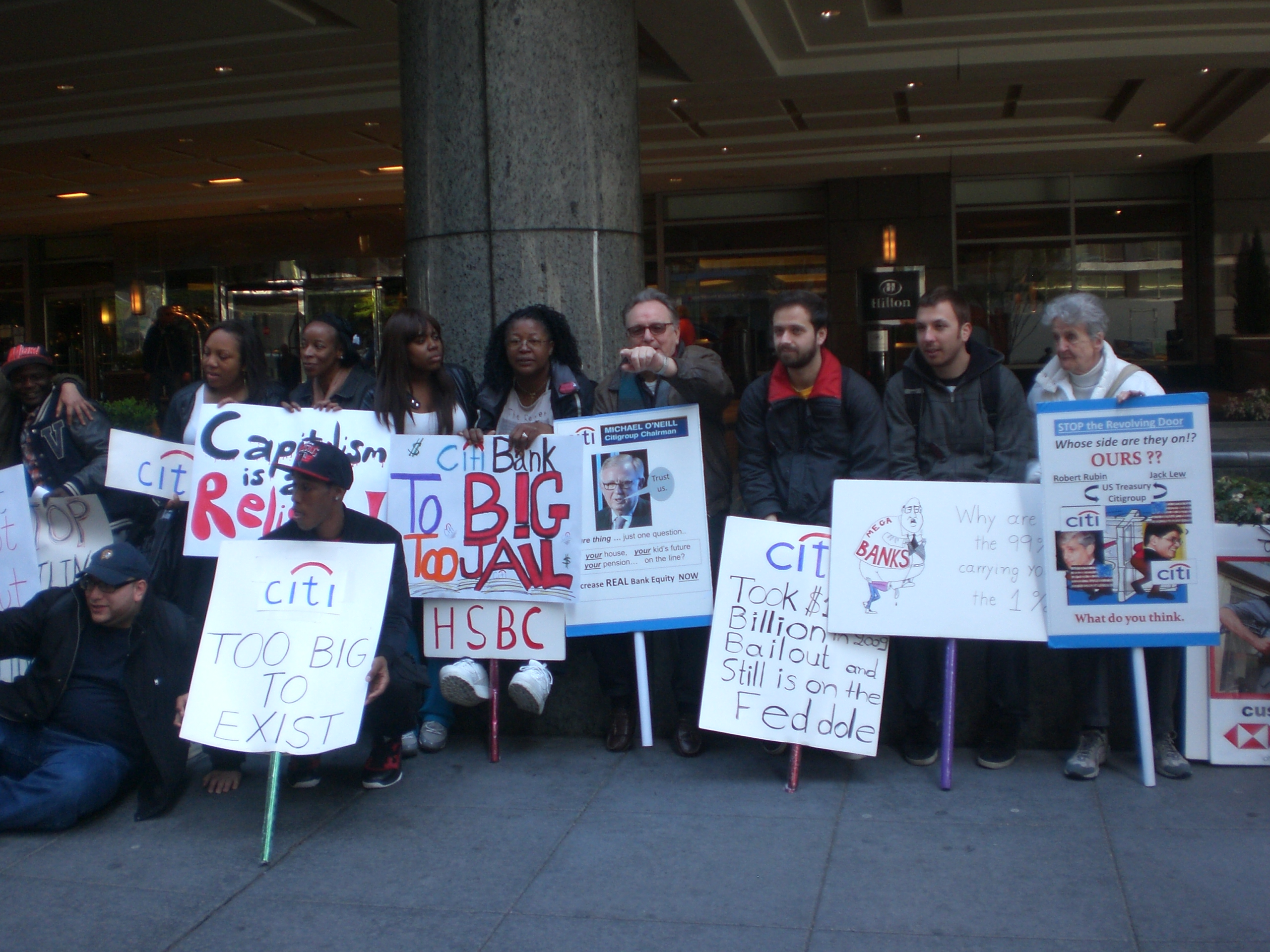
While I was away in D.C. attending a congressional hearing on big data (blog post on that will come soon!) my Alt Banking peeps staged a protest outside the Citigroup annual shareholder meeting in New York. Here’s some coverage:
- Financial Times
- Dealbreaker: Spandex-clad roller-girl
- Dealbreaker: Spandex-Clad Roller Girl Was Not Only Prepared To Put Citi Execs Over Her Knee But Read Them Their Rights
- La Jornada
- Marni’s recent essay in the Huffington Post
Here’s a picture of the whole group:
And here’s a picture of Marni, who was a huge hit:

Occupy Finance
Final thing: we’re writing a book in Alt Banking, called Occupy Finance, and modeled after the Debt Resistor’s Operation Manual, which we adore. Please volunteer to be a writer or an editor if you have time!
Note: you don’t need to be a specialist in finance to be an editor, that’s the point. We’re writing it for the interested public. Email me if you want to be part of it – my email is on the “About” page.
Who’s tracking the trackers?
This is a guest post by Josh Snodgrass.
As the Mathbabe noted recently, a lot of companies are collecting a lot of information about you. Thanks to two Firefox add-ons – Collusion (hat tip to Cathy) and NoScript — you can watch the process and even interfere with it to a degree.
Collusion is a beautiful app that creates a network graph of the various companies that have information about your web activity. Here is an example.

On this graph, I can see that nytimes.com has sent info on me to 2mdn.net, linkstorm.net, serving-sys.com, nyt.com and doubleclick.net. Who are these guys? All I know is that they know more about me than I know about them.
Doubleclick is particularly well-informed. They have gotten information on me from nytimes.com, yahoo.com and ft.com. You may not be able to see it on the picture but there are faint links between the nodes. Some (few) of the nodes are sites I have visited. Most of the nodes, especially some of the central ones are data collectors such as doubleclick and googleanalytics. They have gotten info from sites I’ve visited.
This graph is pretty sparse because I cleared all of my cookies recently. If I let it go for a week and the graph will be so crowded it won’t all fit on a screen.
Pretty much everyone is sharing info about me (and presumably you, too). And, I do mean everyone. Mathbabe is a dot near the top. Collusion tells me that mathbabe.org has shared info with google.com, wordpress.com, wp.com, 52shadesofgreed.com, youtube.com and quantserve.com. Google has passed the info on to googleusercontent.com and gstatic.com
I can understand why. WordPress and presumably wp.com are hosting her blog. Google is providing search capabilities. 52shadesofgreed has an ad posted (You can still buy the decks but even better, come to Alt-Banking meetings and get one free). Youtube is providing some content. It is all innocent enough in a way but it means my surfing is being tracked even on non-commercial sites.
These are the conveniences of modern life. Try blocking all cookies and you will find it pretty inconvenient to use the internet. It would be nice to be selective about cookies but that seems very hard. All of this is happening even though I’ve told my browser not to allow third-party cookies. If you look at cookie policies, it seems you have two alternatives:
- Block all cookies and the site won’t work very well
- Allow cookies and we will send your info to whomever we choose (within the law, of course).
So, it would be nice if there were a law that constrained what they do. My impression is that we Americans have virtually no protection. Europe is better from what I understand.
I’ve found another add-on called NoScript that is very helpful but also very disturbing. It tells you about JavaScripts that want to run when you visit a site.
I’m trying to access a site and there are scripts waiting to run from:
- Brightcove.com
- Quantserve.com
- Facebook.com
- Po.st Scorecard.com
- Wxug.com
- Admeld.com
- Googleadservices.com
- Legolas-media.com
- Criteo.com
- Crwdcntrl.com
Clearly a lot of those are about tracking me or showing me ads. As with cookies, if you block all the scripts, the site probably won’t function properly. But the great thing about NoScript is that is makes it easy to allow scripts one by one. So, you can allow the ones that look more legitimate until the site works well enough. Also, you can allow them temporarily.
NoScript and Collusion are great. But mostly they are making me more aware of all the tracking that is going on. And they are also making it clear how hard it is to keep your privacy.
This isn’t just on the internet. Years ago, an economist had an idea about having people put boxes on their cars that would track where they went and charge them for driving, particularly in high congestion times and places. The motivation was to reduce travel that causes a lot of pollution while no one is going anywhere. But people ridiculed the idea. Who would let themselves be tracked everywhere they went.
Well, 40 years later, nearly everyone who has a car has an EZ-pass. And, even if you don’t, they will take a picture of your license plate and keep it on file. All in the name of improving traffic flow.
And, if you use credit cards, there are some big companies that have records of your spending.
What to do about this?
I don’t know.
I like conveniences. Keeping your privacy is hard. DuckDuckGo is a search engine that doesn’t track you (another hat tip to Cathy). But their search results are not as good as Google’s.
Google has all these nice tools that are free. Even if you don’t use them, the web sites you visit surely do. And if they do, google is getting information from them, about you.
This experience has made me even more of a fan of Firefox and add-ons available in it. But what else should I use. And, none of these tools is going to be perfect.
What information gets tracked? A lot of privacy policies say they don’t give out identifying information. But how can we tell?
Just keeping on top of what is going on is hard. For example: what are LSOs? They seem to be a kind of “supercookies”. And Better Privacy seems to be an add-on to help with them.
FT.com’s cookie policy tells me that:
“Our emails may contain a single, campaign-unique “web beacon pixel” to tell us whether our emails are opened and verify any clicks through to links or advertisements within the email”
Who knew that a pixel could do so much?
The truth is, I want to see these sites. So I am enabling scripts (some of them, as few as I can). The question is how to make the tradeoff. Figuring that out is time consuming. I’ve got better things to do with my life.
I’m going to go read a book.
Big data and surveillance
You know how, every now and then, you hear someone throw out a statistic that implies almost all of the web is devoted to porn?
Well, that turns out to be a false myth, which you can read more about here – although once upon a time it was kind of true, before women started using the web in large numbers and before there was Netflix streaming.
Here’s another myth along the same lines which I think might actually be true: almost all of big data is devoted to surveillance.
Of course, data is data, and you could define “surveillance” broadly (say as “close observation”), to make the above statement a tautology. To what extent is Google’s data, collected about you, a surveillance database, if they only use it to tailor searches and ads?
On the other hand, something that seems unthreatening now can become creepy soon: recall the NSA whistleblower who last year described how the government stores an enormous amount of the “electronic communications” in this country to keep close tabs on us.
The past
Back in 2011, computerworld.com published an article entitled “Big data to drive a surveillance society” and makes the case that there is a natural competition among corporations with large databases to collect more data, have it more interconnected (knowing now only a person’s shopping habits but also their location and age, say) and have the analytics work faster, even real-time, so they can peddle their products faster and better than the next guy.
Of course, not everyone agrees to talk about this “natural competition”. From the article:
Todd Papaioannou, vice president of cloud architecture at Yahoo, said instead of thinking about big data analytics as a weapon that empowers corporate Big Brothers, consumers should regard it as a tool that enables a more personalized Web experience.
“If someone can deliver a more compelling, relevant experience for me as a consumer, then I don’t mind it so much,” he said.
Thanks for telling us consumers how great this is, Todd. Later in the same article Todd says, “Our approach is not to throw any data away.”
The present
Fast forward to 2013, when defence contractor Raytheon is reported to have a new piece of software, called Riot, which is cutting-edge in the surveillance department.
The name Riot refers to “Rapid Information Overlay Technology” and it can locate individuals with longitude and latitudes, using cell phone data, and make predictions as well, using data scraped from Facebook, Twitter, and Foursquare. A video explains how they do it. From the op-ed:
The possibilities for RIOT are hideous at consumer level. This really is the stalker’s dream technology. There’s also behavioural analysis to predict movements in the software. That’s what Big Data can do, and if it’s not foolproof, there are plenty of fools around the world to try it out on.
US employers, who have been creating virtual Gulags of surveillance for employees with much less effective technology, will love this. “We know what you do” has always been a working option for coercion. The fantastic levels of paranoia involved in the previous generations of surveillance technology will be truly gratified by RIOT.
The future
Lest we think that our children are not as affected by such stalking software, since they don’t spend as much time on social media and often don’t have cellphones, you should also be aware that educational data is now being collected about individual learners in the U.S. at an enormous scale and with very little oversight.
This report from educationnewyork.com (hat tip Matthew Cunningham-Cook) explains recent changes in privacy laws for children, which happen to coincide with how much data is being collected (tons) and how much money is in the analysis of that data (tons):
Schools are a rich source of personal information about children that can be legally and illegally accessed by third parties.With incidences of identity theft, database hacking, and sale of personal information rampant, there is an urgent need to protect students’ rights under FERPA and raise awareness of aspects of the law that may compromise the privacy of students and their families.
In 2008 and 2011, amendments to FERPA gave third parties, including private companies,increased access to student data. It is significant that in 2008, the amendments to FERPA expanded the definitions of “school officials” who have access to student data to include “contractors, consultants, volunteers, and other parties to whom an educational agency or institution has outsourced institutional services or functions it would otherwise use employees to perform.” This change has the effect of increasing the market for student data.
There are lots of contractors and consultants, for example inBloom, and they are slightly less concerned about data privacy issues than you might be:
inBloom has stated that it “cannot guarantee the security of the information stored … or that the information will not be intercepted when it is being transmitted.”
The article ends with this:
The question is: Should we compromise and endanger student privacy to support a centralized and profit-driven education reform initiative? Given this new landscape of an information and data free-for-all, and the proliferation of data-driven education reform initiatives like CommonCore and huge databases of student information, we’ve arrived at a time when once a child enters a public school,their parents will never again know who knows what about their children and about their families. It is now up to individual states to find ways to grant students additional privacy protections.
No doubt about it: our children are well on their way to being the most stalked generation.
Privacy policy
One of the reasons I’m writing this post today is that I’m on a train to D.C. to sit in a Congressional hearing where Congressmen will ask “big data experts” questions about big data and analytics. The announcement is here, and I’m hoping to get into it.
The experts present are from IBM, the NSF, and North Carolina State University. I’m wondering how they got picked and what their incentives are. If I get in I will write a follow-up post on what happened.
Here’s what I hope happens. First, I hope it’s made clear that anonymization doesn’t really work with large databases. Second, I hope it’s clear that there’s no longer a very clear dividing line between sensitive data and nonsensitive data – you’d be surprised how much can be inferred about your sensitive data using only nonsensitive data.
Next, I hope it’s clear that the very people who should be worried the most about their data being exposed and freely available are the ones who don’t understand the threat. This means that merely saying that people should protect their data more is utterly insufficient.
Next, we should understand what policies already in place look like in Europe:
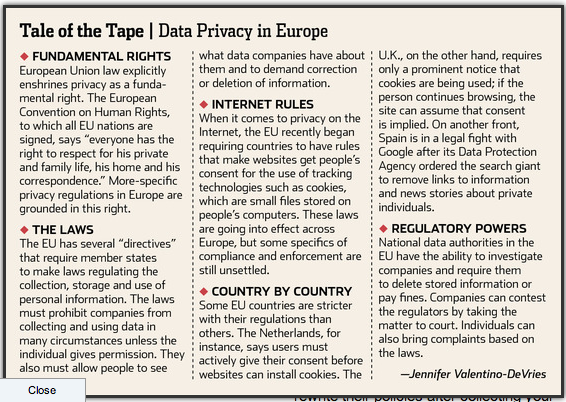
Finally, we should focus not only the collection of data, but on the usage of data. Just because you have a good idea of my age, race, education level, income, and HIV status doesn’t mean you should be able to use that information against me whenever you want.
In particular, it should not be legal for companies that provide loans or insurance to use whatever information they can buy from Acxiom about you. It should be a highly regulated set of data that allows for such decisions.
10 reasons to protest at Citigroup’s annual shareholder meeting tomorrow (#OWS)
The Alternative Banking group of #OWS is showing up bright and early tomorrow morning to protest at Citigroup’s annual shareholder meeting. Details are: we meet outside the Hilton Hotel, Sixth Avenue between 53rd and 54th Streets, tomorrow, April 24th, from 8-10 am. We’ve already made some signs (see below).
Here are ten reasons for you to join us.
1) The Glass-Steagall Act, which had protected the banking system since 1933, was repealed in order to allow Citibank and Traveler’s Insurance to merge.
In fact they merged before the act was even revoked, giving us a great way to date the moment when politicians started taking orders from bankers – at the time, President Bill Clinton publicly declared that “the Glass–Steagall law is no longer appropriate.”
2) The crimes Citi has committed have not been met with reasonable punishments.
From this Bloomberg article:
In its complaint against Citigroup, the SEC said the bank misled investors in a $1 billion fund that included assets the bank had projected would lose money. At the same time it was selling the fund to investors, Citigroup took a short position in many of the underlying assets, according to the agency.
The SEC only attempted to fine Citi $285 million, even though Citi’s customers lost on the order of $600 million from their fraud. Moreover, they were not required to admit wrongdoing. Judge Rakoff refused to sign off on the deal and it’s still pending. Citi is one of those banks that is simply too big to jail.
3) We’d like our pen back, Mr. Weill. Going back to repealing Glass-Steagall. Let’s take an excerpt from this article:
…at the signing ceremony of the Gramm-Leach-Bliley, aka the Glass Steagall repeal act, Clinton presented Weill with one of the pens he used to “fine-tune” Glass-Steagall out of existence, proclaiming, “Today what we are doing is modernizing the financial services industry, tearing down those antiquated laws and granting banks significant new authority.”
Weill has since decided that repealing Glass-Steagall was a mistake.
4) Do you remember the Plutonomy Memos? I wrote about them here. Here’s a tasty excerpt which helps us remember when the class war was started and by whom:
We project that the plutonomies (the U.S., UK, and Canada) will likely see even more income inequality, disproportionately feeding off a further rise in the profit share in their economies, capitalist-friendly governments, more technology-driven productivity, and globalization… Since we think the plutonomy is here, is going to get stronger… It is a good time to switch out of stocks that sell to the masses and back to the plutonomy basket.
5) Robert Rubin – enough said. To say just a wee bit more, let’s look at the Bloomberg Businessweek article, “Rethinking Robert Rubin”:
Rubinomics—his signature economic philosophy, in which the government balances the budget with a mix of tax increases and spending cuts, driving borrowing rates down—was the blueprint for an economy that scraped the sky. When it collapsed, due in part to bank-friendly policies that Rubin advocated, he made more than $100 million while others lost everything.
That $100 million was made at Citigroup, which was later bailed out because of bets Rubin helped them make. He has thus far shown no remorse.
6) The Revolving Door problems Citigroup has. Bill Moyers has a great article on the outrageous revolving door going straight from banks to the Treasury and the White House. What with Rubin and Lew, Citigroup seems pretty much a close second behind Goldman Sachs for this sport.
7) The bailout. Citigroup took $100 billion from the Fed at the height of the bailout in January 2009.
8) The bailout was actually for Citigroup. If you’ve read Sheila Bair’s book Bull by the Horns, you’ll see the bailout from her inside perspective. And it was this: that Citigroup was really the bank that needed it worst. That in fact, the whole bailout was a cover for funneling money to Citi.
9) The ongoing Fed dole. The bailout is still going on – and Citigroup is currently benefitting from the easy money that the Fed is offering, not to mention the $83 billion taxpayer subsidy. WTF?!
10) Lobbying for yet more favors. Citi spent $62 million from 2001 to 2010 on lobbying in Washington. What’s their return on that investment, do you think?
Join us tomorrow morning! Details here.

How to reinvent yourself, nerd version
I wanted to give this advice today just in case it’s useful to someone. It’s basically the way I went about reinventing myself from being a quant in finance to being a data scientist in the tech scene.
In other words, many of the same skills but not all, and many of the same job description elements but not all.
The truth is, I didn’t even know the term “data scientist” when I started my job hunt, so for that reason I think it’s possibly good and useful advice: if you follow it, you may end up getting a great job you don’t even know exists right now.
Also, I used this advice yesterday on my friend who is trying to reinvent himself, and he seemed to find it useful, although time will tell how much – let’s see if he gets a new job soon!
Here goes.
- Write a list of things you like about jobs: learning technical stuff, managing people, whatever floats your boat.
- Next, write a list of things you don’t like: being secretive, no vacation, office politics, whatever. Some people hate working with “dumb people” but some people can’t stand “arrogant people”. It makes a huge difference actually.
- Next, write a list of skills you have: python, basic statistics, math, managing teams, smelling a bad deal, stuff like that. This is probably the most important list, so spend some serious time on it.
- Finally, write a list of skills you don’t have that you wish you did: hadoop, knowing when to stop talking, stuff like that.
Once you have your lists, start going through LinkedIn by cross-searching for your preferred city and a keyword from one of your lists (probably the “skills you have” list).
Every time you find a job that you think you’d like to have, take note of what skills it lists that you don’t have, the name of the company, and your guess on a scale of 1-10 of how much you’d like the job into a spreadsheet or at least a file. This last part is where you use the “stuff I like” and “stuff I don’t like” lists.
And when you’ve done this for a long time, like you made it your job for a few hours a day for at least a few weeks, then do some wordcounts on this file, preferably using a command line script to add to the nerdiness, to see which skills you’d need to get which jobs you’d really like.
Note LinkedIn is not an oracle: it doesn’t have every job in the world (although it might have most jobs you could ever get), and the descriptions aren’t always accurate.
For example, I think companies often need managers of software engineers, but they never advertise for managers of software engineers. They advertise for software engineers, and then let them manage if they have the ability to, and sometimes even if they don’t. But even in that case I think it makes sense: engineers don’t want to be managed by someone they think isn’t technical, and the best way to get someone who is definitely technical is just to get another engineer.
In other words, sometimes the “job requirements” data on LInkedIn dirty, but it’s still useful. And thank god for LinkedIn.
Next, make sure your LinkedIn profile is up-to-date and accurate, and that your ex-coworkers have written letters for you and endorsed you for your skills.
Finally, buy a book or two to learn the new skills you’ve decided to acquire based on your research. I remember bringing a book on Bayesian statistics to my interview for a data scientist. I wasn’t all the way through the book, and my boss didn’t even know enough to interview me on that subject, but it didn’t hurt him to see that I was independently learning stuff because I thought it would be useful, and it didn’t hurt to be on top of that stuff when I started my new job.
What I like about this is that it looks for jobs based on what you want rather than what you already know you can do. It’s in some sense the dual method to what people usually do.
How much math do scientists need to know?
I’m catching up with reading the “big data news” this morning (via Gil Press) and I came across this essay by E. O. Wilson called “Great Scientist ≠ Good at Math”. In it, he argues that most of the successful scientists he knows aren’t good at math, and he doesn’t see why people get discouraged from being scientists just because they suck at math.
Here’s an important excerpt from the essay:
Over the years, I have co-written many papers with mathematicians and statisticians, so I can offer the following principle with confidence. Call it Wilson’s Principle No. 1: It is far easier for scientists to acquire needed collaboration from mathematicians and statisticians than it is for mathematicians and statisticians to find scientists able to make use of their equations.
Given that he’s written many papers with mathematicians and statisticians, then, he is not claiming that math itself is not part of great science, just that he hasn’t been the one that supplied the mathy bits. I think this is really key.
And it resonates with me: I’ve often said that the cool thing about working on a data science team in industry, for example, is that different people bring different skills to the table. I might be an expert on some machine learning algorithms, while someone else will be a domain expert. The problem requires both skill sets, and perhaps no one person has all that knowledge. Teamwork kinda rocks.
Another thing he exposes with Wilson’s Principle No. 1, though, which doesn’t resonate with me, is a general lack of understanding of what mathematicians are actually trying to accomplish with “their equations”.
It is a common enough misconception to think of the quant as a guy with a bunch of tools but no understanding or creativity. I’ve complained about that before on this blog. But when it comes to professional mathematicians, presumably including his co-authors, a prominent scientist such as Wilson should realize that they are doing creative things inside the realm of mathematics simply for the sake of understanding mathematics.
Mathematicians, as a group, are not sitting around wishing someone could “make use of their equations.” For one thing, they often don’t even think about equations. And for another, they often think about abstract structures with no goal whatsoever of connecting it back to, say, how ants live in colonies. And that’s cool and beautiful too, and it’s not a failure of the system. That’s just math.
I’m not saying it wouldn’t be fun for mathematicians to spend more time thinking about applied science. I think it would be fun for them, actually. Moreover, as the next few years and decades unfold, we might very well see a large-scale shrinkage in math departments and basic research money, which could force the issue.
And, to be fair, there are probably some actual examples of mathy-statsy people who are thinking about equations that are supposed to relate to the real world but don’t. Those guys should learn to be better communicators and pair up with colleagues who have great data. In my experience, this is not a typical situation.
One last thing. The danger in ignoring the math yourself, if you’re a scientist, is that you probably aren’t that great at knowing the difference between someone who really knows math and someone who can throw around terminology. You can’t catch charlatans, in other words. And, given that scientists do need real math and statistics to do their research, this can be a huge problem if your work ends up being meaningless because your team got the math wrong.
Aunt Pythia’s advice
Aunt Pythia is happy to be be here, striving as always to answer your questions helpfully and wisely. Even if they have nothing whatsoever to do with sex (single tear running down her face).
If you don’t know what you’re in for, go here for past advice columns and here for an explanation of the name Pythia. Most importantly,
Please submit your PG questions at the bottom of this column!
——
Dear Aunt Pythia,
What are your thoughts about the use of amphetamines or other stimulants (specifically as performance enhancing drugs) in academia or the workplace? Clearly, there are legal issues that one could bring up should a person be obtaining them illicitly; so let’s say for the sake of argument that you read an article online interviewing an academic who has a doctor that knowingly prescribes her/him ritalin for its use as a “performance enhancer” (as opposed to prescribing it for ADD). The doctor assures the interviewer that she carefully monitors the academic’s use of the drug so as to minimize the effects of physiological dependence or addiction and that, from all observations she has made, the academic is responsible about taking the drug and does not abuse it. The interviewer then asks the academic why she/he uses it, and the academic responds that taking the drug allows for a level of productivity that is at or above the level of others in their field, and they fear they could not be as competitive as others in the job market should they stop taking it. What reaction are you left with after reading the (hypothetical) article?
Ever Reflect on the Debate On Speed
Dear ERDOS,
It’s no secret that Erdos was a benzedrine addict. My parents knew him when I was a kid (my dad wrote a paper with him) and so even if I hadn’t heard it through the grapevine I’d know it through that channel. It’s totally true. Moreover, he wasn’t the only mathematician who was popping pills beck then, or for that matter even now. It’s widespread.
In terms of my opinion, I have no moral opinion about it. As far as I’m concerned drug use isn’t a moral issue at all, unless it leaks out into people’s responsibilities to others, which as far as I know never happened with Erdos.
But I do have a personal theory about who does that and why, and Erdos is a great example for my theory. Namely, people who really don’t have any other interests in their lives except math. They are single-mindedly pursuing theorems at the exclusion of having a family, or love, or sex. They’re willing to forgo sex in order to prove theorems faster.
Note I say faster, because I don’t actually think drugs make you smarter, they just let you focus more efficiently. I might be wrong about this, it’s a guess. It would be interesting to see evidence one way or the other.
That’s a pretty huge sacrifice, since I usually think the way things work is something like: be good at something, so you can be successful, so you can get laid. Someone who is forgoing sex for the sake of being good at something is therefore, in my framework, sacrificing the end for the means. But all that means is that other people have different ends than I have.
Aunt Pythia
——
Dear Aunt Pythia,
My son’s teacher was fretting about how dangerous it is to teach in view of sandy hook. Of course anytime you are in public someone could shoot you. But if you are alone you might choke with no one to help you. So it is it more likely to be saved or killed by a stranger when you are in public
Kill or be Killed
Dear Kill,
A more gruesome statistical question you’re never gonna see. I don’t know the answer either, especially if you consider the case where the guy was pushed into the subway tracks and nobody helped him. And if the killer has a gun, then what’s a bystander to do?
In general I think people who really want to kill each other are pretty good at doing it, at least the first time they try. Considering that, we are pretty lucky how rare that is. I’d also add that staying inside all the time is also pretty safe, but your quality of life is pretty low.
As far as the case at hand, namely teachers, I’d worry more about standardized testing and the vilification of my profession than about armed killers.
Aunt Pythia
——
Dear Aunt Pythia,
Do you think introverts stand a chance when it comes to working up the ladder at a cutthroat large corporation?
Quiet in Seattle
Dear Quiet,
If you’d stopped at “large corporation” then I’d have said, “sure, why not?” since all corporations rely on the work of a bunch of different types of people, and introverts are bound to find a place there as well.
But you added “cutthroat” so it’s all about that word. I think you’re kind of answering your own question: if by cutthroat you mean you need to play politics with the sales guys and win, then no, introverts have no chance in such a place.
But if that’s the way it seems from your seat, I’d suggest there might be a different place in your company where you’d find plenty of introverts. Maybe you could switch your division. If not, then just get out altogether, it doesn’t sound healthy!
Aunt Pythia
——
Dear Aunt Pythia,
I have been writing Smalltalk programs that use heuristics to make lottery predictions. The process entails creating competing rankings of numbers and then using wheels to generate combinations. Numbers are ranked using rules about history patterns. The process is deterministic and a combination in a particular position is always generated with the same process. I collect winning information by block and by line. I play the best blocks or the best lines in the next drawing. Do you have a better system?
Lost in Space
Dear Lost,
Yes, yes I do have a better system. I call my system “don’t play the lottery.”
Aunt Pythia
——
Dear Aunt Pythia,
I’ve been interviewing at a lot of different places in data science in several major cities lately. One thing that really sticks out is that there has been literally zero female technical representation amongst the interviewers — besides myself, everyone is a [Caucasian/Asian] male. Where are all the chicks [and Hispanics/Latinos/African-Americans]? We’re such a huge chunk of the population, seems like I should be seeing more different types of people. And do you think this diversity thing matters much anyway?
Diversify This!
Dear Diversify,
I hear you! I think data science is a ton of fun, and I’d love to see more diversity in our midst. I’m getting feedback on my company’s upcoming bootcamp that we should make it for women, or at least make a version for women. That might help, And it would be a lot of fun.
In terms of whether I think it “matters,” I do think there’s an enormous amount of selection bias in the ways companies think about their users and what they want, and they shrink their potential by having only narrow views. So yes, I think it matters. But more immediately the question is how to improve it.
What do you think?
Aunt Pythia
——
Please submit your question to Aunt Pythia!
On being an alpha female, part 2
Almost a year ago now I wrote this post on being an alpha female. I had only recently understood that I was an alpha female, when I wrote it, and it was still kind of new and weird.
For whatever reason it’s been coming up a lot recently and I wanted to update that post with my observations.
Who’s burning which bridges?
Last week I wrote an outraged post about seeing Ina Drew at Barnard.
Mind you, I had anticipated I’d find the event objectionable. I had even polled my Occupy friends for prepared questions for her. But when I got there I realized pretty quickly that I wouldn’t be able to ask her anything. I was just too disgusted with the tone and conceit of the event to participate in it reasonably. Instead I live tweeted the event and seethed.
I lost sleep that night fuming about Drew-as-role-model, and I was grateful to be able to get some of my frustration out on my blog.
One of the first comments I received was this one, which said:
Boy Cathy, you sure do know how to burn bridges.
This was, for me, kind of a perfect alpha female moment. My immediate reaction was to think to myself,
They burned bridges with me, you mean.
Since that sounded too arrogant, at the moment anyway, I said something else just slightly less obnoxious. Three points to make here:
- Anyone who doesn’t agree with me about whether Ina Drew should be celebrated can go suck it.
- That post got linked to from Reuters, FT.com, and Naked Capitalism. Which doesn’t happen when you’re worrying about burning bridges.
- When I’m in a certain kind of mood, I’m simply not concerned with other people’s judgments. I think that’s just part of being an alpha female, and I’m grateful for it.
Why grateful? Because lots of shitty things happen when people go around worrying about “burning their bridges” instead of speaking up about bullshit or evil-doing. Or, as Felix Salmon tweeted recently:
Best point made on this #waronwhistleblowers panel: failure to leak has cost many more lives than leaking ever has.
— felix salmon (@felixsalmon) April 17, 2013
Taking notes from an uber alpha female
A few months ago I got an email inviting me to speak in a Python in Finance conference. The email was somewhat weird and kind of just came out and said they need women speakers. I was put in a position of being asked to be a token woman, which is a mindset I don’t enjoy.
I thought about it though, and although I use python, and I used to work in finance, I don’t work in finance any more, and I don’t really think about python too much, I just use it. So I said to the organizer, no thanks, I don’t have anything to say at that conference.
Fast forward to the week before the conference, when I got wind of the agenda. It turned out my friend Claudia Perlich, Chief Data Scientist at m6d and one of the contributors to my upcoming book with Rachel Schutt, was the keynote speaker. I decided to go to the conference essentially because I wanted to see her.
Well, it turned out Claudia had gotten a similar email, and she had accepted the invitation, even though she doesn’t work in finance and doesn’t even use python (she uses perl).
She gave a great talk about modeling blind spots, which everyone enjoyed. It was quite possibly the best talk of the day, in fact. Plus, she wasn’t at all token – having her on the schedule was what made me come to the conference, and I probably wasn’t the only one. And judging by the crowd at the Meetup I gave last night, I would have drawn my own crowd too, if I had been speaking.
I made an alpha female note to myself that day to accept any invitation to a conference that I’d enjoy, even if my expertise isn’t completely within the realm of the conference. I’m learning from Claudia, a master alpha female. Or is it mistress?
Alpha females and self-image
Chris Wiggins recently sent me this essay entitled “A Rant on Women” by Clay Shirky, a writer and professor who studies the social and economic effects of Internet technologies. Here’s the first paragraph:
So I get email from a good former student, applying for a job and asking for a recommendation. “Sure”, I say, “Tell me what you think I should say.” I then get a draft letter back in which the student has described their work and fitness for the job in terms so superlative it would make an Assistant Brand Manager blush.
Guess what? That student is male.
Shirky goes on to vent about how women don’t oversell themselves enough compared to men and how it’s a problem. An excerpt:
There is no upper limit to the risks men are willing to take in order to succeed, and if there is an upper limit for women, they will succeed less. They will also end up in jail less, but I don’t think we get the rewards without the risks.
This made me think about my experience. First, as a Barnard professor, I certainly saw this effect. I’d have men and women come talk to me about letters of recommendations, and not only would I prepare myself for the difference in posture, I’d try to address it directly, by encouraging women to learn how to brag about their accomplishments. I might have tried to convince men a couple of times to stop bragging quite so much, but quickly found that to be a huge waste of time.
But beyond corroborating that this is typical behavior, the essay made me remember myself as a college student.
When I met my thesis advisor, Barry Mazur, who was on sabbatical at UC Berkeley, I remember telling him a math problem I had worked on and solved. He expressed something about liking the problem and being impressed that I’d explained it so well, and I said back,
“Yeah, I’m awesome”
I remember this because of his reaction. At the time, the word “awesome” was widely used among teenagers, but evidently he hadn’t gotten the teenager memo, and he was taken aback by the way I used it. At least that’s what he said. But now that I think about it, maybe he was taken aback that I’d said it at all.
Alpha females and body image
My friend and guest poster Becky recently sent me this video:
It’s about how women have a biased view on their looks, or at least describe their looks to other people in a consistently negatively biased way.
There’s a great critique of this video here (hat tip Avani Patel), wherein fashion and style guru Jennifer Choy complains that the underlying message to the above video is that, in any case, beauty is about all women have going for them, so they should not underestimate their beauty. Plus that all the women in the video were skinny, young, and white.
Great points, but my take was somewhat different.
My immediate reaction to the video was to say, these women need to spend less time thinking about being fat or ugly, and more time thinking about what they think is sexy and attractive. Why is it always about finding flaws in ourselves? Why don’t we spend more time thinking about what turns us on or what we think is beautiful?
I’ll be honest: I think if I had been interviewed in that setting, I would have said something like, “Gorgeous and sexy as hell” and gone on to list my best features. I am not sure I’d have even been able to describe what I look like in any detail, with any accuracy. Most likely I would have just started bragging about my sexy grey streaks. Even more likely: I wouldn’t have had the time to sit down for this interview at all.
Don’t get me wrong, I’ve dabbled in being insecure in my looks: puberty sucked, as did all three post-natal periods until the baby was weaned*, in addition to any time I was ever on the pill**. I’ve concluded that my inherent arrogance is directly related to my hormones, which in turn makes it undeniably tied to my alpha femaleness.
Suffice it to say, when my hormones are not messed up I have “body eumorphia,” where I ignore or downplay any non-perfect parts of my body. It’s a nice feeling.
It kind of makes me want to develop an alpha female hormone treatment. Business model?
UPDATE: Please watch this new spoof video, it’s perfect (except it should be alpha females and men, not just men):
* It gets better when you know it’s going to go away. By the third kid I was like, “gonna cry every day at 3:00pm for the next six weeks. Must schedule that into my calendar.”
** Note to doctors: you need to tell women that the real reason birth control pills work so well is that you lose interest in sex when you’re on them!
Global move to austerity based on mistake in Excel
As Rortybomb reported yesterday on the Roosevelt Institute blog (hat tip Adam Obeng), a recent paper written by Thomas Herndon, Michael Ash, and Robert Pollin looked into replicating the results of a economics paper originally written by Carmen Reinhart and Kenneth Rogoff entitled Growth in a Time of Debt.
The original Reinhart and Rogoff paper had concluded that public debt loads greater than 90 percent of GDP consistently reduce GDP growth, a “fact” which has been widely used. However, the more recent paper finds problems. Here’s the abstract:
Herndon, Ash and Pollin replicate Reinhart and Rogoff and find that coding errors, selective exclusion of available data, and unconventional weighting of summary statistics lead to serious errors that inaccurately represent the relationship between public debt and GDP growth among 20 advanced economies in the post-war period. They find that when properly calculated, the average real GDP growth rate for countries carrying a public-debt-to-GDP ratio of over 90 percent is actually 2.2 percent, not -0:1 percent as published in Reinhart and Rogo ff. That is, contrary to RR, average GDP growth at public debt/GDP ratios over 90 percent is not dramatically different than when debt/GDP ratios are lower.
The authors also show how the relationship between public debt and GDP growth varies significantly by time period and country. Overall, the evidence we review contradicts Reinhart and Rogoff ’s claim to have identified an important stylized fact, that public debt loads greater than 90 percent of GDP consistently reduce GDP growth.
A few comments.
1) We should always have the data and code for published results.
The way the authors Herndon, Ash and Pollin managed to replicate the results was that they personally requested the excel spreadsheets from Reinhart and Rogoff. Given how politically useful and important this result has been (see Rortybomb’s explanation of this), it’s kind of a miracle that they released the spreadsheet. Indeed that’s the best part of this story from a scientific viewpoint.
2) The data and code should be open source.
One cool thing is that now you can actually download the data – there’s a link at the bottom of this page. I did this and was happy to have a bunch of csv files and some (open source) R code which presumably recovers the excel spreadsheet mistakes. I also found some .dta files, which seems like Stata proprietary file types, which is annoying, but then I googled and it seems like you can use R to turn .dta files into csv files. It’s still weird that they wrote code in R but saved files in Stata.
3) These mistakes are easy to make and they’re mostly not considered mistakes.
Let’s talk about the “mistakes” the authors found. First, they’re excluding certain time periods for certain countries, specifically right after World War II. Second, they chose certain “non-standard” weightings for the various countries they considered. Finally, they accidentally excluded certain rows from their calculation.
Only that last one is considered a mistake by modelers. The others are modeling choices, and they happen all the time. Indeed it’s impossible not to make such choices. Who’s to say that you have to use standard country weightings? Why? How much data do you actually need to consider? Why?
[Aside: I’m sure there are proprietary trading models running right now in hedge funds that anticipate how other people weight countries in standard ways and betting accordingly. In that sense, using standard weightings might be a stupid thing to do. But in any case validating a weighting scheme is extremely difficult. In the end you’re trying to decide how much various countries matter in a certain light, and the answer is often that your country matters the most to you.]
4) We need to actually consider other modeling possibilities.
It’s not a surprise, to economists anyway, that after you include more post-WWII years of data, which we all know to be high debt and high growth years worldwide, you get a substantively different answer. Excluding these data points is just as much a political decision as a modeling decision.
In the end the only reasonable way to proceed is to describe your choices, and your reasoning, and the result, but also consider other “reasonable” choices and report the results there too. And if you don’t like the answer, or don’t want to do the work, at the very least you need to provide your code and data and let other people check how your result changes with different “reasonable” choices.
Once the community of economists (and other data-centric fields) starts doing this, we will all realize that our so-called “objective results” utterly depend on such modeling decisions, and are about as variable as our own opinions.
5) And this is an easy model.
Think about how many modeling decisions and errors are in more complicated models!
Tax haven in comedy: the Caymans (#OWS)
This is a guest post by Justin Wedes. A graduate of the University of Michigan with degrees in Physics and Linguistics with High Honors, Justin has taught formerly truant and low-income youth in subjects ranging from science to media literacy and social justice activism. A founding member of the New York City General Assembly (NYCGA), the group that brought you Occupy Wall Street, Justin continues his education activism with the Grassroots Education Movement, Class Size Matters, and now serves as the Co-Principal of the Paul Robeson Freedom School.
Yesterday was tax day, when millions of Americans fulfilled that annual patriotic ritual that funds roads, schools, libraries, hospitals, and all those pesky social services that regular people rely upon each day to make our country liveable.
Millions of Americans, yes, but not ALL Americans.
Some choose to help fund roads, schools, libraries, hospitals in other places instead. Like the Cayman Islands.
Don’t get me wrong – I love Caymanians. Beautifully hospitable people they are, and they enjoy arguably the most progressive taxes in the world: zero income tax and only the rich pay when they come to work – read “cook the books” – on their island for a few days a year. School is free, health care guaranteed to all who work. It’s a beautiful place to live, wholly subsidized by the 99% in developed countries like yours and mine.
When they stash their money abroad and don’t pay taxes while doing business on our land, using our workforce and electrical grids and roads and getting our tax incentives to (not) create jobs, WE pay.
We small businesses.
We students.
We nurses.
We taxpayers.
I went down to the Caymans myself to figure out just how easy it is to open an offshore tax haven and start helping Caymanians – and myself – rather than Americans.
Here’s what happened:
Interview with Chris Wiggins: don’t send me another $^%& shortcut alias!
When I first met Chris Wiggins of Columbia and hackNY back in 2011, he immediately introduced me to about a hundred other people, which made it obvious that his introductions were highly stereotyped. I thought he was some kind of robot, especially when I started getting emails from his phone which all had the same (long) phrases in them, like “I’m away from my keyboard right now, but when I get back to my desk I’ll calendar prune and send you some free times.”
Finally I was like “what the hell, are you sending me whole auto-generated emails”? To which he replied “of course.”
Chris posted the code to his introduction script last week so now I have proof that some of my favorite emails I thought were from him back in 2011 were actually from tcsh.
Feeling cheated, I called him to tell him he has an addiction to shell scripting. Here’s a brief interview, rewritten to make me sound smarter and cooler than I am.
——
CO: Ok, let’s start with these iphone shortcuts. Sometimes the whole email from you reads like a bunch of shortcuts.
CW: Yup, lots of times.
CO: What the hell? Don’t you want to personalize things for me at least a little?
CW: I do! But I also want to catch the subway.
CO: Ugh. How many shortcuts do you have on that thing?
CW: Well.. (pause)..38.
CO: Ok now I’m officially worried about you. What’s the longest one?
CW: Probably this one I wrote for Sandy: If I write “sandy” it unpacks to
“Sorry for delay and brevity in reply. Sandy knocked out my phone, power, water, and internet so I won’t be replying as quickly as usual. Please do not hesitate to email me again if I don’t reply soon.”
CO: You officially have a problem. What’s the shortest one?
CW: Well, when I type “plu” it becomes “+1”
CO: Ok, let me apply the math for you: your shortcut is longer than your longcut.
CW: I know but not if you include switching from letters to numbers on the iphone, which is annoying.
CO: How did you first become addicted to shortcuts?
CW: I got introduced to UNIX in the 80s and, in my frame of reference at the time, the closest I had come to meeting a wizard was the university’s sysadmin. I was constantly breaking things by chomping cpu with undead processes or removing my $HOME or something, and he had to come in and fix things. I learned a lot over his shoulder. In the summer before I started college, my dream was to be a university sysadmin. He had to explain to me patiently that I shouldn’t spend college in a computercave.
CO: Good advice, but now that you’re a grownup you can do that.
CW: Exactly. Anyway, everytime he would fix whatever incredible mess I had made he would sign off with some different flair and walk out, like he was dropping the mic and walking off stage. He never signed out “logout” it was always “die” or “leave” or “ciao” (I didn’t know that word at the time). So of course by the time he got back to his desk one day there was an email from me asking how to do this and he replied:
“RTFM. alias”
CO: That seems like kind of a mean thing to do to you at such a young age.
CW: It’s true. UNIX alias was clearly the gateway drug that led me to writing shell scripts for everything.
CO: How many aliases do you have now?
CW: According to “alias | wc -l “, I have 1137. So far.
CO: So you’ve spent countless hours making aliases to save time.
CW: Yes! And shell scripts!
CO: Ok let’s talk about this script for introducing me to people. As you know I don’t like getting treated like a small cog. I’m kind of a big deal.
CW: Yes, you’ve mentioned that.
CO: So how does it work?
CW: I have separate biography files for everyone, and a file called nfile.asc that has first name, lastname@tag, and email address. Then I can introduce people via
% ii oneil@mathbabe schutt
It strips out the @mathbabe part (so I can keep track of multiple people named oneil) from the actual email, reads in and reformats the biographies, grepping out the commented lines, and writes an email I can pipe to mutt. The whole thing can be done in a few seconds.
CO: Ok that does sound pretty good. How many shell scripts do you have?
CW: Hundreds. A few of them are in my public mise-en-place repository, which I should update more. I’m not sure which of them I really use all the time, but it’s pretty rare I type an actual legal UNIX command at the command line. That said I try never to leave the command line. Students are always teaching me fancypants tricks for their browsers or some new app, but I spend a lot of time at the command line getting and munging data, and for that, sed, awk, and grep are here to stay.
CO: That’s kinda sad and yet… so true. Ok here’s the only question I really wanted to ask though: will you promise me you’ll never send me any more auto-generated emails?
CW: no.


 mathbabe