Archive
Aunt Pythia’s advice: the nerdy edition
Aunt Pythia is ginormously and ridonkulously excited to be here. She just got back from a nifty bike ride to the other side of the Hudson and took this picture of this amazing city on this amazing day:

The bike traffic on the GWB is not too bad at 7:10am.
OK, so full disclosure. Aunt Pythia kind of blew her load, so to speak, on the sex questions last week, so she’s making do with coyly answering nerdy questions. Because that’s what we got.
I hope you enjoy her efforts, and even if you despise them – especially if you despise them – don’t forget to:
please think of something to ask Aunt Pythia at the bottom of the page!
By the way, if you don’t know what the hell Aunt Pythia is talking about, go here for past advice columns and here for an explanation of the name Pythia.
——
Hi Aunt Pythia,
I’m a math student at MIT, where you did a postdoc. I’m also into computers, and am considering working in some finance classes. I could see myself being happy working for some big financial company that I don’t really care about, as long as I have interesting problems to work on, make a ton of money, and have bright people I get to work with.
My interests right now are in very pure math, I get chills just thinking about categorical-theoretic concepts. I’m planning to learn commutative algebra and algebraic geometry soon. I’m also likely to take stochastic calculus.
What kind of math did you do? Any tips on if taking the pure math I love will be of use, or at least get me “cred” with financial companies?
I do love math, and seeing that you did math at MIT and have seen this world of things, maybe you have some advice to offer me.
Thank you dearly.
Math Cult
Dear MC,
Don’t do it!
Don’t take the math to get “cred” with financial companies. Do what is sexy and beautiful to you. If you love category theory, do that, then do algebra and algebraic geometry. I did number theory in the form of arithmetic algebraic geometry myself. It’s awesomely beautiful and I don’t regret one moment of it.
Let’s say you do decide to go into the “real world.” At the end of the day, if you can do that math stuff we’ve been talking about, you can learn other stuff too. So I’m not going to worry about you on the technical side of things.
On the other side of things, I’d like you to rethink the idea that you “don’t mind who you work for as long as you have interesting problems.” Is that really true? Once you leave pure math there are real applications of your work, and they affect real people. Shit gets real real quick and stuff matters, and I urge you to think it through some more.
Good luck!
Aunt Pythia
——
Dear Aunt Pythia,
Do all mathematicians visualize their problems? From a logical viewpoint there are a lot of mathematical spaces that don’t map onto an imagined 3d workspace but on limited conversations with working mathematicians they seem to me to do it at least at some stage of problem solving.
(I’m more of a physicist who visualizes nearly everything so maybe I’m misreading them.)
Inner glimmer
Dear Inner,
Most, but not all. I once had a conversation with someone who couldn’t understand my drawing of a geometric map between spaces. I was explaining the concept visually (or at least I thought I was!) but he forced me to write it down with double sums and formulas, and I thought that was the weirdest thing ever, but that’s how it became understandable to him.
In general we do think visually, although we really can’t think beyond three dimensions (even though we pretend we can). I guess time makes it 4. Most geometers I know, ironically, don’t have a very good working sense of 3 dimensions, and definitely don’t have a good sense of direction!
Come to think of it my sample is too small, so I’m mostly just saying that for fun. It would be neat to get actual statistics on that. Maybe if I’m ever pulled into going to JMM again I’ll make people fill out forms. Oh wait, I’m going to JMM this January.
I can ask about this, it’s a nice question! Readers, what else should I poll math nerds on?
Aunt Pythia
——
Dear Aunt Pythia,
I’m an American mutt and for awhile I was annoyed when people asked “Where are you from” or “What’s your nationality”. I think I was sensitive to it because kids wanted to narrow down exactly which ethnic slurs to use. But as an adult, mostly people are just curious, and I’m happy to share since I’m curious about them too.
When I meet someone with an accent, I’m curious about them and their background, what it’s like in their home country, how they came to the US, etc.
What is an appropriate way to ask about someone’s ethnic background or country of origin? It seems like you should be able to ask anyone this question; it just seems rude when that person is different from you. Do you know what I mean?
WHy Ask That Rude qUestion
Dear WHATRU,
I like the subtle sign-off!
Here’s the thing, I think you nailed it. If your intention is to be mean, then don’t ask it. If your intention is to be friendly and to make a connection, then go ahead and ask it! I always ask cabbies where they come from, and then I get to learn about their countries. I have never experienced someone who doesn’t want to talk to me about their home country, and I’ve made quite a few friends. I’ve been invited to so many countries for visits, and that is always so incredibly generous and sweet! People are amazing.
Of course, some people just don’t do this kind of small-talk, and I get that too. It’s not for everyone. But it’s super fun for us extroverts.
Aunt Pythia
——
Dear Aunt Pythia,
First off, you’re blog is both entertaining and informative, and you’ve found the sweet spot combination of the two that makes it addictive.
I find your work with the Lede program at Columbia fascinating and relevant to the growing, amorphous “big data” movement. I am a frequent visitor of websites such as Fivethirtyeight, which Nate Silver has rebranded as a news source that derives its stories from statistics and big data analytics. Even other sources, such as The Atlantic, have begun to follow suit and incorporate large statistical analyses into some of their stories. This experiment of basing our news stories on statistics brings hope that we can move closer to the ideal of an unbiased account.
In light of this new format (and your school), what sources do you consider the best? Are there any that you visit to get an insightful statistical perspective on the news. Or do you side with the criticism that many of these sites fuel a sensationalist, biased view of the world intended to spawn viral stories?
Will we ever find the right place for statistics in the news?
Considering unbiased reality in our ubiquitous (news)stories
Dear Curious,
Holy crap, nice sign-off. And thanks for being addicted to mathbabe! All my evil plans are working. Time to start on the next phase… moo-hooo-hahahahahaha.
OK, so here’s the thing. We will never have unbiased accounts. Never. At the very least we will have bias in the way that data is collected.
What I’ve spent the summer talking to my students about is getting used to the fact that there will always be bias, and how we therefore do our best to be at least somewhat aware of them, and try very hard not to obscure them. Transparency is the new objectivity!
This is of course disappointing to people who want there to be “one truth,” but that’s how science is. After a while we get used to the disappointment and we can all appreciate some really good signal/noise ratios.
As for the right place for statistics in the news, I think we’re figuring that out right now, and I’m excited to be part of it. And holy shit, have you seen the new ProPublica work on the Louisiana coast? Those guys are killing it.
Love,
Aunt Pythia
——
Please submit your well-specified, fun-loving, cleverly-abbreviated question to Aunt Pythia!
The bad teacher conspiracy
Any time I see an article about the evaluation system for teachers in New York State, I wince. People get it wrong so very often. Yesterday’s New York Times article written by Elizabeth Harris was even worse than usual.
First, her wording. She mentioned a severe drop in student reading and math proficiency rates statewide and attributed it to a change in the test to the Common Core, which she described as “more rigorous.”
The truth is closer to “students were tested on stuff that wasn’t in their curriculum.” And as you can imagine, if you are tested on stuff you didn’t learn, your score will go down (the Common Core has been plagued by a terrible roll-out, and the timing of this test is Exhibit A). Wording like this matters, because Harris is setting up her reader to attribute the falling scores to bad teachers.
Harris ends her piece with a reference to a teacher-tenure lawsuit: ‘In one of those cases, filed in Albany in July, court documents contrasted the high positive teacher ratings with poor student performance, and called the new evaluation system “deficient and superficial.” The suit said those evaluations were the “most highly predictive measure of whether a teacher will be awarded tenure.”’
In other words, Harris is painting a picture of undeserving teachers sneaking into tenure in spite of not doing their job. It’s ironic, because I actually agree with the statement that the new evaluation system is “deficient and superficial,” but in my case I think it is overly punitive to teachers – overly random, really, since it incorporates the toxic VAM model – but in her framing she is implying it is insufficiently punitive.
Let me dumb Harris’s argument down even further: How can we have 26% English proficiency among students and 94% effectiveness among teachers?! Let’s blame the teachers and question the legitimacy of tenure.
Indeed, after reading the article I felt like looking into whether Harris is being paid by David Welch, the Silicon Valley dude who has vowed to fight teacher tenure nationwide. More likely she just doesn’t understand education and is convinced by simplistic reasoning.
In either case, she clearly needs to learn something about statistics. For that matter, so do other people who drag out this “blame the teacher” line whenever they see poor performance by students.
Because here’s the thing. Beyond obvious issues like switching the content of the tests away from the curriculum, standardized test scores everywhere are hugely dependent on the poverty levels of students. Some data:

It’s not just in this country, either:

Considering how many poor kids we have in the U.S., we are actually doing pretty well.
The conclusion is that, unless you think bad teachers have somehow taken over poor schools everywhere and booted out the good teachers, and good teachers have taken over rich schools everywhere and booted out the bad teachers (which is supposed to be impossible, right?), poverty has much more of an effect than teachers.
Just to clarify this reasoning, let me give you another example: we could blame bad journalists for lower rates of newspaper readership at a given paper, but since newspaper readership is going down everywhere we’d be blaming journalists for what is a cultural issue.
Or, we could develop a process by which we congratulate specific policemen for a reduced crime rate, but then we’d have to admit that crime is down all over the country.
I’m not saying there aren’t bad teachers, because I’m sure there are. But by only focusing on rooting out bad teachers, we are ignoring an even bigger and harder problem. And no, it won’t be solved by privatizing and corporatizing public schools. We need to address childhood poverty. Here’s one more visual for the road:

A decision tree for decision trees
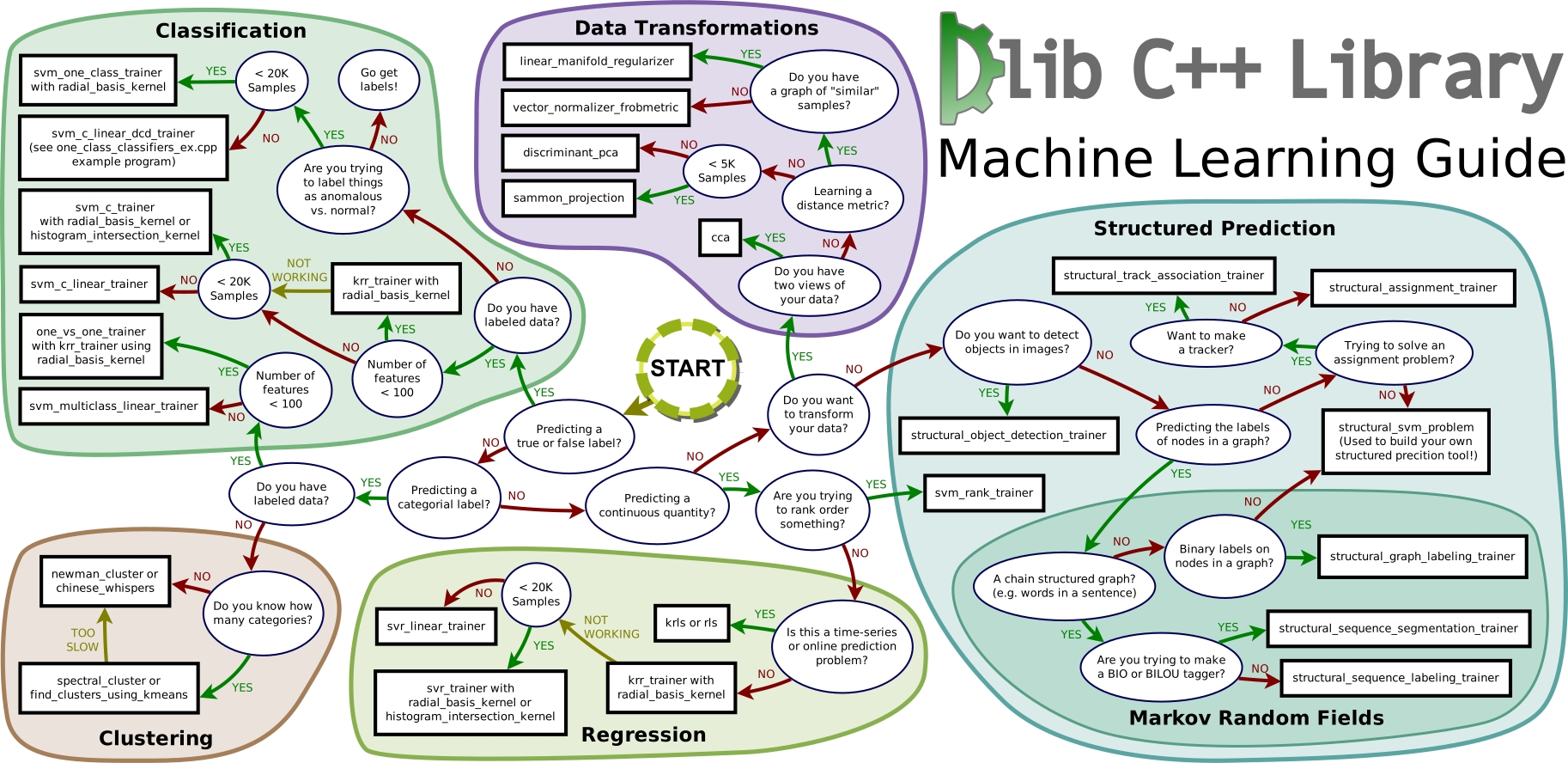
For a while now I’ve been thinking I should build a decision tree for deciding which algorithm to use on a given data project. And yes, I think it’s kind of cool that “decision tree” would be an outcome on my decision tree. Kind of like a nerd pun.
I’m happy to say that I finally started work on my algorithm decision tree, thanks to this website called gliffy.com which allows me to build flowcharts with an easy online tool. It was one of those moments when I said to myself, this morning at 6am, “there should be a start-up that allows me to build a flowchart online! Let me google for that” and it totally worked. I almost feel like I willed gliffy.com into existence.
So here’s how far I’ve gotten this morning:

Not far! But I also learned how to use the tool.
I looked around the web to see if I’m doing something that’s already been done and I came up with this:
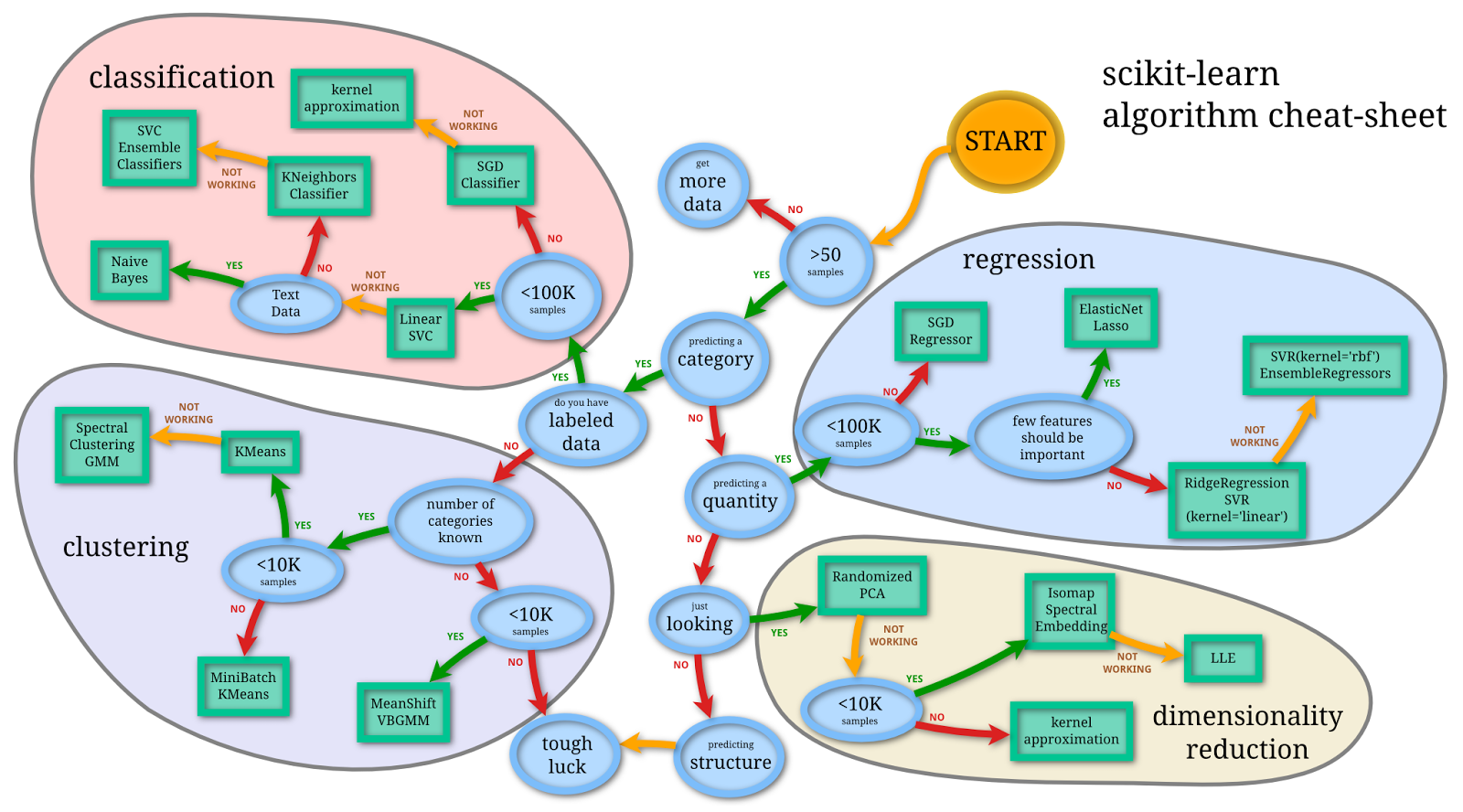
I appreciate the effort but this is way more focused on the size of the data than I intend to be, at least for now. And here’s another one that’s even less like the one I want to build but is still impressive.
Because here’s what I want to focus on: what kind of question are you answering with which algorithm? For example, with clustering algorithms you are, you know, grouping similar things together. That one’s easy, kind of, although plenty of projects have ended up being clustering or classifying algorithms whose motivating questions did not originally take on the form “how would we group these things together?”.
In other words, the process of getting at algorithms from questions is somewhat orthogonal to the normal way algorithms are introduced, and for that reason taking me some time to decide what the questions are that I need to ask in my decision tree. Right about now I’m wishing I had taken notes when my Lede Program students asked me to help them with their projects, because embedded in those questions were some great examples of data questions in search of an algorithm.
Please give me advice!
Aise O’Neil at Gotham Comedy Club
I don’t usually blog about my kids, but my 14-year-old son has explicitly given me his blessing to post his recent stand-up performance at the Gotham Comedy Club:
The look he gives the audience at the end is my favorite part.
The Stubborn Hope of an Urban Teacher
Yesterday I read a book written by Carole Marshall which she called Stubborn Hope: Memoir of an Urban Teacher (thanks to Ernest Davis for sending it to me). Just to give you an idea of how quick this read is, I read it before class. I think it took about 1 hour and 10 minutes in all.
In a nutshell, it was the story of a really hard-working and dedicated urban school teacher who learned how to teach reading skills, and prose and poetry writing skills to her poverty-stricken students in the urban Providence, RI area. She develops curriculum, making it relevant to the kids, and gets them to read every night and to aspire to college. The school that she mostly taught at is profiled in this article from the Brown Daily Herald.
She’s a really good writer herself, and she profiles a bunch of her students with enough details to make you feel enormous empathy for their struggles. In other words, she makes this shit very very real. After reading this you stop wondering why we see a strong negative correlation between standardized tests scores and poverty levels, because it is so obvious.
You might want to check out this video to get a satirical idea of what this woman was like and what she was dealing with (hat tip Jenn Rubinovitz):
Here’s the thing. We need nice white ladies in our schools! And of course nice other people too.
But we are presently losing such dedicated people. Carole Marshall, the author of these memoirs, quit teaching after the school system she worked in was taken over by the mindless testing zombies. She describes her experience like this:
After spending years refining strategies for getting my students to become enthusiastic readers and writers on thoughtful, relevant curriculum, I was being forced to teach canned curriculum purchased for millions of dollars from textbook publishers who knew nothing about urban teaching.
School and district administrators roamed the halls and classrooms, taking notes on shiny new iPads, to make sure teachers were on the same page every day as every other teacher in our grade and subject in the district. All the activities we had used in the past to open our students to a world beyond the narrow constraints of their neighborhoods were no longer permitted; they were seen as time wasted. Every path to good teaching was effectively blocked off.
It had become impossible to do the things with students that I believe teachers need to be able to do. What was going on in the classrooms could no longer be called teaching. When I realized that, it was a sad day. At the end of that year, I left teaching.
That was in 2012, I believe. Since then she’s become more aware of the national disaster that is defined by the testing insanity. She even worked for a time with a test prep company based in Florida that was clearly scamming for the $5 million consultant fee and removing cherry-picked students from important classes so the school would look like it had improved based on the arbitrary measure of the month.
We are so used to pointing at examples of bad and defeated teachers and saying that they are the problem, and that a strict and regimented system of curriculum will improve the classrooms for the students of such teachers. And maybe in some cases that is true.
But when we do that we also push out really talented and inspirational teachers like Carole Marshall. It is painful to imagine how many great teachers have left the educational system because of No Child Left Behind and Race To The Top. Come to think of it, that would be a great data journalism project.
Gillian Tett gets it very wrong on racial profiling
Last Friday Gillian Tett ran a profoundly disturbing article in the Financial Times entitled Mapping Crime – Or Stirring Hate? (hat tip Marcos Carreira), which makes me sad to say this given how much respect I normally have for her regarding her coverage of the financial crisis.
In the article, Tett describes the predictive policing model used by the Chicago police force, which told the police where to go to find criminals based on where people had been arrested in the past.
Her article reads like an advertisement for racist profiling. First she deftly and indirectly claims the model is super successful at lowering the murder rate without actually coming out and saying so (since she actually has only correlative evidence):
And when Weis launched the programme in early 2010, together with a clever policeman-cum-computer expert called Brett Goldstein, it delivered impressive results. In the first year the murder rate fell 5 per cent and then continued to tumble. Indeed by the summer of 2011 it looked as if Chicago’s annual death toll would soon drop below 400, the lowest since 1965. “The homicide rates for that summer were just crazy low compared to what we had been,” Weis observes.
But then, following his departure from the force, the programme was wound down in late 2011. And, tragically, the murder rate immediately rose again.
Here’s the thing, it’s really hard to actually know why murder rates go up and down. In New York City we’ve been using Stop & Frisk as the violent crime rates have been steadily lowering in this city (and many others), and for a long time Bloomberg took credit for that through the Stop & Frisk practice. But when Stop & Frisk rates went down, murder rates didn’t shoot up. Just saying. And that’s ignoring how reliable the police data is, which is another issue. Let’s take a look at her evidence for a longer time frame:
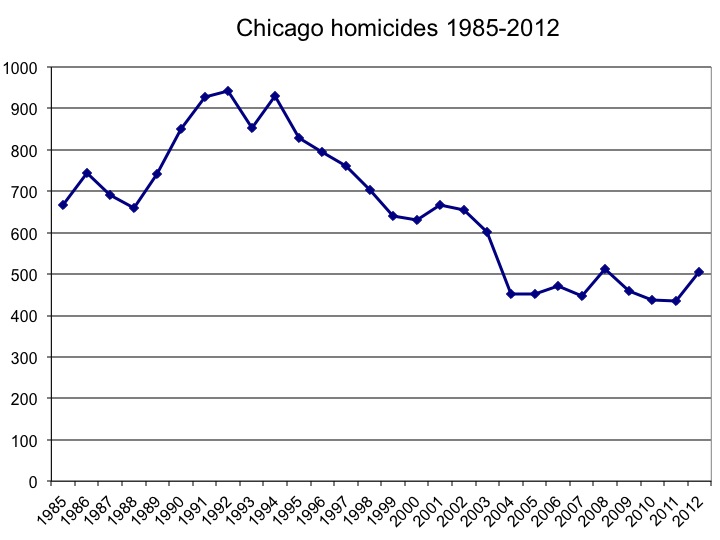
She’s talking about that small uptick at the end, which to the naked eye could well be statistical noise.
The reason I’m pointing out her bad statistics is that she needs them to set up the following, truly disturbing paragraphs (emphasis mine):
But while racism is rightly deemed unacceptable, computer programs pose more subtle questions. If a spreadsheet forecast has a racial imbalance, is this likely to reinforce existing human biases, or racial profiling? Or is a weather map of crime simply a neutral tool? To put it another way, does the benefit of using predictive policing outweigh any worries about political risk?
Personally, I think it does. After all, as the former CPD computer experts point out, the algorithms in themselves are neutral. “This program had absolutely nothing to do with race… but multi-variable equations,” argues Goldstein. Meanwhile, the potential benefits of predictive policing are profound.
No, Gillian Tett, there is no such thing as a neutral tool. No algorithm focused on human behavior is neutral. Anything which is trained on historical human behavior embeds and codifies historical and cultural practices. Specifically, this means that the fact that black Americans are nearly four times as likely as whites to be arrested on charges of marijuana possession even though the two groups use the drug at similar rates would be seen by such a model (or rather, by the people who deploy the model) as a fact of nature that is neutral and true. But it is in fact a direct consequence of systemic racism.
Put it another way: if we allowed a model to be used for college admissions in 1870, we’d still have 0.7% of women going to college. Thank goodness we didn’t have big data back then!
This is very scary to me, when even Gillian Tett, who famously predicted the financial crisis in 2006, can be fooled. We clearly have a lot of work to do.
Aunt Pythia’s advice: the sex edition
Holy crap it’s already been an eventful morning and it’s not even 10am. Aunt Pythia blew a bike tire on the George Washington Bridge and had to walk back across and find the 1 train near 181st street, which was hidden from view. Seriously, it was.
Now, if Aunt Pythia ever asked for advice herself, she would know to carry a spare tire and tools to change a flat. But does Aunt Pythia ever ask for or take advice? I think not. Shame on you, Aunt Pythia, shame on you.
In spite of that obvious flaw, Aunt Pythia is super excited to finally be warming up the advice bus engine. Vroom vroom! Put the pedal to the medal, Auntie P!
As it happens, all the questions are about sex today, and yes that was by design, things this awesomesauce don’t “just happen”. Aunt Pythia makes them happen, please keep this in mind.
After this most ridiculous and sexy ride, please don’t forget to:
please think of something to ask Aunt Pythia at the bottom of the page!
I am almost out of questions!!!
By the way, if you don’t know what the hell Aunt Pythia is talking about, go here for past advice columns and here for an explanation of the name Pythia.
——
Dearest Aunt Pythia,
I’ve been dating this guy for a couple of months, and we always have a lot of fun when we go out on dates together. We see each other at least once or twice a week, but we’ve only been intimate 4 times. Those 4 times have been great, and I don’t mind moving slowly, but a few nights ago something happened that made me question some things:
After a nice dinner-and-a-movie date, I invited him up for a drink (knowing it was a weekend and he would probably be sleeping over). We watched some Hulu, had a drink or two, and then both declared that we were tired and should move to the bedroom. I slipped into the bathroom to put on something a little more “comfortable” (read: I took my pants off), and when I came back into the room, he was in bed wearing boxers and a t-shirt. I got in bed with him, expecting things to heat up, but instead he FELL ASLEEP! That’s right: he had a smart, funny, beautiful and PANTS-LESS girl lying next to him in bed, and he made no attempts to initiate contact. He slept on one side, I slept on the other, with absolutely zero touching. When we woke up the next morning, he acted like his sweet old self and just said he “passed out” because he was “so tired.”
What’s the deal!? Was he really THAT tired? Is he gay? Is he homeless and needed a bed to crash on!? Or maybe worst of all: is he already so comfortable in this “relationship” that he no longer feels the need to be intimate every time we have a sleep over?
I like this guy a lot, but I also like when guys touch me a lot. Have you ever been through this? Any advice?
Lonely on the bathroom side of the bed
Dear Lonely,
First of all, it’s important to know if this is a one-time, “special occasion” thing or a regular occurrence. If, say, he had competed in a triathlon that day, for example, then it would actually make sense for him to be too tired. On that night.
On the other hand, if he does this regularly – and judging by the numbers you gave me, whereby he has seen you about 20 times but you guys have only gotten down 4 times, there does seem to be some regularity to his reluctance – I’m gonna have to conclude that yes, he’s gay.
Haha, no, just kidding. What it really means is that he’s less sexual than you are. Or that he’s not that into you, although since you are smart, funny, beautiful, and pants-less, it’s hard to really imagine that. There are just so many ways I start imagining that and then the imagining just doesn’t move in that direction at all. Nope, it doesn’t.
Here’s a fun theory, that I’ll just throw out there because “not as sexual as you” is so depressing and final: he’s really into kinky sex but hasn’t gotten the nerve up to tell you. Although, to tell you the truth, I’m not seeing evidence for that. Usually people really into kinky sex are agitated and nervous, and hoping you notice their leather bracelets and suchnot, and they typically don’t accidentally fall asleep. Poop.
So, here’s an idea. When you’re next with him and you want to get sexy, take off your shirt and start rubbing your boobs on him. See if that works. After all, why are you waiting for him to initiate? That’s old fashioned and silly. And that also answers the other question you asked near the end of your letter! Why wait passively when you can make it happen? So yeah, go ahead and make the first move, and see if that works.
And if it doesn’t, then you know with a clear conscience that you’ve given it a valiant effort, and he’s just Not Very Sexual. In which case I suggest you run straight for OK Cupid. Or Tinder. Or my slutty friends’ favorite, HowAboutWe.
Good luck!
Aunt Pythia
——
Dear Aunt Pythia,
I’ve recently encountered a few men who refuse to wear condoms. One actually said to me: “I’d rather never have sex again than have sex with a condom.” (Spoiler alert: I didn’t have sex with him). I’ve even had guys try to bully me into going bareback by saying things like “Come on, are we in high school?”
What’s the deal? Unless we are in a monogamous situation in which both parties have been tested AND I am regularly taking birth control (or we are ready to have children), there is no way we’re having condomless sex. Aunt Pythia, do you have any go-to sassy remarks I can whip out when confronted with this aversion to safe sex?
Not Obliging Boys Acting Bullyish In Ejaculating Situations
Dear NOBABIES,
HOLY CRAP I LOVE YOUR SIGN-OFF!!!! It’s perfect. I am ordering a plaque with that on it from zazzle.com.
I am also very in love with you for not taking that bullying crap. YOU ARE AWESOME.
And yes, I do have advice. Sex is not defined as vaginal intercourse. Tell him you guys can have sex without vaginal intercourse, and that it’s fine with you because it might even increase the probability of your overall enjoyment (read: more attention to your clitoris). And if he is super interested in vaginal intercourse, he will have to wear a condom. Because that’s how grownups who do not want to monogamous or have children have vaginal intercourse. But again, since there are lots of other ways to enjoy each others’ bodies, it’s all good.
Key phrase: “only middle schoolers define sex so narrowly as vaginal intercourse! Hahaha, can you IMAGINE!?!” Conversation over.
UPDATE: use condoms during oral sex as well to avoid oral HPV or gonorrhea!
Aunt Pythia
——
Aunt Pythia,
Thanks for all the love. I owe you many hugs. Share with me your take on an approach for the mid-life male discussing the warm-and-fuzzy male experience of age-related sexual dysfunction with a new female partner.
To maximize my affectionate partner’s satisfaction level, I’m fine with my future use of vitamin V (or Cialis or whatever’s been approved), but maybe the relationship honesty/trust thing is also served with a moment of “this stuff happens too.” My last girlfriend, a very loving, lovely, talented woman (also a clinical pharmacist) did not seem able to process the facts of male life-cycle physiology, instead framing the issue as “you’ve lost interest in me,” which cranked up the performance pressure.
Maybe that didn’t help the sex=fun equation & it definitely didn’t help the relationship. I think a plan to focus on showing more interest in multiple ways in the future is called for. But maybe it’s a good moment for some Auntie insight.
Mid-Life Laughs Every Minute
Dear Mid-Life Laughs,
First of all, here’s some more love and hugs.
Next, let’s talk about sex. Here’s the thing about Vitamin V: I’m so glad it exists. It’s another tool in the sex toolbox, sitting there right next to KY Jelly and the feather duster.

Every post needs at least one picture.
Is there a female version of Vitamin V? Not sure, and maybe I could go on a rant about that, but not today. Instead, I want to spend today appreciating just how much fun we can all have if we are understanding and forgiving and loving and sexy.
I think the new lady will – or should – understand the difference between the will and the reality of such things, especially if your words are consistently positive regarding the former, and especially if you go ahead and prepare yourself with a complete toolbox, including the above pictured feather duster. In other words, make it about her pleasure. Who can resist that? Answer: nobody.
Good luck!
Auntie P
——
Hi lovely Auntie P,
This is really good, so I thought I’d share.
Someone recently shared with me their list of “books that changed my life”. The first one I’m reading is called “Passionate Marriage” and has indeed the potential to be life-changing. It is a synthesis of sex therapy and marital counseling supposed to help one enhance their sex life. That sounds theoretical but I suggest you pick it up if you haven’t already.
Since I’m actually supposed to ask a question and cannot merely plug my latest page-turner, here are two, totally unrelated.
- Does Auntie P have a list of books that changed her life and can she, in her transfinite wisdom, share that list with her readers?
- What would you say constitutes “great sex”?
By the way, I loved your bit about everyone having crushes on one another. The world is such a beautiful place. You’re doing your part. I love you for that.
Getting Reads On Wishlist
Dear GROW,
I love you too! And thanks for the book suggestion, I will definitely check that out. After all, who doesn’t want an enhanced sex life? Answer: nobody.
As for the questions, let me think about it after I look up the word “transfinite”…
OK I’m back, and still somewhat confused, but I’ll let it pass.
- Here’s the thing, I can’t remember any book I’ve ever read. For some reason I have an excellent memory for ideas but not people, and remembering where I first heard an idea is nearly impossible for me. I know that’s crazy but it’s true. If I had to say which book affected me the most, I’d have to say The Brothers Karamazov, when I was 15, but I only remember how much I loved the book, not anything about the actual content. Well, I do remember the brothers names and their general characters, but not much more. In general, though, I like books that make me think differently and challenge my assumptions. And I don’t like books with scenes in which people are mean to children.
- This one is easy. Great sex is when both people feel great about it. It is characterized by generosity, empathy, and fun. Not so different, really, from a great dinner or a great bike ride with someone.
Hey, readers, what are your answers to these questions?
Warmly,
Aunt Pythia
——
Please submit your well-specified, fun-loving, cleverly-abbreviated question to Aunt Pythia!
Jeff Larson kills it at the Lede Program
So, Jeff Larson from ProPublica came yesterday to talk to us at the Lede Program, and damn that guy is awesome.
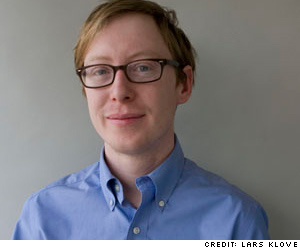
Jeff Larson, my data journalism hero!
First, he showed us his work with the ProPublica Message Machine, where they first crowdsourced, then reverse engineered Obama’s political targeting algorithm. Turns out they used decision trees for that, so we got to talk about decision trees. But since it was an awesome project important to democracy, we also got to talk about democracy.
After that lengthy discussion, Jeff told us about using clustering algorithms to find interesting emails in foreign languages (and in particular, to sort out the spam). He mentioned both cosine similarity and k-means, which was cool because the Lede students already knew about those, and for a moment the class was like, “hey we can do this!” and it was true.
But just then, he showed us how to bypass captcha pages, at least 90% of the time, using neural networks. He seemed to somehow remain humble whilst explaining that he did this over a lunch break. Then the class was like, “holy shit this guy is a crazy genius!” and that was true too.
Then Jeff led the entire program downtown to the ProPublica offices and gave us a tour of the office, and some of the other data journalists came in and told us what they were up to, which was super awesome but also top secret so I can’t tell you anything else about it. Suffice it to say they were all very awesome and that only one of them had formal CS training (Jeff was a lit major!), so the day was overall very inspiring and thought provoking.
When the story IS the interaction with the public
Here at the Lede Program we’ve been getting lots of different perspectives on what data journalism is and what it could be. As usual I will oversimplify for the sake of clarity, and apologies in advance to anyone I might offend.
The old school version of data journalism, which is called computer assisted reporting, maintains that a data story is first and foremost a story and should be viewed as such: you are investigating and interrogating the data as you would a witness, but the data isn’t itself a story, but rather a way of gathering evidence for the claims posed in the story. Every number cited needs to be independently supported with a secondary source.
Really important journalism lives in this context and is supported by the data, and the journalists in this realm are FOIA experts and speak truth to power in an exciting way. Think leaks and whistleblowers.
The new school vision of data journalism – again, entirely oversimplified – is that, by creating interesting data interactives that allow people to see how the news affects them – whether that means a map of “stuff happening” where they can see the stuff happening near them, or a big dataset that people can interact with in a tailored way, or a jury duty quiz that allows people to see how answers might get them kicked off or kept on a jury.
I imagine that some of these new-fangled approaches don’t even seem like stories at all to the old-school journalists, who want to see a bad guy caught, or a straight-up story told with a twist and a surprise and a “human face”. I’m not sure many of them would even get past the pitch stage if proffered to a curmudgeonly editor (and all editors are curmudgeonly, that’s just a fact).
The new interactive stories do not tell one story. Instead, they tell a bunch of stories to a bunch of people, and that interaction itself becomes the story. They also educate the public in a somewhat untamed way: by interacting with a database a reader can see variations in time, or in space, or in demographic, at least if the data is presented carefully.
Similarly, by seeing how each question on a jury duty quiz nudges you towards the plaintiff or the defendant, you can begin to see how seemingly innocuous information collected about you accumulates, which is how profiles are formed, on and offline.
Nafeez Ahmed to join Alt Banking this Sunday
I am super excited to announce that best-selling British author Nafeez Ahmed will be speaking at the Alt Banking group this Sunday. The title of his talk is Mass Surveillance and the Crisis of Civilization: The inevitable collapse of the old paradigm and the potential for the rise of the new.
Ahmed is an international security scholar and investigative journalist and executive director of the Institute for Policy Research & Development. He writes for The Guardian on the geopolitics of interconnected environmental, energy and economic crises, and is currently on tour in the United States to launch his science fiction novel, Zero Point.
As advance reading for this talk, we recommend browsing through his Guardian articles, including the widely read June 2014 piece, Pentagon preparing for mass civil breakdown. He’s also recently published on occupy.com an article entitled Exposed: Pentagon Funds New Data-Mining Tools To Track and Kill Activists, Part I.
Details: Ahmed will speak from 2-3pm on Sunday, August 24th, in room 409 of the International Affairs Building of Columbia University at W. 118th Street and Amsterdam Ave. After that we will have our regular meeting from 3-5pm in the same room, followed by food and drinks at Amsterdam Tapas. Please join us! And if you can’t this weekend but want to be on our mailing list, please email that request to alt.banking.ows@gmail.com.
Advertising vs. Privacy
I’ve was away over the weekend (apologies to Aunt Pythia fans!) and super busy yesterday but this morning I finally had a chance to read Ethan Zuckerman’s Atlantic piece entitled The Internet’s Original Sin, which was sent to me by my friend Ernest Davis.
Here’s the thing, Zuckerman gets lots of things right in the article. Most importantly, the inherent conflict between privacy and the advertisement-based economy of the internet:
Demonstrating that you’re going to target more and better than Facebook requires moving deeper into the world of surveillance—tracking users’ mobile devices as they move through the physical world, assembling more complex user profiles by trading information between data brokers.
Once we’ve assumed that advertising is the default model to support the Internet, the next step is obvious: We need more data so we can make our targeted ads appear to be more effective.
This is well said, and important to understand.
Here’s where Zuckerman goes a little too far in my opinion:
Outrage over experimental manipulation of these profiles by social networks and dating companies has led to heated debates amongst the technologically savvy, but hasn’t shrunk the user bases of these services, as users now accept that this sort of manipulation is an integral part of the online experience.
It is a mistake to assume that “users accept this sort of manipulation” because not everyone has stopped using Facebook. Facebook is, after all, an hours-long daily habit for an enormous number of people, and it’s therefore sticky. People don’t give up addictive habits overnight. But it doesn’t mean they are feeling the same way about Facebook that they did 4 years ago. People are adjusting their opinion of the user experience as that user experience is increasingly manipulated and creepy.
An analogy should be drawn to something like smoking, where the rates have gone way down since we all found out it is bad for you. People stopped smoking even though it is really hard for most people (and impossible for some).
We should instead be thinking longer term about what people will be willing to leave Facebook for. What is the social networking model of the future? What kind of minimum privacy protections will convince people they are safe (enough)?
And, most importantly, will we even have reasonable minimum protections, or will privacy be entirely commoditized, whereby only premium pay members will be protected, while the rest of us will be thrown to the dogs?
What can be achieved by Data Science?
This is a guest post by Sophie Chou, who recently graduated from Columbia in Computer Science and is on her way to the MIT Media Lab. Crossposted on Sophie’s blog.
“Data Science” is one of my least favorite tech buzzwords, second to probably “Big Data”, which in my opinion should be always printed followed by a winky face (after all, my data is bigger than yours). It’s mostly a marketing ploy used by companies to attract talented scientists, statisticians, and mathematicians, who, at the end of the day, will probably be working on some sort of advertising problem or the other.
Still, you have to admit, it does have a nice ring to it. Thus the title Democratizing Data Science, a vision paper which I co-authored with two cool Ph.D students at MIT CSAIL, William Li and Ramesh Sridharan.
The paper focuses on the latter part of the situation mentioned above. Namely, how can we direct these data scientists, aka scientists who interact with the data pipeline throughout the problem-solving process (whether they be computer scientists or programmers or statisticians or mathematicians in practice) towards problems focused on societal issues?
In the paper, we briefly define Data Science (asking ourselves what the heck it even means), then question what it means to democratize the field, and to what end that may be achieved. In other words, the current applications of Data Science, a new but growing field, in both research and industry, has the potential for great social impact, but in reality, resources are rarely distributed in a way to optimize the social good.
We’ll be presenting the paper at the KDD Conference next Sunday, August 24th at 11am as a highlight talk in the Bloomberg Building, 731 Lexington Avenue, NY, NY. It will be more like an open conversation than a lecture and audience participation and opinion is very welcome.
The conference on Sunday at Bloomberg is free, although you do need to register. There are three “tracks” going on that morning, “Data Science & Policy”, “Urban Computing”, and “Data Frameworks”. Ours is in the 3rd track. Sign up here!
If you don’t have time to make it, give the paper a skim anyway, because if you’re on Mathbabe’s blog you probably care about some of these things we talk about.
I love math and I hate the Fields Medal
I’ve loved math since I can remember. When I was 5 I played with spirographs and learned about periodicity, which made me understand prime numbers as colorful patterns on a page. I always thought 5-fold symmetry was the most beautiful.

In high school I was incredibly lucky to attend HCSSiM and learn about the wonders of solving the Rubik’s cube with group theory.

Then I got to college at UC Berkeley and in my second semester was privileged to learn algebra (and later, Galois Theory!) from Ken Ribet, who became my very good friend. He brought me to have dinner with all sorts of amazing mathematicians, like Serge Lang and J.P. Serre and Barry Mazur and John Tate and of course his Berkeley colleagues Hendrik Lenstra and Robert Coleman and many others. Many of the main characters behind the story of solving Fermat’s Last Theorem were people I had met at dinner parties at Ken’s house, including of course Ken himself. Math was discussed in between slices of Cheese Board Pizza and fresh salad mixes from the Berkeley Bowl.
How lucky was I?!?
And I knew it, at least partially. Really the best thing about these generous and wonderful people was how joyful they were about the serious business of doing math. It was a pleasure to them, and it made them smile and even appear wistful if I’d mention my difficulties with tensor products, say.
They were incredibly inviting to me, and honestly I was spoiled. I had been invited into this society because I loved math and because I was devoting myself to it, and that was enough for them. Math is, after all, not an individual act, it is a community effort, and progress is to be celebrated and adored. And it wasn’t just any community, it was a really really nice group of guys who loved what they did for a living and wanted other cool and smart people to join.
I mention all this because I want to clarify how fucking cool it can be to be a mathematician, and what kind of group involvement and effort it can feel like, even though many of the final touches on the proofs are made inside closed offices. Being part of such a community, where math is so revered and celebrated, it is its own reward to be able to prove a theorem and tell your friends about it.
Hey, guess what? This is true too! We always suspected it but now we can use it! How cool is that?
Now that I’ve explained how much I love math (and I still love math very much), let me explain why I hate the Fields Medal. Namely, because that group effort is utterly lost and is replaced with a synthetic and false myth of the individual genius working in isolation.
Here’s the thing, and I can say this now pretty confidently, journalism has rules about writing stories that don’t really work for math. When journalists are told to “put a face on the story,” they end up with all face and no story.
How else is a journalist going to write about progress in some esoteric field? The mathematics itself is naturally not within arms reach: mathematics is by nature deep and uses multiple layers of metaphor and notation which even trained mathematicians grapple with, never mind a new result on the very far edge of what is known. So it makes sense that the story becomes about the mathematician himself or herself.
It’s not just journalists, though. Certain mathematicians do their best to represent research mathematics, and sometimes it’s awesome, sometimes it kind of works, and sometimes it ends up being laughably or even embarrassingly simplistic. That’s the thing about math, it’s deep. It’s hard to boil down to a nut graf.
So here’s the thing, the Fields Medal is easy to understand (“it’s the Nobel Prize for math!”) but it’s incredibly and dangerously misleading. It gives the impression that we have these superstars who “have it” and then we have a bunch of wandering nerds who “don’t really have it.” That stereotype is a bad advertisement for mathematics and for mathematicians, who are actually much more generous and community-spirited than that.
Plus, now that I’m in full rant mode, can I just mention that the 40-year-old age limit for the award is just terrible and obviously works against certain people, especially women or men who take parenting seriously. I am not even going to explain that because it’s so freaking clear, and as a 42-year-old woman myself, may I say I’m just getting started. And yes, the fact that a woman has won the Fields Medal is a good things, but it’s a silver lining on an otherwise big old rain cloud which I do my best to personally blow away.
And, lest I seem somehow mean to the Fields Medal winners, of course they are great mathematicians! Yes, yes they are! They’re all great, and there are many great mathematicians who never get awards, and doing great math and making progress is its own reward, and those mathematicians who do great work tend to be the ones who already have lots of resources and don’t need more, but I’m not saying they shouldn’t be celebrated, because they’re awesome, no question about it.
Here’s what I’d like to see: serious outward-facing science journalism centered around, or at least instructive towards, the incredible collaborative effort that is modern mathematics.
Love StackOverflow and MathOverflow? Now there’s StemForums!
Everyone I know who codes uses stackoverflow.com for absolutely everything.
Just yesterday I met a cool coding chick who was learning python and pandas (of course!) with the assistance of stackoverflow. It is exactly what you need to get stuff working, and it’s better than having a friend to ask, even a highly knowledgable friend, because your friend might be busy or might not know the answer, or even if your friend knew the answer her answer isn’t cut-and-paste-able.
If you are someone who has never used stackoverflow for help, then let me explain how it works. Say you want to know how to load a JSON file into python but you don’t want to write a script for that because you’re pretty sure someone already has. You just search for “import json into python” and you get results with vote counts:

Also, every math nerd I know uses and contributes to mathoverflow.net. It’s not just for math facts and questions, either, there are interesting discussions going on there all the time. Here’s an example of a comment in response to understanding the philosophy behind the claimed proof of the ABC Conjecture:

OK well hold on tight because now there’s a new online forum, but not about coding and not about math. It’s about all the other STEM subjects, which since we’ve removed math might need to be called STE subjects, which is not catchy.
It’s called stemforums.com, and it is being created by a team led by Gary Cornell, mathematician, publisher at Apress, and beloved Black Oak bookstore owner.
So far only statistics is open, but other stuff is coming very soon. Specifically it covers, or soon will cover, the following fields:
- Statistics
- Biology
- Chemistry
- Cognitive Sciences
- Computer Sciences
- Earth and Planetary Sciences
- Economics
- Science & Math Education
- Engineering
- History of Science and Mathematics
- Applied Mathematics, and
- Physics
I’m super excited for this site, it has serious potential to make peoples’ lives better. I wish it had a category for Data Sciences, and for Data Journalism, because I’d probably be more involved in those categories than most of the above, but then again most data science-y questions could be inserted into one of the above. I’ll try to be patient on this one.
Here’s a screen shot of an existing Stats question on the site:
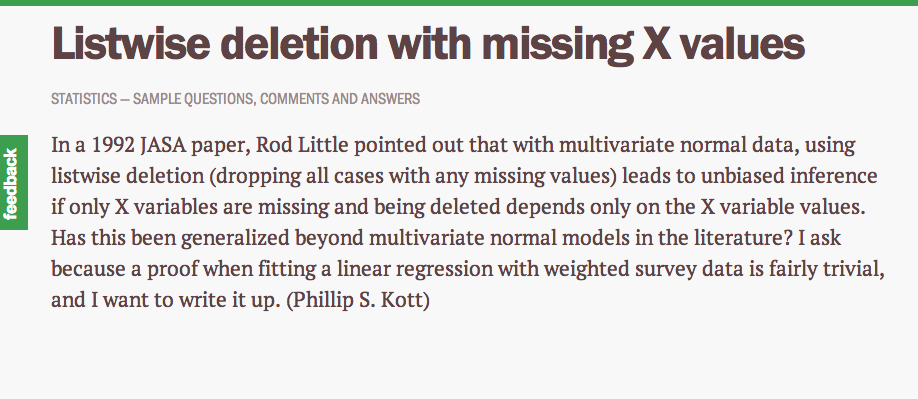 The site doesn’t have many questions, and even fewer answers, but as I understand it the first few people to get involved are eligible for Springer books, so go check it out.
Illegal PayDay syndicate in New York busted
There’s an interesting and horrible New York Time story by Jessica Silver-Greenberg about a PayDay loan syndicate being run out of New York State. The syndicate consists of twelve companies owned by a single dude, Carey Vaughn Brown, with help from a corrupt lawyer and another corrupt COO. Manhattan District Attorneys are charging him and his helpers with usury under New York law.
The complexity of the operation was deliberate and intended to obscure the chain of events that would start with a New Yorker online looking for quick cash online and end with a predatory loan. They’d interface with a company called MyCashNow.com, which would immediately pass their application on to a bunch of other companies in different states or overseas.
Important context: in New York, the usury law caps interest rates at 25 percent annually, and these PayDay operations were charging between 350 and 650 percent annually. Also key, the usury laws apply to where the borrower is, not where the lender is, so even though some of the companies were located (at least on paper) in the West Indies, they were still breaking the law.
They don’t know exactly how big the operation was in New York, but one clue is that in 2012, one of the twelve companies had $50 million in proceeds from New York.
Here’s my question: how did MyCashNow.com advertise? Did it use Google ads, or Facebook ads, or something else, and if so, what were the attributes of the desperate New Yorkers that it looked for to do its predatory work?
One side of this is that vulnerable people were somehow targeted. The other side is that well-off people were not, which meant they didn’t see ads like this, which makes it harder for people like the Manhattan District Attorney to even know about shady operations like this.
Weapon of Math Destruction: “risk-based” sentencing models
There was a recent New York Times op-ed by Sonja Starr entitled Sentencing, by the Numbers (hat tip Jordan Ellenberg and Linda Brown) which described the widespread use – in 20 states so far and growing – of predictive models in sentencing.
The idea is to use a risk score to help inform sentencing of offenders. The risk is, I guess, supposed to tell us how likely the person is to commit another act in the future, although that’s not specified. From the article:
The basic problem is that the risk scores are not based on the defendant’s crime. They are primarily or wholly based on prior characteristics: criminal history (a legitimate criterion), but also factors unrelated to conduct. Specifics vary across states, but common factors include unemployment, marital status, age, education, finances, neighborhood, and family background, including family members’ criminal history.
I knew about the existence of such models, at least in the context of prisoners with mental disorders in England, but I didn’t know how widespread it had become here. This is a great example of a weapon of math destruction and I will be using this in my book.
A few comments:
- I’ll start with the good news. It is unconstitutional to use information such as family member’s criminal history against someone. Eric Holder is fighting against the use of such models.
- It is also presumably unconstitutional to jail someone longer for being poor, which is what this effectively does. The article has good examples of this.
- The modelers defend this crap as “scientific,” which is the worst abuse of science and mathematics imaginable.
- The people using this claim they only use it for as a way to mitigate sentencing, but letting a bunch of rich white people off easier because they are not considered “high risk” is tantamount to sentencing poor minorities more.
- It is a great example of confused causality. We could easily imagine a certain group that gets arrested more often for a given crime (poor black men, marijuana possession) just because the police have that practice for whatever reason (Stop & Frisk). Then model would then consider any such man at a higher risk of repeat offending, but that’s not because any particular person is actually more likely to do it, but because the police are more likely to arrest that person for it.
- It also creates a negative feedback loop on the most vulnerable population: the model will impose longer sentencing on the population it considers most risky, which will in turn make them even riskier in the future, if “length of time in prison previously” is used as an attribute in the model, which is surely is.
- Not to be cynical, but considering my post yesterday, I’m not sure how much momentum will be created to stop the use of such models, considering how discriminatory it is.
- Here’s an extreme example of preferential sentencing which already happens: rich dude Robert H Richards IV raped his 3-year-old daughter and didn’t go to jail because the judge ruled he “wouldn’t fare well in prison.”
- How great would it be if we used data and models to make sure rich people went to jail just as often and for just as long as poor people for the same crime, instead of the other way around?
White people don’t talk about racism
Here’s what comes up in conversations at my Occupy meetings a lot: systemic racism.
Maybe once a week on average, whether we are talking about the criminal justice system, or the court system, or the educational system, or standardized tests, or chronic employment problems, or welfare rhetoric, or homelessness. There are many very well-informed people in my group which can speak eloquently and convincingly about how the system itself, not any particular person (although they do exist), discriminates against minorities in this country.
As a group we cheered when Ta-Nehisi Coates came out with his Atlantic piece entitled The Case for Reparations. So much resonated, especially the parts about widespread reverse redlining of mortgages to minorities in the run-up to the credit crisis. And it finally taught me how to think about affirmative action.
Another thing that comes up sometimes, although less often: how white people, even liberals like Elizabeth Warren, don’t talk about racism anymore. They want to address education inequalities through class-based or income-based measures rather than race-based ones. They talk about unemployment and joblessness and the need for criminal justice reform without referring to the enormous and glaring racial disparities.
I’m left feeling a lot like I felt in 7th grade social studies when we studied the period of mass genocide of American Indians and called it “Manifest Destiny.”
This recent study entitled Racial Disparities in Incarceration Increase Acceptance of Punitive Policies might explain why white people are so reluctant to talk about racism. Namely, because white react strangely when you specifically point out systemic racism (they are OK with it).
So in other words, if you tell them how many people are incarcerated in this country compared to other countries, they think it’s terrible and we should stop putting so many people in jail. But if you tell them most of those prisoners (60% in New York City) are black, then they’re less likely to think it’s terrible. They also remember the number wrong, thinking it’s higher than it is. Here’s a succinct summary from this Vox article:
The question seems to be which instinct wins out: the belief that our prison system isn’t fair, or the assumption that a prisoner must be a criminal. According to the study, when whites are primed to think of prisoners as black, it’s the latter that wins out.
The conclusion of the Vox article is this: politicians and activists have figured out that, if they want to agitate for criminal justice reform, they can’t mention systemically racist unfairness, because that just doesn’t upset powerful people enough. Instead, they need to focus on important stuff like saving money, which is how you get white people people up in arms. That’s what flies in the focus groups, apparently.
It explains why Elizabeth Warren doesn’t talk about race when she talks about student loans, preferring to talk about “young people”, even though the problem is worse for non-Asian minorities. Similarly, Obama is targeting for-profit colleges without reference to race (but with reference to veterans!) even though for-profit colleges notoriously target minorities.
The problem with understanding stuff like this is that it’s primarily used to be politically cunning, which is not enough. I’d like to talk about how to get people to directly confront racism, starting with liberals.
Aunt Pythia’s advice: delicious crepes edition
Aunt Pythia is going to brag about something this morning.
Namely, how delicious her crepes are. And here’s the thing, she’s generous and like to share. If you were willing to get to her house at 8:06am on a weekend morning, she’d also make you some crepes with fresh fruit. You could sit right there, between two of her darling children covered in nutella. Here’s an idea of what you’d be getting:

We don’t usually fold our crepes like that, but you get the idea.
But you aren’t here at 8:06am, are you? Too lazy? That’s what I thought. You don’t get any crepes.
But the good thing about the interwebs is that you don’t have to be awake at any particular time to enjoy Aunt Pythia’s advice whenever you so please. Therefore, feast your eyes on the column and then:
please think of something to ask Aunt Pythia at the bottom of the page!
I am almost out of questions!!!
By the way, if you don’t know what the hell Aunt Pythia is talking about, go here for past advice columns and here for an explanation of the name Pythia.
——
Dear Aunt Pythia,
This is not an Aunt Pythia question, I just want to bring to your attention the following post on math overflow entitled How Does One Justify Funding for Mathematics Research.
Also, I guess you don’t read the Daily News – two Aunt Pythia questions I asked were front page on it, but you hadn’t heard about either (Belle Knox and the philosophy professor at Miami). I just read it to mostly find out about the (violent) crime going on in NYC. It makes me depressed and want to leave this town. It isn’t worth it living here: it is way too expensive to live here, too crowded and dirty, and too cold. Do you ever wish you were back in Massachusetts or Berkeley?
NYDN
Dear NYDN,
I decided that, by the end of that non-question, it was a question worth answering. And thanks for the link, I’ll take a look!
As far as living in New York City, it’s perfect for me for a bunch of reasons which might not resonate with you. For example, I’ve been hugely fortunate to be living in a great and subsidized Columbia apartment since moving here, so that makes it alot easier.
Second, I like the weather to actually change, maybe because I grew up in Boston. It bothered me in Berkeley not to have an autumn. I love autumn. Plus the people in Berkeley get too soft and can’t handle cold weather. So yes, I’m also kind of a macho weather person, although the weather lately has been too temperate to be macho about.
Next, I really really hate regular commuting, with traffic jams and such, and New York is a place where I can walk, bike, or subway anywhere. That’s so cool! I don’t own a car and I never want to again.
Also, and here’s the thing, I like things crowded and dirty. I like people of all ages and races and ethnicities sweating on each other in the subway. So many people! So many languages! It’s incredibly cool, and I never get enough of it. That’s why I like it when the subway stops for an hour in the tunnel and we all end up missing whatever appointments we had and we talk to each and behave like human beings. That’s New York!
Sometimes I even like it when people are rude to each other (as long as nobody is picking on anyone, which bothers me) because it gets out my urban aggression by proxy: just seeing other people be pushy and pointy helps me find my zen. I don’t know how people in suburbia deal with hostility! Maybe through those commuter traffic jams? Too passive aggressive to me, I want it to be face-to-face.
Finally, as for violent crime, it’s inevitable we have some, but overall it’s an incredibly peaceful city. I’ve never been threatened here. By contrast I was definitely threatened in Berkeley a few times, although the early 90’s was a different time. I feel perfectly fine sending my kids outside to walk around by themselves, for example.
Thanks for asking!
Aunt Pythia
——
Hi Aunt Pythia,
This is not a question. I just wanted to share this song I heard on the radio this morning with you:
It is called Dangerous from Big Data 🙂
Cheers!
Big Data Strange Music
Dear BDSM,
Three things.
- That video is bizarre and awesome, and I’m not surprised you thought I’d love it, especially considering my above confession that I like violence, although it kind of went too far, but on the other hand they kept it silly, which made it tolerable.
- I am through with people sending me non-questions. From now on, everything’s a question. I don’t have enough questions left to remove the ones called non-questions.
- Nice sign-off!
Love,
Auntie P
——
Aunt Pythia,
Why should the world care about mathematicians? Note that I didn’t say mathematics.
Alter Egoist
Dear AE,
Great question. There does seem to be an obsession with The Mind Of The Mathematician. Maybe because it represents an extreme of sorts? And because people respect mathematics as an achievement of human culture? But that doesn’t explain all the profiles and such. Not sure. I’ll think about that one. Happy to take reader suggestions on this one!
Aunt Pythia
——
Dear Aunt Pythia,
I am a tenured professor in a good department with many coauthors both senior and junior to me. Like everyone, I have had some failed collaborations, usually because the project didn’t progress and we mutually decided to abandon it. But most of my collaborators have collaborated with me repeatedly on a number of papers.
However there is one strange type of failed collaboration that has happened twice to me in recent years which I cannot comprehend. Perhaps you and your readers might have some insight as to what is going on.
In both collaborations, I proposed the topic and we had good discussions and some exchange of tex files with proofs. Then one day, complete and total email silence. Both times the silence was in response to a request that might take a little while to carry out and so could easily lead to temporary email silence. It could take time to devise a proof of some lemma or decide that it cannot be proven.
Eventually I send a second email mentioning the same question and asking if there is a concern that we need to discuss. I send a third email completely off topic about something else. Usually, when a coauthor is silent for awhile, switching the topic restarts the email exchanges. When this didn’t work I sent an email suggesting we meet in person at an upcoming conference or at one of our departments (funded by me). Finally, after a few months, I emailed the secretary in their respective departments and asked them to print out a note that they should email me and leave it in their mailbox. Still nothing and so I give up some 4 months later.
Well the first collaborator to leave me in total email silence did this about four years ago. I was told by other people he has done this to them as well. The project was very important to me but I have left it aside unsure how to proceed. Do I finish it alone and just put his name on it and send it to him when he’s done? I wasn’t sure. He is important and somewhat powerful. So I just left the project aside.
The second collaborator to leave me in total silence has also left a third junior collaborator in total silence. The junior collaborator and I worked on a different project together while we repeatedly tried to contact him. We finished our other project and contacted the silent partner about returning to the joint project but there is still silence. The junior partner and I are now returning to the original project but solving it in a way complete disjoint from the approach we had been working on with the silent partner. I do not want any suggestion that we stole work from the silent partner but we cannot delay the project any longer. Not when a junior colleague’s career is on the line.
What in the world is going on with these collaborators? What should I do about the first collaborator? At this point they have been silent so long, I do not wish to collaborate with them again even if they suggest returning to the project. I’ve had multiple collaborators in the past who gave reasonable excuses and asked we that postpone working on a project a few months or indefinitely while they handled a job hunt or a divorce or a new baby. In that case, I can wait. But this absolute silence with no reason at all seems to indicate some sort of mental block.
Sincerely,
Angrily Bitter And
Notoriously Dangerously Ornery
Non-Existent Demon
Dear ABANDONED,
Holy shit that’s the mother of all sign-offs.
Plus it’s kind of an awesome question as well. And super long! That makes up for rather short, non-questiony questions that I was making do with until yours.
OK so I think people are just sometimes lame. They drop off the face of the earth. Maybe they just get cold feet, maybe they have consuming mid-life crises, maybe their spam filters go crazy. Chances are, though, they just get overwhelmed with other projects and don’t quite want to shit and don’t quite want to get off the pot either. It’s your job to make them decide which one to do.
Just in case it’s the spam filter problem, do try calling. Also, try talking to a mutual friend? Poke them that way?
Once you’ve tried all those things, I would be very pragmatic about it. Email them and say something along the lines of, “you have two weeks to respond to this and then we are submitting our manuscript without your name on it since you have not been responsive.”
If you want to be double sure of them having a fair chance to get involved, also write them a letter with that message and send it to their department. Don’t hold it against them, they might be dealing with a divorce or a sick kid, you just don’t know, and it’s best to withhold resentment if possible. But no reason to hold back your publications either.
Good luck, ABANDONED!
Aunt Pythia
——
Please submit your well-specified, fun-loving, cleverly-abbreviated question to Aunt Pythia!
Navigating the mindset for data journalism
I’ve been working my butt off this summer starting up a data journalism program and teaching in it. I couldn’t ask for a better crew of students and instructors: engaged, intelligent, brave, and eager to learn. And my class has been amazing, due to the incredibly guest speakers who have given their time to us. On Tuesday we were honored to have danah boyd come talk about her new book It’s Complicated, and yesterday Julie Steele talked to us about visualization and how our technological tools affect our design, which was fabulous and also super useful for the class projects.
I feel like it’s the picture perfect situation for the emerging field of data journalism to be defined and developed. Even so, there are real obstacles to getting this right that I hadn’t anticipated. Let me focus on obstacles that exist within the academy, since that’s what I’ve been confronting these past few weeks and months.
Basically, as everyone knows, academia is severely partitioned between departments, both physically and culturally. Data journalism sits more or less between journalism and computer science, and both of those fields have cultures that are unintentionally hostile to a thriving new descendant. Let me exaggerate for effect, which is what I do.
In cartoonish form, introductory computer science classes are competitive weeder classes that promote a certain kind of narrow, clever, problem-solving approach. If you get your code to work, and work fast, you’re done, and you move quickly to the next question because there’s an avalanche of work and technical issues to plow through.
You don’t get that much time to think, and you almost never address the question of how to do things differently, or why syntax is inconsistent between different parts of python, or generally why a computer language is the way it is and how it could have been designed differently and what the history was that made it so, because you don’t have time and you have to learn learn learn. In other words, it’s kind of the least context-laden and most content-heavy way of learning that you can imagine. You impress people by what you can make work, and how fast, and it is a deep but narrow way of working, kind of like efficient well-digging.
Now let’s paint an equally exaggerated vision of the journalist training. A good journalist collects a ton of information to create a kind of palette for the topic in question, and dives straight into ambiguity or history or bias or contradiction to learn even more, and then starts to build a thesis after such comprehensive information collection has occurred. In other words, the context is what makes a topic interesting and important and newsworthy, and the human and gripping example is critical to illustrate the topic as well as to make it into a story rather than a set of facts. You impress people by your ability to synthesize an incredible breadth of knowledge and then find the hook that makes it a compelling story and draw it out and make it real. This is a broad filtering method where you don’t take the next step until you know you should.
To make it even more dumbed down, journalists are ever aware of the things they know they don’t know, and desperately want to fill in their knowledge gaps because otherwise they feel fraudulent, like they’re jumping to unwarranted conclusions. Computer scientists don’t care about not knowing things as long as their programs work. They can be blithe with respect to messy human details, which of course means they sometimes don’t notice or figure out their data has selection bias because they got an answer, but also means they are super efficient.
Now you can see why it’s a tough thing to teach journalists to code, and it’s also a tough thing to expect coders to become journalists. Both sides emphasize a kind of learning and a definition of success that the other side is blind to.
What would a middle ground look like? In the ideal scenario, it would be a place that appreciates and uses the power of data and programming and spends the time learning the history and searching the inherent human bias of data collection and analysis. That scenario is exciting, but it clearly takes time to build and represents a real investment both by the academic institutions that build it and by the media that eventually hire the data journalists coming from it.
In other words, the outside world has to actually want to hire the emerging thoughtful fruit of that labor. It brings me to other problems for data journalism that largely live outside the academic world, which I might blog about at some other time.
The economics of a McDonalds franchise
I’ve been fascinated to learn all sorts of things about how McDonalds operates their business in the past few days, as news broke about a recent NLRB decision to allow certain people who work in McDonalds to file complaints about their workplace and name McDonalds as a joint employer.
That sounds incredibly dull, right? The idea of letting McDonalds workers name McDonalds as an employer? Let me tell you a bit more. And this is all common knowledge, but I thought I’d gather it here for those of you who haven’t been following the story.
Most of the McDonalds joints you go to are franchises – 90% in this country. That means the business is owned by a franchisee, a person who pays good money (details here) for the right to run a McDonalds and is constrained by a huge long list of rules about how they have to do it.
The franchise owner attends Hamburger University and gets trained in all sorts of things, like exactly how things should look in the store, how customers should be funneled through space (maps included), how long each thing should take, and how to treat employees. There’s a QSC Playbook they are given (Quality, Service, and Cleanliness) as well as minute descriptions of how to organize their teams and even the vocabulary words they should use to encourage workers (see page 24 of the Shift Management Guide I found online here).
McDonalds also installs a real-time surveillance system into each McDonalds, which can calculate the rate of revenue brought in at a given moment, as well as the rate of pay going out, and when the ratio of those two numbers reaches a certain lower bound threshold, they encourage franchise owners to ask people to leave or delay people from clocking in. Encourage, mind you, not require. They are not the employers or anything remotely like that, clearly.
Take a step back here. What is the business model of a franchise? And when did McDonalds stop being a burger joint?
The idea is this. When you own a restaurant you have to deal with all these people who work for you and you have to deal with their complaints, and they might not like the way you treat them and they might organize against you or sue you. In order to contain your risks, you franchise. That effectively removes all of those people except one, the franchise owner, with whom you have an air-tight contract, written by a huge team of lawyers, which basically says that you get to cancel the franchise agreement for any minor infraction (where they’d lose a bunch of investment money), but most importantly it means the people actually working in a given franchise work for that one person, not for you, so their pesky legal issues are kept away from you. It’s a way to box in the legal risk of the parent company.
Restaurants aren’t the only business to learn that it’s easier to sell and manage a brand than it is to sell and manage an actual product. Hotels have been doing this for a long time, and avoid complaints and legal issues stemming from the huge population of service workers in hotels, mostly minority women.
For a copy of the original complaint that gave the details of McDonald’s control over workers, read this. For a better feel for being a McDonalds worker, please read this recent Reuters blog post written by a McDonalds worker. And for a better feel for being a McDonald’s franchise owner, read this recent Washington Post letter from a long-time McDonalds franchise owner who thinks workers are being unfairly treated.
Does that sounds confusing, that a franchise owner would side with the employees? It shouldn’t.
By nature of the franchise contract, the money actually available to a franchise owner is whatever’s left over after they pay McDonalds for advertising, and buy all the equipment and food that McDonalds tells them to from the sources that they tell them to, and after they pay for insurance on everything and for rent on the property (which McDonalds typically owns). In other words the only variable they have to tweak is the employer pay, but if they pay a living wage then they lose money on their business. In fact when franchise owners complain about the profit stream, McDonalds tells them to pay their workers less. McDonalds essentially controls everything except one variable, but since it’s a closed system of equations, that means the franchise owners have to decide between paying their workers reasonably and going in the red.
That’s not to say, of course, that McDonalds as an enterprise is at risk of losing money. In fact the parent corporation is making good money ($1.4 billion per quarter if you include international revenue), by squeezing the franchises. If the franchise owners had more leverage to negotiate better contracts, they could siphon off more revenue and then – possibly – share it with workers.
So back to the ruling. If upheld, and there’s a good chance it won’t be but I’m feeling hopeful today, this decision will allow people to point at McDonalds the corporation when they are treated badly, and will potentially allow a workers’ union to form. Alternatively it might energize the franchise owners to negotiate more flexible contracts, which could allow them to pay their workers better directly.


 mathbabe