Archive
Aunt Pythia’s advice
Well, hello and good morning! Glad you all could make it onto Aunt Pythia’s magic bus today! I’ve redecorated to celebrate Daylight Savings Time (or rather, the end of it):

We can all get in! Squeeeeeze!!!
Daylight savings time has made Aunt Pythia very happy today, because it means an extra hour for me to focus on you, you and your problems, which is what Aunt Pythia loves to do, at least on Saturday mornings, and at least when they involve sex or math (or ideally, both).
By the way, to investigate and demolish the myths around Daylight Savings Time, check out this fantastic and scientific video (best line, “waking up is like sneezing”).
Before we dig in to this week’s juicy questions, Aunt Pythia has an unusual request. Do you remember a couple of weeks ago, when I dragged my family apple picking? Well it turns out that a bushel of apples is A LOT OF APPLES, and I’m really very sick of apples, apple pies (current count: 9 pies made in the past 2 weeks), and apple sauce. If anyone wants some apples, swing on by and I’ll hook you up. Please. Oh, and also:
please think of something interesting, reasonable, and non-apple related
to ask Aunt Pythia at the bottom of the page!
By the way, if you don’t know what the hell Aunt Pythia is talking about, go here for past advice columns and here for an explanation of the name Pythia.
——
Dear Aunt Pythia,
I am pretty much fine with pornography, aside from instances in which women are blatantly coerced or otherwise not participating of free will.
My question pertains to the increasing prevalence of extreme porn and how it impacts real relationships. As with our news and so on, everything has become click bait. Remember back when lesbian porn was risque? Now if a girl isn’t sucking a dick that was just in her ass the previous minute, it’s considered sorta boring. Next thing you know, men imagine women should be doing all these things in real life.
Trying to frame a question here, how does one be generally supportive of the existence of pornography and also help men understand that she is “not doing that” without coming off like a prude? Moreover, when encountering such a man, is it better to just tell them to fuck off entirely? I cannot imagine that any man who is obsessed with the idea to jizz in my eyeball can have actual respect for me as a human being.
Wondering Tolerant Female
Dear WTF,
Great question!
But before we go there, how can you be sure someone isn’t being coerced? I can’t, so I prefer the animated kind of pornography, preferably Japanese, because those Japanese animators are totally perverted and awesome, and then there’s really nobody being coerced. Perhaps TMI about Aunt Pythia, but since I didn’t tell you which of the hundreds of subgenres of Japanese anime I’m into, you really don’t know much – trust me.
Now, on to your actual question. I agree that the realm of “normal sex” has moved by more than a few notches recently. When I was in high school, there was no internet, so we actually had to steal our parent’s dirty magazines and VCR tapes – lots of them – to figure stuff out. Come to think of it, at least where I came from, it really wasn’t hard to come across porn, and moreover I remember it being insanely misogynistic and violent, almost always involving rape of a clearly drugged-up woman. From that vantage point the weird, rape-dominated scenes from the 1980’s have been replaced by weird but consensual extreme positions of today, and I’m personally glad to make that trade.
I’m not a historian of porn, though, I so I might be getting this all wrong, and yes of course I know there’s lots of very extreme stuff available nowadays as well.
In terms of respect for someone as a human being, I’m not sure we’re speaking the same language. There’s nothing logically inconsistent with thoroughly objectivizing a sexual partner during a sex act and then having a mutually respectful and thoughtful conversation about free will fifteen minutes later. It’s all about what you’ve agree to, and what’s fun for you.
So in other words, if you don’t want to be doing this stuff, that’s fine and you shouldn’t agree to it, but measure someone’s respect for you by how they bring up the question, not whether they want to do it. In other words, the man who doesn’t respect you is the man who pushes this stuff on you without consultation, or who makes it your problem that you’re not into it.
Good luck!
Aunt Pythia
——
Dear Aunt Pythia,
The Empire Builder (Amtrak) takes around 46 hours to reach Seattle from Chicago (if it’s on time). Besides the amazing scenery, the trip offers the possibility of scintillating conversations with strangers in the Dining Car. A flight between the two cities, on the other hand, will take just 5 hours. It would be much cheaper, but would otherwise be a nondescript experience. While air travel is the pragmatic choice, the rail option underscores the point that sometimes the journey is as interesting as the destination. As I teach an informal math course to some colleagues, I often find that we are conditioned to find the shortest path to the answer. In many “toy problems” that we discuss in class, it is the path to the answer that is relevant to the real world. The actual answer is relatively inconsequential. Should math be taught differently so that it is more akin to train travel than flying? If so, what would you recommend to make math teaching more contemplative? And would these approaches be scalable, i.e., work in structured courses with larger enrollment?
Obsessive Correlator
Dear OC,
This question is also great, and has a much smaller chance of having been stolen from Savage Love.
I have often fantasized about taking a sleeper train across the country, with my whole family in tow, and meeting people in the dining car and having fascinating conversations. I’ve even priced it out, and it’s expensive but not impossible. I got the idea from a mathematician who had traveled with his family on the Orient Express in the 1980’s, which is even more fantastical (and expensive). Can you imagine getting on a train in Paris and getting off in Hong Kong? How cool would that be?

Even the angle of Europe on this map is mysterious.
Back to your question. Why yes, I think a meandering route through mathematics would be wonderful, and is sadly almost never done. We are so obsessed with skills-based accomplishments, we rarely spend time on why we’re doing something or how someone could have come up with it in the first place.
One of my few regrets of leaving Barnard is that I never had a chance to run a freshman seminar course on mathematics that I’d planned in the style of the Pythagorean Society (minus some of their crazy rules like “not picking up that which has fallen”).
It is my earnest belief that every person engaged in learning mathematics is themselves a mathematician, rediscovering and rejoicing in the mathematics that has been understood by our culture for hundreds of years but by us as individuals for no time at all. We should all be treated as philosopher queens in this process, and so my idea was to do that in a wifi-blocked room, focusing on the questions we pose and how we pose them and what patterns we might find and why we’d care (or not!) about them beyond their intrinsic beauty.
Sounds great! I still wish I could do that. And I also hope that other people do that.
So here’s the thing. Most people think of mathematicians as super lazy, and there’s of course something to that; lots of mathematical breakthroughs are essentially proven shortcuts to long-ass calculations that go something like, “we have a collection of things, and some of them have this cool property that makes them easy to understand, and now I’ve proven that all of them actually have that cool property.”
But at the same time, mathematicians are also the most inefficient people in the world, because they get entirely focused on abstract rules and scenarios that almost never have a concrete application to anything, and they think about the patterns they notice for hours. They are all about the meandering path, in other words. It’s not a bad life, but it does take time.
Finally, to your question: when it’s a small group, consider yourself a facilitator rather than a teacher. Ask questions and get people involved in the discovery. Make a silent pact with yourself that you won’t explain anything directly, that you will only issue hints, and try to emphasize the beauty and truth in everyone’s contributions. With a larger class it’s much harder, but sometimes you can get the right atmosphere and then have people work in groups.
Good luck!
Aunt Pythia
——
Dear Aunt Pythia,
I’m a senior male professor in a STEM department. Here’s my question. What, if anything, should I say about romantic relationships between faculty members and graduate students? In particular, what action should I take concerning a professor who has dated at least three graduate students in our department? There is no formal rule at our university against faculty/student dating, as long as the faculty member has no direct supervisory relationship with the student. What’s more, there is a senior faculty member who is married to a woman he started dating when she was a graduate student here, which makes it awkward to denounce such relationships in general. And I know that Aunt Pythia herself is married to someone she met when she was a grad student and he was faculty!
So you could argue it’s none of my business. But you could also argue it’s rotten to put our grad students in a position of feeling like they’re a captive dating pool for the single faculty members. I know that our graduate students are aware of the serial dating; no grad student has directly told me that they find it threatening or off-putting, but another faculty member (a junior woman) has told me that she thinks it’s bad for the department.
What do you think, Aunt Pythia? Talk to the serial dater himself? Talk to the department chair? Or butt out and say nothing to anyone?
Tenured Professor at a Singles Bar
Dear TPaaSB,
It’s true, I was a grad student and my husband was a post-doc in the same department, but I’d argue that’s a bit different from his being a professor. Even so, I’d probably have dated him even if he had been, so there’s that as well.
I’m not sure how much anyone can do about this, to be honest. You can make rules but then people will probably break them. Not sure if that’s better.
On the one hand, you want graduate students to feel safe and not sexualized in their role as learners, and having the feeling that you might be “next in line” for this professor isn’t helping. It’s particularly unhelpful that he’s dated three, because it is starting to seem like he is both incapable of finding women outside the department and bad at relationships. Or maybe the women all dumped him, who knows. But yes, I agree that this guy is making things weird.
On the other hand, there’s a moment in your life as a man or a woman that you decide it’s time to look around for a life partner, and if you’re a 23-year-old woman who wants kids, like I was, then the men your age simply burst out crying in your presence from the pressure of commitment, and you end up looking for older, more stable, and more mature men that aren’t intimidated by your brains and your life plans. You could look outside the department, but the problem is you spend almost all your time in the department and there are all these yummy smart nerd boys who look great in homemade sweaters would look great in your homemade sweater, so whatareyagonnado.
In terms of advice for you, I’m going to say to keep quiet, unless you feel like the guy is actually predatory or is fucking with these women’s egos or chances of graduating. If that’s true, then talk to him and voice your concerns.
Readers, if you disagree, by all means chime in.
Aunt Pythia
——
Dear Aunt Pythia,
I just met a twenty-something hot girl online (only ten years or so younger than me); her interests (her words) are work, martinis, and rough sex (not necessarily in that order). We’ve met once so far, and it was everything I could have hoped for — spitting, faceslapping, and some dirty talk. But I know that the best way to great sex is though pleasing your partner, so for the next time we meet I want to step up my game. She said she was game for anything, so I want to be creative without crossing any boundaries. She was happy last time to be called a slut and a whore, but maybe there’s something more original as far as dirty talk goes (for example, how can I make it more interactive by forcing her to respond in some way?) Also, she’s a gorgeous BBW (mmmm), so (given the context) is calling her a fat whore a good idea? My impression is that she is naturally very confident and outspoken, so I am imagining her fantasies stem from a positive rather than negative aspect of her personality, but I really don’t know…
Naughty and Salacious; Tenured Young.
Dear NaSTY,
Aahhh, the triple fantasy of spitting, faceslapping, and dirty talk. You’re living the dream, buddy, there’s no doubt. I mean, if you’re into that kind of thing. Which you obviously are.
As far as whether she wants you to call her a “fat whore,” my guess is she wouldn’t be offended if you tried it. It’s not like fat people don’t know they’re fat! We get told it every day of our lives, so turning it around and making it a good thing (erm, in this context I think it qualifies as a good thing) might be fun!
If you’re worried about it, ask her before the next tryst, “hey honey, would it be ok if I call you a fat whore during sex? I find your body exquisite and it turns me on to talk about it.”
Auntie P
——
Please submit your well-specified, fun-loving, cleverly-abbreviated question to Aunt Pythia!
Click here for a form.
Tailored political ads threaten democracy
Not sure if you saw this recent New York Times article on the new data-driven political ad machines. Consider for example, the 2013 Virginia Governor campaign won by Terry McAuliffe:
…the McAuliffe campaign invested heavily in both the data and the creative sides to ensure it could target key voters with specialized messages. Over the course of the campaign, he said, it reached out to 18 to 20 targeted voter groups, with nearly 4,000 Facebook ads, more than 300 banner display ads, and roughly three dozen different pre-roll ads — the ads seen before a video plays — on television and online.
Now I want you to close your eyes and imagine what kind of numbers we will see for the current races, not to mention the upcoming presidential election.
What’s crazy to me about the Times article is that it never questions the implications of this movement. The biggest problem, it seems, is that the analytics have surpassed the creative work of making ads: there are too many segments of populations to tailor the political message to, and not enough marketers to massage those particular messages for each particular segment. I’m guessing that there will be more money and more marketers in the presidential campaign, though.
Translation: politicians can and will send different messages to individuals on Facebook, depending on what they think we want to hear. Not that politicians follow through with all their promises now – they don’t, of course – but imagine what they will say when they can make a different promise to each group. We will all be voting for slightly different versions of a given story. We won’t even know when the politician is being true to their word – which word?
This isn’t the first manifestation of different messages to different groups, of course. Romney’s famous “47%” speech was a famous example of tailored messaging to super rich donors. But on the other hand, it was secretly recorded by a bartender working the event. There will be no such bartenders around when people read their emails and see ads on Facebook.
I’m not the only person worried about this. For example, ProPublica studied this in Obama’s last campaign (see this description). But given the scale of the big data political ad operations now in place, there’s no way they – or anyone, really – can keep track of everything going on.
There are lots of ways that “big data” is threatening democracy. Most of the time, it’s by removing open discussions of how we make decisions and giving them to anonymous and inaccessible quants; think evidence-based sentencing or value-added modeling for teachers. But this political campaign ads is a more direct attack on the concept of a well-informed public choosing their leader.
Core Econ: a free economics textbook
Today I want to tell you guys about core-econ.org, a free (although you do have to register) textbook my buddy Suresh Naidu is using this semester to teach out of and is also contributing to, along with a bunch of other economists.

This was obviously not taken in New York.
It’s super cool, and I wish a class like that had been available when I was an undergrad. In fact I took an economics course at UC Berkeley and it was a bad experience – I couldn’t figure out why anyone would think that people behaved according to arbitrary mathematical rules. There was no discussion of whether the assumptions were valid, no data to back it up. I decided that anybody who kept going had to be either religious or willing to say anything for money.
Not much has changed, and that means that Econ 101 is a terrible gateway for the subject, letting in people who are mostly kind of weird. This is a shame because, later on in graduate level economics, there really is no reason to use toy models of society without argument and without data; the sky’s the limit when you get through the bullshit at the beginning. The goal of the Core Econ project is to give students a taste for the good stuff early; the subtitle on the webpage is teaching economics as if the last three decades happened.
What does that mean? Let’s take a look at the first few chapters of the curriculum (the full list is here):
- The capitalist revolution
- Innovation and the transition from stagnation to rapid growth
- Scarcity, work and progress
- Strategy, altruism and cooperation
- Property, contract and power
- The firm and its employees
- The firm and its customers
Once you register, you can download a given chapter in pdf form. So I did that for Chapter 6, The firm and its employees, and here’s a screenshot of the first page:

Still dry but at least real.
The chapter immediately dives into a discussion of Apple and Foxconn. Interesting! Topical! Like, it might actually help you understand the newspaper!! Can you imagine that?
The project is still in beta version, so give it some time to smooth out the rough edges, but I’m pretty excited about it already. It has super high production values and will squarely compete with the standard textbooks and curriculums, which is a good thing, both because it’s good stuff and because it’s free.
The war against taxes (and the unmarried)
The American Enterprise Institute, conservative think-tank, is releasing a report today. It’s called For richer, for poorer: How family structures economic success in America, and there is also an event in DC today from 9:30am til 12:15pm that will be livestreamed. The report takes a look at statistics for various races and income levels at how marriage is associated with increased hours works and income, for men especially.
It uses a technique called the “fixed-effects model,” and since I’d never studied that I took a look at it on the wikipedia page, and in this worked-out example on Josh Blumenstock’s webpage of massage prices in various cities, and in this example, on Richard William’s webpage, where it’s also a logit model, for girls in and out of poverty.
The critical thing to know about fixed effects models is that we need more than one snapshot of an object of interest – in this case a person who is or isn’t married – in order to use that person as a control against themselves. So in 1990 Person A is 18 and unmarried, but in 2000 he is 28 and married, and makes way more money. Similarly, in 1990 Person B is 18 and unmarried, but in 2000 he is 28 and still unmarried, and makes more money but not quite as much more money as Person A.
The AEI report cannot claim causality – and even notes as much on page 8 of their report – so instead they talk about a bunch of “suggested causal relationships” between marriage and income. But really what they are seeing is that, as men get more hours at work, they also tend to get married. Not sure why the married thing would cause the hours, though. As women get married, they tend to work fewer hours. I’m guessing this is because pregnancy causes both.
The AEI report concludes, rightly, that people who get married, and come from homes where there were married parents, make more money. But that doesn’t mean we can “prescribe” marriage to a population and expect to see that effect. Causality is a bitch.
On the other hand, that’s not what the AEI says we should do. Instead, the AEI is recommending (what else?) tax breaks to encourage people to get married. Most bizarre of their suggestions, at least to me, is to expand tax benefits for single, childless adults to “increase their marriageability.” What? Isn’t that also an incentive to stay single and childless?
What I’m worried about is that this report will be cleverly marketed, using the phrase “fixed effects,” to make it seem like they have indeed proven “mathematically” that individuals, yet again, are to be blamed for the structural failure of our nation’s work problems, and if they would only get married already we’d all be ok and have great jobs. All problems will be solved by tax breaks.
Guest post: Clustering and predicting NYC taxi activity
This is a guest post by Deepak Subburam, a data scientist who works at Tessellate.

from NYCTaxi.info
Greetings fellow Mathbabers! At Cathy’s invitation, I am writing here about NYCTaxi.info, a public service web app my co-founder and I have developed. It overlays on a Google map around you estimated taxi activity, as expected number of passenger pickups and dropoffs this current hour. We modeled these estimates from the recently released 2013 NYC taxi trips dataset comprising 173 million trips, the same dataset that Cathy’s post last week on deanonymization referenced. Our work will not help you stalk your favorite NYC celebrity, but guide your search for a taxi and maybe save some commute time. My writeup below shall take you through the four broad stages our work proceeded through: data extraction and cleaning , clustering, modeling, and visualization.
We extract three columns from the data: the longitude and latitude GPS coordinates of the passenger pickup or dropoff location, and the timestamp. We make no distinction between pickups and dropoffs, since both of these events imply an available taxicab at that location. The data was generally clean, with a very small fraction of a percent of coordinates looking bad, e.g. in the middle of the Hudson River. These coordinate errors get screened out by the clustering step that follows.
We cluster the pickup and dropoff locations into areas of high density, i.e. where many pickups and dropoffs happen, to determine where on the map it is worth making and displaying estimates of taxi activity. We rolled our own algorithm, a variation on heatmap generation, after finding existing clustering algorithms such as K-means unsuitable—we are seeking centroids of areas of high density rather than cluster membership per se. See figure below which shows the cluster centers as identified by our algorithm on a square-mile patch of Manhattan. The axes represent the longitude and latitude of the area; the small blue crosses a random sample of pickups and dropoffs; and the red numbers the identified cluster centers, in descending order of activity.

Taxi activity clusters
We then model taxi activity at each cluster. We discretize time into hourly intervals—for each cluster, we sum all pickups and dropoffs that occur each hour in 2013. So our datapoints now are triples of the form [<cluster>, <hour>, <activity>], with <hour> being some hour in 2013 and <activity> being the number of pickups and dropoffs that occurred in hour <hour> in cluster <cluster>. We then regress each <activity> against neighboring clusters’ and neighboring times’ <activity> values. This regression serves to smooth estimates across time and space, smoothing out effects of special events or weather in the prior year that don’t repeat this year. It required some tricky choices on arranging and aligning the various data elements; not technically difficult or maybe even interesting, but nevertheless likely better part of an hour at a whiteboard to explain. In other words, typical data science. We then extrapolate these predictions to 2014, by mapping each hour in 2014 to the most similar hour in 2013. So we now have a prediction at each cluster location, for each hour in 2014, the number of passenger pickups and dropoffs.
We display these predictions by overlaying them on a Google maps at the corresponding cluster locations. We round <activity> to values like 20, 30 to avoid giving users number dyslexia. We color the labels based on these values, using the black body radiation color temperatures for the color scale, as that is one of two color scales where the ordering of change is perceptually intuitive.
If you live in New York, we hope you find NYCTaxi.info useful. Regardless, we look forward to receiving any comments.

Aunt Pythia’s advice
You guys know how much Aunt Pythia loves you, right (answer: a ton)?
OK, good. Because that means I can be honest with you. The truth is, I’ve been getting some very weird questions recently, and I’ve had to throw out a bunch of them, sifting through the weeds to find some tulips.
It’s not that I mind it when you guys make up questions. By all means, make shit up! It’s just that the made-up questions have to actually be interesting, or at least they have to have an embedded question which I can answer. So please, no more fantasies of poop in pots, thank you very much!
And just to get that image out of your minds, let me brag about my most recent knitted gift for one of my best friends:

I also knitted a matching cap. Very very cute.
Pattern available here, yarn here.
OK, all good? Fantastic! I hope you enjoy today’s tulipy column, and after you’re done,
please think of something interesting, reasonable, and non-excrement related
to ask Aunt Pythia at the bottom of the page!
By the way, if you don’t know what the hell Aunt Pythia is talking about, go here for past advice columns and here for an explanation of the name Pythia.
——
Aunt Pythia,
My partner (female) and I (also female) have been together for about ten years now. Over that timespan, she’s gained about 100 pounds. Not due to any illness, or pregnancy, just to inactivity and poor eating habits.
I don’t know how to put this any better, but I’m just simply not attracted to her in her current state. I’m actively turned off by her body shape. I know we’ll grow old, and our bodies will change naturally, but we’re not *that* old just yet. And it frustrates me that this is a result of her poor choices–this is ultimately under her control.
I have no desire to leave her. We have kids, she’s my best friend, I love her. I wish there were a switch I could turn on to be… well… turned on. From all the advice I’ve found online, I’m an asshole for feeling this way. I know weight issues are deep rooted and difficult to tackle, I’m empathetic. But this doesn’t change the fact that I’m just not attracted to the weight.
Sincerely not an asshole
Dear Sincerely,
Does this mean you guys aren’t having sex? And neither of you having sex with other people? And are you staying together because of the kids?
Look, there are plenty of marriages that become, over time, not very sexy, and for various reasons. When that happens and there are no kids, I always suggest breaking up. Because yes, it’s great to have a best friend, but if you are also a sexual person it just won’t do to live with your best friend and never get laid.
When there are kids, like there are with you, I’d suggest (possibly) staying together for the kids but (definitely) having sex with other people. The hardest part of this plan is the initial conversation, but if you aren’t having sex right now then it probably won’t really come as a surprise to anyone.
It’s not really a single conversation, of course, and it also isn’t really a negotiation: you are telling your partner that you need sex in your life and you’re going to go find it. And there’s no need to tell her all the details once it’s happening. It can be hard to say, but it’s likely still the kindest and most direct route.
What you don’t say is that if she loses 100 pounds you will be faithful. That would be hurtful and, if you’ve ever examined dieting data, useless. The truth is, it doesn’t really matter why you’re not having sex, just that you’re not having sex. Plus, other people will find your partner super hot.
Once you have that conversation, you will both be free to go be desired and be desirous, which is a better place for both of you.
Good luck!
Aunt Pythia
——
Dear Aunt Pythia,
Is data science an IT function, or a business function?
I work at a large financial services firm as a data scientist. At our company, we have data scientists on both sides of the wall, integrated into a data architecture group (me) or in analytics hubs across the lines of business (others).
I often question why I’m in IT. I and my business counterparts are often doing very similar work, but sit in vastly different cultures. And I personally feel the culture of business (at least in our company) is more agile and responsive than IT, which is far slower-paced and more monolithic.
Where do you see data science groups sitting? And how can I make the best of my position sitting close to IT?
Caught between two worlds
Dear Caught,
Interesting, for various reasons. First, I think of finance quants as the original data scientists, so it’s funny to me that finance firms are explicitly hiring “data scientists.”
Second, I think of data scientists as living in a third group, outside either IT or business. In some sense the modern data scientist’s job is to translate between those two worlds without being in either of them. But since that’s obviously not how they thought about it in your company, I think the best advice I can give you is to look around for another job. Turns out there are quite a few jobs out there for people with data skills.
You might have to take a pay cut, though. Finance firms tend to pay IT people well, partly for the experience of working in what is often a massively boring place.
Auntie P
——
Dear Aunt Pythia,
My friend is going for a doctorate at a top department. He has the chance to work with a world renowned scientist who scares the living daylight out of him. He knows he will never possibly be able to meet his advisor’s expectations. So my friend will do everything he can to work on the challenging problems he’s assigned alone, but he does occasionally relent and ask a question. In a few key diagrams his advisor shows him how the problem could be solved. My friend says its like an epiphany, so beautiful and simple, and that he just dreams of possibly ever be that good someday.
Meanwhile I go for a doctorate at a reasonable good department. I am working with a well funded professor who is known for landing her students top notch postdocs with amazing mathematicians. All good, except that she is very demanding and I never seem to be able to meet her expectations. I do everything I can to work on the obscure problems she assigns me but do occasionally give up and ask a question. In a few key diagrams she shows me how the problem could be solved and, boy, I feel like a complete idiot and wonder if I should even be getting a PhD.
Should I find a new advisor or should I just quit?
Brainy Incensed Adolescent Student Earning his Doctorate
Dear BIASED,
Wait, what? Am I supposed to believe these stories? Or is this some kind of test about how things seem when it’s a man versus a woman that is your advisor? I’m a bit confused.
In any case, the options you’ve given – find a new advisor or quit – is missing the most obvious option, which is to continue, because being a graduate student in math, whether your advisor is a man or a woman, is a period where you constantly feel like an idiot. Constantly. So you have no perspective whatsoever.
The most important information you have given me about your future prospects is that your advisor has successful students. So just close your eyes and pretend you might be one of them someday, and keep trying, and keep asking questions, and keep feeling like an idiot, because that’s what learning feels like.
Aunt Pythia
——
Dear Aunt Pythia,
What are your thoughts on John Cochrane’s post on inequality? I’m especially curious given that you two seem to have the exact opposite view of e.g. Dodd-Frank.
Fake Name
Dear Fake,
I have trouble reading stuff by people who only refer to taxes as “confiscatory”, so I only skimmed this. But my general feeling is that this man has spent a lifetime figuring out how to use fancy language to avoid the very simple concept of fairness. Particularly when he says:
Maybe the poor should rise up and overthrow the rich, but they never have. Inequality was pretty bad on Thomas Jefferson’s farm. But he started a revolution, not his slaves.
Sounds pretty smug to me, almost like an invitation.
Aunt Pythia
——
Dear Aunt Pythia,
I read some of your posts on working in a hedge fund. Working as a quant, is there a difference between working for a hedge fund vs. investment bank – in terms of feeling ok about the work that you do? Is that possible at all? And how do you recognize a good, honest hedge fund?
T
Dear T,
Hahahahahaha! Good one.
Aunt Pythia
——
Dear Aunt Pythia,
You call yourself “super healthy fat woman”. What is your definition of healthy? How is that different from your definition of “super healthy”?
NYC_NUMBERS
Dear NYC,
Most days I bike 12 miles. I just got a checkup and all my tests and levels are perfect. I feel incredibly strong and healthy on a daily basis and I haven’t yet reached the period of my life where I get easily injured. For me, that qualifies as “super healthy.” I’m not saying I couldn’t be healthier, say if I had better endurance running, which is hard for me because of my weight, or biking up steep hills, again hard for me.
I usually only mention this stuff because I am, happily, a counter example to the tired stereotype of the lazy fat woman. I have never been lazy, and my weight has basically nothing to do with my exercise levels.
Auntie P
——
Please submit your well-specified, fun-loving, cleverly-abbreviated question to Aunt Pythia!
Click here for a form.
The class warfare of Halloween
What’s the best thing about Halloween, the dress-up or the candy? Or is it the fact that, for that one night, you can go up to people’s houses and ring their bell and talk to them when they answer the door, and if you’re a kid you can even get demand and receive a gift? (Update: I asked my 6-year-old this question and he answered immediately: “it’s eating the candy afterwards.”)
For me it’s always been about the way social rules get thrown out the window and there’s a celebration of generosity and neighborliness. Costumes are the excuse to tell each other how amazing they look, and candy is the excuse to symbolically exchange a token of friendship.
I pretty much had kids in part so I could start going trick-or-treating again, that’s how much I love it. And yes, I went trick-or-treating well into my teens, it was embarrassing for everyone except my best friends who went with me. Near the end there we’d use the phrase “tricks or beer!” just to make fun of ourselves at being too old to do it. But it was addictive and magical nonetheless because of the human interactions and the broken rules. Thrilling.
Even when I was a grown-up and before I had kids, I was super psyched to live in Somerville, Massachusetts where the trick-or-treating was an intense activity – people would drive to my street with piles of trick-or-treaters because we had the exact right density of buildings and everyone on the block would sit outside cheering on the little groups of candy-grabbers. Later on the older kids would come, and we’d leave whatever was left of our stash in big bowls on the porch. And even when we’d bought 12 bags of candy, it was never very expensive, and money wasn’t the point anyway. The point was the freedom.
At least that was my naive opinion until a friend of mine (subject line “this question made me want to nuke connecticut from orbit”) forwarded me this recent Slate.com’s Dear Prudence advice column entitled Kids from poorer neighborhoods keep coming to trick-or-treat in mine. Do I have to give them candy?
Read the column, unless you think you might barf. It’s exactly as bad as you think it is. The good news is that Prudence’s answer is spot on and includes the phrase:
Your whine makes me kind of wish that people from the actual poor side of town come this year not with scary costumes but with real pitchforks.
To tell you the truth, I’d never seen a whiff of class warfare in Halloween until this ridiculous question. But now, having thought about what Halloween represents, as an alternative – if very brief – economic system in which we all actually share (versus the so-called “sharing economy”), I can understand why someone who intensely examines and frets about their place in the hierarchy might find some way to distort it.
Instead of reveling in the inherent rule-breaking nature of Halloween, in other words, this person is threatened by it and wants to control it and make it conform to the class-based system they are familiar with. At least that’s my interpretation, because obviously it’s not really about how much Halloween candy costs.
Or maybe that person is just a witch (or a warlock).

Links (with annotation)
I’ve been heads down writing this week but I wanted to share a bunch of great stuff coming out.
- Here’s a great interview with machine learning expert Michael Jordan on various things including the big data bubble (hat tip Alan Fekete). I had a similar opinion over a year ago on that topic. Update: here’s Michael Jordan ranting about the title for that interview (hat tip Akshay Mishra). I never read titles.
- Have you taken a look at Janet Yellen’s speech on inequality from last week? She was at a conference in Boston about inequality when she gave it. It’s a pretty amazing speech – she acknowledges the increasing inequality, for example, and points at four systems we can focus on as reasons: childhood poverty and public education, college costs, inheritances, and business creation. One thing she didn’t mention: quantitative easing, or anything else the Fed has actual control over. Plus she hid behind the language of economics in terms of how much to care about any of this or what she or anyone else could do. On the other hand, maybe it’s the most we could expect from her. The Fed has, in my opinion, already been overreaching with QE and we can’t expect it to do the job of Congress.
- There’s a cool event at the Columbia Journalism School tomorrow night called #Ferguson: Reporting a Viral News Story (hat tip Smitha Corona) which features sociologist and writer Zeynep Tufekci among others (see for example this article she wrote), with Emily Bell moderating. I’m going to try to go.
- Just in case you didn’t see this, Why Work Is More And More Debased (hat tip Ernest Davis).
- Also: Poor kids who do everything right don’t do better than rich kids who do everything wrong (hat tip Natasha Blakely).
- Jesse Eisenger visits the defense lawyers of the big banks and writes about his experience (hat tip Aryt Alasti).
After writing this list, with all the hat tips, I am once again astounded at how many awesome people send me interesting things to read. Thank you so much!!
Guest post: The dangers of evidence-based sentencing
This is a guest post by Luis Daniel, a research fellow at The GovLab at NYU where he works on issues dealing with tech and policy. He tweets @luisdaniel12. Crossposted at the GovLab.
What is Evidence-based Sentencing?
For several decades, parole and probation departments have been using research-backed assessments to determine the best supervision and treatment strategies for offenders to try and reduce the risk of recidivism. In recent years, state and county justice systems have started to apply these risk and needs assessment tools (RNA’s) to other parts of the criminal process.
Of particular concern is the use of automated tools to determine imprisonment terms. This relatively new practice of applying RNA information into the sentencing process is known as evidence-based sentencing (EBS).
What the Models Do
The different parameters used to determine risk vary by state, and most EBS tools use information that has been central to sentencing schemes for many years such as an offender’s criminal history. However, an increasing amount of states have been utilizing static factors such as gender, age, marital status, education level, employment history, and other demographic information to determine risk and inform sentencing. Especially alarming is the fact that the majority of these risk assessment tools do not take an offender’s particular case into account.
This practice has drawn sharp criticism from Attorney General Eric Holder who says “using static factors from a criminal’s background could perpetuate racial bias in a system that already delivers 20% longer sentences for young black men than for other offenders.” In the annual letter to the US Sentencing Commission, the Attorney General’s Office states that “utilizing such tools for determining prison sentences to be served will have a disparate and adverse impact on offenders from poor communities already struggling with social ills.” Other concerns cite the probable unconstitutionality of using group-based characteristics in risk assessments.
Where the Models Are Used
It is difficult to precisely quantify how many states and counties currently implement these instruments, although at least 20 states have implemented some form of EBS. Some of the states or states with counties that have implemented some sort of EBS (any type of sentencing: parole, imprisonment, etc) are: Pennsylvania, Tennessee, Vermont, Kentucky, Virginia, Arizona, Colorado, California, Idaho, Indiana, Missouri, Nebraska, Ohio, Oregon, Texas, and Wisconsin.
The Role of Race, Education, and Friendship
Overwhelmingly states do not include race in the risk assessments since there seems to be a general consensus that doing so would be unconstitutional. However, even though these tools do not take race into consideration directly, many of the variables used such as economic status, education level, and employment correlate with race. African-Americans and Hispanics are already disproportionately incarcerated and determining sentences based on these variables might cause further racial disparities.
The very socioeconomic characteristics such as income and education level used in risk assessments are the characteristics that are already strong predictors of whether someone will go to prison. For example, high school dropouts are 47 times more likely to be incarcerated than people in their similar age group who received a four-year college degree. It is reasonable to suspect that courts that include education level as a risk predictor will further exacerbate these disparities.
Some states, such as Texas, take into account peer relations and considers associating with other offenders as a “salient problem”. Considering that Texas is in 4th place in the rate of people under some sort of correctional control (parole, probation, etc) and that the rate is 1 in 11 for black males in the United States it is likely that this metric would disproportionately affect African-Americans.
Sonja Starr’s paper
Even so, in some cases, socioeconomic and demographic variables receive significant weight. In her forthcoming paper in the Stanford Law Review, Sonja Starr provides a telling example of how these factors are used in presentence reports. From her paper:
For instance, in Missouri, pre-sentence reports include a score for each defendant on a scale from -8 to 7, where “4-7 is rated ‘good,’ 2-3 is ‘above average,’ 0-1 is ‘average’, -1 to -2 is ‘below average,’ and -3 to -8 is ‘poor.’ Unlike most instruments in use, Missouri’s does not include gender. However, an unemployed high school dropout will score three points worse than an employed high school graduate—potentially making the difference between “good” and “average,” or between “average” and “poor.” Likewise, a defendant under age 22 will score three points worse than a defendant over 45. By comparison, having previously served time in prison is worth one point; having four or more prior misdemeanor convictions that resulted in jail time adds one point (three or fewer adds none); having previously had parole or probation revoked is worth one point; and a prison escape is worth one point. Meanwhile, current crime type and severity receive no weight.
Starr argues that such simple point systems may “linearize” a variable’s effect. In the underlying regression models used to calculate risk, some of the variable’s effects do not translate linearly into changes in probability of recidivism, but they are treated as such by the model.
Another criticism Starr makes is that they often make predictions on an individual based on averages of a group. Starr says these predictions can predict with reasonable precision the average recidivism rate for all offenders who share the same characteristics as the defendant, but that does not make it necessarily useful for individual predictions.
The Future of EBS Tools
The Model Penal Code is currently in the process of being revised and is set to include these risk assessment tools in the sentencing process. According to Starr, this is a serious development because it reflects the increased support of these practices and because of the Model Penal Code’s great influence in guiding penal codes in other states. Attorney General Eric Holder has already spoken against the practice, but it will be interesting to see whether his successor will continue this campaign.
Even if EBS can accurately measure risk of recidivism (which is uncertain according to Starr), does that mean that a greater prison sentence will result in less future offenses after the offender is released? EBS does not seek to answer this question. Further, if knowing there is a harsh penalty for a particular crime is a deterrent to commit said crime, wouldn’t adding more uncertainty to sentencing (EBS tools are not always transparent and sometimes proprietary) effectively remove this deterrent?
Even though many questions remain unanswered and while several people have been critical of the practice, it seems like there is great support for the use of these instruments. They are especially easy to support when they are overwhelmingly regarded as progressive and scientific, something Starr refutes. While there is certainly a place for data analytics and actuarial methods in the criminal justice system, it is important that such research be applied with the appropriate caution. Or perhaps not at all. Even if the tools had full statistical support, the risk of further exacerbating an already disparate criminal justice system should be enough to halt this practice.
Both Starr and Holder believe there is a strong case to be made that the risk prediction instruments now in use are unconstitutional. But EBS has strong advocates, so it’s a difficult subject. Ultimately, evidence-based sentencing is used to determine a person’s sentencing not based on what the person has done, but who that person is.
Big Data’s Disparate Impact
Take a look at this paper by Solon Barocas and Andrew D. Selbst entitled Big Data’s Disparate Impact.
It deals with the question of whether current anti-discrimination law is equipped to handle the kind of unintentional discrimination and digital redlining we see emerging in some “big data” models (and that we suspect are hidden in a bunch more). See for example this post for more on this concept.
The short answer is no, our laws are not equipped.
Here’s the abstract:
This article addresses the potential for disparate impact in the data mining processes that are taking over modern-day business. Scholars and policymakers had, until recently, focused almost exclusively on data mining’s capacity to hide intentional discrimination, hoping to convince regulators to develop the tools to unmask such discrimination. Recently there has been a noted shift in the policy discussions, where some have begun to recognize that unintentional discrimination is a hidden danger that might be even more worrisome. So far, the recognition of the possibility of unintentional discrimination lacks technical and theoretical foundation, making policy recommendations difficult, where they are not simply misdirected. This article provides the necessary foundation about how data mining can give rise to discrimination and how data mining interacts with anti-discrimination law.
The article carefully steps through the technical process of data mining and points to different places within the process where a disproportionately adverse impact on protected classes may result from innocent choices on the part of the data miner. From there, the article analyzes these disproportionate impacts under Title VII. The Article concludes both that Title VII is largely ill equipped to address the discrimination that results from data mining. Worse, due to problems in the internal logic of data mining as well as political and constitutional constraints, there appears to be no easy way to reform Title VII to fix these inadequacies. The article focuses on Title VII because it is the most well developed anti-discrimination doctrine, but the conclusions apply more broadly because they are based on the general approach to anti-discrimination within American law.
I really appreciate this paper, because it’s an area I know almost nothing about: discrimination law and what are the standards for evidence of discrimination.
Sadly, what this paper explains to me is how very far we are away from anything resembling what we need to actually address the problems. For example, even in this paper, where the writers are well aware that training on historical data can unintentionally codify discriminatory treatment, they still seem to assume that the people who build and deploy models will “notice” this treatment. From my experience working in advertising, that’s not actually what happens. We don’t measure the effects of our models on our users. We only see whether we have gained an edge in terms of profit, which is very different.
Essentially, as modelers, we don’t humanize the people on the other side of the transaction, which prevents us from worrying about discrimination or even being aware of it as an issue. It’s so far from “intentional” that it’s almost a ridiculous accusation to make. Even so, it may well be a real problem and I don’t know how we as a society can deal with it unless we update our laws.
Aunt Pythia’s advice
Quick, get on the bus! Hurry!
Aunt Pythia is gonna be super fast this morning because she’s got crepes to make and apples to pick.

And then many, many apple pies to bake.
Are you ready? Belts buckled? OK great, let’s do this. And afterwards:
please think of something to ask Aunt Pythia at the bottom of the page!
By the way, if you don’t know what the hell Aunt Pythia is talking about, go here for past advice columns and here for an explanation of the name Pythia.
——
Dear Aunt Pythia,
Now I’m dying to know – what are some Dan Savage answers that you disagree with?? Say, what are your top 3?
An obliging – and curious! – good friend
Dear Ao-ac-gf,
First, let me say I’m glad this is a written word thing and I don’t have to pronounce your name.
Second, I only disagree with Dan Savage on (pretty much) one thing. And he’s a gay man, and without meaning to offend may I say he has typical gay man aesthetics coming from mostly interacting with other men. You see this is fashion as well, which is dominated by gay men.
Which is to say, he’s really judgmental about fatness. And I find it peculiar, coming from a man who is pro-sex and anti-shame on most topics. As is typical of people who are judgy about fatness, he claims it’s coming from a place of worrying about health, which I first of all object to strenuously as a super healthy fat woman, but secondly it just strikes me as almost comically parallel to how people complain about gayness and hide behind some weird argument that it’s for the sake of the gay person’s soul.
UPDATE: please read this totally awesome essay on the subject.
That’s pretty much it. In almost every other way I agree with Dan Savage. And also, I haven’t read his stuff for a while, so who knows, maybe he’s had a total change of heart, and maybe he embraces fat ladies such as myself nowadays (although, not literally, I’m sure).
XOXOX good friend!
Aunt Pythia
——
Dear Aunt Pythia,
I’m currently in a data quality job that I was promoted into for sheer enthusiasm and work ethic. It’s turned into a data quality/analysis/reporting and visualisation role (can you guess I’m at a non-profit). I’ve taught myself advanced Excel, some data visualisation and how to manage our database since being promoted. I love knowing what all the data shows and being able to explain why certain things are happening. However I want to excel at my job and with no prior training (I’m not even a graduate yet) I find it so stressful as I feel I’m always one step behind.
Currently to improve my skills… (I have your book on my wishlist) I follow your blog and several others in similar fields and I’ve read books on Tableau/Excel/dashboard design and books on how to think statistically. I’m going through the entirety of the maths section on Khan Academy. I’m also studying part time so I will be a graduate soon and I have done some statistics in this course but it’s all been related to psychology experiments (I started the course before being promoted).
Unfortunately no one else in my organisation does anything similar or is any kind of position to train or mentor me. Would you be able to recommend other books/blogs/online courses or even ways of thinking/learning skills that might be useful?
Girl drowing in data
Dear Girl,
Whoa! You rock! Let’s hear it for enthusiasm and work ethic, sister!
And hey, I even have advice: check out the github for my data journalism program this past summer, there’s lots of good stuff there. Also make sure you’ve taken a look at Statistics Done Wrong. And also, the drafts of my book are all on my blog.
Good luck!
Auntie P
——
Dear Aunt Pythia,
I am fed up with being single, and I am fed up with dating mathematicians, because the aftermath is too awkward. I’d like to try online dating, but I’m too embarrassed to tell my friends. But I feel that I need to tell someone to stay safe. Do you have any suggestions?
Currently Unsure of my Prospects In Dating
Dear CUPID,
OK let me just plug dating mathematicians in spite of the fact that you’ve decided to give up on them. They are actually super nice.
Come to think of it, before I met my husband, I decided on three rules for my next boyfriend and publicly announced them to my friends:
- Had to be at least 30 (because younger men were so freaking immature),
- Had to love his job (because men who don’t love their job are so freaking insecure)
- Couldn’t be a mathematician (because it’s so freaking awkward after breakups)
Then, after I met my mathematician husband and people pointed out my hypocrisy, I’d always say, “two out of three aint bad, amIright?”. So in other words, I’m totally fine with your proclamation that you’re done with math people, guys or girls, as long as you are willing to bend rules for the right nerd.
Back to online dating. Yes, I think it makes sense for at least one of your friends to know about your online activities before you start meeting strangers in night clubs. But I don’t really see why that’s embarrassing, maybe because I’m not easily embarrassed, but also because EVERYONE DOES ONLINE DATING. Seriously, I don’t know anyone who hasn’t tried that.
Why don’t you talk to a friend you trust and ask them what they think of online dating, and kind of poke the topic around a bit. I think you will be surprised to learn that it’s very common, and not at all embarrassing. And once you start doing it, with the disclosure to a good friend who will notice if you go missing, please be aware of the problems with online dating that have nothing to do with safety.
Good luck!
Aunt Pythia
——
Dear Aunt Pythia,
Our daughter has recently started watching way too much Faux News and blaming everything wrong in her life on “the liberals.” Not wanting to damage our relationship with her or our grandkids, my wife and I tend not to respond to her tea-partyish pronouncements. Alas, our silence is characterized as “uncomfortable,” and if we look at one another we’re presumed to be eye-rolling. I am afraid the whole thing may be escalating to the point that the kids start to see us as the villains responsible for the tensions in the air. The alternatives to silence appear to be: responding truthfully, which would probably get us ejected, or feigning agreement (i.e., lying), which we simply will not do. Agreeing honestly with minor details only gets us pressed for our positions on the larger issues, and we’re back to those two choices. Any ideas you have would be welcome.
Virtually Unspeaking Leftish Parents In No-win Exercise
Dear VULPINE,
What a foxy sign-off!!!
OK, so this is your daughter, right? Not your daughter-in-law? So presumably you raised her? And presumably she knows all about how leftish you guys are?
If so, it’s a weird situation. My best guess, from way over here in unspeakably leftish territory, is that she has hostility for you two and wants to blame you for her problems but the closest she can get to blaming you is blaming people like you, namely liberals.
Even if I’m wrong, there really does seem to be more than enough blame and hostility to go around in the above description, mostly coming from her, but also being passed around like a hot potato by all concerned. If I were you I’d focus on the underlying hostility, although maybe not talk directly about it with her. Some ideas:
- Maybe you could have dinner with just her (or with her husband if he’s around) and talk about how you guys don’t have to agree about everything to get along as a family. Focus on the interactions rather than the details of what you don’t agree about. Try to make a plan with her to avoid hot topics and enjoy your time together. Plan an apple-picking trip!
- If that’s too direct, think about what she’s actually accomplishing when she makes “tea-partyish pronouncements”. Does she do this right after something happens to embarrass her or put a spotlight on her vulnerabilities? Is there a pattern to the behaviors? Understanding what gives rise to those moments might help you defuse them. And if you can’t defuse them, it still might help you to know when things are coming up. Plan ahead about what you will say to change the subject.
- You can try to address the frustration by giving her lots of love in other ways. In other words, just find things where you guys get along and stick with them. Try to make a habit out of emphasizing common ground. Maybe you all love certain kinds of food or entertainment? Karaoke?
- If all those distraction methods fail, I think an articulate discussion of polite (even if strenuous!) disagreement is great for kids. And it shouldn’t ban you from spending time with the kids either, if you keep it relatively civilized.
- Here’s what might get you into real trouble: if you ever tell the grandkids what you really think when their mom isn’t around. That will get back to her and she will feel betrayed and might take away your private time with the grandkids. I think the disagreements have to happen out in the open in front of everyone.
- Finally, it just might not be possible. If she is on a tear for being hostile and blaming, then that’s what she’s gonna do. Some people are just filled with anger and there’s nothing anyone can do about it. I would just try the other stuff and if they don’t work try to be there for the grandkids, especially when they’re going through puberty.
Good luck, grandpa! I hope this was somewhat helpful.
Aunt Pythia
——
Dear Aunt Pythia,
CA has just adopted legislation to require that colleges require students to give positive consent before sex. In other words, lack of protest does not constitute consent. The change seems appropriate, but I wonder about the basic structure of the system.
My question: why are schools responsible rather than the police and does this empirically make the situation better? Are there fewer incidents, faster prosecution, more victim support, etc, because the universities are involved or does it function to shield perpetrators from criminal punishment?
Sorry this is only a quasi-sex question.
Sex Questions Unlikely In Near Term
Dear SQUINT,
THANK YOU! THANK YOU THANK YOU THANK YOU THANK YOU THAAAANK YOOOOUUUU!!
I’m on the verge of making a huge rant about this issue. I’ll probably still do it actually, but yes, yes yes. Here’s an imaginary Q&A I have with myself on a daily basis.
Why are schools responsible? Mostly historical, towns don’t want to have to hire extra police to deal with the nuisance problems (think: vomit everywhere) that proliferate on campus, so schools are like, “we got this!”.
Does this make sense? It does for actual nuisance problems, but not for violent crime. In fact it leads to ridiculous situations where professors of philosophy are expected to decide whether something was a sex act or just really terrible sex by asking whether it’s really possible for someone to be ass-raped without lubrication. Yes, it is.
Why don’t students go straight to the real police when there is a violent crime committed against them? Partly because the campus police are nearby and present, but mostly because the “real” police are not sufficiently responsive to their complaints.
So doesn’t that mean that there are two entirely different systems available to 19-year-old rape victims, depending on whether they happen to be college students or not? Yes, and it’s bullshit, and elitist, although neither system actually works for the victims.
So what should we do? We should require that claims of violent crimes on campuses go straight to the real police and we should also require that real police learn how to do their jobs when it comes to rape, so it’s a fair system for all 19-year-olds.
Aunt Pythia
——
Please submit your well-specified, fun-loving, cleverly-abbreviated question to Aunt Pythia!
Click here for a form.
De-anonymizing what used to be anonymous: NYC taxicabs
Thanks to Artem Kaznatcheev, I learned yesterday about the recent work of Anthony Tockar in exploring the field of anonymization and deanonymization of datasets.
Specifically, he looked at the 2013 cab rides in New York City, which was provided under a FOIL request, and he stalked celebrities Bradley Cooper and Jessica Alba (and discovered that neither of them tipped the cabby). He also stalked a man who went to a slew of NYC titty bars: found out where the guy lived and even got a picture of him.
Previously, some other civic hackers had identified the cabbies themselves, because the original dataset had scrambled the medallions, but not very well.
The point he was trying to make was that we should not assume that “anonymized” datasets actually protect privacy. Instead we should learn how to use more thoughtful approaches to anonymizing stuff, and he proposes a method called “differential privacy,” which he explains here. It involves adding noise to the data, in a certain way, so that at the end any given person doesn’t risk too much of their own privacy by being included in the dataset versus being not included in the dataset.
Bottomline, it’s actually pretty involved mathematically, and although I’m a nerd and it doesn’t intimidate me, it does give me pause. Here are a few concerns:
- It means that most people, for example the person in charge of fulfilling FOIL requests, will not actually understand the algorithm.
- That means that, if there’s a requirement that such a procedure is used, that person will have to use and trust a third party to implement it. This leads to all sorts of problems in itself.
- Just to name one, depending on what kind of data it is, you have to implement differential privacy differently. There’s no doubt that a complicated mapping of datatype to methodology will be screwed up when the person doing it doesn’t understand the nuances.
- Here’s another: the third party may not be trustworthy and may have created a backdoor.
- Or they just might get it wrong, or do something lazy that doesn’t actually work, and they can get away with it because, again, the user is not an expert and cannot accurately evaluate their work.
Altogether I’m imagining that this is at best an expensive solution for very important datasets, and won’t be used for your everyday FOIL requests like taxicab rides unless the culture around privacy changes dramatically.
Even so, super interesting and important work by Anthony Tockar. Also, if you think that’s cool, take a look at my friend Luis Daniel‘s work on de-anonymizing the Stop & Frisk data.
Bad Paper by Jake Halpern
Yesterday I finished Jake Halpern’s new book, Bad Paper: Chasing Debt From Wall Street To The Underground.
It’s an interesting series of close-up descriptions of the people who have been buying and selling revolving debt since the credit crisis, as well as the actual business of debt collecting. He talks about the very real problem, for debt collectors, of having no proof of debt, of having other people who have stolen on your debt trying to collect on it at the same time, and of course the fact that some debt collectors resort to illegal threats and misleading statements to get debtors – or possibly ex-debtors, it’s never entirely clear – to pay up or suffer the consequences. An arms race of quasi-legal and illegal cultural practices.
Halpern does a good job explaining the plight of the debt collectors, including the people hired for the call centers. It’s the poor pitted against the poorer here, a dirty fight where information asymmetry is absolutely essential to the profit margin of any given tier of the system.
Halpern outlines those tiers well, as well as the interesting lingo created by this subculture centered, at least until recently, in Buffalo, New York. People at the top are credit card companies themselves or hedge fund buyers from credit card companies; in other words, people who get “fresh debt” lists in the form of excel spreadsheets, where the people listed have recently stopped paying and might have some resources to pull. Then there are people who deal in older debt, which is harder to collect on. After that are people who have yet older debt which may or may not be stolen, so other collectors might simultaneously be picking over the carcasses. At the very bottom of the pile, from Halpern’s perspective, come the lawyers. They bring debtors to court and try to garnish wages.
Somewhat buried at very end of Halpern’s book is some quite useful information for the debtors. So for example, if you ever get dragged to court by a debt collection lawyer,
- definitely show up (or else they will just garnish your wages)
- ask for proof that they own the debt and how you spent it. They will likely not have such documentation and will dismiss your case.
Overall Bad Paper is a good book, and it explains a lot of interesting and useful information, but from my perspective, being firmly on the side of (most of) the debtors, everyone who gets a copy of the book should also get a copy of Strike Debt’s Debt Resistors’ Operation Manual, which has way more useful information, and even form letters, for the debtor.
As far as real solutions, we see the usual problems: underfunded and impotent regulators in the FTC, the CFPB, and the Attorney General’s office, as well as ridiculously small fines when actually caught that amount to fractions of the profit already made by illegal tactics. Everyone is feasting, even when they don’t find much meat on the bones.
Given how big a problem this is, and how many people are being pursued by debt collectors, you’d think they might set up a system of incentives so lawyers can make money by nailing illegal actions instead of just leveraging outdated information and trying to squeeze poor people out of their paychecks.
The bigger problem, once again, is that so many people are flat broke and largely go into debt for things like emergency expenses. And yes, of course there are people who buy a bunch of things they don’t need and then refuse to pay off their debts – Halpern profiles one such person – but the vast majority of the people we’re talking about are the struggling poor. It would be nice to see our country become a place where we don’t need so much damn debt in the first place, then the scavengers wouldn’t have so many rubbish piles to live off of.
Upcoming data journalism and data ethics conferences
Today
Today I’m super excited to go to the opening launch party of danah boyd’s Data and Society. Data and Society has a bunch of cool initiatives but I’m particularly interested in their Council for Big Data, Ethics, and Society. They were the people that helped make the Podesta Report on Big Data as good as it was. There will be a mini-conference this afternoon I’m looking forward to very much. Brilliant folks doing great work and talking to each other across disciplinary lines, can’t get enough of that stuff.
This weekend
This coming Saturday I’ll be moderating a panel called Spotlight on Data-Driven Journalism: The job of a data journalist and the impact of computational reporting in the newsroom at the New York Press Club Conference on Journalism. The panelists are going to be great:
- John Keefe @jkeefe, Sr. editor, data news & J-technology, WNYC
- Maryanne Murray @lightnosugar, Global head of graphics, Reuters
- Zach Seward @zseward, Quartz
- Chris Walker @cpwalker07, Dir., data visualization, Mic News
The full program is available here.
December 12th
In mid-December I’m on a panel myself at the Fairness, Accountability, and Transparency in Machine Learning Conference in Montreal. This conference seems to directly take up the call of the Podesta Report I mentioned above, and seeks to provide further research into the dangers of “encoding discrimination in automated decisions”. Amazing! So glad this is happening and that I get to be part of it. Here are some questions that will be taken up at this one-day conference (more information here):
- How can we achieve high classification accuracy while eliminating discriminatory biases? What are meaningful formal fairness properties?
- How can we design expressive yet easily interpretable classifiers?
- Can we ensure that a classifier remains accurate even if the statistical signal it relies on is exposed to public scrutiny?
- Are there practical methods to test existing classifiers for compliance with a policy?
What male allies should *really* be doing
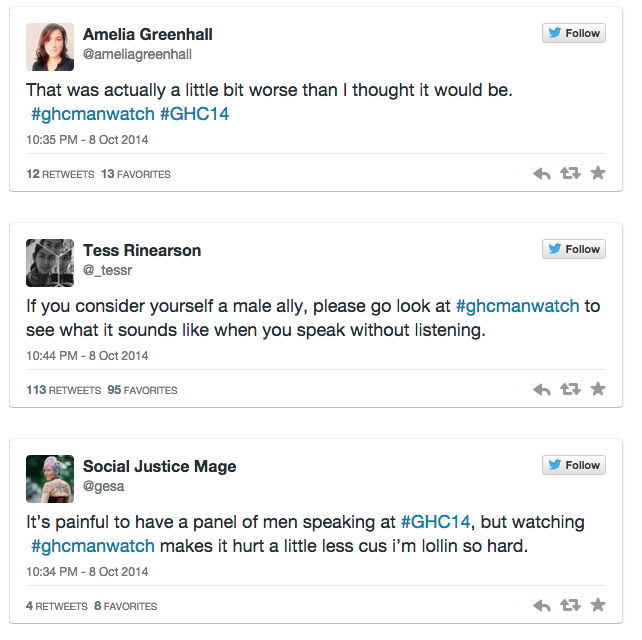
Chris Wiggins was kind enough to forward me this article on a recent panel discussion of “Male Allies of Women” at the 2014 Grace Hopper Celebration, which is a big deal conference for women in tech.
Panelists included Facebook CTO Mike Schroepfer, Google’s SVP of Search Alan Eustace, GoDaddy CEO Blake Irving, and Intuit CTO Tayloe Stansbury. The advice was stale and trite and included things like “speak up,” “lean in,” and “get excited about your ideas like men do.”

Yes, I said GoDaddy.
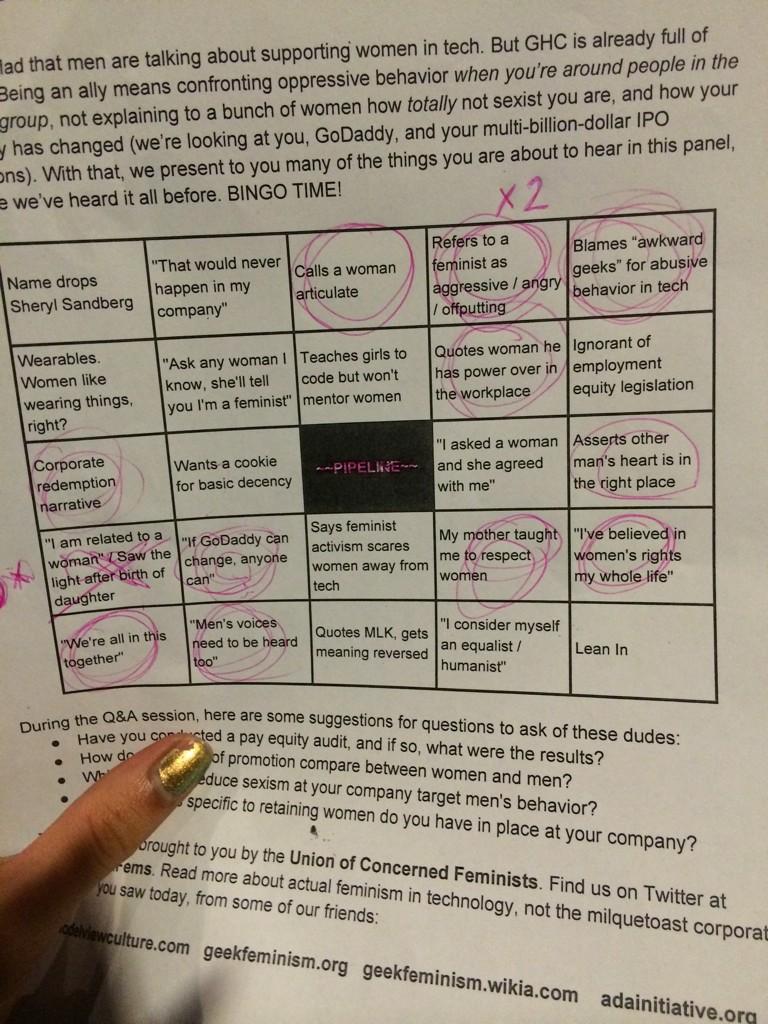
By far the best part was the audience response – I wish I’d been there just for that part.
There was a Bingo game on the phrases that were anticipated:
What male allies should really be doing, step 1
Here’s the thing. If you haven’t seen this video of gamer Anita Sarkeesian speaking at the Feminist Frequency conference (hat tip Josh Vekhter), go take a look. It’s a fantastic and articulate diatribe against sexism and misogyny, and it ends with a super reasonable request of the men in the audience and in the world:
Trust women who say they experience sexism.
What’s amazing to me is how hard this is to hear for men in my life. When I repeated this to a couple of them, they actually said that I didn’t experience the stuff that I had. It was kind of nuts, and I had to point out to them that they were failing on the most basic level.
Yes, it requires empathy, and observation, and yes it sucks, because once you start seeing it you will be disappointed in the world. Tough shit, it’s reality.
What male allies should really be doing, step 2
Once men start trusting the women they love and admire and work with, then the next thing they can do is start acting on that knowledge.
I don’t know how many times I’ve been the target of sexism in front of other men and somehow it’s my job to confront it and deal with it. Men, step the fuck up and, when you see sexism happening, once you can manage that, defend the target and put a stop to it. Speak up and defend your friend, or your wife, or your daughter, or your colleague. Thanks.
Reverse-engineering Chinese censorship
This recent paper written by Gary King, Jennifer Pan, and Margaret Roberts explores the way social media posts are censored in China. It’s interesting, take a look, or read this article on their work.
Here’s their abstract:
Existing research on the extensive Chinese censorship organization uses observational methods with well-known limitations. We conducted the first large-scale experimental study of censorship by creating accounts on numerous social media sites, randomly submitting different texts, and observing from a worldwide network of computers which texts were censored and which were not. We also supplemented interviews with confidential sources by creating our own social media site, contracting with Chinese firms to install the same censoring technologies as existing sites, and—with their software, documentation, and even customer support—reverse-engineering how it all works. Our results offer rigorous support for the recent hypothesis that criticisms of the state, its leaders, and their policies are published, whereas posts about real-world events with collective action potential are censored.
Interesting that they got so much help from the Chinese to censor their posts. Also keep in mind a caveat from the article:
Yu Xie, a sociologist at the University of Michigan, Ann Arbor, says that although the study is methodologically sound, it overemphasizes the importance of coherent central government policies. Political outcomes in China, he notes, often rest on local officials, who are evaluated on how well they maintain stability. Such officials have a “personal interest in suppressing content that could lead to social movements,” Xie says.
I’m a sucker for reverse-engineering powerful algorithms, even when there are major caveats.
Workplace Personality Test for the NY Fed
I’ve got a list of things to write about here on mathbabe, and they include the Carmen Segarra secret tapes as well as workplace personality tests. I’ve decided to do a mash-up just for fun, imagining what Carmen had to go through to get her job.
Update: you can send someone the link to this personality test here.
Detroit’s water problem and the Koch brothers
Yesterday at the Alt Banking group we discussed the recent Koch brothers article from Rolling Stone Magazine, written by Tim Dickinson. You should read it now if you haven’t already.
There are tons of issues that came up, but one of them in particular was the control of information that the Koch brothers maintain over their activities. If you read the article, you realize that the brothers are die-hard libertarians but at some point realized that saying out loud that they are die-hard libertarians was working against them, specifically in terms of getting into trouble for polluting the environment with their chemical factories, so instead they started talking about how much they love the environment and work to protect it.
It’s not that they stopped polluting, it’s that their rhetoric changed. In fact there’s no reason to think they stopped polluting, since they still had plenty of regulators going after them for various violations. Since their apparent change of heart they’ve also decided to be publicly philanthropic, giving money to hospitals, and Lincoln Center, and even PBS (see how that worked out on Stephen Colbert).
The problem with all this window dressing is that people are actually starting to think the Koch brothers may be good guys after all, and what with the fancy lawyers that the Koch brothers hire to control information about them, the public view is very skewed.
For example, how many economists have they bought and inserted into universities nationwide? We will never really know. There’s no way we can keep a score sheet with “good deeds” on one side and “shitty deeds” on the other. We don’t have enough information for the second side.
The exception to this information control is when they get in trouble with regulators and it becomes a matter of public record. And thank goodness those court documents exist, and thank goodness investigative journalist Tim Dickinson did all the work he did to explain it to us.
A couple of conclusions. First, we complain a lot about the bank settlements for the misdeeds of the big banks. Nobody went to jail, and the system is just as likely to repeat this kind of thing again as it was in 2005. But another problem with this out-of-court settlement process, we now realize, is that we actually don’t know what happened except in big, vague terms. There will be no Tim Dickinson reporting on big banks.
Second, the connection to Detroit. Right now there are 15,000 residents of Detroit whose water has been shut down, basically so they can privatize the water system with the best deal from Wall Street. They owe less than $10 million, on average a measly $540. The United Nations has called this water shutoff a violation of the human rights of the people of Detroit.
If you feel bad about that, you can donate to someone’s water bill directly, which is kind of neat.
Or is it? Shouldn’t Obama be declaring Detroit a state of emergency? Wouldn’t we be doing that in another city that had 15,000 residents without water? Why is this an exception to that rule? Because the victims are poor? Don’t we recognize Detroit as a place where it’s unusually difficult to find work? Are we going to allow people to shut off heat as well, once winter comes?
Once you think about it, the idea of a “private solution” to the Detroit water emergency seems wrong. In fact, you can almost imagine David Koch coming to the rescue here, as part of his “positive optics” campaign, and bailing out the Detroit citizens and then, for good measure, buying up the water system altogether. A hero!
And if you’re in that mode, you can think about the asymptotic limit of that approach, whereby a few very rich people gradually take control of resources, and then there are intermittent famines of various types in different cities, and the rich people swoop in and heroically save the day whilst scooping up even more ownership of what used to be public infrastructure. And we might thank them every time, because it was a dire situation and they didn’t really need to do that with all their money.
It’s frustrating to live in a country that has so many resources but which can’t seem to get it together to meet the basic human needs of its citizens. We need a basic income, at least for the people in Detroit, at least right now.
Aunt Pythia’s advice
Has Aunt Pythia mentioned recently how much she loves you people?! Well, if not, then let it be known: Aunt Pythia loves you people.
Aunt Pythia asked for new questions last week, and you guys fucking delivered. Outstanding. I counted 21 questions when I started today’s column, which is a good 18 more questions than I had last week. Granted, some of them look like really long stories continued over multiple submissions, or even spam, but I was just skimming so I don’t know that’s true.
Here’s the thing. It’s 47 degrees outside and rainy, and you might think that’s a bad thing, but I am inwardly celebrating the weather. Why? Well, I’ll tell you: it’s knitting weather my friends! There’s nobody gonna stop me from sorting my yarn and knitting the fuck out of it all day today.
Yessirree. I’m barely gonna get up from my chair except to make my kids crepes. Oh, and to boil some water for a pot of tea. Holy crap that sounds cozy. That’s the plan, people, and I hope you have an equally delicious plan yourselves. Having said all this makes me want to mix it all up and show you a knitted tea cosy which I must assume is flannel lined:

Technically this is crocheted but I do that too.
Are you with me? Flannel bathrobes and comfy chairs! Right now! You!
(pro tip: if you don’t have a flannel bathrobe, a flannel sheet wrapped around you will do in a pinch.)
OK, all comfy? Good. After enjoying today’s column, please don’t hesitate to:
submit yet more stolen question from old Dan Savage columns
By the way, if you don’t know what the hell Aunt Pythia is talking about, go here for past advice columns and here for an explanation of the name Pythia.
——
Dear Aunt Pythia,
What is your opinion about monogamy and respect in a partnership?
I fell into a relationship with the most wonderful, intelligent, kind human being, whom I cherish very much. But I have always found monogamy difficult and sometimes unnatural. I tried from the start not to “define” things, but said wonderful human being is very much against “open” relationships and follows a more traditional conservative view of partnerships. I have no complaints about our own sex life, W.H.B is open minded and open to being tied up, etc., it’s just that sometimes I like to be involved with more free-floating. Thus, I have been committed and loyal to W.H.B, but I am beginning to feel restrained and worry that because of this will end things entirely.
What do you suggest I do? Should I suppress these feelings entirely? So far I have succeeded but it has left me restless. Should I end this relationship? But I care very much for this person and want neither of us to get hurt. Should I try as much as possible to negotiate threesomes? (Although that requires a willing and trusty third person, which might be difficult to find, although potentially worth it, but morever W.H.B. might not be into repeated trysts.) Should I work within the boundaries of what W.H.B. draws as a baseline “OK” aka, making out is okay, but no penetration etc., but in the end might those lines get shady? Should I just flirt my pants off with people without touching them?
I find that many people hear the word “open” and see it as a death sentence for a partnership, and I don’t want to drop that bomb for either of us. In the long run I do believe in life partners to which we remain emotionally faithful, but I have a hard time balancing that with my restless spirit, which frustrates me, because I do care deeply for said being.
Love,
Physically open woman engineer regretting Self limited unity tie
Dear PowerSlut,
Great question! And I’m impressed that you’re asking this question now. Most people who ask me something like that have already been through the “flirting their pants off with someone” phase (more about this phase below!), by which time things have gotten way more complicated.
OK, so I notice you didn’t mention children or marriage, so I’m going to assume that you’re not married to this guy and that there are no kids involved, which honestly makes a huge difference, because it means you have much less at risk.
Now I will make an observation, which is not meant to be a philosophical nor moral statement about slutty people in situations like yours. Just a fact. Namely, those situations don’t last long. It’s a very unstable equilibrium.
In my experience, with my slutty friends and acquaintances, the following tends to happen sooner or later, with emphasis on sooner: you, the slut, start “flirting your pants off without touching” – possibly the sexiest thing in the world to do – and then quickly find yourself with your pants off, on the floor of a bathroom at a club or a bar somewhere. It’s not pretty, but I’d argue it’s a testament to what happens in this modern age when we feel repressed and simultaneously feel entitled to get what we want.
And that’s not to say we shouldn’t feel entitled. Entitled isn’t a bad word here. After all, what was all that progress we made in the last 50 years for if not the rights of the slutty women to go be sluts? Amen to entitlement, sister. It’s time women got what they really want without threat of death or social isolation.
Bottomline, when my slutty friends start complaining to me about not getting enough sex in their current love relationship, I kind of just look at my watch and start the countdown. It averages about 12 months before the inevitable bathroom floor story (or equivalent).
So here’s the thing. Instead of wondering whether that’s going to happen if things go on as they are, you might want to think of whether, when you’re picking yourself up from that bathroom floor, where yes you used a condom, you can go back to your adorable partner W.H.B. and not feel like a shit. There are a few scenarios you might consider:
- Lie to him and never tell him about the bathroom floor incident. This depends on your ability to lie and your guilt levels. And this is frankly impossible if you don’t practice safe sex, so please do.
- Decide to tell him about the bathroom floor incident. If you go this route I’d suggest waiting a few weeks and then being sure you can convincingly say that the sex was safe and that you don’t care about that guy at all, and he’s not a threat to the relationship, and you haven’t seen him since. This requires that you actually think those things and that you are basically informing him of your persistent sluttiness, which he might not be able to handle, but then again he might. Another possibility is to tell him in advance that such a situation might happen, but then it’s theoretical and he might not believe that people can do that without it being a big deal.
- Break up with your dear W.H.B. because neither of these options are doable.
There’s another option which some eagle-eyed readers might have noticed I omitted, which is to never get onto the bathroom floor with some random dude at a club to begin with. I agree that, theoretically speaking, this is an option for some people, but not, in my experience, for sluts. Having said that I might be cheating slightly and defining “sluts” ex post facto.
Notice I haven’t given you advice here, exactly. Because the truth is, I don’t know enough about who you are and who W.H.B. is to know what might work. If I were forced to choose, I’d go for #3, because from the outsider’s perspective, there are far too many young couples that are sexually incompatible but decide to stay together anyway and then are really really frustrated for a very long time. But again, really not sure what’s right for you, and despite that I hope I’ve still been somewhat helpful.
Aunt Pythia
——
Dear Aunt Pythia,
Please don’t rebuke me for not asking you a question. (Yeah like that’ll stop you! 🙂
It’s just that, I thought you’d find this link worth knowing about in case you don’t already.
By the way, I have been reading The New Jim Crow like you said to do. It is both fascinating and totally depressing, but the mere existence of the book makes it a little less depressing. Michelle Alexander is an exceptionally skillful author and a perfect one to have written this amazing book. Many thanks for the great reading assignment.
Yours,
Elvis Von Essende Nicholas Friedrich Lester Otto Widener IV
Dear Elvis,
Thanks for loving The New Jim Crow, if anything since shit went down in Ferguson I think it should be required reading.
For those of you who didn’t bother to click on the link, it’s an article about an app building organization that focuses on helping low-income smartphone users with their daily problems. The most promising app they mention is called “Easy Food Stamps,” and makes it easier for people to apply for foodstamps.
I like the idea. It reminds me of my last visit to Silicon Valley, where I heard one entrepreneur tell another entrepreneur about this amazing app he was using that turned on his air conditioner before he got home, thus saving him the trouble of being in his apartment for a full 5 minutes with the famously unbearable San Francisco heat. I think I heard him describe it as “solving the most important problem of my life.” Which says a lot about these guys’ problems.
Thanks!
Aunt Pythia
——
Dear Aunt Pythia,
I recently started my Ph.D. in a math-intensive male-dominated field, and I find myself surprisingly hurt by some of the subtle sexism I’ve found in my department. For example, when asking questions the (male) TAs twist themselves into mental pretzels in order to find a hint of correctness in the guys’ answers – even when, frankly, there is nothing right about them – but dismiss as trivial and/or fail to understand the women’s answers, even when those answers are almost perfect. I’ve also noticed that when the whole cohort is working on homework together, my fellow women only have their ideas taken seriously after a guy pipes up and seconds their suggestion.
Yesterday I was working on homework with one of the guys in my cohort (let’s call him Tim). Tim and I were trying two different approaches to a proof, and mine ended up coming out really well while his fizzled out. I explained my way to him, we got really excited about it, and I felt great about the whole exchange. When the topic came up later in a group-wide email chain, I said, “Tim and I already worked this one out!” and then proceeded to explain how. Today I arrived at school to find the whole group abuzz about how elegant and great “Tim’s” proof was. I feel like this early stage is when the cohort slowly establishes mental lists of who is good at what (and this area really is my strength), but somehow the credit never ends up going to the girls. How can I build a reputation as a student when my good ideas aren’t good until a guy appropriates them? And what can I do to make sure the other women in my class get the credit they deserve?
Craving Recognition Ensures Disappointment, I’m Told Meanwhile, Everyone Exhibiting Extra Estrogen Experiences Exiguous Encouragement
Dear CREDITMEEEEEEEE,
First, amazing sign-off.
Second, yes, yes, yes, YES. An incredibly important point, and thanks so much for expressing it so well.
This is exactly what I am always explaining to people when they argue against my “Great Men With Big Ideas” rant, whereby I complain that people who explain the history of ideas in terms of Great Men With Big Ideas are using a narrative crutch which is both sexist and inaccurate. Nonetheless, it is a tradition, and people like traditions. It particularly irks me when you see pictures of these Great Men With Big Ideas. It’s one reason I like to focus on ideas rather than the so-called “owners” of these ideas, because I know that, behind the curtain there could very well be an uncredited woman.
As for advice, I’ll tell you what I’d do. I’d take every opportunity to correct people in person: “actually, that was my idea, but then Tim and I worked it out together.” I’d also go to Tim and ask him to do the same and tell him you know he knows how sexist other people are and how this stuff gets out of hand. Depending on whether Tim is a good guy, he’d be happy to do that. And if he isn’t, don’t work with him again.
In other words, this is a cultural practice, which needs to change, but that kind of change is hard, and you just have to do your crummy part in making it change when it concerns you. Another think that you should definitely do is tell other women in your program that, if similar things happen to them, you will be more than happy to advocate for their work. Make an explicit pact with the women and the cool guys that this cultural practice is bullshit and needs to stop.
And, just in case you’re wondering if you’re alone (harhar), make sure you check out this webpage.
Good luck, I’m 100% behind you!
Aunt Pythia
——
Dear Aunt Pythia,
Having gotten over my divorce, I’ve recently turned to on-line dating, like any other introverted nerdy technologist. If I don’t miss my guess, I’m older than your usual audience, let’s say somewhere past you, so I’ve come to accept that the dating process is capricious, and fate or luck, call that as you may, is sometimes the difference.
I’ve found the on-line bit more confusing than the tried-and-true methods of dating simply because it seems that the scoring systems are not working well for humans even if their computations seem fine on their side. Or maybe it’s better stated that they get 75% right and 30% is not just wrong, it’s wacky. For example, they’ll match me with a woman in my area, of the age range I prefer, and our lifestyles seem to match up, but she doesn’t want kids, which is the opposite for me. Or maybe, she loves cats, has cats and is allergic to dogs, where I have a dog. Or, even though I’ve stated a preference for monogamy, they pair me with polyamorous types.
My current approach is simply to get ‘close enough’ on the scoring and then fire away, but I’ve also thought that maybe approaching those who *really* don’t fit my score, just to see if the silly algorithms are working at all.
Your thoughts?
Creature Feature
Dear Creature,
Well, one thing about getting older is that we know what we like way more. This is good and bad. So for example, even just in my 40’s I’ve been figuring out all sorts of things about myself. And that’s cool for me, and make hitherto baffling things from my past way more clear, but that also make me less and less compatible with would-be dates. Luckily my husband and I are happily married, or else I’d be thoroughly undatable.
Or would I? Let me put it this way. When we were 18 we wouldn’t let “she is allergic to dogs” be the reason we were separated from our true love. We wouldn’t give two shits about dog allergies, in fact. So maybe the real problem here is that we somehow get convinced that petty incompatibilities matter deeply. Maybe we should just stop looking at categories that we decide our 18-year-old selves wouldn’t give two shits about.
And that’s the problem with dating sites, as I’ve complained about before. They ask the wrong questions, and the shitty irrelevant data which comes out of those wrong questions get us all confused about what’s important to us. I even made a new set of questions I thought would be better.
Here’s a suggestion: decide on a few things that matter in a strong way (straight woman, for example) and think about dates as things you actually do that exhibit compatibility. For example, propose to go to a musical event of an artist that you actually like, and see if she’s into it. Worst case you get to see a great performance. Or go to a movie you actually want to see with her. Build shared experiences that might bring you together, and explore that side of things. The dog allergies can be overcome if other stuff works.
Good luck!!
Aunt Pythia
——
Please submit your well-specified, fun-loving, cleverly-abbreviated question to Aunt Pythia!
Ello, Enron, and the future of data privacy
If you think Ello is the newest safest social media platform, you might want to think again.
Or at the very least, go ahead and read this piece by my data journalist buddy Meredith Broussard, entitled ‘Ello, social media newcomer! Goodbye, data security fears?. Meredith has read the fine print in Ello’s security policy, and it’s not great news.


 mathbabe