Archive
Fingers crossed – book coming out next May
As it turns out, it takes a while to write a book, and then another few months to publish it.
I’m very excited today to tentatively announce that my book, which is tentatively entitled Weapons of Math Destruction: How Big Data Increases Inequality and Threatens Democracy, will be published in May 2016, in time to appear on summer reading lists and well before the election.
Fuck yeah! I’m so excited.
p.s. Fight for 15 is happening now.
Open Data conference at Berkeley Center for Law & Technology this Friday
I’m excited to be involved with an interesting and important conference this coming Friday at UC Berkeley, held by the Berkeley Center for Law & Technology as well as the student-run journal, the Berkeley Technology Law Journal.
It’s a one day event, entitled Open Data: Addressing Privacy, Security, and Civil Rights Challenges, and it’s got the following blurb:
How can open data promote trust in government without creating a transparent citizenry? Governments at all levels are releasing large datasets for analysis by anyone for any purpose—“Open Data.” Using Open Data, entrepreneurs may create new products and services, and citizens may use it to gain insight into the government. A plethora of time saving and other useful applications have emerged from Open Data feeds, including more accurate traffic information, real-time arrival of public transportation, and information about crimes in neighborhoods.
The program is here, and as you’ll see I’m participating in two ways. First, I’m giving a tutorial first thing in the morning on “doing data science,” which is to say I’m doing my best to explain to a room full of lawyers, in 40 minutes, what it is that modelers actually do with data, and how there might be ethical concerns. Feel free to give me advice on this talk!
Then at the end of the day, I’m in charge of “responding” to Panel 3. Since this is something we don’t have in academic math conferences or talks, I had to ask my lawyer friend what it means to respond, and his answer was that I just take notes during the panel discussion and then I get to comment on stuff I’ve heard. This will be my chance to talk about whether the laws they are talking about, or the proposed changes in the laws, make sense to the world of modeling.
I’m a bit concerned that I simply won’t understand what they’re talking about, since they are experts in this field of security and privacy law which I know very little about, but in any case I’m looking forward to learning a lot on Friday.
Predatory credit score-based insurance fees
I’ve been looking into who uses credit scores – FICO scores or other alternative scores – and I’ve found that the insurance industry is a major user.
Homeowners insurance rates, for example, varies wildly by state depending on what kind of credit score you have, often more than doubling for people with poor credit versus people with excellent credit. This is in spite of the fact that homeowners insurance applies not to the payments of mortgages but rather to the contents of an apartment or home.
Similarly, auto insurance rates vary by credit score, even though someone with a poor credit score isn’t obviously a bad driver. For example, in Maryland, people with bad credit scores can be charged 40% more just for having bad credit scores.
Statistics like this make me wonder, how much of this price discrimination comes from the insurance companies trying to understand and account for actual risk, and how much comes from their understanding that poorer people have fewer options and will simply pay predatory rates?
And just in case you’re a believer in free markets and fair competition, and think such predatory behavior would be whisked away in a competitive market, insurance companies actually target people who don’t shop around and charge them more. In other words, it’s not a free market if not everyone actually has good information.
Tell me if you have more examples like this, I’m a collector!
Aunt Pythia’s advice
Hello, friends. Aunt Pythia is grateful, as usual, to be able to perform her favorite function this morning, namely doling out questionable and downright misleading advice to earnest and vulnerable nerds. She wishes she could do better than that, but there it is.
For example, here’s some terrible advice that Aunt Pythia is offering up, although nobody even asked her: if an ultra-orthodox jewish man comes onto the plane and is assigned to sit next to you but refuses to because you’re a women, and he doesn’t want to worry about the possibility sexual contact, then just go ahead and whip out your tits and rub them against him to let him stop worrying.
Oh, and there’s also this, which I hope you all watch:
Awesome, right? And no, I don’t care if it’s fake. Please signal your agreement by:
asking Aunt Pythia a question at the bottom of the page!
By the way, if you don’t know what the hell Aunt Pythia is talking about, go here for past advice columns and here for an explanation of the name Pythia.
——
Hi AP,
In the spirit of your abominable snow woman pic, here is my favorite joke pertinent to the species. Two snow people are eating. One says to the other, “this tastes like boogers.” The other replies, “it’s carrot cake.”
Real Men Don’t Eat Carrot Cake
Dear RMDECC,
No, wait, that’s not better than my favorite snowman joke, which is also shorter: One snowman says to another snowman, “do you smell carrots?”
AP
——
Aunt Pythia,
OK, update. Communication was a good thing in this case. A very big misunderstanding occurred, actually more than one.
I guess you can answer the question anyhow if you like, since you love sex questions almost as much as sex.
Just put this update in here and tell dudes that if a guy somehow gets the impression that a girl is being shy about getting theirs in return that they should FUCKING ASK.
Also tell them that pulling your hips back a little is not the universal sign of “stop, I’m about to come.”
METOO
Dear METOO,
Wow. What?
It took me a while to parse this letter, but I think I get it now. You are the person whose letter I published last week, which caused a bit of a stir. Quick summary: new guy, he came and then ignored you, what should you do, and I suggested next time you make sure you come first. Some readers were like, yo, talk about it.
Now that I’m against talking about it! I am not against talking about it! I am simply of the opinion that doing is even better than saying in some cases, especially cases where feelings can get easily bruised.
Actually, let me be more nuanced. I think pillow talk is great, and I highly encourage it, but I think you need to time it well, preferably after both people have orgasmed and there’s no immediate reason for defensiveness.
Anyway, back to the update: I really have no idea what the update says, but clearly you seem to have made some progress in some way. Good for you! I have no idea what you are talking about regarding hips. If you mean that he had some weird theory about body language and interpreted yours to mean he was allowed to ignore your orgasm needs, than obviously that is fucked up reasoning. On the other hand, he might have just made that up on the spot to explain the unexplainable. In any case, I hope things are going better.
Good luck, METOO!
Aunt Pythia
p.s. yes, I do love talking about sex as much as sex. I mean, maybe not as much, but it lasts much longer, so yes, as much.
——
Aunt Pythia,
What do you think of Fit Kids February? I can’t believe we have a major media company fat-shaming children…
NYC1NOT
Dear NYC1NOT,
I have three things to say.
- I can’t believe I am still in February with letters. The way I do Aunt Pythia is from oldest to newest, and I never peek ahead, and it’s exciting that I still have more than a month of backlog. That’s never happened before!
- There’s a difference between fat-shaming kids (bad) and convincing kids to exercise (good). Personally I have no problem with pro-fitness messaging as long as there’s no shaming. Do you have examples of that program being shaming?
- In any case, thanks for reminding me that I’m looking forward to reading this book: Fat Talk Nation, The Human Toll of America’s War on Fat, written by Susan Greenhalgh, a Harvard anthropology professor. Thank goodness someone is finally working on this issue.
Love,
Aunt Pythia
——
Dear Aunt Pythia,
Here’s a little suggestion: there once was man who taught a class on his own time back in California called “Love 1A” after the suicide of one of his students. His name was Leo Buscaglia. During the 1980s his PBS series were very well received – sadly, it appears that a lot of what he spoke about in regards to relationships sort of have fallen by the way side.
May I humbly suggest that those who have such issues at least watch his ‘Speaking of Love’ before they may/may not do something they will regret?
Mid-age Monastic Mainframe Mechanical Miserably Masturbating in Minnesota
Dear MMMMMMM,
This guy is awesome. Here’s part 1 of 6:
My favorite line: “When you think I’m crazy, that gives me lots of leeway for behavior.” This guy was an inspirational speaker before they became full of shit.
Thanks!
Aunt Pythia
——
Dear Aunt Pythia,
I am contacting you because lately I have met a personal crisis. I am hoping you can give me some advice because I think you seem to have such a career that you love.
In May I graduate from my bachelor in Computer Science. I have been involved in several research projects as an undergrad and have been certain I wanted to join the academic game. However, not long ago I “discovered” I have never had a proper job, and thought “How can I be so certain about joining academia?”
My reasoning before is that I firstly love computer science and the problems I have been solving in a research setting, as well as the curious environment. However, I also realize I enjoy most challenging mathematical/computational problems… What if life as a data scientist in a company I like/or my own would prove even cooler? Sometimes I just want to leave this safe environment I feel like I am in now, and explore the tech world on my own (but perhaps I am scared?).
I am now working on a project that is essentially a modeling problem, given some cool data. I have been learning a lot more machine learning algorithms and statistics. I really like this and it makes me want to become a data scientist. I am a very impulsive decision maker- I always listen to my (stochastic?) stomach. And these days my stomach is telling me to go out after I graduate and check out a different environment.
I know that my family and people now expect me to do a master etc (and I have applied), and in a way I also expect that of myself because I have wanted it for so long and set these goals. I think there is only one of the masters I applied to that I truly want to do. It is hard to remove these influences and think straight. My worry is that I don’t do something that truly excites me.
I think I am a tough person and should be handling this uncertainty well- but I just end up in circles and it drives me nuts, especially when people say “in the end everything will be ok”. The end????!
Hence I am contacting you Aunt Pythia. I just want some advice from your wise past on how to deal with these ticking issues that occupy too much thinking time these days. Did you always know you wanted to do academia as an undergraduate? Any advice to a random confused 21 year old who is trying to make sense of randomness is much appreciated.
Miss Stochastic Process
Dear Miss Stochastic,
Great name. Also, I’m possibly the worst person in the world to give advice on this, but that won’t stop me.
Go get the masters, maybe a Ph.D.; it won’t be the last thing you do, and you have lots of time. You can try it out and see how it goes.
Instead of thinking about what you want to do for the rest of your life, do something that you are likely to enjoy for at least a while, with a strict promise to yourself to quit and change directions once you stop liking it.
That’s not to say you should give up at the first sign of trouble or difficulty. By no means am I saying that. If anything it’s the opposite: a challenge is a reason to stick with it. At the first sign of boredom, however, you should start looking around.
Good luck!
Auntie P
——
Congratulations, you’ve wasted yet another Saturday morning with Aunt Pythia! I hope you’re satisfied, you could have made progress on that project instead.
But as long as you’re already here, please ask me a question. And don’t forget to make an amazing sign-off, they make me very very happy.
Click here for a form or just do it now:
The achievement gap: whose problem is it?
On Monday night I went to see Boston College professor Henry Braun speak about the Value-Added Model for teachers (VAM) at Teachers College, right here in my hood (hat tip Sendhil Revuluri).
I wrote about VAM recently, and I’m not a fan, so I was excited for the event. Here’s the poster from Monday:

The room was not entirely filled with anti-VAM activists such as myself, even though it was an informed audience. In fact one of the people I found myself talking to before the talk started mentioned that he’d worked on Wall Street, where they “culled” 10% of the workforce regularly – during downsizing phases – and how fantastic it was, how it kept standards high.
I mentioned that the question is, who gets decide which 10% and why, and he responded that it was all about profit, naturally. Being an easily provoked person, I found myself saying, well right, that’s the definition of success for Wall Street, and we can see how that’s turned out for everyone. He stared blankly at me.
I told that story because it irks me, still, how utterly unscathed individuals feel, who were or are part of the Wall Street culture. They don’t see any lesson to learn from that whole mess.
But even more than that, the same mindset which served the country so poorly is now somehow being held up as a success story, and applied to other fields like public education.
That brings me to the talk itself. Professor Braun did a very good job of explaining the VAM, and the inconsistencies, and the smallish correlations and unaccountable black box nature of the test.
But he then did more: he drew up a (necessarily vague) picture of the entire process by which a teacher is “assessed,” of which VAM plays a varying role, and he asked some important questions: how does this process affect the teaching profession? Does the scrutiny of each teacher in this way make students learn more? Does it make bad teachers get better? Does it make good teachers stay in the profession?
Great questions, but he didn’t even stop there. He went on to point something out that I’d never directly considered. Namely, why do we think individual responsibility – i.e. finger pointing at individual teachers – is going to improve the overall system? Here he suggested that there’s been a huge split in the profession between those who want to improve educational systems and those who want to assess teachers (and think that will “close the achievement gap”). The people who want to improve education talk about increasing communication between teachers in a school or between schools in a district, and they talk about improving and strengthening communities and cultures of learning.
By contrast the “assess the teachers” crowd is convinced that holding teachers individually accountable for the achievement of their students is the only possible approach. Fuck the school culture, fuck communicating with other teachers in the school. Fuck differences in curriculum or having old books or not having enough books due to unequal funding.
It got me thinking, especially since I read that book last week, The New Prophets of Capitalism (review here). That book explained how hollow Oprah’s urging to live a perfect life is to people whose situations are beyond their control. The problem with Oprah’s reasoning is that it ignores real systemic problems and issues that radically affect certain parts of the population and make it much harder to take her advice. It’s context free in a world where context is more and more meaningful.
So, whose problem is the achievement gap? Is it owned in tiny pieces by every teacher who dares to enter the profession? Is it owned by schools or school systems? Or is it owned by all of us, by the country as a whole? And if it is, how are we going to start working together to solve it?
Everyone hates college administrators
If you were wondering why I didn’t blog yesterday, which you probably weren’t (confession: I don’t read other peoples’ blogs and I don’t listen to any podcasts. So I would never, ever ask anyone to read my blog or listen to my podcast), it was because I was completely confused and irritated by this NYTimes opinion piece on the rising cost of college, written by University of Colorado Law Professor Paul Campos.
I really think the Times needs to either have footnotes or hyperlinks in their opinion pieces, because this guy was playing so fast and loose with his numbers that I had really no idea what he was talking about most of the time. That’s saying something considering that this, the cost of college and its causes, is something I have spent many hours thinking about and researching.
So what happened was, I didn’t have time to completely formulate my opposition to why his reasoning was muddled and confusing. I spent way too much time trying to figure out where he was getting his data. Waste of time.
Good news, though, my Slate Money co-host Jordan Weissman has done all that work for us, in his piece aptly entitled The New York Times Offers One of the Worst Explanations You’ll Read of Why College Is So Expensive. Who says procrastination doesn’t work?
As usual, if you’ve ever listened to my podcast (and this isn’t a request for you to do so!), I don’t agree completely with Jordan. However, my delta of agreement with Jordan is very manageable compared to the delta of disagreement I had with Campos. Basically I would quibble with laying any of the blame at the feet of instructors, but since he barely does that, let’s just go with his awesome take-down.
Take-down of what? Well, Campos basically hates college administrators, and pretends there’s no other problems in the world except them. It’s a mistake that he doesn’t have to make.
I mean really, who doesn’t hate college administrators? As a former college administrator myself, I know it’s universal; I certainly hated myself the entire time.
But that doesn’t mean there’s no other factors at all. Reduced public money for colleges is in fact a huge problem, especially when you pair it with the increased federal aid money going to students at corrupt for-profit colleges. Corinthian obtained $1.4 billion in federal grant and loan dollars in 2010 alone, more than the 10 University of California campuses combined for that same year. This system is in terrible need of repair.
Instead of simply hating on college admin, or rather, in addition to hating on admin, can we start thinking about an alternative no-frills state college system that is truly affordable and gives honest and basic instructions without trying to compete on the US News & World Reports stage?
Aunt Pythia’s advice
Holy shit people we’ve got an awesome column today. Aunt Pythia shall not disappoint, and when she says that, she really means that you wonderful readers have not disappointed Aunt Pythia – your questions are surprising and rich and thoughtful as always. It brings a sweet lightness to Aunt Pythia’s otherwise heavy, snuffly head.
For you see, Aunt Pythia is suffering from a springtime cold, so nothing too terrible, but it probably didn’t help that Aunt Pythia refused to acknowledge the rain yesterday – because it was 61 degrees! – and insisted on biking everywhere.

Not my actual bike, nor the actual spot I was biking yesterday. But close enough for Aunt Pythia.
After you all enjoy this marvelous column chock full of ridiculous advice, please don’t forget to:
ask Aunt Pythia a question at the bottom of the page!
By the way, if you don’t know what the hell Aunt Pythia is talking about, go here for past advice columns and here for an explanation of the name Pythia.
——
Hello dearest Auntie P,
I just wanted to bring your attention to this calendar – sorry that it’s a buzzfeed article – and wish you the best with sexy pin-up men with various knitted objects.
I suppose I don’t really have a question, other than maybe other ideas you have for good calendar pages relating to men posing with sexy yarn?
But I hope you have a good day looking at this anyway!
Much love,
Casting-on Relishly Adorable Fellows To Sex
Dear CRAFTS,
Oh. My. God. Did you know my dear hubby is Dutch? Did you know I sometimes go to Amsterdam? This is seriously the best thing I’ve ever learned about that place, I’m not much of a smoker.
The name “Club Geluk” can be translated as “Club Happiness,” which seems pretty appropriate given this calendar. Here’s my favorite:

Is he holding a kiwi?
Also, it reminds me of my (previously) favorite calendar, which I buy each year and hand out to some baffled friends and visitors, namely the NYC Taxi Calendar:

You can never have too many calendars.
Readers, please do send me awesome calendars, I’m officially – as of now – a collector.
Love always,
Aunt Pythia
——
Dear Aunt Pythia,
Heads-up: I’m going to try to steer this away from the classic millenial-trying-to-find-purpose-in-life story, but it could go there.
I’m a 22-year old trying to decide whether to do a Ph.D. in pure math (topology/geometry). I’m currently taking grad classes in a non-degree program and my thoughts bounce around from “What’s the point of this?” to “Omigoodness my brain is in love” to “I’mstupid-Ihatethis-I’mstupid-Ihatethis”. It’s the sort of thing where I’ll decide ‘definitively’ not to go to grad school, and then immediately solve a hard problem and get into my reach school.
Amidst all that, I’ve been looking at alternatives to Ph.D. programs – things that are still intellectually rigorous/analytical but seem more relevant to the world. I’ve even considered switching to (shhhh) applied math. So my first question is this: what options/careers would you suggest to mathematicians who want to be able to “be useful”?
My second question comes from the fact that one of the main alternatives to math that I’ve considered is journalism. I enjoy writing and loved the journalism classes I took in undergrad. I was lucky enough to go to a talk you gave recently in which you mentioned data journalism. I’m thoroughly intrigued, but I have no idea how to look into it. How does someone ‘get into’ data journalism?
Moral of the story, I’m pretty confused. I love math (and have advisers pushing me towards grad school), but I’m not sure if I like it enough for a Ph.D. (or that I like who I am when I’m doing math). Any/all thoughts you have to offer on this silly mid-life-crisis business would be wonderful.
Thank you so much!
Does \exists \phi: Me \rightarrow Career, \phi isomorphic?
Dear Does,
I hear you, it’s tough. Personally I did a better job, when I was your age, at ignoring any possibility besides going to math grad school. I was laser focused. It’s good and bad to be that way, though, because it means you don’t hesitate to make bad choices.
Also, I don’t think I’d ever suggest not getting a degree in math. It comes in handy in all sorts of ways even if you end up doing something else. Even if it just trains you to be humble about your abilities, and know how to admit when you’re wrong, two basic and critical take-aways.
As for journalism, that’s such a tough field, and you’d find yourself hanging out with people who write articles like this (which is to say they won’t understand math enough to realize that describing Cuomo’s changes in education as a “victory” is not supported by fact). Not saying everyone in journalism is like that – in general I like the skepticism I encounter there – but there’s also real ignorance in some corners, and very few great jobs. But again, also a super rewarding job sometimes and for some people. I wouldn’t tell you not to pursue this if you’re truly interested.
The way to get into it – my best guess, not from experience – is to start doing it and posting your pieces on a blog – yours or your friends – or Huffington Post, so you can develop a portfolio that you can show people when you apply. That and work with journalists on their stuff.
I guess my overall advice is to get the education you think you want, and realize it’s flexible and can be used in lots of ways. It’s not something math professors tell you, mostly because they don’t know this, but math Ph.D.’s or masters degrees impress people in the outside world.
In the meantime take programming classes, keep in touch with applied math people and data journalism projects, and dip your toe into some of those waters when you can; do some projects. Don’t worry too much that the nerds around you are laser-focused, they might have changed completely in a few years, and it’s really not a competition. And good luck!
Aunt Pythia
——
Dear Aunt Pythia,
I’m a female undergraduate at a very good math department about to enter grad school for mathematics. I have a few stereotypically female qualities which I have found to have negatively impacted my time in undergrad. I don’t want to change who I am, but I’m also sick of the sexism in mathematics.
Just a quick background of what I’m talking about: Most of my side interests are stereotypically feminine: kids, baking, volunteering. I want to be a serious mathematician, but I also enjoy volunteering in local schools and do so quite frequently.
I also am pretty feminine in dress/in personality. I’m not that assertive, and I prefer to not answer in class, despite knowing the answer. Most of the males in my classes are much more assertive, aggressive in answering, and authoritative (even if they have no idea if they are right).
I feel that I’m taken less seriously by my peers and taken advantage of because I’m female, but I’m quite shy and quiet and speaking up is very unnatural for me. I perform at the top of my classes and have been successful in my research experiences, but my classmates don’t respect me (probably because I don’t talk about my success or assert my knowledge). I’m fine with my quiet personality, but I don’t know how to deal with my peers.
Examples:
- Peers assume that I’m going to be a high school math teacher, and are surprised I’m going to grad school.
- Many people applied to REUs from my school, but most didn’t get in anywhere and I got into most of the ones I applied to. Two male students complained in the hallway that I only got in because I’m female (which is not true at all – I’ve taken much more math than them and have published before). They only knew I had gotten in because my professors had told them. They don’t know that I heard them.
- I TA for Analysis II and Algebra II and students often “bully” me for the answers. When I say “no,” they don’t respect that and just ask again. I’ve tried being more assertive and authoritative. The students don’t pressure my fellow male TAs for answers and don’t ignore their refusals to give more help after many hints have been given.
- I’ve been told by my peers that I have a better chance at the grad schools I applied to because I’m female. These are just a few examples – I’m treated differently and feel alone in my undergrad department.
I’m just generally lost! I want to be stronger in grad school and I want people to respect my mathematical abilities, but I don’t know how to be assertive without being arrogant or over-confident. I want peers to stop assuming that I know less. Do you have any advice about how I can change in grad school?
Sorry for the super long question!
Wants To Change For Grad School
Dear Wants To Change,
First of all, congratulations. Sounds like you’re killing it. Seriously, and I’m so glad that your talent is being acknowledged and welcomed by the people who admit you and recruit you to REU’s and grad schools. It tells me that you are in a better place than you let yourself think. Spend a few minutes just gloating.
Second of all, fuck those assholes. Seriously. Fuck them. I know what you’re going through because I went through that stuff too, even though I wasn’t at all shy. The worst kind of person is the arrogant young man, they are unbelievably insufferable. I knew more than my share of such men, and let me tell you, they drove me nuts, and they also drove nice men nuts, as well as all the professors. They are universally despised and tolerated only because sometimes they turn out to be human by the time they get older and humbled (see above letter).
Third, some advice:
- Stick with it, everyone gets better when they are a bit older and less insecure. The truly insecure people often self-select out of the math scene altogether because they’re afraid they can’t cut it. For the horrible ones that stay, they become less and less relevant as they are isolated and everyone hates them.
- Never bake anything for math people. Seriously, there’s something about the act of baking in a department that brings out sexism. Stick with your baking for high school kids who will simply love you for it.
- Just ignore students who ask for answers. Yes, they are bullying you because they are completely unthreatened by you. But when they learn you don’t do that, they will stop.
- I would suggest you challenge yourself to answer questions in class, especially if you are taking a class from someone you hope to work with. It is a great habit to have.
- I would never suggest you change anything else about yourself, except for experimentation’s sake and if you are comfortable doing so. You might find people take you more seriously in certain outfits, and I’d never tell you not to wear them, but in this day and age the idea that you have to conform to other people’s standards of what a “serious” mathematician looks like is fucked.
- Most important, remember that you’re there to be educated, and it’s all about you, not them. Their egos are crying out in pain because they are threatened, and sometimes the noise is deafening, but learn to put on a set of ego headphones.
- Also, feed yourself. You might sometimes have problems with your own ego, and you should also be able to seek support, even though it won’t come at the expense of others. Think about how you can get it. I’m imagining that volunteering is a source of that for you, in which case please think of it as an alternative to therapy, and don’t ever ever give it up.
Good luck!
Aunt Pythia
——
Dear Aunt Pythia,
You’re (still) my favorite blogger, but I feel like you may have erred in your response to “Gossiped About And Hurt Humongously”.
You accuse him of claiming women are “discriminated in favor of”, which he did not. He said, “I was arguing that gender plays a role in fellowship/scholarship selection and college admissions”, which does not indicate in who’s favor that bias might be directed.
I think in this case you’ve unfairly put word in his mouth that were not there. Am I missing something here?
Sad And Disappointed
Dear SAD,
Yeah, maybe. I mean, I agree that I read into it a bit, but I’m not sure what I did was unfair. Let’s go back to what he said about the actual conversation:
I’m a guy and a grad student and I was talking to a fellow grad student, Z, about gender issues in academia. Specifically, I was arguing that gender plays a role in fellowship/scholarship selection and college admissions, and she claimed that no, an applicant’s sex does not have any detectable influence on such decisions. We started talking about affirmative action and before we had time to even discuss the implications of affirmative action, she had to go to class and I thought that was the end of it.
I took from this description that he was arguing that there existed affirmative action in admissions, and that this would promote women. I don’t think that was a crazy jump, since I’ve never heard of affirmative action that promotes men.
Readers, what do you think? The full question and answer are here.
Aunt Pythia
——
Dear Aunt Pythia,
OK, I fucked up. He does say later in the article, that he did make the pro female bias contention. As my girlfriend just pointed out to me. I still don’t think that is by default sexist, but I have to admit I read right over that without even seeing it, which may be.
Sad And Dissapointed
SAD,
Oh, what? Let me take another look. Oh right, he goes on to say, “being female sometimes helps in getting scholarships and in college admissions”.
Thanks for writing back!
Aunt Pythia
——
Dear Aunt Pythia,
After some years of “screw it, I’m not even bothering to date,” I met someone I like a lot. He is very smart, interesting, etc, etc. I made him wait ages to spend the night at my house, and last night he finally stayed over.
So anyway, the making out was awesome. We hit the bedroom, and all the clothes come off. Then, four minutes into giving him a blowjob, he just comes. No warning, but I’m ok with that, and I apparently give pretty good ones. What I’m not ok with was that we were now done. Excuse me, what the fuck?
This guy isn’t a selfish jerk at all, and I get that maybe the mood dies for him a bit after he’s gotten his. I also seem to have an effect on some men that makes them a bit “quick.” Given all that, what the hell do I do now? I will give him another shot, but if the same thing happens, he might be getting dumped. On the other hand, he’s practically the only man I have really been interested in for a long time (like, years).
I am not interested in having a discussion about it, and I especially don’t want to make this guy feel bad if he has some medical/PE type issue. However, I also can’t let him think this is acceptable.
Anyway, what would you do? (Actually, I know you, and you’d probably just grab his head and put it between your legs. Any other thoughts for the less assertive among us?)
My Enjoyment The Optional Orgasm
Dear METOO,
Alternative, less aggressive, no-talk option: start masturbating. What’s he going to do, watch? I mean, maybe. Or maybe he will help you out. He sounds like it’s worth a try.
Although, to be very honest, that’s what I’d start doing first, before the blowjob, when you get him into bed the next time. He’s already shown you that he goes second.
Good luck!
Auntie P
——
Congratulations, you’ve wasted yet another Saturday morning with Aunt Pythia! I hope you’re satisfied, you could have made progress on that project instead.
But as long as you’re already here, please ask me a question. And don’t forget to make an amazing sign-off, they make me very very happy.
Click here for a form or just do it now:
How many NYC are arbitrarily punished by the VAM? About 578 per year.
There’s been an important update in the thought experiment I started yesterday. Namely, a reader (revuluri) has provided me with a link to show how many teachers are considered “ineffective,” which was my shorthand for scoring either third or fourth in the four categories.
According to page 5 of this document, that percentage was 16% in 2011-2012, 17% in 2012-2013, and 16% in 2013-2014. We’ll take this to mean that the true cutoff is about 16.3%. Using my formula from yesterday, that means that after 4 years, about

or 12.7% of teachers going up for tenure in the new system will be arbitrarily denied tenure based only on their VAM score.
How many people is that in a given year? Well, this document explains that in 2000, 9,000 teachers were hired and in 2008, 6,000 teachers were hired. I’ll assume my best guess for “teachers hired” in a given year is something between those two numbers, but I’ll also assume it’s closer to the latter since it is more recent information. Say 7,000 new teachers per year.
Of course, not all of them go up for tenure. There’s attrition. Say 35% of those teachers leave before the tenure decision is made (also guessing from this document). That leave us with about 4,550 teachers going up for tenure each year, and 12.7% of them is 578 people.
So, according to my crude estimates, about 578 people will be denied tenure simply based on this random number generator we call VAM. And as my reader said, this says nothing about the hard-to-measure damage done to all the good teachers trying to teach their kids but having to deal with this standardized testing nonsense. It’s a wonder anyone is willing to work here.
Please comment if you have updated numbers for anything here.
The arbitrary punishment of New York teacher evaluations
The Value-Added Model for teachers (VAM), currently in use all over the country, is a terrible scoring system, as I’ve described before. It is approximately a random number generator.
Even so, it’s still in use, mostly because it wields power over the teacher unions. Let me explain why I say this.
Cuomo’s new budget negotiations with the teacher’s union came up with the following rules around teacher tenure, as I understand them (readers, correct me if I’m wrong):
- It will take at least 4 years to get tenure,
- A teacher must get at least 3 “effective” or “highly effective” ratings in those three years,
- A teacher’s yearly rating depends directly on their VAM score: they are not allowed to get an “effective” or “highly effective” rating if their VAM score comes out as “ineffective.”
Now, I’m ignoring everything else about the system, because I want to distill the effect of VAM.
Let’s think through the math of how likely it is that you’d be denied tenure based only on this random number generator. We will assume only that you otherwise get good ratings from your principal and outside observations. Indeed, Cuomo’s big complaint is that 98% of teachers get good ratings, so this is a safe assumption.
My analysis depends on what qualifies as an “ineffective” VAM score, i.e. what the cutoff is. For now, let’s assume that 30% of teachers receive “ineffective” in a given year, because it has to be some number. Later on we’ll see how things change if that assumption is changed.
That means that 30% of the time, a teacher will not be able to receive an “effective” score, no matter how else they behave, and no matter what their principals or outside observations report for a given year.
Think of it as a biased coin flip, and 30% of the time – for any teacher and for any year – it lands on “ineffective”, and 70% of the time it lands on “effective.” We will ignore the other categories because they don’t matter.
How about if you look over a four year period? To avoid getting any “ineffective” coin flips, you’d need to get “effective” every year, which would happen 0.70^4 = 24% of the time. In other words, 76% of the time, you’d get at least one “ineffective” rating just by chance.
But remember, you don’t need to get an “effective” rating for all four years, you are allowed one “ineffective rating.” The chances of exactly one “ineffective” coin flip and three “effective” flips is 4 (1-0.70) 0.70^3 = 41%.
Adding those two scenarios together, it means that 65% of the time, over a four year period, you’d get sufficient VAM scores to receive tenure. But it also means that 35% of the time you wouldn’t, through no fault of your own.
This is the political power of a terrible scoring system. More than a third of teachers are being arbitrarily chosen to be punished by this opaque and unaccountable test.
Let’s go back to my assumption, that 30% of teachers are deemed “ineffective.” Maybe I got this wrong. It directly impacts my numbers above. If the overall probability of being deemed “effective” is p, then the overall chance of getting sufficient VAM scores will be

So if I got it totally wrong, and 98% of teachers are described as effective by the VAM model, this would mean almost all teachers get sufficient VAM scores.
On the other hand, remember that the reason VAM is being pushed so hard by people is that they don’t like it when evaluations systems think too many people are effective. In fact, they’d rather see arbitrary and random evaluation than see most people get through unscathed.
In other words, it is definitely more than 2% of teachers that are called “ineffective,” but I don’t know the true cutoff.
If anyone knows the true cutoff, please tell me so I can compute anew the percentage of teachers that are arbitrarily being kept from tenure.
Review: The New Prophets of Capital
Last night I finished reading Nicole Aschoff’s new book, The New Prophets of Capital, which was published as part of the Jacobin series of books. Here’s a description from their website of their book series:
The Jacobin series features short interrogations of politics, economics, and culture from a socialist perspective, as an avenue to radical political practice. The books offer critical analysis and engagement with the history and ideas of the Left in an accessible format.
And by the way, if you don’t know what Jacobin magazine is, you should take a look. I recently signed up to receive the paper versions of all of their magazines and books, which was my version of a donation to a good and very thoughtful cause.
Aschoff’s book explores the storytelling nature of modern capitalism and neoliberalism, and focuses on the underlying assumptions, as seen through four larger-than-life figures: Sheryl Sandberg, Whole Foods founder John Mackey, Oprah, and Bill (and Melinda) Gates.
She does a good job of explaining, in plain, non-academic English, what’s wrong with these people’s messages. If you’re wondering what exactly bothers you about the Lean In movement, for example, take a look at the chapter on Sandberg, the book is worth it just for that.
The book is short, only 6 chapters. The first chapter gives reasoning for the book, describing how storytelling matters when we think about how culture works, and then the heart of the book follows with a chapter on each person listed above – the “prophets” – with their particular flavor. There’s also a concluding chapter, which is the least convincing, as it was extremely condensed and left too much reasoning unexplained.
The unifying theme throughout the four chapters devoted to the prophets is how these four people manage to be both public critics and private protectors of the current economic system, with an emphasis on protection.
So when Sandberg tells us to lean in, she’s telling us to conform to the way things are, not to threaten it in any way. When Oprah tells us that we have it in ourselves to live fantabulous lives, she’s giving us personal responsibility to be happy and fulfilled, and structural inequality is not acknowledged or recognized. When John Mackey or Bill Gates sees a problem, they set up a “free market solution” to that problem, even though, by definition, poor people don’t have money to pay for what they need.
While none of the book’s material was entirely new to me, it was interesting to see the connections deliberately made between the prevalent high-level business mindset and the individual choices we make for ourselves based on how we imagine the world works. If I really believed the Sandberg line, I’d still be working at a hedge fund, doing my best to please my colleagues and ignore my kids. If I had bought into Oprah’s context-free attitude, I’d blame people for their poverty and think it amounts to bad decision making.
The book isn’t entirely consistent. It maintains both that Bill Gates believes entirely in a free market and that he undemocratically influences education reform in this country with his money. Maybe those are consistent claims but it’s not obvious to me (although I agree with the undemocratic nature of his mega-philanthropy).
It’s a good book. I’d like a bunch of people to read it so we can have a discussion group. I also get the impression that Aschoff could write one of these a year, and I plan to follow her work.
I accept mathematical bribes
Last Friday I traveled to American University and gave an evening talk, where I met Jeffrey Hakim, a mathematician and designer who openly bribed me.
Don’t worry, it’s not that insidious. He just showed me his nerdy math wallet and said I could have one too if I blogged about it. I obviously said yes. Here’s my new wallet:
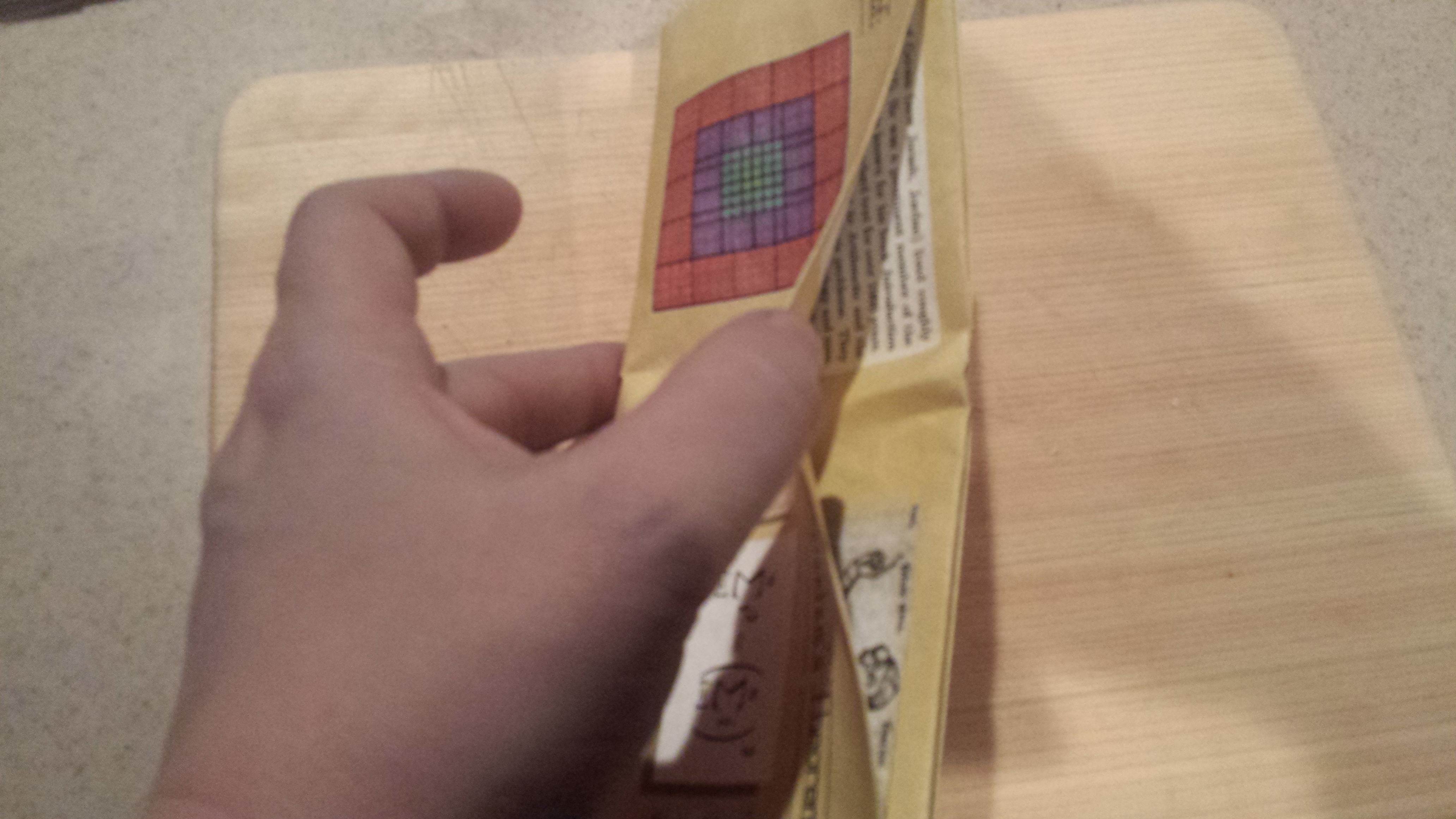
It’s made of the same kind of flexible plastic they use on the outside of buildings. Or something. I expect it will last for many years.
You might notice there is writing and pictures on my new wallet! They are mathematical, which is why I don’t feel bad about accepting this bribe: it’s all in the name of education and fun with mathematics. Let me explain the front and back of the wallet.
The front is a theorem:

Here’s the thing, I’ve proven this. I have even assigned it to my students in the past to prove. We always use induction. This kind of identity is kind of made for induction, no? Don’t you think?
Well Jeffrey Hakim had an even better idea. His proof of Nicomachus’s Theorem is represented as a picture on the back of the wallet:
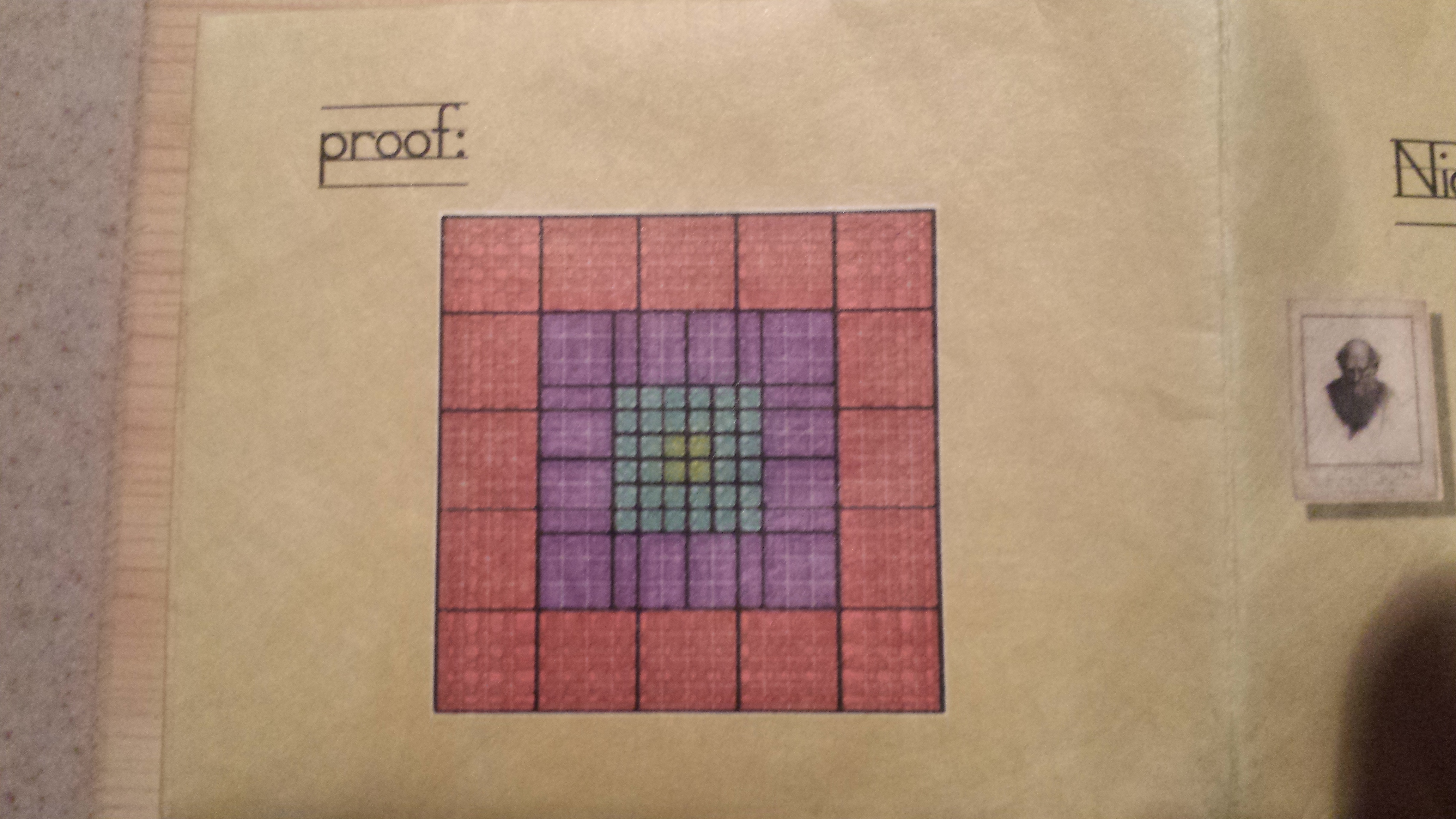
It took me a couple of minutes to see why this is a proof.
Here’s what I’d like you all to do: go think about why this is a proof of the above identity. Come back if you can’t figure it out, but if you can, just go ahead and pat yourself on your back and don’t bother reading the rest of this blogpost because it’s just going to explain the proof.
I’ll give you all a moment…
OK almost ready?
OK cool here’s why this is a proof.
First, convince yourself that this “pattern,” of building a frame of square boxes around the above square, can be continued. In other words, it’s a square of 4 1×1 boxes, framed by 2×2 boxes, framed by 3×3 boxes, and so on. It could go on forever this way, because if you focus on one side of the outside of the third layer, there are 4 3×3 boxes, so length 


OK, now here’s the actual trick. What is the area of this box?
I claim there are two ways to measure the area, and one of the ways will give you the left hand side of Nicomachus’s Theorem but the other way will give you the right hand side of Nicomachus’s Theorem.
To be honest, it’s just one bit more complicated than that. Namely, the first way gives you something that’s 4 times bigger than the left hand side of Nicomachus’s Theorem and the second way gives you something 4 times bigger than the right hand side of Nicomachus’s Theorem.
Why don’t you go think about this for a few minutes, because the clue might be all you need to figure it out.
Or, perhaps you just want me to go ahead and explain it. I’ll do that! That’s why I got the wallet!
OK, now imagine isolating the top right quarter of the above figure. Like this:

That’s a square, obviously, so its area is the square of the length of any side. But if you go along the bottom, the length is obviously 

And since we know we can generalize the original figure to go up to 

That’s 4 times the right-hand side of the theorem, so we’re halfway done!
Next, we will compute the area of the original figure a different way, namely by simply adding up and counting all the differently colored squares that make it up. Assume that we continue changing colors every time we get a new layer.
So, there are 4 1×1 squares, and there are 8 2×2 squares, and there are 12 3×3 squares, and there are 16 4×4 squares. In the generalized figure, there would be 

So if you look at the area of the generalized figure which is all one color, say the

That means the overall generalized figure will have total area:

Since that’s just 4 times the left-hand side of the theorem, we’re done.
Notes:
- this would be a fun thing to do with a kid.
- there’s more math inside the wallet which I haven’t gotten to yet.
- After staring at the picture for another minutes, I just realized the total area of the whole (generalized) thing is obviously
which is to say that either the left-hand side or right-hand side of the original identity is one fourth of that. Cool!
Aunt Pythia’s advice
Dear readers!
Do you know where Aunt Pythia is right now? She’s on a train from Washington D.C., coming home from a very short and very pleasant visit, involving a delicious dinner, an evening talk, and even more delicious desserts.

Not the actual desserts from last night.
Readers, it needs to be said that not one, not two, but three different times – in the span of 4 hours – someone mentioned to Aunt Pythia that she shouldn’t forget her duties the following morning.
And has she forgotten? No, she hasn’t, and it’s not only because she was reminded so gently and so often last night. No, it’s because Aunt Pythia loves and adores you – worships you, really – and could never forget you. If she doesn’t write it’s because she can’t write. And as Amtrak’s wifi is holding up (so far!), we are all in for a treat. Auntie P knows she is, anyway.
Give it up for trains people, and after that, don’t forget to:
ask Aunt Pythia a question at the bottom of the page!
By the way, if you don’t know what the hell Aunt Pythia is talking about, go here for past advice columns and here for an explanation of the name Pythia.
——
Dear Aunt Pythia,
You have written that sexual compatibility is important in finding an appropriate partner. But how do you ask or find that out when meeting people to consider dating? And when/how/where does when ask the question, “so how many sexual partners have you had?” I guess you have to date a person to find that out, and I know I shouldn’t ask that on the first date, and maybe even 2nd. And if the answer is above say two, how does one end the courtship without making the other person feel bad?
Here’s where I’m coming (hehe) from: I have been using okcupid to select for people that seem sexually compatible based on the questions they answer (e.g How many dates till sex?), but as is par for the course when it comes to online dating (at least for guys like me who are not tall, handsome, and/or rich) it is very hard to get responses (let alone dates) to the tons of (non-sexual) messages of interest I send. (I’ve had about 5 dates over 8 years of online dating). So I’m trying other ways (speed dating, meet ups, friends, and perhaps, math conferences) to meet people.
I am very sexually inexperienced – I am in my mid 30’s and haven’t made it past a 2nd date; I’ve never had a girlfriend; never been kissed (except maybe by my mom), and so on. My answer to the “how many dates till sex” is the “6 or more” option, and I only contact women with that answer. (I can’t fathom going on only 3-5 dates with someone and then having sex with them!) I am not comfortable dating someone with a lot of sexual partners, because I’m scared of STDs. I mean, you can test for some of the major STDs, but for others (e.g HPV, warts) it’s not always clinically practical, and then what about latency period during which microbes not detectable, and so on. In fact, I’d prefer to date a virgin like myself for that reason, but unfortunately that is unlikely to find at my age (apart from religious people; but I don’t like religion and would not get along with them). Also, my mom is a religious sex-negative nutcase (who has made sex shameful for me)- for example she isn’t happy or comfortable that my sister married a guy who had two previous partners; but he has been an awesome husband for the past 5 years.
very inexperienced regarding getting into nooky
Dear virgin,
First thing’s first. The way you figure out whether you are sexually compatible with someone is by having sex with them. And it may be great, or it may be terrible, or it may (and this is the most likely one) be not terrible but not great, in which case you might have to get better at it with that person (or just get better at it, period). Which may not work, even if you try a bunch, in which case you need to find another person and try again.
Conclusion: you might find yourself having sex a few times, maybe even a lot of times, with a few people, or many people, before you find the right person for you.
Secondary conclusion: if you run across someone who has had sex a bunch of times with a bunch of other people, then you should assume that they are doing it right. You should not assume they are an STD waiting to happen.
Unless they are, of course, that is also possible. Make sure they practice safe sex.
Next question: when do you ask someone how many sexual partners they have had? Answer: never. That is never a relevant question, in my book. Why does it matter? Unless you’re dealing with a freaked out virgin who has been convinced to worry about STD’s, there’s really no point in having that conversation.
Next question: how do you end a relationship with someone because they’ve had more sex than you without making them feel bad? I’d have to say, first think about how to have a relationship at all, with a real person, then worry about that. Oh but wait, since you’re never going to ask them how many sexual partners they’ve had, this won’t come up.
Here’s the thing. Once you’ve gone this long without getting laid, it takes on mythical proportions. It doesn’t need to. Sex doesn’t have to be all that mind-blowing or earth-shattering. Or dangerous, either. Sex is just like prolonged hugging, except stickier.
Friend, you have fallen prey – big time – to the most common mistake of online dating, namely using the information that has been disclosed via online dating and assuming it is sufficient to understand whether you could love someone. It is not. In fact, that data is mostly misleading, especially the picture (and here are Aunt Pythia’s alternative questions).
Also, I think you might need to reread your question and think about the role your mother has had in your life. Specifically, with religion and sex. I’m no expert on this stuff (but fuck it, pretending to be is really the whole point of this column), but it looks like, in an effort to keep you on the religious path, your mother has deliberately perverted your expectations about sex. That might work in some contexts, where there’s a village matchmaker pairing off young virgins, but it aint here. We are in a free market in terms of sex, for better or for worse. If you want to know more about that, please read Why Love Hurts, a really excellent book.
My advice: stop thinking about STD’s, start thinking about things that matter long term like whether you want kids, or where you want to live, or how you want to be awesome. Cultivate a reason for a woman to fall in love with you that is better and sexier than fear.
Good luck,
Aunt Pythia
——
Dear Tia Pythia (summoning my inner Spaniard),
I’m 20 years removed from official education, when I received a B.A. in Math. I worked in an actuarial department for a few years, and then for about 15 years in the IT dept of an accounting firm, where I did some programming, some design, and a lot of higher tier technical support.
I was let go about 18 months ago, and am now applying to a few Masters degree programs in Management Information Systems. I’m also contemplating applying to Data Science Boot Camps (there are a few out there), but they’re all in the $15,000 range. I’m skeptical about spending that on a program which doesn’t result in an actual degree, but I am curious to get your opinion on such technical boot camps.
Trying to turn the circular corner of my career
Dear Trying,
Yeah, I have no idea. I thought of starting one of those boot camps myself out here in New York, but then I realized the cost would be pretty steep to make it work, and in particular the very people who I’d want to attract wouldn’t have the cash, because the point of it would be to train them into shape to get the job.
That said, if they are really devoted to data, they should have data on how well their graduates do in the job market.
Also, getting a masters degree sounds good, but only if the skills it will teach you are up-to-date and will get you a job afterwards. If I were you I’d compare the curriculum to the stuff listed on LinkedIn as required knowledge for the jobs you want.
Good luck!
Aunt Pythia
——
Dear Aunt Pythia,
I want to support female mathematicians, and make sure they feel comfortable and welcome at conferences. And I make sure I my encourage female students and call on them and that I don’t make comments to put them down and so on.
Ok, now that we got that out of the way. I’m a single guy in my mid 30s (never had a girlfriend despite wanting one). Is it inappropriate to go to math conferences with hopes of finding love? (My mom suggests I do this, but I think my mom is clueless; she is not in math).
My question again is, is it appropriate to indicate romantic interest to a female mathematician I meet at a conference, and if so how? Typically I won’t know whether or not she is single (e.g she may not be wearing any obvious wedding ring) so then how should I go about figuring out (or asking) if she has a boyfriend? Is it appropriate to ask “Do you have a boyfriend?” And to be clear I’m not interested in a one-night stand, but a loving relationship between one man and one woman, as the holy bible requires (I actually can’t stand religion, just added that facetiously because I support gay rights).
Do you have a strategy for how I should go about this goal? Should I study her mathematical work (which I likely would be interested in, regardless of my interest in her) before the conference, and then use that to begin a mathematical conversation with her, and perhaps even a mathematical collaboration with her (which I would enjoy, even if there was no reciprocal romantic interest on her part)? Given my lack of past success with women, I am not confident that she will have any romantic interest in me, which may lead to great awkwardness.
Should I feel ashamed for posing such a question (to Aunt Pythia)? I get the sense (based on some past Aunt Pythia column comments) that going to conferences in part to meet women interested in math might offend some feminists (but if I was gay, my question would be about meeting men). And I wonder how is it some mathematicians are in relationships with other mathematicians whom they met “at work” (e.g in grad school, post-doc, professor, etc) – how’d they navigate past the possibility of sexual harassment? I am confused. I long for love, like everyone else does. And I’m sad I can’t seem to find it anywhere.
too sad for acronym
Dear too sad,
Great question. It’s all in the details. You’ve got some good thoughts here, but you’ve also got some stuff that comes across as super creepy. So let’s clean it up a bit.
OK:
- Making friends with people at conferences, men and women.
- Reading their math beforehand and asking them to discuss it in person, knowing it is almost certainly remaining a professional connection which you actually value.
- Being open to love if things click.
NOT OK:
- Following around women, glomming on to them, or otherwise making them uncomfortable at a conference. Whatever you do, ask yourself, “would I do this to a man?” and “why don’t I got ahead and do this to a man for a while so I can convince myself and others that I’m not a creep?”
- Studying up on someone’s math for the sole purpose of enticing them into a “work conversation” so then you can turn it into a date. Ew, totally gross.
- Acting like a conference is a sexy sexy party. It’s not, although sometimes there are parties at conferences, and sometimes they get sexy. To be on the safe side, assume that the women there are there because they want to talk math and meet mathematicians in a professional way. Just because they’re at a party and drinking doesn’t mean they are open to advances.
If you are unsure of whether your actions are creepy, my suggestion is to ask a man or woman who knows you and likes you and whom you trust is not themselves a creep.
In general, my suggestion is to be nice, and friendly, and invite multiple people to lunch, or join a group of people for lunch, and take the opportunity to engage in a fun conversation with the person sitting next to you. If you’re enjoying the conversation, mention that you’re planning to go to restaurant X tomorrow for lunch, and would they like to join? Stuff like that. Make it easy for them to say no, and to bring friends, and be sure they never feel pressured in any way.
Good luck!
Aunt Pythia
——
Aunt Pythia,
There is a function that I can run online. There is apparently some Visual Basic code that implements the algorithm. I pay to have access to be able to run the function. I would like to be able to do automated testing of the function, but to do that, I have thought that I need to have my own implementation. The guy behind this has some functions that he gives me a script that explains how they work.
In the case of this one, there isn’t a script, just code that is not publicly available. The function takes as input two three-digit numbers. the output is 12 three-digit numbers. Is there a machine learning approach that I could use to derive the function so that I can test its performance?
Missing Link
Dear Missing Link,
The answer is no, at least with the information you’ve given me. I have no idea how that function is derived, what form it’s in. If I knew it was a polynomial function (or 12), with some kind of well-defined form, then absolutely, I could infer the coefficients using linear algebra. But given that it always transforms a three digit numbers into three digit numbers, it doesn’t sound polynomial.
It might not even be intrinsically integral: maybe it uses cosines and logarithms and at the very end it lops off the digits to the left and right of some three digits. The point is, without more information I simply have no idea how to infer the function. I need more, and so do you.
Aunt Pythia
——
Aunt Pythia,
I’m interested in your take on the recent New York Times op-ed piece, Searching for Sex.
It seems to me that there are a lot of assumptions contained in the analysis. But I’m writing to ask for your view, not to share mine. How correct do you think his claims are? Should we care about them?
Person seeking every unique dictum on this one recently seen opinion report
Dear Pseudotorsor,
Fantastic sign-off.
You know, I kind of love it when statistics point out how much people lie about sex. It’s one of my favorite things. What I especially like about the condom story in that article is how it’s obvious that both men and women exaggerate how often they’re having sex, at least with condoms. I say, awesome! I love how people always think they’re porn stars. And although men lie more, it’s cool that women also lie.
Here’s the thing, though. Do we really want to be corrected? I mean, given that I haven’t had nearly as much sex as I wish I had, can’t you data people just leave me alone to my imagined life? Does it do any good, really, to think about just how many weeks go by that are utterly dry?
My theory as to why people lie: when you have sex with a person, it creates a temporary (but fantastic!) amnesiatic effect, where you can’t remember what you were mad about, what was wrong in the world, or how long it had been before that moment that you last had sex. It’s also an amazing hangover cure.
So your brain does this thing, in response, whereby it guesstimates that you must have been having sex pretty regularly, i.e. about once a week. And that brain fart lasts for like 4 weeks. Thus the bias.
My point is, it’s a good bias to have, in general, for most people. In fact (and somewhat ironically!) only actual porn stars are suffering from too little perceived sex. Go us! Go imaginary sex!
In other words, I think the author is wrong to ask, why do we have so little sex? I think we instead should be asking, how can we be unreasonably happy about other things just like we are unreasonably happy about our sex lives?
Also, I agree that the one thing the article didn’t discuss sufficiently is the question of selection bias. I mean, I have never asked google about my vagina, ever. I suspect there are quite a few people who don’t ask google about their vaginas. So instead of saying people are insecure about their smelly particulars, I think we might be tempted to conclude that insecure people ask google about their insecurities.
Auntie P
——
Congratulations, you’ve wasted yet another Saturday morning with Aunt Pythia! I hope you’re satisfied, you could have made progress on that project instead.
But as long as you’re already here, please ask me a question. And don’t forget to make an amazing sign-off, they make me very very happy.
Click here for a form or just do it now:
Songs about mothers
I have a soft spot for sensitive singer songwriting men talking about their mothers, even when it’s a fraught relationship. After all, I’ve got three sons, and it’s nice to imagine they won’t forget about me once they leave. And hey, I’d rather have hate than nothing!
This morning I’m all about that. I started out with Sufjan Stevens (who has a new album coming out, by all accounts his best) singing For the Widows in Paradise, For the Fatherless in Ypsilanti:
Next I moved on to another incredibly emo heartfelt band called Iron and Wine, one of my favorites when I’m in this pineful mood. Here they are singing Upward Over the Mountain, a song I credit with the internal efforts I’ve made (so far) to let my sons someday leave me:
Next, now that I’m thoroughly in the mood, I’ll just go ahead and – brace myself and – listen to John Lennon’s Mother:
And to top that off, I’ll finish with something hopeful, Conor Obersts You Are Your Mother’s Child:
Talking tomorrow evening at American University
Tomorrow I’m running down to D.C. after recording my Slate podcast. I’ll be giving an evening talk to the math and statistics folks (and the general public) at American University on Weapons of Math Destruction. So basically the nerdy low-down on what I’m writing about in my book. Here’s the poster (for live links, go here):

Maybe I’ll see you there!
I felt warm and relaxed
When I was a kid, being the child of nerd atheists, I spent more time watching Star Trek, Animal House, and Monty Python than in church.
Scratch that, I spent no time at all in church, and quite a bit of time at sci-fi conventions, where my father was a sci-fi book dealer. In fact it was a yearly ritual to carry a bunch of boxes of books to the car to tote them to Boskone, where we’d have a table in the big book room.
Sometimes I’d be in charge of selling, at least once I was old enough to make change. When I wasn’t on duty I’d wander around the room and wish I had enough money to buy sparkly purple crystals from weird women wearing scarves.
Sometimes I’d even read the books, out of boredom. They weren’t my thing, and I didn’t know why back then, but now I think I do.
Most of the time, the set-up seemed along these lines: some extremely macho guy, misunderstood and brilliant, gets into some kind of jam and uses his brilliant mind to find his way out of it. On the way he meets stupid men and even stupider – but gorgeous – women, who trick and finagle him, distracting him from his high-minded goals. Every now and then he’d get back at the women by fucking them. And yes, I’m thinking about Heinlein here, which my dad absolutely worships. Probably Larry Niven isn’t quite as bad.
In other words, it was mostly an adolescent male fantasy, with a side order of scientifically flavored situational crisis. Too much getting laid and proving yourself to other men, too little science. Waaay too little science.
Fast forward about 30 years, and I’m married to a man who reads sci-fi for fun (don’t tell him I said this, he denies being a fan). But progress has been made, because he can laugh at the ridiculous posturing.
About 10 years ago, in fact, he laughed out loud at a particularly ridiculous line from Heinlein’s “Puppet Masters.” I will show it to you so you can appreciate how much this explains to me about my childhood:
I felt warm and relaxed, as if I had just killed a man or had a woman.
I mean, for fuck’s sake. Oh, and if you want more context, please go ahead and read this excerpt, which taken as a whole is even worse than I remember. Oh, and here’s the cover:

Also, here’s another thing that I now (finally!) understand. Namely, when a boy reads this stuff, he actually might identify with it. I know this because my husband admitted this to me, and although I was momentarily stunned, it makes sense when you think about it.
Whereas, when I read it, I naturally concluded that it wasn’t about me at all, that it was in fact alien to me. If I wanted to force myself into that universe, where the women were so vile and dumb, then I’d have to decide between:
- not admitting I’m female, or
- admitting it, but trying to prove that, unlike those bimbos who couldn’t even fix a broken warp drive, I would be different. I’d have deep thoughts too, just like men.
Either of these attitudes, both of which I tried on at different times, were and are fucked up. I shouldn’t be surprised then that sci-fi never held sustained interest for me.
Anyway, it’s all good, because in our house nowadays, when we want to be funny, one of us mentions that they feel “warm and relaxed,” and then the other says, “holy crap, did you just kill a man??”
A/B testing in politics
As research for my book I’m studying the way people use big data techniques, mostly from the marketing world, in politics. So naturally I was intrigued by Kyle Rush’s blogpost about A/B testing on the Obama campaign. Kyle was the Deputy Director of Frontend Web Development at Obama for America.
In case you don’t know the lingo, A/B testing is a test done by marketers to decide which of two ad designs is more effective – the ad with the dark blue background or the ad with the dark red background, for example. But in this case it was more like, the ad with Obama’s family or the ad with Obama’s family and the American flag in the background.
The idea is, as a marketer, you offer your target audience both ads – actually, any individual in the target audience either sees ad A or ad B, randomly – and then, after enough people have seen the ads, you see which population responds more, and you go with that version. Then you move on to the next test, where you keep the characteristic that just won and you test some other aspect of the ad, like the font.
As a mathematical testing framework, A/B testing is interesting and has structural complications – how do you know you’re getting a global maximum instead of a local maximum? In other words, if you’d first tested the font, and then the background color, would you have ended up with a “better ad”? What if there are 50 things you’d like to test, how do you decide which order to test them in?
But that’s not what interests me about Kyle’s Obama A/B testing blogpost. Rather, I’m fascinated by the definition of success that was chosen.
After all, an A/B test is all about which ad “works better,” so there has to be some way to measure success, and it has to be measured in real time if you want to go through many iterations of your ad.
In the case of the Obama campaign, there were two definitions of success, or maybe three: how often people signed up to be on Obama’s newsletter, how often they gave money, and how much money they gave. I infer this from Kyle’s braggy second sentence, “Overall we executed about 500 a/b tests on our web pages in a 20 month period which increased donation conversions by 49% and sign up conversions by 161%.” Those were the measures Kyle and his team was optimizing on.
Most of the blog post focused on getting people to donate more, and specifically on getting them to fill out the credit card donation page form. Here’s what they A/B tested:
Our plan was to separate the field groups into four smaller steps so that users did not feel overwhelmed by the length of the form. Essentially the idea was to get users to the top of the mountain by showing them a small incline rather than a steep slope.
What I find super interesting about this stuff (and of course this not the only “data science” that was used in Obama’s campaign, there was a separate team focused on getting Facebook users to share their friends’ lists and such) is that nowhere is there even a slight nod to the question of whether this stuff will improve or even maintain democracy. They don’t even discuss how maintainable this is.
I mean, we gave the Obama analytics team lots of credit for stuff, but in the end what they did was optimize a bunch of people’s donation money. Is that something we should cheer? It seems more like an arms race with the Republican party, in which the Democrats pulled ahead temporarily. And all it means is that the fight for donations will be even more manipulative, by both sides, by the next presidential election cycle.
As Felix Salmon pointed out to me over beer and sausages last week, the problem with big data in politics is that the easiest thing you can measure in politics is money, which means everything is optimized to that metric of success, leaving all other considerations ignored and probably stifled. And yes, “sign ups” are also measurable, but they more or less correspond to people who will receive weekly or daily requests for money from the candidate.
Readers, please tell me I’m wrong. Or suggest a way we can measure something and optimize to something that is less cynical than the size of a war chest.
Guest Post: A Discussion Of PARCC Testing
This is a guest post by Eugene Stern, who writes a blog at Sense Made Here, and Kristin Wald, who writes a blog at This Unique* Weblog. Crossposted on their blogs as well.
Today’s post is a discussion of education reform, standardized testing, and PARCC with my friend Kristin Wald, who has been extremely kind to this blog. Kristin taught high school English in the NYC public schools for many years. Today her kids and mine go to school together in Montclair. She has her own blog that gets orders of magnitude more readers than I do.
ES: PARCC testing is beginning in New Jersey this month. There’s been lots of anxiety and confusion in Montclair and elsewhere as parents debate whether to have their kids take the test or opt out. How do you think about it, both as a teacher and as a parent?
KW: My simple answer is that my kids will sit for PARCC. However, and this is where is gets grainy, that doesn’t mean I consider myself a cheerleader for the exam or for the Common Core curriculum in general.
In fact, my initial reaction, a few years ago, was to distance my children from both the Common Core and PARCC. So much so that I wrote to my child’s principal and teacher requesting that no practice tests be administered to him. At that point I had only peripherally heard about the issues and was extending my distaste for No Child Left Behind and, later, Race to the Top. However, despite reading about and discussing the myriad issues, I still believe in change from within and trying the system out to see kinks and wrinkles up-close rather than condemning it full force.
Standards
ES: Why did you dislike NCLB and Race to the Top? What was your experience with them as a teacher?
KW: Back when I taught in NYC, there was wiggle room if students and schools didn’t meet standards. Part of my survival as a teacher was to shut my door and do what I wanted. By the time I left the classroom in 2007 we were being asked to post the standards codes for the New York State Regents Exams around our rooms, similar to posting Common Core standards all around. That made no sense to me. Who was this supposed to be for? Not the students – if they’re gazing around the room they’re not looking at CC RL.9-10 next to an essay hanging on a bulletin board. I also found NCLB naïve in its “every child can learn it all” attitude. I mean, yes, sure, any child can learn. But kids aren’t starting out at the same place or with the same support. And anyone who has experience with children who have not had the proper support up through 11th grade knows they’re not going to do well, or even half-way to well, just because they have a kickass teacher that year.
Regarding my initial aversion to Common Core, especially as a high school English Language Arts teacher, the minimal appearance of fiction and poetry was disheartening. We’d already seen the slant in the NYS Regents Exam since the late 90’s.
However, a couple of years ago, a friend asked me to explain the reason The Bluest Eye, with its abuse and rape scenes, was included in Common Core selections, so I took a closer look. Basically, a right-wing blogger had excerpted lines and scenes from the novel to paint it as “smut” and child pornography, thus condemning the entire Common Core curriculum. My response to my friend ended up as “In Defense of The Bluest Eye.”
That’s when I started looking more closely at the Common Core curriculum. Learning about some of the challenges facing public schools around the country, I had to admit that having a required curriculum didn’t seem like a terrible idea. In fact, in a few cases, the Common Core felt less confining than what they’d had before. And you know, even in NYC, there were English departments that rarely taught women or minority writers. Without a strong leader in a department, there’s such a thing as too much autonomy. Just like a unit in a class, a school and a department should have a focus, a balance.
But your expertise is Mathematics, Eugene. What are your thoughts on the Common Core from that perspective?
ES: They’re a mix. There are aspects of the reforms that I agree with, aspects that I strongly disagree with, and then a bunch of stuff in between.
The main thing I agree with is that learning math should be centered on learning concepts rather than procedures. You should still learn procedures, but with a conceptual underpinning, so you understand what you’re doing. That’s not a new idea: it’s been in the air, and frustrating some parents, for 50 years or more. In the 1960’s, they called it New Math.
Back then, the reforms didn’t go so well because the concepts they were trying to teach were too abstract – too much set theory, in a nutshell, at least in the younger grades. So then there was a retrenchment, back to learning procedures. But these things seem to go in cycles, and now we’re trying to teach concepts better again. This time more flexibly, less abstractly, with more examples. At least that’s the hope, and I share that hope.
I also agree with your point about needing some common standards defining what gets taught at each grade level. You don’t want to be super-prescriptive, but you need to ensure some kind of consistency between schools. Otherwise, what happens when a kid switches schools? Math, especially, is such a cumulative subject that you really need to have some big picture consistency in how you teach it.
Assessment
ES: What I disagree with is the increased emphasis on standardized testing, especially the raised stakes of those tests. I want to see better, more consistent standards and curriculum, but I think that can and should happen without putting this very heavy and punitive assessment mechanism on top of it.
KW: Yes, claiming to want to assess ability (which is a good thing), but then connecting the results to a teacher’s effectiveness in that moment is insincere evaluation. And using a standardized test not created by the teacher with material not covered in class as a hard percentage of a teacher’s evaluation makes little sense. I understand that much of the exam is testing critical thinking, ability to reason and use logic, and so on. It’s not about specific content, and that’s fine. (I really do think that’s fine!) Linking teacher evaluations to it is not.
Students cannot be taught to think critically in six months. As you mentioned about the spiraling back to concepts, those skills need to be revisited again and again in different contexts. And I agree, tests needn’t be the main driver for raising standards and developing curriculum. But they can give a good read on overall strengths and weaknesses. And if PARCC is supposed to be about assessing student strengths and weaknesses, it should be informing adjustments in curriculum.
On a smaller scale, strong teachers and staffs are supposed to work as a team to influence the entire school and district with adjusted curriculum as well. With a wide reach like the Common Core, a worrying issue is that different parts of the USA will have varying needs to meet. Making adjustments for all based on such a wide collection of assessments is counterintuitive. Local districts (and the principals and teachers in them) need to have leeway with applying them to best suit their own students.
Even so, I do like some things about data driven curricula. Teachers and school administrators are some of the most empathetic and caring people there are, but they are still human, and biases exist. Teachers, guidance counselors, administrators can’t help but be affected by personal sympathies and peeves. Having a consistent assessment of skills can be very helpful for those students who sometimes fall through the cracks. Basically, standards: yes. Linking scores to teacher evaluation: no.
ES: Yes, I just don’t get the conventional wisdom that we can only tell that the reforms are working, at both the individual and group level, through standardized test results. It gives us some information, but it’s still just a proxy. A highly imperfect proxy at that, and we need to have lots of others.
I also really like your point that, as you’re rolling out national standards, you need some local assessment to help you see how those national standards are meeting local needs. It’s a safeguard against getting too cookie-cutter.
I think it’s incredibly important that, as you and I talk, we can separate changes we like from changes we don’t. One reason there’s so much noise and confusion now is that everything – standards, curriculum, testing – gets lumped together under “Common Core.” It becomes this giant kitchen sink that’s very hard to talk about in a rational way. Testing especially should be separated out because it’s fundamentally an issue of process, whereas standards and curriculum are really about content.
You take a guy like Cuomo in New York. He’s trying to increase the reliance on standardized tests in teacher evaluations, so that value added models based on test scores count for half of a teacher’s total evaluation. And he says stuff like this: “Everyone will tell you, nationwide, the key to education reform is a teacher evaluation system.” That’s from his State of the State address in January. He doesn’t care about making the content better at all. “Everyone” will tell you! I know for a fact that the people spending all their time figuring out at what grade level kids should start to learn about fractions aren’t going tell you that!
I couldn’t disagree with that guy more, but I’m not going to argue with him based on whether or not I like the problems my kids are getting in math class. I’m going to point out examples, which he should be well aware of by now, of how badly the models work. That’s a totally different discussion, about what we can model accurately and fairly and what we can’t.
So let’s have that discussion. Starting point: if you want to use test scores to evaluate teachers, you need a model because – I think everyone agrees on this – how kids do on a test depends on much more than how good their teacher was. There’s the talent of the kid, what preparation they got outside their teacher’s classroom, whether they got a good night’s sleep the night before, and a good breakfast, and lots of other things. As well as natural randomness: maybe the reading comprehension section was about DNA, and the kid just read a book about DNA last month. So you need a model to break out the impact of the teacher. And the models we have today, even the most state-of-the-art ones, can give you useful aggregate information, but they just don’t work at that level of detail. I’m saying this as a math person, and the American Statistical Association agrees. I’ve written about this here and here and here and here.
Having student test results impact teacher evaluations is my biggest objection to PARCC, by far.
KW: Yep. Can I just cut and paste what you’ve said? However, for me, another distasteful aspect is how technology is tangled up in the PARCC exam.
Technology
ES: Let me tell you the saddest thing I’ve heard all week. There’s a guy named Dan Meyer, who writes very interesting things about math education, both in his blog and on Twitter. He put out a tweet about a bunch of kids coming into a classroom and collectively groaning when they saw laptops on every desk. And the reason was that they just instinctively assumed they were either about to take a test or do test prep.
That feels like such a collective failure to me. Look, I work in technology, and I’m still optimistic that it’s going to have a positive impact on math education. You can use computers to do experiments, visualize relationships, reinforce concepts by having kids code them up, you name it. The new standards emphasize data analysis and statistics much more than any earlier standards did, and I think that’s a great thing. But using computers primarily as a testing tool is an enormous missed opportunity. It’s like, here’s the most amazing tool human beings have ever invented, and we’re going to use it primarily as a paperweight. And we’re going to waste class time teaching kids exactly how to use it as a paperweight. That’s just so dispiriting.
KW: That’s something that hardly occurred to me. My main objection to hosting the PARCC exam on computers – and giving preparation homework and assignments that MUST be done on a computer – is the unfairness inherent in accessibility. It’s one more way to widen the achievement gap that we are supposed to be minimizing. I wrote about it from one perspective here.
I’m sure there are some students who test better on a computer, but the playing field has to be evenly designed and aggressively offered. Otherwise, a major part of what the PARCC is testing is how accurately and quickly children use a keyboard. And in the aggregate, the group that will have scores negatively impacted will be children with less access to the technology used on the PARCC. That’s not an assessment we need to test to know. When I took the practice tests, I found some questions quite clear, but others were difficult not for content but in maneuvering to create a fraction or other concept. Part of that can be solved through practice and comfort with the technology, but then we return to what we’re actually testing.
ES: Those are both great points. The last thing you want to do is force kids to write math on a computer, because it’s really hard! Math has lots of specialized notation that’s much easier to write with pencil and paper, and learning how to write math and use that notation is a big part of learning the subject. It’s not easy, and you don’t want to put artificial obstacles in kids’ way. I want kids thinking about fractions and exponents and what they mean, and how to write them in a mathematical expression, but not worrying about how to put a numerator above a denominator or do a superscript or make a font smaller on a computer. Plus, why in the world would you limit what kids can express on a test to what they can input on a keyboard? A test is a proxy already, and this limits what it can capture even more.
I believe in using technology in education, but we’ve got the order totally backwards. Don’t introduce the computer as a device to administer tests, introduce it as a tool to help in the classroom. Use it for demos and experiments and illustrating concepts.
As far as access and fairness go, I think that’s another argument for using the computer as a teaching tool rather than a testing tool. If a school is using computers in class, then at least everyone has access in the classroom setting, which is a start. Now you might branch out from there to assignments that require a computer. But if that’s done right, and those assignments grow in an organic way out of what’s happening in the classroom, and they have clear learning value, then the school and the community are also morally obligated to make sure that everyone has access. If you don’t have a computer at home, and you need to do computer-based homework, then we have to get you computer access, after school hours, or at the library, or what have you. And that might actually level the playing field a bit. Whereas now, many computer exercises feel like they’re primarily there to get kids used to the testing medium. There isn’t the same moral imperative to give everybody access to that.
I really want to hear more about your experience with the PARCC practice tests, though. I’ve seen many social media threads about unclear questions, both in a testing context and more generally with the Common Core. It sounds like you didn’t think it was so bad?
KW: Well, “not so bad” in that I am a 45 year old who was really trying to take the practice exam honestly, but didn’t feel stressed about the results. However, I found the questions with fractions confusing in execution on the computer (I almost gave up), and some of the questions really had to be read more than once. Now, granted, I haven’t been exposed to the language and technique of the exam. That matters a lot. In the SAT, for example, if you don’t know the testing language and format it will adversely affect your performance. This is similar to any format of an exam or task, even putting together an IKEA nightstand.
There are mainly two approaches to preparation, and out of fear of failing, some school districts are doing hardcore test preparation – much like SAT preparation classes – to the detriment of content and skill-based learning. Others are not altering their classroom approaches radically; in fact, some teachers and parents have told me they hardly notice a difference. My unscientific observations point to a separation between the two that is lined in Socio-Economic Status. If districts feel like they are on the edge or have a lot to lose (autonomy, funding, jobs), if makes sense that they would be reactionary in dealing with the PARCC exam. Ironically, schools that treat the PARCC like a high-stakes test are the ones losing the most.
Opting Out
KW: Despite my misgivings, I’m not in favor of “opting out” of the test. I understand the frustration that has prompted the push some districts are experiencing, but there have been some compromises in New Jersey. I was glad to see that the NJ Assembly voted to put off using the PARCC results for student placement and teacher evaluations for three years. And I was relieved, though not thrilled, that the percentage of PARCC results to be used in teacher evaluations was lowered to 10% (and now put off). I still think it should not be a part of teacher evaluations, but 10% is an improvement.
Rather than refusing the exam, I’d prefer to see the PARCC in action and compare honest data to school and teacher-generated assessments in order to improve the assessment overall. I believe an objective state or national model is worth having; relying only on teacher-based assessment has consistency and subjective problems in many areas. And that goes double for areas with deeply disadvantaged students.
ES: Yes, NJ seems to be stepping back from the brink as far as model-driven teacher evaluation goes. I think I feel the same way you do, but if I lived in NY, where Cuomo is trying to bump up the weight of value added models in evaluations to 50%, I might very well be opting out.
Let me illustrate the contrast – NY vs. NJ, more test prep vs. less — with an example. My family is good friends with a family that lived in NYC for many years, and just moved to Montclair a couple months ago. Their older kid is in third grade, which is the grade level where all this testing starts. In their NYC gifted and talented public school, the test was this big, stressful thing, and it was giving the kid all kinds of test anxiety. So the mom was planning to opt out. But when they got to Montclair, the kid’s teacher was much more low key, and telling the kids not to worry. And once it became lower stakes, the kid wanted to take the test! The mom was still ambivalent, but she decided that here was an opportunity for her kid to get used to tests without anxiety, and that was the most important factor for her.
I’m trying to make two points here. One: whether or not you opt out depends on lots of factors, and people’s situations and priorities can be very different. We need to respect that, regardless of which way people end up going. Two: shame on us, as grown ups, for polluting our kids’ education with our anxieties! We need to stop that, and that extends both to the education policies we put in place and how we collectively debate those policies. I guess what I’m saying is: less noise, folks, please.
KW: Does this very long blog post count as noise, Eugene? I wonder how this will be assessed? There are so many other issues – private profits from public education, teacher autonomy in high performing schools, a lack of educational supplies and family support, and so on. But we have to start somewhere with civil and productive discourse, right? So, thank you for having the conversation.
ES: Kristin, I won’t try to predict anyone else’s assessment, but I will keep mine low stakes and say this has been a pleasure!
A critique of a review of a book by Bruce Schneier
I haven’t yet read Bruce Schneier’s new book, Data and Goliath: The Hidden Battles To Collect Your Data and Control Your World. I plan to in the coming days, while I’m traveling with my kids for spring break.
Even so, I already feel capable of critiquing this review of his book (hat tip Jordan Ellenberg), written by Columbia Business School Professor and Investment Banker Jonathan Knee. You see, I’m writing a book myself on big data, so I feel like I understand many of the issues intimately.
The review starts out flattering, but then it hits this turn:
When it comes to his specific policy recommendations, however, Mr. Schneier becomes significantly less compelling. And the underlying philosophy that emerges — once he has dispensed with all pretense of an evenhanded presentation of the issues — seems actually subversive of the very democratic principles that he claims animates his mission.
That’s a pretty hefty charge. Let’s take a look into Knee’s evidence that Schneier wants to subvert democratic principles.
NSA
First, he complains that Schneier wants the government to stop collecting and mining massive amounts of data in its search for terrorists. Knee thinks this is dumb because it would be great to have lots of data on the “bad guys” once we catch them.
Any time someone uses the phrase “bad guys,” it makes me wince.
But putting that aside, Knee is either ignorant of or is completely ignoring what mass surveillance and data dredging actually creates: the false positives, the time and money and attention, not to mention the potential for misuse and hacking. Knee’s opinion on that is simply that we normal citizens just don’t know enough to have an opinion on whether it works, including Schneier, and in spite of Schneier knowing Snowden pretty well.
It’s just like waterboarding – Knee says – we can’t be sure it isn’t a great fucking idea.
Wait, before we move on, who is more pro-democracy, the guy who wants to stop totalitarian social control methods, or the guy who wants to leave it to the opaque authorities?
Corporate Data Collection
Here’s where Knee really gets lost in Schneier’s logic, because – get this – Schneier wants corporate collection and sale of consumer data to stop. The nerve. As Knee says:
Mr. Schneier promotes no less than a fundamental reshaping of the media and technology landscape. Companies with access to large amounts of personal data would be “automatically classified as fiduciaries” and subject to “special legal restrictions and protections.”
That these limits would render illegal most current business models — under which consumers exchange enhanced access by advertisers for free services – does not seem to bother Mr. Schneier”
I can’t help but think that Knee cannot understand any argument that would threaten the business world as he knows it. After all, he is a business professor and an investment banker. Things seem pretty well worked out when you live in such an environment.
By Knee’s logic, even if the current business model is subverting democracy – which I also argue in my book – we shouldn’t tamper with it because it’s a business model.
The way Knee paints Schneier as anti-democratic is by using the classic fallacy in big data which I wrote about here:
Although professing to be primarily preoccupied with respect of individual autonomy, the fact that Americans as a group apparently don’t feel the same way as he does about privacy appears to have little impact on the author’s radical regulatory agenda. He actually blames “the media” for the failure of his positions to attract more popular support.
Quick summary: Americans as a group do not feel this way because they do not understand what they are trading when they trade their privacy. Commercial and governmental interests, meanwhile, are all united in convincing Americans not to think too hard about it. There are very few people devoting themselves to alerting people to the dark side of big data, and Schneier is one of them. It is a patriotic act.
Also, yes Professor Knee, “the media” generally speaking writes down whatever a marketer in the big data world says is true. There are wonderful exceptions, of course.
So, here’s a question for Knee. What if you found out about a threat on the citizenry, and wanted to put a stop to it? You might write a book and explain the threat; the fact that not everyone already agrees with you wouldn’t make your book anti-democratic, would it?
MLK
The rest of the review basically boils down to, “you don’t understand the teachings of the Reverend Dr. Martin Luther King Junior like I do.”
Do you know about Godwin’s law, which says that as soon as someone invokes the Nazis in an argument about anything, they’ve lost the argument?
I feel like we need another, similar rule, which says, if you’re invoking MLK and claiming the other person is misinterpreting him while you have him nailed, then you’ve lost the argument.
Data Justice Launches!
I’m super excited to announce that I’m teaming up with Nathan Newman and Frank Pasquale on a newly launched project called Data Justice and subtitled Challenging Rising Exploitation and Economic Inequality from Big Data.
Nathan Newman is the director of Data Justice and is a lawyer and policy advocate. You might remember his work with racial and economic profiling of Google ads. Frank Pasquale is a law professor at the University of Maryland and the author of a book I recently reviewed called The Black Box Society.
The mission for Data Justice can be read here and explains how we hope to build a movement on the data justice front by working across various disciplines like law, computer science, and technology. We also have a blog and a press release which I hope you have time to read.
Aunt Pythia’s advice
Dearest readers, do you know how much Aunt Pythia loves you and misses you during the week? So much that she’s baked everyone a pie for pi day:

Confession: I stole this pic off the web. I could never make a pie that perfect.
According to my calculations, it’s about to be a once-in-a-century moment to celebrate the number pi, so please grab a fork.
Also, you know what they say about April showers bringing May flowers, right? Well now it’s March showers too. It’s raining impressively outside. It’s all good though, because Aunt Pythia is counting on the rain to wash away all those nasty cigarette butts that have emerged from the dirty melted snow. Yuck!
A final word before we get started: this column doesn’t just happen, it’s all about you guys asking your very serious and important questions (no fewer than two sex-related questions this week!) and Aunt Pythia’s terrible and poorly thought out advice, and then of course the commenters who correct me. In other words, it’s just like public radio except more titillating.
All this to say that, after you read today’s column, don’t forget to:
ask Aunt Pythia a question at the bottom of the page!
By the way, if you don’t know what the hell Aunt Pythia is talking about, go here for past advice columns and here for an explanation of the name Pythia.
——
Dear Aunt Pythia,
I met my boyfriend last spring. We’re both STEM majors and had a DiffEq class together. We quickly learned to integrate. We also found ways to locate the local maximum quickly when needed or to calculate the slow, asymptotic convergence to the major axis. My problem is not with Jim.
We each live in apartments off campus even though our families are in the local metro area. We have visited each other’s homes many times. In late spring when it got warm we began going to Jim’s mother’s house on the weekend to swim in the pool and get some sun.
Mrs. W is divorced and she dates frequently. Jim has told me she has no serious relationships, but he thinks she has several FWBs. She is a partner in a prestigious law firm. She works long hours so Jim and I frequently have the uninterrupted use of the house.
One Saturday in June, we went out to the house to go swimming. When I walked out to the pool, I saw Mrs. W sunning herself. Dressed in a tankini with boy shorts, her mid-forties, well-toned body looked fabulous. She got up to greet me as always. She usually gives me a collarbone-to-collarbone hug and a kiss on the cheek. This time the hug was a full-body hug and a wet kiss landed on the side of my neck. Additionally, one of her hands ended up low on my back; so low that her pinky rested on my bikini bottom right at the top of my butt. The full-body hug, kiss on the neck and hand low on my back became her standard greeting whenever we met.
On Labor Day Jim and I decided to have an end-of-summer pool closing party. I drove out to the house early to help set up. When I got there, Mrs. W greeted me at the door with her hug and told me that Jim had run to the store to get drinks and snacks. She followed me to Jim’s room where I stripped off the shorts and tank top I had worn over my bikini. She hugged me again, telling me how glad she was that Jim and I were dating. It was her standard hug, except this time her hand slipped inside my bikini bottom until her fingers rested over the top of my crack. After about 5 seconds, she jumped back apologizing profusely for being clumsy.
In December she announced that she was giving me clothes for Christmas. We went shopping at a very upscale department store. We selected several outfits for me to try on. She also selected four halter tops that she said she would need when she and an FWB went to Aruba for New Year’s. We entered the dressing room and I eagerly began mixing and matching tops and bottoms. Mrs. W took off her blouse and bra to try on the halter tops. Soon we had chosen the outfits for me. Mrs. W had selected the tops she wanted also. The last top did not look good against her skin and she suggested that I try it on.
She took it off and handed it to me. When I had it on, she said it looked great and we would get it so I could wear it for Jim in the spring. I slipped back out of it. Mrs. W told me how much she enjoyed taking me shopping and gave me a hug. We were both topless and she held me for half a minute or more. I was surprised at how nice it felt.
Since that shopping trip, Mrs. W has featured in some of my solo fantasies.
My birthday is coming up in early March. As my birthday gift, Mrs. W has invited me to go on a ‘girl’s only’ weekend to a resort spa. I’m excited about the possibilities yet a little scared to go.
Now my two questions: (1) Am I reading her signals right? (2) She’s my boyfriend’s mom!?!?
Befuddled In MAssachusetts Yet Bewitched and Excited
Dear BIMAYBE,
Holy. I can’t, even. I mean, for fuck’s sake.
How long did it take you to concoct that story?! That is absolutely amazing. You should totally start writing singles for Amazon Kindle. You are really miles ahead of your competition. I’m sweaty over here on a chilly rainy late winter morning.
Plus, the math at the beginning, and the sign-off at the end. Just phenomenal. Maybe my favorite all-time Aunt Pythia submission (har har).
Hey, you know what? Instead of answering your ridiculous and fabricated questions at the end, can I instead ask you a question?
Thanks, here it is: can you come over and hang out with me and tell me how you come up with that stuff? I’m all ears. My email is on my “about” page. Please let me know it’s really you by sending me the next chapter.
And, just in case you are for real, I’ll just say, my advice is to write down what happens next and send it to me via email (which is on my “about” page). Because there’s really nothing at stake here, no morals to worry about, at least that I can see from my vantage point of heavy breathing voyeur.
So yes, my question and my answer amount to the same thing: SEND ME MORE!
Love,
Aunt Pythia
——
Dear Aunt Pythia,
Do you think that we will ever see legal, on-line gambling or will the gambling interests be able to continue to block it? There is a Costa Rican website that we are allowed to use, but I don’t understand why poker players can’t gamble legally? I have thought, at least, that is still true.
Sonambulist
Dear Sonambulist,
Huh? What? Gambling? Not sure, completely distracted. Please do look that up.
Oh wait, it looks complicated. As in, you’d probably not get in trouble as a user, but if you wanted to set something up you might want to be prepared to flee quickly if and when your site is discovered. Also, it might depend whether you can convincingly argue that poker is a game of skill, not of luck. Personally I have been very very consistently unlucky with poker, so I’d say luck.
Auntie P
——
Dear Aunt Pythia,
My Office Cat likes to sit on my keyboard and set in front of the display. What can I do? He needs to be in the office, because his litter box is in the office closet. Also, he likes to be with me.
Missing Link
Dear ML,
I think you’ve confused me for a cat person. I am not. I am a dog person. Dog people don’t understand cat people in various aspects, and this would be one of those aspects. From my perspective, you have a few choices:
- find a new job (with dog people),
- bring your dog to work,
- figure out a way of making your keyboard less comfortable, or
- figure out a way of making something else more comfortable for the cat than your keyboard. For example, build the cat a place to play. Be this guy, who is super awesome and makes me love cat people. Then, after you build the cat palace for 15 years or so, you can get your work done.
Aunt Pythia
——
Dear Aunt Pythia,
Total egghead here. I want to write an op-ed, but I’d like to find some data to support my arguments. (“For example, at Big State U, precalculus courses make up 80% of the courses taught, and they’re taught largely by mathematics graduate students.”) But the problem I’m facing as an out-of-date mathematician is this: how the hell do you actually get your paws on data?! Surely public universities should make such data available…somewhere. Right? Or am I nutters?
Upstate Upstart
Dear UU,
Good question, and the answer is I’m not sure. Readers?
Auntie P
——
Dear Aunt Pythia,
Sorry in advance for any TMI. I’m a 20-year-old female nerd suffering from a common sexual dysfunction: it’s a chronic muscle spasm in my nether regions which makes any form of penetration incredibly painful. I’ve never been able to insert so much as a tampon without discomfort.
I can certainly experience pleasure in other ways, but as a horny and regrettably heterosexual college student, this has really thrown a wrench in my romantic/sex life. I exude the personality of someone who’d have a lot of casual sex, but I frequently pass on hookups I’d otherwise pursue for fear of embarrassing myself or disappointing the person in question. I’ve had some very understanding partners in the past, but I’m single right now and about to move to a new place without any old flames.
Obviously you’re not a physical therapist and can’t fix my actual problem, but I guess my question is, is it impolite to pick up dudes at a bar or party with no intention of letting anything more than a finger in my cooch? How transparent should I be about my issue? How weird will I come off as if I dodge the act without going into detail about why? Do you have any ideas for a smooth exit strategy?
Again… sorry for TMI…
Venture Among Girls Instead Now? Invoke Spinsterhood? More Uncomfortable Sex?
Dear VAGINISMUS,
ARE YOU KIDDING?!!? Aunt Pythia does not understand the meaning of the phrase “TMI.” Plus, she loves learning about new things, although this specific thing is bad news, and she’s very sorry you have to deal with it.
As for your question. It is very very clear in my head that you have not made any vaginal promises to a man just by picking him up in a bar. There are all sorts of ways to enjoy time together, clothed or naked, without doing something that would cause you pain. You have no apologies to make, and neither do you have explanations.
I do think you might want to be prepared to offer pleasure in other ways, but goodness knows you already have a long list of such methods. There’s not a drunk male alive that wouldn’t be satisfied with that list. If you get to know someone well, and it’s actually a sober 5th date, then of course you might feel like explaining what’s up. But absolutely do it on your own time, and don’t stand for anything except gratitude.
Good luck!
Aunt Pythia
——
Congratulations, you’ve wasted yet another Saturday morning with Aunt Pythia! I hope you’re satisfied, you could have made progress on that project instead.
But as long as you’re already here, please ask me a question. And don’t forget to make an amazing sign-off, they make me very very happy.
Click here for a form or just do it now:


 mathbabe