Bloomberg engineering competition goes to Cornell
This just in. Pretty surprising considering we were supposed to hear the results January 15th. I wrote about this here and here.
I wonder what Columbia is going to do with their plans?? I guess there may be two winners, so still exciting.
A rising tide lifts which boats?
My friend Jordan Ellenberg has a really excellent blog post over at Quomodocumque, which is one of my favorite blogs in that it combines hard-core math nerdiness with funny observations about how much the Baltimore Orioles stink (among other things).
In his post he talks about an anti-#OWS article called “The Occupy movement has it all wrong”, by Larry Kaufman, recently published in a Madison, WI newspaper called Isthmus.
Specifically, in that article, Kaufman tries to use the old saying “a rising tide lifts all boats” to argue that most people (in fact, 81% of them) are better off than their parents were. What’s awesome about Jordan is that he goes to the source, a Scott Winship article, and susses out the extent to which that figure is true. Turns out it’s kind of true with a certain way of weighting numbers depending on how many kids there are in the family and because so many women have started working in the past 40 years. Jordan’s conclusion:
So yes: almost all present adults have more money than their parents did. And how did they accomplish this? By having one or two kids instead of three or four, and by sending both parents to work outside the home. Now it can’t be denied that a society in which most familes have two income-earning parents, and the business-hours care of young children is outsourced to daycare and preschool, is more productive from the economic point of view. And I, who grew up with a single sibling and two working parents and went to plenty of preschool, find it downright wholesome. But it is not the kind of development political conservatives typically celebrate.
Another thing that Jordan tears apart from the article is that the original source specifically pointed out stuff that Kaufman seems to have missed, given his political agenda:
Winship also emphasizes the finding that children in Canada and Western Europe have an easier time moving out of poverty than Americans do. This part is absent from Kaufmann’s piece. Maybe he didn’t have the space. Maybe it’s because a comparison with higher-tax economies would make some trouble for his confident conclusion: “the punitive redistribution policies favored by Occupy Madison will divert capital away from productive initiatives that enhance growth and earnings opportunities for all, while doing nothing to build the stable families and “bottom-up” capabilities that are particularly important for helping the poorest Americans escape poverty.”
When the Isthmus is running a more doctrinaire GOP line on poverty than the National Review, the alternative press has arrived at a very strange place indeed.
Go, Jordan!
Let’s go back to that phrase “a rising tide lifts all boats”. It was the basis of Kaufman’s argument, and as Jordan points out was a pretty weak basis, in that the lift was arguable gotten only through sacrifice. But my question is, is that a valid argument to make anyway?
Let’s examine this metaphor a bit. When we think about it positively, and imagine something like the housing bubble which elevated many people’s net worth (ignoring the people who weren’t home owners at all during that time), we can see why “a rising tide lifts all boats” is a good thing: we want the generic imaginary person to do well, and we’re all happy for them to do well.
However, if we turn that phrase around in a negative moment, it’s really not clearly a good perspective. Let’s try it: “an ebbing tide lowers all boats”. Take the example of a housing crash analogously to the above. Firstly it’s not true, since for those people who couldn’t afford housing in the bubble, a more reasonable housing market is a good thing (for some reason people keep forgetting this). Secondly, when we are thinking about lowered boats we worry about those people whose boats are lowered. Who are those people? How much have they lost? Will they be okay?
The answers are, they are the people who were barely able to own the house in the good times. They’ve lost everything. They aren’t okay.
It’s a nearly vapid phrase when you think about it, but it’s used by conservatives a lot to justify policies that only work well in good times.
I’d argue that the real question we should be asking isn’t whether we are all sailing away in boats but how much risk we take on as individuals. I will go into this further in another post, but the gist is that, instead of the unit of measurement being assumed to be dollars, I’d like to reframe the concept of economic health in terms of a unit of risk. Risk is harder to measure than dollars, and there are lots of different kinds of risk, but even so it’s a worthy exercise.
For example, in the housing boom we had people who could barely afford a house get into ridiculous mortgage contracts, with resetting usurious interest rates. They were taking on enormous amounts of risk, in this case risk of being foreclosed on and losing their home. By contrast, people who were well-off at the start of the housing boom are for the most part still well off. There was very little risk for them.
I’d like to offer up an alternative phrase which would capture the risk perspective. Something like, “we should make sure everyone’s boats are water tight and firmly moored to the pier”. Not nearly as catchy, I know. But to make for it I’m linking to this related video called I’m On a Boat. I’ve actually been looking for excuses to link to this for a while. Here’s a kind of awesome picture from the video:

Bloomberg engineering competition gets exciting
Stanford has bowed out of the Bloomberg administration’s competition for an engineering center in New York City. From the New York Times article:
Stanford University abruptly dropped out of the intense international competition to build an innovative science graduate school in New York City, releasing its decision on Friday afternoon. A short time later, its main rival in the contest, Cornell, announced a $350 million gift — the largest in its history — to underwrite its bid.
From what I’d heard, Stanford was the expected winner, with Cornell being a second place. This changes things, and potentially means that Columbia’s plan for a Data Science and Engineering Institute is still a possibility.
Cool and exciting, because I want that place to be really really good.
It also seems like the open data situation in New York is good and getting better. From the NYC Open Data website:
This catalog supplies hundreds of sets of public data produced by City agencies and other City organizations. The data sets are now available as APIs and in a variety of machine-readable formats, making it easier than ever to consume City data and better serve New York City’s residents, visitors, developer community and all!
Maybe New York will be a role model for good, balancing its reputation as the center of financial shenanigans.
What up, New York Times? (#OWS)
There have been people complaining about the #OWS coverage by the New York Times, saying that it’s dismissive and slanted, generally not reporting enough and, when it does report, looking at things from the perspective of the Bloomberg administration.
I have tried to reserve judgment, although I did notice that the day of the 2-month anniversary of the occupation (a few days after Bloomberg cleared the park), where there were lots of actions and the big march, the NYT didn’t seem to cover anything in the morning at all, whereas the WSJ had live coverage of the hundreds of people trying to close down the exchange and disrupt the morning bell.
And I’m not sure if it’s the reporters or the editors who are responsible for the slanted coverage. It’s sometimes hard to tell.
Except sometimes. Here’s an article about Occupy Frankfurt from two days ago, in which a peaceful protest with a supportive police force is described:
“If all demonstrations went so well we wouldn’t have much to do,” said Michael Jenisch, a spokesman for the Frankfurt Ordnungsamt, or Office of Public Order, which issues permits for public gatherings and has been monitoring the Occupy Frankfurt encampment.
“If they have the staying power, they can camp there all winter,” Mr. Jenisch said. That attitude contrasts with that of the authorities in cities like New York, Oakland or Boston, where the police have evicted protesters from public space, and also with other financial centers in Europe.
That’s all fine, but here’s where I find the coverage outrageous. The article was not on the virtual front page; instead there was a link to the article from the front page, and the teaser line was:
Unlike at other Occupy sites, the Frankfurt protesters are being careful to make their points without inciting police interference.
What? Seriously??
I can’t tell you how often I was down at Zucotti, wondering why there were so many cops there, wasting our tax payer money, when the protesters were so incredibly peaceful. Who incited police interference? Was it the sleeping protesters in tents?
The message is not for protesters, on how to incite police aggression. The message here is for American cops, on how to deal with peaceful protesters. New York Times editors, did you even read your own article?
Where is Volcker’s letter? (#OWS)
At the Alternative Banking working group we are working on publicly commenting on the proposed Volcker Rule. Check out this blog post which addresses the exemption for repos. Keeping in mind that repos brought down MF Global a few weeks ago, this is a hot topic.
Here’s another hot topic, at least to me. Who has a copy of Volcker’s original 3-page letter? The published rumor has it that he wrote a 3-page letter to Obama outlining the goal of the regulation, but I can’t find it anywhere. I do have this quote from Volcker about the proposed 550 page behemoth (taken from a New York Times article):
“I’d write a much simpler bill. I’d love to see a four-page bill that bans proprietary trading and makes the board and chief executive responsible for compliance. And I’d have strong regulators. If the banks didn’t comply with the spirit of the bill, they’d go after them.” – Volcker
Also from the New York Times, a column of Simon Johnson’s on the Volcker rule and what it’s missing.
If anyone knows how to get their hands on the original letter, please tell me, I’d really love to see it. Maybe someone knows Volcker and can just ask him for a copy?
Privacy vs. openness
I believe in privacy rights when it comes to modern technology and data science models, especially when the models are dealing with things like email or health records. It makes sense, for example, that the data itself is not made public when researchers study diseases and treatments.
Andrew Gelman’s blog post recently brought this up, and clued me into the rules of sharing data coming from the Institutional Review Board (IRB).
The IRB rules deal with questions like whether the study participants have agreed to let their data be shared if the data is first anonymized. But the crucial question is whether it’s really possible to anonymize data at all.
It turns out it’s not that easy, especially if the database is large. There have been famous cases (Netflix prize) where people have been identified even though the data was “anonymized.”
On the other hand, we don’t want people creating and running with secret models with the excuse that they are protecting people’s privacy. First, because the models may not work: we want scientific claims to be substantiated by retesting, for example (this was the point of Gelman’s post). But also we generally want a view into how people are using personal information about people.
Most modeling going on nowadays involving personal information is probably not fueled by academic interest in curing diseases, but rather how to sell stuff and how to monitor people.
As two examples, this Bloomberg article describes how annoyed people get when they are being tracked while they’re shopping in malls, even though the actual intrusiveness of the tracking is arguably much worse when people shop online, and this Wall Street Journal article describes the usage of French surveillance systems in the Gadhafi regime.
I think we should separate two issues here, namely the model versus the data. In the cases of public surveillance, like at the mall or online, or something involving public employees, I think people should be able to see how their data is being used even if the entire database is being kept out of their view. This way nobody can say their privacy is being invaded.
For example, if the public school system uses data from students and teachers to score the value added of teaching, then the teachers should have access to the model being used to score them. In particular this would mean they’d be able to see how their score would have changed if certain of their attributes changed, like which school they teach at or how many kids are in their class.
It is unlikely that private companies would be happy to expose the models they use to sell merchandise or clicks. If private companies don’t want to reveal their secret sauce, then one possibility is to make their modeling opt-in (rather than opt-out). By the way, right now you can opt out of most things online by consistently clearing your cookies.
I am being pretty extreme here in my suggestions, but even if we don’t go this far, I think it’s clear that we will have to consider these questions and many more questions like this soon. The idea that the online data modeling can be self-regulating is pretty laughable to me, especially when you consider how well that worked in finance. The kind of “stalker apps” that are popping up everywhere are very scary and very creepy to people who like the idea of privacy.
In the meantime we need some nerds to figure out a better way to anonymize data. Please tell me if you know of progress in that field.
The sin of debt (part 2)
I wrote a post about a month ago about the sin of debt and how, for normal people, debt carries a moral weight that isn’t present for corporations (even though corporations are people). Since then I’ve noticed some egregious examples of this phenomenon which I want to share with you.
Warning: this post contains really sickening stuff. I usually try to think of how to solve problems (I really do!) but today I’m just in awe of the problems themselves. Maybe I’ll eventually come up with a “part 3” for this post and have some good, proactive ideas (please help!).
First, there’s this article from the Wall Street Journal which discusses the fact that people are being arrested and put in jail for their credit card, auto loan, and other debt:
More than one-third of U.S. states allow borrowers who can’t or won’t pay to be jailed. Nationwide statistics aren’t known because many courts don’t keep track of warrants by alleged offense, but a tally by The Wall Street Journal earlier this year of court filings in nine counties across the U.S. showed that judges signed off on more than 5,000 such warrants since the start of 2010.
…
Some judges have criticized the use of such warrants, comparing them to a modern-day version of debtors’ prison. Ms. Madigan said she has grown increasingly concerned that borrowers sometimes are being thrown into jail without even knowing they were sued, a problem she blames on sloppy, incomplete or false paperwork submitted to courts.
Outrageous. To contrast that, let’s take a peek at the tone of a Reuters article on AMR bankruptcy filing; AMR is the parent company of American Airlines. From the article:
American plans to operate normally while in bankruptcy, but the Chapter 11 filing could punch a hole in the pensions of roughly 130,000 workers and retirees.
AMR pension plans are $10 billion short of what the carrier owes, and any default could be the largest in U.S. history, government pension insurers estimated.
Ray Neidl, aerospace analyst at Maxim Group, said a lack of progress in contract talks with pilots tipped the carrier into Chapter 11, though it has enough cash to operate. The carrier’s passenger planes average 3,000 daily U.S. departures.
“They were proactive,” Neidl said. “They should have adequate cash reserves to get through this.”
So from where I stand, it looks like this company is being applauded for its bankruptcy filing because it’s such a great opportunity to get rid of pesky pensions from its 130,000 workers and retirees. Note there’s nothing about AMR or American Airlines executives being arrested and brought to jail here.
Finally, there’s the “debt as sin” theme amplified by mourning. This Wall Street Journal article describes the practice that debt collection agencies use to harass the living relatives of people who have passed away in debt. From the article:
Debt collectors often tell surviving family members that they aren’t personally responsible for paying the debts of the deceased. But those words barely register with grieving relatives, according to interviews with a dozen lawyers who represent about 60 families pursued for money owed by dead relatives.
“Each call brought up fresh memories of my husband’s death,” Patricia Smith, 56, says about the calls she started getting last year about $1,787.04 in credit-card debt owed by her late husband, Arthur.
The debt-collection calls and letters kept coming and wore her down, says Mrs. Smith, who lives in Jackson, Miss. She agreed to scrounge together $50 a month “just to make the calls stop.”
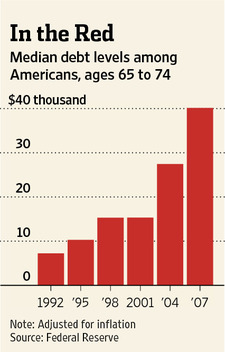
The Wall Street Journal provides a graphic to explain why this is a growing field for debt collectors:
You might ask what the relevant regulator, the Federal Trade Commission (FTC), is doing about this practice. From the article:
Still, the agency determined the previous guidelines were ineffective and “too constricting,” Mr. Dolan says. So, in July, the agency issued a policy statement. Before the new guidelines, collectors were supposed to discuss a dead person’s debt only with the person’s spouse or someone chosen by the dead person’s estate. But Mr. Dolan said few debtors are formally designating someone to handle their affairs after death, leaving debt-collection firms unable to determine whom to contact for payment of any outstanding bills.
The FTC sought to improve the process and now allows debt-collection firms to contact anyone believed to be handling the estate, including parents, friends and neighbors. Agency officials wanted to resolve a “tension that was emerging” between state and U.S. laws on how collectors can go after money, Mr. Dolan adds. “While people might think it is horrible for collectors to speak with surviving spouses, we have no power to change that.”
FTC officials rejected requests by lawyers representing family members for an outright ban on calling surviving family members. The agency also declined to impose a cooling-off period during which relatives couldn’t be contacted by debt collectors.
Thanks, FTC! Thanks for representing the little guy, with the dead wife.
Conservation Law of Money
Being a mathematician, I’ve always been on the lookout for quantitative statements about the financial system as a whole that explain large economic phenomena. Just for the satisfaction of it all.
For example, I think it’s possible that many bubbles (dot com, Japanese stocks) can be explained simply by saying that, when normal people, rather than professional investors, are putting their money in the market, then the market is gonna go up. And moreover, when that happens, we can throw away any silly ideas we may have been harboring about price as indicator of true value; the prices are going up because the public is inflating the market with more cash money.
In other words, the opportunities for good investing doesn’t keep up with the cash flow in those moments. We could go further and say that there’s a kind of seasonality of money flow, which is dominating the market signal at times like these, just like you see in housing markets (when the housing market is functional) in the springtime when humans come out of their hibernation and feel like nesting and mating.
There are other ways for seasonality of money flow to affect the market without introducing newcomers to the market, such as inflation or deflation, where the value of the existing money itself changes. or when there’s an outside force either extracting or adding to the money supply, like the Saudi Arabia or China, although that’s more of a continual drag than a sudden jolt.
I think we may be encountering a very real “Conservation Law of Money” situation with the European debt crisis. Namely, there are all these banks that are on the prowl for cash, since they’re worried about being undercapitalized, with good reason: they are still hanging on to many toxic assets from the credit crisis, and in the meantime their enormous government bond holdings are going to pot. In the meantime Basel III, a new regulatory regime, will be in effect in 2015 and requires much more liquid, high quality assets than they currently own.
But here’s the thing, and it’s not a new observation but it’s an important one: not all of those banks can recover, unless something dramatic happens. From BusinessWeek:
“There aren’t enough assets in the world that are genuinely liquid and of high enough quality to allow all the banks to meet this ratio,” said Barbara Ridpath, chief executive officer of the International Centre for Financial Regulation, a London research group funded by banks and the U.K. government. “And that’s only likely to get worse because of the changing credit quality of some of the sovereigns.”
Mathematically speaking we have an impossibility: way more required stuff than existing stuff inside the current European system. What’s gonna give? Here’s a list of the things I can think of:
- Basel III will be scrapped and Europe will live with an enormous zombie system,
- the ECB will start printing money and eventually inflate the system out of insolvency,
- the banking system will fight to the death over the scarce resources and thereby be massively shrinked (but probably the few surviving banks will be politically well-places too-big-to-fail behemoths),
- European citizens will foot the bill through bailouts and then taxes, possibly leading to widespread civil unrest or even war, or
- outsiders will step in when the price is right (China and/or the Middle East) and end up owning the European banks.
There may be others options as well (please tell me). Of the above though I guess I prefer 3, where Europe ends up with a few huge banks that are highly regulated and well-capitalized. This is the Australian model and I posted about it here. Maybe then the financial system can be allowed to be utility-bank oriented and boring and smart young people will apply their energy outside of financial engineering.
Resampling
I’m enjoying reading and learning about agile software development, which is a method of creating software in teams where people focus on short and medium term “iterations”, with the end goal in sight but without attempting to map out the entire path to that end goal. It’s an excellent idea considering how much time can be wasted by businesses in long-term planning that never gets done. And the movement has its own manifesto, which is cool.
The post I read this morning is by Mike Cohn, who seems heavily involved in the agile movement. It’s a good post, with a good idea, and I have just one nerdy pet peeve concerning it.
I’m a huge fan of stealing good ideas from financial modeling and importing them into other realms. For example, I stole the idea of stress testing of portfolios and use them in stress testing the business itself where I work, replacing scenarios like “the Dow drops 9% in a day” with things like, “one of our clients drops out of the auction.”
I’ve also stolen the idea of “resampling” in order to forecast possible future events based on past data. This is particularly useful when the data you’re handling is not normally distributed, and when you have quite a few data points.
To be more precise, say you want to anticipate what will happen over the next week (5 days) with something. You have 100 days of daily results in the past, and you think the daily results are more or less independent of each other. Then you can take 5 random days in the past and see how that “artificial week” would look if it happened again. Of course, that’s only one artificial week, and you should do that a bunch of times to get an idea of the kind of weeks you may have coming up.
If you do this 10,000 times and then draw a histogram, you have a pretty good sense of what might happen, assuming of course that the 100 days of historical data is a good representation of what can happen on a daily basis.
Here comes my pet peeve. In Mike Cohn’s blog post, he goes to the trouble of resampling to get a histogram, so a distribution of fake scenarios, but instead of really using that as a distribution, for the sake of computing a confidence interval, he only computes the average and standard deviation and then replaces the artificial distribution with a normal distribution with those parameters. From his blog:
Armed with 200 simulations of the ten sprints of the project (or ideally even more), we can now answer the question we started with, which is, How much can this team finish in ten sprints? Cells E17 and E18 of the spreadsheet show the average total work finished from the 200 simulations and the standard deviation around that work.

In this case the resampled average is 240 points (in ten sprints) with a standard deviation of 12. This means our single best guess (50/50) of how much the team can complete is 240 points. Knowing that 95% of the time the value will be within two standard deviations we know that there is a 95% chance of finishing between 240 +/- (2*12), which is 216 to 264 points.
What? This is kind of the whole point of resampling, that you could actually get a handle on non-normal distributions!
For example, let’s say in the above example, your daily numbers are skewed and fat-tailed, like a lognormal distribution or something, and say the weekly numbers are just the sum of 5 daily numbers. Then the weekly numbers will also be skewed and fat-tailed, although less so, and the best estimate of a 95% confidence interval would be to sort the scenarios and look at the 2.5th percentile scenario, the 97.5th percentile scenario and use those as endpoints of your interval.
The weakness of resampling is the possibility that the data you have isn’t representative of the future. But the strength is that you get to work with a honest-to-goodness distribution and don’t need to revert to assuming things are normally distributed.
Thank you, Inside Job
The documentary Inside Job put a spotlight on conflict of interest for “experts,” specifically business school and economic professors at well-known universities. The conflict was that they’d be consulting for some firm or government, getting paid tens or hundreds of thousands of dollars, and would then write academic papers investigating the methods of that firm or government, without disclosing the payments.
Since it’s human nature to do so, these academic papers would end up supporting those methods, more often than not, even when the methods weren’t sound. I’m being intentionally generous, because the alternative is to think that they actually sell their endorsements; I’m sure that happens, but I’m guessing it isn’t always a conscious, deliberate decision.
Last Spring, the Columbia Business School changed its conflict of interest policy to address this exact problem. From the Columbia Spectator Article:
Under the new policy, Business School professors will be required to publicly disclose all outside activities—including consulting—that create or appear to create conflicts of interest.
“If there is even a potential for a conflict of interest, it should be disclosed,” Business School professor Michael Johannes said in an email. “To me, that is what the policy prescribes. That part is easy.”
The policy passed with “overwhelming” faculty support at a Tuesday faculty meeting, according to Business School Vice Dean Christopher Mayer, who chaired the committee that crafted the policy.
The new policy mandates that faculty members publish up-to-date curricula vitae, including a section on outside activities, on their Columbia webpages. In this section, they will be required to list outside organizations to which they have provided paid or unpaid services during the past five years, and which they think creates the appearance of a conflict of interest.
Good for them!
Next up: the Harvard Business School. I don’t think they yet have a comparable policy. When you google for “Harvard Business School conflict of interest” you get lots of links to HBS papers written about conflict of interest, for other people. Interesting.
I don’t understand what the reasoning could be that they are stalling. Is there some reason Harvard Business School professors wouldn’t want to disclose their outside consulting gigs? I mean, we already know about them advising Gaddafi back in 2006, so that can’t be it. Just in case you missed that, here’s an excerpt from the Harvard Crimson article from last Spring:
But Harvard professors have focused on the political conclusions of the report, which, among a set of recommendations, indicated that Libya was a functioning democracy and heralded the country’s system of local political gatherings as “a meaningful forum for Libyan citizens to participate directly in law-making.”
The report was a product of Monitor’s work consulting for Gaddafi from 2006 to 2008. The Libyan government—headed by Gaddafi, who has ruled since a 1969 military coup—hired consultants from Monitor Group to provide policy recommendations, economic advice, and several other services.
The consulting group carries a distinct Harvard flavor. On its website, the company touts the Harvard ties of several of its founders and current leaders.
I’m wondering if this would have happened if there already was a conflict of interest policy, like Columbia’s, in place. And I’m focusing on Harvard because if both Harvard and Columbia set such policies, I think other places will follow. As far as I can see, this is just as important as conflict of interest policies for doctors with respect to drug companies.
Meritocracy and horizon bias
I read this article yesterday about racism in Silicon Valley. It’s interesting, written by an interesting guy named Eric Ries, and it touches on stuff I’ve thought about like stereotype threat and the idea that diverse teams perform better than homogeneous ones.
In spite of liking the article pretty well, I take issue with two points.
In the beginning of the article Ries lays down some ground rules, and one of them is that “meritocracy is good.” Is it really good? Always? And to what limit? People are born with talent just as they’re born rich or poor, and what makes talent a better or more fair way of sorting people? Or are we just claiming it’s more efficient?
Actually I could go on but this blog post kind of says everything I wanted to say on the matter. As an aside, I’m kind of sick of the way people use the idea of “meritocracy” to overpay people who they justify as having superhuman qualifications (I’m looking at you, CEO’s) or a ridiculous, massively scaleable amount of luck (most super rich entrepreneurs).
Second, I’m going to coin a term here, but I’m sure someone else has already done so. Namely, I consider it horizon bias to think that wherever you are, whatever you do, is the coolest place in the world and that everyone else is just super jealous of you and wishes they had that job. So you don’t look beyond your horizon to see that there are other jobs that may be more attractive to people. The reason this comes up is the following paragraph:
What accounts for the decidedly non-diverse results in places like Silicon Valley? We have two competing theories. One is that deliberate racisms keeps people out. Another is that white men are simply the ones that show up, because of some combination of aptitude and effort (which it is depends on who you ask), and that admissions to, say Y Combinator, simply reflect the lack of diversity of the applicant pool, nothing more.
I’d like to offer a third option, namely that only white guys show up because that’s who thinks working in Silicon Valley is an attractive idea. I know it’s kind of like the second option above, but it’s not exactly. The qualification “because of some combination of aptitude and effort” is the difference.
Let’s say I’m considering moving to Silicon Valley to work. But all of my images of that place come from movies and my experiences with my actual friends in the dotcom bubble era who slept under their desks at night. Plus I know that the housing market out there is crazy and that the commute sucks. Finally, I’d picture myself working with lots of single, ambitious, and arrogant young men who believe in meritocracy (code for: use vaguely libertarian philosophical arguments to act ruthlessly). I can imagine that these facts keep plenty of non-white non-men away.
Next, going on to the point about horizon bias. People who already work in Silicon Valley already selected themselves as people who think it’s a great deal. And then they sit around wondering why it’s not a more diverse place, in spite of having everything awesomely meritocratic.
Going back to the article, Ries mentions this idea that diverse teams outperform homogeneous ones. I’d like to look at that in light of horizon bias and ask whether that’s the wrong way to look at it. In other words maybe it’s more a function of what the common goal is, which leads to a diverse team if the common goal is broadly attractive, than how the exact team was created. If goals are super attractive, attractive enough to draw diverse people, then maybe those goals deserve success more.
For example, one of the strengths of Occupy Wall Street has been the diversity of its membership. People of all ages, all backgrounds, and all races have been coming together to speak for the 99%. It’s of course fitting, since 99% does represent lots of people, but I’d like to point out that it is diverse because the cause resonates with so many people, which makes it successful.
Another example. I worked at the math department at M.I.T., which is famously not diverse. And I saw the “Truth Values” play recently which made me think about that experience some more. There’s lots of horizon bias in math, because there’s this assumption that everyone who was ever a math major should want to someday become a math professor (at M.I.T. no less). So it’s easy enough to wring your hands when you see that, although 45% of the undergrad math majors are women, and 40% of the grad students in math are women (I’m making these numbers up by the way), only 1% of the tenured faculty at the top places are women (again totally made up).
And of course there’s real discrimination involved (trust me), but there’s also the possibility that a bunch of women just never wanted to be a professor, they just wanted to get a Ph.D. for whatever reason. But the horizon bias at the top places assumes that everyone would want to become a professor.
On the one hand I’m just making things worse, because I’m pointing out that in addition to the real discrimination that takes place for those women who actually do want to become professors, there’s also this natural but invisible self-selection thing going on where women leave the professorship train at some point. Seems like I’ve made one problem into two.
On the other hand, we can address this horizon bias, if it exists. But instead of addressing it by blotting out the names of candidates on applications (a good idea by the way, and one I think I’ll start using), we would need to address it by looking at the actual company or department or culture and see why it’s less than attractive to people who aren’t already there. It’s a bigger and harder kind of change.
ISDA has a blog!
ISDA, or International Swaps and Derivatives Organization, is an organization which sets the market standards in a bunch of ways for credit default swap (CDS) and other over-the-counter (OTC) derivatives, in particular they legally define CDS and other swaps and have standard forms for other people to use to enter into such contracts. They also have a committee which decides when a CDS has been triggered, which is a big deal with all the Euro debt restructuring that’s happened and will probably continue to happen.
Anyhoo, what I wanted to mention today is their blog. Actually they have two, one for internal blogging about what they’re up to, and the other for responding to media comments about them.
What’s crazy about these blogs is that they’re well written and… funny. Yeah. You wouldn’t expect that from a legal organization which oversees OTC derivatives, but there you have it. Or else, maybe that just means I’m a complete and utter finance nerd.
And they’re also informative. This post talks about their decision to sue the CFTC for some position limits rule they don’t like. One of their arguments is that the CFTC ignored public comments and cost-benefit analysis which would have loosened the rule or argued against them, and they’re hoping that by suing they can at least force the CFTC to explain how they took into account the public comments.
This argument matters to me because I am involved with the Occupy the SEC folk (OMG those guys are relentless) in preparing public comments for the Volcker Rule, and until now I didn’t know what it meant that there will be public comments and someone has to read them. I mean, I still don’t, really, but it is certainly exciting to see if the CFTC’s hand will be forced in this matter.
Their media blog is informative too. This post talks about how misleading some of the media reports were about why MF Global tanked- it was through repos, not OTC derivatives. True! And by the way, also relevant to the Volcker Rule people, since repos are not considered risky trading in the Volcker Rule. Big huge hole! Doesn’t anybody remember the stuff that Lehman was doing near then end with repos? At the very least they are tools of deception, and need to be taken into account.
Obviously everything they say about CDS and the OTC market is pro-them, but that’s okay. They’re at least saying stuff. I’m impressed!
#OWS data nerd
You all know I’m a data nerd. So here goes my little exploration into how #Occupy Wall Street has influenced the conversation. Go to Google trends page to try this for yourself. It’s super fun to play with and to anticipate what the graph will look like.
First, there’s the concept of “Occupy” itself.
|
|||||
|
Rank by occupy
|
I’m happy to see that more people google for “Occupy protest” than for “dirty hippies”:
|
|||||||||
|
Rank by occupy protest dirty hippies
|
Next, let’s look at how #OWS has influenced the conversation. The interest in income inequality has definitely gone up:
|
|||||
|
Rank by income inequality
|
And the idea of looking at the top 1% and bottom 99% has definitely entered into our vocabulary:
|
|||||||||
|
Rank by 1% 99%
|
People also seem to be paying more attention to policy issues:
|
|||||||||
|
Rank by volcker rule tobin tax
|
Please send me any other good search terms that you find! It’s too tempting to spend all day doing this…
Good bank/ bad bank – why we didn’t do it
Today’s guest post is written by my aunt, the economist Susan Woodward. I recently found a paper she had written which proposed to split up banks into ‘good’ and ‘bad’ banks. This is an idea I’ve heard bandied about, and it always sounded like a good one and moreover one that’s seemingly worked in other countries. “Why hasn’t this happened?” I asked. This is her response:
—————————————————-
The good bank/bad bank idea is kaput. “We” (the US) did not do it because
1) it would have re-written the contract between the bank bondholders and equity holders. If the govt forced this, it would have given the bondholders the right to sue for damages for the losses imposed on them, and likely they would have won, as many thrifts did when FIRREA (1989) changed the deal ex post.
2) the only point of it would be to leave the “good” bank with plenty of equity so that it could fund its commercial paper smoothly and cheaply. Any other workout or guarantee would do the same thing, and the other loans (now we know, $7.8 trillion dollars worth) and guarantees did do the same thing. The big US banks are still undercapitalized, but forcing them to raise equity right now is sort of impossible politically. So instead we just don’t let them do anything exciting and avert our gaze from the non-performing mortgages they have not yet written-down. I know that BofA is selling its above-water mortgages in order to book gains.
But I confess I am baffled by bank accounting now — it is a mix of assets (and liabilities!) marked-to-market and others not, by logic that eludes me. In Citi’s last earnings report, a large fraction of “earnings” was a decline in the value of its bonds (if a rise in the value of an asset is income, so is a decline in the value of a liability, it is not entirely crazy, just not done much before) because markets assigned a lower likelihood to them paying the bondholders. What a reporting convention. oh dear.
Citi and BofA are maybe broke anyway. Their market caps are both below $80 billion (depending on the temperature of the Euro mess) on assets of about $2 trillion each. I imagine that various parts of the govt are working on contingency plans for orderly dismantling of them. Just in case.
As for European banks, they may need lots and lots of help, depending on what Europe does about the ECB and its ability to issue bonds, buy bank assets, and, ulp, collect TAXES. All of the pundits are right that if the ECB could buy sovereign bonds and bank bonds, it could fend off a meltdown at least for now. The US Fed has bought 11% of GDP’s worth of US bonds, and the UK has done 13%. So it is not a new or unknown strategy. But in the US and the UK, the power to tax as well as the power to print money lies behind the institution.
The situation is somewhat like the original States after 1779, when the new constitution reserved the right to print money to the federal government, and took it away from the States. The first federal power to tax was not direct, but worked through telling each state what share it owed, then counting on the States to raise the money, sort of like the ECB now. When the Federal govt finally got the power to tax directly, the value of its bonds, 23 cents on the dollar in the early chaotic years, rose to par, then above par. The federal assumption of the States’ expenses for the revolutionary war resulted in a deal — Virginia, which was very prosperous and had paid off some of its war debt, agreed for the deal to assume the burden of Massachusetts, which had not paid off so much and in any case also had a heavier burden in the revolutionary war, in exchange for moving the capital from New York to Philly (temporarily), then on to Washington. The deal was cut at a dinner party in New York attended by Jefferson, Madison, and Hamilton. I wonder what wine was poured.
In those early years, States funded their state-level budgets with earnings from owning shares in banks they chartered! And the previous colonies funded their budgets from mortgage lending! So much for the separation of finance and government.
Were Massachusetts and Virginia then more similar to each other then than Germany and Italy are now? Not so clear.
Writing clear and helpful things about the financial crisis is not easy and takes heaps of time, which is why we quit doing it. But hey, if you have it, go for it.
love, Aunt Susie
Crowdsourcing projects
There are lots of new crowdsourcing projects popping up everywhere nowadays, and I wanted to talk about a couple of them.
First I want to talk about a voting system called Votavox. The idea here is to have a massive database which stores the responses of various questions in order to act as a lobbyist for the people. The questions, or rather statements, can be generated by the users, but are encouraged to be relatively non-partisan (or at least stated in a way that isn’t difficult to disagree with), actionable, and tagged with a person who could actually make the action.
For example, if the #Occupy Wall Street website wanted to start using Votavox, they could create a voting item in the direction of, “Mayor Bloomberg should take down the barricades around Zucotti Park and allow free access.” Then everyone who comes to the nycga.net website could vote for this, and the results could be sent to Mayor Bloomberg.
It could be seen as an online petition. It is more convincing when people go to the trouble of registering, so Bloomberg would get to see how many people from different walks of life think this or that. It would also be even more robust if the voting item got placement on the Wall Street Journal and the New York Times as well. That’s the idea, though, to get people’s votes on statements and to send the result directly to a decision maker.
I met with the guy who started it a couple of days ago and I think it’s a cool idea. However, there are some important issues to suss out.
Namely, what’s the business model behind Votavox? One simple answer would be that the data is sold for people to mine. Unfortunately there are lots of unattractive things about this, verging on privacy issues and also the nuisance of having advertisers know all about your inner thoughts. I doubt that #OWS folk would be all that happy about their data being sold to mega advertisers.
On the other hand, servers and databases aren’t free, and maintaining and upgrading the Votavox software isn’t free either. Any ideas for this worthy project would be appreciated.
Next I wanted to talk about an applied mathematician named Lee Worden. Some of his past work has purportedly ‘challenged conventional wisdom on the possibilities of cooperation in situations where only competitive interactions have been assumed’, which is intriguing (maybe someone has a reference for that?). Right now he is interested in studying the mathematics of direct democracy, which is a cool and natural urge. In his words:
A few years ago I started telling friends that I would like to be an applied mathematician for the public, somehow. Unlike pure mathematicians, who work at a remove from everyday concerns and are something like composers, answering to nobody but the Muse, applied mathematicians live more of a have-gun-will-travel life, working for clients, solving the clients’ problems, and developing new theory along the way. The clients are often corporations and the military. Does this affect what we study, what we learn, and what we don’t learn? Of course it does! I decided I should work for the public, and address the public’s problems – but how?
I didn’t realize, when I started this experiment in crowd-funded research, that that’s just what it is: I actually get to work for regular people, on problems that relate to our collective future!
And here’s a video explanation of his #OWS work and a plea for funding. Some of his questions are really good and touch on stuff I’ve already experienced inside the #OWS working group Alternative Banking group, like whether, when we split into smaller groups, we should group people by similarity of opinion or whether we should make sure a range of opinions are represented. On the one hand, if you do group by similarity, the conversations go faster and seem more efficient, but on the other the chances of the end results being adopted by the larger group go way down.
Quantitative theory of blogging
Once you start blogging, it turns out you can get quite addicted to your daily hits, which is a count of how many people come to your site each day, as well as to the quantity and quality of the comments (my readers have the best comments by the way, just saying).
WordPress even lets you see which things people read, and how they searched google to find your site, and what they clicked on. It’s easy enough to get excited about such statistics, and the natural consequence is an urge to juice your numbers.
What is the equivalent of Major League Baseball steroids for bloggers? I have a few suggestions:
- Post about something super controversial, i.e. something that people care about and are totally divided about. Once I heard a sports talk radio host give away this trade secret on his show, when he said, “okay folks let’s talk about this next question, which when polled was split down the middle 50/50 among people…”. I think I hit on this once when I posted about how I think math contests suck. Lots of strong feelings both ways.
- Post about something involving people that others consider kind of crazy. Once when I posted about living forever, I was kind of responding to this idea of the Singularity Theorists and their summit. Turns out some people don’t want to live forever, like me, and some people really really want to live forever. It’s like a religion.
- Then there’s the celebrity angle. My posts about working with Larry Summers have generated lots of traffic, although I like to think it’s because of what I said in addition to the star power in the title.
- I’m convinced that adding images to your posts makes people more likely to find them. Maybe that’s because they appear bigger when they are shared on Facebook or something.
- If you are fed up with people arguing with each other on your comments pages, then another totally different way of getting lots of hits (and even more comments) is to post about something that allows people to tell a story about themselves that probably nobody else wants to hear. For example, you can write a post entitled, “did you ever have a weird experience at a doctor’s appointment?”. I haven’t done that yet but it’s tempting, just for all the awesome comments I’d get.
- Finally, you can go lowbrow and talk about sex, or even better give advice to people about their weird sexual desires, or even better, make confessions about your weird sexual experiences. Also haven’t done that yet, but also tempted.
I’m a data modeler, so of course it makes sense that I’d try to test out my theoretical signals. So if you see me writing a post in the future about the sexual adventures of me and some nutjob celebrity (update: Charlie Sheen) when we went to the doctor’s together, complete with graphic pix, then you’ll know to click like mad (and comment, please!).
Hank Paulson
A few days ago it came out that former Treasury Secretary Hank Paulson is a complete asshole. Some people knew this already, but Felix Salmon kind of nailed it permanently to the wall with this Reuters column where he describes how Paulson told his buddies all about what was going on in the credit crisis a few weeks or days before the public was informed. Just in case descriptions of his behavior aren’t clear enough, Salmon ends his column with this delicious swipe:
Paulson, says Teitelbaum, “is now a distinguished senior fellow at the University of Chicago, where he’s starting the Paulson Institute, a think tank focused on U.S.-Chinese relations”. I’d take issue with the “distinguished” bit. Unless it means “distinguished by an astonishing black hole where his ethics ought to be”.
Here’s another thing that people may want to know about Paulson, and which some people know already but should be more loudly broadcast: he dodged tens of millions of dollars in taxes by becoming the Treasure Secretary. This article from the Daily Reckoning explains the conditions:
Under the guise of not wanting to “discourage able citizens from entering public service,” Section 1043 is an alteration of the government’s conflict of interest rules. Before 1043, executive appointees (mostly high-up cabinet members and judges) had to sell positions in certain companies to combat conflict of interest – like say, a former Goldman Sachs CEO-turned Treasury Secretary with millions of GS shares. After Sec. 1043, the appointee gets a one-time rollover. Upon their appointment, he or she can transfer their shares to a blind trust, a broad market fund or into treasury bonds. They’ll have to pay taxes on the position one day, but not immediately after the sale… like the rest of us.
I’m a big believer in incentives. And from where I sit, when you piece together Hank Paulson’s incentives, you get his actions. In some sense we shouldn’t even complain that he’s such an asshole, because we invented this system to let people like him act in these asshole ways.
[It brings up another related topic, namely that the level of corruption and misaligned incentives actually drives ethical people out of finance altogether. I want to devote more time to think about this, but as partial evidence, consider how few “leaders” from the financial world have stepped up and supported Occupy Wall Street, or for that matter any real challenge to business as usual. At the same time there are plenty of people in finance who are part of the movement, but they tend to be the foot soldiers, or young, or both. Maybe I’m wrong- maybe there are plenty of senior people who just are remaining anonymous, doing their thing to undermine the status quo, and I just haven’t met them. According to this article which I linked to already for a different reason, and which corroborates my experience, there are lots of people who see the rot but not too many doing anything about it.]
Here’s what we do. We ask people who want to be public servants to sacrifice something (besides their ethics) to actually serve the public. I’m convinced that there really are people who would do this, especially if the system were set up more decently. We don’t need to offer huge cash incentives to attract people like Paulson to be Treasury Secretary.
update: I’m not the only person who thinks like this.
Various #OWS links
Here’s an internal Fed blog describing an internal Fed report which proposes that we tie banker bonuses to the CDS spread of the bank. The crux of the idea:
Under our scheme, a high or increasing CDS spread would translate into a lower cash bonus, and vice versa. For banks that do not have a liquid CDS market, the bonus could be tied to the institution’s borrowing cost as proxied by the debt spread. However, the CDS spread has the benefit of being market based, and can be chosen optimally. It is the closest analogue a bank has to a stock price—it is the market price of credit risk. If CEO deferred compensation were tied directly to the bank’s own CDS spread, bank executives would have a direct financial exposure to the bank’s underlying risk and would have an incentive to reduce risk that does not enhance the value of the enterprise.
It’s an interesting idea and I’ll think about it more. I have two concerns off the bat though. First, the blog (I didn’t read the paper) acts like CDS can be honestly taken as a proxy for likeliness to default. However in the real world everything is juiceable. So this scheme will give people more incentives to push for, among other things, fraudulent accounting to avoid looking risky. My second concern is an add-on to the first: the insiders, who benefit directly from low CDS spread, will have very direct reasons to perpetuate such accounting fraud. Somehow I’d love to see (if possible) a scheme put forth where insiders have incentives to ferret out and expose fraud.
———
A beautiful post about the metamovement of which OWS is a part, by Umair Haque. A piece:
In a sense, that sentiment is the common thread behind each and every movement in the Metamovement — a sense of grievous injustice, not merely at the rich getting richer, but at the loss of human agency and sovereignty over one’s own fate that is the deeper human price of it.
He links to We Are the 99 Percent. Check it out if you haven’t already seen it.
———
Interfluidity blogs about how yes, the bankers really were bailed out. Big time. Great points, here is my favorite part:
Cash is not king in financial markets. Risk is. The government bailed out major banks by assuming the downside risk of major banks when those risks were very large, for minimal compensation. In particular, the government 1) offered regulatory forbearance and tolerated generous valuations; 2) lent to financial institutions at or near risk-free interest rates against sketchy collateral (directly or via guarantee); 3) purchased preferred shares at modest dividend rates under TARP; 4) publicly certified the banks with stress tests and stated “no new Lehmans”. By these actions, the state assumed substantially all of the downside risk of the banking system. The market value of this risk-assumption by the government was more than the entire value of the major banks to their “private shareholders”. On commercial terms, the government paid for and ought to have owned several large banks lock, stock, and barrel. Instead, officials carefully engineered deals to avoid ownership and control.
———
Next, read this Newsweek article if you’re still wondering what Mayor Bloomberg’s personal incentives are for letting OWS complain about crony capitalism and the power of lobbyists. The scariest part:
Let’s say a lobbyist for a coal company wants to squash any legislation that affects his employer’s mining operations. He logs onto BGov.com (the cost is $5,700 per year) and is automatically alerted to breaking news of a just-introduced energy bill. The data drill-down begins. BGov shows the lobbyist how similar legislation has fared, what subcommittee the new bill will face and when, who the key congressmen are, and how they have voted in the past. The lobbyist calls up information on the swing vote’s upcoming election contest: it’s competitive, and the congressman is behind in fundraising. Lists of major donors—who might be induced to contribute or, better yet, place a call to the officeholder himself—are a click away. These political pressure points and a thousand more are how lobbyists make their mark, and Bloomberg thinks BGov can deliver them faster than the competition.
———
Finally, a very nice blog about the Alternative Banking group and David Graeber by Joe Sucher. Here’s an excerpt:
I know the usual naysayers will nay say until they are blue in the face about changing the so-called system. “It will never happen, never will, so let’s wait for things to settle down and go back to business as usual.” These folks, I’d venture to say, may be exhibiting a fundamental crisis of imagination.
I remember an elderly immigrant anarchist reminded me (when I was naysaying) that if you were to tell a 14th century European serf, that some time in the next few hundred years, they’d actually have the ability to cast a vote that mattered, no doubt you’d be met with a blank stare. The thought just wouldn’t compute.
——–
updated: Jesse Eisenger of Propublica wrote this interesting article in DealBook, where he talks about the insiders on the Street who are frustrated by the rampant corruption. I agree with a lot he says but he clearly needs to join us at an Alternative Banking group meeting:
It’s progress that these sentiments now come regularly from people who work in finance. This is an unheralded triumph of the Occupy Wall Street movement. It’s also an opportunity to reach out to make common cause with native informants.
It’s also a failure. One notable absence in this crisis and its aftermath was a great statesman from the financial industry who would publicly embrace reform that mattered. Instead, mere months after the trillions had flowed from taxpayers and the Federal Reserve, they were back defending their prerogatives and fighting any regulations or changes to their business.
Perhaps a major reason so few in this secret confederacy speak out is that they are as flummoxed about practical solutions as the rest of us. They don’t know where to begin.
Um, there are plenty of very good places to begin. It’s a question of politics, not of solutions. Start with the very basics: enforce the rules that already exist. Give the SEC some balls. We’ll go from there. Sheesh!
Correlated trades
One major weakness of quantitative trading is that it’s based on the concept of how correlated various instruments and instrument classes are. Today I’m planning to rant about this, thanks to a reader who suggested I should. By the way, I do not suggest that anything in today’s post is new- I’m just providing a public service by explaining this stuff to people who may not know about it.
Correlation between two things indicates how related they are. The maximum is 1 and the minimum is -1; in other words, correlation ignores the scale of the two things and concentrates only on the de-scaled relationship. Uncorrelated things have correlation 0.
All of the major financial models (for example Modern Portfolio Theory) depend crucially on the concept of correlation, and although it’s known that, at a point in time, correlation can be measured in many different ways, and even given a choice, the statistic itself is noisy, most of the the models assume it’s an exact answer and never bother to compute the sensitivity to error. Similar complaints can just as well be made to the statistic “beta”, for example in the CAPM model.
To compute the correlation between two instruments X and Y, we list their returns, defined in a certain way, for a certain amount of time for a given horizon, and then throw those two series into the sample correlation formula. For example we could choose log or percent returns, or even difference returns, and we could look back at 3 months or 30 years, or have an exponential downweighting scheme with a choice of decay (explained in this post), and we could be talking about hourly, daily, or weekly return horizons (or “secondly” if you are a high frequency trader).
All of those choices matter, and you’ll end up with a different answer depending on what you decide. This is essentially never mentioned in basic quantitative modeling texts but (obviously) does matter when you put cash money on the line.
But in some sense the biggest problem is the opposite one. Namely, that people in finance all make the same choices when they compute correlation, which leads to crowded trades.
Think about it. Everyone shares the same information about what the daily closes are on the various things they trade on. Correlation is often computed using log returns, at a daily return horizon, with an exponential decay weighting typically 0.94 or 0.97. People in the industry thus usually agree more or less on the correlation of, say, the S&P and crude.
[I’m going to put aside the issue that, in fact, most people don’t go to the trouble of figuring out time zone problems, which is to say that even though the Asian markets close earlier in the day than the European or U.S. markets, that fact is ignored in computing correlations, say between country indices, and this leads to a systematic miscalculation of that correlation, which I’m sure sufficiently many quantitative traders are busy arbing.]
Why is this general agreement a problem? Because the models, which are widely used, tell you how to diversify, or what have you, based on their presumably perfect correlations. In fact they are especially widely used by money managers, so those guys who move around pension funds (so have $6 trillion to play with in this country and $20 trillion worldwide), with enough money involved that bad assumptions really matter.
It comes down to a herd mentality thing, as well as cascading consequences. This system breaks down at exactly the wrong time, because after everyone has piled into essentially the same trades in the name of diversification, if there is a jolt on the market, those guys will pull back at the same time, liquidating their portfolios, and cause other managers to lose money, which results in that second tier of managers to pull back and liquidate, and it keeps going. In other words, the movements among various instruments become perfectly aligned in these moments of panic, which means their correlation approaches 1 (or perfectly unaligned, so their correlations approach -1).
The same is true of hedge funds. They don’t rely on the CAPM models, because they are by mandate trying to be market neutral, but they certainly rely on a factor-model based risk model, in equities but also in other instrument classes, and that translates into the fact that they tend to think certain trades will offset others because the correlation matrix tells them so.
These hedge fund quants move around from firm to firm, sharing their correlation matrix expertise, which means they all have basically the same model, and since it’s considered to be in the realm of risk management rather than prop trading, and thus unsexy, nobody really spends too much time trying to make it better.
But the end result is the same: just when there’s a huge market jolt, the correlations, which everyone happily computed to be protecting their trades, turn out to be unreliable.
One especially tricky thing about this is that, since correlations are long-term statistics, and can’t be estimated in short order (unless you look at very very small horizons but then you can’t assume those correlations generalize to daily returns), even if “the market is completely correlated” on one day doesn’t mean people abandon their models. Everyone has been trained to believe that correlations need time to bear themselves out.
In this time of enormous political risk, with the Eurozone at risk of toppling daily, I am not sure how anyone can be using the old models which depend on correlations and sleep well at night. I’m pretty sure they still are though.
I think the best argument I’ve heard for why we saw crude futures prices go so extremely high in the summer of 2008 is that, at the time, crude was believed to be uncorrelated to the market, and since the market was going to hell, everyone wanted “exposure” to crude as a hedge against market losses.
What’s a solution to this correlation problem?
One step towards a solution would be to stop trusting models that use greek letters to denote correlation. Seriously, I know that sounds ridiculous, but I’ve noticed a correlation between such models and blind faith (I haven’t computed the error on my internal estimate though).
Another step: anticipate how much overcrowding there is in the system. Assume everyone is relying on the same exact estimates of correlations and betas, take away 3% for good measure, and then anticipate how much reaction there will be the next time the Euroleaders announce a new economic solution and then promptly fail to deliver, causing correlations to spike.
I’m sure there are quants out there who have mastered this model, by the way. That’s what quants do.
At a higher perspective, I’m saying that we need to stop relying on correlations as fixed over time, and start treating them as volatile as prices. We already have markets in volatility; maybe we need markets in correlations. Or maybe they already exist formally and I just don’t know about them.
At an even higher perspective, we should just figure out a better system altogether which doesn’t put people’s pensions at risk.
Two pieces of good news
I love this New York Times article, first because it shows how much the Occupy Wall Street movement has resonated with young people, and second because my friend Chris Wiggins is featured in it making witty remarks. It’s about the investment bank recruiting machine on college campuses (Yale, Harvard, Columbia, Dartmouth, etc.) being met with resistance from protesters. My favorite lines:
Ms. Brodsky added that she had recently begun openly questioning the career choices of her finance-minded friends, because “these are people who could be doing better things with their energy.”
Kate Orazem, a senior in the student group, added that Yale students often go into finance expecting to leave after several years, but end up staying for their entire careers.
“People are naïve about how addictive the money is going to be,” she said.
Amen to that, and wise for you to know that! There are still plenty of my grown-up friends in finance who won’t admit that it’s a plain old addiction to money keeping them in a crappy job where they are unhappy, and where they end up buying themselves expensive trips and toys to try to combat their unhappiness.
And here’s my friend Chris:
“Zero percent of people show up at the Ivy League saying they want to be an I-banker, but 25 and 30 percent leave thinking that it’s their calling,” he said. “The banks have really perfected, over the last three decades, these large recruitment machines.”
Another piece of really excellent new: Judge Rakoff has come through big time, and rejected the settlement between the SEC and Citigroup. Woohoo!! From this Bloomberg article:
In its complaint against Citigroup, the SEC said the bank misled investors in a $1 billion fund that included assets the bank had projected would lose money. At the same time it was selling the fund to investors, Citigroup took a short position in many of the underlying assets, according to the agency.
“If the allegations of the complaint are true, this is a very good deal for Citigroup,” Rakoff wrote in today’s opinion. “Even if they are untrue, it is a mild and modest cost of doing business.”
A revised settlement would probably have to include “an agreement as to what the actual facts were,” said Darrin Robbins, who represents investors in securities fraud suits. Robbins’s firm, San Diego-based Robbins Geller Rudman & Dowd LLP, was lead counsel in more settled securities class actions than any other firm in the past two years, according to Cornerstone Research, which tracks securities suits.
Investors could use any admissions by Citigroup against the bank in private litigation, he said.
This raises a few questions in my mind. First, do we really have to depend on a randomly chosen judge having balls to see any kind of justice around this kind of thing? Or am I allowed to be hopeful that Judge Rakoff has now set a precedent for other judges to follow, and will they?
Second, something that came up on Sunday’s Alt Banking group meeting. Namely, how many more cases are there that the SEC hasn’t even bothered with, even just with Citigroup? I’ve heard the SEC was only scratching the surface on this, since that’s their method.
Even if they only end up getting $285m, plus the admission that they did wrong by their clients, could the SEC go back and prosecute them for 30 other deals for 30x$285m = $8.55b? Would that give us enough leverage to break up Citigroup and start working on our “Too Big to Fail” problems? And how about the other banks? What would this litigation look like if the SEC were really trying to kick some ass?


 mathbabe