Reputation Scores and Free Tampons
My newest Bloomberg Opinion column on creepy but useful reputation scores is out:
Reputation Scores on Facebook? Bring Them On
For others I wrote, look here.
ALSO! My buddy Laura Strausfeld wrote a Bloomberg Opinion piece on access to tampons and what they’re made of:
Making Tampons Free Can Make Them Safer, Too
Go Laura!!
Zuckerberg Is Totally Out Of His Depth
Hey my newest snarky Bloomberg Opinion piece is out!
Mark Zuckerberg Is Totally Out of His Depth
For a longer list of all my Bloomberg columns, go here.
How America Can Stop Being the Wild West of Data
I wrote a Bloomberg View post about how the U.S. can regulate technology and algorithms which came out this morning:
How America Can Stop Being the Wild West of Data
It can’t follow Europe’s example. But Senator Mark Warner has some good ideas.
You can see the rest of my Bloomberg View posts here.
Financial Times op-ed
I wrote an op-ed in the Financial Times with Bart Schermer. It’s behind the paywall unfortunately, but hopefully some of you have subscriptions:
Audit the algorithms that are ruling our lives
Nerd childhood piece: how I decided to become a mathematician
I’ve got a new Bloomberg View column out about how I decided to become a mathematician:
How Dominoes Helped Make Me a Mathematician
My other Bloomberg columns are listed here.
Science For The People back in action!

The good folks at Science For The People are hosting an event to celebrate their first publication in a long while (see more about the history of SftP here):
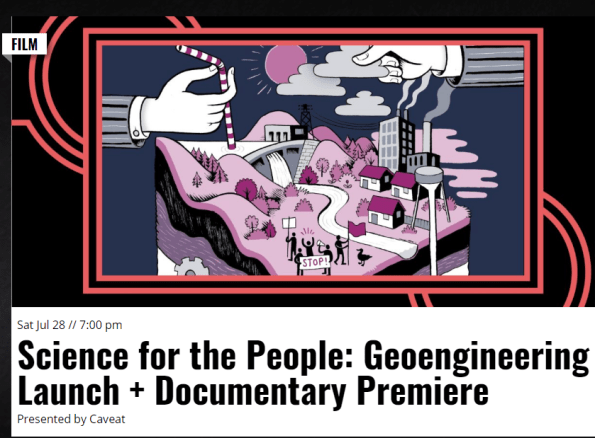
Celebrate the return of Science for the People! Join us for the premiere viewing of the mini-documentary about SftP’s revitalization and readings from our first publication since 1989: a collection of essays about the science and politics of geoengineering.
Doors: 6:30pm
Showtime: 7:00pm
Address: Caveat NYC, 21A Clinton Street, New York NY 10002
Tickets: $15 adv / $20 door
I hope I see you there!
The Failure of Ed Reform
I’ve got a new Bloomberg View column out about the failure of the Gates Foundation’s Education Reform:
Here’s How Not to Improve Public Schools
My other Bloomberg columns are listed here.
Everyone Should Hate Google Glasses
I wrote a new Bloomberg View essay about two of my favorite things to hate, Google Glasses and airplane flights:
My other Bloomberg columns are listed here.
College Admissions Will Never Be Fair
I wrote a new Bloomberg View essay about the Harvard admissions kerfuffle:
College Admissions Will Never Be Fair
My other Bloomberg columns are listed here.
Facebook should be testing election results
I wrote a new Bloomberg View essay about the upcoming elections:
Let’s Send Facebook Some Election Observers
My other Bloomberg columns are listed here.
Guest post: Teaching programming with zines
This is a guest post by Julia Evans, a programmer who blogs and tweets.
What’s a zine?
A zine is a short, usually self-published booklet. Most people who are familiar with zines probably know them from punk zines, art zines, literary zines, feminist zines, or anarchist zines. I love zines like that, but I’ve been doing something a little different — for the last 3 years, I’ve been writing zines about programming concepts!
To get an idea of what I’m talking about in this post: I have a bunch of zines you can read for free at https://jvns.ca/zines. If you love those you can buy my latest Linux zine at http://gum.co/bite-size-linux.
Here’s one page from the current zine I’m working on, which explains 18 important Linux command line tools in 24 pages. This is a quick introduction to grep.
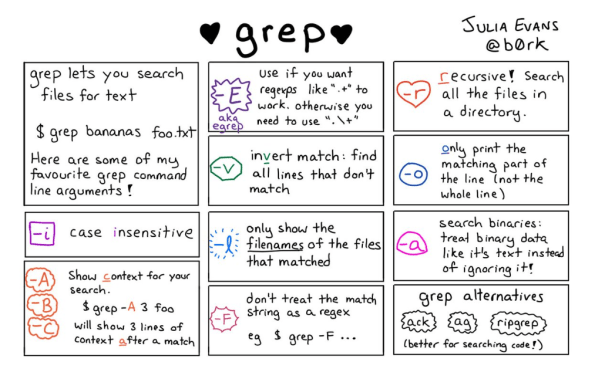
The amazing thing to me about this comic, and other comics like it, is how many people told me that they learned new important facts about grep (you can grep with regular expressions! You can grep recursively!) by reading this tiny comic.
So suddenly comics aren’t just for fun– they’re a tool that you can use to teach new ideas!
Why use zines to teach programming ideas?
Zines and comics are fun, but more importantly I think they’re actually an incredibly efficient way to teach busy professionals new ideas. It turns out that most people don’t have time to read long programming books. And a lot of useful ideas can be explained really quickly!
Fun, accessible content works. People understand it. In the zine “Linux debugging tools you’ll love” (https://jvns.ca/debugging-zine.pdf), I explain netstat, netcat, ngrep, tcpdump, wireshark, strace, eBPF, dstat, and perf and a bunch of its subcommands. This is a lot of material, and it’s material that folks often find intimidating. But because it’s presented in an adorable illustrated 24-page zine people are like “oh how interesting and cute!” and don’t hesitate to pick it up, read it on their commute to work, and learn something.
What I end up finding is that people will read my zines who I wouldn’t expect. Even though they often have pretty advanced content, people will read them even if they’re new to programming or new to Linux! And they’ll often learn something and tell me “yeah, sure, I didn’t understand 100% of it but a lot of it made sense!” To me this is a HUGE WIN.
Printing out hundreds of zines is easy!
The other magical thing about zines is that because they’re so cheap to print (I can get 500 zines printed & stapled at my local print shop for about $300), you can distribute a lot of them easily. Every time I speak at a tech conference these days, I’ll ask the conference to print 500 to 2000 of my zines (usually related to the talk I’m giving) to give out to attendees.
This is amazing because it gives people something fun & useful that they can take home after the talk and give to their friends!
You don’t need to know how to draw to draw comics
If you think this format is cool and you’d like to draw comics to teach people, drawing skills aren’t that necessary! I’ve self-published 7 zines and printed and sold thousands of them, and these are literally all the things I know how to draw.

So you could do it too! When trying to teach, information content and organization is a lot more important than drawing skills.
ORCAA featured in Fast Company!
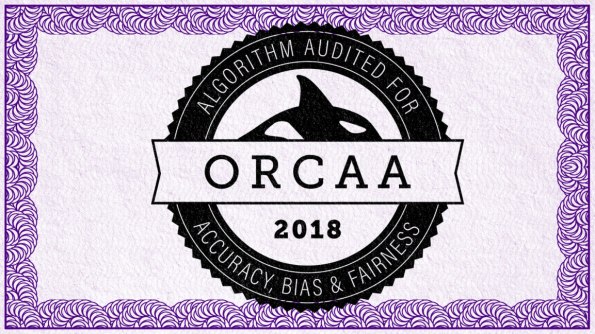
Fast Company’s Katharine Schwab wrote up ORCAA and it’s seal of approval:
This logo is like an “organic” sticker for algorithms
The food we eat has quality certifications. Why shouldn’t the algorithms that shape our world?
Here’s the picture of the seal of approval, designed by our friends at GoodGoodWork:
Let’s Not Forget How Wrong Our Crime Data Are
I’ve got a new post up in Bloomberg Opinion, inspired by the New York Times analysis on pot arrests that came out recently:
Let’s Not Forget How Wrong Our Crime Data Are
When marijuana is legalized, we’ll lose our only reliable barometer of bias in arrests.
There’s no complete list right now of all my Bloomberg columns, because it’s transitioning from Bloomberg View to Bloomberg Opinion. It will be fixed in a manner of a few days or weeks.
ORCAA featured in MIT Technology Review
MIT’s Technology Review has a feature called the “Download” and subtitled “What’s up in emerging technology” that featured my company, ORCAA last week:
This company audits algorithms to see how biased they are
This and the Wired piece last week have led to a bunch of inquiries for ORCAA, which is super exciting! Fingers crossed.
ORCAA was written up in Wired!
I’m psyched to announce that my algorithmic auditing company, ORCAA, has been written up in Wired by Jessi Hempel, in an article that talks about how we audited Rentlogic, our first customer. Take a look!
WANT TO PROVE YOUR BUSINESS IS FAIR? AUDIT YOUR ALGORITHM
Speaker Series: Mathematics and Democracy
This is a guest post by Ben Blum-Smith, a math teacher and researcher. You can find Ben on Twitter at @benblumsmith or read his blog, Research in Practice.
Announcing the first talk in a speaker series on Mathematics and Democracy!
The series will host a scholarly conversation on a broad range of issues where mathematics touches on matters of democracy: election theory, legislative redistricting, algorithmization of social infrastructure, access to mathematics, quantitative fairness, and the census, to name a few.
We are starting things off next week with CMU math professor Wesley Pegden, who was an expert witness in the Pennsylvania gerrymandering case. His team has proven a nice result in probability theory that adds further statistical rigor to an important new method for measuring gerrymanders. Here are the details:
Speaker: Wesley Pegden, Carnegie Mellon University Department of Mathematics
Location: NYU Center for Data Science, 60 Fifth Ave, Room 150
Time: 12pm, Tuesday May 8
Title: Detecting Gerrymandering with Mathematical Rigor
Abstract: In February of this year, the Pennsylvania Supreme Court found Pennsylvania’s Congressional districting to be an unconstitutional partisan gerrymander. In this talk, I will discuss one of the pieces of evidence which the court used to reach this conclusion. In particular, I will discuss a theorem which allows us to use randomness to detect gerrymandering of Congressional districtings in a statistically rigorous way.
On NPR
Hey I was on NPR’s Morning Edition this morning talking with Laurel Wamsley about an alternative to Facebook:
Would We Be Better Off If We Didn’t Rely On 1 Social Network?
A Summer Calculus Camp called PZ Math
This is a guest post by Allison Pacelli, a Professor of Mathematics at Williams College. She got her Ph.D. in Algebraic Number Theory at Brown University in 2003, and has been at Williams ever since. Allison is an award-winning teacher, and author of numerous research papers in mathematics as well as the book Mathematics and Politics: Strategy, Voting, Power, and Proof with Alan Taylor of Union College. Allison is the founder and director of Williams College Math Camp (WCMC), a camp aimed at mathematically talented high school students. She is also the co-founder and director of PZ Math, an organization aimed at promoting mathematical literacy. She also does work in K-12 Math Education, working with elementary and high school teachers.
I met Cathy at UC Berkeley in the summer of 1996. I had just finished my junior year of college, and I was accepted into this 6-week summer program for women in math. Cathy was the TA for my course in elliptic curves, a branch of number theory, which I absolutely loved. I’m now an algebraic number theorist at Williams College. One of the things I remember most about Cathy was how honest and open she was about math being hard, and how other grad students she knew at Harvard pretended they knew what was going on when, in fact, they did not.
Math is hard. Very hard! No matter how intelligent someone is or how amazing their past accomplishments, math eventually becomes difficult for anyone. This should not be a surprise, but it is to most people I know. It’s perfectly acceptable for someone in society to say, “oh I’m not a math person.” Personally, I think, that with the right teacher or materials, everyone can enjoy and be successful with math.
What I most love about math is how useful it is. Yes, of course math is useful in engineering, building, accounting, etc. but that’s not what I mean. Math makes you smarter. It makes you a better problem solver. It makes you better at persevering and trying new ideas until you find a solution. It even makes you a better writer in your English or political science courses. Learning how to approach mathematical problems improves your logical and reasoning abilities. When one method doesn’t work, you try another. You start to build up an arsenal of methods for approaching a difficult situation, in any field. Mathematical thinking also requires that we be very precise and clear. This precision and clarity translates into better arguments in any paper or debate.
So why doesn’t everyone love math? Unfortunately, far too often, math is taught in schools as a bunch of formulas to memorize and rules to use. When I first took Calculus in high school, I did very well and got a 5 on the AP exam. But I didn’t truly understand it. I was just good at knowing which rules to use when, and I was good at algebraic manipulations. When I teach Calculus now, either at Williams or the PZ Math Calculus Prep Camp that I run, I spend a lot of time helping my students actually understand calculus.
What is a derivative? What does it mean? How do you find it? What is it good for?
In a one week camp, we can’t teach our students all of calculus of course. But we do give them all the big ideas and an understanding of what the subject is about, including the Fundamental Theorem. We also delve into the details of the first third of the course material, as well as strengthen students’ algebra and trig skills that are so critical for calculus success. The result is that students know what to expect when they begin their Calculus courses in the fall. The pace of the course doesn’t feel so rushed. They understand the ideas, and they have time to hone their skills with the calculations that do come their way. Most importantly, students feel more confident in their problem solving abilities and are ready to take on challenges, not just in their calculus courses, but with any obstacles that confront them.
Congress is Missing the Point on Facebook
My newest Bloomberg View article just came out:
Congress Is Missing the Point on Facebook
Americans need a data bill of rights.
See all my Bloomberg View pieces here.
Thoughts on a Hippocratic Oath for data science
I was interviewed by Tom Upchurch of Wired UK on a Hippocratic Oath for data science and ethics of AI (it’s long!):
To work for society, data scientists need a hippocratic oath with teeth


 mathbabe