Archive
Singularity Institute and Google: what are their plans?
A few days ago I read a New York Times interview of Ray Kurzweil, who thinks he’s going to live forever and also claims he will cure cancer if and when he gets it (his excuse for not doing it in his spare time now: “Well, I mean, I do have to pick my priorities. Nobody can do everything.”). He also just got hired at Google.
As a joke I suggested that Google employees read the interview and then quit their job.
My reasoning went like this: if someone who is clearly narcissistic and delusional gets hired by your company, and given a position much higher than you (Kurzweil’s title is “Director of Engineering,” and although that doesn’t mean he is in charge of everyone in Engineering, it is nonetheless a high position), then you can give up all hope of ever being promoted based on your actual contributions. Companies have natural stages in their lives, and Google has evidently reached the stage of hiring “thought leaders” who nobody could actually work with but are somehow aligned with the agenda of the leadership.
Since then I’ve learned a bit more about Kurzweil, and about the Singularity Institute (based on the idea that computers will become self-aware and super-intelligent which will culminate in a very special moment for some parts of humanity), and the related ideologies of Futurism (fetishizing technology), Transhumanism (the idea we are going to be immortal), and “human rationality” as espoused by the blog lesswrong. Note I usually link to wikipedia articles but in the above cases, especially for the Singularity Institute, the associated wikipedia article is suspiciously sanitized of actual information.
A lot of my research is covered in this New York Times article from 2010 about the Singularity Institute’s opening. In particular it describes the close relationship between the Google royalty and the Singularity Institute. Suffice it to say there is a serious relationship between the founders of Google and this Institute.
But I’m not writing this to point out the number of ties between those institutions – this is well-documented in the above article and has only grown more obvious with the recent acquisition of Kurzweil.
And I’m also not writing to suggest that the Singularity Institute is a cult. I honestly think they make the case better than I could when the Executive Director, Luke Meuhlhauser, posts things entitled “So You Want to Save the World” wherein he states:
The best way for most people to help save the world is to donate to an organization working to solve these problems, an organization like the Singularity Institute or the Future of Humanity Institute.
Don’t underestimate the importance of donation. You can do more good as a philanthropic banker than as a charity worker or researcher.
It’s really that last sentence I want to focus on. It’s where the creepy elitism of this ideology comes out. Because make no mistake, this is a massive circle jerk for techie men (mostly men) to think of themselves as joining up with gods due to their superior intelligence and creativity.
Whatever, I’ve been around nerds all my life, and it’s nothing new to me that some of them want intelligence to count for more than just getting an edge in education and the job market. Somehow this ideology creates a hunger for much more than that: immortality, for one, and the feeling of being chosen.
You see, I believe in incentives. I want to prepare myself for what people will do next based on what I think their incentives are, and these Singularity Institute guys are on the one hand pretty hardcore with their beliefs, and on the other hand infiltrating Google, which is an incredibly powerful force in an essentially unregulated domain. So what are their plans?
Just to give you an idea, check out this line from Vernor Vinge’s now famous 1993 essay on the Singularity (emphasis mine):
Suppose we could tailor the Singularity. Suppose we could attain our most extravagant hopes. What then would we ask for: That humans themselves would become their own successors, that whatever injustice occurs would be tempered by our knowledge of our roots. For those who remained unaltered, the goal would be benign treatment (perhaps even giving the stay-behinds the appearance of being masters of godlike slaves). It could be a golden age that also involved progress (overleaping Stent’s barrier). Immortality (or at least a lifetime as long as we can make the universe survive [9] [3]) would be achievable.
A few comments:
- Vinge didn’t think the singularity was inevitable when he wrote that.
- Vinge recently spoke at the October 2012 Singularity Summit hosted by the Singularity Institute (along with Director of Research from Google, Peter Norvig). Here’s a video.
- The “stay-behinds” are the people who don’t get to transcend with the machines if and when the Singularity occurs.
Personally, I have fun thinking about the Singularity. I think it’s already happened, in fact, and my best argument for why machines are already smarter than us is this: when someone much smarter than you is saying something, maybe not to you, you don’t always know that that person is smarter – sometimes it just feels like they’re being confusing. But that’s exactly how we humans all feel about this mess we’ve made with the financial system: we are confused by it, we don’t understand it, and moreover we have no hope of dumbing it down to our level. That’s a sign it is superintelligent. Maybe not self-aware, but on the other hand how can you test that? In this light, the “stay-behinds” are Canadians.
Also, I totally believe everyone has the right to their own opinions, and for that matter they have a right to join a cult if they feel like it. In fact people who want to live forever, you could argue, are more likely to take care of the environment and their own children, because those are major investments for them.
On the other hand, what is their plan for the rest of us? Is it to, like Vinge says, give us the appearance of being masters of godlike slaves? Are those slaves our smart phones? Are we being intentionally shepherded into an artificial existence of play-power? Because I’ve suspected that very thing ever since I read the Filter Bubble. What else, especially in the context of the ongoing competition for resources?
The Singularity may never happen, or it may already have happened- that’s irrelevant to me. My thought experiment is this:
What are the consequences of a bunch of people who believe in something called the Singularity and who are also in control of a powerful company?
Bill Gates is naive, data is not objective
In his recent essay in the Wall Street Journal, Bill Gates proposed to “fix the world’s biggest problems” through “good measurement and a commitment to follow the data.” Sounds great!
Unfortunately it’s not so simple.
Gates describes a positive feedback loop when good data is collected and acted on. It’s hard to argue against this: given perfect data-collection procedures with relevant data, specific models do tend to improve, according to their chosen metrics of success. In fact this is almost tautological.
As I’ll explain, however, rather than focusing on how individual models improve with more data, we need to worry more about which models and which data have been chosen in the first place, why that process is successful when it is, and – most importantly – who gets to decide what data is collected and what models are trained.
Take Gates’s example of Ethiopia’s commitment to health care for its people. Let’s face it, it’s not new information that we should ensure “each home has access to a bed net to protect the family from malaria, a pit toilet, first-aid training and other basic health and safety practices.” What’s new is the political decision to do something about it. In other words, where Gates credits the measurement and data-collection for this, I’d suggest we give credit to the political system that allowed both the data collection and the actual resources to make it happen.
Gates also brings up the campaign to eradicate polio and how measurement has helped so much there as well. Here he sidesteps an enormous amount of politics and debate about how that campaign has been fought and, more importantly, how many scarce resources have been put towards it. But he has framed this fight himself, and has collected the data and defined the success metric, so that’s what he’s focused on.
Then he talks about teacher scoring and how great it would be to do that well. Teachers might not agree, and I’d argue they are correct to be wary about scoring systems, especially if they’ve experienced the random number generator called the Value Added Model. Many of the teacher strikes and failed negotiations are being caused by this system where, again, the people who own the model have the power.
Then he talks about college rankings and suggests we replace the flawed US News & World Reports system with his own idea, namely “measures of which colleges were best preparing their graduates for the job market”. Note I’m not arguing for keeping that US News & World Reports model, which is embarrassingly flawed and is consistently gamed. But the question is, who gets to choose the replacement?
This is where we get the closest to seeing him admit what’s really going on: that the person who defines the model defines success, and by obscuring this power behind a data collection process and incrementally improved model results, it seems somehow sanitized and objective when it’s not.
Let’s see some more example of data collection and model design not being objective:
- We see that cars are safer for men than women because the crash-test dummies are men.
- We see that cars are safer for thin people because the crash-test dummies are thin.
- We see drugs are safer and more effective for white people because blacks are underrepresented in clinical trials (which is a whole other story about power and data collection in itself).
- We see that Polaroid film used to only pick up white skin because it was optimized for white people.
- We see that poor people are uninformed by definition of how we take opinion polls (read the fine print).
Bill Gates seems genuinely interested in tackling some big problems in the world, and I wish more people thought long and hard about how they could contribute like that. But the process he describes so lovingly is in fact highly fraught and dangerous.
Don’t be fooled by the mathematical imprimatur: behind every model and every data set is a political process that chose that data and built that model and defined success for that model.
Google search is already open source
I’ve been talking a lot recently, with various people and on this blog, about data and model privacy. It seems like individuals, who should have the right to protect their data, don’t seem to, but huge private companies, with enormous powers over the public, do.
Another example: models working on behalf of the public, like Fed stress tests and other regulatory models, seem essentially publicly known, which is useful indeed to the financial insiders, the very people who are experts on gaming systems.
Google search has a deeply felt power over the public, and arguably needs to be understood for the consistent threat it poses to people’s online environment. It’s a scary thought experiment to imagine what could be done with it, and after all why should we blindly trust a corporation to have our best intentions in mind? Maybe it’s time to call for the Google search model to be open source.
But what would that look like? At first blush we might imagine forcing them to actually opening up their source code. But at this point that code must be absolutely enormous, unreadable, and written specifically for their uniquely massive machine set-up. In other words, totally overwhelming and useless (as my friend Suresh might say, the singularity has already happened and this is what it looks like (update: Suresh credits Cosma)).
Considering how many people would actually be able to make sense of the underlying code base, then you quickly realize that opening it up would be meaningless for the task of protecting the public. Instead, we’d want to make the code accessible in some way.
But I claim that’s exactly what Google does, by allowing everyone to search using the model from anywhere. In other words, it’s on us, the public, to run experiments to undertand what the underlying model actually does. We have the tools, let’s get going.
If we think there’s inherent racism in google searches, then we should run experiments like Nathan Newman recently did, examining the different ads that pop up when someone writes an email about buying a car, for example, with different names and in different zip codes. We should organize to change our zip codes, our personas (which would mean deliberately creating personas and gmail logins, etc.), and our search terms, and see how the Google search results change as our inputs change.
After all, I don’t know what’s in the code base but I’m pretty sure there’s no sub-routine that’s called “add_racism_to_search”; instead, it’s a complicated Rube-Goldberg machine that should be judged by its outputs, in a statistical way, rather than expected to prescriptively describe how it treats things on a case-by-case basis.
Another thing: I don’t think there are bad intentions on the part of the modelers, but that doesn’t mean there aren’t bad consequences – the model is too complicated for anyone to anticipate exactly how it acts unless they perform experiments to test them. In the meantime, until people undertand that, we need to distinguish between the intentions and the results. So, for example, in the update to Nathan Newman’s experiments with Google mail, Google responded with this:
This post relies on flawed methodology to draw a wildly inaccurate conclusion. If Mr. Newman had contacted us before publishing it, we would have told him the facts: we do not select ads based on sensitive information, including ethnic inferences from names.
And then Newman added this:
Now, I’m happy to hear Google doesn’t “select ads” on this basis, but Google’s words seem chosen to allow a lot of wiggle room (as such Google statements usually seem to). Do they mean that Google algorithms do not use the ethnicity of names in ad selection or are they making the broader claim that they bar advertisers from serving up different ads to people with different names?
My point is that it doesn’t matter what Google says it does or doesn’t do, if statistically speaking the ads change depending on ethnicity. It’s a moot argument what they claim to do if what actually happens, the actual output of their Rube-Goldberg machine, is racist.
And I’m not saying Google’s models are definitively racist, by the way, since Newman’s efforts were small, the efforts of one man, and there were not thousands and thousands of tests but only a few. But his approach to understanding the model was certainly correct, and it’s a cause that technologists and activists should take up and expand on.
Mathematically speaking, it’s already as open-source as we need it to be to understand it, although in a dual way than people are used to thinking about. Actually, it defines the gold standard of open-source: instead of getting a bunch of gobbly-gook that we can’t process and that depends on enormously large data that changes over time, we get real-time access to the newest version that even a child can use.
I only wish that other public-facing models had such access. Let’s create a large-scale project like SETI to understand the Google search model.
Quantifying the pull of poverty traps
In yesterday’s New York Times Science section, there was an article called “Life in the Red” (hat tip Becky Jaffe) about people’s behavior when they are in debt, summed up by this:
The usual explanations for reckless borrowing focus on people’s character, or social norms that promote free spending and instant gratification. But recent research has shown that scarcity by itself is enough to cause this kind of financial self-sabotage.
“When we put people in situations of scarcity in experiments, they get into poverty traps,” said Eldar Shafir, a professor of psychology and public affairs at Princeton. “They borrow at high interest rates that hurt them, in ways they knew to avoid when there was less scarcity.”
The psychological burden of debt not only saps intellectual resources, it also reinforces the reckless behavior, and quickly, Dr. Shafir and other experts said. Millions of Americans have been keeping the lights on through hard times with borrowed money, running a kind of shell game to keep bill collectors away.
So what we’ve got here is a feedback loop of poverty, which certainly jives with my observations of friends and acquaintances I’ve seen who are in debt.
I’m guessing the experiments described in the article are not as bad as real life, however.
I say that because I’ve been talking on this blog as well as in my recent math talks about a separate feedback loop involving models, namely the feedback loop whereby people who are judged poor by the model are offered increasingly bad terms on their loans. I call it the death spiral of modeling.
If you think about how these two effects work together – the array of offers gets worse as your vulnerability to bad deals increases – then you start to understand what half of our country is actually living through on a day-to-day basis.
As an aside, I have an enormous amount of empathy for people experiencing this poverty trap. I don’t think it’s a moral issue to be in debt: nobody wants to be poor, and nobody plans it that way.
This opinion article (hat tip Laura Strausfeld), also in yesterday’s New York Times, makes the important point that listening to a bunch of rich, judgmental people like David Bach, Dave Ramsey, and Suze Orman telling us it’s our fault we haven’t finished saving for retirement isn’t actually useful, and suggest we individually choose a money issue to take charge and sort out.
So my empathetic nerd take on poverty traps is this: how can we quantitatively measure this phenomenon, or more precisely these phenomena, since we’ve identified at least two feedback loops?
One reason it’s hard is that it’d be hard to perform natural tests where some people are submitted to the toxic environment but other people aren’t – it’s the “people who aren’t” category that’s the hard part, of course.
For the vulnerability to bad terms, the article describes the level of harassment that people receive from bill collectors as a factor in how they react, which doesn’t surprise anyone who’s ever dealt with a bill collector. Are there certain people who don’t get harassed for whatever reason, and do they fall prey to bad deals at a different rate? Are there local laws in some places prohibiting certain harassment? Can we go to another country where the bill collectors are reined in and see how people in debt behave there?
Also, in terms of availability of loans, it might be relatively easy to start out with people who live in states with payday loans versus people who don’t, and see how much faster the poverty spiral overtakes people with worse options. Of course, as crappy loans get more and more available online, this proximity study will become moot.
It’s also going to be tricky to tease out the two effects from each other. One is a question of supply and the other is a question of demand, and as we know those two are related.
I’m not answering these questions today, it’s a long-term project that I need your help on, so please comment below with ideas. Maybe if we have a few good ideas and if we find some data we can plan a data hackathon.
Should the U.S. News & World Reports college ranking model be open source?
I had a great time giving my “Weapons of Math Destruction” talk in San Diego, and the audience was fantastic and thoughtful.
One question that someone asked was whether the US News & World Reports college ranking model should be forced to be open sourced – wouldn’t that just cause colleges to game the model?
First of all, colleges are already widely gaming the model and have been for some time. And that gaming is a distraction and has been heading colleges in directions away from good instruction, which is a shame.
And if you suggest that they change the model all the time to prevent this, then you’ve got an internal model of this model that needs adjustment. They might be tinkering at the edges but overall it’s quite clear what’s going into the model: namely, graduation rates, SAT scores, number of Ph.D’s on staff, and so on. The exact percentages change over time but not by much.
The impact that this model has had on education and how universities apportion resources has been profound. Academic papers have been written on the law school version of this story.
Moreover, the tactics that US News & World Reports uses to enforce their dominance of the market are bullying, as you can learn from the President of Reed College, which refuses to be involved.
Back to the question. Just as I realize that opening up all data is not reasonable or desirable, because first of all there are serious privacy issues but second of all certain groups have natural advantages to openly shared resources, it is also true that opening up all models is similarly problematic.
However, certain data should surely be open: for example, the laws of our country, that we are all responsible to know, should be freely available to us (something that Aaron Swartz understood and worked towards). How can we be held responsible for laws we can’t read?
Similarly, public-facing models, such as credit scoring models and teacher value-added models, should absolutely be open and accessible to the public. If I’m being judged and measured and held accountable by some model in my daily life as a citizen, that has real impact on how my future will unfold, then I should know how that process works.
And if you complain about the potential gaming of those public-facing models, I’d answer: if they are gameable then they shouldn’t be used, considering the impact they have on so many people’s lives. Because a gameable model is a weak model, with proxies that fail.
Another way to say this is we should want someone to “game” the credit score model if it means they pay their bills on time every month (I wrote about this here).
Back to the US News & World Report model. Is it public facing? I’m no lawyer but I think a case can be made that it is, and that the public’s trust in this model makes it a very important model indeed. Evidence can be gathered by measuring the extent to which colleges game the model, which they only do because the public cares so much about the rankings.
Even so, what difference would that make, to open it up?
In an ideal world, where the public is somewhat savvy about what models can and cannot do, opening up the US News & World Reports college ranking model would result in people losing faith in it. They’d realize that it’s no more valuable than an opinion from a highly vocal uncle of theirs who is obsessed with certain metrics and blind to individual eccentricities and curriculums that may be a perfect match for a non-conformist student. It’s only one opinion among many, and not to be religiously believed.
But this isn’t an ideal world, and we have a lot of work to do to get people to understand models as opinions in this sense, and to get people to stop trusting them just because they’re mathematically presented.
Data scientists and engineers needed for a weekend datafest exploring money and politics
I just signed up for an upcoming datafest called “Big Data, Big Money, and You” which will be co-hosted at Columbia University and Stanford University on February 2nd and 3rd.
The idea is to use data from:
- GovTrack.us,
- MapLight,
- National Institute on Money in State Politics,
- Open States,
- Pew Research Center,
- ProPublica,
- The Center for Responsive Politics,
- State Integrity, and
- The Sunlight Foundation
and open source tools such as R, python, and various api’s to model and explore various issues in the intersection of money and politics. Among those listed are things like: “look for correlation between the subject of bills introduced to state legislatures to big companies within those districts and campaign donations” and “comparing contributions per and post redistricting”.
As usual, a weekend-long datafest is just the beginning of a good data exploration: if you’re interested in this, think of this as an introduction to the ideas and the people involved; it’s just as much about networking with like-minded people as it is about finding an answer in two days.
So sign up, come on by, and get ready to roll up your sleeves and have a great time for that weekend, but also make sure you get people’s email addresses so you can keep in touch as things continue to develop down the road.
The complexity feedback loop of modeling
Yesterday I was interviewed by a tech journalist about the concept of feedback loops in consumer-facing modeling. We ended up talking for a while about the death spiral of modeling, a term I coined for the tendency of certain public-facing models, like credit scoring models, to have such strong effects on people that they arguable create the future rather than forecast it. Of course this is generally presented from the perspective of the winners of this effect, but I care more about who is being forecast to fail.
Another feedback loop that we talked about was one that consumers have basically inheriting from the financial system, namely the “complexity feedback loop”.
In the example she and I discussed, which had to do with consumer-facing financial planning software, the complexity feedback loop refers to the fact that we are urged, as consumers, to keep track of our finances one way or another, including our cash flows, which leads to us worrying that we won’t be able to meet our obligations, which leads to us getting convinced we need to buy some kind of insurance (like overdraft insurance), which in turn has a bunch of complicated conditions on it.
The end result is increased complexity along with an increasing need for a complicated model to keep track of finances – in other words, a feedback loop.
Of course this sounds a lot like what happened in finance, where derivatives were invented to help disperse unwanted risk, but in turn complicated the portfolios so much that nobody understand them anymore, so we have endless discussions about how to measure the risk of the instruments that were created to remove risk.
The complexity feedback loop is generalizable outside of the realm of money as well.
In general models take certain things into account and ignore others, by their nature; models are simplified versions of the world, especially when they involve human behavior. So certain risks, or effects, are sufficiently small that the original model simply doesn’t see them – it may not even collect the data to measure it at all. Sometimes this omission is intentional, sometimes it isn’t.
But once the model is widely used, then the underlying approximation to the world is in some sense assumed, and then the remaining discrepancy is what we need to start modeling: the previously invisible becomes visible, and important. This leads to a second model tacked onto the first, or a modified version of the first. In either case it’s more complicated as it becomes more widely used.
This is not unlike saying that we’ve seen more vegetarian options on menus as restauranteurs realize they are losing out on a subpopulation of diners by ignoring their needs. From this example we can see that the complexity feedback loop can be good or bad, depending on your perspective. I think it’s something we should at least be aware of, as we increasingly interact with and depend on models.
I don’t have to prove theorems to be a mathematician
I’m giving a talk at the Joint Mathematics Meeting on Thursday (it’s a 30 minute talk that starts at 11:20am, in Room 2 of the Upper Level of the San Diego Conference Center, I hope you come!).
I have to distill the talk from an hour-long talk I gave recently in the Stony Brook math department, which was stimulating.
Thinking about that talk brought something up for me that I think I want to address before the next talk. Namely, at the beginning of the talk I was explaining the title, “How Mathematics is Used Outside of Academia,” and I mentioned that most mathematicians that leave academia end up doing modeling.
I can’t remember the exact exchange, but I referred to myself at some point in this discussion as a mathematician outside of academia, at which point someone in the audience expressed incredulity:
him: Really? Are you still a mathematician? Do you prove theorems?
me: No, I don’t prove theorems any longer, now that I am a modeler… (confused look)
At the moment I didn’t have a good response to this, because he was using a different definition of “mathematician” than I was. For some reason he thought a mathematician must prove theorems.
I don’t think so. I had a conversation about this after my talk with Bob Beals, who was in the audience and who taught many years ago at the math summer program I did last summer. After getting his Ph.D. in math, Bob worked for the spooks, and now he works for RenTech. So he knows a lot about doing math outside academia too, and I liked his perspective on this question.
Namely, he wanted to look at the question through the lens of “grunt work”, which is to say all of the actual work that goes into a “result.”
As a mathematician, of course, you don’t simply sit around all day proving theorems. Actually you spend most of your time working through examples to get a feel for the terrain, and thinking up simple ways to do what seems like hard things, and trying out ideas that fail, and going down paths that are dry. If you’re lucky, then at the end of a long journey like this, you will have a theorem.
The same basic thing happens in modeling. You spend lots of time with the data, getting to know it, and then trying out certain approaches, which sometimes, or often, end up giving you nothing interesting, and half the time you realize you were expecting the wrong thing so you have to change it entirely. In the end you may end up with a model which is useful. If you’re lucky.
There’s a lot of grunt work in both endeavors, and there’s a lot of hard thinking along the way, lots of ways for you to fool yourself that you’ve got something when you haven’t. Perhaps in modeling it’s easier to lie, which is a big difference indeed. But if you’re an honest modeler then I claim the difference in the process of getting an interesting and important result is not that different.
And, I claim, I am still being a mathematician while I’m doing it.
Planning for the robot revolution
Yesterday I read this Wired magazine article about the robot revolution by Kevin Kelly called “Better than Human”. The idea of the article is to make peace with the inevitable robot revolution, and to realize that it’s already happened and that it’s good.
I like this line:
We have preconceptions about how an intelligent robot should look and act, and these can blind us to what is already happening around us. To demand that artificial intelligence be humanlike is the same flawed logic as demanding that artificial flying be birdlike, with flapping wings. Robots will think different. To see how far artificial intelligence has penetrated our lives, we need to shed the idea that they will be humanlike.
True! Let’s stop looking for a Star Trek Data-esque android (although he is very cool according to my 10-year-old during our most recent Star Trek marathon).
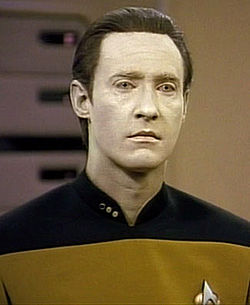
Data is very cool
Instead, let’s realize that the typical artificial intelligence we can expect to experience in our lives is the web itself, inasmuch as it is a problem-solving, decision-making system, and our interactions with it through browsing and searching is both how we benefit from artificial intelligence and how it takes us over.
What I can’t accept about the Wired article, though, is the last part, where we should consider it good. But maybe it is only supposed to be good for the Wired audience and I’m asking for too much. My concerns are touched on briefly here:
When robots and automation do our most basic work, making it relatively easy for us to be fed, clothed, and sheltered, then we are free to ask, “What are humans for?”
Here’s the thing: it’s already relatively easy for us to be fed, clothed, and sheltered, but we aren’t doing it. That doesn’t seem to be our goal. So why would it suddenly become our goal because there is increasing automation? Robots won’t change our moral values, as far as I know.
Also, the article obscures economic political reality. First imagines the audience as a land- and robot-owning master:
Imagine you run a small organic farm. Your fleet of worker bots do all the weeding, pest control, and harvesting of produce, as directed by an overseer bot, embodied by a mesh of probes in the soil. One day your task might be to research which variety of heirloom tomato to plant; the next day it might be to update your custom labels. The bots perform everything else that can be measured.
Great, so the landowners will not need any workers at all. But then what about the people who don’t have a job? Oh wait, something magical happens:
Everyone will have access to a personal robot, but simply owning one will not guarantee success. Rather, success will go to those who innovate in the organization, optimization, and customization of the process of getting work done with bots and machines.
Really? Everyone will own a robot? How is that going to work? It doesn’t seem to be a natural progression from our current system. Or maybe they mean like the way people own phones now. But owning a phone doesn’t help you get work done if there’s no work for you to do.
But maybe I’m being too cynical. I’m sure there’s deep thought being put to this question. Oh here, in this part:
I ask Brooks to walk with me through a local McDonald’s and point out the jobs that his kind of robots can replace. He demurs and suggests it might be 30 years before robots will cook for us.
I guess this means we don’t have to worry at all, since 30 years is such a long, long time.
Open data and the emergence of data philanthropy
This is a guest post. Crossposted at aluation.
I’m a bit late to this conversation, but I was reminded by Cathy’s post over the weekend on open data – which most certainly is not a panacea – of my own experience a couple of years ago with a group that is trying hard to do the right thing with open data.
The UN funded a new initiative in 2009 called Global Pulse, with a mandate to explore ways of using Big Data for the rapid identification of emerging crises as well as for crafting more effective development policy in general. Their working hypothesis at its most simple is that the digital traces individuals leave in their electronic life – whether through purchases, mobile phone activity, social media or other sources – can reveal emergent patterns that can help target policy responses. The group’s website is worth a visit for anyone interested in non-commercial applications of data science – they are absolutely the good guys here, doing the kind of work that embodies the social welfare promise of Big Data.
With that said, I think some observations about their experience in developing their research projects may shed some light on one of Cathy’s two main points from her post:
- How “open” is open data when there are significant differences in both the ability to access the data, and more important, in the ability to analyze it?
- How can we build in appropriate safeguards rather than just focusing on the benefits and doing general hand-waving about the risks?
I’ll focus on Cathy’s first question here since the second gets into areas beyond my pay grade.
The Global Pulse approach to both sourcing and data analytics has been to rely heavily on partnerships with academia and the private sector. To Cathy’s point above, this is true of both closed data projects (such as those that rely on mobile phone data) as well as open data projects (those that rely on blog posts, news sites and other sources). To take one example, the group partnered with two firms in Cambridge to build a real-time indicator of bread prices in Latin America in order. The data in this case was open, while the web-scraping analytics (generally using grocery-story website prices) were developed and controlled by the vendors. As someone who is very interested in food prices, I found their work fascinating. But I also found it unsettling that the only way to make sense of this open data – to turn it into information, in other words – was through the good will of a private company.
The same pattern of open data and closed analytics characterized another project, which tracked Twitter in Indonesia for signals of social distress around food, fuel prices, health and other issues. The project used publicly available Twitter data, so it was open to that extent, though the sheer volume of data and the analytical challenges of teasing meaningful patterns out of it called for a powerful engine. As we all know, web-based consumer analytics are far ahead of the rest of the world in terms of this kind of work. And that was precisely where Global Pulse rationally turned – to a company that has generally focused on analyzing social media on behalf of advertisers.
Does this make them evil? Of course not – as I said above, Global Pulse are the good guys here. My point is not about the nature of their work but about its fragility.
The group’s Director framed their approach this way in a recent blog post:
We are asking companies to consider a new kind of CSR – call it “data philanthropy.” Join us in our efforts by making anonymized data sets available for analysis, by underwriting technology and research projects, or by funding our ongoing efforts in Pulse Labs. The same technologies, tools and analysis that power companies’ efforts to refine the products they sell, could also help make sure their customers are continuing to improve their social and economic wellbeing. We are asking governments to support our efforts because data analytics can help the United Nations become more agile in understanding the needs of and supporting the most vulnerable populations around the globe, which in terms boosts the global economy, benefiting people everywhere.
What happens when corporate donors are no longer willing to be data philanthropists? And a question for Cathy – how can we ensure that these new Data Science programs like the one at Columbia don’t end up just feeding people into consumer analytics firms, in the same way that math and econ programs ended up feeding people into Wall Street jobs?
I don’t have any answers here, and would be skeptical of anyone who claimed to. But the answers to these questions will likely define a lot of the gap between the promise of open data and whatever it ends up becoming.
I totally trust experts, actually
I lied yesterday, as a friend at my Occupy meeting pointed out to me last night.
I made it seem like I look into every model before trusting it, and of course that’s not true. I eat food grown and prepared by other people daily. I go on airplanes and buses all the time, trusting that they will work and that they will be driven safely. I still have my money in a bank, and I also hire an accountant and sign my tax forms without reading them. So I’m a hypocrite, big-time.
There’s another thing I should clear up: I’m not claiming I understand everything about climate research just because I talked to an expert for 2 or 3 hours. I am certainly not an expert, nor am I planning to become one. Even so, I did learn a lot, and the research I undertook was incredibly useful to me.
So, for example, my father is a climate change denier, and I have heard him give a list of scientific facts to argue against climate change. I asked my expert to counter-argue these points, and he did so. I also asked him to explain the underlying model at a high level, which he did.
My conclusion wasn’t that I’ve looked carefully into the model and it’s right, because that’s not possible in such a short time. My conclusion was that this guy is trustworthy and uses logical argument, which he’s happy to share with interested people, and moreover he manages to defend against deniers without being intellectually defensive. In the end, I’m trusting him, an expert.
On the other hand, if I met another person with a totally different conclusion, who also impressed me as intellectually honest and curious, then I’d definitely listen to that guy too, and I’d be willing to change my mind.
So I do imbue models and theories with a limited amount of trust depending on how much sense they makes to me. I think that’s reasonable, and it’s in line with my advocacy of scientific interpreters. Obviously not all scientific interpreters would be telling the same story, but that’s not important – in fact it’s vital that they don’t, because it is a privilege to be allowed to listen to the different sides and be engaged in the debate.
If I sat down with an expert for a whole day, like my friend Jordan suggests, to determine if they were “right” on an issue where there’s argument among experts, then I’d fail, but even understanding what they were arguing about would be worthwhile and educational.
Let me say this another way: experts argue about what they don’t agree on, of course, since it would be silly for them to talk about what they do agree on. But it’s their commonality that we, the laypeople, are missing. And that commonality is often so well understood that we could understand it rather quickly if it was willingly explained to us. That would be a huge step.
So I wasn’t lying after all, if I am allowed to define the “it” that I did get at in the two hours with an expert. When I say I understood it, I didn’t mean everything, I meant a much larger chunk of the approach and method than I’d had before, and enough to evoke (limited) trust.
Something I haven’t addressed, which I need to think about more (please help!), is the question of what subjects require active skepticism. On of my commenters, Paul Stevens, brought this up:
… For me, lay people means John Q Public – public opinion because public opinion can shape policy. In practice, this only matters for a select few issues, such as climate change or science education. There is no impact to a lay person not understanding / believing in the Higgs particle for example.
On trusting experts, climate change research, and scientific translators
Stephanie Tai has written a thoughtful response on Jordan Ellenberg’s blog to my discussion with Jordan regarding trusting experts (see my Nate Silver post and the follow-up post for more context).
Trusting experts
Stephanie asks three important questions about trusting experts, which I paraphrase here:
- What does it take to look into a model yourself? How deeply must you probe?
- How do you avoid being manipulated when you do so?
- Why should we bother since stuff is so hard and we each have a limited amount of time?
I must confess I find the first two questions really interesting and I want to think about them, but I have a very little patience with the last question.
Here’s why:
- I’ve seen too many people (individual modelers) intentionally deflect investigations into models by setting them up as so hard that it’s not worth it (or at least it seems not worth it). They use buzz words and make it seem like there’s a magical layer of their model which makes it too difficult for mere mortals. But my experience (as an arrogant, provocative, and relentless questioner) is that I can always understand a given model if I’m talking to someone who really understands it and actually wants to communicate it.
- It smacks of an excuse rather than a reason. If it’s our responsibility to understand something, then by golly we should do it, even if it’s hard.
- Too many things are left up to people whose intentions are not reasonable using this “too hard” argument, and it gives those people reason to make entire systems seem too difficult to penetrate. For a great example, see the financial system, which is consistently too complicated for regulators to properly regulate.
I’m sure I seem unbelievably cynical here, but that’s where I got by working in finance, where I saw first-hand how manipulative and manipulated mathematical modeling can become. And there’s no reason at all such machinations wouldn’t translate to the world of big data or climate modeling.
Climate research
Speaking of climate modeling: first, it annoys me that people are using my “distrust the experts” line to be cast doubt on climate modelers.
People: I’m not asking you to simply be skeptical, I’m saying you should look into the models yourself! It’s the difference between sitting on a couch and pointing at a football game on TV and complaining about a missed play and getting on the football field yourself and trying to figure out how to throw the ball. The first is entertainment but not valuable to anyone but yourself. You are only adding to the discussion if you invest actual thoughtful work into the matter.
To that end, I invited an expert climate researcher to my house and asked him to explain the climate models to me and my husband, and although I’m not particularly skeptical of climate change research (more on that below when I compare incentives of the two sides), I asked obnoxious, relentless questions about the model until I was satisfied. And now I am satisfied. I am considering writing it up as a post.
As an aside, if climate researchers are annoyed by the skepticism, I can understand that, since football fans are an obnoxious group, but they should not get annoyed by people who want to actually do the work to understand the underlying models.
Another thing about climate research. People keep talking about incentives, and yes I agree wholeheartedly that we should follow the incentives to understand where manipulation might be taking place. But when I followed the incentives with respect to climate modeling, they bring me straight to climate change deniers, not to researchers.
Do we really think these scientists working with their research grants have more at stake than multi-billion dollar international companies who are trying to ignore the effect of their polluting factories on the environment? People, please. The bulk of the incentives are definitely with the business owners. Which is not to say there are no incentives on the other side, since everyone always wants to feel like their research is meaningful, but let’s get real.
Scientific translators
I like this idea Stephanie comes up with:
Some sociologists of science suggest that translational “experts”–that is, “experts” who aren’t necessarily producing new information and research, but instead are “expert” enough to communicate stuff to those not trained in the area–can help bridge this divide without requiring everyone to become “experts” themselves. But that can also raise the question of whether these translational experts have hidden agendas in some way. Moreover, one can also raise questions of whether a partial understanding of the model might in some instances be more misleading than not looking into the model at all–examples of that could be the various challenges to evolution based on fairly minor examples that when fully contextualized seem minor but may pop out to someone who is doing a less systematic inquiry.
First, I attempt to make my blog something like a platform for this, and I also do my best to make my agenda not at all hidden so people don’t have to worry about that.
This raises a few issues for me:
- Right now we depend mostly on press to do our translations, but they aren’t typically trained as scientists. Does that make them more prone to being manipulated? I think it does.
- How do we encourage more translational expertise to emerge from actual experts? Currently, in academia, the translation to the general public of one’s research is not at all encouraged or rewarded, and outside academia even less so.
- Like Stephanie, I worry about hidden agendas and partial understandings, but I honestly think they are secondary to getting a robust system of translation started to begin with, which would hopefully in turn engage the general public with the scientific method and current scientific knowledge. In other words, the good outweighs the bad here.
Consumer segmentation taken to the extreme
I’m up in Western Massachusetts with the family, hidden off in a hotel with a pool and a nearby yarn superstore. My blogging may be spotty for the next few days but rest assured I haven’t forgotten about mathbabe (or Aunt Pythia).
I have just enough time this morning to pose a thought experiment. It’s in three steps. First, read this Reuters article which ends with:
Imagine if Starbucks knew my order as I was pulling into the parking lot, and it was ready the second I walked in. Or better yet, if a barista could automatically run it out to my car the exact second I pulled up. I may not pay more for that everyday, but I sure as hell would if I were late to a meeting with a screaming baby in the car. A lot more. Imagine if my neighborhood restaurants knew my local, big-tipping self was the one who wanted a reservation at 8 pm, not just an anonymous user on OpenTable. They might find some room. And odds are, I’d tip much bigger to make sure I got the preferential treatment the next time. This is why Uber’s surge pricing is genius when it’s not gouging victims of a natural disaster. There are select times when I’ll pay double for a cab. Simply allowing me to do so makes everyone happy.
In a world where the computer knows where we are and who we are and can seamlessly charge us, the world might get more expensive. But it could also get a whole lot less annoying. ”This is what big data means to me,” Rosensweig says.
Second, think about just how not “everyone” is happy. It’s a pet peeve of mine that people who like their personal business plan consistently insist that everybody wins, when clearly there are often people (usually invisible) who are definitely losing. In this case the losers are people whose online personas don’t correlate (in a given model) with big tips. Should those people not be able to reserve a table at a restaurant now? How is that model going to work?
And now I’ve gotten into the third step. It used to be true that if you went to a restaurant enough, the chef and the waitstaff would get to know you and might even keep a table open for you. It was old-school personalization.
What if that really did start to happen at every restaurant and store automatically, based on your online persona? On the one hand, how weird would that be, and on the other hand how quickly would we all get used to it? And what would that mean for understanding each other’s perspectives?
Whom can you trust?
My friend Jordan has written a response to yesterday’s post about Nate Silver. He is a major fan of Silver and contends that I’m not fair to him:
I think Cathy’s distrust is warranted, but I think Silver shares it. The central concern of his chapter on weather prediction is the vast difference in accuracy between federal hurricane forecasters, whose only job is to get the hurricane track right, and TV meteorologists, whose very different incentive structure leads them to get the weather wrong on purpose. He’s just as hard on political pundits and their terrible, terrible predictions, which are designed to be interesting, not correct.
To this I’d say, Silver mocks TV meteorologists and political pundits in a dismissive way, as not being scientific enough. That’s not the same as taking them seriously and understanding their incentives, and it doesn’t translate to the much more complicated world of finance.
In any case, he could have understood incentives in every field except finance and I’d still be mad, because my direct experience with finance made me understand it, and the outsized effect it has on our economy makes it hugely important.
But Jordan brings up an important question about trust:
But what do you do with cases like finance, where the only people with deep domain knowledge are the ones whose incentive structure is socially suboptimal? (Cathy would use saltier language here.) I guess you have to count on mavericks like Cathy, who’ve developed the domain knowledge by working in the financial industry, but who are now separated from the incentives that bind the insiders.
But why do I trust what Cathy says about finance?
Because she’s an expert.
Is Cathy OK with this?
No, Cathy isn’t okay with this. The trust problem is huge, and I address it directly in my post:
This raises a larger question: how can the public possibly sort through all the noise that celebrity-minded data people like Nate Silver hand to them on a silver platter? Whose job is it to push back against rubbish disguised as authoritative scientific theory?
It’s not a new question, since PR men disguising themselves as scientists have been around for decades. But I’d argue it’s a question that is increasingly urgent considering how much of our lives are becoming modeled. It would be great if substantive data scientists had a way of getting together to defend the subject against sensationalist celebrity-fueled noise.
One hope I nurture is that, with the opening of the various data science institutes such as the one at Columbia which was a announced a few months ago, there will be a way to form exactly such a committee. Can we get a little peer review here, people?
I do think domain-expertise-based peer review will help, but not when the entire field is captured, like in some subfields of medical research and in some subfields of economics and finance (for a great example see Glen Hubbard get destroyed in Matt Taibbi’s recent blogpost for selling his economic research).
The truth is, some fields are so yucky that people who want to do serious research just leave because they are disgusted. Then the people who remain are the “experts”, and you can’t trust them.
The toughest part is that you don’t know which fields are like this until you try to work inside them.
Bottomline: I’m telling you not to trust Nate Silver, and I would also urge you not to trust any one person, including me. For that matter don’t necessarily trust crowds of people either. Instead, carry a healthy dose of skepticism and ask hard questions.
This is asking a lot, and will get harder as time goes on and as the world becomes more complicated. On the one hand, we need increased transparency for scientific claims like projects such as runmycode provide. On the other, we need to understand the incentive structure inside a field like finance to make sure it is aligned with its stated mission.
Nate Silver confuses cause and effect, ends up defending corruption
Crossposted on Naked Capitalism
I just finished reading Nate Silver’s newish book, The Signal and the Noise: Why so many predictions fail – but some don’t.
The good news
First off, let me say this: I’m very happy that people are reading a book on modeling in such huge numbers – it’s currently eighth on the New York Times best seller list and it’s been on the list for nine weeks. This means people are starting to really care about modeling, both how it can help us remove biases to clarify reality and how it can institutionalize those same biases and go bad.
As a modeler myself, I am extremely concerned about how models affect the public, so the book’s success is wonderful news. The first step to get people to think critically about something is to get them to think about it at all.
Moreover, the book serves as a soft introduction to some of the issues surrounding modeling. Silver has a knack for explaining things in plain English. While he only goes so far, this is reasonable considering his audience. And he doesn’t dumb the math down.
In particular, Silver does a nice job of explaining Bayes’ Theorem. (If you don’t know what Bayes’ Theorem is, just focus on how Silver uses it in his version of Bayesian modeling: namely, as a way of adjusting your estimate of the probability of an event as you collect more information. You might think infidelity is rare, for example, but after a quick poll of your friends and a quick Google search you might have collected enough information to reexamine and revise your estimates.)
The bad news
Having said all that, I have major problems with this book and what it claims to explain. In fact, I’m angry.
It would be reasonable for Silver to tell us about his baseball models, which he does. It would be reasonable for him to tell us about political polling and how he uses weights on different polls to combine them to get a better overall poll. He does this as well. He also interviews a bunch of people who model in other fields, like meteorology and earthquake prediction, which is fine, albeit superficial.
What is not reasonable, however, is for Silver to claim to understand how the financial crisis was a result of a few inaccurate models, and how medical research need only switch from being frequentist to being Bayesian to become more accurate.
Let me give you some concrete examples from his book.
Easy first example: credit rating agencies
The ratings agencies, which famously put AAA ratings on terrible loans, and spoke among themselves as being willing to rate things that were structured by cows, did not accidentally have bad underlying models. The bankers packaging and selling these deals, which amongst themselves they called sacks of shit, did not blithely believe in their safety because of those ratings.
Rather, the entire industry crucially depended on the false models. Indeed they changed the data to conform with the models, which is to say it was an intentional combination of using flawed models and using irrelevant historical data (see points 64-69 here for more (Update: that link is now behind the paywall)).
In baseball, a team can’t create bad or misleading data to game the models of other teams in order to get an edge. But in the financial markets, parties to a model can and do.
In fact, every failed model is actually a success
Silver gives four examples what he considers to be failed models at the end of his first chapter, all related to economics and finance. But each example is actually a success (for the insiders) if you look at a slightly larger picture and understand the incentives inside the system. Here are the models:
- The housing bubble.
- The credit rating agencies selling AAA ratings on mortgage securities.
- The financial melt-down caused by high leverage in the banking sector.
- The economists’ predictions after the financial crisis of a fast recovery.
Here’s how each of these models worked out rather well for those inside the system:
- Everyone involved in the mortgage industry made a killing. Who’s going to stop the music and tell people to worry about home values? Homeowners and taxpayers made money (on paper at least) in the short term but lost in the long term, but the bankers took home bonuses that they still have.
- As we discussed, this was a system-wide tool for building a money machine.
- The financial melt-down was incidental, but the leverage was intentional. It bumped up the risk and thus, in good times, the bonuses. This is a great example of the modeling feedback loop: nobody cares about the wider consequences if they’re getting bonuses in the meantime.
- Economists are only putatively trying to predict the recovery. Actually they’re trying to affect the recovery. They get paid the big bucks, and they are granted authority and power in part to give consumers confidence, which they presumably hope will lead to a robust economy.
Cause and effect get confused
Silver confuses cause and effect. We didn’t have a financial crisis because of a bad model or a few bad models. We had bad models because of a corrupt and criminally fraudulent financial system.
That’s an important distinction, because we could fix a few bad models with a few good mathematicians, but we can’t fix the entire system so easily. There’s no math band-aid that will cure these boo-boos.
I can’t emphasize this too strongly: this is not just wrong, it’s maliciously wrong. If people believe in the math band-aid, then we won’t fix the problems in the system that so desperately need fixing.
Why does he make this mistake?
Silver has an unswerving assumption, which he repeats several times, that the only goal of a modeler is to produce an accurate model. (Actually, he made an exception for stock analysts.)
This assumption generally holds in his experience: poker, baseball, and polling are all arenas in which one’s incentive is to be as accurate as possible. But he falls prey to some of the very mistakes he warns about in his book, namely over-confidence and over-generalization. He assumes that, since he’s an expert in those arenas, he can generalize to the field of finance, where he is not an expert.
The logical result of this assumption is his definition of failure as something where the underlying mathematical model is inaccurate. But that’s not how most people would define failure, and it is dangerously naive.
Medical Research
Silver discusses both in the Introduction and in Chapter 8 to John Ioannadis’s work which reveals that most medical research is wrong. Silver explains his point of view in the following way:

I’m glad he mentions incentives here, but again he confuses cause and effect.
As I learned when I attended David Madigan’s lecture on Merck’s representation of Vioxx research to the FDA as well as his recent research on the methods in epidemiology research, the flaws in these medical models will be hard to combat, because they advance the interests of the insiders: competition among academic researchers to publish and get tenure is fierce, and there are enormous financial incentives for pharmaceutical companies.
Everyone in this system benefits from methods that allow one to claim statistically significant results, whether or not that’s valid science, and even though there are lives on the line.
In other words, it’s not that there are bad statistical approaches which lead to vastly over-reported statistically significant results and published papers (which could just as easily happen if the researchers were employing Bayesian techniques, by the way). It’s that there’s massive incentive to claim statistically significant findings, and not much push-back when that’s done erroneously, so the field never self-examines and improves their methodology. The bad models are a consequence of misaligned incentives.
I’m not accusing people in these fields of intentionally putting people’s lives on the line for the sake of their publication records. Most of the people in the field are honestly trying their best. But their intentions are kind of irrelevant.
Silver ignores politics and loves experts
Silver chooses to focus on individuals working in a tight competition and their motives and individual biases, which he understands and explains well. For him, modeling is a man versus wild type thing, working with your wits in a finite universe to win the chess game.
He spends very little time on the question of how people act inside larger systems, where a given modeler might be more interested in keeping their job or getting a big bonus than in making their model as accurate as possible.
In other words, Silver crafts an argument which ignores politics. This is Silver’s blind spot: in the real world politics often trump accuracy, and accurate mathematical models don’t matter as much as he hopes they would.
As an example of politics getting in the way, let’s go back to the culture of the credit rating agency Moody’s. William Harrington, an ex-Moody’s analyst, describes the politics of his work as follows:
In 2004 you could still talk back and stop a deal. That was gone by 2006. It became: work your tail off, and at some point management would say, ‘Time’s up, let’s convene in a committee and we’ll all vote “yes”‘.
To be fair, there have been moments in his past when Silver delves into politics directly, like this post from the beginning of Obama’s first administration, where he starts with this (emphasis mine):
To suggest that Obama or Geithner are tools of Wall Street and are looking out for something other than the country’s best interest is freaking asinine.
and he ends with:
This is neither the time nor the place for mass movements — this is the time for expert opinion. Once the experts (and I’m not one of them) have reached some kind of a consensus about what the best course of action is (and they haven’t yet), then figure out who is impeding that action for political or other disingenuous reasons and tackle them — do whatever you can to remove them from the playing field. But we’re not at that stage yet.
My conclusion: Nate Silver is a man who deeply believes in experts, even when the evidence is not good that they have aligned incentives with the public.
Distrust the experts
Call me “asinine,” but I have less faith in the experts than Nate Silver: I don’t want to trust the very people who got us into this mess, while benefitting from it, to also be in charge of cleaning it up. And, being part of the Occupy movement, I obviously think that this is the time for mass movements.
From my experience working first in finance at the hedge fund D.E. Shaw during the credit crisis and afterwards at the risk firm Riskmetrics, and my subsequent experience working in the internet advertising space (a wild west of unregulated personal information warehousing and sales) my conclusion is simple: Distrust the experts.
Why? Because you don’t know their incentives, and they can make the models (including Bayesian models) say whatever is politically useful to them. This is a manipulation of the public’s trust of mathematics, but it is the norm rather than the exception. And modelers rarely if ever consider the feedback loop and the ramifications of their predatory models on our culture.
Why do people like Nate Silver so much?
To be crystal clear: my big complaint about Silver is naivete, and to a lesser extent, authority-worship.
I’m not criticizing Silver for not understanding the financial system. Indeed one of the most crucial problems with the current system is its complexity, and as I’ve said before, most people inside finance don’t really understand it. But at the very least he should know that he is not an authority and should not act like one.
I’m also not accusing him of knowingly helping cover up the financial industry. But covering for the financial industry is an unfortunate side-effect of his naivete and presumed authority, and a very unwelcome source of noise at this moment when so much needs to be done.
I’m writing a book myself on modeling. When I began reading Silver’s book I was a bit worried that he’d already said everything I’d wanted to say. Instead, I feel like he’s written a book which has the potential to dangerously mislead people – if it hasn’t already – because of its lack of consideration of the surrounding political landscape.
Silver has gone to great lengths to make his message simple, and positive, and to make people feel smart and smug, especially Obama’s supporters.
He gets well-paid for his political consulting work and speaker appearances at hedge funds like D.E. Shaw and Jane Street, and, in order to maintain this income, it’s critical that he perfects a patina of modeling genius combined with an easily digested message for his financial and political clients.
Silver is selling a story we all want to hear, and a story we all want to be true. Unfortunately for us and for the world, it’s not.
How to push back against the celebrity-ization of data science
The truth is somewhat harder to understand, a lot less palatable, and much more important than Silver’s gloss. But when independent people like myself step up to denounce a given statement or theory, it’s not clear to the public who is the expert and who isn’t. From this vantage point, the happier, shorter message will win every time.
This raises a larger question: how can the public possibly sort through all the noise that celebrity-minded data people like Nate Silver hand to them on a silver platter? Whose job is it to push back against rubbish disguised as authoritative scientific theory?
It’s not a new question, since PR men disguising themselves as scientists have been around for decades. But I’d argue it’s a question that is increasingly urgent considering how much of our lives are becoming modeled. It would be great if substantive data scientists had a way of getting together to defend the subject against sensationalist celebrity-fueled noise.
One hope I nurture is that, with the opening of the various data science institutes such as the one at Columbia which was a announced a few months ago, there will be a way to form exactly such a committee. Can we get a little peer review here, people?
Conclusion
There’s an easy test here to determine whether to be worried. If you see someone using a model to make predictions that directly benefit them or lose them money – like a day trader, or a chess player, or someone who literally places a bet on an outcome (unless they place another hidden bet on the opposite outcome) – then you can be sure they are optimizing their model for accuracy as best they can. And in this case Silver’s advice on how to avoid one’s own biases are excellent and useful.
But if you are witnessing someone creating a model which predicts outcomes that are irrelevant to their immediate bottom-line, then you might want to look into the model yourself.
Columbia Data Science course, week 14: Presentations
In the final week of Rachel Schutt’s Columbia Data Science course we heard from two groups of students as well as from Rachel herself.
Data Science; class consciousness
The first team of presenters consisted of Yegor, Eurry, and Adam. Many others whose names I didn’t write down contributed to the research, visualization, and writing.
First they showed us the very cool graphic explaining how self-reported skills vary by discipline. The data they used came from the class itself, which did this exercise on the first day:
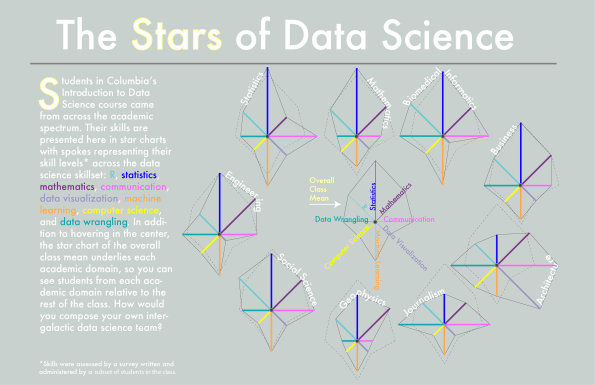
so the star in the middle is the average for the whole class, and each star along the side corresponds to the average (self-reported) skills of people within a specific discipline. The dotted lines on the outside stars shows the “average” star, so it’s easier to see how things vary per discipline compared to the average.
Surprises: Business people seem to think they’re really great at everything except communication. Journalists are better at data wrangling than engineers.
We will get back to the accuracy of self-reported skills later.
We were asked, do you see your reflection in your star?
Also, take a look at the different stars. How would you use them to build a data science team? Would you want people who are good at different skills? Is it enough to have all the skills covered? Are there complementary skills? Are the skills additive, or do you need overlapping skills among team members?
Thought Experiment
If all data which had ever been collected were freely available to everyone, would we be better off?
Some ideas were offered:
- all nude photos are included. [Mathbabe interjects: it’s possible to not let people take nude pics of you. Just sayin’.]
- so are passwords, credit scores, etc.
- how do we make secure transactions between a person and her bank considering this?
- what does it mean to be “freely available” anyway?
The data of power; the power of data
You see a lot of people posting crap like this on Facebook:

But here’s the thing: the Berner Convention doesn’t exist. People are posting this to their walls because they care about their privacy. People think they can exercise control over their data but they can’t. Stuff like this give one a false sense of security.
In Europe the privacy laws are stricter, and you can request data from Irish Facebook and they’re supposed to do it, but it’s still not easy to successfully do.
And it’s not just data that’s being collected about you – it’s data you’re collecting. As scientists we have to be careful about what we create, and take responsibility for our creations.
As Francois Rabelais said,
Wisdom entereth not into a malicious mind, and science without conscience is but the ruin of the soul.

Or as Emily Bell from Columbia said,
Every algorithm is editorial.

We can’t be evil during the day and take it back at hackathons at night. Just as journalists need to be aware that the way they report stories has consequences, so do data scientists. As a data scientist one has impact on people’s lives and how they think.
Here are some takeaways from the course:
- We’ve gained significant powers in this course.
- In the future we may have the opportunity to do more.
- With data power comes data responsibility.
Who does data science empower?
The second presentation was given by Jed and Mike. Again, they had a bunch of people on their team helping out.
Thought experiment
Let’s start with a quote:
“Anything which uses science as part of its name isn’t political science, creation science, computer science.”
– Hal Abelson, MIT CS prof
Keeping this in mind, if you could re-label data science, would you? What would you call it?
Some comments from the audience:
- Let’s call it “modellurgy,” the craft of beating mathematical models into shape instead of metal
- Let’s call it “statistics”
Does it really matter what data science is? What should it end up being?
Chris Wiggins from Columbia contends there are two main views of what data science should end up being. The first stems from John Tukey, inventor of the fast fourier transform and the box plot, and father of exploratory data analysis. Tukey advocated for a style of research he called “data analysis”, emphasizing the primacy of data and therefore computation, which he saw as part of statistics. His descriptions of data analysis, which he saw as part of doing statistics, are very similar to what people call data science today.
The other prespective comes from Jim Gray, Computer Scientist from Microsoft. He saw the scientific ideals of the enlightenment age as expanding and evolving. We’ve gone from the theories of Darwin and Newton to experimental and computational approaches of Turing. Now we have a new science, a data-driven paradigm. It’s actually the fourth paradigm of all the sciences, the first three being experimental, theoretical, and computational. See more about this here.
Wait, can data science be both?

Note it’s difficult to stick Computer Science and Data Science on this line.
Statistics is a tool that everyone uses. Data science also could be seen that way, as a tool rather than a science.
Who does data science?
Here’s a graphic showing the make-up of Kaggle competitors. Teams of students collaborated to collect, wrangle, analyze and visualize this data:

The size of the blocks correspond to how many people in active competitions have an education background in a given field. We see that almost a quarter of competitors are computer scientists. The shading corresponds to how often they compete. So we see the business finance people do more competitions on average than the computer science people.
Consider this: the only people doing math competitions are math people. If you think about it, it’s kind of amazing how many different backgrounds are represented above.
We got some cool graphics created by the students who collaborated to get the data, process it, visualize it and so on.
Which universities offer courses on Data Science?
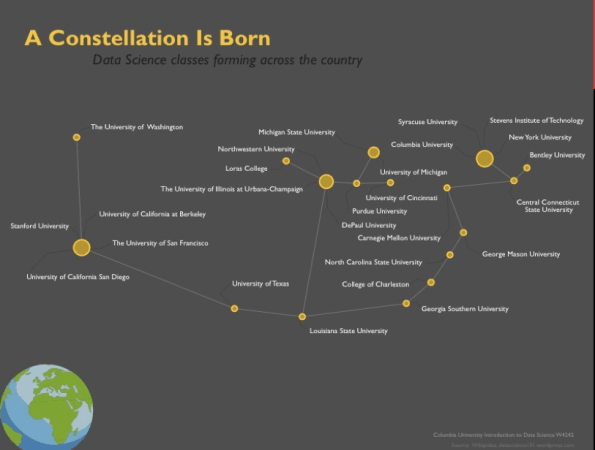
There will be 26 universities in total by 2013 that offer data science courses. The balls are centered at the center of gravity of a given state, and the balls are bigger if there are more in that state.
Where are data science jobs available?

Observations:
- We see more professional schools offering data science courses on the west coast.
- It would also would be interesting to see this corrected for population size.
- Only two states had no jobs.
- Massachusetts #1 per capita, then Maryland
Crossroads
McKinsey says there will be hundreds of thousands of data science jobs in the next few years. There’s a massive demand in any case. Some of us will be part of that. It’s up to us to make sure what we’re doing is really data science, rather than validating previously held beliefs.
We need to advance human knowledge if we want to take the word “scientist” seriously.
How did this class empower you?
You are one of the first people to take a data science class. There’s something powerful there.
Thank you Rachel!

Last Day of Columbia Data Science Class, What just happened? from Rachel’s perspective
Recall the stated goals of this class were:
- learn about what it’s like to be a data scientists
- be able to do some of what a data scientist does
Hey we did this! Think of all the guest lectures; they taught you a lot of what it’s like to be a data scientist, which was goal 1. Here’s what I wanted you guys to learn before the class started based on what a data scientist does, and you’ve learned a lot of that, which was goal 2:

Mission accomplished! Mission accomplished?
Thought experiment that I gave to myself last Spring
How would you design a data science class?
Comments I made to myself:
- It’s not a well-defined body of knowledge, subject, no textbook!
- It’s popularized and celebrated in the press and media, but there’s no “authority” to push back
- I’m intellectually disturbed by idea of teaching a course when the body of knowledge is ill-defined
- I didn’t know who would show up, and what their backgrounds and motivations would be
- Could it become redundant with a machine learning class?
My process
I asked questions of myself and from other people. I gathered information, and endured existential angst about data science not being a “real thing.” I needed to give it structure.
Then I started to think about it this way: while I recognize that data science has the potential to be a deep research area, it’s not there yet, and in order to actually design a class, let’s take a pragmatic approach: Recognize that data science exists. After all, there are jobs out there. I want to help students to be qualified for them. So let me teach them what it takes to get those jobs. That’s how I decided to approach it.
In other words, from this perspective, data science is what data scientists do. So it’s back to the list of what data scientists do. I needed to find structure on top of that, so the structure I used as a starting point were the data scientist profiles.
Data scientist profiles
This was a way to think about your strengths and weaknesses, as well as a link between speakers. Note it’s easy to focus on “technical skills,” but it can also be problematic in being too skills-based, as well as being problematic because it has no scale, and no notion of expertise. On the other hand it’s good in that it allows for and captures variability among data scientists.
I assigned weekly guest speakers topics related to their strengths. We held lectures, labs, and (optional) problem sessions. From this you got mad skillz:
- programming in R
- some python
- you learned some best practices about coding
From the perspective of machine learning,
- you know a bunch of algorithms like linear regression, logistic regression, k-nearest neighbors, k-mean, naive Bayes, random forests,
- you know what they are, what they’re used for, and how to implement them
- you learned machine learning concepts like training sets, test sets, over-fitting, bias-variance tradeoff, evaluation metrics, feature selection, supervised vs. unsupervised learning
- you learned about recommendation systems
- you’ve entered a Kaggle competition
Importantly, you now know that if there is an algorithm and model that you don’t know, you can (and will) look it up and figure it out. I’m pretty sure you’ve all improved relative to how you started.
You’ve learned some data viz by taking flowing data tutorials.
You’ve learned statistical inference, because we discussed
- observational studies,
- causal inference, and
- experimental design.
- We also learned some maximum likelihood topics, but I’d urge you to take more stats classes.
In the realm of data engineering,
- we showed you map reduce and hadoop
- we worked with 30 separate shards
- we used an api to get data
- we spent time cleaning data
- we’ve processed different kinds of data
As for communication,
- you wrote thoughts in response to blog posts
- you observed how different data scientists communicate or present themselves, and have different styles
- your final project required communicating among each other
As for domain knowledge,
- lots of examples were shown to you: social networks, advertising, finance, pharma, recommender systems, dallas art museum
I heard people have been asking the following: why didn’t we see more data science coming from non-profits, governments, and universities? Note that data science, the term, was born in for-profits. But the truth is I’d also like to see more of that. It’s up to you guys to go get that done!
How do I measure the impact of this class I’ve created? Is it possible to incubate awesome data science teams in the classroom? I might have taken you from point A to point B but you might have gone there anyway without me. There’s no counterfactual!
Can we set this up as a data science problem? Can we use a causal modeling approach? This would require finding students who were more or less like you but didn’t take this class and use propensity score matching. It’s not a very well-defined experiment.
But the goal is important: in industry they say you can’t learn data science in a university, that it has to be on the job. But maybe that’s wrong, and maybe this class has proved that.
What has been the impact on you or to the outside world? I feel we have been contributing to the broader discourse.
Does it matter if there was impact? and does it matter if it can be measured or not? Let me switch gears.
What is data science again?
Data science could be defined as:
- A set of best practices used in tech companies, which is how I chose to design the course
- A space of problems that could be solved with data
- A science of data where you can think of the data itself as units
The bottom two have the potential to be the basis of a rich and deep research discipline, but in many cases, the way the term is currently used is:
- Pure hype
But it doesn’t matter how we define it, as much as that I want for you:
- to be problem solvers
- to be question askers
- to think about your process
- to use data responsibly and make the world better, not worse.
More on being problem solvers: cultivate certain habits of mind
Here’s a possible list of things to strive for, taken from here:

Here’s the thing. Tons of people can implement k-nearest neighbors, and many do it badly. What matters is that you cultivate the above habits, remain open to continuous learning.
In education in traditional settings, we focus on answers. But what we probably should focus on is how a student behaves when they don’t know the answer. We need to have qualities that help us find the answer.
Thought experiment
How would you design a data science class around habits of mind rather than technical skills? How would you quantify it? How would you evaluate? What would students be able to write on their resumes?
Comments from the students:
- You’d need to keep making people doing stuff they don’t know how to do while keeping them excited about it.
- have people do stuff in their own domains so we keep up wonderment and awe.
- You’d use case studies across industries to see how things work in different contexts
More on being question-askers
Some suggestions on asking questions of others:
- start with assumption that you’re smart
- don’t assume the person you’re talking to knows more or less. You’re not trying to prove anything.
- be curious like a child, not worried about appearing stupid
- ask for clarification around notation or terminology
- ask for clarification around process: where did this data come from? how will it be used? why is this the right data to use? who is going to do what? how will we work together?
Some questions to ask yourself
- does it have to be this way?
- what is the problem?
- how can I measure this?
- what is the appropriate algorithm?
- how will I evaluate this?
- do I have the skills to do this?
- how can I learn to do this?
- who can I work with? Who can I ask?
- how will it impact the real world?
Data Science Processes
In addition to being problem-solvers and question-askers, I mentioned that I want you to think about process. Here are a couple processes we discussed in this course:
(1) Real World –> Generates Data –>
–> Collect Data –> Clean, Munge (90% of your time)
–> Exploratory Data Analysis –>
–> Feature Selection –>
–> Build Model, Build Algorithm, Visualize
–> Evaluate –>Iterate–>
–> Impact Real World
(2) Asking questions of yourselves and others –>
Identifying problems that need to be solved –>
Gathering information, Measuring –>
Learning to find structure in unstructured situations–>
Framing Problem –>
Creating Solutions –> Evaluating
Thought experiment
Come up with a business that improves the world and makes money and uses data
Comments from the students:
- autonomous self-driving cars you order with a smart phone
- find all the info on people and then show them how to make it private
- social network with no logs and no data retention
10 Important Data Science Ideas
Of all the blog posts I wrote this semester, here’s one I think is important:
10 Important Data Science Ideas
Confidence and Uncertainty
Let’s talk about confidence and uncertainty from a couple perspectives.
First, remember that statistical inference is extracting information from data, estimating, modeling, explaining but also quantifying uncertainty. Data Scientists could benefit from understanding this more. Learn more statistics and read Ben’s blog post on the subject.
Second, we have the Dunning-Kruger Effect.
Have you ever wondered why don’t people say “I don’t know” when they don’t know something? This is partly explained through an unconscious bias called the Dunning-Kruger effect.
Basically, people who are bad at something have no idea that they are bad at it and overestimate their confidence. People who are super good at something underestimate their mastery of it. Actual competence may weaken self-confidence.
Thought experiment
Design an app to combat the dunning-kruger effect.
Optimizing your life, Career Advice
What are you optimizing for? What do you value?
- money, need some minimum to live at the standard of living you want to, might even want a lot.
- time with loved ones and friends
- doing good in the world
- personal fulfillment, intellectual fulfillment
- goals you want to reach or achieve
- being famous, respected, acknowledged
- ?
- some weighted function of all of the above. what are the weights?
What constraints are you under?
- external factors (factors outside of your control)
- your resources: money, time, obligations
- who you are, your education, strengths & weaknesses
- things you can or cannot change about yourself
There are many possible solutions that optimize what you value and take into account the constraints you’re under.
So what should you do with your life?
Remember that whatever you decide to do is not permanent so don’t feel too anxious about it, you can always do something else later –people change jobs all the time
But on the other hand, life is short, so always try to be moving in the right direction (optimizing for what you care about).
If you feel your way of thinking or perspective is somehow different than what those around you are thinking, then embrace and explore that, you might be onto something.
I’m always happy to talk to you about your individual case.
Next Gen Data Scientists
The second blog post I think is important is this “manifesto” that I wrote:
Next-Gen Data Scientists. That’s you! Go out and do awesome things, use data to solve problems, have integrity and humility.
Here’s our class photo!
How do we quantitatively foster leadership?
I was really impressed with yesterday’s Tedx Women at Barnard event yesterday, organized by Nathalie Molina, who organizes the Athena Mastermind group I’m in at Barnard. I went to the morning talks to see my friend and co-author Rachel Schutt‘s presentation and then came home to spend the rest of the day with my kids, but they other three I saw were also interesting and food for thought.
Unfortunately the videos won’t be available for a month or so, and I plan to blog again when they are for content, but I wanted to discuss an issue that came up during the Q&A session, namely:
what we choose to quantify and why that matters, especially to women.
This may sound abstract but it isn’t. Here’s what I mean. The talks were centered around the following 10 themes:
- Inspiration: Motivate, and nurture talented people and build collaborative teams
- Advocacy: Speak up for yourself and on behalf of others
- Communication: Listen actively; speak persuasively and with authority
- Vision: Develop strategies, make decisions and act with purpose
- Leverage: Optimize your networks, technology, and financing to meet strategic goals; engage mentors and sponsors
- Entrepreneurial Spirit: Be innovative, imaginative, persistent, and open to change
- Ambition: Own your power, expertise and value
- Courage: Experiment and take bold, strategic risks
- Negotiation: Bridge differences and find solutions that work effectively for all parties
- Resilience: Bounce back and learn from adversity and failure
The speakers were extraordinary and embodied their themes brilliantly. So Rachel spoke about advocating for humanity through working with data, and this amazing woman named Christa Bell spoke about inspiration, and so on. Again, the actual content is for another time, but you get the point.
A high school teacher was there with five of her female students. She spoke eloquently of how important and inspiring it was that these girls saw these talk. She explained that, at their small-town school, there’s intense pressure to do well on standardized tests and other quantifiable measures of success, but that there’s essentially no time in their normal day to focus on developing the above attributes.
Ironic, considering that you don’t get to be a “success” without ambition and courage, communication and vision, or really any of the themes.
In other words, we have these latent properties that we really care about and are essential to someone’s success, but we don’t know how to measure them so we instead measure stuff that’s easy to measure, and reward people based on those scores.
By the way, I’m not saying we don’t also need to be good at content, and tasks, which are easier to measure. I’m just saying that, by focusing on content and tasks, and rewarding people good at that, we’re not developing people to be more courageous, or more resilient, or especially be better advocates of others.
And that’s where the women part comes in. Women, especially young women, are sensitive to the expectations of the culture. If they are getting scored on X, they tend to focus on getting good at X. That’s not a bad thing, because they usually get really good at X, but we have to understand the consequences of it. We have to choose our X’s well.
I’d love to see a system evolve wherein young women (and men) are trained to be resilient and are rewarded for that just as they’re trained to do well on the SAT’s and rewarded for that. How do you train people to be courageous? I’m sure it can be done. How crazy would it be to see a world where advocating for others is directly encouraged?
Let’s try to do this, and hell let’s quantify it too, since that desire, to quantify everything, is not going away. Instead of giving up because important things are hard to quantify, let’s just figure out a way to quantify them. After all, people didn’t think their musical tastes could be quantified 15 years ago but now there’s Pandora.
Update: Ok to quantify this, but the resulting data should not be sold or publicly available. I don’t want our sons’ and daughters’ “resilience scores” to be part of their online personas for everyone to see.
How to build a model that will be gamed
I can’t help but think that the new Medicare readmissions penalty, as described by the New York Times, is going to lead to wide-spread gaming. It has all the elements of a perfect gaming storm. First of all, a clear economic incentive:
Medicare last month began levying financial penalties against 2,217 hospitals it says have had too many readmissions. Of those hospitals, 307 will receive the maximum punishment, a 1 percent reduction in Medicare’s regular payments for every patient over the next year, federal records show.
It also has the element of unfairness:
“Many of us have been working on this for other reasons than a penalty for many years, and we’ve found it’s very hard to move,” Dr. Lynch said. He said the penalties were unfair to hospitals with the double burden of caring for very sick and very poor patients.
“For us, it’s not a readmissions penalty,” he said. “It’s a mission penalty.”
And the smell of politics:
In some ways, the debate parallels the one on education — specifically, whether educators should be held accountable for lower rates of progress among children from poor families.
“Just blaming the patients or saying ‘it’s destiny’ or ‘we can’t do any better’ is a premature conclusion and is likely to be wrong,” said Dr. Harlan Krumholz, director of the Center for Outcomes Research and Evaluation at Yale-New Haven Hospital, which prepared the study for Medicare. “I’ve got to believe we can do much, much better.”
Oh wait, we already have weird side effects of the new rule:
With pressure to avert readmissions rising, some hospitals have been suspected of sending patients home within 24 hours, so they can bill for the services but not have the stay counted as an admission. But most hospitals are scrambling to reduce the number of repeat patients, with mixed success.
Note, the new policy is already a kind of reaction to gaming that’s already there, namely because of the stupid way Medicare decides how much to pay for treatment (emphasis mine):
Hospitals’ traditional reluctance to tackle readmissions is rooted in Medicare’s payment system. Medicare generally pays hospitals a set fee for a patient’s stay, so the shorter the visit, the more revenue a hospital can keep. Hospitals also get paid when patients return. Until the new penalties kicked in, hospitals had no incentive to make sure patients didn’t wind up coming back.
How about, instead of adding a weird rule that compromises people’s health and especially punishes poor sick people and the hospitals that treat them, we instead improve the original billing system? Otherwise we are certain to see all sorts of weird effects in the coming years with people being stealth readmitted under different names or something, or having to travel to different hospitals to be seen for their congestive heart failure.


 mathbabe