Archive
Why is math research important?
As I’ve already described, I’m worried about the oncoming MOOC revolution and its effect on math research. To say it plainly, I think there will be major cuts in professional math jobs starting very soon, and I’ve even started to discourage young people from their plans to become math professors.
I’d like to start up a conversation – with the public, but starting in the mathematical community – about mathematics research funding and why it’s important.
I’d like to argue for math research as a public good which deserves to be publicly funded. But although I’m sure that we need to make that case, the more I think about it the less sure I am how to make that case. I’d like your help.
So remember, we’re making the case that continuing math research is a good idea for our society, and we should put up some money towards it, even though we have competing needs to fund other stuff too.
So it’s not enough to talk about how arithmetic helps people balance their checkbooks, say, since arithmetic is already widely known and not a topic of research.
And it’s also a different question from “Why should I study math?” which is a reasonable question from a student (with a very reasonable answer found for example here) but also not what I’m asking.
Just to be clear, let’s start our answers with “Continuing math research is important because…”.
Here’s what I got so far and also why I find the individual reasons less than compelling:
——
1) Continuing math research is important because incredibly useful concepts like cryptography and calculus and image and signal processing have and continue to come from mathematics and are helping people solve real-world problems.
This “math as tool” is absolutely true and probably the easiest way to go about making the case for math research. It’s a long-term project, we don’t know exactly what will come out next, or when, but if we follow the trend of “useful tools,” we trust that math will continue to produce for society.
After all, there’s a reason so many students take calculus and linear algebra for their majors. We could probably even put a dollar value on the knowledge they gain in such a class, which is more than one could probably say about classes in many other fields.
Perhaps we should go further – mathematics is omnipresent in the exact science. And although much of that math is basic stuff that’s been known for decades or centuries, there are probably many examples of techniques being used that would benefit from recent updates.
The problem I have with this answer is that no mathematician ever goes into math research because someday it might be useful for the real world. At least no mathematician I know. And although that wasn’t a requirement for my answers, it still strikes me as odd.
In other words, it’s an answer that, although utterly true, and one we should definitely use to make our case, will actually leave the math research community itself cold.
So where does that leave us? At least for me straight to the next reason:
2) Continuing math research is important because it is beautiful. It is an art form, and more than that, an ancient and collaborative art form, performed by an entire community. Seen in this light it is one of the crowning achievements of our civilization.
This answer allows us to compare math research directly with some other fields like philosophy or even writing or music, and we can feel like artisans, or at least craftspeople, and we can in some sense expect to be supported for the very reason they are, that our existence informs us on the most basic questions surrounding what it means to be human.
The problem I have with this is that, although it’s very true, and it’s what attracted me to math in the first place, it feels too elitist, in the following sense. If we mathematicians are performing a kind of art, like an enormous musical piece, then arguably it’s a musical piece that only we can hear.
Because let’s face it, most mathematics research – and I mean current math research, not stuff the Greeks did – is totally inaccessible to the average person. And so it’s kind of a stretch to be asking the public for support on something that they can’t appreciate directly.
3) Continuing math research is important because it trains people to think abstractly and to have a skeptical mindset.
I’ve said it before, and I’ll say it again: one of the most amazing things about mathematicians versus anyone else is that mathematicians – and other kinds of scientists – are trained to admit they’re wrong. This is just so freaking rare in the real world.
And I don’t mean they change their arguments slightly to acknowledge inconvenient truths. I mean that mathematicians, properly trained, are psyched to hear a mistake pointed out in their argument because it signifies progress. There’s no shame in being wrong – it’s an inevitable part of the process of learning.
I really love this answer but I’ll admit that there may be other ways to achieve this kind of abstract and principled mindset without having a fleet of thousands of math researchers. It’s perhaps too indirect as an answer.
——
So that’s what I’ve got. Please chime in if I’ve missed something, or if you have more to add to one of these.
Interview on Math-Frolic with Shecky Riemann
Crossposted from mathtango.
I’ve been reading Cathy O’Neil’s “Mathbabe” blog off-and-on pretty much since its inception, but either I’ve changed or her blog has, because for the last several months almost every entry seems like a gem to me. Cathy is somewhat outside-the-box of the typical math bloggers I follow… a blogger with a tad more ‘attitude’ and range of issues. She is a Harvard (PhD) graduate (also Berkeley and MIT) and a data scientist, who left the finance industry when disillusioned.
Political candidates often talk of having a “fire in the belly,” and that’s also the sense I’ve had of Cathy’s blog for awhile now. So I was very happy to learn more about the life of the blogosphere’s mathbabe, and think you will as well:
************************************
1) To start, could you tell readers a little about your diverse background and how you came to be a sort of math “freelancer” and blogger… including when did your interest in mathematics originally arise, and when did you know you wished to pursue it professionally?
I started liking math when I was 4 or 5. I remember thinking about which numbers could be divided into two equal parts and which couldn’t, and I also remember understanding about primes versus composites, and for that matter g.c.d., when I played with spirographs and taking note of different kinds of periodicities and when things overlap. Of course I didn’t have words for any of this at that point.
Later on in elementary school I got really into base 2 arithmetics in 3rd grade, and I was fascinated by the representation of the number 1 by 0.9999… in 7th grade. I was actually planning on becoming a pianist until I went to a math camp after 9th grade (HCSSiM), and ever since then I’ve known. In fact it was in that summer, when I turned 15, that I decided to become a math professor.
Long story short I spent the next 20 years achieving that goal, and then when I got there I realized it wasn’t the right speed for me. I went into finance in the Spring of 2007 and was there throughout the crisis. It opened my eyes to a lot of things that I’d been ignoring about the real world, and when I left finance in 2011 I decided to start a blog to expose some of the stuff I’d seen, and to explain it as well. I joined Occupy when it started and I’ve been an activist since then.
[Because so many carry the stereotyped image of a mathematician as someone standing at a blackboard writing inscrutable, abstract symbols, I think Cathy’s “activism” has been one of the most appealing aspects of her blog!]
2) You’re involved in quite a number of important activities/issues… what would you list as your most ardent (math-related) goals, for say the next year, and then also longer-term?
My short- or medium- term goal is to write a book called “Weapons of Math Destruction” which I recently sold to Random House. It’s for a general audience but I’ve been giving a kind of mathematical version of it to various math departments. The idea is that the modeling we’re seeing proliferate in all kinds of industries has a dark side and could be quite destructive. We need to stop blindly assuming that because it has a mathematical aspect to it that it should be considered objective or benign.
[…Love the title of the book.]
Longer term I want to promote the concept of open models, where the public has meaningful access to any models that are being used on them that are high impact and high stakes. So credit scoring models or Value-Added Teacher models are good examples of that kind of thing. I think it’s a crime that these models are opaque and yet have so much power over people’s lives. It’s like having secret laws.
3) Related to the above, you’ve been especially outspoken about various financial/banking issues and the “Occupy Wall Street” movement… I have to believe that there are both very rewarding and very frustrating/exasperating aspects to tackling those issues… care to comment?
I’d definitely say more rewarding than frustrating. Of course things don’t change overnight, especially when it comes to the public’s perception and understanding of complex issues. But I’ve seen a lot of change in the past 7 years around finance, and I expect to see more skepticism around the kind of modeling I worry about, especially in light of the NSA surveillance programs that people are up in arms over.
4) Your blog covers a wider diversity of topics than most “math” blogs. Sometimes your blogposts seem to be a combination of educating the public while also simultaneously, venting! (indeed your subheading hints at such)… how might you describe your feelings/attitude/mood when writing typical posts? And what are your favorite (math-related) subjects to write about or study?
Honestly blogging has crept into my daily schedule like a cup of coffee in the morning. It would be really hard for me to stop doing it. One way of thinking about it is that I’m naturally a person who gets kind of worked up about how people just don’t think about a subject X the right way, and if I don’t blog about those vents then they get stuck in my system and I can’t move past them. So maybe a better way of saying it is that getting my daily blog on is kind of like having an awesome poop. But then again maybe that’s too gross. Sorry if that’s too gross.
[Let’s just say that I may never think about composing blog posts in quite the same way again! 😉 ]
5) Is “Mathbabe” blog principally “a labor of love” or is it more than that for you (some sort of means to an end)? i.e., You’re writing a book and you do speaking engagements, along with other activities… is the blog a mechanism to help promote/sustain those other endeavors, or do you view it as just a recreational side activity?
I’ve been really happy with a decision to never let mathbabe be anything except fun for me. There’s no money involved at all, ever, and there never will be. Nobody pays me for anything, nobody gets paid for anything. I do it because I learn more quickly that way, and it forces me to organize my half-thoughts in a way that people can understand. And although the thinking and learning and discussions have made a bunch of things possible, I never had those goals until they just came to me.
At the same time I wouldn’t call it a side activity either. It’s more of a central activity in my life that has no other purpose than being itself.
6) Go ahead and tell us about the book you have in the works and its timetable…
It’s fun to write! I can’t believe people are willing to let me interview them! It won’t be out for a couple of years. At first I thought that was way too long but now I’m glad I have the time to do the research.
7) How do you select the topic you post about on any given day? And are there certain blogposts you’ve done that stand out as personal favorites or ones that were the most fun to work on? From the other side, which posts seem to have been most popular or attention-getting with readers?
I send myself emails with ideas. Then I wake up in the morning and look at my notes and decide which issue is exciting me or infuriating me the most.
I have different audiences that get excited about different things. The math education community is fun, they have a LOT to say on comments. People seem to like Aunt Pythia but nobody comments — I think it’s a guilty pleasure.
[Yes, I was skeptical of Aunt Pythia when you announced it (seemed a bit of a stretch), but it too is a fun read… though I most enjoy the passionate posts about issues tangential to mathematics.]
I guess it’s fair to say that people like it when I combine venting with strong political views and argumentation. My most-viewed post ever was when I complained about Nate Silver’s book.
8) What are some of the math-related books you’ve most enjoyed reading and/or ones you would particularly recommend to lay folks?
I don’t read very many math books to be honest. I’ve always enjoyed talking math with people more than reading about it.
But I have been reading a lot of mathish books in preparation for my writing. For example, I really enjoyed “How to Lie with Statistics” which I read recently and blogged about.
Most of the time I kind of hate books written about modeling, to be honest, because usually they are written by people who are big data cheerleaders. I guess the best counterexamples of that would be “The Filter Bubble,” by Eli Pariser which is great and is a kind of prequel to my book, and “Super Sad True Love Story” by Gary Shteyngart which is a dystopian sci-fi novel that isn’t actually technical but has amazing prescience with respect to the kind of modeling and surveillance — and for that matter political unrest — that I think about all the time.
9) Anything else you’d want to say to a captive audience of math-lovers, that you haven’t covered above?
Math is awesome!
[INDEED!]
************************************
Thanks so much, Cathy, for filling in a bit about yourself here. Good luck in all your endeavors!
Cathy tweets, BTW, at @mathbabedotorg and she did this fascinating interview for PBS’s “Frontline” in 2012 (largely on the financial crisis):
http://www.pbs.org/wgbh/pages/frontline/oral-history/financial-crisis/cathy-oneil/
(I highly recommend this!)
Interview with Bill McCallum, lead writer of Math Common Core
This is an interview I had on 2/4/2014 with Bill McCallum, who is a University Distinguished Professor of Mathematics and member of the Department of Mathematics at the University of Arizona. Bill also led the Work Team which recently wrote the Mathematics Common Core State Standards, and was graciously willing to let me interview him on that.
Q: Tell me about how the Common Core State Standards Mathematics Work Team got formed and how you got onto it.
A: There were actually two separate documents and two separate processes, and people often get confused between them.
The first part happened in the summer of 2009 and produced a document called “College and Career Readiness Standards“. It didn’t go grade by grade but rather described what a high school student leaving and ready for college and career looks like. The team that wrote that pre-cursor document consisted of people from the College Board, ACT, and Achieve and was organized and managed by CCSSO (which represents state education commissioners and the like) and NGA (which represents Governors). Gene Wilhout, then executive director of CCSSO, led the charge.
I was on that first panel representing Achieve. Achieve does not write assessments, but College Board and ACT do, and I think that’s where the charge that the standards were developed by testing companies comes from. It’s worth noting in the context of that charge that both ACT and College Board are non-profits.
The second part of the process, called the Work Team, took that document and worked backwards to create the actual Common Core State Standards for mathematics. I was the chair of the Work Team and was one of the 3 lead writers, the other two being Jason Zimba and Phil Daro. But the other members of the Work Team represent many educators, mathematicians, and math education folks, as well as DOE folks, and importantly there are no testing or textbook companies represented. The full list is here.
Q: Explain what Achieve is and is not.
A: Achieve is not a testing company, so let’s put that to rest.
Without going into too much historical detail (some of which is available here), Achieve was launched as an initiative of a combination of business and education leaders with the goal to improve education. It’s a non-profit think tank, which came out with benchmarks for mathematics education and tried to get states to align standards to them.
I started working with Achieve around 2005 and pretty soon I found myself chairing a committee to revise the benchmarks, which is how I got involved in the drafting of the first document I talked about above.
One more word about getting states on board with the Common Core State Standards (CCSS). There were 48 states that had committed to being involved in the writing, but not necessarily to adopt the standards. The states were involved in the review process as the CCSS were being written in 2009-2010. And here by “states” we usually mean teams from the various Department of Education, but different states had different team makeups.
For example, Arizona heavily involved teachers and some other states had their mathematics specialists at the DOE look things over and make comments.The American Federation of Teachers took the review quite seriously, and Jason and I met twice over the weekend to talk to teams of teachers assembled by AFT, listening to comments and making revisions.The National Council of Teachers of Mathematics was also quite involved in reviews and meetings.
Q: What are the goals of CCSS?
A: The goal is educational: to describe the mathematical achievements, skills, and understandings that we want students to have by the time they leave high school, broken down by grades.
It’s important to note at this point that this is not a new idea. Indeed states have had standards since the early 1990’s. But those standards were pretty unfocused and incoherent in many cases. What’s new is that we have common standards, and that they are focused and coherent.
Q: So what’s the difference between standards and tests?
A: Standards are descriptions of what you want students to learn. What you do with them is up to you. Testing is something you do if you want to know if they’ve learned what you wanted them to learn. It’s assessment.
Q: What’s your view on tests?
A: I would say that it doesn’t make sense to have no tests, no assessments. It doesn’t make sense to spend the money we spend on education ($12000 per student each year) and then not bother to see if it has had an effect. But nobody tests as much as the United States, and it seems quite overdone. This is a legacy of the No Child Left Behind bill, which had punitive measures for schools based on assessments embedded into law.
From my perspective, education in this country goes between extremes, and right now we are undeniably on the extreme with respect to testing. But I’d like to be clear that standards don’t cause testing.
Q: OK, but it’s undeniable that CC makes testing easier, do you agree?
A: Yes, and isn’t that a good thing? Having common standards also makes good testing easier. I’d also argue that they make it possible to spend less money on testing, and to make testing more centered on what you actually want. It puts more, not less, power into the hands of the consumers of the test. And that’s a good thing.
A word about testing companies. There’s no question that testing companies are trying to grab their share of money for tests. But before they could get paid for 50 different tests based on 50 different standards. What’s better?
There are two new assessment consortia, groups of states which are developing common assessments based on the standards. The consortia will have more power in the marketplace than individual states had.
I believe that people are conflating two separate issues which I’d like to separate. First, do we do a good job of choosing tests? Second, do the CCSS make that worse?
I believe that the CCSS have the power to make things better, although it’s possible that nobody will take advantage of the “commonness” in CCSS. And I’m not saying I’m not worried – the assessment consortia might do a good job but they might fail or get caught up in politics. The campaign for teacher accountability is causing fear and anger. I think you are right to be suspicious of VAM, for example. But that’s not caused by CCSS. Having common standards gives us power if we use it.
I’d also like to make the point that having common standards helps gives power to small players in curriculum publishing. When 50 different states had 50 different standards, the big publishing players with huge sales forces were able to send people to every state and adapt books to different standards. But now we will have smallish companies able to make something work and prove their worth in Tennessee and then sell it in California or wherever.
Q: What would you say to the people who might say that we don’t need more tests, we need to address poverty?
A: I’d say that having good standards can help.
Look, we need a good education system and to eliminate poverty. And having good common standards helps that second goal as well as the first. Why do I say that? A lot of what is good about the CCSS is that they are pretty focused, whereas many of the complaints about the old state standards were that they had tended to be “mile wide inch deep,” meaning having laundry lists of skills which were overall unfocused and incoherent.
We wanted to make something focused, which translated into having fewer things per grade level and doing them right, and making the overall standards a progression which tells a story that makes sense. Good standards, as I believe the CCSS represent, help everybody by providing clear guidance, which particularly helps struggling students and poor schools with less than ideal conditions.
Q: Do CC standards make teachers passive? Are they sufficiently flexible?
A: I don’t even get that.
Here’s the thing, standards are not curriculum.
Curriculum is what teachers actually follow in the classroom. We’ve always had standards, so what changed? Why are we suddenly worried about this new concept which isn’t new at all?
Here’s a legitimate fear: regimented, overly-prescriptive curricula that tell you what to do every day, like in France. Fair enough. But standards don’t say you need to have that. They just say what we want students to learn. It’s true that an overzealous implementation of standards could make teachers passive.
Maybe what’s new is that previously most people ignored their state standards and now people are actually paying attention. But that still doesn’t imply boring or rigid curricula.
Q: Are the CCSS “alive”?
A: How living do we want CC standards to be? Countries like Singapore revise standards on a 10-year cycle. After all we don’t want it to move too quickly, since we need to have time to implement stuff. In fact I’d argue that instability has been a big problem: there’s always a new fad, a new thing, and people never get a chance to figure out what we’re doing with what we’ve got. We should study what works and what doesn’t. And of course there should be revisions when that makes sense.
Q: Is there anything else you’d like to say?
A: Two things. First, I’d like to stress that people are conflating CCSS and testing, and they’re also conflating CCSS and curriculum. It’d be nice for people to separate their issues.
And one last thing. We as a country don’t understand common anything. We don’t see advantages of standards. Think about how useful it is to have standards, though. My recent project is a website called Illustrative Mathematics, which could not exist without standards. it’s a national community of teachers figuring out what they need to know – across state lines. That’s neat, and it’s only one of many benefits of having shared standards.
Bad debit cards are not the answer to bad FICO scores
Recently I was made aware of a petition by Suze Orman on change.org to mandate credit bureaus – the companies that create credit scores – to use information from debit cards.
At first glance this seems totally weird, for two reasons. First, debit cards by construction have no ability to go below zero, so they are not directly relevant to the concept of credit, which is by definition when you borrow something and then hopefully pay it back. Second, my first, second, and third intuitive response to credit bureaus is to give them less information, not more. I already think they have way too much data about us. Their recent foray into using social media data is super creepy, for example, and threatens the “no outdated information” rule of the Fair Credit Act, for example.
I watched Orman explain her reasoning about her card, which I believe launched in 2012, and I kind of get her points about why she thinks this is a good idea (even though she clearly has a conflict of interest here): some people have trouble with credit cards, and for that reason they should use debit cards or cash, but cash has no data trail and thus people who are in only cash can never improve their credit scores enough to qualify for things like mortgages and car loans, which they may well be able to handle.
Here’s the thing, though. Her card actually has bad terms, and loads of fees, and it doesn’t look like FICO is actually going to use data from her cards to build peoples’ credit scores after all. Oh well.
Here’s an idea, which is not original at all but hasn’t gotten momentum because it doesn’t make bankers money: instead of shitty and expensive debit cards, let’s have the Post Office open a national bank and let people put money for free on their phones. Systems like this already exist in Kenya (Matt Stoller calls it a “M-Pesa style mobile cash system” in this fine post about the Post Office Bank idea) and in Ghana, and they work great, and let me once again mention there are no fees. It’s a free service as long as you have a cell phone, and it certainly doesn’t have to be a fancy smart phone.
In the short term, such a system will free poor people from getting ever increasingly ripped off by banks and companies with their crappy pre-paid debit cards. It might not give them stellar credit scores, but I’d argue that it’d still be an improvement.
In the asymptotic limit of that system, we’d have a pretty sharp division between people who live in the world of credit, with good FICO scores, and people who deal in cash and mobile cash, with bad or nonexistent FICO scores. It would be hard to get a good mortgage or car loan if you are in the latter group, but that’s already true (unless you count the kind of mortgages Wells Fargo gave to minorities to rip them off).
In the longer term, if we wanted to give credit scores to people who deal in cash, we could use their mobile cash records to deem their spending habits “credit worthy”.
In the much longer term, it would be great if we stopped pretending (I’m looking at you Suze Orman) that having a bad FICO score is a moral failing: it’s really mostly a sign of being broke. If we want to help people get out of debt spirals, then let’s talk about a Basic Guaranteed Income.
Ask Tante Nina and Aunt Pythia
Today we have a special treat for Aunt Pythia fans and lovers, which is that her good friend Tante Nina has helped come up with wise answers to your timeless quandaries. I know you guys will enjoy her brief visit with us as much as I do.
After you enjoy her sage advice, please don’t forget to:
think of something to ask Aunt Pythia at the bottom of the page!
By the way, if you don’t know what the hell Aunt Pythia is talking about, go here for past advice columns and here for an explanation of the name Pythia.
——
Dear Tante Nina and Aunt Pythia,
What do you think of answering overly nosy questions (from acquaintances, cousins, etc) with something along the lines of “Sorry, you don’t have the security clearance for that information”? I feel like it can be done with enough humor that it’s not an insult… but I can imagine I might be bad at making that call.
Nosiness Seeds Awkwardness
Dear NSA,
Given how awesome your sign-off is, we think you’re witty enough to pull this off!
Look, we may not be the best ladies for this question. You ask, we tell. But, as Tante Nina’s mom always said – in Spanish, so it sounds better – “a good understander needs few words”.
Basically, most people will take a hint with just this kind of graceful little brushoff. If someone still doesn’t get it, you can keep going with your metaphor and say, “If I told you I’d have to kill you”.
For the truly obtuse or pushy sometimes, turning the tables can deliver the message. Ask them a super personal question they’d rather not answer. Or, you can always be direct (less fun, less old world, but often my go-to). “How did you get so nosy? Get outta here! I’m not answering that in a million years.”
Tante Nina and Aunt Pythia
——
Dear Tante Nina and Aunt Pythia,
My recent (and less recent) professional life has been marred with sexism, mainly of the form of men (usually much older than I, and in positions of power over me) degrading me based on my gender or sexualizing me.
I’ve been asked to become their department’s fan girl, received numerous unwelcome comments about my weight, had new wardrobes suggested to flatter myself better, etc.
I have never crossed the line of professionalism in my dress or manner, but whenever I address the issue with these men’s superiors, I always get the blame thrown back at me: Well, what WERE you wearing? ARE you working out? Have you suggested they’re being inappropriate?
I have no problem being forward towards these men, and I call them out when they make inappropriate comments to me, usually to have them attempt to intimidate me more or complaining that they’re just jesting and I’m taking the words too seriously.
Do you have any recommendations on how to deal with professional-level sexism? I feel very much like my profession is not being taken seriously, and I’m being judged entirely on my outward appearance (which never pleases the way they want, and doesn’t exist to please them at all).
With much love,
Serious Woman Always Genderized
Dear Reluctant Fan Girl,
First of all, let me say I’m really sorry you are going through this. It truly sucks. Sexism, like racism, is alive and well. You can always try to find a better work environment and I am sure there are companies that are better and worse than others, supervisors who are more sensitive than others, but no matter where you go sexism in the workplace will be an issue to some extent. It’s the world we live in.
That said, your question, is “how do I deal with it?” It would be a good idea to document incidents, perhaps by describing the events and emailing yourself at a non-workplace address. Copy yourself on emails where you set up meetings with superiors to discuss issues and describe the problem clearly. Keep track and have a record so that down the line if you discover you are being passed over for promotions you feel you deserved or being punished unfairly you have a case to present. This is one way to approach your problem but by no means the only one.
I have often wondered how women like Ruth Bader Ginsburg and Sandra Day O’Connor made it to the very top of their professions in a climate that was clearly even more hostile to women than anything we have come close to encountering in our own generation. Clearly, while sexism in the workplace presents a real challenge, and it is unfair that you have to deal with this, it is a surmountable challenge. You are trying to figure out how to work through this and it is exactly the right attitude.
There is some amount of legal recourse and documenting what happens will help you avail yourself of that avenue if you ever decide to take that route, but let’s face it, you don’t want to bring out the big guns unless you really, really have to.
So back to Ruth and Sandra. How did women of that generation get by? On grit, excellent results, hard work, and playing dumb, dumb like a fox.
Don’t let these guys win by undermining your confidence, because that is what they are trying to do. With the little micro-aggressions they are trying to put you in your place. Showing any kind of upset plays right into that. These guys are jerks and bullies. Jerks and bullies generally give up and go away when they can’t get a rise from you.
Laugh, brush them off with humor whenever possible, and remember that success is the best revenge.
Also, don’t worry too much, and give yourself some slack sometimes too. Try to put in place the support in other areas of your life that you will need to call upon to shore up your strength and pull you through.
Finally, remember you must be doing something right if all these guys are running scared.
Warmly,
Tante Nina
——
Dear Aunt Pythia,
I have been dating someone for about 4 months, and in some ways things seem to be going well: we enjoy spending time together, we are attracted to each other, we have a lot of the same attitudes and goals. But I’m not in love with her, and am starting to worry that I never will be. In my previous relationships it happened a lot sooner. How much time should I give this?
Thanks,
Not In Love
Dear NIL,
I’m gonna say it, because I think it has to be said. Walk away. You don’t want to waste your time, and you don’t have an infinite amount of time to waste. Go find something truly satisfying, and stay good friends with this very cool person.
Also, who knows? You might figure out there is love there after you stop seeing each other and you miss each other.
But you gotta have standards, and being bored is not a good enough one.
Aunt Pythia
——
Hiya, Aunt Pythia,
I’ve been seeing a lot of “PhD (ABD)” popping up on people’s LinkedIn profiles and resumes. Having dropped out of grad school when my advisor went on “indefinite” sabbatical four years into my own graduate study, after passing the written oral and qualifying exams for PhD candidacy, I’m wondering if I’m doing myself a disservice by “just” listing Master’s. On the other hand, I certainly don’t want misrepresent myself. What do you think? Is this something you’ve heard discussed in academic or business circles?
Does Representation Of PhD Overstate / Understate Talent?
Dear DROPOUT,
Nice.
Here’s the thing, DROPOUT, we looked over a few LinkedIn friends of ours to check out the sitch, and we’d like mention that we were also surprised by how many ABD’s turned up.
However, those people are all people who expect to get their dissertations written up soon, or at least claim to be well on their way towards that goal. Our conclusion is that “ABD” implies an active engagement with your thesis, which we don’t think you have. So we say: don’t do it.
And it’s possible you could fake it, but then if, after 10 years you still have “ABD” up there, it would look weird, and weirdly defensive. That’s just our opinion. Also, if we were you, we’d focus on other cool things you’re doing with your education rather than fretting over that.
Good luck,
Aunt Pythia and Tante Nina
——
Please submit your well-specified, fun-loving, cleverly-abbreviated question to Aunt Pythia!
Join Alt Banking #OWS
I’m really proud of my Occupy group, Alt Banking. We continue to meet every Sunday at Columbia and we welcome new members. I wanted to throw down a few reasons you might consider coming to our meetings.
If you’re interested, please email alt.banking.ows@gmail.com and ask to be added to the google group. Emails go out Saturday about details on Sunday meetings. And if you’re passing through New York on a Sunday, please consider just joining for one day!
Website
An amazing team of activists have been making the Alt Banking website better and better every week. It’s pretty much up to date and contains real resources for people who can’t come to the meetings, as well as for people who want to continue the conversation between meetings.
Please take a look and give us suggestions to make it even better.
Speakers
We’ve had some amazing speakers come to Alt Banking in the past – including Neil Barofsky, Sheila Bair, Merlyna Lim, Tom Adams, Moe Tkacik, and most recently Stanley Aronowitz – and many more coming up soon. I’d say it’s a great group to know about for the speaker list alone. The speakers come from 2-3pm before the regular 3-5 meeting on Sundays.
Projects
As I’ve mentioned before on mathbabe, we wrote a pretty cool book called Occupy Finance, and we recently got a second printing made since the first printing went so quickly. If you’d like a physical copy, please email alt.banking.ows@gmail.com with your address. A free pdf is available here.
But that’s not all. Last week we decided to start our next big project, which is likely going to be some combination of a book and a movie, or a series of videos, or possibly a series of animated shorts, or something along those lines (still under consideration!). The content of the project is centered around three topics and their intersections, and we already have a cool “first iteration” visual due to Laminated Lychee (note the nerdy use of the Venn Diagram):
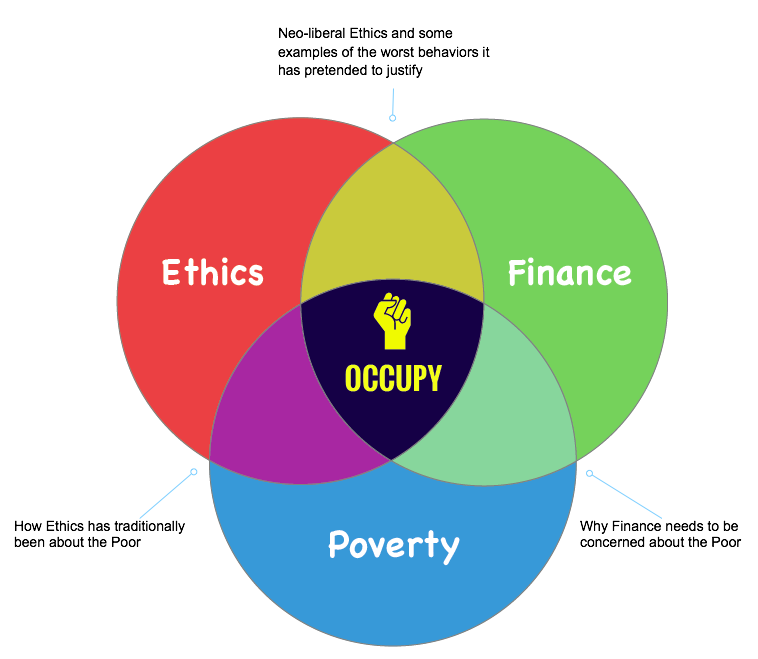
We’re also looking to have a cool roll-out for that project, possibly next September, possibly with a day-long conference of activists and lectures and activities. We could really use some help!
Fun
I also wanted to mention that we have a blast every week, and we often go out for dinner and/or a glass of wine or beer after the regular meeting. It’s really a great group of fun people.
Researching the Common Core
I’m in the middle of researching the Common Core standards for math. So far I’ve watched a Diane Ravitch talk, which I blogged about here, which was interesting but raised more questions than it answered, at least for me.
I’ve also interviewed Bill McCallum this week, who was a lead writer and chair of the Work Team that wrote the Common Core standards for mathematics. I’m still writing up that interview but I should have it done soon.
Next up I plan to interview a long-time teacher and current principal of a Brooklyn-based girls school for math and science, Kiri Soares, on her perspective on the Common Core standards and standardized tests in general.
One thing I can say already for sure: people who are not insiders here conflate a bunch of different issues. I’m hoping to at least separate them and understand where people stand on each issue, and if I at the very least get to the point of agreeing to disagree on well-defined points then I will have done my job.
Tell me if you think I need to go further to fully understand the issues at hand. Of course one thing I’m not doing is delving directly into the content of the standards, and that may very well be essential to understanding them. I’d love your thoughts.
Matt Stoller is tearing up Tumblr
I’ve been super impressed by Matt Stoller’s recent foray into “tumbling”, which is kind of like blogging except it’s called tumbling. Even the spam emails from tumblr are worth following him, because sometimes they contain his newest posts.
His title is Observations on Credit and Surveillance but in fact the content is all over the map, reading original source documents to describe the connections between communism and U.S. slavery or Gerald Ford and Watergate, not to mention the 1894 Post Office Bank proposal.
Most interesting to me is the information he’s uncovered about data provisions in the TPP and the history of credit cards and debt collection.
Go take a look, he’s been on fire. I hope he keeps it going.
Guest Post: Beauty, even in the teaching of mathematics
This is a guest post by Manya Raman-Sundström.
Mathematical Beauty
If you talk to a mathematician about what she or he does, pretty soon it will surface that one reason for working those long hours on those difficult problems has to do with beauty.
Whatever we mean by that term, whether it is the way things hang together, or the sheer simplicity of a result found in a jungle of complexity, beauty – or aesthetics more generally—is often cited as one of the main rewards for the work, and in some cases the main motivating factor for doing this work. Indeed, the fact that a proof of known theorem can be published just because it is more elegant is one evidence of this fact.
Mathematics is beautiful. Any mathematician will tell you that. Then why is it that when we teach mathematics we tend not to bring out the beauty? We would consider it odd to teach music via scales and theory without ever giving children a chance to listen to a symphony. So why do we teach mathematics in bits and pieces without exposing students to the real thing, the full aesthetic experience?
Of course there are marvelous teachers out there who do manage to bring out the beauty and excitement and maybe even the depth of mathematics, but aesthetics is not something we tend to value at a curricular level. The new Common Core Standards that most US states have adopted as their curricular blueprint do not mention beauty as a goal. Neither do the curriculum guidelines of most countries, western or eastern (one exception is Korea).
Mathematics teaching is about achievement, not about aesthetic appreciation, a fact that test-makers are probably grateful for – can you imagine the makeover needed for the SAT if we started to try to measure aesthetic appreciation?
Why Does Beauty Matter?
First, it should be a bit troubling that our mathematics classrooms do not mirror practice. How can young people make wise decisions about whether they should continue to study mathematics if they have never really seen mathematics?
Second, to overlook the aesthetic components of mathematical thought might be to preventing our children from developing their intellectual capacities.
In the 1970s Seymour Papert , a well-known mathematician and educator, claimed that scientific thought consisted of three components: cognitive, affective, and aesthetic (for some discussion on aesthetics, see here).
At the time, research in education was almost entirely cognitive. In the last couple decades, the role of affect in thinking has become better understood, and now appears visibly in national curriculum documents. Enjoying mathematics, it turns out, is important for learning it. However, aesthetics is still largely overlooked.
Recently Nathalie Sinclair, of Simon Frasier University, has shown that children can develop aesthetic appreciation, even at a young age, somewhat analogously to mathematicians. But this kind of research is very far, currently, from making an impact on teaching on a broad scale.
Once one starts to take seriously the aesthetic nature of mathematics, one quickly meets some very tough (but quite interesting!) questions. What do we mean by beauty? How do we characterise it? Is beauty subjective, or objective (or neither? or both?) Is beauty something that can be taught, or does it just come to be experienced over time?
These questions, despite their allure, have not been fully explored. Several mathematicians (Hardy, Poincare, Rota) have speculated, but there is no definite answer even on the question of what characterizes beauty.
Example
To see why these questions might be of interest to anyone but hard-core philosophers, let’s look at an example. Consider the famous question, answered supposedly by Gauss, of the sum of the first n integers. Think about your favorite proof of this. Probably the proof that did NOT come to your mind first was a proof by induction:
Prove that S(n) = 1 + 2 + 3 … + n = n (n+1) /2
S(k + 1) = S(k) + (k + 1)
= k(k + 1)/2 + 2(k + 1)/2
= k(k + 1)/2 + 2(k + 1)/2
= (k + 1)(k + 2)/2.
Now compare this proof to another well known one. I will give the picture and leave the details to you:
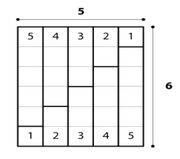
Does one of these strike you as nicer, or more explanatory, or perhaps even more beautiful than the other? My guess is that you will find the second one more appealing once you see that it is two sequences put together, giving an area of n (n+1), so S(n) = n (n+1)/2.
Note: another nice proof of this theorem, of course, is the one where S(n) is written both forwards and backwards and added. That proof also involves a visual component, as well as an algebraic one. See here for this and a few other proofs.
Beauty vs. Explanation
How often do we, as teachers, stop and think about the aesthetic merits of a proof? What is it, exactly, that makes the explanatory proof more attractive? In what way does the presentation of the proof make the key ideas accessible, and does this accessibility affect our sense of understanding, and what underpins the feeling that one has found exactly the right proof or exactly the right picture or exactly the right argument?
Beauty and explanation, while not obvious related (see here), might at least be bed-fellows. It may be the case that what lies at the bottom of explanation — a feeling of understanding, or a sense that one can ”see” what is going on — is also related to the aesthetic rewards we get when we find a particularly good solution.
Perhaps our minds are drawn to what is easiest to grasp, which brings us back to central questions of teaching and learning: how do we best present mathematics in a way that makes it understandable, clear, and perhaps even beautiful? These questions might all be related.
Workshop on Math Beauty
This March 10-12, 2014 in Umeå, Sweden, a group will gather to discuss this topic. Specifically, we will look at the question of whether mathematical beauty has anything to do with mathematical explanation. And if so, whether the two might have anything to do with visualization.
If this discussion peaks your interest at all, you are welcome to check out my blog on math beauty. There you will find a link to the workshop, with a fantastic lineup of philosophers, mathematicians, and mathematics educators who will come together to try to make some progress on these hard questions.
Thanks to Cathy, the always fabulous mathbabe, for letting me take up her space to share the news of this workshop (and perhaps get someone out there excited about this research area). Perhaps she, or you if you have read this far, would be willing to share your own favorite examples of beautiful mathematics. Some examples have already been collected here, please add yours.
How to Lie With Statistics (in the Age of Big Data)
When I emailed my mom last month to tell her the awesome news about the book I’m writing she emailed me back the following:
i.e, A modern-day How to Lie with Statistics (1954), avail on Amazon
for $9.10. Love, Mom
That was her whole email. She’s never been very verbose, in person or electronically. Too busy hacking.
Even so, she gave me enough to go on, and I bought the book and recently read it. It was awesome and I recommend it to anyone who hasn’t read it – or read it recently. It’s a quick read and available as a free pdf download here.
The goal of the book is to demonstrate all the ways marketers, journalists, accountants, and sometimes even statisticians can bias your interpretation of statistical facts or even just confuse you into thinking something is true when it’s not. It’s illustrated as well, which is fun and often funny.

The author does things like talk about how you can present graphs to be very misleading – my favorite, because it happens to be my pet peeve, is the “growth chart” where the y-axis goes from 1400 to 1402 so things look like they’ve grown a huge amount because “0” isn’t represented anywhere. Or of course the chart that has no numbers at all so you don’t know what you’re looking at.

There are a few things that don’t translate: so for example, he has a big thing about how people say “average” but they don’t specify whether they mean “arithmetic mean” or “median.” Nowadays this is taken to mean the former (am I wrong?).
And also, it’s fascinating to see how culture has changed – many of his examples that involve race would be very different nowadays, and issues around women, and the idea that you could run a randomized experiment to give half the people polio vaccines and withhold them from the other half, when polio is a real threat that leaves children paralyzed, is really strange.
Also, many of the examples – there are hundreds – refer to the Great Depression and the recovery since then, and the assumptions are bizarrely different in 1954 than you see in 2014 (and I’d guess different than how it will be in 2024 but I hope I’m wrong). Specifically, it seems that many of the lies that people are propagating with statistics are to downplay their profits so as to not seem excessive. Can you imagine?!
One of the reasons I read this book, of course, was to see if my book really is a modern version of that one. And I have to say that many of the issues do not translate, but some of them do, in interesting ways.
Even the reason that many of them don’t is kind of interesting: in the age of big data, we often don’t even see charts of data so how can we be misled by them? In other words, the presumption is that the data is so big as to be inaccessible. Google doesn’t bother showing us the numbers. Plus they don’t have to since we use their services anyway.
The most transferrable tips on how to lie with statistics probably stem from discussions on the following topics:
- Selection bias (things like, of the people who responded to our poll, they are all happy with our service)
- Survivorship bias (things like, companies that have been in the S&P for 30 years have great stock performance)
- Confusing people about topic A by discussing a related but not directly relevant topic B. This is described in the book as a “semi-attached figure”
The last one is the most relevant, I believe. In the age of big data, and partly because the data is “too big” to take a real look at, we spend an amazing amount of time talking about how a model is measuring something we care about (teachers’ value, or how good a candidate is for a job) when in fact the model is doing something quite different (test scores, demographic data).
If we were aware of those discrepancies we’d have way more skepticism, but we’re intimidated by the size of the data and the complexity of the models.
A final point. For the most part that crucial big data issue of complexity isn’t addressed in the book. It kind of makes me pine for the olden days, except not really if I’m black, a woman, or at risk of being exposed to polio.
UPDATES: First, my bad for not understanding that, at the time, the polio vaccine wasn’t known to work, or even be harmful, so of course there were trials. I was speaking from the perspective of the present day when it seems obvious that it works. For that matter I’m not even sure it was the particular vaccine that ended up working that was being tested.
Second, I showed my mom this post and her response was perfect:
Glad you liked it! Love, Mom
Aunt Pythia’s advice
Aunt Pythia missed you guys last week, she was sadly without wifi.
Or was she? Another possibility you might want to consider is that she was reading the entire history of the newly discovered NSFW critique my dick pic tumblr (not me! but kind of wish it were!), or possibly that she had finally discovered the way to bypass running out of lives on Candy Crush.
We will perhaps never know. But in the meantime, please
think of something to ask Aunt Pythia at the bottom of the page!
By the way, if you don’t know what the hell Aunt Pythia is talking about, go here for past advice columns and here for an explanation of the name Pythia.
——
Dear Aunt Pythia,
Your letter from Sex Life: Unending Training brought to mind a reciprocal question from this straight male. Please posit, for purposes of discussion, that I’m not only experienced in bed but expert. And not one of your “80% good and who thinks they don’t need any tutoring” — I’m always eager to improve! A woman once told me in surprise, “I never thought you’d be subtle as a lover.” Others have said that had they known, they’d have jumped my bones sooner.
My question is this: how do I convey this to women like SLUT who would be interested in this fact, short of direct demonstration?
Don’t overlook My expertise
Dear DoMe,
First of all, I’m happy for you, kind of. I mean, what you’ve explained is that you exceed expectations, but then again that means you set them low to begin with.
My suggestion is to take a page from the Latin Lovers’ Handbook and sweet talk women with promises of amazing, mind-blowing experiences if they agree to go to bed with you. Turns out women love being flattered, and they also like signaling that emphasizes their pleasure as a priority.
In other words, the way to “convey” your mad skillz to women such as SLUT is to brag at length about them, in a raspy and whispery voice, directly into her ear. The more people around the better, this is no time to be shy. Commit to raising expectations, not lowering them, and be explicitly sexual. Women like sexy promises, especially if you can follow through, which you’re claiming you’ve got covered. I hope you’ve got that covered.
Oh and this all has to be done at the appropriate moment, of course, or else you’ll be super creepy.
Aunt Pythia
——
Dear Aunt Pythia,
How do partners of professors thrive professionally? From what I can see, most professors are employed in small/medium towns where employment opportunities are already limited. How do they make it work?
I’m currently employed in a job I love and can work remotely, but I’m worried about 3-7 years down the line when I’ll be looking for another job. What if my best options are the next big city 250-1000 miles away? Is there a way to support one another’s career with the combination of shorter job stints in the private sector, tenure requirements and a glacial job market in academia?
Professional
Dear Professional,
Great question. Lots of examples come to mind of partners who are also professors, or who work in the college/university in question in an administrative capacity, or who have super portable jobs such as high school teachers or doctors or lawyers (although the different state bars make that less than ideal).
I suggest that, when you and your partner are negotiating with a given school, after your partner has her or his offer, you mention this as an issue. It’s a super common problem of course, and I’m sure the institution has come up with ideas in the past.
However, the truth is that this system was set up in a different age, where women and families were expected to follow husbands around. So sometimes it just sucks. My overall advice for you is to consider all your options as a family, including having your partner leave academics and work in industry or such.
Aunt Pythia
——
Dear Aunt Pythia,
This will sound made-up but it’s not.
After accumulating a small but modestly comfortable stash, mostly for objectionable work in finance, I found a few years ago that I couldn’t find anything rewarding. This depressed me, setting me on a desultory search. Then a friend with 30 years’ experience managing grassroots developing-country projects told me he’d gotten into exporting non-conflict gold from small mines in darkest Africa and needed funds and a partner. He’d already raised a substantial amount from investors including a smart friend of ours. His bizarre adventures fascinated me, so I put a little into it but as urgency and promised payoffs grew I thought “what the hell” and invested the whole damn stash.
It turned out the friend, an intelligent, accomplished man, had a tragic weakness. He was a lover who sees no flaw even when his loved one is using the hell out of him – except his love object was Africans in general. I lost all my money.
My question: Five years after, possibly as a providential result of that act of personal creative destruction, I’ve found what I was looking for and am creeping back toward solvency. When I meet a woman and it may be getting serious, when do I tell her that her assumption that I’m well-heeled is wrong? This happened recently; after I told her things kind of came apart. It was relevant because she wanted children and it would be hard with little money. I think I’ll claw my way back to my previous wealth but can’t be sure. When and what should I have told her?
Decidedly uncertain of proper events to divulge
Dear Duopetd,
First of all, work on your acronyms – little words count, you know! You can’t assume “of” and “to” will be ignored!
Second of all, you’re right that the whole thing sounds completely made up, but mostly by you, in your weird little brain, because you don’t want to see the truth.
Here’s how I read your story. You made a bunch of money for the sole reason that you sold your soul at the right time. Then you got out and gave all your money to a swindler. Even so, you still like to think of yourself as a successful guy, so you maintain that facade to women when you date. When it gets serious, you either find out that those women are shallow and only wanted you for your money or that they can’t believe how dumb you were to give all your money to a swindler, or how sadly obsessed you are about money altogether. In any case the women leave, and I don’t blame them.
My advice to you is to get over yourself, and especially the idea that you need to be rich. Just get a job like everyone else and make sure you live within your means, and don’t take on airs, and please support your local public schools.
UPDATE: I’ve been told I’m being overly harsh here. It’s quite possible that people are misled by your nice clothes and resume. My advice is to nip the misimpressions in the bud on the first date. Figure out how to explain your true situation quickly and avoid longterm misunderstandings.
Aunt Pythia
——
Dear Aunt Pythia,
The bro formula establishes a lower bound for the acceptable age of the woman in a romantic human male-female pair bond as 7 years + male age/2.
Is there a similar formula that gives a strict upper bound for the acceptable age of a pop music fan based on the age of the performer? Does it vary by gender of the performer and the fan? And, is there special treatment available for someone overage watching Girls Generation (ick) particularly?
Pop Music Makes Papa Leer
Dear PMMPL,
First of all, why is that the “bro” formula? Why does it have to always be about men and younger women? Why can’t women be interested in younger men? And how about older men and younger men, and older women and younger women? Sheesh. I hate that name.
But I don’t hate the formula itself. My theory is that this formula, correctly named and applied, is a nod to the fact that it is difficult to maintain an equitable relationship with someone with a vastly different amount of life experience. Of course there are exceptions (Harold and Maude) but in general we wish to maintain this kind of equity, and in general it makes more sense to do so – it’s easier to do so – with people of similar ages.
Having said that, when you check out the hip maneuvering on a music video such as this (terrible) Girls Generation offering, you are probably not expecting a long-term relationship with the doll-like characters. Putting aside how deeply fetishistic, stylized, and hypersexualized that overly produced crap is, I think the whole point of it is for everyone to leer. So you’re really just doing your job in some sense.
Having said that, if I had a young daughter I’d probably want to keep that stuff away from her, it looks like a breeding ground for eating disorders.
Auntie P
——
Dear Aunt Pythia,
I saw an ad looking for a typist to generate a word doc from a typewritten manuscript. Is it unethical to scan the original document and use Optical Character Recognition software, and charge the same amount as a typist would?
Thanks!
Against Carpal Tunnel
Dear ACT,
I’m with you – if someone is dumb enough to not use technology, no reason you shouldn’t. However, there may be details about the requirements that don’t allow for your plan. Look carefully at the contract you sign.
Aunt Pythia
——
Please submit your well-specified, fun-loving, cleverly-abbreviated question to Aunt Pythia!
Journalism after Snowden
Last night I was lucky enough to grab a seat across Broadway at an event put on by Columbia Journalism School’s Tow Center called “Journalism after Snowden.”
It featured four distinguished panelists:
- Jill Abramson Executive Editor, The New York Times
- Janine Gibson Editor-in-Chief, Guardian U.S.
- David Schulz Outside Counsel to The Guardian and Partner, Levine, Sullivan Koch & Schulz LLP
- Cass Sunstein Member, President Obama’s Review Group on Intelligence and Communications Technologies and Robert Walmsley University Professor, Harvard University
First Janine talked about receiving the documents from Snowden, or “the source” as he was called, and spending a bunch of time with her team in verifying the documents as well as focusing on exactly two questions:
- Is this story true?
- Is this story in the public’s interest?
She and her team decided it passed both those tests and they published it. Then Jill Abramson chimed in to talk about how the New York Times got in on the story as well.
David Schulz, and also Lee Bollinger who started out the evening, framed the legal issues around newspapers publishing things in the context of national security here in the U.S., and although much of it was over my head I came away with the distinct impression that in this country, journalisms have historically had a protected space.
However, there have been exceptions recently, and very recently Director of National Intelligence James Clapper insinuated that dozens of journalists reporting on documents leaked by NSA whistleblower Edward Snowden were “accomplices” to a crime.
Those recent events, and Obama’s general campaign against whistleblowers, which are in direct contradiction to his campaign promises, have had a chilling effect on reporting and on reporters who work on national security issues, according to NY Times Executive Editor Jill Abramson.
There was some discussion about how difficult it was to have secure communication between Snowden and journalists, given the situation, and how crucial it is to be able to do so for journalists in order to protect their sources. The question came up of whether it even makes sense for a journalist to suggest to a source that they’d be protected, given how much surveillance now exists.
My favorite line of the night came when David Schulz pointed out that we normal citizens might not think we care about having secure communications, since we don’t intend to do top secret messaging, but even so the lack of secure messaging systems for other people effects what we learn about the world.
Finally, there was a poll taken by the moderator Emily Bell: are we better off because of Snowden? Not all of the panelists agreed, or rather Jill, Janine, and David seemed to think it was obvious but Cass demurred, which I guess was consistent with his being on a Review Group for Obama.
Personally, I don’t think it’s super cut and dry, but I do think we need to have people like Snowden, and whistleblowers more generally, and that in any case journalists absolutely need legal protection to do their jobs.
One last personal comment: I find it absolutely amazing that an entire profession like journalism would actually consider the public good as a major question they put before them before they choose what to work on. I’m coming from inside the tech industry and finance, where the only question that is ever asked is whether an idea is profitable and, secondarily, legal. It’s a refreshing perspective, although I’m guessing somewhat misleading.
Friday protest in Queens against Fast Track TPP #OWS
This coming Friday will be a coordinated day of action against the Trans Pacific Partnership Agreement (TPP). Actions will take place all over the world with the New York version taking place at noon in Queens (details below).
Why anti-TPP? Isn’t “free trade” a good thing? The word “free” is in it!
Language is a tricky thing, and people choose the names of their initiatives to make them sound good. We know that from the “pro life” and “pro choice” debate.
Turns out that, in this case, “free trade” is a weird phrase to describe a campaign that increases the legal power of corporations (ex: tobacco companies) against governments (ex: Namibia).
I’ve written about it here, but if you haven’t seen this Huffington Post video (h/t Matt Stoller) then please take the time. It’s funny and it’s an amazingly clear and beautiful explanation of the dangers of TPP, and especially the so-called “Fast Tracking” of that international agreement.
Details for the Queens anti-TPP rally on Friday
- TUG O’ JOE- a street theater performance where Crowley will be pulled by characters on both sides of the issues – corporate monsters on the one and the defenders of our jobs, health and environment on the other!
- CROWLEY – STOP BEING SPEECHLESS! – another street theater bit, satirizing Crowley’s “Speechless” presentation on the floor of Congress!
- NEW TPP SONGS by the NYC Raging Grannies!
- ROUSING SPEECHES by Mimi Rosenberg (WBAI’S Building Bridges: Your Community and Labor Report), Malú Huacuja del Toro (anti-NAFTA and Zapatista solidarity activist, acclaimed author), Corrine Rosen (Food and Water Watch), Freddy Castiblano (Latin America solidarity activist and small business owner), and others!
- Time: 10am – noon
- Location: Rep. Crowley’s Queens Office, 82-11 37th Ave between 82th and 83rd Streets, Jackson Heights, Queens. Please arrive on time as we may march! If you’re late and can’t find us, call Wendy at (347) 881-5635 or Carlos at (646) 416-3440.
- Directions: Take the 7 train to 82nd Street-Jackson Heights
- Additional Info: Phone: (718) 218-4523 Email: info@tradejustice.net Web: http://tradejustice.net/tpp
Diane Ravitch speaks in Westchester
One thing I learned on the “Public Facing Math” panel at the JMM was that I needed to know more about the Common Core, since so much of the audience was very interested in discussing it and since it was actually a huge factor in the public’s perception of math, both in the sense of high school math curriculum and in the context of the associated mathematical models related to assessments. In fact at that panel I promised to learned more about the Common Core and I urged other mathematicians in the room to do the same.
As part of my research I listened to a recent lecture that Diane Ravitch gave in Westchester which centered on the Common Core. The video of the lecture is available here.
Diane Ravitch
If you don’t know anything about Diane Ravitch, you should. She’s got a super interesting history in education – she’s an education historian – and in particular has worked high up, as the U.S. Assistant Secretary of Education and on the National Assessment Governing Board, which supervises the National Assessment of Educational Progress.
What’s most interesting about her is that, as a high ranking person in education, she originally supported the Bush “No Child Left Behind” policy but now is an outspoken opponent of it as well as Obama’s “Race to the Top“, which she claims in an extension of the same bad idea.
Ravitch writes an incredibly interesting blog on education issues and, what’s most interesting to me, assessment issues.
Ravitch in Westchester
Let me summarize her remarks in a free-form and incomplete way. If you want to know exactly what she said and how she said it, watch the video, and feel free to skip the first 16 minutes of introductions.
She doesn’t like the Common Core initiative and mentions that Gates Foundation people, mostly not experienced educators, and many of them associated to the testing industry, developed the Common Core standards. So there’s a suspicion right off the bat that the material is overly academic and unrealistic for actual teachers in actual classrooms.
She also objects to the idea of any fixed and untested set of standards. No standard is perfect, and this one is rigid. At the very least, if we need a “one solution for all” kind of standard, it needs to be under constant review and testing and open to revisions – a living document to change with the times and with the needs and limits of classrooms.
So now we have an unrealistic and rigid set of standards, written by outsiders with vested interests, and it’s all for the sake of being able to test everyone to death. She also made some remarks about the crappiness of the Value-Added Model similar to stuff I’ve mentioned in the past.
The Common Core initiative, she explains, exposes an underlying and incorrect mindset, which is that testing makes kids learn, and more testing makes kids learn faster. That setting a high bar makes kids suddenly be able to jump higher. The Common Core, she says, is that higher bar. But just because you raise standards doesn’t mean people suddenly know more.
In fact, she got a leaked copy of last year’s Common Core test and saw that it’s 5th grade version is similar to a current 8th grade standardized test. So it’s very much this “raise the bar” setup. And it points to the fact that standardized testing is used as punishment rather than diagnostic.
In other words, if we were interested in finding out who needs help and giving them help, we wouldn’t need harder and harder tests, we’d just look at who is struggling with the current tests and go help them. But because it’s all about punishment, we need to add causality and blame to the environment.
She claims that poverty causes kids to underperform in schools, and blaming the teachers on poverty is a huge distraction and meaningless for those kids. In fact, she asks, what are going to happen to all of those kids who fail the Common Core standards? What is going to become of them if we don’t allow them to graduate? And how do we think we are helping them? Why do we spend so much time with developing these fancy tests and on assessments instead of figuring out how to help them graduate?
She also points out that the blame game going on in this country is fueled by bad facts.
For example, there is no actual educational emergency in this country. In fact, test scores and graduation rates have never been higher for each racial group. And, although we are alway made to be afraid vis a vis our “international competition” (great recent example of this here) we actually historically never scored at the top of international rankings. But we didn’t think that meant we weren’t competitive 50 years ago, so why do we suddenly care now?
She provides the answer. Namely, if people are convinced there is an emergency in education, then the private companies – test prep and testing companies as well as companies that run charter school – stand to make big money from our response and from straight up privatization.
The statistical argument that poverty causes educational delays is ready to be made. If we want to “fix our educational system” then we need to address poverty, not scapegoat teachers.
Jamie Dimon’s bonus too low – shoulda been $100 million at least
Crossposted on the Alt Banking blog, the below reflects a discussion at Alt Banking from last Sunday’s meeting.
People have been making a big fuss about JP Morgan Chase CEO Jamie Dimon’s recent raise. They seem to think that, what with all the lawsuits that JP Morgan Chase has been involved in this past year, exposing so much fraudulent behavior which directly contributed to so much human suffering, the guy should be somewhat humbled and punished. They even wanna question his right to stock options he shoulda had way back in 2008, when the world was on fire. The nerve!
I mean, maybe by some definition of “earned” he doesn’t deserve those 20 sticks. Maybe they think they have better plans for the bonus money. But from where I sit, the guy should have gotten way more, considering he set the price of fraud by big banks so low and in so many different ways.
I estimate that he should have gotten at least $100 million, using a very basic fact that the regulatory arbitrage which he displayed, and which now exists as a precedent for all bankers for the rest of eternity, benefitted not just him, not just JP Morgan Chase, but all the Too-Big-To-Fail banks. For that reason, every TBTF bank should give him at least $20 million as a reward for their future profitable fraudulent earnings. Since there are at least 5 TBTF banks, I’m just scaling up in a super reasonable way.
I know that might sound weird, for Bank of America and Goldman Sachs, which are generally speaking competitors to JP Morgan, to give Jamie Dimon cash money. And they might want to keep it on the DL for that matter, for the sake of appearances.
But after all, this is the guy who called Attorney General Eric Holder on the phone and negotiated a settlement, for christ’s sake! Who DOES that? That’s really above and beyond the chutzpah of even the most criminal of masterminds. Only the creamiest of the crop, only the most devoted of banker psychopaths can get away with that shit. That is to say, Jamie Dimon, and maybe Lloyd Blankfein (Dear Lloyd: I don’t doubt for a minute that you will have your day too, very soon, and then all the big boys will pitch in for your supersized bonus).
So what are you waiting for, Citigroup? Wells? When are you guys ponying up what we all know Dimon deserves from all of the elite institutions protected from prosecution? I say you guys perform the equivalent of a kowtow in Wall Street terms, which is of course monetized, in the form of a check. Send it on over.
Come to think of it we should also offer extra cash to HSBC’s legal team, and for that matter Eric Holder himself. If it hasn’t already been done.
A visit to Fair Foods in winter
It’s been a few days since I last posted. The reason was my trip to WPI for my talk (slides from my talk available here), and then on to Boston, where I stayed with my good friends over at Fair Foods in Dorchester, near Fields Corner.
I mentioned Fair Foods before, for example in this post from two and a half years ago. I worked with the director Nancy in high school back in 1988 and 1989, when me and my sometimes guest blogger Becky would go work a couple of days a week. Here’s a picture I stole from the site with Becky in overalls:

We’d drive at 6am with Nancy and her beat up old box truck to the Chelsea Produce Market and ask for donations of pallets of vegetables that were too old to be sold to supermarkets but still fresh enough to be eaten that same day. We’d also grab similarly oldish bread from an Arnold’s Bread bakery in Cambridge and then we’d distribute the food at “dollar bag” sites, raking in less than the amount of money we’d spent on gas and insurance for the truck.
The program is still going, scraping by with sometime grants and contributions, many from ex-volunteers like me (feel free to send a contribution yourself – a check made out to “Fair Foods” and mailed to PO Box 220168, Dorchester, MA 02122 would be very welcome). And the hard working people there have my undying love and admiration for their incredible commitment and work ethic. To give you some idea, they live in an old drafty Victorian and heat their house with woodstoves. All I can say about this past weekend is thank god for union suits and wool socks.
But here’s the thing, you get a pretty ground-level view of hardship and poverty working in a program like that, especially when you’ve done it for more than 25 years, and especially when you see increasingly long lines of people willing to wait for vegetables and bread in bitterly cold weather. Business is booming this winter.
Many of the customers of Fair Foods are old friends by now, they’ve been coming weekly to various sites for many years to feed their children and their grandchildren. Many of them are immigrants with very little money, and the $2 it now costs for a big bag of vegetables and fruit is a great deal.
I guess my point is this. I worked for Fair Foods back in the crack epidemic of the late 1980’s and the early 1990’s, which was a hellish time for Dorchester and of course other parts of the country. But nowadays, when the crime rate is so much lower, we’re seeing another kind of hell. It’s a lot quieter.
It’s incredibly sad to see how much more demand there is for salvaged food now than there was 25 years ago, and how many of those old beautiful Victorian family houses are abandoned or at risk of foreclosure, and how few cars there are on the street compared to then. And most especially, how many of the kids I used to play with on the street are now in prison.
Before I left Saturday I made a delicious soup out of the vegetables that Jason and Liz had collected from the Chelsea Market, and I made banana bread that the banana guy had given them. A little boy from the neighborhood who came to talk to Nancy about his report card ate about half of that banana bread in one sitting. A small attempt to try to feed the people who work so hard to feed other people.
It makes me wonder what kind of country we’ve created where people are so hungry, we’re reducing food stamps, and Jamie Dimon is getting an extra big bonus. Where is the justice in that?
How do you define success for a calculus MOOC?
I’m going to strike now, while the conversational iron is hot, and ask people to define success for a calculus MOOC.
Why?
I’ve already mostly explained why in this recent post, but just in case you missed it, I think mathematics is being threatened by calculus MOOCs, and although maybe in some possibly futures this wouldn’t be a bad thing, in others it definitely would.
One way it could be a really truly bad thing is if the metric of success were as perverted as we’ve seen happen in high school teaching, where Value-Added Models have no defined metric of success and are tearing up a generation of students and teachers, creating the kind of opaque, confusing, and threatening environment where code errors lead to people getting fired.
And yes, it’s kind of weird to define success in a systematic way given that calculus has been taught in a lot of places for a long time without such a rigid concept. And it’s quite possible that flexibility should be built in to the definition, so as to acknowledge that different contexts need different outcomes.
Let’s keep things as complicated as they need to be to get things right!
The problem with large-scale models is that they are easier to build if you have some fixed definition of success against which to optimize. And if we mathematicians don’t get busy thinking this through, my fear is that administrations will do it for us, and will come up with things based strictly on money and not so much on pedagogy.
So what should we try?
Here’s what I consider to be a critical idea to get started:
- Calculus teachers should start experimenting with teaching calculus in different ways. Do randomized experiments with different calculus sections that meet at comparable times (I say comparable because I’ve noticed that people who show up for 8am sections are typically more motivated students, so don’t pit them against 4pm sections).
- Try out a bunch of different possible definitions of success, including the experience and attitude of the students and the teacher.
- So for example, it could be how students perform on the final, which should be consistent for both sections (although to do that fairly you need to make sure the MOOC you’re using covers the critical material to do the final).
- Or it could be partly an oral exam or long-form written exam, whether students have learned to discuss the concepts (keeping in mind that we have to compare the “MOOC” students to the standardly taught students).
- Design the questions you will ask your students and yourself before the semester begins so as to practice good model design – we don’t want to decide on our metric after the fact. A great way to do this is to keep a blog with your plan carefully described – that will timestamp the plan and allow others to comment.
- Of course there’s more than one way to incorporate MOOCs in the curriculum, so I’d suggest more than one experiment.
- And of course the success of the experiment will also depend on the teaching style of the calc prof.
- Finally, share your results with the world so we can all start thinking in terms of what works and for whom.
One last comment. One might complain that, if we do this, we’re actually speeding on our own deaths by accelerating the MOOCs in the classroom. But I think it’s important we take control before someone else does.
Upcoming talks
A few months ago I gave a talk entitled “Start Your Own Netflix” talk that was part of the MAA Distinguished Lecture Series, the slides for which are available here and a short video version here.
Today I’m planning to modify that talk so I can give a longer and more technical version of it on Friday morning at the Department of Mathematical Science of Worcester Polytechnic Institute, where I’ve been invited to speak by Suzy Weekes.
In about a month I’m going to Berkeley for a week to give a so-called MSRI-Evans talk on Monday, February 24th, at 4pm, thanks to the kind invitation of Lauren Williams. I still haven’t decided whether to give a “The World Is Going To Hell” talk, which would be kind of the technical version of my book (and which I gave at Harvard’s IQSS recently), or whether I should give yet another version of the Netflix talk, which is cool and technical but not as doomsday. If you’re planning to attend please voice your opinion!
Finally, I’m hoping to join in a meeting of some manifestation of the Noetherian Ring while I’m at Berkeley. This is a women in math group that was started when I was an undergrad there, back in the middle ages, in something like 1992. It’s where I gave my first and second math talks and there was always free pizza. It really was a great example of how to create a supportive environment for collaborative math.
If it’s hocus pocus then it’s not math
A few days ago there was a kerfuffle over this “numberphile” video, which was blogged about in Slate here by Phil Plait in his “Bad Astronomy” column, with a followup post here with an apology and a great quote from my friend Jordan Ellenberg.
The original video is hideous and should never have gotten attention in the first place. I say that not because the subject couldn’t have been done well – it could have, for sure – but because it was done so poorly that it ends up being destructive to the public’s most basic understanding of math and in particular positive versus negative numbers. My least favorite line from the crappy video:
I was trying to come up with an intuitive reason for this I and I just couldn’t. You have to do the mathematical hocus pocus to see it.
What??
Anything that is hocus pocus isn’t actually math. And people who don’t understand that shouldn’t be making math videos for public consumption, especially ones that have MSRI’s logo on them and get written up in Slate. Yuck!
I’m not going to just vent about the cultural context, though, I’m going to mention what the actual mathematical object of study was in this video. Namely, it’s an argument that “prove” that we have the following identity:

Wait, how can that be? Isn’t the left hand side positive and the right hand side negative?!
This mathematical argument is familiar to me – in fact it is very much along the lines of stuff we sometimes cover at the math summer program HCSSiM I teach at sometimes (see my notes from 2012 here). But in the case of HCSSiM, we do it quite differently. Specifically, we use it as a demonstration of flawed mathematical thinking. Then we take note and make sure we’re more careful in the future.
If you watch the video, you will see the flaw almost immediately. Namely, it starts with the question of what the value is of the infinite sum

But here’s the thing, that doesn’t actually have a value. That is, it doesn’t have a value until you assign it a value, which you can do but then you might want to absolutely positively must explain how you’ve done so. Instead of that explanation, the guy in the video just acts like it’s obvious and uses that “fact,” along with a bunch of super careless moving around of terms in infinite sums, to infer the above outrageous identity.
To be clear, sometimes infinite sums do have pretty intuitive and reasonable values (even though you should be careful to acknowledge that they too are assigned rather than “true”). For example, any geometric series where each successive term gets smaller has an actual “converging sum”. The most canonical example of this is the following:

What’s nice about this sum is that it is naively plausible. Our intuition from elementary school is corroborated when we think about eating half a cake, then another quarter, and then half of what’s left, and so on, and it makes sense to us that, if we did that forever (or if we did that increasingly quickly) we’d end up eating the whole cake.
This concept has a name, and it’s convergence, and it jibes with our sense of what would happen “if we kept doing stuff forever (again at possibly increasing speed).” The amounts we’ve measured on the way to forever are called partial sums, and we make sure they converge to the answer. In the example above the partial sums are 
There’s a mathematical way of defining convergence of series like this that the geometric series follows but that the 
So if you want it to get within 0.00001, there’s a number N so that, after the Nth partial sum, all partial sums are within 0.00001 of the answer. And so on.
Notice that if you take the partial sums of the 
As for the first infinite sum we came across, the 
But here’s the thing. Mathematicians are pretty clever, so they haven’t stopped there, and they’ve assigned a value to the infinite sum 
[Note: what would be really cool is if a mathematician made a video explaining the crazy-ass universe and why it’s useful and in what contexts. This might be hard and it’s not my expertise but I for one would love to watch that video.]
That doesn’t mean the identity is “true” in any intuitively plausible sense of the word. It means that mathematicians are scrappy.
Now here’s my last point, and it’s the only place I disagree somewhat (I think) with Jordan in his tweets. Namely, I really do think that the intuitive definition is qualitatively different from what I’ve termed the “crazy-ass” definition. Maybe not in a context where you’re talking to other mathematicians, and everyone is sufficiently sophisticated to know what’s going on, but definitely in the context of explaining math to the public where you can rely on number sense and (hopefully!) a strong intuition that positive numbers can’t suddenly become negative numbers.
Specifically, if you can’t make any sense of it, intuitive or otherwise, and if you have to ascribe it to “mathematical hocus pocus,” then you’re definitely doing something wrong. Please stop.
The coming Calculus MOOC Revolution and the end of math research
I don’t usually like to sound like a doomsayer but today I’m going to make an exception. I’m going to describe an effect that I believe will be present, even if it’s not as strong as I am suggesting it might be. There are three points to my post today.
1) Math research is a byproduct of calculus teaching
I’ve said it before, calculus (and pre-calculus, and linear algebra) might be a thorn in many math teachers’ side, and boring to teach over and over again, but it’s the bread and butter of math departments. I’ve heard statistics that 85% of students who take any class in math at a given college take only calculus.
Math research is essentially funded through these teaching jobs. This is less true for the super elite institutions which might have their own army of calculus adjuncts and have separate sources of funding both from NSF-like entities and private entities, but if you take the group of people I just saw at JMM you have a bunch of people who essentially depend on their take-home salary to do research, and their take-home salary depends on lots of students at their school taking service courses.
I wish I had a graph comparing the number of student enrolled in calculus each year versus the number of papers published in math journals each year. That would be a great graphic to have, and I think it would make my point.
2) Calculus MOOCs and other web tools are going to start replacing calculus teaching very soon and at a large scale
It’s already happening at Penn through Coursera. Word on the street is it is about to happen at MIT through EdX.
If this isn’t feasible right now it will be soon. Right now the average calculus class might be better than the best MOOC, especially if you consider asking questions and getting a human response. But as the calculus version of math overflow springs into existence with a record of every question and every answer provided, it will become less and less important to have a Ph.D. mathematician present.
Which isn’t to say we won’t need a person at all – we might well need someone. But chances are they won’t be tenured, and chances are they could be overseas in a call center.
This is not really a bad thing in theory, at least for the students, as long as they actually learn the stuff (as compared to now). Once the appropriate tools have been written and deployed and populated, the students may be better off and happier. They will very likely be more adept at finding correct answers for their calculus questions online, which may be a way of evaluating success (although not mine).
It’s called progress, and machines have been doing it for more than a hundred years, replacing skilled craftspeople. It hurts at first but then the world adjusts. And after all, lots of people complain now about teaching boring classes, and they will get relief. But then again many of them will have to find other jobs.
Colleges might take a hit from parents about how expensive they are and how they’re just getting the kids to learn via computer. And maybe they will actually lower tuition, but my guess is they’ll come up with something else they are offering that makes up for it which will have nothing to do with the math department.
3) Math researchers will be severely reduced if nothing is done
Let’s put those two things together, and what we see is that math research, which we’ve basically been getting for free all this time, as a byproduct of calculus, will be severely curtailed. Not at the small elite institutions that don’t mind paying for it, but at the rest of the country. That’s a lot of research. In terms of scale, my guess is that the average faculty will be reduced by more than 50%, and some faculties will be closed altogether.
Why isn’t anything being done? Why do mathematicians seem so asleep at this wheel? Why aren’t they making the case that math research is vital to a long-term functioning society?
My theory is that mathematicians haven’t been promoting their work for the simple reason that they haven’t had to, because they had this cash cow called calculus which many of them aren’t even aware of as a great thing (because close up it’s often a pain).
It’s possible that mathematicians don’t even know how to promote math to the general public, at least right now. But I’m thinking that’s going to change. We’re going to think about it pretty hard and learn how to promote math research very soon, or else we’re going back to 1850 levels of math research, where everyone knew each other and stuff was done by letter.
How worried am I about this?
For my friends with tenure, not so worried, except if their entire department is at risk. But for my younger friends who are interested in going to grad school now, I’m not writing them letters of recommendation before having this talk, because they’ll be looking around for tenured positions in about 10 years, and that’s the time scale at which I think math departments will be shrinking instead of expanding.
In terms of math PR, I’m also pretty worried, but not hopeless. I think one can really make the case that basic math research should be supported and expanded, but it’s going to take a lot of things going right and a lot of people willing to put time and organizing skills into the effort for it to work. And hopefully it will be a community effort and not controlled by a few billionaires.


 mathbabe