We’re Losing the War on Opioids
For older columns, click here.
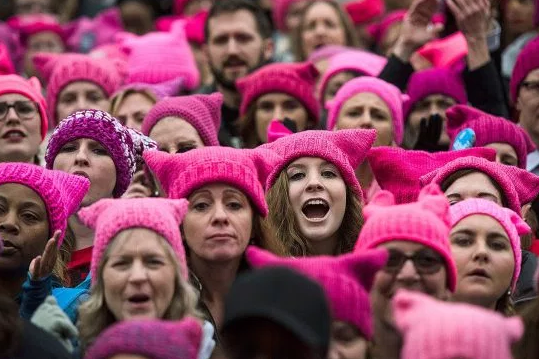
I found out there’s going to be another Women’s March by – you guessed it – going to a yarn store and finding there’d been a run on pink yarn. Even better, there are going to be a ton of Women’s Marches in a ton of cities.
Get knitting, folks! And mark your calendars for Saturday, January 20, 2018.
There’s never been a better time for this, I’m sorry to say. And if you don’t know what I mean, listen to this Takeaway episode on John Hockenberry’s systematic sexual harassment and abuse of his female colleagues of color, who he systematically pushed out of senior positions on the show:
Bloomberg View
My newest Bloomberg piece is out, in which I consider the problem of false negatives in the context of love and war:
You can see all of my Bloomberg View pieces here.
Book Club!
I also wanted to announce that my Occupy group Alt Banking is starting a book club. We’re meeting this Sunday from 2-3pm at Columbia (room 409 of the International Affairs Building at Amsterdam and 118th), and we’re discussing the introductions and first chapters of the two following books:
Please join us, we welcome everyone and anyone!
My newest Bloomberg View piece just came out this morning:
Looking back I just realized that I never posted last week’s Bloomberg View column:
For a complete list of my Bloomberg View articles, go here.
Well it’s been a bit more than 3 months since my gastric sleeve surgery and I wanted to give an update.
Clothes
I finished cleaning out my closet yesterday. All my old clothes are gone. I’m ashamed of just how many clothes I had to get rid of. I’ve gone from a size 24 to a size 18, and as I mentioned in an earlier post, I’ve decided to go goth.
That means my closet has basically only black clothes in it now. I made a handful of exceptions for stuff I didn’t throw out that was way too small for me 3 months ago, knitted things, and some workout clothes that are not black.
Going goth has been lots of fun, and deciding in advance what to buy has been a time saver as well as efficient. Since everything is black, everything goes with everything else. And since I’m vaguely looking for a certain type of clothing in a specific color, it means I can narrow down my shopping goals quite quickly. I can’t imagine what it would be like to have no rules and start buying a new wardrobe.
The only downside is that it’s kind of boring. But I think that will change once we enter winter and I can wear colorful scarves and hats, that are guaranteed to go with my black outfits. Also, I’m not sure what black summer dresses will be like. I might need a different rule for summer things. Suggestions welcome.
Food
As I mentioned in a previous post, I have more or less changed my entire eating style since the surgery. I rarely eat meat, although I sometimes eat sashimi (especially salmon). I tend to avoid desserts because I don’t have a sweet tooth at all, and things that seemed bland to me before taste rich to me now, which means I don’t seek out buttery things anymore, since olive oil is already buttery to me.
I more or less live off of a quinoa recipe I learned about in college, which is spicy, savory, and somewhat cheesy:
I think the most important difference in my eating now versus before the surgery is how hunger works with me. I still get hungry, but it’s of a totally different nature than it used to be.
So before, if I got hungry, it was like a loud panic button in my brain had been set off. I had to eat, and I’d scavenge the fridge for something to turn off the noise. Nowadays, I realize I’m getting hungry, but it simply means that I have to start thinking about food pretty soon. I have time, for example, to cook quinoa as described above, even though it takes at least an hour.
One positive consequence: I have more time to think
One negative consequence: I can never, ever, ever overeat. I have never really tried to do this, and so I’ve never thrown up or anything, but trust me, I’ve gotten uncomfortable. It’s not something you want to do regularly. It makes you regret your choices.
Exercise
I’ve started running. For the first time in maybe 12 years, I’m regularly jogging. And when I say jogging, to be clear I’m incredibly slow and I don’t go far – it’s fair to say that speed walkers would easily overtake me – but it’s something I couldn’t have done 3 months ago so that’s cool.
But it’s also necessary. I have lots of anxiety, and I need to let out steam somehow. I’m trying my best to make that healthy rather than unhealthy.
Why am I so anxious? I don’t know. It’s hard being a parent to teenagers. It’s hard being a woman in this age of misogyny. It’s hard being a human in this age of political cruelty.
I don’t want to become an alcoholic. I’ve noticed that, since my operation, alcohol works really really well. It hits me hard, it makes me forget my problems, it takes me on a fast ride. It also ends soon and I don’t end up with a hangover. What’s not to love? Except I have plenty of reasons to know better.
Moreover, I have lost food as a source of comfort. To be honest, I don’t think I ever had a disordered way of eating (except for the doctor-approved diets I went on!) but I did know how to comfort myself with food. And before you blame my obesity on that, let me suggest that thin people comfort themselves with food all the time but aren’t accused of bad behavior.
That’s not to say I don’t love my quinoa – I do! – or that I don’t like running – I do! – but that it’s more like an outlet to deal with anxiety and grief than I’d like it to be.
Long story short, I’m doing great, and I feel healthy, and the world still is what it is.
I was on WBUR’s Open Source with Christopher Lydon – a show I regularly listened to when I lived in Somerville – last night discussing Max Tegmark’s new book, Life 3.0. Other guests were Erik Brynjolfsson and Yarden Katz. Here’s the episode:
I’m very happy with an essay that just came out this morning with Boston Review, on futurism:
Also, my newest Bloomberg View column came out this morning, about how we’re having the wrong conversation about personal data:
For the rest of my Bloomberg View columns, go here.
My latest Bloomberg View article is out. I interviewed Michal Kosinski, gaydar algorithm author, about the ethical responsibilities of data scientists:
Read my other Bloomberg View columns here.
The paperback edition of my book just came out last week, so I’ve been on a tear with interviews, and I’m also doing two public events in New York City in the next week. I wanted to tell you about it in case you have time to come!
My latest Bloomberg View column is out, in which I try to imagine an internet optimized for citizens rather than consumers:
For other columns, take a look here.
I have a new and disgusting if useful way of thinking about weight loss. You’re welcome in advance.
A couple of weeks into the starvation diet and right after my surgery, I complained to my husband that all my weight loss – something like 20 pounds or so at the time – had been taken out of my boobs. I was sad to see them go, I told him. Why couldn’t the weight loss happen elsewhere?!
He demurred. You should look at yourself as a container – most likely a bag – of liquid, he said, much like a plastic container of milk. After all, we’re almost entirely made up of liquid. So, thinking that way, and considering that a whole gallon of milk weighs 8 pounds or so, you’ve lost more than two gallons of milk, which means that your weight loss most definitely hasn’t entirely come from your boobs. Because, after all, they didn’t start out as big as gallons of milk, nor are they entirely gone.
This explanation was foolproof but left me with a queazy feeling which has since only grown.
As of my last weighing, which close readers of my blog will know happened at my doctor’s office last week and not my home, since I threw away my scale, I’ve lost 43 pounds and counting. That’s about 5 gallons of milk, friends. And it’s definitely not exclusively coming out of my sad, baggy boobs.
Indeed I have a new theory about how one loses fat, and it’s called my “sponge theory of fat loss.”
Namely, I think every fat cell in my body is losing weight at the same rate. That’s not to say, of course, that all parts of my body are losing weight at the same rate, since my fat cells accumulate in certain areas like hips, butt, and stomach (and until recently, boobs). Although it has to be said that my shoes have been seeming to grow bigger, which is mysterious. I never thought of my feet as at all fat.
Now, the reason I call it the sponge theory is that, as my voluminous thighs lose weight, they get increasingly spongey. That is, if you squeeze them, you feel like you’re maybe wringing out a sponge. This isn’t necessarily a bad sensation, but it’s definitely weird. It’s basically a loss of density just as much, or more than, a loss of volume.
But I do think the overall loss of volume is catching up in intensity. My skin is excessive for my needs, if you catch my drift. And that’s not going away.
I’ll tell you a secret. When I was young, like maybe 39 or 40, I went on a low carb diet. To be more precise: I decided to eat stuff my friend Laura ate. I modeled myself after her. She’s tiny, and eats well, and loves food, and so I thought, why not give that a try? I lived for months on healthy food like nuts, vegetables, fruit, lentils, and cheese.
It was a good life, and I lost quite a bit of weight. I never got to the point I am now, but I did get close. And you know what happened next? I saw my boobs disappearing, and my skin get excessive for my needs, and I freaked out. I ate a bagel. A single, delicious, still-warm-from-the-oven cinnamon raisin Absolute Bagel with cream cheese. It was delicious, my friends, and it broke me. Somehow I could never look back.
I now have a theory about that, too, because why not, an overactive mind. My theory is that I’d managed to develop a “skinny biome” in my stomach due to the hard work of adjusting to the Laura diet, but that it was precarious for whatever reason, and that bagel tipped my over into a fat person’s biome once again.
To clarify:
Long story short, in the past 7 years I’ve tried to come to terms with what major weight loss would do to my skin. I haven’t, yet. By night I have nightmares that yards and yards of my own excess skin smother me in my sleep. By day I feel guilty for the implicit ageism of my fears. I want to be someone who loves every inch of herself, even the extra skin.
This is what I want to say to people who congratulate me for losing a ton of weight, starting now and ending never: Please don’t equate thin with beautiful. I liked my body so much more when I was fat, when I looked like an enormous buddha, full and round. I didn’t do this to look better, I did it to be healthier, to bike in the summer and to avoid diabetes. I’m hoping to eventually find a way to love my body in spite of how it looks, but it’s a monumental challenge.
Statistically speaking I’m expected to lose quite a few more gallons of milk before stabilizing. I’m scared. I’ve decided to give it a few years of adjustment before turning to surgical means of dealing with excess skin, which would be expensive, dangerous, and a blow to my identity as someone who can adjust to things and rise above issues of vanity.
Wish me luck.
My newest Bloomberg View column just came out:
For older columns, click here.
So, I’m learning to eat again. Like a newborn child perhaps, but worse, since I have all sorts of memories of how much I can eat and what I like to eat that are misleading. A Bayesian prior that I can’t easily shake.
Pescatarian
For example, once I was cleared to eat ground meat, I made myself a pot of beef chili, which is something I’ve always loved to eat. I knew I could only eat a bit of it at a time, but I figured that was fine, since I’d share it with other people. But the truth is, I couldn’t eat it at all. I tried one tiny bowl of it and it felt like a million tons in my stomach.
That’s been the way it is for me, with pretty much all meat, including chicken. I can’t seem to eat meat and feel good afterwards.
By contrast, I can eat fish. To be more precise, sashimi. I’ve really enjoyed salmon sashimi. And tofu. I’ve been pretty much addicted to tofu. Anything Thai, and the lighter the sauce the better.
Traveling
Traveling while learning to eat sucks. I went away with my kids for a few days to West Springfield, MA. Talk about a food desert. The best restaurant we went to was Bertucci’s, followed by IHOP, followed by Friendly’s. Not an exaggeration. And since I’m not eating pasta or doughy bread, Bertucci’s was tough. And since I don’t want to eat sweet things, IHOP was basically impossible. And since I don’t digest fried things, Friendly’s was awful.
Out of desperation, I google searched “good healthy food near me” and it came up with two results: Dunkin Donuts and a martini bar.
Basically I lived off of the cheese I brought with me for the trip. I now kind of understand why rich people pay so much to vacation in fancy places with healthy food. I would have paid good money for avocado toast.
As a side note, I’ve never been more aware of how most of America eats. The food available in places like this is unhealthy, addictive, and omnipresent. Not to mention very, very cheap. Which is to say, there is a systemic problem we will have to face sooner or later when it comes to health.
Throwing the Rulebook Out the Window
I think I mentioned before that the instructions I’ve received from the surgeon’s office – specifically, from the nutritionist – have been hard to follow, in part because they’re extra strict to make allowances for the fact that they assume practically everyone cheats. That’s not a theory, I asked. And since I’m actually trying to be compliant, that makes it kind of ridiculous.
For example, the instructions tell you to eat meat with mayonnaise so that it will go down easier. But they also tell you not to ever eat something with more than 25% fat in a meal. That’s hard to do, so the conclusion is to mix up your meat with diet mayonnaise to force it down.
I mean, yuck. Who wants to force down chunks of chicken or beef with diet mayonnaise? I’d rather never eat meat in the first place.
More generally, though, I once again think the entire causal relationship has been misunderstood.
It’s easy enough to do as a nutritionist: if you notice that people who eat high fat foods don’t lose as much weight as people who eat lean foods, it’s natural to tell everyone to eat lean foods. But that doesn’t mean such advice will be heeded or will work.
My perspective is that I’ve thrown the dice on this surgery, and it has changed my hormones, and my stomach biome, and my tastes will change, and I might end up being one of those people who both desire and consume lean foods. And if I’m lucky, and I end up wanting to eat lean foods, this surgery will have been a success. But I cannot make it a success with sheer force of will.
You see, I also like my cheese, and sometimes my entire “meal” (still the size of a snack) consists of eating cheese, and I’m sure it’s more than 25% fat, but I’m not planning to replace it with diet cheese. Instead, I’m happy to report, other meals all I want is fruit, or salad, and they’ll have to balance stuff out.
Long story short, I’m ending up relatively noncompliant, after all. The only things I’m being super careful about are my vitamin patches and my protein intake, which seem important.
I don’t know how this will all end up, but I do know that I value delicious and satisfying food, and I’d rather be listening to my body and eating good food than ignoring my body and eating plastic.
I wrote a new Bloomberg View column about some of the tools to fight bad algorithms:
Take a look at my older Bloomberg View columns here.
This is a guest post by Becky Jaffe.
One way to disarm the dangerous ideology of white supremacy is to teach and learn Black history inside and outside of the classroom. Here is a personal list I compiled from my own collection of books and documentaries I would like to share with you. I have arranged the order of the titles into a poem in homage to these freedom writers. The first version of the poem omits the authors, while the second version includes authors and clickable links for more information on each title and author.
Please add your own inspirational thinkers in the comments below. Let us not give an ideological inch to the white nationalists in the white house.
A Black History Curriculum in Poem Form:
Kindred
Roots
Country of My Skull
Things Fall Apart
How Europe Underdeveloped Africa
Cry, The Beloved Country
An African Elegy
Americanah
Life Upon These Shores
To Be a Slave
To Kill a Mockingbird
My Bondage and My Freedom
Black Skin, White Masks
Their Eyes Were Watching God
The Half Has Never Been Told
Tales of Tenderness and Power
The Poisonwood Bible
Incidents in the Life of a Slave Girl
Weep Not, Child
I Know Why the Caged Bird Sings
Parting the Waters
Up From Slavery
Native Son
Invisible Man
Hidden Figures
Ain’t I a Woman?
I Am Not Your Negro
Between the World and Me
Eyes on the Prize
You Must Set Forth At Dawn
Long Walk to Freedom
Long Night’s Journey Into Day
Homegoing
The Audacity of Hope
Naming Our Destiny
Astonishing the Gods
I, Too, Am America
A Raisin in the Sun
The Souls of Black Folk
Unbowed
Beloved
Don’t Let’s Go to the Dogs Tonight
We Are the Ones We Have Been Waiting For
Anything We Love Can Be Saved
—
Here is the same poem with the authors included and clickable links for each title:
Kindred by Octavia Butler
Roots by Alex Haley
Country of My Skull by Antje Krog
Things Fall Apart by Chinua Achebe
How Europe Underdeveloped Africa by Walter Rodney
Cry, The Beloved Country by Alan Paton
An African Elegy by Ben Okri
Americanah by Chimamanda Ngozi Adichi
Life Upon These Shores by Henry Louis Gates, Jr.
To Be a Slave by Julius Lester
To Kill a Mockingbird by Harper Lee
My Bondage and My Freedom by Frederick Douglass
Black Skin, White Masks by Frantz Fanon
Their Eyes Were Watching God by Zora Neale Hurston
The Half Has Never Been Told by Edward E. Baptist
Tales of Tenderness and Power by Bessie Head
The Poisonwood Bible by Barbara Kingsolver
Incidents in the Life of a Slave Girl by Harriet Ann Jacobs
Weep Not, Child by Ngugi Wa Thiong’o
I Know Why the Caged Bird Sings by Maya Angelou
Parting the Waters by Taylor Branch
Up From Slavery by Booker T. Washington
Native Son by Richard Wright
Invisible Man by Ralph Ellison
Hidden Figures by Margot Lee Shetterly
Ain’t I a Woman? By Sojourner Truth
I Am Not Your Negro – James Baldwin documentary
Between the World and Me by Ta-Nehisi Coates
Eyes on the Prize documentary
You Must Set Forth At Dawn by Wole Soyinka
Long Walk to Freedom by Nelson Mandela
Long Night’s Journey Into Day – documentary
Homegoing by Yaa Gyasi
The Audacity of Hope by Barack Obama
Naming Our Destiny by June Jordan
Astonishing the Gods by Ben Okri
I, Too, Am America by Langston Hughes
A Raisin in the Sun by Lorraine Hansberry
The Souls of Black Folk by W.E.B. Du Bois
Unbowed by Wangari Maathai
Beloved by Toni Morrison
Don’t Let’s Go to the Dogs Tonight by Alexandra Fuller
We Are the Ones We Have Been Waiting For by Alice Walker
Anything We Love Can Be Saved by Alice Walker
It went up this morning, I hope you like it:
Hello, friends! I’m here to give you an update on my recovery from bariatric surgery.
Swimming and biking
I’ve been cleared to swim and bike and take baths, and I’ve been swimming and biking – mostly biking and taking baths – every day since I got the news, which was on Tuesday. A small bummer: I’m really out of shape compared to where I once was, and it’s hard work. It doesn’t help that the weather, except for Wednesday, has been insanely moist and humid, exaggerating my sweatiness and making my gasping helplessly for breath all the more sad and pathetic.
Fuck it though, I’ll do it anyway! I feel very grateful for having the freedom and energy to do this stuff at all, and it will only get better as long as I keep at it.
Scales
I got deeply depressed yesterday morning. Partly it was the awful horrible weather, partly the political situation of the country, but partly it was something that made me feel awful that I did to myself: I weighed myself.
Now, and I know many of you will relate, I haven’t weighed myself regularly for maybe 23 years, and for good reason: it didn’t matter, it made me crazy, and my mental health was better without it. That’s not to say I didn’t get weighed every now and then; I did, especially when I was pregnant, and it was fine because it was a medical requirement and didn’t seem to bother me, probably because somebody else did it to me.
But, and here’s the naive part of the story, I convinced myself and my husband that I might be able to weigh myself once a week to sort of understand the effects of the bariatric surgery on my body. I had somehow framed it to myself as a scientific lark, ignoring the heaps of evidence that I had accumulated 23 years before that it was a really terrible idea. I thought I was mature enough to handle it now.
Long story short, I weighed myself once a week starting a few weeks ago. At least I was smart enough not to weigh myself every day.
As an aside, my husband loves weighing himself and does so 5 times a day or more. He doesn’t mind when it goes up. He’s endlessly fascinated by how he weighs 4 pounds more at certain times than at others. He’s most assuredly in a different relationship to scales than I am, or probably than any woman I know. Even my friends who are skinny have problems with scales, for various reasons. AmIright?
And it was fine! It really seemed fine. One day last week I decided to nerd out for a bit, so I built a predictive curve of my weight loss based on the information I’d been told by the doctor and my research, plotting out what I could expect to lose each week for a year, and getting to almost exactly the expected overall weight loss I’d been told was appropriate for my height and beginning weight.
And then, yesterday morning, Friday, I weighed myself. And I came in 1 pound more than “expected” based on this totally made up, unscientific graph I had built from nothing. And at some level I was like, 1 pound is the difference between a poop and not a poop, so whatever, I didn’t poop yet today. But at another level I turned immediately into my 14-year-old self, blaming and shaming myself for behaving badly (even though I’d done nothing wrong). It was fucking crazy.
To calm myself down, I made the next fatal error, which was to go onto the chat boards (mostly old) about weight loss after bariatric surgery. For whatever reason – mostly selection bias – these chat boards are populated exclusively by people who are actually insane.
Either someone’s saying they eat 500 calories a day, exercise constantly, but still weigh 300 pounds, and asking if there’s another surgery that will cure them, or it’s someone saying they “jumpstarted” a loss of yet another 10 pounds with the simple trick of drinking only protein shakes for two weeks, or it’s someone asking how to “jumpstart” their weight loss once again, and on and on and on. If you removed the words “bariatric” from these chats, they’d be indistinguishable from those famous websites that exchange tricks on anorexia.
Then, my friends, something shook me out of my stupor, and it was that Steve Bannon was fired. It was the energy I needed. I stood up from my seat, walked over to my scale, and threw it the fuck away.
After all, I didn’t have this surgery to lose weight, I had this surgery to be healthy. And that’s not something you can measure on a scale, or even once a week. It’s a long term thing, and the scale was seriously getting in my way. And shit, I’ll know I’ve lost weight when my pants fall off.
One more thing. I’m an idiot for letting myself get sucked into this weight loss perspective, but it’s really not my fault. In my defense, the people at the surgeon’s office are obsessed with my weight loss, and are constantly trying to get me to name a “goal weight” as if that will help me achieve something. It won’t.
We live in a fucked up world, people. There are lots of things that we have no control over and that suck. Then there are things that we do have control over and that suck. My new motto is, if it’s something in the latter category, throw it the fuck away.
I wrote a piece for Bloomberg View this week, here’s how it starts:
We’re having the wrong conversation about women in tech. We need to decouple two very different issues that have arisen amid the commotion about diversity at Google: biological differences between genders, and bias against females working in tech and more generally in well-paid, prestigious jobs.
For the whole article, go here.
For all of my Bloomberg View posts, go here.
This is a guest post by Michael J. Barany, a postdoc in History at Dartmouth.
One year ago, I wrote a post for the Scientific American Guest Blog arguing against the widespread truism that mathematics is everywhere. The post laid out the history of mathematics as a special and exclusive kind of knowledge wielded by privileged elites. I claimed that the idea that math is everywhere not only gets the history wrong, but also misrepresents how mathematics matters most in most people’s lives, and may be a misguided premise on which to build a more inclusive and responsible discipline. If we start by recognizing the bias and exclusion that affect who gets to use advanced mathematics to intervene in the world, we might get better at responding to those biases while empowering the vast majority in the mathematical non-elite to hold the mathematical elite accountable for the great power they are privileged to wield.
While I received a lot of private responses from people who found the post convincing or clarifying, most of the public reaction represented sharp, sometimes visceral opposition to one or more of my claims. I want to revisit some of those responses here in light of a variety of developments from the past year that I think underscore my argument. The initial responses to my Scientific American post show some of the blindspots and hazards that continue to mark public discourse about mathematics, even from those sincerely committed to rectifying the discipline’s historical inequities. This past year has shown, time and again, that math still isn’t everywhere, and that this matters to everyone.
I wrote my original essay primarily for the mathematics educators, popularizers, and researchers who seem to make the bulk of public claims that “math is everywhere,” as well as for their many different audiences interested in mathematics education and policy. Since I framed my argument historically, however, an important secondary audience came from those who study, share, and read the history of math and science. Their responses bear notice, in part for the contrasts they offer compared to responses from those more vested in the mathematical present.
Specialists on more recent history recognized the essay as a faithful popularization of what recent scholarship on modern science convincingly shows: that math and science are thoroughly political, and that claims to universality are often a misleading means of sidestepping those politics. I received more skeptical responses, however, from some scholars of early periods, especially of the Scientific Revolution. Utrecht University’s Viktor Blasjo got the point of the essay while disagreeing with the interpretation I advanced, calling it a “Po-Mo … party line social constructivist narrative.” (This made Blasjo the second person I know of from 2016 to call my interpretations postmodern as a pejorative. At least my approach is transparent!) If that characterization doesn’t mean much to you, take it simply as an indication of the intensity of interpretive disagreements historians can have while more or less agreeing on the relevant facts.
Other responses showed less careful engagement and less acknowledgement of the grounds for disagreement among historians. A short email with the subject “oh dear” from the University of York’s Anniversary Professor of History, David Wootton, informed me that he suspected I had not read his recent book, which “rather disqualifie[d]” me from opining on the Scientific Revolution. He admitted in a followup email that he had not read my essay, but thought a discussion of it he encountered online seemed “to betray a rather woful [sic] ignorance” that his book would have rectified. The online discussion in question was more substantive than Wootton’s curious irruption of condescension and self-promotion, but reflected a similar dismissive attitude. It began with an extended rebuttal to several points from my essay by math history blogger Thony Christie, who opened by admitting that he was “not really interested in the substantial argument of the article” (a claim Wootton also made to me by email) but rather felt obliged to object to what he saw as historical errors “made worse by the fact that the author is a historian of mathematics.” Since my essay pointed to several places where mathematics was used to claim exclusive authority, and to other places where there were important criticisms of mathematics for precisely that reason, Christie questioned exactly how exclusive mathematics actually was and defended the importance of mathematics in spite of those criticisms. You can decide for yourself from the ensuing back-and-forth what to make of Christie’s objections (I think they only tend to reinforce my argument), but for our purposes here the most significant point was that Christie and Wootton felt comfortable ignoring the stakes and implications of the history of elitism and exclusion in mathematics, as though these were independent of how we understand that history and what we make of it today.
For readers with a stake in today’s mathematics, the response was almost the opposite (and I think a lot more interesting): they tended to grant the historical claims about mathematics and focused almost exclusively on the implications. Two of the more thoughtful and generous responses of this sort came from mathematicians Steven Strogatz and Anna Haensch, on Twitter and the American Mathematical Society Blog on Math Blogs, respectively. Both suggested that we should distinguish the questions of where math is and who is able to use it. This inclination to separate math from its users and creators, I think, gets to the heart of the matter, and was one of my primary reasons for writing the original essay. Haensch argued that “Math is everywhere just as much as anything is everywhere,” that is, that you can find math wherever you look. This view, according to Haensch, “is exactly the antidote” to arguments that dismiss the importance of learning mathematics because of questions like “when will I ever use this?”
Here, Haensch helpfully linked two of the most common kinds of responses to the essay that often appeared less constructively in isolation. The first had to do with what we mean when we say math is everywhere, which in large part is a question about what we mean by math itself. Is math a fundamental latent aspect of the natural world? A basic human capacity for understanding things numerically or logically? An infinitely adaptable tool that modern societies have developed to understand and intervene in the world? A system of training and professionalization that equips certain individuals with specific abstract means of solving problems, and a specific kind of authority that comes with them? How important is it to distinguish basic math from advanced math? Numeracy from algorithms? Dynamical systems from category theory? Is something mathematical if it can in principle be described using mathematics, or just if it is in practice engaged through math?
The second kind of response had to do with the stakes of saying math is everywhere. If math should be more open and inclusive, and more people learning and appreciating math is a good thing, then what do such claims about math accomplish toward that goal? Are there other goals we should have for mathematics that such claims also affect? As many responses put it: does saying math is not everywhere devalue the discipline and make it harder to understand, appreciate, and share? By linking together these two kinds of responses–about what math is, and what is at stake in the answer–Haensch underscored the crucial and fundamental fact that these questions are always implicated in each other: the philosophy of mathematics is political, and the politics of mathematics are philosophical.
Those who claim mathematics is everywhere choose to emphasize what mathematics can be in principle. As Haensch and many others noted, I used Jordan Ellenberg (whose work to share mathematics I greatly respect and admire, for the record) as an example of a mathematician who emphasizes all the places math can reach in order to encourage his audience to appreciate the breadth and power of mathematical thinking. This is not, as many interpreted it, a philosophical claim about the nature of mathematics. Rather (and this is why Haensch’s framing matters), it is primarily a political and pedagogical claim that the best way to understand math (whether or not you’re a mathematician) is as something that is potentially everywhere. And that is what those who expressed either of the two just-considered responses in isolation seemed to miss: that “math is not everywhere” is also at root a political and pedagogical claim, premised on the lessons and legacies of the history of mathematics that most such responses set to the side. Instead of focusing on what math can do in principle, history’s lessons are about what math has been in practice, and this shift in perspective can be as important as the historical episodes themselves.
Which brings us to the most fiery response I received on Twitter, from mathematician Ed Frenkel, whose book Love and Math begins by depicting mathematics as hidden all around us in our daily lives. Frenkel later told me that this was his first real experience of an extended dispute on Twitter, and he would probably have approached it differently in retrospect. Out of respect for this sentiment, I am here focusing on the substance of the exchange rather than the sometimes hyperbolic terms in which it played out. Twitterer @abhinav_shresth distilled one relatively sanitized thread, and a search for both of our Twitter handles shows the parts of the back-and-forth that Frenkel did not delete.
The exchange started after Frenkel shared a link to Haensch’s article, calling it “A good riposte” to my “incoherent ramblings,” and I responded with disappointment that, unlike Haensch, Frenkel seemed to dismiss my essay without taking its claims seriously. It turned out that once Frenkel spelled out his beliefs we had a lot of common ground. We agreed that math is currently and historically elitist and that this is a problem, especially given the huge (and seemingly growing) role mathematics has in contemporary society. Frenkel argued that the solution is for everyone to be empowered by learning more math, to have “equal access” (in his words), and the way to encourage that was to show that math is everywhere. As we have already seen, this claim is both political and pedagogical. Frenkel asserted that the best way to understand the power of mathematics in society is to see it as potentially everywhere, and the best way to give people purchase on that power is to show examples (even mundane ones that are more tractable than the complex mathematics through which that power is often exercised) of mathematics hidden all around us.
By placing the emphasis on how mathematics isn’t everywhere, I claimed that history gave us a different lesson. Politically, I think that it is better to focus on the areas where mathematics does have a profound effect on people’s lives, at the expense of the kinds of tractable examples that are often used to popularize math. This requires sacrificing the expectation that such lessons will always be mathematically tractable, since by their nature these kinds of mathematics are difficult and exclusive, often inaccessible to all but the narrow subset of mathematical professionals who specialize in those specific theories and applications. We should instead seek political, ethical, and other related kinds of understanding about these kinds of mathematics, which would allow more people (however much or little mathematics they know) to hold mathematical elites responsible. Pedagogically, I questioned whether stressing the ubiquity of mathematics was the best motivation. If instead we started by emphasizing that math is and has historically been an alienating and exclusive kind of knowledge (indeed, has often been so by design), then those who have felt alienated or excluded from mathematics need not blame themselves for failing to grasp the mathematics that is supposedly all around them, and mathematics educators (as well as theorists) could prioritize inclusive formulations of their subjects.
A number of developments in the last year have driven home the inadequacy of just trying to convince more people to learn more math as a response to elitism and exclusion in the discipline. News stories abound of malign uses of algorithms and other mathematical technologies for encryption, surveillance, and analysis. During my exchange with Frenkel, one interlocutor called attention to the imminent launch of Cathy O’Neil’s Weapons of Math Destruction book. Indeed, among the book’s many strengths is O’Neil’s way of explaining complex mathematical issues in a way that combines mathematical, political, ethical, and other kinds of understanding. O’Neil used these explanations to argue that the public needs to recognize and appreciate the many specific areas where mathematical models and algorithms affected their lives and society, but that this understanding was not enough. Those who wielded difficult mathematical tools also have a responsibility to use them ethically, and to seek the kinds of mathematical and non-mathematical knowledge that will help them do so.
Amidst the martial analogies associated with O’Neil’s title, there was a striking parallel in both Frenkel’s public writing and a number of reviews of O’Neil’s book to debates about a more common kind of weapon. Back in 2013, Frenkel called for “the 21st century version of the Second Amendment” giving everyone the right “to possess mathematical knowledge and tools needed to protect us from arbitrary decisions by the powerful few in the increasingly math-driven world.” Reviewers of Weapons of Math Destruction, meanwhile, seemed to rush to declare the innocence of mathematics while decrying only those who misuse it out of ignorance or malice. That is: math doesn’t kill people, people misusing math do. And, paraphrasing Frenkel: the only way to stop a bad guy with math is a good guy with math. Decades of policy debates have taught us the dangerous fallacy of these claims when applied to guns instead of mathematics. In a provocative Twitter exchange with mathematician Gizem Karaali, I explored whether the same lessons apply to for math, too. We did not come to a clear conclusion, but the discussion emphasized the importance of asking about responsibility, safety-minded training, and contextual understanding for mathematics education and policy. It also underscored that mathematics, like guns and gun control, is an emotional topic with deep-seated cultural valences that policy-makers ignore at their peril.
If this year has made clear the stakes and power of mathematics in our society, for good and bad, the year has also driven home the range of factors beyond just talent and interest that shape who can wield mathematical power. The end of 2016 saw the theatrical release of the film Hidden Figures, based on Margot Lee Shetterly’s book about African-American women computers at NASA. The film and book were the subject of an especially well-attended panel at the 2017 Joint Mathematics Meetings, and drew attention to how racism and sexism have limited access to advanced mathematical education and careers, while also limiting recognition for those who made major contributions despite those barriers.
The problem is not confined to the past. Shortly after the 2017 JMM, a team of mathematicians launched the excellent and timely Inclusion/Exclusion Blog under the auspices of the American Mathematical Society. Since last February, contributors to that blog have chronicled a wide range of barriers to diversity and access for underrepresented groups in mathematics, as well as a wide range of initiatives aimed at rectifying persistent inequities. These initiatives have often been focused on building professional networks, offering recognition and support, and otherwise promoting mathematicians at an individual and institutional level. Few, as far as I can tell, hinged on the premise that math was everywhere (whether in principle or in practice); most started instead with the unequal realities the discipline currently faces. Contributors have asked tough questions about how to respond to the social and structural conditions that keep mathematics unequal. That linked example was by Piper Harron, who has elsewhere (including on this blog) powerfully analyzed the links between social and structural exclusion and our ideas, assumptions, and approaches to mathematics itself.
The August issue of the Notices of the American Mathematical Society featured a pair of articles on recent political developments in the United States and their affect on the international mathematics community. Another article in the same issue announced a Global Math Project whose aim is to “foster a global conversation about joyous mathematics,” a goal very much in line with the “math is everywhere” approach to access and inclusion: get people excited about math, and inclusion will follow. The juxtaposition with discussions of the U.S. Travel Ban strikingly underscored how access to the mathematical elite is as deeply political as ever, with barriers that require attention to mathematics as a specific and place-delimited discipline rather than a limitless fount of potential joy. While global educational projects can certainly do a lot of good, it is telling that the organizers of this particular project seemed to take for granted that the fundamental problem for mathematics across the globe is “a perception issue,” that it is insufficiently appealing.
There is a potent hope embedded in that kind of thinking. Even if math is and always has been elitist and exclusive, the reasoning goes, it is also (and always has been) available to everyone in principle. The theorems of geometry and the sequence of primes don’t care about where you’re from or the color of your skin. Here, the claim that math can be found everywhere goes hand in glove with the claim that it can be found by everyone. By emphasizing the apparent all-encompassing neutrality of mathematics itself, one might hope, we can see that the only real barriers are the ones we make ourselves and we can resolve to move beyond those barriers individually and collectively. That is, to return to the theme raised by Haensch and Strogatz, by separating math from its users we can aspire to make the user-based practice of math more like math’s universal principles. If we start with “math is everywhere” then we can work toward “math is for everyone” so that any individual has potential ownership of the subject.
I think this gets things backwards. It is precisely because math can’t be separated from its practice and its place in society that, in a meaningful sense, the theorems of geometry do care and have always cared who you are. This is all the more true for math that reaches farther and more powerfully into our lives–the secret mathematics of finance, surveillance, literal weapons and figurative ones–all these kinds of math are guarded and inaccessible by means of an indissociable mix of technical and social barriers. History tells us this isn’t a bug; it’s a feature. It is fundamental to math’s place in the world that it is not open to everyone. But, conversely, the mathematical elite is made collectively, and societies do get to shape who has access to math and what we expect of them. If we start with “math isn’t everywhere,” we are better equipped to see math as embedded in larger social structures of our own making, and, I’d suggest, we are better equipped to reshape those structures for the better.
I may have erred by concluding my Scientific American essay with the implication that “there is much work to be done” so that math might “belong to everyone equally.” There is definitely much work to be done, but that work is premised on the unavoidable reality that math cannot belong to everyone equally, that power does not obey utopian principles. Rather, such inequality creates ethical, political, and pedagogical imperatives, and these latter challenges are what demand constant work and attention. The most misleading aspect of the claim that math is everywhere is its timeless formulation, set apart from movement and change, of opportunities for structural reform. “Math isn’t everywhere” risks that same timeless implication. But math and society alike are always changing, always open to new expectations and understandings. Instead of looking to static universal principles, we might find a more productive kind of inspiration from a recognition more rooted in time and place: math still isn’t everywhere.


 mathbabe