Unreliable Data Can Threaten Democracy
My newest Bloomberg Column about politically driven data finagling:
Unreliable Data Can Threaten Democracy
Also, you can see all my Bloomberg columns here.
100 Day Blanket
I’m a bit behind with posting my latest gargantuan knitting project. I call it the 100 Day Blanket because I bought the yarn on the day after the election in an effort to counterbalance my wildly unbalanced thoughts and emotions, and I finished it 100 days after the inauguration. It was a very successful coping mechanism for anxiety.
Given that it has 144 squares in it, and that there were about 10 weeks in between the election and inauguration, that means I knitted nearly one square on average. Actually it took me a couple of weeks to gather the courage to put it all together so I’d say I really did just continuously knit for a while there.
Because, dude, that’s a lot of nervous energy. I should also mention that I knitted numerous pussy hats and other smaller projects during that same period. Serious question, what do non-knitters do to deal with their anxiety?
Without further ado, the 100 Day Blanket:

Please don’t look too carefully at our messy side tables.
Here’s a glamour shot:

And a couple of shots of putting it together:

This took place at our friends’ ‘Happy House’ upstate.

One quarter at a time!
The VAM Might Finally be Dead
My latest Bloomberg View column, probably my favorite so far:
Don’t Grade Teachers With a Bad Algorithm
I’d Rather Not Merge With Robots, Thank You
My newest column in Bloomberg View, in which I argue that Yuval Harari is putting us all on:
I’d Rather Not Merge With Robots, Thank You
Anonymous Guest Post: Mentorship Problems for Women in Tech
This is an anonymous guest post.
Mentorship is important in any field. In the tech industry, it is essential. In tech, one’s network is key for learning about the existence of smaller startups, where the financial upside is often higher than at big companies due to stock grants. For a culture that emphasizes meritocracy so heavily, tech is much more of a who-is-who than I ever realized before moving out to the Bay Area as an engineer last year. Not only that, but it is especially difficult to access this network as a woman. I believe that the informal culture of tech, in which professional and social mix to an extent that it is unclear whether an interaction is professional or romantic, harms women in finding mentorship. Ultimately, those with real power and influence in Silicon Valley are in a network of their own.
I learned this firsthand when I met with my first Very Important Person (VIP). This VIP invited me to meet at The Battery, described on its website as a “unique sort of social destination” featuring “an eager, inquisitive bunch, always curious, always on the hunt for new ideas and problems to solve…Here is where they came to refill their cups. To tell stories. To swap ideas. To eschew status but enjoy the company of those they respected. Here is where they came to feel at home on an evening out.” For an easy annual payment of $2400.
I was initially surprised when this VIP decided to meet with me, given how difficult I had found it to get face time with anyone. I was even more surprised when he talked at me for nearly an hour (ignoring my pre-prepared questions), until his next meeting – a tall blonde girl – arrived. Being just out of college and naive, I thought nothing of it, though he did reference how he “just wanted to get laid in college” during our meeting – until the emails and texts started coming. Over the course of the next month, I received email after email from this person, to all three of my email addresses which he somehow got, and later to my cell phone, saying “wanted to see me again” among other things. I will never be 100 percent sure about his intent. At the same time, why on earth would a VIP be so interested in seeing me again?
Whatever his intent, I am confident that it wasn’t mentorship. Despite my having prepared specific questions for our meeting that I wanted advice on, he instead talked at me for the full hour. I think that was the most upsetting piece of it for me. I wanted mentorship, and instead ended up getting weird emails and texts.
I am not the only one of my friends with a Battery story. I’ve been told that there is a secret bar behind the regular bar, which is where things get really weird.
This VIP is certainly an outlier. Only a small fraction of men have creepy intent. And yet, I am sure that plenty of white men aged 35 to 50 (the “older generation” by tech standards that I am trying to access) probably don’t want to talk to me for precisely that reason. Getting coffee with a young woman can look like a date even if it is not, and men in positions of power are especially wary of sexual harassment allegations.
I believe that the informal culture of hoodies and happy hours makes it more difficult for women to access mentorship. A college classmate who works in politics remarked that senior people in politics are more willing to chat with her, sometimes for hours. The informal culture of tech, in which men frequently grab a drink with a male mentor but often do not feel comfortable doing the same with a woman, means that it is difficult for women to get access. At least in politics, it is more clear whether a mentor is inappropriately hitting on you in a professional setting, because that setting is clearly professional.
What about senior female mentors? I have pursued this strategy as well with some limited success, but feel that there are simply not enough senior women to go around for this to be a viable solution. Attrition rates, coupled with the fact that this industry was far more hostile to women 10+ years ago, means that senior women are few and far between, as well as stretched thin. It is essential to connect with mentors of all genders.
I am enormously grateful to those who have provided me with mentorship, including peers just a year or two above me who have helped fill in some of the gaps. That being said, I feel that as long as succeeding in tech involves being well-connected in a way that women and minorities in tech are not, diversity in the industry will stall. The past year has felt more like The Social Network than I ever could have imagined – creepy but well-connected mentors, hiring decisions made over drinks, and all.
Simpson’s Paradox Comes to Facebook
Here’s my newest Bloomberg View column, about female engineers at Facebook and Simpson’s Paradox:
Is Facebook Tough on Women? Let’s Check the Data
Justice Needs Nerds
This is a guest post by Phil Goff, the inaugural Franklin A. Thomas Professor in Policing Equity at John Jay College of Criminal Justice. He is the co-founder and president of the Center for Policing Equity, and an expert in contemporary forms of racial bias and discrimination, as well as the intersections of race and gender.
On November 9, 2016, the world of police accountability shifted dramatically. Though the Movement for Black Lives and local engagement in police reform did not end, the drastic change to the political landscape left many who supported those fights in shock. And as the first 100 days of the new Administration are now behind us, the ways in which this Administration has already changed the trajectory of criminal justice reform and other aligned civil liberties is discouraging. From the appointment of Jeff Sessions to Attorney General to his order to review existing DOJ grants, investigations, and consent decrees, many are expecting both an evaporating role of federal government in police accountability and an expanding role for it in immigration and surveillance activities that run antithetical to public safety and fairness.
The retreat from principles of safety and justice hurts me, too. But I don’t despair. That’s at least in part because I’m a professional JusticeNerd™ (in addition to being one in my spare time). My job is to build more and better protections for civil rights through science. So, while the picture at the federal level is not inspiring, the rest of the landscape is. Specifically, recent commitments from philanthropy and tech giants like Google bring the promise of accountability through data metrics closer than it was before the election. Here’s what I mean:
When the crisis of public trust in police began, we had no national data on police behavior. Nothing on stops. Nothing on use of force. Nothing on policies. Nothing on officer psychological profiles. Nothing. And without metrics, the job of holding police accountable is nigh impossible.
But unbeknownst to many, police chiefs were already organizing to fix that. Yes. Police chiefs. At a conference my organization, the Center for Policing Equity (CPE), co-hosted with DOJ, representatives from 36 of the largest police departments called for a national database where stops and use of force could be standardized, compared, and mined for insights about racial disparities. They wanted answers to their questions about how “bad” their disparities were—and what they could do to fix them. As a result, CPE won a million-dollar grant from the National Science Foundation, and we began constructing the National Justice Database (NJD), the first and still the largest standardized database of police officer behavior. The NJD also collects data on officer psychological orientations (including implicit bias), providing a unique opportunity to study the roots of racial disparities in policing.
But the database was not ready when the crisis hit. We were still putting together the infrastructure. Still adding departments. So, when the crisis hit, first in Ferguson, then in Baltimore, New York, Minneapolis, Baton Rouge, and Charlotte, we had fewer answers than questions. Still, like the JusticeNerds™ we are, we persisted.
The past 5 years have been labor intensive, with data extraction, cleaning, standardization, and analysis taking months for each department. With those months of effort came valuable insights about the right metrics to use for identifying racial disparities that were rooted in broader racial inequality (e.g., employment, education, or housing disparities) as opposed to police policies, psychologies, or behaviors. The metrics represent the ability to hold police accountable to the values of equality we should all share. And, with voluntary commitments from departments that cover around one-third of the United States by population—with so much enthusiasm among police and communities—I was already optimistic about where things were headed.
Then, recently, Google came into the picture, and my optimism soared. Along with a $5 million commitment, Google did what we most needed: pledged to help us automate the processes of data extraction, cleaning, standardization, and analysis. This means that the months-long slog of putting a report together for each department is likely to turn into a matter of hours or days. And that means that there will no longer be any reasonable excuse for a department who collects data on any of these factors to say they don’t know what they mean.
What CPE—and the field—needs now are analysts. Lots and lots of analysts. And we, at least, are hiring DataNerds who want to be JusticeNerds™. With departments now coming in by the state-load, we are inundated with confidential data that needs to be interrogated so that we can answer some of the most fundamental questions in policing like: what economic conditions predict racial disparities in police stops? When does housing segregation most influence police activity? And, how do race and gender intersect in predicting police use of force?
Doing this work is exciting. It’s energizing. And, most importantly, it staves off the temptation to despair when it seems that progress is in retreat. So, even if policing isn’t your thing, my goal in writing this is to encourage folks to consider being a professional JusticeNerd™, regardless (in addition to being a nerd in your spare time). Because my hope is that the JusticeNerds™ who have not yet connected to this work professionally have also not given up on it. I hope that as more folks who feel passionately about social justice—and geek out over data architecture and social science—think about how they want to make their money, that they will work to find employment at the intersections of tech and justice. Or that they will create those opportunities.
Our country needs professional JusticeNerds™, and we are in short supply. My colleagues at the Vera Institute, Measures for Justice, the PICO Network, the National Network for Safe Communities, PolicyLink, Urban Institute, the Police Foundation, as well as at CPE are almost constantly in need of a diverse array of the most creative and committed folks. Folks who may have felt dispirited, but who are willing to fight despair as a vocation. So, if you feel like I’ve been talking directly to you (or to someone you know), you’re probably right. And if you are looking to make your passions your fulltime gig, please do. The whole field is hiring. And the whole country needs us to.
How the Robot Apocalypse Will Go Down
People, I need to tell you all about the TED experience from last week. I promise it will happen soon.
In the meantime check out my latest Bloomberg View column:
How the Robot Apocalypse Will Go Down
United Airlines Exposes Our Twisted Idea of Dignity
My latest post on Bloomberg View:
United Airlines Exposes Our Twisted Idea of Dignity
Also last Friday I wrote an old-fashioned philosophical essay:
What If We Could Upload Books to Our Brains?
Does Capitalism shrink inequality?
In today’s Bloomberg View column, I debate Noah Smith over one of his previous columns in which he claims that capitalism shrinks inequality. I don’t think the facts are on his side:
Debating Whether Capitalism Shrinks Inequality
President Bannon and Big Data Juries #Resist
I’m super happy to say that, according to the New York Times, Bannon was demoted yesterday in part because the President Bannon/ #PostcardToBannon campaign – which I wrote about back in February – really got under Trump’s skin. From the article:

Obviously Bannon hasn’t been kicked out of the White House, but I think we can all agree this is a step in the right direction.
Also, my newest Bloomberg View column is out, where I describe the idea behind Big Data jury selection and decide against it:
Big Data Won’t Make Juries Better
March for Science Knitwear #Resist
My buddy Brian Conrad alerted me yesterday to a very welcome three-way intersection:
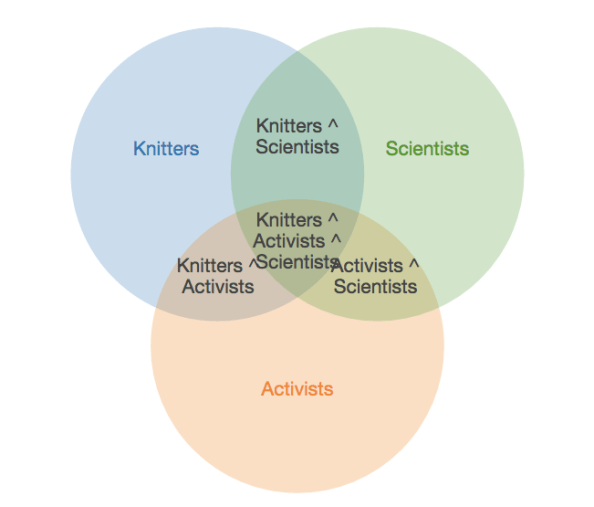
Graphics courtesy of meta-chart.com
So, anyone surprised? I’m not. But I am excited. Here’s what we’ve got on Ravelry:
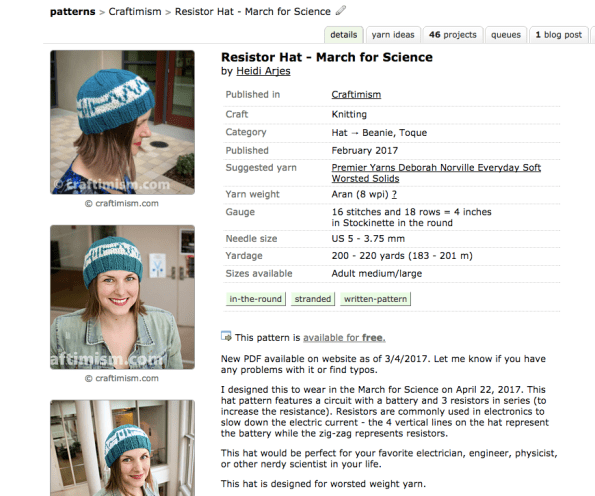
You can get the pattern for free here, and you can read and article about the concept here.
But, there’s more! Because knitting nerd activists are endlessly creative, we have the following generalizations on the above idea:

Combination pussy hat and resistor hat
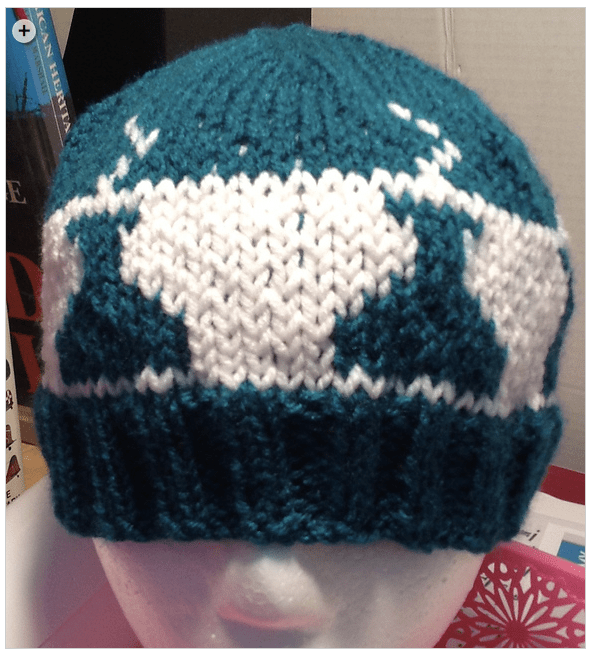
Chemistry hat
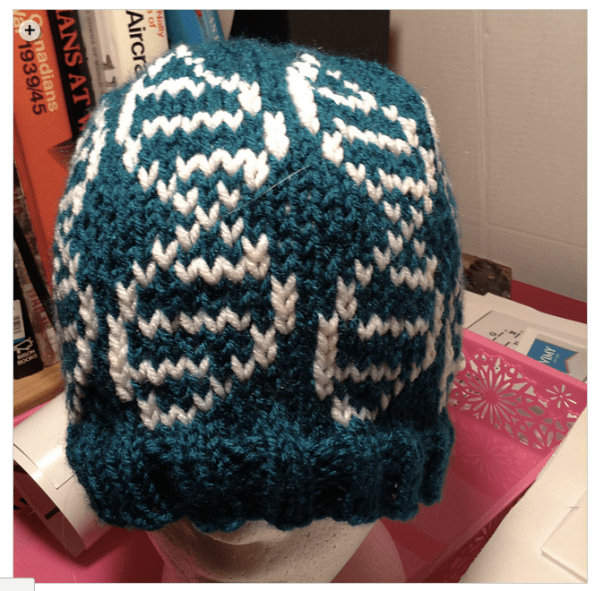
DNA helix hat
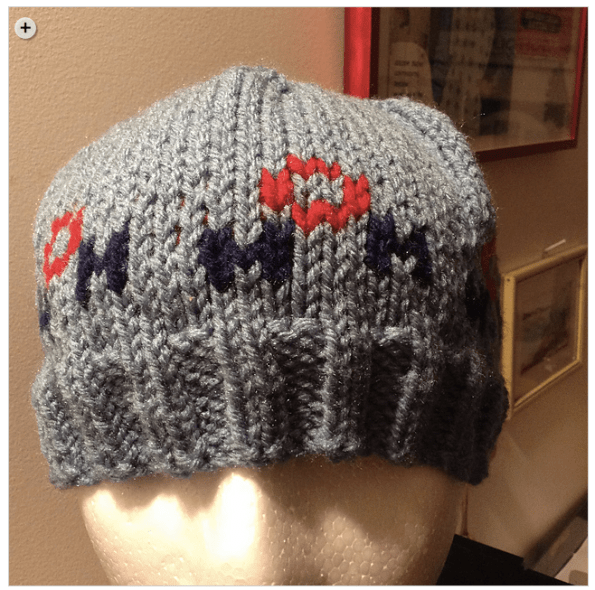
Water molecule hat
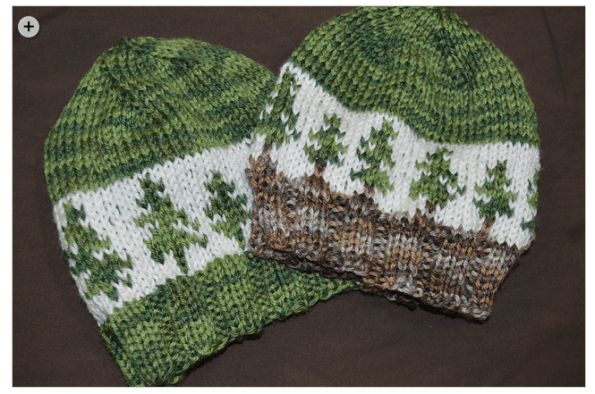
March for Trees hat
Amazing!
All patterns available here.
Guest post: Make Your Browsing Noiszy
This is a guest post by Angela Grammatas, a digital analytics consultant specializing in worldwide implementations of online analytics tools. She loves powerful data, but doesn’t love having artificial intelligence use it in creepy ways. She also has synesthesia and paints numbers (Instgram @angelagrammatas).
This week, the US Congress voted to allow ISPs (Internet Service Providers) to collect and sell your internet data without your consent. Erasing your web data – or not allowing any to be collected in the first place – is getting more difficult, and less effective. Hiding from data collection isn’t working.
It’s time for a completely different approach. Instead of restricting our data, it’s time to create more – a lot more. A flood of meaningless data could create a noisy cover that makes our true behavior hard to understand. This could be a path to bursting the filter bubble, one person at a time. And if enough people participate, we could collectively render some datasets completely meaningless.
Why should we care about where our data goes?
Organizations rely on data to “target” users online and serve them relevant (read, “more likely to be clicked”) advertisements. Plenty of targeting is innocuous and can be genuinely helpful. For example, getting a sale offer on a recently-viewed product can be a win-win; the company makes a sale, and the customer is happy about the discount. Targeting (and re-targeting) makes that possible.
But when the pool of data gets larger and more integrated, the implications change. For example: let’s imagine that “Jane Internet” loves cats, and visits cats.com daily. One day, she’s considering how to vote on a local proposition, and she does some research by visiting two political news sites at opposite ends of the spectrum. She reads a relevant article on each site, getting a balanced view of the issue. Let’s imagine that the “Yes on Prop A” campaign has access to retargeting capabilities that utilize that large, blended dataset. Soon, Jane starts to see “Vote Yes on Prop A” advertisements on many unrelated websites, with the message that Prop A will be great for local wildlife.
Jane has no way of knowing this, but that pro-wildlife message has been chosen specifically for her, because of her past visits to cats.com. The ads are everywhere online (for Jane), so Jane believes that this message is a primary “Yes on A” talking point, and she’s encouraged to vote in agreement. The “No on A” campaign never has any opportunity to discuss or debate the point. They may not even know that the cats-related topic has been raised, because they’ve never even been exposed to it – that message is reserved for retargeting campaigns directed at people like Jane. Jane’s attempt to be a well-informed voter has been usurped by retargeting. And, perhaps most importantly, Jane doesn’t even know this has happened.
How could meaningless data help?
Jane was targeted because of her visits to cats.com, and the (reasonable) assumption that cats.com visitors are animal lovers. What if she’d spent just as much time visiting sites related to other topics – desserts.com, running.com, and supportthelibrary.com? Many organizations want to access potential customers who are interested in desserts, running, and libraries. If Jane was visiting all of those sites, she’d be seeing a variety of targeted messages, exposing her to different points of view while also decreasing the impact of any single message. Jane would start to break out of the “filter bubble” created by targeted ads. In that case, Jane may not see any ads related to Prop A – or she might see ads that address the issue from a variety of perspectives. For Jane, the playing field would be leveled again.
But if Janes all over the country also began to visit a much wider variety of sites, they could level the playing field for everyone. Targeting algorithms that identify “people like Jane” look for similarities in web browsing behavior, and assume that these people will have similar ad-clicking behavior. If the dataset becomes more randomized, those correlations will be weaker, and even when similar groups are identified, they won’t result in as many clicks – driving the cost of the ads up, and reducing the incentive to retarget.
The reality, of course, is that Jane doesn’t have the time or inclination to spend hours clicking random links online just to create her own personal meaningless dataset. That’s why I created Noiszy (http://noiszy.com), a free browser plugin that runs in the background on Jane’s computer (or yours!) and creates real-but-meaningless web data – digital “noise.” It visits and navigates around websites from within the user’s browser, leaving your misleading digital footprints wherever it goes.
When organizations lose the ability to “figure us out” from our browsing data, they’ll have to work harder to build products and content that people willingly engage and share data with, rather than simply chasing clicks and impressions. Could “fake data” lead to the end of “fake news”? Targeting algorithms are happily churning away on our data, pushing whatever messages the highest bidder wants us to see, and we have no obvious way to feed back into the cycle. Meaningless data can help us hack this system, and bring about a conversation we deeply need to have: how should algorithms be (re)built for the greatest good?
TomTown Ramblers playing this Sunday!
Please join us if you can!

How to Manage Our Algorithmic Overlords
My latest piece in Bloomberg View just came out:
How to Manage Our Algorithmic Overlords
Guest Post: In Praise of Globes
This is a guest post by Ernie Davis Professor of Computer Science at NYU. Ernie has a BS in Math from MIT (1977) and a PhD in Computer Science from Yale (1984). He does research in artificial intelligence, knowledge representation, and automated commonsense reasoning. He and his father, Philip Davis, are editors of Mathematics, Substance and Surmise: Views on the Ontology and Meaning of Mathematics, published by Springer.
Any government which genuinely cared about education would see to it that a globe map, at present an expensive rarity, was accessible to every school child.
— George Orwell, “As I Please” February 11, 1944
The decision by the Boston school system to replace maps of the world using the Mercator projection with maps using the Gall-Peters projection has garnered a lot of favorable press from outlets such as NPR, The Guardian, Newsweek, and many others.
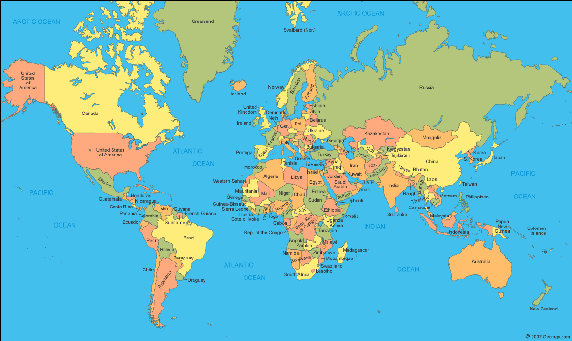
Mercator map of the world.
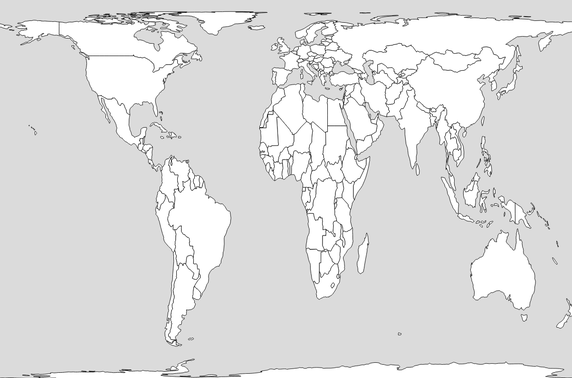
Gall-Peters map of the world.
The pros and cons of these two maps have been debated extensively for many years; there was even an episode of West Wing that dealt with the subject. I would give the current collection of news articles a B for clarity and accuracy. If you read the Guardian article carefully from beginning to end, you can get a clear idea of the issues. But if you only skim the beginning, then phrases like “more accurate map”, and “amend[ing] 500 of distortion” are likely to leave you with the impressions, first, that the Gall-Peters map is indisputably more accurate, and, second, that the Mercator map was devised as an expression of Eurocentrism, neither of which is correct.
I hope that that is not what the students in Boston are being taught about the two maps. Still more, I hope that they are not being taught that these two maps are two competing theories about the geography of the world and that choosing between them is all a matter of your point of view and your political preferences, and that there is no actual truth of the matter. I wish I felt more confident of that.
The well-known truth is this: The Gall-Peters map accurately displays relative area, whereas the Mercator map grossly distorts relative area. However, the Mercator map accurately displays shapes and direction, whereas the Gall-Peters maps substantially distorts those. Each has their strengths and weaknesses.
As an illustration, consider Suriname and Iceland. Both are roughly squarish countries. Suriname’s area is 161,470 square km; it has an east-west span of about 460 km and an almost equal north-south span. Iceland is smaller; it has an area of 102,775 square km; its east-west span is about 390 km and its north-south span is about 300 km (these spans were hand-measured from a map and are not precise).
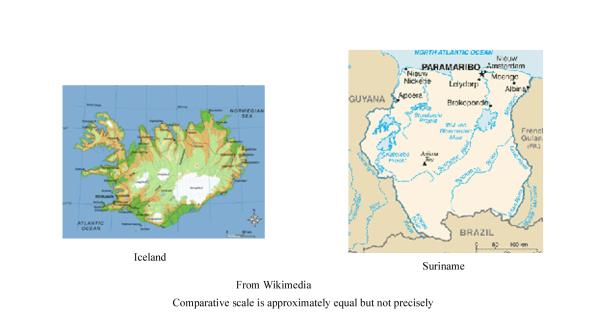
If you take the Gall-Peters map of the world and cut out the maps of Suriname and Iceland, then the relative areas will be correct; Suriname will be about 1.6 times as large as Iceland. However, both will have bad distortion in the aspect ratio in opposite direction; the north-south span Suriname will appear substantially larger than its east-west span; and the north-south span of Iceland will appear very much smaller than its east-west span. Both of these are terrible maps of their individual countries. If you are used to looking at maps of Iceland and then look at Iceland on the Gall-Peters map, it will look seriously wrong, for good reason.
On the other hand, if you take a Mercator map of the world and cut out the maps of Suriname and Iceland, then each one by itself is exactly the right shape; each is a fine map of its individual country. However, Iceland will be 3 times the area of Suriname instead of 2/3 the area.
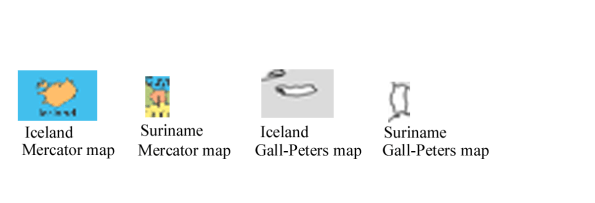
The explanation of both of these distortions is simple. At the equator, the 460 km east-west span of Suriname corresponds to 4 degrees of longitude. At 64 degrees latitude, the 390 km east-west span of Iceland corresponds to 9 degrees of longitude. However, on both the Gall-Peters map and the Mercator map draw parallels of longitude as vertical lines, so Iceland ends up measuring 2-1/2 times as wide as Suriname on both maps; and, generally, an east-west mile in Iceland is displayed about 2-1/2 times as long as one in Suriname. The two maps adjust the north-south scale in opposite ways, depending on their different purposes. The Gall-Peters map, to preserve the area relation, must make a north-south mile in Suriname 2-1/2 times as long as one in Iceland; it does this, partly by stretching Suriname north-south and partly by shrinking Iceland north-south. The Mercator map, to preserve shape, must keep the ratio of the north-south mile to east-west mile always equal to 1; therefore, a north-south mile in Iceland is also 2-1/2 times as long as a north-south mile in Suriname.
There are other kinds of area-preserving maps besides Gall-Peters, and there are other kinds of shape-preserving maps besides Mercator. And there are many other kinds of maps; this article by Max Galka surveys the Miller, Winkel-Triple, and the Authagraph, which gets his vote. (The Authagraph is quite accurate as regards the land masses; the distortion gets pushed off onto the oceans, so the relative positions of the continents is bizarre.) However, there is absolutely no planar map of the world that can succeed in being both shape preserving and area preserving. There is just no way to perfectly flatten out the surface of a sphere.
§
Most educational debates do not have any final, ideal answer. What should be taught in literature, in history, in science, even in math, are matters of eternal debate, with no possible final resolution that is uncontentious, or apolitical, or value-free. However, this question of the proper way to display the geography of the earth is an exception. The obvious, perfect solution is — drumroll — a globe. A globe is an (essentially) perfect scale model of the geography of the earth, with no distortion of any kind. A child or adult who gets used to consulting a globe on questions of large scale geography, can get an exactly right idea of relative sizes and shapes and relative positions. (They should also have a good atlas, for small-scale geography).
As quoted above, George Orwell said that in 1944 globes were an “expensive rarity”. Presumably in 1944, getting globes to schoolchildren was not the top priority of the British government. But now they are really not expensive. You can get an inexpensive 6-inch globe for $10. You can get a good 11-inch globe for $30. I do find it surprising that none of the articles I’ve seen about the choice of maps even mentions this, best, option.
Of course if you have a globe for reference then it becomes enormously easier to explain how the Mercator, Gall-Peters, and other flat maps work, and what they get right and wrong.
In addition to its huge value in teaching geography, there are all kinds of cool things you can do and teach with a globe, particularly if you take it out of its stand:
- Great circle. You can easily illustrate the great circle path from any point to any other point by stretching a string between them and pulling it tight. No possible planar map correctly represents large scale geodesics.
- Seasons. Apparently a surprisingly large fraction even of college educated people think that the earth is closer to the sun in summer and further in winter. A globe makes it easier to illustrate both that the days are longer and that the light is more direct in the summer than in the winter. You also easily explain the significance of the poles, the equators, and of the polar and tropical circles.
- Astronomy of the earth and the moon. With a second, smaller ball, you can illustrate the interaction of the earth and the moon, and explain things like eclipses. (In fact, you can make a scale model; if you have an 11 inch globe for the earth, then the moon is a 3 inch ball, about 23 feet away.)
- Other celestial astronomy. With some additional props, you can show how the appearance of the night sky changes with latitude and with the time of year. You can explain why latitude has always been easy to determine, whereas the determination of longitude on board ship was one of the major problems for eighteenth century science. You can explain the significance of the ecliptic and the zodiac and the precession of the equinoxes.
- Geometry. Purely from the standpoint of teaching geometry, a globe has the amazing property of being a sphere on which there are thousands of easily identifiable points with memorable names. So an enterprising high school math teacher with good students can use it as a source of examples for an introduction to spherical geometry and thus non-Euclidean geometry. You can also illustrate three-dimensional rotations and the fact that they don’t commute. The original meaning of “geometry”, after all, is “measuring the earth.”
At the minimum, hopefully, early and extensive exposure to globes will deter students from growing up to believe that the earth is flat.
Guest post: the age of algorithms
Artie has kindly allowed me to post his thoughtful email to me regarding my NYU conversation with Julia Angwin last month.
This is a guest post by Arthur Doskow, who is currently retired but remains interested in the application and overapplication of mathematical and data oriented techniques in business and society. Artie has a BS in Math and an MS that is technically in Urban Engineering, but the coursework was mostly in Operations Research. He spent the largest part of my professional life working for a large telco (that need not be named) on protocols, interconnection testing and network security. He is a co-inventor on several patents. He also volunteers as a tutor.
Dear Dr. O’Neil and Ms. Angwin,
I had the pleasure of watching the livestream of your discussion at NYU on February 15. I wanted to offer a few thoughts. I’ll try to be brief.
- Algorithms are difficult, and the ones that were discussed were being asked to make difficult decisions. Although it was not discussed, it would be a mistake to assume a priori that there is an effective mechanized and quantitative process by which good decisions can be made with regard to any particular matter. If someone cannot describe in detail how they would evaluate a teacher, or make a credit decision or a hiring decision or a parole decision, then it’s hard to imagine how they would devise an algorithm that would reliably perform the function in their stead. While it seems intuitively obvious that there are better teachers and worse teachers, reformed convicts and likely recidivist criminals and other similar distinctions, it is not (or should not be) equally obvious that the location of an individual on these continua can be reliably determined by quantitative methods. Reliance on a quantitative decision methodology essentially replaces a (perhaps arbitrary) individual bias with what may be a reliable and consistent algorithmic bias. Whether or not that represents an improvement must be assessed on a situation by situation basis.
- Beyond this stark “solvability” issue, of course, are the issues of how to set objectives for how an algorithm should perform (this was discussed with respect to the possible performance objectives of a parole evaluation system) and the devising, validating and implementing of a prospective system. This is a significant and demanding set of activities for any organization, but the alternative of procuring an outsourced “black box” solution requires, at the least, an understanding and an assessment of how these issues were addressed.
- If an organization is considering outsourcing an algorithmic decision system, the RFP process offers them an invaluable opportunity to learn and assess how a proposed system is designed and how it will work – What inputs does it use? How does its decision engine operate? How has it been validated? How will it cover certain test cases? Where has it been used? To what effect? Etc. Organizations that do not take advantage of an RFP process to ask these detailed questions and demand thorough and responsive answers have only themselves to blame.
- While a developers’ code of ethics is certainly a good thing, the development, marketing and support of a proposed solution is a shared task for which all members of the team must share responsibility – coders, system designers and specifiers, testers, marketers, trainers, support staff, executives. There is no single point of responsibility that can guarantee either a correct or an ethical implementation. Perhaps, in the same way that a CEO must personally sign off on all financial filings, the CEO of a company offering an evaluative system should be required to sign off on the legality, effectiveness and accuracy of claims made regarding the system.
- Software contracts are notoriously developer-friendly, basically absolving the developer of all possible consequences arising out of the use of their product. This needs to change, particularly in the case of systems sold as “black box” solutions to a purchaser’s needs, and contracts should be negotiated in which the developer retains significant responsibility and liability.
- As I think was pointed out, there is a broad range of analysis and modeling techniques, ranging from expert systems that seek to encode human knowledge, to heuristic learning system such as neural nets. While heuristic systems have the potential to ferret out non-intuitive relationships, their results obviously require a much higher degree of scrutiny. Part of me wonders how IBM and Watson would do at developing decision systems.
- Extensive testing and analysis should be required before any system “goes live”. It is disappointing to hear that “algorithm auditing” does not seem to be a thriving business, and, depending on the definition of “algorithm auditing”, I may be suggesting even more. Perhaps “algorithm testing” would be a more attractive sounding service name. Beyond requiring an analytical assessment of underlying data requirements and assessment algorithms, systems should be tested using an extensive set of test cases. Test cases should be assessed in advance by other (e.g., human expert) means, and system results should be examined for plausibility and for sanity. Another set of test cases should assess performance with extreme (e.g., best case, worst case) scenarios to check for system sanity. Another possibility is “side by side” testing, in which the system will “shadow” the current implementation, either concurrently or in retrospect and the results will be compared.
- Psychological and other pre-employment tests, described in Weapons of Math Destruction, are problematic in two ways. First is whether it is appropriate to conduct them at all, and second is whether they are effective in their stated purpose (i.e., to select the best prospective employees, or those best matched to the position in question). Certainly, competency testing is an appropriate part of candidate selection, but whether psychological characteristics are a component of competency is arguable, at best. At the very least, however, such testing should be assessed as to whether it predicts what it claims to predict, and whether that characteristic is emblematic of work effectiveness. How to conduct such testing would require some creativity. Testing could be conducted on an “incoming class” of employees, whether prior to hiring, or after hiring with the test results being sequestered (neither reported to company management nor used in any evaluation process). After some period (1 – 2 years), the qualitative measures of employee performance and effectiveness could be compared to the sequestered test results and examined for correlation. Another possibility would be to identify a disinterested company with employees performing similar work. (By disinterested, I mean disinterested in using the evaluative test in question.) Employees of that company could be asked to undergo “risk free” testing, with results again being sequestered from their employer. The quantitative test results could then be compared to the qualitative measures of employee performance and effectiveness used by that employer. Whatever one thinks of such testing, as Weapons of Math Destruction correctly points out, to the extent to which it is used, efforts should be made to test and improve its efficacy. To the extent that such testing is promoted by an outside party, that party should be ready, willing and able to demonstrate observed effectiveness.
- An interesting alternative to a proprietary black box system would be what might be called a meta-system, a configurable engine which would allow its procurer to specify the inputs, weightings and the manner in which they are used to formulate a decision, perhaps offering a drag and drop software interface to specify the decision algorithm. Such a system would leave the fundamentals of the decision algorithm design to the purchasing company, but simply facilitate its implementation.
- One must always be cautious the possibility of inherent bias in data. As a simple example, recidivism is most easily estimated by the proportion of released convicts who are re-arrested. But if recidivism is actually defined by the percentage of released convicts who return to criminal life, then the estimate is likely skewed in several ways. Some recidivists will be caught; others will not. For example, some types of crime are more heavily investigated than others, leading to higher re-arrest rates. Further, even among perpetrators of the same crime, investigation and enforcement may well be targeted more to some areas than to others.
- As was pointed out during the discussion, being fair, being humane may cost money. And this is the real issue with many algorithms. In economists’ terms, the inhumanity associated with an algorithm could be referred to as an externality. Optimization has its origins with the solutions to problem in the inanimate world, how to inspect mass produced parts for flaws, how to cut a board to obtain the most salable pieces of lumber, how to minimize the lengths of circuit traces on a PC board. There were problems that touched on human behavior, scheduling issues, or traveling salesman type problems, but not to the extent that they ignored humane considerations. We are now to the point where we have human beings being compared to poisonous Skittles, and where life altering decisions of great import (hiring, firing parole, assessment, scheduling, etc.) are being subjected to optimization processes, often of questionable validity, which objectify people, view them as resources or threats, and give little or no consideration to the very human consequences of their deployment. Assuming that your good work can drive to this consensus, there is a fork in the road as to how it can be addressed. One way would be to attempt to implement humane costs, benefits and constraints into the models being deployed and optimize on that basis. The other is to stand back and monitor applications for their human costs and attempt to address them iteratively. Or, as Yogi said, you can come to the fork and take it.
Dystopian Bloomberg Posts: Price Discrimination and Snap
This is just out on Bloomberg:
The Dystopian Future of Price Discrimination
And this came out Monday:
Snap Needs to Get Inside Your Head
We don’t know why we’re all so fat
One of the most ridiculous aspects of the “blame the individual” approach to obesity is the overall trend of fatness throughout the country and the world over the past few decades.
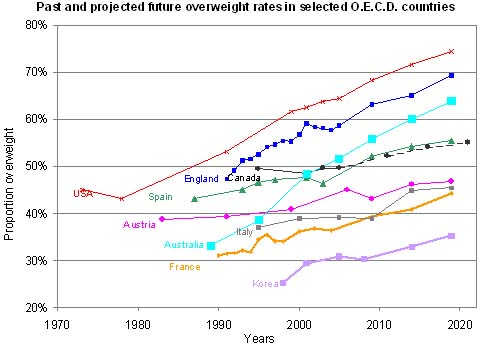
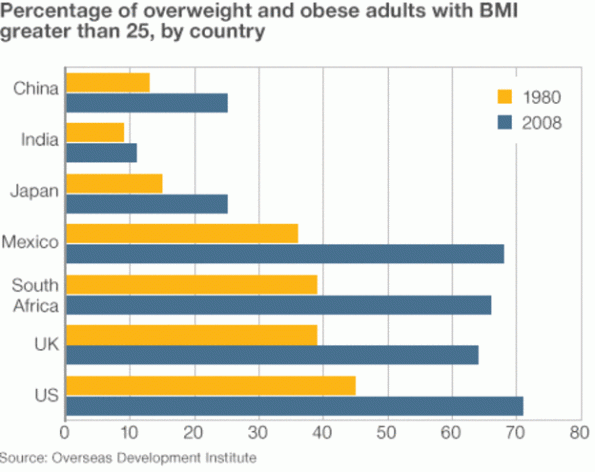
The rates of obesity have skyrocketed and we simply don’t know why. Here are a few reasons that are consistently trotted out:
- People have become lazy. (Actually this one’s easy. In fact we’re getting more exercise and it doesn’t seem to help. And for that matter, exercise doesn’t make you lose weight.)
- We’re eating too much fast food.
- We’re drinking too much soda and generally eating too much sugar.
- We’re watching too much TV/ playing too many video games.
- There are too many food options constantly surrounding us.
- Our portion sizes are too big.
- We’re just eating too much of everything. In some sense this is a tautology. The question is why.
- Glyphosates in our grains are making us fat.
- Our internal stomach biomes are messed up and make us fat.
- Bad genetics make us fat. This one’s easy too, since our gene pool hasn’t changed that much recently.
- Dieting itself makes us fat.
So, there are tons of reasons, and I’m sure I missed some. The tricky thing is, all of them sound plausible, and none of them are likely the single answer. Likely it’s a combination of a bunch of them.
But the truth is, we don’t know. And people hate not knowing stuff, so they pretend they know. That’s not helpful. We need to be scientists and try testing out hypotheses.
The biggest problem with testing the above hypotheses is that many of them are hard to avoid environmental factors of modern life. You can take the soda machine away from a high school but then the kids will just buy soda at the nearby corner store.
Until we’ve figured it out, I’d like us to admit I don’t know why we’re all so fat. And I’d like us to stop blaming individuals, especially children.
How to think statistically (about dieting)
There are lots of ways to get statistical thinking wrong, not so many ways to get it right. Here’s a series of examples from wrong to right:
- I did this, and it’s not a “diet,” it’s a lifestyle change, and it works for me!
- I know people who live or interact with the world in a certain way, and it seems to work for them! After all, French women are thin. We should all do what they do.
- There was a study of volunteers, and for the people who stayed in the study to the end, they lost weight doing such and such lifestyle change!
- There was a study of volunteers, and they tracked people down who tried to leave the study, and the average weight gain was still real, among the people they found!
- There was a study of doctors giving advice or enrolling people in programs to help overweight people lose weight, and 97% of people lost no weight and plenty of people gained weight, maybe even more than half.
What I’d love is for people to understand how much difference there is between a personal experience (1) and advice we’d have on public health (5).
Here’s the golden standard: if you can come up with something to tell Medicare about how to have a population of morbidly obese people become a population of regular weight people, then you win. Otherwise, if you’re tempted to tell me about a lifestyle change that worked for you, please don’t, because that’s not statistical.
Also, I’d like a word about the theory that with enough discipline and willpower, anyone can lose weight. I think it’s fair to say I have discipline and willpower. In fact, I’m a fucking poster child for them. I wrote a Ph.D. as one of few women in a male-dominated field. I wrote a book or two. I’ve had three kids and I’ve never struck one of them in anger. In fact I’m pretty nice to people most of the time, even though I’m relatively often filled with rage at the unfairness of the world. That’s hard. It takes willpower.
I even ran a sprint triathlon at 275 pounds, really fast, which took months of ridiculous training. Also, I know all about healthy habits, I don’t eat “emotionally,” just when I’m hungry, and I love brussel sprouts and other healthy foods. I just get really fucking hungry, often.
Readers, I’m the fucking center of the disciple in willpower universe over here.
Given all of that, if anything I’d argue my willpower is one reason I’m so heavy. When I was 22 or so, I went on a fat-free diet, on the advice of my doctor, that fucked me up; I lost 30 pounds but then gained something like 75. I think I messed up my insulin resistance. In fact I believe that also happened to me on my first starvation diet when I was 14.
I’m guessing I’d be thinner if I’d had less willpower, in other words. I wouldn’t be better off, though, because I kind of like my books and my Ph.D. and my kids who don’t fear their parents.
Anyway, from now on let’s talk statistically, shall we?


 mathbabe