Archive
Towards a better financial system
This is a guest post by H.R., a risk management quant:
First, let’s clear the ground for new ideas by questioning the myths that have justified the current system.
Myth 1: The wisdom of the free market is the answer to everything (if only we could get rid of market frictions like regulations and taxes).
Evidence against:
- Behavioral finance has empirically demonstrated a wealth of cognitive biases that distort the market.
- An Indian perspective on the effects of the liberalization of their economy.
- When it comes to their own welfare, the 1% have abandoned the free market in favor of the predator nanny state.
Myth 2: The work of the 1% is indispensable.
Evidence against:
- Empirically, pumping resources to the “job creators” does not seem to be very effective.
- Most of the 1% are not even “job creators”.
- And the marginal value of those that are is questionable.
Myth 3: The unemployed exist because they don’t have the right skills or attitude.
Evidence against:
- Bill Mitchell argues that with the current lack of jobs, “skills training” and similar efforts may shuffle around who gets the jobs, but won’t solve the unemployment problem.
- Economist DeLong concedes that maybe Kalecki had a point about unemployment as a means of lowering wage earners bargaining power.
Myth 4: The government can never compete with the private sector.
Evidence against:
US health care is ridiculously uncompetitive compared to other countries nationalized systems.
Myth 5: We have to choose efficiency over inequality.
Evidence against: Chris Dillow makes the argument that
- better managed government can’t simultaneously deliver us maximum efficiency and equality, and
- there are good arguments for choosing equality over efficiency.
Myth 6: We are constrained by budget deficits.
Some basic ideas from Modern Monetary Theory would disagree.
Myth 7:
- Dollar hegemony,
- cheap oil,
- and infinite growth will go on forever.
Next, we need to imagine the possibilities.
There will be government giveaways. Leave it up to the 1% and they will grab the giveaways for themselves. Let’s decide for ourselves what our priorities are and imagine a system that serves us all.
We can use the tools of
We can imagine the possibilities for a better system
If we aren’t happy with are national system, we can think about how to start local action.
- by switching to alternative local currencies
- which is already happening in the Bay Area.
Open Forum next Friday
I went back to Occupy Wall Street two nights ago after work. I hadn’t been there since last Friday, and all of the tents made the place awfully depressing. I was getting kind of skeeved out when I found myself next to the “red structure” and in the middle of the beginning of an “Open Forum” about Media Justice.
It was the first time I was an actual human microphone for a meeting, and the speeches were really good (they explained net neutrality and the cell phone industry). I was super impressed, and afterwards I introduced myself to the organizer. She explained it’s part of the Education and Empowerment working group.
Bottomline is, I’m giving an Open Forum about the financial system next Friday, November 4th. Very exciting! This format is exactly what I was hoping for when I tried to do the “teach-in” a couple of weeks ago. It’s also a chance to hand out my flyer.
I have to go write a speech consisting of 4-word phrases now. Kind of like poetry.
Is Big Data Evil?
Back when I was growing up, your S.A.T. score was a big deal, but I feel like I lived in a relatively unfettered world of anonymity compared to what we are creating now. Imagine if your SAT score decided your entire future.
Two days ago I wrote about Emanuel Derman’s excellent new book “Models. Behaving. Badly.” and mentioned his Modeler’s Hippocratic Oath, which I may have to restate on every post from now on:
- I will remember that I didn’t make the world, and it doesn’t satisfy my equations.
- Though I will use models boldly to estimate value, I will not be overly impressed by mathematics.
- I will never sacrifice reality for elegance without explaining why I have done so.
- Nor will I give the people who use my model false comfort about its accuracy. Instead, I will make explicit its assumptions and oversights.
- I understand that my work may have enormous effects on society and the economy, many of them beyond my comprehension.
I mentioned that every data scientist should sign at the bottom of this page. Since then I’ve read three disturbing articles about big data. First, this article in the New York Times, which basically says that big data is a bubble:
This is a common characteristic of technology that its champions do not like to talk about, but it is why we have so many bubbles in this industry. Technologists build or discover something great, like railroads or radio or the Internet. The change is so important, often world-changing, that it is hard to value, so people overshoot toward the infinite. When it turns out to be merely huge, there is a crash, in railroad bonds, or RCA stock, or Pets.com. Perhaps Big Data is next, on its way to changing the world.
In a way I agree, but let’s emphasize the “changing the world” part, and ignore the hype. The truth is that, beyond the hype, the depth of big data’s reach is not really understood yet by most people, especially people inside big data. I’m not talking about the technological reach, but rather the moral and philosophical reach.
Let me illustrate my point by explaining the gist of the other two articles, both from the Wall Street Journal. The second article describes a model which uses the information on peoples’ credit card purchases to direct online advertising at them:
MasterCard earlier this year proposed an idea to ad executives to link Internet users to information about actual purchase behaviors for ad targeting, according to a MasterCard document and executives at some of the world’s largest ad companies who were involved in the talks. “You are what you buy,” the MasterCard document says.
MasterCard doesn’t collect people’s names or addresses when processing credit-card transactions. That makes it tricky to directly link people’s card activity to their online profiles, ad executives said. The company’s document describes its “extensive experience” linking “anonymized purchased attributes to consumer names and addresses” with the help of third-party companies.
MasterCard has since backtracked on this plan:
The MasterCard spokeswoman also said the idea described in MasterCard’s April document has “evolved significantly” and has “changed considerably” since August. After the company’s conversations with ad agencies, MasterCard said, it found there was “no feasible way” to connect Internet users with its analysis of their purchase history. “We cannot link individual transaction data,” MasterCard said.
How loudly can you hear me say “bullshit”? Even if they decide not to do this because of bad public relations, there are always smaller third-party companies who don’t even have a PR department:
Credit-card issuers including Discover Financial Services’ Discover Card, Bank of America Corp., Capital One Financial Corp. and J.P. Morgan Chase & Co. disclose in their privacy policies that they can share personal information about people with outside companies for marketing. They said they don’t make transaction data or purchase-history information available to outside companies for digital ad targeting.
The third article talks about using credit scores, among other “scoring” systems, to track and forecast peoples’ behavior. They model all sorts of things, like the likelihood you will take your pills:
Experian PLC, the credit-report giant, recently introduced an Income Insight score, designed to estimate the income of a credit-card applicant based on the applicant’s credit history. Another Experian score attempts to gauge the odds that a consumer will file for bankruptcy.
Rival credit reporter Equifax Inc. offers an Ability to Pay Index and a Discretionary Spending Index that purports to indicate whether people have extra money burning a hole in their pocket.
Understood, this is all about money. This is, in fact, all about companies ranking you in terms of your potential profitability to them. Just to make sure we’re all clear on the goal then:
The system “has been incredibly powerful for consumers,” said Mr. Wagner.
Ummm… well, at least it’s nice to see that it’s understood there is some error in the modeling:
Eric Rosenberg, director of state-government relations for credit bureau TransUnion LLC, told Oregon state lawmakers last year that his company can’t show “any statistical correlation” between the contents of a credit report and job performance.
But wait, let’s see what the CEO of Fair Isaac Co, one of the companies creating the scores, says about his new system:
“We know what you’re going to do tomorrow”
This is not well aligned with the fourth part of the Modeler’s Hippocratic Oath (MHO). The article goes on to expose some of the questionable morality that stems from such models:
Use of credit histories also raises concerns about racial discrimination, because studies show blacks and Hispanics, on average, have lower credit scores than non-Hispanic whites. The U.S. Equal Employment Opportunity Commission filed suit last December against the Kaplan Higher Education unit of Washington Post Co., claiming it discriminated against black employees and applicants by using credit-based screens that were “not job-related.”
Let me make the argument for these models before I explain why I think they’re flawed.
First, in terms of the credit card information, you should all be glad that the ads coming to us online are so beautifully tailored to your needs and desires- it’s so convenient, almost like someone read your mind and anticipated you’d be needing more vacuum cleaner bags at just the right time! And in terms of the scoring, it’s also very convenient that people and businesses somehow know to trust you, know that you’ve been raised with good (firm) middle-class values and ethics. You don’t have to argue my way into a new credit card or a car purchase, because the model knows you’re good for it. Okay, I’m done.
The flip side of this is that, if you don’t happen to look good to the models, you are funneled into a shitty situation, where you will continue to look bad. It’s a game of chutes and ladders, played on an enormous scale.
[If there’s one thing about big data that we all need to understand, it’s the enormous scale of these models.]
Moreover, this kind of cyclical effect will actually decrease the apparent error of the models: this is because if we forecast you as being uncredit-worthy, and your life sucks from now on and you have trouble getting a job or a credit card and when you do you have to pay high fees, then you are way more likely to be a credit risk in the future.
One last word about errors: it’s always scary to see someone on the one hand admit that the forecasting abilities of a model may be weak, but on the other hand say things like “we know what you’re going to do tomorrow”. It’s a human nature thing to want something to work better than it does, and that’s why we need the IMO (especially the fifth part).
This all makes me think of the movie Blade Runner, with its oppressive sense of corporate control, where the seedy underground economy of artificial eyeballs was the last place on earth you didn’t need to show ID. There aren’t any robots to kill (yet) but I’m getting the feeling more and more that we are sorting people at birth, or soon after, to be winners or losers in this culture.
Of course, collecting information about people isn’t new. Why am I all upset about it? Here are a few reasons, which I will expand on in another post:
- There’s way more information about people nowadays than their Social Security Number; the field of consumer information gathering is huge and growing exponentially
- All of those quants who left Wall Street are now working in data science and have real skills (myself included)
- They also typically don’t have any qualms; they justify models like this by saying, hey we’re just using correlations, we’re not forcing people to behave well or badly, and anyway if I don’t make this model someone else will
- The real bubble is this: thinking these things work, and advocating their bulletproof convenience and profitability (in the name of mathematics)
- Who suffers when these models fail? Answer: not the corporations that use them, but rather the invisible people who are designated as failures.
What’s your short list of actionable complaints?
After reading this article from the New York Times about what Volcker says still needs to be done about the financial system (the title of his speech was “Three Years Later: Unfinished Business in Financial Reform”), I’m wondering if he wants to join the #OWS Alternative Banking working group. He’s got his own “short list of actionable complaints” list, not that different from mine:
- make capital requirements for banks tough and enforceable,
- make derivatives more standardized and transparent,
- ensure auditors are truly independent by rotating them periodically,
- end too big to fail,
- create and enforce reserve requirements and capital requirements for money market funds, and
- get rid of Fannie and Freddie, or at least make a plan to.
He also pointed to the weakness of the ratings agencies as one of the big reasons for the credit crisis, so I assume that “making the ratings agencies accountable” may be on the list too, at least in the top 10.
I was interviewed last night about being on the Alternative Banking working group for #OWS (I will link to the article if and when it comes out), and I mentioned this speech as well as the general fact that many of these problems named above are really non-partisan, especially “Too Big to Fail”. This column from the New York Times, written by former IMF chief economist Simon Johnson points this out as well.
That makes me encouraged and depressed at the same time. Encouraged because there really does seem to be a consensus about what’s terribly wrong with at least some of the most obvious issues, but depressed because in spite of this we haven’t solved any of them. To make this vague sense of depression precise, just take a look at what has happened to the original “Volcker Rule”: it has expanded by a factor of 100, from 3 to 300 pages, making it impossibly difficult to understand or probably to follow (unless you have fancy lawyers who do nothing else besides find loopholes). It’s reminiscent of our tax code. Speaking of which, here’s yet another “short list of actionable complaints” to fix that.
I’m enjoying how many people are now coming up with personal short lists of actionable complaints (even if it’s in response to complete stalemate of the political process). It’s a way of claiming and maintaining our freedom and agency. It isn’t as easy at is seems, because you have to sort out the important from the annoying, and the actionable from the existential. If you haven’t already, I encourage you to write your own short list, and feel free to post it here.
Some really terrible ideas
I’m in the middle of writing up my talk about “math in business”. Turns out I can talk faster than I can type, since it’s taking me much longer to write this up that in took for me to say.
In the meantime I want to share with you some really terrible ideas I’ve seen in the news lately.
The prize goes to this idea of how to make the ratings agencies better in Europe. Namely, by banning them when they don’t like them. From the Wall Street Journal article:
In a press conference, Barnier acknowledged this was a “difficult” issue and said that Europe needed to “reduce its dependency on ratings.”
While Barnier gave no further details on the idea of banning some sovereign ratings, a person familiar with the situation explained when the ratings suspension or ban could be appropriate.
The official said the ban would only be used in a “specific” set of circumstances.
That could include if the consequences of a ratings move led to “volatility” or a threat to financial stability. The person also said that the ratings could be banned if there were “imminent changes to the creditworthiness of a state because of negotiations” on a bailout program.
It would be one thing if we had gotten the overall impression that the ratings agencies have been exaggerating a problem through their sovereign ratings… but I don’t have that impression, do you? Um, I have an idea, instead of banning them, how about we instead force them to explain their reasoning? How is turning off the heart rate monitor going to help the patient?
Next up, I just want to say how much I hate articles with misleading titles like this one. Now that I link to it I realize the title has been changed from “Jobless Claims in U.S. Dropped Last Week” to “Jobless Claims in U.S. Decreased Last Week.” This is slightly better but I’ll still complain: the drop from 409,000 to 403,000 is clearly not statistically significant, as anyone who knows any statistics could see just by how small that relative shift is. But even worse if you read the article, you’ll see that last week’s numbers had come in at 404,000 at this week had been corrected to 409,000. So the actual news should have read “U.S. Jobless Claims Changed Not At All”. I guess that’s not a snazzy title.
Here’s not such a bad idea: making people own the underlying sovereign bonds if they buy CDS contracts on them. I’ve seen enough damage cause by “not knowing where the CDS’s live” with regard to Greek debt to know that uncontrolled selling of CDS contracts needs to be curbed – even better if we can make people transparent about their holdings, of course, but that’s kind of a pipe dream.
However, you’ll notice in the article that it’s kind of a weird rule, where countries can “opt out” of the ban if they want to. When would they want to do that? From the Bloomberg article:
The opt out-clause won over some critics of possible bans.
“I never signed up to the belief that a ban on uncovered sovereign CDS would have any positive impact,” Syed Kamall, who represents London in the EU Parliament, said in an e-mailed statement. “However, I’m reassured that member states will have the ability to opt out of the ban, if they see signals that sovereign debt markets are distressed.”
So, I’m guessing that means that some people think that when nobody’s willing to buy their bonds, they will become willing if they can find some A.I.G.-like entity that is willing to sell CDS contracts on those bonds for way less than they’re worth? I don’t get it. Please explain if you do.
And also I don’t like how this idea of no naked CDS contracts is being lumped in with the idea of no short selling- maybe because there’s also the word “naked” associated with that? Let’s not get confused: naked short selling is already illegal. But short selling itself isn’t and shouldn’t be.
NYCLU: Stop Question and Frisk data
As I mentioned yesterday, I’m the data wrangler for the Data Without Borders datadive this weekend. There are three N.G.O.’s participating: NYCLU (mine), MIX, and UN Global Pulse. The organizations all pitched their data and their questions last night to the crowd of nerds, and this morning we are meeting bright and early (8am) to start crunching.
I’m particularly psyched to be working with NYCLU on Stop and Frisk data. The women I met from NYCLU last night had spent time at Occupy Wall Street the previous day giving out water and information to the protesters. How cool!
The data is available here. It’s zipped in .por format, which is to say it was collected and used in SPSS, a language that’s not open source. I wanted to get it into csv format for the data miners this morning, but I have been having trouble. Sometimes R can handle .por files but at least my install of R is having trouble with the years 2006-2009. Then we tried installing PSPP, which is an open source version of SPSS, and it seemed to be able to import the .por files and then export as csv, in the sense that it didn’t throw any errors, but actually when we looked we saw major flaws. Finally we found a program called StatTransfer, which seems to work (you can download a trial version for free) but unless you pay $179 for the package, it actually doesn’t transfer all of the lines of the file for you.
If anyone knows how to help, please make a comment, I’ll be checking my comments. Of course there could easily be someone at the datadive with SPSS on their computer, which would solve everything, but on the other hand it could also be a major pain and we could waste lots of precious analyzing time with formatting issues. I may just buckle down and pay $179 but I’d prefer to find an open source solution.
UPDATE (9:00am): Someone has SPSS! We’re totally getting that data into csv format. Next step: set up Dropbox account to share it.
UPDATE (9:21am): Have met about 5 or 6 adorable nerds who are eager to work on this sexy data set. YES!
UPDATE (10:02am): People are starting to work in small groups. One guy is working on turning the x- and y-coordinates into latitude and longitude so we can use mapping tools easier. These guys are awesome.
UPDATE (11:37am): Now have a mapping team of 4. Really interesting conversations going on about statistically rigorous techniques for human rights abuses. Looking for publicly available data on crime rates, no luck so far… also looking for police officer id’s on data set but that seems to be missing. Looking also to extend some basic statistics to all of the data set and aggregated by months rather than years so we can plot trends. See it all take place on our wiki!
UPDATE (12:24pm): Oh my god, we have a map. We have officer ID’s (maybe). We have awesome discussions around what bayesian priors are reasonable. This is awesome! Lunch soon, where we will discuss our morning, plan for the afternoon, and regroup. Exciting!
UPDATE (2:18pm): Nice. We just had lunch, and I managed to get a sound byte about every current project, and it’s just amazing how many different things are being tried. Awesome. Will update soon.
UPDATE (7:10pm): Holy shit I’ve been inside crunching data all day while the world explodes around me.
Wall Street and the protests
Today I want to update you on my involvement with the Occupy Wall Street protest and also make an observation about the defensive behavior we see by the Wall Streeters themselves.
Update
Yesterday after work I went back to the protests and looked around to offer a teach-in. Unfortunately it hadn’t been sufficiently organized: the contact who had originally invited me wasn’t around, and hadn’t confirmed with me on email, and nobody else knew anything. It was also very windy, threatening rain, and the noise of the drumming was overbearing. There were drumming circles on two of the four corners of the square, and in the other two corners there were already meetings going on. It would be great if the protests could restrict the drumming area so that people could actually talk.
However, I kind of suspected this would happen, so I wasn’t disappointed. I handed out some flyers with a few friends that met me down there, and I met a few new really interesting and engaging people. I got re-invited to give a teach-in by a very nice man named Rock, who took my information. Rock suggested a daytime talk sometime around noon, and this sounds about right. Hopefully this will pan out, but even if it doesn’t now I have a flyer to distribute and it’s a conversation starter if nothing else. One of my friends also suggested having a t-shirt made with the phrase, “ask me about the financial system” printed on it. I think this is a great idea. I will go back down and be involved when I can make the time.
Also, I wanted to share Matt Taibbi’s column about the protest. His five top demands have a lot in common with the ones we came up with here.
Act Crazy
You know how some people win fights even though they’re not big or strong? They act totally crazy and angry, and it works because it confuses their opponents. This is what I think the tactic of the big bosses on Wall Street is right now. They’ve got Tim Geithner talking about it:
“They react to what is pretty modest, common sense observations about the system as if they are deep affronts to the dignity of their profession. And I don’t understand why they are so sensitive,” Geithner said at a forum hosted by The Atlantic and the Aspen Institute.
We’ve also seen Paul Krugman address this:
Last year, you may recall, a number of financial-industry barons went wild over very mild criticism from President Obama. They denounced Mr. Obama as being almost a socialist for endorsing the so-called Volcker rule, which would simply prohibit banks backed by federal guarantees from engaging in risky speculation. And as for their reaction to proposals to close a loophole that lets some of them pay remarkably low taxes — well, Stephen Schwarzman, chairman of the Blackstone Group, compared it to Hitler’s invasion of Poland.
The overall idea is to act like they are the victims somehow. Actually there’s another article in Bloomberg about the Wall St suffering, which I find fascinating as a phrase, and which contains passages like this one:
Bankers aren’t optimistic about those gains. Options Group’s Karp said he met last month over tea at the Gramercy Park Hotel in New York with a trader who made $500,000 last year at one of the six largest U.S. banks.
The trader, a 27-year-old Ivy League graduate, complained that he has worked harder this year and will be paid less. The headhunter told him to stay put and collect his bonus.
Here’s the thing. They are suffering, in exactly the same way that a child who is spoiled suffers when they are told they can’t get a toy in a store that they want even though they have one at home just like it. But that’s not real need, that’s a temper tantrum. It’s the parents’ responsibility to ignore that kind of posturing and establish reasonable expectations. But the analogy becomes kind of painful here, because who are the parents?
I guess you’d want them to be the government, or the regulators, but the problem is that those groups have shown the same lack of imagination (or fear) of a new world as the people on Wall Street.
So even though the protests are disorganized and sometimes annoying, the very fact that they are putting pressure on the system to fundamentally change is why I will continue to support them.
Koo: don’t be surprised by the crappy economy
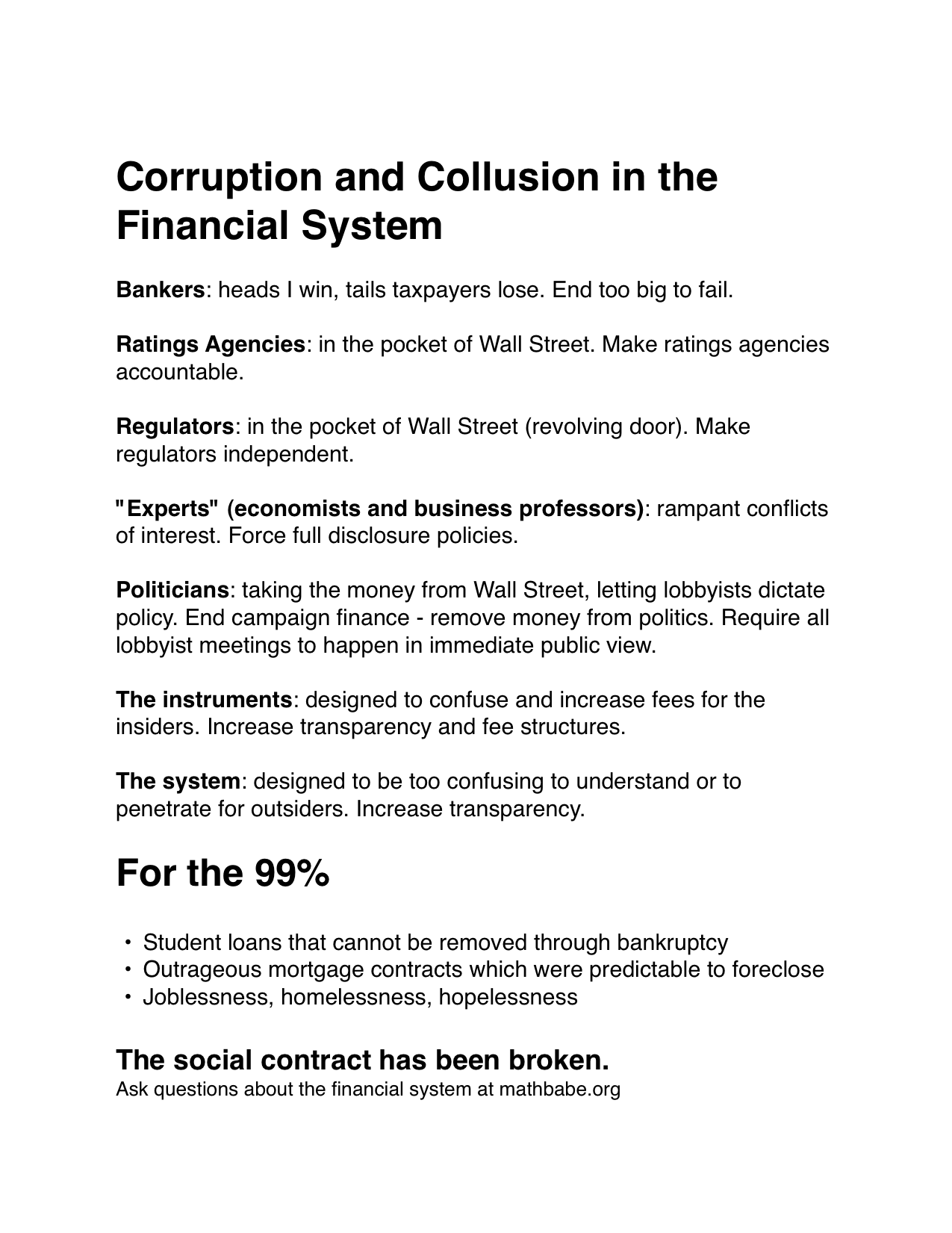
First I wanted to thank you for the wonderful comments I’ve been enjoying and compiling from my last post about what’s corrupt about the financial system and what should be done about it. Even if I don’t end up doing the teach-in (hopefully I will! In any case I’ll go down there, even if it’s just to try to set up the teach-in for a later date) I think this is a really fantastic and important discussion. I’m putting together a final list of issues tonight and I think I’ll make a flyer to bring tomorrow, so if I don’t actually conduct the teach-in (yet) I’ll at least be able to give the info booth the flyers.
And it’s not too late! Please keep the comments coming.
Today I want to start a discussion on Richard Koo’s book, which is about Japan’s so-called “lost decade” (a reader suggested this book to me, and it’s fascinating, so thanks! And please feel free to make more suggestions for my reading list).
You can actually get a pretty good overview of his book by watching this excellent interview by Koo. For those of you, like me, whose sound doesn’t work on their computers, here’s his basic thesis:
- After the housing bubble in Japan burst, a bunch of firms, banks and otherwise, became technically insolvent. This meant that, although they had cash flow, they owed more than their assets.
- Because they were insolvent, they didn’t maximize profits like in normal times; instead they minimized debts.
- In other words, they didn’t borrow money to grow their businesses, like you’d expect in normal circumstances, which is proved by looking at data showing that corporate borrowing went down even as interest rates lowered to zero.
- The CEO’s didn’t talk about this because they don’t want anyone to know they’re insolvent!
- Investors are also somewhat blind to this, because they typically look at growth and cash flow issues.
- Japan’s government made massive investments in order to cover the lack of private investments.
- Rather than this being a mistake, this was absolutely essential to the Japanese economy and prevented a massive depression.
- Moreover, the idea that Japan had a lost decade is false: actually, there was a lot going on in that decade (actually, 15 years) but people didn’t see it. Namely, the balance sheets were slowly improved over the entire economy.
- This is a lesson for us all: any time there’s a massive credit bubble which breaks, we can expect a balance sheet recession where behavior like this is the rule. The U.S. economy right now is an example of this.
I have a few comments about this. I wanted to mention that I’m only about halfway through the book so it’s possible that Koo addresses some of these issues but on the other hand the book was published in 2009 but was clearly written before the U.S. credit crisis was really full-blown:
- A friend of mine who recently traveled to Japan noted that the people there live extremely well. In fact, if he hadn’t been told that their country has been in recession for nearly twenty years then he’d have never guessed it. This supports Koo’s claim that the Japanese government absolutely did the right thing by bankrolling the economy when it did. It also brings up a very basic question: how do we measure success? And why do we listen to economists when they tell us how to define success?
- Not every country can do what Japan did in terms of investing in its economy, although the U.S. probably can. In other words, it depends on how other countries see your credit risk whether you can go ahead and bail out an entire economy.
- Some of the businesses in the U.S. are clearly not technically insolvent; we’ve already seen ample evidence of cash hoarding. On the other hand, I guess if sufficiently many are, then the overall environment can be affected like Koo describes.
- In general it makes me wonder, how many of the firms out there today are technically insolvent? How insolvent? How long will it take for those that are to either fail outright or pay back their loans? If we go by this article, then the answer is pretty alarming, at least for the banks.
In general I like Koo’s book in that it introduces a new paradigm which explains something as totally self-evident that had been mysterious. It’s pretty bad news for us, though, for two reasons. First, it means we could be in this (by which I mean stagnant growth) for a long, long time, and second, considering the hyperbolic political situation, it’s not clear that the government will end up responding appropriately, which means we may be in it for even longer.
What’s wrong with Wall Street and what should be done about it?
I am trying to figure out the top five (or so) most important corrupt and actionable issues related to the financial system. I’m going to compile this list in order to conduct a “teach-in” at the Occupy Wall Street protest next week. The tentative date is Wednesday, October 12, at 5:30pm.
I’d love to hear your thoughts: please tell me if I’m missing something or got something wrong or left something out.
The list I have so far:
- Investment bankers trading their books and taking outrageous risks which lead to government-backed bailouts because they are “too big to fail”. The related action in the U.S. might be the “Volcker rule” (i.e. reinstating something like Glass-Steagall); unfortunately it’s being watered down as you read this.
- Ratings agencies in collusion with their clients. The actions here would be changing the pay structure of the ratings agencies and opening up the methods, as well as having better regulatory oversight. We also need to change the structure of ratings agencies, and either make it easier to form an agency or make the agencies that already exist and have government protection actually accountable for their “opinions”.
- SEC and other regulators in collusion with the industry. The action here would be to nurture and maintain an adversarial relationship between regulators and bankers. We’ve seen too many people skip from the SEC to the banks they were regulating and then back. There should be rules against this (how about a minimum time requirement of 5 years between jobs on the opposite sides?). There should also be much better funding for the SEC and the other regulators, so they can actually meet their expanded mandate.
- Conflict of interest issues from economists and business school professors. If you’ve seen “Inside Job” then you’ll know all about how professors at various universities use their credentials to back up questionable practices. Moreover, they are often not even required to expose their industry connections when they do expert witnessing or write “academic” papers. The action here would be, at the very least, to force full disclosure for all such appearances and all publications. I’ve heard some good news in this direction but there obviously should be a standard.
- Rampant buying of politicians and influence of lobbyists from the financial industry. This is maybe more of a political problem than a financial one so I’m willing to chuck this off the list. Please tell me if you have something else in mind. Someone has suggested the opaque and elevated pension fund management system. Although I consider that pretty corrupt, I’m not sure it’s as important as other issues to the average person. I’m on the fence.
Saturday afternoon quickie
Two things.
- If I see another fucking article about how the world is going to miss Steve Jobs I’m going to puke. He made and sold overpriced gadgets for fucks sake! It’s hero worship plain and simple, maybe even a sick cult.
- I am happy that I’ve been invited to give a “teach-in” at Occupy Wall Street next Wednesday at 5:30 (tentative date and time). I’ve promised an overview of the 5 top corrupt things in the financial system. I’d really appreciate your thoughts: what is your top 5 list? I want them to be both important and relatively actionable. So far I’ve got:
- Volcker rule (i.e. reinstating something like Glass-Steagall); it’s being watered down as you read this.
- Ratings agencies in collusion with their clients
- SEC and other regulators in collusion with the industry
- Rampant buying of politicians and influence of lobbyists from the financial industry
- Incredibly poor incentives for the individuals in the industry, both in terms of salary and whistleblowing
Financial Terms Dictionary
I’ve got a bunch of things to mention today. First, I’ll be at M.I.T. in less than two weeks to give a talk to women in math about working in business. Feel free to come if you are around and interested!
Next, last night I signed up for this free online machine learning course being offered out of Stanford. I love this idea and I really think it’s going to catch on. There are groups here in New York that are getting together to talk about the class and do homework. Very cool!
Next, I’m going back to the protests after work. The media coverage has gotten better and Matt Stoller really wrote a great piece and called on people to stop criticizing and start helping, which is always my motto. For my part, I’m planning to set up some kind of Finance Q&A booth at the demonstration with some other friends of mine in finance. It’s going to be hard since I don’t have lots of time but we’ll try it and see. One of my artistic friends came up with this:
 Finally, one last idea. I wanted to find a funny way to help people understand financial and economic stuff, so I thought of starting a “Financial Terms Dictionary”, which would start with an obscure phrase that economists and bankers use and translate it into plain English. For example, under “injection of liquidity” you might see “the act of printing money and giving it to the banks”.
I’d love comments and suggestions for the Financial Terms Dictionary! I’ll start a separate page for it if it catches on.
My friend the coffee douche
About a year ago or so, I went with my friend to a new coffee store in lower Manhattan that he was super excited about. He knew the name of their espresso machine (the Slayer) and kept going on about how amazing the espresso made from this machine must be, if done right. I was happy to go, first because I needed coffee and second because I just like my friend and like it when people get really into things. On the way there I told him that the way he was waxing poetic about the Slayer really defined him as an all-out “coffee douche”. He took it well- in fact I think he actually loved the title. Coffee douches rarely get rewarded with titles, I realized.
I used to be a coffee douche myself. Or at least a potential coffee douche. I worked at Coffee Connection in my youth, which was eventually bought out by Starbucks but in its time gave lots of people in the Boston area pretty good coffee. I hung with the owner, especially once I decided to go to Berkeley, because that’s where he went for undergrad and where he learned to love good coffee (he told me he fell in love at Istanbul Express, I wonder if that place still exists). At some point I knew how many seconds of roasting produced each style (I never liked Italian Roast myself- too burnt) and the characteristics of the different coffees from all over the world (mmm… Sumatra).
Over time, though, I lost it. Something about having kids. I’m now at the level of carrying around Nodoz in my purse just in case I’m traveling and there’s no coffee machine in the hotel room (or in case those tiny little packages of grounds are insufficient). I still enjoy a good cup of Sumatra but I’m almost equally happy going to 7 Eleven. So you can see that coffee douchery is at best a fond memory for me.
When we got to the store, we were immediately asked at the door if we were “press”. Umm, no, what’s going on? It turned out that Sylvia was the guest barista! She was 3 time Brazilian pull champion!! I inferred that this meant there are actually competitions for making espresso. My friend was getting more and more excited and agitated. We got our pictures taken before and after the coffee drinks arrived. Or rather, our cups and saucers were- I think we may have only accidentally entered a frame or two. Sylvia was very gracious and hard-working at the same time. I think I managed to shake her hand, just for the celebrity moment of it all.
As an aside, I noticed something about the whole coffee movement thing when I was checking out Sylvia and her methods. Everything there has a fetishized whiff to it. The coffee machine was the Slayer, the various implements were wooden of some kind of hardwood that they were happy to explain in detail, and although I can’t remember all the names of the implements, I got the distinct impression that there may be a sex shop in the back room with leather and wooden tools very similar to the coffee tools. Maybe just me.
Here’s a close-up sexy shot of the Slayer (if you look carefully at the reflections you will note at least 3 people there admiring its shiny round parts), taken from the website of RBC coffee:

I don’t think I’ve ever been under such pressure to enjoy my espresso, but it was pretty good (I think). Near the end of drinking it, we seemed to be peppered with technical questions from the people there, including the owner of the store, the owner of the coffee plantation that supplied the store, and the guy who roasted the coffee beans. It was a triumvirate of coffee! I was glad I had my coffee douche with me!! He impressed them with his idiosyncratic knowledge (I remember his sympathy combined with pride when he mentioned that he was aware that there were laws against roasting in Manhattan but not in Brooklyn, so did they roast in Brooklyn? They did).
When I left, I was invigorated. Here are these people, completely obsessed and fascinated with coffee and everything pertaining to coffee. In some sense it struck me as a waste of time, but in a larger sense it was very very cool. That’s what’s interesting and fun about humans, after all, that they get totally nerdy and into things that other people can’t relate to, and they really improve our knowledge as a community about the best way to do that thing. There are probably people somewhere who are as into park benches as these guys are into coffee, and thanks to them the park benches are getting more and more comfy and beautifully designed and long-lasting, at least if you know where to go for really excellent park benches.
“Our organization does not reward failure” – Koch
You have to check out this Bloomberg article about Koch Industries. Although it rambles a bit at times, it’s absolutely mesmerizing and horrible. Here’s the main premise, which bizarrely comes near the end of the article:
For six decades around the world, Koch Industries has blazed a path to riches — in part, by making illicit payments to win contracts, trading with a terrorist state, fixing prices, neglecting safety and ignoring environmental regulations. At the same time, Charles and David Koch have promoted a form of government that interferes less with company actions.
The phrase “our organization does not reward failure” comes from a book in 2007 written by one of the Koch brothers where he somehow fails to discuss a pipeline explosion that had recently killed two teenagers in Oklahoma:
The 570-mile-long pipeline carrying liquid butane from Medford, Oklahoma, to Mont Belvieu, Texas had corroded so badly that one expert, Edward Ziegler, likened it to Swiss cheese. The company didn’t give 40 of the 45 families near the explosion site — including the Smalley and Stone families — any information about what to do in case of an emergency, the NTSB wrote.
The article is complete, in that it even has a spiteful twin brother of one of the Koch brothers appearing to give away his brothers for stealing.
The Senate held hearings in May 1989 after Bill Koch, David Koch’s twin brother, told a U.S. Senate special committee on investigations that Koch Industries was stealing oil on American Indian reservations, cheating the federal government of royalties.
The investigators caught Koch Oil’s employees falsifying records so that the company would get more crude than it paid for, shortchanging Indian families, Elroy said. Koch’s records showed that the company took 1.95 million barrels of oil it didn’t pay for from 1986 to 1988, according to data compiled by the Senate.
One thing that fascinating to me is that there are two whistle-blowers in the story, both women who were essentially fired for having ethics (one reported on bribes and the other on toxic gas dumping, both sued the company after leaving). Doesn’t it seem like women are more often whistle-blowers? Especially if you consider the fact that high ranking people in these kinds of companies with access to the kind of information that whistle-blowers need to uncover fraud are typically men.
These Koch brothers are seriously despicable, and really all they seem to care about is the ability to make money without having to worry about rules, even basic rules of morality. They currently largely bankroll the Tea Party. It’s a scary thought that I could someday live in a country whose president owes a favor to these guys.
Is the Onion actually America’s finest news source?
Have you noticed that some of the best reporting nowadays is satire? I feel like I learn most of the news I know from reading newspapers online, but I’m unusual: most people, especially young people, seem to get their news from the Daily Show and Colbert, as well as the Onion.
And it’s not just the writing, which is generally excellent and intelligent, as well as hilariously entertaining. It’s the topics themselves that are incisive and that get to the heart of what’s ridiculous or dysfunctional about our financial, cultural, and political systems.
What if we started a newspaper that took its cues directly from the Onion, and rewrote every article in a straight, anti-satire way? Would that newspaper be better or worse than the New York Times? I claim it would be more bizarre but also more relevant to our lives. It may miss entire swaths of typical news coverage but then again it would cover certain things in a more holistic light.
For example, what would a anti-satirist do with this article? Or this one? Just having someone seriously articulate why these things are so funny would be a good start, and an article I’d love to read.
Occupy Wall Street: Day 13
So I went to see the Occupy Wall Street protests this morning before work and this evening after work again. Here are some of my comments and observations.
First, if you are interested in checking it out, know that there are small marches at opening and closing bell for the market.
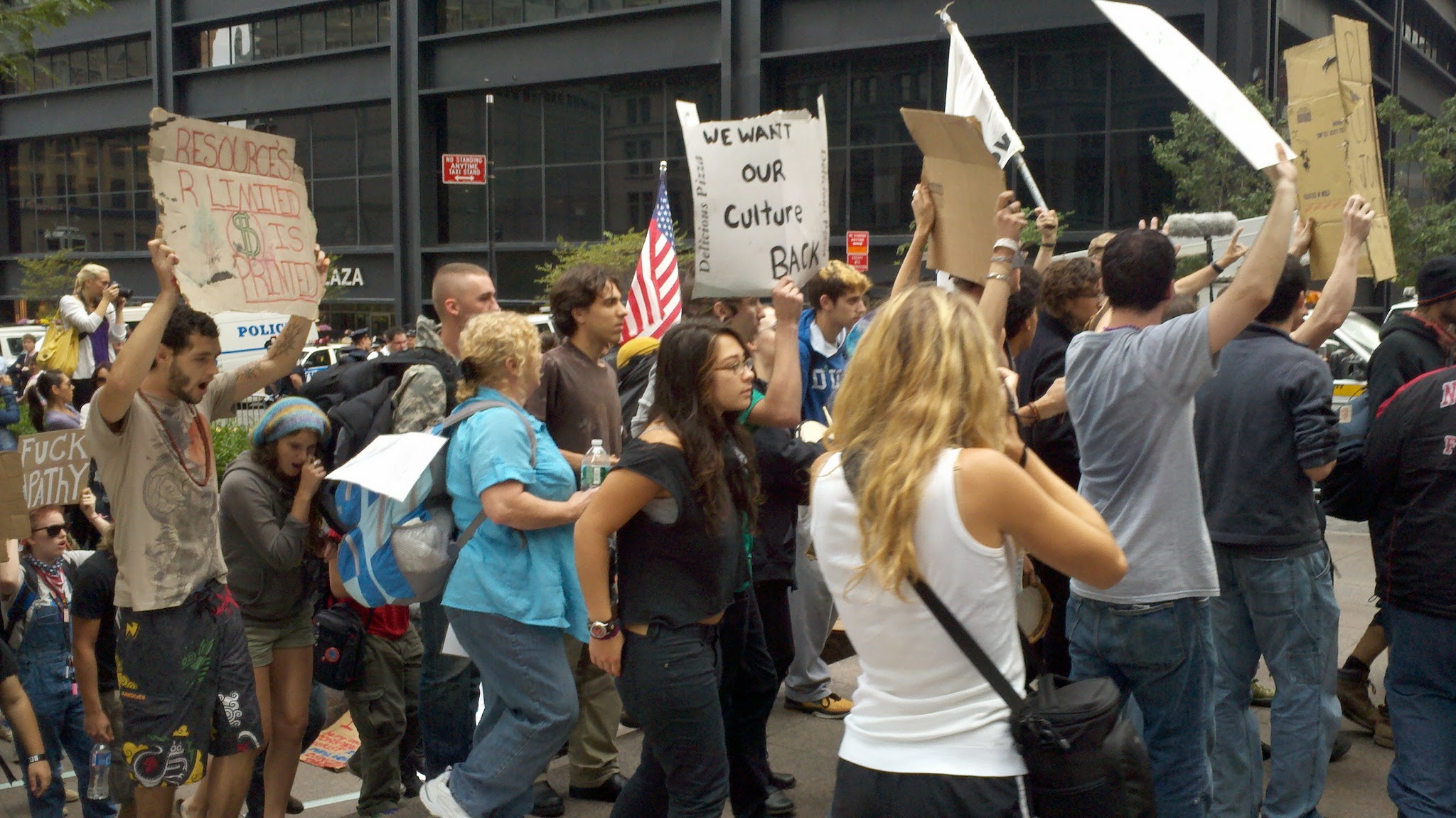
However, the police have made it basically impossible to walk on Wall Street, due to some incredibly annoying barricades.
 So for our march this morning we seemed to just circle the city block where the protest is based, although I didn’t stay til the end so it’s possible they decided to very very slowly march on Wall Street proper.
Second, they have “assemblies” twice a day, with guest speakers sometimes (Michael Moore, Susan Sarandon and Cornel West have visited), and this is where general announcements are made. The crowd was quite large tonight and it was difficult to hear what the speaker and the repeaters were saying, which is frustrating. But maybe it’s easier at the 1pm assembly. Also, it seems to be easier to actually discuss issues in the morning- at night it gets loud and kind of crazy and hard to focus in my opinion.

Next, I’d like to address the issue of the message of the protesters being dismissed as incoherent. For the record, I went to a conference at the end of 2009 at Columbia Business School on the financial crisis and what we should do about it, where the speakers were fancy economists from central banks and CEOs of international banks, and they were about as incoherent as these protesters. There was absolutely no getting them to say anything that was an actual plan or even an attempt at a plan for changing the system so this mess wouldn’t happen again. I should know, because there was a question and answer period and I asked.
Having said that, there have been some pretty unconvincing statements reported from some of the protesters in terms of what they would like to see. For example, some of them seem to think that short selling should be banned. As some of you know, I disagree. In fact there are lots of seriously corrupt and ridiculous things going on in the financial system which they should know about and they should protest, and I’d like to invite them to educate themselves.
In particular, if you are someone interested in knowing stuff about how the financial system works, then please ask! A major part of why I blog is to try to inform people about these things who are interested. Please comment below and ask whatever you want, and if I don’t know the answer I will find someone who does, or I will blog about the question.
Having said that, I’d like to add that it’s on the one hand perfectly reasonable that people don’t understand the financial system, because it has essentially been set up to be too complicated to understand, and on the other hand it’s also reasonable to think of the entire financial system as a black box which can be judged by its outputs.
Finally, if we are going to judge the system by looking at its outputs, then these protesters, who are in general young, with educations, huge students debts, and hopeless outlooks, have a pretty dismal view. In other words they have every right to complain that the system is fucking them, even though they don’t know how the system works. I for one am super proud that they’re out there doing something, even if it’s not obviously organized and polished, rather than passively sitting by.
Go Rays!
As a long-time (yes since they sucked) Red Sox fan, let me just say, the Tampa Bay Rays totally deserve to be in the play-offs. They made me a fan last night with an absolutely amazing game.
Occupy Wall Street—Report
This is a guest post by FogOfWar.
I was originally going to lead with a tongue-in-cheek comment (later in the post now), but then the NYPD did something colossally stupid. If you haven’t seen it, here’s the video from this last weekend. It pretty much speaks for itself.
There’s a lot to be said about freedom of expression and police overreaction. I’ve been to see the protests a number of times, and they’ve never been violent and in fact seem pretty well trained in the confines of freedom of assembly in the US legal system. Using mace against an imminent threat of violence is OK for the police, but the video seems to show no threatening moves made at all (and it runs for a good period before the police attack so it wasn’t edited out).
I’d suggest the NYPD be shown the following video (taken from the protests in Greece) to demonstrate when things reach a level where force might be an appropriate response. Note that the crowd is attacking with sticks, Molotov cocktails and a fucking bowling ball. In contrast, the NYPD appears to be pepper spraying people for just holding signs and walking down the street. What the fuck?
There are maybe a few hundred people consistently protesting at “Occupy Wall Street” for about 10 days now. It’s got a definite crunchy vibe to the center. Drumming and Mohawks are mandatory:


But also a (growing?) contingent of more mainstream participants like this one:

Here’s a crowd shot for scale:

And some people painting signs:

And then of course, there’s the dreaded “consensus circle”:

It’s hard to tell what they really want to happen—this was up at one of the information booths (but then down the next time I went):

Misspelled “derivatives”, and there are some things on that list that are spot on and then others that are just weird and irrelevant (DTC? Really?). I don’t think you can hold that against them though. I work in the industry, and I’ve been spending the last three years thinking about this stuff and I still find it confusing and hard to come up with a cohesive plan of what I think should be done. At least these people are doing something, even if it’s a bit incoherent at times.
I have to end with my all time favorite sign from the protest. Someone was looking for good cardboard and inadvertently came up with the following:
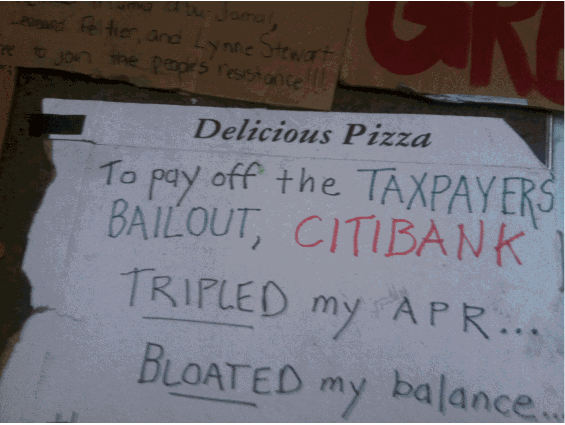
“Delicious pizza to pay off the taxpayers”. Now that’s a slogan I think we can all rally behind!
-FoW
The flat screen TV phenomenon
Do you remember, back in 2005 or 2006 or even up to early 2008, how absolutely everyone seemed to be buying flat screen TVs? And not only one, they’d actually buy new ones when new models came out, or ones with different high definition properties. And not just people who could afford it, either. The marketers did an excellent job in somehow convincing people that they needed these flat screen TVs so bad that they should just put it on their credit cards, all 3 thousand dollars of it, or whatever those things cost.
I don’t know exactly how much they cost because I never bought one. The last TV we bought was in 1997 and it still works, for the most part, although it’s really hard to turn it on and off. When it finally kicks the bucket I’m thinking we go without a TV, since TV pretty much sucks anyway. When we do watch it, it’s for live sports (local, or nationally televised, since we don’t pay for cable). Baseball we watch or listen to on the computer.
I was reminded of the the “flat screen TV era” by my friend Ian Langmore the other day when we were discussing household debt amnesty. His argument against debt amnesty for consumers was that they might spend it on crappy things. His example was luxury dog poo, but I’ve been obsessed with the flat screen TV phenomenon ever since a friend of mine, who was $120,000 in debt and didn’t have a salary, somehow managed to buy a flat screen TV in 2007. It blew me away in terms of wasteful consumerism. Ian found this unbelievable blog which kind of sums up my concerns.
In Ian’s opinion, the danger of amnesty, or any system where money is put willy-nilly into the hands of consumers, is twofold:
1) We waste time on unproductive activities. E.g. people spent time buying/building cars that are unneeded.
2) If a miscalculation is made, then the over-leveraged money-go-round stops with a huge mis-balance. E.g. home mortgage crisis.
These are very good points, and put together form a lesson we somehow can’t learn, although perhaps that can be partially explained by this article.
I have two thoughts. First, I’m also uncomfortable putting money in the hands of irresponsible consumers. But the truth is, the way I see it is currently working, we are already putting money in the hands of irresponsible bankers (that’s what the term “injection of liquidity” really means), and they are not doing anything with it, so let’s try something else. In other words, an alternative unpleasant idea.
Second, I don’t think we are going to see a new wave of flat screen TV buying any time soon. If we put money into the hands of consumers right now, I think we’d see them pay down their debts, go to the doctor, and buy jeans for their kids. Of course, there is always someone whose pockets burn with cash, and they would waste money in any situation. Let’s face it, though, credit is tight right now compared to the mid-2000’s. In fact, since economists seem to have a tough time spotting bubbles until afterwards, maybe we can take “a huge part of the population starts buying useless gadgets on credit” as almost a definition, or at least a leading indicator. Then at least there would be some point to all of that wasteful spending.
I never sit on the subway
I remember when I moved to New York in 2005. I found it intimidating and shocking how aggressively people vied for seats on the subway. I live near Columbia so the 1 train is my line, and of course everyone thinks their subway line is the most overused and crazy line, but in this case I’m right. I came from Boston, where we have subways too, four little itty bitty ones, and we are extremely polite to each other and, in particular, we never touch. By contrast here were these New Yorkers not only touching but literally squeezing into these tiny seats and sweating all over each other in the summer.
After about 3 months of living here I got really into it. I was in love with this city, and every gritty thing about it, and I considered the shared experience of the subway a sign of a larger public communistic love. Here they were, people from all walks of life, sharing their sweat! Isn’t it beautiful?
That kind of admiration only grew in the two years I stayed a professor at Barnard, which meant I almost never left the cozy neighborhood of Morningside Heights, so subway rides were rather rare, amusing events. I loved the subway and I developed theories about when people start talking on the subway (in three situations: 1) someone who is incredibly smelly gets off the train and everyone needs to talk about how smelly they were, 2) someone who is incredibly sick and coughing up a lung gets off the train and everyone has to talk about how sick and nasty they were, and 3) the train stops in the tunnel and the announcer tells us we have no idea when we will be able to move, and everyone has to talk about their stuck-in-a-tunnel-during-9/11 experiences.)
As soon as I started working at D.E. Shaw in midtown, and commuted during rush hour, I got real. I figured out exactly where to stand, and I mean exactly where on each platform, to maximize my chances of getting a seat once the train came. I figured out, depending on how many people were on which platform in Times Square, and the subsequent stations as we passed them, what the recent train traffic pattern had been in terms of the express 2/3 train and my local 1 train, and sometimes I’d do crazy things like get off the express train early to get on the 1 train because I’d anticipate that if I waited til 96th street like everyone else, there would be no chance I could get on the 1 train. Actually looking back, I almost never sat down at all during these commutes, even when I was pregnant.
Which comes to the turn in my story. When I was heavily pregnant, commuting on the subway was actually hellish. I had no balance, and felt vulnerable, and being squished up against people with no place to hold on was really scary. For the most part commuters are a selfish bunch, and people sitting would pretend not to notice me, so they wouldn’t have to give up their seat. I promised myself I’d never be that jerk.
For the last two weeks of my pregnancy I took a cab to work every day, but even so coming home was another story, since it’s hard to get a cab in Times Square at 5pm. I remember one time some asshole in a suit actually ran to grab a cab that had stopped for me, and he beat me because… I was 9 months pregnant and couldn’t keep up with him. I started crying, on the street, until this nice pedicab guy pulled over and asked me if he could help. I told him I lived all the way uptown and he biked me around until he found me a cab; he refused to let me pay. I still love that guy.
Once I started down the road of getting up for pregnant people, though, it was a short logical step to never sitting down again. After all, there are all kinds of hidden reasons people may need to sit down more than I do. What if their feet are killing them after standing all day at work? What if they have balance problems?
For a while I decided it’s okay to sit if everyone else had an available seat. That seemed safe. But then I’d be sitting there, spaced out or reading, with a sea of empty seats around me, and all of a sudden a huge group of people would converge and somehow I’d be face to face with someone with a murderous look which said, you motherfucker you’re sitting in my seat. In the end, it’s become my policy to just never sit down.
I do of course still think about the question of where’s the best place to stand in the subway. This is a whole different optimization play, which for intellectual property reasons I won’t share with you all, since I don’t want more competition than I already have. Just one hint: don’t get on in the middle of the car. Always get on at one of the ends.


 mathbabe
