Archive
The meritocracy myth
Jack and Larry
Recently a Wall Street Journal article described what I’ll call a “Larry Summers” moment for women in business. Namely, Jack Welch, the former CEO of General Electric, spoke to a bunch of women about how if they work hard enough they’ll be appreciated and get ahead. From the article:
He had this advice for women who want to get ahead: Grab tough assignments to prove yourself, get line experience, and embrace serious performance reviews and the coaching inherent in them.
“Without a rigorous appraisal system, without you knowing where you stand…and how you can improve, none of these ‘help’ programs that were up there are going to be worth much to you,” he said. Mr. Welch said later that the appraisal “is the best way to attack bias” because the facts go into the document, which both parties have to sign.
Just as in the case of Larry Summer’s now-famous 2005 speech about women in science and math, a bunch of women left Welch’s talk in frustration.
There is no such thing as a meritocracy
Having been in academic mathematics and a quant in a hedge fund, I’d guess I’ve experienced what comes closest in many people’s minds as the closest to a meritocratic system. But my experience is that it’s anything but, even in these highly quantitative settings.
Instead, as it probably is everywhere, the job environment is a huge social game where it matters, a lot, what kind of priorities you demonstrate and what kind of other signals you give off or respond to. We don’t expect people to play golf and smoke cigars in academia but caring about teaching, or worse, getting a teaching award, can be the kiss of death.
I’m not saying that your personal efforts don’t matter at all, because they do, and you do need to produce stuff, and at a certain rate, but even “personal efforts” are first of all received in the context of a social order (i.e. the perceived importance of your efforts at the very least is a social invention), and second of all they’re are not really personal – one frames the questions one answers with the help of the community, so it’s important you have a good connection and social acceptance in that community (i.e. access to the experts).
Business in more generality is even less meritocratic- there’s a specific requirement that you must “play well with others,” which is absent from academics (mercifully). This means that instead of being an implicit social game, it’s been made very explicit. This is where people promote their work, take credit for others’ work, learn to say what people want to hear, etc. The performance review is a circle-jerk event for such empty-headed manipulations, which makes it particularly ironic that Welch suggested women take the criticism in an appraisal so seriously.
In my experience, it is unbelievably useful for these social games to have an alpha personality, which just kind of means you assume you’re in charge even when it’s not explicitly a situation where someone’s in charge. People respond to such personalities on a chemical level and there’s really nothing a so-called meritocratic system can do about that.
In other words, I’m not holding my breath for a truly meritocratic system. It’s just not what humans evolved for. Let’s acknowledge that and work on how to make the system responsive to good ideas anyway (whatever the system is).
Successful people want to believe that there is such a thing as meritocracy
This begs the question, why do people like Jack Welch and Larry Summers hold on so tight to the myth of meritocracy? My theory is that it serves a two-fold goal: as advertisement for new people and as a validation of the winners in the system.
People want to feel like they are entering a level playing field then the best thing you can do is advertise it as a meritocracy, because it’s human nature to think that you’re better than average. So everyone wants to enter such a field, assuming they will rise to the top.
At the same time, the `winners’ of the social game want desperately to think they did amazing stuff in order to be so successful. They hold on to the myth of meritocracy as a religious belief, and it is pure dogma by the time they reach upper management. This plays into another part of human nature where we discount luck and the infrastructure that led to our success and take it as a sign of our personal choices. Lots of people in finance in general suffer from this diseased mindset but actually anyone who is high enough up in their respective `meritocratic system’ does too.
That’s my simple explanation for why these guys can go in front of a bunch of women and be so unbelievably tone-deaf. They are true believers, because their entire egos are built on this belief, and it doesn’t matter how much counter-evidence is presented to them, even in the form of humans in the room with them.
One last thought. If I saw people leaving a room in disgust when I was giving a talk, I imagine I’d be slightly aghast- I might even pause and ask them what’s wrong. But I guess that’s because I’m not alpha enough.
The student debt crisis
A few weeks ago I wrote about the higher education bubble that I saw at the individual level. This is the idea that, for a given student trying to decide whether or not to take on more loans to go to school, it’s essentially a no-brainer; it’s a cultural given that a college education pays off, statistically speaking, even if in a specific case it doesn’t.
As always, however, the situation at the individual level (a student going into debt) is informed by the overall system. Today I want to write a bit more about how this system got so out of whack.
I’ll actually write about a series of theories of mine, so please tell me if you think I’ve got the facts wrong. I don’t want to claim these are new ideas, but rather a storytelling version of a common understanding of how this all went down. In this case, it’s a story about money and perceived risk, no too dissimilar from the housing crisis.
Before I get into the details of the theory, let me throw in that the Ivy Leagues like Harvard and Princeton have always been super expensive, but that’s part and parcel of their brand. It’s actually intentional, they wouldn’t have it any other way, because part of being elite is being out of control expensive (although it needs to be said that their financial aid to poor kids is exemplary). In other words, I don’t think my theory is going to work on super elite colleges, but that’s fine because most people don’t attend those colleges.
And college always cost some money, although some state schools were really quite reasonable back in the day. It’s just a question of how long after college someone would have to wait or work before their student debts would be gone so they could move on with their lives and think about buying a house (more on that connection below).
Okay, with those disclaimers, let me get started. Namely, it’s all about bankruptcy laws. I know that sounds unbelievable, but it’s really true. From Justin Pope:
Until 1976, all education loans were dischargeable in bankruptcy. That year Congress began requiring borrowers to wait at least five years before they could discharge federal student loans. Since 1998, borrowers have been unable ever to discharge federal student loans, and in 2005 the then-Republican-controlled Congress made private loans almost impossible to discharge.
Why does this matter?
Because it meant that people lending to students wouldn’t need to worry about getting their money back. That sets up a perverse system where young people who are not creditworthy can take on piles of debt.
On the one hand, it’s good for students to be able to finance their education- you wouldn’t want young poor kids to not attend colleges at all for want of enough funding.
On the other hand, it meant that the tuition and fees could essentially rise without pause, since there was nothing to force them back- no supply vs. demand situation.
This is especially true because students aren’t told and do not generally “shop around” for a good deal in college, and moreover colleges are incredibly underhanded about making their tuition and fees clear (I am giving the CFPB about 3 more months to force them to present packages in a standard form before I really start complaining).
Another example: Pell Grants. These are grants given to poor kids to go to college, and they aren’t loans – the government pays them straight to the college. But the colleges have not really made it easier for kids to go to college because of this free money, but rather have raised their tuitions by the amount of the expected Pell Grant. Some colleges are better at getting Pell Grant money than others, and in particular for-profit colleges get 7 out of 10 such grants.
[Speaking of for-profit colleges, how are they allowed to exist? They are the worst of the worst and in particular have outrageous practices in terms of disclosing fees and tuitions, giving commissions to financial aid officers who then urge students to lie on their financial aid forms. Not to mention providing questionable educations.]
I hope it’s not too hard now to understand why student debt has just surpassed $1,000,000,000,000 in this country, ahead of credit cards. On the banker side of the room, these student debts are being bundled up and securitized and sold to investors just like old mortgage-backed securities (which, as you recall, couldn’t fail because the housing market always goes up) who are being told there’s very little risk since students can’t discharge student debt through bankruptcy. There’s a strong analogy with the previous housing bubble and the current education bubble: even ignoring the individual’s goal of becoming an educated citizen and qualified worker, there’s the demand side from the banking system itself which feeds on the fees of securitized products that seem riskless.
But the cost to those individual borrowers is heavy; we have a system whereby young people are being saddled with enormous and unreasonable debt in order to even qualify as a worker, and they are carrying it around like a noose. It is, for example, one thing preventing the housing market from recovering, because the generation of young people who should be buying a house right now is instead still trying to pay off student loans.
What should we do about this?
First of all, let’s focus on the culture of education and how we think about it. Is it a certification process that people should pay for? Or is it a part of what we offer our citizens as their right?
If the latter, it’s time we rethink why state schools should exist, and fund them accordingly, rather than removing more and more funding while expecting them to uphold their state-school mandates. I went to UC Berkeley in the early 1990’s and it was completely awesome, but it’s getting more and more squeezed by the state of California, which is forcing it to choose between becoming a bad school and becoming a private institution. And yes, that means taxpayer money going towards the investment of broad education rather than to banker bailouts.
Second of all, let’s rethink the bankruptcy laws. At the very least for private student debt. For public student debt it also needs to be negotiable in certain circumstances. We need to get the colleges themselves to lower their fees enough that the debt loads are tolerable.
Finally, let’s rethink how much to expect someone to pay down their debt depending on their salary. From Bloomberg:
The second crucial step is to mitigate the burdens of already distressed borrowers. The Obama administration has made progress, for instance by proposing an initiative that would let some students limit their loan repayments to 10 percent of their discretionary incomes next year and would forgive balances after two decades. Private lenders should be given incentives to offer more modifications and flexible payment options.
Yes, this means that some of those securitized student debt loans will default, just like mortgages. And that will mean that already undercapitalized banks will be even more so, because they’ve been taking risky bets yet again, and Sallie Mae will be up Shit’s Creek. But the alternative, of a continuing debt trap for young people, is an even worse alternative.
Conclusion (#OWS)
This is the final part of a four-part essay that was proposed by Cathy O’Neil, a facilitator of the Occupy Wall Street Alternative Banking Working Group, and written by Morgan Sandquist, a participant in the Working Group. The first three parts are here, here, and here. Crossposted from Naked Capitalism.

Still sitting in our breakfast nook, with the banking industry squinting grumpily back at us through the glare of the morning sun on the perfectly polished granite table top, we can sit back, rest our hands on the table, and rather than shouting what it expects to hear, playing our part in the script of codependency, we can speak, without pleading or rancor, the truths that are beyond the script.
Rather than repeating once again our expectations and the banking industry’s failure to meet them, rather than pleading with it to live up to its obligations and do what’s fair, we can speak of the mundane practical details of our life and our children’s lives after its eventual demise, of the specific process by which everything around us will be sold to pay the ruinous debts for which its insurance will prove woefully inadequate.
We can make of the inevitability something tangible, rather than a vague, abstract threat. We can catalog the likely disposition of all of the banking industry’s prized possessions and family heirlooms, the eventual owners of everything it values. We won’t engage in a debate over whether the inevitable will occur, nor will we revel in the justice of it, because we’ll all suffer.
The banking industry must take responsibility for the laws it has broken and make appropriate restitution, not because we’re vengeful, but because the connection between choices and consequences so necessary to any successful relationship must be restored. And as long as the banking industry is adamant that it can’t or won’t change, and given the suffering that will follow from that refusal, we have no choice but to regretfully plan for our own and our children’s well-being to the extent we can. Should it accuse us of betrayal, our response is that the first step toward an alternative is one the banking industry must take.
I would have liked to title this section of this essay “Recovery,” but I’m not in the position to do that. I can’t speak to outcomes, only to process. I’m neither imaginative nor prescient enough to suggest what the successful results of our efforts might look like, but I have some idea of how those efforts should be undertaken.
I could use the Twelve Steps of Alcoholics Anonymous (“We admitted we were powerless over debt–that our industry had become unmanageable,” and so on) to describe what might follow from the banking industry taking that first step, but that would be a too literal extension of the metaphor.
The truth is that history offers no examples of the sort of transformation that’s now needed. Though addiction and recovery may offer greater insight into our predicament than yet another political or economic analysis, there’s no reason to believe that the situation will stick to that metaphor as it evolves, even as we proceed with what is essentially an intervention.
Gil Scott-Heron famously said, “the revolution will not be televised.” I take this to mean that any real, fundamental change to the workings of our society, won’t be an entertainment offered by revolutionaries to the rest of us. It won’t be achieved if we sit home waiting for someone on television, or now the Internet, to present us with a number we can call or text, a petition we can sign, or a ballot we can fill out. Our opinions will effect nothing, and our agreement is neither solicited nor required.
I offer this essay not to start another in the endless string of conversations about what is to be done, but to prompt you to do it, whatever it will be, even if what you will do proves that everything I’ve written here it categorically incorrect. I also offer this as an explanation of why I’m doing what I’m doing.
Among other things, I’m working with several participants in the Alternative Banking Working Group on a Web application that will allow people in New York City (and, later, the rest of the country) to find credit unions for which they’re eligible (something that turns out to be far more complicated than you might expect). This will facilitate the return of money from banks, where it functions as an addictive substance, to community ownership, where it functions as a tool in the business of that community.
I do this on your behalf as well as my own, but not in your place. What else will be done and what will come of it will be the result of what you do. The Occupy Wall Street movement is entirely open and will become no more or less than what we make of it. Tomorrow’s May Day events will provide people with the chance to find out for themselves what that movement is, how they can become involved, and what it will become.
With events in more than 115 American cities and many more around the world, you should be able to find an event near you (if you’re in New York City, you can even hear more about the prank played on MF Global by the banks).
Take the day off and meet the people with whom you share this struggle, whether you’ve agreed to it or not. If the movement isn’t what you want it to be, it’s incumbent upon you to transform it as necessary. You can sit home waiting for a movement that checks all your boxes to somehow arise and solicit your participation, but so passive an approach is unlikely to accomplish much.
Let’s all get together on May 1st and see how much we can accomplish in this American Spring.
An Intervention (#OWS)
This is the third part of a four-part essay that was proposed by Cathy O’Neil, a facilitator of the Occupy Wall Street Alternative Banking Working Group, and written by Morgan Sandquist, a participant in the Working Group. The first part is here and the second part is here. Crossposted from Naked Capitalism.
What are we to do with our banking industry, sitting there at the kitchen table in its underwear, drumming on the table with one hand and scratching its increasingly coarse chin with the other in an impossibly syncopated rhythm, letting fly a dizzying stream of assurances, justifications, and accusations, and generally spoiling for a fight that can only be avoided by complete and enthusiastic agreement with a narrative that can be very difficult to follow, let alone make sense of?
Because this is our kitchen too, we have our legal and moral rights. We would be well within those rights to respond to its nonsense with far more coherent and sweeping condemnations of our own. Throwing the bum out in its underwear without so much as a cup of coffee, taking the children, and keeping our share of whatever might be left could certainly be justified.
Though the sense of release offered by those responses is tempting, they’re not likely to be of any practical use. We can’t win an argument with an irrational person, and our share of an insolvent industry is likely to be very little–certainly not enough to feed the children. We have to recognize the hard truth of our implication in the banking industry and its addiction.
This doesn’t mean that we’re responsible for the addiction and its consequences, or that we can make the choice not to continue that addiction on our own, but it does mean that the problem won’t be constructively resolved without our efforts. To the extent that denial is about obscuring the connection between decisions and results, the most effective means of undermining denial is to clarify that connection, and the process of doing that is intervention.
Whether or not its participants are thinking in these terms, Occupy Wall Street, to the extent that it can coherently be referred to as an entity, is in many respects functioning as an intervention into the banking industry’s increasingly untenable addiction to money and debt.
The movement’s core values of transparency, sustainability, and nonviolence reflect the clarity, patience, and compassion needed for an effective intervention.
This is not to say that all of the efforts directed at banks by the movement have been magnanimous or constructive. We have to remember the terrible suffering that has been inflicted upon so many and offer that clarity, patience, and compassion not just to the addict, but also to ourselves as intervenors and to everyone who has been affected by the banking industry.
On the whole, I have been deeply heartened by how this movement has evolved over the last seven months, and though intervention isn’t the easiest or most promising process, it’s one I recognize and know can work (in stark contrast to political revolution). From the beginning, the Occupiers have shown a fearless, poignant spontaneity that’s available only beyond the addiction-centered dynamic of denial, and the banking industry, its enablers, and others still within that dynamic of denial (which, to be fair, has included most of us at one point or another) have responded as would be expected.
The determination and wisdom granted to those who see more clearly is profoundly threatening to those seeking to maintain denial, though of course they wouldn’t be able to say quite why.
The initial objections from the press that Occupy Wall Street was making no demands could be seen as an enabler’s yearning for symptoms that can be isolated and addressed, without admitting to or addressing the addiction from which they arise. To keep calmly and patiently pointing to that underlying cause is simultaneously incomprehensible and maddening to those trapped within denial, and their responses have run the gamut from smug certainty that nothing could possibly be wrong to whistling past the graveyard to ill-conceived and unjustified violence. And the Occupiers’ patience, diligence, and good nature in the face of that decidedly ill will is as textbook an illustration of the process of intervention as we’re likely to see.
It would be all too easy to remain passive in the face of our increasingly delusional, erratic, and combative banking industry. Surely there must be a more palatable alternative to undermining the continued functioning of the complex and highly evolved process that is the core of our economy.
If we force it to rehabilitate, what will happen during that process? Will our economy collapse? When its rehabilitation is complete, will the banking industry be able to function as well as it once did? Or as the banking industry’s enablers would have it: Any attempts to regulate the banking industry will only harm it, making it less effective to all of our detriment; these banks are too important a part of our economy to be allowed to fail; and bankers must continue to receive bonuses for banks to remain competitive.
It’s true that the banking industry has seized upon the process that’s the basis of our economic survival, and that attempts to address the problems of the banking industry cannot be undertaken lightly. But it’s also true that the banking industry has perverted that process, and that attempts to address that won’t prevent our return to some fantasy of efficiency and plenty, though they might prevent the otherwise inevitable, tragic end of the current trajectory left unchecked.
Whatever happens while the banking industry is rehabilitated is unlikely to be worse than what will happen as it continues to indulge in its addiction unaddressed, and it’s unlikely to function any worse upon the completion of its rehabilitation than it is now. As Charles Eisenstein puts it, “any efforts we make today to ‘raise bottom’ for our collectively addicted civilization–any efforts we make to protect or reclaim social, natural, or spiritual capital–will both hasten and ameliorate the crisis.”
Once an addict has reached the point in his or her descent where an intervention is necessary, there’s no realistic possibility of a return to some pre-addiction Golden Age. The apparent paradox that an addict’s life must be destroyed to save it is, stated in those terms, false. The addict’s life only appears to be as yet undestroyed through the lens of denial, and a future life without substance abuse or consequences is an illusion.
But the more gently stated paradox that intervention will cause the addict suffering in the short term to help him or her in the long term is accurate. There are, however, deeper, more intractable paradoxes, and they are those of the psychology of addiction. The process of intervention is often crucial to an addict’s entering rehab and beginning recovery, yet only the addict can decide to enter rehab.
The addict must understand the damage he or she has done in order to stop using but mustn’t succumb to shame, which would simply cause a retreat to the substance. The addict must admit that he or she is powerless over the substance and that life has become unmanageable, but mustn’t surrender to hopelessness and despair, which would sap the considerable motivation needed in the process of recovery. An intervenor must do something, but there’s nothing that can be done. There is no single act, no grand gesture or magic bullet, that can accomplish anything meaningful or lasting. Intervention is a long, unpredictable process requiring superhuman compassion and patience of everyone involved. Prior training or practice in commitment to a process without regard to the outcome of that process is invaluable.
Yes, we can answer the banking industry’s petulant invective in kind, but that won’t fix the problem; the industry will become more defensive and reckless, and we probably wouldn’t end up feeling any better anyway. Our encyclopedic harangue would be cogent, compelling, and convince our friends in the retelling, but no matter how loud we shout it over the banking industry’s coffee cup into that sullen, bloodshot face, it will simply be brushed aside with the wave of a shaky hand and a hoarse grumble, or, worse, it will hit home, and rattled, the banking industry will glare at us and we’ll know that tonight will bring another nihilistic binge of leverage and derivatives, and maybe this time there will be no tomorrow morning. The industry will tell us that we don’t understand, that the pressure it’s under is unimaginable, that life is grim, and that even though it can’t fix that, it should be thanked for what it has accomplished, and that that’s the best it can do. What more could we want? What more could it do? And we can only sigh and shake our head, because we know the simple, honest answer would just fall on deaf ears, and even if it were understood and accepted, the broken soul sitting across the table is in no shape to do anything constructive.
The confrontations shown on television or in the movies, or that you have perhaps participated in yourself, are just part of the larger process of intervention, but they illustrate the themes that inform that larger process. Those themes can best be summarized as connection: the connection between the addict’s choices and the suffering of the addict and those who are around him or her; the connection between addiction and the addict’s choices; and the unbreakable, always available connection between the addict and the intervenors.
Where denial seeks to divide and conquer, intervention seeks to unify and transcend. Intervention doesn’t respond to denial on denial’s terms, but rather reflects reality as it is. It doesn’t engage in the petty distractions of accusations and recriminations, nor does it seek escape from the addict and his or her problems. Intervention shows the addict his or her choices as they’re made, how those choices are determined by addiction, and the consequences that follow from those choices, but it also shows the redemption that’s always available despite those choices and their consequences.
Where denial is deceptive, impulsive, and selfish, intervention is clear, patient, and compassionate. Intervention finally presents the addict with an unavoidable choice between continued deluded suffering and real, sustainable sanity. The addict may or may not respond positively to that choice, but it must continually be presented on the same terms until the addict surrenders his or her denial.
And to induce that surrender, it’s crucial that the addict be offered an alternative to his or her addiction, whether it’s formal rehab, a twelve-step program, methadone, or a recovery dog. It’s important to recognize that even before the addict became physically or emotionally dependent on the substance, that substance met an otherwise unmet need, and leaving it unmet will lead only to relapse.
Tomorrow: Conclusion
The Addiction (#OWS)
This is the second part of a four-part essay that was proposed by Cathy O’Neil, a facilitator of the Occupy Wall Street Alternative Banking Working Group, and written by Morgan Sandquist, a participant in the Working Group. The first part is here. Crossposted from Naked Capitalism.

Is it fair to say that because the quality of the denial surrounding the banking industry’s problems is so similar to that of the denial surrounding addiction, that addiction is therefore the root of those problems and our ongoing failure to adequately address them? Perhaps not, but others have come to describe money, debt, and banking as something very much like addiction for entirely different, and far better argued, reasons.
In Debt: The First Five Thousand Years, David Graeber looks deeply into the anthropological record and finds that money and debt, and, by extension, banking, are all essentially the same thing, and they’re not what most of us understand them to be. Money is certainly not simply the objective store of value and medium of exchange that economists would have us believe it is. Because money is created as debt, its use to finance productive activity means that that activity, whatever it is, must then generate interest to be returned to money’s creators in addition to the money lent.
This has given rise to an industry, even a class of people, that derives its livelihood not from any productive activity of its own, but merely from having money. In Sacred Economics, Charles Eisenstein takes this a step further to show that this overhead cost inherent in all monetarily denominated activities means that the value represented by money must always grow. There is no logical end to what must be monetized–natural resources, ideas, time. Nothing can remain unowned and clear of liens, and that will eventually consume any finite realm:
The dynamics of usury-money are addiction dynamics, requiring an ever-greater dose (of the commons) to maintain normality, converting more and more of the basis of well-being into money for a fix. If you have an addict friend, it won’t do any good to give her “help” of the usual kind, such as money, a car to replace the one she crashed, or a job to replace the one she lost. All of those resources will just go down the black hole of addiction. So too it is with our politicians’ efforts to prolong the age of growth.
I don’t hope to make in a couple of paragraphs the full case that those two authors have made over hundreds of pages, so I’ll just assert it to have been compellingly made: namely, that money, debt, and banking have gone from being a tool that we might use to ease social activities to being the purpose of those activities. They have become an addiction, and because they’re an addiction, all of us who are touched by them have developed a rich and pervasive denial of this fact, its history, and its consequences.
In practical terms, what do we gain by perceiving money, debt, and banking as an addiction and the discourse around them as denial? Speaking for myself, it helps me understand the otherwise inexplicable irrationality behind our ongoing financial decline. I can imagine no other explanation for so much of what we’ve seen in the last few years: the failures to properly address the mortgage and subsequent foreclosure crises; the criminal activities of banks, hedge funds, and ratings agencies, and the spiral of consumer indebtedness; the deeply emotional and often militarized response to people sleeping in an otherwise unused square of concrete in a nocturnally unpopulated commercial district; and, most of all, the general populace’s willing acquiescence to all of this.
It appears only that banking must continue as it is, undisturbed, and nothing must disrupt the use and abuse of debt and money. Though an explanation for the full range of symptoms of the banking crisis, or for the full range of symptoms of any addiction, risks being reductive, without some causal dynamic behind these symptoms, there can be no effective response to them. To prevent something from happening, a cause must be identified and addressed.
Understanding money, debt, and banking as addiction also helps me trust myself and seek a constructive approach to the daunting task of resolving this crisis. As anyone who has ever had to face the full force of shared social and familial evasion can attest, the temptation to surrender to that alternate reality despite his or her better judgment, if only for the sake of civil relations, can be overwhelming.
In the case of the banking industry, that evasion often comes in the form of expert opinion that seeks to persuade not through the substance of the discussion, but through a dependence on credentials and ad hominem dismissal. It’s invaluable to be reminded that such a surrender, regardless of expert arguments, will at best only defer the consequences that we fear. Asking ourselves if, at the addict’s eventual funeral, we’ll be comfortable that we did everything we could is a remarkable inducement to focus. It can also be a powerful inducement to anger, so the understanding that it’s really addiction and denial, not friends and family, that we’re fighting can provide a basis for the compassion we would need to constructively approach such an emotionally volatile undertaking.
Finally, this understanding helps me focus on the ultimate goal of any such effort, rather than becoming sidetracked by pointless diversions.
As I mentioned above, one strategy of denial is to hide the connection between the symptoms of addiction and their real cause. It allows the alcoholic to believe that his or her diabetes and other health issues are the result of poor diet and that his or her depression is genetic or the result of poor parenting. It’s not that an alcoholic necessarily consumes a model diet or was well reared, but addressing just those symptoms allows the alcoholic to keep drinking, and other symptoms will follow from that drinking.
Similarly, it’s not that banks don’t need to be better capitalized, but providing them with capital and liquidity alone allows banks to continue pursuing courses of action that are neither financially nor economically viable.
To effectively address addiction is to prevent further addictive use of the substance. Any effort directed at symptoms will, to the extent they’re effective, simply enable continued substance abuse. It’s only by understanding the nature and extent of denial, navigating its maze, and intervening directly in the use of the substance that one can hope to effectively address addiction, and even then, the odds aren’t in the addict’s favor. And only with a thorough understanding of this dynamic and all of its implications can we hope to intervene effectively in the banking crisis that as of now continues unabated.
Tomorrow: An Intervention
In Denial (#OWS)
This is the first part of a four-part essay that was proposed by Cathy O’Neil, a facilitator of the Occupy Wall Street Alternative Banking Working Group, and written by Morgan Sandquist, a participant in the Working Group. Crossposted from Naked Capitalism.

The largest banks in America–Citibank, Bank of America, Wells Fargo, and others–are probably insolvent. I learned of this from my companions in Occupy Wall Street’s Alternative Banking Working Group. It seems that, based on a host of legal and accounting irregularities, the banks have been able to conceal real and potential losses far larger than their capital reserves. But this has been difficult to confirm.
Isn’t that strange? Wouldn’t the possible insolvency of the core of our banking industry be a matter of nearly universal importance? Shouldn’t we be trying to figure out if this is in fact so, how it came to be, what we’re going to do about it, and how we can prevent its happening again?
Anyone investigating the true health of the banking industry, apparently including regulators, is faced with opacity, complexity, and even outright hostility that stymies all but the most savvy and persistent. Fortunately, people within OWS, including the Occupy the SEC Working Group, are that savvy and persistent. But the reaction of the industry and its partisans to such efforts has included the not-so-subtle suggestion that inquiring into the well-being of the banking industry will somehow cause problems to arise that wouldn’t otherwise exist if we would all just mind our own business.
This seems odd in an ostensibly objective and quantitative context like banking. Shouldn’t the truth be clearly visible in the accounting? Shouldn’t we all–borrowers, investors, depositors, and regulators–want to know exactly what’s going on?
As unexpected as such a visceral and irrational reaction to genuine, well-founded concern is from the supposedly rational realm of finance, that telltale blend of evasion, grandiosity, and superstition will be familiar to anyone who has ever confronted an addict about his or her addiction.
Denial is far more than an addict’s dismissal of the truth of his or her addiction; it’s collectively developed by the addict’s entire social sphere, and it takes many forms.
It might be helpful to imagine addiction and denial as intangible agents acting in a social context. Addiction’s agency is directed solely toward uninterrupted use of the addictive substance, and denial’s agency is directed solely toward ensuring that no one sees, understands, or limits addiction’s agency. Denial denies not just claims and assertions, it also denies access and insight into the reality of addiction. It denies that behavior is driven by addiction and that behavior’s consequences are the results of addiction. It denies the story of addiction and proposes an endless collection of counter-conspiracies.
It appears as those around the addict ignoring the addict’s use and the consequences of that use; as the narratives, tics, and habits through which the addict understands and acts out his or her use; and as the alternate version of reality that the addict and everyone around him or her shares in lieu of the reality of addiction. To paraphrase Baudelaire on the devil, denial’s best trick is to persuade us that addiction doesn’t exist.
No addiction could develop a more effective narrative of denial than the trade in exotic financial instruments that’s evolved over the last decade or so; no addiction could hope for more willing abettors than the financial press, regulators, and ratings agencies; and no addiction could depend on a more permissive enabler than the Federal Reserve Bank.
It’s difficult not to imagine the banking industry as jittery and unshaven, embarking on yet another unregulated derivative binge, telling us, its concerned partner, that we just wouldn’t understand what it’s like, how high the return can get, while its friends in the financial press and ratings agencies encourage it, scoffing at the very idea of risk.
And later that night, as it’s coming down, it’ll shout something at us about not really needing the $1.2 trillion in liquidity, but if the Fed’s offering, why not?, it’ll make the night that much better, only to face us the next morning, hungover and distractedly claiming none of it ever happened.
We’ll confront it with seemingly undeniable evidence of MERS, TARP, executive bonuses, and a ruined housing sector, and it’ll look betrayed, ask us how we could even say such a thing, and tell us that it’s none of our concern and that we just have to trust it, because the bills are paid, right? It’s not like it’s as bad as AIG or MF Global, it’ll say, which will lead to an impossible-to-follow tale of the prank it played on MF Global last night, and how that was like something that happened to Bear Stearns and Lehman Brothers once, and ending with the declaration that the Fed and the SEC would never let anything bad happen to the Banking Industry.
And what choice do we have? Maybe it’s not that bad. After all, if the banks really were insolvent, there would’ve been something on the evening news.
Tomorrow: The Addiction
Reputational risk is insufficient for ratings agencies
I’ve had a few conversations recently with intelligent, informed people about the failure of the ratings agencies during the housing bubble to keep up standards on their ratings of CDO‘s. You can discuss all day whether it was individual ratings they got wrong (at the level of the MBS‘s) or whether it was the correlation of defaults they were underestimating. It was both. But in the end the fact is they sold AAA ratings.
Nobody really argues against that. What fascinates me, though, is that people sometimes still argue against the idea that the revenue model of ratings agencies, whereby the issuers of debt pay the ratings agencies for ratings, is fundamentally flawed.
Their explanation is something like this.
That system worked fine for a long time, because for a given rating they wouldn’t sacrifice their reputation on a ridiculous rating for some small-fry issuer. And the system would have continued to work fine except that the issuers became huge and the amount of money involved became too tempting and so they ended up whoring themselves. But there’s nothing fundamentally wrong with the incentive system, we just need to keep reputational risk the driving force.
What?? That’s argument kind of reminds me of the so-called dental insurance which pays for cleanings but when it comes to dental emergencies with root canals and surgeries you’re shit out of luck. That’s not insurance at all, in other words.
I see the need for ratings agencies – it’s a way of crowd sourcing due diligence, which makes sense, but only if we can trust the ratings agencies as an impartial third party. And I don’t want to seem like someone who doesn’t have faith in humanity, but my trust isn’t won by a system of perverse incentives that has already failed. Let’s just say I have hope for humanity but I also acknowledge our weaknesses.
And just to be clear, the new bond rating agency Kroll, which has been getting a lot of attention, also uses an issuer-pays revenue model. But I guess Egan-Jones doesn’t, it uses a subscription-based revenue model. I still prefer the concept of an open source ratings agency – I’ve been in touch with Marc Joffe, who is doing just that for sovereign debt, which I will talk more about in a separate post.
The Great Wealth Transfer, late 1900’s to early 2000’s (part 1)
When historians write about this era of U.S. history, how will it be described? I have a guess: “the Great Wealth Transfer” from the middle class to the wealthy. Let me explain why I say this.
There are lots of different parts to this story, but today I’ll concentrate on the housing wealth transfer.
We all know there was a housing bubble, that millions of people took out mortgages on dubious terms for houses that were already overpriced but that they were each counting on to go even higher. The way this was sold at the time, and even today is described, was as “home ownership for an expanded middle class.” But as Sue Waters from the Alt Banking group pointed out to me, these people didn’t get home ownership, they got debt ownership.
I know, it sounds a bit strange, but that’s just it, the language is important.
When people say they own their home, do they mean they don’t have a mortgage? Probably not. They probably mean they’re in the process of paying a mortgage, but they conflate the two concepts because they assume they will pay off the mortgage eventually. But in the meantime they don’t actually own their home, the bank does. The extent to which this is an important distinction is the extent to which it is likely that they will be able to pay off that mortgage some day in the future.
When you’ve stopped conflating home ownership with debt ownership, and you look back at the housing bubble, it’s a different picture. How many new home owners were there really? It’s not an easy question to answer, but it’s clear that there were way fewer than we thought- many of the mortgages had terms that were clearly very optimistically written. Nobody really thought it would work out well, but the system just kept growing and the optimism kept getting less reasonable. Meanwhile, bankers got extremely rich.
How did this all happen?
This is answered by asking an even larger question: how does the financial system make money? I claim a large part of it is by finding a group of people that are relatively naive and pushing risk to them. For example, the dot com bubble was created by getting normal people to invest in dumb new-fangled things – they were the pawns.
For the housing bubble, it was a bit more devious. One one end, systemic risk was pushed (into the future) to the taxpayers themselves through bailouts of the banks, AIG, Fannie, and Freddie. In other words, taxpayers didn’t know it at the time but they were getting more and more on the hook for losses as the banks and financial system took larger and larger bets on the direction of the housing market.
At the same time and at the other end of the mortgage contracts, the so-called “homeowners” who took on mortgages were the fall guys. As a whole, they signed up for debt (and the right to claim themselves as homeowners) and in return are now hopelessly underwater. The Obama administration, just like the Bush administration before it, is urging these people to do what they are morally compelled to do, namely pay off their unmanageable debts, while changing the laws for the big banks so they can get away with whatever they need to in order to ignore their outrageous undercapitalization.
To sum it up: we found a very large pool of people too naive to understand the risk they were taking on, we signed them up for that risk while painting them a beautiful picture of the American dream, and now we get to accuse them of being immoral for not being able to hold up their end of the contract. It was an amazing swindle.
To be continued in part 2, in which many of the same players who brokered the mortgages to the “new homeowners” are now buying up their foreclosed homes and renting them back.
Should we have a ratings agency for scientific theories?
Recently in my friend Peter Woit’s blog, he discussed the idea of establishing a ratings agency for physics. From his blog:
In this week’s Nature, Abraham Loeb, the chair of the Harvard astronomy department, has a column proposing the creation of a web-site that would act as a sort of “ratings agency”, implementing some mathematical model that would measure the health of various subfields of physics. This would provide young scientists with more objective information about what subfields are doing well and worth getting involved with, as opposed to those which are lingering on despite a lack of progress.
Abraham Loeb was proposing to describe the field of String Theory as a perfect example of a bubble. And it’s absolutely true that String Theory has provided finance with tons of brilliant young orphans who either got disillusioned with the field or simply couldn’t get a job after writing a Ph.D. or after a post-doc. It provides an extreme example of a mismatch between supply and demand.
Would a ratings agency for scientific theories help? I don’t think so.
The very basic reason, as Peter points out, is that it’s hard to evaluate scientific theories while they are unfolding. There are two underlying causes: first, people in a field are too invested to admit things aren’t working out, and second, by the nature of scientific research, things could not work out for some time but then eventually still work out. It’s not clear when to give up on a theory!
Ignoring those problems, imagine a “mathematical model” which tries to gauge the success of a field. What would the elemental quantities be that would signify success? Would it count the number of proven theorems? Crappy theorems are easy to prove. Would it count the the number of successful experiments? We could always take a successful experiment and change it ever so slightly to get another success. I can’t think of a quantitative way to measure a field that isn’t open for enormous manipulation (which would only happen if people actually cared about the ratings agency’s rating).
Of course the same might be said about financial ratings. It begs the question, why are ratings agencies useful at all?
In finance we have lots of people buying very similar products with very similar contracts. Sometimes these are even sold on exchanges and carry with them the exact same risk profiles. In such a situation it makes sense to assign someone to look into the underlying risks and report back to the community on how risky a product is.
I would claim that the situation is very different in science or math. People enter a field for all sorts of reasons, with all sorts of goals and situations. String Theory is an extreme case where it could be argued that it got such spin that a whole generation of physics students got sucked into the field by sheer momentum. Perhaps it would have been nice to have a trusted institution whose job it was to calm people down and point out the reality, but I’m not sure it would have helped that much with all the excitement, especially if there had been a model which counted theorems and such. People would just have said the model had never seen something this exciting.
Then there’s the issue of trusting the modeler. Right now ratings agencies have a terrible reputation because they are paid by the people they rate products for, and have been known to sell good ratings. I’m hoping we can do better in the future, but it’s hard (but not impossible!) to imagine gathering enough experts in finance to do it well and to have the product be trusted by the community.
What is the analogy for scientific theories? The problem with rating science is that, because of the depth of most fields, only the experts in the field themselves understand it well enough to even talk about it. So that problem of getting an informed and impartial view on the worthiness of a theory is super super hard, assuming it’s possible.
Finally, I’m not sure what the ratings agency would be in charge of warning people about. Even the financial ratings agencies don’t agree- some of them measure default risk and others measure expected loss through default, which can be two really different things (for example if you think the U.S. will technically default but will end up paying their debts).
In science, I guess you could try to measure the risk that “the theory won’t end up being useful” but it’s not even clear how you’d decide that even after the fact. Maybe you could forecast the number of jobs in the field for graduating Ph.D. students, and that would be helpful to grad students but would also not be the best metric of success for the field.
I’m not saying we shouldn’t have people talk about fields and whether fields are failing, because that’s hugely important. But I don’t think there’s a quantitative model there to be created that would help the conversation. Let’s start an open forum, or a wiki, with the goal of talking about the health of various fields of scientific endeavor and have a bunch of good questions about the field and people can each add their two cents.
Who is the market?
Oftentimes you’ll read an article in the middle of a market day about how “the market is responding” to the jobs report, or the manufacturing index, or sentiment reports. That kind of makes sense – it is shorthand for the fact that the people betting on the market are, as a group, reacting and changing their bets based on new news. If the expectation was for 200,000 jobs to be added but only 120,000 jobs were added, you’d expect disappointment and a drop in the S&P index.
Even so, this language is pretty confusing, since it’s certainly not true that everyone who invests in the market is doing this – most people with money in the market don’t do anything at all on a given day. Okay then, let’s interpret it as meaning something kind of reasonable like, “of those people who respond to this news by changing their bets, a majority of them are betting in one way which is moving the market.”
It still may not be true, since people who are seriously involved with the market typically don’t have the same expectations as what the official expectation report says – that report may have contained no surprising news at all, but one hedge fund liquidating their portfolio may be dominating the market. So even if there is a reasonable interpretation, the chances are it’s vapid.
Other times you’ll read an article, probably put out by Bloomberg, about how the market is “recalibrating,” or “taking stock” after a rise. This is where I get confused. It’s like I’m expected to imagine a huge man, hunched over thinking about what to do next.

But what does that really mean? As far as I can tell, nothing at all. There’s no man, there are no little men behind the wall representing this man, and everyone betting on the market is just doing their thing. It’s maybe just a way of writing a story because the journalist was told to write a story and the market wasn’t doing anything.
But lately I’m wondering if there’s something more to it. Why are journalists covering the market allowed, day after day, to write vapid articles about the market? What is it about using language like this that makes us comforted?
My guess is that people want there to be such a man, and moreover want him to be understandable and reasonable.
It’s primarily a question of control – control over our lives, as if we can say, as long as we kind of get his (the market’s) sentiments, we can avoid catastrophic risks. Like in those human nature tests where 85% of people consider themselves better than average drivers, we feel that we understand the market and so we’re covered and safe. Even when there’s plenty of evidence that we don’t actually understand the risks, we continue the market myth out of this need to feel in control.
I also think there’s another, secondary effect of this personification. Namely, we feel like the system is massive and powerful and there’s nothing we can do to affect it. It makes us passive.
My friend Hannah, who’s an anthropologist and whom I met through Occupy, likes to say to people, “that good idea you’ve had that someone should do? It’s your idea, and you should do it! There’s no Occupy elf that will go do it for you just because it’s a good idea.” I love that sentiment, and the idea of Occupy elves (why aren’t there Occupy elves?).
It makes me realize how much we expect other people to do stuff just because it’s a good idea, when in fact from experience we should have learned by now that the stuff that gets done by other people is usually because it’s a good idea for them. Stuff that’s a good idea for us, or for everyone, we should consider our personal responsibility. The market is certainly not looking out for us.
Who here reads Dutch? (#OWS)
Hey I was interviewed last week by the Belgian newspaper De Tijd about Occupy Wall Street and the Alternative Banking group. Here are pdf versions of the first page and the second page, but I wanted to show the picture too, event though this jpeg version isn’t good enough to read:

The muppets strike back
No time this morning but you gotta see this video (hat tip Nathan T. and Michael C.).
Vote with your wallet
Today we have a guest post from Elizabeth Friedrich, with whom I work on the Credit Union Findr webapp I blogged about here. Cross posted from Beyond the Bailout.
In 2008, America was in shock seeing the stock market crash, the housing market collapse, and a $12.8 trillion-dollar bailout of financial institutions many felt were responsible for the economic crash. We were paralyzed, unable to see past the madness and despair. At first, our national response was minimal. Americans had lost their homes, jobs, everything, and the anger was evident in the national mood. However, from that desperation and pain-came action and movement! People began to organize in order to decide their own fate, not leave it up to the 1% and/or a complacent government. Action came in many forms, marches in streets, letter-writing and media campaigns, peaceful occupation of public spaces, and of course “Move Your Money.”
The Move Your Money Project actually started several years ago, but had not gained significant momentum until last year, when consumers began to voice their anger and outrage at the very largest for-profit financial institutions, who had been bailed-out with billions in tax-payer dollars, and rather than using those funds to expand credit to communities in need, instead sat on this cheap money and tightened their lending standards. With historic low interest rates set and held by the Federal Reserve system, profit margins became slimmer and many banks responded by increasing their fees across the board, much to the ire of many fed-up consumers. This action was a catalyst to finally moved people to question the role of their so-called trusted financial institutions and on November 5 2011, over 600,000 people moved their money totaling $80 million dollars out of traditional banking institutions into credit unions and community banks across the country. In addition to that single day of action, over the last few years, over 4 million accounts have moved from the nation’s largest Wall Street banks according to Moebs Services, an economic research firm in Lake Bluff, IL. They also project an additional 12 million people will do the same in the next two years.
This mass-exodus from the big banks is by no means accidental and shows the overwhelming, yet untapped energy of the American people who have grown discouraged with a government that was unwilling or unable to enact true, meaningful financial reform. Many of their reasons for this are clear: consumers are looking for ethical practices, re-investment in local communities, fewer fees and more service, and the end of “Too Big to Fail” financial oligopolies. Naturally, people began focusing on credit unions and community development banks, institutions that have the public interest in mind and seek to strengthen local communities. At these community-focused institutions you actually know where you money goes and what is used for.
Convenience over accountability…
Our culture has taught us that convenience is primary tool when making decisions as opposed to accountability and fairness. Just as we make other choices; purchasing food, clothing, and transportation. Convenience is often the factor that carries the most weight in our decisions rather than ethics. This comes with many consequences – often at the expense of the environment and disadvantaged communities. Hopefully, in the future accountability and transparency will be a primary motivation for consumers when making financial decisions.
What to do?
Today we have a choice whether we know it or not. There is a parallel financial industry functioning on the fringe: Community Development Financial Institutions (CDFIs), a national network community development banks, loan funds, and community development credit unions (CDCUs). These are institutions with a primary mission to strengthen vulnerable communities and invest locally. Banks and credit unions are regulated depository institutions; banks by the Federal Deposit Insurance Corporation (FDIC) and credit unions by the National Credit Union Administration (NCUA). Credit unions offer many of the same services as banks: mortgages, car loans, personal loans, small dollar loans, credit cards, savings/checking accounts, international money transfers, Individual Development Accounts (matched-savings accounts), retirement planning, financial literacy education and budgeting, affordable savings and checking accounts, and credit and debit cards with low minimum balances and flexible terms. They are not-for-profit financial institutions created to serve their local communities and members first. Unlike banks, which can serve any customer that walks in the door, credit unions are restricted to specific fields of membership.
This means that consumers have more options than ever with respect to their primary financial institutions, and a major selling-point for many is that the money they deposit in their credit union stays local within the specific field of membership. Rather than profiting shareholders, income earned at a credit union, dividends are returned in different forms from free services to better interest rates or to expand services in the community.
Making the choice to bank at a credit union or a community development bank creates a multiplier effect for the local communities being served, and ultimately in the entire the financial system. When you invest in a community development financial institution you are investing in job creation, building schools, developing housing and financing small businesses.
Some banks may be “too big to fail,” but consumers are waking up and realizing they have a choice where they put their money, and the impact that choice can have in their own communities. Rather than letting too big to fail institutions gamble away their hard-earned cash, people are choosing to exercise their power as consumers and speak with their wallet. In banking this means find the smart, responsible alternative for you, your family and your community, and community development banks and community development credit unions are a logical choice.
How informed does an opinion have to be before it’s taken seriously?
How informed should an opinion have to be before it’s taken seriously?
I’m kind of on one end of the spectrum here. I would argue that you only need to know enough to get it right.
The original power of Occupy for me is in the following sentiment: you don’t need to understand the system’s insides and outs in order to know the system is screwing you. Of course it’s a different thing to fix something, but let’s leave that aside for the moment.
So, if you are a student with $80,000 in loans, a degree, and no job prospects, and all your friends are in the same or similar situations, then you can fairly say that the system is broken. And you’d have a powerful argument. The beauty of this argument, in fact, is that you and your friends provides living examples of how the system is broken, and defies all expert opinion to the contrary.
And one thing that we have had enough of lately is expert opinion.
This question came up at a recent Occupy Wall Street Alternative Banking group meeting, and not for the first time. The context was the collapse of MF Global, and we were talking about tri-party repos, which have intermediaries, and (maybe) fiduciary duties, and various questions arose over the legal issues as well as the question of whether Corzine et al had yet been asked these questions by Congress.
The details don’t matter. The point is, it’s complicated, and the question came up whether we had to know absolutely everything in order to be seen as asking an informed opinion and in order to be taken seriously.
Now, it’s a good idea for us to know the basics: the parties involved, their relationship to each other, and especially their individual incentives. But on the question of knowing if a specific question has been asked before, I think that doesn’t really matter. The truth is, we are some of the wonkier people in financial matters, and if we don’t know about it, then probably most people don’t.
And moreover, since we are trying to figure out how to represent the average person in such situations, that’s a good enough test. In fact, even if a question has been asked, if it hasn’t been adequately answered for the sake of the 99%, it’s still fine to ask and ask again until we have a satisfactory answer.
I’m all for being informed myself, and I like informed debates, but I don’t want to get stuck in some “cult of expertise”, where I think nobody is allowed to have an opinion unless they are incredibly well versed in something, especially when the underlying issue is actually one of ethics and justice.
Think about it: such thinking gives experts an incentive to make things more complicated in order to exclude non-experts. In fact I’d argue that such a “cult of expertise” incentive does in fact exist, has existed for some time, and the result is our financial system, tax system, and legal system.
It’s bullshit. We need to allow people who know enough to get it right, and have skin in the game, to enter the debate, and be heard, even if they don’t know the intricacies of the legal issues etc.. Those intricacies, likelier than not, have been partially put in there to confuse the very people the system was putatively set up to serve.
Bloomberg joins Occupy Wall Street
Yesterday I was astounded to read this article in Bloomberg, explaining how the debt collectors hired by the Department of Education have been illegally screwing people to the ground on their debt. This could have come straight out of an #OWS Alternative Banking meeting. From the article:
Under Education Department contracts, collection companies “rehabilitate” a defaulted loan by getting a borrower to make nine payments in 10 months. If they succeed, they reap a jackpot: a commission equal to as much as 16 percent of the entire loan amount, or $3,200 on a $20,000 loan.
Incentive Pressure
These companies receive that fee only if borrowers make a minimum payment of 0.75 percent to 1.25 percent of the loan each month, depending on its size. For example, a $20,000 loan would require payments of about $200 a month. If the payment falls below that figure, the collector receives an administrative fee of $150.
That differential provides an incentive for collectors to insist on the minimum payment and fail to reveal when borrowers are eligible for a more affordable schedule, according to Loonin, the attorney at the National Consumer Law Center, which is representing borrowers in the Washington talks with the Education Department
Here’s a closeup of Pioneer Credit Recovery, one of the debt collection agencies in contract with the U.S. Education Department. From the Bloomberg article:
Pioneer maintained a “boiler room” environment, with high turnover among those who didn’t perform, said Joshua Kehoe, a former collector. Kehoe worked in Batavia, New York, from July 2006 through October 2008 after managing a pizza stand at a theme park.
Pioneer rewarded collectors with $100 restaurant gift cards, a $500 mahogany jewelry box, televisions and a trip to the Dominican Republic, according to Kehoe, who said he earned $9.60 an hour before the incentives.
It would be “a cold day in Hades” before collectors would tell borrowers about options with lower payments, according to Kehoe, who said “rehab cash was king.” The company pushed collectors to sign borrowers up for the rehabilitation plans, which often required payments equal to 1.25 percent of their loan amount monthly, he said.
Just in case you think student debt is someone else’s problem, read this post from ZeroHedge from a couple of days ago. In it, Tyler Durden throws down two statistics we might want to keep in mind:
- … of the $1 trillion + in student debt outstanding, “as many as 27% of all student loan borrowers are more than 30 days past due.” In other words at least $270 billion in student loans are no longer current, and
- … the unemployment for 18-24 year olds is 46%. Yup: 46%.
When you throw in that student debt cannot be expelled through bankruptcy, you have a major problem for young people. And that means a major problem for all of us.
Random stuff, some good some bad
- In case you didn’t hear, Obama didn’t nominate Larry Summers to head the World Bank. This goes in the category of good news in the sense that expectations were so low that this seems like a close call. But I guess it’s bad news that expectations have gotten so low.
- Am I the only person who always thinks of tapioca when I hear the word “mediocre”?
- There are lots of actions going on in Occupy Wall Street, part of the Spring Resistance. It’s going to be an exciting May Day, what are you plans?
- Did you hear that New Jersey was somehow calculated to be the country’s least corrupt state? This Bloomberg article convincingly blows away the methodology that came to that conclusion. In particular, as part of the methodology they asked questions about levels of transparency and other things to people working in New Jersey League of Municipalities (NJLM). A bit of googling brings up this article from nj.com, exposing that NJLM clearly have incentives to want the state government to look good: it consists of “… more than 13,000 elected and appointed municipal officials — including 560 mayors — as members… its 17 employees are members of the Public Employees’ Retirement System, and 16 percent of its budget comes from taxpayer funds in the form of dues from each municipality.” Guess what NJLM said? That New Jersey is wonderfully transparent. And guess what else? The resulting report is front and center on their webpage. By the way, NJLM was sued by Fair Share Housing to open up their documents to the public, and they lost. So they have a thing about transparency. And just to be clear, the questions for deciding whether a given state is corrupt could have been along the lines whether the accounting methods for the state pension funds are available on the web and searchable on the state government’s website.
- If you know of examples of so-called quantitative models that are fundamentally flawed and/or politically motivated like this, please tell me about them! I enjoy tearing apart such models.
- The Dallas Fed has called for an end to too-big-to-fail banks. Mmmhmmm. I love it when someone uses the phrase, “Aspiring politicians in this audience do not have to be part of the Occupy Wall Street movement, or be advocates for the Tea Party, to recognize that government-assisted bailouts of reckless financial institutions are sociologically and politically offensive”.
- Volcker says more reforms are needed in finance and government. Can we start listening to this guy now that we broke up with Summers? Please?
Supply side economics and human nature
The original goal of my blog, or at least one of them, was to expose the inner workings of modeling, so that more people could use these powerful techniques for stuff other than trying to skim money off of pension funds.
Sometimes models are really complicated and seem almost like magic, so part of my blog is devoted to demystifying modeling, and explaining the underlying methods and reasoning. Even simple sounding models, like seasonal adjustments (see my posts here and here), can involve modeling choices that are tricky and can lead you to be mightily confused.
On the other hand, sometimes there are “models” which are actually fraudulent, in that they are not based on data or mathematics or statistics at all- they are pure politics. Supply-side economics is a good example of this.
First, the alleged model. Then, why I think it’s actually a poser model. Then, why I think it’s still alive. Finally, conclusions.
Supply-side economics
At its most basic level, supply-side economics is the theory that raising taxes will stifle growth so much that the tax hike will be counterproductive. To be fair, the underlying theory just says that, once tax rates are sufficiently high, the previous sentence is valid. But the people who actually refer to supply-side economics always assume we are already well withing this range.
To phrase it another way, the argument is that tax cuts will “pay for themselves” by freeing up money to go towards growth rather than the government. That extra growth will then result in more taxes taken in, albeit at the lower rate.
Now, as we’ve states this above, it does sound like a model. In other words, if we could model our tax system and economy well enough, and then change the tax rate by epsilon, we could see whether growth grows sufficiently that our tax revenue, i.e. the amount of money that the government takes in with the lower tax rate, is actually bigger. The problem is, both our tax system and economy are way too complicated to directly model.
Let’s talk abstractly, if it’s the best we can do. If tax rates (which are assumed flat, so not progressive) are at either 0% or at 100%, the government isn’t collecting any money: none at 0% because in that case the government isn’t even trying to collect money, and none at 100% because at that level nobody would bother to work (which is an assumption in itself).
On the other hand, at 35% we clearly do collect some money. Therefore, assuming continuity, there’s some point between 0% and 100% which maximizes revenue (note the reference to the Extreme Value Theorem from calculus). Let’s call this the critical point. This is illustrated using something called the Laffer Curve. Now assume we’re above that critical point. Then raising taxes actually decreases revenue, or conversely lowering taxes pays for itself.
Supply-side economics is not a model
Let me introduce some problems with this theory:
- We don’t have flat taxes. In fact our taxes are progressive. This is really important and the theory simply doesn’t address it.
- The idea of a 100% tax rate is mathematically flawed, because it may well be a singular point. We should instead consider how people would behave as we approach 100% taxation from below. For example, I can imagine that at 90% taxation, people would be perfectly happy to work hard, especially if their healthcare, education, housing, and food were taken care of for them. Same for 99% taxation. I do think people want some power over their money, so it makes more sense to think about taxation approaching 100% than it does to imagine it at 100%. Another way of saying this is that the critical point may be at 97%, and the just plummets after that or does something crazy.
- It of course does depend on what the government is doing with all that money. If it’s just a series of Congressional bickering sessions, then nobody wants to pay for that.
- The real problem is that we just don’t know where the critical point is, and it is essentially impossible to figure out given our progressive tax system and the enormous number of tax loopholes that exist and all the idiosyncratic economic noise going on everywhere all the time.
- The best we can do is try to figure out whether a given tax increase or decrease had a positive revenue effect or not on different subpopulations that for some reason are or are not left out, so what’s called a natural experiment. This New York Time article written by Christina Romer explains one such study and the conclusion is that raising taxes also raises revenue. From the article:
Where does this leave us? I can’t say marginal rates don’t matter at all. They have some impact on reported income, and it’s possible they have other effects through subtle channels not captured in the studies I’ve described. But the strong conclusion from available evidence is that their effects are small. This means policy makers should spend a lot less time worrying about the incentive effects of marginal rates and a lot more worrying about other tax issues.
- There are plenty of ways that natural experiments are biased (namely the subpopulations that are left out of tax hikes are always chosen very carefully by politicians), so I wouldn’t necessarily take these studies at face value either.
Supply-side economics is a political model, not a statistical model
In this recent Economix blog in the New York Times, Bruce Bartlett explains the history of supply-side economics and the real reason this flawed model is so popular. He explains an old essay of Jude Wanniski’s entitled “Taxes and a Two-Santa Theory,” which if you read it is an political, idiosyncratic argument for supply-side economics. Bartlett describes Wanniski’s essay thus:
Instead of worrying about the deficit, he (Wanniski) said, Republicans should just cut taxes and push for faster growth, which would make the debt more bearable.
Mr. Kristol, who was very well connected to Republican leaders, quickly saw the political virtue in Mr. Wanniski’s theory. In the introduction to his 1995 book, “Neoconservatism: The Autobiography of an Idea,” Mr. Kristol explained how it affected his thinking:
I was not certain of its economic merits but quickly saw its political possibilities. To refocus Republican conservative thought on the economics of growth rather than simply on the economics of stability seemed to me very promising. Republican economics was then in truth a dismal science, explaining to the populace, parent-like, why the good things in life that they wanted were all too expensive.
The Kristol quoted above is Irving Kristol, the “godfather of neoconservatism”. So he went on record saying that whatever the statistical merits of the supply-side theory were, it was awesome politics.
Conclusions
First, my conclusion is that Christina Romer should be ahead of Larry Summers on the short list to be the head of the World Bank. I mean, at least she’s trying to use actual data to figure this stuff out.
Second, I think there’s some lessons here to be learned about how people think and how they want to be convinced things work. When confronted with something they don’t like, like taxes, they are happy to believe a secondary effect, namely stifled growth, actually dominates a primary effect, namely tax revenue. It’s wishful thinking but it’s human nature.
My first question is, can Democrats come up with something along those lines too, which uses wishful thinking and fuzzy math to get what they want done? How about they come up with an economic model for how getting rid of big banker bonuses and terrible corporate governance will improve the economy, with a reference to a calculus theorem thrown in for authentification purposes?
My second question is, can we get to the point where people can figure out they are being manipulated by wishful thinking and fuzzy math with unnecessary references to calculus theorems? I know, wishful thinking.
Why Larry Summers lost the presidency of Harvard
Some people still think Larry Summers got fired from being the president of Harvard because of the ridiculous comments he made about women in math (see my post about this here) or because of the comments he made about Cornel West. Actually, the truth is something worse, and for which he should actually be in jail. It’s also something that makes Harvard look bad, so maybe that’s why it’s less known.
The subtitle of this post is: Why Larry Summers shouldn’t be made head of the World Bank.
I was inspired to write this by being disgusted at continued rumors that he could get yet another prestigious job. It’s like this guy can’t fail spectacularly enough! Let’s give him another chance!
Let’s set the record straight: Summers was directly involved with defrauding the U.S. Government (see below) and Russia. He admitted to not understand conflict of interest issues (see below). It is particularly appalling, knowing these things, that he would be considered for the World Bank head, which presumably requires nuanced understanding of such issues.
I’m using this article, entitled “How Harvard Lost Russia,” and written in 2006 in Institutional Insider (II), as a reference. More on that article and how it led to getting Summers fired below. And by the way, I’m not claiming this story is completely unkown: see this wikipedia article for a quick overview, for example, in addition to the II article. I just think it needs reviving at this crucial moment, before Summers gets more toys to play with.
Shleifer
So why did Summers lose his job at Harvard? It was because of his protecting a buddy, a fellow economist at Harvard named Andrei Shleifer.
Andrei Shleifer managed to get put in charge of helping Russia privatize stuff in the mid 1990’s. His mission was to make things more useful and transparent to the infant capitalist system. Through his wife and friends, Shleifer instead orchestrated a boondoggle on Russia. He invested money through his wife and helped his friend Jonathan Hay and his lover and friends invest theirs, and set up the very first mutual fund as well as thwarting the efforts of other people to set up their own funds. All of these things were strictly against the conflict of interest policy they were working under.
Shleifer got in trouble, and the U.S Government sued and won against Harvard and Shleifer. From the article:
The judge determined that Shleifer and Hay were subject to the conflict-of-interest rules and had tried to circumvent them; that Shleifer engaged in apparent self-dealing; that Hay attempted to “launder” $400,000 through his father and girlfriend; that Hay knew the claims he caused to be submitted to AID were false; and that Shleifer and Hay conspired to defraud the U.S. government by submitting false claims.
On August 3, 2005, the parties announced a settlement under which Harvard was required to pay $26.5 million to the U.S. government, Shleifer $2 million and Hay between $1 million and $2 million, depending on his earnings over the next decade. Shleifer was barred from participating in any AID project for two years and Hay for five years. Shleifer and Zimmerman were required by terms of the settlement to take out a $2 million mortgage on their Newton house. None of the defendants acknowledged any liability under the settlement. (Forum Financial also settled its lawsuit against Harvard, Shleifer and Hay under undisclosed terms.
Summers and Shleifer
Summers was good friends with this criminal, and used his position to protect him. From the article:
Shleifer remained close to his friend and mentor Summers; they talked to and saw each other frequently and continued vacationing together in the summer on the Cape. Then it became known in early 2001 that Summers was on the short list of candidates to succeed Neil Rudenstine as the president of Harvard University. Shleifer and Zimmerman began campaigning for Summers to get the Harvard post, giving meet-and-greet parties for him at their home. Summers stayed with them when he visited Harvard.
In March 2001, Summers was named president of Harvard. Shleifer, who had been courted by New York University’s Stern School of Business, decided to stay put.
Having his close friend as his boss would turn out to be quite helpful to Shleifer. Summers asserted in his deposition that he recused himself from any involvement in the university’s handling of the Shleifer matter, but the new president stayed involved anyway. Early in his presidency he told the dean of the faculty of arts and sciences, Jeremy Knowles, to keep Shleifer at Harvard.
“I expressed to Dean Knowles,” Summers testified in a deposition in 2002, “. . . that I was concerned to make sure that Professor Shleifer remained at Harvard because I felt that he made a great contribution to the economics department . . . and expressed the hope that Dean Knowles would be attentive to that. . . . I think he recognized and shared the concern.”
“Conflict of interest issues should be left to the lawyers” says Summers
This is the testimony that says to me, in no uncertain terms, that Summers cannot be put in charge of something politically sensitive:
Summers said conflict-of-interest “issues,” in his Washington experience, were “left to the lawyers.” He said he was sensitive to “ethics rules,” but testified that “in Washington I wasn’t ever smart enough to predict them . . . things that seemed very ethical to me were thought of as problematic and things that seemed quite problematic to me were thought of as perfectly fine. . . .”
More intervention on behalf of Shleifer
Maybe you’d think that getting sued by the US Government and losing $40 million might lose your job as a Harvard Professor. But you’d be wrong:
Knowles tells Institutional Investor that he does not remember Summers’ approaching him about Shleifer. “I don’t recall this particular conversation, but the president and I shared the goal of recruiting and retaining the best faculty, so it would have been perfectly natural for us to mention to each other the names of people that we certainly wouldn’t want to lose.” However, not long after Summers says he intervened on the professor’s behalf, Knowles promoted Shleifer from professor of economics to a named chair, the Whipple V.N. Jones professorship.
Shleifer’s legal position changed on June 28, 2004, when Judge Woodlock ruled that he and Hay had conspired to defraud the U.S. government and had violated conflict-of-interest regulations. Still, there was no indication that the Summers administration had initiated disciplinary proceedings. To the contrary, efforts were seemingly made to divert attention from the growing scandal. The message from the top at Harvard was, “No problem — Andrei Shleifer is a star,” says one senior Harvard figure.
The Summers-Shleifer friendship flourished. They spoke on the phone more than once a day, on average. Two months after the court ruling against Shleifer, he hosted Summers at a break-the-fast dinner on Yom Kippur.
One instance was a meeting early in the academic year that began in September 2004, less than two months after the federal court formally adjudicated Shleifer’s liability for conspiring to defraud the U.S. government. A faculty member asked Kirby why Harvard should defend a professor who had been found liable for conspiring to commit fraud. The second confrontation came early in the current academic year when another professor asked Kirby why Harvard should pay a settlement of $26.5 million and legal fees estimated at between $10 million and $15 million for legal violations by a single professor and his employee, about which it was unaware. On both occasions Kirby is said to have turned red in the face and angrily cut off discussion.
On at least one other occasion, Summers himself told members of the faculty of arts and sciences that the millions of dollars that Harvard paid in damages did not come from the budget of the faculty of arts and sciences, but didn’t say where the money came from. Those listening inferred he meant that the matter shouldn’t be of concern to the faculty and that they shouldn’t raise it, a curious notion, given that Shleifer was one of their own.
A spokesman for Summers said he was “unable to schedule” an interview with Summers for II in December, when this article was being prepared. As the lawsuit was against the university, not just the faculty of arts and sciences, the settlement came from “university funds available for these purposes,” the spokesman added.
…
Shleifer has never acknowledged doing anything wrong. Summers has said nothing. And so far as is known, there has been no internal investigation or sanction. “An observer trying to make sense of the University’s position on Shleifer, Ogletree and Tribe is driven to an unhappy conclusion. Defiance seems to be a better way to escape institutional opprobrium than confession and apology. . . . And most of all being a close personal friend of the president probably does one no harm.”
The article gets Summers fired
An anonymous person got a bunch of copies of the II article and stuck one in every Harvard faculty’s mailbox the morning of the no-confidence vote that got Summers ousted.
And just in case you’re wondering, here’s the website of Sheifer, still on faculty of Harvard.
Charity auctions and hate crimes
I read an absolutely incredible story last night on Bloomberg.
This Morgan Stanley executive William Jennings (co-head of North American fixed-income capital markets) is being charged with a hate crime. Let me piece it together a bit.
On December 22nd Jennings hosted a charity auction at Morgan Stanley until 6pm, then went to Ink48, a hotel in midtown on the west side. After partying on the rooftops for some time, and drinking, his car service didn’t show up fast enough for him so he hailed a cab to take him to Connecticut, where he lives with his wife and three kids in a $3.4 million house.
When he got to Connecticut, he got into a fight with the cab driver and ended up refusing to pay, stabbing the guy in his hand with a knife (which required 60 stitches) while using ethnic slurs. Then he went away to Florida for two weeks on the DL. My favorite line from the article:
Jennings fell asleep during the trip, the driver said. Once at the destination, though, Jennings said “he did not feel like paying” because he was already home.
Up for debate and the trial: did he really refuse to pay or was he just arguing his fare? Was it really 60 stitches or is that an exaggeration? Did he really use ethnic slurs? I’m throwing in these questions because I want to be correct and because the overall point of my post won’t depend on these details anyway.
Not up for debate: he stabbed the cabbie, it was definitely an argument over money, and he was worried enough to go to Florida for two weeks.
Okay, now that I’ve summed this up I’m gonna connect it to charity auctions. Yes I am.
I’ve been to charity auctions myself. I want to devote an entire post to describing what such an event consists of; for now take it from me that they are orgies of self-congratulatory arrogance. And ironically, they are not at all charitable in the sense of being generous and tolerant.
They are in fact celebrations of self-centeredness, displays of careless overabundance. Yes, I’ll pay $120k to go to Australia for a week to golf, and I’ll do it for the poor children, and by the way also because I can afford to throw away such money and especially by the way because everyone in this room now knows that.
So I think it’s extra deliciously ironic that this guy went from that atmosphere to arguing with an Egyptian cabbie over a $200 fare (or maybe $300, if we want to be generous to Jennings and believe his “extortionist cabbie” sob story).
But my point is that, although the cab ride was a different atmosphere from the charity auction, his was not a different attitude at all: both parts of his evening centered on assumptions of entitlement and selfishness and the idea that he is somehow outside the regular rules and cannot be held accountable like normal people. From the article:
He then went on vacation to Florida, police said. Jennings told officers he subsequently called his lawyer after a friend told him police were looking for a suspect in the stabbing incident, according to the report.
“Jennings said he didn’t know what to do — he just wanted the whole thing to go away,” Darien Police Detective Chester Perkowski said in a court document filed with the report.
The part about the car service not showing up is absolutely key: these guys use car services a lot, and when you do that, you get used to not paying for such trivial little things as rides, or for that matter food or drinks. All such things are handed to you for free when you are this important (read: rich). Paying, writing a check or what have you, is reserved for ostentatious displays of wealth. I know hedge fund guys that don’t even carry money in their wallet because they never use cash. Actually I don’t know them personally but I know that this is true because they brag about it in the elevators.
I’m not trying to generalize this story – most Morgan Stanley execs haven’t been charged with knifing down working class cabbies. But it’s impossible for me not to see the consistency in the two events.
Open Models (part 2)
In my first post about open models, I argued that something needs to be done but I didn’t really say what.
This morning I want to outline how I see an open model platform working, although I won’t be able to resist mentioning a few more reasons we urgently need this kind of thing to happen.
The idea is for the platform to have easy interfaces both for modelers and for users. I’ll tackle these one at a time.
Modeler
Say I’m a modeler. I just wrote a paper on something that used a model, and I want to open source my model so that people can see how it works. I go to this open source platform and I click on “new model”. It asks for source code, as well as which version of which open source language (and exactly which packages) it’s written in. I feed it the code.
It then asks for the data and I either upload the data or I give it a url which tells the platform the location of the data. I also need to explain to the platform exactly how to transform the data, if at all, to prepare it for feeding to the model. This may require code as well.
Next, I specify the extent to which the data needs to stay anonymous (hopefully not at all, but sometimes in the case of medical data or something, I need to place security around the data). These anonymity limits will translate into the kinds of visualizations and results that can be requested by users but not the overall model’s aggregated results.
Finally, I specify which parameters in my model were obvious “choices” (like tuning parameters, or prior strengths, or thresholds I chose for cleaning data). This is helpful but not necessary, since other people will be able to come along later and add things. Specifically, they might try out new things like how many signals to use, which ones to use, and how to normalize various signals.
That’s it, I’m done, and just to be sure I “play” the model and make sure that the results jive with my published paper. There’s a suite of visualization tools and metrics of success built into the model platform for me to choose from which emphasize the good news for my model. I’ve created an instance of my model which is available for anyone to take a look at. This alone would be major progress, and the technology already exists for some languages.
User
Now say I’m a user. First of all, I want to be able to retrain the model and confirm the results, or see a record that this has already been done.
Next, I want to be able to see how the model predicts a given set of input data (that I supply). Specifically, if I’m a teacher and this is the open-sourced value added teacher model, I’d like to see how my score would have varied if I’d had 3 fewer students or they had had free school lunches or if I’d been teaching in a different district. If there were a bunch of different models, I could see what scores my data would have produced in different cities or different years in my city. This is a good start for a robustness test for such models.
If I’m also a modeler, I’d like to be able to play with the model itself. For example, I’d like to tweak the choices that have been made by the original modeler and retrain the model, seeing how different the results are. I’d like to be able to provide new data, or a new url for data, along with instructions for using the data, to see how this model would fare on new training data. Or I’d like to think of this new data as updating the model.
This way I get to confirm the results of the model, but also see how robust the model is under various conditions. If the overall result holds only when you exclude certain outliers and have a specific prior strength, that’s not good news.
I can also change the model more fundamentally. I can make a copy of the model, and add another predictor from the data or from new data, and retrain the model and see how this new model performs. I can change the way the data is normalized. I can visualize the results in an entirely different way. Or whatever.
Depending on the anonymity constraints of the original data, there are things I may not be able to ask as a user. However, most aggregated results should be allowed. Specifically, the final model with its coefficients.
Records
As a user, when I play with a model, there is an anonymous record kept of what I’ve done, which I can choose to put my name on. On the one hand this is useful for users because if I’m a teacher, I can fiddle with my data and see how my score changes under various conditions, and if it changes radically, I have a way of referencing this when I write my op-ed in the New York Times. If I’m a scientist trying to make a specific point about some published result, there’s a way for me to reference my work.
On the other hand this is useful for the original modelers, because if someone comes along and improves my model, then I have a way of seeing how they did it. This is a way to crowdsource modeling.
Note that this is possible even if the data itself is anonymous, because everyone in sight could just be playing with the model itself and only have metadata information.
More on why we need this
First, I really think we need a better credit rating system, and so do some guys in Europe. From the New York Times article (emphasis mine):
Last November, the European Commission proposed laws to regulate the ratings agencies, outlining measures to increase transparency, to reduce the bloc’s dependence on ratings and to tackle conflicts of interest in the sector.
But it’s not just finance that needs this. The entirety of science publishing is in need of more transparent models. From the nature article’s abstract:
Scientific communication relies on evidence that cannot be entirely included in publications, but the rise of computational science has added a new layer of inaccessibility. Although it is now accepted that data should be made available on request, the current regulations regarding the availability of software are inconsistent. We argue that, with some exceptions, anything less than the release of source programs is intolerable for results that depend on computation. The vagaries of hardware, software and natural language will always ensure that exact reproducibility remains uncertain, but withholding code increases the chances that efforts to reproduce results will fail.
Finally, the field of education is going through a revolution, and it’s not all good. Teachers are being humiliated and shamed by weak models, which very few people actually understand. Here’s what the teacher’s union has just put out to prove this point:
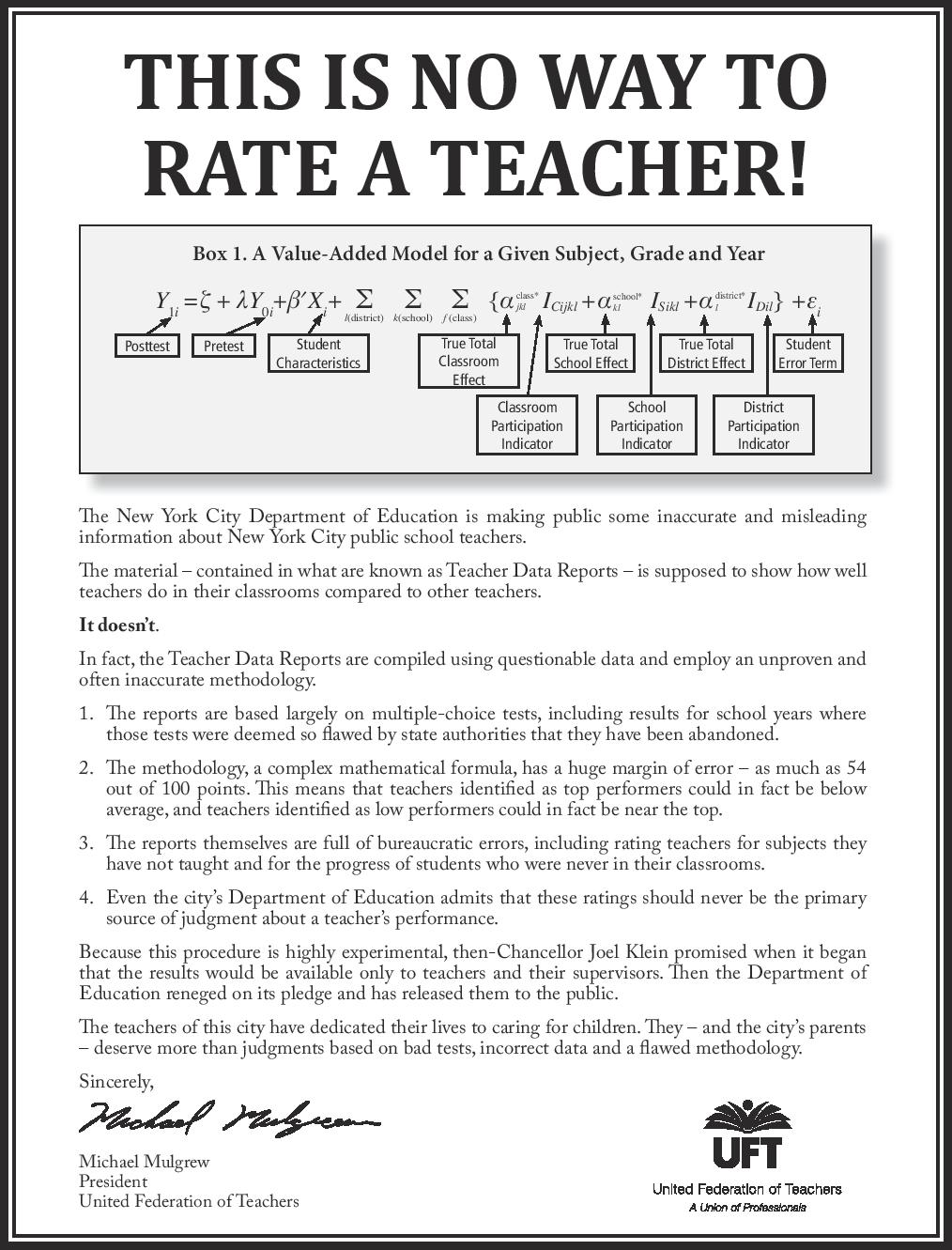


 mathbabe