Archive
The flat screen TV phenomenon
Do you remember, back in 2005 or 2006 or even up to early 2008, how absolutely everyone seemed to be buying flat screen TVs? And not only one, they’d actually buy new ones when new models came out, or ones with different high definition properties. And not just people who could afford it, either. The marketers did an excellent job in somehow convincing people that they needed these flat screen TVs so bad that they should just put it on their credit cards, all 3 thousand dollars of it, or whatever those things cost.
I don’t know exactly how much they cost because I never bought one. The last TV we bought was in 1997 and it still works, for the most part, although it’s really hard to turn it on and off. When it finally kicks the bucket I’m thinking we go without a TV, since TV pretty much sucks anyway. When we do watch it, it’s for live sports (local, or nationally televised, since we don’t pay for cable). Baseball we watch or listen to on the computer.
I was reminded of the the “flat screen TV era” by my friend Ian Langmore the other day when we were discussing household debt amnesty. His argument against debt amnesty for consumers was that they might spend it on crappy things. His example was luxury dog poo, but I’ve been obsessed with the flat screen TV phenomenon ever since a friend of mine, who was $120,000 in debt and didn’t have a salary, somehow managed to buy a flat screen TV in 2007. It blew me away in terms of wasteful consumerism. Ian found this unbelievable blog which kind of sums up my concerns.
In Ian’s opinion, the danger of amnesty, or any system where money is put willy-nilly into the hands of consumers, is twofold:
1) We waste time on unproductive activities. E.g. people spent time buying/building cars that are unneeded.
2) If a miscalculation is made, then the over-leveraged money-go-round stops with a huge mis-balance. E.g. home mortgage crisis.
These are very good points, and put together form a lesson we somehow can’t learn, although perhaps that can be partially explained by this article.
I have two thoughts. First, I’m also uncomfortable putting money in the hands of irresponsible consumers. But the truth is, the way I see it is currently working, we are already putting money in the hands of irresponsible bankers (that’s what the term “injection of liquidity” really means), and they are not doing anything with it, so let’s try something else. In other words, an alternative unpleasant idea.
Second, I don’t think we are going to see a new wave of flat screen TV buying any time soon. If we put money into the hands of consumers right now, I think we’d see them pay down their debts, go to the doctor, and buy jeans for their kids. Of course, there is always someone whose pockets burn with cash, and they would waste money in any situation. Let’s face it, though, credit is tight right now compared to the mid-2000’s. In fact, since economists seem to have a tough time spotting bubbles until afterwards, maybe we can take “a huge part of the population starts buying useless gadgets on credit” as almost a definition, or at least a leading indicator. Then at least there would be some point to all of that wasteful spending.
Why and how to hire a data scientist for your business
Here are the annotated slides from my Strata talk. The audience consisted of business people interested in big data. Many of them were coming from startups that are newly formed or are currently being formed, and are wondering who to hire.
When do you need a data scientist?
When you have too much data for Excel to handle: data scientists know how to deal with large data sets.
When your data visualization skills are being stretched: as we will see, data scientists are skilled (or should be) at data visualization and should be able to figure out a way to visualize most quantitative things that you can describe with words.
When you aren’t sure if something is noise or information: this is a big one, and we will come back to it.
When you don’t know what a confidence interval is: this is related to the above; it refers to the fact that almost every number you see coming out of your business is actually an estimate of something, and the question you constantly face is, how trustworthy is that estimate?
Let’s take a step back: Should you need a data scientist?
Are you asking the right questions? Is there a business that you’re not in that you could be in if you were thinking more quantitatively? Big data is making things possible that weren’t just a few years ago.
Are you getting the most out of your data? In other words, are you sitting on a bunch of delicious data and not even trying to mine it for your business?
Are you anticipating shocks to your business? As we will see, data scientists can help you do this in ways you may be surprised at.
Are you running your business sufficiently quantitatively? Are you not collecting the data (or not collecting it in a centralized way) that would lead to opportunities for data mining?
So, you’ve decided to hire a Data Scientist (nice move!)
What do you need to get started?
Data storage. You gotta keep all your data in one place and in some unified format.
Data access — usually through a database (payoffs for different types). Specifically, you can pay for someone else to run a convenient SQL database that people know how to use walking in the door without much training, or you could set something up that’s open source and “free” but then it will probably take more time to set up and make take the data scientists longer to figure out how to use. The investment here is to create tools to make it convenient to use.
Larger-scale or less uniform data may require Hadoop access (and someone with real tech expertise to set it up). The larger your data is the more complicated and developed your skills need to be to access it. But it’s getting easier (and other people here at the conference can tell you all you need to know about services like this).
Who and how should you hire? It’s not obvious how to hire a data scientist, especially if your business so far consists of less mathematical people.
A math major? Perhaps a Masters in statistics? Or a Ph.D. in machine learning? If you’re looking for someone to implement a specific thing, then you just need proof that they’re smart and know some relevant stuff. But typically you’re asking more than that: you’re asking for them to design models to answer hard questions and even to figure out what the right questions are. For that reason you need to see that the candidate has the ability to think independently and creatively. A Ph.D. is evidence of this but not the only evidence- some people could get into grad school or even go for a while but decide they are not academically-minded, and that’s okay (but you should be looking for someone who could have gotten a Ph.D. if they’d wanted to). As long as they went somewhere and challenged themselves and did new stuff and created something, that’s what you want to see. I’ll talk about specific skills you’d like in a later section, but keep in mind that these are people who are freaking smart and can learn new skills, so you shouldn’t obsess over something small like whether they already know SQL.
What should the job description include? Things like, super quantitative, can work independently, know machine learning or time series analysis, data visualization, statistics, knows how to program, loves data.
Who even interviews someone like this? Consider getting a data scientist as a consultant just to interview a candidate to see if they are as smart as they claim to be. But at the same time you want to make sure they are good communicators, so ask them to explain their stuff to you (and ask them to explain stuff that has been on your mind lately too) and make sure they can.
Also: don’t confuse a data scientist with a software engineer! Just as software engineers focus on their craft and aren’t expected to be experts at the craft of modeling, data scientists know how to program in the sense that they typically know how to use a scripting language like python to manipulate the data into a form where they can do analytics on it. They sometimes even know a bit of java or C, but they aren’t software engineers, and asking them to be is missing the point of their value to your business.
What do you want from them?
Here are some basic skills you should be looking for when you’re hiring a data scientist. They are general enough that they should have some form of all of them (but again don’t be too choosy about exactly how they can address the below needs, because if they’re super smart they can learn more):
- Data grappling skills: they should know how to move data around and manipulate data with some programming language or languages.
- Data viz experience: they should know how to draw informative pictures of data. That should in fact be the very first thing they do when they encounter new data
- Knowledge of stats, errorbars, confidence intervals: ask them to explain this stuff to you. They should be able to.
- Experience with forecasting and prediction, both general and specific (ex): lots of variety here, and if you have more than one data scientist position open, I’d try to get people from different backgrounds (finance and machine learning for example) because you’ll get great cross-pollination that way
- Great communication skills: data scientists will be a big part of your business and will contribute to communications with big clients.
What does a Data Scientist want from you? This is an important question because data scientists are in high demand and are highly educated and can get poached easily.
Interesting, challenging work. We’re talking about nerds here, and they love puzzles, and they get bored easily. Make sure they have opportunities to work on good stuff or they’ll get other jobs. Make sure they are encouraged to think of their own projects when it’s possible.
Lots of great data (data is sexy!): data scientists love data, they play with it and become intimate with it. Make sure you have lots of data, or at least really high-quality data, or soon will, before asking a data scientist to work for you. Data science is an experimental science and cannot be done without data!
To be needed, and to have central importance to the business. Hopefully it’s obvious that you will want your data scientists to play a central role in your business.
To be part of a team that is building something: this should be true of anyone working in business, especially startups. If your candidate wants to write academic papers and sit around while they get published, then hire someone else.
A good and ethically sound work atmosphere.
Cash money. Most data scientists aren’t totally focused on money though or they would go into finance.
Further business reasons for hiring a Data Scientist
Reporting help: automatically generated daily reports can be a pain to set up and can require lots of tech work and may even require a dedicated person to generate charts. Data scientists can pull together certain kinds of reports in a matter of days or weeks and generate them every day with cronjobs. Here’s a sample picture of something I did at my job:
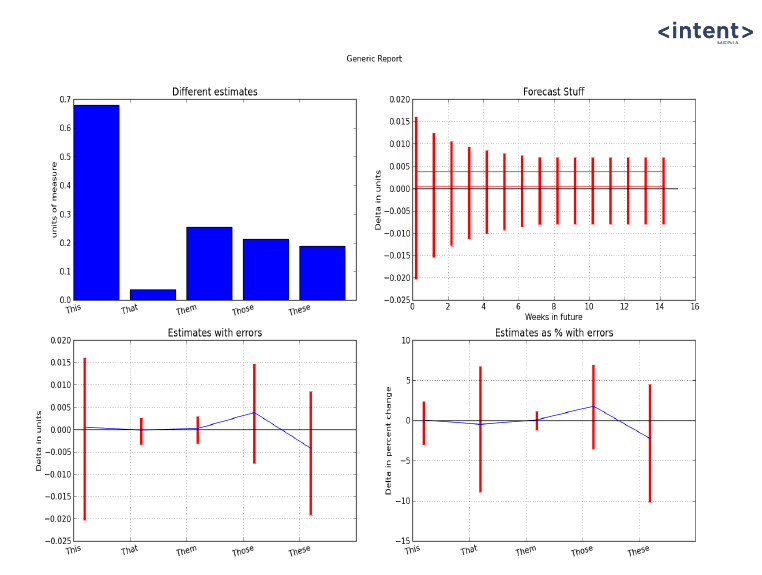 Having a data scientist enables you to see into data without taxing your tech team (beyond setup) via visualizations and reports like the above.
A/B testing: data scientists help you set up A/B testing rigorously.
Beyond A/B testing: adaptability and customization. What you really want to do is get beyond A/B testing. Instead of having the paradigm where customers come to the ad and respond in a certain way, we want to have the (right) ad come to the customer.
Knowing whether numbers are random (seasonality) or require action. If revenue goes down in a certain week, is that because of noise? Or is it because it always goes down the week after Labor Day? Data scientists can answer questions like this.
What-if analysis: you can ask data scientists to estimate what would happen to revenue (or some other stat) if a client drops you, or if you gain a new client, or if someone doubles their bid at an auction (more on this later).
Help with business planning: Will there be enough data to answer a given question? Will there be enough data to optimize on the answer? These are some of the most difficult and most important questions, and the fact that a data scientist can help you answer them means they will be central to the business.
Education for senior management: senior people who talk to and recruit new clients will need to be able to explain how to think about the data, the signals, the stats, and the errorbars in a rigorous and credible way. Data scientists can and should take on the role of an educator for situations like this.
Mathematically sound communication to clients: you may have situations where you need the data scientists to talk directly to clients or to their data scientists. This is yet another reason to make sure you hire someone with excellent communication skills, because they will be representing your business to really smart people who can see through bullshit.
Case Study: Stress Tests
We can learn from finance: the idea of a stress test is stolen directly from finance, where we look at how replays of things like the credit crisis would affect portfolios. I wanted to do something like that but for general environmental effects that a business like mine, which hosts an advertising platform, encounters.
You know how big changes will affect your business directionally and specifically. But do you know how combinations will play out? Stress tests allow you to combine changes and estimate their overall effect quantitatively. For example, say we want to know how lowering or raising their bids (by some scalar amount) will effect advertisers impression share (the number of times their ads get displayed to users). Then we can run that as a scenario (for each advertiser separately) using the last two weeks (say) of auction data with everything else kept the same, and compare it to what actually happened in the last two weeks. This gives an estimate of how such a change would affect impression change in the future. Here’s a heat map of possible results of such a “stress test”:
 This shows a client-facing person that Advertiser 13 would benefit a lot from raising their bid 50% but that Advertiser 12 would suffer from lowering their bid.
We could also:
- run scenarios which combine things like the above
- run scenarios which ask different questions: how would advertisers be affected if a new advertiser entered the auction? If we change the minimum bid? If one of the servers fails? If we grow into new markets?
- run scenarios from the perspective of the business: how would revenue change if the bids change?
In the end stress tests can benefit any client-facing person or anyone who wants to anticipate revenue, so across many of the verticals of the business.
I never sit on the subway
I remember when I moved to New York in 2005. I found it intimidating and shocking how aggressively people vied for seats on the subway. I live near Columbia so the 1 train is my line, and of course everyone thinks their subway line is the most overused and crazy line, but in this case I’m right. I came from Boston, where we have subways too, four little itty bitty ones, and we are extremely polite to each other and, in particular, we never touch. By contrast here were these New Yorkers not only touching but literally squeezing into these tiny seats and sweating all over each other in the summer.
After about 3 months of living here I got really into it. I was in love with this city, and every gritty thing about it, and I considered the shared experience of the subway a sign of a larger public communistic love. Here they were, people from all walks of life, sharing their sweat! Isn’t it beautiful?
That kind of admiration only grew in the two years I stayed a professor at Barnard, which meant I almost never left the cozy neighborhood of Morningside Heights, so subway rides were rather rare, amusing events. I loved the subway and I developed theories about when people start talking on the subway (in three situations: 1) someone who is incredibly smelly gets off the train and everyone needs to talk about how smelly they were, 2) someone who is incredibly sick and coughing up a lung gets off the train and everyone has to talk about how sick and nasty they were, and 3) the train stops in the tunnel and the announcer tells us we have no idea when we will be able to move, and everyone has to talk about their stuck-in-a-tunnel-during-9/11 experiences.)
As soon as I started working at D.E. Shaw in midtown, and commuted during rush hour, I got real. I figured out exactly where to stand, and I mean exactly where on each platform, to maximize my chances of getting a seat once the train came. I figured out, depending on how many people were on which platform in Times Square, and the subsequent stations as we passed them, what the recent train traffic pattern had been in terms of the express 2/3 train and my local 1 train, and sometimes I’d do crazy things like get off the express train early to get on the 1 train because I’d anticipate that if I waited til 96th street like everyone else, there would be no chance I could get on the 1 train. Actually looking back, I almost never sat down at all during these commutes, even when I was pregnant.
Which comes to the turn in my story. When I was heavily pregnant, commuting on the subway was actually hellish. I had no balance, and felt vulnerable, and being squished up against people with no place to hold on was really scary. For the most part commuters are a selfish bunch, and people sitting would pretend not to notice me, so they wouldn’t have to give up their seat. I promised myself I’d never be that jerk.
For the last two weeks of my pregnancy I took a cab to work every day, but even so coming home was another story, since it’s hard to get a cab in Times Square at 5pm. I remember one time some asshole in a suit actually ran to grab a cab that had stopped for me, and he beat me because… I was 9 months pregnant and couldn’t keep up with him. I started crying, on the street, until this nice pedicab guy pulled over and asked me if he could help. I told him I lived all the way uptown and he biked me around until he found me a cab; he refused to let me pay. I still love that guy.
Once I started down the road of getting up for pregnant people, though, it was a short logical step to never sitting down again. After all, there are all kinds of hidden reasons people may need to sit down more than I do. What if their feet are killing them after standing all day at work? What if they have balance problems?
For a while I decided it’s okay to sit if everyone else had an available seat. That seemed safe. But then I’d be sitting there, spaced out or reading, with a sea of empty seats around me, and all of a sudden a huge group of people would converge and somehow I’d be face to face with someone with a murderous look which said, you motherfucker you’re sitting in my seat. In the end, it’s become my policy to just never sit down.
I do of course still think about the question of where’s the best place to stand in the subway. This is a whole different optimization play, which for intellectual property reasons I won’t share with you all, since I don’t want more competition than I already have. Just one hint: don’t get on in the middle of the car. Always get on at one of the ends.
In German beard circles, tensions are high.
Best article ever about beards.
Are SAT scores going down?
I wrote here about standardizing tests like the SAT. Today I wanted to spend a bit more time on them since they’ve been in the news and it’s pretty confusing what to think.
First, it needs to be said that, as I have learned in this book I’m reading, it’s probably a bad idea to make statements about learning when you make “cohort-to-cohort comparisons” instead of following actual students along in time. In other words, if you compare how well the 3rd grade did in a test one year to the next, then for the most part the difference could be explained by the fact that they are different populations or demographics. Indeed the College Board, which administers the SAT, explains that the scores went down this year because more and more diverse kids are taking the test. So that’s encouraging, and it makes you think that the statement “SAT scores went down” is in this case pretty meaningless.
But is it meaningless for that reason?
Keep in mind that these are small differences we’re talking about, but with a pretty huge sample size overall. Even so, it would be nice to see some errorbars and see the methodology for computing errorbars.
What I’m really worried about though is the “equating” part of the process. That’s the process by which they decide how to compare tests from year to year, mostly by having questions in common that are ungraded. At least that’s what I’m guessing, it’s actually not clear from their website.
My first question is, are they keeping in mind the errors for the equating process? (I find it annoying how often people, when they calculate errors, only calculate based on the very last step they take in a very sketchy overall process with many steps.) For example, is their equating process so good that they can really tell us with statistical significance that American Indians as a group did 2 points worse on the writing test (see this article for numbers like this)? I am pretty sure that’s a best guess with significant error bars.
Additional note: found this quote in a survey paper on equating methodologies (top of page 519):
Almost all test-equating studies ignore the issue of the standard error of the equating
function.
Second, I’m really worried about the equating process and its errorbars for the following reason: the number of repeat testers varies widely depending on the demographic, and also from year to year. How then can we assess performance on the “linking questions” (the questions that are repeated on different tests) if some kids (in fact the kids more likely to be practicing for the test) are seeing them repeatedly? Is that controlled for, and how? Are they removing repeat testers?
This brings me to my main complaint about all of this. Why is the SAT equating methodology not open source? Isn’t the proprietary “intellectual property” in the test itself? Am I missing a link? I’d really like to take a look. Even better of course if the methodology is open source (as in there’s an available script which actually computes the scores starting with raw data) and the data is also available with anonymization of course.
Do higher taxes kill jobs?
Being a mathematician, I find myself forced to consider statements like “higher taxes kill jobs” as statements of theorems with missing stated assumptions. How could you fill in the assumptions and prove this theorem?
First I think about extreme cases- sometimes extreme situations need fewer assumptions, they kind of spill out as obvious. So here’s one, the tax rate is at 80%, what would happen if we raised taxes? My first reaction is, 80%!? That must mean you have way too much government and regulation and for those reasons businesses are probably already quite pinned down and don’t have lots of freedom- don’t tax them more, that will make their good ideas (if they have them) all the more suffocated. Just think of the paperwork you’d need to go through in a society that government-heavy, to hire someone.
What’s another extreme case? How about taxes are super low, more like fees for doing business. Then no, I don’t think raising them a moderate amount would kill jobs at all, in fact it may introduce enough government to make things less wild west and safer for businesses to operate.
So in other words at some level I buy the anti-regulation anti-government angle. I don’t want super duper high taxes because I think it encourages too much bureaucracy and that stuff is boring (but some amount of it is necessary to make things safe).
Moreover I’m assuming that governments generally use taxes to protect people from food poisoning and the like, regulate to force companies to play fair, and as social safety nets when things go bad, and that they’re not particularly efficient. Those of course are my assumptions, which anyone can disagree with.
But in terms of proving my theorem, I’m stuck thinking it’s more like, there’s some point in between very low and very high taxes where it gradually becomes true that raising taxes more will indeed start to kill jobs.
How about our situation now? Right now we have pretty low taxes by historical measures, and moreover the known loopholes mean that businesses (especially big ones with fancy lawyers) pay much less than their stated tax rate.
Why, in this case, would a moderate bump in their tax rates kill jobs?
Here’s a possible argument: if higher taxes actually encourage more regulation, then that could be a major problem for smaller businesses, who don’t have the margin for dealing with hiring that many lawyers for compliance issues. Although this article argues that “regulation kills jobs” is an invalid statement in general.
Pet peeve of mine: when you hear conservatives talk about killing jobs, they often frame it in terms of struggling small businesses, often run by a woman. But it’s easy enough to imagine that we introduce taxes and regulation that are easier for small businesses to avoid smothering them. It’s really the huge businesses that we want to see start hiring, and it’s the huge businesses that pay so little taxes.
Here’s another one: if you raise taxes people will spend their cash on taxes instead of hiring people. But wait, that doesn’t apply right now when we have so much frigging cash on hand (and hidden in other countries). In other words, companies are not not hiring people for cash flow reasons, it’s because they don’t see the demand.
In the end I can’t see how to prove or even argue that theorem, assuming today’s conditions. Would love to hear the argument I’m missing.
Back from Strata Jumpstart
So I gave my talk yesterday at the Strata Jumpstart conference, and I’ll be back on Thursday and Friday to attend the Strata Conference conference.
I was delighted to meet a huge number of fun, hopeful, and excited nerds throughout the day. Since my talk was pretty early in the morning, I was able to relax afterwards and just enjoy all the questions and remarks that people wanted to discuss with me.
Some were people with lots of data, looking for data scientists who could analyze it for them, others were working with packs of data scientists (herds? covens?) and were in search of data. It was fun to try to help them find each other, as well as to hear about all the super nerdy and data-driven businesses that are getting off the ground right now. It certainly was an optimistic tone, I didn’t feel like we were in the middle of a double-dip recession for the entire day (well, at least til I got home and looked at the Greek default news).
Conferences like these are excellent; they allow people to get together and learn each others’ languages and the existence of the new tools and techniques in use or in development. They also save people lots of time, make fast connection that would otherwise difficult or impossible, and of course sometimes inspire great new ideas. Too bad they are so expensive!
I also learned that there’s such thing as a “data scientist in residence,” held of course by very few people, which is the equivalent in academic math to having a gig at the Institute for Advanced Study in Princeton. Wow. I still haven’t decided whether I’d want such a cushy job. After all, I think I learn the most when I have reasonable pressure to get stuff done with actual data. On the other hand maybe that much freedom would allow one to do really cool stuff. Dunno.
How do you standardize tests?
I’m reading an interesting book by Douglas Harris about the value-added model movement, called Value-added Measures in Education, available here from Harvard Education Press. Harris goes into a very reasonable critique of how “snapshot” views of students, teachers, and school are a very poor assessment of teacher ability, since they are absolute measurements rather than changes in knowledge. Kind of like comparing the Dow to the S&P and concluding that you should definitely invest in Dow stocks since they are ten times better, it’s all about the return on a test score or an index, not the absolute number, when you are trying to gauge learning or profit.
His goal of the book is to explain how value-added models work, how they measure learning, how the take into account things like poverty level and other circumstances beyond the control of the school or the teachers, and other such factors. In his introduction he also promises not to be unreasonable about applying the results of these tests beyond where it makes sense. He certainly seems to be a smart guy; smart enough to know about errors and the problems with badly set up incentives – he uses the financial crisis as a model of how not to do it. I’m hopeful!
Here’s what I am interested in talking about today, which is how the “standardized” gets into standardized testing, because already at this point the mathematical modeling is pretty tricky (and involves lots of choices). There are many ways a test is ultimately standardized, assuming for simplicity that it’s a national test given at many grade levels yearly (pretend it’s an SAT that every grade takes):
- the test is normalized for being harder or easier than it was last year, for each grade’s test separately, and sometimes per question as well,
- the grading is normalized so that a student who learns exactly as much “as is expected” gets the same grade from year to year, and
- the grading is further normalized so that a student who gets 10 more points than expected in 3rd grade is doing as well as if she got 10 extra points in 4th grade.
One way of accomplishing all of the above would be to draw a histogram of raw results per year and per grade and normalize that distribution of raw scores by some standard mean and standard deviation, just as you would make a normal distribution standard, i.e. mean 0 and standard deviation 1. In fact, go ahead and demean it and divide by the standard deviation. That’s the first thing I’d do.
But if you actually do that, then you lose lots of the information you are actually trying to glean. Namely, how could you then conclude if students are doing better or worse than last year? I’m sure you’ve seen the recent news that SAT scores have fallen this year from last. I guess my question is, how can they tell? If we do something as simple as what I suggested, then the definition of doing as well “as is expected” is that you did “as well as the average person did”. But clearly this is not what the SAT people do, since they claim people aren’t doing as well as they used to. So how are they standardizing their test?
It isn’t really explained here or here, but there are clues. Namely, if you give 3rd and 4th graders some of the same questions on a given year, then you can infer how much better 4th graders do on those questions than 3rd graders do, and you can use that as a proxy for how to scale between grades (assuming that those questions represent the general questions well). Next, since you can’t repeat questions (at least questions that count towards the score) between years, because the stakes are too high and people would cheat, you can instead have ungraded sections that have repeated questions which give you a standard against which to compare between years. In fact the SAT does have ungraded sections, and so did the GREs as I recall, and my guess is this is why.
That brings up the question, do all standardized tests have ungraded sections? Is there some other clever way to get around this problem? Also in my mind, how well does standardization work, and what is a way to test it?
What the hell is going on in Europe?
This week has been particularly confusing when it comes to the European debt crisis. It’s complicated enough to think about the various countries, with their various current debt problems, future debt problems, and austerity plans, not to mention how they typically interact at the political level versus how the average citizen is affected by it all. But this week we’ve seen weird and coordinated intervention by a bunch of central banks to address a so-called “liquidity crisis”.
What is this all about? Is it actually a credit crisis disguised as a liquidity crisis? Is it just another stealth way to bail out huge banks?
I’m going to take a stab at answering these questions, at the risk of talking out of my ass (and when has that ever stopped me?).
Finance is a big messy system, and it’s hard to know where to begin on the merry-go-round of confusion, but let’s start with European banks since they are the ones in need of funding.
European banks have lots of euros on hand, just as American banks have lots of dollars, because of the actual deposits they hold. However, European banks invest in American things (like businesses) that need them to come up with short term funding denominated in dollars. Similarly American banks invest in Europe, but that’s not really relevant to the discussion yet.
How do European banks get these short term (3 month) loans? Historically they do a large majority of it through money-markets: much of the money people have in banks is funneled to huge vats called money markets, and the fund managers of those vats are very very conservatively trying to make a bit of interest on them. In fact they were burned in the credit crisis, when they famously “broke the buck” on Lehman short-term loans.
Well, guess what, those same American money managers are avoiding European short-term loans right now, because they are super afraid of losing money on them. So that source of funding has dried up. Note that this is a credit problem: the money market managers do not trust the banks to be around in 3 months.
Another source of funding for the European banks’ American investments has been just to use their euros, exchange them to dollars (the currency market is very very large and liquid, especially on this particular exchange), then wait until the term of the short-term financing is over, and then convert the dollars back to euros. What actually happens, in fact, is that they borrow euros (at the going rate of 1%), do the exchange, then financing, and then get their money back in the future.
The guys who work at the European banks and who do this short-term financing aren’t allowed to take on the risk that the exchange rate is going to violently change between now and when the short-term term is over. Therefore they need to hedge the risk, which means they have to have a guarantee that the dollars they get out at the end of the term will be turned into a reasonable number of euros.
This kind of guarantee is called a currency swap, and the market for those is also very large and liquid, but has been less liquid recently because of the one-sidedness of this problem: European banks need short-term dollars but American banks don’t need euros at the same rate at the same maturity. So the end result is that the swaps are very very expensive for European banks.
Let’s put this another way, the way that seems strangest and most confusing: right now the European banks can borrow at 1% in euros but at 4% in dollars (for three month maturity), and more generally the demand for USD seems to be skyrocketing recently from all over the place. Does this mean there’s an arbitrage opportunity somewhere? The swaps market is at 3% so no obvious arbitrage. More likely it means that the markets are expecting the exchange rate to drastically change, or at least they are pricing in the risk of it changing violently in the very near future. (The strangest thing to me is why it hasn’t just changed the spot exchange rate as well.)
By the way, a pet peeve or two I have with people talking about arbitrage: firstly, many people use the term so loosely it means nothing at all, as when they take risk over time (exposing themselves to the possibility of an exchange rate change for example). But even here, I’m misusing the term, since in an arbitrage it’s literally supposed to be a way to make money risk-free, but the whole point of my post is that this is really all about counter-party risk! In other words, there’s no arbitrage opportunity to get into contracts with people where you’d make money except if they go bankrupt tomorrow, when there’s a good chance that will happen.
The bottomline is that although the ECB and the Fed and the other central banks have spun this as a coordinated effort to help out a liquidity squeezed but functional market, it doesn’t pass the smell test. What’s actually happening is that the shoddy accounting and investments of French banks and others is not being trusted by American money market managers who are wise to them.
One more thing: the collateral being asked of the European banks is purportedly of low standard, which is to say the ECB is allowing thing like Greek debt as collateral, which wouldn’t past muster with other institutions (or with U.S. money markets!). In that sense this can be seen as a stealth bailout, although I think not the first one in Europe under that definition. This isn’t going away until they figure out how to deal with the Greek debt problem.
Household debt amnesty?
It’s Saturday morning, which means it’s time to conduct a thoroughly absurd thought experiment just for the sake of argument. Today I want to consider the idea of a widespread household debt amnesty: everyone who owes money on their credit cards and payday loans and also perhaps mortgage will be forgiven their debt (although mortgages would have to be rewritten rather than forgiven). What would happen next?
I was discussing this very question, and David Graeber’s book (still not finished- it’s long!) with a friend of mine, specifically how Graeber cites ancient Sumerian civilization as having periodically enacted household debt amnesties to avoid the collapse of their cities (specifically to avoid the debtors from fleeing the cities to avoid their debt problems).
One thing that I realized in that conversation is that, whereas Graeber mentions that it was historically an amnesty for household debt only, so didn’t involve commercial debt between companies and merchants, what we’ve seen in this country in the past 3 years is something like the opposite of that concept. Our (large financial) companies have been granted special considerations while the people who had made the mistake of entering contracts with them have not. And the so-called mortgage modification process has not been sufficiently widespread yet to really consider it an example of this. There is an excellent article here which makes this point, although not in this context.
The objection my friend had to the idea of enacting such an amnesty was that it would be pouring good money after bad; he’s European so he cited the example of Greece, and how the more money Greece gets the more money they spend, so it’s an impossible situation.
Actually I think this is an appealing analogy to make, but it’s a false one. Greece has a large-scale system in place, and giving them money without changing that system clearly isn’t going to solve any long term problems- it just kicks the can down the road.
However, it’s really different with consumer debt (credit cards etc.). Namely, the “system” that a given consumer enters into is a simple relationship (contract) with the credit card company in question. If the debt is forgiven, then the credit card company doesn’t have any obligation to extend more credit to that person. And in many cases, it wouldn’t.
I think the consequences of a household debt amnesty would be something along these lines:
- People who were previously in debt would have some cash on hand and would be able to spend it on consumer stuff (that they can actually afford with no credit) instead of spending it all on minimum payments to old credit card debt
- Credit card companies, burned from their losses, wouldn’t give them new credit cards, or would change the payment arrangements to make sure they got their money back faster
- Since they have no credit, those people who essentially be living in a cash-dominated society. This may actually be a good thing, because it would force people to budget in real time.
- Eventually people could rebuild a credit score over time if they decided to try credit again
In other words, that’s really not so bad and would get money flowing through the system again, which might help with our current recession.
Of course not everyone would be happy about a household debt amnesty. In particular the people who aren’t debtors would feel pretty burned that they’ve been careful (or lucky) with their money and aren’t getting a free ride. And the credit card companies would have to eat a lot of loss. On the other hand they’re going to eat (and have eaten) a lot of loss already, and the slowness of this process is killing the economy.
Is there a way we could set it up to make this work? Even if we ignore the political obstacles?
Guest Post: What is a family?
By guest blogger rwitte
The social structures commonly talked about when discussing finance and economics include individuals, governments and corporations. However the most social structure is family, since it is the structure that results in the perpetuation of society. I was reminded of this by a recent link that mathbabe posted here. And since she invited me to write a guest post, it inspired me to mouth off about family.
What do you think of when someone uses the word family? I am guessing that you think of the so-called nuclear family consisting of a husband a wife and a variable number of children. For sure their are many variants including one-parent families and gay families, but the ideal is thus. It wasn’t always so. I am a fifty year old male of Ashkenazi Jewish descent. In that community my generation is the first to have prioritise the needs of small nuclear families. My grandmother’s idea of family was a much larger group, extending over several generations, and with a healthy side-order of cousins, aunts etc. My wife is Jaimaican, and her mother’s conception of family is similar to my grandmother’s (except the Jamaican version is even more matriarchal because so many of the fathers are absent).
I don’t know if you have ever seen a family home from a hundred and fifty or more years ago. You will be surprised at the size; there are more rooms for a family, at any level in the social scale. This is because the experiences of my wife and I are not unique, they are just a few generations later than those of the majority. Until relatively recently, as in most ‘primitive’ societies, the family is the extended family, and you will commonly find three or four generations living together.
I think the organisation of society into extended families was a great idea, and that the fragmentation into nuclear families sucks. But before I explain what’s so terrible about them I want to take a paragraph to explain why I think the change occured in the first place. Nuclear families are small and relatively mobile. As industrialization progressed and first transcontinental and then transglobal corporations formed, it suited their purpose to be able to move and resettle employees between different sites in their empires. At the other end of society the pull of the factories was encouraging many to move from rural areas to the big city. This also fragmented extended families; the units that moved were nuclear. As a process in the developed countries, it probably peake in the 1950s or 1960s, but it is still going on now in developing countries such as China.
The original myth of the nuclear family was one in which the male was the breadwinner and married women stayed home to provide full time childcare. This idea, obviously sexually discriminatory, is certainly a myth. It has never been the case that poor couples could support themselves on one person’s wages. Manual labour has never been that well payed. And since the rich typically had access to nannies, only a thin stratum of society has ever organized childcare this way.
Today, in an attempt to paper over the cracks in this story, a new myth has arisen. Namely, the ‘superwoman’ who has it all: career, children, and social life (it only take 28 hours a day eight days a week!). In actual fact this myth is probably even more dangerous than the previous one, because millions of women are now trying to live up to this impossible ideal. When they don’t overachieve these impossibly demanding targets, they feel guilty and inadequate. For some, serious mental health issues can ensue as the buckle under the pressure.
We often complain about the poor quality of life our society offers to our elders. They get stuck in some retirement home quitely out of sight where they can slowly die of boredom. The middle classes must pay for child-care and the exorbitant prices push them towards poverty. Meanwhile poor parents simply cannot afford adequate child care and poor children roam the streets; ‘latch-key kids’ with no adequate supervision between the end of school and the parents’ return from the work. Some of these children get really out-of-control; getting involved with drugs, crime, and street-gangs in some combination. I don’t want to get too carried away with arguments about ‘the youth of today’ because the rose-tinted vision painted nostagia never was, but still I hear the cries, something must be done.
I believe that we can overcome all these social problems by returning to a social organisation based on extended families. The grandparents can look after the children while the able-bodied parents go out to work. This leads to an interesting and fulfilling retirement, in which they can pass on the wisdom that they have accumulated over the years to a willing audience. The children get an educational, loving and supportive home-life which will help them to grow up honest and secure. And the fittest adults can commit 100% to the workforce increasing social productivity.
Of course it may be that the grandparents are still too young to retire and the great-grandparents take on the responsibility. Or maybe a cousin or Aunt who particularly enjoys childcare can set up a sort of family creche. Perhaps all the adults work and coordinate their days off in a rota so that who looks after the children depends on the day of the week. Nobody would be surprised to discover that while all families have much in common, every family is different. The role of the greater society is as to encourage and enable relatives to remain geographically close to each other. It would be up to each particular family to work out how to organise themselves for their own convenience (although there is some evidence to suggest that children brought up by maternal grandparents are more psychologically secure than those brought up by paternal grandparents).
Modern advances in information and communication technology may render a society with less geographical relocation of people possible. You don’t have to be in the same office to work with somebody (hell, you don’t even have to be in the same continent). Instead of workers having to move around the globe, they can stay with their parents and children while their information flows around the internet and other computing networks, more quickly, conveniently and cheaply.
Politics: the good news and the bad news
I love Elizabeth Warren. I think she’s real, she cares about people, she’s smart and tough, and she’s incorruptible. The bizarre news, under these circumstances, is that she’s running for Congress. Is she too good to win in politics? Don’t you have to be a slime ball? Don’t you need to attract and sell out to megacorporations to succeed? We shall see. It could be really great.
And just in case you think I’m being too cynical, please read this. It’s an absolutely stunning, depressing insider’s view of the Republic Party from Mike Lofgren, who retired in June after 28 years as a Congressional staffer, having served 16 years as a professional staff member on the Republican side of both the House and Senate Budget Committees.
The pandas module and the IPython notebook
Last night I attended this Meetup on a cool package that Wes McKinney has been writing (in python and in cython, which I guess is like python but is as fast as c). That guys has been ridiculously prolific in his code, and we can all thank him for it, because pandas looks really useful.
To sum up what he’s done: he’s imported the concept of the R dataframe into python, with SQL query-like capabilities as well, and potentially with some map-reduce functionality, although he hasn’t tested it on huge data. He’s also in the process of adding “statsmodel” functionality to the dataframe context (he calls a dataframe a Series), with more to come soon he’s assured us.
So for example he demonstrated how quickly one could regress various stocks against each other, and if we had a column of dates and months (so actually hierarchical labels of the data), then you could use a “groupby” statement to regress within each month and year. Very cool!
He demonstrated all of this within his IPython Notebook, which seems to demonstrate lots of what I liked when I learned about Elastic-R (though not all, like the cloud computing part of Elastic-R is just awesome), namely the ability to basically send your python session to someone like a website url and to collaborate. Note, I just saw the demo I can’t speak from personal experience, but hopefully I will be able to soon! It’s a cool way to remotely use a powerful machine and not need to worry about your local setup.
What are the chances that this will work?
One of the positive things about working at D.E. Shaw was the discipline shown in determining whether a model had a good chance of working before spending a bunch of time on it. I’ve noticed people could sometimes really use this kind of discipline, both in their data mining projects and in their normal lives (either personal lives or with their jobs).
Some of the relevant modeling questions were asked and quantified:
- How much data do you expect to be able to collect? Can you pool across countries? Is there proxy historical data?
- How much signal do you estimate could be in that data? (Do you even know what the signal is you’re looking for?)
- What is the probability that this will fail? (not good) That it will fail quickly? (good)
- How much time will it take to do the initial phase of the modeling? Subsequent phases?
- What is the scope of the model if it works? International? Daily? Monthly?
- How much money can you expect from a model like this if it works? (takes knowing how other models work)
- How much risk would a model like this impose?
- How similar is this model to other models we already have?
- What are the other models that you’re not doing if you do this one, and how do they compare in overall value?
Even if you can’t answer all of these questions, they’re certainly good to ask. Really we should be asking questions like these about lots of projects we take on in our lives, with smallish tweaks:
- What are the resources I need to do this? Am I really collecting all the resources I need? What are the resources that I can substitute for them?
- How good are my resources? Would better quality resources help this work? Do I even have a well-defined goal?
- What is the probability this will fail? That it will fail quickly?
- How long will I need to work on this before deciding whether it is working? (Here I’d say write down a date and stick to it. People tend to give themselves too much extra time doing stuff that doesn’t seem to work)
- What’s the best case scenario?
- How much am I going to learn from this?
- How much am I going to grow from doing this?
- What are the risks of doing this?
- Have I already done this?
- What am I not doing if I do this?
Monday morning links
First, if you know and love the Statistical Abstract as much as I do, then help save it! Go to this post and follow the instructions to appeal to the census to not discontinue its publication.
Next, if you want evidence that it sucks to be rich, or at least it sucks to be a child of rich people, then read this absolutely miserable article about how rich people control and manipulate their children. Note the entire discussion about “problem children” never discusses the possibility that you are actually a lousy, money-obsessed and withholding parent.
Next, how friggin’ cool is this? Makes me want to visit Mars personally.
And also, how cool is it that the World Bank is opening up its data?
Finally, good article here about Bernanke’s lack of understanding of reality.
Working with Larry Summers (part 3)
Previously I’ve talked about the quant culture of D.E. Shaw as well as the tendencies of people working there. Today I wanted to add a third part about the experience of being “on the inside looking out” during the credit crisis.
I started my quant job in June 2007, which was perfect timing to never actually experience unbridled profit and success; within two months of starting, there was a major disruption in the market which caused enough momentary panic and uncertainty that the Equities group decided to liquidate their holdings. This was a big deal and meant they lost quite a bit of money on transaction costs as well as losing money because other investors were pulling out of similar trades at the same time.
The August 2007 market disruption was referred to internally as “the kerfuffle”. I’ve grown to think that this slightly dismissive term, which connotates more of an awkward misunderstanding than any real underlying problem, was indicative of a larger phenomenon. Namely, there was a sense that nothing really bad was afoot, that the system couldn’t be at risk, and that as long as we kept our trades on balance market neutral, we would be fine, except for possibly bizarre moments of exception. The tone would be something like, if an upper class man went to a restaurant and his credit card was denied- the waiter would return the credit card with almost an apology, assuming that it must have expired or something, that surely it is a mistake more than an exposure of underlying bankruptcy.
This framing of the world around us, as individual exceptional moments, as mysterious, almost amusing singularities in an otherwise smooth manifold, continued throughout the credit crisis (I left in May 2009), with the exception of the days after Lehman collapsed (Lehman was a 20% owner of D.E. Shaw at the time of its collapse, as well as a one of our major brokers).
But Lehman fell kind of late in the game, actually, for those in the industry. In other words there were months and months of disturbing signs, especially in the overnight lending market (where banks lend to each other for just the night or over the weekend) leading up to the Lehman moment. I remember one experience during those times that still baffles me.
It was a company-wide event, an invitation to see Larry Summers, Robert Rubin, and Alan Greenspan chat with each other and with us at the Rainbow Room in Rockefeller Center. It started with a lavish spread, fit for the dignitaries that were visiting, as well as introductory remarks wherein David Shaw described Larry Summer’s appointment as managing director at D.E. Shaw a “promotion” from being President at Harvard (just to be clear, this was a joke – even David Shaw isn’t that arrogant). In incredibly collegial terms, each of the three spoke for some time and reminisced about working together in the Clinton administration. Whatever, that’s not the important part, although it is kind of strange to think about now.
The important part, in retrospect, was later, near the end, when Alan Greenspan started talking about CMO‘s and how worried he was that anybody investing in them was in for a world of hurt. When I had gotten to D.E. Shaw, one of the first presentations I’d ever gone to was by a guy describing how he thought the same thing, and how we had divested ourselves of any such holdings, at least for the high-risk kind. So when Greenspan asserted these warnings, I sensed quite a bit of smugness in the crowd around me. It made me imagine us investors as a bunch of people playing illegal poker in the back of a club, where the smartest ones in the game get told a few minutes before the cops come and they leave out the back (except in this case it wasn’t actually illegal, and it was retired cops- Greenspan left the Fed at the end of 2006).
I wish I could remember when exactly that Rainbow Room event was, because I specifically remember Rubin saying absolutely nothing and looking uncomfortable when Greenspan was going on about CMOs and the danger in their future. Way later, it was revealed that Rubin, who was being paid obscene amounts by Citigroup at the time, claimed not to know about how toxic those mortgage-backed securities were (nor did he claim to know how much Citibank had invested in them- which begs the question of what he actually did for Citigroup) back when he could do something about it. He was booted in January 2009.
I wanted to mention one other specific thing I remember about this attitude of bemused nonchalance in the face of the world crumbling. When Lehman fell, and the overnight lending market froze for some weeks leading to government intervention, there was a term for this at D.E. Shaw, attributed (perhaps wrongly) to Larry Summers. Namely, the term was “magic liquidity dust”, implying that all we needed, to solve the problems around us and the apparent irrational panic of the markets, was for a fairy to come down to us and shake her wand, spreading this liquidity dust generously in our otherwise functional and robust system.
The saddest part of all of this is that, in a very real sense, these guys were essentially right not to worry. There has been no real restructuring of the system that led to this, just its continuation and backing.
In my next installation I’ll talk about why I think people in finance were, and to some extent still are, so insulated from reality.
Meetups
I wanted to tell you guys about Meetup.com, which is a company that helps people form communities to share knowledge and techniques as well as to have pizza and beer. It’s kind of like taking the best from academics (good talks, interested and nerdy audience) and adding immediacy and relevance; I’ve been using stuff I learned at Meetups in my daily job.
I’m involved in three Meetup groups. The first is called NYC Machine Learning, and they hold talks every month or so which are technical and really excellent and help me learn this new field, and in particular the vocabulary of machine learners. For example at this recent meeting, on the cross-entropy method.
The second Meetup group I go to is called New York Open Statistical Programming Meetup, and there the focus is more on recent developments in open source programming languages. It’s where I first heard of Elastic R for example, and it’s super cool; I’m looking forward to this week’s talk entitled “Statistics and Data Analysis in Python with pandas and statsmode“. So as you can see the talks really combine technical knowledge with open source techniques. Very cool and very useful, and also a great place to meet other nerdy startuppy data scientists and engineers.
The third Meetup group I got to is called Predictive Analytics. Next month they’re having a talk to discuss Bayesians vs. frequentists, and I’m hoping for a smackdown with jello wrestling. Don’t know who I’ll root for, but it will be intense.
Debt
So I’ve been reading David Graeber’s book about debt. He really has quite a few interesting and, I would say, wonderful points in his book, among them:
1) Debt came before money, often in the form of gift giving (you can read about this in his interview with Naked Capitalism)
2) In ancient cultures, and even in more recent cultures before the introduction of money, there were typically two separate spheres of accounting: the first was for daily goods like food and goats, which worked on the credit system, and the second for rearranging human relationships. Here there were things like dowries and symbolic exchanges of gold, meant to acknowledge the changing human relationship, but not as a “price” per se – because it was understood that you couldn’t put a price on a human.
3) Money as we know it is intricately tied in with slavery because it was when a person became a thing that could be sold for profit that we had a sense of price and when these two separate spheres were united. In particular the existence of money also implies the existence of a threat of violence. Moreover, it is this “decontextualizing” of people from their homes, their communities, and families who are forced into slavery that allows us to measure them with a dollar value, and in general it is only through pure decontextualizing that we can have a money system. It is this paradigm, where everyone and everything has no context, that economists rely on to describe the standard game theory of economics.
4) There are three social structures that people come into contact with in their daily lives and in which they give each other things: communistic, reciprocal, and hierarchical. For example, among parents and children, it is communistic; among a CEO and his workers it is often hierarchical, and among two strangers at a market it is reciprocal.
Even though I could (and might) write a post on any of the above points, because I find them each rich with stimulating and challenging concepts (and I haven’t even finished the book yet!), I want to first describe something Graeber mentions about the last one. Also, if someone is reading this that thinks I’ve misrepresented Graeber’s points then please comment.
Namely, Graeber mentions that, although we each have experience, and maybe lots of experience, in the three different social structures, when we tell the story of economics and exchange we invariably talk about reciprocal exchange. So, for example, I have three sons and I spend way more time hanging out with my sons, attending to their needs and making sure their infected toes are treated and helping them find their raincoats, then I spend at any market. In other words, if I were tallying up my contributions to things, my kids would be a far greater drain on my resources than groceries. But our “story” of how we give things and take things is inevitably about buying stocks or negotiating for a house price. In other words, we have been trained (by economists?) or we have trained ourselves to define exchange as a reciprocal, Austrian schoolish, “be selfish and take advantage whenever possible” endeavor, even when in the face of it we can’t claim to be like that.
Since I’m unwaveringly interested in how one tells the story of oneself, this fascinates me. It’s a really excellent example of how we are blind to the most obvious things. It also makes me think that economic theory has a loooong way to go before it can really explain meaningful things about “how things work”. After all, when you allow yourself to include “personal feelings” in your definition of giving and receiving, you realize that the reciprocal exchange part of your life is actually pretty insignificant, and in fact if that’s all that economists can even hope to explain (and it’s not clear they can), then there is more left unexplained than explained.
Moreover, the fact that we don’t see this as a failing (or at least a major hole) in the economic theory, because we are blind to it in ourselves, also immediately points to the possibility that we have overemphasized this aspect, the reciprocal exchange sphere, in our current economic system. In other words, if we had a healthy understanding of how the other two systems work (communistic and hierarchical) we may have developed them in parallel with the reciprocal system, and we may well be better off for it. We may even have an economics system that doesn’t reward rich people and punish poor people, who knows.
By the way, ridiculous and ignorant critique of Graeber’s book here (as in he didn’t read the book) with rebuff in comments by Graeber himself. Thanks to a commenter for that link!
Some cool links
First, right on the heels of my complaining about publicly available data being unusable, let me share this link, which is a FREAKING cool website which allows people to download 2010 census data in a convenient and usable form, and also allows you to compare those numbers to the 2000 census. It allows you to download it directly, or by using a url, or via SQL, or via Github. It was created by a group called Investigative Reporters and Editors (IRE) for other journalists to use. That is super awesome and should be a model for other people providing publicly available data (SEC, take notes!).
Next, I want you guys to know about stats.org, which is a fantastic organization which “looks at major issues and news stories from a quantitative and scientific perspective.” I always find something thought-provoking and exciting when I go to their website. See for example their new article on nature vs. nurture for girls in math. Actually I got my hands on the original paper about this and I plan to read it and post my take soon (thanks, Matt!). Also my friend Rebecca Goldin is their Director of Research (and is featured in the above article) and she rocks.
Along the same lines, check out straightstatistics.org which is based in the UK and whose stated goal is this: “we are a campaign established by journalists and statisticians to improve the understanding and use of statistics by government, politicians, companies, advertisers and the mass media. By exposing bad practice and rewarding good, we aim to restore public confidence in statistics. which checks the statistics behind news and politics.” Very cool.
Guest post: The gold standard
FogOfWar kindly wrote a guest post for me while I was on vacation:
First off, for anyone who hasn’t seen the first or second round of “Keynes vs. Hayek” in hip-hop style, please check them out, they’re hilarious.
There’s an economic crisis going on around us, and periodically one hears people suggesting that we go back to the gold standard. It’s a pretty complicated issue, and I don’t really have an answer to the “gold standard debate”–just probing questions and a lingering feeling that the chattering class has been dismissive when they should be seriously inquisitive. I think this dismissiveness is driven by the fact that Ron Paul is the leading political proponent of the gold standard and competing currencies, and he’s (1) a traditional conservative libertarian (a bit in the Goldwater vein); and (2) a bit of a wingnut.
Aristotle would be ashamed— the validity of an argument does not depend upon the person making the argument, but upon whether the ideas contained are valid or invalid. Andrew Sullivan recently linked to this article by Barry Eichengreen, claiming that it’s “a lucid explanation of why calls to go back to the gold standard are so misguided.” In fact, it’s a fairly serious examination of the gold standard (ultimately coming down “nay”), which is a welcome relief from the flippant and arrogant dismissiveness one usually sees from economic pundits.
As with many edited articles, I recommend skipping the first page and a half (begin from the paragraph starting “For this libertarian infatuation with the gold standard…”). Here’s how I think the article should have begun:
[T]he period leading up to the 2008 crisis displayed a number of specific characteristics associated with the Austrian theory of the business cycle. The engine of instability, according to members of the Austrian School, is the procyclical behavior of the banking system. In boom times, exuberant bankers aggressively expand their balance sheets, more so when an accommodating central bank, unrestrained by the disciplines of the gold standard, funds their investments at low cost. Their excessive credit creation encourages reckless consumption and investment, fueling inflation and asset-price bubbles. It distorts the makeup of spending toward interest-rate-sensitive items like housing.
But the longer the asset-price inflation in question is allowed to run, the more likely it becomes that the stock of sound investment projects is depleted and that significant amounts of finance come to be allocated in unsound ways. At some point, inevitably, those unsound investments are revealed as such. Euphoria then gives way to panic. Leveraging gives way to deleveraging. The entire financial edifice comes crashing down.
This schema bears more than a passing to the events of the last two decades.
First, I would reword that last sentence as follows: This schema bear a striking resemblance to the events of the last two decades. Moreover, I would add, in light of this data, one might ask not why fringe candidate Ron Paul is calling for examination of a return to the gold standard, but rather why this view is considered to be on the fringe rather than at the center of debate. There are a number of reasons to believe that a return to the gold standard might not have the desired effect, although that certainly begs the question of what can be done to prevent future crisis on the order of 2008.
I’d place myself in the camp of “not convinced that the gold standard is the answer, but think it would be really hard to fuck up the economy as bad as the Fed did over the last 20 years even if you were trying, so maybe it’s an idea that deserves some real thought.”
Here’s another key paragraph:
Society, in its wisdom, has concluded that inflicting intense pain upon innocent bystanders through a long period of high unemployment [by allowing bubbles to work themselves out as Austrians advocate] is not the best way of discouraging irrational exuberance in financial markets. Nor is precipitating a depression the most expeditious way of cleansing bank and corporate balance sheets. Better is to stabilize the level of economic activity and encourage the strong expansion of the economy. This enables banks and firms to grow out from under their bad debts. In this way, the mistaken investments of the past eventually become inconsequential. While there may indeed be a problem of moral hazard, it is best left for the future, when it can be addressed by imposing more rigorous regulatory restraints on the banking and financial systems.
This gets to the crux of Eichengreen’s argument, but consider the following points:
- The “help” proposed by Keynsians in fact might make things worse in the long term (not out of malice, but the road to hell is paved with good intentions) by dragging out the inevitable consequences of misallocation during the bubble. In essence, this is a ‘rip the band-aid’ off argument. I think I’ve seen some historical analysis that the total damage done from a bank-solvency driven recession is, in fact, worse over time if extended rather than allowing banks to fail and recapitalize (Sweden vs. Japan).
- “… nor is precipitating a depression…” It’s taken as an article of faith that we would have been in a depression if not for the stimulus package, but I’m skeptical. This is and will always be a theoretical “what if” analysis, conducted by economists who have a cognitive bias in favor of a certain answer (and, for those working in government, a President who needs to juke the stats to get reelected).
- “While there may indeed be a problem of moral hazard it is best left for the future, when it can be addressed by imposing more rigorous regulatory restraints on the banking and financial system.” Whaaaaaaaaat? This is where Keynesians lose me. The sentence is so hopelessly naïve that it undermines the entire argument. Take your nose out of your input-driven models for a minute and take a look around and ask yourself how good a track record bank regulators have at imposing “more rigorous regulatory restraints” during boom times; major new regulatory changes only have political will during a crisis (Securities Act of ’33, Exchange Act of ’34, Glass-Steagall in ’34). I’m not going to argue the relative benefits of economic models when the theory is premised on a factual event that’s very likely not going to happen.
Here’s a paragraph I liked:
Bank lending was strongly procyclical in the late nineteenth and early twentieth centuries, gold convertibility or not. There were repeated booms and busts, not infrequently culminating in financial crises. Indeed, such crises were especially prevalent in the United States, which was not only on the gold standard but didn’t yet have a central bank to organize bailouts.
The problem, then as now, was the intrinsic instability of fractional-reserve banking.
This is a really good point; I don’t have an answer and it ties in to a lot of deep questions about the structure of the banking system and “what is money”. I do like that it’s being discussed, and I’d love to hear views (educated and layman alike) on “so if the gold standard won’t work and the Fed fucked things up so bad, what do you suggest?”
Lastly, here’s the end of the piece:
For a solution to this instability, Hayek himself ultimately looked not to the gold standard but to the rise of private monies that might compete with the government’s own. Private issuers, he argued, would have an interest in keeping the purchasing power of their monies stable, for otherwise there would be no market for them. The central bank would then have no option but to do likewise, since private parties now had alternatives guaranteed to hold their value.
Abstract and idealistic, one might say. On the other hand, maybe the Tea Party should look for monetary salvation not to the gold standard but to private monies like Bitcoin.
Um, for the record that’s long been the position of Paul. See for example this. Moreover, I think the author isn’t aware that there may be significant legal obstacles to create a competing currency.
I don’t have an answer to the many questions raised here, but they’ve been on my mind a lot. Any thoughts?
FoW


 mathbabe