Archive
Apologies to Adam Smith
Not a lot of time to write this morning what with the sledding schedule, but I thought you might like this:
How’s it going with the Volcker Rule?
Glad you asked.
Recall that Occupy the SEC is currently drafting a letter of public comment of the Volcker Rule for the SEC (for background on the Volcker Rule itself, see my previous post). I was invited to join them on a call with the SEC last week and I will talk further about that below, but first I want to give you more recent news.
Yves Smith at Naked Capitalism wrote this post a couple of days ago talking about a House Financial Services Committee meeting, which happened Wednesday. Specifically, the House Financial Services Committee was considering a study done by Oliver Wyman which warned of reduced liquidity if the Volcker Rule goes into effect. Just to be clear, Oliver Wyman was paid by a collection of financial institutions (SIFMA) who would suffer under the Volcker Rule to study whether the Volcker Rule is a good idea. In her post, Yves was discussed the meeting as well as Occupy the SEC’s letter to that Committee which refuted the findings of Oliver Wyman’s study.
Simon Johnson, who was somehow on the panel even though it was more or less stuffed with people who wouldn’t argue, had some things to say about how much it makes sense to listen to people who are paid to write studies in his New York Times column published yesterday. He also made lots of good arguments against the content of the study, namely about the assumptions going into it and how reasonable they are. From Simon’s article:
Specifically, the study assumes that every dollar disallowed in pure proprietary trading by banks will necessarily disappear from the market. But if money can still be made (without subsidies), the same trading should continue in another form. For example, the bank could spin off the trading activity and associated capital at a fair market price.
Alternatively, the relevant trader – with valuable skills and experience – could raise outside capital and continue doing an equivalent version of his or her job. These traders would, of course, bear more of their own downside risks.
If it turns out that the previous form or extent of trading existed only because of the implicit government subsidies, then we should not mourn its end.
The Oliver Wyman study further assumes that the sensitivity of bond spreads to liquidity will be as it was in the depth of the financial crisis, 2007-9. This is ironic, given that the financial crisis severely disrupted liquidity and credit availability more generally – in fact this is a major implication of the Dick-Nelson, Feldhutter and Lando paper.
If Oliver Wyman had used instead the pre-crisis period estimates from the authors, covering the period 2004-7, even giving their own methods the implied effects would be one-fifth to one-twentieth of the size (this adjustment is based on my discussions with Professor Feldhutter).
CSPAN taped the meeting, which was pretty long, but I’d suggest you watch minutes 50 through 57, where Congressman Keith Ellison took some of the panel to task for being, or acting, super dumb.
For whatever reason, Occupy the SEC wasn’t invited to the panel. You can read their letter that argues against Wyman’s study, which is on Yves’s post, or you can read this comment that one of the members of Occupy the SEC posted on Johnson’s NYTimes piece (“OW” refers to Oliver Wyman, the author of the paid study):
Your testimony at the hearings yesterday was a refreshing counterpoint to the other members of the panel.
On top of the flaws in the OW analysis you covered in the article, there was another misleading point that the OW report purported to prove.
The study focused on liquidity for corporate bonds, which SIFMA/OW characterized as ‘financing american businesses’ . But a quick review of the outstanding corporate bonds in the study reveals that the lions share of corporate bonds are CMOs and ABS. Additionally, the study reports that the majority of the holdings of corporate bonds are in the hands of the finance industry.
As a result the loss of liquidity anticipated by the SIFMA folks will mostly impact them, not the pensioners and soldiers (and their Congressmen) the bankers were trying to scare with the OW loss estimates.
If the banks are forced to withdraw as market makers for this debt, replacement market makers won’t enter until these bonds trade at much lower levels. These losses are currently stranded (and disguised) in the banking system, and by extension are inflating the value of the funds invested in these bonds.
It’s critical that the market making rules are clarified to ensure that liquidity provision for these instruments is driven out of the protected banks and into a transparent market where the mispricing will be corrected and the losses will be properly recognized.
So just to summarize, the Congressional committee listened to the results of a paid study talking about how bad the Volcker Rule would be for the market, when in fact it would be good for the market to be uninsured and realistic.
I’m not a huge fan of the Volcker Rule as it is written, but these are really terrible reasons to argue against it. To my mind, the real problem is that, as written, the Volcker Rule is too easy to game and has too many exceptions written into it.
Going back to the call with the SEC (and with Occupy the SEC). I haven’t kept abreast of the details of the Volcker Rule like these guys (they are super relentless), but I did have some questions about the risk part. Namely, were they going to end up referring to an already existing risk regulatory scheme like Basel or Basel II, or were they creating something separate altogether? They were creating something separate. They mentioned that they weren’t interested in risk per se but only to the extent that wildly fluctuating risk numbers expose proprietary trading, which is the big no-no under the Volcker Rule.
But here’s the thing, I explained, the risk numbers you are asking for are so vague that it’s super easy, if I’m a bank, to game this to make my risk numbers look calm. You don’t specify the lookback period, you don’t specify the kind of Value-at-Risk, and you don’t compare my risk model worked out on a benchmark portfolio so you really don’t know what it’s saying. Their response was: oh, yeah, um, if you could give us better wording for that section that would be great.
So to re-summarize, we have “experts”, being paid by the banks, who explain to Congress why we shouldn’t let the Volcker Rule go through, and in the meantime we’ve assigned the SEC the job of writing that rule even though they don’t know how to game a risk model (there’s a good example here of JP Morgan doing just that last week).
One last issue: when we asked about why repos had been exempted sometime in between the writing of the statute and the design of the implementation, the SEC people just told us we’d “have to ask the Fed that”.
Followup: Change academic publishing
I really appreciate the amazing and immediate feedback I got from my post yesterday about changing the system of academic publishing. Let me gather the things I’ve learned or thought about in response:
First, I learned that mathoverflow is competitive and you “do well” on it if you’re quick and clever. Actually I didn’t know this, and since it is online I naively assumed people read it when they had time and so the answers to questions kind of drifted in over time. I kind of hate competitive math, and yes I wouldn’t like that to be the single metric deciding my tenure or job.
Next, ArXiv already existed when I left math, but I don’t think it’s all that good a “solution” either, because it’s treated mostly as a warehouse for papers, and there is not much feedback (although I’ve heard there’s way more in physics). Correct me if I’m wrong here.
I don’t want to sound like a pessimist, because the above two things really do function and add a lot to the community. I’m just pointing out that they aren’t perfect.
We, the mathematics community, should formally set out to be creative and thoughtful about different ways to collaborate and to document collaboration, and to score it for depth as well as helpfulness, etc. Let’s keep inventing stuff until we have a system which is respected and useful. The reason people may not be putting time into this right now is that they won’t be rewarded for it, but I say do it anyway and worry about that later. Let’s start brainstorming about what that system would look like.
That gets to another crucial point, which is that the people we have to convince are really not each other so much as deans and provosts of universities who are super conservative and want to be absolutely sure that the people they award tenure to are contributing citizens and will be for 40 years. We need to convince them to reconsider their definitions of “mathematical contributions”. How are we going to do this?
My first guess is that deans and provosts would listen to “experts in the field” quite a bit. This is good news, because it means that in some sense we just need to wait until the experts in the field come from the generation of people who invented (or at least appreciate) these tools. There are probably other issues though, which I don’t know about. I’d love to get comments from a dean or a provost on this one.
Change academic publishing
My last number theory paper just came out. I received it last week, so that makes it about 5 years since I submitted it – I know this since I haven’t even done number theory for 5 years. Actually I had already submitted it to a journal, and they took more than a year to reject it, so it’s been at least 6 years since I finished writing it.
One of the reasons I left academics was the painfully slow pace of being published, plus the feeling I got that, even when my papers did come out, nobody read them. I felt that way because I never read any papers, or at least I rarely read the new papers out of the new journals. I did read some older papers, ones that were recommended to me.
In other words I’m a pretty impatient person and the pace was killing me.
And I went to plenty of talks, but that process is of course very selective, and I would mostly be at a conference, or inside my own department. It led me to feel like I was mathematically isolated in my field as well as being incredibly impatient.
Plus, when you find yourself building a reputation more through giving talks and face-to-face interactions, you realize that much of that reputation is based on how you look and how well you give talks, and it stops seeming like mathematics is a just society, where everyone is judged based on their theorems. In fact it doesn’t feel like that at all.
I was really happy to see this article in the New York Times yesterday about how scientists are starting to collaborate online. This has got to be the future as far as I’m concerned. For example, the article mentions mathoverflow.net, which is a super awesome site where mathematicians pose and answer questions, and get brownie points if their answers are consistently good.
It’s funny how nowadays, to get tenure, you need to have a long list of publications, but brownie points for answering lots of questions on a community website for mathematicians doesn’t buy you anything. It’s totally ass backwards in terms of what we should actually be encouraging for a young mathematician. We should be hoping that young person is engaged in doing and explaining mathematics clearly, for its own sake. I can’t think of a better way of judging such a thing than mathoverflow.net points.
Maybe we also need to see that they can do original work. Why does it have to go through a 5 year process and be printed on paper? Why can’t we do it online and have other people read and rate (and correct) current research?
I know that people would respond that this would make lots of crappy papers seem on equal par with good, well thought-out papers, but I disagree. I think, first of all, that crap would be identified and buried, and that people would be more willing to referee online, since on the one hand it wouldn’t be resented, free work for publishers, and on the other hand, people would get more immediate and direct feedback and that would be cool and it would inspire people to work at it.
In other words, we can’t compare it to an ideal world where everyone’s papers are perfectly judged (not happening now) and where the good and important papers are widely read. We need to compare it to what we have now, which is highly dysfunctional.
That begs another huge question, which is why papers at all? Why not just contributions to projects that can be done online? For example my husband has an online open source project called the stacks project, but he feels like he can’t really urge anyone, especially if they’re young, to help out on it, because any work they do wouldn’t be recognized by their department. This is in spite of the fact that there’s already a system in place to describe who did what and who contributed what, and there are logs for corrections etc.; in other words, there’s a perfectly good way of seeing how much a given mathematician contributed to the project.
I honestly don’t see why we can’t, as a culture, acclimate to the computer age and start awarding tenure, or jobs, to people who have made major contributions to mathematics, rather than narrowly fulfilled some publisher’s fantasy. I also wonder if, when it finally happens, it will be a more enticing job prospect for smart but impatient people like myself who thrive on feedback. Probably so.
See also the follow-up post to this one.
Happy Birthday, Betty White!
Betty White turns 90 today (although Obama doesn’t seem to completely believe it).
I love her, and want to be just like her when I grow up. If you don’t know why, check her out describing Sarah Palin as a crazy bitch a couple of years ago, a brilliant combination of humor, politics, and sexual freedom.
Quantitative analysis of regulatory capture
I wrote earlier about how the movie “Inside Job” brought to light the issue of conflict of interest for business school professors, and I discussed Columbia and Harvard Business Schools. As some people pointed out, I forgot to mention economists.
Luckily the editors at Bloomberg took up that cause for me. Yesterday they published an opinion piece saying that disclosure won’t even be sufficient (but that it is absolutely necessary). From the article:
Disclosure, though, won’t eliminate the actual conflicts. Even the best-intentioned economists — and particularly those in the area of finance — face a litany of influences pushing them toward a rosier view of the industries they study. In a yet-to-be-published paper, Luigi Zingales, a finance professor at the University of Chicago’s Booth School of Business, likens the pressure to regulatory capture. A pro-business attitude, he notes, can increase an economist’s chances of landing lucrative consulting, expert-witness and research contracts, and can facilitate publication in academic journals whose editors are themselves captured. (Zingales is a contributor to Bloomberg View’s Business Class blog and has accepted money for speeches to Dimensional Fund Advisors, a hedge fund, and Banca Intermobiliare, an Italian private bank, among others.)
As a small test, Zingales looked at the 150 most-downloaded papers that had been done on executive pay — a subject he reasoned could legitimately be argued either way. He found that papers supporting high pay for top executives were 55 percent more likely to be published in prestigious economic journals, suggesting that the editors, also academic economists, have a bias.
I think this is an important study, and I look forward to reading it. Beyond the question of economists and disclosure, it points to a new subfield of quantitative analysis: the quantitative analysis of regulatory capture. I hope it is being done well: in other words, it could be true that high pay for top executives is really a better idea, and that’s why those studies are being published in prestigious economic journals. There has to be some way to separate the techniques from the politics of the results. It’s certainly an interesting question.
If we quants do this right, and especially if we make our models open source, then we potentially have the ability to measure the extent to which, when politicians and judges and the public get “expert” opinions, the information they receive is coming directly from the financial lobbyists (or other kinds of lobbyists) who are paid to think a certain way. It’s a possible first step towards removing some of the influence of money from decisions such as how much regulation or capital requirements we should impose on banks, for example.
Puzzle blog
Do you love puzzles like Sudoku? Check out Melon’s Puzzles. It’s a blog with lots of puzzles, including something new to me called Slitherlink (and lots of variations). Only go there if you have lots of time. It also gives you an insider’s view into puzzle contests. Only consider that if you have asstons of time.
Sunday Links
What do an upscale nightclub for Wall Streeters and the People’s Library from #Occupy Wall Street have in common? Turns out, nothing.
Someone thinks we can cure accounting shenanigans by rotating accounting firms. I’m not convinced.
I like this story from Matt Taibbi about one of the biggest assholes in the world.
For whatever reason I can’t get enough of this picture from a recent car show:

High Frequency Trading and Transaction Taxes
If you look at this list of the 20 biggest donors of the 2012 election, and you scroll down to number 20, you’ll find out stuff about Robert Mercer:
Robert Mercer is co-CEO of the $15 billion hedge fund company Renaissance Technologies. In 2009, according to the New York Daily News, he accused a builder of overcharging him $2 million for a construction project in his mansion—a “museum-quality” model train display “about half the size of a basketball court.” During the 2010 midterms, Mercer was outed as the funder behind $300,000 worth of attack ads targeting Rep. Peter DeFazio (D-Ore.). In the 2012 election cycle, he and his wife Diana have given $150,000 to the Republican National Lawyers Association and $100,000 to the free-market super-PAC Club for Growth Action.
Total giving for 2012 race: $384,100
• Giving to outside-spending groups: $260,000
• Giving to candidates and parties: $124,100
First, if I’m the model train set guy from above, I overcharge Mercer $2M and hope that he’s too embarrassed to sue me. And I am wrong.
Second, let’s look a bit more into the attack ads against DeFazio. Why is he spending so much time to work against this guy? Oh maybe this explains it. DeFazio was trying to impose a small transaction tax to curb high frequency trading, and Renaissance Technology, where Mercer works, makes their money through high frequency trading on the futures exchanges:
Capitol Hill Democrats introduced legislation today that would impose a tax on financial transactions in order to curb high-frequency trading and force Wall Street to contribute a bigger share to the federal budget.
A measure written by Sen. Tom Harkin, D-Iowa, and Rep. Peter DeFazio, D-Ore., would place a 0.03% levy on financial trading in stocks and bonds at their market value. It also would cover derivative contracts, options, puts, forward contracts and swaps at their purchase price.
So this is how politics works. As Sarkozy mentioned in this Bloomberg article where he was discussing imposing a similar transaction tax in France:
“If France waits for others to tax finance, then finance will never be taxed,” Sarkozy said today in a speech in the eastern French city of Mulhouse.
It seems like the Harkin/DeFazio transaction tax bill is still alive, for now. What’s so worrisome about it? To find out I registered to read this article from Investment News (registration is free), which starts out quite nicely:
Hark: Beware of Harkin tax plan
Investors, beware of the financial transactions tax proposed by Sen. Tom Harkin, D-Iowa, and Rep. Peter DeFazio, D-Ore. The tax may appear to have no chance of adoption at present, with the Republicans in control of the House and in position to block many proposals in the Senate, but the situation could change after the 2012 elections.
If Barack Obama retains the presidency and the Democrats regain control of both houses of Congress, we could see a tax on securities trades, especially if the passions evidenced by the Occupy Wall Street demonstrations remain high.
Woohoo! I love it when people are afraid of Occupy Wall Street, especially when they think they are only talking to their insider friends. After explaining the scope of the tax (again, 3 cents on 100 dollars), the article goes on:
In a breathtaking display of economic ignorance, Mr. Harkin declared: “This measure is not likely to impact the decision to engage in productive economic activity. There’s no question that Wall Street can easily bear this modest tax.”
Does Mr. Harkin not realize that customers, not Wall Street, would pay the tax? As opponents of the proposal argue, the proposed levy — effectively, a sales tax — would increase the cost of investing and be passed on to the ultimate customer, not absorbed by the brokerage firms, hedge funds and other professional traders at whom it is nominally aimed.
In effect, it also is a tax on liquidity. As anyone who has studied economics knows, when you tax something, you get less of it, so the result would be less liquid markets and more-costly transactions.
The article then goes on to warn that such a tax would move business offshore:
Finally, a transactions tax might drive trading and investing offshore to financial centers, such as Singapore or Dubai, that don’t impose such taxes. Academic research suggests that after the imposition of a transactions tax, market volatility would rise, while trading volume —and with it, liquidity — declined.
Just in case you’re not sufficiently worried yet, the article makes some further scary suggestions, which bizarrely allows for the fact that the current plan is benign:
Other dangers regarding the transactions tax proposal are that the low initial tax rate, 0.03%, might be absorbed by investors without too much pain, leading it to be raised quickly to a more burdensome and damaging rate.
That is what happened with the income tax in the U.S., and, more recently, with the value-added tax throughout Europe.
Another danger is that a transactions tax could be extended quickly to other financial transactions, including credit and debit card transactions, checks and bill payments. These likely would be even more damaging to economic activity.
The financial services industry should continue to resist the financial transactions tax, even at the proposed low rate. Once the camel’s nose is in the tent, the whole camel soon follows.
I asked a quant friend of mine what he thought of this article, and he said the following:
I’m personally not a huge fan of transaction taxes because I guess I feel trades should be encouraged (people should, for example, be able to have an S&P500 account instead of a checking account, where you sell units of S&P each time you buy some milk) and in general tight spreads means more actionable information (in the sense of knowing whether a bank is solvent for example, or allocating resources to build a new power plant). In addition, they are often avoided at some additional cost to investors. In the UK, they have a stamp tax on equities, and as a result only a few people trade equities, and almost all funds trade “swaps” with some additional arb/copmlexity added to the system as a result.
That said, the doomsaying in the article is definitely overboard. It would certainly wipe out a lot of HF trading, which is of limited value to society (I think HF does make for better pricing, but the resources put into it might not match the societal benefit of the slightly more accurate prices).
This would cause some trading to go offshore. In the UK for example, various regulations were (a small) part of the reason ManU decided to list in Singapore. The loss in capital gain taxes are from a bunch of sources, but one of the major ones is sure to be deferred sales, meaning the taxes would just be paid later.
It does make some sort of intuitive sense to match the costs associated with overseeing transactions paid for by the transactions though. If you feel that financial transactions are burdensome and need more regulation, the people who are causing that burden should pay. Whether that should be via a transaction tax or by a profit tax or by an exchange/regulatory fee, I don’t know.
(You know my bias, that it’s really the hidden transactions that are the main issue, and so I think if anything you should be taking financial intermediaries for having illiquid/non-tradable assets on their books rather than encouraging them to have more of it).
I’m left kind of rooting for the transaction tax, personally, and it’s not just because I want to see Mercer miserable; it can be seen as a tax that most people will not notice but people who make enormous number of bets will be affected by. On the one hand, this means it’s a truly progressive tax, and on the other hand, it means you will actually need to think a trade is worthwhile before making it.
Shareholder value and Adam Smith
I’m reading a fascinating “Ethnography of Wall Street” called Liquidated. This was written by anthropologist Karen Ho, who did her graduate student field work at an investment bank in the mid-1990’s.
As a woman and as a minority, Ho had an interesting, outsider’s view into the culture of investment banking, and the first third of the book describes that culture in painful detail; I might write a further post on her observations, but suffice it to say I recognize her experiences as both shocking (because awful) and totally unsurprising (because familiar).
What I’ve really gotten into in the middle third of the book (not done yet! I’m reading it on my kindle app on the phone on the subway to and from work) is her explanation of the history of the cult of shareholder value. Although she starts in the present and goes backwards, I’ll summarize (and simplify) her narrative by starting earlier and going forward.
Back when Adam Smith wrote his book, most commerce was conducted by small business owners. Smith wrote that the small business owner, by having complete control and by profiting directly from his business, will improve the overall system by acting in his self interest. This is the fundamental belief behind the “invisible hand” theory.
Fast forward to the beginning of the 20th century. The stock market was created, and sold to people, as a way of having ownership of companies without having responsibility, or importantly, control. In other words the fundamental idea of owning a stock was to separate the Adam Smith “ownership/control” concept. Incidentally, Ho has quite a few excellent quotations from Adam Smith explaining that if you do this, your enterprise is destined for failure.
Now move forward to post-World War II. At this point we see the rise of the large corporation, and stock holders continue to own but not control, and managers of the corporations consider the corporations to be social entities, and consider their obligations diffused among stake holders such as employees, customers,stockholders, and the general public.
At some point it seems that investment bankers, who wanted a bigger piece of this pie, and economists got together and cooked up the shareholder value theory. According to Ho, modern economics at this point in history was still relying on the Adam Smith concept of individuals working in their self-interest. It had no theory of corporations, and didn’t know what to make of them.
Except it did know how to squeeze them into the tiny box they’d already built. In order to do this, though, they had to recombine the concept of ownership and control, and reimagine the corporation as an entity, where the role of the small business owner would be taken by the collection of shareholders.
Essentially, then, the idea was to convince the managers and the market itself that the only stakeholder to really pay attention to is the supposedly unified group of shareholders. The corporation should do everything in its power to increase share price, for the sake of this shareholder which was essentially mute (because they didn’t have power) but for whom the investment banker was more than happy to speak (for a large fee involved in restructuring the corporation). It also resulted in the CEO-as-shareholder concept of stock options etc. so that the CEO would be more aligned with his “natural” duties.
One reason this is a screwy concept: shareholders don’t actually have control, nor do they really want control (or responsibility). Most shareholders want to think of their stocks as fluid, like money, except riskier. Indeed Ho makes the argument, which I buy, that shareholders traded control and responsibility for liquidity, which is more meaningful to them.
Another reason this is a screwy concept: in effect, the only people who actually gain from the “shareholder value” revolution in the 1980’s and 1990’s were the investment bankers themselves, and some of the managers of those corporations. Ho goes into detail on how she reached this conclusion, and her facts are convincing, but I was already convinced by observing the lack of faith in the markets right now by regular shareholders (most people through their 401K’s) and by the monstrous size of the financial system.
I really like the way Ho explains this stuff. In particular I enjoy the way she pokes holes in invented nostalgic histories; she talks about how people generate authenticity for their “shareholder value” theory by inventing a past that never was, when shareholders had more say in the running of the company. In fact she does that more than once, and you start to realize how much you can get away with by relying on people not knowing even recent history.
I am looking forward to the last third of the book!
Happy Baconmas!
Actually Baconmas is not til January 22nd but I wanted to get everyone totally psyched for it so I led with a misleading title. Sorry about that.
What is Baconmas?
Baconmas is a relatively new holiday, celebrated on January 22nd (the birthday of Sir Francis Bacon) to celebrate the sciences, with a side order of bacon.
Here’s what I love about the blog Baconmas. First of all the fun science experiments, second of all the bacon-related recipes, and third of all the fun of making up ridiculous traditions, including:
1. The Boasting Prop
Would it be that bad if we had a time set aside to acknowledge that we’ve done some pretty awesome things? I think not. So set aside some prop at your party (in my case an awesome model brain) as the Boasting X (again, the Boasting Brain in my case), and make the rule that whenever you hold it, you can announce to all around you the coolest thing you’ve done or achieved in the past 12 months, and bask in the applause.
Variations: No statute of limitations on boasting material; require everyone to boast once; allow for increasingly ridiculous fake boasts.
2. Science Book Swap
It’s a bit awkward recommending your favorite books to your friends, or asking to borrow one. We can fix this on Baconmas. Have everyone bring a book (related to some science in some way; sci-fi totally counts) that they’d recommend to others, and that they wouldn’t mind loaning to a random party guest. (Make sure everyone’s written their email or contact info on their offering.) Then when the party starts, anyone can swap books with anyone else, for as long as the party goes! At the end, most everyone should have a new and exciting book to read.
Variations: Instead of having everyone carry their books for the whole time, you could just run a round of “Rob Your Neighbor” in the middle of the party.
3. Great Moments in Science
From the discovery of phosphorus (the first official elemental discovery- a glowing residue produced from giant vats of urine) to the discovery of pulsars (Jocelyn Bell, a grad student at Cambridge, found the signals which were quickly dubbed “little green men”), the history of science is full of moments that would be really neat to re-enact for your friends. In full costume and on video, if you feel like it. (Please think carefully before re-enacting the Archimedes’ discovery of fluid displacement.)
Suggestions: In addition to the ones above:
James Young Simpson’s discovery of chloroform as anaesthesia
Marie and Pierre Curie’s discovery of radium
Louis Pasteur’s disproof of spontaneous generation
Erasto Mpemba’s discovery of the Mpemba effect in fluid cooling
Variations: Have one person read a short description of the event, then run it as a Genre Switch improv game: two people act it out ‘normal’ the first time, then take audience suggestions for different genres and act it out again in that style! Alexander Fleming’s discovery of penicillin as an antibiotic should be a lot more interesting when played as a zombie buddy-cop movie…
4. Drunk Science Lectures
Now, I wouldn’t recommend letting your friends get as drunk as the Drunk History stars, but if you’re planning to make it an alcoholic Baconmas, you can’t go wrong with having a knowledgeable friend try and give an impromptu scientific lecture in an inebriated state. And you certainly can’t go wrong by filming this, then using it as the voiceover for a “serious” science video on the topic.
Variations: Instead of having one impaired person try to explain science, you could record the results when your entire party tries to explain a concept, with each word being spoken by the next person in line (like the Whose Line is it Anyway? game Three-Headed Broadway Star– Google it for some hilarious clips).
5. Free Cookies
This one isn’t a party tradition, but a good “day of” tradition. Bake a bunch of homemade cookies, find a busy public place, and give them away for free! Watch a neverending wave of gratitude and confusion. (It goes without saying that you’d better not put anything bad in the cookies. We don’t want a bad reputation here!)
Variation: Compete to invent the best explanation when people ask you why you’re giving away free baked goods- I’ll start you off with “Because cheeseburgers don’t stay tasty nearly as long!”
This guy is just plain funny, and I love his blog. My kids and I are coming up with ideas for the big day. On the list: fun with non-Newtonian fluids.
Open Models (part 1)
A few days ago I posted about how riled up I was to see the Heritage Foundation publish a study about teacher pay which was obviously politically motivated. In the comment section a skeptical reader challenged me on a few things. He had some great points, and I’d love to address them all, but today I will only address the most important one, namely:
…the criticism about this particular study could be leveled to any study funded by any think tank, from the lowly ones, to the more prestigious ones, which have near-academic status (e.g. Brookings or Hoover). But indeed, most social scientists have a political bias. Piketty advised Segolene Goyal. Does it invalidate his study on inequality in America? Rogoff is a republican. Should one dismiss his work on debit crises? I think the best reaction is not to dismiss any study, or any author for that sake, on the basis of their political opinion, even if we dislike their pre-made tweets (which may have been prepared by editors that have nothing to do with the authors, by the way). Instead, the paper should be judged on its own merit. Even if we know we’ll disagree, a good paper can sharpen and challenge our prior convictions.
Agreed! Let’s judge papers on their own merits. However, how can we do that well? Especially when the data is secret and/or the model itself is only vaguely described, it’s impossible. I claim we need to demand more information in such cases, especially when the results of the study are taken seriously and policy decisions are potentially made based on them.
What should we do?
Addressing this problem of verifying modelling results is my goal with defining open source models. I’m not really inventing something new, but rather crystallizing and standardizing something that is already in the air (see below) among modelers who are sufficiently skeptical of the underlying incentives that modelers and their institutions have to look confident.
The basic idea is that we cannot and should not trust models that are opaque. We should all realize how sensitive models are to design decisions and tuning parameters. In the best case, this means we, the public, should have access to the model itself, manifested as a kind of app that we can play with.
Specifically, this means we can play around with the parameters and see how the model changes. We can input new data and see what the model spits out. We can retrain the model altogether with a slightly different assumption, or with new data, or with a different cross validation set.
The technology to allow us to do this all exists – even the various ways we can anonymize sensitive data so that it can still be semi-public. I will go further into how we can put this together in later posts. For now let me give you some indication of how badly this is needed.
Already in the Air
I was heartened yesterday to read this article from Bloomberg written by Victoria Stodden and Samuel Arbesman. In it they complain about how much of science depends on modeling and data, and how difficult it is to confirm studies when the data (and modeling) is being kept secret. They call on federal agencies to insist on data sharing:
Many people assume that scientists the world over freely exchange not only the results of their experiments but also the detailed data, statistical tools and computer instructions they employed to arrive at those results. This is the kind of information that other scientists need in order to replicate the studies. The truth is, open exchange of such information is not common, making verification of published findings all but impossible and creating a credibility crisis in computational science.
Federal agencies that fund scientific research are in a position to help fix this problem. They should require that all scientists whose studies they finance share the files that generated their published findings, the raw data and the computer instructions that carried out their analysis.
The ability to reproduce experiments is important not only for the advancement of pure science but also to address many science-based issues in the public sphere, from climate change to biotechnology.
How bad is it now?
You may think I’m exaggerating the problem. Here’s an article that you should read, in which the case is made that most published research is false. Now, open source modeling won’t fix all of that problem, since a large part of is it the underlying bias that you only publish something that looks important (you never publish results explaining all the things you tried but didn’t look statistically significant).
But think about it, that’s most published research. I’d like to posit that it’s the unpublished research that we should be really worried about. Note that banks and hedge funds don’t ever publish their research, obviously, because of proprietary reasons, but that this doesn’t improve the verifiability problems.
Indeed my experience is that very few people in the bank or hedge fund actually vet the underlying models, partly because they don’t want information to leak and partly because those models are really hard. You may argue that the models are carefully vetted, since big money is often at stake. But I’d reply that actually, you’d be surprised.
How about on the internet? Again, not published, and we don’t have reason to believe that they are more correct than published scientific models. And those models are being used day in and day out and are drawing conclusions about you (what is your credit score, whether you deserve a certain loan) every time you click.
We need a better way to verify models. I will attempt to outline specific ideas of how this should work in further posts.
The Waltons’ money
We have the following statistic, taken from this Reuters article written by Felix Salmon:
In 2007, according to the labor economist Sylvia Allegretto, the six Walton family members on the Forbes 400 had a net worth equal to the bottom 30 percent of all Americans.
To be precise:
The Waltons are now collectively worth about $93 billion, according to Forbes.
Ummmm… that’s obscene under any measurement. But I wouldn’t be posting about it if it ended there, because I think we had some idea how much money, Walmart makes, or at least the scale of it.
However, it doesn’t end there. For some reason people who like super income inequality keep coming back with this:
This sounds outrageous, until you stop for a second and take note of the fact that Jeffrey Goldberg, individually, has a net worth greater than the bottom 25% of all Americans.
According to the latest data we have, 24.8% of American households had zero or negative net worth — add them all together, and you get zero.
For context, Jeffrey Goldberg is the guy who pointed out how stinking rich the Waltons are, and Salmon’s point here is to show that Goldberg, by dint of not being in debt, is actually kind of relatively rich.
That’s supposed to make the Waltons’ money okay? How does it make it okay? Here’s an indication that it’s supposed to somehow make it okay:
And while it’s definitely a bad thing that one in four Americans have no net worth at all, I don’t think you can really blame Walmart for that.
I will attempt to understand: we are saying that 25% of the households in this country are either in debt or have zero asset worth. Incidentally, if you are looking for an explanation of why “social mobility” has gone down in this country, look no further than this. We are starting out with a quarter of the people below the water line.
That’s not the point though: I think part of the point is that we are supposed to imagine some of those people in that 25% are recent college graduates with great jobs who will eventually pay off their student debt. I wonder how much, as a percentage, those whippersnappers account for in that 25% of households? Not much. And it doesn’t do anything about the $93 billion statistic we saw earlier. It’s just another shocking statistic that is supposed to make us… what? Feel like those 25% of households are just too damn lazy? I’m not understanding something.
I would posit that we have two extremely depressing statistics here, and one does not make the other one okay. Taken independently, they each make me want to barf.
And just because I’m close to barfing anyway, please allow me to refer to recent this article where former hedge fund manager Andy Kessler explains to us that nobody in this country should complain about being poor since 8-year-olds now own cell phones. Here’s my favorite line of ignorance:
Medical care? Thanks to the market, you can afford a hip replacement and extracapsular cataract extraction and a defibrillator—the costs have all come down with volume. Arthroscopic, endoscopic, laparoscopic, drug-eluting stents—these are all mainstream and engineered to get you up and around in days. They wouldn’t have been invented to service only the 1%.
I’d love to see this guy in a conversation with Elizabeth Warren about the real cost of medical care for the poor.
CBC Radio
If you are in Canada, or if you can figure out how to stream CBC Radio 1 online, then you can hear me talk #Occupy Wall Street stuff this morning at 8:30am Eastern time on their show The Current.
update: there’s a recording of the interview here. I was on with David Sauvage, a very cool man who created this commercial.
#OWS news
First, wanted to make sure people know we are having an #OWS Alternative Banking Working Group meeting today; the announcement is here. Topics on the agenda so far are:
Please come!
Next, Occupy the SEC, which is preparing public comments for the Volcker Rule, has a new blog post which examines other public comments and asks what the regulators’ actual goals are in writing and implementing the Volcker Rule. From the post:
It appears that many pundits and Asset Managers assume that a priority of the regulators writing the Volcker rules is to maintain the status quo in spite of the statute. In fact, their arguments actually strengthen the regulators’ hand to change the status quo. Simply put, the proprietary trading and market making definition need to be tightened.
Finally, I was in Boston yesterday and ran into two small #OWS demonstrations in Harvard Square, one in Brattle Square and the other in Harvard yard. It was great to connect with these guys, they are doing great work. For example, the Harvard occupiers told me that the investment banks no longer attempt to recruit on campus, which is a huge win and needs more attention. Right on!
#Occupy Wall Street course at Columbia University: update
I wrote this post a few days ago after I found an announcement of a Columbia University course on Occupy Wall Street. Unfortunately it looks like the course is not going to be held (according to Bwog).
However, it does look like NYU is going to offer an #OWS course, according to this article in the Gothamist.
Who the hell is buying European debt?
I’m a bit confused about the “successful” European sovereign debt auctions we’ve been hearing about lately.
If I’m a European bank, say in Italy, Spain, or Portugal, or maybe even France, then about 10 months ago or so I’d be buying all the sovereign debt of my own country that I can get or that my country wants me to, because I’d figure, hey we’re in the same boat- if my country defaults then we’re going down, probably exorcised from the Euro zone.
But nowadays, because of Greece’s example, it seems increasingly likely that a country could default on its bonds, and if orderly (and “voluntary”), the country gets to stay in the Euro zone and the banks get to live on- if they can.
So if I’m a European bank now in a peripheral country, I’m going to try to stay solvent in the case of my country’s default. And I don’t even need to be completely solvent, I just need to be more solvent than most of the other banks in my country, because, especially if the Euro zone does stay intact, they probably won’t allow all the banks to fail, but they might easily let the weakest banks fail.
Wouldn’t that reasoning mean I’d avoid buying my country’s crappy debt? So why is crappy debt bought at all anymore? I realize that the yields are high, but I don’t think they’re high enough, and I just don’t get it. Maybe I’m being dumb. Here are the possibilities as I see them:
- I’m exaggerating the problem altogether, and the debt is actually fairly priced and not so risky. In answer to this let me quote Princeton economist Alan Blinder, a former U.S. Federal Reserve vice chairman, in this Wall Street Journal article about what to worry about in 2012: “Europe is absolutely my No. 1 concern. It is so far in the lead I can’t think of what my No. 2 concern is.”
- The governments are putting backroom pressure on the banks to buy their debt. This seems quite probable. I definitely get the impression that there’s real politics behind the accumulation of Greek debt in French banks, for example, because otherwise the enormous holdings in BNP Paribas and others is frankly impenetrable, and certainly not in the interest of the bank itself.
- There is some short or medium term gaming of the system going on right now, using the ECB’s recent action to restore “liquidity” in order to look better. Specifically, we have this quote from Bill Gross of PIMCO: “Amazingly, Italian banks are now issuing state guaranteed paper to obtain funds from the European Central Bank (ECB) and then reinvesting the proceeds into Italian bonds, which is QE by any definition and near Ponzi by another.”
- Actually, the next time peripheral countries issue debt nobody will show up to buy it.
I’d love to hear comments from people who have different theories.
It takes imagination to be boring
I suffer from a lack of imagination.
I have been so inculcated in the necessary complexity of finance and banking, that I’ve lost touch with some basic, simple realities. I have been brainwashed by the half-assed and lame attempts at regulation by the elements of the Dodd-Frank bill, losing myself in the details of the Volcker Rule for example, and I’ve lost the forest for the trees. I’m spending my time furiously figuring out how to allow banks to have all of their goodies (CDS, derivatives, repos, etc.), but not let them eat so much they get themselves (and us) sick.
Sometimes you need imagination to be boring.
Luckily, there was an op-ed article in the New York Times yesterday which served as a wake-up call. The article is called “Bring Back Boring Banks” and it’s written by Amar Bhide. I kind of feel like quoting the entire article, since it’s all so good, but I’ll make do with this part (emphasis mine):
Guaranteeing all bank accounts would pave the way for reinstating interest-rate caps, ending the competition for fickle yield-chasers that helps set off credit booms and busts. (Banks vie with one another to attract wholesale depositors by paying higher rates, and are then impelled to take greater risks to be able to pay the higher rates.) Stringent limits on the activities of banks would be even more crucial. If people thought that losses were likely to be unbearable, guarantees would be useless.
Banks must therefore be restricted to those activities, like making traditional loans and simple hedging operations, that a regulator of average education and intelligence can monitor. If the average examiner can’t understand it, it shouldn’t be allowed. Giant banks that are mega-receptacles for hot deposits would have to cease opaque activities that regulators cannot realistically examine and that top executives cannot control. Tighter regulation would drastically reduce the assets in money-market mutual funds and even put many out of business. Other, more mysterious denizens of the shadow banking world, from tender option bonds to asset-backed commercial paper, would also shrivel.
This is what we need to do. Thank you Amar Bhide, for having the clarity to say it.
Politics of teacher pay disguised as data science
I am super riled up about this report coming out of the Heritage Foundation. It’s part of a general trend of disguising a political agenda as data science. For some reason, this seems especially true in education.
The report claims to prove that public school teachers are overpaid. As proof of its true political goals, let me highlight a screen shot of the “summary” page (which has no technical details of the methods in the paper):
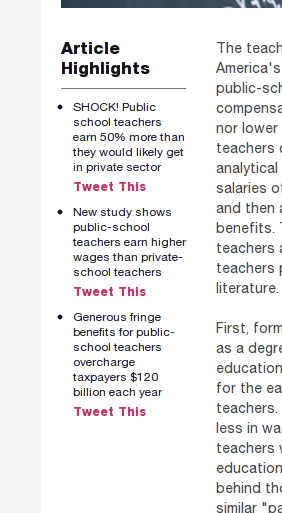
I’m sorry, but are you pre-writing my tweets for me now? Are you seriously suggesting that you have investigated the issue of public school teacher pay in an unbiased and professional manner with those pre-written tweets, Heritage Foundation?
If you read the report, which I haven’t had time to really do yet, you will notice how few equations there are, and how many words. I’m not saying that you need equations to explain math, but it sure helps when your goal is to be precise.
And I’d also like to say, shame on you, New York Times, for your coverage of this. You allow the voices of the authors, from the American Enterprise Institute and the Heritage Foundation, as well as another political voice from the Reason Foundation. But you didn’t ask a data scientist to look at the underlying method.
The truth is, you can make the numbers say whatever you want, and good data scientists (or quants, or statisticians) know this. The stuff they write in their report is almost certainly not the whole story, and it’s obviously politically motivated. I’d love to be hired to research their research and see what kind of similar results they’ve left out of the final paper.
Ken Ribet’s love note from Serge Lang
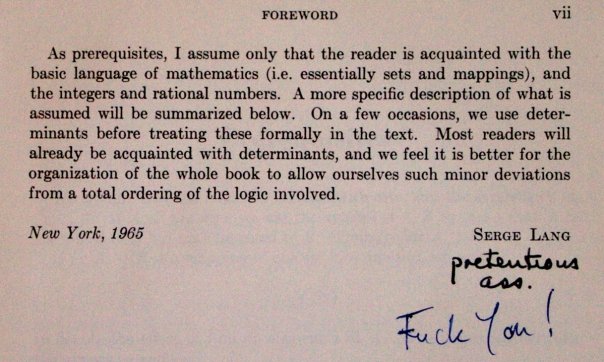
I took at graduate algebra course at Brown when I was an undergraduate. I bought a copy of Lang’s “Algebra,” 3rd edition around that time. It was the bible of graduate algebra, and I suppose that it still is. When I was at Harvard, I studied very hard for the written qualifying exam that we sat for at the end of our first year of graduate work. I spent months mastering the core material in algebra, topology and analysis. I got a little frustrated by Lang’s style and wrote the comment that you see in black ink. Years later, Serge had my office in Princeton while I was away in Paris. As usual, he consulted his own books, and he found my comment. He added his own (bottom of the page) and told me about it when I returned to the US. We both had a good laugh.
I was amazed, years later, when a German mathematician asked me about this page when we were at the Canadian number theory meeting in Vancouver — this must have been 20 years ago. How did the guy know? Serge or I must have talked, and word had gotten around.
—-
I made this image in July, 2001 by pointing my first digital camera at the page and pressing the shutter. Serge was in town, and I told him that I wanted to link this image to the web page for the graduate algebra course (Math 250A) that I was about to teach. That way the students could see it. “Of course!” As the semester progressed, mathematicians around the world found out about the link on my web page and began forwarding the URL to their friends. One day Serge phoned me in my office: “You mean anyone in the world can see this? Take it down!!” So I did.


 mathbabe