Archive
Phenomenal woman
Today’s post goes out to all the phenomenal women I am lucky to know and to love. It’s a gorgeous song based on this poem by Maya Angelou (h/t Becky Jaffe).
Aunt Pythia’s advice
Readers, I was really close to declaring this the last Aunt Pythia column.
My explanation was gonna be this: I am finding myself surprisingly unqualified to answer most of the questions submitted. I thought I was a loud mouth and would have no problem, but when people ask me hugely philosophical questions about the existence of god, or ask me questions about how to change fields from physics to politics, it just makes me feel very unthoughtful and small.
So in other words, as a mode of self-preservation, I was going to discontinue this practice and go back to doing stuff that makes me feel smart.
But after doing the actual writing (which you will find below) I’ve changed my mind. It’s too much fun! But I have fired you guys from answering a question each week since you suck at that.
If you don’t know what you’re in for, go here for past advice columns and here for an explanation of the name Pythia. Most importantly,
Please submit your question at the bottom of this column!!
——
Let’s start out with the question from last time that remained unanswered:
Dear Aunt Pythia,
As a graduate student, I enjoy attending departmental teas, if only because it’s an excuse to get away from the books for a few minutes. However, my department recently started having some of our teas sponsored by a trading firm. As somebody who has concerns about the finance industry, I am bothered by this. I thought about dumping all the tea in one of the fountains on campus, but I’d like to find a more constructive approach. Any suggestions?
Tea Party Patriot
TPP,
Interesting. Let me ask you this. Is the money given with strings attached? Do they also expect to be able to recruit math people on campus? Do they advertise their firm in some way at the teas? How do you happen to know who’s sponsoring it?
If one of the above is true, then yes I’d say dump the tea in a fountain, and object to the blatant commercialization of your department. But if none of the above is true, and if I haven’t forgotten something, then the money is a kind of bribe, but it’s lower level.
That is, your department is psyched to not pay for cookies, but over time the money that it’s saving will be used for other things, and people’s taste in cookies will be inflated because of the extra fancy cookies that finance people can afford, and there will be this weird dependency set up. At that point they may try to advertise or recruit, which is in my opinion totally outrageous on a campus and deserves some fountain dumping. Hopefully you can band together with other outraged folk and make a big scene of it.
Another possibility: if they are recruiting on campus, tell me where in advance and I’ll come recruit for Occupy at the next table.
Good luck, Patriot!
Aunt Pythia
——
Dear Aunt Pythia,
Dear Aunt Pythia, after living for quite a lot time I think my life has been mostly erratic and not driven by myself but for random forces beyond my scope. I don’t mean I am in a bad position. In fact I am quite happy and own everything I and my family need to live comfortably. However a lot of people think of themselves as making long term plans and succeding (or failing) at them. Sometimes I think there are essentialy different kinds of people (with and without living plans speaking on binary mode), sometimes I think they just deceive themselves. What do you think about? Do you have a long term plan for yourself?
Rooted At Nothing Durable On My Living Years
Dear RANDOMLY,
First, let me speak of my gratitude for your excellently chosen fake name, which translates so beautifully into an appropriate word (see how RANDOMLY did that, people?). Thank you so so much.
Second, you have essentially described me twice, in different parts of my life. So when I was 15 and went to math camp, I decided to become a math professor. For twenty pleasant years I was one of those people with a plan. Actually, my life wasn’t consistently pleasant during those years, but having a plan was a consistently pleasant part of my life.
But ever since I quit my math professor job at Barnard College in 2007, I’ve been adrift in a world without a plan. I essentially don’t know what the future will bring, nor do I want to know.
Back to your question: are long-term planners deceiving themselves? Yes and no.
Yes because, by dint of it being such a very long time before your plan is fulfilled, you will be a very different person by that time, and who knows if you will still have the same goals and interests. Chances are you won’t, and you’ll be less naive about the negatives of your plan, and your role models will have disappointed you, etc. Long-term plans are filled with bittersweet consequences.
On the other hand, I do think it can be good to have some plan, especially if you’re a woman. I don’t regret getting my Ph.D. in math for a second, partly because I learned so much (about math but also about myself, as trite as it sounds) and because it’s a pretty flexible achievement – people respect that on your resume. So in fact I tell young math nerd girls all the time to make it a goal of theirs to get their Ph.D. and then decide what’s next. I suggest that people have a long-term plan but keep in mind they can always change it.
Having a plan helped me make decisions, so in that sense it acted as a crutch (“Should I do this? Do math professors do this?”). Not having a plan has been harder but I luckily waited until I was old enough to deal with the uncertainty. It’s not unlike the feeling I described in this post about learning to not understand tensor products.
One thing that has surprised me about not having a plan is that you might expect I’d have less interest in learning new things, since learning can be seen as investing in a new long-term plan. But actually, if anything I’ve learned more, more quickly, since giving up plans, because I’ve been following my instincts and curiosity rather than my idea of the what would be appropriate for the person I expect to become. So that’s an advertisement for not having a plan, at least for me.
I hope this rambling answer has helped, RANDOMLY!
Aunt Pythia
——
Aunt P,
What’s the difference between a hipster and a nerd? Aren’t they both purported minorities with fringe obsessional interests? One of them is sexy while the other is only ironically sexy. But which is it?
Nerdster
Dear Nerdster,
I have never compared the two groups until now, but I’d argue that hipsters are generally hyper aware of what’s “normal” and act in constant reference to that, whereas nerds are oblivious to what’s normal, or at least ignore it because they’ve got more interesting things to think about. That’s a big difference.
Personally I find almost everything sexy, but if I had to decide between nerds and hipsters, I’d go with nerds. Here’s why: if you think about it, nerds in groups commonly invent their own universes (think “Star Trek”), which light the way to aspirational societies, which are very sexy. Even the singularity stuff is exciting in that kind of nerd nirvana way.
Whereas if you take the hipster to the asymptotic limit of his philosophical mindset, you get artisanal pencil sharpening.
I am completely willing to believe my vision is biased because I’m a nerd, by the way. Hipsters, please speak up for your peeps and correct me if I’m wrong about your sexiness.
Best,
AP
——
Dear Aunt Pythia,
I’m a queer gal and last year for about 5 months, I worked with an amazing woman and we got really close. We connected so well, unlike anyone I’ve met before. She’s married (to a guy) with kids, and I have a gf of 8 years, so nothing happened between us, but the possibility was there.
I’m in a new location (unrelated circumstances), and tried reconnecting with her via email but she never responded, so obviously I get the message. Trouble is, I can’t get her out of my head a year later. And the kicker is I’m doing a presentation at the old location in a few months. I want to see her and maybe I’ll get over this serious crush. Also, there are others I want to reconnect with, so I want to send out an email letting them know I’ll be back for a day. Questions: 1. Is including her in the email stupid? 2. How do I stop thinking about her?
Gal Apparently Yearning
Dear GAY,
First, thanks for the great fake name, it brings tears to my eyes that you guys are on top of this shit.
Next, let’s do this in cases. Best case scenario she’s in love with you but can’t handle it because she’s got kids and doesn’t want to fuck up her family. In that case your plan has to be super sexy but also protective of her life, so in other words send her a brief email that you’ll be back and, if she dares to see you, spend the whole time holding her hand, looking into her eyes, and talking about how beautiful she is and how you know she can’t jeopardize her family but you love her anyway. That makes a great story and it’s true.
Worst case scenario she doesn’t acknowledge even to herself that she’s in love with you. In that case same plan since you’ll never know which it is unless you try.
Good luck!! Tell me what happens!
Aunt Pythia
——
Please please please submit questions, thanks!
HSBC protest yesterday (#OWS)
Here’s a picture from yesterday (thanks Pam!):

This was near the end when some people had already left. We met on the steps of the NYPL as above but in between we went across the street and marched in front of HSBC, which was barricaded by the police. Indeed there were as many police, or more, as protesters. We chanted things like, “Stop and Frisk HSBC!” or “The banks got bailed out, we got sold out” but my favorite chant was a song Nick and Manny made up during the event:
Bankers and drug lords sittin’ in a tree
K-I-S-S-I-N-G
First comes love, then comes prrofit,
Then comes a settlement from the Justice De-partment!
Here’s a pic from the marching part with an appropriate Valentine’s Day theme (note the barricades behind the protesters):

And here’s me with my sandwich board. The front (note the long line of police motorcycles behind me):

And the back:

Also check out Taibbi’s HSBC article from yesterday.
There should be a macho way to say “I don’t know”
I recently gave an interview with Russ Roberts at EconTalk, which was fun and which has generated a lot of interesting feedback for me. I had no idea so many people listened to that podcast. Turns out it’ll eventually add up to something like 50,000, with half of those people listening this week. Cool!
One thing Russ and I talked about is still on my mind. Namely, how many problems are the direct result of people pretending to understand something, or exaggerating the certainty of an uncertain quantity. People just don’t acknowledge errorbars when they should!
What up, people?
Part of the problem exists because when we model something, the model typically just comes out with a single answer, usually a number, and it seems so certain to us, so tangible, even when we know that slightly different starting conditions or inputs to our models would have resulted in a different number.
So for example, an SAT score. We know that, on a different day with a different amount of sleep or a different test, we might score significantly differently. And yet the score is the score, and it’s hugely important and we brand ourselves with it as if it’s some kind of final word.
But another part of this problem is that people are seldom incentivized to admit they don’t know something. Indeed the ones we hear from the most are professional opinion-holders, and they are going to lose their audience and their gigs if they go on air saying, “I’m not sure what’s going to happen with [the economy], we’ve honestly never been in this situation before and our data is just not sufficient to make a prediction that’s worth its weight.”
You can replace “the economy” by anything and the problem still holds.
Who’s going to say that?? Someone who doesn’t mind losing their job is who. Which is too bad, because honest people do say that quite a large portion of the time. So professional opinion-holders are kind of trained to be dishonest in this way.
And so are TED talks, but that’s a vent for another day.
I wish there were a macho way to admit you didn’t know something, so people could understand that admitting uncertainty isn’t equivalent to being wishy-washy.
I mean, sometimes I want to bust out and say, “I don’t know that, and neither do you, motherfucker!” but I’m not sure how well that would go over. Some people get touchy about profanity.
But it’s getting there, and it points to something ironic about this uncertainty-as-wishy-washiness: it is sometimes macho to point out that other people are blowing smoke. In other words, I can be a whistle blower on other people’s illusion of certainty even when I can’t make being uncertain sound cool.
I think that explains, to some extent, why so many people end up criticizing other people for false claims rather than making a stance on uncertainty themselves. The other reason of course is that it’s easier to blow holes in other people’s theories, once stated, than it is to come up with a foolproof theory of one’s own.
Any suggestions for macho approaches to errorbars?
The smell test for big data
The other day I was chatting with a data scientist (who didn’t know me), and I asked him what he does. He said that he used social media graphs to see how we might influence people to lose weight.
Whaaaa? That doesn’t pass the smell test.
If I can imagine it happening in real life, between people, then I can imagine it happening in a social medium. If it doesn’t happen in real life, it doesn’t magically appear on the internet.
So if I have a huge crush on LeBron James (true), and if he tweets that I should go out and watch “Life of Pi” because it’s a great movie (true), then I’d do it, because I’d imagine he is here with me in my living room suggesting that I see that movie, and I’d do anything that man says if he’s in my living room, especially if he’s jamming with me.
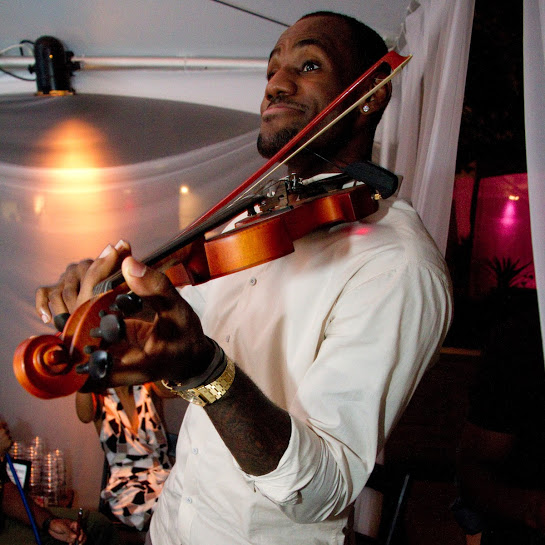
Not actually my living room.
But if LeBron James tells me to lose weight while we’re hanging, then I just feel bad and weird. Because nobody can influence someone else to lose weight in person*.
Bottomline: there’s a smell test, and it states that real influence happening inside a social graph isn’t magical just because it’s mathematically formulated. It is at best an echo of the actual influence exerted in real life. I have yet to see a counter-example to that. If you have one, please challenge me on this.
Any data scientist going around claiming they’re going to surpass this smell test should stop right now, because it adds to the hype and adds to the noise around big data without adding to the conversation.
* I’ll make an exception if they’re a doctor wielding a surgical knife about to remove my stomach or something, which doesn’t translate well into social media, and might not always work long-term. And to be fair, you (or LeBron) can influence me to not eat a given thing on a given day, or even to go on a diet, but by now we should know that doesn’t have long term effects. There’s a reason Weight Watchers either doesn’t publish their results or relies on survivorship bias for fake results.
Johnson Research Labs
I have exciting news this morning.
I’ll be starting a new job next Monday at Johnson Research Labs (JRL). It’s made up of a small group of data scientists, social scientists, and cloud computing people working on interesting problems that will hopefully have a positive impact on the world. JRL was founded recently by David Park and John Johnson and is backed by Johnson.
My first job once I’m there will be to finish my book Doing Data Science with my co-author, Rachel Schutt, who is also joining JRL from Google. The book is based on Rachel’s data science class from last semester at Columbia which I blogged about here.
Ian Langmore and Daniel Krasner, who are co-teaching another class at Columbia this semester in applied data science (along with Chang She), are also working at JRL.
Occupy HSBC: Valentine’s Day protest at noon #OWS
Protest with #OWS Alternative Banking Group
I’m writing to invite you to a protest against mega-bank HSBC at noon on Valentine’s Day (Thursday) starting on the steps of the New York Public Library at 42nd and 5th. Details are here but it’s the big green box on the map on the Fifth Avenue side:

Why are we protesting?
Like you, I’m sure, I’d like nothing more than to stop worrying about shit that goes on in our country’s banks.
We have better things to do with out time than to get annoyed over enormous bonuses being given to idiots for their repeated failures. We’re frankly exhausted from the outrage.
I mean, the average person doesn’t have a job where they get an $11 million bonus instead of a $22 million dollar bonus when they royally screw up. Outside the surreal realm of international banking, the normal response to screw-ups on that level is to get fired.
You might expect a company that has been caught criminally screwing minorities out of fair contracts might be at risk of being closed down, but in this day and age you’d know that big banks, or TIBACO (too interconnected, big, and complex to oversee) institutions, as we in Alt Banking like to call them, are immune to such action.
There’s a clear evolving standard of treatment in the banking sector when it comes to criminal activity:
- the powers that be (SEC, DOJ, etc.) make a huge production over the severity of the fine,
- which is large in dollar amounts but
- usually represents about 10% of the overall profit the given banks made during their exploit.
- Nobody ever goes to jail, and
- the shareholders pay the fine, not the perpetrators.
- The perps get somewhat diminished bonuses. At worst.
The bottomline: we have an entire class of citizens that are immune to the laws because they are considered too important to our financial stability.

But why HSBC?
HSBC is a perfect example of this. An outrageous example.
HSBC didn’t get a bailout in 2008 like many other banks, even though they were ranked #2 in subprime mortgage lending. But that’s not because they didn’t lose money – in fact they lost $6 billion but somehow kept afloat.
And now we know why.
Namely, they were money-laundering, earning asstons by facilitating drugs and terrorism. This was blood money, make no mistake, and it went directly into the pockets of HSBC bankers in the form of bonuses.
When this years-long criminal mafia activity was discovered, nothing much happened beyond a fine, as per usual. Well, to be honest, they were fined $1.9 billion dollars, which is a lot of money, but is only 5 weeks of earnings for the mammoth institution – depending on the way you look at it, HSBC is the 2nd largest bank in the world.

Too big to jail
And that’s when “Too big to fail” became “Too big to jail.” Even the New York Times was outraged. From their editorial page:
Federal and state authorities have chosen not to indict HSBC, the London-based bank, on charges of vast and prolonged money laundering, for fear that criminal prosecution would topple the bank and, in the process, endanger the financial system. They also have not charged any top HSBC banker in the case, though it boggles the mind that a bank could launder money as HSBC did without anyone in a position of authority making culpable decisions.
Clearly, the government has bought into the notion that too big to fail is too big to jail. When prosecutors choose not to prosecute to the full extent of the law in a case as egregious as this, the law itself is diminished. The deterrence that comes from the threat of criminal prosecution is weakened, if not lost.

National Threat
You may recall that there was an extensive FBI investigation of OWS before Zuccotti Park was even occupied.
Ironic? As the Village Voice said, “apparently non-violent demonstration against corrupt banking is subject to more criminal scrutiny than actual corrupt banking.”
Question for you: which is the bigger national security threat, OWS or HSBC?
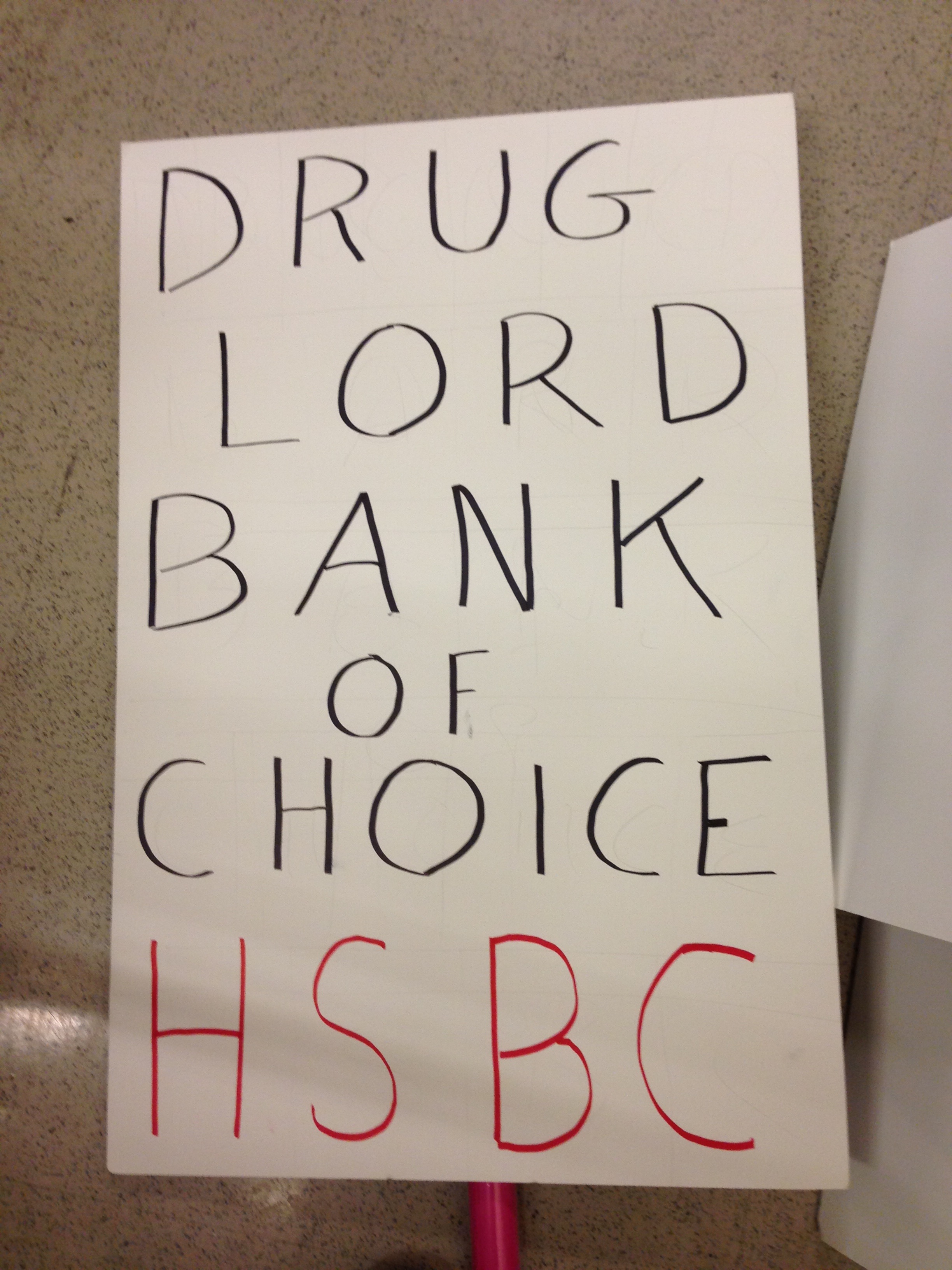
We demand
HSBC needs its license revoked, and there need to be prosecutions. Those who are guilty need to be punished or else we have an official invitation to criminal acts by bankers. We simply can’t live in a country which rewards this kind of behavior.
Mind you, this isn’t just about HSBC. This is about all the megabanks. Citi or BoA are exempt from prosecution, too. Our message needs to be “break up the megabanks”.
I’ll end with what Matt Taibbi had to say about the HSBC settlement:
On the other hand, if you are an important person, and you work for a big international bank, you won’t be prosecuted even if you launder nine billion dollars. Even if you actively collude with the people at the very top of the international narcotics trade, your punishment will be far smaller than that of the person at the very bottom of the world drug pyramid. You will be treated with more deference and sympathy than a junkie passing out on a subway car in Manhattan (using two seats of a subway car is a common prosecutable offense in this city). An international drug trafficker is a criminal and usually a murderer; the drug addict walking the street is one of his victims. But thanks to Breuer, we’re now in the business, officially, of jailing the victims and enabling the criminals.
Join us on Valentine’s Day at noon on the steps of the New York Public Library and help us Occupy HSBC. Please redistribute widely!

Gender bias in math
I don’t agree with everything she always says, but I agree with everything Izabella Laba says in this post called Gender Bias 101 For Mathematicians (hat tip Jordan Ellenberg). And I’m kind of jealous she put it together in such a fantastic no-bullshit way.
Namely, she debunks a bunch of myths of gender bias. Here’s my summary, but you should read the whole thing:
- Myth: Sexism in math is perpetrated mainly by a bunch of enormously sexist old guys. Izabella: Nope, it’s everyone, and there’s lots of evidence for that.
- Myth: The way to combat sexism is to find those guys and isolate them. Izabella: Nope, that won’t work, since it’s everyone.
- Myth: If it’s really everyone, it’s too hard to solve. Izabella: Not necessarily, and hey you are still trying to solve the Riemann Hypothesis even though that’s hard (my favorite argument).
- Myth: We should continue to debate about its existence rather than solution. Izabella: We are beyond that, it’s a waste of time, and I’m not going to waste my time anymore.
- Myth: Izabella, you are only writing this to be reassured. Izabella: Don’t patronize me.
Here’s what I’d add. I’ve been arguing for a long time that gender bias against girls in math starts young and starts at the cultural level. It has to do with expectations of oneself just as much as a bunch of nasty old men (by the way, the above is not to say there aren’t nasty old men (and nasty old women!), just that it’s not only about them).
My argument has been that the cultural differences are larger than the talent differences, something Larry Summers strangely dismissed without actually investigating in his famous speech.
And I think I’ve found the smoking gun for my side of this argument, in the form of an interactive New York Times graphic from last week’s Science section which I’ve screenshot here:
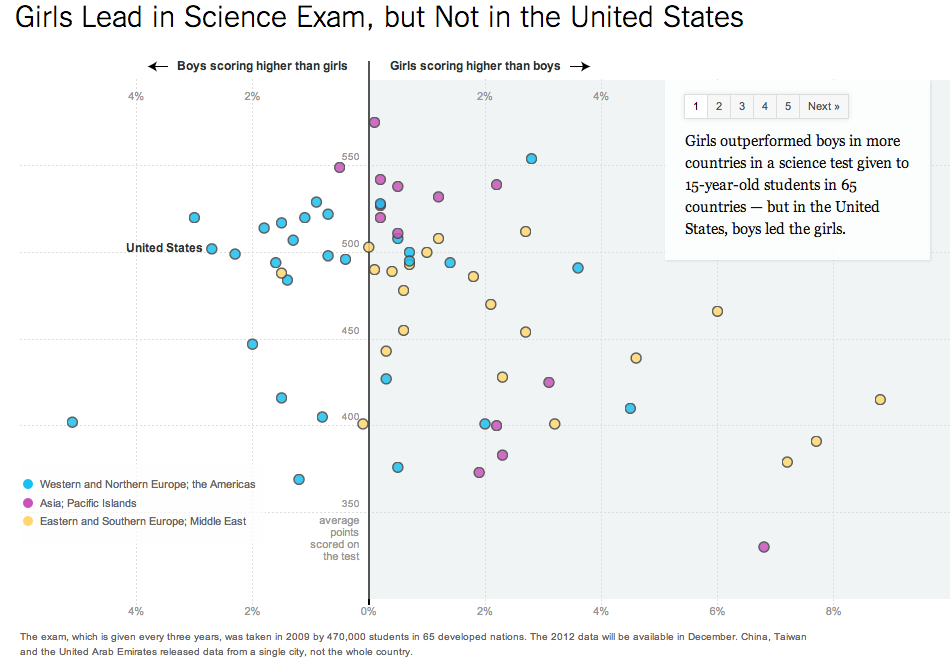
What this shows is that 15-year-old girls out-perform 15-year-old boys in certain countries and under-perform them in others. Those countries where they outperform boys is not random and has everything to do with cultural expectations and opportunities for girls in those countries and is explained to some extent by stereotype threat. Go read the article, it’s fascinating.
I’ll say again what I said already at the end of this post: the great news is that it is possible to address stereotype threat directly, which won’t solve everything but will go a long way.
You do it by emphasizing that mathematical talent is not inherent, nor fixed at birth, and that you can cultivate it and grow it over time and through hard work. I make this speech whenever I can to young people. Spread the word!
Aunt Pythia’s advice
Aunt Pythia is excited by all the snow outside and has at least a couple of appointments with a sled this morning, but before she runs off she’d like to spread her words of wisdom to her good readers.
If you don’t know what you’re in for, go here for past advice columns and here for an explanation of the name Pythia, and most importantly, please submit your question at the bottom of this column!!
And… thank you for making your questions funny and/or outrageous. Extra points if your fake name is also funny before or after I shorten it into initials. For example, you could sign your letter “From A Rotten Town”. And when I say “funny” I could mean “puerile”.
From last time:
——
Aunt Pythia,
How do you explain your work (and its importance/relevance to the world) to laypeople? I’m interested in your answers to this question for math, for finance, and for data science.
Pre-Expositor
Dear Pre-Expositor,
First, reader Mr. Exposition had this to suggest:
When non-mathematicians ask, I usually start off by describing something simple in my general area of math that has a cool real-life application. If and only if they then ask me about what I do in particular, I start breaking out the analogies and trying to give them an idea. (This gives the other person an escape valve if they wanted to be polite but don’t want to have an intense conversation.)
I’ll add a few words too. I think it helps to know a bit about the person you’re talking to. Are they wondering what math could be useful for at all? Or are they physicists? The answer is going to depend a lot on who your audience is.
Sometimes it turns out they want to be convinced that math can be interesting to someone in its own right, and why, but sometimes they might just want to knowhow the lifestyle of a mathematician is different from that of a high school teacher. I am happy to have those conversations and leave it at that. I especially love the “why is math important one” because people who ask it often answer it without my help.
If they really want to get into the details of what you think about on a daily basis, which is pretty rare, then as a data scientist I compare my approaches to something they are aware of, for example a Netflix-like recommendation system, or a Google search-like algorithm, or a finance-style trading algorithm.
If they want to talk about what I did as an academic mathematician, I talk about elementary diophantine equations and how they get increasingly difficult as you increase the degree, and if they’re still with me I talk about seeing solutions through the eyes of individual primes, and if they are still with me I talk about the local-global principle.
I don’t try to sell academic research math as important per se, just as fascinating and beautiful.
I hope that helps,
Aunt Pythia
——
Dear Aunt Pythia,
You seem like a very un-neurotic person. What’s your secret? Do you have personal demons? What’s your go-to strategy for when they rear their ugly heads?
Wanna-be neuroses-free
Dear Wbnf,
I do of course have personal demons, as everybody does. I often find myself waking up at 3am thinking about things I’m behind on or things I wish had gone better. I have two pieces of advice for this kind of thing.
First, use suppression. I think suppression has a bad name. People think of it as a bad thing. They say stuff like, “oh you’re just suppressed” like that’s a crime.
But I say, use suppression to your advantage! If you can’t fix something that’s bothering you, agree to ignore it (which is an agreement you make with yourself, so nobody can even complain about it). And I don’t mean ignore it forever, either. Just make a plan to start thinking about it if and when you might have control over it. OWN your suppression and it will give back to you.
So for example, if you are stressing about your kid getting into a good kindergarten in New York City, then do what you can in terms of looking up schools and applying to them, and then after that, start up the suppression motors til you hear back. There’s absolutely nothing you can do in the meantime except fret, and you have better things to do with your time. Suppression is your friend!
Second, be pro-active. I know that’s a trite, overused phrase, but there may not be another word that means what I want to say – namely, do your best, to the best of your knowledge, on whatever it is, and forgive yourself in advance if that wasn’t enough. Of couse sometimes it wasn’t, and you have to live with the consequences, and sometimes you take notes on what would have been better. That’s ok, because the third thing is you gotta forgive yourself. It’s so obvious I won’t even make it a separate thing.
In my experience, being pro-active about something in advance, followed by 100% suppression mode, works a lot better than constantly putting something off and feeling guilty about it.
By the way, one more thing. I also let things slide. If I can’t get myself into enough of a froth to be pro-active about something, then I just let it go and I don’t look back (I do this via suppression, see above). It’s important to know when to do that too.
I hope that helps!
Cathy
——
Dear Aunt Pythia,
I’ve decided to leave academia and become a research scientist in the tech world. In addition to my area of math, I know a bit of programming and machine learning. What else can I learn in the next few months to better prepare myself?
Rambling On
Dear Rambling,
Great question, but I’m not sure how many “research scientist” positions there are in the tech world. Most of them don’t want you to research, they want you to model! So I’m going to assume you meant something like “data scientist” if that’s ok.
First, learn python, for reals. Next, learn statistics, enough so you can explain to anyone what statistical significance is and mean it. Then, read the book I’m writing with Rachel Schutt, Doing Data Science. Oh wait, it’s not out yet. So for now, read the notes I took on Rachel’s Columbia Data Science class last semester.
And to test your new knowledge, implement the recommendation system using python. And send me the code! We’d love to have it for the book, thanks.
Good luck,
Auntie P
——
Now it’s time for you guys to help me answer a question. I’ve got a juicy one for you:
Dear Aunt Pythia,
As a graduate student, I enjoy attending departmental teas, if only because it’s an excuse to get away from the books for a few minutes. However, my department recently started having some of our teas sponsored by a trading firm. As somebody who has concerns about the finance industry, I am bothered by this. I thought about dumping all the tea in one of the fountains on campus, but I’d like to find a more constructive approach. Any suggestions?
Tea Party Patriot
——
Please please please submit questions, thanks!
Looking for ideas for a mathbabe logo
Apologies for the self-indulgent posts two days in a row, but I’m looking for ideas for a mathbabe logo. I have a coffee mug and a shirt already, because for whatever reason zazzle.com already had a mathbabe logo when I checked, and it looks like this:

Mysteriously found on Zazzle.com
The problem is that I’m not exactly a pink frilly person, although I’ve made do with a black T-shirt background.
And I need this why? Because I’m thinking of making some mathbabe t-shirts and paraphernalia to give to people and/or sell (partly because I’m jealous of the stack project t-shirts I see all over the neighborhood).
Anyway, if anyone has ideas for a new graphic, or a designer friend who needs money (not too much I hope), or better yet a sample graphic, please get in touch with me, thanks! My email is on the “About” page.
It’s not that I don’t understand you, it’s that you’re wrong
Dear …..,
I’ve been meaning to explain this to you. It took me a while to get what was happening in our interactions, so it’s only fair for me to explain it to you now that I get it.
Namely, every time we meet, you try to explain the same thing to me, even though I already understood it the first time – maybe even before meeting you.
You see, it’s not that I don’t understand you, it’s that you’re wrong.
You obviously think that anybody who doesn’t agree with you must not understand you (because what you actually think is that anyone who understands your impeccable logic must agree with you), but take it from me, I don’t agree with you. At all. And I’m not interested in you explaining your logic to me again. Next time you try to do that, I will stop you.
Mind you, I don’t have huge hope for this plan, because I’ve tried it before. I spent one conversation with you very carefully giving you supporting evidence that I understood your points. I even did things like encouragingly rephrasing what you were saying in my own words to convince you that I understood. Then, after that, I explained to you that in spite of that clarity, your conclusions still held no sway with me. None whatsoever! They were based on naive and obvious simplifications! We might as well agree to disagree!
And yet… yet you seemed to have forgotten that episode entirely by the time we next met.
So, actually, here’s what’s gonna happen, next time we meet. I’m going to avoid you, and if that doesn’t work, I’ll avoid talking to you, and if that is impossible, I will nod and smile. I don’t want to have to resort to nastiness, and although I believe in being direct and I’m no conflict avoider, there are certain conflicts one can’t resolve, and one of them is you.
Thanks,
Cathy
Bad model + high stakes = gaming
Today let’s talk some oldish news about Michelle Rhee, the Chancellor of Washington public schools from 2007-2010, who recently appeared on the Daily Show.
Specifically I want to discuss a New York Times article from 2011 (hat tip Suresh Naidu) that is entitled “Eager for Spotlight, but Not if It Is on a Testing Scandal”.
When she was Chancellor, Rhee was a huge backer of the standardized testing approach to locating “bad teachers”. She did obnoxious stuff like carry around a broom to illustrate her “cleaning out the trash” approach. She fired a principal on camera.
She also enjoyed taking credit when scores went up, and the system rewarded those teachers with bonuses. So it was very high stakes: you get a cash incentive to improve your students’ scores and the threat of a broom if they go down.
And guess what, there was good evidence of cheating. If you want to read more details, read the article, then read this and this: short version is that a pseudo-investigation came up with nothing (surprise!) but then again scores went way down when they changed leadership and added security.
My point isn’t that we should put security in every school, though. My point is that when you implement a model which is both gameable and high stakes, you should expect it to be gamed. Don’t be surprised by that, and don’t give yourself credit that everyone is suddenly perfect by your measurement in the meantime.
Another way of saying it is that if you go around trusting the numbers, you have to be ready to trust the evidence of gaming too. You can’t have it both ways. We taxpayers should remember that next time we give the banks gameable stress tests or when we discover off-shore tax shelters by corporations.
HSBC Valentine’s Day action (#OWS)
We in the Alt Banking group are planning a protest against “too big to jail” bank HSBC for Valentine’s Day. As soon as we started the planning we realized they are utterly ripe for satire with their ridiculous airport posters like this one:

Here’s a new poster for them, courtesy of Nick from our group (and crossposted from the Alt Banking blog):
Readers, can you help us come up with posters and slogans for the event? Bonus if it has to do with a Valentine’s Day theme, along the lines of “You broke my heart, HSBC!” or if it riffs on their slogan, “The World’s Local Bank”. We will be making posters and flyers with this stuff next Sunday afternoon, if you’re going to be up near Columbia you should join us.
Thanks for your help! If you tweet this, don’t forget to use the hashtag #HSBC as a gift to those guys.
update: Public Citizen in Maryland is attempting to revoke HSBC’s bank charter.
Links to videotaped talks and pdf slides
Busy at work today but I wanted to share a few links coming out of talks I gave recently.
First the one I gave at Brown University at the Agnes Conference (October 2012). It’s called “How Math is Used outside Academia”.
Second the one I gave at Stony Brook’s colloquium (December 2012). It has the same title.
These two are videos of the same talk (although with very different audiences), so please don’t watch both of them, you will get bored! If you like friendly audiences, go with Agnes. If you like to watch me getting heckled, go with Stony Brook.
[p.s.: I pretty much never watch other people’s videos, so please don’t watch either one, actually.]
The third talk, which was the shortest, was at the Joint Math Meetings (January 2013) but I don’t think it was taped. It was called Weapons of Math Destruction and the slides are available here (I’ve turned them into a pdf).
Barry Mazur wins the National Medal of Science
Last Friday my thesis advisor Barry Mazur got awarded the National Medal of Science (hat tip Mike Hopkins).
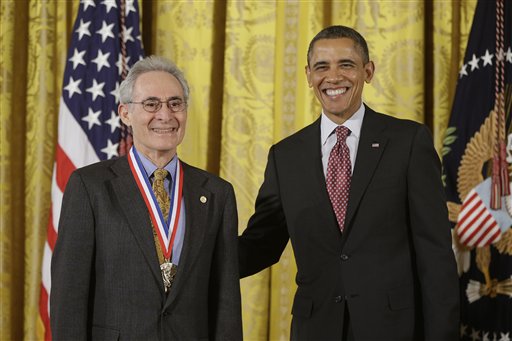
President Barack Obama awards the National Medal of Science to Dr. Barry Mazur of Harvard University, Friday, Feb. 1, 2013, during a ceremony in the East Room of the White House in Washington. The awards are the highest honors bestowed by the United States Government upon scientists, engineers, and inventors. (AP Photo/Charles Dharapak)
One of many wonderful things about Barry is how broad his interests are (in addition to being profoundly deep). I remember that, in order to get time to talk math with him in grad school, he’d bring me to poetry readings so we could discuss math during the intermission. Last semester he taught a class with people from the law school about the shifting concept of evidence in different fields.
That guy is awesome.
Aunt Pythia’s advice
I’m excited to be spending the day at the BiCoastal Datafest looking into money and politics. But before I go, I need to answer some questions as my alter ego Aunt Pythia.
If you don’t know what you’re in for, go here for past advice columns and here for an explanation of the name Pythia, and most importantly, please submit your question at the bottom of this column.
——
First, let’s review last week’s advice you helped out with:
Dear Aunt Pythia,
I need a pie crust recipe and a personal lubricant recommendation. Please try to incorporate lard into both answers.
Apple Pie Seductress
Apple Pie Seductress,
Wobblebug gave you an amazing and involved pie crust recipe here. Please send me feedback on the smear-and-fold-and-roll-out method.
As for the personal lubricant, I spotted that immediately as a trick question, since you do all the pie crust stuff with your bare hands.
Aunt Pythia
——
Dear Aunt Pythia,
Are all people supposed to feel down when they are thirty? If so, is this something we learn or a defect we are born with?
Hurts all over
Dear Hurts,
I’m not sure about everybody else, but 30 was a really tough time for me. I had 2 small kids, a post-doc at MIT where nobody else did number theory and I always felt crappy, and I had no idea how long that feeling would last. I was on the job market for the 4th year in a row wishing someone would eventually want me to be part of their department and wondering why I decided to be a mathematician.
I am a lot better now, and looking back I can understand why I felt so completely stressed out and lost. A large part of it is that I’ve shifted the expectations and now, instead of wondering when someone will want me, I wonder if I’ll want them. It’s not like that makes it all better but somehow it’s comforting.
Plus, ever since I turned 40, I have realized that everyone’s entitled to my opinion. Thus the blog and this column. But somehow the confidence I feel now in the way I look at life was something I just didn’t have when I was 30.
I’m not sure what my advice is, exactly, except to say hang in there and you might become as obnoxious and opinionated as me.
Oh, and in the meantime you might benefit from a pep talk (hat tip Becky):
I hope that helps!
Aunt Pythia
——
Aunt Pythia,
I have been successfully self-employed for a several years but I want to move into a more formal job. I have a decent presence online and would like to let readers, peers, Twitter followers etc. know that I’m looking, but without alienating current customers and clients. Should I just try through private channels first, and save a public notice for last in case nothing turns up?
Maple Leaf
Dear Maple Leaf,
Have you considered asking for a lead “for a friend” who has qualifications that are uncannily similar to yours? And then when it comes down to the private conversation you can say, “Actually, ‘Fred’ is me. I’m looking for a job.”
Auntie
——
Aunt Pythia,
I have a skeleton in my closet… actually it’s more like a still warm corpse. I hate to advertise it (why should I tell people something bad about myself) but I also want to avoid disingenuousness in the event that they find out later. What would you do?
Between a rock and a hard place
Dear Between,
I suggest you remember back to what your reasoning was that made you decide to do whatever it was or be involved with whatever it was, and be prepared to explain it openly and efficiently. Depending on what it is (“I killed children for their livers”, “I used to work in finance”) you will find people understand past mistakes, especially if they are owned up to, and especially if you can say, “it was a mistake, but I didn’t know better at the time because (insert truth here).”
Good luck!
Aunt Pythia
——
Finally, a question for the readers:
Aunt Pythia,
How do you explain your work (and its importance/relevance to the world) to laypeople? I’m interested in your answers to this question for math, for finance, and for data science.
Pre-Expositor
Please respond to Pre-Expositor below!
——
And please submit questions, thanks!
The Sandy Hook Project
I wanted to share with you guys a project I’ve been involved with started by John Spens of Thoughtworks regarding data collection and open analysis around guns and gun-related violence. John lives in Connecticut and has friends who were directly affected by the massacre in Newtown. Here is John’s description of the project:
I initiated the Sandy Hook Project in response to this need for information. The purpose of this project is to produce rigorous and transparent analyses of data pertaining to gun-related violence. My goal is to move beyond the rhetoric and emotion and produce (hopefully) objective insight into the relationship between guns and violence in the US. I realize that objectivity will be challenging, which is why I want to share the methods and the data openly so others can validate or refute my findings as well as contribute their own.
…
I’ve put the project on GitHub. (https://github.com/john-m-spens/SandyHookProject). While it’s not designed as a data repository, I think the ubiquitous nature of GitHub and the control enforced through the code repository model will support effective collaboration.
John has written a handful of posts about statistics and guns, including A Brief Analysis of Firearm-related Homicide Rates and Investigating Statistics Regarding Right to Carry Laws.
In addition to looking into the statistics that exist, John wants to address the conversation itself. As he said in his most recent post:
What limited data and analysis that exists is often misrepresented and abused, and is given much less attention than anecdotal evidence. It is relatively simple to produce a handful of cases that support either side in this debate. What we really need is to understand the true impact of guns on our society. Push back by the NRA that any such research would be “political opinion masquerading as medical science.” is unacceptable. We can only make intelligent decisions when we have the fullest picture possible.
John is looking for nerd collaborators who can help him with data collection and open analysis. He’s also hoping to have a weekend datafest to work on this project in March, so stay tuned if you want to be part of that!
Singularity Institute and Google: what are their plans?
A few days ago I read a New York Times interview of Ray Kurzweil, who thinks he’s going to live forever and also claims he will cure cancer if and when he gets it (his excuse for not doing it in his spare time now: “Well, I mean, I do have to pick my priorities. Nobody can do everything.”). He also just got hired at Google.
As a joke I suggested that Google employees read the interview and then quit their job.
My reasoning went like this: if someone who is clearly narcissistic and delusional gets hired by your company, and given a position much higher than you (Kurzweil’s title is “Director of Engineering,” and although that doesn’t mean he is in charge of everyone in Engineering, it is nonetheless a high position), then you can give up all hope of ever being promoted based on your actual contributions. Companies have natural stages in their lives, and Google has evidently reached the stage of hiring “thought leaders” who nobody could actually work with but are somehow aligned with the agenda of the leadership.
Since then I’ve learned a bit more about Kurzweil, and about the Singularity Institute (based on the idea that computers will become self-aware and super-intelligent which will culminate in a very special moment for some parts of humanity), and the related ideologies of Futurism (fetishizing technology), Transhumanism (the idea we are going to be immortal), and “human rationality” as espoused by the blog lesswrong. Note I usually link to wikipedia articles but in the above cases, especially for the Singularity Institute, the associated wikipedia article is suspiciously sanitized of actual information.
A lot of my research is covered in this New York Times article from 2010 about the Singularity Institute’s opening. In particular it describes the close relationship between the Google royalty and the Singularity Institute. Suffice it to say there is a serious relationship between the founders of Google and this Institute.
But I’m not writing this to point out the number of ties between those institutions – this is well-documented in the above article and has only grown more obvious with the recent acquisition of Kurzweil.
And I’m also not writing to suggest that the Singularity Institute is a cult. I honestly think they make the case better than I could when the Executive Director, Luke Meuhlhauser, posts things entitled “So You Want to Save the World” wherein he states:
The best way for most people to help save the world is to donate to an organization working to solve these problems, an organization like the Singularity Institute or the Future of Humanity Institute.
Don’t underestimate the importance of donation. You can do more good as a philanthropic banker than as a charity worker or researcher.
It’s really that last sentence I want to focus on. It’s where the creepy elitism of this ideology comes out. Because make no mistake, this is a massive circle jerk for techie men (mostly men) to think of themselves as joining up with gods due to their superior intelligence and creativity.
Whatever, I’ve been around nerds all my life, and it’s nothing new to me that some of them want intelligence to count for more than just getting an edge in education and the job market. Somehow this ideology creates a hunger for much more than that: immortality, for one, and the feeling of being chosen.
You see, I believe in incentives. I want to prepare myself for what people will do next based on what I think their incentives are, and these Singularity Institute guys are on the one hand pretty hardcore with their beliefs, and on the other hand infiltrating Google, which is an incredibly powerful force in an essentially unregulated domain. So what are their plans?
Just to give you an idea, check out this line from Vernor Vinge’s now famous 1993 essay on the Singularity (emphasis mine):
Suppose we could tailor the Singularity. Suppose we could attain our most extravagant hopes. What then would we ask for: That humans themselves would become their own successors, that whatever injustice occurs would be tempered by our knowledge of our roots. For those who remained unaltered, the goal would be benign treatment (perhaps even giving the stay-behinds the appearance of being masters of godlike slaves). It could be a golden age that also involved progress (overleaping Stent’s barrier). Immortality (or at least a lifetime as long as we can make the universe survive [9] [3]) would be achievable.
A few comments:
- Vinge didn’t think the singularity was inevitable when he wrote that.
- Vinge recently spoke at the October 2012 Singularity Summit hosted by the Singularity Institute (along with Director of Research from Google, Peter Norvig). Here’s a video.
- The “stay-behinds” are the people who don’t get to transcend with the machines if and when the Singularity occurs.
Personally, I have fun thinking about the Singularity. I think it’s already happened, in fact, and my best argument for why machines are already smarter than us is this: when someone much smarter than you is saying something, maybe not to you, you don’t always know that that person is smarter – sometimes it just feels like they’re being confusing. But that’s exactly how we humans all feel about this mess we’ve made with the financial system: we are confused by it, we don’t understand it, and moreover we have no hope of dumbing it down to our level. That’s a sign it is superintelligent. Maybe not self-aware, but on the other hand how can you test that? In this light, the “stay-behinds” are Canadians.
Also, I totally believe everyone has the right to their own opinions, and for that matter they have a right to join a cult if they feel like it. In fact people who want to live forever, you could argue, are more likely to take care of the environment and their own children, because those are major investments for them.
On the other hand, what is their plan for the rest of us? Is it to, like Vinge says, give us the appearance of being masters of godlike slaves? Are those slaves our smart phones? Are we being intentionally shepherded into an artificial existence of play-power? Because I’ve suspected that very thing ever since I read the Filter Bubble. What else, especially in the context of the ongoing competition for resources?
The Singularity may never happen, or it may already have happened- that’s irrelevant to me. My thought experiment is this:
What are the consequences of a bunch of people who believe in something called the Singularity and who are also in control of a powerful company?
Money in politics
I’m excited about the upcoming weekend, because I’ll be at the Bicoastal Datafest: analyzing money in politics. The event is full at Columbia (but not yet at Stanford) but I believe you can still participate remotely, and of course you can keep an eye on things in any case.
One way to do that: I am setting up a wiki with my friend and colleague Lee Drutman from the Sunlight Foundation. Actually my husband set it up for us (thanks! and happy birthday!).
Let’s visualize the influence of money, people!
Bill Gates is naive, data is not objective
In his recent essay in the Wall Street Journal, Bill Gates proposed to “fix the world’s biggest problems” through “good measurement and a commitment to follow the data.” Sounds great!
Unfortunately it’s not so simple.
Gates describes a positive feedback loop when good data is collected and acted on. It’s hard to argue against this: given perfect data-collection procedures with relevant data, specific models do tend to improve, according to their chosen metrics of success. In fact this is almost tautological.
As I’ll explain, however, rather than focusing on how individual models improve with more data, we need to worry more about which models and which data have been chosen in the first place, why that process is successful when it is, and – most importantly – who gets to decide what data is collected and what models are trained.
Take Gates’s example of Ethiopia’s commitment to health care for its people. Let’s face it, it’s not new information that we should ensure “each home has access to a bed net to protect the family from malaria, a pit toilet, first-aid training and other basic health and safety practices.” What’s new is the political decision to do something about it. In other words, where Gates credits the measurement and data-collection for this, I’d suggest we give credit to the political system that allowed both the data collection and the actual resources to make it happen.
Gates also brings up the campaign to eradicate polio and how measurement has helped so much there as well. Here he sidesteps an enormous amount of politics and debate about how that campaign has been fought and, more importantly, how many scarce resources have been put towards it. But he has framed this fight himself, and has collected the data and defined the success metric, so that’s what he’s focused on.
Then he talks about teacher scoring and how great it would be to do that well. Teachers might not agree, and I’d argue they are correct to be wary about scoring systems, especially if they’ve experienced the random number generator called the Value Added Model. Many of the teacher strikes and failed negotiations are being caused by this system where, again, the people who own the model have the power.
Then he talks about college rankings and suggests we replace the flawed US News & World Reports system with his own idea, namely “measures of which colleges were best preparing their graduates for the job market”. Note I’m not arguing for keeping that US News & World Reports model, which is embarrassingly flawed and is consistently gamed. But the question is, who gets to choose the replacement?
This is where we get the closest to seeing him admit what’s really going on: that the person who defines the model defines success, and by obscuring this power behind a data collection process and incrementally improved model results, it seems somehow sanitized and objective when it’s not.
Let’s see some more example of data collection and model design not being objective:
- We see that cars are safer for men than women because the crash-test dummies are men.
- We see that cars are safer for thin people because the crash-test dummies are thin.
- We see drugs are safer and more effective for white people because blacks are underrepresented in clinical trials (which is a whole other story about power and data collection in itself).
- We see that Polaroid film used to only pick up white skin because it was optimized for white people.
- We see that poor people are uninformed by definition of how we take opinion polls (read the fine print).
Bill Gates seems genuinely interested in tackling some big problems in the world, and I wish more people thought long and hard about how they could contribute like that. But the process he describes so lovingly is in fact highly fraught and dangerous.
Don’t be fooled by the mathematical imprimatur: behind every model and every data set is a political process that chose that data and built that model and defined success for that model.


 mathbabe