Adam Smith made me buy a Kindle
When I was pregnant with my third son, and working at D.E. Shaw, I got really into reading Adam Smith’s seminal work “Wealth of Nations” on the subway rides to and from work. Once the baby came, though, the problem was that the book is huge, like 1,200 pages, and impossible to read while breastfeeding. In my frustration, and to combat baby brain-rot, I bought a Kindle to continue my reading through many many exhausting hours those first few months. Totally worth it, an investment in my sanity.
This post got me remembering my personal experience with Adam Smith. Adam Smith has really gotten a bum rap. He is generally known for inventing the concept of the invisible hand, which is the idea that, as long as each person is working as hard as they can to personally profit from their labor, the overall economy will benefit from that self-interest. However, it’s often used is as an excuse for why regulations are unnecessary, because somehow, the feeling goes, the invisible hand is all we need. To tell you the truth, I don’t even remember seeing that in his book. Maybe it was there, and maybe I was getting barfed on during that page, but he definitely didn’t focus on it. He had other fascinating points though which he did reiterate.
Here’s why Wealth of Nations is so amazing. First, Smith really is incredibly good at explaining how markets work and, considering that he was inventing a field as he was writing, did so extremely well (although at times the book can be a bit repetitive, probably because he never invented notation- he just rewrote out entire phrase whenever he wanted to refer to an idea). The most basic goal of the book is to explain that it makes more sense to trade between countries so that things that are relatively cheaper to make or produce in Country A can be traded for things that are easier for Country B to make, and to generalize that to “between towns” or “between people”.
The examples he uses are really interesting, and include various layered considerations such as whether the goods are easily stored. For example, he maintains that cotton and wools should absolutely have free trade, since there is a clear advantage to having the appropriate climate for the growth of the plants, as well as the long storage. By contrast, he talks about the price of meat in England versus Argentina, being non-storable, and mentions that the price of a cow in Argentina is equal to the tip you need to give a village boy to go catch a cow (I’m paraphrasing because it was almost three years ago).
Another fascinating aspect of the book is that, since he wrote it in the 1770’s, economic conditions were really different, and he talks at length of the peasant classes in various countries. One of the most striking descriptions comes when he describes how much healthier the Irish peasants were compared to the Scottish peasants, because they ate potatoes, whereas the Scots ate oatmeal. It took me a few minutes to realize that he meant, that they only ate oatmeal. And he was saying that you could tell, by the way the 20 year olds still had teeth in Ireland, how much better a staple potatoes are than oatmeal.
He also talks about the various economies of South America and Europe and it sounds like they were doing better than Great Britain, especially Holland, which was a huge trading country back then. It’s fascinating just to understand, at the level of the average person, the peasants and the merchants, how incredibly different the world was then, something you don’t get as good a look at reading history books (at least the history books I’ve read).
Adam Smith was certainly pro-business, in the sense that he wanted a functioning and efficient system to work for all of the people in the world. However, he was well aware of the natural tendencies of people in power to abuse that power. He speaks at length against monopolies, which he thinks are a natural tendency, and claims that regulations to prevent such things are absolutely necessary.
He also talks at length about currencies and bank notes and the concept of borrowing money to be paid later. He is a proponent of usury laws- he doesn’t think it’s fair to entrap people into debt that they can’t repay (and back then I believe the consequences for unpaid debt were pretty severe). He also goes into incredible detail in describing the way Scotland went through a credit crisis, caused by a lending bubble, where people were cycling through various banks with different loans, borrowing more money to repay other debts, and which spiraled into a huge mess which caused the banking system to collapse. The Bank of England itself defaulted as well in one of his other historical accounts of lending bubbles.
One really interesting point he made about the credit crises he talks about is that, in those days, if you had money, which were called bank notes, then if you wanted to use them in another country you’d have to exchange them for gold when you left the country, and then you’d have to exchange the gold back into bank notes when you entered the next country. He claims that this system actually limited the scope of the credit crisis from going beyond the shores of Scotland; he used a kind of conservation of money argument, wherein he considered promised money, i.e. bank notes, to be only probabilistically worth something . Of course there are many parallels to be made to our current credit crisis, but that part about containing the crisis inside a country really makes me think about how much China has lent to the United States.
Adam Smith had one huge blind spot, which was the way he talked about slaves. It was a long time ago and times were different but it’s really hard to read those passages where he talks condescendingly about how naturally lazy slaves are, although he also mentions how little motivation they have. It’s totally brutal, but then again if you read the 1911 Encyclopedia Britannica you will find much the same kind of thing and worse.
Why should you care about statistical modeling?
One of the major goals of this blog is to let people know how statistical modeling works. My plan is to explain as much as I can in simple plain English, with the least amount of confusion, and the maximum amount of elucidation at every possible level, so every reader can take at least a basic understanding away.
Why? What’s so important about you knowing about what nerds do?
Well, there are different answers. First, you may be interested in it from a purely cerebral perspective – you may yourself be a nerd or a potential nerd. Since it is interesting, and since there will be I suspect many more job openings coming soon that use this stuff, there’s nothing wrong with getting technical; it may come in handy.
But I would argue that even if it’s not intellectually stimulating for you, you should know at least the basics of this stuff, kind of like how we should all know how our government is run and how to conserve energy; kind of a modern civic duty, if you will.
Civic duty? Whaaa?
Here’s why. There’s an incredible amount of data out there, more than every before, and certainly more than when I was growing up. I mean, sure, we always kept track of our GDP and the stock market, that’s old school data collection. And marketers and politicians have always experimented with different ads and campaigns and kept track of what does and what doesn’t work. That’s all data too. But the sheer volume of data that we are now collecting about people and behaviors is positively stunning. Just think of it as a huge and exponentially growing data vat.
And with that data comes data analysis. This is a young field. Even though I encourage every nerd out there to consider becoming a data scientist, I know that if a huge number of them agreed to it today, there wouldn’t be enough jobs out there for everyone. Even so, there will be, and very soon. Each CEO of each internet startup should be seriously considering hiring a data scientist, if they don’t have one already. The power in data mining is immense and it’s only growing. And as I said, the field is young but it’s growing in sophistication rapidly, for good and for evil.
And that gets me to the evil part, and with it the civic duty part.
I claim two things. First, that statistical modeling can and does get out of hand, which I define as when it starts controlling things in a way that is not intended or understood by the people who built the model (or who use the model, or whose lives are affected by the model). And second, that by staying informed about what models are, what they aren’t, what limits they have and what boundaries need to be enforced, we can, as a society, live in a place which is still data-intensive but reasonable.
To give evidence to my first claim, I point you to the credit crisis. In fact finance is a field which is not that different from others like politics and marketing, except that it is years ahead in terms of data analysis. It was and still is the most data-driven, sophisticated place where models rule and the people typically stand back passively and watch (and wait for the money to be transferred to their bank accounts). To be sure, it’s not the fault of the models. In fact I firmly believe that nobody in the mortgage industry, for example, really believed that the various tranches of the mortgage backed securities were in fact risk-free; they knew they were just getting rid of the risk with a hefty reward and they left it at that. And yet, the models were run, and their numbers were quoted, and people relied on them in an abstract way at the very least, and defended their AAA ratings because that’s what the models said. It was a very good example of models being misapplied in situations that weren’t intended or appropriate. The result, as we know, was and still is an economic breakdown when the underlying numbers were revealed to be far far different than the models had predicted.
Another example, which I plan to write more about, is the value-added models being used to evaluate school teachers. In some sense this example is actually more scary than the example of modeling in finance, in that in this case, we are actually talking about people being fired based on a model that nobody really understands. Lives are ruined and schools are closed based on the output of an opaque process which even the model’s creators do not really comprehend (I have seen a technical white paper of one of the currently used value-added models, and it’s my opinion that the writer did not really understand modeling or at best tried not to explain it if he did).
In summary, we are already seeing how statistical modeling can and has affected all of us. And it’s only going to get more omnipresent. Sometimes it’s actually really nice, like when I go to Pandora.com and learn about new bands besides Bright Eyes (is there really any band besides Bright Eyes?!). I’m not trying to stop cool types of modeling! I’m just saying, we wouldn’t let a model tell us what to name our kids, or when to have them. We just like models to suggest cool new songs we’d like.
Actually, it’s a fun thought experiment to imagine what kind of things will be modeled in the future. Will we have models for how much insurance you need to pay based on your DNA? Will there be modeling of how long you will live? How much joy you give to the people around you? Will we model your worth? Will other people model those things about you?
I’d like to take a pause just for a moment to mention a philosophical point about what models do. They make best guesses. They don’t know anything for sure. In finance, a successful model is a model that makes the right bet 51% of the time. In data science we want to find out who is twice as likely to click a button- but that subpopulation is still very unlikely to click! In other words, in terms of money, weak correlations and likelihoods pay off. But that doesn’t mean they should decide peoples’ fates.
My appeal is this: we need to educate ourselves on how the models around us work so we can spot one that’s a runaway model. We need to assert our right to have power over the models rather than the other way around. And to do that we need to understand how to create them and how to control them. And when we do, we should also demand that any model which does affect us needs to be explained to us in terms we can understand as educated people.
Some R code and a data mining book
I’m very pleased to add some R code which does essentially the same thing as my python code for this post, which was about using Bayesian inference to thing about women on boards of directors of S&P companies, and for this post, which was about measuring historical volatility for the S&P index. I have added the code to those respective posts. Hopefully the code will be useful for some of you to start practicing manipulating visualizing data in the two languages.
Thanks very much to Daniel Krasner for providing the R code!
Also, I wanted to mention a really good book I’m reading about data mining, namely “Data Analysis with Open Source Tools,” by Phillipp Janert, published by O’Reilly. He wrote it without assuming much mathematics, but in a sophisticated manner. In other words, for people who are mathematicians, the lack of explanation of the math will be fine, but the good news is he doesn’t dumb down the craft of modeling itself. And I like his approach, which is to never complicate stuff with fancy methods and tools unless you have a very clear grasp on what it will mean and why it’s going to improve the situation. In the end this is very similar to the book I would have imagined writing on data analysis, so I’m kind of annoyed that it’s already written and so good.
Speaking of O’Reilly, I’ll be at their “Strata: Making Data Work” conference next month here in New York, who’s going to meet me there? It looks pretty great, and will be a great chance to meet other people who are as in love with sexy data as I am.
How do you disagree?
I remember when I was considering moving to New York from Boston, in late 2004. I came to give a number theory seminar at the CUNY Graduate Center, and afterwards we had a very nice dinner and discussion. Bush had just won re-election, and being typical left-wing academics, we were all disappointed by the news. The most startling aspect of that conversation to me was how often the word “crazy” or “stupid” was used to describe this result. In other words, it seemed like the only way we could come to terms with how half the country had voted for Bush was to describe them as feeble-minded one way or the other.
Gary Gutting wrote a wonderful Opinionator article in today’s New York Times which addresses this issue. It talks about the difference between logical argument and rational thought. He first promotes the idea that we each carry around a developed “picture” of the world:
Conservatives, for example, see business as primarily a source of social and economic good, achieved by the market mechanism of seeking to maximize profit. They therefore think government’s primary duty regarding businesses is to see that they are free to pursue their goal of maximizing profit. Liberals, on the other hand, think that the effort to maximize profit threatens at least as much as it contributes to our societies’ well-being. They therefore think that government’s primary duty regarding businesses is to protect citizens against business malpractice.
He then goes on to say that it’s not irrational to have a picture of the world in mind- we all do it, and it’s an important if not essential way to develop moral, political, and religious views. Moreover, we reasonably view other peoples’ opinions in the context of our pictures, looking naturally for evidence that ours is right.
But what does qualify as irrational is when we stick to our picture in light of really good evidence against its consistency:
But although accepting one of these rival pictures is not irrational, inflexible adherence to it can be. Neither picture would be viable without an exception-clause that acknowledges a certain validity to the rival picture. When an issue about regulation comes up, it’s entirely appropriate (and rational) for liberals and conservatives to begin with an inclination to the response generally favored by their picture. But both sides need to attend to the specific facts of the situation at hand and take seriously the possibility that these facts give reason for invoking the exception-clause in their picture. (For example: The risk from that nuclear plant is too big to take for the sake of free market principles, or the severity of our unemployment makes it worthwhile to exempt small businesses from some record-keeping regulations.) When liberals or conservatives become incapable of thinking this way, their positions become irrational.
I’d like to go one step further (because I agree with everything he said) and ask, what can we do to encourage ourselves and the people we disagree with to have this exception-clause out and ready to use?
It seems to me that when you approach a disagreement armed with facts and arguments to prove your point, you may as well concede defeat before you begin – you won’t “win” an argument that way, at least if it’s a deep argument, even if you can leave it feeling like you made the cleverer points, because you will not have persuaded anyone to change their mind. On the other hand, if you approach disagreement genuinely wondering why the other person feels and thinks the way they do, it becomes much easier to hone in on the basic cause for conflict, and for each person in the discussion to take out their exception-clause and listen to logical argument. In fact I don’t think logical argument can be useful until this point of readiness has been reached. I will call this approach, where you are each mutually assured of the exception-clause readiness before delving into logical argument, as “disagreeing well”.
For example, if I had the time, it would be fascinating to get to know sufficiently many people who voted for Bush in 2004 to be not at all surprised that he won the election. It’s a sad fact about the insularity of my life that I don’t know enough people like that.
More generally, I think a key element of developing your ability to disagree well is to expose yourself to lots of opinions. I am glad to have done a few really different jobs – loading trucks for Fair Foods, barista at Coffee Connection, secretary at a corrupt computer hardware store, student, teacher, quant, professor, data scientist – and met enough people of different classes and backgrounds that I feel relatively exposed to the world- but only the world of the Northeast United States, which is primarily composed of Democrats (although my excursions into the Bluegrass community may be the exception to that rule).
Here’s the irony of disagreeing well: you end up not actually believing your own opinion nearly as much as you thought to begin with. That’s probably why it’s hard to do, because it’s scary to put your belief on the line in an attempt to understand someone else’s viewpoint better. It’s way more work, and it’s for the most part a relationship-building event, with the logical discussion coming in after a long time and sporadically. In particular you can’t plan it and you won’t know how long it will take or even if it will work. I think, though, that to have the most interesting and provocative discussions, we need to do it anyway, even though for the most part you end up more confused than convinced, or convincing.
What about you? How do you disagree well? How do you take out your exception clause and how do you convince other people to do the same?
Cool example of Bayesian methods applied to education
My friend Matt DeLand teamed up recently with Jared Chung to enter a data mining hacking contest sponsored by Donors Choose, which is a well-known online charity connecting low-income classrooms across the country to donors who get to choose which projects to support.
Their goal was to figure out how many of the thousands of projects up for funding were directly related to career preparation, and they performed a nifty Bayesian analysis to do it. Turns out it’s less than 1%!
Here’s their report. It’s really well explained in the 5-page pdf, if you have a few minutes.
Speaking of Donors Choose, it was featured at a HackNY Summer Fellows event I went to last week. The Summer Fellows is essentially like the math camp I taught at for high school students except it’s a computer camp for college students – same level of nerdy loveliness though. The event was a showcase for the fantastically nerdy student hackers, and there were some very impressive exhibits.
The hack involving Donors Choose shows a movie of how the donations are being given from some location to the classroom that’s benefitting on a big map of the country, and shown quickly from 2005 or so really exhibits how quickly the concept grew. It’s not unlike this visualization of the history of the world through the lens of Wikipedia.
Why didn’t anybody invite me!?
There was an attempt yesterday morning to increase transparency on Wall St.
What kind of math nerd job should you have?
Say you’re a math nerd, finishing your Ph.D. or a post-doc, and you’re wondering whether academics is really the place for you. Well I’ve got some advice for you! Actually I will have some advice for you, after you’ve answered a few questions. It’s all about fit. Since I know them best, I will center my questions and my advice around academic math vs. hedge fund quant vs. data scientist at a startup.
By the way, this is the advice I find myself telling people when they ask. It’s supposed to be taken over a beer and with lots of tongue in cheek.
1) What are your vices?
It turns out that the vices of the three jobs we are considering are practically disjoint! If you care about a good fit for your vices, then please pay attention.
NOTE: I am not saying that everyone in these fields has all of these vices! Far from it! It’s more like, if one or more of these vices drives you nuts, then you may get frustrated when you encounter them in these fields.
In academics, the major vices are laziness, envy, and arrogance. It’s perhaps true that laziness (at least outside of research) is typically not rewarded until after tenure, but at that point it’s pretty much expected, unless you want to be the fool who spends all of his(her) time writing recommendation letters and actually advising undergraduates. Envy is, of course, a huge deal in academics, because the only actual feedback is in the form of adulating rumor. Finally, arrogance in academics is kind of too obvious to explain.
At a hedge fund, the major vices are greed, covetousness, and arrogance. The number one source of feedback is pay, after all, so it’s all about how much you got (and how much your officemate got). Plus the isolation even inside your own office can lead to the feeling that you know more and more interesting, valuable, things than anyone else, thus the arrogance.
Finally, at a startup, the major vices are vanity, impatience, and arrogance. People really care about their image- maybe because they are ready to jump ship and land a better job as soon as they start to smell something bad. Plus it’s pretty easy in startups as well to live inside a bubble of self-importance and coolness and buzz. Thus the arrogance. On the flip side of vanity, startups are definitely the sexiest of the three, and the best source by far for good karaoke singers.
Okay it turns out they all have arrogance. Maybe that’s just a property of any job category.
2) What do you care about?
Do you care about titles? Don’t work at a startup.
Do you care about stability? Don’t work at a startup. Actually you might think I’d say don’t work at a hedge fund either, but I’ve found that hedge funds are surprisingly stable, and are full of people who are surprisingly risk averse. Maybe small hedge funds are unstable.
Do you care about feedback? Don’t work in academics.
Do you care about publishing? Don’t work outside academics (it’s sometimes possible to publish outside of academics but it’s not always possible and it’s not always easy).
Do you care about making lots of money? Don’t work in academics. In a startup you make a medium amount of money but there are stock options which may pan out someday, so it’s kind of in between academics and Wall St.
Do you care about being able to decide what you’re working on? Definitely stay in academics.
Do you care about making the world a better place? I’m still working on that one. There really should be a way of doing that if you’re a math nerd. It’s probably not Wall Street.
3) What do you not care about?
If you just like math, and don’t care exactly what kind of math you’re doing, then any of these choices can be really interesting and challenging.
If you don’t mind super competitive and quasi-ethical atmospheres, then you may really enjoy hedge fund quant work- the modeling is really interesting, the pay is good, and you are part of the world of finance and economics, which leaks into politics as well and is absolutely fascinating.
If you don’t mind getting nearly no vacation days and yet feeling like your job may blow up any minute, you may like working at a startup. The people there are real risk lovers, care about their quality of life (at least at the office!), and know how to throw a great party.
If you don’t mind being relatively isolated mathematically, and have enormous internal motivation and drive, then academics is a pretty awesome job, and teaching is really fun and rewarding. Also academic jobs have lots of flexibility as well as cool things like sabbaticals.
4) What about for women who want kids?
Let’s face it, the tenure clock couldn’t have been set up worse for women who want children. And startups have terrible vacation policies and child-care policies as well; it’s just the nature of living on a Venture Capitalist’s shoestring. So actually I’d say the best place to balance work and life issues is at an established hedge fund or bank, where the maternity policies are good; this is assuming though that your personality otherwise fits well with a Wall St. job. Actually many of the women I’ve met who have left academics for government research jobs (like at NASA or the NSA) are very happy as well.
Three strikes against the mortgage industry
There’s a great example here of mortgage lenders lying through their teeth with statistics. Felix Salmon uncovers a ridiculous attempt to make loans look safe by cutting up the pile of mortgages in a tricky way- sound familiar at all?
And there’s a great article here about why they are lying. Namely, there is proposed legislation that would require the banks to keep 5% of the packaged mortgages on their books.
And finally here’s a great description of why they should know better. A breakdown of what banks are currently doing to avoid marking down their mortgage book.
Historical volatility on the S&P index
In a previous post I described the way people in finance often compute historical volatility, in order to try to anticipate future moves in a single stock. I’d like to give a couple of big caveats to this method as well as a worked example, namely on daily returns of the S&P index, with the accompanying python code. I will use these results in a future post I’m planning about errorbars and how people abuse and misuse them.
Two important characteristics of returns
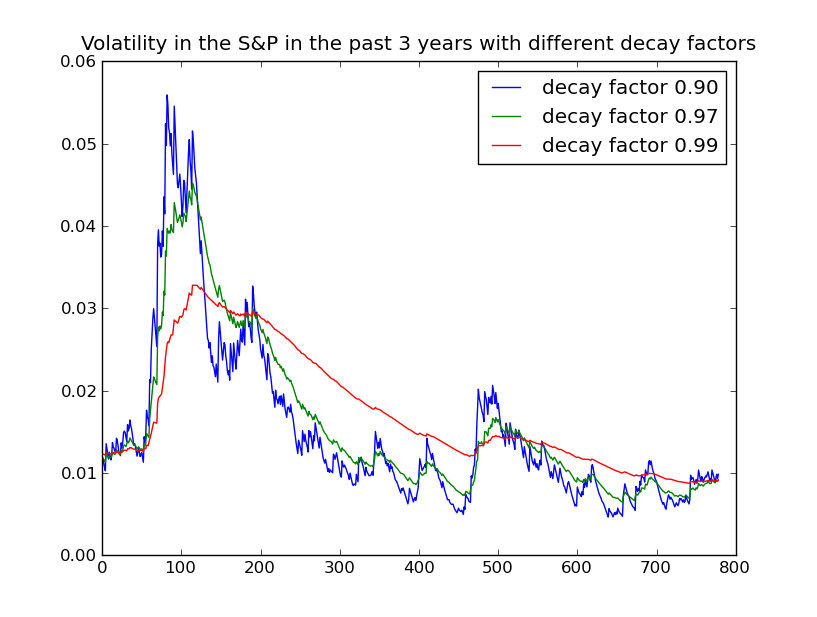
First, market returns in general have fat-tailed distributions; things can seem “quiet” for long stretches of time (longer than any lookback window), during which the sample volatility is a possibly severe underestimate of the “true” standard of deviation of the underlying distribution (if that even makes sense – for the sake of this discussion let’s assume it does). Then when a fat-tailed event occurs, the sample volatility typically spikes to being an overestimate of the standard of deviation for that distribution.
Second, in the markets, there is clustering of volatility- another way of saying this is that volatility itself is rather auto-correlated, so even if we can’t predict the direction of the return, we can still estimate the size of the return. This is particularly true right after a shock, and there are time series models like ARCH and its cousins that model this phenomenon; they in fact allow you to model an overall auto-correlated volatility, which can be thought of as scaling for returns, and allows you to then approximate the normalized returns (returns divided by current volatility) as independent, although still not normal (because they are still fat-tailed even after removing the clustered volatility effect). See below for examples of normalized daily S&P returns with various decays.
Example: S&P daily returns
I got this data from Yahoo Finance, where they let you download daily S&P closes since 1950 to an excel spreadsheet. I could have used some other instrument class, but the below results would be stronger (especially for things like credit default swamps), not weaker- the S&P, being an index, is already the sum of a bunch of things and tends to be more normal as a result; in other words, the Central Limit Theorem is already taking effect on an intraday basis.
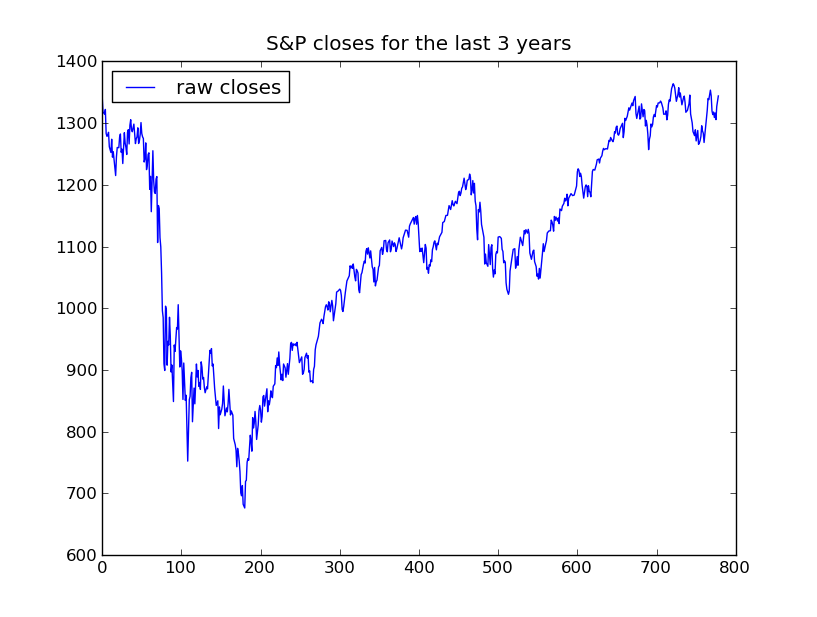
First let’s take a look at the last 3 years of closes, so starting in the summer of 2008:
Next we can look at the log returns for the past 3 years:

Now let’s look at how the historical volatility works out with different decays (decays are numbers less than 1 which you use to downweight old data: see this post for an explanation):
For each choice of the above decays, we can normalize the log returns. to try to remove the “volatility clustering”:
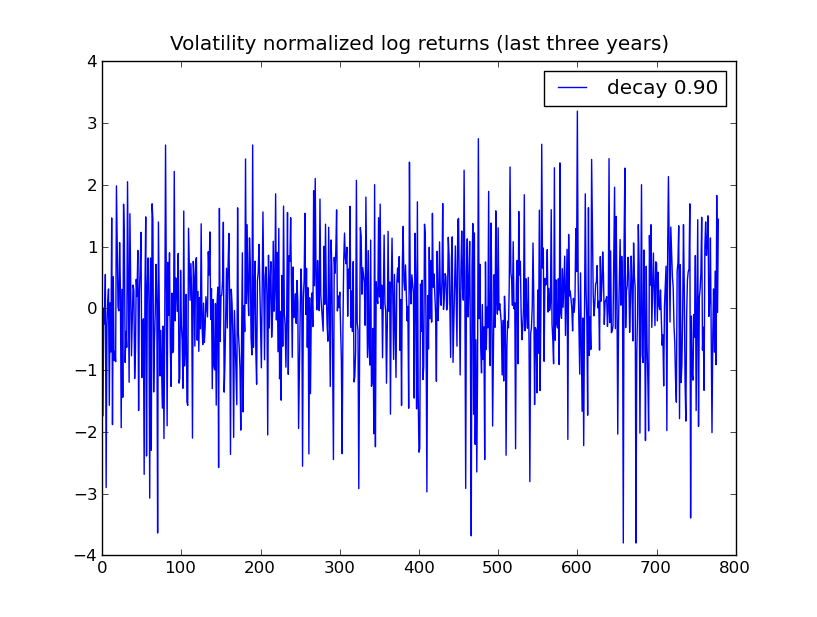
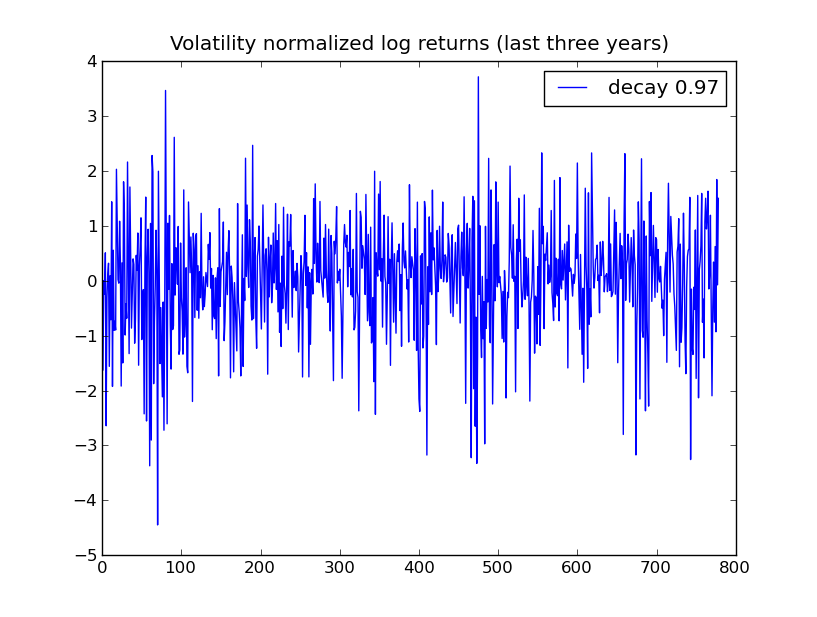
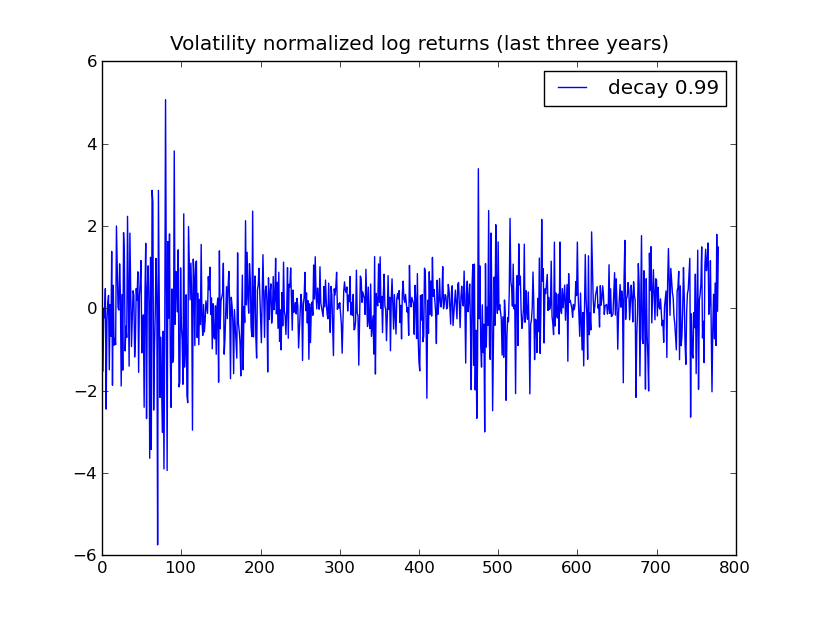
As we see, the long decay doesn’t do a very good job. In fact, here are the histograms, which are far from normal:


Here’s the python code I used to generate these plots from the data (see also R code below):
#!/usr/bin/env python
import csv
from matplotlib.pylab import *
from numpy import *
from math import *
import os
os.chdir(‘/Users/cathyoneil/python/sandp/’)
dataReader = csv.DictReader(open(‘SandP_data.txt’, ‘rU’), delimiter=’,’, quotechar=’|’)
close_list = []
for row in dataReader:
#print row[“Date”], row[“Close”]
close_list.append(float(row[“Close”]))
close_list.reverse()
close_array = array(close_list)
close_log_array = array([log(x) for x in close_list])
log_rets = array(diff(close_log_array))
perc_rets = array([exp(x)-1 for x in log_rets])
figure()
plot(close_array[-780:-1], label = “raw closes”)
title(“S&P closes for the last 3 years”)
legend(loc=2)
#figure()
#plot(log_rets, label = “log returns”)
#legend()
#figure()
#hist(log_rets, 100, label = “log returns”)
#legend()
#figure()
#hist(perc_rets, 100, label = “percentage returns”)
#legend()
#show()
def get_vol(d):
var = 0.0
lam = 0.0
var_list = []
for r in log_rets:
lam = lam*(1.0-1.0/d) + 1
var = (1-1.0/lam)*var + (1.0/lam)*r**2
var_list.append(var)
return [sqrt(x) for x in var_list]
figure()
for d in [10, 30, 100]:
plot(get_vol(d)[-780:-1], label = “decay factor %.2f” %(1-1.0/d))
title(“Volatility in the S&P in the past 3 years with different decay factors”)
legend()
for d in [10, 30, 100]:
figure()
these_vols = get_vol(d)
plot([log_rets[i]/these_vols[i-1] for i in range(len(log_rets) – 780, len(log_rets)-1)], label = “decay %.2f” %(1-1.0/d))
title(“Volatility normalized log returns (last three years)”)
legend()
figure()
plot([log_rets[i] for i in range(len(log_rets) – 780, len(log_rets)-1)], label = “raw log returns”)
title(“Raw log returns (last three years)”)
for d in [10, 30, 100]:
figure()
these_vols = get_vol(d)
normed_rets = [log_rets[i]/these_vols[i-1] for i in range(len(log_rets) – 780, len(log_rets)-1)]
hist(normed_rets, 100,label = “decay %.2f” %(1-1.0/d))
title(“Histogram of volatility normalized log returns (last three years)”)
legend()
Here’s the R code Daniel Krasner kindly wrote for the same plots:
setwd(“/Users/cathyoneil/R”)
dataReader <- read.csv(“SandP_data.txt”, header=T)
close_list <- as.numeric(dataReader$Close)
close_list <- rev(close_list)
close_log_list <- log(close_list)
log_rets <- diff(close_log_list)
perc_rets = exp(log_rets)-1
x11()
plot(close_list[(length(close_list)-779):(length(close_list))], type=’l’, main=”S&P closes for the last 3 years”, col=’blue’)
legend(125, 1300, “raw closes”, cex=0.8, col=”blue”, lty=1)
get_vol <- function(d){
var = 0
lam=0
var_list <- c()
for (r in log_rets){
lam <- lam*(1 – 1/d) + 1
var = (1 – 1/lam)*var + (1/lam)*r^2
var_list <- c(var_list, var)
}
return (sqrt(var_list))
}
L <- (length(close_list))
x11()
plot(get_vol(10)[(L-779):L], type=’l’, main=”Volatility in the S&P in the past 3 years with different decay factors”, col=1)
lines(get_vol(30)[(L-779):L], col=2)
lines(get_vol(100)[(L-779):L], col=3)
legend(550, 0.05, c(“decay factor .90”, “decay factor .97″,”decay factor .99”) , cex=0.8, col=c(1,2,3), lty = 1:3)
x11()
par(mfrow=c(3,1))
plot((log_rets[2:L]/get_vol(10))[(L-779):L], type=’l’, col=1, lty=1, ylab=”)
legend(620, 3, “decay factor .90”, cex=0.6, col=1, lty = 1)
plot((log_rets[2:L]/get_vol(30))[(L-779):L], type=’l’, col=2, lty =2, ylab=”)
legend(620, 3, “decay factor .97”, cex=0.6, col=2, lty = 2)
plot((log_rets[2:L]/get_vol(100))[(L-779):L], type=’l’, col=3, lty =3, ylab=”)
legend(620, 3, “decay factor .99”, cex=0.6, col=3, lty = 3)
x11()
plot(log_rets[(L-779):L], type=’l’, main = “raw log returns”, col=”blue”, ylab=”)
par(mfrow=c(3,1))
hist((log_rets[2:L]/get_vol(10))[(L-779):L], breaks=200, col=1, lty=1, ylab=”, xlab=”, main=”)
legend(2, 15, “decay factor .90”, cex=.8, col=1, lty = 1)
hist((log_rets[2:L]/get_vol(30))[(L-779):L], breaks=200, col=2, lty =2, ylab=”, xlab=”, main=”)
legend(2, 40, “decay factor .97”, cex=0.8, col=2, lty = 2)
hist((log_rets[2:L]/get_vol(100))[(L-779):L], breaks=200, col=3, lty =3, ylab=”, xlab=”, main=”)
legend(3, 50, “decay factor .99”, cex=0.8, col=3, lty = 3)
Is too big to fail a good thing?
I read this blog post a couple of days and it really got me thinking. This guy John Hempton from Australia is advocating the too big to fail model- in fact he things we should merge more big banks together (Citigroup and Wells Fargo) because we haven’t gone far enough!
His overall thesis is that competition in finance increases as a function of how many banks there are out there and is a bad thing for stockholders and for society, because it makes people desperate for profit, and in particular people increase their risk profiles in pursuit of profit and they blow up:
What I am advocating is – that as a matter of policy – you should deliberately give up competition in financial services – and that you should do this by hide-bound regulation and by deliberately inducing financial service firms to merge to create stronger, larger and (most importantly) more anti-competitive entities.
He acknowledges that the remaining banks will be hugely profitable, and perhaps also extremely lazy, but claims this is a good thing: we would, as a culture, essentially be paying a fee for stability. It’s something we do all the time in some sense, when we buy insurance. Insurance is a fee we pay so that disruptions and small disasters in our lives don’t completely wipe us out. So perhaps, as a culture, this would be a price worth paying?
The biggest evidence he has that this setup works well is that it works in Australia- they have four huge incompetent yet profitable banks there, and they don’t blow up. People who work there are sitting pretty, I guess, because they really are just living in a money press. There is no financial innovation because there’s no competition.
I guess I have a few different reactions to this scenario. First, it’s kind of an interesting twist on the too-big-to-fail debate, in that it’s combined with the idea I already talked about here of having a system of banks that are utilities. John is saying that, really, we don’t need to make that official, that as soon as banks are this huge, we are already done, they are essentially going to act like utilities. This is super interesting to me, but I’m not convinced it’s a necessary or even natural result of huge banks.
Second, I don’t buy that what happened in Australia will happen here- perhaps Australia squelched financial innovation through regulations and the existing boring system, but maybe the people who would have been financial innovators all just moved to the U.S. and became innovators here (there are plenty of examples of that!). In other words Australia may have made it just a bit too difficult to be competitive relative to what else is out there- if everyone tried to be that repressive to financial innovation, we may see people moving back into Australia’s financial waters (like sharks).
Third, I think what John is talking about is an example of a general phenomenon, namely that, in the limit as regulations go to infinity, there is only one bank left standing. This is because every additional regulation requires a lawyer to go over the requirements and a compliance person to make sure the rules are being followed continuously. So the more regulation, the more it behooves banks to merge so that they can share those lawyers and compliance officers to save costs. In the end the regulations have defined the environment to such an extent that there’s only one bank that can possibly follow all the rules, and knows how to because of historical reasons. And that one, last bank may as well be a government institution, albeit with better pay, especially for its managers.
But we don’t have that kind of regulatory environment, and hedge funds are alive and well. They have to follow some rules, it’s absolutely true, but it’s still possible to start a smallish hedge fund without a million lawyers.
I guess what I’m concluding is that if we had formed our very few, very huge banks because of a stifling regulatory environment, then maybe we would have an environment that is sufficiently anti-competitive to think that our banks would serve us as slightly overpaid utilities. However, that’s not why we have them – it was because of the credit crisis, and the rules and regulations haven’t changed that much since then.
At the same time, I don’t totally disagree that huge banks do become anti-competitive, just by dint of how long it takes them to make decisions and do things. But I’m not sure anti-competitive is the same thing as low-risk.
Elizabeth Warren: Moses and the Promised Land
This is a guest post by FogOfWar
In Biblical style, Elizabeth Warren (EW) was not nominated to head the CFPB (Consumer Financial Protection Bureau). Having spearheaded the movement to create the institution, pushed to make it part of the otherwise-generally-useless* Dodd Frank “Financial Reform” Bill, and spent the better part of the last two years staffing the actual CFPB and moving it into gear, she has now been deemed too controversial by what passes for a President these days.
One of my favorite EW quotes: “My first choice is a strong consumer agency. My second choice is no agency at all and plenty of blood and teeth left on the floor.” This still remains to be seen, as opposition to the CPFB (and filibuster threats to any appointment to head the Bureau) remains in the face of nominee Richard Cordray. In fact, if one were inclined to be an Obama apologist (I gave up apologizing for Obama right about here), one might view the Warren-Cordray switch as a potentially brilliant tactical maneuver, with the emphasis on “potentially”. If the opposition to the CPFB took its persona in EW, then sidestepping her personally to get the agency up and running would be worthwhile, particularly as Cordray seems at least as assertively pro-consumer as EW (a bank lobbyist described him as “Elizabeth Warren without the charm”).
Barney Frank believes gender bias played a role. Maybe yes, maybe no and the Cordray confirmation will give some evidence to that question. I suspect the Republican opposition isn’t stupid and knows that Cordray will run a good agency. If that’s right then passing over EW doesn’t really serve any purpose.
Hard to tell what a public figure is really like, but my sense is EW doesn’t have any ego attached to running the agency personally. And what she does next is really up to her, I mean who really cares what we think she should do?
Wait—this is a blog! Our Raison d’être is practically making suggestions that no one will listen to, so let’s go…
1. Run for Congress
The biggest idea floated around. Yves Smith thinks it’s a terrible idea. I’m not entirely convinced—there are many ways to make a difference in this world, and being one minority member of a large and powerful body, and thus moving the body incrementally in the right direction can be a very good thing.
Two questions though: can she win (a few early stage polls seemed to indicate no, but do early stage polls really have much predictive value on final election results? Cathy? Fivethirtyeight?), and on which party platform would she run (I vote for running as an Independent)? Any thoughts from the ground from our MA-registered voters?
2. The “Al Gore” option
EW could continue to advocate, lecture and write outside of political office. She’s good television and would be free to speak without the gag order of elected office. Definitely something to be said for this option. Just realized pulling links for this post that EW was the person from the movie “Maxed Out”. Part of me thinks “damn that was effective and she should do more of that because it was so effective” and part of me thinks “wait, that movie came out in 2006 and no one listened and no one will listen”, and then the other part goes “but it can happen—you’ve actually seen social perceptions change in the wake of Al Gore (and yes, lots and lots of other people, but sparks do matter) with real and deep impacts.”
3. The “Colin Powell” option
Y’now, being in the public light kinda sucks ass. Colin Powell passed up a run for President, and largely retired to private life, and doesn’t seem to have any complaints about it. One legitimate option is to say “I did my part, you guys fight the good fight & I’m going to hang out with my grandkids on the beach.”
Any other suggestions?
*-Paul Volker deserves a parallel post of equal length for pushing the Volker Rule through this legislation and similarly receiving the thanks of being sidelined by the TBTF bank-capital-must-increase-even-if-the-peasants-have-to-eat-cake crowd.
Quit your job and become a data miner!?
Today my friend sent me this link, which is a pretty interesting and inspiring video of a talk from a guy from Google named Steve Yegge talking at an O’Reilly conference about how he’s sick of working on uninspiring projects involving social media and cat pictures, and wants to devote himself (and wants you to devote yourself) to more important questions about the nature of human existence. And he things the way to go about this is to become a data miner. I dig it! Of course he’s preaching to the choir at that conference. I wonder what other people will make of his appeal. Can one nerd change an entire culture of endless cat pic collections?
And lest you think that data mining is the answer to everything, here’s an article about how much data mining (in the form of “Value-added modeling”) can screw up other peoples’ lives when it’s misdirected. It’s written by John Ewing, who is the fabulous president of MfA, an organization that trains and mentors excellent college math majors to become effective math teachers in the New York Public School system and beyond- the “beyond” part is partly due to the crazy state of the budgets for new teachers here in NYC- we now have access to these wonderful MfA graduates but have hiring freezes so we can’t hire them. Also, my good friend Japheth Wood, a.k.a. the Math Wizard, is one of the MfA mentors.
I’m planning to post more soon on how crappy the value-added modeling (VAM) system is and how’s it’s a perfect example of mathematics being used to make things seem magical and therefore inaccessible, the exact opposite of what should be going on.
The Bad Food Tax
There’s an interesting op-ed article in today’s New York Times. The author, Mark Bittman, is proposing that we tax bad foods to the point where people will naturally select healthy food because they will be subsidized and cheap.
He has lots of statistics to back him up, and if you’re someone like me who reads this kind of thing widely, nothing surprised me. Of course Americans eat crappy food and it’s terrible for our bodies. We know that, it’s old news.
And we all want to know how to fix this- clearly education about nutrition isn’t doing the trick by itself. And I’m the first person who would love to use quantitative methods to solve a really important, big problem. Moreover, if we start to get rid of the evil farm subsidies that are currently creating a ridiculous market for corn sugar (a major reason we have some much soda on the shelves at such low prices to begin with) as well as screwing up the farmers in Africa and other places, that will be a good thing.
Unfortunately, I really think his tax plan stinks. The main problem is something he actually brings up and dismisses- namely:
Some advocates for the poor say taxes like these are unfair because low-income people pay a higher percentage of their income for food and would find it more difficult to buy soda or junk. But since poor people suffer disproportionately from the cost of high-quality, fresh foods, subsidizing those foods would be particularly beneficial to them.
Yes they would, if they could actually buy them in their neighborhood! If he has the idea that the reason poor people buy crappy food is because they go into their neighborhood grocery store with a museum-like display of fresh fruits and vegetables, bypass those foods (because they are too expensive) to go straight to the back and find junk, then I guess his plan would make sense. Unfortunately the truth is, there is no fresh fruit at most of the food stores in poor urban areas – they are typically small and carry long-lasting packaged goods and groceries, from canned evaporated milk to diapers, and don’t have extra space. Moreover, I don’t think a pure price comparison is going to convince them to carry fruit, because it’s not just the higher prices that makes bodegas carry no fruit- it’s also the convenience of packages that don’t go bad. In fact it’s an entirely different business model, which is unfortunately a pretty tough nut to crack, but is essential in this discussion.
In other words, the result of this tax plan would be, for poor people, even higher prices for crappy food, not access to fresh cheap food. Unless the plan has worked out a system for how to get fresh fruit into poor areas, it really is missing the very audience it wishes to target.
Measuring historical volatility
Say we are trying to estimate risk on a stock or a portfolio of stocks. For the purpose of this discussion, let’s say we’d like to know how far up or down we might expect to see a price move in one day.
First we need to decide how to measure the upness or downness of the prices as they vary from day to day. In other words we need to define a return. For most people this would naturally be defined as a percentage return, which is given by the formula:

where 


If you know your power series expansions, you will quickly realize there is not much difference between these two definitions for small returns- it’s only when we are talking about pretty serious market days that we will see a difference. One advantage of using the log returns is that they are additive- if you go down 0.01 one day, then up 0.01 the next, you end up with the same price as you started. This is not true for percentage returns (and is even more not true when you consider large movements like 50% down one day, 50% up the next).
Once we have our returns defined, we can keep a running estimate of how much we have seen it change recently, which is usually measured as a sample standard deviation, and is called a volatility estimate.
A critical decision in measuring the volatility is in choosing a lookback window, which is a length of time in the past we will take our information from. The longer the lookback window is, the more information we have to go by for our estimate. However, the shorter our lookback window, the more quickly our volatility estimate responds to new information. Sometimes you can think about it like this: if a pretty big market event occurs, how long does it take for the market to “forget about it”? That’s pretty vague but it can give one an intuition on the appropriate length of a lookback window. So, for example, more than a week, less than 4 months.
Next we need to decide how we are using the past few days worth of data. The simplest approach is to take a strictly rolling window, which means we weight each of the previous n days equally and a given day’s return is counted for those n days and then drops off the back of a window. The bad news about this easy approach is that a big return will be counted as big until that last moment, and it will completely disappear. This doesn’t jive with the sense of the ways people forget about things- they usually let information gradually fade from their memories.
For this reason we instead have a continuous look-back window, where we exponentially downweight the older data and we have a concept of the “half-life” of the data. This works out to saying that we scale the impact of the past returns depending on how far back in the past they are, and for each day they get multiplied by some number less than 1 (called the decay). For example, if we take the number to be 0.97, then for 5 days ago we are multiplying the impact of that return by the scalar 0.97^5. Then we will divide by the sum of the weights, and overall we are taking the weighted average of returns where the weights are just powers of something like 0.97. The “half-life” in this model can be inferred from the number 0.97 using these formulas as -ln(2)/ln(0.97) = 23.
Now that we have figured out how much we want to weight each previous day’s return, we calculate the variance as simply the weighted sum of the squares of the previous returns. Then we take the square root at the end to estimate the volatility.
Note I’ve just given you a formula that involves all of the previous returns. It’s potentially an infinite calculation, albeit with exponentially decaying weights. But there’s a cool trick: to actually compute this we only need to keep one running total of the sum so far, and combine it with the new squared return. So we can update our vol estimate with one thing in memory and one easy weighted average. This is easily seen as follows:
First, we are dividing by the sum of the weights, but the weights are powers of some number s, so it’s a geometric sum and the sum is given by

Next, assume we have the current variance estimate as

and we have a new return 

Note that I said we would use the sample standard deviation, but the formula for that normally involves removing the mean before taking the sum of squares. Here we ignore the mean, mostly because we are typically taking daily volatility, where the mean (which is hard to anticipate in any case!) is a much smaller factor than the noise. If we were to measure volatility on a longer time scale such as quarters or years, then we would not ignore the mean.
In my next post I will talk about how people use and abuse this concept of volatility, and in particular how it is this perspective that leads people to say things like, “a 6-standard deviation event took place three times in a row.”
Happiest being sad
I’m done with math camp, and I am stopping off in Harvard Square on the way home to New York. I collected my two older sons from their first stint at overnight camp yesterday evening, a two-week middle-of-the-woods experience complete with a cold lake, dirty socks and sticky bunk beds. They were actually happy to see me, I could tell by the way they let me hug them in front of other people. I cried when I realized they had each grown two inches.
The past few days have been incredibly emotional. Somehow I started to pine for the program and for the students at the program before it had ended, and now I seem to miss my kids even though I have them back. I’m a mess of yearning, for a million things at once, and it seems like I’ve set myself up for this.
Of course when I think about it I absolutely have, and I guess the only real question is why I’m surprised. I keep falling in love with people and experiences that often even love me back, and even though I’m an experienced piner it doesn’t get any less painful. And yet it seems like the only alternative, if it is a choice I could even make, would be to close myself off from that openness and compassion and live in a careless void. That is certainly more terrifying to me than the safety of wistful suffering.
My friend Moon came to the program a couple of nights ago and gave a kick-ass talk to the students about the Banach-Tarski paradox. She stuck around that night for dinner and asked the program director, who has been doing this for 40 years, whether I had ever been shy. The director said, “No, Cathy was never shy, but she was memorable for the fact that she always said the same thing whenever someone started a conversation with her.” I had no idea what that could have been, and to tell you the truth I was a little worried what he’d say. So Moon asked, and he said the phrase was, “I love math!” It brought back a clear memory of the passion I had then and still have, and hopefully will always have. I am happy to be this sad.
What tensor products taught me about living my life
When I was a junior in college, I went to the Budapest Semesters in Math. I got really bummed while I was there, and I was thinking of leaving math, when a friend of mine back home sent me Silverman and Tate’s book on elliptic curves. That book restored my faith in math and I decided to become a number theorist. I went back to Berkeley and enrolled in Hendrik Lenstra’s Class Field Theory class, which was the second semester of a grad number theory class, and in Ken Ribet’s second semester grad algebra class. Since I’d missed the first semester of each, I pretty much got my ass kicked. I lived and breathed algebra and p-adics and local-glocal principles for the next three months. It was pretty awesome and incredibly challenging. The moment of my biggest frustration happened when we learned about tensor products over arbitrary rings with zero divisors.
I kept trying to understand these rings, and in particular the elements of these rings. I wasn’t asking much: I just wanted to figure out the most basic properties of tensor products. And it seemed like a moral issue. I felt strongly that if I really really wanted to feel like I understand this ring, which is after all a set, then at least I should be able to tell you, with moral authority, whether an element is zero or not. For fuck’s sake!
I couldn’t do it. In fact all the proofs I came up with involved the universal property of tensor products, never the elements themselves. It was incredibly unsatisfying, it was like I could only describe the outside of an alien world instead of getting to know its inhabitants.
After a few months, though, I realized something. I hadn’t gotten any better at understanding tensor products, but I was getting used to not understanding them. It was pretty amazing. I no longer felt anguished when tensor products came up; I was instead almost amused by their cunning ways.
Every now and then something like that happens in my life. Something that I start out desperately wanting to understand, to analyze, and to own. It’s practically a moral imperative! And I consider myself a person who gets stuff done! How can I let this lie unexplained?
Then after a few days it turns out, no, I still don’t understand it, but it actually makes me like it more. In fact now I look forward to things like that; little puzzles of human existence, where, for perhaps small examples (like when you work over a field) you can understand the issue entirely, but overall you realize it’s harder than that, and moreover you shouldn’t kill yourself over it. You can remain content maybe knowing how to describe some of its properties, while allowing it to maintain its secrets, because life is actually more interesting that way.
Follow up on: math contests kind of suck
I have been really impressed with the comments and thoughts of my first post about how I think math contests kind of suck. Thinking about it some more, I’d like to make two corrections to my original thoughts as well as a clarification.
The first correction is that it’s the MAA, not the NSF, that mysteriously only seems to support contests, or at least for the most part supports contests and not enrichment. The NSF, as has been pointed out in the comments, mysteriously supports primarily college-level math enrichment (through REUs) instead of high-school level stuff, but that’s a different mystery.
The second correction is that, instead of saying about contests “most people don’t get close to winning, and in particular give those people the impression that because they lost a contest they don’t “have it” when it comes to math,” I should have said, “most people don’t get close to winning, and for the subset of people who care about winning, in gives them the impression that because they lost a contest they don’t “have it” when it comes to math.” In other words, I’m not discussing the subpopulation who don’t care if they win. (To those people I’d say: you are rare and you are lucky.)
Except I am discussing them, and this is where the clarification comes in. My point about girls is this: girls are more likely to be in the subpopulation of kids who care, and therefore more likely to be disappointed in themselves. In fact I would add that girls are more likely to underestimate their performance, even if it was great, and moreover they are more likely to do badly in the presence of the negative stereotype that tells them girls aren’t good at math.
These are all statistical statements. In particular, an argument that won’t convince me I’m wrong is something like: I’m a guy and I didn’t care if I won or lost and I loved (or hated) contests. That just means you are not in the population of kids I am talking about. Another argument that won’t convince me I’m wrong goes like this: I’m a guy and I cared and I did awesome. In fact won’t even really change my mind if a woman writes and said she cared and did badly (or well) but loved (or hated) them anyway. Because what I’m talking about is essentially a statistical statement, and idiosyncratic examples probably won’t change my mind.
In fact I’d argue that it’s very very difficult to prove or disprove my claim, at least with comments, because there’s a strong survivorship bias in place, namely that people who got scared away from math won’t be reading my blog at all. In order to give evidence to support or discredit my claim we would have to look at examples of populations which were or weren’t exposed to enrichment, versus contests, versus perhaps something else (like no math outside their classroom) and see who became mathematicians. Oh wait here’s something.
By the way, it’s important to make clear that I’m not suggesting stripping contest math out of the picture altogether. I think there’s a case to be made that they’re better than nothing. But we don’t need to settle for nothing! However, I think we should be creating alternatives that are not competitive or timed. I was very happy to hear about the month-long test and I also heard about a team 24-hour test (does anyone know the name of that and if it still exists?)
Two last tangentially related issues:
- I would argue that any time a bunch of nerd kids get together they have a blast. So we definitely should be getting math nerd kids together. We just shouldn’t be having them compete against each other. I claim they’d have an even better time that way.
- Also, has anyone else noticed the prevalence of girls who are good at competitions and very involved fathers? It’s really interesting. My dad is a mathematician too, and many (but not all) of the women mathematicians I know have heavily involved and/or mathematical dads.
_Love_ you people
I’d like to make a shout-out today to a bunch of people.
First, my readers, who are gorgeous, sexy, and brilliant people. Thanks for reading.
Second, my commenters, who are thoughtful, gorgeous, sexy, and brilliant people, especially when they back me the fuck up. Go, you people! I’m nearly at a 3-to-1 comment-to-post ratio, which makes me feel pretty awesome. I’ve learned a whole bunch and met some pretty amazing people recently through their comments. I’ve actually been please to discover that I really enjoy being disagreed with and argued with- it makes it so much faster to learn. So keep the (constructive) criticisms coming!
Next, I’d like to throw out a bunch of links to blogs which I really like. Actually I recently created a blog roll so there’s that. But in particular I’d like you to check out some of my favorites:
- My good friend Jordan Ellenberg has a wonderful blog entitled “Quomodocumque“, whatever that means (oh wait! it means “whatever” in Latin; I wonder if that is meant sarcastically), in which he muses about math (Rubik’s cubes included!) and… whatever.
- Just in case you’ve somehow missed the whole String Theory Debate, please inform yourself at Peter Woit’s blog called “Not Even Wrong”. When I taught at the Columbia math department, as a Barnard math professor, I used to eat lunch with Peter every day at the Mill Korean on Broadway and 112th. What was adorable about Peter is that every frigging day, and I mean every day, he’d read the menu, look a bit confused, and then order beef fried rice. And then he’d give me his Chiclets at the end of the meal. I’m not sure why this story would recommend his blog to you but it certainly endears him to me. His blog rocks btw.
- Andrew Gelman’s blog titled Statistical Modeling, Causal Inference, and Social Science has a pretty awesome post today about economists (who doesn’t love hating on economists?!).
- I just found this blog, Quantivity, which contains impressively informed finance stuff, and is more technical than what I’m going for.
- Check out a new game theory blog, called Nuclear Chicken Collusion, which comes up with very readable, fun versions of fancy ideas. Their most recent post talks about the probability of there being a god and what it means for you.
High frequency trading: Update
I’d like to make an update to my earlier rant about high frequency trading. I got an awesome comment from someone in finance that explains that my main point is invalid, namely:
…the statement that high frequency traders tend to back away when the market gets volatile may be true, but it is demonstrably true that other, non-electronic, non-high-frequency, market makers do and have done exactly the same thing historically (numerous examples included 1987, 1998, various times in the mortgage crisis, and just the other morning in Italian government bonds when they traded 3 points wide for I believe over an hour). While there is an obligation to make markets, in general one is not obliged to make markets at any particular width; and if there were such an obligation, the economics of being a marketmaker would be really terrible, because you would be saying that at certain junctures you are obliged to be picked off (typically exactly when that has the greatest chance of bankrupting your enterprise).
My conclusion is that it’s not a clear but case that high-frequency traders actually increase the risk.
By the way, just in case it’s not clear: one of the main reasons I am blogging in the first place is so that people will set me straight if I’m wrong about the facts. So please do comment if you think I’m getting things wrong.
High frequency trading
This morning there was an article in the New York Times describing high frequency traders- what they do and how they want people to like them. I’m of the mind that there’s not much to like.
NOTE: Please see update!
High frequency traders are basic, old-fashioned opportunists. They buy somewhere and try to sell somewhere else cheaper. They have expensive technology and colocate next to exchanges to deal with speed-of-light issues to shave off tiny fractions of seconds for their trades. They notice a currency change in Brazil and trade on it in the US before anyone else notices. That kind of thing.
They will tell you that they are useful to the market, because they have set the bid-ask spread smaller than it used to be. Back in the day, there were official “market makers” who would maintain a book of certain instruments, and would be the go-to person for anyone who wanted to buy or sell. In return for the service they would charge a fee, which would be this so-called spread. Moreover, they were required to offer to buy and to sell in all kinds of trading environments (the spreads could get pretty wide of course).
It’s true that those spreads have gotten smaller since high-frequency traders have come to dominate. They have substantially replaced the old-school market makers and claim to be doing a better job. However, it’s also true that high-frequency traders aren’t required to be there. So when the going gets tough they completely vanish. This happens in moments of panic, and it can easily be true that their ability to vanish at will can also create more panics more often (I’d love some evidence to support or deny this theory), since from their perspective, at the first sign of weirdness, they may as well pull out until the dust settles.
The analogy I like to come up with is a little story about chores. Suppose you have someone who comes and helps you with your cleaning, mostly dishes, every day, for a small fee. Since you have kids and a job, the small fee seems to be worth it. After a while someone else comes along and offers to do your dishes every day! for free!! What a deal! You can’t resist. However, it turns out that, if the kitchen actually gets really dirty and needs to be mopped up or seriously cleaned, the free-dishes guy is nowhere to be found and you’re on your own, just when all the kids are sick and there’s a product release at work. Maybe not such a great deal after all.


