Aunt Pythia’s advice
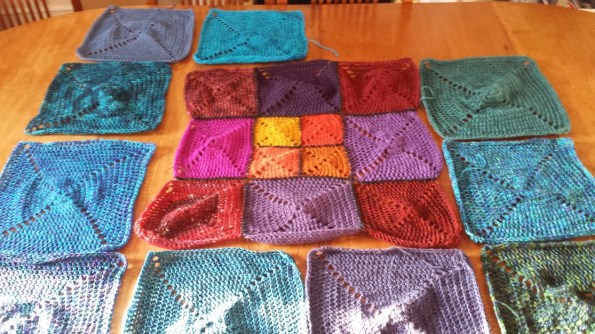
Readers, Aunt Pythia must apologize. She was taken over last weekend with the intense urge to craft. This is a coping mechanism of hers which takes over in times of stress, and the Paris attacks combined with anything Trump says, ever, overwhelmed her for about a week and it started last weekend. The good news is she got her project done:

It’s a baby blanket for my friend Adrian’s new baby. The design is here.

It’s reversible. Except for the name.
As for yesterday, Aunt Pythia had family over and was whipping up 5 dozen pancakes. Forgot to take pictures of them, but there were a lot of bananas and chocolate chips involved.
Anyhoo, that’s the explanation, but rest assured she has recovered and has emerged from her craft cave that exists inside the head. She is here for you and wants nothing more than to listen to your questions and give her half-reasoned and pseudo-sound advice. Before that, though, a small interruption.
Public Service Announcement: Reading Aunt Pythia has been known to improve mental and physical health, if only because it keeps you away from Thanksgiving leftovers for a few extra minutes. This effect is not statistically significant. I repeat, not statistically significant. This has been a Public Service Announcement brought to you by state and local authorities. In the event of an actual emergency, this announcement would not be helpful. I repeat, unhelpful.
If, after reading the below, you want to waste even more time, please don’t hesitate to:
ask Aunt Pythia any question at all at the bottom of the page!
By the way, if you don’t know what the hell Aunt Pythia is talking about, go here for past advice columns and here for an explanation of the name Pythia.
——
Dear Aunt Pythia,
I’d like to tell you an anecdote, one that is both mortifying and instructive. I offer it in the hope that it will elicit some thoughtful discussion from you, and from your other readers.
I am a male mathematician of a certain age. About twenty years ago, in my capacity as a member of a journal editorial board, I received a paper to handle. The author, a European, was nobody I had heard of. I took a look at the paper and decided that it was not up to the journal’s standards. The theorem was correct, but I could explain it to myself quickly using standard ideas in a routine way, by arguments simpler than those in the paper.
So without sending it to a referee I wrote a polite rejection letter explaining my reasons. From the author’s name, I assumed she was a woman. In fact he was a man.
I learned this about ten years later, when I happened to meet him at a small international conference. I don’t believe that either of us acknowledged the fact that our paths had crossed long ago. Several embarrassing thoughts flew into my head. Had he received a rejection letter starting “Dear Ms ____”? I would like to think that I knew enough back then to write “Dear Professor ____” or “Dear Dr ____”. Maybe I did.
But the thing that really made me squirm was that, as soon as I learned that she was a he, it came to me in a flash that I had written the letter in a sexist frame of mind. Imagining that I was writing to a woman, probably a struggling new-fledged female PhD, I had adopted a condescending tone that I don’t think I would have taken with a struggling new-fledged male PhD.
I can’t say for sure whether the air of condescension would have been obvious to the reader, but it was certainly there in my head. If I couldn’t see my own sexism in that case until this chance discovery made it apparent, how can I guard against similar attitudes when I’m teaching, or writing a reference letter, or reading a job application or a grad school application?
Baffling, Our Own Biases, Yes?
Dear BOOBY?,
I get it. I’m like that too. In fact women are just as sexist as men. I often find myself wondering if I spoke too condescendingly to women. I sometimes wish I could “play back the tape,” as it were, from old conversations so that I could apologize when appropriate.
But of course, you can’t do that in a conversation, because we don’t record conversations, or for that matter take any other anti-bias steps for real-world interactions. On the other hand, we can and should for formal situations like submitting papers.
Here’s a very concrete suggestion: Make it a rule that you obscure the name of every article that comes in to every journal, and that at least one referee sees each one. This way you, who saw the name before it was obscured, will not be tempted to immediately dismiss articles written by women. And as a happy by-product you won’t have to fret later on about your own sexist impulses, which again we all have.
Maybe you can arrange for someone else to do the obscuring-of-the-names process so you can look at the papers yourself. Maybe you could arrange with another editor to obscure their names in return for them obscuring yours. Whatever. Do what it takes to make it a blind audition.
I’d like to add that, whenever possible, do this for grad school applications and job applications as well. I know it’s hard for job applicants, because they are known personally at that level, but try to put processes into place that at least mitigate this kind of thing.
Good luck, and please know that once this system is in place you will have accomplished way more than you are now by kicking yourself needlessly and fruitlessly.
Aunt Pythia
——
Aunt Pythia,
My wife, her sister and I are all in our late 40’s and empty nesters. My sister-in-law, Naomi, is divorced and currently between boyfriends. As a result, she usually shows up at our place Saturday mornings. She and my wife, Allison, go shopping or to an art exhibit or other places, returning to our house in the late afternoon. They both shower and get dressed and then the three of us go out for dinner and other activities. I’ve edited some of the conversation below to make it more coherent.
Allison showers in the master bath and Naomi in the guest bath. They both come to the double sink in the master bath to fix their makeup, do their hair, and talk. I’ve taken to joining them because they both primp while wrapped in bath towels and I’m hoping for a flash. Allison will usually oblige pretending to need to get something from the under sink. She bends over keeping her legs straight. Then she’ll straighten up and smirk at me.
Several weeks ago Allison was alone in front of her sink when I came in. She smelled so fresh that I couldn’t resist. I knelt in front of her, put a hand behind her thigh for balance, pulled down her towel, and licked her nipples. All of a sudden Naomi showed up. Allison was trapped.
“Ronnie, don’t embarrass Naomi!”
I took one more lick of each nipple making sure Naomi could see my tongue flicking each bud. I stood up.
“Sorry, sometimes I get carried away,” I said to Naomi.
“Looked like fun,” Naomi replied. “I wish I had someone to do that to me.”
The minor exhibitionism revved me up. That night I was harder than I had been in a long time. Allison was hot also. She had a couple of orgasms.
Since that Saturday night had gone so well, I decided to try the same thing the next week. When I walked into our bedroom Allison was naked and still drying off. Unfortunately Naomi was already there. My disappointment showed.
“Aww, no sugar tits this week, Ron,” Naomi said and laughed.
The following week I pulled down Allison’s towel before Naomi showed up. Allison was moaning when Naomi walked in on us.
“Ronnie, stop Naomi’s here.” But she didn’t push me away.
“Yeah, Ron. You’re making me jealous.”
I took one last long lick to make sure Naomi saw.
“Doesn’t your sister have nice breasts?” I cupped one of Allison’s breasts and turned to Naomi.
“Mine are bigger.” Naomi pulled her towel down for about three seconds before covering up again.
That night Allison was all over me as soon as Naomi left.
“Did you like seeing my slut sister’s big boobs?” I was sucking Allison’s breasts so it took me a few seconds to reply.
“They’re okay.”
“Don’t bullshit a bullshitter. I saw the way your eyes bugged out when she flashed you.”
“Honey, I’ve told you before, anything over a mouthful is wasted.”
“So you would waste a lot if you sucked her boobs?”
“I guess so.” After that the conversation waned as I moved lower on her body.
We all felt a certain excitement the next Saturday when the girls got ready for their showers.
Allison was still drying off when I caught her out of the shower. This time as I lowered my lips to her nipples I slipped the hand that I used to balance on the back of her thigh up higher until my fingers were against her sex.
“You be good if Naomi comes in. Don’t embarrass me.” Naomi showed up a minute later.
“Don’t you two ever get enough?” I licked both nipples before raising my head and looking at Allison.
“If Naomi is going to watch us each week, don’t you think she ought to show us something?”
“Yeah, Sis. Show us your boobs again.” I dropped my head back down and watched out of the corner of my eye as Naomi lowered her towel to her waist. After about fifteen seconds I raised my head again.
“Do you think she wants her nipples licked?”
“Sis, do you want Ronnie to lick your nipples?” Allison moaned. Then she spread her legs farther apart. My index finger slipped between her moistening lips.
Naomi didn’t reply, but she drifted over beside me. I turned my head and put my other hand on the back of Naomi ‘s thigh to balance. Of course that hand slipped higher to touch between her legs. I moved my mouth to her nearest nipple. As I sucked, Naomi spread her legs a little. I extended my finger upward. After about five minutes of switching back and forth and tonguing four nipples, I was about to explode.
“Ronnie, we need to finish getting ready for dinner.”
“Yeah, Ron, I bet you’re hungry,” Naomi added hoarsely.
I got up reluctantly.
That night I was licking between Allison’s legs.
“Do you think Naomi would like it if I licked her clit?” I asked as I stopped briefly.
“My sister’s such a slut. I bet she would give you a blowjob and swallow if you licked her clit. But maybe you shouldn’t get confused about which sister you’re married to.” With that she dug her fingernails into my shoulder hard enough to hurt. “Get back to my clit.
So, here’s my question. Is my wife giving me permission to steal third base or is she calling me out and sending me to the dugout?
Wants to Smell the Roses but Afraid of the Thorns
Dear WrStRbAotT,
First of all, I want to thank you for your letter. I appreciate the work you put into it, I really do. It’s obvious what you put yourself through on Aunt Pythia’s behalf, and she appreciates it.
Second of all, I don’t have a sister, but if I did, I am pretty sure I’d never want to be sexual with her or in her presence. I mean, I have a brother, so I know how I feel about that kind of thing, and I’m pretty sure sisters are similar. Even so, it seems like – and I’m generalizing from Happy Days and Fonzie, but who doesn’t – it seems like this is a common enough male fantasy.

I guess to probe just a bit on this topic, how would you react if I talked about having sex with you and your brother at the same time? Would that turn you on? I doubt it. Just saying.
In answer to your question, I think your wife has been giving you mixed signals, and maybe you should take that as a sign of ambivalence, or maybe she’s just saving the best for the next chapter, if you will.
To sum up: I’d definitely let her take the lead if I were you. If she wants you to do the nasty with her sister, believe me, she’ll tell you to. Or maybe show you how (cough).
Good luck!
Aunt Pythia
——
Dear Aunt Pythia,
About seventeen years ago when I was a grad student I was in the computer room of a national science facility analyzing my data. The only other person there was a fellow grad student analyzing her data when her thesis supervisor came in the room and started to sexually assault her.
Without thinking, I pulled him away from her and dragged him to my desk where I said “here are those plots which I mentioned before” which is true because a few hours earlier I was talking to him about that data. He looked quite livid, but said nothing and left the room.
The grad student was stunned and left the room. Neither of us said anything either then or later. I have not seen XXXXXX (AP: name redacted) for at least ten years. The recent news about the sexual harassment case at Berkeley has made me think of these memories after so many years of not wanting to think of them. I have also started wondering whether what I did really made a difference in her life and so I have thought of contacting her directly and asking that question.
There is no question in my mind that what I did was the right thing, yet somehow it would be nice to get some sort of acknowledgment. Do you think contacting her and asking her whether what I did made any kind of difference in her life be a good idea and if so, how would you word it ?
Old Memories Arise Again
Dear OMAA,
Hmm. I’m thinking, you maybe didn’t do the wrong thing, but I don’t think I’d characterize it as “the perfect thing”. That’s not to blame you at all, because I think your intuition was good, and you definitely defused the situation. But I’m wondering if the internal conflict you’re feeling might arise from the fact that you could have done more. In short, you diverted him but you didn’t keep him from trying it again.
The problem with diversion, as a technique, is that it doesn’t address the underlying issue, and it doesn’t call it out as fucked up. It simply avoids it in a short-term way. So for example, there’s no reason to think that your colleague ever felt safe going back to that computer lab to do work again, even if she got a new advisor.
So, if you’re wondering what you’d do if that situation came up again, I’d suggest 1) telling him he’s doing something illegal while he’s doing it, 2) telling your colleague she has every right to call the police, and 3) calling the police yourself in front of both of them. That way he gets the message, and even if he ends up thinking he did nothing wrong, which is typical in this kind of situation, at least he’s been through enough that he doesn’t think doing it again is worth it. Introduce serious friction into his predatory ways, in other words, and it will at least slow him down, and at best get him fired.
As far as contacting her, I don’t think you should, especially with your current expectation of “acknowledgement” for “doing the right thing.” If I were that woman, I’d kind of want to say, “why the fuck didn’t you speak up?” and I would definitely not appreciate it. If, on the other hand, you wanted to reach out and ask her what you should have done, and what would have helped her the most, then yeah, maybe that could fly. But it would have to be done carefully.
Finally, I think it’s strange that you’d say her name. Is that some kind of signal to me that this is a fake question? In that case, please don’t send me fake questions; better to say what you’re sending me is a hypothetical. Otherwise, I’m not clear on why you’d name the victim at all. Is it an unnecessary pseudonym? I don’t get it.
Aunt Pythia
——
Dear Aunt Pythia,
What do you think of the heartbreaking story of Anna Stubblefield – to me it reads like a Shakespearean tragedy: brave woman leaves her white cis-male husband for a differently-abled man of color, but instead of being praised she is arrested and send to prison on ridiculous charges without any evidence.
LIM
Dear LIM,
Wow. Seriously?
Anna Stubblefield is super nuts. Yes, in a tragic way, but still. The best thing I can say about her is that she’s nuts and I don’t think she had evil intentions. But she’s still nuts.
Otherwise said: people have an amazing ability to believe what they want to believe. I know this because I worked in finance and I get that Lloyd Blankfein was not joking when he said that Goldman Sachs was “doing God’s work.” For reals some people are true believers, and they are the scariest people around.
Aunt Pythia
——
Readers? Aunt Pythia loves you so much. She wants to hear from you – she needs to hear from you – and then tell you what for in a most indulgent way. Will you help her do that?
Please, pleeeeease ask her a question. She will take it seriously and answer it if she can.
Click here for a form for later or just do it now:
What are you thankful for in finance or economics?
It’s been a few days, I’ve been listening to Adele’s new album pretty much on loop while knitting and sewing curtains. So yes, it’s that nesting time of year, where we hunker down and seriously consume creamy spiked drinks.

And by “we” I mean Americans, Canadians, Australians, and New Zealanders. Obviously we blame the hobbits on that last one.

Well, here’s a question for you nog-quaffers: what are you thankful for from finance? I’ll extend it to the economy as well if you’d like.
The reason I’m asking is that this week, the Slate Money podcast I’m on is doing a special “thanksgiving” episode where we all talk about something we’re grateful for, and I’m having trouble coming up with something. Here’s what I’ve got so far:
- I’m grateful for consumer loans. After all, they help us out in rough times and allow us to invest in ourselves and our futures through mortgages and student loans. On the other hand, they also raise the price of everything through their availability. In fact I spent a couple of weeks ago on the show arguing that all college debt should be forgiven and that state colleges should be free. So I don’t think this works.
- I guess I’m thankful for inflation, in a sense. I mean, inflation makes it easier on debtors, since their debt is constantly dwindling in value, and it’s certainly better for an economy than deflation. But on the other hand, it can get out of hand and that’s bad, and it’s hard to control. So in the end I’m not actually all that excited by inflation.
- I could just be grateful for the entire financial system working at all. If you think about how much we depend on its functioning, to take out loans, to use our credit and debit cards, and to get paid monthly, it’s kind of amazing. On the other hand, if you think about the way finance deals with poor people, squeezing them for nickels and dimes, then you kind of lose respect. In fact it makes you want to be grateful for the CFPB instead, but that’s not financial enough.
- Finally, I’m thinking about how much I appreciate insurance. Yeah, I know there are plenty of problems with insurance (for example how cray-cray medical prices are for those without insurance, but I tend to blame a lack of reasonable transparency regulation on pricing in medicine on that, not insurance per se). But if you just think about how much insurance actually does for us, whether it’s medical or fire or car or life insurance, then you appreciate that it more or less functions as intended: to even out the bumpy risks of everyday life.
I’m still thinking about this question, and I’d love to hear your ideas!
Do Charter Schools Cherrypick Students?
Yesterday I looked into quantitatively measuring the rumor I’ve been hearing for years, namely that charter schools cherrypick students – get rid of troublesome ones, keep well-behaved ones, and so on.
Here are two pieces of anecdotal evidence. There was a “Got To Go” list of students at one charter school in the Success Academy network. These were troublesome kids that the school was pushing out.
Also, I recently learned that Success Academy doesn’t accept new kids after the fourth grade. Their reasoning is that older kids wouldn’t be able to catch up with the rest of the kids, but on the other hand it also means that kids kicked out of one school will never land there. This is another form of selection.
Now that I’ve said my two examples I realize they both come from Success Academy. There really aren’t that many of them, as you can see on this map, but they are a politically potent force in the charter school movement.
Also, to be clear, I am not against charter schools as a concept. I love the idea of experimentation, and to the extent that charter schools perform experiments that can inform how public schools run, that’s interesting and worthwhile.
Anyhoo, let’s get to the analysis. I got my data from this DOE website, down at the bottom where I clicked “citywide results” and grabbed the following excel file:
With that data, I built an iPython Notebook which is on github here so you can take a look, reproduce my results with the above data (I removed the first line after turning it in to a csv file), or do more.
From talking to friends of mine who run NYC schools, I learned of two proxies for difficult students. One is ‘Percent Students with Disabilities’ and the other is ‘Percent English Language Learners’ (I also learned that charter schools’ DBN code starts with 84). Equipped with that information, I was able to build the following histograms:

Percent Students with Disabilities, non-Charter

Percent Students with Disabilities, Charter

Percent English Language Learners, non-Charter

Percent English Language Learners, Charter. Please note that the x-axis differs from above.
I also computed statistics which you can look at on the iPython notebook. Finally, I put it all together with a single scatterplot:

The blue dots to the left and all the way down on the x-axis are mostly test schools and “screened” schools, which are actually constructed to cherrypick their students.
The main conclusion of this analysis is to say that, generally speaking, charter schools don’t have as many kids with disabilities or poor language skills, and so when we compare their performance to non-charter schools, we need to somehow take this into account.
A final caveat: we can see just by looking at the above scatter plot that there are plenty of charter schools that are well inside the middle of the blue cloud. So this is not a indictment on any specific charter school, but rather a statistical statement about wanting to compare apples to apples.
Update: I’ve now added t-tests to test the hypothesis that this data comes from the same distribution. The answer is no.

Those very small numbers are the p-values which are much smaller than 0.05. Other t-tests give similar results (but go ahead and try them yourself)
Line Edits
Right now I’m eyeball deep in line edits for my book, Weapons of Math Destruction: how big data increases inequality and threatens democracy.
Or rather, I’m in the phase of minor(ish) edits from my editor (post-existential threats, anyway, and that’s a big deal!) which is before the next phase, where I’ll be dealing with issues from the actual line editor, the person who knows all about commas and what gets italicized versus quoted and so forth.
Then come the galleys, and along the way of course I help choose a cover design. After that the blurbs start (who should I ask?) and they print a bunch of copies in China and have it all shipped back here by boat. The process takes months and it’s all new to me.
Point is, my brain is completely occupied with this stuff, which is the opposite of sexy but on the other hand is exactly why the book will be better (hopefully!) than a blog – it will be actually carefully edited.
Everyone, fingers crossed, but the tentative launch date is September 5th of 2016. I know, it’s forever from now, but at least it’s an actual date. I’m already planning the party.
Open Data Conference this Friday
I’m going to be on a panel Friday at a conference called Responsible Use of Open Data in Government and the Private Sector, which is being co-organized by Berkeley and NYU and is being held at NYU this Thursday evening and Friday all day.
The agenda is here. The first keynote, on Thursday night, is to be given by the Chief Analytics Officer of New York City, who I’m interested to hear from. I’m wondering what de Blasio’s administration is up to with respect to data and predictive modeling.
I’m going to miss Panel 2 because of my podcast taping, which is a shame, but I’m looking forward to Panel 1 which will discuss consequences of data sharing, unintended as well as intended: privacy concerns, discrimination concerns, and so on.
I’m on Panel 3, which with Panel 4 is devoted to the topic of private data use and collection versus the public good. The focus is on health care data and smart cities, but I will probably veer off to all kinds of ways that private companies use data to the detriment of the public, and how that should change.
Panel 5 discusses platforms for sharing data as well as the proposed governance of shared data. To be honest I’m a bit skeptical of the concept I’ve heard floated about recently that private companies will “donate” their data for the public good, but I’d love to be wrong.
Registration is free and open and available here.
Debiasing techniques in science
My buddy Ernie Davis just sent me an article, published in Nature, called How scientists fool themselves – and how they can stop. It’s really pretty great – a list of ways scientists fool themselves, essentially through cognitive biases, and another list of ways they can try to get around those biases.
There’s even an accompanying graphic which summarizes the piece:
I’ve actually never heard of “blind data analysis” before, but I think it’s an interesting idea. However, it’s not clear how it would exactly work in a typical data science situation, where you perform exploratory data analysis to see what the data looks like, and you form a “story” based on that.
One thing they mentioned in the article but not in the graphic is the importance of having your research open sourced, which I think is the way to let the “devil’s advocacy” and “team of rivals” approaches actually happen in practice.
It’s all the rage nowadays to have meta analyses. I’d love for someone to somehow measure the ability of the above debiasing techniques to see which work well, and under what circumstances.
Aunt Pythia’s advice
It’s a crisp autumn morning, and Aunt Pythia is deeply enjoying snuggling into her La-Z-Boy whilst wearing her cottony and fluffy hoodie, and she’s looking forward to a good long chat. She’s drinking coffee but she’s willing to make you tea if that’s your preference. In any case, make yourself comfortable, Aunt Pythia has some explaining to do.
Confession the first: recently Aunt Pythia has been going on somewhat of a craft binge. She’s taken to sewing lined curtains for her New York apartment, and the learning curve for someone who has never successfully done more than seam pants is steep. So far one prototype, a lopsided affair that looks much more 1970’s than she had envisioned. Stay tuned for updates, but please also make it your plan to sympathize with uneven hemming and puckers for a little while. Solidarity, people.
Also! Aunt Pythia readers, another confession/ brag. About a month ago Aunt Pythia received an email requesting her presence for an underwear modeling shoot, and she said yes (exact quote from CEO Julie at the shoot: “nobody has ever said yes that quickly. Most women have a million questions.”). It’s safe to say, dear readers, that the only question Aunt Pythia had about the underwear modeling gig was, why did it take you so long to ask me?
Two reasons this story might matter to you: first, you can check out the pictures here – please note Aunt Pythia’s hair goes with her shirt – and second, you can get an “Aunt Pythia discount” on Dear Kate underwear for women by using the discount code AuntPythia30, good through November 30th.
Now that all has been revealed! Aunt Pythia is getting on with the important stuff: your problems, ethical dilemmas, and general questions. Let’s do this, people! And after we do that, please don’t forget to:
ask Aunt Pythia any question at all at the bottom of the page!
By the way, if you don’t know what the hell Aunt Pythia is talking about, go here for past advice columns and here for an explanation of the name Pythia.
——
Dear Aunt Pythia,
In light of the discussion started by “Woman not at a bar”, I’ve been thinking about what women say about where it is OK to express romantic and sexual interest. I have been repeatedly told that men shouldn’t approach women they don’t know, because that shows that they only care about her looks.
Also, that a man shouldn’t approach a woman at a recreational activity (sports team, crafts, class, etc), because if she says no she might feel uncomfortable or scared and feel forced to drop out of the activity. One shouldn’t approach a woman at work, because that implies not taking her seriously as a professional. And approaching a close friend risks ruining the friendship.
All of these make sense to me individually, and if a woman says that something makes her uncomfortable I believe her, but they don’t seem to leave much room. Sometimes people tell me to wait for a woman to show clear signs of interest before making a move, but that seems to mean waiting forever (twice in the last ten years for me; one was a student in a class I was teaching, and the other one turned out not to be interested after all).
So is there any way to approach a woman that doesn’t make her feel threatened if she isn’t interested? And if not, perhaps it’s time for women to switch to making the first move as a rule?
A Single Heterosexual Adult Male Experiencing Distress
Dear ASHAMED,
You had me until the student in your class. I don’t think it’s ever ok to “make a move” on a student in your class. I’m going to give you the benefit of the doubt and assume you meant you waited at least long enough so that she wasn’t a student anymore. That’s a requirement. But let’s put it aside. It’s over there, next to the sugar bowl.
Here’s the thing. I think you might have gotten bad advice, but I think it happened before your scrutiny of the situation set in.
Because yes, if you assume the set-up is, “I approach a woman, not knowing if she likes me at all, and I make my moves” then I agree, it’s really hard to know when that’s appropriate. In fact it might never be. But the good news is, that’s not how it actually works. Or at least I’ve never seen that approach work unless it’s at a bar or a party and everyone’s incredibly drunk and horny, and even then it often doesn’t work.
What actually works, IRL, is that you slowly orbit around someone that you’re interested in, and you pick up on positive feedback, and you test things out with the other person, and after a bit of back-and-forth, and some body language, and after she laughs at your jokes, and you laugh at hers, and after you both figure out how to spend more time together without making it seem like it’s on purpose, then you find yourselves “Interested” with a capital I. It’s a whole lot of very ambiguous, somewhat ambiguous, then not-so-ambiguous communication leading up to the first “move.”
It’s called flirting. It’s fun, and it’s the number one way you determine whether someone wants to date you. I suggest you practice doing it, because it’s basically a requirement for someone who wants to avoid the above misunderstandings.
Why do I say that? Because if you’re trying to find a girlfriend in your native environment, then yes, it’s generally speaking not appropriate unless the flirting has established it the two of you as “a possible thing.” You cannot abruptly “make a move” on someone you work with, or someone you play sports with, or someone on the streets you’ve never met, without seeming like a creep. You just can’t. And that’s because it is creepy, actually, and it’s creepy because there’s this technology called “flirting” which everyone knows about and is an expected and required lead-in to making a move. Think of flirting as a means of obtaining consent for a move.
Exceptions can be made in the following circumstances:
- You are being set up by mutual friends. So it’s already a date.
- You meet online at a dating website, so it’s already a date.
But even if the above things happen, and it’s “already a date,” I suggest you still diligently engage in the flirting phase anyway, because it’s still a great way of establishing mutual feedback, a non-creepy persona, and an atmosphere of lighthearted and sexy fun.
Wait, I hear you saying, how do I flirt so that it’s not creepy? How do I slowly but surely cross the spectrum from “friendly” to “sexy”?
So, when you encounter a woman you are attracted to, you are friendly, and you listen. You figure out what she likes, and what she likes about you. You do not think to yourself, “I am attracted to this women, when can I make a move?” but rather you think, “how do I know if she’s interested in me? what encouragement has she given me that she likes me, and what encouragement have I given her that I like her?”
Evidence of encouragement can be stuff like, in order of ambiguity (a very incomplete list!):
- she makes eye contact when you arrive and smiles
- she laughs at your jokes and asks you questions about yourself
- she touches your arm or hand when she talks to you
- she mentions she’s going somewhere and invites you to come along
- she sits on your lap and grinds
Flirting works kind of like a ladder, where you and the woman are both climbing it at the same time. If she is on the 4th rung, you should be on the 3rd, 4th, or 5th for you guys to stay close. If she goes one rung further than you, then you can keep up, and then even go one rung further yourself.
But by no means do you ever leave her behind on the ladder. Then she’d feel like, “Dude, I’m not keeping up with you, haven’t you noticed? Why aren’t you paying attention to where I am on this flirt ladder?” And you will come across as a creep. Creeps are people who aren’t paying attention to what the woman actually wants and are just barreling ahead based on what they want.
Does this all make sense? And, given this context, does it make sense that “making a move” on someone is almost always creepy? It’s basically like showing up at the top of the ladder. Maybe like stilts, except even less stable. And the woman is like, holy crap, you might fall right on top of my head and give me a concussion.
I hope this little story has helped. Now, go forth and flirt!
Love,
Aunt Pythia
——
Dear Aunt Pythia,
Another blogger I read got confused by the same sort of Google traffic and looked into it. Apparently it’s not incest, it’s that in India and Pakistan the word “aunt” is used in porn searches for older women the way people here might use “MILF”.
The blogger in question realized that his searches were coming from people who misspelled “auntie fuck” as “anti faq” and wound up on his Anti-Libertarian FAQ. No kidding. So unfortunately, a column by Aunt Pythia that mentions sex or boobs is going to get those kind of visitors…
Absurdly Understood Naughty Terminology
Dear AUNT,
I’m not complaining! But thanks, I do feel a bit better about it now that it’s less incestuous.
Auntie P
——
Dear Aunt Pythia,
Would you mind pointing me in the direction of resources for women in math trying to figure out how to be thoughtful about what it means to be a woman in math? (In addition to your blog, of course!)
I am a fourth year statistics and economics student at UVA, and I find myself increasingly desirous of things to read to help me articulate and name and talk about the challenges of being a lady in the math department.
As I have spent more and more time in math, there have been things that have happened that have made me upset, and I have struggled to articulate *why*. For example: I went to office hours for my probability class – maybe ~75% male, with a male professor – and there were four of my male classmates there as well. I asked a question, and immediately all five men responded with some version of “that’s a dumb/obvious question” in a please-don’t-waste-our-time-tone. I explained that they had misunderstood my question, that my question was really X not Y, and the professor kinda sorta answered X.
I left, very upset at what had just happened, but not being able to quite articular why. It would be natural to be upset if five people in general shut down my question. But what about how it had been five *men* did I find particularly offensive/upsetting?
Another example: A few weeks ago one of my (female) friends withdrew from our stochastic processes class, which had 4 women out of 22 students. For me this was a painful things to watch, but I again, I had difficulty saying why. She was a math major and withdrawing wouldn’t change that.
What was wrong? Was it that it felt so avoidable, that if things had gone so slightly differently I knew she would have stayed (and so this wasn’t even about gender at all)? Was it that I’ve watched the number of women in my math classes decrease with every successive class I’ve taken, and here I was watching this war of attrition happen before my eyes? She’s happy, so why am I upset?
Another: Until this semester I have never had either a female professor or TA in any economics, statistics, math, or CS class. I’m a fourth year, so I’ve taken a lot of classes aka had lots of opportunity to have had a female instructor in my field. I have yet to successfully explain why that’s hard – not just philosophically too bad, but hard – to my friends. Or to successfully communicate *how* that hard-ness presents itself. Sometimes I think the things that upset me maybe shouldn’t upset me, or that I’m seeing ghosts where there are none.
That math is just really hard, and it’s hard and even lonely for everyone, and that men/everyone experiences the same thing. I don’t know how to respond to that devil’s advocate in my head, or how to think well about that either. I would love your advice on what to read and where to go to learn how to coherently articulate my thoughts and frustrations in this arena. Especially because I only have room in my schedule to take either abstract algebra or a feminism class next semester, and I would really like to take the math class AND have the intellectual resources to think well about these things.
Sincerely,
Woman Here In Math Seeking Intellectual & Constructive Assistance, Legitimately (WHIMSICAL)
Dear WHIMSICAL,
I don’t know whether to be offended that you needed to spell out your sign-off for me. I supposed I deserve it, sometimes in the past I’ve missed some really good ones. Apologies to all those Aunt Pythia contributors!!
Here’s the thing. I think you’re already miles ahead of where I was at your age, because of two things. First, you’ve figured out what’s bothering you. I remember not knowing why I was upset, but simply bursting out in tears every now and then. It was bewildering.
Second, you’ve found my blog! And I’m so glad about that! One of the major goals of my blog is to be here for you.
Now, here’s the bad news. I don’t really have too much in the way of concrete advice for you. I’ll do my best though, here goes:
- I’d also be sad to see that woman go, and I’d also be confused as to why. I feel that way whenever I see women leave math, even though I myself left. But of course I don’t regret that I left, and I’m much happier now, so it doesn’t make sense at the individual level to feel sorry for a woman who chose to do something else.
- Maybe we’re both just feeling bad for math’s culture itself, that it can’t seem to get itself together to be a welcoming place for all these wonderful women. I’m sorry for you, math culture. And I’m not sure you can hear me, or what you’d say if you could answer me, but believe me you’re missing out on some majorly wonderful people by being so difficult.
- Having said that, the underlying math, the actual math questions and riddles and puzzles, is awesome, and when it’s just you and it, and the rest of the culture is shut out, then it can be magical.
- About the men: they are dumb, immature, and asinine. Including the professor. But not everyone is like that. So my advice here is: seek out men and women who are not like that, and figure out how to do math with them.
- I remember being in Victor Guillemin‘s MIT math grad class on differential geometry. He is so nice, and the math was super beautiful. There was this really badly off man who would come to the class, maybe he was homeless, and he’d ask bizarre and unrelated questions. Guillemin would, without fail, figure out a way to turn it into a really good question and would quite gallantly and kindly answer it, ending with something sincere like, “thanks so much for asking that!” Love that guy, and love how consistently elegant he made that potentially disastrous situation.
- Which is to say, we all have something to strive for. In your story above, the least we could expect from the professor is an honest answer to the question he thought you were asking, and we didn’t even get that. Lame.
- So, my advice to you is, trade up. Spend time with the people who are closer to Guillemin and further away from those people. And if that’s momentarily impossible, make do but keep in mind that there are better ways to run a culture, and that when you’re in charge you’ll see to it that it does get better.
- So when you’re a professor, you will never ridicule a question because it might end up being much deeper than you expect and after all math is really hard and sometimes we have brain farts and that’s ok too. Make your worst case scenario that you never humiliate anyone or call into question their basic dignity, and you’ll be rising the level of discourse by a mile and a half.
- Find women in math, at conferences and whatnot, and make friends. A little commiseration goes a long way.
Good luck!
Aunt Pythia
——
Dear Aunt Pythia,
Four-plus years after #OWS, I find myself within sight of a reputable liberal arts degree in both Politics and Economics, facing an uncertain job-market just over the horizon. So far, I feel like I’ve chosen well, trying to make sense of the financial system through an interdisciplinary lens. I have read a lot of the post-crisis canon, in hopes of new directions to pursue. I found your blog years ago following the Frontline feature, and was struck by mathbabe’s candor (No one understands the ‘whole financial system’) and quantitative rigor. As for my own skills, I’m good at compiling and interpreting research, written exposition, and creative analysis. I have some training in econometrics, but it’s definitely not my forte. I’ve done a couple of legislative internships, but I’m more and more certain that I need to pivot to a finance-related position or institution.
Grad school seems a remote possibility for the future, but right now I want to chart a course in the direction of economic journalism or policy analysis. I have major qualms about finance’s ability to confront long-term risk and deliver sustainable growth. Someday, I’d love to contribute to a prominent publication or think-tank, and help to craft the financial reforms we urgently need. (Stop me, please, if you see more effective ways to intervene for someone with my background). If you see fit, I am eager to hear which organizations you think are making the most progress, or what roles a newly-minted grad could hope to play therein.
So far, I’ve researched numerous SRI/ESG-based firms, government regulators (especially those agencies empowered by Dodd-Frank), industry monitors like FINRA, and even mission-oriented banks, CDFIs, B-corp lenders, and the like. I have yet to explore consulting or other professional services in as much depth. Is there a phylum that I’m neglecting here? Do you have any specific suggestions? I also wonder: if you or others in the Alt-Banking community knew as undergrads what you knew now, what organizations or roles would you have striven for?
Thanks for your consideration.
Curious About Robust Economic Empowerment & Risk Strategies
Dear CAREERS,
Thanks for the question. It’s a tricky one. One of the things that finance successfully does as a field is to make itself seem impenetrable for people not on the inside. At the same time, it’s an absolute requirement of a working modern economy. So there you have it, only insiders can penetrate and understand it, it has to exist and be healthy, and yet insiders are often corrupt (even when they don’t know they are).
So part of me doesn’t want you to go into field at all, because it kind of stinks. But on the other hand, the other effect that’s making things worse is that only money-grubbing jerks ever do go in. So, in the name of not wanting the field to be entirely overwhelmed by such people, I will in fact encourage you to go in, keeping your eyes open of course.
What I suggest is to get a job at a big bank and think of it as a sociological experiment, a la Karen Ho’s Liquidated. Then maybe go work for regulators or something. Honestly I know it sounds terrible – I’m suggesting you be part of the revolving door problem, but I don’t think it makes sense to be a financial regulator without actually having experience in finance.
Readers, weigh in if you have other ideas for CAREERS.
Good luck, and keep in touch!
Aunt Pythia
——
Readers? Aunt Pythia loves you so much. She wants to hear from you – she needs to hear from you – and then tell you what for in a most indulgent way. Will you help her do that?
Please, pleeeeease ask her a question. She will take it seriously and answer it if she can.
Click here for a form for later or just do it now:
Silicon Valley and Journalism conference at Columbia’s Tow Center
Today I’m excited to attend a Tow Center Journalism Conference on the relationship between Silicon Valley and journalism. Unfortunately it’s sold out at this point, but here’s the updated schedule.
Republicans would let car dealers continue racist practices undeterred
There’s an upcoming House Bill, HR1737, that would make it easier for auto dealers to get away with being racist. It’s being supported by Republicans* and is being voted on in the next couple of weeks. We should fight against it.
The issue centers on the problematic practice of “dealer markups,” discretionary fees that brokers slap on after the credit risk of a given borrower has been established. It turns out that these fees vary in size and are consistently bigger for blacks and Hispanics. Which means that if a number of people of different races but a similar credit history walk into a car dealership and buy a car, the minorities will typically end up paying more. This is illegal discrimination under the legal tool called the theory of “disparate impact.”
The Consumer Financial Protection Bureau (CFPB) has been making a valiant effort to hold accountable the financiers behind these loans. For political (read: lobbying) reasons the CFPB doesn’t have regulating power over auto dealers directly, but they do regulate the bankers that supply the money, and they’ve been nailing those bankers for unfair practices. For example, there’s an ongoing case against Ally Financial for upwards of $80 million, which would go to compensating the victims.
Here’s the amazing thing: Ally Financial doesn’t claim their loans weren’t racist. They simply claim that they were less racist than the CFPB thinks, and that the methodology that the CFPB used to measure the racism is flawed. The Republicans agree, and they’re trying to remove the CFPB’s ability to enforce disparate impact violations altogether**.
So, just to recap, the Republican argument is: if you can’t specify exactly how racist this practice is, then you can’t stop people from doing it at all. It’s a dumb and dangerous argument. It is, in fact, exactly what disparate impact was meant to avoid.
A little background on why the measurement is so involved. In mortgage lending, the race of the borrower is recorded. In fact the race of every applicant is recorded, so that later on people can go back and see if there are racist practices going on. This is not so for auto lending, however. That means that when the CFPB suspects racism in auto lending, they have to impute the race of the applicant based on the information they know. Then, once they have partitioned the borrower population into “probably minority” and “probably white” subgroups, they measure the extent to which the “probably minority” gets overcharged. If it’s substantial, they charge the lender with discrimination and allot damages.
The opponents of the CFPB methodology claim that the race estimates are inaccurate; in particular, they charge that white people are sometimes being mistakenly labeled black or Hispanic. But consider this. That error, of overestimating minorities, would be alleviated by the second step, because the measurement of the extent of racism would be diluted if the “probably minority” group contained a bunch of white people, for the very reason that white people don’t suffer from racism. So it’s not even clear that the amount of damages being awarded is inflated; it’s just that the damages aren’t provably being sent to exactly the right people.
In statistical terms, we are worried about false positives – white people who might receive a compensation check for racist practices – and the proposed solution is to ignore all the actual victims of racist practices – so all the true positives. It’s throwing the baby out with the bathwater.
Even so, the CFPB’s race model is an imperfect methodology, as all models which depend on proxies are. And hey, you can try it yourself here.
—
Let’s take a step back. What’s the long-term goal here? It’s most definitely not to stand by, watching car dealerships screw minorities, and then after the fact to step in and assess damages. The actual goal is to put an end to the racist policies themselves.
What would that look like? Well, BB&T, another big financing bank for car loans, is changing from the dealer markup system to a system of flat fees which solves this particular problem (there are others!). From the article:
The bank didn’t attribute the move to pressure from regulators, but in a written statement the bank cited “fair and equal treatment of all consumers,” and said it was launching a “nondiscretionary dealer compensation program.”
To state the situation frankly: the anti-discrimination policies that the CFPB has been developing puts pressure on car dealers’ banks, and thus on car dealers, to deal fairly and transparently with their customers. And pushback against those policies is a vote to keep shady, discriminatory negotiations with car dealers that, generally speaking, screw minorities.
From my perspective, as a data scientist who studies both algorithmic unfairness and institutional racism, this is just the beginning of a much larger debate around what kind of processes we can audit with algorithms, what constitutes evidence of discrimination, and how quickly – or slowly – the laws are going to catch up with technology. It’s a litmus test, and it’s on the verge of failing badly.
* and some Democrats as well. See the full list of supporters here.
** Technically, the CFPB would still be able to enforce Fair Lending laws, but given that their methodology would be scrapped, it’s not clear how they’d actually go about doing that.
Duke deans drop the ball on scientific misconduct
Former Duke University cancer researcher Anil Potti was found guilty of research misconduct yesterday by the federal Office of Research Integrity (ORI), after a multi-year investigation. You can read the story in Science, for example. His punishment is that he won’t do research without government-sponsored supervision for the next five years. Not exactly stiff.
This article also covers the ORI decision, and describes some of the people who suffered from poor cancer treatment because of his lies. Here’s an excerpt:
Shoffner, who had Stage 3 breast cancer, said she still has side effects from the wrong chemotherapy given to her in the Duke trial. Her joints were damaged, she said, and she suffered blood clots that prevent her from having knee surgery now. Of the eight patients who sued, Shoffner said, she is one of two survivors.
What’s interesting to me this morning is that both articles above mention the same reason for the initial investigation in his work. Namely, that he had padded his resume, pretending to be a Rhodes Scholar when he wasn’t. That fact was reported by a website called Cancer Letter in 2010.
But here’s the thing, back in 2008 a 3rd-year medical student named Bradford Perez sent the deans at Duke (according to Cancer Letter) a letter explaining that Potti’s lab was fabricating results. And for those of you who can read nerd, please go ahead and read his letter, it is extremely convincing. An excerpt:
Fifty-nine cell line samples with mRNA expression data from NCI-60 with associated radiation sensitivity were split in half to designate sensitive and resistant phenotypes. Then in developing the model, only those samples which fit the model best in cross validation were included. Over half of the original samples were removed. It is very possible that using these methods two samples with very little if any difference in radiation sensitivity could be in separate phenotypic categories. This was an incredibly biased approach which does little more than give the appearance of a successful cross validation.
Instead of taking up the matter seriously, the deans pressured Perez to keep quiet. And nothing more happened for two more years.
The good news: Bradford Perez seems to have gotten a perfectly good job.
The bad news: the deans at Duke suck. Unfortunately I don’t know exactly which deans and what their job titles are, but still: why are they not under investigation? What would deans have to do – or not do – to get in trouble? Is there any kind of accountability here?
Goldman Sachs explains: social impact bonds are socially bankrupt
Have you ever heard of a social impact bond? It’s a kooky financial instrument – a bond that “pays off” when some socially desirable outcome is reached.
The idea is that people with money put that money to some “positive” purpose, and if it works out they get their money back with a bonus for a job well done. It’s meant to incentivize socially positive change in the market. Instead of only caring about profit, the reasoning goes, social impact bonds will give rich people and companies a reason to care about healthy communities.
So, for example, New York City issued a social impact bond in 2012 around recidivism for jails. Recidivism, which is the tendency for people to return to prison, has to go down for the bond to pay off. So Goldman Sachs made a bet that they could lower the recidivism rate for certain jails in the NYC area.
Or who knows, maybe they sold that bond three times over to their clients, and they are left short the bond. Maybe they are actually, internally, making a bet that more people are going to jail in the future. That’s the thing about financial instruments, they are flexible little doodads.
Also, and here’s a crucial element to look for when you hear about social impact bonds: the city of New York didn’t actually put up an money to issue the bonds. That was done instead by Goldman Sachs and MDRC, a local nonprofit. However, NYC might be on the hook if recidivism rates actually go down. On the other hand fewer people would be in jail in that case, so maybe the numbers would work out overall, I’m not sure. Theoretically, in that best case scenario, the city would also have the knowledge of how to reduce recidivism rates, so they’d be happy for that as well.
Which is how we get to the underlying goal of the social impact bond: namely, looking for privately financed “solutions” to social problems. The reasoning is that governments are inefficient and cannot be expected to solve deep problems associated to jails or homelessness, but private companies and possibly innovative non-profits might have the answers.
As another example, there’s a Massachusetts anti-homelessness social impact bond initiative, set up in 2014 with $1 million in philanthropic funding and $2.5 million in private capital investments, with the following description: “the investors assume project risk by financing services up front with the promise of Commonwealth repayment only in the event of success”.
There are actually a ton of examples. This is the new, hot way to create social experiments. Take a look here for an incomplete list. It’s international, as well; it’s done mostly in the US and the UK, but New Zealand is throwing its hat into the ring as well.
It’s a good idea to try things out and see what works for the big problems like homelessness and recidivism. That’s not up for debate. However, it’s not clear that social impact bonds are the best approach to this. There’s a real danger that it’s going end up being a lot like the charter school movement: they juice their numbers by weeding out problematic students, they are unaccountable, and even when they tout success their “solutions” don’t scale.
Here’s a big red flag on the whole social impact bond parade: Goldman Sachs was caught rigging the definition of success for a social impact bond in Utah. It revolved around a preschool program that was supposed to keep kids out of special ed. Again, it was hailed by the Utah Governor as “a model for a new way of financing public projects.” But when enormous success was claimed, it seemed like the books had been cooked.
Basically, Goldman Sachs got paid back, and rewarded, if enough kids who were expected to go into special ed actually didn’t. But the problems started with how find the kids “expected to go into special ed.”
Namely, they administered a test known as the PPVT, and if the kid got a score lower than 70, they were deemed “headed to special ed.” But the test was administered in English, when up to half of the preschoolers didn’t speak English at home. And also, the PPVT was never meant to measure kids for special ed needs in the first place. In fact, it’s a vocabulary test. Kids are shown a picture and a word or two of description – in English – is spoken, and the kid is supposed to say the number of the picture associated with the description. Here’s a sample:
Lo and behold, after a couple of years where the kids learned English, most of them headed to normal classrooms, and Goldman Sachs got paid back. From the article:
From 2006 to 2009, 30 to 40 percent of the children in the preschool program scored below 70 on the P.P.V.T., even though typically just 3 percent of 4-year-olds score this low. Almost none of the children ended up needing special education.
Let’s take a step back. We’re asking for help from private finance companies to solve big hard societal problems, and we’re putting huge money on the line. There’s a problem with this approach. We asking for gaming such as the above. We should expect to see more of it.
Worst case scenario: financiers are betting against the “socially beneficial” outcomes. It’s possible, we saw it happen in the housing crisis. From their perspective, it doesn’t make sense to have a market where you can’t bet against something, and if they think the chances of a positive outcome are overblown, they’d be stupid not to. And of course, if they can influence the result directly, then why not. It could get ugly.
Here’s my hope: that we soon realize that engaging like this doesn’t solve any problems, and moreover it wastes time and money. Financial incentives are not compatible with the scientific approach, and basic research depends on money not being directly involved. When private financiers want to get involved in this stuff, it’s because they can profit off of it, not because they want to help.
Fox reporter needs math help
Yesterday I gave my day-long tutorial on data science here in Stockholm. The only weird thing was that Swedish audiences are super quiet and polite so my material went way faster than I’d planned. But on lunch breaks and bathroom breaks they were extremely outgoing and positive, so I’m going to assume it went well.
This morning I’m scheduled to give a talk at a Statistics Sweden conference. I’m planning to talk a lot for each slide so I don’t end 15 minutes early. I have just enough time right now to share this amusing email, originally written by a Columbia University Public Affairs Officer, that was forwarded to me from an anonymous source:
Hello,
A reporter with Fox News just called looking for some help calculating percentages for a story he’s preparing for tonight’s broadcast. He’s looking for someone who can help him explain what percentage of $60 billion would $325,000 be. It’s for a story about the NY State $60 billion budget, of which $325,000 was found in fraud. It’s not a controversial story and he’s just looking for someone who can help him explain how much this is in lay terms. It does not have to be on the record.
Do we have any mathematics professors who could help with this calculation in the next hour or so? Thanks!
A couple of quick links
I’m in Stockholm, trying desperately to get over jet lag in time for my day-long tutorial tomorrow. Before I go out on the required yarn store walking tour I wanted to share two things with you:
First, I’m super proud of my Occupy group’s recent Huffington Post submission, an essay entitled Free Markets Ideology is Making Us Sick. This is the first of quite a few essays we are planning on the topic, and it’s the driving theme.
Second, I want you to consider listening to the most recent Slate Money podcast, where we interviewed University of Georgia Law Professor Mehrsa Baradaran, who recently wrote How The Other Half Banks. It’s a fantastic book, and I might write a review of it soon for those people (like me!) who don’t listen to podcasts. Bottomline, we should start a postal bank. Or restart one, rather.
The gender wage gap is not misleading
The U.S. gender wage gap is the difference between what the median woman earns and what the median man earns in the United States. Since women earn consistently less than men, it’s typically quoted as the percentage that the median woman’s pay is of the median man’s pay. It’s gone up slowly over time:
You can also break it down by age, by race, by location, by percentile, or by occupation. You’ll find that the gender wage gap rises and falls depending on how you measure it and what restrictions you set.
I’m bringing up this simple statistic because I’ve noticed that recently, when it comes up in conversation, the person I’m talking to will often say that it’s “misleading.” When I ask them why, they mention that “women choose jobs that don’t pay as well.”
Well, I think this is incorrect. Or rather, I think that, taken as a whole, including socialization and how our culture values work, and so on, the simplistic statistic represented by the gender wage gap is actually pretty sophisticated. It captures a lot of the nuances of our sexist culture.
For example, it’s true that not as many women choose to become mathematicians versus, say, high school math teachers. But is this really an independently made choice that young women take? Or is it socialized choice? In other words, are women squeezed out of the mindset whereby they’d consider that path? Obviously the answer is “a bit of both.”
On the statistic side, then, it’s not enough to only consider “women who became mathematicians versus men who became mathematicians” when comparing ultimate wages. That would ignore the implicit socialization element that keeps women away from higher-paying jobs. Indeed, if you think about it, you’d really want to compare “women who might have become mathematicians if there weren’t so many barriers to doing so” with “men who might have become mathematicians if there weren’t so many barriers to doing so,” and I say it like that because of course, there are plenty of barriers for both men and women, although I’m pretty sure not as many men had their 6th grade teacher explicitly tell them not to study math because they “wouldn’t need it later in life” like I did.
The problem is, it’s hard to find those groups of people, because a good fraction of them didn’t become mathematicians or even high school math teachers. So we’re kind of left without a statistic at all for math nerds, if we are being honest. We just can’t collect the relevant data.
However, this same argument applies to basically every high-paying career. In fact it applies to every career, if you’re willing to generalize a bit and point out that some jobs are shunned by men for mostly social reasons, and they just happen to also be relatively underpaid as well.
So what we do, to be statistically correct, is we pool all the “women who might have done X” and we compare them against all the “men who might have done X,” where X varies over everything, and we get the best version of the gender wage gap that we can. And that’s actually what we’ve done when we compute the above statistic. It’s not misleading at all, in other words, when you take into account weird social rules we have around who should do what job and how much that job should be valued.
Just to give another example of how strong a signal this gender wage gap represents, imagine that we instead had separated the population into two different groups: the humans that were born during an even hour of the day versus the humans that were born during an odd hour of the day. We’d not expect to see a huge wage gap then, would we? And that’s because we don’t think they evenness or oddness of the hour of the day you were born really dictates much about your choice of work nor your ability to command a good salary.
Aunt Pythia’s advice
Readers, Aunt Pythia needs your help. She’s decided to start a women’s magazine, inspired by this recent article and this front cover suggestion:
My idea would be to expand the “sex advice” section a bit by adding sexual fantasies, written from the women’s perspective, to talk about the pros and cons of shaving in general (with a bottomline recommendation not to give in to pressure from the patriarchy), and to list the 10 easiest ways to get rid of douchebags from your life (go ahead, text him, see if he wilts). Stuff like that. Other ideas from Facebook friends include: how to choose birth control, how to get good plumbers and electricians, and how to decide when to say “fuck you” in response to comments about your fashion sense (answer: pretty much always).
As usual, I’m looking to you, dear readers, for yet more awesome ideas on how to make women’s magazines great. Whaddya got?
After thinking up more subjects for listicles, and after disagreeing vehemently with Aunt Pythia’s ill-considered suggestions below, please don’t forget to:
ask Aunt Pythia any question at all at the bottom of the page!
By the way, if you don’t know what the hell Aunt Pythia is talking about, go here for past advice columns and here for an explanation of the name Pythia.
——
Aunt Pythia,
I had a very bad time in the first year of my graduate program. Nothing went well. Now I feel much better, but the thoughts of people who caused me lot of problems in the first year keep cluttering my mind. Sometimes, I just can’t get over it. Can you help?
Cluttered Mind
Dear Cluttered,
I’m sorry that those shitheads got to you. And I know how you feel, because I’ve been there. Here’s what has helped me. You can totally ignore this plan but the good things about it for me is that it’s a plan, and it has worked for me.
First of all, give yourself some time each day to think about what happened. Like, not a huge amount of time, maybe 20 minutes. Think of it as a meditation on this issue. The important thing about setting aside time to think about it is that, the rest of the day, you don’t have to. In fact avoid thinking about it the rest of the day, knowing you’ll have ample time later. Clear up the rest of the day from thinking about this. That’s just as important as setting aside time to think about it.
Next, during those 20 minutes, think about what happened, why it happened, why you reacted to it the way you did, and so on. After you remind yourself of those things, and try to learn lessons from it – but don’t dwell on lessons, that’s not the point – imagine it all stuffed into a box. Now imagine the box in the corner of a room. Now imagine that room expanding, bigger and bigger. That room is your existence, or your mind if you’d prefer it, and that box is pretty small compared to the size of the room. If that box consisted of stinky cheese, it would be stifling if the room were small, but since the room is enormous and growing larger all the time, it’s barely noticeable. It’s not gone. It’s still there. But as the room grows, it just doesn’t overwhelm the room anymore. No more clutter!
Do this every day for a month, and then take stock of how much less it hurts after a while. If you decide you don’t have time to think about it on a given day, good. That’s progress.
Love,
Aunt Pythia
——
Dear Aunt Pythia,
Should I take condoms to mathematics conferences?
Can One Negligently Damage Own Marriage?
Dear CONDOM,
Absolutely, you should, but it’s part of a general rule that you should take condoms everywhere, especially as a woman. By the way, your sign-off is also a question, and the answer to that is also, obviously, yes, but it’s also part of a general rule that you can damage any relationship through negligence. To sum up: bring condoms, don’t be negligent.
Aunt Pythia
——
Dear Aunt Pythia,
I would like to start an organization in my department that will give math PhDs easier access to industry opportunities that will utilize their mathematical expertise. I’ve noticed that when students get to their 4th and 5th year and realizing that they likely won’t get an academic position or they no longer want to pursue academia, they are lost and don’t know what to do with their expertise in math. There are so many opportunities for us to make an impact in industry actually, it’s just not obvious to most grad students. The club will bring these opportunities to the forefront and will proactively prepare math PhDs for success in industry to complement their preparation for success in academia.
Do you have any advice on how to open the door to industry mathematics to pure mathematicians? One idea I had was to have guest mathematicians from companies here in Chicago give us talks about what they do. I know that you jumped from academia to industry. What opened your mind to that idea? Thanks so much!
Curious math PhD student
Dear Curious,
Great idea. Don’t do what I did, which was just move to the only job I absolutely knew about existing, namely being a quant at D.E. Shaw, simply because I got recruitment emails about the job and knew people who had done it. I wish I could go back in time and explore more about non-academic math opportunities.
Having said that, I’m not sure how many jobs there are for pure math Ph.D. folks without extra training. I was in a sense super lucky that D.E. Shaw was prepared to train me from scratch. It seems like nowadays the opposite is true – even data science jobs require specialized knowledge. Personally I was turned down recently for a data science job because I didn’t have experience with a specific algorithm, which I found bizarre.
Maybe what you could do is think about starting an internship program in the summers so that graduate students can go work for free or for very little and at the same time learn about an industry. I’m not sure how hard that would be to set up, but I bet it would work. Just an idea.
Keep in touch and tell me what happens!
Aunt Pythia
——
Aunt Pythia,
I am a guy and have never had any luck with online dating, because I am short for a guy. So now that Aunt Pythia (sadly, but I guess I see the logic in your post explaining your change of position) no longer recommends math conferences or, I assume, math seminars as places to try to meet a woman to form a relationship, I guess I am thinking about the gym or the grocery store.
I have hobbies (mostly sports), but they are even more male dominated than math – and the male competition is extremely fit and muscular, unlike typically in math. Also, I am interested in a relationship, not solely or even immediately sex – there is a difference as was pointed out in the comments to your explanation (although you said that for people asking out at a conference, most people thing they are asking for sex).
Any advice for I should I go about picking up women at the gym or grocery store? Or perhaps I shouldn’t because if I ask them out the first time I meet them, they have to assume I’m asking for sex, which I’m not (not immediately, anyway). Not interested in the bar scene; want to pick up a classy lady.
Man not at a bar
Dear MNAAB,
That’s the shitty thing about online dating. They ask for very few, poorly chosen statistics, and if you don’t fit into what people think is desirable, you’re totally fucked. Unless you lie, but that leads to other obvious problems. That’s why Aunt Pythia came up with her own online dating questions which she thinks would far outperform the standard ones.
So far, though, no major online dating site has taken up the call, so it’s not helpful to you. That’s bullshit, since you still need to find a girlfriend.
Here’s what I’m going to go with: friends of friends. Don’t people have parties anymore? Can’t you meet the friend of your best friend’s girlfriend somehow? I remember there being lots of people being semi-set up through friends and it working out pretty well back in my day. Or they’d just have parties and everyone would drink and make out. Maybe that was just me, in Berkeley, in the early 1990’s? I know that wasn’t just me.
Also, I’d suggest that women at bars can be quite classy. Don’t rule them out. I’ve been at plenty of bars myself. Not sure if that raises the bar though.
What do other people suggest for MNAAB?
Aunt Pythia
——
Readers? Aunt Pythia loves you so much. She wants to hear from you – she needs to hear from you – and then tell you what for in a most indulgent way. Will you help her do that?
Please, pleeeeease ask her a question. She will take it seriously and answer it if she can.
Click here for a form for later or just do it now:
Slides for Stockholm
I’ve been busy preparing the data science tutorial I’m giving next week in Stockholm, and I thought I’d share my prezi slides with you. Almost everything in these slide decks is stolen from the web, and the more I worked on my presentation the more I realized how much of a tool the web itself has become for learning and explaining things.
The tutorial will be divided up into three parts. The first part I call “Data,” and it takes 2.5 hours. In that time I introduce the kind of data used in various fields of data science, how to get the data, how to store it, and how to do basic exploratory data analysis, cleaning, and basic statistics. Here’s the slide deck.
The second part is called “Models,” also 2.5 hours, and during that section I discuss the modeling process, including defining success, finding proxies, understanding information, choosing algorithms, understanding results through visualization, the problem of overfitting, and how to avoid it. The slide deck for Models is here.
In the final part, which is 1.5 hours, I am calling my presentation Product, and it addresses the various ways data science projects are published, whether through production code in higher level languages, or academic journals, or data journalism. Here I address end-product visualizations, keeping models updated with new data, building in feedback loops, and documentation. I’m not quite done with this one but close enough. That slide deck is here.
Tell me if you think I’m missing something!
It’s time to stop watching football
My husband and I have boycotted football. It’s hard, especially at this time of year when baseball is winding down, and our traditional Sunday and Monday night activities involve beer and relaxation while watching bunches of men in tight jumping on other bunches of men in tights (although the Mets being in the World Series certainly helps for now). I’ve been a football fan for more than 20 years, so it’s a deeply held habit.
Nowadays, though, every time I hear the familiar crunch of football helmets crashing against each other on the front lines or the receivers being thrown to the ground, all I can think is “concussion.” And it’s more than just one concussion, or even a few. It’s known to accumulate and lead to a serious and debilitating brain disease, called chronic traumatic encephalopathy, or CTE. Memory loss, dementia, that kind of thing, at young ages. Here’s a wiki page listing the players who are known to have CTE and who are involved in a lawsuit against the NFL for concussion-related injuries. The lists are far from complete. In fact, a recent study showed that 96% of deceased players suffered from CTE. So a good approximation of a complete list would be “all football players, ever.” Acute readers have pointed out that the group studied in this paper were self-selected, so there’s likely a bias involved. Even so, nobody would argue that football isn’t rife with CTE.
Here’s the thing. I have three sons, and I wouldn’t let any of them play football. So what does it mean that I let myself be entertained by other people playing it?
It’s similar with the military. I would absolutely avoid my sons entering the military if possible, because of the inherent danger. It’s an extremely privileged position to take, because I’m not claiming the U.S. shouldn’t have armed forces, but I would still act to prevent my kids from being involved, at least as it is now.
On the other hand, I am also fully aware that one reason we enter wars the way we do is that the children of the privileged are by and large not on the front lines. In other words, I am willing to engage in a conversation about what kind of army we would need to have, and what kind of military engagements we would enter, if everyone were a soldier for at least a little while, including women. In principle, it would be a better system. We would all have a serious stake in making it better.
Football is different, of course. Nobody needs to play football. That means I don’t need to consider sending my son, and other sons, off to training camp in order to have skin in the game. If the past few years of child abuse, wife abuse, and violent and criminal tendencies leaking out of NFL and college football locker rooms haven’t convinced us we need to clean that up, then I don’t know what would.
The analogy of the army and football is apt, however, in some ways. One of the most uneasy aspects of my enjoyment of football has always been the way the NFL and even college football coaches and media play up and play to the military aspects of the game. They talk about war, they talk about preparing for battle, they discuss the shame of losing a game as if it involved lives lost. They perform weirdly contrived rituals when there is military presence in the audience. It makes you think of the worst kinds of forced patriotism. Rudy Giuliani-ism, if you will. It’s not earnest.
And it’s too much. Last Saturday night I was having trouble sleeping so I listened to sports radio, which is what I do. Much of the coverage centered on the dismal performance of a Miami college football team in a 58-0 loss. If you didn’t know what they were talking about, the words they were using, and the coach’s interview, sounded like the end of the world. If I had been a player on that team, I might have considered suicide, it was so bad.
What the fuck is wrong with us? Why do we take these games so seriously? Especially when young people are concerned, it makes no sense. And I’m saying that as a huge sports fan: we need to realize this stuff is just a game. We need to enjoy the victories and ignore the defeats. And crucially, we need to treat college level sports like we treat minor league baseball, namely not that important because it’s young kids learning to play the game.
I’ve lost patience with the violence of it all. Kids are losing their lives from injuries, and better helmets aren’t going to fix this problem. The NFL is avoiding dealing with the problem, because there’s so much frigging money on the table. Instead they shove yet more military might talk and fake patriotism down our throats, hoping we won’t think too hard about it between rounds of beer.
So I’ve been boycotting football this season. I have meant to do it for a few years, but this season it’s finally stuck. That doesn’t mean I don’t encounter football by accident. In fact it happens all the time, because it’s everywhere. Just the other day I was at a bar with some friends and I went to order a beer, and looked up at the TV, and there it was, Sunday night football. The play had been suspended because a player was lying unconscious on the field. Another head injury.
In Praise of Cabbies
My son’s tibia (shin) bone was broken last Thursday, after school, in a totally random soccer accident (shin against shin). That has resulted in four excruciating days of pain for him, though thankfully each less bad than the last. Even after your leg is in a cast, any kind of micro-movement that vibrates a broken tibia even in the slightest gives you pain. So getting into or out of bed, going to the bathroom, or god forbid getting into a cab, is very slow and often very traumatic.
He’s had to get into and out of 4 cabs since it happened. After the first, we figured out that carefully pulling him backwards, across the seat, while someone else hold his leg as still as possible, is the best approach. It hurts, of course, but not as badly as other systems.
Three out of these four times that we did this, the cabbies were infinitely patient and kind. They had no problem waiting, for as long as it would take, and they even offered to help. I was so grateful, because obviously it’s not good money to be waiting around for a crying 7-year-old to calm down and move one more inch.
But for one trip, to get the permanent cast put on at Mount Sinai, I had to miss the cab trip in order to be downtown for my Slate podcast, and my husband went without me. The cabbie volunteered to help, and as Johan put it, he was “infinitely strong and infinitely patient” and somehow managed to port my son backwards across the back seat in a perfect, smooth motion, that made him think he was levitating. It was the least painful of all the journeys.
Can I just take a moment now, and mention how grateful I am to all of these guys? These four cab drivers were all extremely kind and sympathetic men, any of whom would have immediately done whatever they could to help my son. And here’s the thing, I don’t even think I was particularly lucky; I think that’s actually pretty normal for cabbies. They are some really great people, willing and able to help out strangers all the time. That’s their job. And in a big, crowded city that might seem anonymous and pitiless, it’s a super comforting feeling to know they are there.
Aunt Pythia’s advice
Readers, Aunt Pythia is a bit sad and a pinch exhausted today. On Thursday, Aunt Pythia’s sweetiepie 7-year-old had an accident at school and broke his tibia bone. And it really caused him such excruciating pain, readers, that it was terrible to behold. You all would have been crying alongside Aunt Pythia if you’d been there.
Now he’s got a good cast on, thank goodness, and a waterproof one at that, which means he can take showers and even baths with it, and things are normalizing, but it isn’t great, and bathroom visits are a real ordeal.
The moral of that story is, thank goodness for casts.

You can even swim with it. The water goes in but then drips out.(this is not a picture of my 7-year-old)
For that matter, can we take a moment to just appreciate penicillin too? And our present-day understanding of hygiene? And surgical techniques and such? That stuff is amazing, and I’m glad I’m alive today to enjoy it all. Who’s with me?
After meditating on modern medicine, and digesting the questionable content below, please don’t forget to:
ask Aunt Pythia any question at all at the bottom of the page!
By the way, if you don’t know what the hell Aunt Pythia is talking about, go here for past advice columns and here for an explanation of the name Pythia.
——
Dear Aunt Pythia,
I need your help! I am a (relatively) young womanly person of late 20’s who is striving to become more conscientious about where to ethically invest my earnings. When researching how much I need to have prepared for retirement, all of the online calculators and financial advisers I’ve consulted have thrown a figure my way in the ballpark of $2-3 million assuming a retirement age of mid to late 60s and a 4% gradually increasing annual withdrawal rate.
While I make a decent income (70K), there is not much of a chance that I can save that much in the next 35 years without falling into the trappings of Wall Street investment returns. I can’t do much about the restrictions my employer has placed on my 401K investment options, but I do have control over my IRA and general savings/investment practices.
What micro-level advice do you have for people starting out in ethical retirement planning/investing? Any resources or must reads? Much obliged.
Confused And Tentative
Dear Confused,
First, let me just say that you are way ahead of your peers in planning this stuff. I really haven’t started planning myself, because kids cost so much and so on, and I’m figuring I’ll just work until I die.
Second, there’s really no way every person can have $2-3 million in retirement savings. I just don’t think it’s reasonable or realistic. Think about that as a social policy: hey everyone, I know you’re still paying off your student loans, and that the cost of renting is sky high, and homes are already overpriced and poised not to rise, and daycare costs more than ever, but please save $2 million on top of everything else. WTF.
Not a viable expectation for the average household. Politically speaking, retirement in this country is going to have to change as the post-Boomer population gets old and continues to be broke.
Also, you’re right, there are few options for ethical investing that aren’t risky. I mean by that that you can always sponsor your friend’s ethical business, but most businesses fail, so it is super risky. More generally, if you’re interested in avoiding fossil fuel investments, take a look at this, and if that catches your fancy, check out this website.
But my general advice is to do your best, and stay healthy, and not worry too much about money. If you have retirement investments, great, and think of putting some in an ETF that tracks the market just as a hedge against political manipulation more than anything else.
Good luck,
Aunt Pythia
——
Dear Aunt Pythia,
I love your column. It feels like a community of warm hugs. I have gone back and forth on sending this embarrassing question so many times, but I finally decided that I need your honest insight.
As a minority grad student in STEM, I routinely come across mean, patronizing jerks. I have learnt to survive my interactions with them with my sanity somewhat intact. However, what catches me off guard is my reaction when someone decides to take an interest in me and mentor me academically and personally. I end up developing a crush almost every time.
I want to make it very clear that I don’t want a physical connection with them at all. But, I do fantasize about an emotional and intellectual bond with them. Some of these relationships have actually led to some wonderful (strictly platonic) mentoring relationships.
Grad school and academia can be very isolating, so it’s so nice to have someone to talk. And if this someone has been in your field doing the work that you dream of doing one day, that’s even better. Still, I can’t help feeling guilty for feeling so vulnerable that even the slightest bit of attention or praise from them makes me feel so exhilarated.
I have friends outside of my field and am a somewhat social person with a fairly fulfilling personal life. So, what is it about charming, passionate, and kind STEM people that brings out these intense feelings in me? How do I avoid developing these silly crushes?
Lastly, (I’m not even sure that I am prepared to hear an honest answer to this), do you think my feelings are obvious to them? I am always respectful and deferential to them, but I wonder if they might have an inkling anyway. I love what I do and I don’t want my work to be undermined by these stupid feelings that I can’t seem to be able to control right now.
Great Regrets About Pining Heart
——
Dear Pining,
Oh my god, I am so glad you wrote. I am the same way. Seriously. And the crushes can be quite intense, sometimes, right? I remember when one of my sons (I won’t name his name because he’ll hate me for it) went through his first crush when he was about 6 and he said to me, “I love her so so much, it’s getting worser and worser!” and he looked positively anxious about what would happen to the explosion happening in his little heart. Well, I got him at that moment, and I get you now.
But wait, and here comes what will become my tag line, what’s the problem here? You haven’t actually told me why this is a bad thing except for how you sometimes get embarrassed by them.
To answer your question: do people notice your crushes? Maybe, probably not in an exact way, but even if they did it would be super flattering. And since it’s platonic, and you’re looking for an emotional bond, I’m thinking that’s exactly appropriate, and probably also what they want.
Finally, I’d say you are controlling yourself with respect to these feelings, in spite of your sense that you’re not. In other words, you can’t control your feelings directly, but you can control what you do in response to them. And since you haven’t actually done anything super impulsive, and stuff hasn’t developed beyond intellectual and emotional realm, I am not only proud to say I get you, I’m proud to say you’ve done great.
You know what? I feel sorry for people who aren’t like us, and for whom it takes weeks if not years to develop strong emotions for people and things. They don’t get to experience the intensities that we do! And yes, it means they spend less time lying on couches crying about broken hearts to dear friends who have heard it all before many times, but whatever, we always eventually pick ourselves up again and go find a new person to love. Plus we buy our friends beer and they merrily forgive us.
Many warm hugs,
Aunt Pythia
p.s. there really is no way to avoid this, it’s part of you, like your arm. I’ve tried. Just buckle up and try to enjoy the ride.
——
Dear Aunt Pythia,
I’m in my early thirties. I have a newborn, my first child, and I find it so damn hard to take care of him. He’s now 8 weeks old, and I’m on maternity leave for 6 months (luckily I’m in Europe, can’t imagine what I would have done in the States).
Both my husband and me live abroad and have no family around to help. I consider myself a pretty capable person, and I keep thinking how the hell do other people manage. There are so many babies, children, people in this world. How do all millions of moms manage, when I’m barely surviving?
I have figured out how to be highly successful academically and professionally. I have learned to have good relationships and a pretty good life. But I am probably average at taking care of a newborn. I find it so hard.
Dear Aunt Pythia, did you have a hard time too when you had your first baby (and second and third)? What helped? Any tips? Ideas? Strategies? What would you do differently if you had your first one again?
Maybe Overthinking Motherhood
Dear MOM,
Thanks for asking. I tell this to everyone I know with a newborn, especially if it’s their second.
Namely, the first 4 months of a baby’s life, and especially the first 6 weeks, is really really hard. In fact the way to survive it is to try to quantify how difficult yesterday was, and compare it to today, and take note of the minute differences. Give yourself a break, and a chance to cry, every time there’s been a regression, and give yourself a party every time there’s even the smallest amount of progress. In other words, keep your head down, in a day-to-day sense, and you will slowly begin to see how certain things have gotten easier (breastfeeding, putting them down to nap, walking around without pain) even as other stuff is momentarily harder (sleep deprivation, never getting a chance to take a shower, running out of groceries). It’s super painful, and surprisingly difficult, but after a few weeks you begin to see things improving, and then by the time they’re 6 months old, you almost feel human again.
Oh, and the moment they try to keep themselves up to say up with you when they’re tired is the moment when you can train them to sleep through the night. This usually happens at 5 months or so. And the trick there is, if you notice a bunch of fussing with an 8pm bedtime, then put the baby down at 7:30 the next night. And if they’re fussy at 7:30, try for 7pm the next night. Sounds counter-intuitive but it works.
Finally, the only moment where I really felt truly desperate was when I had a newborn and a 2-year-old and my husband went away for a math conference for a week, and I was working. Please kill me now, I thought, and I meant it. But even that ended, and now those two kids are like, almost adults, and they are my favorite people to hang out with. The younger one just explained fission to me the other day.
In the words of my wise mother, sometimes you just have to muddle through. Also, good babysitting is worth it. Go into debt temporarily if necessary, it’s still cheaper than therapy.
Hugs,
Aunt Pythia
——
Dear Aunt Pythia,
I want to fuck an aunt.
Manoj
Dear Manoj,
Thanks for the note. It reminds me that, as a WordPress Premium member, I get to look at all kinds of statistics with respect to how people got to my blog, what they looked at and when, and which links they click on while they’re here. It’s interesting, and I look at such statistics daily.
One of the categories is a list of search terms that people used to get to my blog, and by far one of the most common ones has been, over the years, something about aunts and sex, so a kind of incest fetish thing. For example, here’s a screenshot of today’s search terms:
So, what can I say? Aunt Pythia constitutes – possibly defines – her own bizarre porn fetish category. It’s somewhere in between flattering and repulsive.
So Manoj: thanks, I think.
Aunt Pythia
——
Readers? Aunt Pythia loves you so much. She wants to hear from you – she needs to hear from you – and then tell you what for in a most indulgent way. Will you help her do that?
Please, pleeeeease ask her a question. She will take it seriously and answer it if she can.
Click here for a form for later or just do it now:
The internet is no place for conversation
I admit I’m lucky. On a daily basis I think to myself, “damn my commenters are smart, and thoughtful, and they make me think and rethink my positions.” That’s amazing! I love you people!
But it’s really not like that in general. The crazy, outsized responses and reactions to responses you find on almost any unmoderated discussion are just… terrible.
Case in point: a few people yesterday – including some wonderful commenters! – pointed me to this Atlantic article on calculating the chances that a 20 person panel at a math conference would contain only one woman.
[As an aside: the assumption was that the pool of possible panelists was 24% female, since 24% of recent Ph.D.s are women, and the probability mass function from a binomial distribution was used, which is reasonable. What’s possibly controversial is the assumption that every person who has a Ph.D. is equally qualified and available to be on a panel. The reasons they aren’t are interesting and complicated, and what’s important is that we understand it, not that we put all the blame on people who organize panels. Although people who organize panels should obviously try to do better than 1 female panelist out of 20.]
Well, take a look at the comments from this article. The very first comment contains this:
Of course panels like this will be dominated by men. If the women had a panel, most of them would want to talk about volunteering at– you got it– the local PTA.
And – guess what? – the conversation doesn’t get better after that. It’s such a shame, and such a wasted opportunity. Only people willing to resort to very low level, hostile accusations are willing to wade into that muck.
I’m just not sure what can be done about this. Do we turn off comments? Do we turn off comments except for moderated comment sections, like the New York Times? That’s very expensive. Do we devise algorithms that try to detect hateful or hostile speech and put that stuff in a harder-to-reach area? To some that stinks of censorship, but on the other hand those people often have a weak understanding of freedom of speech. Here’s a good explanation.
I guess the question is, what do we owe to the idea that everyone gets their say, and what do we owe to the idea that we want to have an actual meaningful conversation?
Personally, I moderate the first comment someone suggests, and once they’re in, they’re in. It doesn’t always work – sometimes I have to delete further comments by someone, if they become disrespectful – but it mostly does. And it really only works because on a given day I get a dozen or so comments. I wouldn’t be able to do it for a large site. Even so, I’ve really appreciated the resulting conversation.