Archive
Financial Terms Dictionary
I’ve got a bunch of things to mention today. First, I’ll be at M.I.T. in less than two weeks to give a talk to women in math about working in business. Feel free to come if you are around and interested!
Next, last night I signed up for this free online machine learning course being offered out of Stanford. I love this idea and I really think it’s going to catch on. There are groups here in New York that are getting together to talk about the class and do homework. Very cool!
Next, I’m going back to the protests after work. The media coverage has gotten better and Matt Stoller really wrote a great piece and called on people to stop criticizing and start helping, which is always my motto. For my part, I’m planning to set up some kind of Finance Q&A booth at the demonstration with some other friends of mine in finance. It’s going to be hard since I don’t have lots of time but we’ll try it and see. One of my artistic friends came up with this:
 Finally, one last idea. I wanted to find a funny way to help people understand financial and economic stuff, so I thought of starting a “Financial Terms Dictionary”, which would start with an obscure phrase that economists and bankers use and translate it into plain English. For example, under “injection of liquidity” you might see “the act of printing money and giving it to the banks”.
I’d love comments and suggestions for the Financial Terms Dictionary! I’ll start a separate page for it if it catches on.
First day of calculus class
Last night I had dinner with a friend who is a post-doc in math, and she was mentioning that her students, especially in the lower-level calculus classes, generally don’t refer to her as “professor.” This would be fine since she’s not yet a professor, but she also mentioned they do refer to graduate student men in the same department as professor. She’s a young looking woman, and my guess is they simply don’t know better. Here’s what my advice to her was (and as usual, I’d give this advice to both men and women).
On the first day of class, introduce yourself and put your name on the board, explain when and where you got a Ph.D., what your field of research is, what your current job is, as well as office hours and homework policies. In addition, wear a button-down shirt that first day of class. It’s kind of ridiculous but it works, in the sense that the students will be more impressed with you, which translates into them behaving more respectfully.
Moreover, it’s totally appropriate and not manipulative to explain your credentials. It’s probably most important for calculus, because generally those students don’t really want to be there, at least not all of them. Upper level classes contain students who are more psyched about math and eager to like their professors. I say this partly from experience, partly from talking to other people about their experiences, and partly via information I glean from the student evaluations I’ve read.
Speaking of evaluations, at some point I want to write about the noise that come from calculus evaluations, because that may as well be an entire subfield of statistics in itself. For example, I think there may be more variation depending on semester than depending on professor, due to the way kids take calculus in high school. In general it’s really hard to infer how good a job you did teaching based on calculus evaluations.
However, there is some signal. I remember reading about a study that said when some guy who was teaching two sections was introduced the first day in one of the sections by a distinguished-looking professor who went on about the instructor’s credentials, that class had much better end-of-semester evaluations, even though the content of the two sections was identical. Even more evidence that you should formally introduce yourself, if not bring in a friend for the job.
Never apologize
Last night I was talking to a friend of mine about my teaching experiences, and what’s it’s like to be a woman in math and to be taken seriously. We were going over the standard stuff, that women are too self-effacing compared to men and tend not to strut their stuff enough. But then I remembered this story from my early teaching experiences that kind of put a different spin on that.
I was in grad school, and over the summer I went to Berkeley to teach at a women in math program, which was still called the “Mill’s program” even though it was being held at Berkeley. It was a really fun experience, something like 30 days of lecture and problem session, and I led the problem sessions.
It was some time in the second week when, one day because of something or other, I hadn’t prepared completely and I apologized to the class for being slightly unprepared. I said something like, “sorry I’m not completely prepared today”. I remember thinking that, in spite of that, the class went very well and there was no “damage” from my being unprepared. Every other day I was completely, perhaps overly prepared, and that was the only day I ever mentioned something about my preparedness.
At the end of the summer we got back teaching evaluations, and I remember that a full half of the evaluations described me as unprepared.
I made a promise to myself never ever to apologize for anything again. And I never have, and I’ve never been accused like that since. Which isn’t to say I pretend to be a perfect teacher, but there are subtle ways of dealing with imperfections (my favorite: turn a self-criticism into a flattery. Instead of saying, oh how stupid I am for not thinking of that, say oh how smart you are for thinking of that. Generosity is not a negative in my experience!).
Going back to last night, though, it’ a two-way street. Women may be too self-effacing, but other people (including women!) are absolutely too dismissive. It’s a very important thing to keep in mind when you are teaching or presenting.
One other thing, in a one-on-one, professional setting, I believe you can apologize and not be executed for it (sometimes and depending on the person), but in a teacher-students setting, or when you’re presenting to clients in business, or even when you’re presenting to colleagues, you’re giving a performance and need to be flawlessly confident.
In an ideal world, we would use this information to learn to become better audiences, to not be dismissive and overly harsh of self-effacing people, and I do try to keep this in mind when I’m in the audience. But it’s going to take lots of effort for this to happen on a large scale, especially among strangers. It’s a cultural axiom in a certain sense.
My advice to young people, especially women: never apologize.
Some cool links
First, right on the heels of my complaining about publicly available data being unusable, let me share this link, which is a FREAKING cool website which allows people to download 2010 census data in a convenient and usable form, and also allows you to compare those numbers to the 2000 census. It allows you to download it directly, or by using a url, or via SQL, or via Github. It was created by a group called Investigative Reporters and Editors (IRE) for other journalists to use. That is super awesome and should be a model for other people providing publicly available data (SEC, take notes!).
Next, I want you guys to know about stats.org, which is a fantastic organization which “looks at major issues and news stories from a quantitative and scientific perspective.” I always find something thought-provoking and exciting when I go to their website. See for example their new article on nature vs. nurture for girls in math. Actually I got my hands on the original paper about this and I plan to read it and post my take soon (thanks, Matt!). Also my friend Rebecca Goldin is their Director of Research (and is featured in the above article) and she rocks.
Along the same lines, check out straightstatistics.org which is based in the UK and whose stated goal is this: “we are a campaign established by journalists and statisticians to improve the understanding and use of statistics by government, politicians, companies, advertisers and the mass media. By exposing bad practice and rewarding good, we aim to restore public confidence in statistics. which checks the statistics behind news and politics.” Very cool.
Monday morning reading list
I’m happy to have found three really interesting articles in the New York Times this morning that I thought I’d share.
First, there’s a book review of “The Theory That Would Not Die,” a book about the history of Bayes’ law and the field of Bayesian statistics. It’s always seemed silly (and amusing) to me that there are such pissing contests between different groups of statisticians (the Bayesians versus the Frequentists), but there you are. And I guess this book is here to explain that partly it’s due to the fact that nobody took Bayes’ law seriously, so the people using it were constantly having to defend themselves. Honestly I’m just psyched that a math book is being reviewed in the first place, and written by a woman no less.
Second, there’s an interesting article about A.I.G. suing Bank of America over the mortgage bonds, with excellent background for how little litigation is actually happening due to the credit crisis, especially by our government. Reading between the lines, I would say we could summarize this attitude by our government as along the lines of the following: “Oh wow, those models are complicated. Since I don’t understand them and I don’t expect you to, even though you relied on them for your business, I will let you off the hook. After all, you can’t go to jail for not understanding math!”.
Finally, there’s a really scathing description here of how the politicians are rendering the S.E.C. impotent by giving them too much to do, taking away their power and resources, and generally trying to get micromanaging control over how they do their thing. True, it’s written by a former chairman of the S.E.C., but it’s still not a convincing way to create a powerful regulator (if that’s what anyone wants).
What kind of math nerd job should you have?
Say you’re a math nerd, finishing your Ph.D. or a post-doc, and you’re wondering whether academics is really the place for you. Well I’ve got some advice for you! Actually I will have some advice for you, after you’ve answered a few questions. It’s all about fit. Since I know them best, I will center my questions and my advice around academic math vs. hedge fund quant vs. data scientist at a startup.
By the way, this is the advice I find myself telling people when they ask. It’s supposed to be taken over a beer and with lots of tongue in cheek.
1) What are your vices?
It turns out that the vices of the three jobs we are considering are practically disjoint! If you care about a good fit for your vices, then please pay attention.
NOTE: I am not saying that everyone in these fields has all of these vices! Far from it! It’s more like, if one or more of these vices drives you nuts, then you may get frustrated when you encounter them in these fields.
In academics, the major vices are laziness, envy, and arrogance. It’s perhaps true that laziness (at least outside of research) is typically not rewarded until after tenure, but at that point it’s pretty much expected, unless you want to be the fool who spends all of his(her) time writing recommendation letters and actually advising undergraduates. Envy is, of course, a huge deal in academics, because the only actual feedback is in the form of adulating rumor. Finally, arrogance in academics is kind of too obvious to explain.
At a hedge fund, the major vices are greed, covetousness, and arrogance. The number one source of feedback is pay, after all, so it’s all about how much you got (and how much your officemate got). Plus the isolation even inside your own office can lead to the feeling that you know more and more interesting, valuable, things than anyone else, thus the arrogance.
Finally, at a startup, the major vices are vanity, impatience, and arrogance. People really care about their image- maybe because they are ready to jump ship and land a better job as soon as they start to smell something bad. Plus it’s pretty easy in startups as well to live inside a bubble of self-importance and coolness and buzz. Thus the arrogance. On the flip side of vanity, startups are definitely the sexiest of the three, and the best source by far for good karaoke singers.
Okay it turns out they all have arrogance. Maybe that’s just a property of any job category.
2) What do you care about?
Do you care about titles? Don’t work at a startup.
Do you care about stability? Don’t work at a startup. Actually you might think I’d say don’t work at a hedge fund either, but I’ve found that hedge funds are surprisingly stable, and are full of people who are surprisingly risk averse. Maybe small hedge funds are unstable.
Do you care about feedback? Don’t work in academics.
Do you care about publishing? Don’t work outside academics (it’s sometimes possible to publish outside of academics but it’s not always possible and it’s not always easy).
Do you care about making lots of money? Don’t work in academics. In a startup you make a medium amount of money but there are stock options which may pan out someday, so it’s kind of in between academics and Wall St.
Do you care about being able to decide what you’re working on? Definitely stay in academics.
Do you care about making the world a better place? I’m still working on that one. There really should be a way of doing that if you’re a math nerd. It’s probably not Wall Street.
3) What do you not care about?
If you just like math, and don’t care exactly what kind of math you’re doing, then any of these choices can be really interesting and challenging.
If you don’t mind super competitive and quasi-ethical atmospheres, then you may really enjoy hedge fund quant work- the modeling is really interesting, the pay is good, and you are part of the world of finance and economics, which leaks into politics as well and is absolutely fascinating.
If you don’t mind getting nearly no vacation days and yet feeling like your job may blow up any minute, you may like working at a startup. The people there are real risk lovers, care about their quality of life (at least at the office!), and know how to throw a great party.
If you don’t mind being relatively isolated mathematically, and have enormous internal motivation and drive, then academics is a pretty awesome job, and teaching is really fun and rewarding. Also academic jobs have lots of flexibility as well as cool things like sabbaticals.
4) What about for women who want kids?
Let’s face it, the tenure clock couldn’t have been set up worse for women who want children. And startups have terrible vacation policies and child-care policies as well; it’s just the nature of living on a Venture Capitalist’s shoestring. So actually I’d say the best place to balance work and life issues is at an established hedge fund or bank, where the maternity policies are good; this is assuming though that your personality otherwise fits well with a Wall St. job. Actually many of the women I’ve met who have left academics for government research jobs (like at NASA or the NSA) are very happy as well.
I love math nerd kids
So I’m almost at the end of my second week here at HCSSiM, and the pathetic truth is I already miss these kids. They are so freaking adorable, and of course I miss my own kids so much, that the emotional turmoil of the situation combines to create the reality that I am actually nostalgic for each moment with them before that moment happens. Pathetic!! It’s something about identifying with their nerdy selves finding each other and figuring out that they have a community of nerds that accepts them… whatever, now I’m tearing up. Pitiful.
As for what I’m teaching them, the first week it was number theory, number theory, and more number theory. Can you tell I like number theory? At the end of the first week I looked around and I saw a bunch of earnest faces wondering if I was going to prove yet another thing about relatively prime numbers and solving polynomials modulo n and I thought to myself, these kids are going to think there’s no other examples of proof by induction! How shameless! So this week I talked about graph theory. Next week: I’m going back to number theory. Yes I know, but it’s AWESOME. I’m going to talk about Farey numbers and continued fractions and maybe the Pell equation. They will know all about the golden ratio and maybe we’ll even measure each other’s faces. I can’t wait.
Last night we went to the director’s house and ate corn on the cob (we made the kids husk the corn- did you know teenagers today have mostly never husked corn before in their lives?) and pizza and we played “Mafia,” which was hilarious and sweetly innocent.
This weekend is “Yellow Pig day” at the camp program, which is a day where we celebrate yellow pigs and the number 17. We take this incredibly seriously, including making t-shirts with yellow pigs, having a 4-hour (feels like 17) talk about interesting properties of the number 17, and finally, singing yellow pig carols and eating a yellow pig cake at the end. It’s a wild time for math nerd kids. They will remember this and each other for the rest of their lives. Woohoo!!
Did I mention that I was a minor celebrity last night because I solved a 7x7x7 Rubik’s cube in front of them? This is status at its best. I even showed them my trick, and one of the kids came back to me at breakfast this morning proudly displaying his cube with a 3-cycle. Update: he has solved his entire cube using 3-cycles. Now he’s moving on to a dodecahedron puzzle.
LOVE these kids.
Short Post!
I’ve been told my posts are intimidatingly long, what with the twitter generation’s sound byte attention span. Normally I’d say, screw that! It’s because my ideas are so freaking nuanced they can’t be condensed to under a paragraph without losing their essence!
But today I acquiesce; here’s a short post containing at most one idea.
Namely, I’ve been getting pretty strong reactions online and offline regarding my post about whether an academic math job is a crappy job. I just want to set the record straight: I’m not even saying it’s a crappy job, I’m simply talking about someone else’s essay which describes it that way. But moreover, even if I were saying that, I would only be saying it’s crappy (which I’m not) compared to other jobs that very very smart mathy people could get. Obviously in the grand scheme of things it’s a very good job- safe working conditions, regular hours, well-respected, etc., and many people in this world have far crappier jobs and would love a job with those conditions. But relative to other jobs that math people could be getting, it may not be the best.
Many professors of math (you know who you are) have this weird narrow world view, that they feed their students, which goes something like, “if you want to be a success, you should be exactly like me (which is to say, an academic)”. So anyone who gets educated in a math department is apt to run into all these people who define success as getting tenure in an academic math department, and they just don’t know about or consider other kinds of gigs. It would be nice if there was a way to get a more balanced view of the pros and cons of all of the options.
Does an academic job in math really suck?
My cousin recently sent me a link to this article about women in science. Actually it’s really about jobs in science, and how much they suck, and how women are too practical to want them. It’s definitely interesting- and pretty widely read, as well, although I’d never seen it. It makes a few excellent points, especially about the crappy amount of money and feedback one gets as an academic, two issues which were definitely part of my personal decision to leave my academic career.
I think his overall argument, though, is simultaneously too practical-minded and not practical-minded enough. And although his essay is about science, I’ll concentrate on how it relates to math.
It’s too practical in that it doesn’t really understand the attraction- the nearly carnal desire- people have to math. It essentially assumes that after some amount of time, maybe 20 years, people will lose interest in their subject, perhaps because they are getting poorly paid.
Is this really true? Maybe for some people this is true, but the nerds I know are nerds for life – they don’t wake up one day thinking math isn’t cool after all. And from what I know about people, they acclimate pretty thoroughly to their standard of living by the time they are 40.
It’s not practical enough, though, because it doesn’t get at one of the most important reasons women leave math, namely because they are married and maybe have kids and they simply can’t be that person who moves across the country for a visiting semester in Berkeley because their husband has a job already and it’s not in Berkeley.
[As a side note, if someone wants to actually encourage women in math, and they are loaded, I would encourage them to set up a fund that would pay costs for quality childcare and airplane tickets for kids when woman go to math conferences. You don’t even need to help organize the babysitting, just pay for it. It would help out a lot of young women and free them up to go to way more conferences, evening the playing field with young men.]
In fact there are plenty of women who are super nerdy and would love to go do math across the country, but when it comes to choosing between that lifestyle and having a family life, they will choose the family life more times than not. Really it’s the “nomadic monk” system itself that is crappy for women at that moment, even if they are theoretically happy to be a poor nerd for the rest of their lives.
I have another complaint (which will make it sound like I don’t like the essay but actually I do). It says that people in science don’t have the ability to switch careers, essentially because they don’t have the money. But that’s really not true, at least in math, and I’m a testament to the possibility of switching careers. One thing a nerd is really good at is learning new things quickly.
I also thought that there was something missing about the alternative jobs he mentions, in industry or otherwise, which is that, yes you do get paid better outside of academics, but on the other hand pretty much any nonacademic job requires you to have a boss, which can be really fine or really horrible, and restricts your vacation time to 3 or 4 weeks. By contrast the quality of life as an academic is, if not luxurious, at least much more under one’s control.
Cora Sadosky
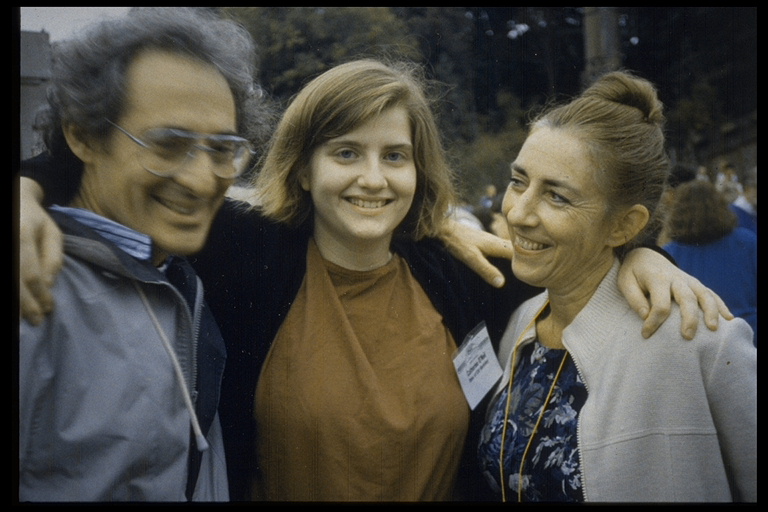
I was looking through an old photo album (the kind where there are sticky pages and actual physical photos- it looks like an ancient technology now) and I came across one of my favorites of all time- a picture of me being embraced and supported by Cora Sadosky on one side and Barry Mazur on the other. This picture was taken in 1993 in Vancouver, where I received the Alice T. Schafer prize. It was a critical moment for me, and both of those people have influenced me profoundly. Barry became my thesis advisor; part of the reason I went into number theory was to become his student (the other part was this book).
Cora became my mathematical role model and spiritual mother. I already wrote earlier about how going to math camp when I was 14 changed my life and made me realize there is a whole community of math nerds out there and that I belonged to that nerd community. Well, Cora, whom I met when I was 21, was the person that made me realize there is a community of women mathematicians, and that I was also welcome to that world.
Actually it was something I didn’t even really want to know at the time. After all, I was happy to be a successful math undergraduate at UC Berkeley, frolicking in the graduate student lounge and partaking in tea every day at 3:00. Who cares that I was a woman? It seemed antiquated to me, almost crude, to mention my gender. When I got word that I’d won the prize, my reaction was essentially, “is there money?” (there was a bit).
And when I meet young women in math nowadays with that attitude, I am happy for them, really very happy for them. To live in that state of not caring what your gender is in mathematics is a kind of bliss, that lasts until the very moment it stops. My greatest wish for future generations of women in math is for that bliss to never stop.
And yet. I went to Vancouver and met Cora and learned about Alice Shafer and her struggles and successes as a trailblazer for women in math, and I felt really honored to be collecting an award in her name. And I felt honored to have met Cora, whose obvious passion for mathematics was absolutely awe-inspiring. She was the person who first explained to me that, as women mathematicians, we will keep growing, keep writing, and keep getting better at math as we grow older (unlike men who typically do their best work when they’re 29), and we absolutely have to maintain a purpose and a drive and fortitude for that highest call, the struggle of creation.
I kept up with Cora over the years. Every now and then she’d write to me and send me pushy little maternal notes reminding me to work hard and stay strong and productive. And I’d write to her with news of my life and my growing family and sometimes when I visited D.C. I’d meet her and we’d have lunch or dinner and talk about ideas and great books we’d read and how much we loved each other.
When I googled her this morning, I found out she’d died about 6 months ago. You can read about her difficult and inspiring mathematical career in this biography. It made me cry and made me think about how much the world needs role models like Cora.
Inspirational speech for women in math
I wanted to tell you about my experience a few months back sitting on a “non-academic career” panel at a women’s math conference at IPAM on the UCLA campus*.
The panel consisted of four women who have Ph.Ds in math and had left academics for other things. I was the only person from finance represented- the other women worked for government sponsored research agencies (NSA, Aerospace Corporation, and Los Alamos National Labs). In fact considering the fact that I was unemployed you could say I was a bad role model but I decided to attend anyway because I thought I could contribute- and after all, being unemployed is part of life, especially outside of academics. The audience consisted of about 50 women (and one man who never announced himself but I think worked for the NSF) who were either finishing up their Ph.Ds or had recently gotten them and were in post-docs – the perfect moment for a little inspirational speech. The panelists were given about 10 minutes each to talk about their experiences and then the audience had a chance to ask questions. Here’s (more or less) what I said to them.
Hi, I’m your unemployed role model. I thought of not coming here today since, after all, I’m unemployed, and what kind of role model does that make me? Actually it makes me a good one, and here’s why. That job I left wasn’t good enough for me. I didn’t get fired, I quit (although plenty of great people I know have been laid off so that’s no proof of anything). The truth is, I deserve a job that I really like, where I’m challenged to grow and to learn and to do my best and I’m rewarded for doing so. After all, I have a super power, which is mathematics. So the reason I’m saying this is that you do too. All of you have a superpower, which is mathematics. You all deserve to work at good jobs that you actually enjoy- and if the jobs you have turn out to be bad, or if the become bad for some reason, then quit! Get another one! Get a better one! I actually got a job offer on the plane over here yesterday (true!). I know I’m going to get a good job, even in this economy, because I can do something other people actually regard as magical. Mathematical training and thinking is something that everybody needs and not everybody can achieve, so remember that. Never feel stuck. This is not to say that the specific training you have right now is sellable on the open market, but since you’re a mathematician the one thing you can count on being good at is learning new stuff. So if you decide to change fields, get ready to roll up your sleeves and work your butt off to learn the necessary stuff, but be sure that you can do it and that it will be really important to the people you work for. And if it isn’t, or if you don’t think your work is being appreciated, go get a better job. Thanks!
By the way, I thought I should give you a wee bit of context for the above speech. It’s my opinion that one of the main reasons you don’t see as many women as men in great positions in the sciences is that, just around this point in their careers, women lack the confidence to sell themselves strongly in the job market. In fact the confidence problem exists earlier- I don’t know how many times I’ve seen (at MIT and then at Barnard/Columbia) a woman in my class crying over a grade of 94 (out of 100) in office hours while at the same time I talk to a man who got a 64 who says, “no problem I’ll ace the final”. However, once the grades stop and the field becomes more about confidence in yourself than in other peoples’ grades, women often flounder.
Just as a measurement of how much women need to hear this kind of stuff, I must have been approached by nearly all the women in the audience on a person-by-person basis, as well as emailed by quite a few thanking me for my inspirational words. Many of them expressed relief and astonishment that their accomplishments are actually worthy of a good job. These women need to hear this stuff- not to become arrogant but just to know that they really have something to offer. Also many of them are married or engaged and many of them have small kids, so they also need to prioritize themselves, which is again something they have trouble with.
And one more thing: I love encouraging young men in math too.
* This has been posted at my friend Chelsea’s blog already.
Working with Larry Summers (part 1)
This post is continued here and then here.
After I had been working at D.E. Shaw for a few months, I was asked by the American Mathematic Society to write an expository article on leaving academics for finance. Here’s what I wrote. It was infinitely vetted by the legal department, and they removed a bunch of stuff- by the time they approved it I couldn’t remember why I had wanted to write it in the first place. Oh yeah, something about answering a bunch of questions that math grad students kept asking me. The one edit I refused to budge on, I remember, was that they objected to the word “rich” in the sentence “However, it is clear that if you stay in finance for long enough, and are successful, you do become rich”. They wanted change the word to “wealthy”. As if that was going to soften the blow to the poor suckers who weren’t privileged enough to work at this holy place.
Ever since it was published, I’ve wanted to write a second edition. It would go something like this (taken from a letter I wrote to a friend recently who is applying to another hedge fund):
I actually never really intended to stay in finance, it was just the only “real job” I could get with my number theory skills. In the end I decided I wanted to work at a startup and there are more internet startups than finance ones. The truth is, there are a bunch of jerks
in finance, very likely due to the amount of money floating around, and I noticed a correlation with the size/age of the company and the douchebagginess of the “leaders” of the firms. I don’t know alot about ****** but word on the street is that they are huge douchebags. On the other hand, I myself don’t regret working with douchebags for four years, because it thickened my skin quite a bit (and in particular made me realize how impotent and feeble the academic douchebags are in comparison) and made me strive for something better. Although to be honest it sometimes really sucked.
I could sum it up pretty well thus: people who are successful for a while think they know everything. People who are rich think they are always right. People who are both successful and rich are absolutely incredible douchebags. It seems like a law of nature (i.e. I can only assume that if I ever become rich and successful I will also become a douchebag. One more reason not to be wishing too hard for things like that.).
So instead I work for *pretty good* money (better than I’d have gotten in academics but not as good as at DE Shaw) and I enjoy things like oatmeal in the morning, biking to work on the bike path, my incredible adorable macho developer colleagues, a really cool hands-off boss, and a bunch of awesome karaoke-loving beer-drinking coworkers who think I have special powers since I can do math. Oh, and the possibility that someday my numerous stock options in this startup may make me a douchebag someday.
I just want to add that, of course, not everyone I worked with at D.E. Shaw is a douchebag, not even all the leaders. In fact I still have many friends from there. But it’s definitely not a random cut of the population, and I would have to believe that people in it would agree with that (and would say it’s worth it).
In part 2 of this post I will talk about what specifically made me decide to leave the hedge fund industry.
Why “mathbabe”?
Let me tell you a bit about my childhood.
I grew up in Lexington, MA, which is an upper-middle class liberal suburb of Boston. Most of the people I went to school with had parents that either worked at or went to Harvard or M.I.T. – it was a pretty nerdy, intellectual environment. My parents, both computer scientists, moved there for the public schools.
In spite of that, I was a hopeless, pathetic nerd. My idea of fun was practicing classical piano, watching “Amadeus” over and over again, and factoring license plate numbers in my head. When you add to that the facts that I wore glasses, braces, and was chubby, you are talking about one pathetic young nerd girl. When, you top *that* off with the fact that I went through puberty at the wrong time, you can imagine that I went through junior high wondering what everyone was smoking. Oh, and did I mention that my mom hated shopping so I was always wearing one of two bright pink stretch polyester pants? And that my personal hygiene skills were undeveloped? You get the picture.
I was lucky enough to have a best friend starting in 7th grade, who saved me from many pits of despair (although not all). But come high school, my self-esteem was pretty crappy, and the only thing I seemed to be good at, my refuge, was piano and math team.
My parents did an excellent job of not really caring about what I did for the most part, so I wasn’t at all pressured into doing math, and definitely not pressured into doing music. When I came home with an advertisement from a math camp at Hampshire College in western Massachusetts, though, my parents essentially bribed me to go. It didn’t take much convincing, I was intrigued.
Here’s where we get to the title of the post. When I got there, I quickly noticed there were 50 boys and 10 girls. And then I noticed that a bunch of these guys were kind of… cool, they were mostly from places like Stuyvesant and Bronx Science and Evanston, places I’d never heard of but which obviously placed a premium on being a math nerd. Then, this was the miracle, I noticed that these cool, sexy guys, thought I was cool and sexy. OMG, I was a math babe!
It was the first moment I had ever felt like I belonged somewhere, that I was with my peeps. I learned lots of math that first summer, and although most of the specifics kind of wore away over the following year, the feeling that I had a community never did. Actually the one thing I did really learn for good that summer was how to solve the Rubik’s cube using group theory (a subject for another post!). And I distinctly remember carrying around a Rubik’s cube like a piece of platinum my entire junior year of high school, just because it reminded me that I was, in fact, a math babe, at least in one context (although not here! not here whatsoever!).
Which reminds me! This summer, I’m very excited to be going back to the same math camp to teach as a senior staff member. Here’s the list of stuff I have prepared to teach this crop of math studs and math babes:
1) magic squares and generalizations. I just figured out how to generate all 3×3 magic squares! I love those little guys.
2) elementary number theory: fundamental theorem of arithmetic
3) cool geometry stuff like bisectors of angles and sides and all those cool theorems
4) pigeon hole principle, lots of examples
5) euler’s formula and the platonic solids
6) cool stuff with perfect numbers and non-perfect numbers
7) proof by induction, lots of examples
8) basic graph theory
9) bipartite graphs and related theorems.
10) basic ramsey theory
11) more number theory
12) farey fractions
13) continued fractions and the golden ratio
I can’t friggin wait!! Please send me more suggestions if I’m missing something that they really need to know. By the way I’m only teaching the first three weeks, because I couldn’t arrange for the whole 6- the second half they will be learning more specialized subjects from some very cool mathematicians.
Actually there’s another reason I ultimately decided to call this blog “mathbabe,” namely when I googled it, I was first of all offended that the name wasn’t already taken by some other woman math nerd who posting about cool stuff, but what really offended me was that there’s another site with a very similar name which simply shows nearly naked women next to cliff notes on basic math subjects. WTF?!? It is ridiculously obvious to me that math babes should be doing math, not adorning it. So I kind of had to call myself mathbabe after that.
What’s it take to be a woman in math?
One of the first things I’d like to set people straight on is what it takes to be a woman in math. The short answer is, a warrior. The longer answer starts like this. At least in this country, in this culture*, it required near-constant resistance to the niggling feeling that you don’t belong, that you are an outsider, and that you will always be an outsider. It takes the belief in yourself as an abstract thinker, as a scientist, and as a _source_ of wisdom. This is completely counter to how the average woman has been taught to behave: demurely, modestly, quietly. Unleaderly. And the above description refers only to the psychological barriers, not the underlying mathematics.
Considering how difficult the material itself is, it’s not surprising how many women drop out eventually.
To be fair, we are seeing many more women finishing college degrees in mathematics and Ph.D.s in mathematics, and that is frigging awesome. But we are still not seeing that many professors, not in the numbers you might think from the Ph.D. programs. Why is this? I think I can explain this at least in part. When one decides to become a math major, it’s a difficult decision in terms of the surrounding cultural expectations, but there’s very good, very consistent feedback (at least outside of Harvard), namely in the form of homework and test grades from undergrad classes. In other words, it may be a weird decision to be a woman in math, but you can *see* your success whenever your homework comes back with a good grade. It’s proof positive that you are doing ok. To some extent in grad school this feedback loop continues, and with luck you have a good advisor who is encouraging and nurturing. However, once outside of grad school the feedback loop all but vanishes and you are left to decide, *within yourself* whether you are good at what you do. This is when you as a woman (and of course this happens to men too but for whatever reason, maybe just hormones, maybe culture, not as often) question yourself, and then look to the outside world for affirmation, and to be honest that’s a pretty tough moment. Many women leave at that moment.
In some sense I am one of them, because I did leave academics. But I left because I decided I wanted more, so more of a moment of strength than a moment of fear. I got a Ph.D. at Harvard, went to M.I.T. for a post-doc, then became an assistant professor at Barnard College. I got to the point where I was pretty sure I’d be able to get tenure, or in other words to the point that I was sure I deserved tenure, and I looked around and decided, this isn’t the kind of feedback loop I want in my life. I need actual feedback, in real time. I left to be a quant in finance (and since then a data scientist at an internet ad company). I feel very lucky that I could make that decision without fear, and I still consider myself a woman in math, and I still encourage women in math to stay in math or at least stay mathematical.
I think if people understood what women in math need to do in order to just be themselves every day, they would be treated less like anomalies and more like superheroes. It’s a tough thing to do, and they should be respected for it. And they are cool. I mean, what’s cooler than someone who lives as an outsider and has come to terms with that? It’s a strength that not everyone has.
Here’s the thing, I don’t want to end this post on a negative note. In spite of everything I’ve said, being a math babe totally rocks, because math rocks. I hope to convincingly illustrate just how much math rocks in future posts.
* I’ve talked to women outside the US about being mathematicians in their country. One thing that commonly comes up is that in Italy, and to some extent France, it is much more common to see women mathematicians. Why is this? One of my Italian women mathematician friends described it to me like this: in Italy, the academic track to become a mathematician is identical to that of becoming a high school math teacher- indeed the two tracks diverge only after a masters degree. The outcome of this system is that it is not seen as a particularly glamorous or even difficult profession- perhaps similar to that of an engineer. According to her, truly ambitious Italians become politicians, not mathematicians.
Hello world! [stet]
Welcome to my new “mathbabe” blog! I’d like to outline my aspirations for this blog, at least as I see it now.
First, I want to share my experiences as a female mathematician, for the sake of young women wanting to know what things are like as a professional woman mathematician. Second, I want to share my experiences as an academic mathematician and as a quant in finance, and finally as a data scientist in internet advertising. (Wait, did I say finally?)
I also want to share explicit mathematical and statistical techniques that I’ve learned by doing these jobs. For some reason being a quant is treated like a closed guild, and I object to that, because these are powerful techniques that are not that difficult to learn and use.
Next I want to share thoughts and news on subjects such as mathematics and science education, open-source software packages, and anything else I want, since after all this is a blog.
Finally, I want to use this venue to explore new subjects using the techniques I have under my belt, and hopefully develop new ones. I have a few in mind already and I’m really excited by them, and hopefully with time and feedback from readers some progress can be made. I want to primarily focus on things that will actually help people, or at least have the potential to help people, and which lend themselves to quantitative analysis.
Woohoo!


 mathbabe