Archive
Today is a day for politics
President Obama made comments last Friday in Fort Myers, Florida, about the Aurora theater shooting in Colorado. Here’s an excerpt of what he had to say:
So, again, I am so grateful that all of you are here. I am so moved by your support. But there are going to be other days for politics. This, I think, is a day for prayer and reflection.
This makes no sense. Actually, it’s offensive. When is it a day for politics, President Obama? And why are we treating this tragedy like an act of nature?
When a guy gets enough ammunition shipped to him legally, through the U.S. Post Office, to perform a massacre, and he rigs his house with sophisticated booby traps over months of preparation, we can safely say two things. First, this guy was absolutely insane, and second he had all of the resources available to him to kill dozens of people.
I can understand why, for the families of the victims, their therapists or priests may ask them to accept this fatalistically – they can’t get their loved one back. But as a nation, we should not be willing to be so passive in the face of what is obviously a fucked up system. We can imagine, I hope, a culture where it’s a wee bit more difficult to massacre innocent people if and when you decide that’s a good idea.
If you’re in doubt that this system is skewed towards the madman, keep in mind that the uninsured Aurora shooting victims are at risk of debtor’s prison in this country.
It begs the question of why we’ve become so inured to bad politicians. Notice I’m not saying inured to violence and random shootings, because we’re not, actually. We are all horrified, but in the face of such tragedy we shrug our shoulders and say stuff about the fact that there’s nothing we can do. Because that’s what our politicians say.
I’ll draw an analogy between this and the financial crisis, which is ongoing and could be getting worse. We often hear passive, third person narratives coming from our politicians and central bankers, who talk about the bankrupt banks and the corruption like there’s nothing we can actually do to fix this. Again, acts of nature.
Bullshit. These guys have been paid off by bank lobbyists and told to act impotent. They are following orders. Our country deserves better than this leadership, whose politicians give money to banks, which they turn around and use to buy off politicians. As Neil Barofsky said in his new book:
“The suspicions that the system is rigged in favor of the largest banks and their elites, so they play by their own set of rules to the disfavor of the taxpayers who funded their bailout, are true,” Mr. Barofsky said in an interview last week. “It really happened. These suspicions are valid.”
I’d like to separate, for a moment, two issues. First, what we have come to expect from Obama, who gave us such hope when he was elected. Second, what we deserve – what we should expect from a politician who cares about people and doing the right thing.
There’s a huge difference, but let’s not lose sight of that second thing. That’s when I turn from pissed to bitter, and I really don’t want to be bitter.
This is a day for politics, President Obama, so step it up. I’m not giving up hope that someone, though probably not you, can deliver it to us.
A call to Occupy: we should listen.
Yesterday a Bloomberg View article was published, written by Neil Barofsky.
In case you don’t remember, Barofsky was the special inspector general of the Troubled Asset Relief Program, which meant he was in charge of watching over TARP until he resigned in February 2011. And if you can judge a man by his enemies, then Barofsky is doing pretty well by being cussed out by Tim Geithner.
The Bloomberg View article was an excerpt from his new book, which comes out July 24th and which I’m going to have to find time to read, because this guy knows what’s going on and the politics behind possible change.
In the article, Barofsky tears through some of the most obvious and ridiculous shenanigans that the Obama administration and the Treasury have been up to in preserving the status quo whereby the banks get bailed out and the average person pays. In order, he obliterates:
- Obama’s HAMP project: “with fewer than 800,000 ongoing permanent modifications as of March 31, 2012, a number that is growing at the glacial pace of just 12,000 per month.”
- The recent mortgage settlement: “In return for what was touted as a $25 billion payout, the banks received broad immunity from future civil cases arising out of their widespread use of forged, fraudulent or completely fabricated documents to foreclose on homeowners.” and “As a result, the settlement will actually involve money flowing, once again, from taxpayers to the banks.”
- The recent so-called Task Force for investigating toxic mortgage practices: “it seems unlikely that an 11th-hour task force will result in a proliferation of handcuffs on culpable bankers.”
- The Dodd-Frank Bill: “…the market distortions that flow from the presumption of bailout may have gotten worse. By failing to alter this presumption, Dodd-Frank may have inadvertently sowed the seeds for the next financial crisis.”
- Specifically, the Volcker Rule, where he quotes a milquetoast Geithner: `“We’re going to look at all the concerns expressed by these rules,” he said. “It is my view that we have the capacity to address those concerns.”’ – Barofsky draws a line directly from Geithner to the conclusion of Senator Levin, `“Treasury are willing to weaken the law.”’ Barofsky here highlights out the most basic problem we face, namely that regulators are suckling from their Wall Street masters: “Indeed, words like Geithner’s, when accompanied by actions such as the Fed’s authorization of the largest banks to release capital, send what should be a clear message. We may be in danger of quickly returning to the pre-crisis status quo of inadequately capitalized banks that take outsized risks while being coddled by their over-accommodating regulators. A repeat of the financial crisis would soon be upon us.”
- Finally, he gets on my favorite riff about TARP, namely that it’s not about the money being paid back, it’s about the risk that we’ve taken on as a nation.
But what’s most interesting to me about the article is the fact that he’s not proposing a political solution to the unbelievably unbalanced distribution of resources. Probably this is because the political power is so firmly entrenched and because it is so firmly corrupt that there’s no use barking up that tree. Instead, he is asking for Occupy and other popular movements to step it up. The article ends:
The missteps by Treasury have produced a valuable byproduct: the widespread anger that may contain the only hope for meaningful reform. Americans should lose faith in their government. They should deplore the captured politicians and regulators who distributed tax dollars to the banks without insisting that they be accountable. The American people should be revolted by a financial system that rewards failure and protects those who drove it to the point of collapse and will undoubtedly do so again.
Only with this appropriate and justified rage can we hope for the type of reform that will one day break our system free from the corrupting grasp of the megabanks.
The question I have is, will we need yet another financial crisis to get this done? (Not that I think one is far off- the banning of short selling recently by Spain and Italy is a desperate move, kind of like throwing in the towel and admitting you’d rather openly manipulate markets than let people have honest opinions.)
I for one think we’ve got plenty of evidence right now, and I’m outraged. But maybe not everyone is, and I take responsibility for that.
I think my job now, as an Occupier, is to make sure people understand that these decisions and speeches made at the Treasury and the White House are directly related to people illegally losing their homes and jobs and town services and having their pensions rewritten after they’ve reached retirement age. I absolutely believe that, if people knew all of those connections, we’d have an enormous number of people ready to occupy and the political power to do something.
Tu-du leest bork bork
What with finishing a job up at the end of June, and then immediately going off to three weeks of math camp, I’ve put off lots of stuff around the house. My to-do list, just on household stuff alone, is getting kind of intimidating:
- Call Richard to get air conditioners installed
- Call insurance company about crazy bills
- Send care package to junior staff
- Deposit paycheck in bank
- Replace broken window shades
- Replace lightbulbs in bedroom
- Find babysitter for this Friday
- Find babysitter for early September
But I’ve figured out a way to avoid being too down about it. Namely, I just put it through the Swedish Chef Translator (if you can’t remember the Swedish Chef, check this out), and I’m good (borks added):
- Cell Reecherd tu get eur cundeeshuners instelled bork bork
- Cell insoorunce-a cumpuny ebuoot crezy beells bork bork
- Send cere-a peckege-a tu jooneeur steffff bork bork
- Depuseet peycheck in bunk bork bork
- Replece-a brukee veendoo shedes bork bork
- Replece-a leeghtboolbs in bedruum bork bork
- Feend bebyseetter fur thees Freedey bork bork
- Feend bebyseetter fur ierly September bork bork
Also available in Pig Latin to make me feel sneaky:
- allCay ichardRay otay etgay airway onditionerscay installedway
- allCay insuranceway ompanycay aboutway azycray illsbay
- endSay arecay ackagepay otay uniorjay affstay
- epositDay aycheckpay inway ankbay
- eplaceRay okenbray indowway adesshay
- eplaceRay ightbulbslay inway edroombay
- indFay abysitterbay orfay isthay idayFray
- indFay abysitterbay orfay earlyway eptemberSay
Exploit me some more please
I’m back home from HCSSiM (see my lecture notes here). Yesterday I took the bus from Amherst to New York and slept all the way, then got home and took a nap, and then after putting my 3-year-old to bed crashed on the couch until just now when I woke up. That’s about 13 hours of sleep in the past 20, and I’m planning to take a nap after writing this. That’s just an wee indication of how sleep deprived I became at math camp.
Add to that the fact that my bed there was hard plastic, that I completely lost touch with the memory of enjoying good food (taste buds? what are those?), and that I was pitifully underpaid, and you might think I’m glad to be home.
And I am, because I missed my family, but I’m already working feverishly to convince them to let me go again next year, and come with me next time if that would be better. Because I’m so in love with those kids and with those junior staff and with Kelly and with Hampshire College and with the whole entire program.
Just so you get an idea of what there is to love, check out one of the students talking about his plan for his yellow pig day shirt which I luckily captured on my phone:
And here’s a job description which always makes me laugh (and cry) (and I only worked there the first half):
When people haven’t experienced HCSSiM, we worry about being able to explain adequately the unusual commitment required by the exploitative position. The workday is long and challenging; it is also exciting and rewarding. A senior faculty and 2 junior faculty members actively participate in the morning classes (8:30 – 2:30, M-S) and evening problem sessions (7:30 – 10:30, M-F) of each of the c. 14-student Workshops (7/2 – 7/20 = days); they prepare (and duplicate) daily problem sets; they proofread notes and program journal articles, and they write evaluations; they offer constructive criticism; they attend the afternoon Prime Time Theorems (a 51-minute math-club type talk, over half given by visitors) and give 1 or 2. The staffing and most of those teaching opportunities (chores) apply to the 2nd half of the program when students take a Maxi-course (8:30-11, M-S, and 7:30 – 10:30, M-F, 7/23 – 8/10). During the 2nd half of the program, students also take, consecutively, 2 Mini-courses, which meet from 11:17 until 12:30 for 7 days and which have no attached problem sessions; many minis are created or co-created by junior staff. Except for Kelly and Susan (who are on call) the staff live in in the dorm (Enfield this year), join students for meals and recreational activities, provide transportation and counseling and supervision for students, and help to get the program to sleep around 11:17. There is virtually no hope of getting any research done or of maintaining an outside social life. In spite of (with some because of) the preceding, the job is exhilarating as well as exhausting; we have repeaters, and there are a lot of good math teachers out there who credit HCSSiM with teaching them to teach.
HCSSiM Workshop day 17
This is a continuation of this, where I take notes on my workshop at HCSSiM.
Magic Squares
First Elizabeth Campolongo talked about magic squares. First she exhibited a bunch, including these classic ones which I found here:

Then we noted that flipping or rotating a magic square gives you another one, and also that the trivial magic square with all “1”‘s should also count as a crappy kind of magic square.
Then, for 3-by-3 magic squares, Elizabeth showed that knowing 3 entries (say the lowest row) would give you everything. This is in part because if you add up all four “lines” going through the center, you get the center guy four times and everything else once, or in other words everything once and the center guy three times. But you can also add up all the horizontal lines to get everything once. The first sum is 4C, if C is the sum of any line, and the second sum is 3C, so subtracting we get that C is the the center three times, or the center is just C/3.
This means if you have the bottom row, you can also infer C and thus the center. Then once you have the bottom and the center you can infer the top, and then you can infer the two sides.
After convincing them of this, Elizabeth explained that the set of magic cubes was actually a vector space over the rational numbers, and since we’d exhibited 3 non-collinear ones and since we’d proved we can have at most 3 degrees of freedom for any magic square, we actually had a basis.
Finally, she showed them one of the “all prime magic squares”:
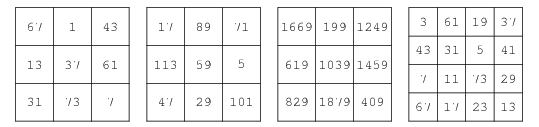 The one with the “17” in the corner of course. She exhibited this as a sum of the basis we had written down. It was very cool.
The game of Set
My man Max Levit then whipped out some Set cards and showed people how to play (most of them already knew). After assigning numbers mod 3 to each of the 4 dimensions, he noted that taking any two cards, you’d be able to define the third card uniquely so that all three form a set. Moreover, that third card is just the negative of the sum of the first two, or in other words the sum of all three cards in a set is the vector

Next Max started talking about how many cards you can have where they don’t form a set. He started in the case where you have only two dimensions (but you’re still working mod 3). There are clearly at most 4, with a short pigeon hole argument, and he exhibited 4 that work.
He moved on to 3 and 4 dimensions and showed you could lay down 9 in 3 and 20 in 4 dimensions without forming a set (picture from here), which one of our students eagerly demonstrated with actual cards:

Finally, Max talked about creating magic squares with sets, tying together his awesome lecture with Elizabeth’s. A magic square of sets is also generated by 3 non-collinear cards, and you get the rest from those three placed anywhere away from a line:

Probability functions on lattices
Josh Vekhter then talked about probability distributions as functions from posets of “event spaces” to the real line. So if you role a 6-sided die, for example, you can think of the event “it’s a 3, 4, or 6” as being above the event “it’s a 3”. He talked about a lattice as a poset where there’s always an “or” and an “and”, so there’s always a common ancestor and child for any two elements.
Then he talked about the question of whether that probability function distributes in the way it “should” with respect to “and” and “or”, and explained how it doesn’t in the case of the two slit experiment.
He related this lack of distribution law of the probability function to the concept of the convexity of the space of probability distributions (keeping in mind that we actually have a vector space of possibly probability functions on a given lattice, can we find “pure” probability distributions that always take the values of 0 or 1 and which form a kind of basis for the entire set?).
This is not my expertise and hopefully Josh will fill in some details in the coming days.
King Chicken
I took over here at the end and discussed some beautiful problems related to flocks of chickens and pecking orders, which can be found in this paper. It was particularly poignant for me to talk about this because my first exposure to these problems was my entrance exam to get into this math program in 1987, when I was 14.
Notetaking algorithm
Finally, I proved that the notetaking algorithm we started the workshop with 3 weeks before actually always works. I did this by first remarking that, as long as it really was a function from the people to the numbers, i.e. it never gets stuck in an infinite loop, then it’s a bijection for sure because it has an inverse.
To show you don’t get stuck in an infinite loop, consider it as a directed graph instead of an undirected graph, in which case you put down arrows on all the columns (and all the segments of columns) from the names to the numbers, since you always go down when you’re on a column.
For the pipes between columns, you can actually squint really hard and realize there are two directed arrows there, one from the top left to the lower right and the other from the top right to the lower left. You’ve now replaces the “T” connections with directed arrows, and if you do this to every pipe you’ve removed all of the “T” connections altogether. It now looks like a bowl of yummy spaghetti.
But that means there is no chance to fall into an infinite loop, since that would require a vertex. Note that after doing this you do get lots of spaghetti circles falling out of your diagram.
HCSSiM Workshop day 16
This is a continuation of this, where I take notes on my workshop at HCSSiM.
Two days ago Benji Fisher came to my workshop to talk about group laws on rational points of weird things in the plane. Here are his notes.
Degenerate Elliptic Curves in the plane
Conics in the plane
Pick 


Substitute 

After you do it the hard way, notice that you already know one root: 
The sum of the roots is 


From 

Do not forget that if you are given 


This gives you a 1-1 correspondence between the points of the circle (conic) and the points of the 


There are several ways you can generalize this. You could project a sphere onto a plane. I want to consider replacing the circle with a cubic curve. The problem is that the expected number of intersections between a line and a cubic is 3, so you get a 2-to-1 correspondence in general. That is interesting, too, but for now I want to consider the cases where the curve has a double point and I choose lines through that point. Such lines should intersect the cube in one other point, giving a 1-1 correspondence between the curve (minus the singular point) and a line (minus a small number of points).
cubic with a cusp
Let 

which has a sharp corner at the origin. This type of singularity is called a cusp. Let 


- Sketch the curve
- The line
. Find formulae for
- You almost get a digestion (bijection) between
. What points do you have to omit from each in order to get a digestion?
- Three points
, and
on
The calculations are easier than for the circle: 

You have to remove the point 

The condition for colliniarity is

Plug in the expressions in terms of the

If we let 


cubic with a node
This problem deals with the curve

which intersects itself at the origin. This type of singularity is called a node. Let

- Sketch the curve
- The line
). Find formulae for
- You almost get a digestion (bijection) between
- Three points
Once again, 


The lines through the origin with slope 

Remember our curve 


Claim: in terms of 

(Hint: In terms of 
If you start with the known equation and replace the 
If you start with the LHS of the desired equation, there is a shortcut:


But then we have

Note that the change-of-variable formulae are fractional linear transformations. Geometrically, 
To get from one line to the other, just draw a line through the origin.
One interpretation of our results for the curves 

In other words, we are allowed to draw vertical lines. I will continue to refer to this as “straightedge only.” I forgot to mention: you need to have the curve provided as well. Explicitly, this is the rule. Given two points on the line, find the corresponding point on the curve. Draw a line through them. The third point of intersection with the curve will be the (additive or multiplicative) inverse of the desired sum. Draw a vertical line through this point: the second point of intersection (or the third, if you count the point at infinity as being the second) will be the desired sum/product.
More precisely, it is the point on the curve corresponding to the desired sum/product, so you have to draw one more line.
Another interpretation is that we get a troupe (or karafiol) structure on the points of the curve, excluding the singular point but including the point at infinity. The point at infinity is the identity element of the troupe (group). The construction is exactly the same as in the previous paragraph, except you leave off the parts about starting and ending on the line.

smooth cubic
Similarly, we get a troupe (group) structure on any smooth cubic curve. For example, consider the curve 

Start with two points on the curve, say 


Solving for 

Plug this into the equation defining 

Luckily, we know how to solve the general cubic. (Just kidding! Coming back to what we did with the circle, we observe that 


The result is:

where the final form comes from squaring 


At this point, a little patience (or a little computer-aided algebra) gives

Do not forget the final step: 


Now, I give up. With a lot of machinery, I could exlpain why the group law is associative. (The identity, as I think I said above, is the point at infinity. Commutativity and inverses are clear.) What I can do with a different machine (Mathematica or some other computer-algebra system) is verify the associative law. I could also do it by hand, given a week, but I do not think I would learn anything from that exercise.
Some content on this page was disabled on December 15, 2019.
HCSSiM Workshop day 15
This is a continuation of this, where I take notes on my workshop at HCSSiM.
Aaron was visiting my class yesterday and talked about Sandpiles. Here are his notes:
Sandpiles: what they are
For fixed 


Do stable
Answer: well, you can add them together (pointwise) and then let that stabilize until you’ve got back to a stable beach (not trivial to prove this always settles! But it does). But is the sum well-defined?
In other words, if there is a cascade of toppling, does it matter what order things topple? Will you always reach the same stable beach regardless of how you topple?
Turns out the answer is yes, if you think about these grids as huge vectors and toppling as adding other 2-dimensional vectors with a ‘-4’ in one spot, a ‘1’ in each of the four spots neighboring that, and ‘0’ elsewhere. It inherits commutativity from addition in the integers.
Wait! Is there an identity? Yep, the beach with no sand; it doesn’t change anything when you add it.
Wait!! Are there inverses? Hmmmmm….
Lemma: There is no way to get back to all 0’s from any beach that has sand.
Proof. Imagine you could. Then the last topple would have to end up with no sand. But every topple adds sand to at least 2 sites (4 if the toppling happens in the center, 3 if on an edge, 2 if on a corner). Equivalently, nothing will topple unless there are at least 4 grains of sand total, and toppling never loses more than 2 grains, so you can never get down to 0.
Conclusion: there are no inverses; you cannot get back to the ‘0’ grid from anywhere. So it’s not a group.
Try again
Question: Are there beaches that you can get back to by adding sand?
There are: on a 2-by-2 beach, the ‘2’ grid (which means a 2 in every spot) plus itself is the ‘4’ grid, and that topples back to the ‘2’ grid if you topple every spot once. Also, the ‘2’ grid adds to the 
Wow, it seems like the ‘2’ grid is some kind of additive identity, at least for these two elements. But note that the ‘1’ grid plus the ‘2’ grid is the ‘3’ grid, which doesn’t topple back to the ‘1’ grid. So the ‘2’ grid doesn’t work as an identity for everything.
We need another definition.
Recurrent sandpiles
A stable beach C is recurrent if (i) it is stable, and (ii) given any beach A, there is a beach B such that C is the stabilization of A+B. We just write this C = A+B but we know that’s kind of cheating.
Alternative definition: a stable beach C is recurrent if (i) it is stable, and (ii) you can get to C by starting at the maximum ‘3’ grid, adding sand (call that part D), and toppling until you get something stable. C = ‘3’ + D.
It’s not hard to show these definitions are equivalent: if you have the first, let A = ‘3’. If you have the second, and if A is stable, write A + A’ = ‘3’, and we have B = A’ + D. Then convince yourself A doesn’t need to be stable.
Letting A=C we get a beach E so C = C+E, and E looks like an identity.
It turns out that if you have two recurrent beaches, then if you can get back to one using a beach E then you can get back to to the other using that same beach E (if you look for the identity for C + D, note that (C+D)+E = (C+E) + D = C+D; all recurrent beaches are of the form C+D so we’re done). Then that E is an identity element under beach addition for recurrent beaches.
Is the identity recurrent? Yes it is (why? this is hard and we won’t prove it). So you can also get from A to the identity, meaning there are inverses.
The recurrent beaches form a group!
What is the identity element? On a 2-by-2 beach it is the ‘2’ grid. The fact that it didn’t act as an identity on the ‘1’ grid was caused by the fact that the ‘1’ grid isn’t itself recurrent so isn’t considered to be inside this group.
Try to guess what it is on a 2-by-3 beach. Were you right? What is the order of the ‘2’ grid as a 2-by-3 beach?
Try to guess what the identity looks like on a 198-by-198 beach. Were you right? Here’s a picture of that:
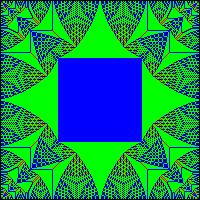
We looked at some identities on other grids, and we watched an app generate one. You can play with this yourself. (Insert link).
The group of recurrent beaches is called the m-by-n sandpile group. I wanted to show it to the kids because I think it is a super cool example of a finite commutative group where it is hard to know what the identity element looks like.
You can do all sorts of weird things with sandpiles, like adding grains of sand randomly and seeing what happens. You can even model avalanches with this. There’s a sandpile applet you can go to and play with.
HCSSiM Workshop, day 14
This is a continuation of this, where I take notes on my workshop at HCSSiM.
We switched it up a bit and I went to talk about Rubik’s Cubes in Benji Fisher’s classroom whilst Aaron Abrams taught in mine and Benji taught in Aaron’s. We did this so we could meet each other’s classes and because we each had a presentation that we thought all the classes might want to see.
In my class, besides what Aaron talked about (which I hope to blog about tomorrow), we talked about representing groups with generators and relations and we looked at how to create fractals on the complex plane using Mathematica.
Solving the Rubik’s Cube with group theory
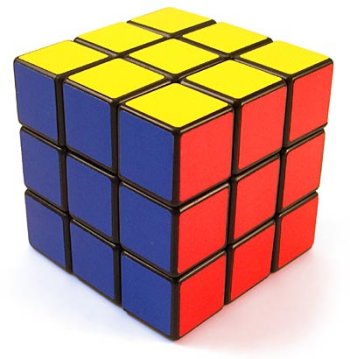
First I talked about the position game, so ignoring orientation of the pieces. In other words, if all the pieces are in the correct position but are twisted or flipped, that’s ok.
Consider the group acting on the set which is the Rubik’s cube. We can fix the centers, and then this group is clearly generated by 90 degree clockwise turns on each of the 6 faces (clockwise when you look straight at the center of the face). It has a bunch of relations too, of course, including (for example) that the “front” move commutes with the “back” move and that any of these generators is trivial if you do it 4 times in a row.
Next we noted that the 8 corners always move to other corners on any of these moves, and that the 12 edges always move to edges. So we could further divide the “positions game” into an “edges game” and a “corners game.” Furthermore, because of this separation, any action can be realized as an element of the group

But there’s more: any one of these generators is a 4-cycle on both edges and corners, which is odd in both cases, so so is a product of the generators. This means the group action actually lands inside

where I denote by 

Next I stated and proved that the 3-cycles generate 
The reason that’s interesting is that, once I show that I can act by arbitrary 3-cycles on the edges or corners, this means I get that entire group up there of the form (even, even) or (odd, odd).
Next I demonstrated a 3-cycle on three “bad pieces” where one needs to go into the position of one of the other two. Namely:
- Put two “bad” pieces on the top and one below, including the piece which is the destination of the third.
- Do some move U which moves the third bad piece below to its position on the top without changing anything else.
- Move the top so you decoy the new piece with the other bad piece on top. Call this decoy move V.
- Undo the U move.
- Undo the V move.
Seen from the perspective of the top, all that happens is that suddenly it has one piece in the right place (after U), then it gets rid of a piece it didn’t want anyway. From the perspective of the bottom, it sent up a piece it didn’t want to the top, then unmessed itself by taking back another piece from the top.
That’s a 3-cycle on the pieces, on the one hand (and a commutator on the basic moves), and we can perform it on any three corners or edges by first performing some move to get 2 out of the 3 pieces on the same face and the third not on that face. This is essentially acting by conjugation (and it’s still a commutator).
Moreover, the overall effect on the puzzle is that it took 3 pieces that were messed up and got at least 1 in the right spot.
The overall plan now is that you solve the corners puzzle, then the edges puzzle, and you’re done. Specifically, I get to the (even, even) situation by turning one face once if necessary, and then I can perform arbitrary 3-cycles to solve my problem. If I have fewer than three messed up corners (resp. edges), then I have either 0, 1, or 2 messed up corners (resp. edges). But I can’t have exactly 1, and exactly 2 would be odd, so I have 0.
That’s the position game, and I’ve given an algorithm to solve it (albeit not efficient!).
What about the orientations?
Shade the left and right side of a solved cube. Both the position (cubicle) and the piece of plastic (cubie) can be considered as shaded. Also shade a strip on the front and on the back, so we get the top and bottom edge of the front and back shaded.
Convince yourself that every edge and every corner position has exactly one shaded face.
When the cube is messed up, the shaded face of the position may not coincide with the shaded face of the cubie in that position. For edges it’s either right or wrong – assign each a value of 0 (if it’s right) or 1 (if it’s wrong). These can be considered orientation values modulo 2.
For corners, it can be wrong in two ways. The cubie’s shaded face could coincide with the position’s shaded face (give it a value 0), or it could be clockwise 120 degrees (value 1), or counterclockwise 120 degrees (value -1). These numbers are modulo 3.
Next, convince yourself that all of the generators of the group of actions on the rubik’s cube preserve the fact that the sum of the orientation numbers is 0, considered either mod 3 for the corners or mod 2 for the edges.
In particular, this means we can’t have exactly one edge flipped but everything in the right position. If you see this on a Rubik’s cube then someone took it apart and put it back together wrong.
However, you can twist one corner clockwise and another one counterclockwise, which means you can get any configuration of orientation numbers on the corners that satisfy that their sum is 0. Same with edges – it’s possible to flip two.
Finally, I exhibit how to do each of these basic orientation moves by 2 3-cycles. First I choose a pivot corner and perform a 3-cycle on those three corners, and then I do another 3-cycle, which uses the same 3 corners but is slightly different and results in everything being back in the right position but two corners twisted. I can do the same thing for edges, and I have thus totally solved the cube.
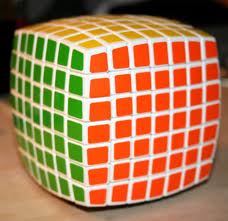
This method of 3-cycles is slow but it generalizes to all Rubik’s puzzles, so for example the 7 by 7 cube:
Or, with some work, something else like this:
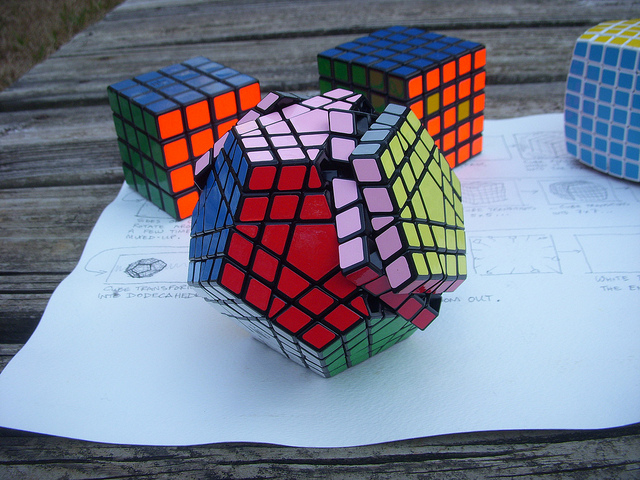
p.s. I learned all of this when I was 15 from Mike Reid at HCSSiM 1987.
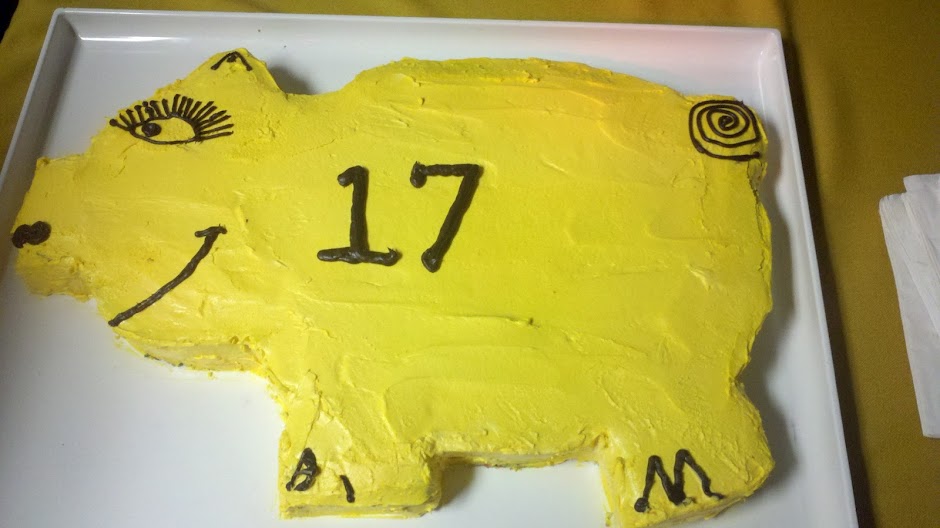
p.p.s. This was what we ate after singing our Yellow Pig Carols last night:
HCSSiM Workshop, day 13
This is a continuation of this, where I take notes on my workshop at HCSSiM.
Permutation notation
Using a tetrahedron as inspiration, we found the group of rotational symmetries as a subgroup of the permutation group 

Quadratic Reciprocity
Today we proved quadratic reciprocity, which totally rocks. In order to get there we needed three lemmas, which were essentially a bunch of different formulas for computing the Jacobi symbol.
The first was that, modulo 
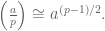
The second one was that we could write 


In the third one we assume 

![\left[ \frac{a j}{p} \right]](https://s0.wp.com/latex.php?latex=%5Cleft%5B+%5Cfrac%7Ba+j%7D%7Bp%7D+%5Cright%5D&bg=ffffff&fg=555555&s=0&c=20201002)

Each of these lemmas, in other words, gave us different ways to compute the symbol
The first one uses the fact that if 

The second one just uses the fact that, ignoring negative signs, 


The third lemma follows from repeatedly applying the division algorithm to 
![\displaystyle{a j = p \cdot \left[\frac{aj}{p} \right] + r_j}](https://s0.wp.com/latex.php?latex=%5Cdisplaystyle%7Ba+j+%3D+p+%5Ccdot+%5Cleft%5B%5Cfrac%7Baj%7D%7Bp%7D+%5Cright%5D+%2B+r_j%7D&bg=ffffff&fg=555555&s=0&c=20201002)
for all 


![a (1 + 2 + \dots + \frac{p-1}{2}) = \left( \left[\frac{a}{p} \right] + \left[\frac{2a}{p} \right]+ \dots + \left[\frac{\frac{p-1}{2} a}{p} \right] \right) p + s_1 + s_2 + \dots + s_{\frac{p-1}{2}} + n \cdot p.](https://s0.wp.com/latex.php?latex=a+%281+%2B+2+%2B+%5Cdots+%2B+%5Cfrac%7Bp-1%7D%7B2%7D%29+%3D+%5Cleft%28+%5Cleft%5B%5Cfrac%7Ba%7D%7Bp%7D+%5Cright%5D+%2B+%5Cleft%5B%5Cfrac%7B2a%7D%7Bp%7D+%5Cright%5D%2B+%5Cdots+%2B+%5Cleft%5B%5Cfrac%7B%5Cfrac%7Bp-1%7D%7B2%7D+a%7D%7Bp%7D+%5Cright%5D+%5Cright%29+p+%2B+s_1+%2B+s_2+%2B+%5Cdots+%2B+s_%7B%5Cfrac%7Bp-1%7D%7B2%7D%7D+%2B+n+%5Ccdot+p.&bg=ffffff&fg=555555&s=0&c=20201002)
Since
![1 + 2 + \dots + \frac{p-1}{2} = \left[\frac{a}{p} \right] + \left[\frac{2a}{p} \right]+ \dots + \left[\frac{\frac{p-1}{2} a}{p} \right] + s_1 + s_2 + \dots + s_{\frac{p-1}{2}} + n.](https://s0.wp.com/latex.php?latex=1+%2B+2+%2B+%5Cdots+%2B+%5Cfrac%7Bp-1%7D%7B2%7D+%3D+%5Cleft%5B%5Cfrac%7Ba%7D%7Bp%7D+%5Cright%5D+%2B+%5Cleft%5B%5Cfrac%7B2a%7D%7Bp%7D+%5Cright%5D%2B+%5Cdots+%2B+%5Cleft%5B%5Cfrac%7B%5Cfrac%7Bp-1%7D%7B2%7D+a%7D%7Bp%7D+%5Cright%5D+%2B+s_1+%2B+s_2+%2B+%5Cdots+%2B+s_%7B%5Cfrac%7Bp-1%7D%7B2%7D%7D+%2B+n.&bg=ffffff&fg=555555&s=0&c=20201002)
Up to signs, 
Incidentally, using the formula above (before we ignore
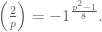
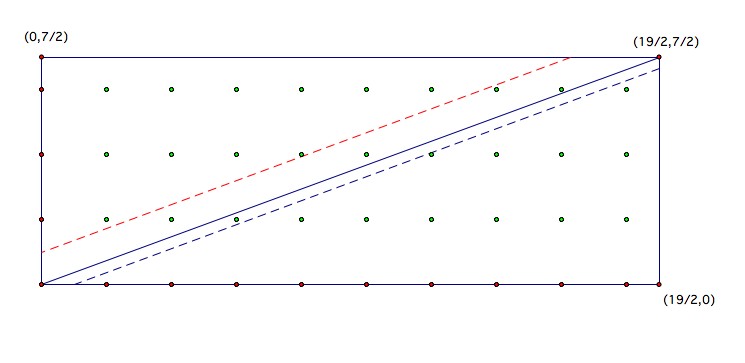
Finally, we show that the sum ![\left[\frac{a}{p} \right] + \left[\frac{2a}{p} \right]+ \dots + \left[\frac{\frac{p-1}{2} a}{p} \right]](https://s0.wp.com/latex.php?latex=%5Cleft%5B%5Cfrac%7Ba%7D%7Bp%7D+%5Cright%5D+%2B+%5Cleft%5B%5Cfrac%7B2a%7D%7Bp%7D+%5Cright%5D%2B+%5Cdots+%2B+%5Cleft%5B%5Cfrac%7B%5Cfrac%7Bp-1%7D%7B2%7D+a%7D%7Bp%7D+%5Cright%5D&bg=ffffff&fg=555555&s=0&c=20201002)


But, letting 
![\left[\frac{p}{q} \right] + \left[\frac{2p}{q} \right]+ \dots + \left[\frac{\frac{q-1}{2} p}{q} \right]](https://s0.wp.com/latex.php?latex=%5Cleft%5B%5Cfrac%7Bp%7D%7Bq%7D+%5Cright%5D+%2B+%5Cleft%5B%5Cfrac%7B2p%7D%7Bq%7D+%5Cright%5D%2B+%5Cdots+%2B+%5Cleft%5B%5Cfrac%7B%5Cfrac%7Bq-1%7D%7B2%7D+p%7D%7Bq%7D+%5Cright%5D&bg=ffffff&fg=555555&s=0&c=20201002)


 Therefore we’ve proved:
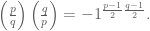
Alternating Group
We introduced cyclic notation, showing everything is a product of transpositions, then we introduced the sign function and showed that 
Transformation of the Plane
We discussed rotations, shears, shrinks, reflections, and translations of the plane and demonstrated them in Mathematica using this.
Yellow Pig Carols
Tomorrow is Yellow Pig Day, which is a yearly tradition here at HCSSiM during which we celebrate our mascot the yellow pig and our favorite number, 17.

In particular, there will be an hour and a half lecture during which we will hear many surprising and elegant 17 facts (examples: the longest time anybody has ever sat in a tub of ketchup? 17 hours. The average adolescent male has a sexually related thought how often? Every 17 seconds).
Some time after the 17 lecture we get together to sing Yellow Pig Carols. These are usually set to the tune of some song, with the lyrics changed to refer to math, in particular the number 17, and yellow pigs, Weird Al Yankovic- style. Check out this list for a taste.
But there’s a problem, which is that the songs are really old and many of the tunes are unknown to this crop of kids. In desperate need of a revamp, I got my workshop to write a new song, which I’m super proud of. We started out by voting on a song (winner: Somewhere Over the Rainbow) for which we wrote new lyrics. Here they are:
Some July Seventeenth
Some july seventeenth
when pigs fly
we’ll see patches of yellow
scattered across the sky
Some “f” over the reals
satisfy
f of x plus f of y
is f-of-x plus y
someday I’ll find another g
besides f of t is k t or zer-o
and then I will compose the two
and get solutions that are new
they’ll appear-o
Some groups they are abelian
they commute
but some have commutators
whose actions are not moot
The action on the complex plane
by matrices is so in-sanely dum-ber
than even that of conjugation
whose equivalence relation pairs the num-bers
Some july seventeenth
when pigs fly
we’ll see patches of yellow
scattered across the sky
Honestly I thought it would stop there, but people around here have been on a tear. My hilarious junior staff Maxwell Levit has written a brilliant song based on Gotye’s “Somebody I Used to Know”. If you haven’t been living under a rock, you will have heard that song (and if you haven’t heard that song, please go ahead and do so now), about a guy wondering why this woman has left him and won’t talk to him, and then she comes in and tells her story which is how much of a manipulative creep he really was. There’s a dramatic video featuring nakedness and body paint which adds to the drama and to the song.
Well Max just turned that shit around and now it’s Fermat singing to Fermat’s Last Theorem, wondering where he went wrong, and then the theorem talks back and tells us the real deal. Plus he uses the word “marginalia,” which is in itself awesome. Here it is:
A Theorem that I used to know
(Fermat)
Now and then I think of Diophantine equations
Like how Pythagoras showed the case for n=2
Told myself that I understood,
And didn’t write down what I thought I would
Remember when I looked back at my marginalia
You can get addicted to a certain type of hubris
Assuming you don’t need to use elliptic curves
So when I found my proof did not make sense,
I knew it wasn’t my incompetence
But I’ll admit I was confused to say the least.
But you didn’t have to be so hard,
Make out like my intuitive method was for nothing
I don’t even need to know
But they treat you like Wiles solved you and that feels so rough
No you didn’t have to stoop so low
Elliptic curves and modular forms lack in imagination
I guess I don’t need you though,
Now you’re just some theorem that I used to know.
Now you’re just some theorem that I used to know.
Now you’re just some theorem that I used to know.
(theorem)
Now and then I think of when you said you’d solved me.
Part of me believing I had some marvelous proof.
But I don’t really work that way.
Adhering to everything you say.
You said that you could let it go,
And you shouldn’t get too hung up on a theorem that you used to know!
(Fermat)
But you didn’t have to be so hard,
Make out like my intuitive method was for nothing
I don’t even need to know
But they treat you like Wiles solved you and that feels so rough
No you didn’t have to stoop so low
Elliptic curves and modular forms lack in imagination
I don’t even need you though,
Now you’re just some theorem that I used to know.
[x2]
Some Theorem!
(I used to know)
Some Theorem!
(Now you’re just some theorem that I used to know)
(I used to know)
(That I used to know)
(I used to know)
Some Theorem!
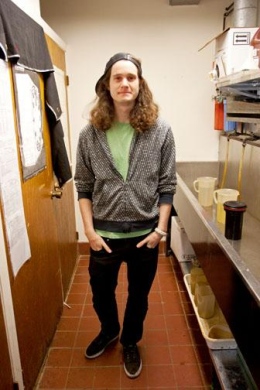
We’re gonna make Devin Ivy, a fantastically funny junior staff here as well as a photographer, play Gotye/ Fermat in the video, with yellow pigs getting continually plastered all over his body. He’s Gotye’s spitting image:
HCSSiM Workshop, day 12
This is a continuation of this, where I take notes on my workshop at HCSSiM.
We originally defined ![\mathbb{R}[x]/(x^2+1),](https://s0.wp.com/latex.php?latex=%5Cmathbb%7BR%7D%5Bx%5D%2F%28x%5E2%2B1%29%2C&bg=ffffff&fg=555555&s=0&c=20201002)


After we reminded people about matrix addition and multiplication, we showed this was an injective homomorphism under addition and also jived with the multiplication that we knew coming from 
Then we talked about actions on the plane including translations and scaling and showed that under the above map, “multiplication by 
Platonic Solids
We went over the 5 platonic solids from yesterday- we’d proved it was impossible to have more than 5, and now it was time to show all 5 are actually possible! That’s when we whipped out Wayne Daniel’s “all five” puzzle:

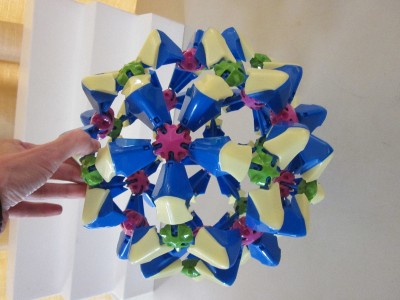
We then introduced the concept of dual graph, and showed which platonic solids go to which under this map. We saw an example of a toy which flips from one platonic solid (cube) to its dual (octahedron) when you toss it in the air, the Hoberman Flip Out.

Here is it in between states:
Finally, we talked about symmetries of regular polyhedra and saw how we could embed an action into the group of symmetries on its vertices. So symmetries on tetrahedra is a subgroup of 
Then one of our students, Milo, showed us how he projected a tiling of the plane onto the surface of a sphere using the language “processing“. Unbelievable.
After that we went to an origami workshop to construct yellow pigs as well as platonic solid type structures.
HCSSiM Workshop, day 11
This is a continuation of this, where I take notes on my workshop at HCSSiM.
Lagrange
We reminded people that a finite group is a finite set with an associative multiplication law “*”, and an identity and inverses with respect that law. A subgroup is a subset which is a group in its own right with the same multiplication law. Given a subgroup 



We proved that “being in the same coset as” is an equivalence relation and that each coset has the same size. Altogether the cosets form a partition of the group, so the size of the group is the product of the size of any coset and the number of cosets.
One of the students decided that you could form a group law on the set of cosets, inheriting the multiplication operation from 
Primitive Roots modulo p
Next we spent more time than you’d think proving there’s a nonzero number 


The left group is a group under multiplication, and the right one is a group under addition, which means this can be seen as a kind of logarithm in finite groups. Indeed an element 

To prove such an 


To do that, we have a few lemmas. First, that there are at most 
Next we proved that there are at most 


Finally, we wrote out boxes labeled with the divisors of 



Platonic Solids
Riffing on our proof of Euler’s formula for planar graphs, we convinced the kids that we could just as well consider a graph to be on a sphere, using a stereographic projection.
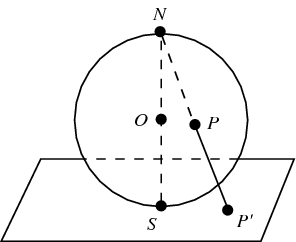
Then, using graphs on spheres as guides, we looked at how many examples we could come up with for a regular polytope, where each face has the same number of edges and each vertex has the same number of edges leaving it. We came up with the five platonic solids.

It rocks to be 40
So it’s my birthday today, I’m finally 40. I’m enjoying it so much I started calling myself 40 like four months ago because I couldn’t wait.

I’m not exactly sure why it is so meaningful to me, this number. You might think I’m enough of a rebel to just not care at all about a number like this, even though it is certainly culturally significant. But here’s the thing, I’m owning it.
Since I’m an alpha female, being 40 frees me up quite a bit. I don’t have to even imagine not being taken seriously or being thought of as too young or inexperienced to have an opinion. I have no urge to be cute or play dumb. Leave that to younger people, it wouldn’t work for me anymore anyhow.
My dad used to tell me to try to be “more demure” so that people wouldn’t be put off by me. Worst advice ever. I definitely have gotten more out of my life by being completely honest and upfront than by playing a synthetic role. It also wastes less time for everyone. At this point I’m able to look over my experiences and know things like that rock-solid, and not second guess myself. That’s a good feeling.
You know what rocks about being 40? It comes down to this: I am old enough to know the difference between bullshit and the good stuff and I’m still feeling healthy and fully capable of enjoying the good stuff. It is seriously freeing, and I’m looking forward to everything about it. And I say this basically unemployed and not knowing what I’m doing next, which for some reason gives rise to the most freeing moments for me.
Presents I don’t want for my 40th birthday:
- hair dye. I’m letting myself go grey, it’s gorgeous IMHO.
- anti-wrinkle cream. Screw that.
- girdles. I’ve already complained about that.
Presents I might want for my 40th birthday:
- a night out on the town ending with karaoke is always nice.
- puzzles and games. I’ve always love playing with puzzles. Crosswords too.
- time with the many people I love. That’s the best part.
Let’s do this, people! Fuck yeah!!
HCSSiM Workshop day 10
This is a continuation of this, where I take notes on my workshop at HCSSiM.
Quadratic equations modulo p
We looked at the general quadratic equation 



We then defined the Jacobi symbol 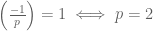

Cantor
We then reviewed some things we’d been talking about in terms of counting and cardinality, we defined the 


Then we used Cantor’s argument to show the power set of a set always has strictly bigger cardinality than the set.
Euler and planar graphs
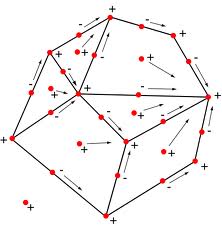
At this point the CSO (Chief Silliness Officer) Josh Vekhter took over class and described a way of assessing risk for bank robbers. You draw out a map of a bank as a graph with vertices in the corners and edges as walls. It can look like a tree, he said, but it would be a pretty crappy bank. But no judgment. He decided that, from the perspective of a bank robber, corners are good (more places to hide), rooms are good (more places for money to be stashed) but walls are bad (more things you need to break through to get money.
With this system, and assigning a -1 to every wall and a 1 to every corner or room, the overall risk of a bank’s map consistently looks like 2. He proved this is always true using induction on the number of rooms.
How to lie with statistics, Merck style
In the pharmaceutical industry, where companies are making enormous bets with huge money and people’s lives, it makes sense that there are conflicting interests. The companies, who are in charge of testing their drugs for safety and for successful treatment, tend to want to emphasize the good and ignore the bad.
That’s why they are expected to describe beforehand how they are planning to do the tests. It stands to reason that, if they did a thousand tests and then only reported on the best ones, the public would get a biased view of the safety of their products.
For some reason, though, this standard doesn’t seem to be universally followed, and lying with statistics seems to be okay.
The newest example comes from Merck (see Pharmalot article here), which changed its statistical methods on testing Vioxx for Alzheimer’s patients from an intent-to-treat analysis to an on-treatment analysis even though their stipulated plans were the former. And even though the standard in the industry is the former.
Intent-to-treat means you choose people and stick with them, even if they get off the drug for some reason. And on-treatment only counts people that stay on the drug the whole time.
The difference is one of survivorship bias; there may be a good reason someone gets off the drug, and that may be because they got sick, and maybe they got sick because they were taking the drug.
What’s the difference in this case? From the article:
A subsequent intent-to-treat analysis found that as of April 11, 2002, when the FDA approved Vioxx labeling, there were 17 confirmed cardiovascular deaths on Vioxx compared with five on placebo in the same two trials.
With their on-treatment analysis, though, they didn’t see an elevated risk. So as it turns out the actual heart attacks happened a couple of weeks after people got off the pill.
So what happened there? Why were they allowed to change their stipulated method? Why were they allowed to not report their stipulated, gold-standard method? That’s complete bullshit and it must mean that someone at the FDA is either insanely stupid or very rich. Or both.
I’ve written about this issue before, specifically here. Just let me remind you of how we might assess the damage done by Merck through their statistical shenanigans:
Also on the Congress testimony I mentioned above is Dr. David Graham, who speaks passionately from minute 41:11 to minute 53:37 about Vioxx and how it is a symptom of a broken regulatory system. Please take 10 minutes to listen if you can.
He claims a conservative estimate is that 100,000 people have had heart attacks as a result of using Vioxx, leading to between 30,000 and 40,000 deaths (again conservatively estimated). He points out that this 100,000 is 5% of Iowa, and in terms people may understand better, this is like 4 aircraft falling out of the sky every week for 5 years.
According to this blog, the noticeable downwards blip in overall death count nationwide in 2004 is probably due to the fact that Vioxx was taken off the market that year.
Finally, I’d like to reiterate my question, why are pharmaceutical companies allowed to do their own trials?
HCSSiM Workshop day 9
A continuation of this, where I take notes on my workshop at HCSSiM.
First we had a few proofs from the previous night’s problem set, including a proof of Hall’s Marriage Problem using Dilworth’s Theorem.
Counting stuff
We then proved an uncountable set union a countable set is uncountable, with the help of Lior’s comment from yesterday.
Then we proved the Cantor-Schroeder-Bernstein Theorem, which states that if you have two injective maps 


It doesn’t take much thinking to convince yourself that these orbits come in three forms: an infinite list in both directions, a finite loop, or an infinite forward path but a finite backwards path, where at some point you can’t pull back any more. In the last case you could get “stuck” in either 


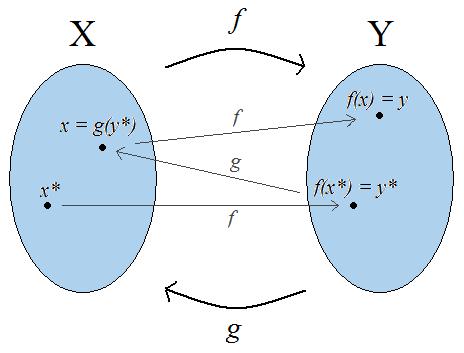
Now that I think of it, I’m pretty sure this proof uses the axiom of choice, and according to the wikipage on this theorem it doesn’t need to, but I don’t know a proof which avoids it. The truth is I can never tell. Please explain to me if you can, how you can verify if you’re using the axiom of choice in an argument where you make infinitely many decisions.
Homomorphisms
We defined a homomorphism of groups and wrote it in both additive and multiplicative notation, because it turns out some of the students were getting confused. We proved very basic properties that follow such as the fact that the identity element goes to the identity element under a homomorphism, and the image of the inverse of an element is the inverse of the image. We ended by asking them to consider the set of homomorphisms between a cyclic group of 6 elements and itself, or between a cyclic group of 6 elements to a cyclic group of 7 elements.
Fermat and Wilson
Next we whipped out some theorems modulo a prime 


Next, we wondered, what was that product of all those non-zero numbers mod
Mathematicians know how to admit they’re wrong
One thing I discussed with my students here at HCSSiM yesterday is the question of what is a proof.
They’re smart kids, but completely new to proofs, and they often have questions about whether what they’ve written down constitutes a proof. Here’s what I said to them.
A proof is a social construct – it is what we need it to be in order to be convinced something is true. If you write something down and you want it to count as a proof, the only real issue is whether you’re completely convincing.
Having said that, there are plenty of methods of proof that have been standardized and will help you in your arguments. There are things like proof by contradiction, or the pigeon hole principle, or proof by induction, or taking cases.
But in the end you still need to convince me; if you say there are three cases to consider, and I find a fourth, then I’ve blown away your proof, even if your three cases looked solid. If you try to prove something by induction, but your inductive step argument fails going from the case n=16 to n=17, then it’s not a proof.
Ultimately, then, a proof is a description of why you think something is true. The first half of your training is to problem solve (so, come up with a reason something is true) and construct a really convincing argument.
Coming at it from the other side, how can you check that what you’ve got is really a proof if you’ve written down the reason you think it’s true? That’s when the other half of your training comes in, to poke holes in arguments.
To be a really good mathematician you need to be a skeptic and to walk around with a metaphorical gun to shoot holes in other people’s arguments. Every time you hear a reasoned explanation, you look for the cases it doesn’t cover or the assumptions it’s making.
And you do the same thing with your own proofs to help yourself realize your mistakes before looking like a fool. Because putting out a proof of something is tantamount to asking for other people to shoot holes in your argument.
For that reason, every proof that one of these young kids offers up is an act of courage. They don’t know exactly how to explain their thinking, nor do they yet know exactly how to shoot holes in arguments, including their own. It’s an exercise in being wrong and admitting it. They are being trained to get shot down, to admit their mistake, and then immediately get back up again with better reasoning. The goal is to get so good at being wrong that it doesn’t hurt, that it’s not taken personally, and that it’s even fun to be wrong and to improve your argument.
Not every person gets trained in being wrong and admitting it. I’d wager that most people in the world, for most of their professional lives, are trained to do the opposite in the face of being wrong: namely, to wriggle out of it or deflect criticism. Most disciplines spend more time arguing they’re right, or at least not as wrong, or at least they have different mistakes, than other related fields. In math, you can at the most argue that what you’re doing is more interesting or somehow more important than some other field.
[I’ve never understood why people would think certain math is more important than other math. It’s almost never on the basis of having applications in the real world, or helping people in some way. It’s just some arbitrary snobbery, or at least that’s how it’s seemed. For my part I can’t explain why I love number theory more than analysis, it’s pure sense of smell.]
Most people never even say something that’s provably wrong in the first place. And that makes it harder to prove they’re wrong, of course, but it doesn’t mean they’re always right. Since they’ve not let themselves get pinned down on a provably wrong thing, they tend to stick with their wrong ideas for way too long.
I’m a huge fan of skepticism, and I think it’s generally undervalued. People who run companies, or universities, or government agencies, typically say they like healthy skepticism but actually want people to drink the kool aid. People who are skeptical are misinterpreted as being negative, but there’s a huge difference: negative means you’re not trying to solve the problem, skeptical means you care enough about the problem to want to solve it for real.
Now that I’ve thought about the training I’ve received as a mathematician, though, and that I’m now giving that training to these new students, I’ll add this to my defense of skepticism: I’m also a huge fan of people being able to admit they’re wrong. It’s the flip side of skepticism, and it’s why things get better instead of stay wrong.
By the way, one caveat: I’m not claiming that mathematicians are any better at admitting they’re wrong outside a strictly logical sphere.
HCSSiM Workshop day 8
A continuation of this, where I take notes on my workshop at HCSSiM.
We first saw presentations from the students from last night’s problem set. One was a four line proof that the last two digits of 


Dillworth’s Theorem Revisited
After going over examples of chains and antichains, and making sure we knew that there must be at least as many chains as there are elements in an anti-chains if we want the chains to cover our set, we set up a proof by induction on the number of elements in our set. The base case is easy (one element, one chain, one element in a maximal anti-chain) and then to reduce to a smaller case we remove any maximal element 


We then stated two lemmas. The first is that any maximal anti-chain must have a unique element in each chain $C_i$, and the second is that, after defining the elements 
Now we put back the removed point 
In the first case, we have an anti-chain of size 

In the second case, 


Dihedral Groups
After reviewing the formal definition of a Karafiol (group), we used rotations and flips of a folder and then of a regular 5-gon to come up with a non-commutative group. We defined a subgroup and explored the different subgroups of the dihedral group as well as other examples we’d seen coming from modular arithmetic.
Euler’s Totient function
We introduced the number of positive integers less than 





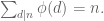
We ended by proving Euler’s formula by induction on the number of distinct prime factors:
HCSSiM Workshop day 7
A continuation of this, where I take notes on my workshop at HCSSiM.
The real numbers are uncountable
Today we used Cantor’s diagonal argument to prove that the real numbers aren’t countable. Namely, we assumed they were, and that we had a bijection 


Then we wanted to show that 


So then we decided to instead consider the set of decimal expansions, which is a bit bigger than the reals, and there the splicing map works. We reduced it to this case and are leaving it to homework to prove that the set of decimal expansions has the same cardinality as the reals. Although I don’t actually know how to do this without Cantor-Schroder-Bernstein, which we haven’t proven yet.
The Chinese Remainder Theorem
We stated and proved the Chinese (Llama) Remainder Theorem. It was a nice example of a constructive proof that assumes it’s possible and then, when you follow your nose, it’s possible to completely characterize what the solution must look like, and then it falls out. We showed it described a bijection of sets 
Dilworth’s Theorem on chains and anti-chains in posets
We started the proof of Dilworth’s Theorem but didn’t finish yet (to be continued tomorrow). Turns out that this problem is really hard and that, moreover, there are lots of ways to convince yourself it’s true but be wrong about. The inductive proof in wikipedia, for example, is incomplete, but can be extended to a complete proof.
As an example, try to cover the following poset on the power set of five letters with 10 chains:

In particular you can see we solve a matching problem on the way, between subsets of size two and subsets of size 3 in the set of five letters, which isn’t the normal “take the complement” match, but rather is an inclusion of one in the other. I’m still wondering if there’s a more direct way to do this.
Center for Popular Economics Summer Institute 2012
I’ll going to be giving a plenary talk on Tuesday, July 24th at the CPE Summer Institute 2012, which is being held this summer at Columbia the week of July 23rd – July 27th. I’ll be joined by Richard Wolff, an economist, radio show host, and author of multiple books, most recently Occupy the Economy. You can register for the Institute here (sliding scale).
The Summer Institute open to non-experts to teach them about the financial system and economics. They have two core courses, one based in the U.S. and the other international. From their web page:
The U.S. Economy/ Topics include
» Roots of the economic meltdown and solutions
» Speculation, finance and housing bubbles
» Economy, race, class and gender
» Economic histories – from personal to global
» Labor and jobs
» Democratizing the Federal Reserve and banks.
» Economic alternatives, socialism and the solidarity economy
The International Economy/ Topics include
» Roots of the economic meltdown and solutions
» Brief history of the global economy
» International trade, production and finance
» The IMF, World Bank, WTO
» Global climate change and the environment
» Creating a new world economy
In addition to hosting this cool and open Summer Institute, the Center for Popular Economics also recently came out with a booklet explaining some economic history of the U.S. written for the non-expert; take a look here.
I’m about halfway through, and I’ve spotted things you usually don’t see in economics texts you might read in high school, such as the following phrase:
So What Caused This Crisis?
Neoliberal capitalism has had three features that both explain how it promoted 25 years of economic expansions and why it led to a massive crisis in 2008. First, inequality grew rapidly, as profits rose while workers’ wages actually fell. From 1979 to 2007, the average inflation-corrected hourly wage of non-supervisory workers declined by 1 percent, while inflation-corrected nonfinancial corporate profits after taxes rose by a remarkable 255 percent. While surging profits pleased the capitalists, it brought a problem: who could buy the growing output that comes with economic expansion? The solution was debt. Somehow, people would have to borrow more and more if a form of capitalism that brings skyrocketing profits and falling wages was to function.
I think it would be cool to have a typical high school “history of economics” text side by side with this one, and have students read both and argue them.
I’m going to try to go to as much of the Summer Institute as I can as a student. I hope I see you there!


 mathbabe
