Archive
Seasonal Adjustments Will Skew Labor Reports
This is a guest post by Aise O’Neil.
I think that the next two labor reports will overstate job growth because of a technical issue, namely Seasonal Adjustments. To explain why I will explain 1) what seasonal adjustments are and 2) why they will overestimate the strength of the labor market this year.
Explanation of Seasonal Adjustments:
The idea of seasonally adjusting data is that the meaning of a data point can depend on the time of year. For instance, say the government is reporting on a value, like fuel oil, which is known to go up in January each year as people use it more in the winter. If one is trying to notice trends in the price of fuel oil, they would like a data series on fuel oil that accounts for the usual January spikes and shows the unusual changes.
The mechanisms for calculating seasonal adjustments are complicated, vary by government department, and often require a few college courses on econometrics to understand. The essential idea is that governments can look at recent data to estimate how much higher or lower a value gets in a particular month relative to a long-term trend. For instance, oil prices might be 1% higher in January than their longer-term trend according to recent data. When new seasonally adjusted data is reported, it will include the raw data plus an adjustment based on the estimates of how high or low the data is because of the time of year. For instance, when oil prices are released in the CPI report in January, the new seasonally adjusted data point may be 1% lower than the raw data in order to adjust for the fact that the raw data will show particularly high prices in January.
Seasonal adjustments to incoming data are made using estimates of seasonal trends which come from analyzing recent historical data. As more data comes in, seasonal adjustments to recent historical data can and will be retroactively revised.
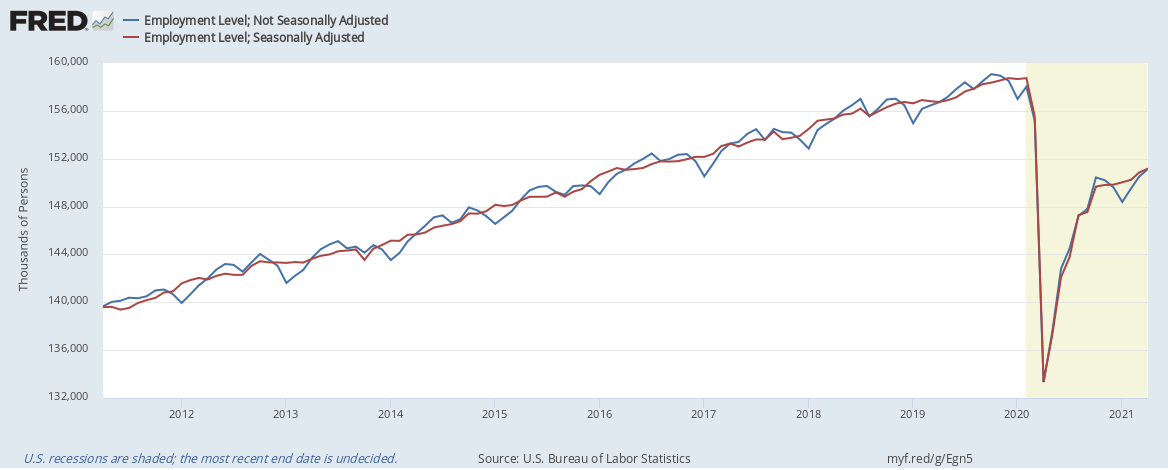
For example, the Bureau of Labor Statistics (BLS), which releases both the CPI and Current Employment Statistics (“CES”) Report seasonally adjusts incoming data based on data from the past 5 years and revises it based on incoming data for the next 5 years. The CES is the source of the “unemployment rate” and monthly job growth figures which the media often reports on. The chart below is an example of BLS seasonal adjustments in action. It shows the seasonally adjusted and non seasonally adjusted estimates of the same thing: the population of employed people in the US. Without the seasonally adjusted data series we would normally see reports of employment going up or down based on the time of year, not underlying trends in the economy.
Why Seasonal Adjustments Will Overstate Job Growth
It’s pretty clear that seasonally adjusted data is going to give a better sense of what’s happening in the economy than data which isn’t seasonally adjusted. However, seasonal adjustments aren’t perfect. Seasonal adjustments to incoming data will be based on rigorous analysis of historical data and will implicitly presume incoming data will display the same seasonal trends as past data. I’d argue that the disruption Covid has made to schooling is going to disrupt seasonal trends in employment.
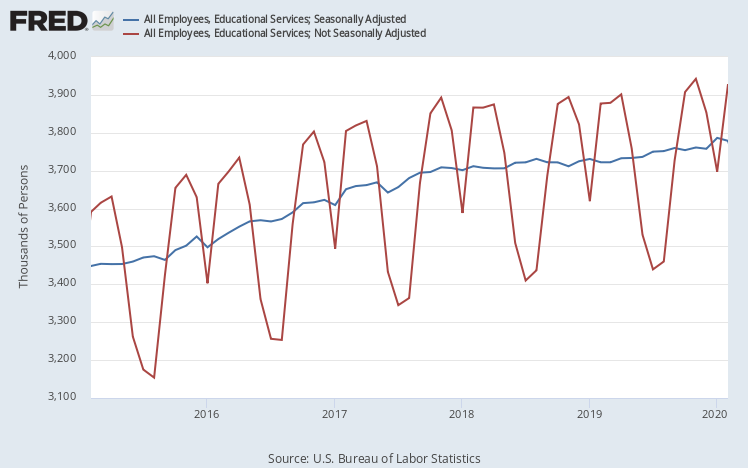
Normally the summer (and to a lesser extent winter) breaks will reduce overall employment for two reasons. Firstly, employment in education declines during summer and winter breaks. This can be seen in the graph below which depicts the seasonally adjusted and non-seasonally adjusted levels of employment in education. It includes data from 5 years prior to the Covid recession.
Secondly, parents have to look after their children and this will keep them out of the workforce. So employment levels should decline during school breaks. This would especially be true for women because women are more likely to be single parents and may bear more responsibility of looking after children generally even in two-parent heterosexual households. The graph below depicts the level of female employment in the United States divided by the overall level of employment. This is calculated using seasonally adjusted and non seasonally adjusted data series. It covers the 5 years prior to the Covid Recession. The relative female employment consistently falls in non seasonally adjusted terms going into the summer.

Both of these factors changed in the Covid era, because of virtual learning. In such an environment, certain seasonal jobs like janitorial staff, cafeteria workers, IT workers, and so on aren’t as prevalent as they used to be. The seasonal fluctuation coming directly from education is thus weaker. Additionally, many parents have had to stay out of the workforce to look after their kids throughout the year during online schooling. That means the seasonal fluctuation of summer break starting or ending is less important too.
With weaker seasonal effects now, seasonal adjustments which are based on historical data will over-account for them. When seasonal effects of the school holidays starting/ending will depress/increase employment, the seasonally adjusted levels of employment should show an increase/decrease.
One way to confirm this speculation is to look at what happens to both indicators of labor market health from August to September. That period is the strongest time for relative female employment growth as well as educational employment growth as a lot of schools start their fall semester in late August. As a consequence, the seasonally adjusted figures in both cases show a decline in seasonally adjusted terms. The graphs below show seasonally adjusted education employment and relative female employment over the past year to show the apparent weakness at the beginning of fall.
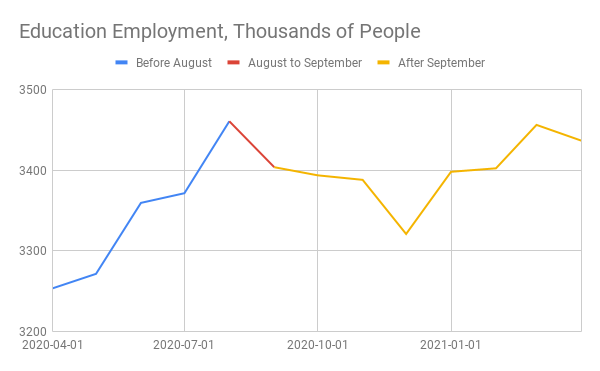
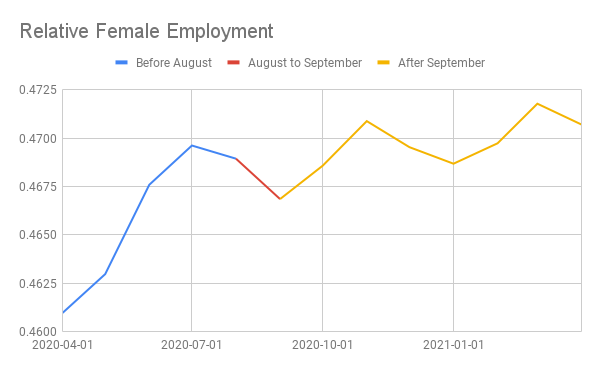
Both indicators of labor market health in seasonally adjusted terms fell significantly from August to September of 2020. This is because the start of the school year failed to create as many jobs for women and educators as it normally does, so in seasonally adjusted terms it showed a drop. In raw terms, the actual levels of relative female employment and employment in education increased, as is usual for that time of year.
In this same fashion, one can expect that the start of summer break will destroy less jobs than it normally does. As a result, in seasonally adjusted terms, the May and June jobs report will likely show strong job creation. This misleading seasonally adjusted data will be what the media reports in terms of the unemployment rate and monthly job creation.
Is Hyperinflation Coming?
This is a guest post by Aise O’Neil.
Inflation is growing out of control, or so we are told. Tucker Carlson recently said, “we wound up with frightening levels of inflation,” blaming such levels on the policies of the Biden administration. Glenn Beck published a youtube video entitled “How to Prepare for Hyperinflation in America.”
But it’s not just rightwing cranks who are panicking about inflation. Leading industrialists, like Warren Buffet, are concerned too. For that matter, financiers in the bond market are betting on high inflation. The 5-year breakeven inflation rate, a measure of expected inflation priced into the bond market recently hit a new high for the past decade: 2.72%. At the same time, the cpi index in April 2021, was 4.16% higher than it was in April 2020. That’s another record for a decade. And it’s likely that when this month’s CPI index comes out it will show an even higher percentage change from a year prior.
But even though CPI inflation is hitting records (and so is PCE inflation), there are three reasons to believe the numbers are misleading. Firstly, one has to consider factors which are making usual inflation indicators overstate the actual inflation rate. Second, one should consider better methods of tracking long term inflation trends, like median inflation. Thirdly, economic theory has something to say.
Reason #1: Normal Measures of Inflation Are Giving False Signals
There are two main indices used to track overall inflation that ordinary people might hear about. Both of them use year-on-year measures, which skew readings about a year after something weird happens.
Their names are CPI (“consumer price index”) and the PCE index (“Personal Consumption Expenditures Index”). Each month the government publishes a CPI and a PCE index for last month. We can measure how much prices have changed by looking at the differences in indexes. If the CPI is growing at an approximate rate of 2% a year, we could say CPI inflation is 2%.
When we hear about inflation rates, we normally are hearing about the “annual” inflation which is the % change in an index from a month to the same month next year. So we hear that “inflation was 4.16% in April 2021” we should think that prices are estimated to have risen about 4.16% from April 2020 to April 2021. Essentially, annual inflation is not a data point but a cumulative 12-month sum of data points. When that number is higher than it was last month, that could tell us about what happened recently in terms of the CPI/PCE index, or it could tell us about what happened to the CPI/PCE index last year. For instance, from March to April 2021, the annual CPI inflation went from 2.62% to 4.16%. This is because from March to April 2021 the CPI went up .76%; but from March to April 2020 it fell .7%.
If price changes of plus or minus .7% a month seem kind of volatile, that’s because they are. Volatility is particularly high in both the CPI and PCE index at the moment because of the effects the shutdown, it’s aftershock and reopening have been having on prices. The graph to the bottom left shows monthly changes in the CPI, measured in log-%. The data is seasonally adjusted by the government so seasonal factors have little to do with the behavior of the data. The blue line is the data and the red line is the average monthly inflation rate for December 2018 to December 2019. On the bottom right, one can see data on annual inflation measured in log-% changes to the cpi. The blue line is still the data and the red line is the inflation rate from December of 2018 to December of 2019.
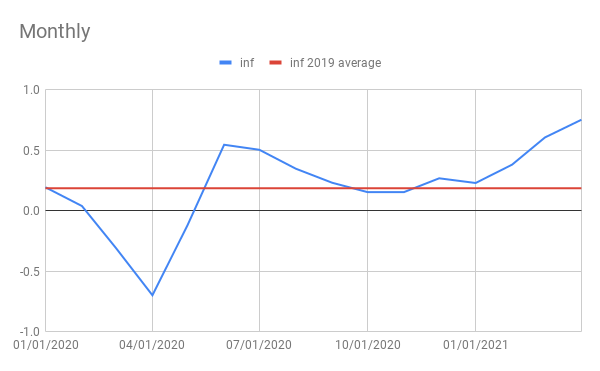
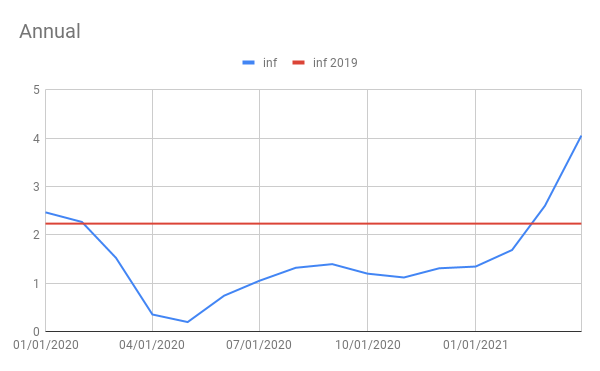
The point of the red line in both graphs is to give a sense of normal levels of inflation. The purpose of a monthly and annual inflation graph side by side is to show that monthly inflation tells some information that annual inflation does not. Both of these graphs are in terms of CPI data, but PCE index data would give similar results.
In terms of monthly inflation, what we saw at the early part of 2020 was extremely low, even negative inflation. This was a temporary phenomenon which occurred as prices for certain goods crashed at the beginning of the shutdown. For instance, when people stopped driving as much oil prices crashed. A few months later and prices slightly rebounded as companies like oil rigs cut back production. Afterwards, monthly inflation seemed to be at normal levels until now where the rollout of the vaccine is allowing for the economy to open up again.
What effect is this having on annual inflation? For about a year after the shutdown, annual inflation gave low readings because the shutdown crash in prices occured over the 1 year time frame to estimate annual inflation. Right now, two things are happening; 1) The volatile and temporary weak monthly inflation readings are falling out of the one year average, and 2) Volatile and temporarily strong inflation readings are coming into the average. This is going to mean an appearance of accelerating inflation.
Additionally, when the current month’s CPI comes out on June 10th, 1 year inflation will cover the rebound in prices shortly after the shutdown along with the spike in prices experienced during the re-opening. While prices did grow strongly from May to August of 2020, that was an aftershock of declining prices from February to May of 2020. The next annual inflation figure will cover the aftershock of the shutdown price decline but not the price decline itself, while at the same time it will include price growth we are experiencing during the re-opening. If prices grow from April to May 2021 as much as they did from March to April, then annual CPI inflation could be as high as 5.05%. This will be scary to some if they don’t understand that it is just temporary shocks.
Reason #2: Better Long-term Inflation Measures
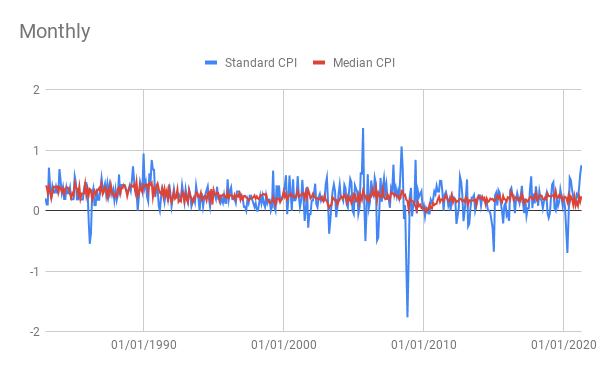
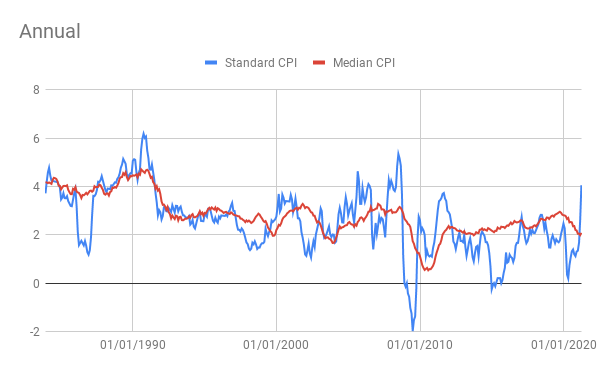
It should be clear now that CPI and PCE index data often has to be scrutinized and can be quite volatile. For that reason many economists attempt to find less volatile measures of inflation. The Cleveland Branch of the Federal Reserve has developed multiple ways to measure underlying trends in inflation. They have developed 2 very good ones: Median CPI and Median PCE inflation. While standard PCE and CPI inflation measure inflation through finding changes to the average levels of prices in an index (it’s slightly more complicated for PCE); median inflation finds the weighted median change of prices in an index. The graphs below compare historical standard and median inflation (in log-% terms) and show how median CPI inflation is more stable and reliable and is not indicating a risk of rising inflation.
Reason #3: Economic Theory
Economic theory tells us that inflation is determined by three things. The first is shocks of the forms I’ve been explaining so far (like the shutdown causing commodity prices to drop). Overall, these impacts will be short-lived and average out to 0 in the long term.
The second relates to how inflation declines during recessions and grows during expansions. If due to a lack of strong spending, a lot of resources like land labor and capital go unused, the prices for those inputs will decline lowering production cost. This can be observed in the graphs above which show a decline in inflation following the early 90s recession, a slight dip following the 2002-2003 recession and a large dip following the great recession of 2008. Recently annual inflation has dipped down again according to median inflation. This is because we have entered another recession.
Thirdly, embedded inflation is a very important long-term determinant of inflation. Oftentimes, economic actors set prices in response to or in anticipation of inflation which then determines inflation. Hence, factors like catch-up inflation and expected inflation are useful in modeling inflation and are thought to give it a good deal of inertia.
In conclusion, what theory tells us is that it is unlikely we will go from inflation persistently undershooting 2% PCE for years to hyperinflation. It is also probably a good idea for economic policymakers to ignore transitory shocks to the best extent possible.
Finally, the most important question to determine where inflation will be headed when the virus is dealt with is: How high will unemployment be? If we cannot ensure a full, rapid recovery to this economic crisis, and likely we can’t, then inflation will probably be heading down, not up.
Conclusion
Overall the conclusion from this is one should not personally be too worried about hyperinflation. Furthermore, one should not pay too much attention to the ideas of Tucker Carlson and Glenn Beck (that’s a more general rule).
Finally, if one wants to make some money, one should realize that betting on rising inflation is a winning bet on wall street right now. It will likely continue to be until June 10th where the next CPI report comes out showing a yearly inflation rate in the vicinity of 4.5% to 5%. However, this high inflation is illusory and eventually wall street will catch on.
The Swing-State Power of Black Voters Is Real
I wrote an uncharacteristically non-nerdy political opinion piece for Bloomberg, my way of finding yet another way of celebrating Stacey Abrams:
The Swing-State Power of Black Voters Is Real
After the 2020 election, discouragement campaigns shouldn’t work anymore.
For more of my Bloomberg pieces, go here.
Let’s Detox From Polling
I cannot believe I fell, once again, for the polling that gave me the information I wanted to hear. It is indeed an emotional addiction, rather than a scientific curiosity, and I think we’d all be better off shedding our addiction to political polling. My latest Bloomberg Opinion column:
Polling Failed. It’s Time to Kick the Addiction
Doubling down won’t help Americans understand themselves.
For more of my Bloomberg columns, go here.
Get ready for an epic hangover
In my latest Bloomberg post, I make the case that, in the best case scenario that Trump is gone in January, we have a massive amount of work to catch up on, especially with regard to combatting the power and malevolence of big tech.
If Biden Wins, Prepare for an Epic Policy Hangover
There’s so much to fix beyond what Trump has broken.
For more of my Bloomberg columns, go here.
We need more pre-existing condition clauses, not fewer
In today’s Bloomberg column, I wrote about how we should protect our medical “pre-existing condition” clause and agitate for many more:
This Essential Part of Obamacare Needs Expanding
The problem of pre-existing conditions extends far beyond health.
For more of my Bloomberg columns, go here.
A working vaccine might not end well
I wrote a Bloomberg column in which I argued that we’re terrible at anticipating feedback loops, especially in the world of coronavirus. One consequence of this is that we keep overreacting to good news by making things worse. I’m worried that, once a safe and effective vaccine is announced, people will change their behavior dramatically, undermining the good news and making it effectively bad.
People, Please Don’t Throw Your Masks Away
They can keep saving lives even after a vaccine becomes available.
You can read more of my Bloomberg pieces here.
TikTok’s Algorithm Cannot Be Trusted
My newest Bloomberg column is one in which I explain what I know about recommendation engines, which concludes with my claim that whoever controls TikTok’s algorithm can of course tamp down or emphasize whatever kind of content they want, misinformation or otherwise (and to be clear, being able to manipulate recommendation algorithms is in general a good thing!):
TikTok’s Algorithm Can’t Be Trusted
If it operates like other recommendation engines, it can be used for good or for evil.
Read my other Bloomberg columns here.
Three Updates
Good afternoon! I hope you are well. I have three updates for mathbabe readers.
First, I wrote a new Bloomberg column, in which I suggest that the recent algorithmic grading scandals in the UK (the IB exam and the A-levels) are just the beginning of an oncoming mutant army of crap algorithms:
Mutant Algorithms Are Coming for Your Education
Grading scandals are just the beginning.
Next, I reviewed mathematician Eugenia Cheng’s new book, X+Y: A Mathematician’s Manifesto on Rethinking Gender for the New York Times:
Third, I was in a movie that’s coming out on Netflix tomorrow called The Social Dilemma:
Documentary Filmmaker Jeff Orlowski Uncovers Invisible Threat With ‘The Social Dilemma’
Finally, I wanted to draw your attention to two new pieces:
- Meredith Broussard’s op-ed in the New York Times today When Algorithms Give Real Students Imaginary Grades
- Yael Eisenstein’s new TED talk, How Facebook Profits from Polarization.
School reopening is a disaster. This is deliberate.
Hi all,
After talking to a bunch of my friends and acquaintances in public education I’ve realized that not only is the school reopening plan a total freaking disaster, but it’s absolutely deliberately so. My newest Bloomberg piece:
School Reopening Is a Disaster in the Making
From New York City to Florida, students and teachers are pawns in a political game.
You can read more of my Bloomberg columns here.
I’m taking Trump seriously
Yesterday I wrote a new Bloomberg column in which I took Trump seriously when he repeated for the nth time that our problem is that we do too many tests, which thus shows too many confirmed COVID-19 cases.
And when I say “seriously”, what I mean is I thought through what kind of model of the world Trump must have in his head that would be consistent with this statement. For him, metrics like case counts or TV ratings are somehow more real than people dying of coronavirus. It’s weird but consistently true, and I think we should understand it. Here’s my column:
Here’s More Evidence That Trump Is an Algorithm
The president is focused on data, independent of substance.
You can read more of my Bloomberg columns here.
I was wrong about Florida COVID deaths. But not as wrong as I wish I were.
I just wrote a new Bloomberg column about how I was wrong to predict 600 daily deaths by COVID in Florida by now; right now it’s at 184. But the fishy data coming out of Florida makes me think I’m not as wrong as I wish I were. Narrow definitions of what counts as a COVID death, lagging data, and changing methodologies make me doubt the official numbers.
Why Florida Doesn’t Look as Deadly as New York
I was wrong about Covid-19 deaths. But not as wrong as I wish I was
For more of my Bloomberg columns, go here.
Let’s crowdsource CO2 levels
Hey guys,
Let’s face it, the federal response to COVID has been counterproductive. We’re on our own. In my newest Bloomberg piece, I suggest that we should crowdsource CO2 levels in places like schools, airports, and buildings where people work, so we know the ventilation is good:
People need a way to crowdsource data on indoor air quality.
This App Could Solve a Big Reopening Problem
For other Bloomberg columns, go here.
The political uprising we should have expected
A few months ago (it was published March 19th), Politico asked me and other “thought leaders” to predict how Coronavirus would change the world.
The answers are here, and include various fancy people predicting “a decline in polarization”, “less individualism”, “a healthier digital lifestyle”, “science reigns again,” and my personal favorite, Tom Nichols’s prediction that we will have “a return to faith in serious experts.”
I think my prediction was the least optimistic, entitled “Expect a political uprising.” The full statement is this:
The aftermath of the coronavirus is likely to include a new political uprising—an Occupy Wall Street 2.0, but this time much more massive and angrier. Once the health emergency is over, we will see the extent to which rich, well-connected and well-resourced communities will have been taken care of, while contingent, poor and stigmatized communities will have been thoroughly destroyed. Moreover, we will have seen how political action is possible—multitrillion dollar bailouts and projects can be mobilized quickly—but only if the cause is considered urgent. This mismatch of long-disregarded populations finally getting the message that their needs are not only chronically unattended, but also chronically dismissed as politically required, will likely have drastic, pitchfork consequences.
It makes me sad to feel so right about this.
IB’s grading algorithm is a huge mess
In my newest Bloomberg column, I wrote about a boy named Hadrien, interested in studying engineering, whose future has been put in doubt by the International Baccalaureate Organization’s new grading algorithm, which assigns grade in a secret, powerful, and destructive manner. This qualifies it as a “weapons of math destruction:”
This Grading Algorithm Is Failing Students
The International Baccalaureate’s experience offers a cautionary tale.
You can read more of my Bloomberg columns here.
Florida’s death count is gonna hit 600 soon, I predict
I’ve spent a bunch of time worried about Florida and COVID in the past few months, partly because my grandma lived there for a number of years and so I spent a bunch of time there growing up. It’s a really vulnerable place, in some ways more so than Manhattan. And according to the data, and some reckoning, I figure the daily death counts will soon hit 600. I explain why in my new Bloomberg column:
Florida’s Covid-19 Deaths Might Rival New York’s
The state’s daily fatality count could hit 600 in a few weeks.
More of my Bloomberg columns can be found here.
Quantifying Dread
You guys might have been wondering what happened to me! Well the answer is I moved to Somerville, MA temporarily, and it takes a TON of work to move, especially when you haven’t moved in 15 years!
Side note: I discovered I am a major hoarder in the categories of clothing, shoes, and yarn. This is something that is easy to deny when you don’t have to empty out large closets but is impossible to deny when you do.
OK so, and this is dark, I wrote a Bloomberg piece about my definition of quantified dread, which loosely speaking when things are getting worse and the rate at which they’re getting worse is getting worse:
America Is Being Way Too Calm About Covid-19
This is a case where optimism may be an existential threat.
You can read more of my Bloomberg columns here.
Defunding the Police Will Be Easy (we’ve already done the data work)
Here’s my newest Bloomberg column, in which I argue that we’ve already done the data work behind defunding the police, because “crime risk scores” predict police, and not in a good way:
Here’s an Algorithm for Defunding the Police
Crime-risk scores reveal the problems that society has shunted onto law enforcement.
Read more of my Bloomberg columns here.
Congress Needs to Act On Facial Recognition
Here’s my newest Bloomberg column regarding the state of facial recognition.
Amazon Can’t Make Facial Recognition Go Away
That would take an act of Congress.
Read more of my Bloomberg columns here.
Let’s Fill in Dangerous Blindspots in Police Data
Here’s my newest Bloomberg column, in which I discuss the darkest, scariest kind of data, namely missing data. We are getting some of those holes filled in when it comes to police misconduct, and we need more.
Don’t Let the Police Hide Their Bad Behavior
Fixing law enforcement will require better data.
Read more of my Bloomberg columns here.


 mathbabe