Archive
Continuously forecasting
So I’ve been thinking about how to forecast a continuous event. In other words, I don’t want to forecast a “yes” or a “no”, which is something you might do in face recognition using logistic regression, and I don’t want to split the samples into multiple but finite bins, which is something you may want to do in handwriting recognition using neural networks or decision trees or recommender systems.
I want essentially a score, in fact an expected value of something, where the answers could range over the real numbers (but will probably just range over a pretty small subset but I don’t know exactly what smallish subset).
What happens when you look around is that you realize machine learning algorithms pretty much all do the former, except for various types of regression (adding weights, adding prior, nonlinear terms), which I already know about from my finance quant days. So I’m using various types of regression, but it would be fun to also use a new kind of machine learning algorithm to compare the two. But it looks like there’s nothing out there to compare with.
It’s something I hadn’t noticed til now, and I’d love to be wrong about it, so tell me if I’m wrong.
On the making of a girl nerd
Today I want to discuss the process by which girls become math and cs nerds.
I could be tempted to talk primarily about my own story, since I’m a huge nerd. And I will talk about my story, but my focus is going to be on the girls of my generation who could have become nerds but didn’t. I’m hoping we can learn some lessons so that future generations will have more nerd girls.
Both my parents are nerds. My mother has a Ph.D. in applied math and my father has a Ph.D. in pure math. Moreover, I was on the math team in high school, found out about a math camp, and went to it for two summers, with the full support of my family.
I want to go over these details again, because I want to point out that they gave me an enormous advantage to becoming a successful nerd.
First, my parents being nerds: I have found an amazing correlation between women with math Ph.D.’s and women whose fathers are mathematicians. I don’t think this is random- indeed I think it means two things. First, that girls with mathematician dads have an easy time imagining themselves as mathematicians (and an even easier time if their mom is too). Second, that girls without mathematician dads don’t. Otherwise you wouldn’t be able to explain the statistics I have.
Second, the math camp experience. I went to math camp in spite of it being an extremely uncool summer endeavor, according to my classmates at school. Yet I didn’t care, and went anyway, mostly because I was already a complete outsider, a fat girl on the math team (but a mathbabe when I got there!).
Two things about this. First, most smart girls around me in Lexington High School, and there were a lot of them, would not have been willing to go to math camp and ruin their reputations. Most of them were relatively popular, and wanted to keep it that way. I had nothing to lose in that aspect and knew it. This kind of thinking may seem silly to us as grownups but seemed like life or death choices then.
Second, the advantage having been to math camp gave me when I got to college was phenomenal. I knew how to prove things by induction, by contradiction, and using the pigeon-hole principle. I knew basic group theory, graph theory, and real analysis. This gave me a jump-start in all of my undergrad math major classes. I was an elite, and what I could do seemed like magic to the kids who were math majors who didn’t know that stuff.
The thing about math is that people get into this mindset about being good at it: they think that you either have it or you don’t (see this post for more on the mindset). So the experience for the other kids, boys and girls, going to an algebra class and sitting next to me and a few other kids from math camp backgrounds was understandably intimidating and made them think they couldn’t compete. But I believe that, considering the social constructs and the kind of confidence girls and boys are trained to have (or not have), it was particularly daunting for other girls to see their competition in a small group of elite nerds who already knew all the answers.
I’m not advocating closing math camps. In fact, I am going back to teach at my high school math camp in July for three weeks (woohoo!). What I am advocating is thinking seriously about the selection process for young nerds and how much it weeds out girls. We can do better.
For example, Harvey Mudd is doing better by careful thought and attention to the issue. Namely, they are changing the introduction to programming class to be more appealing for non-math-or-cs-camp nerds. From the New York Times article:
Known as CS 5, the course focused on hard-core programming, appealing to a particular kind of student — young men, already seasoned programmers, who dominated the class. This only reinforced the women’s sense that computer science was for geeky know-it-alls.
“Most of the female students were unwilling to go on in computer science because of the stereotypes they had grown up with,” said Zachary Dodds, a computer scientist at Mudd. “We realized we were helping perpetuate that by teaching such a standard course.”
To reduce the intimidation factor, the course was divided into two sections — “gold,” for those with no prior experience, and “black” for everyone else. Java, a notoriously opaque programming language, was replaced by a more accessible language called Python. And the focus of the course changed to computational approaches to solving problems across science.
This sounds like a brilliant idea, and one that we should all consider (and python rocks!). It is reminiscent of the “Introduction to Proofs” class which I started with Karen Edwards and Sara Robinson in 1993 at UC Berkeley as an undergrad and which is still going, as well as the class I started at in 2006 at Barnard College, which is also still going. The dual goals of such a class are to teach basic proof techniques to people interested in the major (who probably didn’t go to math camp) and to show people that being able to prove things isn’t magic, it just takes practice and knowing techniques.
Let’s get more campuses across the country to think about all the math and cs nerds they are missing out on by teaching the same old math (or cs) major classes every year. This is a curriculum change that is easy, fun to teach, and completely worthwhile.
Who is the market?
Oftentimes you’ll read an article in the middle of a market day about how “the market is responding” to the jobs report, or the manufacturing index, or sentiment reports. That kind of makes sense – it is shorthand for the fact that the people betting on the market are, as a group, reacting and changing their bets based on new news. If the expectation was for 200,000 jobs to be added but only 120,000 jobs were added, you’d expect disappointment and a drop in the S&P index.
Even so, this language is pretty confusing, since it’s certainly not true that everyone who invests in the market is doing this – most people with money in the market don’t do anything at all on a given day. Okay then, let’s interpret it as meaning something kind of reasonable like, “of those people who respond to this news by changing their bets, a majority of them are betting in one way which is moving the market.”
It still may not be true, since people who are seriously involved with the market typically don’t have the same expectations as what the official expectation report says – that report may have contained no surprising news at all, but one hedge fund liquidating their portfolio may be dominating the market. So even if there is a reasonable interpretation, the chances are it’s vapid.
Other times you’ll read an article, probably put out by Bloomberg, about how the market is “recalibrating,” or “taking stock” after a rise. This is where I get confused. It’s like I’m expected to imagine a huge man, hunched over thinking about what to do next.

But what does that really mean? As far as I can tell, nothing at all. There’s no man, there are no little men behind the wall representing this man, and everyone betting on the market is just doing their thing. It’s maybe just a way of writing a story because the journalist was told to write a story and the market wasn’t doing anything.
But lately I’m wondering if there’s something more to it. Why are journalists covering the market allowed, day after day, to write vapid articles about the market? What is it about using language like this that makes us comforted?
My guess is that people want there to be such a man, and moreover want him to be understandable and reasonable.
It’s primarily a question of control – control over our lives, as if we can say, as long as we kind of get his (the market’s) sentiments, we can avoid catastrophic risks. Like in those human nature tests where 85% of people consider themselves better than average drivers, we feel that we understand the market and so we’re covered and safe. Even when there’s plenty of evidence that we don’t actually understand the risks, we continue the market myth out of this need to feel in control.
I also think there’s another, secondary effect of this personification. Namely, we feel like the system is massive and powerful and there’s nothing we can do to affect it. It makes us passive.
My friend Hannah, who’s an anthropologist and whom I met through Occupy, likes to say to people, “that good idea you’ve had that someone should do? It’s your idea, and you should do it! There’s no Occupy elf that will go do it for you just because it’s a good idea.” I love that sentiment, and the idea of Occupy elves (why aren’t there Occupy elves?).
It makes me realize how much we expect other people to do stuff just because it’s a good idea, when in fact from experience we should have learned by now that the stuff that gets done by other people is usually because it’s a good idea for them. Stuff that’s a good idea for us, or for everyone, we should consider our personal responsibility. The market is certainly not looking out for us.
More creepy models
I’ve been having fun collecting creepy data-driven models for your enjoyment. My first installment was here, with additional models added by my dear commenters. I’ve got three doozies to add today.
- Girls Around Me. This is a way to find out if you know any girls in your immediate vicinity, which is perfect for my stalker friends, using Foursquare data. My favorite part is that the title of this article about it actually uses the word “creepy”.
- Zestcash is a cash lending, payday-like service that data mines their customers, with a stated APR of up to 350%. On of my favorite misleading quotes in this article about the model: “Better accuracy should translate into lower interest rates for consumers.” Ummmm… yeah for some of them. And I guess the idea goes, those other losers deserve what they get because they’re already poor?
- The creepiest of all by far (because it is so painfully scalable and I could imagine it being everywhere in 2 years) is this one which proposes to embody the “best practices” of medicine into a data science model. Look, we desperately need a good model in health and medicine to do some of the leg-work for us, namely come up with a list of reasonable treatments that your doctor can take a look at and discuss with you. But we definitely don’t need a model which comes up with that list and then decides for you and your doctor which one you should undergo. Decisions like that, which often come down to things like how we care about quality of life, cannot and should not be turned into an algorithm.
By the way, just to balance the creepy models a bit, I also wanted to mention a few cool ideas:
- What about having a Reckoner General, like a surgeon general? That person could answer basic questions to explain how models are being used and to head off creepy models. Proposed by my pal Jordan Ellenberg.
- What about having an F.D.A.-like regulator for financial products? They would be in charge of testing the social utility of a proposed instrument class before it went to market. Can we do the same for data-driven models? Can the regulator be kick-ass and reasonably funded?
- What about having a creep model auditing board that brings together a bunch of nerds from technology and ethics and looks through the new models and formally reprimands creepiness, using the power of social pressure to fend it off? They could publicize a list of creeps who made these models to call people out and shame them. That really doesn’t happen enough, it’s like the modelers are invisible.
- How about a law that, if you add a cookie to your digital signature that says, “don’t track me for reals”, then if you find someone tracking you, as in saving and selling your information, you can sue for $100K in damages and win?
It sucks to be rich
I often find myself uttering the phrase, “you don’t want to be really rich, because it sucks to be rich.” For whatever reason I’m always asked to explain that opinion. I’ll do so here so I can just reference this blog post from now on instead of having to repeat myself.
Just to be clear, it also sucks to be poor. I’m not saying it doesn’t because it really, obviously does. My experience going to Ghana and making friends with dancers who later injured their backs has shown me that, especially when there are unmet medical needs, being poor absolutely bites.
But I would (and will) argue it also sucks to be rich, in a more psychological, and less sympathetic (as in, people don’t have sympathy for you) kind of way.
This recent article from the New York Times, about a reported who lived like a billionaire for a day, is worth a read and is what spurred me to write this post. My favorite line:
“Somebody’s got to live this life,” he says, gesturing to the pristine view from his penthouse villa. “God decided it should be me.”
Not that this line supports my arguments, but it’s just awesomely grandiose and despicable.
Anyhoo, back to why it actually sucks. I am using evidence I gleaned from working at D.E. Shaw with quite a few rich people (as in never have to work in their lives and can take yearly ski vacations in the Alps or wherever) and a few insanely rich people (way more). So it’s a relatively small sample size, but even so it’s not empty.
The main reason I think it sucks, is that human nature has us worrying about stuff no matter what. And rich people don’t have normal things to worry about, so they make up really weird shit to worry about. That’s kind of the whole argument but I’ll give a bunch of examples.
The primary reason it sucks to be rich is that, counter-intuitively, rich people constantly worry about money. If you drew a graph of “have money” versus “worry about money” it would be a “U” shaped graph. I feel very lucky to be in the sweet spot where I make enough money not to worry about paying my bills or being on medical insurance but I don’t make so much money that I have to start worrying about it.
What do I mean? I mean:
- Rich people worry about whether they’ve invested their money correctly (not a concern for me). This sounds like a joke but believe me, they talk about it for many many hours, probably more time than they spend with their kids.
- They worry about whether the charities they give money to are really producing stuff, because the scale of their donations is so large (again, not a concern for me, if I give money it’s to Fair Foods and I know exactly where it goes, usually to paying for insurance for the trucks).
- They scheme and plan how to affect politics and politicians with their money. Maybe not so much sympathy for this.
- They worry about whether their kids will turn into good-for-nothing leeches and so come up with weird estate planning contracts with lawyers to keep money away from their kids, which in turn screws up their kids and their relationship with their kids. This stuff is for real and can get insanely nasty, see this article if you don’t believe me.
Who needs all that? I’m much happier having kids where I’ll say, when they are ready to go to college, hey here’s how much we’ve been able to save, here are your college choices, the rest you’ll have to pay for yourself so choose wisely.
In other words, it’s good to have nice and reasonable worries.
Besides money, what do rich people worry about? The answer is: absolutely everything, and nothing, at the same time.
My favorite two examples come from stories about David Shaw himself, who is massively rich. I didn’t actually meet the people involved, so these are myths I heard working there, but they are really good myths and have the ring of so-absurd-nobody-could-make-this-up.
First example: David hires a Ph.D. in English literature (he has a thing for “geniuses”, even in the mail room) to test mattresses for him. So that person’s job is to sleep on 15 different mattresses, for 8 nights each, and draw up a report to tell him the pros and cons of each mattress. This is to avoid him having an uncomfy night’s sleep. That’s what the risk was that we were avoiding with that.
Second example: David wants to be sure his trip to California goes smoothly, so he hires a Ph.D. in Something to take the exact same trip – same car service to the NY airport, same flight (same seat on plane!), same car service upon arrival, same hotel, exactly a week before his trip (due to understood seasonality issues of air travel) – to make sure there are no snags, and to draw up the report that presumable explains how much leg room there was in his plane.
You could say that he’s just a weirdo, but here’s where I’d disagree. Before making $2.5 billion, he was just a computer science nerd at Columbia. Sure, he was intense and probably competitive, but he had normal worries and isn’t famous for being a total jerk. For that matter he’s still not famous for being a total jerk, but he’s clearly got not enough to worry about.
In other words, I’m convinced that if I had that much money, I’d be doing stuff like that too, and so would you. The existence of asstons of money around you makes you weird and entitled. Add to that that everyone around you is either your servant or someone who assumes you are living a perfect happy life, and you become increasingly isolated and misunderstood on top of it, which leads to more weirdness.
Yuck! I’d rather be saving up for a family trip to somewhere nice, and in the meantime having stay-cations where the biggest expense is a Brazilian barbeque restaurant in Queens.
Thought experiment: witness protection program
I’m often accused by my family members of having no imagination.
I really don’t think that’s fair, I think it’s more that they have outrageous amounts of imagination, and I’m normal. My husband will say something at the dinner table along the lines of, “hey I was thinking about what it would be like to live on a planet that’s attached to another planet by a weird system of ropes,” and without skipping a beat one of my sons will start asking questions: “Are they going straight up in the air or slanted? Can you climb up to the other planet? How far away is it?”. Pretty soon they are, and I’m not kidding, arguing about how thick the ropes are and the question of traveling between the planets and the different civilizations that would evolve on these two conjoined spheres. I’m an observer.
When one of them says something directly to me along the lines of, “mom, what if we lived on a spaceship going to Mars and we could only eat a liquid diet and there were no books, only videogames?”, I am usually pretty stumped (fake example, I just made it up, but you get what I mean). It just doesn’t make sense to me, and I’m constantly going back to one of the assumptions and asking why – why no books? Can’t we get books if we have so much technology? This is when my kids roll their eyes and walk back to their room.
I can’t help it, I’m just a practical-minded person. I want to solve problems but I want those problems to make sense.
In pure defense of my own ability to imagine, I came up with the following thought experiment. For some reason, which doesn’t matter (although it can be fun to come up with ridiculous reasons), we are all put into the witness protection program, and have to move to a tiny little town in the south or the midwest and we have to blend in with the townspeople, and figure out how to make a living and how to make a home. Or at the very least, if we don’t blend in exactly, we have to come up with a good story to explain our eccentricities, and it can’t be, “we’re in the witness protection program!”.
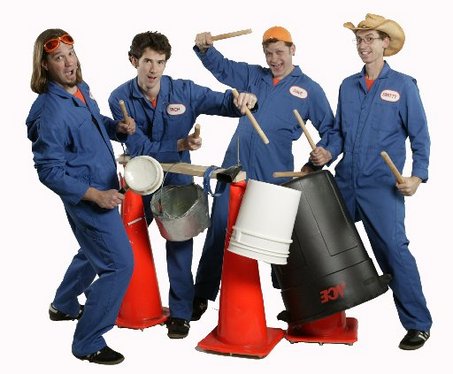
The first question is how we can make a living. I usually imagine waitressing at first, then learning how to be a car mechanic. I think of being a car mechanic as the coolest, nerdiest thing you can count on being able to do in a small town. Plus I love those jumpsuits with the grease stains, I would totally rock my jumpsuit, kinda like these guys:
My husband is a bit harder to place. He’s kind of a huge math nerd, with no actual practical skills, so the best we’ve come up with is that he can be the guy who goes around to people’s houses and helps them with their computer set-ups. But as people are getting better at computers, and as wireless systems are getting easier to set up, this plan is becoming increasingly weak.
Then there’s the issue of his Dutch accent. The idea that our story is that we’ve just moved like 60 miles, so we’re supposed to be heartland Americans, and the accent totally messes up that story. Sometimes (in my mind of course) I make him mute, other times we explain it with some weird speech impediment or maybe a stroke. I know it’s ridiculous, but it’s a toughie!
Finally, there are my kids. They are going to have to play along with the story too, but the problem there is that they’ve been raised (intentionally) to be pretty smart-assed. I’m trying to imagine them going to some random school and not giving away that they’re from Manhattan, watch the Colbert Report every night, and have strong opinions about the GOP race (and those opinions are not positive). Put on top of that the atheism thing, and I’m getting worried. I haven’t spent enough time in little towns (say, in Iowa) to really know how weird that would be, but I’m guessing pretty obviously not-from-around-here weird.
This is one of my favorite dinner topics, I suggest you try it.
Who here reads Dutch? (#OWS)
Hey I was interviewed last week by the Belgian newspaper De Tijd about Occupy Wall Street and the Alternative Banking group. Here are pdf versions of the first page and the second page, but I wanted to show the picture too, event though this jpeg version isn’t good enough to read:

The muppets strike back
No time this morning but you gotta see this video (hat tip Nathan T. and Michael C.).
What is innovation?
I’ve come to pretty much despise the word “innovation.”
First of all, it’s painfully overused, whether you work in finance or a start-up.
In finance, when people complain that banks and hedge funds should be regulated because they take dangerous risks that they don’t understand and that taxpayers have to backstop, the response, typically from a chorus of business professors and economists, is “don’t over-regulate, you might stifle innovation!”
Never mind that if you dig down to what is meant by financial innovation, it usually consists of creating weird mathematical instruments or contracts that require a complicated computer algorithm to price. So, pretty much the stuff that gets us into weird messes in the first place.
If I needed to write a sign to sum this up, it would read something like “Please stifle financial innovation!”. Actually, Volcker said it best: “the only useful banking innovation was the invention of the ATM.”
As it’s used in start-ups, the word “innovation” is also mostly painful to experience. For the most part it’s baldly used as a buzzword, by someone with a spiffy presentation who is clearly not himself (or herself, don’t want to be sexist) planning to be innovative.
In such a buzzword context, innovation becomes meaningless. At best, it’s their attempt to encourage and cajole the people around them to be innovative, and then perhaps take credit for such innovation. At worst, they fetishize Steve Jobs, which usually means channeling his perfectionist asshole side, thinking that may spur extra innovation.
What’s particularly sad about the abuse of this word is that it is inherently meaningful, and that I see and read about true innovation every day, mostly gone unnoticed by the spin doctors. Maybe that’s because most of it is too technical for business guys to get their heads around.
Another thing I’ve noticed, is that usually the most innovative people are also the most high maintenance pain-in-the-ass people to work with. Sometimes (often) downright hostile in fact.
I’ve come to enjoy this phase of “creative hostility” as a way of getting through skeptical or openly suspicious questioning incredibly efficiently. If I propose something and my most innovative, hostile critics immediately jump down my throat, that’s a sign my idea was a good one. I know that sounds weird but it’s true.
Actually maybe it’s not so weird. I watched this TED talk by Brene Brown where she talks about shame, vulnerability, and innovation. You should watch it, it’s only 20 minutes and it’s good.
Specifically, she talks about how, in order to be innovative, one must make oneself vulnerable. Even though she didn’t have time to really argue this, it resonates with me. The most innovative moments I’ve experienced are when everyone involved is willing to be wrong (vulnerable) and to smell each other’s bullshit (skeptical). Opening yourself up to other people’s skepticism takes courage.
She also describes how cultural norms can come into play at moments of shame or vulnerability or courage. In particular, this thing where men cannot be seen as weak. I think it explains why, when I see innovation, I also tend to see overt displays of macho behavior.
I wouldn’t have it any other way. I say that because I’m pretty sure the alternative is passivity and indifference, which is totally unappealing.
Here’s what I think. Real innovation is a mess and brings up all sorts of things that people don’t actually want to talk about. That’s why we only hear about some watered-down a posteriori description of it.
Parents: don’t put your kid on a diet
Yesterday I read this article about a mother, Dara-Lynn, who put her daughter Bea on a diet, tiger-mom style, and then triumphantly wrote about it in Vogue, and more recently got a book deal. This brings up lots of stuff for me personally, and I think it’s time for me to write about it.
First of all, I would like to address the issue of why people care so much about parenting issues in the first place. I mean, I guess if you aren’t a parent and don’t plan to be one, this doesn’t matter quite as much (even though you of course were yourself parented, so it should still be somewhat relevant).
My message is basically, don’t dismiss parenting discussions- they expose who we are and what we aspire to be as human beings. Questions of how we parent and what values we choose to impose on our children, who are of course vulnerable to such things, are question of how we individually form and inform culture, creating a tiny piece of the larger culture inside our homes. As parents we want to both affect that culture and prepare our children for the larger world, and it’s a tricky balance.
So given that, what values are we imposing on our kids when we put them on a diet? I can infer that somewhat from the article but I can also speak from personal experience, because my parents put me on a diet when I was 10. My parents set up system whereby I’d be punished (by losing my allowance) if I didn’t lose at least a certain amount of weight each week. They also explained to me how calories worked. That’s it. They let me loose with that information and ultimatum. (ooh, just remembered: the reward for losing 5 pounds was, ironically, a candy bar.)
It was a little strange, in retrospect, for a few reasons. First, I had been chubby since soon after birth. My parents are both and were both chubby. My grandmother lived with us off and on and constantly hoarded bags of candy and fed them to us constantly while watching soap operas. My older brother was also somewhat chubby. In spite of this, I was the only person on this regimen, and nothing else about our eating habits changed besides that I was expected to keep track of the calories I ate- the food itself was still hamburgers, boiled vegatables, and spaghetti with butter.
I guess this may have been my first experience dealing first-hand with a misleading, pseudo-quantitative model. I was told by my parents that losing weight was a simple concept of calories in and calories out, and thus must be simple to deal with. I was honestly too young to question this, and to also question why they hadn’t achieved their perfect weights if it was so simple.
Now, to the question of values. From my perspective as a kid, the values I learned were the following:
- I am terrible at following simple directions, because I can’t seem to control my eating,
- I don’t look good to other people, and
- it’s really important to look good to other people.
All in all, a pretty nasty set of values that I carried around with me like a sin for years, until something else happened, which I will get back to soon.
You might say that the article with Dara-Lynn and Bea is completely different, because first of all the mother wasn’t offhand in planning her daughter’s diet: she lived and breathed the control that she thought was required to get her daughter to lose weight. Also, it was a “success,” in that Bea lost the weight her mother set out for her. Even so, I see parallels for Bea’s received wisdom from her mother:
- You have to submit entirely to someone else (me, your mother) because you can’t be trusted to follow your instincts,
- You didn’t look good to other people, and
- it’s really important to look good to other people.
But I do feel sorry for her on top of what I went through, because now her mom is not only in a national magazine bragging about her control over her kids, she’s also gotten a book deal to go into the details of this control freakiness. Because it’s all about how a mother can foster good eating habits in her kid. I guess.
If there was any justice in the world, it would be Bea getting the book deal, in advance, to describe what it’s like to live with such a control freak mother. I honestly wish her luck.
A few concluding remarks. First of all, if you were wondering when the nerdy stuff was coming, here it is: there’s enormous selection bias going on. For every mother you hear about who drags their kids kicking and screaming through a diet, there are hundreds of poor kids who ended up like me, with failed enforced diets and incredibly guilty consciences (but at least no pictures in Vogue of their shame). We don’t hear about them, of course, because nobody wants to.
Next, although Bea is a “success story” now, I’m pretty well versed in statistics on teenage dieting and I’m anticipating lots of terrible experiences for the daughters of the women who will buy this book. A generation of girls who are ashamed and self-conscious.
Finally, how I got over my shame. It was mostly a coping mechanism. I went into a hospital when I was in 10th grade, with deep feelings of depression, and missed a few weeks of school. It was a critical moment for me, and I knew it. I had to decide whether to be depressed and passive for the rest of my life or whether to try to live life on my own terms. I basically decided to take on the following “anti-values” in order to obviate the terrible self-image I harbored at that time. I came up with these three anti-values, which I still live by:
- I forgive myself for not being good at controlling myself, because I love my body, even parts of it that confound me,
- I look good to myself, and
- it’s not that important to look good to other people.
Probably not stuff for a book deal, but at least it’s kept me from giving my kids eating disorders.
Vote with your wallet
Today we have a guest post from Elizabeth Friedrich, with whom I work on the Credit Union Findr webapp I blogged about here. Cross posted from Beyond the Bailout.
In 2008, America was in shock seeing the stock market crash, the housing market collapse, and a $12.8 trillion-dollar bailout of financial institutions many felt were responsible for the economic crash. We were paralyzed, unable to see past the madness and despair. At first, our national response was minimal. Americans had lost their homes, jobs, everything, and the anger was evident in the national mood. However, from that desperation and pain-came action and movement! People began to organize in order to decide their own fate, not leave it up to the 1% and/or a complacent government. Action came in many forms, marches in streets, letter-writing and media campaigns, peaceful occupation of public spaces, and of course “Move Your Money.”
The Move Your Money Project actually started several years ago, but had not gained significant momentum until last year, when consumers began to voice their anger and outrage at the very largest for-profit financial institutions, who had been bailed-out with billions in tax-payer dollars, and rather than using those funds to expand credit to communities in need, instead sat on this cheap money and tightened their lending standards. With historic low interest rates set and held by the Federal Reserve system, profit margins became slimmer and many banks responded by increasing their fees across the board, much to the ire of many fed-up consumers. This action was a catalyst to finally moved people to question the role of their so-called trusted financial institutions and on November 5 2011, over 600,000 people moved their money totaling $80 million dollars out of traditional banking institutions into credit unions and community banks across the country. In addition to that single day of action, over the last few years, over 4 million accounts have moved from the nation’s largest Wall Street banks according to Moebs Services, an economic research firm in Lake Bluff, IL. They also project an additional 12 million people will do the same in the next two years.
This mass-exodus from the big banks is by no means accidental and shows the overwhelming, yet untapped energy of the American people who have grown discouraged with a government that was unwilling or unable to enact true, meaningful financial reform. Many of their reasons for this are clear: consumers are looking for ethical practices, re-investment in local communities, fewer fees and more service, and the end of “Too Big to Fail” financial oligopolies. Naturally, people began focusing on credit unions and community development banks, institutions that have the public interest in mind and seek to strengthen local communities. At these community-focused institutions you actually know where you money goes and what is used for.
Convenience over accountability…
Our culture has taught us that convenience is primary tool when making decisions as opposed to accountability and fairness. Just as we make other choices; purchasing food, clothing, and transportation. Convenience is often the factor that carries the most weight in our decisions rather than ethics. This comes with many consequences – often at the expense of the environment and disadvantaged communities. Hopefully, in the future accountability and transparency will be a primary motivation for consumers when making financial decisions.
What to do?
Today we have a choice whether we know it or not. There is a parallel financial industry functioning on the fringe: Community Development Financial Institutions (CDFIs), a national network community development banks, loan funds, and community development credit unions (CDCUs). These are institutions with a primary mission to strengthen vulnerable communities and invest locally. Banks and credit unions are regulated depository institutions; banks by the Federal Deposit Insurance Corporation (FDIC) and credit unions by the National Credit Union Administration (NCUA). Credit unions offer many of the same services as banks: mortgages, car loans, personal loans, small dollar loans, credit cards, savings/checking accounts, international money transfers, Individual Development Accounts (matched-savings accounts), retirement planning, financial literacy education and budgeting, affordable savings and checking accounts, and credit and debit cards with low minimum balances and flexible terms. They are not-for-profit financial institutions created to serve their local communities and members first. Unlike banks, which can serve any customer that walks in the door, credit unions are restricted to specific fields of membership.
This means that consumers have more options than ever with respect to their primary financial institutions, and a major selling-point for many is that the money they deposit in their credit union stays local within the specific field of membership. Rather than profiting shareholders, income earned at a credit union, dividends are returned in different forms from free services to better interest rates or to expand services in the community.
Making the choice to bank at a credit union or a community development bank creates a multiplier effect for the local communities being served, and ultimately in the entire the financial system. When you invest in a community development financial institution you are investing in job creation, building schools, developing housing and financing small businesses.
Some banks may be “too big to fail,” but consumers are waking up and realizing they have a choice where they put their money, and the impact that choice can have in their own communities. Rather than letting too big to fail institutions gamble away their hard-earned cash, people are choosing to exercise their power as consumers and speak with their wallet. In banking this means find the smart, responsible alternative for you, your family and your community, and community development banks and community development credit unions are a logical choice.
What’s Mahout?

Mahout is an Apache project, which means it’s open source software.
Specifically, Mahout consists of machine learning algorithms that are (typically) map-reducable, and implemented in a map-reduce framework (Hadoop), which means you can either use them on the cloud or on your own personal distributed cluster of machines.
So in other words, if you have a massive amount of data up in the cloud, and you want to apply some machine-learning algorithm to your data, then you may want to consider using Mahout.
Yesterday I learned about a recommendation algorithm and how to map-reduce it (i.e. make it as fast as I want by distributing the work on many machines) by reading Mahout in Action. And the cool thing is that it’s already implemented and optimized, which is good because there’s a big difference between thinking I know how to map-reduce something and making it fast.
So if Netflix ever fails, but their data is miraculously left intact, they can send me and a few other nerds in as a kind of data scientist rescue squad and we can help figure out how to reassemble the recommendations of new movies based on what people have already watched and rated.
If that ever really happens, I hope we’d get t-shirts that say “data scientist rescue squad” on the back.
Update: a mahout is also someone who drives an elephant. And Mahout drives Hadoop, which is the name of Doug Cutting‘s son’s toy elephant. Doug is the guy who started Hadoop at Yahoo! but now he’s at Cloudera.
How informed does an opinion have to be before it’s taken seriously?
How informed should an opinion have to be before it’s taken seriously?
I’m kind of on one end of the spectrum here. I would argue that you only need to know enough to get it right.
The original power of Occupy for me is in the following sentiment: you don’t need to understand the system’s insides and outs in order to know the system is screwing you. Of course it’s a different thing to fix something, but let’s leave that aside for the moment.
So, if you are a student with $80,000 in loans, a degree, and no job prospects, and all your friends are in the same or similar situations, then you can fairly say that the system is broken. And you’d have a powerful argument. The beauty of this argument, in fact, is that you and your friends provides living examples of how the system is broken, and defies all expert opinion to the contrary.
And one thing that we have had enough of lately is expert opinion.
This question came up at a recent Occupy Wall Street Alternative Banking group meeting, and not for the first time. The context was the collapse of MF Global, and we were talking about tri-party repos, which have intermediaries, and (maybe) fiduciary duties, and various questions arose over the legal issues as well as the question of whether Corzine et al had yet been asked these questions by Congress.
The details don’t matter. The point is, it’s complicated, and the question came up whether we had to know absolutely everything in order to be seen as asking an informed opinion and in order to be taken seriously.
Now, it’s a good idea for us to know the basics: the parties involved, their relationship to each other, and especially their individual incentives. But on the question of knowing if a specific question has been asked before, I think that doesn’t really matter. The truth is, we are some of the wonkier people in financial matters, and if we don’t know about it, then probably most people don’t.
And moreover, since we are trying to figure out how to represent the average person in such situations, that’s a good enough test. In fact, even if a question has been asked, if it hasn’t been adequately answered for the sake of the 99%, it’s still fine to ask and ask again until we have a satisfactory answer.
I’m all for being informed myself, and I like informed debates, but I don’t want to get stuck in some “cult of expertise”, where I think nobody is allowed to have an opinion unless they are incredibly well versed in something, especially when the underlying issue is actually one of ethics and justice.
Think about it: such thinking gives experts an incentive to make things more complicated in order to exclude non-experts. In fact I’d argue that such a “cult of expertise” incentive does in fact exist, has existed for some time, and the result is our financial system, tax system, and legal system.
It’s bullshit. We need to allow people who know enough to get it right, and have skin in the game, to enter the debate, and be heard, even if they don’t know the intricacies of the legal issues etc.. Those intricacies, likelier than not, have been partially put in there to confuse the very people the system was putatively set up to serve.
On NPR’s Morning Edition (#OWS)
The Alternative Banking group was on NPR’s Morning Edition with Margot Adler today.
Here’s a recording of the piece.
Bloomberg joins Occupy Wall Street
Yesterday I was astounded to read this article in Bloomberg, explaining how the debt collectors hired by the Department of Education have been illegally screwing people to the ground on their debt. This could have come straight out of an #OWS Alternative Banking meeting. From the article:
Under Education Department contracts, collection companies “rehabilitate” a defaulted loan by getting a borrower to make nine payments in 10 months. If they succeed, they reap a jackpot: a commission equal to as much as 16 percent of the entire loan amount, or $3,200 on a $20,000 loan.
Incentive Pressure
These companies receive that fee only if borrowers make a minimum payment of 0.75 percent to 1.25 percent of the loan each month, depending on its size. For example, a $20,000 loan would require payments of about $200 a month. If the payment falls below that figure, the collector receives an administrative fee of $150.
That differential provides an incentive for collectors to insist on the minimum payment and fail to reveal when borrowers are eligible for a more affordable schedule, according to Loonin, the attorney at the National Consumer Law Center, which is representing borrowers in the Washington talks with the Education Department
Here’s a closeup of Pioneer Credit Recovery, one of the debt collection agencies in contract with the U.S. Education Department. From the Bloomberg article:
Pioneer maintained a “boiler room” environment, with high turnover among those who didn’t perform, said Joshua Kehoe, a former collector. Kehoe worked in Batavia, New York, from July 2006 through October 2008 after managing a pizza stand at a theme park.
Pioneer rewarded collectors with $100 restaurant gift cards, a $500 mahogany jewelry box, televisions and a trip to the Dominican Republic, according to Kehoe, who said he earned $9.60 an hour before the incentives.
It would be “a cold day in Hades” before collectors would tell borrowers about options with lower payments, according to Kehoe, who said “rehab cash was king.” The company pushed collectors to sign borrowers up for the rehabilitation plans, which often required payments equal to 1.25 percent of their loan amount monthly, he said.
Just in case you think student debt is someone else’s problem, read this post from ZeroHedge from a couple of days ago. In it, Tyler Durden throws down two statistics we might want to keep in mind:
- … of the $1 trillion + in student debt outstanding, “as many as 27% of all student loan borrowers are more than 30 days past due.” In other words at least $270 billion in student loans are no longer current, and
- … the unemployment for 18-24 year olds is 46%. Yup: 46%.
When you throw in that student debt cannot be expelled through bankruptcy, you have a major problem for young people. And that means a major problem for all of us.
Random stuff, some good some bad
- In case you didn’t hear, Obama didn’t nominate Larry Summers to head the World Bank. This goes in the category of good news in the sense that expectations were so low that this seems like a close call. But I guess it’s bad news that expectations have gotten so low.
- Am I the only person who always thinks of tapioca when I hear the word “mediocre”?
- There are lots of actions going on in Occupy Wall Street, part of the Spring Resistance. It’s going to be an exciting May Day, what are you plans?
- Did you hear that New Jersey was somehow calculated to be the country’s least corrupt state? This Bloomberg article convincingly blows away the methodology that came to that conclusion. In particular, as part of the methodology they asked questions about levels of transparency and other things to people working in New Jersey League of Municipalities (NJLM). A bit of googling brings up this article from nj.com, exposing that NJLM clearly have incentives to want the state government to look good: it consists of “… more than 13,000 elected and appointed municipal officials — including 560 mayors — as members… its 17 employees are members of the Public Employees’ Retirement System, and 16 percent of its budget comes from taxpayer funds in the form of dues from each municipality.” Guess what NJLM said? That New Jersey is wonderfully transparent. And guess what else? The resulting report is front and center on their webpage. By the way, NJLM was sued by Fair Share Housing to open up their documents to the public, and they lost. So they have a thing about transparency. And just to be clear, the questions for deciding whether a given state is corrupt could have been along the lines whether the accounting methods for the state pension funds are available on the web and searchable on the state government’s website.
- If you know of examples of so-called quantitative models that are fundamentally flawed and/or politically motivated like this, please tell me about them! I enjoy tearing apart such models.
- The Dallas Fed has called for an end to too-big-to-fail banks. Mmmhmmm. I love it when someone uses the phrase, “Aspiring politicians in this audience do not have to be part of the Occupy Wall Street movement, or be advocates for the Tea Party, to recognize that government-assisted bailouts of reckless financial institutions are sociologically and politically offensive”.
- Volcker says more reforms are needed in finance and government. Can we start listening to this guy now that we broke up with Summers? Please?
I regret nothing
There are a few parts of my brain that are missing. I know this not because I used to have them, because I didn’t, but because of how other people refer to their own feelings and thoughts, which I simply can’t relate to or sometimes even decipher.
One of them is the part of the brain that enjoys art. I already explained how I don’t like or understand paintings. I just don’t get why people look at art. The closest I can get to enjoying art is photography, and then usually I only like naked photos. But at that point I don’t think it’s liking it for the artistic part exactly.
Here’s another confession. I don’t have a regret center in my brain. I am someone who regrets nothing. I mean, every now and then I certainly realize I made a mistake, and I do experience an “oh shit!” feeling that I made that mistake. Like, I’ll get in the wrong line at a check-out counter and the other line will go faster (“oh shit!”). But that doesn’t seem to compare with other people’s concept of regret.
Here’s how I argue that nobody should experience regret. Let’s assume you a regret decision you’ve made, that you later believe you should have made differently. But when you’re faced with a choice, there are things you can control and things you can’t. There are things you know and things you don’t. There are consequences that you can measure and those you can’t. You do the best you can with the information you have when you make your decision. Then it’s done. What’s to regret? If you went back to that place and that time, knowing what you knew then, and being that person you were then, you’d do the same thing. It’s kind of a tautology, but it’s convincing to me.
Maybe you are mourning for not being a person who could have made a different, better choice? Even so, (I’d suggest), don’t be regretful about that, but rather try now to become someone who would make the right decision next time.
What is the utility of a regret? Does it help us do better next time? I’m all for learning from mistakes, but I don’t see why it should be such a negative process. Maybe I learn more slowly from my mistakes because I don’t have regretful feelings.
On the other hand, from my observation of this alien emotion, I’d argue that the fear of having future regrets is more of a problem than the possible mistakes people actually make. That fear seems pretty unpleasant and it seems to cloud people’s decisions: they end up experimenting less and taking fewer risks.
Am I missing something? Since I can’t understand regretting, I probable am, so please explain it to me.
The Market Price of Privacy
I recently got annoyed by this New York Times “Bitz” blog, written by Somini Sengupta, about paying for privacy. It correctly pointed out that we get services on the web that seem `free’ to us, but there is an actual price which we pay, namely we are targets of ads and are sometimes forced to hand over personal information. Moreover, when we use `free’ services such as sending invitations to a party, we are subjecting all of our friends to advertising as well. From the post:
It was a perfect microcosm of the bargain we make with the Web every day. Send me ads based on what you know about me (bachelorette party vs. child’s birthday party) or take my money to keep my screen free of ads. That bargain was the topic of a fascinating study that asked how much we are willing to pay to keep our personal data to ourselves.
The article then explained the recent study. Namely, it seems that Germans aren’t willing to pay an extra 50 Euro cents for movie tickets to avoid giving out their cells numbers, but they do claim to care about personal information gathering. If there was no price difference they wanted the less intrusive version. The author seemed to think this is a paradox.
What? That’s kind of like me saying, I like better quality chocolate, but I’m not willing to pay $400 per serving for better chocolate, and then you say I’m a hypocrite and must not like chocolate.
The fact is, it’s all about the price. It’s always all about the price. There is no way, absolutely no way, that a cell phone number, reluctantly given in a situation such as for buying movie tickets, is worth 50 Euro cents to the company collecting the number. Therefore there’s no way you should have to pay that much to avoid giving it.
Here’s another example the blog gave, when explaining sending out a dozen web-based invitations to a party:
Faced with the choice of paying an extra $10 to keep my invitation advertisement-free, I dithered. It would be easy and inexpensive, I thought, to follow Wikipedia’s lead on this (the online encyclopedia is stubbornly ad-free). But then I thought about that little risk that accompanies the ease of digital consumption: Would my credit card information be safe with this online greeting card company? The worrywart in me won out. I did not pay the extra $10. I chose to lob advertisements at my friends.
I’m in internet advertising, and I can tell you right now that a very generous estimate of how much each opportunity to advertise for your guests on an invitation, and presumably the original email and anything you’d click on in receiving the invitation, could be worth up to 10 cents, max. That is to say, the offer of keeping your invitations advertisement free for $10 is an approximately 10x markup, and you’d be a fool to pay that much for something worth so little on the open market.
So here’s what drives me crazy. It’s not that people aren’t willing to pay for privacy. They are. They’re just not willing to overpay by an outrageous amount for privacy. Far from seeming like a paradox, this seems like good intuition for a market price. If there is a web-based company that offers to send out advertisement-free invitations for a dime per guest, I think about my friends and I say, yeah they’re worth a dime each (but actually I just send them an email to come to my party).
Consumers don’t (yet) actually have access to the market price of privacy- that market is dominated for now by large-scale institutional collectors of information, which is why we’re seeing outrageous markups like these for individuals. It will be interesting to see how that changes.
Today is Sonia Kovalevsky Day
Sometimes I imagine what my life would have been life if I’d been born way earlier, like in 1850. Knowing how difficult it was back then to be a female mathematician, and not wanting to assume some special property like I was born royalty or otherwise incredibly rich, I usually settle on something like a farmer’s life, with 7 kids and a butter churn, Little-House-on-the-Prairie style. To satisfy my nerdy urges I imagine myself knitting difficult patterns and formally organizing the community’s crop rotations.
I really don’t have much insight into what it must have been like back then, but even a short thought experiment like this helps me appreciate the story of Sofia Kovalevskaya, who was indeed born in Moscow in 1850 and unbelievably contributed majorly to mathematics, even though (hat tip Robert Lipshitz):
- it was illegal to go to university in Russia at the time so she had a faux marriage in order to get permission from her husband to go abroad to study,
- got a Ph.D. in Berlin studying under some famous men (Helmholtz, Kirchhoff and Bunsen in Heidelberg, Weirstrass), becoming the first woman in Europe to ever get hold the degree,
- after which time nobody in Germany would let her work so she did various jobs including installing streetlamps,
- and finally managed to get some kind of weird position in Sweden (here‘s a more complete bio).
Did I mention that she eventually had a kid with her husband and then died at the age of 41 from the flu?
I’d really love to go back in time for a day, find Sweden, and buy that amazing woman a drink (and I’d try to arrange to slip some antibiotics into said drink).
Today we are celebrating Sonia at Barnard College (here’s the schedule), where for the nth time (where n is at least 5) we’re having a Sonia Kovalevsky Day with a crowd of young women mathematicians, 9th graders from the Urban Assembly Institute of Math & Science for Young Women, will come and enjoy math talks from Barnard and Columbia professors and then engage in a team competition (with their teachers, which is my favorite part) to see who will win incredibly small prizes but for which they will all scream their heads off for 2 hours. It’s fun!
I started this tradition when I was a Barnard math professor back in 2006 with my friend Kiri Soares who runs the UA Institute, and that fact that it’s still going makes me very happy. Every time I go I try to teach the students how to solve the Rubiks cube using a few tricks which stem from group theory. It’s fun to do and they all get to take home their cubes, along with other math toys and goodies. Mmmm… math toys.

The higher education bubble
Yesterday there was a Bloomberg article that explained how badly students understand their student debt. It occurred to me reading this, and not for the first time, that students are really the perfect choice of victim for the educational financing machine: they are typically naive about money, and a combination of incredibly hopeful and incredibly thoughtless about their futures – if they think about the future at all, they project themselves to be as successful as some chosen role model, against all odds. I was lucky enough to go to a state school which my parents could afford and were willing to pay for, graduating in 1994, but looking back I would have signed away on whatever dotted lines if I’d been asked.
Students don’t think to shop around for a better deal, or even bother to understand the deal they’re in. What’s the incentive for good deals in these circumstances?
More generally, the existence and price of college itself is a perfect trap for students. It’s been a growing assumption in the past few decades that one needs a college education to get a good job, and certainly in a poor job market like the one right now that is certainly true. And yet, the student debt load is increasing faster than the opportunities higher education provides.
We are just now finally seeing a “market reaction” to the outrageous costs and relatively meager returns on law school education. For example see this recent New York Times article, which I found through Naked Capitalism (and which also gave me the title for this post).
My mother and I were recently talking about Occupy Wall Street protesters and student debt. She’s been a professor in computer science for more than 40 years, and explained how she sees it:
Academia expands for students and gets subsidized by all the loans to them, without regard to what the society actually can accommodate.
So not only are students fed the line that they have to go to college, no matter the cost, and whatever the resulting debt, but they then go to college and end up with majors and/or knowledge that is actually not needed or useful to them or anybody else when they graduate.
In a given individual situation, you can always sort of blame the choice someone makes- why did you major in that at that over-priced college with that outrageous private loan? Did you really think you’d be a hot item on the job market?
But when you step back and look at this system, it’s maddening. We are essentially forcing, as a rite of passage to adulthood, each generation of our young people to go through a process which leaves them with ever more questionable skills and saddles them with an ever-increasing debt burden. When you add to this that fewer and fewer jobs are willing to train people while paying them, the advantage that a wealthy young person gets from having no debt and being able to intern for free means this system is also increasing inequality.
I understand that professors don’t like to think of their departments as businesses, and I am not someone who wants to corporatize academics in the sense of wanting departments to prove their business models by producing revenue streams or winning grants just to stay alive. But at the same time we’ve got to do a better job with this overall and help give our younger people a better chance.
Update: apropos article from Bloomberg just published here.


 mathbabe