Archive
Why are pharmaceutical companies allowed to do their own trials?
A recent New York Times article clearly addressed the problem with big pharma being in charge of its own trials. In this case it was Pfizer doing a trial for Celebrex, but I previously wrote about Merck doing corrupt trials for Vioxx (see How Big Pharma Cooks Data: The Case of Vioxx and Heart Disease). In the article, it has the following damning evidence that this practice is ludicrous:
- Research Director Dr. Samuel Zwillich, in an email after a medical conference discussing Celebrex, stated: “They swallowed our story, hook, line and sinker.”
- Executives considered attacking the trial’s design before they even knew the results. “Worse case: we have to attack the trial design if we do not see the results we want,” a memo read. It went on: “If other endpoints do not deliver, we will also need to strategize on how we provide the data.” This simply can’t happen. There should be an outside third-party firm in charge of trial design, and there needs to be sign-off on the design in advance so no monkey business like this takes place.
- Executives disregarded the advice of an employee and an outside consultant who had argued the companies should disclose the fact that they were using incomplete data – they were using only half. This kind of statistical dishonesty is the easiest way to get numbers you want.
- In another email, associate medical director Dr. Emilio Arbe from Pharmacia (which was later bought by Pfizer) disparaged the way the study was being presented as “data massage,” for “no other reason than it happens to look better.” Mind you, this statement was made in September 2000, so in other words the side effects of Celebrex have been known for over a decade.
- Medical Director Dr. Mona Wahba described it as “cherry-picking” the data. In May 2001.
Why is this happening? It’s all about money:
It is one of the company’s best-selling drugs, racking up more than $2.5 billion in sales, and was prescribed to 2.4 million patients in the United States last year alone.
How much are you in doubt that the people in charge are being pressured not to be honest? Dr. Samuel Zwillich claims the hook, line and sinker statement was probably about something else. The cherry-picking Dr. Mona Wahba now can’t remember what she meant.
This is bullshit, people. Statistics is getting a bad name, and people are suffering and dying from bad medicine, not to mention paying way too much for fancy meds that don’t actually help them more than aspirin.
What we need here is some basic integrity. And it’s not just a few bad eggs either – stay tuned for a post on Prof. David Madigan’s recent research on the robustness of medical trials and research in general.
Coding is like being in a band
I asked my friend Nikolai last week what I should learn if I want to be a really awesome data scientist (since I’m an alpha female I’m sure I phrased it more like, how can I be even more awesome than I already am?).
Being a engineer, Nik gave me the most obvious advice possible: become an engineer.
So this past weekend I’ve looked in to learning Scala, which is the language he and I agreed on as the most useful for large-scale machine learning, both because it’s designed to be scalable and because the guys at Twitter are open sourcing tons of new stuff all the time.
That begs the question, though, to what extent can I become an engineer by reading books about languages in my spare time? According to Nik, real coding is an experience you can’t do alone. It’s more like joining a band. So I need to read my books, and I need to practice on my computer, but I won’t really qualify as an engineer until I’ve coded within a group of engineers working on a product.
Similarly, a person can get really good at an instrument by themselves, they can learn to play the electric guitar, they can perfect the solos of Jimi Hendrix, but when it comes down to it they have to do it in conjunction with other people. This typically means adding lots of process they wouldn’t normally have to think about or care about, like making sure the key is agreed upon, as well as the tempo, as well as deciding who gets to solo when (i.e. sharing the show-offy parts). Not to mention the song list. Oh, and then there’s tuning up at the beginning, choosing a band name, and getting gigs.
It’s a similar thing for coders, and I’ve seen it working with development teams. When they bring in someone new, they have to merge their existing culture with the ideas and habits of the new person. This means explaining how unit tests and code reviews are done, how work gets divided and played, how people work together, and of course how success gets rewarded. Moreover, like musicians, coders tend to have reputations and egos corresponding to their skills and talents which, like a good band, a development team wants to nurture, without letting itself become a pure vehicle to it.
Which means that when you hire a superstar coder (and yes the word seems to be superstar- great coders can do the job of multiple mediocre coders), you tend to listen more carefully to their ideas on how to do things, and that includes how to change the system entirely and try something new, or switch languages etc. I imagine that bands who get to work with Eric Clapton would be the same way.
I’ve been in bands, usually playing banjo, as well as in chamber music groups back when I played piano, so this analogy works great for me. And it makes me more interested in the engineering thing rather than less: my experience was that, although my individual contribution was slightly less in a band setting, the product of the group was something I was always very proud of, and was impossible to accomplish alone.
Now I don’t want you to think I’ve done no coding at all. As a quant, I learned python, which I used extensively at D.E. Shaw and ever since, and some Matlab, as well as SQL and Pig more recently. But the stuff I’ve done is essentially prototyping models. That is, I work alone, playing with data through a script, until I’m happy with the overall model. Since I’m alone I don’t have to follow any process at all, and trust me you can tell by looking at my scripts. Actually I wrote some unit tests for the first time in python, and it was fun. Kind of like solving a Sudoku puzzle.
The part I don’t think works about the coding/ band analogy is that I don’t think coders have quite as good a time as bands. Where are the back-stage groupies? Where are the first two parts of sex, drugs, and rock ‘n’ roll? I think coding groups have their work cut out for them if they really want to play on that analogy.
Is science a girl thing?
One of the reasons I chose to call this blog “mathbabe” is that when I searched that term, I found a website, now defunct (woohoo!), where semi-naked women were adorning math.
This pissed me off, because I want math babes to be doing math.
If you get that (what’s not to get?) then you might see why the European Commission’s latest effort to inspire girls to do science is truly repugnant (hat tip Debbie Berebichez, a.k.a. Science Babe).
It’s a commercial where you see a standard male scientist (in a white lab coat no less) being surprised, and, we assume, aroused, when three girly models come in, giggle, dance, and generally adorn the commercial.
At the end they put on lab goggles in the style of an ironic accessory. They’re all wearing high heels and there’s even lipstick in a few shots for some unexplained reason (are we supposed to infer that wearing lipstick makes you more scientific-alicious?).
And although there are a couple of shots of an actual female writing what could be actual formulas on a hyped-up whiteboard, that’s more than balanced by some other shots of the models with unmistakable come-hither looks, gestures and blown kisses.
People. At the European Commission. Do you have no advisors!? Do you have no common sense? Who vetted this garbage video?!?
I’d like to see us get to the point where our slogan is more along the lines of:
Science, it’s for really smart women
And our video consists of cool, funky women giving actual talks and lectures or actually working on experiments. Maybe they’re wearing heels, but for sure they’re not acting like complete fucking idiots. How’s that?
I personally could suggest about 40 people for such a video. Not hard to do.
Saturday morning reading
I’m feeling deliciously lazy today, with one more week left of my current job and one more week of hazy New York weather before I head up to math camp for three weeks (woohoo!). I’m trying to figure out what to do with my life after that, and suggestions are very welcome! Bonus for ideas on how to use modeling techniques to help people rather than to exploit them.
In the meantime, please join me in some light reading:
1) Read this (hat tip Kurt Schrader). Seriously, it’s incredibly snarky and funny and right on – a gawker’s view on the New York Times Style Section and its systematic approach of torturing its readers. My favorite line:
I want to take this sentence, drag it out into the backyard, and beat it to death with a shovel.
2) How are bee hives like too-big-to-fail banks? Turns out, in fewer ways than you think. Read more to understand a beekeeper’s perspective on risk (hat tip Eugene Stern). A nugget:
Take, for example, their approach toward the “too-big-to-fail” risk our financial sector famously took on. Honeybees have a failsafe preventive for that. It’s: “Don’t get too big.” Hives grow through successive divestures or spin-offs: They swarm. When a colony gets too large, it becomes operationally unwieldy and grossly inefficient and the hive splits. Eventually, risk is spread across many hives and revenue sources in contrast to relying on one big, vulnerable “super-hive” for sustenance.
3) As we already knew, people with bad credit scores don’t really have access to all this amazing lending at amazing rates, as the Fed now admits and as I suggested in this post, “A low Fed rate: what does it means for the 99%?”. I think the next step is a data dive into credit scoring histograms (say, aggregate FICO scores for all Americans) over the past 20 years, compared to corresponding credit card offers – I want to see what kind of deals average people can expect to get on loans. If you know how to get this data, please tell me!
4) One of my readers was kind enough to leave a link to this article on why incompetent people think they’re awesome. I’m sharing it with you guys but I reserve the right to write a post on this as well. Specifically, I’m thinking of writing a meta-piece about why, when people read about incompetent people thinking they’re awesome, they somehow always smugly conclude that those pathetic fools should get a clue and realize this article is about them.
Quants, Models, and the Blame Game
This is crossposted from Naked Capitalism.
Recently a paper came out written by Donald MacKensie and Taylor Spears. It’s about the role of the Gaussian Copula model in the credit crisis, and it’s partly in reaction to Felix Salmon’s article in Wired from February 2009. Both Felix Salmon and Lisa Pollack have written responses to this paper, and they’re quite entertaining and worth a read.
Without going into too many details about the underlying models, which I might do in another post, I wanted to spend some time appreciating this paper for bringing up two issues that I believe far too few people give notice to:
- The politics of being a quant. The pressures on a quant inside an investment bank, a ratings agency, on a trading desk, or for that matter in a risk group are real and need to be understood.
- The narrative of blame. Who gets blamed when a model fails? For that matter, who is responsible for making sure it works at all?
Politics
In the paper, they discuss the concept of a “model dope,” which is a rhetorical device helping you imagine an idiot who ‘unthinkingly believes in the output of the model’. The paper explains that, as far as they could tell, there were no such actual people, that the quants they interviewed all knew the model was and is flawed and overly simplistic.
I completely believe this, and I think it wouldn’t surprise any quant who’s worked in the industry. Quants are the guys who get metaphorically paraded out in front of the bank, with their Ph.D. hanging out as a kind of badge, but when they get back to work are put back in the mines. It’s a trader’s world, or a salesman’s world, and nobody asks the quants for their nuanced opinion on the validity of basing billions of dollars in transactions on these models if the P&L looks good.
Let me say it this way: how many places employing quants to create risk or hedging models have their quants actually in charge of stuff? Very, very few is the answer. The quants are not in charge, they rarely have real power, and as soon as they produce something semi-functional and useful, they no longer own that thing – it’s been taken away from them and is owned by the real power brokers.
Which is not to say the guys in power don’t kind of understand the stuff- they do, they’re smart, but they’re not typically wedded to the idea of intellectual integrity. They typically understand it well enough to see how it can be gamed.
So I don’t think it was the quants that were promoting the wide use of the Gaussian Copula model. In the paper, they explain that it happened for essentially political reasons:
First, it was easy to talk about, since an entire correlation matrix of default was boiled down to one number, “base correlation”:
“If traders in one bank … had to ‘talk using a model’ to traders in a different bank that used a different copula, the Gaussian copula was the most convenient Esperanto: the common denominator that made communication easy.”
Next, it allowed traders to book P&L on the same day they made a trade:
“The most important role of a correlation model, another quant told the first author in January 2007, is as ‘a device for being able to book P&L’,”
Next, once it was widely used, it had staying power just because it was difficult to explain something else, not to mention difficult to admit the current model’s flaws:
“Here, the fact that the Gaussian copula base correlation model was a market standard provided a considerable incentive to keep using it, because it avoided having to persuade accountants and auditors within the bank and auditors outside it of the virtues of a different approach.”
Putting that stuff together, we can see that the mere, lowly quant’s objection, if there was one, that the model sucked was the least of the considerations of the powers-that-were:
“From the viewpoint of both communication and remuneration, therefore, the Gaussian copula was hard to discard.”
Blame
As to the question of blame, that’s also all about power. Just because the objections of quants were likely ignored doesn’t mean we can’t blame them after the fact – that’s another useful thing about quants, since they even admit the models were overly simplistic. Easy fall guys.
By the way, I’m not saying that quants rebelled against the misuse of their models, that they tried their best to warn the public of the known flaws of the Gaussian Copula or any other model for that matter. In fact I don’t know of many quants who did stand up to these assholes, partly because they were paid really well not to, and partly because they were not the alpha males in the place.
I’m just trying to point out that blame can get kind of murky. If a quant comes up with a model and says up front, hey this is just a sketch of something, it’s not totally realistic, but it’s better than nothing, and then the investment bank ignored the quant’s misgivings and bets the house on the model, who is responsible for the resulting risk?
In other words, I’d love the quants to grow some balls, but it’s going to take a major revolution in the power structure for that to be enough.
A Question
The two issues of politics and blame raise for me a larger question in reference to modeling. Namely, why and how to models develop?
[This is a cultural question, and separate from the standard (and interesting) questions you usually hear people ask of a model:
- What does the model claims to do?
- How well it works with real data?, and
- If it is widely employed, how the model affects the market itself?]
- To simplify a businessman’s day. Instead of reading out results from 5 trading desks, we want to dumb it down to one single number, so we employ a modeler to come in and do their best to summarize with one P&L number and one risk number. In other words, it’s the modeler’s job to turn a report into a sound bite. Of course the problem with that model genesis is that it doesn’t necessarily make sense to combine a bunch of numbers into one number. Sometimes the world is actually complex and needs to be understood with a nuanced view. Sometimes a sound bite isn’t enough.
- To sound incredibly smart – in other words, pure spin doctoring. I encounter this more in tech than in finance, where there are enough model-savvy people that you can’t be quite as blithe about hiding bullshit in a model. But this is real in finance too, and I think is used to confuse regulators all the time.
- To dissect, or attempt to dissect, various kinds of ‘unintentional risk’ from ‘intentional positions’. This is the single most dangerous kind of model, because on paper it can look so good, and can seem to work for so long. Credit default swaps can be thought of as manifestation of this goal – an attempt to separate default risk from holding-a-bond risk. The problem we face is that our models are never really that good, or even testable, and there are unintended consequences of these new-fangled contracts that sometimes cause catastrophic events.
- Of course, in quant shops like D.E. Shaw or RenTech or Citadel, there are also quants who try to predict the market or trade superfast on currencies, which is different from the stuff I’ve been talking about which mostly deals with hedging and risk, with different kinds of corresponding risks.
Please don’t have any kids
I recently read this New York Times article about choosing to have kids, called “Think Before You Breed”.
It describes the pressure childless people have from breeders to have kids. I believe they feel that pressure, and I want to explain it a bit, from the point of view of a person with three kids.
First of all, if you feel pressure coming from me, it’s entirely unintentional. In fact, I consider having children a deeply irrational thing to do – any kind of cost/benefit analysis focusing on material costs and such would steer me very wide of the practice of sacrificing my health, my time, and enormous amounts of resources to these little economic leeches that likely won’t even talk to me after they leave for college, which I will be paying for if I can afford it.
And not only is having kids a stupid idea in terms of economics – it’s also a hugely dangerous proposition, because it’s so much easier to screw up your kids than it is to raise healthy, well-adjusted people. There are pitfalls in every direction, and when it comes to it I think there should be a 4-year college, with forced enrollment of people who are embarking on the parenting thing, before it happens. That nothing like this happens, that kids themselves can have kids without any planning or training, is actually crazy considering how much maturity is required to do a half-decent job of it.
The only defense I really have of bearing three children is that my instincts told me to do it, and they, my instincts, didn’t play fair. In fact until I turned 23 I didn’t want kids, and I had a completely rational view of how much of a pain they’d be, and how much they’d take over my life, etc.. But somehow when I turned 23, there was something deep in my gut that kicked in and made me start missing my as-yet-unborn kids, as if I’d forgotten to kiss them goodnight and they were whimpering upstairs in their rooms. I know, I know, it’s over the top, but there you have it, instincts take no prisoners.
In summation: I don’t want you to have kids unless you absolutely have to. It’s bad for the planet, it’s bad for you, and it’s likely bad for your kids. The only thing I’d be checking if I ask you whether you plan to have kids is whether you have caught the same disease I did when I turned 23 – it’s not a request! It’s a sanity check!
Now I don’t think I’m completely normal in my view. I do think that lots of people get so intoxicated with the breeding thing that they literally think other people are insane if they don’t want to join the club. That’s super annoying and I don’t think there’s much you can actually do about these people. If it helps, when I’m listening in on that conversation I’ll be happy to interject and suggest that nobody in their right mind would ever breed. But rational arguments such as lack of resources, time, and attention would probably not sway these people, because they are true believers and need to think that it’s the only reasonable thing to do. They are married to convention.
They are also usually convinced their kids will never hate them, never move across the country for college and refuse to write, so the argument that they’ll be lonely when they’re old also doesn’t seem to help – they will tell you that, as a non-breeder, it will be you who is lonely when you’re old. It’s ironic, this line of argument, especially because you’re often talking to someone who hasn’t invested themselves in hobbies; they’re obsessed with the progress of their kids’ violin lessons and robotics teams but don’t have a true independent interest outside their children. Do they really think their kids will still let them into their lives 24 hours a day when they’re 25?
I firmly believe that, without kids, I could be establishing a far richer network of (probably childless) friends that will still be around to hang out with and talk politics when I get old. I’m still trying to do this now, by the way, but most nights I need to get home by 5:45 to make plain pasta and steamed broccoli, the only two things I’ve eaten in the past 12 years.
Look, everyone tries to convince themselves and people around them that the life choices they’ve made are the right ones. It’s uncomfortable to constantly feel like an idiot about this kind of thing, believe me. For myself, in spite of how irrational I have been, I can truly say I’ve managed to convince myself on a daily basis that I don’t mind the sacrifice because at least I get to hear my kids say insulting, sarcastic things that seem new to me (“ooh, I hadn’t heard that one! It’s goooood!”). It all makes it worth it. Plus I love them to bits, and they happen to be really cool people that might just contribute positively to the world whilst having a raucous amount of mischievous fun. At least that’s what I’ll imagine is happening when I’m old and lonely.
Who should be on the Fed Bank Boards? #OpenFed
Please consider this a civic duty: nominate someone for one of the Fed Bank Boards.
Why? Because:
- these guys regulate the banks,
- they also decide on and implement monetary policy (things like interest rates),
- in times of trouble they also help bail out banks (think Tim Geithner, Lehman, and Bear Stearns)
- the current process is an old boy’s network.
If you haven’t been living under a rock, you might have heard that Jamie Dimon, the CEO of JP Morgan Chase, sits on the NY Fed Board. There have been a number of calls for his resignation or removal. But as Jonathan Reiss points out in this excellent Huffington Post piece, even better than removing Jamie Dimon and leaving it at that would be to call for all of the Fed Boards to be populated with people who represent the interests of 99% rather than their own narrow business interests. From his article:
…rather than complaining about individual cases, we should fix the process that appointed Dimon and will appoint his successor and 35 other directors to 3-year terms starting January 2013. There are systemic problems with how the directors are selected. The Government Accountability Office studied the bank boards and found they were neither diverse nor representative of the public despite a mandate requiring it. If we work now, this process can be greatly improved.
Did you hear that? The rules already stipulate diverse boards! From a Time article which picked up Reiss’s:
The fact is, the 1913 law creating the central bank was structured to avoid these conflicts. The Federal Reserve System is made up of 12 regional banks, each with nine board members — three of each of three “classes,” A, B, and C. Class A directors are to be from the banking industry and represent large, medium-size, and small banks. Both Class B and Class C directors are supposed to represent non-banking interests — labor, consumers, agriculture, and the like. But bankers select the Class B directors, and the governors of the Federal Reserve select the Class C members, in theory to help ensure their complete independence from the banking industry.
How well does the theory work? Take a look at the list of people on the NY Fed Board, in class C (ignoring classes A and B for now):
|
Lee C. Bollinger (bio) Chair, 2012 |
 |
|
|
| Kathryn S. Wylde (bio) Deputy Chair, 2013 President and Chief Executive Officer Partnership for New York City |
|
|
|
| Emily K. Rafferty (bio), 2014 President The Metropolitan Museum of Art |
A bit of background on Kathryn Wylde can be found here, where she was quoted defending Wall Street and trying to shame someone else into doing the same; the article calls for her resignation from the NY Fed. All three of them: Lee Bollinger, Kathy Wylde, and Emily Rafferty, are professional fundraisers. Which means they grovel at the feet of rich people (read: bankers) for a living. This is not the definition of representing “non-banking interests — labor, consumers, agriculture, and the like” I would come up with. In fact if I came up with a definition, there’d be a “no ass-kissing” stipulation.
Is this a problem just for the NY Fed? And why is it happening? According to Reiss:
Dodd-Frank commissioned a study of the bank boards of directors by the GAO. They found in 2010 of the 108 directors, only 5 represented consumers. Agriculture and food processing was better represented. Curiously, the GAO says that several reserve banks said it was “challenging” to find qualified consumer representatives who are interested in these positions. They attributed this to low pay (relative to corporate boards), restrictions on political activity and the requirement that they divest themselves of bank stock holdings. But I find it hard to believe that is the problem.
This is where you come in.
Reiss wants you to nominate qualified people for the local Fed Boards. He’ll compile the list and send them on to the reserve banks, since they seem to be having trouble finding qualified consumer advocates (for whatever reason they are only friends with rich bankers and their fans).
Some good news, the turnover is pretty high: the terms are three years, staggered, which means all 12 Fed Banks make 3 new appointments every year, and by custom nobody serves more than 2 terms. That means that within 6 years we could have a fairly representative board in each Fed if we do this right.
Tweet your nomination to the hashtag #OpenFed.
Jamie Dimon gets a happy ending massage at Banking Committee hearing
Do you guys remember how last week the #OWS Alternative Banking group, along with Occupy the SEC, wrote up some questions for Jamie Dimon, the CEO of JP Morgan Chase?
Yves Smith also posted those Alt Banking questions on Naked Capitalism, along with some commentary about the senators who were expected to be asking questions of Dimon. Among other things, she mentioned their connections to Wall Street money:
…this is likely to be at most a ritual roughing up. First, the hearing is only two hours, and that includes the usual pontificating at the start of the session. By contrast, Goldman executives were raked over the coals for 10 hours over their dubious collateralized debt obligations. The comparatively easy treatment is no doubt related to the fact that JP Morgan is a major contributor to the five most senior committee members. Per American Banker:
JPMorgan is Banking Committee Chairman Tim Johnson’s second-largest contributor over the last two-plus decades, according to the Center for Responsive Politics, which analyzes campaign giving from companies’ employees and their political action committees since 1989. The same is true for the committee’s top Republican, Sen. Richard Shelby, and its second-ranking Democrat, Sen. Jack Reed.
The committee’s number-two Republican, Sen. Mike Crapo, and its third-ranking Democrat, Sen. Charles Schumer, are not far behind their colleagues, with JPMorgan ranking third and fourth, respectively, among their contributors.
Second is that the format of these hearings, with each Senator getting only five minutes each per witness, makes it difficult for a questioner to pin an evasive or clever witness. It won’t be hard for Dimon to either run out the clock or bamboozle his interrogators. But he might, as he did in his hastily-called press conference announcing the losses, make more admissions to the effect that he and senior management weren’t on top of what the group was doing. That would support the notion that JP Morgan’s risk controls were inadequate, which would mean that Dimon’s Sarbanes Oxley certification for 2011, and potentially earlier years, was false.
Who wants to know what actually happened? To find out, go read Matt Taibbi’s Rolling Stones excellent article on the hearing, which is very much in line with what Yves predicted. One of my favorite lines from the article:
This is a guy who just committed a massive blunder with federally-insured money, a guy who is here answering questions because his company, at his direction, clearly and intentionally violated the spirit of the Volcker rule, and these clowns on the Banking Committee are asking Dimon for advice on how to write the rule! It was incredible. Can you imagine senators asking the captain of the Exxon Valdez what his ideas are for new shipping safety regulations – and taking him seriously when he says he doesn’t think they’re a good idea?
Stop and Frisk silent march today
It’s Father’s Day, and if you read the wikipedia article about the origins of Father’s Day you’ll find pretty much what you expect, namely it was started about 100 years ago (1910) and was only successful after the necktie and tobacco industries starting to promote it. In fact the only surprising thing I learned was that it was originally spelled “Fathers’ Day.”
Growing up, my mom always referred to these kinds of days as “Hallmark Holidays,” by which she meant that they were simply created by vendors wanting you to feel like you need to consume. For the record our family tradition is to give the celebrated person in question breakfast in bed but not to spend extra money.
It makes me wonder, though: what would Father’s Day be in the best of worlds, in some abstract place where it isn’t propelled by crude consumerism and sentimentality?
I got nothing. I’m too used to our shallow take on it.
But I do have a feeling that a nice first approach would be to join the Silent March to stop Stop and Frisk, today at 3pm: Assemble on West 110th St. between Central Park West/8th Ave. and Fifth Ave.

On being an alpha female
About 8 months ago I found out I’m an alpha female. What happened was, one day at work my boss mentioned that he and everyone else is afraid of me. I looked around and realized he was pretty much right (there are exceptions).
I went home to my husband and mentioned how weird it was that people at work are afraid of me, and he said, “No, it’s not weird at all. Don’t you realize that you’re constantly giving people the impression that you’re about to take away their toy and break it??”. No, I hadn’t realized that – and that sounds pretty awful! Am I really that mean? Then he told me I was an alpha male living in a woman’s body.
If you google “alpha male in a woman’s body,” (without the quotes) which I did, you come upon the phrase “alpha female” pretty quickly.
It came as a surprise to me – I’d always thought I am nice. But it wasn’t a surprise to anyone else; in fact when I mentioned my realization to my close friends, each and every one of them laughed out loud that I hadn’t known this about myself. One of my friends told me it was less that I was about breaking toys and more about how I call out people’s bullshit, which is something I have to admit I relish doing.
Upon further reflection I had to admit to myself that I am nice, but only to people who I think are nice themselves. So I guess that means I’m not just simply nice. And if I enjoy calling people on their bullshit, that’s not exactly nice either.
Over the past 8 months, I’ve been slowly observing my alpha femaleness, and at this point I can honestly say I’m comfortable with it. I own it now. It’s kind of fun to know about it, because of how people react to me, without me intentionally doing anything.
How I now think about my alpha femaleness is that it lends me authority. It’s a kind of portable power. Not always, of course, and sometimes I am in situations where I’m totally incompetent, and sometimes I run into someone who completely ignores my alpha femaleness or is themselves an alpha male and competes. I usually really like them.
I’ve also realize how much my life has been informed by this property; my life has been, for the most part, much easier than it could have been without this property. And I want to acknowledge that because most people aren’t like this and don’t have this advantage.
For example: I interview really well. I speak with perceived confidence even when I don’t feel confident, and that comes across well in interviews.
In fact all my life people have mentioned to me that “things seem easy” to me, even in situations where I felt completely insecure and flustered. I used to lift weights at the gym with my buddies in college, and they would not really spot me on the bench press because they were convinced I didn’t need help. I almost dropped the weights on my neck a couple of times calling my friends over from the other side of the room. So in retrospect maybe it was a sign I’m an alpha female, but at the time I was just baffled.
It’s good and bad. When people perceive you as more confident and more comfortable in a situation than you actually are, it’s about 80% good and 20% bad, and could be the opposite depending on the situation. It’s bad when it’s dangerous and you really don’t know what you’re doing (that happened to me when I was driving an ATV once, and luckily when I turned it over in a mud pit I didn’t actually break my legs, but I could have) and it’s totally convenient when you’re presenting stuff or in an interview.
Why am I mentioning all of this? Because I think it might help people, especially women in math or in tech, to learn to think a bit more like an alpha female, and I want to give some tips on how to do it. It’s like injecting a shot of testosterone at the right time.
These tips can be used in specific situations like an interview or a talk or at a work meeting. Feel free to ignore these tips if you hate everything about the idea, which I would totally understand too. In fact when I first learned about it myself, I was offended by it on a matter of principle, but I’ve come to think of it more like a mysterious part of the human experience, on the same page as pheromones and how women have the same menstrual cycle when they live together.
Tips on how to think and act like an alpha female
- When you’re asked to describe your accomplishments, talk about yourself the way your best friend would describe you. So in other words with pride and enthusiasm for your accomplishments, without being embarrassed. Don’t lie or exaggerate, but don’t underplay anything.
- Let there be silence. If you’ve finished what you’re saying and you’re done, wait for someone else to say something.
- If you want credit, give credit first. Generosity is, in my experience, contagious. So if you want to get credit for contributing something to a project, start out by talking about how awesome your collaborators have been on the project. This gets people thinking about credit in a generous way, and it also gives you authority for bestowing it as the first person who brought it up. Note this is different from what I see lots of people do, namely not mentioning credit themselves and waiting passively for someone else to raise it (and to share it).
- Ignore titles and hierarchy. Those things are silly. You can talk to anyone at any time if you have a good idea.
- If you want feedback, give feedback. This includes to your boss (see previous tip). If you want to find out how you stand with someone, the best thing to do is to tell someone else how they stand with you. People love hearing about themselves. This works best when you can say something nice, but it also works when it’s a difficult conversation.
- Define your narrative. When your standing is in question, put out your version of the story first, for a couple of reasons – one is that you define the scope of the question, and the other is that your narrative is now the standard, and any one refuting it has to refute it.
- When you’re in a meeting and want to bring your point across in a room full of alpha males, think about defending or arguing for an idea, rather than for yourself. It helps with gaining confidence in your argument.
- Of course it also helps if your argument is water-tight, so practice making your points in your mind, and write them down beforehand if that helps.
- Develop a thick skin. When you say what you think first, there are plenty of people who might take offense and jump on you and be vicious. Sometimes it’s just a show of power. Keep an observer’s eye on that kind of reaction, and don’t take it personally, because it’s almost never about you really, it’s maybe about their relationship with their mom or something.
- At the same time, what’s cool about putting yourself out there is that people react and often point out how your thinking is flawed or lazy and you get to learn really, really quickly. Learning is the best part!
Germany’s risk
My friend Nathan recently sent me this Credit Writedowns article on the markets in German risk. There’s basically a single, interesting observation in the article, namely that 5-year bond yields are going down while credit default (CDS) spreads are going up.
When I was working in risk, we’d use both the bond market prices and the CDS market prices to infer the risk of default of a debt issuer – mostly we thought about companies, but we also generalized to countries (although mostly not in Europe!).
For example with bonds, we would split up the yield (how much the bond pays) into two pieces. Namely, you’d get some money back simply because you have to wait for the money, so you’re kind of being compensated for inflation, and then the other part of the money is your compensation for taking on the risk that it might not be paid back at all. This second part is the default risk, and we’d measure default risk of a company like GM in the U.S., for example, by comparing U.S. bond yields to GM yields, the assumption being that there’s no default risk for the U.S. at all. Note this same calculation was typical in lots of countries, but especially the U.S. and Germany, which were considered the two least risky issuers in the world.
With the CDS market, it was a bit more complicated in terms of math but the same idea was underneath – CDS is kind of like an insurance on bonds, although you don’t need to buy the underlying bonds to buy the insurance (something like buying fire insurance on a house you don’t own). The amount you’d have to pay would go up if the perceived risk of default of the issuer went up, all other things being equal.
And that’s what I want to talk about now- in the case of Germany, are all other things equal? I’ve got a short list of things that might be coming into play here besides the risk of a German default.
- Counterparty risk – whereas you only have to worry about Germany defaulting on German bonds, you actually have to worry about whomever wrote the CDS when you buy a CDS. Remember AIG? They went down because they wrote lots of CDS they couldn’t possibly pay out on, and the U.S. taxpayer paid all their bills. But that may not happen again. The counterparty risk is real, especially considering the state of banks in Europe right now.
- People might be losing faith in the CDS market. There’s a group of people who call themselves ISDA and who decide when the issuer of the debt has “defaulted”, triggering the payment of the CDS. But when Greece took a haircut on their debt, it took ISDA a long time to decide it constituted a default. If I’m a would-be CDS buyer, I think hard about whether CDS is a proper hedge for my German bonds (or whatever).
- As the writer of the article mentioned, even though it looks like there’s an “arbitrage opportunity,” people aren’t piling into the trade. Part of this may be because it’s a five year trade and nobody thinks that far ahead when they’re afraid of the next 12 months, which is I think what the author was saying.
- There are rules for some funds about what they are allowed to invest in, and bonds are deemed more elemental and therefore safe than CDSs, for good reason. Another possibility for the German bond/ CDS discrepancy is that certain funds need exposure to highly rated bonds, so German bonds or U.S. bonds, and they can’t substitute writing CDSs for that long exposure.
- Finally, in the formula for how much big a CDS spread is compared to the price, there’s an assumption about how much of a “haircut” the debt owner would have to take on their bond – but this isn’t clear from the outset, it’s determined (as it was in Greece) through a long, drawn-out, political process. If the market thinks this number is changing the spreads on CDS could be moving without the perceived default risk moving.
My followership problem
David Brooks wrote an interesting and provocative column recently in the New York Times about leadership and followership, claiming our country has forgotten how to follow. First he talks about how we dismiss leaders, focusing only on the victims:
We live in a culture that finds it easier to assign moral status to victims of power than to those who wield power. Most of the stories we tell ourselves are about victims who have endured oppression, racism and cruelty.
Then there is our fervent devotion to equality, to the notion that all people are equal and deserve equal recognition and respect. It’s hard in this frame of mind to define and celebrate greatness, to hold up others who are immeasurably superior to ourselves.
I have to admit, I agree with him here. It’s hard for me to swallow the phrase, “immeasurably superior to ourselves” when I think about the role models we have today in politics and elsewhere. I think it’s smart that he’s keeping this stuff abstract, because any given example would seem kind of embarrassing.
He then goes on to make what I think is a great point:
But the main problem is our inability to think properly about how power should be used to bind and build. Legitimate power is built on a series of paradoxes: that leaders have to wield power while knowing they are corrupted by it; that great leaders are superior to their followers while also being of them; that the higher they rise, the more they feel like instruments in larger designs. The Lincoln and Jefferson memorials are about how to navigate those paradoxes.
This idea of legitimacy of power is key. The truth is, the last time I felt myself in the presence of legitimate power was when Obama was sworn in. Ever since then I’ve been pretty much despairing, although there have been moments of relief and hope, like when Occupy started. But overall, yes, I have become a major skeptic of authority.
But I’d argue, nobody wants to feel this way. We all want there to be legitimate authority, we want to stop worrying about the economy, or whatever, and get to work and think about nothing more complicated than our personal careers, or our kids, or our haircuts, knowing that there are honest and reasonable stewards doing their job in the background. But the environment is not conducive to such blissful ignorance right now. Not in finance, not in economics, and not in government.
I’m pretty sure it’s not our attitudes here that are the problem, although they may take some time to adjust if things spontaneously improved. I think it’s the system itself, combined with modernity.
The system has become too dysfunctional for leaders to lead well. Obama has not impressed, but I’d also have to admit he hasn’t been given that many opportunities to. There’s a reason people are hating on politicians these days, and when they again fail to come to agreement on the debt ceiling it’s not going to be getting any better.
Modernity has played its part too. One of the reasons it’s harder to glorify people nowadays is that we simply know too much about them. It’s kind of in the “everybody poops” category – and that’s not going away.
I think we need a new way of appreciating just authority, if and when it comes up (i.e. if we can somehow improve our dysfunctional system). Namely, we need to appreciate people are flawed and sometimes greedy or mean, but mostly trying their best, and set up systems that don’t tempt them to be downright corrupt. Then we need to trust just as much in our systems as the leaders we set up in those systems, and see if it can work.
Using retirement money now
This is a guest post by Micah Warren.
A few weeks ago the Census Bureau reported that more than half of all births in the US are non-white. The social implications are more widely discussed and reported, but the more interesting and worrisome fact is that overall births are sharply declining, especially among whites, ever since the recession hit.
My best guess is that the declines are mostly among the middle class, who are feeling squeezed by student loans, mortgage debt or inability to buy a home, stagnant incomes and employment uncertainty.
Since middle class Americans typically prefer to buy a house before popping out children, it’s fairly simple math: Years ago when the median house price to median income was a little above 2, and nobody was drowning in student loans, and you didn’t have to obtain advanced degrees to make a reasonable wage, most families could comfortably start having children by their late twenties.
Nowadays, the median house is 3 times the median income, people are finishing college/grad school later, have students loans which take a large chunk of what would otherwise be discretionary income, setting the time-line back 5-15 years. To most people, this means less kids. I took a different path, and am learning the hard way that I might have made a choice between a home and children in my (relative) youth.
I wanted to buy a house in my thirties, but savings has been hard to come by with three kids (including twins), student loans, high rent, on one income. I had planned on using retirement funds, until my benefits office, said, “sorry, you can’t touch that money.”
Why?
In their own words, “paternalistic reasons.” They don’t want me to jeopardize my retirement. My retirement has been growing at a very healthy rate, with employer contributions much higher than our discretionary income.
I griped around a bit and the common response seems to be that I would never be so foolish as to mess with the magic money in my retirement funds, to spend today. After all, if had invested $10,000 in Berkshire Hathaway in 1965, my holdings would be worth more than $50 million today, right?
Now I have two points in response to this.
- Pulling money out of retirement to put on a house may actually be a good idea for an individual.
- Individuals collectively pulling money out of retirement plans to put on houses is a good idea for the economy as a whole.
The individual
- Retirement funds are in for a tough road. Firstly, the global economy has hit the skids and will take a while to rebuild. Secondly, the aging population: as these guys from the Fed pointed out, the P/E ratio appears to be linked to the ratio of retirees to people in their prime earnings years. This report seems widely ignored and/or downplayed. About $18 trillion is in retirement funds which will be coming out of the market as baby boomers retire and age. Note that those in the financial services industry have a vested interest in convincing people their retirement funds will grow at a 10.8%, which is bats. Most retirement funds are in managed funds, which means that they are being eaten away by the typical 1.5% fees that fund managers take. That takes an optimistic 6% underlying growth rate down to 4.5% which is in the range of most mortgages
- Private mortgage insurance is expensive.
- Rent money is not equity in your home: 5-10 years rent saving for a down payment is a lot of money.
- Tax is tax. Your money will be taxed. Yes, it may be at a lower marginal rate when you retire, but you don’t know that. Further, because compounding is nonlinear, a small change in returns makes a much bigger difference than a difference in tax rates.
The economy
On the other hand, if we do pull money from retirement and put in on homes,
- Home prices may find a bottom sooner. Clearly, if more people like myself have money to spend on houses, more houses will be sold at better prices.
- Finance will have less money and markets will be more stable. (OWS rant ommitted)
- More young middle class people will have more babies. Healthier, well-fed, well-educated children will support the economy in the future. This is the main point here. The greatest investment in our future economy is children today. Money in an account does nothing, unless you still believe in trickle-down theory. The middle class is being depleted, and this will be made much worse in the future due to the simple reason that there will be less middle class children to squeeze. Things could get much uglier years down the road if the population continues to age and retire and expect the money they dumped in the retirement funds to be there without the economy to support it.
Bottom line: A large chunk of younger American couples/families are not able to buy homes and participate in the real economy (rather than just as debtors) and we are in danger of losing out on a whole generation of economic output. This spells a much bigger disaster for our retirement funds than the loss of $20K to home equity.
Instead of choosing a better living standard when our children are young, we are expected to (somewhat selfishly) leave money in a fund that has no guarantee of growth rate, which we have no guarantee will be alive to use, and while optimistically may be spent on glorious retirement, it is also quite likely these funds will be depleted in a few short months by end-of-life care. In the meantime, Wall Street plays puff-puff-give with the money.
I personally would gladly accept financial comfort while my children are young in exchange for a smaller chunk of money later, which gives me little comfort at all, because there is no earthly way to discern what this money will mean to me when I am 70. On the other hand, I can tell you exactly how much a 20% down payment on a $300,000 house is, today.
Questions for Jamie Dimon
Jamie Dimon is meeting with Congress today. Occupy the SEC and the Alternative Banking Working Group jointly wrote a bunch of questions for the Senators to ask him. Please read the letter and some interesting facts about the Senators scheduled to talk to Dimon today on this Naked Capitalism post.
I don’t trust politicians more than I trust bankers
There are certain people who are obsessed with the way money is created in the U.S. – I call them “money creationists”. Some of these people are friends of mine from Occupy, and I really enjoy and like them.
But I don’t agree with them, and here’s why. Because I don’t trust politicians more than I trust bankers. I mean, don’t get me wrong, I don’t trust bankers. But I really don’t trust politicians.
The reason this comparison comes up is this. The way money is created through the Fed lending window is described here, in an article that could have been written by my friends, although I don’t think I’ve met Gar. Pay attention to the following concept which the writer is proposing:
Why, you might ask, doesn’t the Federal Reserve Board simply “create” money (as it does all the time) and lend it at 0.75 percent to the government (rather than let the banks do it) to pay for important public goods and to settle its debts? (Our bridges are falling down; not a bad thing in which to invest.)
As soon as I hear this I think, holy fuck let’s not even go there! The image of unlimited cash machines directly bankrolling the whims of Congress is just too much. But wait, here’s where the money-creationists get really confused – they give themselves away in fact:
… if a “public bank” were set up that operates just the way private banks are run today, including making profits for the owners – who in this case would obviously be the public – i.e. the government.
What? When was the last time the public is the same thing as the government? In this universe, for whatever reason, politicians have been wished away and all we have left are well-meaning would-be bridge builders facing off against evil venal bankers. But that’s not the world I live in.
To my money-creationist friends: there are stewards of the government, and they’re called politicians, and they love money. They are just as corrupt as bankers. It’s not a good idea to give them a printing press. Let’s instead think of a way to persuade them to require reasonable capital requirements of the banks so they don’t get to do crazy shit, if they can get their hands off of financial lobbyist money for more than fifteen minutes.
Happy Birthday to me!
The mathbabe blog is one year old today. I want to thank all of you guys for making this such a wonderful and thoughtful year for me. I totally love and adore you readers, and commenters, and guest bloggers, and yes, right now I even have room in my heart for you trolls.
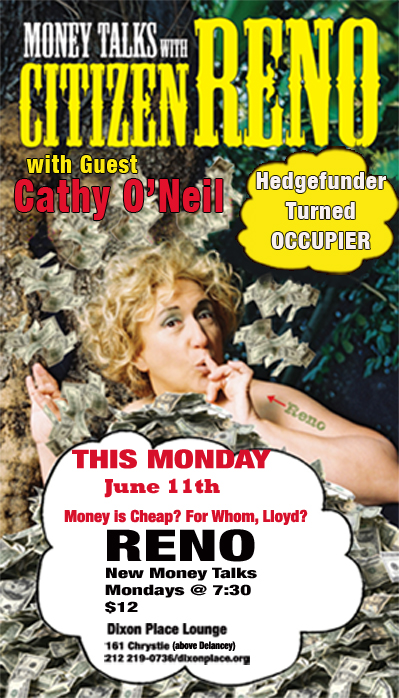
Tonight I’ll be performing again with Reno, which promises to be a hoot. Please come!
The fake problem of fake geek girls, and how to be a sexy man nerd
My friend Rachel Schutt recently sent me this Forbes article by Tara Tiger Brown on the so-called problem of too many fake geek girls stealing the thunder and limelight from us true geek girls.
The working definition of geek seems to be someone who is obsessively interested in something (I would argue that you don’t get to be a geek if your obsession is art, for example, I’d like to define it to be an obsession with something technical). She also claims that “true geeks” don’t do something for airtime. From the article:
Girls who genuinely like their hobby or interest and document what they are doing to help others, not garner attention, are true geeks. The ones who think about how to get attention and then work on a project in order to maximize their klout, are exhibitionists.
I kind of like this but I kind of don’t too. I like this because, like you, I have run into many many people (men and women) who loudly claim technical knowledge that they don’t seem to actually have, which is annoying and exhibitionistic. And yes, it’s annoying to see people like that doing things like giving things like Ted talks on “big data” when you seriously doubt they know how to program a linear regression. But again, men and women.
At the same time, there’s no reason someone can’t be both a true geek and an exhibitionist, and it seems kind of funny for a Forbes magazine writer to be claiming the authentic rights to the former but not the latter.
If there’s one thing I’d like to avoid, it’s peer pressure that, as a girl geek, I have to have a certain personality. I like the fact that girl geeks are sometimes shy and sometimes outspoken, sometimes humble and sometimes arrogant, sometimes demure and sometimes slutty. It makes it way more interesting during technical chats.
What’s the asymmetry between men and women here? According to Tara Tiger Brown, women think they’ll get attention from men by acting like a geek but my experience is that men don’t think they’ll get attention from women by acting like a geek.
I think this is a mistake that man geeks are making. For me, and for essentially all my female friends, being really fucking good at some thing is extremely sexy. Man geeks are, therefore, very sexy, if they are in fact really fucking good at something and not just posing. Maybe they just need to realize that and own it a bit more.
Next time, instead of apologizing for doing something nerdy, I suggest you (a man geek I’m imagining talking to right now) figure out how to describe what skill you mastered and talk about it as an accomplishment.
No: I’m kind of tired today, sorry. I stayed up all night playing with my computer. Should we reschedule?
Yes: Last night I implemented dynamic logistic regression and managed to get it to converge on 30 terabytes of streaming data in under 3 hours. And it’s all open source, I just checked in into github. That was awesome! But now I need to sleep. Wanna take a nap with me?
Personal Democracy Hackathon today
This Morning I’m going to the CUNY Graduate School of Journalism to pitch the Credit Union Findr Webapp to a bunch of developers at today’s Personal Democracy Hackathon. Hopefully they’ll be interested enough to work on our geo-problem of credit union eligibility, namely taking in an address and finding the credit unions you become eligible for through your address. All open source of course.
Update: We’ve got two teams working, one on our webpage and our geo-locator project. Woohoo!
Hangover cure
After a long night of vodkas and karaoke, there’s one sure method for feeling brand new once again, namely listening to Empire State of Mind, really loud, over and over.
At least I hope so.
p.s. The first year anniversary of mathbabe.org is coming up next Monday, please come up with suggestions for how to celebrate!
What if the bond markets priced in actual risk?
A friend sent me this article written by Daniel Gross, which talks about how taxpayers in Europe and in the U.S. are paying for the mistakes of bondholders. First he starts with Ireland:
When Ireland’s large private banks collapsed spectacularly a few years ago, the Irish government formally assumed the debts of the private banks. To ensure that bondholders of Irish banks would remain whole, the government undertook a massive bailout. To pay for it, it has inflicted vicious austerity on its populace.
He moves on to Greece:
As Liz Alderman and Jack Ewing reported in the New York Times this week, about two-thirds of the $177 billion in European aid to Greece given since May 2010 has been used to make payments to bondholders and other lenders. The upshot: Greece is imposing significant austerity on its citizens for the sake of preserving the value of bondholders.
And the U.S.:
Yes, it’s true that the U.S. in 2008 and 2009 acted to keep bondholders from taking big losses. The taxpayers formally assumed the debt of Fannie Mae and Freddie Mac without insisting bondholders take any haircut, just as the Irish taxpayers formally assumed the debts of their large banks. That was a big and expensive mistake. In a time of austerity, the U.S. government is channeling tax payer funds to make interest payments on bonds that were first issued by for-profit entities.
He points out that Spain appears to be taking the same approach, and that the actual people of Ireland and Greece are having second thoughts about paying all these bills, expressed through who they are voting for. I believe it’s left to the reader to wonder what’s going to happen to Spain.
Gross suggests a different tact for governments to use, namely to ignore old debt and to provide insurance for new debt issued by the banks and other private companies. The U.S. did this during the crisis, it was called the Temporary Liquidity Guarantee Program. His point is that we’ve made money off this program and we’ve let lots of really insolvent banks fail as well.
On the other hand, I’d argue, we haven’t let the big banks fail, so there’s a limit to its effectiveness (but I won’t blame this program for that, because that’s a problem of political will). And it’s of course not altogether clear that the insurance it sold was sold at market value, since if it had been, I’m guessing it wouldn’t have been such a boon to a given company to issue debt and pay for insurance versus just issuing debt at a higher risk premium. In other words, I think the “Liquidity” in “Temporary Liquidity Guarantee Program” is key.
But he’s got it basically right- taxpayers are definitely on the hook for risky bets other people took. And backups and guarantees by governments definitely skews the bond market. Specifically, big companies end up paying less than they should given their risk, and the taxpayers foot the bill in situations of default (which aren’t allowed to actually be defaults with respect to the bondholders).
So sufficiently big companies are paying too little for debt. That’s about half the story though. The other half is how normal people are paying too much for debt.
For example, with student debt, Bloomberg recently reported that private issuers of student debt are charging as much as credit card companies:
Tovar, who lives with her parents in the Chicago suburb of Blue Island, owes $55,600 to Chase Student Loans, a unit of JPMorgan, according to a May 17 statement provided by her. A loan for $24,794 carries an interest rate of 10.25 percent, as does a second loan for more than $2,619. A third for $28,187 has a rate of 8.97 percent. She has a balance of $42,326 in loans from a different lender.
Given that these loans are effectively undischargable through bankruptcy, what is the real risk for private issuers in getting their money back? What would a fair market price be for these loans? And why don’t we have a fair market?


 mathbabe