Archive
How to teach someone how to prove something
In a couple of my posts (most recently here), I’ve talked about the need for a course early on in undergraduate math classes on proof techniques.
The goals of the class are two-fold: first, teach the students basic skills, and second demystify the concept of proof. The students should come away from the class thinking, no it’s not magic, and I’ve learned how to do this stuff, and there are a few basic techniques which seem to come in handy.
Today I want to go further into what a curriculum for such a course might look like.
And I will, in a moment, but first I want to explain something. It’s actually a really important and dangerous question, how to teach such a course, because it could go wildly wrong, and sometimes does. From my commenter Jordan:
… “Numbers, Equations, and Proofs,” which I started at Princeton in 2002 and which is still going as well. Though here’s an interview with a dude who was an ace math competition dude and found the course so hard as to drive him out of the math major! So maybe it’s no longer as “for everyone” as I designed it to be….
This struck me, how perverted Jordan’s class became. For that matter, Math 55 at Harvard could have started out as a good idea as well, but by the time I got to Harvard as a grad student it was the reason so few math majors ever stuck at Harvard and why there were especially few women.
I remember Noam Elkies taught it while I was there and was famous for asking questions in class and getting students to compete to answer them quickly. It makes sense that he’d run a class like this, because he’s so fast and clever, and he’s naturally wondering, am I the fastest and clevererest of them all? But rather than a place where proof is demystified and people feel safe asking dumb questions, he’d created the polar opposite, a live quiz show of clever competition. Ew!
In order to combat this downfall and decay, I think the class needs to have a clearly stated mission as well as built-in curriculum requirements that works against ostentatious displays of cleverness, which indeed only serve to further the “I got it but you don’t” stereotype of math skills (but which mathematicians themselves are incentivized to further since that magical aura comes in handy).
For example, when I taught it, I let the students hand in homework again and again until they got a score they liked. Of course, this depending on me having an awesome grader (and a relatively small class), which luckily I had.
Also, I asked each student to give a presentation to the class on some proof they particularly enjoyed, and I sat through a preview of their presentation and gave them extensive advice on board work and eye contact, which took a lot of work but really helped them prepare and also boosted their egos while at the same time increased their sympathy with each other and with me.
But of course the most important thing was that I clearly stated at the beginning of each class in the first two weeks that proving things in math was a skill like any other that you get good at through practice. And when I left Barnard Dusa McDuff took over the class and still teaches it, so I know it’s in good hands.
If I hadn’t had Dusa, I’d probably have written a manifesto to be given to each person who would teach the class after me. Of course anyone could have just thrown that away but it’s an idea.
As for content, I taught them really basic proof techniques, so induction, proof by contradiction, the pigeon-hole principle, and some epsilon-delta practice. We covered some basic logic, graph theory, group theory, ordinals, and basic analysis. We constructed the reals two ways and the complex numbers once and talked for a long time about whether “i” is real and what that even means. We used A Transition to Higher Mathematics, which I recommend with a few reservations (please tell me if you’ve found a better text for something like this!).
Everything was done super explicitly and carefully, no rushing. I said things three times in three different ways. I wasn’t expecting people to be fast or clever, because I know intelligence works in different ways and that this stuff was completely new to most of the students. And at least one student in the class, who had been an artist, is now a grad student in math at Berkeley.
Looking over my post I realize I spent way more time talking about the tone of the class than the content, but that’s totally appropriate, since I think of this class as an introduction to the culture of mathematics (or rather the culture I wish we had) just as much as mathematics itself.
After all, there really is no time limit on good ideas, and you do get to do it over if you make a mistake, and going over things slowly gives you more time to ask good questions and find mistakes.
Calling all data scientists! The first ever global data science hackathon
Hey I’m helping organize a NYC data hackathon at Bloomberg Ventures to take place April 28th – 29th, from 8am Saturday to 8am Sunday. I’m looking for outrageously nerdy people to come help. There will be some prizes.
Read the official blurb below carefully and if you’re in, sign up for the event by registering here.
Update: they’ve decided on prizes.
See you there!
——————————————————————————————————————————————–
Are you a smart data scientist? Participate in this hackful event. 24 hours of non-stop, fun data science competition. The first ever global, simultaneous data science hackathon!
In connection with Big Data Week, we’re helping organize a global data science hackathon that will simultaneously take place in various locations around the world (including London, Sydney, and San Francisco). We will host the NYC event at the Bloomberg Ventures office in the West Village.
The aim of the hackathon is to promote data science and show the world what is possible today combining data science with open source, Hadoop, machine learning, and data mining tools.
Data scientists, data geeks, and hackers will self organize around teams of 3-5 members. Contestants will be presented with a ‘big data’ set (hosted on the Kaggle platform). In order to win prizes, the teams will have to use data science tools and develop an analytical model that will solve a specific data science problem specified by the judging tech panel. The contestants will have to report their achievements at specific milestones, and a leader board will be published online at each milestone.
The contestants will spend 24 hours in Bloomberg Ventures’ office space where food, drinks, workspaces, and resting areas will be provided. Teams will compete for both local and global titles and prizes.
The Hackathon runs for 24 hours starting on April 28th at 8am (early start to allow for the event to happen simultaneously in multiple time zones around the world).
If you have questions, please email shivon.zilis@bloombergventures.com
PLEASE READ CAREFULLY:
1. This is a technical competition, not a networking event or an opportunity to learn more about big data techniques and technologies. We have limited space, so we unfortunately need to be strict about who gets to compete. If you’re an entrepreneur looking to recruit, we’re excited to have you as a member of this community, but this specific event is not the right venue, please come our regular Data Business meetups instead! 🙂
2. You should have Mad Skillz at at least one of the following:
- Data grappling and/or cleaning,
- Data modeling and forecasting,
- Data visualization,
- Spontaneous micro- and macro-economic theory creation
3. You should know one or more of the following languages:
- R
- python
- Matlab
- Some statistical package like SPSS or SAS
4. You should bring your hardcore laptop to the event, since we will have on the order of 10 gigs of data to play with.
In which mathbabe becomes insurance claims adjuster
Who knows what I’m talking about with this story.
My husband dislocated his finger sledding with my son last January, so more than a year ago, and the hospital kept sending us bills for the event.
But here’s the thing, we were covered under my medical insurance, which had perhaps recently changed policy numbers when MSCI took over Riskmetrics. So probably what had happened was my husband had given them the old insurance card, but in any case, in the the end I knew I wouldn’t have to pay since we’d definitely been covered.
The hospital called once a month or so, and every time they got hold of me I argued with them and told them to check their records. They kept telling me that the insurance company was refusing payment under any of the policy numbers I gave them.
In the end, last month, I called up the insurance company myself and got them to admit payment, which wasn’t hard since they said they’d already paid for the X-ray from the dislocation on that date. I called up the hospital and straightened it out.
So yeah, I ended up doing their job for them, and that’s both annoying and exciting because now nobody thinks I owe them $2400. In fact I did a victory dance (at work, because you always have to do this during work hours for people to answer the phone).
But why I’m writing about it today is that it’s actually really infuriating how often something like this happens, and I can’t help noticing that I always get out of it but many people wouldn’t. I’m at a huge advantage in this common situation because:
- I worked as a customer service person so I know how to talk to customer service people. Turns out you should always be polite, but never hang up the phone until your problem is solved. Just keep asking, extremely nicely, things like, “Hmmm… that’s confusing, what do you think could have gone wrong?” or “What would you do if you were me?” or if those don’t work, “Do you think you could tell me who to talk to sort this out? I’d really appreciate it.”
- I am always covered by insurance, so I never worry that they are right. This is an enormous advantage over people who sometimes lose coverage between jobs or something.
- I keep all my old paperwork. Impossible for people who don’t have an incredibly
boringstable lifestyle like mine. - I have a job that allows me to make calls like this during work hours. Obviously huge.
- I am completely unafraid of forms and red tape. This comes from experience, but I know most people are afraid of such stuff, and that alone would probably keep most people from arguing.
I really do feel like I am relying on my professional skills in order to get my insurance to pay for setting my husband’s dislocated finger, when that should be a no-brainer. If you are inexperienced and poor, you’d probably be completely at a loss for how to deal with this situation.
I wonder how many people have their credit scores lowered by medical claims which should have been paid but weren’t due to crap like this. It’s a broken system, but it only leaks on the most vulnerable people, and I hate that.
Continuously forecasting
So I’ve been thinking about how to forecast a continuous event. In other words, I don’t want to forecast a “yes” or a “no”, which is something you might do in face recognition using logistic regression, and I don’t want to split the samples into multiple but finite bins, which is something you may want to do in handwriting recognition using neural networks or decision trees or recommender systems.
I want essentially a score, in fact an expected value of something, where the answers could range over the real numbers (but will probably just range over a pretty small subset but I don’t know exactly what smallish subset).
What happens when you look around is that you realize machine learning algorithms pretty much all do the former, except for various types of regression (adding weights, adding prior, nonlinear terms), which I already know about from my finance quant days. So I’m using various types of regression, but it would be fun to also use a new kind of machine learning algorithm to compare the two. But it looks like there’s nothing out there to compare with.
It’s something I hadn’t noticed til now, and I’d love to be wrong about it, so tell me if I’m wrong.
On the making of a girl nerd
Today I want to discuss the process by which girls become math and cs nerds.
I could be tempted to talk primarily about my own story, since I’m a huge nerd. And I will talk about my story, but my focus is going to be on the girls of my generation who could have become nerds but didn’t. I’m hoping we can learn some lessons so that future generations will have more nerd girls.
Both my parents are nerds. My mother has a Ph.D. in applied math and my father has a Ph.D. in pure math. Moreover, I was on the math team in high school, found out about a math camp, and went to it for two summers, with the full support of my family.
I want to go over these details again, because I want to point out that they gave me an enormous advantage to becoming a successful nerd.
First, my parents being nerds: I have found an amazing correlation between women with math Ph.D.’s and women whose fathers are mathematicians. I don’t think this is random- indeed I think it means two things. First, that girls with mathematician dads have an easy time imagining themselves as mathematicians (and an even easier time if their mom is too). Second, that girls without mathematician dads don’t. Otherwise you wouldn’t be able to explain the statistics I have.
Second, the math camp experience. I went to math camp in spite of it being an extremely uncool summer endeavor, according to my classmates at school. Yet I didn’t care, and went anyway, mostly because I was already a complete outsider, a fat girl on the math team (but a mathbabe when I got there!).
Two things about this. First, most smart girls around me in Lexington High School, and there were a lot of them, would not have been willing to go to math camp and ruin their reputations. Most of them were relatively popular, and wanted to keep it that way. I had nothing to lose in that aspect and knew it. This kind of thinking may seem silly to us as grownups but seemed like life or death choices then.
Second, the advantage having been to math camp gave me when I got to college was phenomenal. I knew how to prove things by induction, by contradiction, and using the pigeon-hole principle. I knew basic group theory, graph theory, and real analysis. This gave me a jump-start in all of my undergrad math major classes. I was an elite, and what I could do seemed like magic to the kids who were math majors who didn’t know that stuff.
The thing about math is that people get into this mindset about being good at it: they think that you either have it or you don’t (see this post for more on the mindset). So the experience for the other kids, boys and girls, going to an algebra class and sitting next to me and a few other kids from math camp backgrounds was understandably intimidating and made them think they couldn’t compete. But I believe that, considering the social constructs and the kind of confidence girls and boys are trained to have (or not have), it was particularly daunting for other girls to see their competition in a small group of elite nerds who already knew all the answers.
I’m not advocating closing math camps. In fact, I am going back to teach at my high school math camp in July for three weeks (woohoo!). What I am advocating is thinking seriously about the selection process for young nerds and how much it weeds out girls. We can do better.
For example, Harvey Mudd is doing better by careful thought and attention to the issue. Namely, they are changing the introduction to programming class to be more appealing for non-math-or-cs-camp nerds. From the New York Times article:
Known as CS 5, the course focused on hard-core programming, appealing to a particular kind of student — young men, already seasoned programmers, who dominated the class. This only reinforced the women’s sense that computer science was for geeky know-it-alls.
“Most of the female students were unwilling to go on in computer science because of the stereotypes they had grown up with,” said Zachary Dodds, a computer scientist at Mudd. “We realized we were helping perpetuate that by teaching such a standard course.”
To reduce the intimidation factor, the course was divided into two sections — “gold,” for those with no prior experience, and “black” for everyone else. Java, a notoriously opaque programming language, was replaced by a more accessible language called Python. And the focus of the course changed to computational approaches to solving problems across science.
This sounds like a brilliant idea, and one that we should all consider (and python rocks!). It is reminiscent of the “Introduction to Proofs” class which I started with Karen Edwards and Sara Robinson in 1993 at UC Berkeley as an undergrad and which is still going, as well as the class I started at in 2006 at Barnard College, which is also still going. The dual goals of such a class are to teach basic proof techniques to people interested in the major (who probably didn’t go to math camp) and to show people that being able to prove things isn’t magic, it just takes practice and knowing techniques.
Let’s get more campuses across the country to think about all the math and cs nerds they are missing out on by teaching the same old math (or cs) major classes every year. This is a curriculum change that is easy, fun to teach, and completely worthwhile.
Who is the market?
Oftentimes you’ll read an article in the middle of a market day about how “the market is responding” to the jobs report, or the manufacturing index, or sentiment reports. That kind of makes sense – it is shorthand for the fact that the people betting on the market are, as a group, reacting and changing their bets based on new news. If the expectation was for 200,000 jobs to be added but only 120,000 jobs were added, you’d expect disappointment and a drop in the S&P index.
Even so, this language is pretty confusing, since it’s certainly not true that everyone who invests in the market is doing this – most people with money in the market don’t do anything at all on a given day. Okay then, let’s interpret it as meaning something kind of reasonable like, “of those people who respond to this news by changing their bets, a majority of them are betting in one way which is moving the market.”
It still may not be true, since people who are seriously involved with the market typically don’t have the same expectations as what the official expectation report says – that report may have contained no surprising news at all, but one hedge fund liquidating their portfolio may be dominating the market. So even if there is a reasonable interpretation, the chances are it’s vapid.
Other times you’ll read an article, probably put out by Bloomberg, about how the market is “recalibrating,” or “taking stock” after a rise. This is where I get confused. It’s like I’m expected to imagine a huge man, hunched over thinking about what to do next.

But what does that really mean? As far as I can tell, nothing at all. There’s no man, there are no little men behind the wall representing this man, and everyone betting on the market is just doing their thing. It’s maybe just a way of writing a story because the journalist was told to write a story and the market wasn’t doing anything.
But lately I’m wondering if there’s something more to it. Why are journalists covering the market allowed, day after day, to write vapid articles about the market? What is it about using language like this that makes us comforted?
My guess is that people want there to be such a man, and moreover want him to be understandable and reasonable.
It’s primarily a question of control – control over our lives, as if we can say, as long as we kind of get his (the market’s) sentiments, we can avoid catastrophic risks. Like in those human nature tests where 85% of people consider themselves better than average drivers, we feel that we understand the market and so we’re covered and safe. Even when there’s plenty of evidence that we don’t actually understand the risks, we continue the market myth out of this need to feel in control.
I also think there’s another, secondary effect of this personification. Namely, we feel like the system is massive and powerful and there’s nothing we can do to affect it. It makes us passive.
My friend Hannah, who’s an anthropologist and whom I met through Occupy, likes to say to people, “that good idea you’ve had that someone should do? It’s your idea, and you should do it! There’s no Occupy elf that will go do it for you just because it’s a good idea.” I love that sentiment, and the idea of Occupy elves (why aren’t there Occupy elves?).
It makes me realize how much we expect other people to do stuff just because it’s a good idea, when in fact from experience we should have learned by now that the stuff that gets done by other people is usually because it’s a good idea for them. Stuff that’s a good idea for us, or for everyone, we should consider our personal responsibility. The market is certainly not looking out for us.
More creepy models
I’ve been having fun collecting creepy data-driven models for your enjoyment. My first installment was here, with additional models added by my dear commenters. I’ve got three doozies to add today.
- Girls Around Me. This is a way to find out if you know any girls in your immediate vicinity, which is perfect for my stalker friends, using Foursquare data. My favorite part is that the title of this article about it actually uses the word “creepy”.
- Zestcash is a cash lending, payday-like service that data mines their customers, with a stated APR of up to 350%. On of my favorite misleading quotes in this article about the model: “Better accuracy should translate into lower interest rates for consumers.” Ummmm… yeah for some of them. And I guess the idea goes, those other losers deserve what they get because they’re already poor?
- The creepiest of all by far (because it is so painfully scalable and I could imagine it being everywhere in 2 years) is this one which proposes to embody the “best practices” of medicine into a data science model. Look, we desperately need a good model in health and medicine to do some of the leg-work for us, namely come up with a list of reasonable treatments that your doctor can take a look at and discuss with you. But we definitely don’t need a model which comes up with that list and then decides for you and your doctor which one you should undergo. Decisions like that, which often come down to things like how we care about quality of life, cannot and should not be turned into an algorithm.
By the way, just to balance the creepy models a bit, I also wanted to mention a few cool ideas:
- What about having a Reckoner General, like a surgeon general? That person could answer basic questions to explain how models are being used and to head off creepy models. Proposed by my pal Jordan Ellenberg.
- What about having an F.D.A.-like regulator for financial products? They would be in charge of testing the social utility of a proposed instrument class before it went to market. Can we do the same for data-driven models? Can the regulator be kick-ass and reasonably funded?
- What about having a creep model auditing board that brings together a bunch of nerds from technology and ethics and looks through the new models and formally reprimands creepiness, using the power of social pressure to fend it off? They could publicize a list of creeps who made these models to call people out and shame them. That really doesn’t happen enough, it’s like the modelers are invisible.
- How about a law that, if you add a cookie to your digital signature that says, “don’t track me for reals”, then if you find someone tracking you, as in saving and selling your information, you can sue for $100K in damages and win?
It sucks to be rich
I often find myself uttering the phrase, “you don’t want to be really rich, because it sucks to be rich.” For whatever reason I’m always asked to explain that opinion. I’ll do so here so I can just reference this blog post from now on instead of having to repeat myself.
Just to be clear, it also sucks to be poor. I’m not saying it doesn’t because it really, obviously does. My experience going to Ghana and making friends with dancers who later injured their backs has shown me that, especially when there are unmet medical needs, being poor absolutely bites.
But I would (and will) argue it also sucks to be rich, in a more psychological, and less sympathetic (as in, people don’t have sympathy for you) kind of way.
This recent article from the New York Times, about a reported who lived like a billionaire for a day, is worth a read and is what spurred me to write this post. My favorite line:
“Somebody’s got to live this life,” he says, gesturing to the pristine view from his penthouse villa. “God decided it should be me.”
Not that this line supports my arguments, but it’s just awesomely grandiose and despicable.
Anyhoo, back to why it actually sucks. I am using evidence I gleaned from working at D.E. Shaw with quite a few rich people (as in never have to work in their lives and can take yearly ski vacations in the Alps or wherever) and a few insanely rich people (way more). So it’s a relatively small sample size, but even so it’s not empty.
The main reason I think it sucks, is that human nature has us worrying about stuff no matter what. And rich people don’t have normal things to worry about, so they make up really weird shit to worry about. That’s kind of the whole argument but I’ll give a bunch of examples.
The primary reason it sucks to be rich is that, counter-intuitively, rich people constantly worry about money. If you drew a graph of “have money” versus “worry about money” it would be a “U” shaped graph. I feel very lucky to be in the sweet spot where I make enough money not to worry about paying my bills or being on medical insurance but I don’t make so much money that I have to start worrying about it.
What do I mean? I mean:
- Rich people worry about whether they’ve invested their money correctly (not a concern for me). This sounds like a joke but believe me, they talk about it for many many hours, probably more time than they spend with their kids.
- They worry about whether the charities they give money to are really producing stuff, because the scale of their donations is so large (again, not a concern for me, if I give money it’s to Fair Foods and I know exactly where it goes, usually to paying for insurance for the trucks).
- They scheme and plan how to affect politics and politicians with their money. Maybe not so much sympathy for this.
- They worry about whether their kids will turn into good-for-nothing leeches and so come up with weird estate planning contracts with lawyers to keep money away from their kids, which in turn screws up their kids and their relationship with their kids. This stuff is for real and can get insanely nasty, see this article if you don’t believe me.
Who needs all that? I’m much happier having kids where I’ll say, when they are ready to go to college, hey here’s how much we’ve been able to save, here are your college choices, the rest you’ll have to pay for yourself so choose wisely.
In other words, it’s good to have nice and reasonable worries.
Besides money, what do rich people worry about? The answer is: absolutely everything, and nothing, at the same time.
My favorite two examples come from stories about David Shaw himself, who is massively rich. I didn’t actually meet the people involved, so these are myths I heard working there, but they are really good myths and have the ring of so-absurd-nobody-could-make-this-up.
First example: David hires a Ph.D. in English literature (he has a thing for “geniuses”, even in the mail room) to test mattresses for him. So that person’s job is to sleep on 15 different mattresses, for 8 nights each, and draw up a report to tell him the pros and cons of each mattress. This is to avoid him having an uncomfy night’s sleep. That’s what the risk was that we were avoiding with that.
Second example: David wants to be sure his trip to California goes smoothly, so he hires a Ph.D. in Something to take the exact same trip – same car service to the NY airport, same flight (same seat on plane!), same car service upon arrival, same hotel, exactly a week before his trip (due to understood seasonality issues of air travel) – to make sure there are no snags, and to draw up the report that presumable explains how much leg room there was in his plane.
You could say that he’s just a weirdo, but here’s where I’d disagree. Before making $2.5 billion, he was just a computer science nerd at Columbia. Sure, he was intense and probably competitive, but he had normal worries and isn’t famous for being a total jerk. For that matter he’s still not famous for being a total jerk, but he’s clearly got not enough to worry about.
In other words, I’m convinced that if I had that much money, I’d be doing stuff like that too, and so would you. The existence of asstons of money around you makes you weird and entitled. Add to that that everyone around you is either your servant or someone who assumes you are living a perfect happy life, and you become increasingly isolated and misunderstood on top of it, which leads to more weirdness.
Yuck! I’d rather be saving up for a family trip to somewhere nice, and in the meantime having stay-cations where the biggest expense is a Brazilian barbeque restaurant in Queens.
Thought experiment: witness protection program
I’m often accused by my family members of having no imagination.
I really don’t think that’s fair, I think it’s more that they have outrageous amounts of imagination, and I’m normal. My husband will say something at the dinner table along the lines of, “hey I was thinking about what it would be like to live on a planet that’s attached to another planet by a weird system of ropes,” and without skipping a beat one of my sons will start asking questions: “Are they going straight up in the air or slanted? Can you climb up to the other planet? How far away is it?”. Pretty soon they are, and I’m not kidding, arguing about how thick the ropes are and the question of traveling between the planets and the different civilizations that would evolve on these two conjoined spheres. I’m an observer.
When one of them says something directly to me along the lines of, “mom, what if we lived on a spaceship going to Mars and we could only eat a liquid diet and there were no books, only videogames?”, I am usually pretty stumped (fake example, I just made it up, but you get what I mean). It just doesn’t make sense to me, and I’m constantly going back to one of the assumptions and asking why – why no books? Can’t we get books if we have so much technology? This is when my kids roll their eyes and walk back to their room.
I can’t help it, I’m just a practical-minded person. I want to solve problems but I want those problems to make sense.
In pure defense of my own ability to imagine, I came up with the following thought experiment. For some reason, which doesn’t matter (although it can be fun to come up with ridiculous reasons), we are all put into the witness protection program, and have to move to a tiny little town in the south or the midwest and we have to blend in with the townspeople, and figure out how to make a living and how to make a home. Or at the very least, if we don’t blend in exactly, we have to come up with a good story to explain our eccentricities, and it can’t be, “we’re in the witness protection program!”.
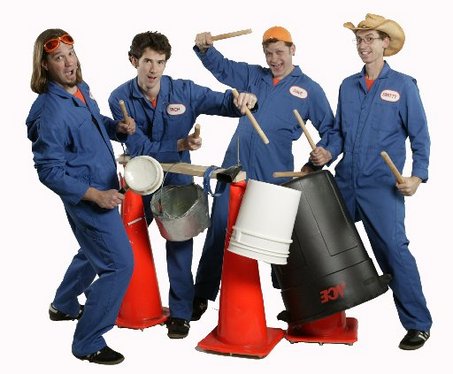
The first question is how we can make a living. I usually imagine waitressing at first, then learning how to be a car mechanic. I think of being a car mechanic as the coolest, nerdiest thing you can count on being able to do in a small town. Plus I love those jumpsuits with the grease stains, I would totally rock my jumpsuit, kinda like these guys:
My husband is a bit harder to place. He’s kind of a huge math nerd, with no actual practical skills, so the best we’ve come up with is that he can be the guy who goes around to people’s houses and helps them with their computer set-ups. But as people are getting better at computers, and as wireless systems are getting easier to set up, this plan is becoming increasingly weak.
Then there’s the issue of his Dutch accent. The idea that our story is that we’ve just moved like 60 miles, so we’re supposed to be heartland Americans, and the accent totally messes up that story. Sometimes (in my mind of course) I make him mute, other times we explain it with some weird speech impediment or maybe a stroke. I know it’s ridiculous, but it’s a toughie!
Finally, there are my kids. They are going to have to play along with the story too, but the problem there is that they’ve been raised (intentionally) to be pretty smart-assed. I’m trying to imagine them going to some random school and not giving away that they’re from Manhattan, watch the Colbert Report every night, and have strong opinions about the GOP race (and those opinions are not positive). Put on top of that the atheism thing, and I’m getting worried. I haven’t spent enough time in little towns (say, in Iowa) to really know how weird that would be, but I’m guessing pretty obviously not-from-around-here weird.
This is one of my favorite dinner topics, I suggest you try it.
Who here reads Dutch? (#OWS)
Hey I was interviewed last week by the Belgian newspaper De Tijd about Occupy Wall Street and the Alternative Banking group. Here are pdf versions of the first page and the second page, but I wanted to show the picture too, event though this jpeg version isn’t good enough to read:

The muppets strike back
No time this morning but you gotta see this video (hat tip Nathan T. and Michael C.).
What is innovation?
I’ve come to pretty much despise the word “innovation.”
First of all, it’s painfully overused, whether you work in finance or a start-up.
In finance, when people complain that banks and hedge funds should be regulated because they take dangerous risks that they don’t understand and that taxpayers have to backstop, the response, typically from a chorus of business professors and economists, is “don’t over-regulate, you might stifle innovation!”
Never mind that if you dig down to what is meant by financial innovation, it usually consists of creating weird mathematical instruments or contracts that require a complicated computer algorithm to price. So, pretty much the stuff that gets us into weird messes in the first place.
If I needed to write a sign to sum this up, it would read something like “Please stifle financial innovation!”. Actually, Volcker said it best: “the only useful banking innovation was the invention of the ATM.”
As it’s used in start-ups, the word “innovation” is also mostly painful to experience. For the most part it’s baldly used as a buzzword, by someone with a spiffy presentation who is clearly not himself (or herself, don’t want to be sexist) planning to be innovative.
In such a buzzword context, innovation becomes meaningless. At best, it’s their attempt to encourage and cajole the people around them to be innovative, and then perhaps take credit for such innovation. At worst, they fetishize Steve Jobs, which usually means channeling his perfectionist asshole side, thinking that may spur extra innovation.
What’s particularly sad about the abuse of this word is that it is inherently meaningful, and that I see and read about true innovation every day, mostly gone unnoticed by the spin doctors. Maybe that’s because most of it is too technical for business guys to get their heads around.
Another thing I’ve noticed, is that usually the most innovative people are also the most high maintenance pain-in-the-ass people to work with. Sometimes (often) downright hostile in fact.
I’ve come to enjoy this phase of “creative hostility” as a way of getting through skeptical or openly suspicious questioning incredibly efficiently. If I propose something and my most innovative, hostile critics immediately jump down my throat, that’s a sign my idea was a good one. I know that sounds weird but it’s true.
Actually maybe it’s not so weird. I watched this TED talk by Brene Brown where she talks about shame, vulnerability, and innovation. You should watch it, it’s only 20 minutes and it’s good.
Specifically, she talks about how, in order to be innovative, one must make oneself vulnerable. Even though she didn’t have time to really argue this, it resonates with me. The most innovative moments I’ve experienced are when everyone involved is willing to be wrong (vulnerable) and to smell each other’s bullshit (skeptical). Opening yourself up to other people’s skepticism takes courage.
She also describes how cultural norms can come into play at moments of shame or vulnerability or courage. In particular, this thing where men cannot be seen as weak. I think it explains why, when I see innovation, I also tend to see overt displays of macho behavior.
I wouldn’t have it any other way. I say that because I’m pretty sure the alternative is passivity and indifference, which is totally unappealing.
Here’s what I think. Real innovation is a mess and brings up all sorts of things that people don’t actually want to talk about. That’s why we only hear about some watered-down a posteriori description of it.


 mathbabe