Romance and math meetings
As many of you know, I write a fun Saturday morning column called Aunt Pythia, where I give advice to people about all sorts of things. I typically have at least one or two questions per week (out of 4) from math people, and some of those are questions about dating and romance, from both men and women.
With some consistency, then, I get a question something like last week’s question:
Dear Aunt Pythia,
Is it perverse that one of my initial reactions to something bad happening in my life was “this ought to make good Aunt Pythia material”?!
To set the scene, I’m a young female maths PhD student, who attended a graduate school/conference a few months ago. Initially I didn’t know anyone at this conference (it was the wrong side of the atlantic) so it was great to find lots of really cool people to talk to. In particular I talked a couple of postdocs, whose research directly connects with mine. One of them, “Smith”, sent me preprint, which I excitedly read over the weekend (it was a 2 week event).
Aunt Pythia, is it wrong that our conversations at these events are not just mathematical?
Smith started paying me too much attention. Well, there are lots of other people at this conference so I can just talk to other people (I accept evasion was rather weak of me). Then during a break between lectures, in which I had elected to get on with work, he proceeded to ask me on a date. The humiliation was not even private, there were many other people remaining quietly in the room like myself.
This deeply upset me. I still like to think of myself as a serious mathematician sometimes, and so the rude awakening from my naive collaboration ambitions may account for much of that pain. Or perhaps it was the way he seemed so sure of a yes, or his remark “I can concentrate on the lectures now”.
I thought of several defiant responses to give to his question, but, alas, only hours later. My parting remark to him was “never do that to someone again”. He was misguided and somewhat upset too… I don’t think he will embarrass himself like that again anyway.
Aunt Pythia, I still can’t move on from this. I still feel the injustice when I think of it. How can I move on? Am I making too much of this?? I feel like I really want people to understand why this was upsetting for me.
Moreover, I wonder at my responsibility in this. There have been other situations in which I felt I may have won more favour than I deserved perhaps by being the female. Am I obligated to be sensitive to this bias, and reduce my level of warmth ‘just in case’? Smith is giving a seminar to my group in the near future. I’m not sure how I should behave around him, hence why moving on would be really great…
Woman not at a bar
Here was my (typical for Aunt Pythia) response:
Dear Woman,
First of all, I appreciate that certain situations are “Aunt Pythia material.” That is in fact a goal of mine, which I can now check off as “achieved.”
Second of all, I’m not really sure I understand why you are so upset. And I’m sorry for that, because as you stated, it’s important to you that other people understand this point. I am going to make some guesses because I think if I miss it, my advice will probably be totally useless. Here I go:
- You wish he had asked you in private, because it’s just a private matter and asking you in public put you on the spot too much.
- You hate him for acting like he was definitely going to get a “yes” from you, because it made you look and feel like you should be grateful for the attention and flattery, which you are not.
- You think questions of romance in the context of mathematical conferences degrade you as a mathematician, and you want to keep the two things absolutely separate.
- You think that his romantic attention, in front of other people, made them think he wasn’t taking you seriously as a mathematician, but only as a romantic or sexual interest, which might possibly make them also not take you seriously as a mathematician.
Now, just as an exercise, I want to imagine what this guy’s perspective on the whole thing was. Various versions as well:
- He met this amazing, brilliant math nerd and he thought things were going really well – they were talking about all kinds of things, not just math – but when he asked her on a proper date, she got really mad and told him never to “do that” to someone again, which confused him. Do what? He ended up sad.
- He met this amazing, brilliant math nerd and he thought things were going really well – they were talking about all kinds of things, not just math – but when he asked her on a proper date, she got really mad and told him never to “do that” to someone again. After thinking about it a while, he realized that he had put her on the spot and hadn’t judged the situation properly. He wants to apologize to her and remain friends (and he still has a crush on her, but whatever) but he’s not sure how to do it. He vows to be more careful and more private in the future.
- He met this amazing, brilliant math nerd and was really into other people seeing him score with her, so he asked her out in front of them, but it didn’t work out because she was onto him and called him out on it. He’s going to have to revise his plan in the future.
- He pretended to be interested in a female mathematician’s work so he could get down her pants. Plan failed with that one but he moved on to the next in line.
OK, so I am not sure which scenario you think this guy fits into – if any – but personal guess, bases on what I know, is he’s a #1. The thing about men (and women) is that nobody knows what they’re doing, but mostly they’re not trying to be bad people.
I’m not saying there aren’t people like #4, but I don’t want to assume anyone, ever, is actually like that unless I have really large piles of evidence. So I am advising you to give him the benefit of the doubt and assume he was just crushing out on you and had no idea that you’d be uncomfortable with the situation.
I also don’t see why you can’t collaborate with this guy. Honestly. Having a crush on you is his problem, not yours. I’d even say that crushing out on your collaborators might help the work. Certainly keeps it interesting, and it doesn’t have to lead anywhere or even mean anything. Honestly I don’t know if I can work with someone without developing something of a crush on them.
I don’t actually think we can separate our mathematical selves from our self selves, and sexual/romantic parts of us emerge no matter how hard we try to restrict them. That’s not to say the guy should have put you on the spot – I agree with you that it was an awkward if not somewhat hostile move – but I don’t think it makes sense to assume that working on math with someone isn’t an intimate thing to do.
In any case, if and when this happens again, feel free to have a response memorized along the lines of, “I really don’t want to date people within my field, it’s just not my style. But thanks anyway.” That way it’s not about them, and the answer is final.
The one thing I feel I should object to is the use of “injustice.” I think that’s going too far. The guy didn’t impugn your honor, integrity, or mathematical talent. He simply asked you out in the wrong time and place. Put it this way: you’re going to need a thicker skin to be a woman warrior in mathematics. Sad but true. Save the word “injustice” for when it’s really needed.
Here’s my advice about his upcoming visit. Go to his seminar, ask really good questions. Be a mathematician. Be warm because that’s who you are. Be attractive because that’s who you are. Don’t worry about people being falsely attracted to you because it’s real. And it’s not anyone’s fault and it’s actually awesome. Oh, and everyone has it to some extent, tall men especially, and they don’t feel weird about the attention they receive. Feel free to turn your attention to others when someone is being weird.
Good luck,
Aunt Pythia
This generated a ton of comments, much more than usual for an Aunt Pythia column, and you can read them here. The debate is great, and it’s made me think about this issue much more, and I’ve come to the conclusion that I gave bad advice.
Wait, let me rephrase that. I have come to the conclusion that I was wrong about this issue, but at the end of the day I think I might stick by my advice in the final paragraph. Here’s my thinking about it.
First of all, a very personal confession. I am a pro-love hippy throwback from the 1960’s. That means a few things, and I probably wouldn’t even be writing Aunt Pythia if I weren’t weird in all sorts of ways, but the consequences that are most relevant to this discussion are the following:
- As a pro-love hippy throwback from the 1960’s, I do not find it inherently bad if someone is attracted to me in a romantic, sexual, or really any sort of way. In fact, I think it’s great news! More love is good!
- I crush out on people all the time, and I always have. If my friends stopped hanging out with me every time I hit on them, I would have no friends (thanks for the forbearance, friends!). I think of it as “part of my charm,” but it also has the effect of surrounding me with people who are, in general, also somewhat pro-love hippy throwbacks. It’s a selection bias thing.
- As a pro-love hippy throwback from the 1960’s, I am simply not awkward about this issue, and indeed I don’t even see a reason to be (see above selection bias). What this means is that if someone expresses a desire to date me or have sex with me that I don’t reciprocate, I don’t get at all alarmed, and I don’t feel any responsibility towards them, or awkwardness, or anything really other than a mild sense of flattery. It happens enough that I have a crush on someone that they don’t reciprocate (because I crush out on people all the time) that I know it’s no big deal. And it almost never is.
- In particular, it would never occur to me to rule out someone as a potential mathematical (or otherwise) collaborator because they expressed sexual or romantic interest in me. Here’s why. From my weird perspective, my brain is my best feature, and I would assume it means they are really into my brain, i.e. working together. I don’t tend to separate different kinds of attraction, because I don’t think it’s possible. So if someone is ambivalent to the way I look when they meet me, and then they talk to me a while and love the way I think, then they might end up being super attracted to me. I think that’s normal. In any case I don’t think someone being attracted to me sexually is a sign they don’t take me seriously as a thinker. That has certainly not been my experience.
- Having said that, if someone exhibited harassing tendencies: stalking me, not taking no for an answer, threatening me in any way, or even just being overtly sexual with me when I’ve already politely declined, then yes, I would totally think the person was a stinky jerk.
- And here’s the final, important part of my confession: that very rarely happens to me. I think it’s a combination of my body type (extra large) and my personality (extrovert), but I very rarely get hit on by men who are creepy. Those men do not see me as a potential victim of their harassing ways.
As a result of my above confession, when I heard about someone who gets asked out by a man, I honestly didn’t understand why she would be upset. But here’s the thing, I’m weird, and I know that. So I shouldn’t assume all women relate to sexual and romantic attention the way I do. In fact, they don’t, as I have (slowly!) learned over the years from my readers.
Many of the people who commented on the thread mentioned that, when a romantic or sexual interest has been expressed between two people, things get extra complicated, and it makes it much more difficult to work with someone collaboratively. This is not true for me, but it’s true for enough other people that I should just assume it’s true. So for now let’s work with the following simplified and slightly cartoonish assumption (and I apologize for being heterosexist but I’m doing so for clarity, and I’m not sure if it applies to gay relationships):
Assumption A: if a man or a woman has expressed interest in being sexually or romantically involved with the other, they can no longer do math together.
Given Assumption A, I can absolutely understand why Woman not at a bar was upset about the event. It meant that she was no longer capable of working with this guy whose math she was interested in. That’s a huge loss, and it’s upsetting.
Moreover, and here I’m simply repeating what a bunch of people on my comment thread explained to me, it’s something that the guy did to Woman not at the bar, which is not cool because she has no power to undo it. It’s like, imagine she has a list of “possible collaborators” and he just went and crossed out his name from her list.
OK, now let’s do some simple reckoning and figure out why Assumption A causes a problem in general. The field of math is deeply lopsided, with many more men than women. If the women are all hit on by men, then they all exclude themselves as collaborators. This isn’t much of a problem for the men, who have plenty of other potential collaborators, but it is a huge problem for the women. They end up with very short lists.
Altogether, it really looks like Assumption A is a major problem, even if it’s expressed in a hyperbolic way and is only somewhat true, and even if it’s not true for all women but only a majority. My new advice towards math men will be in the future: don’t ask out other women in math, and certainly not in your own field, and most definitely not in the context of a math conference.
It makes me sad to say this, I need to confess, because I personally love math guys and I think they’re wonderful partners, and of course I’m married to one of them. But I really do get the logic, and for as long as a version of Assumption A holds, I think it’s kind of an inevitable loss. So yeah, I was wrong about this. I’ve changed my mind.
Next, and I’m sorry if I’m beating a dead horse, I do want to go back to my advice for Woman not at a bar:
Here’s my advice about his upcoming visit. Go to his seminar, ask really good questions. Be a mathematician. Be warm because that’s who you are. Be attractive because that’s who you are. Don’t worry about people being falsely attracted to you because it’s real. And it’s not anyone’s fault and it’s actually awesome. Oh, and everyone has it to some extent, tall men especially, and they don’t feel weird about the attention they receive. Feel free to turn your attention to others when someone is being weird.
I still stand by this advice. I don’t think that we should try to give Assumption A any more power than it already has. If I could, I would try to convince people to discard it altogether, because ultimately I do think it’s a choice that people make inside their heads, it’s not a god-given truth, and as such it deserves to be examined and ignored if it is deemed not useful. And if there’s anything that’s not useful, it’s a rule that limits options for women’s math careers, which is already unduly difficult for so many other reasons.
My final word on this is this: I do think we’re in danger of conflating two issues, namely sexuality and sexism. I have experienced enough toxic sexism in my life, that had absolutely nothing to do with sexuality, that I worry we’re making unnecessarily strong cultural rules around sex where we should be thinking longer and harder about structural and institutional sexism, which is the real problem. And of course there are confusing combinations of the two, like this guy, where there are sexual predators and they’re also sexist, and to be clear it’s never ok to be sexual with someone who is your student or someone whose career you influence.
Microfinance is mostly a scam
I might be well behind others on this subject, but I’m trying to catch up. I just finished a book entitled Confessions of a Microfinance Heretic: how microfinance lost its way and betrayed the poor, written by Hugh Sinclair. Published in 2012, it reviews the previous decade or so of microfinance institutions and how there are essentially very few that haven’t become loan sharks for poor people.
The promise of microfinance was this: that poor people are budding entrepreneurs, who simply don’t have access to the capital required to make their dreams come true. Turns out that’s pretty rare in practice, and that 90% of the loans taken out are “consumption loans,” meaning they are used to buy something like a TV or a service, and then some part of the remaining 10% are loans taken out to repay other loans, and so the “investment loans” are down to small single digits.
There’s a success story given in the book of a female Mongolian “head processor,” who takes unused body parts and salvages them, and who borrows money to buy an electric grinder to improve efficiency so she can grind multiple brains per day, and then when that improves her business she buys a freezer so she can buy heads in bulk more cheaply and store them, which improves her business yet again.
It’s a nice story, but of course it means, even in this best case, that the people around her who had previously done what she now does have been pushed out of business. They need to find a new job.
And by the way, the example above happened in Mongolia, which has strict and enforced usury laws, which keeps the loans down to something like 30% annual interest. In other places there are weak laws and little or no enforcement, and the interest rates, if you include fees and tricks, are upwards of 140% (in Nigeria) or even 200% (in Mexico).
Let’s face it, that kind of extortionist interest rate doesn’t anyone. So we come to a basic question: how can that possibly happen under the guise of helping the poor?
The answer is that there’s an inherent conflict of interest between making profitable loans and helping the poor, and greed nearly always wins. Moreover, the feel-good message of helping the poor just seems too good to give up. It’s really sad but also entirely convincing.
The author, Hugh Sinclair, chronicles his efforts to whistle-blow on one particularly egregious microfinance firm in Nigeria, called LAPO, which still seems to exist. He was basically given the job of establishing a better IT system, which means he got to see all the data. I’ve often said, cynically, that companies don’t really want data consultants because those consultants get to see the most embarrassing stuff. Well, in this case the most cynical of readings is true, and Sinclair saw everything and was disgusted by the way LAPO treated its customers, doing stuff like making them put a 20% deposit but charging them on the whole loan, miscalculating their interest rates, using their deposits for further loans, and of course having them sign a form they didn’t understand. Their astronomical interest rates made it impossible for their customers to actually benefit at all.
In fact some of the stuff he uncovered was actually illegal, but it didn’t stop the practices, and even when Sinclair went back to the so-called “microfinance funds” and told them about LAPO, it didn’t stop them from investing, even the one he worked for at the time. Microfinance funds collect money from investors and governments, and their job is due diligence, but they weren’t doing it, nor did they appreciate Sinclair’s attention to that fact, because their investors might get spooked and because the entire house of cards was at risk of falling.
Sinclair also makes a convincing case that regulations and tough regulators are absolutely necessary if we’re going to have widespread loans, and that due diligence is a difficult thing to do from afar but is absolutely required. Not surprisingly, the countries where the most micro-finance occurred are also ones that don’t have such strong regulatory infrastructure (although who does, really?).
The one part of the system that got a lot of credit was, interestingly, the independent credit rating companies, who knew their stuff and refused to be cowed, even through they got paid by their clients, the microfinance funds. That’s nice to hear and is certainly unusual.
At the end of the book Sinclair adds a convincing “Microfinance 101” section that explains how most of the entrepreneurial efforts that the poor are likely to engage in are nothing more than microfinance arms races that do little to help the local economies but do one thing for sure, namely impose a tax on business that is taken out of the local community entirely and distributed back to the rich world in the form of the investors.
Since the book came out, some economists have performed experiments to test microfinance, in the “best case scenario” conditions, i.e. no loan sharking, and they’ve basically found no benefit. Here’s one of them.
My conclusion is that microfinance is a failure in almost all ways, and for almost all people.
Aunt Pythia’s advice
Readers, today I’m celebrating hair.
I think people under-appreciate hair, especially in this climate of shaving everywhere and everything, and I think we need a good old 1970’s style comeback of hair. Big hair, bushy hair, facial hair, leg hair, pubes, and armpit hair. This guy knows what I’m talking about:

Holy crap that’s creative.
Who’s with me?! WHO CAN GET BEHIND HAIR THIS MORNING!?
If you’re still in doubt, read this and get back to me. I thought so.
OK, now that we’re all in hair agreement, it’s time for really terrible advice from yours truly. Please enjoy! And afterwards, please:
ask Aunt Pythia any question at all at the bottom of the page!
By the way, if you don’t know what the hell Aunt Pythia is talking about, go here for past advice columns and here for an explanation of the name Pythia.
——
Dear Aunt Pythia,
Is it perverse that one of my initial reactions to something bad happening in my life was “this ought to make good Aunt Pythia material”?!
To set the scene, I’m a young female maths PhD student, who attended a graduate school/conference a few months ago. Initially I didn’t know anyone at this conference (it was the wrong side of the atlantic) so it was great to find lots of really cool people to talk to. In particular I talked a couple of postdocs, whose research directly connects with mine. One of them, “Smith”, sent me preprint, which I exitedly read over the weekend (it was a 2 week event).
Aunt Pythia, is it wrong that our conversations at these events are not just mathematical?
Smith started paying me too much attention. Well, there are lots of other people at this conference so I can just talk to other people (I accept evasion was rather weak of me). Then during a break between lectures, in which I had elected to get on with work, he proceeded to ask me on a date. The humiliation was not even private, there were many other people remaining quietly in the room like myself.
This deeply upset me. I still like to think of myself as a serious mathematician sometimes, and so the rude awakening from my naive collaboration ambitions may account for much of that pain. Or perhaps it was the way he seemed so sure of a yes, or his remark “I can concentrate on the lectures now”.
I thought of several defiant responses to give to his question, but, alas, only hours later. My parting remark to him was “never do that to someone again”. He was misguided and somewhat upset too… I don’t think he will embarrass himself like that again anyway.
Aunt Pythia, I still can’t move on from this. I still feel the injustice when I think of it. How can I move on? Am I making too much of this?? I feel like I really want people to understand why this was upsetting for me.
Moreover, I wonder at my responsibility in this. There have been other situations in which I felt I may have won more favour than I deserved perhaps by being the female. Am I obligated to be sensitive to this bias, and reduce my level of warmth ‘just in case’? Smith is giving a seminar to my group in the near future. I’m not sure how I should behave around him, hence why moving on would be really great…
Woman not at a bar
Dear Woman,
First of all, I appreciate that certain situations are “Aunt Pythia material.” That is in fact a goal of mine, which I can now check off as “achieved.”
Second of all, I’m not really sure I understand why you are so upset. And I’m sorry for that, because as you stated, it’s important to you that other people understand this point. I am going to make some guesses because I think if I miss it, my advice will probably be totally useless. Here I go:
- You wish he had asked you in private, because it’s just a private matter and asking you in public put you on the spot too much.
- You hate him for acting like he was definitely going to get a “yes” from you, because it made you look and feel like you should be grateful for the attention and flattery, which you are not.
- You think questions of romance in the context of mathematical conferences degrade you as a mathematician, and you want to keep the two things absolutely separate.
- You think that his romantic attention, in front of other people, made them think he wasn’t taking you seriously as a mathematician, but only as a romantic or sexual interest, which might possibly make them also not take you seriously as a mathematician.
Now, just as an exercise, I want to imagine what this guy’s perspective on the whole thing was. Various versions as well:
- He met this amazing, brilliant math nerd and he thought things were going really well – they were talking about all kinds of things, not just math – but when he asked her on a proper date, she got really mad and told him never to “do that” to someone again, which confused him. Do what? He ended up sad.
- He met this amazing, brilliant math nerd and he thought things were going really well – they were talking about all kinds of things, not just math – but when he asked her on a proper date, she got really mad and told him never to “do that” to someone again. After thinking about it a while, he realized that he had put her on the spot and hadn’t judged the situation properly. He wants to apologize to her and remain friends (and he still has a crush on her, but whatever) but he’s not sure how to do it. He vows to be more careful and more private in the future.
- He met this amazing, brilliant math nerd and was really into other people seeing him score with her, so he asked her out in front of them, but it didn’t work out because she was onto him and called him out on it. He’s going to have to revise his plan in the future.
- He pretended to be interested in a female mathematician’s work so he could get down her pants. Plan failed with that one but he moved on to the next in line.
OK, so I am not sure which scenario you think this guy fits into – if any – but personal guess, bases on what I know, is he’s a #1. The thing about men (and women) is that nobody knows what they’re doing, but mostly they’re not trying to be bad people.
I’m not saying there aren’t people like #4, but I don’t want to assume anyone, ever, is actually like that unless I have really large piles of evidence. So I am advising you to give him the benefit of the doubt and assume he was just crushing out on you and had no idea that you’d be uncomfortable with the situation.
I also don’t see why you can’t collaborate with this guy. Honestly. Having a crush on you is his problem, not yours. I’d even say that crushing out on your collaborators might help the work. Certainly keeps it interesting, and it doesn’t have to lead anywhere or even mean anything. Honestly I don’t know if I can work with someone without developing something of a crush on them.
I don’t actually think we can separate our mathematical selves from our self selves, and sexual/romantic parts of us emerge no matter how hard we try to restrict them. That’s not to say the guy should have put you on the spot – I agree with you that it was an awkward if not somewhat hostile move – but I don’t think it makes sense to assume that working on math with someone isn’t an intimate thing to do.
In any case, if and when this happens again, feel free to have a response memorized along the lines of, “I really don’t want to date people within my field, it’s just not my style. But thanks anyway.” That way it’s not about them, and the answer is final.
The one thing I feel I should object to is the use of “injustice.” I think that’s going too far. The guy didn’t impugn your honor, integrity, or mathematical talent. He simply asked you out in the wrong time and place. Put it this way: you’re going to need a thicker skin to be a woman warrior in mathematics. Sad but true. Save the word “injustice” for when it’s really needed.
Here’s my advice about his upcoming visit. Go to his seminar, ask really good questions. Be a mathematician. Be warm because that’s who you are. Be attractive because that’s who you are. Don’t worry about people being falsely attracted to you because it’s real. And it’s not anyone’s fault and it’s actually awesome. Oh, and everyone has it to some extent, tall men especially, and they don’t feel weird about the attention they receive. Feel free to turn your attention to others when someone is being weird.
Good luck,
Aunt Pythia
——
Dear AP,
In my youth, I really enjoyed hagiographic and/or fictionalized biographies like Men of Mathematics and the Feynman autobiographies. Now, when I think of giving them to my own children…there are a lot of values I don’t want them to pick up. But also ones I do.
My Own Curious Karacter
Dear MOCK,
I think of myself as someone who doesn’t idolize or hero-worship anyone, at any time. Not to say I don’t have role models, I do, but only in limited ways. Nobody’s a saint, everyone has flaws, Erdos asked my mom to fix his buttons because she’s a woman and he treated women like servants, blah blah blah. I’ve always been like this.
Or have I? Now that you mention it, maybe I became like this from all the fucking mathematical hagiographies of dead white men that were so unlike me that I simply turned it off inside me in order to be able to imagine myself as a successful mathematician.
And it continues (turns out I have a rant about this, who knew)! Every time I turn on NPR, it seems like, I am hearing yet another piece about the genius mind of a mathematician – always a man – and how mysterious and how fucking genius it is. When is NPR going to realize that mathematicians are just people who like puzzles?
Fuck that idolatry. I would never give my kids that crap to read.
Aunt Pythia
p.s. what I do like is mathematical ideas. And I don’t really care if there’s a name attached to them, I think of those names as labels.
——
Dear Aunt Pythia,
Recognize anyone you know among the Ashley Madison customer list?
But seriously… who is morally culpable for the damaged marriages that will result? I’ll make it multiple choice:
- the cheaters,
- Ashley Madison,
- the hackers who stole and released the raw data,
- the people who processed the raw data to make it searchable,
- the people who searched through the data,
- write in your own answer.
Ashley Madison Is Simple A Disaster
Dear AMISAD,
Is this a moral issue? I’m not sure. I mean, call me nuts, but it seems to me that nobody is being forced to ruin their marriage over this stuff. There are all sorts of reasons I can think of not to ruin your marriage in fact, including:
- not looking at the data,
- not caring what you find in the data even if you look,
- caring what you find but realizing that maybe your marriage needs more communication, and maybe even different ground rules, rather than a divorce. Hell, it could help.
I mean, right? I figure many of the marriages that are going to be “ruined” because of Ashley Madison were kind of sucky anyway. Personally, I’m going with #1.
Aunt Pythia
——
Dear Aunt Pythia,
This article, entitled Passions Supplant Reason in Dialogue on Women in Science, was interesting and I wanted to get your take.
K
Dear K,
It was kind of TL;DR for me, but I’ll pull out the most salient issue. Namely, there was an empirical study that women in science are favored in certain conditions for tenure-track hires. The push-back on this study was enormous, with a bunch of people calling it unscientific etc. etc.
So, here’s the thing. We don’t suspect that sexism is gone from science. We don’t suspect that girls are equally nurtured as budding scientists. We don’t see women getting hired as tenured professors at top colleges.
What we might see is better practices at one spot, namely at the tenure-track spot. That’s not to say they hire equal numbers of men and women at this position, because so many women have already been squeezed out. Just to be clear, this is exactly one spot along a huge line of decision points where it seems like women aren’t being fucked.
Do I believe it? Yes, I do. I know for a fact that colleges have specifically been pushing for more qualified women candidates, and there are all sorts of “woman-designated” spots created university-wide, for example at Columbia, specifically for this purpose.
So, great! It’s data, and it’s good news, and it doesn’t mean any of the other worse news is automatically gone. What we’ve done, if this study is upheld, is successfully removed one of many bottlenecks for women in science.
And I agree with the authors that if their study had found the opposite, there would have been very little scrutiny, at least from the people clamoring for their heads.
My take: we should all just stay calm and try to figure this stuff out so it can get better as we learn what works and what doesn’t.
Aunt Pythia
——
Readers? Aunt Pythia loves you so much. She wants to hear from you – she needs to hear from you – and then tell you what for in a most indulgent way. Will you help her do that?
Please, pleeeeease ask her a question. She will take it seriously and answer it if she can.
Click here for a form for later or just do it now:
Guest Post: Housing is not a good investment
This is a guest post by Josh Snodgrass.
Housing is not a good investment, and it never was.
Our country has a special reverence for home ownership as a route to comfort and prosperity – and so provides subsidies and tax breaks. But, actually, housing is not nearly as good an investment as people think and it wasn’t so good historically, either. The big gains people earned from housing in the past were mostly the result of leverage, forced savings and inflation.
Many, white, middle-class American families have a story that goes something like this: They bought a home with a $10,000 down payment. While they raised their children there, the house grew in value to $250,000 which provided the funds to send their kids to college with something left over for their retirement.
This idyllic story led us to mythologize housing but it is just that, a myth. While the facts are true, the growth is a mis-perception. While things turned out well, the house was not that great an investment. Here is the full story.
The $10,000 down payment was only one-fifth of the total cost of a $50,000 home. So, instead of a 25-fold increase in value that they perceive, the price increased “only” 400%. Even 400% doesn’t seem bad, but considering that it took decades to earn, it wasn’t that great. Most financial investments we hold for decades grow to a multiple of their cost. The reason houses seem special is that they are the only asset we hold that long. Actually, the gain on houses typically just barely holds its own against inflation.
The key to turning a mediocre gain into a big one was the mortgage that they took out. If you only put up a fraction of the money but get all of the gain, you can multiply the returns earned. Wall Street loves this game and calls it leverage. But, it has a downside.If prices drop, you lose bigtime – as millions of families losing their houses to foreclosure these days are learning to their sorrow.
The mortgage was key to the myth in two other ways. In addition to the $10,000 the family put up when they bought the house, they may have paid a total of $100,000 on their mortgage, but since this was in relatively small monthly payments, it tends to be ignored when people do mental accounting on the investment.
The need to make monthly payments effectively required the family to save regularly – something we have trouble doing if we aren’t forced to do so. Saving regularly is a good thing. So the saving they had to do to pay the mortgage, more than the house, was what resulted in their having money for the kid’s college and retirement.
So, is this a good strategy after all? Not really. Buying a house on leverage is a risky investment. Home prices do go down, more often than we realize. And, with leverage, a 20% drop in price can wipe out all of the family savings.
In addition, home prices have been propped up by tax subsidies, low interest rates and the mythology. We cannot be sure their prices will even keep up with inflation in the future.
Bethany McLean’s Shaky Ground: the strange saga of the U.S. mortgage giants
In preparation for an all-housing special on this week’s Slate Money podcast, I just finished Bethany McLean’s new book, Shaky Ground: the strange saga of the U.S. mortgage giants. It’s a quick read and not an expensive book, well worth the money for the amount of information packed into the pages.
Namely, the book tells the story of Fannie Mae and Freddie Mac, and more generally the story of U.S. governmental involvement in the mortgage and housing markets, starting soon after the Great Depression. It’s fascinating stuff, and also completely baffling as well, partly because it’s so deeply entwined with politics, so there’s really not a lot of rational logic attached to it. Here are a few interesting things I learned, or was reminded of, while reading the book:
- When the shit hit the fan in 2008, Fannie and Freddie were put into conservatorships, rather than nationalized (which would have gotten rid of shareholders), but really the only reason (or at least one big reason) they weren’t nationalized was because if they had been, their debts would have been added to the national debt, and the accounting would have looked bad. This is the same reason they were originally made private.
- They were also forced to assume extremely heavy losses, which made their accounting look incredibly bad. That may have been a political move by people who hated them, but it also may have just been pessimistic guesses as to how bad the mortgages they had were.
- In any case, they’ve recently been quite profitable, but all their profit has been siphoned off to the Treasury, in spite of the fact that they are technically still supposed to serve shareholders.
- As a result a bunch of hedge funds, who generally speaking bought shares at very low prices, are suing because they think that profit belongs to them. They have not done well in court as of now.
- Stepping back a bit, the whole reason Fannie and Freddie exist is so that they can insure mortgages, so that more mortgages are given out on better terms, so that every American can “live the American dream” of homeownership. Speaking as a non-homeowner, I think this is crap. Oh, and also, most of the loans in the mid-2000’s were for refinancing and for second homes, so it wasn’t like that was actually happening.
- People still “hate” Fannie and Freddie but nobody seems to have a plan to transition to a system whereby the government isn’t the final backstop for mortgages. It’s like they just want to get rid of these political entities, which did behave extremely badly in the late 1990’s, giving their executives outrageous salaries and wielding ridiculous political sway via favors.
- In any case, the combination of the cheap backstop represented by Fannie and Freddie, in addition to the mortgage tax deduction represents a FUCKTON of government support for homeownership, and also raises the prices of houses by an extreme amount.
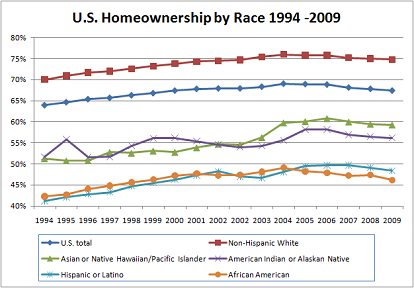
- In spite of this all, homeownership as a percentage of households is way down, although that can be misleading, and is particularly low for minorities:

- There is no current plan to get rid of Fannie and Freddie, or to change their status from conservatorship. Moreover, the current system whereby all their profit goes to Treasury leaves them with no cushion, so should another economic shock happen to them, there’s really no telling what’ll happen.

After reading this book, I can only conclude that it’s time to strengthen renter laws.
Nerdy comments about measuring disparate impact
For the past few days I’ve been contemplating how the Consumer Financial Protection Bureau (CFPB), or anyone for that matter, might attempt to measure disparate impact. This is timely because the CFPB is trying to nail auto dealers for racist practices, and an important part of those cases is measuring who should receive restitution and how much.
As I wrote last week, the CFPB has been under fire recently for using an imperfect methodology to guess at a consumer’s race with proxy information such as zip code and surname. Here’s their white paper on it. I believe the argument between the CFPB and the bankers they’re charging with disparate impact hinges on the probability threshold they use: too high, and you get a lot of false negatives (skipping payments to minority borrowers), too low and a lot of false positives (offering money to white borrowers).
Actually, though, the issue of who is what race is only one source of uncertainty among many. Said another way, even if we had a requirement that the borrowers specify their race on their loan application forms, like they do for mortgages because of a history of redlining (so why don’t we do it for other loans too?), we’d still have plenty of other questions to deal with statistically.
Here’s a short list of those concerns, again assuming we already know the minority status of borrowers:
- First, it has to be said that it’s difficult if not impossible to prove an individual case of racism. A given loan application might have terms that are specific to that borrower and their situation. So it is by nature a statistical thing – what terms and interest rates do the pool of minority applicants get on their loans compared to a similar pool of white applicants?
- Now assume the care dealerships have two locations. The different locations could have different processes. Maybe one of them, location A is fairer than the other, location B. But if the statistics are pooled, the overall disparate impact will be estimated as smaller than it should be for location B but bigger for location A.
- Of course, it could also be that different car dealers in the same location treat their customers differently, so the same thing could be happening in one location.
- Also, over time you could see different treatment of customers. Maybe some terrible dude retires. So there’s a temporal issue to consider as well.
- The problem is, if you try to “account” for all these things, at least in the obvious way where you cut down your data, you end up looking at a restricted location, for a restricted time window, maybe for a single car dealer, and your data becomes too thin and your error bars become too large.
- The good thing about pooling is that you have more data and thus smaller error bars; it’s easier to make the case that disparate impact has taken place beyond a reasonable statistical doubt.
- Then again, the way you end up doing it exactly will obviously depend on choices you make – you might end up deciding that you really need to account for location, and it gives you enough data to have reasonably small error bars, but another person making the same model decides to account for time instead. Both might be reasonable choices.
- And so we come to the current biggest problem the CFPB is having, namely gaming between models. Because there are various models that could be used, such as I’ve described, there’s always one model that ends up costing the bank the least. They will always argue for that one, and claim the CFPB is using the wrong model with “overestimates” the disparate impact.
- They even have an expert consultant who works both for the CFPB and the banks and helps them game the models in this way.
For this reason, I’d suggest we have some standards for measuring disparate impact, so that the “gaming between models” comes to an end. Sure, the model you end up choosing won’t be perfect, and it might be itself gameable, but I’m guessing the extent of gaming will be smaller overall. And, going back to the model which guesses at someone’s minority status, I think the CFPB needs to come up with a standard threshold for that, and for the same reason: not because it’s perfect, but because it will prevent banks from complaining that other banks get treated better.
Stockholm Tutorial on Data Science
I’m super excited to be teaching a day-long technical tutorial in data science in Stockholm in one month. Stockholm is gorgeous and Sweden is an amazing country. Last time I was there with the entire family, the husband was giving talks the whole time and the little guy had an ear infection, so it was kind of a bust (although not entirely; I did become the bus queen of Stockholm). This time I’m going alone. Cheese fondue and meatballs will be eaten.
Here’s the flier for the event:
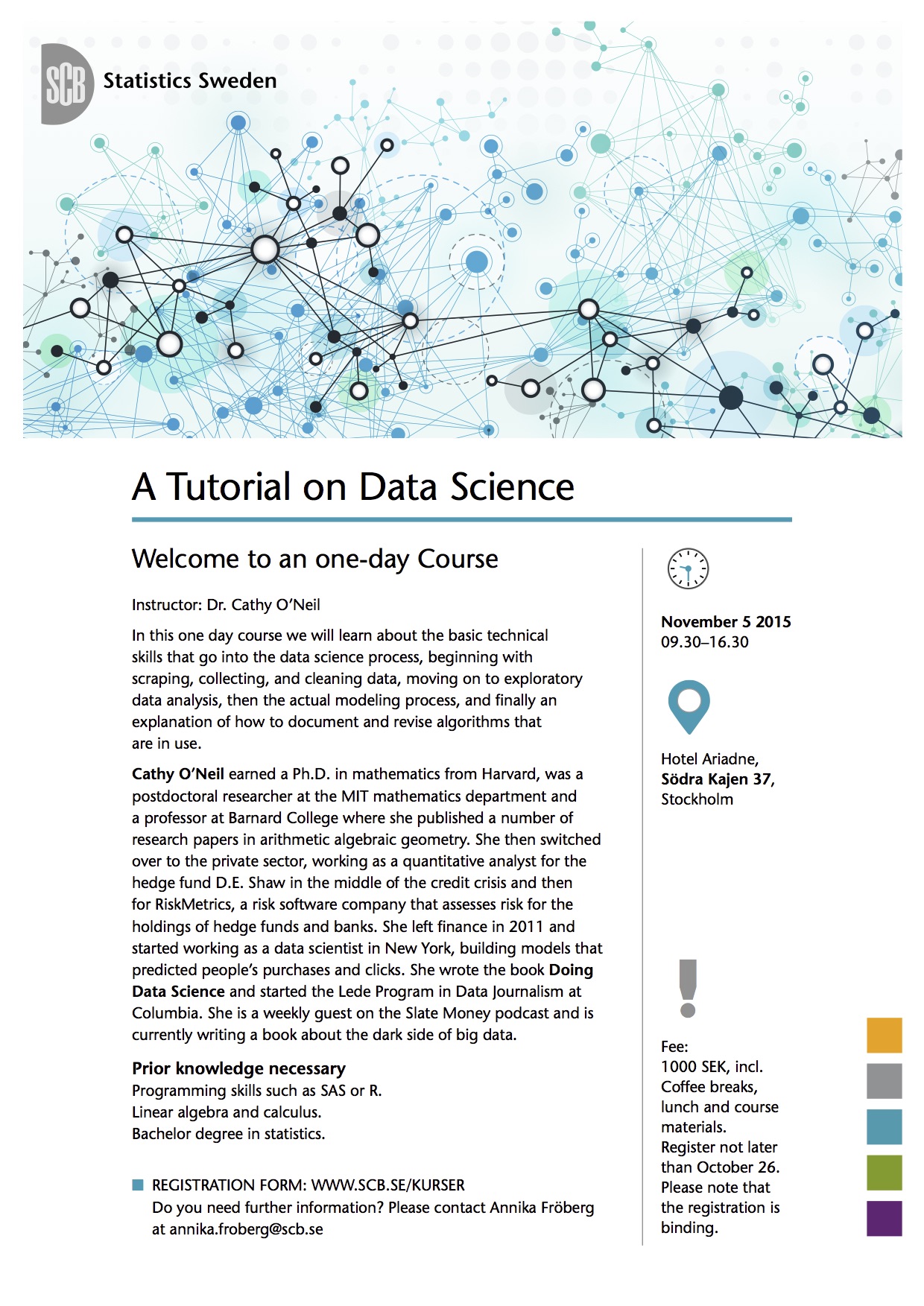
According to my calculation, 1000 SEK is equivalent to $120. That’s with coffee and lunch though, so I feel like as long as I explain k-nearest neighbors we’re good. Also, this is a draft of the flier. I told them to change the “prior knowledge” to be less focused on statistics. After all, data scientists are not all stats majors.
So far there have been around 20 people who have signed up, mostly affiliated with Statistics Sweden, the Swedish government agency responsible for producing official statistics regarding Sweden, established in 1749. This means I’ll be addressing the important question, what’s the difference between statistics and data science?
Well, it’s kind of hard to answer that question abstractly. I need to supply examples of realistic “found data” which we use in data science. So that’s my plan for the day, to create a few iPython notebooks with examples of the kind of data and algorithmic techniques that you’d typically find in nature. I think once these statisticians see those examples they will be comfortable knowing how much better off they are in Sweden measuring the inflation rate (currently at -0.2%) than we are trying to understand whether people like specific brand names by scouring Twitter.
However! I’m totally not above stealing other people’s examples to make my points, so if you know of a nice example or two, that involves scraping (or API’ing), cleaning, and algorithmizing, and especially if it does all this in python, then please make suggestions. Otherwise I’ll look up some topics in my book and try to do it myself.
[Update: Holy crap look at this repository of iPython notebooks which explain data science stuff! Amazing.]
I definitely want to spend at least some time showing the audience how much the answer can depend on seemingly benign choices of hyperparameters and so on. If I end up with good examples I’ll be sure to share them here.
Beyond my tutorial, I’m also giving a keynote talk at an associated conference taking place at the very nice Hotel Sign, which is also where they’re putting me up.
Aunt Pythia’s advice
Readers, so glad to be back with you this week, and many apologies for missing last week, but I was arranging my yarn collection.

It’s all on ravelry.com now. Username cathyoneil.
I’m back now, though, and reading interesting articles about the real life of a sex worker (not arousing, as it turns out) and recording my weekly Slate Money podcast (I’m particularly proud of this week’s episode on Disparate Impact).
Enjoy today’s column! And afterwards, please:
ask Aunt Pythia any question at all at the bottom of the page!
By the way, if you don’t know what the hell Aunt Pythia is talking about, go here for past advice columns and here for an explanation of the name Pythia.
——
Dear Aunt Pythia,
Must I go to my grandmothers funeral? I do not really even like her.
Greek Girl
Dear GG,
Let’s think this through. Your grandmother is dead, so she won’t mind if you don’t come to her funeral. Really the only people who are going to be bothered are the people in your family. If they are going to the trouble of having a funeral at all, I’d guess they think people should come to it. So your primary consideration, to my mind, is how much you feel obligated to them (assuming you care what they think about you in the first place).
Next, I don’t think you need to actually like someone to go to their funeral, but at the same time, if someone was really cruel to you, it’s totally acceptable to skip it. From the tone of your letter I’m guessing she wasn’t really horrible, though. So that’s not an easy out.
Finally, it may be difficult to get to, expensive, or time consuming. And you may be a busy person who doesn’t have extra time and/or money. If true, send your regrets and tell your family how much you’re looking forward to seeing them soon, at a happier time.
If it’s nearby and convenient, and your family really cares that you’re there, I’d say you’re stuck.
Good luck!
Aunt Pythia
——
Dear Aunt Pythia,
In this age of hyper-macho global finance, how come individual stock markets such as the NYSE have ‘trading hours’ instead of just being open 24/7? Are there no computerized trading algorithms that are willing to sacrifice their family life to stay at work until 4 am on a Sunday?
Just Idly Musing
Dear JIM,
Great question. The technology is there, certainly. But why then isn’t the trading happening?
The answer is more or less, people don’t trade 24 hours a day because people aren’t already trading 24 hours a day. It takes a certain amount of liquidity for trading to be efficient, and without that you end up with large spreads between buy and sell and nobody wants to feel like they’re wasting money.
Of course, the algorithms could run all day and night, but at the end of the day people watch over those algorithms (really!) and they want to sleep. Plus, it’s actually true that most people sleep at basically the same time in the same time zone, and that people in the U.S. are more likely to care about U.S. stocks.
The flip side of that is that soon after the NYSE closes, the Asian market opens, then the European market. So it’s not like there’s a lot of downtime as it is.
Aunt Pythia
——
Aunt Pythia,
I don’t believe in imposter syndrome. It’s all the rage to tell us successful women how we have imposter syndrome and many successful women are saying this about themselves as if this is somehow rooted in their psyche.
I am a successful woman and I’ve discovered that what happens when you reach a certain level of success is a huge backlash. That is, I was permitted to be successful from my quiet little corner where people could just appreciate my work and grant me their benevolence. But when my success went too far, and I left that corner and stepped up as an equal to my former benefactors, I began to have everything I did questioned and lowered.
Now, some of my former benefactors, the ones who have truly stellar positions in society, they are still benefactors because I am still far beneath them. Thanks to these truly well located folks telling me my work is better than ever and they expect even more from me, I have had the confidence not to develop imposter syndrome.
If I was left with all the trashing my cohort has showered upon me since I joined them, I could well develop all the symptoms of that syndrome but not because I have a psych problem but out of mistreatment.
Shouldn’t there be a term for this? Its not quite battered worker syndrome or battered employee syndrome, because I’m speaking of someone who is very successful. It’s not imposter syndrome because I don’t feel like an imposter. But it is something and it infuriates me and it is very, very common.
Fortunate Uber Cunt Kicked Effrontery Down
Dear FUCKED,
They say to “Lean In,” but I say, to what? To these douchebags? I’d rather not.
So yes, I think you’re right. When it’s called “Imposter Syndrome,” it’s often a way for people to dismiss us as inwardly insecure and, therefore, incompetent. It’s used as an excuse to explain the mysterious forces which keep us from succeeding further, in fact.
On the other hand, it sucks for everyone at a certain level, and you have to be just totally focused on success beyond anything else no matter what, whether you’re a man or a woman. So there’s that too. Said another way, if I were a man I still wouldn’t want to be in that rat race, personally.
My advice to you is, call it “being an Uber Cunt that nobody can handle” and refer to it – breezily and often – as a superpower.
Auntie P
——
Dear Aunt Pythia,
I have a question about the fair trade of blowjobs. (I also must acknowledge before I move on that I was never sure if just licking someone’s genitals w/o them getting off on it is considered a ‘blowjob’. I use it here more as a pre-sex tool than as a way to come.)
I enjoy giving them. I don’t see it as a chore, or something my partner needs to earn. (I’ve even given unsolicited blowjobs at first dates!) My latest partner of several years is more stingy about giving blowjobs though. He still makes the sex interesting with finger-play, etc, but I don’t know why he doesn’t constantly offer a blowjob into the sex like I do.
I tried bringing up this a few times, but he kinda avoided the subject with comments like “I am sorry, i know.” – I should also add “I am sorry” is his first response to anything.
But even without getting them, I like giving blowjobs. Though lately, I have been thinking if I should appropriate my blowjobs. Should blowjobs only be traded on a one-for-one basis so that one party don’t get exploited? Am I adding to the sexism in the world by giving non-deserving men blowjobs? Is this a bigger issue than I think it is?
What is your take on blowjobs?
Being Lewd Or Wicked Sexy?
Dear BLOWS,
Amazing question and sign-off. And I think the “unsolicited first-date blowjob” is a generous concept that will earn you quite a few fans among my readership. We are on your side!
I’d say a straight-up conversation with said partner is called for. Specifically, ask him what the conditions are that make him want to give you a blowjob, and how you can achieve them more often. Who knows, he might be squeamish about certain smells which you can solve with a quick shower. What a shame, after all, if that’s all it would take and you just don’t know. Communication, communication, communication.
Now, as part of that conversation, you should add that, because of the unequal blowjobbery in your relationship, you’ve found yourself thinking somewhat and surprisingly quid pro quo in the blowjob department. This will probably spur him to action, as the urgency of the situation will immediately be revealed. You don’t have to directly threaten him, mind you, just mention that the count is off, the blowjob equity is lacking, and you need some relief.
Or else, maybe you do need to threaten? I mean, try the talk first, but I do think reciprocity in bed is a basic requirement of a good relationship, and if he’s not up for it (as it were!), plenty of other men would be.
And: wicked sexy, not lewd.
Aunt Pythia
——
Dear Aunt Pythia,
I’m thinking about buying one of those test kits that takes a sample of your DNA and reports your ancestry. There are a few companies that sell kits: Ancestry.com, 23andme, and National Geographic’s Genographic Project.
I’m wondering whether I should be concerned about my DNA data being misused in any way. Would you do it? Why or why not? More info here.
If you did get yourself genetically tested, what percent Neanderthal would you wager you are?
DNA Data Skeptic
Dear Skeptic,
Not sure. I don’t think I’d be too worried about my DNA being used, but that’s likely because I’m not financially insecure, I’m a US citizen, and I have health insurance. I think other people might be more worried. And even if the company I gave my DNA to doesn’t sell it or something, there’s always the chance they’d get hacked. So I’d go in thinking that my DNA would in fact be public knowledge.
On the other hand, I’m also not particularly interested in my heritage, so the very small interest would not overwhelm the small risk, and I’d end up not doing it.
Here’s the question I was hoping you’d ask: would I send away my DNA to get it tested for possible hereditary diseases? And the answer there is a firm no, because as I learned reading this article, the results on those kinds of test are terribly innaccurate and vary wildly depending on the company’s methods. This is not yet science. And I’m not sure if the ancestry thing is better or worse.
Come to think of it, I might suggest you do it just to see how the answered vary depending on the company.
Aunt Pythia
——
Readers? Aunt Pythia loves you so much. She wants to hear from you – she needs to hear from you – and then tell you what for in a most indulgent way. Will you help her do that?
Please, pleeeeease ask her a question. She will take it seriously and answer it if she can.
Click here for a form for later or just do it now:
The tricky thing about disparate impact
Today I’m fascinated by the story described in this three-part American Banker series on the Consumer Financial Protection Bureau’s (CFPB’s) use of disparate impact, written by Rachel Witkowski. Disparate impact, according to the article, is a legal theory that says lenders can be penalized if they have a neutral policy that creates an adverse impact against a protected class of borrowers, regardless of intent.
Witkowski reports on the CFPB trying to understand and punish auto lenders for their process for figuring out fees and interest rates on auto loans. In general, the auto dealers, who work in partnerships with auto lenders, have discretion to add on some interest rate and pocket the difference. They seem to be pocketing fatter differences for certain populations, specifically black car buyers.
The problem is, it’s hard to measure exactly how much fatter and who is getting screwed, by how much. And in the world of law and punishment, it’s not enough to prove that there’s been a disparate impact – you have to actually make restitutions to the victims. So for example, the CFPB is in discussions with Ally Financial for exactly this problem, and the question is how much money to they give to which borrowers as a refund.
The first reason this is hard to get right is that auto dealers and lenders don’t actually collect race information, in contrast to mortgage lending, where it’s a requirement of the lending process, specifically to ward against redlining. So the CFPB, in its investigation, has to rely on proxy data like zip codes and names to guess the race of a given borrower. In fact their methodology is described in this white paper, but unsurprisingly the auto lenders under scrutiny complain it is not sufficiently transparent.
What that translates into is the possibility that some white car buyers people will get refunded accidentally and some black car buyers won’t, even if there were shenanigans going on with their car loan. From my perspective as a data person, this tells me that, as long as we have problems like this, we should probably require race to be recorded in a car loan.
That’s not the only problem, though. The thing about these modern cases of measuring disparate impact is that it’s a model, and models are extremely squishy things. Two people asked to build a disparate impact model on the same data will likely come up with different answers, because all sorts of decisions have to be made on the way. From the article:
Each financial regulator has its own method for determining disparities and harm in fair-lending cases, and each of those cases can differ depending on the business model of the bank and what variables the regulators will consider. The Federal Reserve, for instance, generally adds controls, such as geography, to the statistical model if the bank’s business model indicates that certain pricing criteria can influence the price or markup, according to a 2013 Fed presentation.
Given this uncertainty, plus the uncertainty of the race of the borrowers, you end up firmly in a land of statistics, where each borrower is assigned a probability of being minority and a probability of having been screwed. Then the question becomes, do we err on the side of under- or over-refunding these borrowers? The lenders, who are paying for this all, tend to lean on the side of not giving any money away at all unless we’re sure.
In this particular story, specifically in part 3, there’s even an expert consultant named Dr. Bernard Siskin who happens to work for both sides – the banks and the CFPB. The excuse for that questionable arrangement is that there aren’t enough statisticians who can do this work (my hand is raised!), but the end result is that Siskin seems to help the banks complain about exactly this issue: which version of the disparate impact model is to be used, and what kind of attributes will be controlled for, so that they can each get the least expensive settlement.
Here’s my theory. This is a big new field in statistics and data science, and this is just the tip of the iceberg. We will be seeing a large amount of work being done and tools being made which aim to measure and audit processes and algorithms, whether they are auto loans that discriminate against minority borrowers or car computers that bypass emissions tests. And we will have to develop standards by which we measure a company’s work. The standards won’t be perfect, mind you, and people will end up getting away with certain things, but at leas we won’t have the gaming that’s obviously going on now, because there will be a set way, hopefully reasonably thought out, to measure discrimination, or lying, or cheating, or what have you.
That’s the field I want to go into. Building models that call bullshit on other models.
Strata and swag
Yesterday I gave a 5-minute lightning talk at a corporate big data conference here in New York called Strata+Hadoop World, put on by O’Reilly and Cloudera.
My talk was part of a session run by DataKind, aimed at talking about the ethics of algorithms. My 5 minutes were taken up discussing 5 ideas:
- In order to do good with data, first you have to not do bad. Data scientists aren’t trained to think through the ethics and social impact of their work, so this is non-trivial.
- We haven’t actually figured out the difference between correlation and causation. That means, in the context of social algorithms, that we blame the victim constantly. Think about the HR algorithm that decides never to hire another woman engineer because it notices how badly women engineers fare in the workplace.
- Or, we could take the example of the justice system, where we use recidivism algorithms to figure out that poor black people are more likely to be arrested, and we decide to punish them even more as a result, instead of asking why the justice system isn’t serving to help them as much as it helps white or rich people.
- Or, we could take the example of teacher assessment, where we blame teachers on student test scores, even though they have little power over them.
- Conclusion: data scientists are de facto policy makers. We shouldn’t be.
So, the talk I gave was sparsely attended, with maybe 40 people in the room (which is actually more than we expected). I was happy to see those people, and many of them were earnest and thoughtful, to be sure. Danah Boyd spoke in the second session, as usual very eloquently, and I felt like there were far too few people in the room compared to who might benefit from hearing her.
But let’s face it, Strata is a celebration of big data in the corporate setting, and few people there were spending too much time fretting about ethics. It was dominated by its expo room, where dozens of data science platforms extending the hype of the power of big data were set to sell you magical thinking. There were also a few groups doing good stuff, to be sure, but the overall feel was similar to how it felt back in 2011, except bigger.
Not to be cynical! There’s plenty of other stuff going on that wasn’t in 2011, so really it’s fine. And plus, I did manage to meet up with some colorful ladies:

Picture taken by my buddy Debbie Berebichez
and I picked up an enormous amount of Strata swag (more here) because teenage sons:

This one is the cutest. Most of the other t-shirts I got had silly puns.
If I had stayed longer I could have gotten plenty of free beer and food, not to mention more pens than I could ever use. There were even lego data science characters, but to get those I had to stay to listen to the pitch, which was a dealbreaker for me.
Conclusion: Strata fills a niche not unlike the New York Coffee Festival. Almost completely frivolous but fun for the participants, as long as you don’t get caffeine poisoning.
Guest Post: how to be a data scientist at a non-profit
This is a guest post by John Santerre, a 5th year Ph.D. student at the University of Chicago in the Computer Science Department. Previously a photojournalist, John has worked with nonprofits and NGO’s off and on for the last ten years. This summer he served as a Research Programmer at The Eric and Wendy Schmidt Data Science for Social Good Fellowship. His master’s work, under Prof. Lek-heng Lim, involved the use of Hodge Decomposition for rank disambiguation while his Ph.D work is at Argonne National Laboratory and involves scalable Machine Learning techniques for use on Cancer and Anti-Microbial Resistance (AMR).
The recent mathbabe post What can a non-academic mathematician do that makes the world a better place struck a chord with me. Over the last ten years I’ve worked as a photojournalist on and off with nonprofits photographing everything from Sigourney Weaver and Anna Wintour to documenting drug dealers in Puerto Rico, rebel fighters in Burma/Myanmar, and the UN Peacekeeping effort in Haiti. I was so involved with nonprofit work, I founded my own, just to provide photography services to other nonprofits. Most recently I spent the summer as research programer for the Eric and Wendy Schmidt Data Science for Social Good Fellowship. I thought my experience might offer a small amount insight, at least for those who are truly new to working with nonprofits or “social good” organizations.
The most rewarding and challenging aspect of working at a nonprofit is the responsibility you bear to educate the organization about the limitations and potential you present. This can’t be overstated. The organization you choose to work with will have any number of teachers, secretaries, drivers, programmers, and support staff all with clearly delineated jobs descriptions. As the outsider who, as in T.S. Eliot’s poem, has “Come … to tell you all, I shall tell you all,” you will almost certainly be alone in your role. In fact, that is the explicit reason we seek out such opportunities: working at the “tip of the spear” presents an opportunity for our skills to be uniquely impactful. Offering insights that the organization wouldn’t have access to, or perhaps cannot afford, can be vastly fulfilling.
However, this brings with it an inherent Faustian bargain. Just as the violinist Joshua Bell was ignored in the DC Metro but adored in the philharmonic [1], so too will many of your finely tuned skills fall on comparatively (computationally?) deaf ears. In my experience, you have/get to “check” your craft at the door. In my role as a photographer this often meant my most useful skill was taking comparatively simple photographs [2]. Now it often means my technical contribution to nonprofits is less than my potential. In fact, the clients are more than happy to explicitly express that. Often they are looking for a “sanity check” and understand that I am overqualified for their problem. In fact they often seek out and will only work with someone who they perceive is overqualified. I personally don’t mind this. In the right organization you can build on your own personal skill sets. In fact, I’ve never been challenged in the ways I had expected. Even so, there are a host of fairly common challenges and insights that are orthogonal to my craft that have kept appearing over the last ten years which I’ll share.
1. You are alone.
You will likely be a solo consultant who has no one to brainstorm with, no one to advocate for an agenda with, and no one to share the burden of the tumultuous experience of making sense of a new work environment. To top all of that off, you are often working on a necessarily compressed schedule. Ryan Kappadal, a statistics professor at the Air Force Institute of Technology (10+ years of experience in data science) told me this summer that the Air Force integrates its data science teams into other units in pairs. It was instantly obvious to me how much more impressive it is for an organization to watch and interact with two professionals debating approaches and building a strategy out loud rather than listening to a pitch from a single perspective.
2. You will likely have different metrics of success.
Currently I work on classifying Anti-Microbial Resistance (AMR) at Argonne National Lab, a topic so important that the UN, POTUS, and WHO have all identified it as a top threat facing global humanity. When I explained my work to a ‘data scientist’ at a start-up I noted a 95% accuracy of one classifier. They responded slightly dismissively “Is 95% high enough?”. Sure it’s “just” the k-means classification accuracy on the MNIST data set, but it’s also high enough to identify consistently (despite low sample size), the gene regions that confer resistance to a particular antimicrobial.This provides evidence of the likely mechanism – i.e., cell wall transport – that has mutated thereby implying possible counter strategies for the biologists.
Perhaps more humorously, I traveled to Cambodia to work with a nonprofit at “Smoke Mountain”, the continually burning garbage dump in Phnom Penh. The most useful service I provided for them was photographing their Christmas card. I climbed atop a nearby building and photographed the children spelling out “Thank You!” in human gymnastic positions. Not exactly what I was expecting after traveling 1/2 way around the world!
I cannot stress this topic enough, so I will harp on one more little point. In my mind, the inculcation required to become a specialist in our craft can blind us to the impact our client requires. In NGO work the objective is to build a shared skill set between you and the organization, rather than develop new insights into the problem. Photographers are constantly looking for new ways to restructure the frame. Similarly, machine Learning people are constantly trying to find new ways to approach the problems. But working with organizations requires a different metric. I have to judge my contribution not by the number of trailing digits of prediction accuracy, but by the impact I have on how biologist’s approach the problem of AMR. I love the craft of both ML and photography, so stepping out of the role where the craft is the most important thing is always hard, but when appropriate it can be vastly rewarding.
3. Different organizations have surprisingly similar needs.
This summer at the DSSG, my role, along with another programer was to build a “best practices” pipeline across the DSSG fellows and individual teams [3]. Freed from providing results to a client we could write maintainable clean code, while simultaneously “looking over their shoulders” for similarities between workflows. While each group was different, there was surprisingly consistency across groups, especially in terms of client interaction. That is another way of saying a sampling of 3-5 such organizations will give you a good sense of what this work is actually like.
4. Social good doesn’t require a 501c3 status.
It can be more rewarding and impactful to provide sophisticated technical services to a for-profit start-up preventing relapse in drug addiction (i.e. TriggrHealth.com) than providing rudimentary analysis consulting with a nonprofit following bird migrations [4]. It can be more fulfilling working for a growing for-profit but non-partisan organization like BallotReady.org targeting voter engagement, than it is to work for an issue-based partisan nonprofit. Or maybe it’s not for you. We are fortunate enough to work in a time where both types of organizations require our services.
—
In summary, with such tremendous need for the intersection of statistics and computer science, I find I am overwhelmed with options, but only if I am flexible in what role I expect to provide. Having “a voice” as a photographer or a focused specialty as an academic are hallmarks of advanced practitioners for good reason. These are the contributions that move the field forward. Conversely, serving as an advocate is a generalist position. Recognizing that helps me to find unique ways to ensure both my professional progress and that the organization’s needs are met.
1. While people walked past him IRL, he did manage to get 160k youtube views of his being ignored however!
2. A.K. Kimoto traveled through northern Afghanistan as photographer for UNICEF taking simple portraits that were very much needed. Later he used the connections he gained to return and photograph this work, a far more subtle and evocative collection of imagery that was very close to his heart.
3. It’s a (not quite alpha stage) python grid search library across models and parameters. We named Diogenes and gave it the tongue in cheek slogan “Searching for an honest classifier”.
4. Although, I used to watch the fall migrations mountain-side, and .csv’s of the data might make for an interesting weekend!
Yarn Confessions
Readers, you might have missed me for the past few days. I know I’ve missed you (and so has Aunt Pythia).
Well, full disclosure on what’s been happening is in order: I’ve been organizing my yarn collection.
Yes, it’s true, I have a deeply alarming amount of yarn, which has hitherto been gathered in smallish bags tucked all over the house, in every nook, cranny, and corner.
Well, with the help of my good friend Elena, who is starting a side business to help people organize their homes (ask me for an amazing reference!), I have officially tamed the yarn beast.
Just to give you a sense of the sprawl, here are just the “odds and ends” yarns in the blue or purple spectrum:

Pretty much every ball here represents a project I have long finished. I always buy a bit too much yarn and then keep the extra. Yes, that’s my foot and boob shelf.
Of course, I have odds and ends in other colors too:
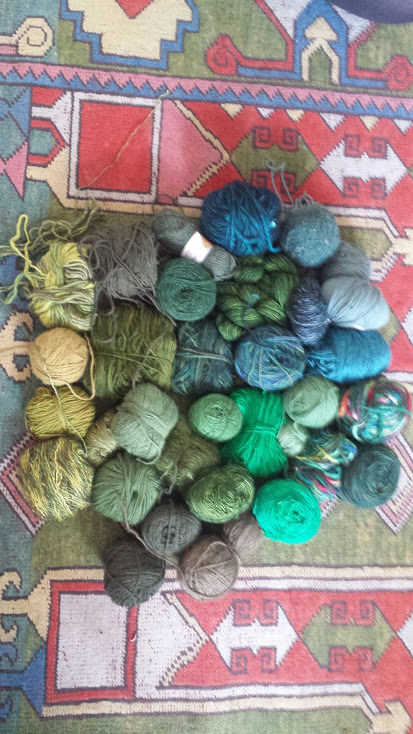
For whatever reason I keep buying lots of green yarn. I have like 5 green sweaters in my closet.
Of course, not all my yarn is in the “odds and ends” category. I have whole bags of unopened yarn I got on sale during one of my winter excursions to Webs, the biggest and best yarn store in the world (you can tell it’s a big deal because it owns the “yarn.com” url). Here’s an example:

I also love orange, as a color, but nothing orange ever looks good on me.
Anyhoo, the entire collection is here, feel free to take a look. I am beyond shame and embarrassment at this point, because at some point, when all my yarn was splayed across my entire living room and dining room, I realized how amazingly beautiful it all is and how much I’ve gotten out of my hobby over the years.
Also, I think I might actually have more yarn than the average yarn shop, so there’s that option as well, if I’m ever really broke. Plus, now that my yarn is so nicely organized and tidy, I’d even be able to show it to people.
So there you have it, yarn confessions. Life is too short to be ashamed of your passion.
Obsessed with VW
So I’m kind of obsessed with the VW story. Specifically, I want to know what happened back in 2009 when they started cheating. What was that conversation like? And how many people were privy to the deception? And how did they think it was going to go undetected?
In case you haven’t read all available articles on this like I have, the VOX article is really informative. Here are the key facts:
- Diesel cars are better at gas mileage, worse at polluting out nitrogen oxide (NOx). We care more about NOx in the US than they do in Europe, which is why there’s so much more diesel in Europe.
- But recently we’ve started caring about gas mileage, so there’s been a spot for diesel cars that can pass the NOx emissions test, which most diesel cars cannot (at least for a given price).
- VW blew everyone away with a diesel car that seemed to have good gas mileage and good emissions test results.
- They were discovered by people hired by an independent group, the International Council on Clean Transportation, who hired people to stick a probe up the tailpipe of some VW cars and drive them from Seattle to San Diego, where it was discovered that the NOx levels were up to 35 times higher than was allowed. And that group wanted to know how VW did it so they could copy them.
- Basically they were discovered because their results were “too good to be true.”
So, back to my question. How did the decision get made, that they’d just cheat? Didn’t they know they’d eventually get discovered? It’s kind of like when teachers and principals change the results on students’ tests so they can get a bonus: short term thinking, and kind of obvious if you track erasure marks.
Or… another way of looking at this was that they really didn’t think they’d get caught. The evidence they’d need for that theory is that they cheated all the time like this and had never gotten caught, or they knew others did.
Another possibility: it was a small group of engineers who did this, looking for a large bonus. This kind of thing happens all the time in finance, where you cook the books in a short term way to get a pay-out. Could this be true? Certainly many of the raw ingredients were already available – surely the software already existed for the engineers to test performance and emissions under all types of conditions, so putting it together with a simple “if” statement wouldn’t be too hard. But that begs the question of how they’d explain it to their boss.
In any case, there’s an internal VW story – or perhaps industry-wide story – here that I’d love to hear.
Interrogating algorithms
What with the recent discovery that VW has been using software to cheat on emissions tests, there has been a sudden and widespread conversation taking place on how we can interrogate algorithms.
In an New York Times op-ed from yesterday, Zeynep Tufekci weighed in on both the VW scandal and another recent software problem of public interest, namely voting machines. She concludes that “…the public can’t always know if the device is working properly — but we can check its operation by creating auditable and hard-to-tamper-with logs of how the software is running that regulators can inspect.” She also notes that slot machines in casinos have regular such inspections, so it’s not impossible.
Another New York Times article profiles Columbia Law professor Eben Moglen, quoted as saying that “proprietary software is an unsafe building material,” because “you can’t inspect it.” That was in 2010. Ironically, the article explained, the reason automobile manufacturers gave for not allowing inspection is that individuals would set up their cars to cheat on admissions tests. Of course, that doesn’t explain why you wouldn’t open up the algorithms at least to regulators.
The inspection of algorithms is a concept that’s probably new to a lot of people, first because algorithms are marketed as “objective” and “fair,” second because they are almost by construction too complicated for an average person to understand.
But, as we’ve seen in this example, those are simply not good enough reasons not to do it anyway. There’s a trade-off when we take advantage of automation and algorithms: we get efficiency and scale, on the one hand, and on the other we lose control. In fact, we don’t really know what’s happening and when.
The very least we could do is ask them.
In The Crimson and Le Monde
Do you guys remember the event I went to last week? It was the kick-off event for a new group at Harvard called Gender Inclusivity in Mathematics (GIIS), and it went well. It was written up in The Crimson, together with an action shot of me and Moon giving out tough love advice:
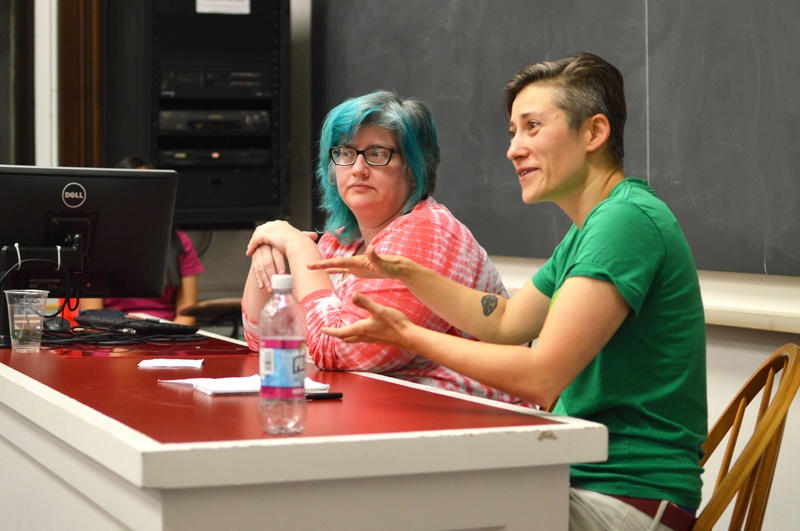
This took place in the same room in which I wrote my quals, which might explain why I’m looking confused and horrified.
One of the organizers, Cherie Hu, wrote a blog yesterday inspired by last week’s event which ponders identity and mathematics.
Also! I was please to be featured in a story that ran in Le Monde last week with my friend and mathematical colleague Leila Schneps, who recently wrote a book with her daughter about bad math in courts systems. It’s in French, obviously, but if I remember my schooling correctly I am quoted in the article talking about destructive algorithms like the Value-Added Model for teachers and even political micro-targeting. No picture there though.
Pre-settlement funding companies in the lawsuit economy
This is a guest post by Ronald Sinai, the founder and CEO of Nova Legal Funding, a national lawsuit funding company based in Los Angeles. Prior to entering the legal finance field, Ron was a student at the University of California, Berkeley where he earned a Bachelor’s degree in 2014.
Personal injury law is a big business in the United States. With every traffic accident or slip and fall, a ‘lawsuit economy’ emerges in expectation for the looming monetary compensation for the plaintiff. Attorneys, medical treatment centers and litigation service providers make up the bulk of this network. This post will tackle the latest, fastest growing and most disruptive industry to enter the lawsuit economy: pre-settlement funding companies.
Pre-settlement funding is a financial lifeline for plaintiffs involved in personal injury litigation. It’s a cash advance on the future proceeds of a settlement for people who can’t wait years for their cases to finalize. Plaintiffs often use the advance to pay for living necessities, medical bills and other immediate financial obligations. Repayment to the funder is wholly contingent on the case being settled out of court or won in trial. The plaintiff repays nothing if the case is lost, making it a risky non-recourse investment for the funding company.
As a principal in a funding company, I felt obliged to contact Cathy after hearing her speak on Slate.com’s Money Podcast and reading her negative blog post about my industry. While it may surprise you, my intent in reaching out was not to correct her. In fact, her worries are completely valid and for good reason. Little-to-no oversight by regulators has allowed bad players in the legal finance industry to employ business models that place profits over ethics. Over time, such practices justifiably resulted in a bad name for the industry, with some comparing this otherwise justice-equalizing tool with payday loans.
It’s important that we don’t throw the baby out with the bathwater. Simply because a lack of regulation led to a swarm of bad actors doesn’t mean pre-settlement funding should go away. When done correctly, embracing the fundamental benefits of lawsuit funding can help our justice system become more equitable and accessible to everyone.
On the value of plaintiff funding
Funding does more than ensure fair and complete compensation for the injured—it ensures that our justice system is blind to an individual’s economic standing.
Pre-settlement funding empowers small plaintiffs against big insurance companies. Just as attorneys litigate and treatment centers heal, the funder adds value to the case by granting the plaintiff financial stability. Solid financial footing helps them reject early lowball settlement offers from insurance companies, who always seek to take advantage of a person’s vulnerable economic position.
No matter how obvious the negligence or big the damages, insurance companies always delay compensation. It’s the oldest and most effective trick in the book: gain leverage by inducing desperation. The adjuster capitalizes on this desperation by offering the plaintiff a lowball offer in exchange for a quick and early payout. Funding the plaintiff takes the leverage away from the adjuster, which results in a big win for the small guy.
On the problem with plaintiff funding
No matter how great the premise of consumer legal finance might be, a lack of oversight will continue to allow bad players to charge unreasonable rates and make the service abusive rather than valuable.
As an operator in the space, I know what deals are being made and under what terms. I’ve seen countless of funding agreements from dozens of companies since the inception of my business. Plaintiffs who previously received funding from other sources come to us in hopes of refinancing their expensive paper. I don’t have hard data, but the average rate seems to be 3-4% compounded monthly or 35-40% every six month period. That’s not including a possible broker fee (10-20% of funding) and an application fee of $250-$400.
Even worse, most companies charge rates that are uncorrelated with the risk profile of each individual case. In other words, a litigious person with a questionable slip and fall at Wal Mart will get the same rate as a victim who was rear-ended while stopped at a red light.
The “fund-everything-at-high-rates” business model
Companies that charge high rates have the luxury of relying less on proper underwriting than they do on volume. This business model is attractive for many reasons. First, higher rates makes it easier to swallow loser cases, which reduces underwriting requirements and drives an increase in deal flow. Relaxed underwriting also means hiring less attorneys, which leads to a massive reduction in overhead.
Secondly, a lack of proper underwriting makes the process hassle-free for the plaintiff’s busy attorney, who wants nothing more than to get the funding process over with. Believe it or not, attorneys whose clients bug them enough for cash will take a quicker funding process over lower rates every time. Same goes for the plaintiff: they like what is fast, not what is affordable. They only realize the mistake when it comes time to repay the funder.
The fix? Enforce rate caps, force careful underwriting.
Not all funders behave recklessly. At my firm, for example, we offer a fixed payoff schedule for 10-15% each consecutive 6-month period. At these rates, our underwriting has to be lock-tight in order to turn a profit. A call with the attorney needs to be arranged, all liens must be inspected, and a variety of documents must be submitted by the law firm before a deal is made.
This forces us to only fund meritorious claims where plaintiffs suffer serious damages, and negligence is clear. By this logic, rate caps will do more than stop unreasonable rates. They will also make it impossible for frivolous lawsuits to get funding and hurt our economy.
Aunt Pythia’s advice
Readers, Aunt Pythia is quite pleased with herself this morning. She has come up with an amazing solution to the problem of teenage dissipation and slovenliness.
Now, don’t get Aunt Pythia wrong: she’s got some amazing teenagers. They even do their own laundry, and take turns doing the dishes (when prompted!). But one thing they haven’t been able to do, no matter the level of coaxing, is to put away their clean clothes in their dresser. What invariably happens is they put their clean clothes in a bag, which gets turned over onto the floor in the following morning’s search for a clean sock.
Bottomline: their floors are always entirely covered with clothes.
Solution: get rid of their dressers altogether and replace them with a large “clean laundry” bin. These are the bins I bought which have just been delivered:

Strangely enough, their father doesn’t seem as excited as Aunt Pythia about the “clean laundry bin”. Something about the aesthetics, or the size. His tune will change when there’s no laundry on the floor, though, I assure you. I promise to update you on this miraculous cure to all things slipshod and/or lackadaisical.
OK, on with the advice! And after you enjoy said advice, please:
ask Aunt Pythia any question at all at the bottom of the page!
By the way, if you don’t know what the hell Aunt Pythia is talking about, go here for past advice columns and here for an explanation of the name Pythia.
——
Dear Aunt Pythia,
I’m stuck in an interpersonal pickle and I need some insight from someone totally removed from the situation. Most of the time I have a pretty strong moral intuition but this has me at a loss.
I’ve known this woman, “Beth,” since high school. She has always been a difficult person to be a friend to, and I think I’m reaching my limit. (We’re both in our early 30s now, to give you an idea of the timeline.) Beth is difficult because she is a self-centered person, which is exacerbated by mental illness. Beth has been on medication for OCD since high school and for bipolar disorder since college.
While she is currently seeing a psychiatrist, she definitely never visited a mental health professional in high school and probably didn’t in college, either. According to her, she “diagnosed herself” with OCD, depression, and bipolar, then talked to her GP (a close friend of the family), who agreed with her assessment and wrote out the prescriptions. I don’t know how prevalent this kind of “self diagnosis” is, but I think this part of her background is relevant, so I’m including it.
For what it’s worth, I don’t doubt for a moment that she suffers from mental illness. I just worry that she is getting the wrong treatment, since she doesn’t seem any “better” after ten years of this particular cocktail of medication. (But I haven’t said any of this to her, and wouldn’t dare, because IMO that would be presumptuous and maybe she’s coming off worse online than IRL. That’s the job of a mental health professional.)
At the moment I am one of two people she talks to who aren’t her family (husband, in-laws, mother), her psychiatrist, or her current lover. (She has been having an affair for almost a year; this is not an open/”monogamousish” marriage.) I feel morally obligated to remain in her life to at least some degree, since I imagine she is probably very lonely, especially since she is in the middle of an argument with her only other friend. This “only two friends” situation is also something she’s told me; I’m not making any suppositions here. Otherwise, I would have cut ties a while ago.
I don’t like the person I become when I talk to her and I don’t think I have the right skillset or knowledge to help her. The only thing that happens as a result of our conversations is that she gives me minute-by-minute updates on her moods/activities, trash talks her husband, relates the sexcapades she’s having with her lover, and asks me for advice that she doesn’t follow. Occasionally she shares random news link with a few throwaway comments on them, and once in a while she asks me what I’m doing, but after a few lines of conversation everything is back to her.
Most people I think I could say, “I want to support you, but I’ve got a lot of stuff going on my self and it’s taking all of my cope just to deal with that. I’ll let you know when I’m feeling better.” or “You know, you tell me a lot about what’s going on with you, but you don’t seem to be displaying any interest in my life. I know that you care, of course, but it would be nice if you could show me that you do.” and, while it would sting, they would be able to handle it. But she is fragile enough that I think even that would crush her, considering that she is angry at her only other friend for essentially saying just that.
The silver lining in all of this is that I am hundreds miles of way and will remain there for the rest of my life, so I only have to interact with Beth online. At the moment I am basically checked out. I’ve limited myself to blase responses like “that sounds annoying” or “that’s good” to most things and outright ignoring what I think is the most harmful/unhealthy stuff she says, or the things that sound like a bid for attention or validation. Is this the best I can do? Should I tell her I need some alone time (or full-on ghost her) and reduce her social outlets by half? Am I overestimating my own importance? Am I underestimating her resilience? Am I making myself a martyr?
Thank you for your input.
Confused Friend
Dear Confused,
A few things. First, sympathy: your friend sounds really hard to deal with, and it’s kind of you to stick with her.
Second, I agree that she sounds like she has real problems, and I’m no professional so I wouldn’t hazard a guess what her problem is, but I’d suggest you spend some time looking at personality disorder profiles. I say that because it has helped me enormously in the past; when you encounter someone with a personality disorder, you feel bewildered and confused – and sometimes even partially responsible to help – but then, reading about the disorders, and the support groups for people who are married to people with them, you realize that you are not alone in your confusion, and that you are not capable of curing them.
Finally, advice. You are at risk of getting so fed up with your friend that you leave her entirely. Instead of letting your last ounce of true goodwill drip out of you slowly, I suggest you tell her about the difficulties you’re having, and asking for her help to remain friends, while you still can do it. Too often, people only express frustration at the point of no return, so the underlying message is, “you cannot convince me to be your friend anymore, it’s too late.” I would love to see your message be something more like, “you need to be a friend to me as well or else you’ll lose me.” It’s a much kinder message.
So, if you can do it, tell her truthfully what’s frustrating you, and be sure to tell her that you still want to be friends, and see what happens. In other words, don’t be a martyr, and don’t underestimate her resilience. If she cannot hear you, and gets upset and refuses to talk, then wait a few months or a year or two and get back in touch, because people often need time to recover, and their disorders often oscillate in terms of severity. Above all, keep careful track of what you’re thinking and doing versus what she accuses you of thinking and doing, because you’ll need to stay calm and reasonable, and that might be hard, but it’s what a good friend does.
Good luck,
Aunt Pythia
——
Dear Aunt Pythia,
I have been close friends with a guy from undergrad for six years. We met my freshman year and became best (platonic) friends that year. He was dating a girl from his hometown, but they were never very close. He felt obligated to stay with her for intense family reasons, but the emotional bond between them was minimal. They fought often and had very little in common. There was no sexual relationship.
They broke up during our sophomore year and he approached me about starting a relationship. I was in a bad place and was not ready to be in a relationship. They got back together about six months later.
We remained very close throughout college – ran together, studied together, went backpacking together. We both told each other everything. I thought that we were really just friends, and that the people who thought we were dating or should date were reading into things (professors, friends, etc. frequently assumed we were).
After graduation, we remained very very close and he remained dating his girlfriend, still under strict family pressure. I realized after we both graduated that I was in love with him. I was/am very physically attracted to him and emotionally bonded with him. I didn’t say anything to him. We both started doctoral programs in New England (in the sameish field) and are both two years in. We don’t see each other much (about every 2 months), but talk on the phone once a week, write, and text often.
They broke up about four months ago and I’m at a loss of what to do. They definitely won’t be getting back together, but at this point, I’ve lived in stagnation for so long that I’m afraid to tell him. I don’t want to lose my best friend, and the long wait has left me more scared than ever. I don’t even know if I want to tell him. What do I do? Help me, Aunt Pythia! I dreamed of this for so long, but now I don’t know what to do.
Perplexed and Frozen
Dear Perplexed,
OK, so two comments. First, nobody writes to Aunt Pythia so that she can say, “don’t go for it, it’s a trap!”. That doesn’t happen. So obviously what you’re looking for here is the green light. They don’t call me Aunt “Go For It” Pythia for nothin’.
Second, I’ma give you the green light here. Not necessarily because I think it will work out – although it well might! – but mostly because I need you to move the fuck on. Holy crap, lady, you gotta get your love life moving here, and it’s been according to my calculations 6 years of this platonic friend crap at least. You didn’t mention how many love affairs you’ve been having on the side in the meantime, so I’m going to imagine at least a few, but jeez. How can you be so patient?!
As for my advice, it’s the oldest and simplest plan in the book. Invite your friend to stay with you for the weekend, get everyone out of the area with strict instructions never to return, and drink a ton of booze. Easy peasy lemon squeezy, with an emphasis on the lemon squeezy. And please do it quick, my patience is completely worn out. And then please write back and tell me what happened.
Aunt Pythia
——
Dear Aunt Pythia,
I’m a liberal arts/sciences undergrad focused on the obstacles to just climate and economic policies. I’m also interested in economics/finance, the political process, and social justice, among other things.
I want to get work experience related to my interests before I graduate, so I’m planning not to take classes in Spring 2016 so that I can do an internship (or several), but I’m not sure about how to find the right opportunities. I’ve reached out through some social connections to folks who might be interesting, but I should do more.
Do you have any tips for finding internships? Or even better, do you know of any great people who could use a smart research assistant this coming Spring? I do good research.
Thank you, Idealistic Human
Dear Idealistic,
Great idea, and I’m sure my commenters will weigh in with ideas. Personally I’d find underfunded organizations that do good stuff and I’d simply ask them if they need help. The ones that advertise for internships are way too overstaffed and organized.
Aunt Pythia
——
Dear Aunt Pythia,
So, as a not young in body person (half a century, woohoo!) am a little surprised to find myself:
- with a job after almost 12 months out of work,
- excited like I was starting fresh, and
- worried about the future – aka ai/robots getting the work.
The job I am about to start shouldn’t last more than 5 years. The goal is to set up a reporting system for a variety of KPIs drawing on data from a variety of external organizations.
On the one hand, if I don’t manage to automate most of this, I would see it as a failure. On the other hand, what work will be left for others when I succeed?
I will be fine. After 5 more years of earning, I should be mortgage free and healthy savings. Should I feel a bit bad that I am helping software eat the world?
Frumpy Old Graduate Excitedly Yearning
Dear FOGEY,
A wise man (Suresh Naidu) once said to me, “protect the people, not the jobs.” I think he’s right. We are going to have to deal with the robot/ automation revolution sooner or later, and so instead of pushing to avoid automation, a futile gesture to save unnecessary and outdated jobs, we should be thinking about pushing for free college and training for the jobs of the future with all the money we’re saving as a result of this nifty automation revolution.
So, in short, no, don’t feel guilty. But be sure to do your part in figuring out what the future should look like for young people once you retire. Be an advocate for a fair and equitable future!
Aunt Pythia
——
Readers? Aunt Pythia loves you so much. She wants to hear from you – she needs to hear from you – and then tell you what for in a most indulgent way. Will you help her do that?
Please, pleeeeease ask her a question. She will take it seriously and answer it if she can.
Click here for a form for later or just do it now:
Jury duty
For the past two days I spent my time bored out of my mind at jury duty. And it’s not even that unpleasant or uncomfortable, and it even has pretty good wi-fi, but for some reason, seated as we are in a big room with 90 other people or so makes you kind of nuts. It’s like you’re on a two day plane ride to nowhere.
For reading I had with me A Confederacy of Dunces, which I’m reading for the second time, and which is great background for the story I’m about to tell you.
On the first morning of jury duty, you get to see your cast of characters, and it’s kind of amusing. In my case, we had an extremely overworked clerk named Bill, who was doing the job of three people, telling us how to fill out our forms in precise and extremely detailed patient language, repeating everything 5 times for clarity and emphasis. And I would have started to wonder at Bill’s constant repetition, except that in spite of it, there were a few people who would manage to get confused and go up to him – invariably in the middle of a task – and ask him questions.
One woman in particular seemed to do this a lot, and she was loud as well, and almost seemed hostile. It seemed like she was objecting to the form itself, and wanted to find a way to trip up Bill or something, as a way to get back at having to be at jury duty. To the credit of Bill, he was always extremely polite to her. That guy is a saint. But it didn’t prevent her from looking around at the crowd of people, as if she wanted confirmation that her plight was unreasonable.
So yesterday rolled around, the second day of interminable waiting, and it was much worse than the first day. Because, after all, we all knew how boring it would be, and we were all hoping we wouldn’t be called to do our actual civic duty. Being prepared to do it was surely enough. The guy next to me kept mumbling, “I gotta get outta here” under his breath, while shaking his leg furiously.
At around 11am, something happened that kind of broke through the tense fog of boredom. Namely, about half of all the cell phones started to beep loudly. It was an Amber Alert (since resolved). We all pressed “OK” and the beeping din subsided.
Except not for long. I guess people who are on different networks get their Amber Alerts at different times. So for the next 10 minutes or so, random cell phone beeps would happen and be resolved. For all but one phone, everyone’s noise eventually went silent for good.
That last phone, however, was left unattended, which meant that every 3 minutes or so, it beeped loudly for 15 seconds. The fourth or fifth time this happened, the loud lady from the previous day started loudly complaining, “THAT NOISE IS ANNOOOOOYING ME! CAN SOMEONE TURN DOWN THAT NOISE?! IT’S SO ANNOOOOYING!”
Some combination of how pent up everyone’s frustration was, and this loud woman, and probably also the book I was reading, made me start laughing uncontrollably at this point, which was slightly contagious but didn’t stop the loud woman from complaining.
A bunch of people started to explain to her about Amber Alerts, but she just kept telling everyone how annoyed she was (loudly). Finally, one of the clerks at the front, who had (very reluctantly!) decided to show up to work today, told her there was nothing she could do and could the woman settle down.
Well, that made her quiet for about 15 minutes, but it didn’t stop the Amber Alerts from sounding every 3 minutes. And every time they started again it was difficult not to laugh. After the fifth time, some guy who had been in the bathroom for the first kerfuffle made the mistake of saying to the group, “I think someone needs to look at their phone and deal with it,” which was the cue to the loud woman to start wailing again about the noise, and it made a bunch of us start laughing again (I admit I was the worst). This time the loud woman added some sarcastic comments about how SOME people seemed to think her suffering was FUNNY, which made me simultaneously laugh harder and consider suicide. The lady at the front asked us all to settle down again and we did.
At this point it had been going on for almost an hour, everyone was hungry, and it was nearing lunch time. Finally, just as we were being dismissed for lunch, someone sitting next to the loud lady proclaimed, and I literally have no idea why it took them so long, “Hey lady, that’s your phone!,” which she denied, but then the woman up front said, “Lady, that better not be your phone! Take out your phone and check it right now!”
Readers, it was her phone.
Data science job blurbs
I’ve been getting lots of people writing to me recently with data science jobs that I think look like nice jobs, with nice people, but I am personally not going to apply for. Instead of forgetting about them, I’ve decided to advertise them myself.
—
The first position is from Harmony Institute, a research center trying to understanding the social impact of media. They are looking for a Technical Data Analyst. Here’s their blurb:
HI is looking for a media-savvy researcher with an understanding of social science/humanities research and a passion for empowering causes for social good. The ideal candidate is interested in studying complex phenomena — such as information diffusion, media framing, and emotional responses to stories — from multiple, often indirect perspectives. You know how to hack code and wrangle data, but you’re just as concerned with big questions as big data.
In this role, you’ll be working closely with a team of social scientists to study various aspects of the social impact of media. Most projects have a critical data component, and you’ll be the go-to person for a broad range of data tasks: identifying indicators and datasets of interest based on research questions; collecting data from available APIs, databases, and even web scraping; verifying, documenting, and sharing the processed data; and either leading or facilitating the data analysis and visualization of results. You’ll also collaborate with and get support from our product focused data scientists and software engineers. Fortunately, HI has built up a large code base (in Python) to help you with your work, so you’ll rarely be starting from scratch. You can look forward to improving your programming and data skills through diverse, interesting research projects; being exposed to many different perspectives among media makers, funders, and researchers; and advance the field’s understanding of media’s impact on society.
The full description is here, and they’re also looking for a data engineer.
—
The second position is from Paperless Post, which you’re doubtless familiar with if you’ve ever been invited to a kid’s birthday party. They are looking for a data scientist, and here’s their blurb:
The data team at Paperless Post helps people throughout the company use data to make better business decisions. We’re a team of five people (three women, two men), and each person supports various business and product teams. We spend around three fifths of our time working on projects for teams, and two fifths working on data team projects.
We do all types of data work: data engineering, ETL, analysis, building production data systems, building visualizations, building dashboards, creating KPIs, and more. As the main data contact for a team, you get a lot of autonomy and flexibility when helping them best use data.
We’re looking to grow our team, and are looking for both junior and senior data people. Paperless Post is a great company to work for as a data person. We have a product that people enjoy and pay for, and we don’t sell our user data. We care about professional development, and are supportive of interests outside work. Within the company, the data team is viewed as a valued partner to the teams we work with.\
For questions, contact solomon@paperlesspost.com.
—
If you have a data science position that is not in finance, or ad tech, and is with super nice people, I plan to do it at least one more time, so email me at the gmail address listed on my About page.
The fight for 15
Whenever I hear an argument about the possibility of raising the minimum wage to $15 per hour, it sounds like this. Person A, who is for it, makes the case that it’s too difficult to live on minimum wage earnings, and it doesn’t make sense for someone working full time to struggle so much to feed their kids. Person B, who’s against it, says that 15 is too high, that too many employers will be unwilling to pay for unskilled workers at that rate, and they will replace such people with machines instead of doing so. Essentially, they argue the bad will outweigh the good.
Full disclosure: I am often Person A. I once figured out that if you take someone’s hourly wage in dollars, and you multiply by 2, then you get their yearly wages in thousands of dollars. That means an income of $100K per year is $50 per hour. That means an income of the current New York minimum wage, $8.75 per hour, is a measly $17.5K per year, which would be absolutely crazy to try to live on, according to my reckoning. In other words, I think about what I could theoretically live on, if I had a minimum wage job, and I have extreme sympathy for people who try to.
Let’s get back to Person B’s argument. It’s weird because it sounds like Person B is arguing for the sake of the poor, but they’re ignoring the vital question of what is a living wage. Let me give you an analogy.
You have a sick population, and they all need 3 pills per day to stay well. The pills are expensive, though, and so the people in charge of pill distribution give most people 2 pills per day. They argue that, if they gave out 3 pills per day to everyone, some people would have no pills. For the sake of those theoretical people, then, they give out only 2, and everyone remains sick.
In other words, for the sake of holding on to crappy jobs that pay below living wages, and where the employees need food stamps to survive, we don’t raise the bar so they can actually sustain someone in a basic way. It’s almost like we’re desperate to hold on to them because otherwise our unemployment rate would be higher.
I say, figure out what a living wage is, and raise the minimum wage to that level. I actually don’t know what the magic number should be, exactly. Is 15 big enough? Maybe it is, in some places, but maybe in others it’s actually smaller. It doesn’t have to be the same throughout the country. But for as long as we live in a country where the model is that a job is supposed to support you, we should make sure it actually does.


 mathbabe