Archive
In Denial (#OWS)
This is the first part of a four-part essay that was proposed by Cathy O’Neil, a facilitator of the Occupy Wall Street Alternative Banking Working Group, and written by Morgan Sandquist, a participant in the Working Group. Crossposted from Naked Capitalism.

The largest banks in America–Citibank, Bank of America, Wells Fargo, and others–are probably insolvent. I learned of this from my companions in Occupy Wall Street’s Alternative Banking Working Group. It seems that, based on a host of legal and accounting irregularities, the banks have been able to conceal real and potential losses far larger than their capital reserves. But this has been difficult to confirm.
Isn’t that strange? Wouldn’t the possible insolvency of the core of our banking industry be a matter of nearly universal importance? Shouldn’t we be trying to figure out if this is in fact so, how it came to be, what we’re going to do about it, and how we can prevent its happening again?
Anyone investigating the true health of the banking industry, apparently including regulators, is faced with opacity, complexity, and even outright hostility that stymies all but the most savvy and persistent. Fortunately, people within OWS, including the Occupy the SEC Working Group, are that savvy and persistent. But the reaction of the industry and its partisans to such efforts has included the not-so-subtle suggestion that inquiring into the well-being of the banking industry will somehow cause problems to arise that wouldn’t otherwise exist if we would all just mind our own business.
This seems odd in an ostensibly objective and quantitative context like banking. Shouldn’t the truth be clearly visible in the accounting? Shouldn’t we all–borrowers, investors, depositors, and regulators–want to know exactly what’s going on?
As unexpected as such a visceral and irrational reaction to genuine, well-founded concern is from the supposedly rational realm of finance, that telltale blend of evasion, grandiosity, and superstition will be familiar to anyone who has ever confronted an addict about his or her addiction.
Denial is far more than an addict’s dismissal of the truth of his or her addiction; it’s collectively developed by the addict’s entire social sphere, and it takes many forms.
It might be helpful to imagine addiction and denial as intangible agents acting in a social context. Addiction’s agency is directed solely toward uninterrupted use of the addictive substance, and denial’s agency is directed solely toward ensuring that no one sees, understands, or limits addiction’s agency. Denial denies not just claims and assertions, it also denies access and insight into the reality of addiction. It denies that behavior is driven by addiction and that behavior’s consequences are the results of addiction. It denies the story of addiction and proposes an endless collection of counter-conspiracies.
It appears as those around the addict ignoring the addict’s use and the consequences of that use; as the narratives, tics, and habits through which the addict understands and acts out his or her use; and as the alternate version of reality that the addict and everyone around him or her shares in lieu of the reality of addiction. To paraphrase Baudelaire on the devil, denial’s best trick is to persuade us that addiction doesn’t exist.
No addiction could develop a more effective narrative of denial than the trade in exotic financial instruments that’s evolved over the last decade or so; no addiction could hope for more willing abettors than the financial press, regulators, and ratings agencies; and no addiction could depend on a more permissive enabler than the Federal Reserve Bank.
It’s difficult not to imagine the banking industry as jittery and unshaven, embarking on yet another unregulated derivative binge, telling us, its concerned partner, that we just wouldn’t understand what it’s like, how high the return can get, while its friends in the financial press and ratings agencies encourage it, scoffing at the very idea of risk.
And later that night, as it’s coming down, it’ll shout something at us about not really needing the $1.2 trillion in liquidity, but if the Fed’s offering, why not?, it’ll make the night that much better, only to face us the next morning, hungover and distractedly claiming none of it ever happened.
We’ll confront it with seemingly undeniable evidence of MERS, TARP, executive bonuses, and a ruined housing sector, and it’ll look betrayed, ask us how we could even say such a thing, and tell us that it’s none of our concern and that we just have to trust it, because the bills are paid, right? It’s not like it’s as bad as AIG or MF Global, it’ll say, which will lead to an impossible-to-follow tale of the prank it played on MF Global last night, and how that was like something that happened to Bear Stearns and Lehman Brothers once, and ending with the declaration that the Fed and the SEC would never let anything bad happen to the Banking Industry.
And what choice do we have? Maybe it’s not that bad. After all, if the banks really were insolvent, there would’ve been something on the evening news.
Tomorrow: The Addiction
Vote with your wallet
Today we have a guest post from Elizabeth Friedrich, with whom I work on the Credit Union Findr webapp I blogged about here. Cross posted from Beyond the Bailout.
In 2008, America was in shock seeing the stock market crash, the housing market collapse, and a $12.8 trillion-dollar bailout of financial institutions many felt were responsible for the economic crash. We were paralyzed, unable to see past the madness and despair. At first, our national response was minimal. Americans had lost their homes, jobs, everything, and the anger was evident in the national mood. However, from that desperation and pain-came action and movement! People began to organize in order to decide their own fate, not leave it up to the 1% and/or a complacent government. Action came in many forms, marches in streets, letter-writing and media campaigns, peaceful occupation of public spaces, and of course “Move Your Money.”
The Move Your Money Project actually started several years ago, but had not gained significant momentum until last year, when consumers began to voice their anger and outrage at the very largest for-profit financial institutions, who had been bailed-out with billions in tax-payer dollars, and rather than using those funds to expand credit to communities in need, instead sat on this cheap money and tightened their lending standards. With historic low interest rates set and held by the Federal Reserve system, profit margins became slimmer and many banks responded by increasing their fees across the board, much to the ire of many fed-up consumers. This action was a catalyst to finally moved people to question the role of their so-called trusted financial institutions and on November 5 2011, over 600,000 people moved their money totaling $80 million dollars out of traditional banking institutions into credit unions and community banks across the country. In addition to that single day of action, over the last few years, over 4 million accounts have moved from the nation’s largest Wall Street banks according to Moebs Services, an economic research firm in Lake Bluff, IL. They also project an additional 12 million people will do the same in the next two years.
This mass-exodus from the big banks is by no means accidental and shows the overwhelming, yet untapped energy of the American people who have grown discouraged with a government that was unwilling or unable to enact true, meaningful financial reform. Many of their reasons for this are clear: consumers are looking for ethical practices, re-investment in local communities, fewer fees and more service, and the end of “Too Big to Fail” financial oligopolies. Naturally, people began focusing on credit unions and community development banks, institutions that have the public interest in mind and seek to strengthen local communities. At these community-focused institutions you actually know where you money goes and what is used for.
Convenience over accountability…
Our culture has taught us that convenience is primary tool when making decisions as opposed to accountability and fairness. Just as we make other choices; purchasing food, clothing, and transportation. Convenience is often the factor that carries the most weight in our decisions rather than ethics. This comes with many consequences – often at the expense of the environment and disadvantaged communities. Hopefully, in the future accountability and transparency will be a primary motivation for consumers when making financial decisions.
What to do?
Today we have a choice whether we know it or not. There is a parallel financial industry functioning on the fringe: Community Development Financial Institutions (CDFIs), a national network community development banks, loan funds, and community development credit unions (CDCUs). These are institutions with a primary mission to strengthen vulnerable communities and invest locally. Banks and credit unions are regulated depository institutions; banks by the Federal Deposit Insurance Corporation (FDIC) and credit unions by the National Credit Union Administration (NCUA). Credit unions offer many of the same services as banks: mortgages, car loans, personal loans, small dollar loans, credit cards, savings/checking accounts, international money transfers, Individual Development Accounts (matched-savings accounts), retirement planning, financial literacy education and budgeting, affordable savings and checking accounts, and credit and debit cards with low minimum balances and flexible terms. They are not-for-profit financial institutions created to serve their local communities and members first. Unlike banks, which can serve any customer that walks in the door, credit unions are restricted to specific fields of membership.
This means that consumers have more options than ever with respect to their primary financial institutions, and a major selling-point for many is that the money they deposit in their credit union stays local within the specific field of membership. Rather than profiting shareholders, income earned at a credit union, dividends are returned in different forms from free services to better interest rates or to expand services in the community.
Making the choice to bank at a credit union or a community development bank creates a multiplier effect for the local communities being served, and ultimately in the entire the financial system. When you invest in a community development financial institution you are investing in job creation, building schools, developing housing and financing small businesses.
Some banks may be “too big to fail,” but consumers are waking up and realizing they have a choice where they put their money, and the impact that choice can have in their own communities. Rather than letting too big to fail institutions gamble away their hard-earned cash, people are choosing to exercise their power as consumers and speak with their wallet. In banking this means find the smart, responsible alternative for you, your family and your community, and community development banks and community development credit unions are a logical choice.
Interlude: Egret Ardor

Snowy Egret
A late summer night and the snowy egret
has come again to the shallows in front of my house
as he has for forty years.
Don’t think he is a casual part of my life,
that white stroke in the dark.
– Mary Oliver
Hip Hop’s Cambrian Explosion: Part 2
Since Cee Lo got the last word on the previous post, the first word of today’s guest post goes to Senegalese rapper Sister Fa. The word is Sarabah, the inspiration for point 4 in this prolix paean to Hip Hop.
4. Hip Hop is international. Although it originated in the African American community as a critique of white supremacy and an expression of community pride, it has gained international popularity over the past three decades, going viral as a musical meme, and inspiring artists from across the globe to adapt it and hybridize it with local traditions. To make a biological analogy, Hip Hop has undergone a global adaptive radiation to rival that of the Cambrian explosion.
I highly recommend the documentary film The Furious Force of Rhymes, which includes interviews with rappers in Senegal, Israel/Palestine, the United States, and Germany, chronicling its global appeal and rapid evolution. The film is a tribute to young artists who are drawn to Hip Hop as a vehicle for exploring social and political inequalities. Artists like Sister Fa, who raps in Wolof, Manding, Jola, and French. Her song Life Am reads like a public service announcement about the importance of practicing safe sex to contain the AIDS epidemic, but it’s the catchiest PSA I’ve ever heard, which is why it’s so effective. I find myself singing along to the rhythmic “utiliser le preservatif” only to realize that’s about the least sexy thing it’s possible to say in French. Voici une video, Milyamba. Sister Fa is leveraging her fame as a rapper to campaign throughout West Africa against female genital mutilation. Subjected to the practice herself, she tells her story in the documentary film about her life and activism entitled Sarabah.
Sister Fa’s use of multiple languages in the course of one song is typical of the way in which international artists have embellished the form and upleveled the wordplay. I’m particularly fond of songs that blend English with other languages, like Ozomatli’s Nada’s Por Free, sung in Spanglish (“So me levanto off the suelo straight chillando with my pena.” Ha!). I’m kvelling over this video of Ozomatli performing in Spanglish at the Tu B’Shvat Nature Fest.
Code-switching and language-switching are natural stylistic choices for a medium concerned with raising questions about racial identity. It was not so long ago that Apartheid imposed arbitrary racial categories on South Africans and enforced them with singular cruelty. (Check out this excellent documentary on Apartheid featuring Archbishop Desmond Tutu.) In the context of a country attempting to decolonize its national psyche and forge more pluralistic and inclusive social structures, rapper Emile YX uses Xhosa, Zulu, English and Afrikaans to explore lingering questions of racial identity.
In Who Am I? Emile YX mixes it up like the chromosomes in his name:
I’m every brother and sister
Working in a factory
I’m Easter weekend
camping at Kommetjie
I’m Sunday braaivleis
Dik geeet en gaan slaap
I’m that stone thrower at Caspers
During Apartheid innie Kaap
I’m that dummies player, kennetjie en Akoos
I’m that ANC supporter saying the DA se ma se,
I’m that voes gamtaal talker, corner broker
Gooi neer jou tol want hier gaan jy stoke ja,
I’m that mass marcher and tyre burner,
Minimal wage sub-economic earner
I’m that doctor, lawyer and politician in the ghetto
Wait a minute … Most of them have moved out though.
So I’m that one who stays to be a good role-model,
My election promises are not just oral.
Even when I can’t understand all the content of a song, I enjoy listening for Hip Hop’s recognizable elements, as well as the unique aspects that mark its cultural adaptation.
Here are a few gems:
In Spanish: Humanidad by Ana Tijoux
In Tagalog: Bebot by the Black Eyed Peas
In Japanese: Togesashi by Inden
In Arabic: Al Kuffiyeh 3Arabeyyeh by Shadia Mansour
With Hip Hop’s increasingly international reach, it is ever more pluralistic in both form and content. What is it exactly that makes the genre so appealing to a diverse global audience?
5. Hip Hop is democratic. A key stylistic convention of the genre involves using multiple first-person narrators who rotate in order to collectively construct the story as a mosaic. In the Black Eyed Peas’ Beautiful People, each of three narrators takes turns recounting his experience of coming into his own, overcoming the obstacles presented by anti-semitism, poverty, and the INS. Pinoy poet apl.de.ap tells his story:
Back in the days when I was in Philippines,
I had a dream to be heard and to be seen.
Came overseas at the age of fourteen,
Stood behind the front, if you know what I mean.
The song explores questions of worth – self-worth, material worth, innate worth — themes which are woven into each person’s narrative so that the song tells a collective story while still allowing each individual to express his unique perspective. Macy Gray sings the melody, an adaptation of the chorus from the Beatles’ Baby You’re a Rich Man With her wonderfully scratchy voice (What I wouldn’t give to bring Janis Joplin back from the dead to hear her and Macy Gray growl a duet!) she asks, “How does it feel to be one of the Beautiful People?” Collectively, the Black Eyed Peas convey a fairly democratic sentiment: You refugee, you immigrant, you down-and-out listener (and yes you, reader): You are the beautiful people.
Another favorite example of a song that uses rotating narrators to tell a single story is the Fugee’s Rumble in the Jungle. Seven narrators take turns paying homage to the historic boxing match between Muhammad Ali and George Foreman that took place in Zaire in197. At the height of the Black Power movement, Muhammad Ali’s journey back to Africa took on a significance and symbolism that became a source of shared pride bolstered further by the fact that Ali was the World Heavyweight Champion and a radical to boot. Ali was an early Conscientious Objector to the Vietnam War, stating succinctly, “I ain’t got no quarrel with them Viet Cong; No Viet Cong ever called me ‘nigger.’” The song opens with a quote by Ali, so in a sense he becomes an eighth narrator:
“I’m gonna fight for prestige, not for me, but to uplift my little brothers who are sleeping on concrete floors today in America, black people who are living on welfare, black people who can’t eat, black people who don’t know no knowledge of themselves, black people who don’t have no future. I want to win my title and walk down the allies, set on the garbage can with the wineheads. I wanna walk down the street with the dope addicts, talk to the prostitutes. So, I can help a lot of people.”
I recommend the documentary When We Were Kings, a biopic about Ali, which situates Rumble in the Jungle in its historical context, including the glaring irony of the event: the fact that it was funded by dictator Mobutu Sese Seko, who had only recently assumed power via coup after the C.I.A. orchestrated the overthrow of the democratically-elected Patrice Lumumba. For more on the story of this egregious episode in American foreign policy, two good resources are the film Lumumba and the book The Poisonwood Bible by Barbara Kingsolver, a fictional account of the period surrounding Lumumba’s assassination. Interestingly, her novel also uses the device of rotating first-person narrators to structure the story. When telling a story about democracy – or the deliberate undermining thereof – the technique of weaving multiple narrators’s perspectives is apt in that it models pluralism.
Women’s voices are too often missing in Hip Hop, so I am particularly smitten with Cell Block Tango/He Had It Comin’ by Macy Gray, L’il Kim, and Queen Latifah. This song uses the multiple-narrator format to address a serious topic in a campy tone: domestic violence. The song’s over-the-top Broadway style (it was written for the musical Chicago) signals to the listener that we are in the realm of fantasy as each artist imagines violent revenge against her lover/abuser. Queen Latifah sings the first verse with characteristic sassitude:
I mean imagine, why was he hittin’ his woman?
Why was she takin’ that?
Now picture her fightin’ back, picture the ass kickin’
Think of his ass flippin’ down the stairs
And me at the top smilin’, he shoulda stopped wildin’.
Now could you picture me tryin’ to finish him off?
See why I pictured me on this side of the law?
High heels leave holes, you’d a thought I was gunnin’!
Now the cops comin’, I ain’t runnin’!
Hip Hop is very much a macho, male-dominant form, misogyny being its blind spot. So Queen Latifah’s is a minority voice. But that’s just it. Even if yours is a minority opinion, if you can voice it with enough panache, and what you’re saying smacks of truth, then you can have your day in court in Hip Hop. The democratic nature of the form has a lot to do with the method by which rappers rise in fame and credibility: the rap battle.
6. Hip Hop is competitive. Emerging rappers can be recognized in public because they carry a notebook in their pocket which they frequently take out to jot down rap lyrics and song hooks. They are avid consumers of rap music, noting other rapper’s cadences and rhyme schemes, and honing their skills in cyphers. A cypher is a group of rappers who get together and take turns improvising raps either acapella or over a beat. If you have ever seen this live, you know how impressive this ability to extemporize is. Here’s a home-made video of a stellar cypher I saw live as part of the annual Life is Living Festival. (Check out the 9-year-old who rocks the mic at 3:20 and 13:28!) Cyphers provide creative community and serve as training grounds for the high-stakes battles that put rappers to the test. Many of you are familiar with the battle scene in Eminem’s 8-Mile, a film that is notorious in my mind largely for its terribly unsexy sex scene. (And they didn’t even “user le preservatif!”) Here’s a link to the final battle scene in 8-Mile, in which Eminem wins by confessing his flaws to the crowd first, stealing his opponent’s best ammunition.
In a rap battle, two artists at a time compete. They are each given a time limit, taking turns addressing each other back and forth, all the while wooing the crowd with their artistry and skills. When the beat drops – one they have not heard in advance – they have to deliver a performance that: a) belittles the competitor; b) self-aggrandizes; c) references a comment or event that just occurred, demonstrating that the lyrics are improvised in the moment; and d) impresses the crowd. This last one is critical, as it is the audience who decides who the winner is in an instant and rambunctious plebiscite. Picture an Occupy General Assembly, but with different hand gestures. Hip Hop’s virtuosos are vetted in the democratic forum of the rap battle.
Apropos of democracy and internationalism, I’ll give the last word of today’s post, part 2 of 3, to the Occupy Wall Street movement. Enjoy this funky rallying cry from Occupy London.
Cheers!

Interlude: Newt Haiku

Photo: The newt on the left hovers above an egg sac moments before approaching the beast with two tails on the right.
On one of the first unmistakable days of Spring, I led a group of five six-year-olds on a walk through the UC Botanical Garden, where I am a docent. I say “walk,” but children at that age do anything but: they skip, bound, trip, jostle, spin,and vibrate in a sort of Brownian motion, but rarely walk. On this first morning of emboldening sunlight and tentative short sleeves, my group was particularly kinetic, their effervescence reaching a feverish pitch when we arrived at the Japanese pool and found the newts in a similar frenzy. Pairs of newts gripped each other in slippery contortions, splashy displays that incited the childrens’ curiosity. Lone newts trailed after mating pairs, latching on to a tail and rolling into a tan-and-yellow tangle of three- four- and five-newt bundles. One of the children asked, “What is that brown knot?” The adult chaperones tittered. Since Spring has inspired haiku for centuries, I offer this reply, in haiku form.
What is that brown knot?
The newts are dancing, children,
celebrating Spring.
What is that brown knot?
The newts are wrestling, children,
That’s how life begins.
What is that brown knot?
A miracle of nature,
one more mystery.
What is that brown knot?
The newts are in love, children,
euphemistically.
What is that brown knot?
A good old-fashioned tussle,
a frenzy, a fray.
What is that brown knot?
Survival of the fittest,
Shuffling DNA.
What is that brown knot?
An amphibian orgy,
It’s rude, kids, to stare.
What is that brown knot?
Sexual reproduction.
Ask that docent there.
Hip Hop’s Cambrian Explosion: Part 1
On her January 28th post entitled Does Hip Hop Still Exist? Mathbabe wrote:
“My oldest friend sent me some mixed CDs for Christmas. I listened to them at work one recent morning, and although I like a few songs, many of them were downright jarring. I mean, so syncopated! So raw and violent! What the hell is this?! It was hip-hop, I think, although that was a word from some far-away time and place. Does hip-hop still exist?”
Fortunately for me, I am that oldest friend, mixer of said CD, and guest blogger this week, here to answer Mathbabe’s question with the first of a three-part post entitled Hip Hop’s Cambrian Explosion.
______________
I discovered Hip Hop around the same time I discovered Mathbabe. In 1987, Hip Hop was a toddler living in Brooklyn while Cathy and I were teenagers living in suburban Massachusetts. As I walked home from school one afternoon, I popped Boogie Down Production’s debut cassette into my walkman and snapped to attention as KRS One delivered a high-energy critique of public schooling’s systematic omission of Black history from the curriculum. As I listened I found myself considering for the first time the ways in which I had been raised on a steady academic diet of European and American histories and literatures, with no mention of those of Africa, Latin America, or Asia. These were entire continents and peoples whose histories were tacitly deemed peripheral to the central drama of whiteness. I listened closely as KRS One, aptly known as “The Teacher,” educated me about the people studiously ignored in my history textbooks. Here is a delightfully dated video of that first song, You Must Learn: http://www.youtube.com/watch?v=RDd7UbJmdmw.
I am now nearly 40 and recently had the opportunity to meet KRS One at a concert in Berkeley, where I was able to thank him in person for supplementing my education. He is as dynamic as I remember, still using the mic as a vehicle to teach critical thinking, still building community by inviting up-and-coming rappers onto the stage to improvise with him, still innovating by rapping over electric violins spilling amplified Mozart over the surging audience. In this photo I took from stageside he reaches out to connect with the crowd:

And here I am, looking up at him.

Photo by Hugo Garcia, aka Steelo
As you can see in the photo, I plainly admire him, as I do any iconoclast who has the audacity and clarity to say so when the Emperor has no clothes. So as an avid fan of Hip Hop, I’d like to appeal its case for those of you who are new to the genre or are considering giving it a second listen. Why should you bother listening to Hip Hop? And what exactly is Hip Hop anyway? I offer this primer as a paean.
1. Hip Hop is political. Hip Hop gained national attention in 1989 when Public Enemy’s Fight the Power piqued the paranoia of white America. The now-classic ghetto anthem opens with Martin Luther King’s lilting oratory, not the more tepid, politically-milktoast MLK Jr. of the official public holiday, but the radical MLK Jr, who exhorts Americans not only to refuse to serve in the U.S. Army, but to switch allegiance to fight alongside the Viet Cong.
 Chuck D and Flavor Flav at Yoshi’s in San Francisco. “Most of my heroes don’t appear on no stamps.” – Chuck D. Photo by Cherie Chavez
True to its origins, Hip Hop remains today the artistic genre of choice and the voicebox for people pushed to the margins of power by historical and social forces. And it’s not afraid to name those forces. Paramount among the themes tackled in Hip Hop is that of white supremacy, a topic — a phrase even — that tends to make white people uncomfortable. When rapper Brother Ali released Uncle Sam Goddamn, an overview of American racism — past and present — cell phone company Verizon responded by revoking its sponsorship of his tour. Corporations typically don’t profit by talking about racism, unless it’s in that “Rainbow Nation” manner of Benetton, which carefully eschews analysis of power relations. The video for Uncle Sam Goddamn includes some powerful historical footage.
Another of Hip Hop’s recurring themes is poverty. As Somalian-born rapper (and personal favorite) K’Naan explains:
…I remember when I was 7
When rap came mysteriously and made me feel 11
It understood me, and made my ghetto heaven
I understood it as the new poor people’s weapon.
Smart 7-year-old. The excerpt is from The African Way, a funky fusion of American-style rap vocals and East African drum rhythms. As K’Naan recounts in several of his autobiographical songs, he learned English by listening to rap music (it’s no coincidence he sounds so much like Eminem) in order to have a forum for speaking about the violence he experienced as a child growing up in his native Mogadishu. His beautiful Blues for the Horn is both lament and homage to the Horn of Africa. He narrates the story of Somalia himself so that no one can “make a mockery of our struggle like Hollywood plans to.” And despite the seriousness of his purpose, he carries on another of Hip Hop’s traditions: its sense of humor. Describing Mogadishu, he quips:
If you bring the world hoods to a seminar
We’re from the only place worse than Kandahar —
And that’s kinda hard!
In the song Somalia, he reminisces about his childhood:
We used to take barbed wire
Mold it around discarded bike tires,
Roll em down the hill in foot blazin’ —
Now that was our version of mountain bike racing!
Daaaaaammn!
Do you see why it’s amazing
When someone comes out of such a dire situation
And learns the English language,
Just to share his observations?
Probably get a Grammy without a grammar education.
Hip Hop has an unapologetic working class hero sensibility, like John Lennon’s Working Class Hero, but edgier. How’s this for edgier? 5 Million Ways to Kill a C.E.O.
The racism and classism that inhere in our justice system are the targets of Lauryn Hill’s epic rant in The Mystery of Iniquity. She seems to enter a poetic trance as she excoriates the American judicial system in a style that calls to mind the dogged dirge of Allen Ginsberg’s Howl. This is but a tiny excerpt of Hill’s stream-of-consciousness dressing down:
Do we expect the system made for the elect
To possibly judge correct?
Properly serve and protect?
Materially corrupt
Spiritually amuck…
Mafia with diplomas keeping us in a coma trying to own a piece
of the American Corona.
The revolving door:
Insanity every floor
Skyscraping, paper chasing,
What are we working for?
Empty traditions
Reaching social positions
Teaching ambition to support the family superstition?
With a bass voice like Barry White, rapper Lyrics Born questions our funding priorities in Stop Complaining:
I pay my taxes when I’m asked to.
I’m not enthusiastic about it, but shit, I make it happen.
Yeah, it’s last minute, but goddammit they cash it.
(“This is fiscal harassment, they keep touchin my assets!”)
Now I imagine I might be feeling different about it
If it was given outright, witness it helping somebody
But it just so happens in life, the school district’s too crowded
It ain’t no teachers in sight, that’s why the kids are so rowdy.
I just imagine some asshole with glasses on up at the Capitol
One of a thousand pawns packed in an office cramped up like animals,
Pictures of his sister, his mixture Lapso Apso-poodle
His 2.6 kids, and the missus thumbtacked to his cubicle
So damn detached from the average man’s planet, he cain’t fathom
That we could ever be anything other than stats, fat and taxable
He’s gettin his usual ritual 2 o’clock Cup of Noodles on
While he’s fuckin you on your W2, his John Denver music on.
The ongoing disparities in K-12 schooling and access to higher education are a common theme in Hip Hop. Shad K, who pursued his career in Hip Hop while simultaneously earning a Masters degree in Business, writes in Exile:
We’re taught not to question the status quo cuz the masses never get heard
unless you’re established
with expert professors in dress-shirts
and glasses that lecture to classes
from lecterns
where next term the best third will pass and
earn cash working as
desk clerks for the best firms in Manhattan.
Shad was born in Kenya, the son of Rwandan refugee Bernadette Kabango, whose autobiographical poetry he incorporates in the chilling song I’ll Never Understand. Shad’s mother reads in her own voice, telling the story of her family’s murder in the 1994 genocide, addressing those who committed violence against her, and raising questions about the possibility of forgiveness. Shad’s rap vocals interlace with his mother’s voice, interjecting questions about whose genocides matter and whose don’t. The video of I’ll Never Understand includes footage that defies commentary from the Rwandan massacres. How could one begin to talk about such atrocities but through art? As writer Victor Hugo observed, “Music expresses that which cannot be said and on which it is impossible to be silent.”
The musical conversation between mother and son brings me to Hip Hop’s next defining characteristic.
2. Hip Hop is intergenerational. One of the stylistic and structural conventions of the genre is sampling. The contemporary artist layers his/her vocal track over a repeated excerpt of a melodic track — the sample — by an older artist, alive or dead. The tradition of sampling older artists from a generation prior (e.g., Nina Simone, Ray Charles, etc.) began perhaps for practical reasons, as access to older songs was not limited by royalties and copyright. Regardless of the motivation, sampling has the effect of creating intergenerational dialogue, a musical conversation across time.
Hip Hop has its roots in the oral traditions of West Africa, where people still live in active relationship with their ancestors and respect for elders is a core cultural value. Hip Hop carries on this tradition of talking with the dead and honoring those who have paved the way. Erick Sermon’s Just Like Music is an ode to music’s healing power (“I wish music could adopt me!”), sampling musical legend Marvin Gaye. Sermon cleverly interweaves his contemporary vocals over Marvin Gaye’s melodies so that at one point they appear to be in direct conversation:
Sermon: Is that true, Marvin?
Gaye: Yeeeeeeaaah!
It’s no surprise that songs from the Civil Rights movement provide a rich pool of sampling material. Movin’ Forward by Collective Efforts samples Civil Rights song Ain’t Gonna Let Nobody Turn Me Around, and references Eyes on the Prize, the comprehensive and inspiring documentary on the history of the Civil Rights movement.
Fort Minor’s Kenji tells the story of the United States internment of Japanese Americans during World War II and honors elder survivors by incorporating original audio interviews of former internees.
I’ve talked a lot about politics here, but if Hip Hop were all politics, it would be two-dimensional, flat like a Soviet-era agitprop poster (you know the ones of the workers with the disproportionately huge fists). It is the next characteristic which gives Hip Hop its complexity, dynamism, and multi-dimensionality.
3. Hip Hop is poetry. On steroids. A bit like aural caffeine. While I first got hooked on rap for its incisive outsider critiques, I equally enjoy the verbal acrobatics and linguistic playfulness of the form. I’m a word nerd, a sesquipedalian, easily wooed by an orator who can wield an adjective, so the highly verbal genre holds a natural appeal for me.
Others have told me that they find the language of Hip Hop itself a barrier to listening, the lyrics so rapid-fire and abstruse as to be unintelligible to the uninitiated. Perhaps so, but many of us found Shakespeare difficult to parse at the beginning but ultimately worth the effort. As in any specialized field, rap has created a unique language, its own grid of intelligibility, with webs of cross-references and insider lingo that can be opaque to newcomers to the genre. Just as you would read Shakespeare with a dictionary at your side as a reference to make meaning of the text, rap music lyrics must be studied with the right reference materials at hand. The rate of word evolution in rap music is rapid, which can make it difficult to keep up with the neologisms. Fortunately, there’s Urban Dictionary, with user-entered definitions being added continuously.
Approaching Hip Hop with the same spirit of literary criticism used to analyze Shakespeare or T.S. Eliot reveals that its poets employ all of the literary devices standard in the craft: alliteration, assonance, consonance, onomatopoeia, irony, and variation. They amplify the metrical effects of diction and syntax with the percussion and syncopation provided by the music itself. It is the interplay of the two (or more often, multiple) meters – the rhythm inherent in language, and the nonvocal rhythms of layered drums, piano, trumpet, or kora – that so stimulates the linguistically-inclined mind.
What rap adds to the traditional toolbox available to written poetry is a tool only available to the spoken word artist: something called flow. Flow is a bit difficult to describe, but you know it when you hear it. Flow is that state a rapper gets into when the syllables are tumbling off the tongue in a waterfall of words, the cadences rising and falling, surprising and mesmerizing. Flow is that trance artists crave, that moment when the rational mind steps aside, time telescopes, and the artist becomes hypnotized by the presence of the muse. Flow is when the music comes through the musician rather than from the musician. Cee-Lo has it. I couldn’t agree more with his self-review in One for the Road: “Oh, his way with words! I want seconds and thirds!”
I’ll let Cee Lo have the last word for now, and will continue tomorrow with Part 2 of Hip Hop’s Cambrian Explosion.
Today is Volcker Day
This is a guest post by George Bailey, who is part of Occupy the SEC. I just want insert here a congratulations to Occupy the SEC for submitting their public comments letter yesterday, and to point out that the organization SIFMA below is the same SIFMA I mentioned here and here (those guys are everywhere, defending the interests of the banks).
Today is “Volcker Day” and Paul Volcker was on a tear.
Mr Volcker added in a formal submission to regulators Monday that “proprietary trading is not an essential commercial bank service that justifies taxpayer support,” and that banks should stop “stonewalling.”
He went on:
“There should not be a presumption that evermore market liquidity brings a public benefit,” Volcker, 84, wrote in a letter submitted yesterday to regulators in defense of the rule curtailing banks’ bets on asset prices with their own money. “At some point, great liquidity, or the perception of it, may itself encourage more speculative trading (see here and here for the full story).
But then Jamie Dimon came along and bitch slapped Tall Paul. Ouch.
“Paul Volcker by his own admission has said he doesn’t understand capital markets,” Dimon told Francis in the Fox Business interview. “He has proven that to me.”
SIFMA, on behalf of the industry, took over to explain in detail just what it is that Mr. Volcker doesn’t understand in their comment letter. They reiterate their dire warning about the devastating effects on ‘corporate liquidity’’ from the Volcker Rule. Yet surprisingly, no non-financial corporate bond issuers filed any comments to acknowledge or object to this danger.
In fact, there are no comment letters from any non-financial companies. They did haul out the widely lampooned Oliver Wyman study to bolster their comment that ‘corporate’ America would suffer horribly if Volcker is enacted. But that just serves to remind us again that the corporate bond liquidity that will be affected is the liquidity in dodgy financial company ‘corporate’ bonds, like CDOs and other drek. They conclude the only solution is a rewrite . They request the rule makers go back and start all over again.
The SIFMA comment letter runs to 175 pages. I haven’t read all the other financial company letters, but the ones I’ve skimmed conform to SIFMAs position.
The Occupy the SEC comment letter logs in at 325 pages and oddly enough draws the exact opposite conclusions to each of SIFMAs objections. It’s an interesting contrast. For some reason (some familiarity with the subject matter and public interest primarily) the group seems to have understood and articulated Volcker’s (and the electorate’s) intent pretty effectively.
Of the comment letters received about 90% are from financial institutions, and another 5% are from foreign governments objecting to the priority the US regulators have gifted to US traders in US Government Bonds. The remaining 5% are from ordinary folks, like Mr. Volcker, Occupy the SEC and other public interest groups.
Its interesting that 95% of the comments reflect the views of the 1%, and the views of the 99% are embodied in the comments of the remaining 5% of commenters. I’m confident the regulators will recognize that, for all its complexity, the rules are comprehensible and can be refined to serve the public’s demand for control over a runaway financial system.
More Money than God
This is a guest post from an anonymous friend. Actually is was a letter to me that I thought was hilarious and got permission to post.
———————————————————
Dear Cathy,
Earlier I mentioned that I was reading “More Money than God”, which might have been construed as an endorsement, so, in case you haven’t read it already, I thought I would save you some time by summarizing it:
Chapter {2,\ldots,(N-2)}: All the hedge fund dudes you have heard of are* sages both of human nature and of economics. When they destroy foreign currencies, it’s to correct bad governments. When they attempt to short foreign currencies but fail, it’s because they (Soros) care deeply about these developing countries and are using their money to help support them. They are huge philanthropists. They increase economic stability by being contrarian. The only time they are outsmarted is when they are outsmarted by other hedge fund titans.
Chapter N: Don’t regulate hedge funds. Regulating hedge funds would be bad for the economy and for philanthropy. There’s no need for hedge funds to be regulated. Regulate the banks or something else but for God’s sake not hedge funds. Also: no regulation!
Acknowledgments: thanks to Rubin and all my other buddies at CFR, and at Blackstone, and to Paul Tudor Jones, and all the other hedge fundies who supported me while I wrote this book for 3 years.
* They are now, but in the 60s when hedge funds started the whole “hedging” and “long-short” thing was just a distraction from organized insider trading over corned-beef sandwiches. But no one ever insider trades anymore. Except for Raj, who’s clearly not a real hedge fund guy. Who eats SIM cards? We’re not those kind of thugs.
Opacity, noise, and overpopulation in finance
This is a guest post by Mekon:
When you come in to work nowadays, you have to read the blogs. The other day, two blogs I like to read both had pieces about Freddie Mac and whether it had inappropriately bet against people refinancing their homes. I’ll spare you the details, which live in the highly technical world of mortgage securitization, but the issue is that Freddie Mac had a large position in “inverse floaters,” which are worth more when people don’t refinance.
The first piece says this is fishy, because Freddie Mac also makes rules on who gets to refinance and who doesn’t. So they have lots of incentive to make the rules more stringent, block people from refinancing, and profit by doing so.
But the second piece says there’s nothing fishy here at all: Freddie Mac is probably holding the inverse floaters to hedge interest rate risk. That is, they might need them just to be neutral to interest rates (people prepay when interest rates go down), because the rest of their book is exposed the other way.
How do you tell who’s right?
The first thing to realize is that they’re actually disagreeing on facts. This isn’t like the usual economic disagreements, where people argue over principles (whether the Fed should worry about unemployment as well as inflation) or things you can’t prove (how bad the economy would have gotten without the stimulus). It should be easy to settle this one: take Freddie’s book and see how it goes up and down when interest rates go down/stay the same/go up and people prepay more or less.
I imagine we haven’t done this because we don’t have the book.
Some opacity in finance may be unavoidable, but sometimes it’s completely unnecessary and self-inflicted. These are government enterprises! Why don’t we make their books transparent? If we can’t do it right away, what about with some kind of time lag? We’re talking about their positions from 2010, for heaven’s sake!
The second thing – forgive me if I’m off base here, I’m a fan of both blogs – is that it doesn’t seem like either one of them has fully done their homework (to be fair, without being able to see into Freddie’s book, it’s not clear how they could have). Both sites followed up with more detail, but nothing that seems definitive – put another way, I still can’t tell who’s right.
I’d like to see people be more sure about the facts before publishing conclusions. I thought maybe this was just me, but then I ran across a paper by Andrew Lo which makes much the same point (see the last section). Andrew looks at 21 different books about the financial crisis and compares the range of conclusions they draw to Rashomon. And, like the Freddie example, he finds no agreement on the underlying facts. I hear his frustration when he urges: “By working with a common set of facts, we have a much better chance of responding more effectively and preparing more successfully for future crises.” Amen.
Finally, if you’ll indulge me, a little sociology. If you’ve been around finance for a while, I think you’ll agree with me that people being on loose ground with their arguments and a bit quick on the draw with their conclusions is more the norm than the exception. Put another way, there’s an awful lot of noise in finance. Why is this?
This blog has focused a lot on how finance today is both complicated and opaque. One thing I’d add is that finance isoverpopulated. I don’t just mean that we’d be better off if smart people thought more about curing cancer and avoiding famine and less about executing trades a millisecond faster or securitizing and sell some kind of risk that’s never been traded before. (But duh.)
What I mean is that finance today is so complicated and opaque that it requires extremely specialized skills to understand what’s going on. At the same time, the field employs way more people than could ever have those specialized skills. End result: many people working in finance don’t really understand it. Which makes noise an accepted part of the culture. Which in turn makes it even harder to understand what the hell is going on.
I don’t know how to fix this, but wouldn’t you feel a lot better about our financial system if we could (1) make it simpler, and (2) cut the number of people needed to operate it in half?
Ken Ribet’s love note from Serge Lang
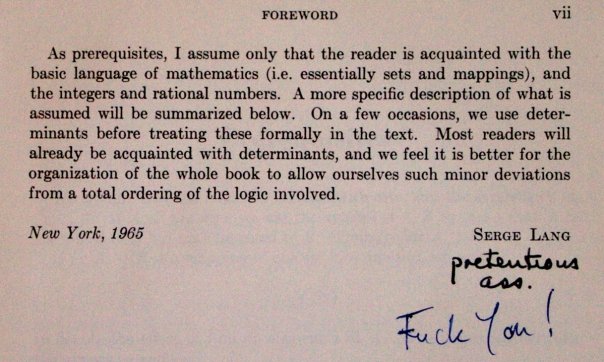
I took at graduate algebra course at Brown when I was an undergraduate. I bought a copy of Lang’s “Algebra,” 3rd edition around that time. It was the bible of graduate algebra, and I suppose that it still is. When I was at Harvard, I studied very hard for the written qualifying exam that we sat for at the end of our first year of graduate work. I spent months mastering the core material in algebra, topology and analysis. I got a little frustrated by Lang’s style and wrote the comment that you see in black ink. Years later, Serge had my office in Princeton while I was away in Paris. As usual, he consulted his own books, and he found my comment. He added his own (bottom of the page) and told me about it when I returned to the US. We both had a good laugh.
I was amazed, years later, when a German mathematician asked me about this page when we were at the Canadian number theory meeting in Vancouver — this must have been 20 years ago. How did the guy know? Serge or I must have talked, and word had gotten around.
—-
I made this image in July, 2001 by pointing my first digital camera at the page and pressing the shutter. Serge was in town, and I told him that I wanted to link this image to the web page for the graduate algebra course (Math 250A) that I was about to teach. That way the students could see it. “Of course!” As the semester progressed, mathematicians around the world found out about the link on my web page and began forwarding the URL to their friends. One day Serge phoned me in my office: “You mean anyone in the world can see this? Take it down!!” So I did.
How to challenge the SEC
This is a guest post by Aaron Abrams and Zeph Landau.
No, not the Securities and Exchange Commission. We are talking about the Southeastern Conference, a collection of 12 (or so) college football teams.
College football is a mess. Depending on your point of view, you can take it to task for many reasons: universities exploiting student athletes, student athletes not getting an education, student athletes getting special treatment, money corrupting everybody’s morals . . .
Putting those issues aside, however, there is virtually unanimous discontent with an aspect of the sport that is very quantitative, namely, how the season ends. Fans hate it, coaches hate it, players hate it, and there is a substantial controversy almost every single year. Only a few people who make lots of money off the current system seem to like it. (Never mind that anyone with a brain thinks there should be a playoff … perhaps that’s the subject of another post.)
Here’s how it works. There are roughly 120 major college football teams and each team plays 12 or 13 games in the fall. Almost all the teams belong to one of eleven conferences — these are like regional leagues — and most of the games they play are against other teams in their conference. (How they schedule their out-of-conference games is an interesting issue that we may write about another day.) At the end of the season, teams are invited to play in bowl games: games hosted at big stadiums with names like the Rose Bowl, the Orange Bowl, etc., that have long traditions. The problem centers around how teams are chosen to compete in these bowl games.
Basically, a cartel comprised of six of the eleven conferences (those that historically have been the strongest, including the SEC) created a system, called the BCS, that favors their own teams to get into the 5 most prestigious (and lucrative) bowl games, including the so called “national championship game” that claims to feature the top two teams in the country. The prestige gained by the 10 teams that compete in these games is matched by large amounts of money, coming mainly from television contracts and ticket sales. For each of these teams, we are talking about 10-20 million dollars that goes to a combination of the team and their conference. This is not a paltry sum for schools facing major budget cuts.
The most blatant problem with this system is that is it literally unfair: the rules of the system are written in such a way that at the beginning of the season, before any games are played and regardless of how good the teams are, the teams from the six “BCS conferences” have a better chance of getting into one of the major bowls than a team from a non-BCS conference. (You can read the rules, but notably, each of the conference champions of the six BCS conferences automatically gets to play in a BCS bowl game; whereas the other conference champions only get to play in a BCS bowl game if various other conditions are met, like they’re highly ranked in the polls).
There are lots of other problems, too, but we’re not really going to talk about those. For instance the method for choosing the top two teams (which is based on both human and computer polls) is deeply and fundamentally flawed. These are the teams that play for the “BCS championship”, so it matters who the top two are. But again, that’s the subject of a different post.
Back to the inherent unfairness. Colleges in the non-BCS conferences are well aware of this situation. Led by Tulane, they filed a lawsuit several years ago and essentially won; the rules used to be even worse before that. But in the face of the continued lack of fairness, colleges from non-BCS conferences have lately taken to responding by trying to get into the BCS conferences, jockeying for opportunity at big money. It has gotten so bad that a BCS conference called the Big East now includes teams from Idaho and California. Realignment has caused the Big 12 to have only 10 teams, while the Big 10 has 12.
But realignment takes a lot of work to pull off, and it only benefits the teams that get into the major conferences. The minor conferences themselves are still left behind. So here is a better idea. If you’re a non-BCS conference, do what any good red-blooded american corporation would do: find a loophole.
Here is one we thought of.
The current rules force the BCS to choose a team from one of the 5 non-BCS conferences if:
(a) a team has won its conference AND is ranked in the top 12, or
(b) a team has won its conference AND is ranked in the top 16 AND is ranked higher than the conference champion from one of the BCS conferences.
What they don’t say is what it means for a team to “win its conference.” Some conferences determine their champion by overall record, and others have a championship game to decide the champion. This is the chink in the armor.
This year two interesting things happened: (1) in the Western Athletic Conference (WAC), Boise State ended up ranked #7, but did not win their conference. The WAC doesn’t have its own championship game, and the conference winner was TCU by virtue of beating Boise State in a game in the middle of the season. However, TCU also lost a game to a team outside their conference, and they ended up ranked only #18. As a result, neither team satisfied condition (a) or (b) above.
And (2) in Conference USA, Houston was undefeated and ranked #6 in the country before the final game of the season, when it lost its conference championship game to USM. The loss dropped Houston to #19 in the rankings, whereas USM, the conference champion, finished with a final ranking of #21. Thus neither of these teams met (a) or (b), either.
Here is what we noticed: if the Western Athletic Conference had a conference championship game, then either Boise St would have won it, been declared the champion, and qualified for a BCS bowl, or else TCU would have won it and would almost surely have ended up with a high enough rank to qualify for a BCS bowl. (As it was, TCU finished the season at #18, but one more victory against a top ten team would very likely have gained them at least two spots. This would have been good enough for (b) to apply, since the champion of the Big East (a BCS conference) was West Virginia, who finished ranked #23.)
On the other hand, if Conference USA hadn’t had a championship game, Houston would have been declared the conference champion (by virtue of being undefeated before the championship game) and they would easily have been ranked highly enough to get into a BCS bowl. Indeed, it has been estimated that their loss to USM cost Conference USA $17 million.
So, what should these non-BCS conferences do? Hold a conference championship game . . . if, and only if, it benefits them. They can decide this during the last week of the season. This year, with nothing to lose and plenty to gain, the WAC would clearly have chosen to have a championship game. With nothing to gain and plenty to lose, Conference USA would have chosen not to.
Bingo. Loophole. 17 million big ones. Cha ching.
Good bank/ bad bank – why we didn’t do it
Today’s guest post is written by my aunt, the economist Susan Woodward. I recently found a paper she had written which proposed to split up banks into ‘good’ and ‘bad’ banks. This is an idea I’ve heard bandied about, and it always sounded like a good one and moreover one that’s seemingly worked in other countries. “Why hasn’t this happened?” I asked. This is her response:
—————————————————-
The good bank/bad bank idea is kaput. “We” (the US) did not do it because
1) it would have re-written the contract between the bank bondholders and equity holders. If the govt forced this, it would have given the bondholders the right to sue for damages for the losses imposed on them, and likely they would have won, as many thrifts did when FIRREA (1989) changed the deal ex post.
2) the only point of it would be to leave the “good” bank with plenty of equity so that it could fund its commercial paper smoothly and cheaply. Any other workout or guarantee would do the same thing, and the other loans (now we know, $7.8 trillion dollars worth) and guarantees did do the same thing. The big US banks are still undercapitalized, but forcing them to raise equity right now is sort of impossible politically. So instead we just don’t let them do anything exciting and avert our gaze from the non-performing mortgages they have not yet written-down. I know that BofA is selling its above-water mortgages in order to book gains.
But I confess I am baffled by bank accounting now — it is a mix of assets (and liabilities!) marked-to-market and others not, by logic that eludes me. In Citi’s last earnings report, a large fraction of “earnings” was a decline in the value of its bonds (if a rise in the value of an asset is income, so is a decline in the value of a liability, it is not entirely crazy, just not done much before) because markets assigned a lower likelihood to them paying the bondholders. What a reporting convention. oh dear.
Citi and BofA are maybe broke anyway. Their market caps are both below $80 billion (depending on the temperature of the Euro mess) on assets of about $2 trillion each. I imagine that various parts of the govt are working on contingency plans for orderly dismantling of them. Just in case.
As for European banks, they may need lots and lots of help, depending on what Europe does about the ECB and its ability to issue bonds, buy bank assets, and, ulp, collect TAXES. All of the pundits are right that if the ECB could buy sovereign bonds and bank bonds, it could fend off a meltdown at least for now. The US Fed has bought 11% of GDP’s worth of US bonds, and the UK has done 13%. So it is not a new or unknown strategy. But in the US and the UK, the power to tax as well as the power to print money lies behind the institution.
The situation is somewhat like the original States after 1779, when the new constitution reserved the right to print money to the federal government, and took it away from the States. The first federal power to tax was not direct, but worked through telling each state what share it owed, then counting on the States to raise the money, sort of like the ECB now. When the Federal govt finally got the power to tax directly, the value of its bonds, 23 cents on the dollar in the early chaotic years, rose to par, then above par. The federal assumption of the States’ expenses for the revolutionary war resulted in a deal — Virginia, which was very prosperous and had paid off some of its war debt, agreed for the deal to assume the burden of Massachusetts, which had not paid off so much and in any case also had a heavier burden in the revolutionary war, in exchange for moving the capital from New York to Philly (temporarily), then on to Washington. The deal was cut at a dinner party in New York attended by Jefferson, Madison, and Hamilton. I wonder what wine was poured.
In those early years, States funded their state-level budgets with earnings from owning shares in banks they chartered! And the previous colonies funded their budgets from mortgage lending! So much for the separation of finance and government.
Were Massachusetts and Virginia then more similar to each other then than Germany and Italy are now? Not so clear.
Writing clear and helpful things about the financial crisis is not easy and takes heaps of time, which is why we quit doing it. But hey, if you have it, go for it.
love, Aunt Susie
The Numbers are in: Round 1 to #OWS
This is a guest post by FogOfWar:
CUNA (a trade industry group for credit unions) just announced that at least 650,000 customers and USD $4.5 Billion have switched from banks to credit unions in the last five weeks. I think this is a pretty impressive showing for the lead up to “Bank Transfer Day”, and, as posted before, am a supporter of the CU transfers. A few quick points on the announcement:
Are those numbers driven by “Move Your Money” or BofA’s $5 Debit Fee?
A little of both, I suspect, and there’s no hard survey data (that I know of) splitting it out. The two points aren’t completely separate, as one of the points of “move your money” (at least in my mind) is to let people know that credit unions generally have lower fees than large commercial banks & it often makes financial sense to shift your account over regardless of your political views on “Too Big To Fail (TBTF)”.
So is 4.5 Billion a lot or a little?
It isn’t a big number in the scope of overall deposits, but it’s a really big number for transfers in just one month. For scale, the total deposits in all 11,000+ CUs nationwide are somewhere around $800Bn, and that’s roughly 10% of the total deposits in the US. So $4Bn (to make the math easy) is a 0.5% increase in deposits for CUs and somewhere around a 0.05% reduction in the deposit base of US banks in the aggregate. I suspect the transfers are concentrated in the large “final four” banks (BAC, JPM, C, WFC which, if memory serves, account for somewhere around 40% of deposits), so the reduction might be closer to 0.10% for the TBTF quartet.
Wait, those seem like really small percentages—why do you think this matters?
Well, because it’s a greater increase in deposits in one month than credit unions (in aggregate) got in the entirety of last year (and last year was a good year for CUs in which they saw their market share increase). People (rightly) don’t change their checking accounts lightly (there’s a lot of “stickiness” to having direct deposit/ATM cards/etc.—in short it’s a pain in the ass to change your financial institution), so this is a pretty impressive number of people and amount of deposits in this span of time.
Also (and this will play out over time), this could be the start of a trend. Certainly there seems to be a large uptick in discussion of “move your money”, and, as the idea percolates around there’s a lag between thought an action, so this well could be a slow build.
“A Slow Deliberative Walk Away from the TBTF Banks.”
Another important point is that, in fact, you really don’t want too many people moving their accounts in a short period of time for two reasons. First, a rush of people all removing their deposits at the same time is, in fact, a “run on the bank”. This is destructive for a host of reasons—in particular it can cause the institution on which there’s been a run to go into bankruptcy (regardless of whether that bank is otherwise solvent), and, let’s not forget, we the taxpayer are ultimately on the hook for the deposits of bankrupt commercial banks through the FDIC, which is funded by bank fees but backed by the full faith and credit of the taxpayer (and a BofA bankruptcy might put that backstop to the test). So, much as I disagree with many of the decisions of the mega banks, I don’t want the “move your money” campaign to be a catalyst for their insolvency proceedings.
Instead, what I’d really like to see is a slow steady whittling down of their deposit base, and thus their overall size, until they are no longer considered “to big to fail” and thus pose no danger to the taxpayers, as they will be free to make good or bad decisions and live or die, respectively, by them. In short, I’d like to see a “slow deliberative walk away from the TBTF banks” playing out over the course of the next 2-3 years.
The other reason is that credit union’s can only take deposits at a certain pace without running into issues with their own capital buffers and operations. This is a slightly technical issue, but with a substantive point behind it. In essence, absorbing a large growth in new deposits takes some time, not just from an operational perspective (ramping up staff, at a certain point opening new branches and ATMs), but also because more capital needs to be accumulated to provide a safety buffer for the additional deposits that have been taken on. From this perspective, the $4.5 Bn in 5 weeks is a “goldilocks” level—not to much to overheat, not too little to be a rounding error, but just right (OK, actually think it could be 2-3 times the pace without overheating, but everyone else loves to use that hackneyed “goldilocks” metaphor and I just felt peer pressure to frame it that way).
I read that it won’t have an impact on the banks—is that true?
In a word, “total fucking bullshit”. The deposit base is the skeleton of a bank—it’s what holds the whole thing together. Deposits are steady (essentially) free money. Money that can be deployed wherever the bank finds interesting at the moment: loans to customers, speculative exotic derivatives, new branches, foreign investment, whatever. Moreover, if retail deposits mean so little to banks, then why in the world do they spend so much advertising coin chasing them? Generally for profit institutions advertise for products that are profitable to them, not one’s that are irrelevant. QED.
That’s true over the long term. It is worth noting, however, that at this exact moment in time the banks are flush with cash sitting idle on deposit with the fed. http://www.cnbc.com/id/44019510/Bank_of_New_York_Puts_Charge_on_Cash_Deposits Which, by the way, makes it perfect timing for the “move your money” campaign. As I said before, I really don’t want a “run” on the banks, and the fact that banks are flush with cash currently means they’re relatively safe in the immediate moment from a loss of deposits.
But the real reason you’re still seeing Chase commercials on TV even though they’re flush with cash doing nothing at the Fed, is that Chase knows that most people rarely change their primary checking accounts. The accounts that are moving over now are (statistically) gone for good. Later, when that flush cash at the Fed is no more and the banks want the easy money of a wide retail deposit base, they’ll find it very difficult to bring those people back. Not because credit unions are really awesome, just because people really don’t like switching accounts—BofA has to spend a lot of energy to bring in a new account from another institution and doesn’t actually care if it brings it in from lower east side people’s or from Citibank (money is fungible).
Lastly, and perhaps most important, the primary checking account is the primary point of entry to our financial lives. Big banks like the free money you give them on deposits, but equally much they like the chance to have your credit card business, your mortgage and car loan business, your insurance business, your investing business and possibly your retirement and college savings business. All that ancillary business can be (and very much is) statistically quantified on a per-account average basis. All those cross-sells add up over time to big numbers.
FoW
Towards a better financial system
This is a guest post by H.R., a risk management quant:
First, let’s clear the ground for new ideas by questioning the myths that have justified the current system.
Myth 1: The wisdom of the free market is the answer to everything (if only we could get rid of market frictions like regulations and taxes).
Evidence against:
- Behavioral finance has empirically demonstrated a wealth of cognitive biases that distort the market.
- An Indian perspective on the effects of the liberalization of their economy.
- When it comes to their own welfare, the 1% have abandoned the free market in favor of the predator nanny state.
Myth 2: The work of the 1% is indispensable.
Evidence against:
- Empirically, pumping resources to the “job creators” does not seem to be very effective.
- Most of the 1% are not even “job creators”.
- And the marginal value of those that are is questionable.
Myth 3: The unemployed exist because they don’t have the right skills or attitude.
Evidence against:
- Bill Mitchell argues that with the current lack of jobs, “skills training” and similar efforts may shuffle around who gets the jobs, but won’t solve the unemployment problem.
- Economist DeLong concedes that maybe Kalecki had a point about unemployment as a means of lowering wage earners bargaining power.
Myth 4: The government can never compete with the private sector.
Evidence against:
US health care is ridiculously uncompetitive compared to other countries nationalized systems.
Myth 5: We have to choose efficiency over inequality.
Evidence against: Chris Dillow makes the argument that
- better managed government can’t simultaneously deliver us maximum efficiency and equality, and
- there are good arguments for choosing equality over efficiency.
Myth 6: We are constrained by budget deficits.
Some basic ideas from Modern Monetary Theory would disagree.
Myth 7:
- Dollar hegemony,
- cheap oil,
- and infinite growth will go on forever.
Next, we need to imagine the possibilities.
There will be government giveaways. Leave it up to the 1% and they will grab the giveaways for themselves. Let’s decide for ourselves what our priorities are and imagine a system that serves us all.
We can use the tools of
We can imagine the possibilities for a better system
If we aren’t happy with are national system, we can think about how to start local action.
- by switching to alternative local currencies
- which is already happening in the Bay Area.
Shareholder Value
This is a guest post by Mekon:
It was late August, 1990. The barely-above-mediocre Boston Red Sox (record: 73-57) led the definitely-mediocre Toronto Blue Jays (record: 67-64) by 6½ games in the American League East. Unsure his team could hold off the hard-charging Jays with a month left in the season, Sox general manager Lou Gorman decided to shore up his bullpen. He offered the Houston Astros a young minor league prospect named Jeff Bagwell for aging-but-competent relief pitcher Larry Andersen. The Astros, long out of the race, said yes. What happened next is the stuff of legend, sort of:
- In September, the Sox went from flirting with mediocrity to wrapping it in a loving embrace (a 15-17 record down the stretch), but still managed to hold off the mighty Jays by 2 games.
- As the Sox staggered to the division title, Andersen chipped in 22 innings in 15 games with 1 save and a good ERA (1.23). If you believe in the Win Shares statistic they quote here, Mr. Aging-but-Competent contributed the equivalent of about 1 win.
- In the playoffs, the 88-74 Red Sox faced the defending World Series champion Oakland A’s (record: 103-59). The A’s won all four games, by an aggregate score of 20-4. Andersen pitched three innings and gave up two runs. He was charged with the loss in the first game when he gave up a run in the 7th inning of a 1-1 game just before the A’s broke the game open.
- The A’s, overwhelming favorites to repeat as World Series champs, lost the Series to the 91-71 Cincinnati Reds in four straight. You never know, do you, baseball fans?
- Andersen was declared a free agent after the season ended. He left the Sox, signed with the San Diego Padres, and pitched in the majors for another four years. Somewhere along the way, “aging-but-competent” became just “aging,” as he compiled an aggregate record of 8-8.
- The Astros promoted Bagwell to the major leagues in 1991. He was the 1991 rookie-of-the-year, the 1994 MVP, and the face of the franchise for 15 seasons. He retired with an exceptional lifetime OPS (On-base Plus Slugging average, today’s batting statistic of choice) of .948, as well as 449 home runs, currently 35th of all time. In his first year of Hall of Fame eligibility (2011), he got about 40% of the vote, a figure dragged down by suspicions of steroid use.
- In later years, Gorman appeared to look back on the trade with pride: “I called Bob Watson and made the trade, Bagwell for Andersen. Andersen would strengthen our bullpen and help us win the Eastern Division title, and we’d go on to face the A’s,” Gorman would write. “He was exactly what we needed to bolster the pen at a critical juncture in our run at the division title.”
- Red Sox fans and ownership agreed. At the Sox’ 1990 holiday dinner, owner and chair Jean Yawkey announced a $2.5M bonus for Gorman for “enhancing ticketholder value” by getting the team to the playoffs. Grateful fans gave him a loud ovation on Opening Day the following April. While a few cranky Boston Globe writers made fun of the Bagwell-for-Andersen trade over the next few years, the public didn’t buy it. As the Sox finished well out of the running each of the next four years, fans always found comfort in the thrilling playoff run of 1990.
OK, I made that last one up: everyone, except apparently Gorman, realized almost from the outset that trading away Bagwell for Andersen was a disaster. As the Sox stumbled through the next several years (see, I didn’t make it all up), poor Lou, who had actually had a pretty good career as a major league GM, became a laughingstock, finally losing his job in 1993. His name still shows up near the top of any “Worst Trades Ever” list that baseball writers feel obligated to make every year around the trading deadline. You could even argue that teams became more cautious about holding on to their minor league prospects after seeing how badly Gorman and the Sox screwed up.
All well and good. But what if I told you that outside sports, in the world of business and finance, the little piece of fiction I put at the end of the Bagwell-for-Andersen story actually isn’t fiction at all?
Shareholder value. Google the phrase and you’ll find almost 5 million links. Virtually all of them (or at least the first five I checked) equate it with the value of the firm or the share price. If you think that’s just a shortcut, it’s not: at the end of every year, companies whose stock grew in price that year give their CEO’s hefty bonuses for – you guessed it – boosting shareholder value. The trouble with all this is that it misses the dimension that Sox fans demanding Lou Gorman’s head understood very well: time.
Say you’re a shareholder in IBM. Maybe you bought (or received) your stock outright, or maybe you gave some money to a manager and had them buy the stock, either directly in your name or pooled with money from other people just like you (i.e., through a fund). Either way, you are, in financial parlance, an asset owner (as distinguished from an asset manager, who manages what you, the owner, hold).
But step back a bit: why do you own this asset, anyway? You’re not going to consume it, like you might a gallon of milk or a car. You don’t get any pleasure from it, like you might from a piece of art that hangs on the wall. The only reason to own a share of IBM is so you can sell it. Hopefully at a high price. And if you own IBM stock now to sell it later, you have to think about time. When will you sell it? Five minutes from now? Five years from now?
When you’ll sell is driven by why. Essentially, there can be two reasons:
- You want to spend the money. You sell your IBM shares and use the proceeds to buy a car, or a house, or a nice picture, or to send your kids to college. A variant of this is that you expect to need the money soon (your kids are going to college next year), and you don’t want to risk IBM decreasing in value, so you sell your shares and put the money in the bank (or in another low-risk asset) until you need it.
- You (or an asset manager acting on your behalf) decide to replace IBM with an asset you like better. Time is embedded implicitly here too: if you’re selling IBM to buy AAPL, you expect AAPL to do better than IBM over some time horizon. Which could be until you need the money, or it could be sooner. For example, I might plan to hold AAPL for a year (over which time I expect it to do better than IBM), and reevaluate what I hold after that.
Asset owners who sell because of (1) are called buy-and-hold investors. Asset owners who sell because of (2) are called traders. Rebalancing, where you hold assets for some period of time, then decide whether to replace them, is essentially a disciplined form of trading.
Now that we know why asset holders sell, we can talk about when. Take buy-and-hold investors first. If you’re selling assets to fund expenses, you’re usually either buying something big (a house or a car, not a gallon of milk) or you no longer have income (you’re retired). Now, truly large expenses are rare, and people usually retire late in life, so asset sales by buy-and-hold investors are spread out across time. In any given year, only a small minority of buy-and-hold investors need to sell assets to raise funds.
Traders initially seem more complicated, and probably are. But we can capture them pretty well by saying they sell when they see a new asset they think will get them better future returns. The more they like the return profile of an asset they already hold, the more they behave like buy-and-hold investors.
Now let’s ask again: what is true shareholder value? Given what we know about asset owners, what is in their best interest? A related question: who benefits when the stock price goes up? Shareholders, surely. But that’s only half the answer. The full answer is shareholders who sell.
Let’s look at buy-and-hold investors first. If the stock price goes up over a year, it benefits investors who sell that year. The remaining investors realize the gains only to the extent that those gains persist when they sell. Since they sell at different times, there’s only one way to benefit them as a group: enhance the value of the company consistently over time.
Of course, once you realize that boosting the share price over the short term doesn’t actually enhance value for most shareholders, you also see that immediate stock price gains are a terrible measure of a CEO’s performance. Red Sox fans understood this right away, and did all they could to run out of town the guy who boosted the short-term stock price (likelihood of making the 1990 playoffs) at the expense of long-term value (Jeff Bagwell’s career).
If you don’t believe me, here’s Warren Buffett making a related point:
“If you expect to be a net saver during the next 5 years, should you hope for a higher or lower stock market during that period? Many investors get this one wrong. Even though they are going to be net buyers of stocks for many years to come, they are elated when stock prices rise and depressed when they fall. This reaction makes no sense. Only those who will be sellers of equities in the near future should be happy at seeing stocks rise. Prospective purchasers should much prefer sinking prices.”
Now, this doesn’t mean you should manage a company to make the stock price drop, in part because there’s a big difference between existing shareholders and prospective ones. But the intuition is the same: investors should worry about the stock price when they buy and sell, and at no other time, and CEO’s should worry about shareholder value across time, not in the short term.
We know, though, that not all asset owners are buy-and-hold investors. Does the presence of traders – whether disciplined rebalancers, day traders, or high-frequency hedge funds – change things? Should it make management pay more attention to short-term stock price movements?
Let’s start with the basics: when you own an asset, its price matters only when you sell, and traders sell when another asset has a better return profile (or when they need to raise funds). Ignoring the latter, and assuming other assets’ profiles don’t change, we conclude that a rising stock price benefits traders if it comes with a worsening future return profile. (By the way, rapidly rising asset prices do usually mean worse expected future returns – but that’s a longer discussion.) That’s clearly no way to run a company, but it’s worth articulating two important reasons why:
- It harms the rest of their shareholders, who plan to keep their shares for longer and want a good future return profile (duh).
- In the aggregate, it even harms short-term traders. Remember, we’re taking asset owners’ points of view here, and even asset owners who are traders need to get their long-term returns from somewhere!
In a little more detail, imagine a world where all companies are managed for the (supposed) benefit of short-term traders, maximizing short-term stock price growth and (purposely or not) making longer-term growth prospects less attractive. So now a year (say) goes by, and all stock prices have gone up a bunch (i.e., there’s a bubble). Asset owners who are traders want to take their profits and invest in another asset that’s more attractive in the long-term – but what? If all companies focus on short-term profit, then all assets are worse in the long term. So, as an asset owner, you’ve made some money, but what are you going to retire on?
Put another way, there’s no way to trade out of the economy – from a global point of view, everyone’s a buy-and-hold investor. If companies manage for the benefit of short-term traders, even traders lose.
So why do we keep rewarding CEO’s for short-term stock price boosts? Every Red Sox fan knew Lou Gorman was mismanaging the team, so why can’t the best minds in business and finance see it? Or does something about the system pervert perspectives and incentives? I’ll take that on in another post.
Credit Unions in NYC flyer
Also from FogOfWar; see also this post where FoW discusses “Why Credit Unions?”:
Why Credit Unions? (#OWS) (part 1)
This is a guest post by FogOfWar. See also the “Credit Unions in NYC flyer“.
Moving your money from a megabank to a credit union or community development bank makes for a good sound bite, but is it really an action that can have an impact in the right direction? I think so (although the matter is not free from doubt), and thought it would be worthwhile to lay out thoughts on the subject as a follow-up to the “What is a Credit Union?” post.
I’ll focus this discussion on credit unions, rather than community development banks or smaller locally owned banks as that’s where my knowledge lies.
Credit Unions are not Too Big To Fail
A quick google search indicates the largest credit union in America is Navy FCU with $34Bn in assets. (Internationally, it may be the Dutch Rabobank, although I’ve never gotten a good handle on whether Rabo is still a cooperative or not.) Individual credit unions fail regularly, just like individual banks, but there isn’t one CU that’s in danger of crashing the entire financial system in the same manner as BAC, C, JPM or WF.
During the 2008 crisis and aftermath the only credit unions that got a federal bailout were the corporate credit unions. There’s a good article about that here. The corporate credit unions definitely got into trouble buying structured products and I don’t want to gloss this fact over. There’s a split between the retail credit unions, who are going to have to pay for these mistakes, and the corporate credit unions which made the bad investments as well as the NCUA, who was asleep at the switch when the corporate CUs were making that investment. Also worth noting that the NCUA has filed suit against the banks for selling crap product to the corporate CUs.
The corporate credit union bailout was small proportionate to the overall credit union size. $30 bn of gov’t backed bonds equates to $270 bn proportionate for banks—less than ½ of the official state of TARP and a small fraction of the overall size of the taxpayer support given to the large (non-CU) banks indirectly through TAF, TSLF, PDFC, TARP, TALF, etc.,… (see this for an explanation of term).
All in all, I’d say CUs come out somewhat ahead by this measure.
Volker Rule/Glass Steagall
Unlike commercial banks, credit unions never revoked the Glass Steagall act and remained segmented as “pure” traditional banking entities. This means that CUs don’t mingle traditional banking (deposits, checking accounts, loans to customers), with investment banking activities (IPOs, M&A advisory) or derivatives trading or sales desks, let alone prop desk frontrunning of client information.
There’s a lot of ink out there on Volker and Glass Steagall. In short, it seems like a good idea, if not sufficient as a complete solution, to keep traditional banking segmented from investment banking and proprietary trading. The core point is that trading risk should not infect the core banking business putting it (and the taxpayer standing behind the federal deposit insurance) at risk. Very good recent example of this here.
CUs come out dramatically ahead on this measure.
Lobbying—just as bad?
Credit Unions do lobby, largely through two groups, CUNA and NAFCU. In fact, NAFCU has been an opponent of the CPFB, and the CU lobby got itself removed from the debit swipe fee cap.
There was a time I can remember when CUNA and NAFCU just went up to the hill to remind Congress that they existed and defend against the ABA’s occasional attempts to change the tax status of CUs. It seems times have, rather unfortunately, changed.
Regrettably, no advantage to Credit Unions here.
Part 2 will talk about investments in local communities, democratic control (the good, the bad and the ugly) and securitization/mortgage transfers.
FoW
Habits
This is a guest post by my friend Tara Mathur:
I don’t need to read Tiger Mother to know that I don’t have one. I don’t remember either of my parents putting a lot of pressure on me to do things – even to study, although I developed that habit on my own.
As kids we develop some habits on our own, but we pick up a lot of habits from our parents.
We learn habits from our parents in a few ways. One is by mirroring them. For example, my parents have always read in bed before going to sleep and so have I; it’s so natural to me that until I got married I thought this was something everyone did.
Another is by having our parents make us do something repeatedly. For example, when we first brushed our teeth it probably seemed like a pain to do, but our parents kept making us do it, and it became automatic.
How can we cultivate new habits as adults?
(And am I the only one who associates the word “will-power” with pain and failure? People use that word when they’re talking about doing something really hard, against their natural tendencies. I hear that word and think, how is this gonna last?)
In the last few years I’ve become a big fan of a blog called Zen Habits written by Leo Babauta. He’s made big positive changes in his life – getting out of debt, quitting smoking, running marathons, starting a successful writing career – by focusing on habits rather than goals. Even though big goals are sexy and easy to get excited about, it’s the daily habits, built up baby step by baby step, which last and which comprise most of our life. By definition, when something is a habit we don’t have to rely on willl-power to stick with it. It’s effortless, automatic behavior. Leo emphasizes starting small and focusing on one habit at a time.
This could apply to any positive change we’d like to make in our life. BJ Fogg, a human behavior expert who runs the Persuasive Technology Lab at Stanford, sums up the three steps to cultivate a new habit as follows:
- Make it tiny. To create a new habit, you must first simplify the behavior. Make it tiny, even ridiculous. (examples: floss one tooth, walk for three minutes, do two push-ups)
- Find a spot. Find a spot in your existing routine where this tiny new behavior could fit. Put it after some act that is a solid habit for you, like brushing teeth or eating lunch. One key to a new habit is this simple: you need to find what it comes after.
- Train the cycle. Now focus on doing the tiny behavior as part of your routine – every day, on cycle. At first you’ll need reminders. But soon the tiny behavior will get more automatic. Keep the behavior simple until it becomes a solid habit. That’s the secret to success.
That’s it! He says. Just keep your tiny habit going. Believe in baby steps. Eventually it will naturally expand to the bigger behavior, without much effort.
(There are other tricks too. I’ve also read that you’ll pick up a habit more quickly if you surround yourself with people who already have the habit you want — though I’m not sure if it will last when you’re no longer around those people. Try it and see what works.)
Guest Post: What is a family?
By guest blogger rwitte
The social structures commonly talked about when discussing finance and economics include individuals, governments and corporations. However the most social structure is family, since it is the structure that results in the perpetuation of society. I was reminded of this by a recent link that mathbabe posted here. And since she invited me to write a guest post, it inspired me to mouth off about family.
What do you think of when someone uses the word family? I am guessing that you think of the so-called nuclear family consisting of a husband a wife and a variable number of children. For sure their are many variants including one-parent families and gay families, but the ideal is thus. It wasn’t always so. I am a fifty year old male of Ashkenazi Jewish descent. In that community my generation is the first to have prioritise the needs of small nuclear families. My grandmother’s idea of family was a much larger group, extending over several generations, and with a healthy side-order of cousins, aunts etc. My wife is Jaimaican, and her mother’s conception of family is similar to my grandmother’s (except the Jamaican version is even more matriarchal because so many of the fathers are absent).
I don’t know if you have ever seen a family home from a hundred and fifty or more years ago. You will be surprised at the size; there are more rooms for a family, at any level in the social scale. This is because the experiences of my wife and I are not unique, they are just a few generations later than those of the majority. Until relatively recently, as in most ‘primitive’ societies, the family is the extended family, and you will commonly find three or four generations living together.
I think the organisation of society into extended families was a great idea, and that the fragmentation into nuclear families sucks. But before I explain what’s so terrible about them I want to take a paragraph to explain why I think the change occured in the first place. Nuclear families are small and relatively mobile. As industrialization progressed and first transcontinental and then transglobal corporations formed, it suited their purpose to be able to move and resettle employees between different sites in their empires. At the other end of society the pull of the factories was encouraging many to move from rural areas to the big city. This also fragmented extended families; the units that moved were nuclear. As a process in the developed countries, it probably peake in the 1950s or 1960s, but it is still going on now in developing countries such as China.
The original myth of the nuclear family was one in which the male was the breadwinner and married women stayed home to provide full time childcare. This idea, obviously sexually discriminatory, is certainly a myth. It has never been the case that poor couples could support themselves on one person’s wages. Manual labour has never been that well payed. And since the rich typically had access to nannies, only a thin stratum of society has ever organized childcare this way.
Today, in an attempt to paper over the cracks in this story, a new myth has arisen. Namely, the ‘superwoman’ who has it all: career, children, and social life (it only take 28 hours a day eight days a week!). In actual fact this myth is probably even more dangerous than the previous one, because millions of women are now trying to live up to this impossible ideal. When they don’t overachieve these impossibly demanding targets, they feel guilty and inadequate. For some, serious mental health issues can ensue as the buckle under the pressure.
We often complain about the poor quality of life our society offers to our elders. They get stuck in some retirement home quitely out of sight where they can slowly die of boredom. The middle classes must pay for child-care and the exorbitant prices push them towards poverty. Meanwhile poor parents simply cannot afford adequate child care and poor children roam the streets; ‘latch-key kids’ with no adequate supervision between the end of school and the parents’ return from the work. Some of these children get really out-of-control; getting involved with drugs, crime, and street-gangs in some combination. I don’t want to get too carried away with arguments about ‘the youth of today’ because the rose-tinted vision painted nostagia never was, but still I hear the cries, something must be done.
I believe that we can overcome all these social problems by returning to a social organisation based on extended families. The grandparents can look after the children while the able-bodied parents go out to work. This leads to an interesting and fulfilling retirement, in which they can pass on the wisdom that they have accumulated over the years to a willing audience. The children get an educational, loving and supportive home-life which will help them to grow up honest and secure. And the fittest adults can commit 100% to the workforce increasing social productivity.
Of course it may be that the grandparents are still too young to retire and the great-grandparents take on the responsibility. Or maybe a cousin or Aunt who particularly enjoys childcare can set up a sort of family creche. Perhaps all the adults work and coordinate their days off in a rota so that who looks after the children depends on the day of the week. Nobody would be surprised to discover that while all families have much in common, every family is different. The role of the greater society is as to encourage and enable relatives to remain geographically close to each other. It would be up to each particular family to work out how to organise themselves for their own convenience (although there is some evidence to suggest that children brought up by maternal grandparents are more psychologically secure than those brought up by paternal grandparents).
Modern advances in information and communication technology may render a society with less geographical relocation of people possible. You don’t have to be in the same office to work with somebody (hell, you don’t even have to be in the same continent). Instead of workers having to move around the globe, they can stay with their parents and children while their information flows around the internet and other computing networks, more quickly, conveniently and cheaply.


 mathbabe
