Archive
Guest post: Who gets to live in techno-utopia? Disability rights, eugenics, and effective altruism
This is a guest post by Victor Zhenyi Wang. Victor worked as a data scientist in global health and development at IDinsight India. He is currently a Masters student at the Blum Center for Developing Economies at UC Berkeley. He is interested in technology policy, participatory approaches to AI, and digital public infrastructure. He studied mathematics at the Australian National University where he developed a passion for long distance running. Victor also writes a blog about technology, ethics, and disabilities.
In September, I attended Manifest, a forecasting and prediction markets conference. This conference attracted a unique combination of speakers: Nate Silver, Robin Hanson, Destiny, Aella, to name a few. Other prominent guests included Richard Hanania, author of the recent “The Origins of Woke” and Jonathan Anomaly, an academic who writes on the ethics of eugenics, among other things. This conference, in Berkeley, also attracted a typically rationalist and effective altruism crowd.
Before the conference, there was a fair bit of contention around Richard Hanania’s attendance. A HuffPost article had just come out which revealed that under a different name, he wrote a number of hateful diatribes on race, gender, among other things. Since this is a prediction markets conference, a market was formed around whether he deserves to attend as a speaker. Austin Chen, the founder of Manifold (the forecasting app behind the conference), published a statement on his views on why he chose to invite Hanania; Hanania’s talk was withdrawn although he did attend the conference to promote his new book. A related post is on how many people protested by not coming.
Meanwhile, another speaker, the philosopher Jonathan Anomaly, spoke on “liberal eugenics”. “Liberal” eugenics concerns genetic enhancement at the group level through manipulation via technology. This is “liberal” in that no existing people are harmed and there is no obvious coercion. Instead, voluntary genetic selection and enhancement¹ is mediated via technological advancements. This is analogous to existing practices in genetic screenings of embryos. For instance, parents today have the choice to abort a fetus if certain genetic conditions such as Down syndrome are detected. This is legal in some countries, such as Australia.
If we believe that this is permissible, then why not allow parents to do this for other traits? As genome sequencing and predictive medicine evolve, we will likely have the technology to predict traits of embryos in vitro. It may even be possible for us to estimate probabilities for various genetic illnesses, mental illnesses or even addiction. One trait Anomaly stressed at the conference was intelligence and more broadly, whether society at large should select for children that are more intelligent or otherwise gifted.
At the end of his talk, the audience did not challenge his premises or core arguments. A common idea for why you invite or even platform someone with different, sometimes radical, opinions to your own is so you can challenge them publicly. If so, then does this mean everyone at the talk agreed with the speaker?
Walking out of the talk, I overheard a young attendee casually mention “wow I had no idea technology was so advanced now”. As someone who lives with a disability (and likely candidate for embryonic annihilation), it is a surreal experience to be in a room full of people who believe that they would like to do good in the world and at the same time be a person who they would prefer not to exist at all. I wish I had the capacity in that moment to have said something — anything — but I didn’t. I only hoped that others in the audience felt the discomfort that I did and that they did not de facto agree with the speaker.
But I think that if you find utilitarianism somewhat plausible, it is actually consistent to believe that the world in which liberal eugenics is widespread and permissible results in better outcomes for its denizens. Since, after all, if we focus on the elimination of disabilities, people with disabilities live “worse off” lives than those without, all else being equal, so surely this would be a much better world? If we focus on maximizing propensities for beneficial traits in future persons, surely they would all live better lives?
In this short essay, I want to challenge the idea that disabilities result in lives which are worse and discuss why cost benefit analysis (and therefore cost-effectiveness) is not a reasonable framework for thinking about disabilities.
I think what many utilitarians get wrong about disabilities is that most disabled people actually do believe that our lives are worth living but also valuable and ought to be valued. In fact, it is challenged whether disabled lives are “worse”. There is a New York Times magazine article from 2003 by Harriet McBride Johnson, a prominent disability rights activist, detailing her meeting with Peter Singer.
“Are we ‘’worse off’’? I don’t think so. Not in any meaningful sense. There are too many variables. For those of us with congenital conditions, disability shapes all we are. Those disabled later in life adapt. We take constraints that no one would choose and build rich and satisfying lives within them. We enjoy pleasures other people enjoy, and pleasures peculiarly our own. We have something the world needs.”
We fall in love. Our capabilities are different but not necessarily diminished. Advocacy by those much braver and much more determined than myself have changed history so that today, we are able to attain the capabilities that we wish to.
Obviously, people living with disabilities face a range of challenges in accessibility. Yet these challenges are not inherent to disabilities. For example, shortsightedness in the neolithic period would result in serious difficulties yet in today’s society, with both technology (glasses) and changes in the structure of society, in the configuration of people’s lives, shortsightedness does not really represent a diminishment in someone’s capabilities. What Johnson is claiming is that it is really a property of society that disabilities constrains the ability for one to attain the capabilities they wish for.
This becomes a problem in making policy decisions. Common metrics of wellbeing like Quality Adjusted Life Year (QALY) or its equivalent Disability Adjusted Life Year (DALY) may feel neutral and objective but are based on surveys that rely on subjective accounts of participants’ (who are typically without disabilities) ratings of quality of life with and without counterfactual disabilities or illnesses. So this metric is going to inherit all the biases society already has against disabled people.
If you imagine a utopia with this kind of metric at its core, what kind of society would this create? Since people with disabilities are a minority and we typically have both lower baseline utility and less utility to gain, this is a group that should be de-prioritized in order to maximize the total amount of good we can do since resources are limited and need rationing. As Nick Beckstead and Toby Ord have previously written, if we try to avoid disability discrimination in healthcare rationing, other worse outcomes might arise. In trying to smooth some air bubbles under wallpaper, we might create other ones. Better then, to not have to make this decision altogether, and eliminate the possibility that such individuals might exist at all. Liberal eugenics fits in perfectly with this idea.
This is however, not a new idea. In fact, historically, cost effectiveness analysis or cost benefit analysis have always been used to deny accommodations and basic dignities for disabled people. For example, in 1981 President Reagan signed an executive order which put Section 504 of the Rehabilitation Act of 1973 at risk. In this executive order, he mandated that regulation should “maximize the net-benefits to society” as well as choosing between alternative approaches that incur the “least net cost to society”. In other words, disability accommodations only help the disabled, do not benefit most of society, and tend to be terribly expensive (adding in elevators to a subway system tend to be much more expensive than just designing the subway with elevators in mind) — these concerns should be weighed against the interests of broader society. Accessibility and equity needs to be squared against cost justifications.
Since then, the language of cost benefit analysis has become an ubiquitous excuse to deny all sorts of basic rights in American politics. But this is really quite absurd. In 2012, the Department of Justice conducted a cost benefit analysis on whether prisons should prevent rape.
In the words of the disability rights activist Judith Heumann, that this is even being discussed “is so intolerable, I can’t quite put it into words.” The history of disability rights in this country was fought with disabled bodies thrown against callous institutions. This reveals the true nature of the threat -that it is tempting and beyond that terribly easy to use the language of cost effectiveness as an instrument of dispossession.
Techno-optimists will tell us that technology, through liberal eugenics, will create a world in which everyone is better off by design. But there will always be people with disabilities even if we were selecting ‘optimal’ embryos with predictive genetic selection. In that world, which seems not so far off, we will be marked as lesser, our dignities and rights denied to us. It would be a return to a world in which the expendable members of society are systematically institutionalized and recast as abject figures, confined. The air bubbles under the wallpaper vanished at last.
Footnotes
- Some draw a distinction between enhancement and treatment. I lean towards the side that this line is likely blurry and also I do not consider this to be an interesting question in this context
An interview with someone who left Effective Altruism
C: Tell me a little bit about your college experience. How did you get interested in this work originally?
E: Good question. It kind of started for me in high school actually. I took my first philosophy class when I was 16 or 17, and I loved it. But one of the things that we read in that class was an article by Peter Singer, who was a key member in starting effective altruism or at least inspiring it in the first place. The article was called Famine, Affluence, and Morality. And that was kind of my first introduction into the ideas of effective giving, which is kind how EA started originally before it became about all this other long-term stuff.
And I just really liked the idea of, you know, thinking about how and why and where we donate and what the moral obligation is, whether it’s supererogatory or something that should actually be our moral obligations as people who live in a more affluent country and can survive and also afford to give back a decent amount of our money in a consistent way.
So that was kind of the first introduction, and then I forgot about it for a little bit. And then when I was in college, I had a friend who I knew because we lived in halls together that got really involved with the effective altruism movement on campus. He really encouraged me to come along.
C: Can you remind me where you went to college?
E: Yes, I went to St Andrews in Scotland. I was also a philosophy major, so I feel like I was a usual target for that kind of thing. EA is very popular with the philosophy majors, and also with medical students and biology majors for some reason. So my friend encouraged me to come along to an EA meeting, and they had this mentorship program where you get paired with another person to do some reading over the summer and then you have calls if you talk about it.
And I became really good friends with the guy that I was paired with for that. So yeah, that’s kind of a long-winded version of how I got involved in the first place. And then I went on to start the One for the World Club, which is how I ended up working there after college.
C: Oh you actually started it?
E: Yeah, well, I started the chapter at college.
C: Oh, got it. Can you tell me a little bit more about that organization and what attracted you to it back in college?
E: Yes, well so One for the World is kind of interesting because it’s very connected to cultural EA stuff but I wouldn’t say it is a core organization of the movement. It was kind of on the outskirts. What One for the World does is we had a bunch of chapters at universities in the US, the UK, Canada and Australia and the goal was to convince students to take a pledge that once they graduated and started having an income, they would donate one percent or more – it usually was one percent – of their income to effective nonprofits which were chosen by a charity evaluator called GiveWell. GiveWell is like one of the key original organizations of Effective Altruism.
So, yeah, that’s what One for the World does. And I got involved with them my senior year at St Andrews because the friend who I had been paired with for this mentorship scheme, through the EA club, basically called me one day of the summer and asked if I wanted to start it with him, and I thought it sounded really cool, so I did.
I was totally diehard about this club, willing to do whatever it took, because I really believed in this idea that first of all, we were all these students that were going to graduate from a good university, to be and how such a college graduate should probably in a much better position to make an income after college than others. And I felt really strongly that there should be some commitment and some obligation to giving back and to giving back in a way that was effective and based on the needs of the world, rather than on what particular charitable intervention felt closest to home or interested us.
So I was super involved in that for a while, and then a couple months after I graduated, One for the World ended up hiring me, then I worked there for almost two years, and I basically was coaching and doing community organizing work with the chapter leaders that were running all of the chapters at other universities, I was getting on calls with them all the time, trying to develop their leadership skills, and doing all of this kind of work.
Interestingly, some of the chapter leaders were very interested or involved in EA. But a lot of them didn’t even really know what it was until they started working with us. So we were kind of their first introduction to it, and I think something kind interesting that happened strategically at One for the World at the time I worked there was that we started off being much more connected to EA and wanting to use that network as a resource for both development and advertising on the EA forum, things like that. And then at some point, there was kind of a conscious decision to shift our communication so that we weren’t mentioning EA or outwardly advertising that we were connected to the movement. I think that had to do with a lot of the scandal that was going on in the area at the time.
C: I see. And what was the scandal? Was it Sam Bankman-Fried stuff or other stuff?
E: Yeah, so SBF stuff but there was also a lot of weird like sexual harassment allegations and basically I think a lot, of a, lot men in particular in the EA had taken up polyamory, you know, were kind of avid arbiters of polyamory, they thought polyamory is the greatest thing ever and that’s still going on in EA. I And I think what ended up happening was there were a lot of these big conferences like EA Global, where people that are working at EA get together and there are lectures and you have a bunch of one-on-ones, and some people were going around in these conferences and trying to convince people to have threesomes with them, making women kind of uncomfortable in that way.
C: Wow, I can totally imagine that would be gross. Was there a gender imbalance?
E: Yes, definitely. I think even still, EA is like at least 80% straight white men, I want to say. And I think they are trying to get a little bit better about that because they’re starting to realize that it’s an issue, but even at St Andrews, there were not a ton of women in the club, most of the people that were part of the leadership team were men.
One for the World wasn’t like that, by the time I started working there, and there was one guy and everyone else working there was a woman, but yeah, I think we were different from lots of other EA orgs in many ways. And I think that they way they were involved in EA and are still involved in it, they are mostly working on short term specific issues like global health and development and the long-termism stuff is much more dominated by men.
C: Interesting. So I mean, it sounds like you at One for the World separated yourself from EA a little bit, but did you end up thinking it was even so it’s like too embedded or what made you get disillusioned?
E: I think I lost a little bit of hope. You know, when I first got involved with the EA, at least with global health and development stuff, I really felt not only that it was a good idea in theory, but that it was also actually effective in practice.
And one thing, and not that it’s not effective, but I did one that started to feel, was that EA is a very theory-based movement full of philosophers and intellectuals who love to grapple with these interesting, moral, philosophical questions.
But I started to feel like it was very, what’s the word, self-indulgent. There are a lot of people in EA who just wanted a legitimate reason or excuse to sit around and talk about these big questions. But that made it feel like it’s a real job and they’re doing something good in the world instead of just sitting in a room and talking about philosophy.
C: So it was like a hobby that they wanted to have taken seriously.
E: Yeah, I think so. And wanted to feel like they’re actually doing something good in the world and something that other people are going to take seriously. So yeah, that was a big realization for me is that it wasn’t really all that I had cracked it up to be.
Also there’s a lot of interesting behavioral norms in EA as a community that I disagreed with. So, for example, there is this big emphasis on maximizing your time and how you spend your marginal extra hour, whether it should be doing this or doing that. And I felt sometimes that that was kind of toxic behavior. There were people, there were higher-ups in the EA movement who would hire assistants, like young students or recent graduates who really just wanted to work in EA and were willing to get any job to be part of the movement, and they would have them picking up their laundry because they’d say my marginal hour is better spent working on this AI issue than on doing my own laundry.
C: So it sounds like the EA work was not just an excuse to sit around, but an excuse not to do laundry.
E: Pretty much. There’s something so strange about people like taking themselves and their time so seriously that they think about things like replaceability and is it better to have someone else doing this thing because my time is better spent doing that or like should I pursue this particular job if there’s someone else there who could do it just as well are better than I could have been, so I should do something else, just as like really intense emphasis on how you use your time on the that level is kind of weird and unhealthy.
C: Yeah, it sounds like it’s very economic talk, like very much competitive advantage, as in you want to optimize your competitive advantage versus optimizing your quality of life or your happiness or how much love you have.
E: Exactly. And yeah, I think there’s this intense emphasis on rationality and logic, which I think appealed to me at first, because I’m a very logical person, and I was a philosophy student. I mean, in some ways, a lot of the EA thinking is great. Like, for example, when you’re thinking about where to donate, I think it’s great that you put the emphasis on logic and on research, right? Like, let’s actually give money to the organizations that are cost-effective and where the money is gonna make the most difference instead of just the ones that have the biggest brand-new budget, so you’ve heard of them. And in that way, I think that the emphasis of logic is great, but then I think in a lot of ways they take it way too far to the point where you’re losing things like emotion and empathy and passion.
C: Yeah. I call it spreadsheet thinking, myself. And I was introduced to it at a hedge fund. That’s exactly how you think through, which project should we work on? Because what’s the expected profit? And they do a lot of calculations. It seems scientific. It’s really not. But it makes people feel like they’re doing something logical. So I’m familiar with it. But I mean, going back to your earlier thing that you were worried that One for the World was not effective. At the same time, if it was getting people to give money and then GiveWell is figuring out where to give it, that sounds like effectiveness. So was that not actually happening? Was it not actually collecting money, or was GiveWell doing a bad calculation? Or what was going on?
E: I do think One for the World is effective, and I think GiveWell is still doing really great work and it’s actually one the only organizations in EA that has resisted this whole pull towards longtermism and is still doing the stuff which I think is really great.
One for the World is effective to some extent. You know, we were bringing in money and all of it was going directly to the non profits that GiveWell would recommend. I think the struggle sometimes was that the model didn’t work as well as we thought it would. So in theory, it’s this great idea that you know, you get all these young people that take the pledge while they’re still in school and then they go on to have these careers and some of them go into corporate law and end up making a ton of money. And then, if you get them to buy into this philosophy of donating consistently and regularly early on, it can have a really great impact on the future.
But I think, unfortunately, sometimes students would make this commitment when they were in school, but then, they’re a year out or two years out, and they are not making the kind of money that they thought they would, or they didn’t actually have that much of a philosophical or emotional connection to the pledge, so then the money starts coming out of their bank account, and their like, what is this? I’m canceling.
C: I see, yeah.
E: It was this weird catch 22. There are some people who are training students to run the EA groups at different schools. They were very effective at finding and recruiting a small number of students and really getting them like so bought into the idea of EA that every single one of those kids is going to go on to restructure their whole career path based on EA, but the downside to that was that they weren’t doing any actual tangible work to help current people, like donating or convincing people to take a giving pledge. The other side of that coin is what we were doing was like very tangible research-backed work, which is why I liked it, but because we were just focusing on trying to get people that take the pledge, maybe there wasn’t enough social, cultural, philosophical buy-in to the movement as a whole and therefore some people would end up canceling later on.
C: Yeah. Got it. Do you think it would be fixable, if you could start over again and be in charge of how it works?
E: About how One for the World works?
C: Yeah, or do you think there’s something fundamentally problematic with the model?
E: I know that one thing that OFTW has been doing more of is just going, focusing more on corporate giving. So they have done some of that in the past where they just go into companies like Microsoft and Bridgewater and Bain. And I think that’s definitely an effective route, not only because they have a lot more money, so 1% means something very different from an English major, who just graduated, but also because they are making a commitment to start now rather than a future-dated pledge.
C: Yeah. That makes sense. Can I ask you to comment on a theory I have about effective altruism?
E: Sure.
C: And this is in part because I’ve been heavily involved in like thinking about AI policy with people in Washington and a lot of them have told me that, especially recently, there have been like embedded EA lobbyists who are like being offered to work for free because they’ve been paid by EA essentially on writing up bills and they I think of it as a kind of intentional effort for Silicon Valley to distract policymaking on AI away from short-term problems, and I will just add that the folks that I’ve talked to who are interested in EA or maybe even part of EA, I don’t think they’re intentionally doing that. I kind of feel like there’s a way that young people are being taken advantage of, because these are young people, early 20s, maybe mid-20s typically, that they’re like the true believers and they are going to Washington and they want to do good, but I feel that the actual goal the overall movement is to not do anything. Does that make sense to you?
E: Yeah, it totally does. I think that longtermism is just an excuse for a bunch of guys to legitimize the fun philosophical questions that they think are really interesting, by making it into thinking through a catastrophic event, that would have an insane effect on the world and the future and therefore it’s like the only thing that we should focus on, but actually just because it is really fun to think about that. Yeah. And so I totally see that that’s part of what’s going on and I think my experience in a really scary way is that there’s been a total shift in the last maybe three or four years away from tangible short-term issues, whether it comes to AI or global health development or animal advocacy, where we’re actually trying to make policy changes and effect changes and support interventions in the here and now, like helping human beings and helping animals that live on this earth now.
So there’s been a real shift away from that and towards talking about, you know, people that are going to be living 100, 200, 300 years from now, or even thousands of years from now, where it’s this like probability game of, we have no way of knowing what life is going to be like, you know, 100, 200, 300, 1000 years from now, but it’s like a slim chance that AI takes over the world and tries to kill everyone, then working on AI safety is the most important thing that anyone could spend their time doing. And for some reason, I think EA thinks that means everyone should quit their job and work full-time on AI safety and alignment which means that logic doesn’t make a ton of sense.
C: By the way what is alignment in this context? I’ve heard that phrase but I don’t really understand it.
E: So I don’t really know very much about AI safety stuff at all but alignment is working on making sure that what the humans who are creating and writing the code for this AI want and what the AI wants are the same thing. Does that make sense?
C: No. Because AI doesn’t want things.
E: Right, but maybe it will in its future. I guess that’s the goal.
C: I see. So does it have a premise that AI is going to have desires?
E: Yeah, that it might be sentient in the future. So I think the general idea with alignment is just like making sure that, you know, AI does exactly what we want it to do, and nothing more, and nothing less.
C: Ah, okay. Well that makes more sense to me.
E: But I’m really not the right person to ask.
C: Okay. My last question is a subpart of the same question: is it a deliberate attempt to get us to think about stupid things, or is there just too much money in this, in part because of the success of the 1% giving thing, that somehow causes downstream events? Things like taking over philosophy departments?
I spoke to a philosophy class a few months ago, and I brought it up with a philosopher who was trained, I believe, in the UK. And he was just like, oh my god, the way those fuckers are taking over philosophy departments! And there’s no pushback from the universities, because the universities are so underfunded that they cannot say no. But he makes it out as a real takeover attempt, or not even an attempt.
E: Yeah, well I think that EA is something that is growing and growing, and kind of wants everyone to join, they’re very intentional about that, like they are very, very strategic about how we get as many people involved as possible. And it is kind of scary when you look at it. So part of my work at One with the World was helping students think about how they could engage more students on their campus and get them to show up to events and clubs. And so I would do a lot of research into what the Center for Effective Altruism was advising their student leaders to do to get people to come to events and to join their mentorship program. And it is kind of terrifying how intensely strategic they were when we’re talking about 19-year-old students trying to figure out the best way to trick other 19-year-old students into coming, you know, it’s like being brainwashed and coming to this event, and then joining the mentorship program and blah, blah blah. And they’re sometimes very effective at it.
C: I mean, okay, like you just reminded me of my actual last question, which is, you said brainwashed. When we first met, you said cult. Can you riff on that a bit? What do you think is actually happening overall?
E: Yeah. And also I want to be fair and say, you know, I think that this doesn’t represent everyone who’s in EA. I have definitely met a good chunk of people who got into this in the first place for the right reasons, and who are still there for the right reason.
But I think there’s a really scary intentionality to get people involved in this movement, to not just get involved, but really hooked to them. Because the idea of EA is that it’s also a lifestyle. It’s not just a cultural movement or a way to the job market, but it is just about how you think about the world and how you spend your life, and where you donate, and what you need to do with your career, And even how you eat, whether you’re vegan or how you source your food, it’s all of those things. In order to involve people in a movement that’s so broad and that spans every aspect of your life and how you live it, you need to really get that philosophical buy-in for it, you need to sell people on it and get them to commit for life.
And so I think that it starts at the university level. And then people start there, and they completely get indoctrinated into it. And there’s a very intense intentionality behind that, a strategy behind how they’re convincing 19-year-olds to change their career path and what they want to do with their lives and how they think and all of it, which is…
C: Just to clarify, because I don’t really know the answer to this, what career should they take? Are they told they go make as much money as possible so that your 1% goes further? What is the advice?
E: So what you just said is called earning to give. That’s actually not at all what they advise people to do anymore. That’s kind of what was when EA started in 2014 or whenever it was. Now they’re totally advising people against that. Instead, I feel like it’s mostly at this point encouraging people to go into AI. So, when I was involved with the EA group at St Andrews, there’s this website called 80,000 Hours that is, you know, another one of these big kingpins of the EU movement, and their role is to give career advice to anyone who wants to be an EA and how to have a career would that help people in some way. If you look on their website, I feel like there’s actually a really slim selection of options for different careers that you could go into.
They’re definitely encouraging some people to go to politics and represent EA values within politics. And then they are encouraging a lot of people to become researchers for AI and AI safety. And then there’s some stuff like pandemic preparedness, animal advocacy, global health and development. But basically there are just a few cause areas and then a few types of roles within each of those cause areas.
And they’re trying to get everyone to go in one of the two directions. So that’s it.
C: Wow, that is really narrow.
E: I think that was a conflict for me. Another issue that I have with EA is that, in order to be effective, it’s important to do high impact work, but I also think in doing that you have to also be happy and have a fulfilled life. You know? Like, find some meaning in your life, so that also means things like building community and making art. And I think that, in this philosophical framework of impactfulness and effectiveness, there was no room for love or community or empathy or creativity. It was just like these are in the four or five genres where you can be the most impactful with your career. And if you’re not working one of those, you are not being impactful, or you aren’t making the most impact you could.
C: It’s a weird cult in the sense of like, why AI? But when you put it together like you did with here’s how you should eat, here is what you work on, here how you should think, here’s what you shouldn’t think about, and then there’s like that intense recruitment and it’s not just like, try this out, it’s a lifelong commitment. It really adds up to something kind of spooky.
E: It does, yeah. And again, I think that there are incredible people that are involved with EA, but I sometimes think it is possible to pick out parts of EA that are really good and helpful and smart without buying into other parts of it. And I think that’s easier for adults who have come into it later in life, and harder for people who enter the movement as students and are kind of brainwashed from the get-go to zoom out and see it that way.
I’m still donating 1% of my income, and I think it’s a really good thing to do. But I have no interest in going to the EA Global conferences or writing on the EA forum or any of that.
C: Are you keeping in touch with the other people who have left the company you worked at?
E: Yeah, actually, one of them was going to stay with me in the city, which was nice, but we’re very close. I still have really good relationships with actually everyone that I worked with. And again, I think part of that turns to the fact that we were EA adjacent rather than being a key or a core part of the movement.
So I think that was helpful because as we started to see all of these controversies happen, and watch EA turn in a very different direction from why we all first got involved, we were able to like distance ourselves from it as an organization,
C: Yeah, sounds like it. Wow, well, is there anything that you want to add to anything that we’ve been talking about?
E: I could talk about this for many, many hours. I think I covered most of it.
C: I really appreciate talking to you. It’s very, very interesting. Thank you.
Google’s mistake with Gemini
You have probably heard that Google had to suspend it’s Gemini image feature after showing people black Nazis and female popes:


Well I have a simple explanation for what happened here. Namely, the folks at Google wanted to avoid an embarrassment that they’d been involved with multiple times, and seen others get involved with, namely the “pale male” dataset problem, that happens especially at tech companies dominated by white men, and ironically, especially especially at tech companies dominated by white men who are careful about privacy, because then they only collect pictures of people who give consent, which is typically people who work there! See for example this webpage, or Safiya Noble’s entire book.
So, in order to avoid this embarrassment, they scaled up a notion of diversity. Which is to say, they stuck diversity into everything, at scale, even if it made no historical sense.
In other words, the real mistake they made is to think that equity or fairness is something that can be done at scale.
In reality equity and fairness are narrowly defined, contextual notions. When we decide it’s fair to use a FICO score in order to determine an interest rate on a loan, that’s very different from using a FICO score to decide how many weeks of unemployment insurance you should receive after breaking your leg. You cannot decide that “FICO scores are legitimate discriminators” as a universal rule, just as “diverse skin tones and genders” is not a universal good, especially when “diverse” is not even a well-defined notion unless you specify a geographic area or culture.
This mistake that Google made was not a coincidence, by the way. It’s a result of a combination of laziness (as in, they just didn’t think very hard about this) and capitalism (as in, it would be expensive to do this right).
The AI Fairness Hype is Real
Who knew that CBS works for Silicon Valley? And yet, when I watched their show Eye on America this morning, that’s what I discovered: an entire hour devoted to hyping the likes of Meta and Boston Scientific.
Titled Emerging AI and robotics tech, the hour was devoted to asking the most powerful folks in BigTech to report on how cool, useful, and yet fair AI is. For example, they interviewed the “godfathers of AI:” Yann Le Cun at Meta, Geoffrey Hinton who until recently was a big deal at Google but is now calling for regulation, and Yoshuo Bengio at MILA in Montreal, who is one of those long-term existential risk people whose main goal seems to be to talk about possible future catastrophes instead of existing current harms.
They spent the most time with Yann. Before going into what he said, I want to recall how LeCun once replied, in an answer to a question from the audience at a Brooklyn event I attended in 2017, that thinking about fairness in AI was “above his paygrade,” a laughable comment even at the time, when he was the Head of Deep Learning at Facebook. Now he’s Chief AI Scientist at Meta, making I’m sure even more money, and I’ll bet there are few folks working there who actually get paid to think about fairness, and zero that get paid close to what LeCun gets paid.
Anyhoo, now I guess he does get paid to talk about fairness in AI. And this morning, CBS invited him (starting at 7:45) to wax poetic about how he, as an academic researcher, really cares about open source research, which at Meta is how they are doing some of their AI stuff. Just in case you’re wondering how far this principle actually goes, take a look here at how academia has been coopted into becoming propagandists for BigTech.
LeCun maintains that fear of long term existential risk is pure sci-fi (even a broken clock!), that he trusts people and the world’s institutions to limit the repercussions of AI harms – even while he opposed AI regulation. LeCun also “sees an upside” in autonomous weapons, which he argues are “necessary for the protection of democracy” instead of being good or bad. The closest thing I saw to actual skeptical journalism was the line that came from the narrator (11:00), describing LeCun as “armed with a mix of optimism and inevitability.” OK, but how about interviewing someone else less optimistic and/or who can imagine another future?
If we have folks like LeCun weighing in on the ethics of AI and autonomous weapons, we must have reached a kind of event horizon in field of AI journalism, where nothing means anything and it’s all being sucked towards some nearly infinite source of gravity. CBS, you can do better.
Tampon Tax update
Do you guys remember when I was a plaintiff in a New York State lawsuit against the tampon tax? My blog was entitled,
Holy shit I look amazing holding tampons
After that I even designed and knitted a hat to go along with the theme:
Well my best friend Laura Strausfeld is the genius behind all of this (all of it! She’s a freaking GENIUS!) and now she has an op-ed on the front page of the Washington Post talking about how amazingly successful she’s been doing this good work:

Goodbye, tampon tax. Hello, MDCDs.
It’s a hilarious description (“womansplaining”) of why a ridiculous term, namely “menstrual discharge collection device,” or MDCD, was coined for one purpose: to get men in power to understand that tampons and other menstrual products are things that prevent women from bleeding all over subway cars. They somehow didn’t get that until the name was changed! No kidding!
Great news, largely due to Laura the momentum on the end of tampon taxes nationwide is picking up. Texas just got rid of theirs, and that bodes very well.
Laura is my hero!!
Abortion rights and paternity tests
This morning my thought is pretty simple: abortion is seen as a woman’s issue, which of course it historically has been, but with the advent of paternity tests, it could easily and quickly become a man’s issue.
Back before abortion was legal, and especially if the women were unwed or otherwise shameable, the fathers could just deny paternity. But what with the science we now have, men who are proven to be fathers will be on the hook for caring for their babies much more.
Of course DNA tests are not new, but we’ve had abortion rights for a while now. So for the past few decades if a man were worried about being forced to pay he could try to talk his girlfriend or mistress into an abortion. That’s obviously gotten much harder in some places.
Finally, this argument depends on courts actually making fathers pay. That might not always happen, but then again it might happen to well off, powerful men who in the past would have had opted for an abortion. This scenario makes abortion a man’s issue in a way that I am interested to see play out in red states.
Black box auditing is fine
Last week I read this paper entitled “Black-Box Access is Insufficient for Rigorous AI Audits” with some excitement, since I do black box algorithmic auditing at my company and I was looking forward to knowing what more I could do with even more access. Also, it was written by a bunch of smart people from MIT, Harvard, Northeastern, Stanford, and so on.
But I’m not very impressed! Actually I think this paper is a weird result of what happens when academics write about stuff that mostly happens outside of academia. In particular, and I’ll skip a lot of things, I want to focus on their section entitled “Limitations of Black Box Audits,” because of the five bullet points they include, they are all wrong. I’ll just go through them one by one:
1. Black-box methods are not well suited to develop a generalizable understanding.
Their argument here is that you don’t understand weird inputs that could lead to strange behavior. They argue it causes the black box auditor to rely on heuristics. But that’s not at all true! When I audit algorithms, either with private companies who provide the data, or follow my instructions, or with regulators or enforcement agencies that insist on the data from the companies deploying algorithms, we always use all of the historical data that we can get our hands on. In other words, we do not rely on heuristics or synthetic inputs, we instead see how actual people were actually treated by these systems. This is a much more thorough black box audit, and it doesn’t require “understanding,” which I think is a misleading and unattainable goal; even the coders don’t really “understand” algorithms (just ask them).
2. Black-box access prevents system components from being studied separately.
Yes, that’s true! And no, that’s not a flaw! Audits are not supposed to identify where things go wrong, they are supposed to decide whether something is going wrong. From the perspective of an auditor, if certain stakeholder groups (say, black patients in the case of Optum) are being treated badly, then that’s the point of the audit. The question of what exactly went wrong and when is the problem of the folks who set out to fix the problem, but they are not auditors.
3. Black-box evaluations can produce misleading results.
The example they give here is that an algorithm can pass statistical tests of non-discrimination but still have underlying flaws in reasoning. But I’d argue, as an auditor, we don’t actually care what the underlying reasoning looks like as long as it *consistently* passes the discrimination tests! Of course, it’s likely that there should be a battery of tests rather than just one. I’m happy to talk endlessly about how to design such a battery.
4. Black-box explanation methods are often unreliable.
Yes, true, but that’s because explanations of algorithms are almost always nonsense. I’d suggest you stop trying to understand “how an algorithm thinks” and start testing whether an algorithm is causing meaningful harm to stakeholders.
5. Black-box evaluations offer limited insights to help address failures.
True, but again, not a problem! If you want to be an engineer paid to fix problems, don’t call yourself an auditor. Indeed there would be a conflict of interest if that were the same job, because you’d be incentivized to find problems to fix, or to only find fixable problems, etcetera.
If one of the authors of this paper wants to discuss this with me, I’d be more than happy to. We could even have a public conversation, since I live in Cambridge!
Why people hate Wegovy
I’ve been on Wegovy now for seven months. I’ve lost a ton of weight – about 60 pounds – and my risk of getting diabetes has gone way *way* down. I think it’s a total fucking miracle. But there are people on the left and the right that hate what’s happening. I have been observing these arguments with interest.
On the right, it’s a matter of not being sufficiently ashamed. It’s the notion that losing weight should be a form of repentance for sin, and if you take the easy way out, by just taking in chemicals, it’s not honest (read: painful and doomed to failure) enough. That’s why you see lots of people hiding the fact that they’re on one of the semiglutide miracle drugs (others are Ozempic and Mounjaro, and there are many more to come). I obviously disagree that one should be ashamed of being fat, and I wrote a whole book about it. My premise is that it’s not even actually a choice, and therefore it’s unreasonable to expect people to conform to a norm that has them “making a better choice.”
On the left, it’s kind of different but kind of the same. It’s that people should *not* be ashamed of their weight, and everyone should learn to be happy with their weight whatever it happens to be.
Now, that’s a worthy goal of course, and if it were just a matter of aesthetic norms, it might even be achievable! But this is not the case. It’s actually a pain in the ass to carry around 100 extra pounds: it’s hard on your knees, your hips, your joints in general. It carries a huge risk of diabetes. It’s hard or impossible to fit into airplane seats. And yes, they should make airplane seats bigger. But if you look at my list, that won’t address most of the actual problems of actually being 100 pounds overweight.
I’m choosing my words carefully. If someone is only slightly overweight, which I’ll define as 40 pounds or less, then it really is mostly an aesthetic problem for them. I should know, I’m now in the category, and I do not see the point of losing more weight.
We still fit into clothes and seats and are only at mild or even zero extra risk for most health problems. And moreover, overweight but not really fat people are typically the ones who talk their doctors into getting a prescription, then they lose a bunch of unwanted weight for aesthetic reasons, and then they talk about it confessionally.
So, to be clear, fuck those people, and there are a lot of them. They are just vain and I don’t care about them. And they might arguably be taking on more risk of side effects than benefits, except psychic benefits which are harder to measure.
Who I *do* care about are the huge number of people who have diabetes or almost have diabetes, who struggle to walk up hills and stairs, and for whom Wegovy or other drugs would be a miracle, as it is for me, if it became affordable and widely available. The risks are much lower than the benefits for this population. And although I say that as a person that’s had very little in the way of side effects – some running to the bathroom every now and then and that’s it – I suspect that most people are like me, and you just mostly hear about the people for whom Wegovy doesn’t work, because who is going to publish an article about drugs that work great?
Also consider the strong possibility that the meds will be improved and will get even better with fewer side effects. We are already learning of some of its other miraculous health effects. And of course, while it may be true that it has longer term deleterious effects, I’ll take a few more years of not getting diabetes, which has well known and absolutely awful side effects.
If you’ve read Susan Sontag’s Illness as Metaphor, you’ll know that people used to be blamed for getting cancer. Now we (mostly) know better. I am looking forward to the day, which I predict will come soon, when anti-fatness medicine will be standard, affordable, and accessible, and people will wonder why there was ever such a stigma attached to fatness or for that matter why there was ever a stigma attached to treating fatness with a miracle drug.
Fat shaming food columnist in WaPo
It’s kind of amazing but here we are: a food columnist writes about how diets are shams, how they statistically don’t work, and they play on people’s desires to live a different life – all good things to point out – and yet – yet!! – the piece ends with her describing how she, in fact, loses weight on diets anyway, because, and I quote:
My hat is off to the people who are comfortable at whatever weight they are and focus on other aspects of their health. Unfortunately, I’m not one of them; being fat made me unhappy.
https://www.washingtonpost.com/food/2023/01/23/weight-loss-diets-fasting-keto/
So, we are left to assume that it is after all a choice, and that dieting does work, but just not commercial dieting? Give me a break lady.
When you admit that diets don’t work, stop with the fat shaming.
Can we embed dignity into social media?
I’m working on a philosophy paper with an ethicist named William Cochran. I’ll post a link to it once it’s written but in the meantime I have decided to use this neglected space to think through parts of my work on the paper.
Namely, I’m trying to work out whether it’s possible or practical to embed dignity into social media. That sounds like a hard question to make precise, and my approach is to make use of Donna Hick’s amazing work, which came out of peace treaty negotiations, and you can learn about here or read her book Dignity.
Specifically for our purposes, Donna has a list of required conditions for dignity, which can be found here.
There are ten of them, and I was thinking of taking off bite sized chunks, namely to work with one or two at a time and think through how the design of social media’s algorithms or space on the platform itself could be redesigned (if necessary) to confer that particular condition of dignity.
The thing I’ll say before beginning is that, as of now, I don’t think this is being done well, and as a result I consider the human experience on social media to be mostly bad if not toxic. And yes, I do understand that people get a lot out of it too, which is why we should try to make it better rather than to abandon it.
Also, even if we do embed dignity into social media in an upheaval of design, which is hard enough to imagine: I do not think that means it will always be a great place to be. We should know by now that it’s a tool, and depending on how that tool is used it could be wielded as a weapon, as the Rohingya in Myanman learned in 2017.
Finally, I fully expect this to be hard, maybe impossible. But I want to try anyway, and I’d love comments from my always thoughtful readers if you think I’ve missed something or I’m being too blithe or optimistic. Thank you in advance.
So, let’s start with the first essential element of dignity:
Acceptance of Identity
https://www.ikedacenter.org/thinkers-themes/thinkers/interviews/hicks/elements
Approach people as neither inferior nor superior to you; give others the freedom to express their authentic selves without fear of being negatively judged; interact without prejudice or bias, accepting how race, religion, gender, class, sexual orientation, age, disability, etc. are at the core of their identities. Assume they have integrity.
The first part of this, the expressions part, looks pretty straightforward. On a social media platform, we should be able to self-identify in various ways, and we should be able to control how we are identified. All of that is easy to program. The second part is where it gets tricky, though: how do we do so without fear of being judged? Fully half of the evil shit going on now on social media is related to ridiculous, bigoted attacks on the basis of identity. How do we protect a given person from that? Automated bots looking for hate speech does not and will not work, and having an army of underpaid workers scanning for such speech is expensive and deeply awful to them.
It’s possible my experiment is already over, before it’s begun. But I have a couple of ideas nonetheless:
First, Make it much harder to broadcast bigoted views. This could be done iteratively, first by hiding identity-related information from people that have not been invited into a particular space on social media, and next by making general broadcasts (of anything) be held up to much higher scrutiny.
There’s always been a balance struck in social media of making it easy to connect people, for the sake of building enough of a network to keep somebody interested in spending time there, with making sure unwanted people aren’t invading spaces and making them toxic for the group that’s happy to be there. Folks such as Facebook group moderators (or other group moderators on other social media) do a lot of this work, for example.
So, here’s a model that might do the trick (one of many). Imagine a social media that is formed as a series of hotel rooms set off of a main hallway, where you really don’t know who is inside yet, you have to apply to go in, and there’s a moderation system that will kick you out if you don’t conform to rules. That might be too much of a burden to be instant fun, but it also might lead to better conversations and way less disbursement of hate speech. Does such a social media like this already exist?
On the other hand, there are going to be plenty of folks who actually want to engage in bigotry. They would clearly set up their rooms to be hate speech and bigot friendly. Would that be ok, or would there also need to be super-moderators who kick out rooms for violating rules?
Next, is there a third model that is somewhere in between the one that exists now, where you can pay to broadcast your views practically anywhere, and the much more zipped up model I outlined above? The critical use case is that someone should be able to identify themselves in all sorts of ways without fear of being yelled out or judged.
I’m also kind of prepared to be told that’s just what we humans do, there’s no way to build a policy that bypasses that. And when I say kind of, I just want to point out that on Ravelry, which is my knitting and crocheting community website, I don’t see a lot of this. I really don’t. And I think it’s because it’s already got something to talk about, so we don’t have to name call, because we’re busy.
ChatGPT: neither wise nor threatening
There’s been a huge amount of hubbub in the tech press lately around the newest generation of chatbots, with ChatGPT being the version that is most celebrated and/or feared.
I don’t think the celebration or the fear is warranted.
First of all, we don’t need to fear that ChatGPT is going to replace humans. It doesn’t have a model for truth; it’s simply writing words and phrases that are akin to the patterns it has observed in the historical speech it was fed. So in other words, it’s not actually answering a question thoughtfully or relevantly. Any kind of thoughtfulness that might be observed in its output is a combination of the human wisdom that is embedded in its training data and the projected credit that we tend to give others when we hear them making an attempt to formulate thoughts.
But what about students cheating by using ChatGPT instead of doing their own writing? The thing about technology is that it is interfering with the very weak proxies we have of measuring student learning, namely homework and tests. The truth is, the internet has allowed students to cheat on homework for a long long time, and for that matter many tests, and now they have a slightly better (albeit still imperfect) way to cheat. It’s just another reminder that it’s actually really hard to know how much someone has learned something, and especially if we’re not talking to them directly but relying on some scaled up automated or nearly automated system to measure it for us. I’m guessing there will be much more one-to-one oral exams in the future, at least when it comes to high stakes tests of knowledge. And for that matter, there will be fewer such tests, because many sorts of “knowledge” that humans once needed to memorize might not be necessary if the internet is always available.
Next, I do not think we have cause to celebrate either. There is no wisdom in ChatGPT or the other like that. To illustrate this point, consider Galactica, an AI that was introduced and then pulled by Meta, the parent company of Facebook. Galactica was trained on scientific papers to churn out scientific-ese paragraphs. It was pretty good at it. Actually I like this characterization, that it was a bullshit generator.
Galactica was supposed to help scientists write their paper, and help everybody look up scientific knowledge. It sometimes worked but often just made shit up. Deep fakes but for science.
Anyway, here’s one thing it will never do: create new science. And that’s why there’s nothing here to be all that excited about.
Another way to say it is that Galactica can show us what is “easy” about writing science papers: the language, jargon, third person authoritative style, etc. versus what is hard: the new ideas. Galactica can do all the easy stuff but none of the hard stuff, and so why should we be impressed?
US News & World Reports Rankings Rely on Blind Trust
Have you been keeping up with the drama around the US News & World Reports college ranking and law school ranking models?
Well, I have, mostly, and it’s in large part because of my friend Michael Thaddeus who gets a ton of credit for pointing out how Columbia was totally lying about their self-reported numbers, which has kicked off a huge amount of scrutiny of the model and self-scrutiny by the colleges to why they still engage with it.
The thing I want to talk about today is this article, which describes a “law dean rebellion” where a bunch of law schools quite rightly questioned the value of the rankings system and decided to get out, and how US News is begging them to stay and offering to rejigger the formula a little bit to appease them.
I’m particularly interested in this story because I devoted a large part of a chapter of my book to it. It was essentially the first Weapon of Math Destruction, if you will, because it was the first opaque scoring system that had widespread and devastating impact, in large part because it was crappy from the get go, but parents really cared about it in spite of that, and so colleges were forced to reckon with it, and they ended up gaming it so badly (see above) that everything got warped, including most importantly the lives of teenagers, and education got worse, and most expensive, and nobody won, except maybe the huge number of people who now work in administration.
Anyhoo, that’s all pretty well understood and many times demonstrated. But what I wanted to point out about this new story is just how perfectly it demonstrates my favorite refrain about algorithms, namely that they are opinions embedded in math.
Because, get this, here are the ways that US News wants to tweak its formula, according to the piece:
- less weight for “reputation”
- more weight for “do students do public service”
- nothing about student debt
- nothing about how the schools spend money
By contrast, here are the things that the deans are purported to want adjusted:
- credit for diversity
- credit for loan forgiveness and financial aid
- credit for public service by students
As you can see, there is one thing in common but a lot not in common, and more importantly, these are all stabs in the dark as to how a given person might actually decide to value a given school. In other words, it’s all opinion, it’s always been opinion, and the US News folks are finding themselves old fashioned and flat footed because their opinions are archaic, undependable, and totally reliant on a public that just trusts numbers because they “seem scientific.”
THIS IS NOW AN ARCHIVE
I’ve stopped blogging, but I’m keeping mathbabe.org around as an archive, which I hope you enjoy!
Cathy
The Shame Machine has arrived!
Look what came in the mail today, I’m so psyched!

Who starts blogging in 2021?
It’s a reasonable question: who starts blogging in 2021? After all, it’s an old fashioned writing form, and not so many people spend their days reading blogs when there are Twitter TLs and Facebook feeds to scroll through.
Well, the answer is my son Aise does. And I’m totally behind it.
As I’ve mentioned here before, blogging is a great way to get an idea out there, fully formed, on a daily or nearly daily basis. It’s good practice with making arguments, and forming precise claims with evidence, and most of all it gets you past the initial idea formation stage (the first blogpost on a topic) to the next one, where you get to ask, so what? or what next? kinds of questions. Personally, I never would have written a book without this blog, and of course my readers, who are the best blog readers ever.
Anyway, you’ve seen me crossposting his first three posts, about hyperinflation, seasonal adjustments, and the so-called housing shortage.
He’s now started his own blog here, and in the past three days he wrote about how he was right to worry about the job report, how homeownership is overrated, and how we should definitely worry about the growth of the economy. What’s more, he has plenty of data to support his arguments.
Congratulations, Aise!
There is Not a Housing Shortage; There is a Home Price Bubble
This is a guest post by Aise O’Neil. Crossposted here.
Homelessness is the greatest moral evil of our time. It is hard to be critical of any economic trends or rhetoric that seems focused in the direction of increasing home construction, given the context of homelessness. However, the increase of housing supply does not have a directly proportional relationship with the population of housed people.
The rental vacancy rate hit an all time high following the great recession after several boom years for housing construction. At the same time, the boom in housing supply gave way to a boom in foreclosures, leading many empty houses to be held by banks for years.
In other words, an increase in housing supply may not actually house new people. eIt may just mean more second homes or it may allow more students to move out of their parents’ households.
So, while the long term effects of more private housing supply would be positive, it will not be nearly as positive as the long term effects of public housing affordable to all people.
Having said that, the goal of this essay is to demonstrate that a housing price bubble – as well as a temporary boom in home construction – are happening and that their existence is being obfuscated by the home construction industry.
People Say There Is a Housing Shortage, But They Are Wrong:
News stories regarding our nation’s ostensible housing shortage have appeared on CNBC, Yahoo, NASDAQ, Fox Business, Bloomberg, the Washington Post and many other news sites. It certainly would explain the explosive growth in home prices we have been observing recently. According to the Case-Schiller home price index, home prices have grown 13.17% from March 2020 to March 2021.
The argument for a housing shortage seems pretty clear. Covid and the public policy impact of Covid seems to have caused the price of things used to make houses go up. The price of lumber, for instance, has increased dramatically. Similar things have happened to additional building materials. Furthermore there is a belief among many people that our country is in the midst of a labor shortage, which would lead to more expensive labor costs in home construction.
However, I have my own explanation. I say there is a bubble in home prices.
There are a lot of reasons to believe a bubble may exist. In response to the outbreak of Covid-19 and the subsequent economic downturn, the FED cut interest rates to the lowest overall levels they’ve ever been in American history. According to Freddie Mac, 30-year fixed rate mortgage interest rates hit an all-time low on the week of January 7th, 2021.
At the same time, the concentration of the outbreak in major cities, civil unrest and the possibility of tax hikes in municipalities facing new fiscal challenges has contributed to the problem of white flight to the suburbs. The consequence of white flight and low borrowing cost has set off a speculative bidding war as home prices grow higher and higher.
As the two factors started to push up the price of housing, people feel compelled to buy into the market to capture some of the price gains. Hence the price increases in home prices are self-sustaining for now.
While both the housing bubble and the housing shortage arguments are intuitive and seem to feasibly explain the rise in prices (one from a rise in demand the other from a lack of supply), the bubble idea is more supported by the data.
Here’s why. Both theories would tell us that there would be a frantic market for home purchases, rising prices and low housing inventory as demand for housing exceeds supply (or supply undershoots demand).
However, the bubble theory tells us that home prices should go up first and that this should increase home production. This increase in home production would then explain rising building material cost.
The shortage theory, on the other hand, tells us that building material cost and labor cost should go up first. Then, home production should fall as it becomes more expensive. The resulting shortage of new homes on the market would thus explain the rising prices.
The big difference between these two ideas is that if there is a bubble in housing, we should expect more home production, but if there is a shortage we should expect less.
In fact, home production has gone up and one can see that in the data. New home starts, a measure of home construction graphed below, has continued to grow through the crisis, despite a slight dip at the very beginning:

Real Private Residential Investment, another measure of home construction, has dipped then risen through the pandemic as the graph below shows:

Finally, new home sales are higher during the pandemic than they were before, showing that there is no shortage of new real estate entering the housing market:

Motivation Behind the Shortage Framing
Why are we hearing the wrong explanation for high home prices? The line behind the housing shortage is being intentionally pushed by some industry leaders in home construction.
For instance, the National Association of Home Builders (NAHB) has a page warning about the “housing affordability crisis,” framing it as a shortage-driven issue. In an interview with NASDAQ, the Chief Economist of the NAHB, claimed the housing shortage could be resolved by getting rid of regulations related to zoning, building safety and employee rights.
If you work for the NAHB it is your job to advocate for such reforms regardless of the context.
Furthermore, representatives of the NAHB don’t actually want home prices to fall. Nonetheless, they are go-to interview guests of the financial guests when reporters want an expert to explain why home prices are rising. Most of the economic experts in the housing market work for construction companies or related enterprises and have an agenda.
Conclusion:
A lot of high level information you get from the news you read is not the truth so much as a lobby’s version of the truth. The job of the news is not just to provide facts to us but to interpret the fats for us. Unless you’re a powerful corporation or association of small corporations, that interpretation is probably not being done in your own interests.
The housing bubble has increased the population of people for whom homeownership is unaffordable. The people we should worry about are those who cannot even afford homerentership and find themselves out in the cold. Bubbles are one of many pieces of evidence that markets aren’t efficient. They are a good reason to think ending homelessness might be a more important goal than keeping markets free. Housing bubbles are a good reason to think that houses are good to live in, not gamble with.
Seasonal Adjustments Will Skew Labor Reports
This is a guest post by Aise O’Neil.
I think that the next two labor reports will overstate job growth because of a technical issue, namely Seasonal Adjustments. To explain why I will explain 1) what seasonal adjustments are and 2) why they will overestimate the strength of the labor market this year.
Explanation of Seasonal Adjustments:
The idea of seasonally adjusting data is that the meaning of a data point can depend on the time of year. For instance, say the government is reporting on a value, like fuel oil, which is known to go up in January each year as people use it more in the winter. If one is trying to notice trends in the price of fuel oil, they would like a data series on fuel oil that accounts for the usual January spikes and shows the unusual changes.
The mechanisms for calculating seasonal adjustments are complicated, vary by government department, and often require a few college courses on econometrics to understand. The essential idea is that governments can look at recent data to estimate how much higher or lower a value gets in a particular month relative to a long-term trend. For instance, oil prices might be 1% higher in January than their longer-term trend according to recent data. When new seasonally adjusted data is reported, it will include the raw data plus an adjustment based on the estimates of how high or low the data is because of the time of year. For instance, when oil prices are released in the CPI report in January, the new seasonally adjusted data point may be 1% lower than the raw data in order to adjust for the fact that the raw data will show particularly high prices in January.
Seasonal adjustments to incoming data are made using estimates of seasonal trends which come from analyzing recent historical data. As more data comes in, seasonal adjustments to recent historical data can and will be retroactively revised.
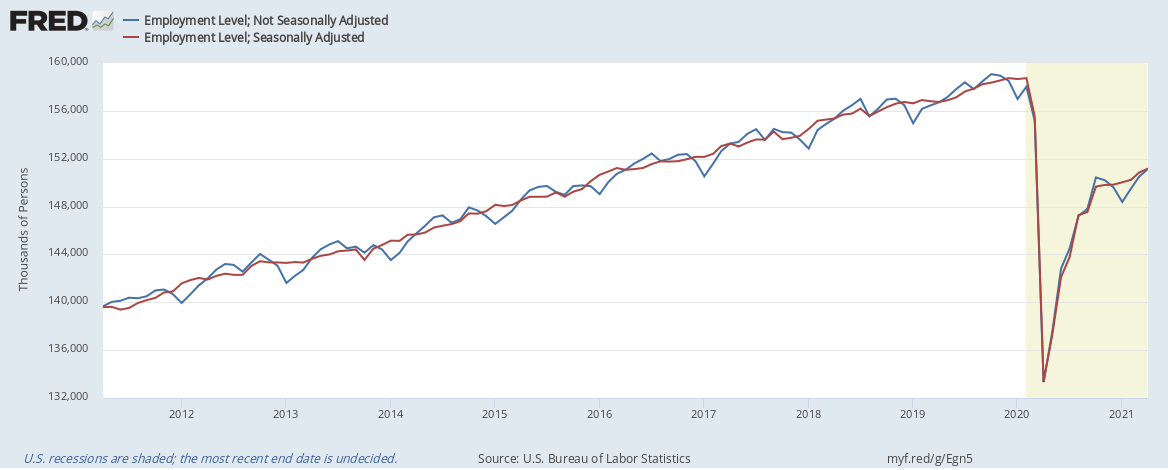
For example, the Bureau of Labor Statistics (BLS), which releases both the CPI and Current Employment Statistics (“CES”) Report seasonally adjusts incoming data based on data from the past 5 years and revises it based on incoming data for the next 5 years. The CES is the source of the “unemployment rate” and monthly job growth figures which the media often reports on. The chart below is an example of BLS seasonal adjustments in action. It shows the seasonally adjusted and non seasonally adjusted estimates of the same thing: the population of employed people in the US. Without the seasonally adjusted data series we would normally see reports of employment going up or down based on the time of year, not underlying trends in the economy.
Why Seasonal Adjustments Will Overstate Job Growth
It’s pretty clear that seasonally adjusted data is going to give a better sense of what’s happening in the economy than data which isn’t seasonally adjusted. However, seasonal adjustments aren’t perfect. Seasonal adjustments to incoming data will be based on rigorous analysis of historical data and will implicitly presume incoming data will display the same seasonal trends as past data. I’d argue that the disruption Covid has made to schooling is going to disrupt seasonal trends in employment.
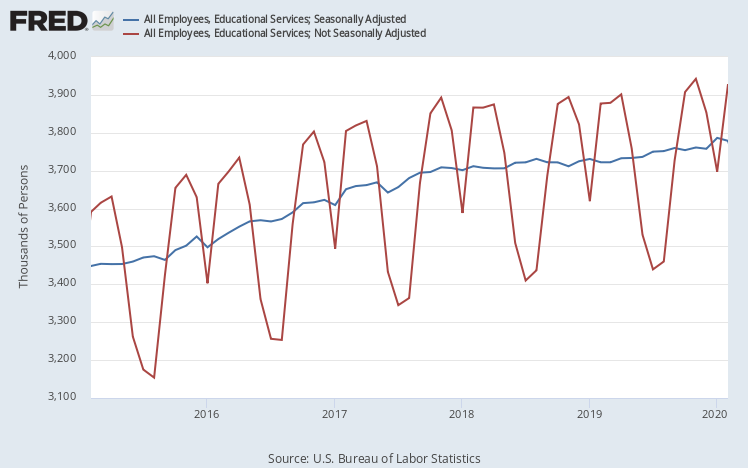
Normally the summer (and to a lesser extent winter) breaks will reduce overall employment for two reasons. Firstly, employment in education declines during summer and winter breaks. This can be seen in the graph below which depicts the seasonally adjusted and non-seasonally adjusted levels of employment in education. It includes data from 5 years prior to the Covid recession.
Secondly, parents have to look after their children and this will keep them out of the workforce. So employment levels should decline during school breaks. This would especially be true for women because women are more likely to be single parents and may bear more responsibility of looking after children generally even in two-parent heterosexual households. The graph below depicts the level of female employment in the United States divided by the overall level of employment. This is calculated using seasonally adjusted and non seasonally adjusted data series. It covers the 5 years prior to the Covid Recession. The relative female employment consistently falls in non seasonally adjusted terms going into the summer.

Both of these factors changed in the Covid era, because of virtual learning. In such an environment, certain seasonal jobs like janitorial staff, cafeteria workers, IT workers, and so on aren’t as prevalent as they used to be. The seasonal fluctuation coming directly from education is thus weaker. Additionally, many parents have had to stay out of the workforce to look after their kids throughout the year during online schooling. That means the seasonal fluctuation of summer break starting or ending is less important too.
With weaker seasonal effects now, seasonal adjustments which are based on historical data will over-account for them. When seasonal effects of the school holidays starting/ending will depress/increase employment, the seasonally adjusted levels of employment should show an increase/decrease.
One way to confirm this speculation is to look at what happens to both indicators of labor market health from August to September. That period is the strongest time for relative female employment growth as well as educational employment growth as a lot of schools start their fall semester in late August. As a consequence, the seasonally adjusted figures in both cases show a decline in seasonally adjusted terms. The graphs below show seasonally adjusted education employment and relative female employment over the past year to show the apparent weakness at the beginning of fall.
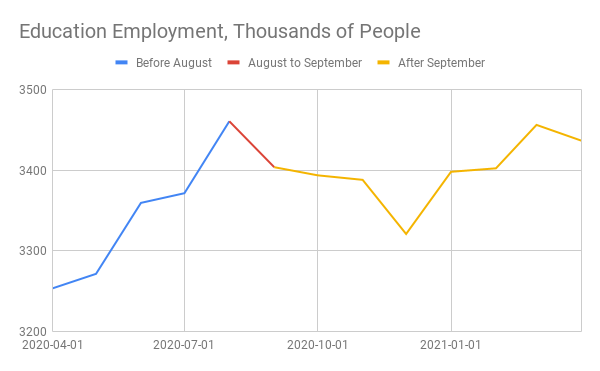
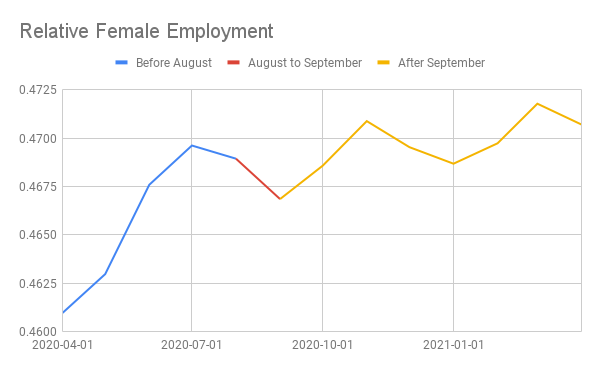
Both indicators of labor market health in seasonally adjusted terms fell significantly from August to September of 2020. This is because the start of the school year failed to create as many jobs for women and educators as it normally does, so in seasonally adjusted terms it showed a drop. In raw terms, the actual levels of relative female employment and employment in education increased, as is usual for that time of year.
In this same fashion, one can expect that the start of summer break will destroy less jobs than it normally does. As a result, in seasonally adjusted terms, the May and June jobs report will likely show strong job creation. This misleading seasonally adjusted data will be what the media reports in terms of the unemployment rate and monthly job creation.
Is Hyperinflation Coming?
This is a guest post by Aise O’Neil.
Inflation is growing out of control, or so we are told. Tucker Carlson recently said, “we wound up with frightening levels of inflation,” blaming such levels on the policies of the Biden administration. Glenn Beck published a youtube video entitled “How to Prepare for Hyperinflation in America.”
But it’s not just rightwing cranks who are panicking about inflation. Leading industrialists, like Warren Buffet, are concerned too. For that matter, financiers in the bond market are betting on high inflation. The 5-year breakeven inflation rate, a measure of expected inflation priced into the bond market recently hit a new high for the past decade: 2.72%. At the same time, the cpi index in April 2021, was 4.16% higher than it was in April 2020. That’s another record for a decade. And it’s likely that when this month’s CPI index comes out it will show an even higher percentage change from a year prior.
But even though CPI inflation is hitting records (and so is PCE inflation), there are three reasons to believe the numbers are misleading. Firstly, one has to consider factors which are making usual inflation indicators overstate the actual inflation rate. Second, one should consider better methods of tracking long term inflation trends, like median inflation. Thirdly, economic theory has something to say.
Reason #1: Normal Measures of Inflation Are Giving False Signals
There are two main indices used to track overall inflation that ordinary people might hear about. Both of them use year-on-year measures, which skew readings about a year after something weird happens.
Their names are CPI (“consumer price index”) and the PCE index (“Personal Consumption Expenditures Index”). Each month the government publishes a CPI and a PCE index for last month. We can measure how much prices have changed by looking at the differences in indexes. If the CPI is growing at an approximate rate of 2% a year, we could say CPI inflation is 2%.
When we hear about inflation rates, we normally are hearing about the “annual” inflation which is the % change in an index from a month to the same month next year. So we hear that “inflation was 4.16% in April 2021” we should think that prices are estimated to have risen about 4.16% from April 2020 to April 2021. Essentially, annual inflation is not a data point but a cumulative 12-month sum of data points. When that number is higher than it was last month, that could tell us about what happened recently in terms of the CPI/PCE index, or it could tell us about what happened to the CPI/PCE index last year. For instance, from March to April 2021, the annual CPI inflation went from 2.62% to 4.16%. This is because from March to April 2021 the CPI went up .76%; but from March to April 2020 it fell .7%.
If price changes of plus or minus .7% a month seem kind of volatile, that’s because they are. Volatility is particularly high in both the CPI and PCE index at the moment because of the effects the shutdown, it’s aftershock and reopening have been having on prices. The graph to the bottom left shows monthly changes in the CPI, measured in log-%. The data is seasonally adjusted by the government so seasonal factors have little to do with the behavior of the data. The blue line is the data and the red line is the average monthly inflation rate for December 2018 to December 2019. On the bottom right, one can see data on annual inflation measured in log-% changes to the cpi. The blue line is still the data and the red line is the inflation rate from December of 2018 to December of 2019.
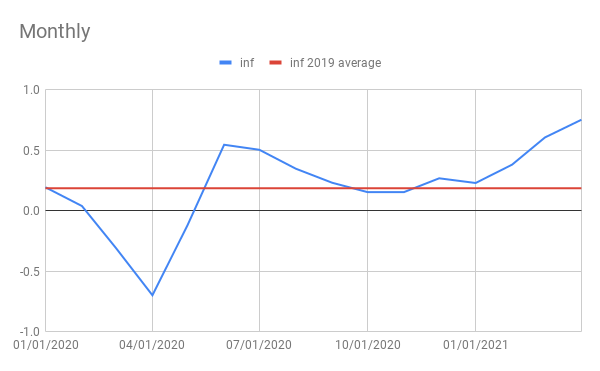
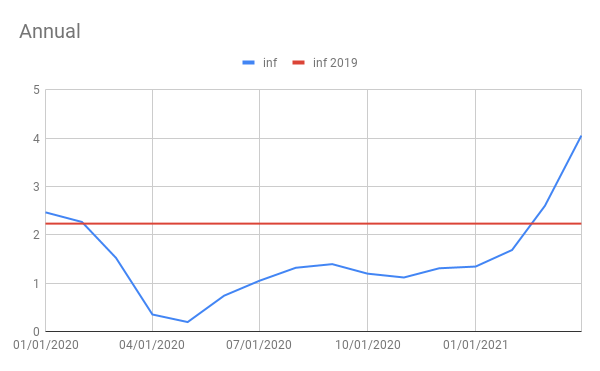
The point of the red line in both graphs is to give a sense of normal levels of inflation. The purpose of a monthly and annual inflation graph side by side is to show that monthly inflation tells some information that annual inflation does not. Both of these graphs are in terms of CPI data, but PCE index data would give similar results.
In terms of monthly inflation, what we saw at the early part of 2020 was extremely low, even negative inflation. This was a temporary phenomenon which occurred as prices for certain goods crashed at the beginning of the shutdown. For instance, when people stopped driving as much oil prices crashed. A few months later and prices slightly rebounded as companies like oil rigs cut back production. Afterwards, monthly inflation seemed to be at normal levels until now where the rollout of the vaccine is allowing for the economy to open up again.
What effect is this having on annual inflation? For about a year after the shutdown, annual inflation gave low readings because the shutdown crash in prices occured over the 1 year time frame to estimate annual inflation. Right now, two things are happening; 1) The volatile and temporary weak monthly inflation readings are falling out of the one year average, and 2) Volatile and temporarily strong inflation readings are coming into the average. This is going to mean an appearance of accelerating inflation.
Additionally, when the current month’s CPI comes out on June 10th, 1 year inflation will cover the rebound in prices shortly after the shutdown along with the spike in prices experienced during the re-opening. While prices did grow strongly from May to August of 2020, that was an aftershock of declining prices from February to May of 2020. The next annual inflation figure will cover the aftershock of the shutdown price decline but not the price decline itself, while at the same time it will include price growth we are experiencing during the re-opening. If prices grow from April to May 2021 as much as they did from March to April, then annual CPI inflation could be as high as 5.05%. This will be scary to some if they don’t understand that it is just temporary shocks.
Reason #2: Better Long-term Inflation Measures
It should be clear now that CPI and PCE index data often has to be scrutinized and can be quite volatile. For that reason many economists attempt to find less volatile measures of inflation. The Cleveland Branch of the Federal Reserve has developed multiple ways to measure underlying trends in inflation. They have developed 2 very good ones: Median CPI and Median PCE inflation. While standard PCE and CPI inflation measure inflation through finding changes to the average levels of prices in an index (it’s slightly more complicated for PCE); median inflation finds the weighted median change of prices in an index. The graphs below compare historical standard and median inflation (in log-% terms) and show how median CPI inflation is more stable and reliable and is not indicating a risk of rising inflation.
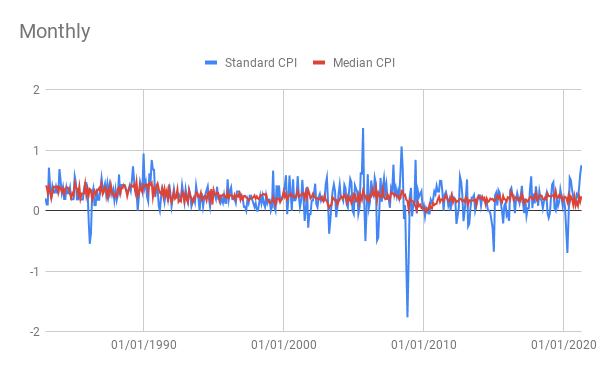
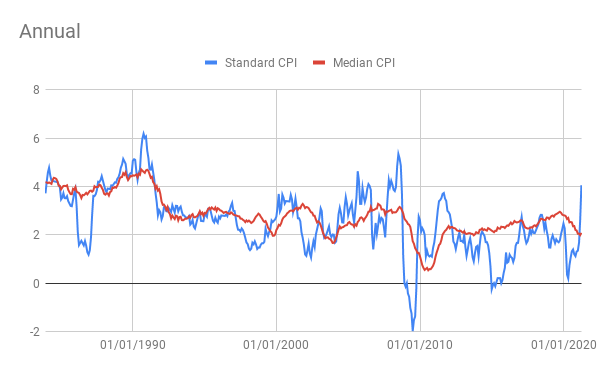
Reason #3: Economic Theory
Economic theory tells us that inflation is determined by three things. The first is shocks of the forms I’ve been explaining so far (like the shutdown causing commodity prices to drop). Overall, these impacts will be short-lived and average out to 0 in the long term.
The second relates to how inflation declines during recessions and grows during expansions. If due to a lack of strong spending, a lot of resources like land labor and capital go unused, the prices for those inputs will decline lowering production cost. This can be observed in the graphs above which show a decline in inflation following the early 90s recession, a slight dip following the 2002-2003 recession and a large dip following the great recession of 2008. Recently annual inflation has dipped down again according to median inflation. This is because we have entered another recession.
Thirdly, embedded inflation is a very important long-term determinant of inflation. Oftentimes, economic actors set prices in response to or in anticipation of inflation which then determines inflation. Hence, factors like catch-up inflation and expected inflation are useful in modeling inflation and are thought to give it a good deal of inertia.
In conclusion, what theory tells us is that it is unlikely we will go from inflation persistently undershooting 2% PCE for years to hyperinflation. It is also probably a good idea for economic policymakers to ignore transitory shocks to the best extent possible.
Finally, the most important question to determine where inflation will be headed when the virus is dealt with is: How high will unemployment be? If we cannot ensure a full, rapid recovery to this economic crisis, and likely we can’t, then inflation will probably be heading down, not up.
Conclusion
Overall the conclusion from this is one should not personally be too worried about hyperinflation. Furthermore, one should not pay too much attention to the ideas of Tucker Carlson and Glenn Beck (that’s a more general rule).
Finally, if one wants to make some money, one should realize that betting on rising inflation is a winning bet on wall street right now. It will likely continue to be until June 10th where the next CPI report comes out showing a yearly inflation rate in the vicinity of 4.5% to 5%. However, this high inflation is illusory and eventually wall street will catch on.
The Swing-State Power of Black Voters Is Real
I wrote an uncharacteristically non-nerdy political opinion piece for Bloomberg, my way of finding yet another way of celebrating Stacey Abrams:
The Swing-State Power of Black Voters Is Real
After the 2020 election, discouragement campaigns shouldn’t work anymore.
For more of my Bloomberg pieces, go here.
Let’s Detox From Polling
I cannot believe I fell, once again, for the polling that gave me the information I wanted to hear. It is indeed an emotional addiction, rather than a scientific curiosity, and I think we’d all be better off shedding our addiction to political polling. My latest Bloomberg Opinion column:
Polling Failed. It’s Time to Kick the Addiction
Doubling down won’t help Americans understand themselves.
For more of my Bloomberg columns, go here.


 mathbabe