I’ve found the soundtrack to my angsty teenaged life
I grew up in the Breakfast Club era, which is to say a time when every teenager had a soundtrack to their lives, depending on where they fit in the social strata of their particular high school.
We would make mixed tapes, and listen to them on constant loop on our walkmans, until they were scratchy and worn, and we would take odd jobs to pay for the monumental AA battery use. A sure sign of long-lasting and meaningful friendship would be if one teenager made a mixed tape and gave it to another teenager. That would be a deep sign, both of kinship and, of course, of musical identity.
Personally, I was a misfit. That doesn’t mean that I didn’t belong in any clique, it means, ironically, that I fit in with “the misfits,” which were their own group, proud of not getting along with any other groups, except at times we’d forge alliances with the druggies. For example, when I first got to Lexington High School – my freshman year was 1986 – there was a smoking section outside the principal’s office where the misfits and the druggies could all smoke whatever we wanted, for some reason there were really no rules, and it was a happy time. By the time I left, though, the smokers were forced very slightly off campus, which is to say about a block away on Park Drive, and the temporary misfit/druggie alliance was forever broken. We misfits retreated to the J-House lounge.

I lived on Waltham Street, and my old house is on this map.
Anyhoo, I’m getting away from myself, because I meant to talk about soundtracks, but I instead got carried away with nostalgic memories of hanging out – for a brief time – with the cool, fucked up kids.
My soundtrack was simple: Led Zeppelin, Pink Floyd, and Jethro Tull. I wore an army jacket and was deeply misunderstood, and sometimes in the summer I’d tie dye shirts and refuse to participate in things. This is me refusing to participate in the junior prom:

Isn’t my friend Karen looking gorgeous?!
Here’s why this all came up today. If I could go back in time and live high school all over again, which I tend to do without permission anyway, I’d listen nonstop to Neutral Milk Hotel’s album, In the Aeroplane Over The Sea, even though it was release in 1998 and I graduated in 1990. Hey, it’s a fantasy, and they don’t always make sense.
I dare you to tell me you don’t agree when you hear the title track (or else you already know it, in which case you already agree):
Make sure you listen to the bridge, which is the best part of any song, ever.
Bloggy young nerd women
Today I want to share with you all two recent blog posts from nerdy young women. And who doesn’t love nerdy young women!?
The first is by Michelle G, an M.I.T. student, class of 2018, who is majoring in “14,” which is M.I.T. code for economics. She wrote a blogpost called Picture yourself as a stereotypical male, about the question of intelligence, gender, and stereotype threat. I thought I knew all about that stuff but I learned quite a bit from her post. p.s. Larry Summers, I hope you read this.
The second is by Meena Boppana, a Harvard CS major/math minor who has guest blogged here on mathbabe before. This post is called The Making of A Girl Mathlete, and it describes her experience winning math competitions, often as the only girl. Even though I personally think math contests kind of suck, I appreciate how much Meena got out of them.
Speaking of the Harvard math department, I’ll be there next Monday, on a panel with Moon Duchin talking about gender inclusivity in mathematics. It’s the first of a series. Here’s the Facebook page of the event.
Holy crap, you guys rock
Yesterday I wrote a post complaining that I didn’t know how to find an awesome job. The thing is, most advertised data science jobs either make rich people richer (finance) or make poor people poorer (ad tech) [1]
Well, I asked for advice, and you guys seriously delivered. I am so very lucky to have such amazing commenters and friends, and as a small token of my gratitude I want to compile some of the advice I got.
- A lot of you encouraged me to try to first figure out what I want to do and then convince a company doing that to give me a job. Great idea! Someone even sent me articles with useful advice on how to do that, here and here.
- Someone suggest I look for independent contract work by searching this list. Great idea.
- I got a few people writing to me to encourage me to consider teaming up with the Data Science for Social Good crowd. Maybe I should start a New York chapter?
- Someone had a friend who made a huge list her favorite toys and then wrote to the companies that made them telling them she’d be great as an employee, and it totally worked. “Toys” can be taken to be a general term, of course.
- Someone encouraged me to consider the environment and the team I’d be working with rather than the job I’d be doing. Trouble is I tried that, it didn’t work. But it might work for someone else.
- A bunch of people mentioned working for non-profits as data people. Non-profits have their challenges to work with but they seem to need the help. Hopefully I’ll have a guest post soon on this issue.
- Many people wrote to me with ideas for specific jobs I should apply for. I will, thanks!
- Also, a few people just wrote saying I’d be fine and they had hope for me. Those were really nice emails.
- Finally, quite a few other data scientists wrote saying they, too, want to make the world a better place and are frustrated by the lack of obvious chances to do this. Obviously I’m not alone.
Anyway, thanks to everyone for their advice and encouragement. I’ll keep you updated.
1. In fact I consider it my go-to example of how “the market” fails, if you think the market is supposed to offer profitable opportunities to do stuff that is worthwhile and/or important for society. It’s kind of the opposite, but maybe – hopefully – I’m defining the market too narrowly, i.e. by searching for data science jobs on LinkedIn.
What can a non-academic mathematician do that makes the world a better place?
You may have noticed the long-standing tagline on my About page:
What can a non-academic mathematician do that makes the world a better place?
I’ve been thinking about this question a lot lately. I’m looking for a job nowadays since my book project is wrapping up and I have no source of income. So far my attempts at sorting through the LinkedIn “data science” jobs are leading to a huge list of finance and online advertising jobs (which I don’t apply to), and a few others which are somewhat more interesting thrown in the mix. But they typically have more than 100 people each applying to them.
Which is to say, I’ve applied to a bunch of jobs I only kind of want and haven’t heard back from almost any of them. It’s kind of depressing. Actually it’s super depressing.
So I’ve come up with another way of thinking about searching. Why don’t I start with organizations that I think are doing cool things and offer them my data science expertise? In a consulting role primarily, but also longer-term if they are interested.
I know there are places where you can sign up to be an “expert witness,” so I’m looking for something similar: an expert consultant. There must already be ways to do this, but I don’t know how. Obviously one way would be to try to get a job at IBM, but then I’d be back to working for clients in finance.
Advice would be deeply appreciated. You can comment here or send me email at the address on my About page.
Big data, disparate impact, and the neoliberal mindset
When you’re writing a book for the general public’s consumption, you have to keep things pretty simple. You can’t spend a lot of time theorizing about why some stuff is going on, you have to focus on what’s happening, and how bad it is, and who’s getting screwed. Anything beyond that and you’ll be called a conspiracy theorist by some level of your editing team.
But the good thing about writing a blog is that you can actually say anything you like. That’s one reason I cling so strongly to mathbabe; I need to be able to write stuff that’s mildly conspiracy-theoretical. After all, just because you’re paranoid doesn’t mean nobody’s out to get you, right?
Anyhoo, I’m going to throw out a theory about big data, disparate impact, and the neoliberal mindset. First I need to set it up a bit.
Did you hear about this recent story whereby Facebook just got a patent to measure someone’s creditworthiness by looking at who their friends are and what their credit scores are? They idea is, you are more likely to be able to pay back your loans if the people you’re friends with pay back their loans.
On the one hand, it sounds possibly true: richer people tend to have richer friends, and so if there’s not very much information about someone, but that person is nevertheless inferred to be “friends with rich people,” then they might be a better bet for paying back loans.
On the other hand, it also sounds like an unfair way to distribute loans: most of us are friends with a bunch of people from high school, and if I happened to go to a high school filled with poor kids, then loans for me would be ruled out by this method.
This leads to the concept of disparate impact, which was beautifully explained in this recent article called When Big Data Becomes Bad Data (hat tip Marc Sobel). The idea is, when your process (or algorithm) favors one group of people over another, intentionally or not, it might be considered unfair and thus illegal. There’s lots of precedent for this in the courts, and recently the Supreme Court upheld it as a legitimate argument in Fair Housing Act cases.
It’s still not clear whether a “disparate impact” argument can be used in the case of algorithms, though. And there are plenty of people who work in the field of big data who dismiss this possibility altogether, and who even claim that things like the Facebook idea above are entirely legitimate. I had an argument on my Slate Money podcast last Friday about this very question.
Here’s my theory as to why it’s so hard for people to understand. They have been taken over in these matters by a neoliberal thought process, whereby every person is told to behave rationally, as an individual, and to seek maximum profit. It’s like an invisible hand on a miniature scale, acting everywhere and at all times.
Since this ideology has us acting as individuals, and ignoring group dynamics, the disparate impact argument is difficult if not impossible to understand. Why would anyone want to loan money to a poor person? That wouldn’t make economic sense. Or, more relevantly, why would anyone not distinguish between a poor person and a rich person before making a loan? That’s the absolute heart of how the big data movement operates. Changing that would be like throwing away money.
Since every interaction boils down to game theory and strategies for winning, “fairness” doesn’t come into the equation (note, the more equations the better!) of an individual’s striving for more opportunity and more money. Fairness isn’t even definable unless you give context, and context is exactly what this mindset ignores.
Here’s how I talk to someone when this subject comes up. I right away distinguish between the goal of the loaner – namely, accuracy and profit – and the goal of the public at large, namely that we have a reasonable financial system that doesn’t exacerbate the current inequalities or send people into debt spirals. This second goal has a lot to do with fairness and definitely pertains broadly to groups of people. Then, after setting that up, we can go ahead and discuss the newest big data idea, as long as we remember to look at it through both lenses.
Project Occupy
I’m very happy to announce that the wonderful high school students that we worked with over the summer at Occupy Summer School have decided to self-organize into an after-school program at their school, the UAI, starting this fall (if you don’t know what I’m talking about, go check out our webpage or the press we got from the New Yorker written by Alex Carp).
A few of us from the Alt Banking group had a meeting with 5 of them earlier this week. Together they represent the organizing committee of their new activism group, which they named “Project Occupy.” Their plan is to hold weekly afternoon meetings, which will be topic-based, and for a given week they want material for their chosen topic in the form of a short video or an article. One of the topics they already chose for one of the first meetings is “cultural appropriation.” They then named a bunch of examples of cultural appropriation of black culture. I’m planning to send them this for reading material.
They are, as always, very sharp and observant. Teenagers are the best.
I am super proud of them and I can’t wait to see what they do. I told them how much they’ve taught us about keeping protests fun and generous, and giving away gifts of food or balloons (actually, both) to make their point well-received.
They want to eventually plan events around the topics they’ve learned about and gotten passionate about, and possibly also create podcasts or YouTube video series. Oh, and they want food at all their meetings. Gotta keep things fun.
The Continuing War on Teachers
We all know about the achievement gap, whereby poor kids don’t do as well on standardized tests as rich kids. It’s big and it’s growing. Logically speaking, we might try to solve it – to close the achievement gap – by lowering inequality. But that’s a hard thing to do, politically. It would require things like higher taxes and better minimum wages and stronger safety nets.
So instead, politicians everywhere have decided to simply assign blame to the school teachers who the last people to be seen with poor kids before they take the standardized tests.
If you watched the Republican debate, you might have seen Chris Christie emphatically suggest that the teachers’ union should be punched in the face. He’s willing to repeat that:
Speaking of getting rid of teacher unions, that’s exactly what they did in New Orleans after Hurricane Katrina, 10 years ago. And the results are mixed:

I googled for “new orleans charter school performance”
In Washington D.C., they hired School Chancellor Michelle Rhee to fix their ailing schools, so she came in and fired a bunch of teachers with bad scores, and then gave bonuses to a bunch of teachers and schools with good ones, and then ignored the ensuing cheating scandal. After she left scores largely went back to normal. The achievement gap is wider than it was before Rhee:
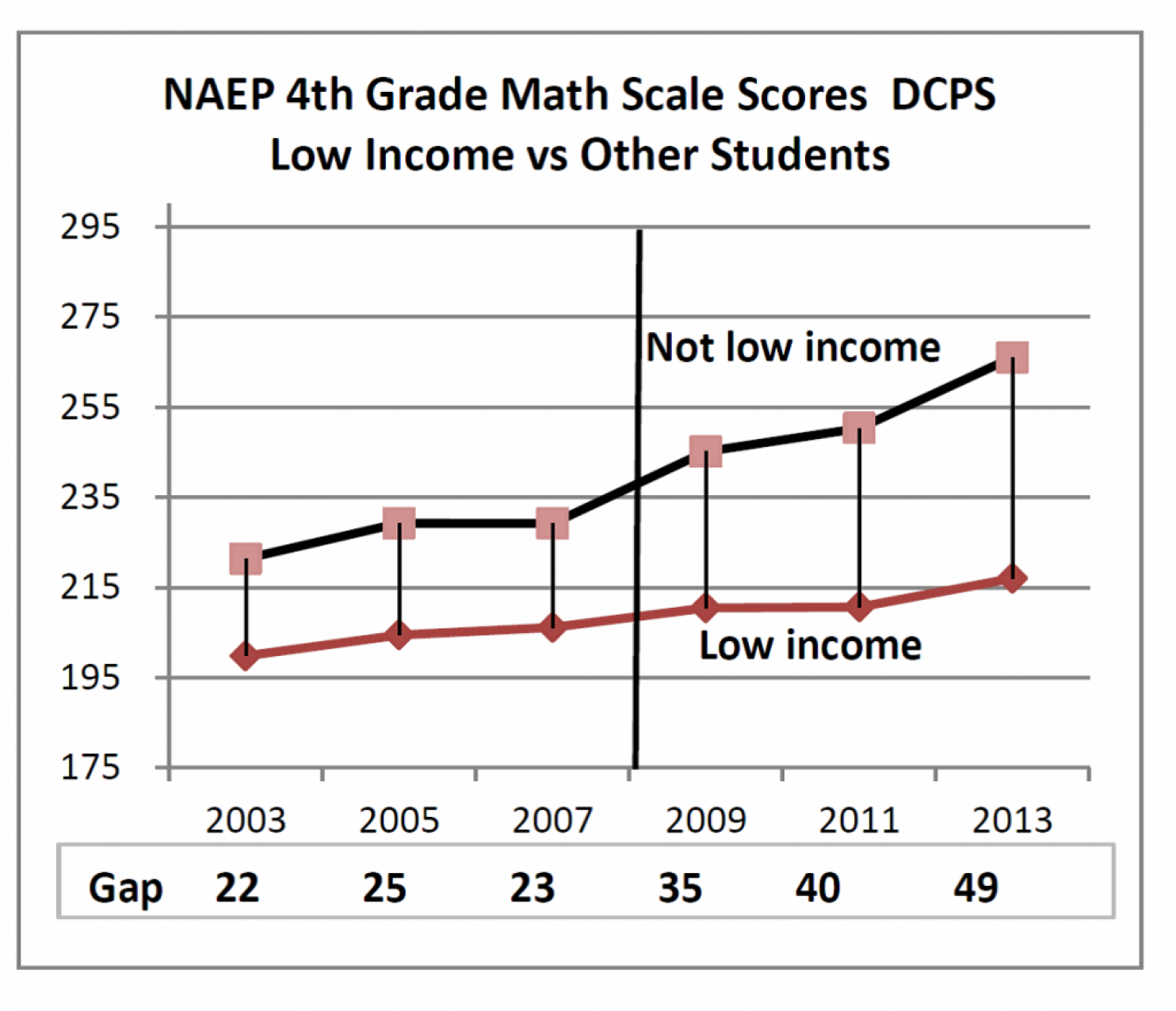
None of this particularly surprises me because, again, it’s likely not a teacher-specific problem, but rather an economic problem, and residents of New Orleans are still poor.
It’s a correlation versus causation problem, actually. We know poor kids do badly on tests compared to rich kids, and we look for something we can control that would change that story. Originally we focused on more tests, thinking that shining a light on the problem would automatically solve it. That didn’t work, so we turned our focus to teachers, again mostly as an easily available knob to turn. It’s taking a few years for the data to come out that this new method also isn’t addressing the problem.
There’s a new idea afloat on how to close the achievement gap, by way of Florida (h/t Jordan Ellenberg). Namely, to give bonuses to teachers that themselves got good SAT scores. A few details:
- The bonus is $10,000
- The cut-off is 80th percentile of SAT scores
- Teachers are eligible even if they took the test 30 years ago
- The teachers also need to be rated “highly effective” to earn their bonus
- Except if they are first year teachers, in which case they don’t have a rating yet, so just their high SAT scores will do
It’s probably unnecessary to mention exactly how ridiculous this is, but I do want to point that teachers have no motivation whatsoever under this new scheme. They either qualify or they don’t. Not sure what it’s supposed to achieve in terms of carrots or sticks. It’s the equivalent of giving tall men extra money to buy suits.
I’m waiting for the meta-analysis that shows the achievement gap doesn’t respond to firing bad teachers, or charter schools, or even more testing, or any other easy target.
So what should we be doing? I have two suggestions, and neither of them is politically easy.
First, if we really wanted to see progress, we should stop persecuting teachers and immediately normalize the funding of school systems so poor kids have equal or more resources than rich kids. That would have some effects – at least poor districts could afford the latest books, for example.
Second, even that kind of progress would take us only so far. As long as a deep inequality of opportunities exists, and mobility is low, we can expect a lack of investment in poor people. We need to address these issues on the societal level.
Litigation finance: a terrible idea
I watch my share of bad commercials on TV. I don’t have cable but I have an antenna so I can receive some free TV stations, including one that is clearly meant for senior citizens called CoziTV. Cozi regularly has marathons of Murder She Wrote, Magnum P.I., Hart to Hart, and Fantasy Island, all shows that I somehow can’t stop watching, partly I think because I get so much confirmation from them about how awful my childhood was.
Anyhoo, back to the commercials. I couldn’t help notice a proliferation of ads for help with a medical condition called “transvaginal mesh injury.” Basically the ads were asking whether the viewer had such a problem, and whether they’d like to perhaps talk to a lawyer at this free phone number. Pretty much every other ad was about this condition, so it seemed like a pretty big deal, at least for the intended audience of old ladies.
Well, I didn’t pay much attention to it, until I came across this fascinating Reuters special report on corrupt medical lending practices entitled New breed of investor profits by financing surgeries for desperate women patients and written by Alison Frankel and Jessica Dye.
The article outlines the following scheme: financiers find women who need this surgery, based on a defective medical part, but don’t have the money for it and whose insurance companies won’t immediately cover it. They offer them the financing now in return for part of the eventual settlement with the company that was responsible for the faulty mesh. But then they make a deal with a surgeon to overcharge for the surgery, and they inflate the costs as well, and at the end of the whole thing they take a large part of the settlement which the woman was entitled to, and sometimes the woman even ends up owing them money.
It’s horrible, but it’s really just one example of a large industry of what is known as litigation finance, which just means the world where people with lots of money decide to bet on outcomes of court cases.
A recent Bloomberg article discussed the growing industry of litigation finance, and describes how congresspeople are starting to pay attention to all the hedge funds getting in on the act.
Of course, the financiers defend this practice by pointing out that, with money from people like them, a given side in a legal proceeding has more resources to make their case. They would also point out that they only put money behind cases that have at least some chance of winning.
However, there are two big problems with it as a concept. First, it means that there will be more money available to lawsuits in general. We’ve already seen what happened with college tuition when something that’s already too expensive gets access to loans: it gets even more expensive. It’s an arms race. According to Bloomberg, the typical client for these litigation finance firms are big companies which use corporate law firms.
Second, the justice system is already super unfair, and it’s not like hedge funds are running into this game to improve the system. Rather, they are there to exploit the system. That’s what hedge funds do. So if they have detected a bias in the system, they are going to treat it like an arbitrage situation and throw money at it for all they’re worth. The side effects of that will have nothing to do with justice.
The real reforms we need to see with the justice system is a way for money to be less of a factor, not more.
The inevitability of sexual assault
Whose fault is it when a woman gets sexually assaulted? For most people I interact with, the answer seems obvious: the assailant is at fault. Otherwise we’re blaming the victim.
In spite of that commonsense logic, though, there seems to be a sustained argument on the other side of the debate, and not only from right-wing talk radio. For example, over on the Guardian there’s quite a discussion about how The Pretenders star Chrissie Hynde blames herself for previous sexual assault, with the following excerpt pretty much summing up her position:
She said: “Technically speaking, however you want to look at it, this was all my doing and I take full responsibility. You can’t f*** about with people, especially people who wear ‘I Heart Rape’ and ‘On Your Knees’ badges … those motorcycle gangs, that’s what they do.
“You can’t paint yourself into a corner and then say whose brush is this? You have to take responsibility. I mean, I was naive.”
In Bangladesh, we similarly see arguments for why people marry their daughters off young which rely on the inevitability of sexual violence:
“I photographed the wedding of Akhi’s 13-year-old sister last year, and when I asked her mother why she was marrying her daughter off, she described not feeling comfortable to let her walk to the corner store because she would be harassed by men and boys,” Joyce said. “She also said no boy wants to marry a girl older than 18. If a girl is still single past that age people will ask too many questions. She knew it was wrong to marry very early, but they weren’t from a wealthy family, and she told her daughter’s husband to wear condoms for a few years, so it will be OK. Marriage is seen as a cover of respect and protection for women. By not going to school, it reduces the risk of being sexually active outside the house or be harassed while commuting.”
Don’t get me wrong, I think sexual violence is outrageous and wrong. The last thing I’d want to do is to suggest acquiescence in the face of it. I don’t want to blame victims or make things worse for them in any way. But we hear arguments like the above from reasonable, thoughtful people, who have plenty to lose by being wrong. They’re coming from personal experience which we should listen to. We should, in addition, examine why the “logical” argument doesn’t seem to work with them.
I have a theory. It’s about what our cultural expectations about men are. I’ll divide it into cases.
- Men can more or less control violent urges and are not inherently sexual predators. In this worldview, women of all ages should be free to wear whatever we want and go wherever we want and expect only consensual sexual interactions. This is an ideal world, which one might call civilized. Mind you I’m not even talking about being bombarded with idealized visions of sexualized femininity on billboards (but that would be nice too). I think I more or less live in this world and that means I’m lucky.
- Men are divided into two groups: sexual predators and “others.” Just as it would be silly to ask a lion not to kill an antelope when it’s hungry, and similarly it would be ridiculous to think that (some) men wouldn’t rape a woman if they had the chance. That’s along the lines of the worldview of Chrissie Hynde. If you really think that there just simply are men out there who are uncontrolled and uncontrollable sexual predators, then of course it’s up to the individual to steer clear of them. And it doesn’t make her wrong and us right, it just means we have different expectations of what men are like.
- No man can be trusted, they’re all trying to take advantage of women at all times, and harassment is to be expected. This does seem to be more or less the expectation in certain situations, like in the above quote from a mother in Bangladesh as well as all the communities torn apart by war and insecurity and desperate poverty. If someone faces this kind of reality, they have to work within it, even if it means marrying off their 13-year-old daughter before she’s ready or willing. It’s a bad choice versus a worse choice.
Aunt Pythia’s advice
Readers, did you know Aunt Pythia is a rabid biker? And did you know that the High Bridge just opened for the first time in 40 years? Aunt Pythia is itching to bike all over it as soon as she’s shot this Saturday’s wisdom wad all over your browser.

The High Bridge in 1900 connecting Manhattan and the Bronx. I love biking to other boroughs.
Fun facts about the High Bridge:
- It’s been closed for more than 40 years.
- It used to be an aqueduct.
- It is the oldest standing bridge in NYC.
Let’s do this, folks, we got stuff to do today! You too, amiright? Enough already with the chitchat then.
After cleansing yourself from today’s drivel, please:
ask Aunt Pythia any question at all at the bottom of the page!
By the way, if you don’t know what the hell Aunt Pythia is talking about, go here for past advice columns and here for an explanation of the name Pythia.
——
Dear Aunt Pythia,
I apologise, in advance, for the long question. After years spent battling one identity crisis after another, I (sort of) figured out, a few years ago, that my shtick was: angsty, feminist, WOC in STEM, and social justice advocate with a love for funky thrift store fashion finds. Over the years, I have tried to train myself to channel all my angst into a dark sense of humor while perfecting the smokey eye look.
As a result, I supposedly “exude an air of confidence which can excite and/or terrify people” according to quite a few people. As someone who was an outcast growing up in an extremely repressed country, this transition has worked out surprisingly well for the most part after my move to the first wold. The issue arises when I’m with my fellow science grad students.
As the only female in my program in my particular subfield (and often the only female or POC in most of my classes) with a very low tolerance for bullsh-t, I seem to find myself isolated again. I don’t mind being labelled the feminist killjoy when I call out intolerant behavior or when I’m just bulldozing over people. I refuse to accept the notion that minority grad students have to be at the bottom of the food chain. I get paid too little and love my field too much to not take pride in my work. I have close friends in other programs, but in my immediate professional family, I feel like everyone shies away from speaking to me. I sometimes wonder if the problem is that there a is a savvier way of being myself that I just don’t know of. The emphasis on networking for grad students makes me feel like this is something that I should care about. Please help?
She sells sea–oh, screw it.
Dear SSS-osi,
There’s a lot there, but let me just start by saying, thanks for writing and you’ve come to the right place.
Just this morning, Aunt Pythia woke up with that familiar yet unnerving and highly anxiety-provoking feeling that she’s gone ahead and done it once again: she’s been too much, somewhere and somehow, and the poor sensitive folks of that place and that manner of the moment are still reeling from her awful behavior.
As a fellow bulldozer, in other words, I know exactly what you mean. And in my darkest moments I succumb – temporarily – to the idea that I need to stop calling out intolerant and/or obnoxious behavior, that I should just sit there silently not mentioning injustice, that I should lean towards making people feel comfortable over so rudely asking them to acknowledge bullshit.
But then, when fully awake and reading the newspaper, or walking around outside, or even just drinking my morning coffee, I change my mind. After all, you and I, we have benefitted more from our sassy approach than have we suffered. There are people who love us and that must mean we’re not intolerable to be with, right? And although we sometimes go overboard and make mistakes, the world really could use a few more hot-headed loudmouths with our perspective, no?
Public service, world, you’re welcome.
Truth is, people can’t handle you because they’re not secure enough. They don’t “know what to do with you” so they avoid you, and I think it’s a pretty good indication that they really aren’t much fun. It’s kind of like, when you’re looking for some action, and you ask someone, “on a scale of 1 to 10, how sexual are you?” and they say, “I’m a 4,” then you believe them. In fact, subtract 2. The answer I was looking for was 17. Time to move on.
Advice: Go find other people who can be real with you. They’re out there, and one great aspect of being completely over-the-top real is that other people self-select for us. The ones who stick around can be trusted. That’s not to say you don’t go to grad student mixers, but go with the intention of just being completely yourself, and hilarious and smokey eyed and angsty, and some people – me, me!! – will naturally gravitate towards your amazing self. If that doesn’t happen, their loss.
Good luck!
Aunt Pythia
p.s. in terms of being close to your colleagues, I’d suggest study partners for specific problem sets or classes. Ask someone to meet over coffee, since that’s highly unthreatening and could well blossom into friendship.
——
Dear Aunt Pythia,
I am a female in her late 20’s who also happens to be
- aspergian,
- asexual,
- religious/conservative (I guess the relational boundaries of the (3) are pretty easy to accept for me because of the (2)), and
- not particularly attractive.
I would really like to get married eventually, but I feel like I can’t understand and relate to people on so many levels, that P(marrying | (1), (2), (3), (4)) = 0. Actually, columns like yours are very useful to me to get to know what’s going on in other people’s minds, but the more I know, the more I feel like I belong to another planet.
My social life revolves solely around interest groups (nerdy and church-y), where I do meet quite a lot of nice guys. At best, though, they consider me a “bro”, which is great but not helpful, because even if I’m asked out, it is not a date. I have already tried asexy dating sites but unfortunately they are too sparsely populated.
What do you think? Should I just give up the thought of lifelong companionship and focus on my career and interests? Or should I decorate my laptop with a “lonely heart” sticker? Or what else? I’d really appreciate some advice.
Somewhat Preoccupied Individual Not Suited To Experience Relationships
Dear SPINSTER,
Fantastic sign-off, wow.
So, I never knew about adult asexuals before, but this Guardian article explains it pretty well, at least for the person who they interviewed. In his case, he found someone to marry by joining asexuality.org, which seems like a valuable resource and is a great example of what is so amazing about the internet.
So, it seems that asexual people like companionship and partnership like anyone else, just without sex. And, as long as that’s been made clear to both people in advance, and they are both cool with it, there’s really no issue at all.
Except for one thing, namely the rarity of your potential mates. As you are well aware, most men are sexual, and asking them to be in a long-term intimate relationship without sex would likely be a dealbreaker. So to optimize your chances, I’d give up on finding a boyfriend through your social groups, and I’d go straight towards asexual meeting places, either virtual or in person.
Turns out there are 44 asexual Meetup groups, and I suggest you start attending!
As for your concerns about being “not particularly unattractive,” you could either ask for advice from someone you trust on how to flatter your look, or you could just wear stuff that makes you very comfortable. That’s already an attractive feature. But in any case I’m guessing this society of asexual people is pretty open-minded.
Good luck!
Aunt Pythia
——
Dear Aunt Pythia,
How can I find meaning in my life as a pure mathematician? I am a tenure-track professor, and I spend so much time studying and giving myself so much of a headache trying to understand totally pure math notions like perfectoid spaces, almost ring theory, p-adic Hodge theory, etc. These may of course have some practical use some day, but not today. And of course, I teach calculus and whatnot to mostly disinterested students, but teaching is not really where my heart is.
I don’t have a significant other because I am short and fat and all I want to do is study the aforementioned esoterica all day. I love it, there is nothing else I would rather do, but when the going gets tough, like when I can’t follow a proof, or when the road to all the mathematical topics I have to learn seems too long, I find myself wondering why am I beating myself over and giving myself such a hard time trying to follow such technical minutiae that don’t have any impact at all on the world?
It makes me unhappy, and so my mom tells me I should go work for Google and make significantly more money and have a 9-5 job and do work that makes a difference. I have no interest at all in working for Google, i.e “industry,” or making lots of money. I love the freedom that academia provides. On non teaching days I can get up when I want to, stay home in my pjs, etc. And of course I enjoy the freedom to study what I want. But how can I make studying pure math meaningful?
Almost Going Into Industry
Dear AGII,
A few comments:
- It is not true that short and fat people don’t date. That’s a myth. Here’s an entirely unscientific article that supports me in this.
- You can definitely go out and “make a difference,” but what kind of difference?
- Your mom just wants you to be happy, and she thinks making more money will make you happy. Will it? I don’t think so, you said yourself you don’t care about money.
- Academia is painfully slow, but you love it. You said so yourself.
- Teaching is the shit work of academia. Some of your students – most, actually – are disinterested, but some are not. They are awesome.
- The shit work of other jobs is much less awesome and (often) much more like shoveling actual shit.
- Having said all that, I left academia, and you know that, so it feels like you’re asking me to give you permission to do so, which I do.
- But even as I give you permission, know that some people (like my husband) are made for academia and would suffer outside it, and other people (like myself) have left academia but it’s not like that suddenly made them happy, because they are just naturally identity crisis prone people who are never actually happy and always wonder what they fuck they should be doing with their lives.
- Plus, I don’t actually want you to be happy.
Hope that helps!
Aunt Pythia
——
Hi Aunt Pythia!
I am a 30 year old female in the tech industry living in Washington DC. My family and I immigrated some 20 years ago and I am by far the only one doing well. I am looking down the barrel of becoming my parents’ living retirement plan and housing provider in a few years and, as such, I am trying to get as much traveling and ‘living’ out of the way before I take up that job.
I am doing relatively well financially: make a decent income, paid off my student loans, rent a cheap place, live on a budget, and trying to save 14% of my income towards my own retirement, but I’m also looking at what’s coming and thinking I need to figure out a way to prepare financially for that and I just don’t know how.
How would you advise someone like me in financially preparing for what is coming when what is coming involves elderly parents:
– With no savings
– With no property
– With no retirement plan
– With no ability to help themselves (language barrier)
– With very small social security payments (~$500 for the both of them)
Please keep in mind that I am not resentful of the fact that my mom and dad need the help (my unhelpful siblings, on the other hand, I do resent), I’m just worried I’m financially unprepared for it and trying to balance that with my own wishes/dreams.
Future Caregiver
Dear FC,
Well, I really don’t know. I think you should talk to someone who does, lickety split. Here are some basic facts that you’ll need to have ready:
- Are you parents green card holders?
- Are they eligible for medicare? Look here for some useful info on that.
- Are they prepared to go back to their home country for retirement? Is it safe? Does it have a safety net for them? Is it cheaper to live there? Do they have family and friends there still?
- Maybe the good place to start with possible future scenarios is finding other immigrants who have features similar to your parents but are slightly older, and see how they are living. I’d interview their functional children to see what they learned.
- As for your siblings, it could be a major problem down the line, but first thing’s first. Don’t take on the whole world at once.
Aunt Pythia
——
Readers? Aunt Pythia loves you so much. She wants to hear from you – she needs to hear from you – and then tell you what for in a most indulgent way. Will you help her do that?
Please, pleeeeease ask her a question. She will take it seriously and answer it if she can.
Click here for a form for later or just do it now:
A huge win for contractors and franchise workers
Today I’m celebrating some good news for working-class people in this country. Namely, the definition of “employee” is changing, making it easier for employees at McDonalds and other places to complain about poor treatment. The good news comes via a National Labor Relations Board ruling yesterday.
I wrote previously about the economics of McDonalds franchises, but it comes down to this: 90% of the low-level employees at McDonalds don’t technically work for McDonalds at all; instead, they work for a local franchise owner, who in turn rents stuff, including the McDonalds brand, from the parent corporation.
In spite of the technical and legal framework, the parent corporation controlled the burger flippers at a minute level, through surveillance, customer service policy, branding requirements, and most importantly through controlling the margins of the franchise owner.
The legal separation, which was solidly working until yesterday, meant that employees couldn’t complain about bad treatment of their employer, McDonalds, but rather had to complain only about the way the local franchise owner treated them. This prevented large-scale unionization attempts among other things. The new ruling means that the workers will have the right to negotiate with McDonalds corporation as a “joint employer.” Another way of saying this is that McDonalds will have much more liability when it concerns mistreatment of franchise workers.
An example of how this is good news is the following: it used to be true that if one McDonalds unionized, and demanded and received better wages, it would have little knock-on effects and indeed it would be quite difficult to pull off, given how tight the margins are for franchisees. Now, with the new ruling, a second McDonalds location could possibly use that one example as leverage in a bargaining agreement. Moreover, as a joint employer, McDonalds corp cannot shut down a franchise just for unionizing.
The ruling extends well beyond McDonalds. In fact the original case was a company that hired contractors to do its recycling. It will likely mean that it will in general be much harder for corporations to create legal distance between itself and the people hired to do work for that company, so contractors of all varieties, as long as the parent company has a substantial amount of control over the workers.
Tipping, power, and the gig economy
Power is the opposite of dependency. I learned this definition from Adam Reich when he came to talk to my Occupy Summer School students this summer about sociology and the OurWalmart struggle.
It’s useful and convincing: you have power over someone if they are dependent on you.
So it makes sense that systems of tipping gives us power as consumers. Waiters, or other service people, are dependent on us for tips, which are often a large part of their overall salaries, so we have power over them.
In fact, it gives us a kick, a real but short-lived kind of status in service situations. We get to temporarily play the part of the “little lord.” Some people exploit this role, demanding too much, asking for special favors, and enjoying having someone do our bidding. Others are over-sensitive to slights; if they feel like their status is being questioned at any level, they switch from little lords to little tyrants, demanding attention and extra work from their waiters. We’ve all seen this.
When you ask an American, we like our tipping systems, and we don’t want to give them up, even though it leads to all kinds of financial problems for restaurant workers. Partly this is because, as part of the power relationship, if the waitstaff or serviceperson wants to get a good tip from us, they have to be nice to us. They have to make us feel like they like us, and, a secondary requirement, that they like their job. Surly waiters are waiters who don’t depend on tips and who make us realize that being a waiter isn’t always such a great job. Not that this entire dynamic is obvious to us every time we enter into a tipper-tippee relationship, but it’s there, lurking.
So far nothing I’ve said is at all new. Tipping has been around for a while. But there is a new kind of service economy evolving, which I call “the gig economy,” but which tellingly has been described as “the sharing economy” by some.
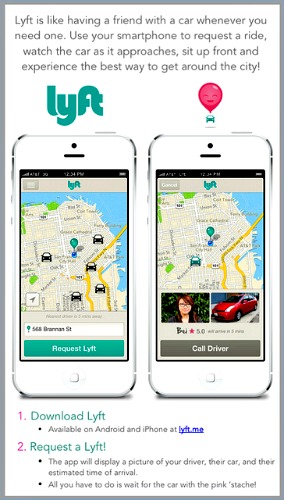
So, if you hire an Uber or Lyft driver to drive you somewhere, the payment has become somewhat invisible, since it happens on your credit card via the app, and instead of tipping you rate your driver (although you can tip as well). in fact the “cashless and seamless” experience of being driven by an Uber driver is one of the selling points. “Hassle-free” is a commonly heard phrase around the gig economy.
But in terms of power dynamics, replacing tipping by rating doesn’t do much, since Uber drivers are entirely dependent on their overall rating to stay employed. And you might object because riders get rated as well, but let’s face it, the worst thing that could happen to a poorly rated rider is that he gets kicked off the app and has to use another rider app, but the worst thing that can happen to a driver with a bad rating is he could lose his job.
My fear is this: the invisibility of the transaction makes us as consumers even less aware of the power dynamics than we already are. We have gone from a transactional relationship, in a restaurant, to a inequitable faux-friendship. The marketing of the “sharing economy” doesn’t help:
Why is this a problem? Some of the most important lessons I teach my children is how to be grateful, polite, and non-tyrannical to people who are serving us, at a restaurant or wherever. It’s part of learning how to be an empathetic person, and a balancing out of one-on-one human interactions which I think is super important. I want them to know that service is not servitude, and that everyone is a person just trying to do their best. Of course, this goes for any kind of transactional service, not just the tipping kind.
However, the first step in extending gratitude to people who are extending us a service is to know when that transaction is occurring. If every bill is magically and invisibly settled, then my kids won’t even recognize that it existed, and instead of gratitude for help, they might just think the person they just interacted with really liked them. Another way for my kids to learn empathy is, of course, for them to have jobs in which they experience the other side of the transaction, and I hope they do have jobs like that, although it’s getting much harder to get such a job than it used to be.
Maybe I’m being an old fuddy-duddy here. After all, when I think about the future of work, I often come to the conclusion that sooner or later, once the robots are doing lots of the grunt work and hard labor, the rest of us will be more or less in service to each other. There will be teachers, and personal trainers, and personal assistants, and life coaches, and people who hang out with old people, and nannies, and so on. Every now and then society will support people who just think – although they too will provide service in the form of essays or research – or people who just have loads of cash and just entertain themselves all the time.
So, maybe it’s old-fashioned to want balance in each relationship; instead, we can enjoy the “friendly interactions” of servicing one person and then turning around and being serviced by someone else in another realm. Maybe someday I’ll be an Uber driver, smiling at my rider, then I’ll meet up with my personal trainer who is extremely nice to me. Maybe the seamlessness and cashlessness of each future transaction will free everyone up to talk about politics, and philosophy, and what have you, instead of haggling over the bill.
Or, and here’s my pessimistic side emerging, or maybe we’re watering down the appearance of power relationships because we have redefined the word “innovation” as “ways to make rich peoples lives easier” and we call something a “disruption” if a bunch of people’s job security is weakened and they need to rely on rating systems – and need to claim to like their job and their customers – in order to scrape by.
What do you think? What are the consequences of the gig economy on power dynamics between people?
Links about big bad data
There have been a lot of great articles recently on my beat, the dark side of big data. I wanted to share some of them with you today:
- An interview with Cynthia Dwork by Clair Cain Miller (h/t Marc Sobel). Describes how fairness is not automatic in algorithms, and the somewhat surprising fact that, in order to make sure an algorithm isn’t racist, for example, you must actually take race into consideration when testing it.
- How Google Could Rig the 2016 Election by Robert Epstein (h/t Ernie Davis). This describes the unreasonable power of search rank in terms political trust. Namely, when a given candidate was artificially lifted in terms of rank, people started to trust them more. Google’s meaningless response: “Providing relevant answers has been the cornerstone of Google’s approach to search from the very beginning. It would undermine the people’s trust in our results and company if we were to change course.”
- Big Data, Machine Learning, and the Social Sciences: Fairness, Accountability, and Transparency by Hannah Wallach (h/t Arnaud Sahuguet). She addresses the need for social scientists to work alongside computer scientists when working with human behavior data, as well as a prioritization on the question rather than data availability. She also promotes the idea of including a concept of uncertainty when possible.
- How Big Data Is Unfair by Moritz Hardt. This isn’t new but it is a fantastic overview of fairness issues in big data, specifically how data mining techniques deal with minority groups.
- How Social Bias Creeps Into Web Technology by Elizabeth Dwoskin (h/t Ernie Davis). Unfortunately behind the pay wall, this article talks about negative unintended consequences of data mining.
- A somewhat different topic but great article, The MOOC revolution that wasn’t, by Audrey Watters (h/t Ernie Davis). This article traces the fall of the mighty MOOC ideals. Best quote in the article: “High failure rates and dropouts are features, not bugs,” Caulfield suggests, “because they represent a way to thin pools of applicants for potential employers.”
Comparative advantage in international trade and in married life
What is Comparative Advantage?
You may have heard about comparative advantage. As a concept, it’s a neat and mathematically valid argument. It goes like this, as described in wikipedia:
Say you have two countries, England and Portugal, which both make and use cloth and wine, say at time 1. Their productivity is described in this chart:
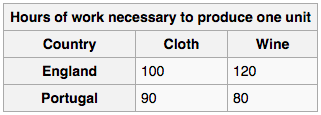
Which is to say that in England, it takes more work than in Portugal to produce one unit of either cloth or wine, maybe because of climate differences. In this sense, Portugal has an “absolute advantage” over England in both categories.
However, as I said, both England and Portugal make and use both products. So, if England needs one unit of each, it takes them 220 hours, and if Portugal wishes to consumer one unit of each, it takes them 170 hours to produce it.
Here’s where trade comes in. Starting at time 2, they decide to cooperate. Let’s say England focused on cloth, and make 2 units of cloth. That would take them 200 hours instead of 220 earlier. And let’s also assume Portugal focused on what it’s good at, namely making 2 units of wine. That would take them 160 hours, instead of 170. Then the countries could trade their extra units to each other, and both of them would have saved time and would have gotten the same amount of stuff.
Actually, there’s another way of thinking about it. Instead of working less, workers in England and Portugal could work the same number of hours and produce more stuff. They could use their extra stuff to trade for new things, and that excess would essentially be proof that this comparative advantage theory is a success.
Criticisms of Comparative Advantage
Comparative advantage is used as a reason that countries should engage whenever possible in free trade; it’s almost a religious belief for some economists. But, as you might have anticipated, there are some serious issues with comparative advantage. For example:
- When comparative advantage kicks in for a given industry, the people in that industry lose jobs. Like wine-makers in England in the above example. Even cloth makers in England might lose jobs if the actual demand for cloth is limited. Of course, the idea is that the economy of England as a whole benefits, so a few jobs lost should somehow be absorbed.
- Also, you can’t simply expect the country that’s the best at a certain thing to be able to arbitrarily expand that industry and forget everything else. Think overfishing, or overgrazing: eventually there are diminishing returns.
- Next, technology comes into play. When one country figures out how to be incredibly productive due to technological advantages, like for example huge farming machines and equipment, then it’s essentially impossible for other countries, without access to such technology, to compete, even if they have good climates. That means most farmers in other countries cannot compete with the United States from a productivity standpoint, for example, even putting aside the ludicrous farm bill, which subsidizes American farmers and further distorts their advantage.
- Speaking of distortions, one argument against comparative advantage is that historically countries didn’t actually become powerful through exploiting comparative advantage and free trade. Instead, they imposed tariffs and such to nourish and grow internal industries.
- If a country buys into comparative advantage, by need or by choice, they often find themselves overreliant on one product, the market of which could be volatile or fail. There’s plenty of historical evidence that this monoculture approach to economics is a bad idea. For example, Ireland went through a famine when there was a blight on their potatoes, even while it was exporting huge amounts of “money crop” grains to England, and more recently Ireland focused heavily on finance and technology, only to be severely hurt by the credit crisis.
- Mostly, though, what is most troublesome about the modern worshipping of comparative advantage is that we end up using it as an excuse to exploit people. As my friend Jordan Ellenberg explained:
If you apply comparative advantage to, say, the US and Bangladesh, what you get is “given existing conditions, the US should make computers, not work very hard, and be rich, Bangladesh should stitch T-shirts for Old Navy at 30 cents an hour, work really hard, and be poor.”
- Not that they don’t want jobs in Bangladesh. They do, and generally speaking trade agreements with poor countries help people in those countries. It’s just that we have to also acknowledge our moral responsibility to people and to reasonable working conditions.
How does this relate to marriage?
Well, first let’s think about how to apply the theory of comparative advantage to a marriage, which people tend to do. The idea is that, instead of splitting up the chores with your spouse half and half, which causes unending arguments about whose turn it is, as well as wasted productivity, we instead decide “who’s good at what” and divvy up the chores in a more scientific manner.
Growing up, I did almost all the household chores while my brother did very few (and the ones we kids didn’t do, my mother did). it wasn’t because my parents told me that, as a girl, I was the natural choice, but because I just “seemed better” at everything. The result was that I did everything, and slowly my “advantage” over my brother – defined here as efficiency, not actual advantage – which was at first small, became large.
Of course nowadays parents rarely ask their kids to do chores, so chores have mostly become a marital dispute. And given that women are expected to be – and have been trained to be – both better at and more willing to do housework, they tend to have more practice at multi-tasking and the dishes.
We arrive at a problem similar to the Bangladesh/ US situation above. Again, Jordan nailed it:
In the sexist soup straight couples all swim in, “don’t keep score, everybody do what you’re best at” seems to invariably end up at the equilibrium “woman does 75% of the shitwork” and what the comparative advantage crowd says is you are not even allowed to be mad about this, women, it is ratified by science, accept that like the Bangladeshis you are in your proper place in the equilibrium state.
One of the problems with applying an economic theory to a marriage is that we don’t actually keep track of how much time it takes us to do various things, and even if we did do that we’d probably do it wrong. Just imagining watching the clock during dishes or laundry sounds silly, and never mind with being in charge of the grocery list, since depending on how you measure that, it could either take no time at all or take all your time. Plus, when you find yourself being petty about small things, you end up measuring your marriage along those petty lines, and even thinking about it that way.
My advice to married couples is to ignore scientific arguments, and instead think about a system that will minimize longterm resentment, which is poison in any marriage or relationship. And that might mean using comparative advantage in part, both as a way of figuring out what people are good at and what people like to do, but it will also probably include doing stuff that you hate and you’re bad at sometimes just to understand what the other person goes through.
After all, the essential ingredients in any marriage is a sense of teamwork, the dedication to alleviating the other person’s suffering, and a promise to encouraging one another’s fulfillment. And economics doesn’t have much to say about those things.
Aunt Pythia’s advice
Readers! Aunt Pythia is extremely pleased to tell you that she’s on vacation in beautiful but arid northern California. This morning we’re planning a walk to the Santa Cruz boardwalk, and Aunt Pythia is even imagining a ride on a roller coaster.

It’s all flights of fancy and whimsy over here, if you catch my drift, which is perfect for doling out the advice. Honestly, every Saturday is a vacation for Aunt Pythia, but giving out advice whilst on vacation just can’t be beat.
If you want to be kind to Aunt Pythia, let her know! Please please please:
ask Aunt Pythia any question at all at the bottom of the page!
By the way, if you don’t know what the hell Aunt Pythia is talking about, go here for past advice columns and here for an explanation of the name Pythia.
——
Dear Aunt Pythia,
I’m in my early fifties, and my kids are teens. I’ve lived in a small, boring city since they were born, and would like a change of pace. I have a job that would allow me to spend two or three months per year elsewhere, but I would have to pay rent. Should I go for it, or is it my duty to save every penny for my kids’ futures?
If it helps, there’s more than enough to pay for (European) college for everybody; there’s by far not enough for them to live of it.
Inverted Matrix
p.s. I ran exercise sessions in linear algebra for so many years you can wake me up at 3am and I would remember the formula for inverting matrices.
Dear Inverted,
It occurs to me that “The Inverted Matrices” would be a good band name.
It is by no means obvious that we should make ourselves miserable for the sake of college costs. Even so, I’m wondering if it’s possible to think differently, and less dramatically, about your nice plan.
In terms of the economics: have you considered subletting your apartment while you’re away? That could easily earn you some money which could offset your travel costs. Or you could think about what other way you could either save or make more money, and imagine it going directly to the “travel pot.” Would that make it easier to plan for?
In any event, it’s not just economic; your kids will also benefit from seeing interesting places. Maybe they’ll get into the planning parts of it with you. Or maybe, being teenagers, they’ll find a friend back home to stay with while you go. That would also be great!
Also, consider going away for three weeks instead of three months, it might be enough for you. For myself, in spite of my nearly daily fantasies about travel, when I’m actually away (like I am right now) I long for the comforts and familiarity of home after about 5 days.
If you decide none of this applies to you, and you’re going to blow the college savings accounts on an awesome summer in Paris, just remember this: you won’t be nearly as badly behaved as my friend’s parents who didn’t help pay for college at all and even stole her identity to take out credit cards in her name while she was away, resulting in her having terrible credit from the get-go. Don’t be that person.
Aunt Pythia
——
Dear Aunt Pythia,
I have reached a point where I have pretty much exhausted all my emotional currency for finding romance. I’m at the love casino with my last $10, and I can risk gambling it away or cash in my chips and leave.
I have been at this point for several years now, sending men away rather than open my heart even a little bit. I know what I’m doing is self-destructive, that I’m taking the slow path to suicide with self-destructive behaviors that stem from lack of love and affection.
I should be a winner at this game. I’m smart and pretty and funny and well-liked. Do men just assume that women like that don’t have feelings or that we cannot be hurt? More importantly, what does a person do when they have nothing more of their self-esteem to invest in this game? I have so much confidence in so many areas of life, but I am shaken and defeated by the roulette wheel of dating.
Given Up Real Love
Dear GURL,
My heart aches for you. Knowing nothing specific about you, I can promise you that you’re not alone. This dating system we have is ruthless and defeating. I’m sure you’ve read this recent article from Vanity Fair about the dating apocalypse, and just in case you missed it the reaction from Tinder. The article is likely too painful to read, but I’ll give you a quote from a young ex-Ivy League investment banker in the first paragraph explaining his multi-women night’s plans: “You can’t be stuck in one lane … There’s always something better.” Barf.
The truth is, it’s not fair to say that Tinder that’s doing this to dating; Tinder is just making it more obvious. We’ve entirely commoditized sex, love, and even affection, and especially in places like New York where there are so many beautiful and single women, the single man feels like an idiot for settling with one. And Tinder is making every place feel like New York.
Now to your questions. Do men assume women don’t have feelings, or can’t be hurt? In some sense, yes. Here’s why I say that.
I think (many) men are better at learning the rules of a system and exploiting them viciously to their benefit. It may be purely socialization here, I don’t want to be sexist, but I’ve always been amazed how quickly the men around me adapt to the petty and arbitrary rules of power and status, whether in academics, finance, or engineering startups. Maybe it’s the testosterone? Whatever the reason, it’s pounding one’s chest stuff everywhere you look.
Not all men, mind you. But enough for one to imagine that there is in some sense a standard approach to putting your brain and your heart on hold, and just following the rules for all you’re worth. It makes sense when you’re in the army, kind of, but it also seems to hold in the mating game, where’s it’s downright obnoxious.
So in other words, I think those men have repressed their feelings, often, in the name of “winning” dating. So they (might) imagine that anyone they come into contact – i.e. other men who they’re competing with, or women who they’re attempting to woo – will also have done the same.
Let’s talk about the other men now, though. The ones that aren’t on Tinder, and that find themselves actually feeling stuff like loneliness and also – gasp – consider other people’s feelings. They exist but they’re harder to find. You want to meet them somehow, though, so I’d seek them out at meetups, bridge clubs, Nerd Nites, and other places where – gasp!! – actual ideas are being discussed.
And I’ll give you the advice I give many people in your position: meet people with the expectation of being friends, and open your heart to that. You might have only $10 to spend on love, but you might have thousands of friend bucks in the bank. And who knows, you might find that friend bucks are (eventually) convertible currency.
Oh, and read Why Love Hurts to understand more about the sociology of the love market.
Aunt Pythia
——
Aunt Pythia,
- “modified because I use salted butter”
- “1 slightly rounded teaspoon of salt”
Why the extra salt?
And, Aunt Pythia, what kind of butter did Marlon Brando’s character use in The Last Tango in Paris? Salted or unsalted?
Maria Schneider
Dear Maria,
I’ve decided you’re referring to my recent recipe for identity crisis crepes. However, you misunderstood. The recipe calls for more salt, but I cut it down because I use salted butter.
Never watched that movie because it seemed nasty. And now that I have read the wikipedia article about it, I’m sure I’m right. But as you’re a character in it, I should think you’d remember the kind of butter used. Sheesh.
Auntie P
——
Aunt Pythia,
Do you like big butts, or can you lie?
Music Is eXcellent – Always Like Appreciating Tunes
Dear MIXALAT,
Sir, I love big butts, thanks for asking! Also, I can absolutely lie; I’m amazing at lying, thanks for reminding me!
But I’m not lying about my love for big butts. Here’s how I feel in song:
Love,
Aunt Pythia
——
Readers? Aunt Pythia loves you so much. She wants to hear from you – she needs to hear from you – and then tell you what for in a most indulgent way. Will you help her do that?
Please, pleeeeease ask her a question. She will take it seriously and answer it if she can.
Click here for a form for later or just do it now:
The seven work languages
You might have heard about “the five love languages.” They come from a ridiculously popular book by Gary Chapman by the same name, and they are purportedly the following:
- gifts,
- quality time,
- words of affirmation,
- acts of service (devotion), and
- physical touch.
Chapman’s idea is that, in order to be happier with your loved one, you figure out how they like to receive your love, instead of just doing to them what you’d have done to yourself. So you might like hugs and physical touch the most, but they might need you to say kind things to them. So you say nice things, and then they give you hugs, and everybody’s happy.
I like this list because it really does seem like some people respond more to certain things than others. Personally I’m a touch person, and someone who likes gifts seems almost fake to me, but putting them both on a list makes me realize that maybe we’re just wired differently. It helps me understand other people a bit more and reserve judgment.
I want to do the same thing but for work instead of love. The question changes from “how to you want to receive love” to “what motivates you to work?”. I’ve come up with the following list:
- money
- security
- status
- social connection
- making a positive contribution to the world
- relief from boredom/ organizing framework
- passion
Ideally an employer would offer to people what they care about. Personally I care about making a positive contribution to the world, but most employers only offer money.
I’m the freak here, I guess. Most people would say they work because they get paid. But really it’s not that simple when you think about it. Some people value money past the point of security, which is why I separated out those two. For that matter, some people care about money as status, but on the other hand academics (generally) care about status beyond money, which is why I made status a separate category too.
The next three are self-explanatory, and I think independent, and for the last category I’m including musicians and artists, people who do stuff in spite of having no reason to think it will ever pay.
Well, my list might be imperfect, but I think it’s good enough to make one point. Namely, that most of those reasons are actually pretty much independent of money after all, so maybe I’m not such a freak.
The work versus money issue matters because of the countless discussions about what might happen if we ever get to the “Star Trek economy” stage of existence, where our basic needs are met and we’re capable of doing other stuff. When we have free time and the resources and security not to worry about food or shelter, what would happen next?
Would we all just play video games 12 hours a day and eat too much? Would we feel useless and dried up and depressed?
I think the answer is, it depends on your personality. If you are the type of person who works out of passion, this new world order wouldn’t slow you down a bit; you’d have even more time to pursue your thing. If you want to contribute to the world, or create meaningful social connections, you’d find a way to do that with likeminded people. If you’re an academic who wants to be the smartest person in the world, you’ll have even more time to do that (but probably way more competition for the title).
My guess is that the only people that would be deeply disappointed are the people who now really really like money for its own sake. I don’t really think there are too many of these people, but they are the very people who might create obstructions to the Star Trek economy’s existence, because they are both powerful and rich in this setup, and potentially have the most to lose.
The Chef Shortage, Explained
This is a guest post by Sam Kanson-Benanav, a chef who has managed restaurants in Minnesota, Wisconsin, and New York City. He spent two years in the studying global resource marketplaces in the Amazon rainforest, and his favorite food is a french omelet.
Despite my desperate attempts at a career change, I’ve become fairly inured to the fact I work in one of the most job secure industries in America. And I’m not a tenured professor.
I am a professional restaurant person – cook, manager, server, and bartender (on nights when a bartender doesn’t show up). As a recent Washington Post article highlights: it has become increasingly more difficult for kitchens to staff their teams with proper talent. We could ponder a litany of reasons why talented cooks are not flocking to the kitchens, but if you prefer to stop reading now, just reference Mathbabe’s entirely accurate post on labor shortages.
Or, we could just pay cooks more. As it turns out, money is a very effective motivator, but restaurants employ two cannibalizing labor models based on fundamentally contrasting motivators: tipping and wages. I’ll take these on separately.
Tipping servers suppress wages for the kitchen
We already know tipping is a bad system, which bears less correlation to the actual quality of service you receive than to the color or gender of your server. It’s an external rewards based system akin to paying your employees a negligible wage with a constant cash bonus, a historically awful way to run a business.
In other words, restaurant owners are able to pass off the cost of labor for employing servers onto their consumers. That means they factor into their menu prices only the cost of labor for the kitchen, which remains considerable in the labor-intensive low margin restaurant world. Thankfully, we are all alcoholics and willing to pay 400% markups on our beer and only a 30% markup on our burgers. Nevertheless, the math here rarely works in a cook’s favor.
For a restaurant to remain a viable business, a cook (and dishwasher’s) hourly wage must be low, even as bartenders and servers walk away with considerable more cash.
In the event that a restaurant, under this conventional model, would like to raise its prices and better compensate its cooks, it cannot do so without also raising wages for its servers. Every dollar increase in the price of line item on your receipt increases a consumers cost by $1.20 , the server happily pocketing the difference.
Unfair? Yes. Inefficient? Certainly. Is change possible? Probably not.
Let’s assume change is possible
Some restaurants are doing away with this trend, in a worthy campaign to better price the cost of your meal, and compensate cooks more for their work. These restaurants charge a 20% administration fee, which becomes part of their combined revenue—the total pool of cash from which they can pay all their employees at set hourly rates.
That’s different then an automatic service fee you might find at the end of your bill at a higher end restaurant or when dining with a large group. It’s a pre tax charge that repackages the cost of a meal by charging a combined 30% tax on the consumer (8% sales tax on 20% service tax) allowing business owners to allocate funds for labor at their discretion rather than obligate them to give it all to service staff.
Under this model cooks now may make a stunning $15-18 an hour, up from $12-$13, and servers $20-30, which is yes, down from their previous wages. That’s wealth redistribution in the restaurant world! For unscrupulous business owners, it could also incentive further wealth suppression by minimizing the amount a 20% administration fee that is utilized for labor, as busier nights no longer translate into higher tips for the service staff.
I am a progressive minded individual who recognizes the virtue of (sorry server, but let’s face it) fairer wages. Nevertheless, I’m concerned the precedents we’ve set for ourselves will make unilateral redistribution a lofty task.
There is not much incentive for an experienced server to take a considerable pay cut. The outcome is likelier to blur the lines between who is a server and who is a cook, or, a dilution in the level of service generally.
Wage Growth
Indeed wages are rising in the food industry, but at a paltry average of $12.48 an hour, there’s considerable room for growth before cooking becomes a viable career choice for the creative minded and educated talent the industry thirsts for. Celebrity chefs may glamorize the industry, but their presence in the marketplace is more akin to celebrity than chef, and their salaries have little bearing on real wage growth of labor force.
Unlike most other industries, a cook’s best chance and long term financial security is to work their way into ownership. Cooking is not an ideal position to age into: the physicality of the work and hours only become more grueling, and your wages will not increase substantially with time. This all to say – if the restaurant industry wants more cooks, it needs to be willing to pay a higher price upfront for them. This is not just a New York problem complicated by sky high rents. It’s as real in Wisconsin as it is Manhattan.
Ultimately paying cooks more is a question of reconciling two contrasting payment models. That’s a question of redistribution.
But “whoa Sam – you are a not an economist, this is purely speculative!” you say?
Possibly, and so far at least a couple of restaurants have been able to maintain normal operations under these alternative models, but their actions alone are unlikely to fill the labor shortage we see. Whether we are ultimately willing to pay servers less or pay considerably more for our meals remains to be seen, but, for what its worth, I’m currently looking for a serving job and I can tell you a few places I’m not applying to.
Aunt Pythia and Sister of My Sister’s advice
Dearest Readers,
Oh My God! Holy crap!! I’ve got incredible news for you all. Namely, my best friend, who will be henceforth known as Sister Of My Sister, is here with me today to help dole out incredibly unhelpful, entirely silly, and possibly hurtful advice. Congratulations to all of you for receiving it!!
Before we begin, I need to mention my new hero, the woman who has slept with 3000 men:

Captivating! Is that a pole? What is that pole for?
You can read all about her here, my friends. Tell me in comments how much you love her too. What vim! What vigor! Also high on the my-list-of-favorite-people: this lady.
On with the main event! Readers, remember when I complained last week about running out of questions? Well, you’ve responded, for which I am very grateful. My trust Google Spreadsheet (soon to be the “Alphabet Spreadsheet”) is happily filled in with a dozen or so new questions. But that’s not to say it should stop! Please continue to add to my list, because why? Because it is a real pleasure of my life, which I look forward to all week and I am ever so grateful for it.
So please do a sweet Auntie a good turn and:
ask Aunt Pythia any question at all at the bottom of the page!
By the way, if you don’t know what the hell Aunt Pythia is talking about, go here for past advice columns and here for an explanation of the name Pythia.
——
Dear Aunt Pythia,
I’m on the verge of graduating with a bachelor’s degree in Mathematics, and suddenly I’m wondering whether going to grad school is the right thing to do – there are a few subjects (mostly in Complex Analysis) which I really like, and I definitely will keep reading about them in the future. Thing is, I really don’t know if I have what it takes to do research in math. I don’t know whether I should try going to grad school and drop out if it doesn’t work out, or whether I should just be content with my bachelor’s degree and keep reading Ahlfors in my free time.
Thanks for any reply,
E
Dear E,
Here’s the thing. We never know whether we have what it takes for anything. At least we who are not crazy narcissistic don’t. So I’d say, if you love something, and if the signals are good that you are capable (i.e. your profs are encouraging), then follow your instincts. It’s a very good sign that you want to read math in your spare time! Go with that.
Or, in the words of my good friend Jordan Ellenberg, do what you’d do if you weren’t insecure.
Sister of My Sister says: go to culinary school.
Aunt Pythia and SoMS
——
Dear Aunt Pythia,
I find this article disturbing. Here’s an excerpt:
[O]ne of academia’s little-known secrets is that private college admissions are exempt from Title IX’s ban on sex discrimination—a shameful loophole that allows some of the most supposedly progressive campuses in the nation to discriminate against female applicants.
Consider my own alma mater, Brown University. In 2014, 11 percent of men were accepted at Brown versus 7 percent of women, according to U.S. Department of Education data.
Brown is hardly the only, or the worst, offender. At Vassar College, the 34 percent acceptance rate for men was almost twice as high as the 19 percent rate for women. At Columbia University, the acceptance rate was 8 percent for men versus 6 percent for women. At Vanderbilt University, it was 15 percent versus 11 percent. Pomona College: 15 percent versus 10 percent. Williams College: 21 percent versus 18 percent. This bias in private-college admissions is blatant enough that it can’t be long before “gender-blind admissions” becomes the new campus rallying cry.
Colleges won’t say it, but this is happening because elite schools field applications from many more qualified women than men and thus are trying to hold the line against a 60:40 ratio of women to men. Were Brown to accept women and men at the same rate, its undergraduate population would be almost 60 percent women instead of 52 percent—three women for every two men. . . .
Today’s [admissions] officials . . . fear though that if enrollments reach 60 percent women, it will scare off the most sought-after applicants, who generally want gender balance for social reasons. “Once you become decidedly female in enrollment, fewer males and, as it turns out, fewer females find your campus attractive,” Kenyon College’s dean of admissions, Jennifer Delahunty Britz, wrote in The New York Times in 2006.
Any comments?
Smart Guy
Dear SG,
Interesting. So you’re saying there’s a de facto affirmative action policy for men taking place in elite colleges.
The statistician in me needs to make the following caveats: some of these statistics could be explained away if we found out that high-achieving girls tend to apply to more places than high-achieving boys on average. Then you’d see many of the same girls applying to a bunch of places, for example, and the boys might apply to fewer.
As a thought experiment, say girls apply to twice as many colleges as boys. From the perspective of the college, among their best applicants they see twice as many from girls. Their acceptance rates, even if they had consistent standards across genders, would be lower for girls. Does that make sense?
Also, keep in mind that a college’s acceptance rate isn’t the same thing as kids actually showing up at college. It could be – and we know it is likely true, in fact – that the same kids are being accepted at a bunch of places and then saying no to all but one. Again, we have to be smart about this, which is all a crazy and inflated system. And without being on the admission committee myself, I really don’t know what’s going on.
Having said all that, I don’t know of any statistics that would make us think girls do apply to more places. I conclude that the stats from the article definitely warrants more investigation.
Here’s another thing to keep in mind. Girls, statistically speaking, are better students than boys, but boys tend to do better on SAT’s at the high end. Personally I don’t think this is all that meaningful one way or another, because both “grades” and “SAT scores” are somewhat arbitrary systems of judgement, neither of which are particularly convincing to me of inner intrinsic worth. Even so, it might be partly responsible for college admissions; colleges might care more about SAT scores than about grades.
I guess that’s what it comes down to: how do colleges decide who to accept? What are their acceptance guidelines like, and are they gender specific? I mean, we might find them discussing the “too many girls” situation, or, more likely, we might just find them trying out different processes until they come upon one that results in “a satisfactory student body.”
A cynical person would point out that what colleges really care about is future endowment contributions, and in our sexist society men are more likely to be the contributors to that. I’m not saying it’s not a factor, but I’m not sure it could possibly be that explicit; it’s more likely to be embedded in an algorithm or at least a process, as many such assumptions are. In any case I’d love someone with more experience in the admissions process at an elite school to weigh in.
Sister of My Sister says she believes that our worst suspicions about the college admissions process are true.
Aunt Pythia and SoMS
——
Dear Aunt Pythia,
Which question that you’ve answered most affected you, and what was the effect?
Curiously Hunting And Obviously Sympathetic
Dear CHAOS,
Thanks for the question, it’s brought me great pleasure in thinking back at all the wonderful questions I’ve had the pleasure to answer. I hope it won’t bother you terribly if I admit that my favorite piece of advice wasn’t actually in an Aunt Pythia column at all, but rather was a mathbabe post called How do I know if I’m good enough to go into math?, which, come to think of it, I should have referred my friend E above to as well. Hey E, go look at that post!
Here’s why that post affected me. I met the wonderful young person who wrote the question to me, afterwards, and she told me quite earnestly how much it helped her. She’s now a thriving and ambitious math major at an elite school. What a pleasant experience, to be able to encourage someone like that!
Moreover, when I went to visit my math camp earlier this summer, I was told that this note had been shared with quite a few of the participants as a way to ward off annoying and competitive behavior; hopefully it helped, but in any case I was super astonished at how much it is needed.
I guess I’m saying that, this is the piece of advice that is closest to that fantasy you have, that you could get in a time machine and go back to your previous self and say something like, hey self! Don’t worry so much, everything’s going to be okay, and you can go ahead and start feeling good now! Because there’s really no time to lose when it comes to just getting on with your life. And that’s really the best feeling that an inveterate advice giver like myself could possibly feel.
Sister of My Sister says that that post and every other is why mathbabe is her hero.
Aunt Pythia and SoMS
——
Dear Aunt Pythia,
My wife of 5 years is a lesbian and I’m not a woman. We’ve known this for about 3 years.
As you might imagine this eliminates the kinds of sex that we find convenient to share with other people in most social settings.
We’ve taken to pretending we’re sexually conventional, even to close friends, because we fear that they’d be really awkward about it if we ever let on. Everyone we have told so far has made a point of avoiding the subject, as if they simply don’t know what to say, understandably I suppose. They’ve been supportive and kind, but awkward.
How can we avoid widespread social awkwardness without feeling like we’re deceiving our friends and families?
Accidentally Asexual Humans
Dear AAH,
Why are you two still married? Are there kids? If I’m a friend of yours, and you tell me this, and you don’t have kids, i’d be anything but quiet. I’d say, get the fuck out!
And that holds for anyone who tells me they aren’t getting regular sex from their partner – unless they have a very good reason, like an illness – and they don’t have kids. If they have kids, then fine, make an arrangement with your spouse to get some outside action while you keep a stable household and until the kids are in college. But for an unromantic atheist such as myself, marriages are not simply friendships, they are sexual arrangements. Moreover, to live a full life you want to at least have the option to get action.
You say you’ve been married for 5 years, and for more than half you’re not having sex. Moreover, it doesn’t seem to be ending soon. I just don’t get it. Your friends are too polite and confused to say what I’m saying now: get out, remain friends, and go find someone who can’t resist your manly self. There are plenty of women looking for a good man that would love to enjoy your company.
Sister of My Sister agrees with me wholeheartedly, but suspects there is some other compelling reason you’ve stayed with your wife and would like you to write back and tell us what that is.
Aunt Pythia and SoMS
——
Readers? Aunt Pythia loves you so much. She wants to hear from you – she needs to hear from you – and then tell you what for in a most indulgent way. Will you help her do that?
Please, pleeeeease ask her a question. She will take it seriously and answer it if she can.
Click here for a form for later or just do it now:
Four Strategies to Delay Child Marriage
Yesterday I went to a fascinating discussion at the Population Council on child marriage in sub-saharan Africa. Specifically, we heard about the effectiveness of four strategies to delay the age at marriage among girls aged 12–17 in parts of Ethiopia, Tanzania, and Burkina Faso in regions with a high prevalence of child marriage (around 12-18%). The strategies were:
- holding community conversations about the benefits of delayed marriage,
- helping pay for school supplies to keep girls in school,
- giving families with girls aged 12-17 a goat or two chickens in exchange for an agreement that they keep her unmarried for two years, and
- doing all of the above.
They also had control areas where they did nothing except poll the girls at the beginning and end to see what percentage of them overall were married, had sexual experience, and had been pregnant. There were typically about 2500 girls in each of the three areas.
They also split the girls further, into two age ranges: 12-14, and 15-17. There are, sadly, many girls in that younger group getting married, sometimes without even knowing in advance that they were to marry, and not knowing or even meeting their husband in advance of their marriage day.
The researchers kept track of effectiveness as well as cost for each of the strategies, both per vulnerable girl and per “avoided child marriage”. A few comments:
- A local economic condition in one region – I think it was Tanzania – namely a situation where all the local coffee farmers were swindled out of their pay, resulted in worsening poverty and dramatically increased child marriage in that region.
- While giving a family a goat or two chickens might sound like a bizarre incentive to avoid marrying their daughter, it is common in Burkina Faso (but not in Ethiopia) to offer dowries in the form of livestock.
- In fact, the reasoning is often desperate and economic: I need these cows, I will give up my daughter for them.
- In Ethiopia, if I remember correctly, it’s a social bonding issue, where you are bound to marry your daughter to a neighbor’s son out of a sense of neighborliness. It’s also hard to refuse these requests.
- There’s also fear that parents have that their daughter might become pregnant before they are married, so they marry her off before that can happen.
- They also worry about their girls becoming “old maids” if they’re not married by 18.
- Different strategies to delay marriage seemed to work for the younger girls than for the older girls.
- Often the young girls who are going to be married young are also not going to school, so it makes little sense to focus efforts only on girls in school.
- As the closing speaker pointed out, these girls’ sexuality has been utterly commoditized for the marriage market, and their autonomy is basically nonexistent. In that sense, even delaying marriage from 12 until they are 16 makes a real difference in their negotiating power.
- Not to mention that, the younger they are married and start having babies, the more likely they are to live in poverty for another generation.
It’s refreshing to see scientific experimental design and data collection being used for such a good cause! I was really impressed by their approach and intelligence over at the Population Council, and I just subscribed to be notified of their future events and research announcements here.
Who wants to be a school teacher (or a fruit picker)?
Some of you may have seen the recent New York Times article entitled Teacher Shortages Spur a Nationwide Hiring Scramble (Credentials Optional). As the title indicates, it turns out that not too many people are throwing their hat into the school teacher ring recently. And given the enormous turnover, this is bad news for the profession.
I’ve got a general rule about such headlines that I like to follow. Namely, whenever we hear about a “labor shortage” in a given profession, we should think about four things:
- Wages
- Conditions on the job
- Benefits, including retirement
- Cost/ length of training
So for school teachers, we might break it down like this:
- Wages – median at around $58K, has been rising a bit ahead of inflation if I’m eyeballing this graph correctly
- Conditions on the job – much worse in the past decade due to the Value-Added Model, and other Education Reform measures which remove autonomy and force teachers to teach to the test
- Benefits, including tenure and retirement – under relentless fire from gleeful Republican politicians
- Cost/ length of training – sizable, which means that it might take the profession quite some time to recover
When you take the above points together, you realize that it’s not a salary thing so much as an environment that has become toxic. A capable person, however earnest, would think twice before entering such an industry. This is particularly true right now, when tenure is on the chopping block but the salary hasn’t risen to compensate for the added risk.
Teachers, as a profession, are not so different from truckers, who I wrote about a couple of weeks ago. We’ve got some skilled workers whose environments have been severely degraded, and whose salaries have not risen in response. Considering the fact that the economy is somewhat better, this means people are unwilling to go get trained and qualify for such jobs. Moreover, there’s a real reason in both industries to avoid lowering the barrier to entry; we don’t want illiterate teachers nor do we want dangerous truckers. The solutions are obvious: either make their lives better or give them more money, or both.
There’s one more profession that’s going through a “labor shortage,” namely fruit pickers (hat tip Tom Adams). This is because we have many fewer Mexicans coming in for work, and Americans are generally unwilling to break their backs for a measly $11.33 per hour median wage. This is somewhat different from the other industries, because there’s really no lower bar for training, and anyone willing to do the work is given a job. There are also no benefits or job security, and obviously conditions are horrendous.
Even so, the solutions are still obvious: make the job better or pay more.


 mathbabe