Archive
Swedish vacation
Dear Readers,
I hope you know I miss you as much as you miss me.
For the past few days I’ve been in sunny friendly Stockholm. In my defense, I’m suffering badly from jetlag. Since I left New York last Thursday I’ve had one good night’s sleep and about 3 naps. My youngest son has an ear infection which is making him miserable, and so I’m kind of stuck at home with the kids while Johan temporarily works at the nearby KTH math department.
But honestly, traveling, even with kids, and even with jetlag, is no excuse to take off so much time from blogging. I didn’t even announce beforehand I’d be going away because I’d planned to blog every day anyway.
Here’s my confession: the real reason I haven’t blogged is because I’ve fallen into a Northern European funk.
Let me explain. Being here in gorgeous sunny Stockholm is kind of like lying back in a cloud. It’s so soft, so bereft of the natural tension and energy of New York, that you just feel like knitting all day and drinking coffee. And then, when you can’t sleep and it’s still light out at midnight, you feel like knitting some more. I’m almost done with a sweater I didn’t even have the yarn for until Saturday.
Not that I’m complaining, exactly – the Swedish people I’ve met are incredibly nice. So nice in fact that it’s almost become a personal challenge I’ve given myself to see what makes them tick.
For example, they don’t seem to value their time like we do in New York. There are lines for everything here, and although I can appreciate an organized line myself now and again, this is a different matter – it’s kind of a national pasttime.
For example, to gain entrance to an amusement park yesterday, my sons and I stood in line for 30 minutes. Then we tried to get onto some rides, but it turns out you have to stand in a second, separate line inside the park for another 30 minutes to buy tickets for the rides. Woohoo! Another line! I seemed to be the only person in line who was crazed by the system.
When I finally got to the ticket window and confronted the ticket seller in my polite-but-impatient New York way, he explained that it was the same system that the park had opened with back in 1830 or something. Naturally I felt incredibly honored to be taking part in such a hallowed ritual, as I explained to him.
Let’s talk Star Trek comparisons for a moment. There’s a spectrum of represented civilizations, from oppressed penal colonies on the one hand, where everyone’s dirty and wearing rags, but even so there’s always a shockingly articulate and thoughtful representatives, to ideal utopias on the other, where everyone’s incredibly fit and beautiful, bounding about without a care in the world (although often also hiding a dark secret – perhaps they sap the life energy from a slave race hidden underground?).
I’d have to put Stockholm and its ridiculously gorgeous citizenry firmly on the utopia end of the Star Trek spectrum, with a few inconsistent details, namely that, unlike in Star Trek, they still exchange money (although not for their high quality medical care) and that, despite their utopian existence, they don’t seem to have the requisite dirty secret. Of course I say that while temporarily residing in the Upper West Side equivalent of Stockholm, and not as an unemployed immigrant youth in the suburbs.
In any case, I’m coming back in a few days, and I’m looking forward to the friction, the hot grimy subway cars, and of course the beloved controversy over citibikes. Aunt Pythia, who missed her column this past Saturday, is also chomping at the bit (with some help from guest advice columnist Cousin Lily!), so stay tuned for that too.
XOXOX,
Cathy
The Compliment Gang
Today I want to share a story with permission from my 10-year-old son.
There’s a bully in his school, a girl who is known to get other kids, boys and girls, together for the express purpose of choosing random victims and insulting them (his phrase is “dis”).
He claims to counteract this behavior by getting together his own posse of “nerd boys” and forming what he calls a compliment gang, where they essentially follow around the above dis gang and say things like, “Hey! I like your shoes!”.
He also enjoys challenging the ringleader to a dance-off, where he demonstrates absurd moves a la Chris Farley:
ThoughtWorks
Yesterday morning when I got to my office, where I’ve been doing a temporary consulting gig, I was surprised to learn that I’d been working in the same room with Aaron Swartz for the past 3 weeks.
The company is called ThoughtWorks, and I’d learned about it through my last company, where some of the best developers had come from the “ThoughtWorks family,” and one of them was still going back to the office every week to work on a volunteer coding project which uses technology to help find missing children. And that’s not all.
The first time I formally met the ThoughtWorkers was on a retreat in lower Manhattan, when I came as an Occupier to pitch a web app to help people find a credit union. I got immediate response, and they quickly formed a team of developers and product people to help our Occupy group build the app (for unrelated reasons this project has stalled, namely we couldn’t find a long-term home for the app inside the credit union community).
So it wasn’t that surprising to learn that they’d hired Aaron 9 months ago, knowing full well what legal problems he was having, understanding and valuing his activist activities, and hiring him on with a new project aimed to promote justice.
It just made me wish I’d introduced myself to everyone last week rather than yesterday, when we were talking in sadness and anger at losing him. As I said yesterday, it speaks well of ThoughtWorks that they’d made a home for Aaron, and I am proud to be working there now, even if it’s only for a short time.
They expressed a desire to carry on in Aaron’s name, which of course different people will go about in different ways. But if you ask me, that means promoting justice and fair access to resources through scrappy technology, broadly understood. Because as I’ve learned, he was a generalist of the best kind when it came to working towards a fairer society.
Aunt Pythia’s advice
It’s time for another possibly final installment of Aunt Pythia’s advice; if you don’t know what you’re in for, go here for past advice columns and here for an explanation of the name Pythia.
And most importantly, please submit your question at the bottom of this column, I need questions! In fact I’m pretty much going to answer all my remaining questions today, just to show you how much I need questions. So this will be the last installment of Aunt Pythia unless I get new questions.
From last time, I asked about the etiquette of ignoring Elsevier referee requests from the perspective of an editor:
Aunt Pythia,
If an editor of an Elsevier journal asks you to referee a paper, wouldn’t it be the norm to decline the request instead of leaving it unanswered, or does Gowers’s revolution includes that anyone who has not joined for one reason or another should be shunned and considered a pariah?
Trapped Editor
The answers were pretty clear: etiquette demands we say why we’re not doing it. If you haven’t got an actual refusal, you’re dealing with a lazy-ass, not a political activist.
——
Dear Aunt Pythia,
Every time I say I admire how Lionel Messi plays for Barcelona and Argentina, my husband says it is a crush. According to my husband, women cannot admire men without them mixing up some lust or crush or impure love. What do you say?
novembertwentyeleven
Dear 11/11,
I agree with your husband, but at the same time I don’t see any problem whatsoever with having a crush on Lionel Messi, he’s hot:

In general I project onto others what I have experienced internally, so I would always assume a crush when it comes to a strapping young male athlete, yes. I may be wrong, but even if you insist I am, I will suspect I’m right. But what does it matter really?
I hope that helps,
Aunt Pythia
——
Dear Aunt Pythia,
Dear Aunt Pythia, How much do you tip on to go orders?
Outrageous in Oakland
Dear Outrageous,
What?! I don’t tip on to-go orders at all. If I’m standing there an picking up my own food from a restaurant I kind of don’t think they need extra money for all the service they’re providing me.
If you mean on delivery, then I tip at a rounded-up 10% rate to the nearest dollar, with a $5 minimum. One time I tipped less than this and a belligerent deliverer refused to leave. It was a learning experience.
AP
——
Dear Aunt Pythia,
Dear Aunt Pythia, as an alpha female are you able to fall in love?
Happy Brownian
Dear Happy,
What a bizarre question. But I’m going to answer it anyway.
Yes, I definitely fall in love, but since you asked I’m going to throw in that I don’t expect love to be magical, to find a soul mate, or to have my partner complete me in some weird way. I find that kind of romantic notion utterly weird and unattractive and it’s never made sense to me why people would even desire that loss of self. I’m tempted to think this is related to my being alpha, but I’m not sure.
For me true love means finding someone you still want to hang out with and are still surprised by 17 years after you met them, even though they never learned to play bridge.
AP
——
Dear Aunt Pythia,
Do you know you give a new meaning to the acronym MILF?
DrunkGuy
Dear DrunkGuy,
Now that you’ve sobered up, can you be more specific as to the “new meaning” part? For now I’ll assume you mean “Momma I’d like to Fund (for her open model initiative)”.
Aunt Pythia
Again, please ask questions, I’m out.
Note: it is okay to recycle old Dan Savage questions: I have no ethics here.
Rolling Jubilee is a better idea than the lottery
Yesterday there was a reporter from CBS Morning News looking around for a quirky fun statistician or mathematician to talk about the Powerball lottery, which is worth more than $500 million right now. I thought about doing it and accumulated some cute facts I might want to say on air:
- It costs $2 to play.
- If you took away the grand prize, a ticket is worth 36 cents in expectation (there are 9 ways to win with prizes ranging from $4 to $1 million).
- The chance of winning grand prize is one in about 175,000,000.
- So when the prize goes over $175 million, that’s worth $1 in expectation.
- So if the prize is twice that, at $350 million, that’s worth $2 in expectation.
- Right now the prize is $500 million, so the tickets are worth more than $2 in expectation.
- Even so, the chances of being hit by lightening in a given year is something like 1,000,000, so 175 times more likely than winning the lottery
In general, the expected payoff for playing the lottery is well below the price. And keep in mind that if you win, almost half goes to taxes. I am super busy trying to write, so I ended up helping find someone else for the interview: Jared Lander. I hope he has fun.
If you look a bit further into the lottery system, you’ll find some questionable information. For example, lotteries are super regressive: poor people spend more money than rich people on lotteries, and way more if you think of it as a percentage of their income.
One thing that didn’t occur to me yesterday but would have been nice to try, and came to me via my friend Aaron, is to suggest that instead of “investing” their $2 in a lottery, people might consider investing it in the Rolling Jubilee. Here are some reasons:
- The payoff is larger than the investment by construction. You never pay more than $1 for $1 of debt.
- It’s similar to the lottery in that people are anonymously chosen and their debts are removed.
- The taxes on the benefits are nonexistent, at least as we understand the taxcode, because it’s a gift.
It would be interesting to see how the mindset would change if people were spending money to anonymously remove debt from each other rather than to win a jackpot. Not as flashy, perhaps, but maybe more stimulative to the economy. Note: an estimated $50 billion was spent on lotteries in 2010. That’s a lot of debt.
Birdwatching
Today I’m posting my friend Becky’s poem about wasting time on a hobby you love. I spent the day at a yarn festival admiring hand-spun, dyed, and knit sweaters that cost about 5 times as much money and infinitely more time than the machine-made ones you can buy in any clothing store. I believe there’s no economic theory that could possibly explain why thousands of other people were just as excited as I was to be there.
——
What pastime could be less economically productive?
Owl swivels her tufted attention,
fixing her severity
on a silent stirring
in the fraying field
a mute meditation
just beyond
my upturned incomprehension.
What activity could be of less social value?
Hawk tears into hare
with his Swiss Army face,
unblinkingly slices
the limp sinew of snow,
a leap of fur
a moment before.
What hobby could be of less measurable benefit?
Egret unfolds her fistful of light,
lifts her improbable wings,
no metaphor for an angel
but the real deal –
You can see for yourself
how Spirit fancies feathers.
What avocation could be a more fervent waste of time?
Only Prayer –
Hummingbird’s eggs are a pair of pearl earrings
nestled in a pocket of lichen and silk –
and Love,
Loon’s lone lament.
Live and let live, motherfuckers
It’s high time I tell you guys about my favorite blog, Effing Dykes.
Why now? Well, I’ve wanted to write a post about body image like Effing Dykes’ The Body Electric ever since I started this blog (ever since I turned 10, actually). But I couldn’t get it right. Not in a million years could I have written something so beautiful or so right. So I’m really grateful she has written it. Please read and enjoy.
That url again: http://effingdykes.blogspot.com/2012/09/the-body-electric.html
Note: I’ve stolen the catchy phrase “live and let live, motherfuckers” (can you say “phrase of the week”?) from that post, as well as this picture, which reminds me of my wordpress profile pic as well as all of my friends from high school:
 p.s. I had a wardrobe crisis last week when I realized I only owned one ugly plaid flannel shirt, but luckily Old Navy has an ugly plaid flannel shirt sale going on.
School starts next week
I know I’m not alone when I say, thank god school starts next week. These kids need to be back in school.
Not that I don’t adore the little lovemuffins, or that I don’t enjoy spending time with them, or that I enjoy hearing them whine about homework. It’s been great, and we’ve watched quite a few good movies in the past few days (for some reason they didn’t enjoy “12 Angry Men” or “Contact” as much as they should have, though).
Don’t get me wrong, I am happy for them to have summer vacation. I just wish we could all take a pill about a week before school actually starts that puts us in a coma for exactly one week. Is that too much to ask?
It wouldn’t help to make summer one week shorter, either. That would just move up the insanity one week sooner. No good. We need that pill.
I’m not employed right now, and I’m trying to find time to write and to plan my future. But it’s kind of hard to do that when my three sons are actively coming up with ways to simultaneously talk louder than anyone knew was humanly possible and to fight ferociously about such things like who gets to play with the cardboard boxes from the last Fresh Direct delivery.
I’m not gonna lie, I’ll be glad when they’re gone. I’m counting the hours. T minus 166.
Hangover cure
After a long night of vodkas and karaoke, there’s one sure method for feeling brand new once again, namely listening to Empire State of Mind, really loud, over and over.
At least I hope so.
p.s. The first year anniversary of mathbabe.org is coming up next Monday, please come up with suggestions for how to celebrate!
Being a single mom is not a crime
I’m reading a book called “The Righteous Mind: Why Good People Are Divided by Politics and Religion” which explains how people first make moral decisions, then use their brains to argue those decisions.
It also promises to explain how you can actually change people’s minds, so I’m looking forward to that.
My goal of reading this is to understand how good, moral people can really believe some things that seem just so outrageous and illogical to me. I want to know when it makes sense to have a difficult conversation and how to approach it. I’ll tell you how that goes.
But every now and then I lose faith in the idea that those outrageous ideas come from an earnestly moral place. And one example came from my son, who is 12.
If you have a 12-year-old, or if you’ve ever been a 12-year-old, you may remember that they speak somewhat hyperbolically. So when mine told me there’s someone in Wisconsin making it illegal to be a single parent, I thought he was making it up.
But then he found this article for me. I was dumbfounded, and he said I’d have to blog about it since he was right and I was wrong. So here I am.
This just seems so so ass backwards on so so many levels, especially when you think about how it would go down if it became law. Do we get the fathers in trouble too? What if we don’t know who the father is? Do we make it illegal to have unprotected sex in the first place with someone you aren’t married to?
Beyond the crazy idea of where this would stop, I always get upset when I see vulnerable people further abused. If this guy can make a case that kids of single moms are more at risk for various things, why not take that as a cue to give them more support (rather than punishing them)?
Fox News fabricates a part of Obama’s speech
This is a guest post by Michael Thaddeus.
When President Obama spoke at Lorain County Community College in Elyria, Ohio, on Wednesday, he said, “Somebody gave me an education. I wasn’t born with a silver spoon in my mouth. Michelle wasn’t. But somebody gave us a chance.” [Minute 9:24 on video.] He has made similar remarks numerous times, including as early as 2009.
But when smirking reporter Steve Doocy quoted the President to Mitt Romney on Fox News, he added three words: “Unlike some people, I wasn’t born with a silver spoon in my mouth.” [Minute 3:39 on video.]
Those three words, “unlike some people,” were a complete fabrication. President Obama never said them or anything like them. The extra words make the President sound snide, as if he were mocking Romney.
Where did these extra words come from? Steve Doocy seemingly made them up out of whole cloth. Are reporters really supposed to do that?
What happened next? Philip Rucker at the Washington Post “reported” the story on Thursday, but he made no effort to check the fabricated quote against the primary sources, easily available online. Instead, he put Fox’s words directly into the mouth of President Obama. Are reporters really supposed to do that? I e-mailed him and the Post editors to request a correction, but he hasn’t answered, and guess what, the false quote is still there.
Update: the Washington Post has made a correction.
Then what happened? The New York Post devoted one of its two Friday editorials to slamming Obama for taunting Romney. They called him “cynical,” “misguided,” and “snotty.” Well, of course he sounded snotty! That’s because the Post used the snotty quote concocted by their colleagues at Fox News! Are newspapers really supposed to do that?
When I pointed this out to the editorial staff at the Post on Friday, they replied, “we’d be happy to consider running a letter to the editor on this subject, if you’d care to write one.” Great! But what’s the catch? “I couldn’t guarantee that we could run it.” What odds do you give me? Meanwhile, even though a prominent editorial in the Post is devoted to denouncing the President for saying something that he didn’t really say, there seem to be no plans for a correction or retraction.
So there you have it. One branch of the Murdoch empire concocts a snotty quote, supposedly from Barack Hussein Obama. Another branch vilifies him for supposedly saying the snotty thing that they themselves concocted. Meanwhile, the fabricated quote continues to reverberate in the echo chamber of the right-wing blogosphere. And thanks to the Washington Post, it will soon be as good as true.
Let’s grant that these three little words are a petty mendacity by the Iraq War standards to which we’ve become accustomed. And let’s grant that Obama’s speechwriters are shrewd and were hardly unaware of the contrast with Romney when they wrote the “silver spoon” line. Still, what makes Murdoch newspapers and TV stations think they can fabricate quotes, enclose them in quotation marks, attribute them to the President of the United States, and get away with it? It’s pretty shocking when you think about it.
It sucks to be rich
I often find myself uttering the phrase, “you don’t want to be really rich, because it sucks to be rich.” For whatever reason I’m always asked to explain that opinion. I’ll do so here so I can just reference this blog post from now on instead of having to repeat myself.
Just to be clear, it also sucks to be poor. I’m not saying it doesn’t because it really, obviously does. My experience going to Ghana and making friends with dancers who later injured their backs has shown me that, especially when there are unmet medical needs, being poor absolutely bites.
But I would (and will) argue it also sucks to be rich, in a more psychological, and less sympathetic (as in, people don’t have sympathy for you) kind of way.
This recent article from the New York Times, about a reported who lived like a billionaire for a day, is worth a read and is what spurred me to write this post. My favorite line:
“Somebody’s got to live this life,” he says, gesturing to the pristine view from his penthouse villa. “God decided it should be me.”
Not that this line supports my arguments, but it’s just awesomely grandiose and despicable.
Anyhoo, back to why it actually sucks. I am using evidence I gleaned from working at D.E. Shaw with quite a few rich people (as in never have to work in their lives and can take yearly ski vacations in the Alps or wherever) and a few insanely rich people (way more). So it’s a relatively small sample size, but even so it’s not empty.
The main reason I think it sucks, is that human nature has us worrying about stuff no matter what. And rich people don’t have normal things to worry about, so they make up really weird shit to worry about. That’s kind of the whole argument but I’ll give a bunch of examples.
The primary reason it sucks to be rich is that, counter-intuitively, rich people constantly worry about money. If you drew a graph of “have money” versus “worry about money” it would be a “U” shaped graph. I feel very lucky to be in the sweet spot where I make enough money not to worry about paying my bills or being on medical insurance but I don’t make so much money that I have to start worrying about it.
What do I mean? I mean:
- Rich people worry about whether they’ve invested their money correctly (not a concern for me). This sounds like a joke but believe me, they talk about it for many many hours, probably more time than they spend with their kids.
- They worry about whether the charities they give money to are really producing stuff, because the scale of their donations is so large (again, not a concern for me, if I give money it’s to Fair Foods and I know exactly where it goes, usually to paying for insurance for the trucks).
- They scheme and plan how to affect politics and politicians with their money. Maybe not so much sympathy for this.
- They worry about whether their kids will turn into good-for-nothing leeches and so come up with weird estate planning contracts with lawyers to keep money away from their kids, which in turn screws up their kids and their relationship with their kids. This stuff is for real and can get insanely nasty, see this article if you don’t believe me.
Who needs all that? I’m much happier having kids where I’ll say, when they are ready to go to college, hey here’s how much we’ve been able to save, here are your college choices, the rest you’ll have to pay for yourself so choose wisely.
In other words, it’s good to have nice and reasonable worries.
Besides money, what do rich people worry about? The answer is: absolutely everything, and nothing, at the same time.
My favorite two examples come from stories about David Shaw himself, who is massively rich. I didn’t actually meet the people involved, so these are myths I heard working there, but they are really good myths and have the ring of so-absurd-nobody-could-make-this-up.
First example: David hires a Ph.D. in English literature (he has a thing for “geniuses”, even in the mail room) to test mattresses for him. So that person’s job is to sleep on 15 different mattresses, for 8 nights each, and draw up a report to tell him the pros and cons of each mattress. This is to avoid him having an uncomfy night’s sleep. That’s what the risk was that we were avoiding with that.
Second example: David wants to be sure his trip to California goes smoothly, so he hires a Ph.D. in Something to take the exact same trip – same car service to the NY airport, same flight (same seat on plane!), same car service upon arrival, same hotel, exactly a week before his trip (due to understood seasonality issues of air travel) – to make sure there are no snags, and to draw up the report that presumable explains how much leg room there was in his plane.
You could say that he’s just a weirdo, but here’s where I’d disagree. Before making $2.5 billion, he was just a computer science nerd at Columbia. Sure, he was intense and probably competitive, but he had normal worries and isn’t famous for being a total jerk. For that matter he’s still not famous for being a total jerk, but he’s clearly got not enough to worry about.
In other words, I’m convinced that if I had that much money, I’d be doing stuff like that too, and so would you. The existence of asstons of money around you makes you weird and entitled. Add to that that everyone around you is either your servant or someone who assumes you are living a perfect happy life, and you become increasingly isolated and misunderstood on top of it, which leads to more weirdness.
Yuck! I’d rather be saving up for a family trip to somewhere nice, and in the meantime having stay-cations where the biggest expense is a Brazilian barbeque restaurant in Queens.
Which muppet are you?

I’m kind of into Greg Smith telling us that those guys at Goldman Sachs consider us all muppets, because the muppets fucking rock.
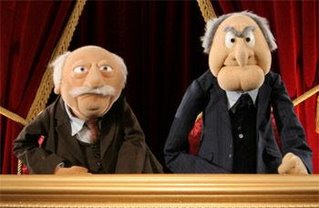
Depending on my mood, I’m either Miss Piggy or one of those guys in the balcony complaining about stuff.
Recruiting against Goldman Sachs
I’m back from Amsterdam. Can I hear a “fuck yeah” for my guest blogger Becky while I was gone?
FUCK YEAH!!
Lots of things to talk about, sausage wall-related and otherwise, but here’s what’s first.
After reading Karen Ho’s book Liquidated, which I blogged about here, it’s impossible not to understand Goldman Sachs and other investment banks recruitment plans as not coincidental but absolutely central to their overall business strategy of seeming elite and smart. That’s one reason Greg Smith’s resignation letter is so awesome: it erodes the brand of GS, and perhaps keeps young people from joining, cutting them off at the source.
This recent article from the New York Times discusses this issue and quotes both Karen Ho and my friend Chris Wiggins, which is cool because Chris told me about Karen’s book. From the article:
“Everything from Occupy Wall Street to larger critical discourses of ‘fat cats,’ all of that has had some trickle-down effect” to young people, said Karen Ho, an associate professor of anthropology at the University of Minnesota, who has studied the culture of Wall Street.
The decline in the finance industry’s allure has been accelerated by the explosion of the technology industry. A 2011 survey of 6,700 young professionals by the consulting firm Universum ranked Google, Apple and Facebook as the most coveted workplaces; JPMorgan Chase, the highest-ranking bank on the survey, was 41st.
This doesn’t really tell us much since i-banks only recruit at certain colleges, and we don’t know where the survey took place. Also, I’m hearing disappointingly large numbers of kids are currently planning to go into investment banking. However, I’m guessing that the numbers of students going into investment banking from Princeton and Harvard are going to go down about two or three years after Occupy started – these older students had already been brainwashed by the time Occupy got to them. More of the article:
At this year’s SXSW Interactive conference in Austin, Tex., a panel called “Keeping Kids off the Street: Wall St. vs. Start-ups” was convened to address questions including whether the finance industry was to blame for what organizers called a “failure to nurture a culture of innovation” in New York. Chris Wiggins, an associate professor of applied math at Columbia University who sat on the panel, said he was seeing students shy away from Wall Street and veer toward industries where they could work and profit without bringing their morality under the microscope.
“The claim of investment banking that it serves a social purpose by ‘lubricating capitalism’ has eroded,” Professor Wiggins said. “It’s simply very difficult for young people to believe that they’re serving any social purpose now.”
First of all, great quote from Chris.
Next, I have no problem trying to talk young people out of going into investment banking and into internet start-ups, because one industry is just too big and the other is enjoying explosive growth. But on the other hand, there’s plenty of reason to worry about the idea that ones morality isn’t under the microscope if one is engaged in highly scalable modeling that affects people’s lives. In fact that’s exactly what I’m worried about right nowadays.
By the way, I’ll be talking about the job of the quant in these two industries, as well as my related concerns, tonight at Emanuel Derman’s Financial Engineering Practitioner’s Seminar at 6pm at Columbia.
Calligraphy of geese

Calligraphy of geese
against the sky —
the moon seals it.
– Buson
Hip Hop’s Cambrian Explosion: Part 3

My last post left off on the topic of rap battles, element #16 in the Elements of Hip Hop. As one astute reader points out, Hip Hop is a culture as much as it is a musical genre. And as in any culture, the values are contested in public fora. The rap battle is only one arena in which the values of Hip Hop are contested and negotiated. Hip Hop also finds expression in dance and the visual arts.
Breakdancing was an early choreographic innovation that contributed to Hip Hop’s meteoric rise in popularity.
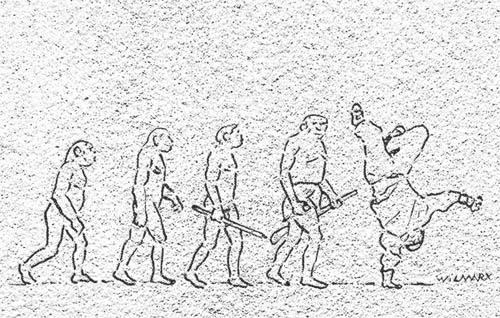
It later speciated into two new dance styles, popping and krumping. The documentary Rize showcases the talented pioneers of krumping, an athletic dance/fight form that calls to mind the Brazilian martial art of capoeira. The film situates krumping in its historical and social context, chronicling how it emerged in improverished neighborhoods in South Central LA as a community-building alternative to gangs and an outlet for artistic expression. Its founders, who see it as a faith-based practice, cite krumping’s capacity to “release anger, aggression, and frustration positively, in a non-violent way.”
The film is a testament to the power of art to heal and transform suffering, but it’s also just good eye candy. It’s the best of Cirque de Soleil – the reticulated musculature, the contortionism, the elastic gesture, the disdain for gravity – but without the fancy sets and high ticket prices, performed on a street corner for free and for freedom.
Another forum for Hip Hop’s artistic expression is the graffiti battle. Or “aerosol art.” The annual Estria Invitational Graffiti Battle draws together artists from around the country to compete in a day-long public visual arts contest. This video of the 2011 Estria battle illustrates the form: artists are given five hours and the challenge of incorporating the same word into their public art piece. Last year’s word was “Heal.” As Nate One explains in the video, “Art is not a drug; it’s free, and when you do it, it makes you feel better. That’s magic!”
Sometimes art is the only way to transform a dire situation. Street artist Banksy, featured in the riveting and somewhat surreal documentary Exit Through the Gift Shop, turned the wall separating Israel from Palestine into a canvas of possibility.

So why is the Academy of Art University in San Francisco not only participating in anti-graffiti campaigns, but using their anti-graffiti efforts to recruit new students in their promotional advertisements? I would think they would be more interested in hiring Banksy as a professor than white-washing street art. But since tuition alone for an undergraduate degree at the Academy of Art costs approximately $80,000, my hunch is that it has something to do with classism. Fortunately, the top-notch Oakland Museum of California is more supportive of local artists, sponsoring the Living Concrete live graffiti mural painting festival.

Together, Hip Hop’s rap battles, dance battles, and graffiti battles are venues for positive artistic expression, bringing me to the next point in this protracted paean to Hip Hop.
7. Hip Hop is positive. Hip Hop receives a lot of negative attention in the media for its materialism, its machismo, and its militance. Those are accurate descriptors of mainstream rap, perhaps, but Hip Hop is a large umbrella that shelters many subcultures. It’s such a large category, in fact, that describing it is like trying to describe Christianity, which encompasses myriad splinter groups with ideologies as distinct from each other as Lutheranism is from Mormonism. As distinct as gangsta rap is from underground Hip Hop.
Rapper Too Short, representative of the former subculture, was in the news this week for some ill-advised “advice” he gave to young boys in a youtube video. The organization We Are the 44% called him on the carpet for promoting sexual violence against young women. You can read about the town hall discussion that ensued here, on Davey D’s blog.
Given the range of subcultures within Hip Hop, with Too Short arguably on one end, it’s painting with perhaps too broad a stroke to describe all of Hip Hop as positive. The media, however, tend to focus on Hip Hop’s more negative aspects and overlook the positive ones, which abound. Consider Shad’s Keep Shining, which is a welcome antidote to Too Short’s views:
My mom taught me where to keep my heart,
My aunts taught me how to sing two parts,
My sis taught me how to parallel park,
Tried to teach me math but she’s way too smart.
My grandma in her 80′s is still sharp,
My girl cousin’s in activism and art.
They taught me there’s no curls too tight
No mind to bright,
No skin too dark to keep shining!
I got off the 2 train in Brooklyn on my way to a session
Said let me help this woman up the stairs before I get to steppin’
We got in a conversation, she said she was 107.
Just her presence was a blessing,
and her essence was a lesson.
She had her head wrapped
And long dreads that peeked out the back
Like antenna to help her get a sense of where she was at.
Imagine that:
Livin’ a century,
the strength of her memories.
Felt like an angel had been sent to me.
She lived from nigger to colored to negro to black
To afro then african-american and right back to nigger.
You figure she’d be bitter in the twilight,
But she alright, ’cause she done seen the circle of life.
Hers is a story of resilience, and what’s more positive than resilience?
As you may have inferred from the tracks I’ve referenced so far, I eschew the brand of rap that glorifies guns and denigrates women and listen to what’s referred to as “progressive,” “underground,” or “conscious” Hip Hop. In contrast to the more commercially successful rap, the underground stuff is so positive and upbeat that I’ve dubbed it “Self Help Hip Hop,” or when I’m feeling really cheesy, Hip Hope.
I’m referring to groups like Atlanta-based Collective Efforts with tracks like Doin’ Alright and Try Again. Here’s one blogger’s picks for the Top 10 Progressive Hip Hop Artists. Self Help Hip Hop is values-based music, and one of its core values is gratitude. One of my favorite songs is by Brother Ali, written to his young son, Faheem. Ours has been described as a fatherless generation, and in that context his words are refreshingly sentimental:
I fed you, changed you, read to you and bathed you.
I ain’t trying to hold that over your head; I’m saying ‘thank you.’
K’Naan’s 15 Minutes Away is an object lesson in the value of generosity. He opens the song recounting his pre-immigration experience of being “broke like an empty promise,” destitute to the point of hunger. I feel for him as he jokes about anxiously awaiting a Western Union money transfer. The song follows his arrival in Canada as a refugee and his subsequent rise in fame as a musician, and ultimately comes full circle as he describes rushing from the concert venue to the Western Union office to send money to his grandmother. “Generosity is the key!” he intones. And he repeats it twice, in case we weren’t paying attention: Generosity is the key.
While detailing explicitly the hardships of life, hip-hop music often concludes its narratives with the hopeful assertion that odds can be overcome – as evidenced, if nothing else, by the fact of the individual rapper’s rise to fame. And it’s not just the lyrics and the message that make Hip Hop positive. The music itself may be operating on a molecular level to lift your mood, according to Oliver Sack’s characteristically charming Musicophilia. Dr. Sacks provides insights into the neurology of listening to music, including how it raises serotonin levels and other biochemical agents of wellbeing.

I might be paraphrasing here, but I think what Dr. Sacks is saying is:
8. Hip Hop is funky. For all its incisive analysis, creative rhyme schemes, and positive poetry, I like Hip Hop mostly because it feels good. It gets me reaquainted with my soul via my hips. I challenge you to NOT do the Humpty Dance. I defy you to NOT get down at Collective Efforts’ I Get Down. Or Shad’s I Get Down.
Rapper Lyrics Born, with a voice like Paul Robeson, joins James Brown in my personal Hall of Funk Fame for his ode to the Bay Area, The Bay. Ozomatli’s Cut Chemist is a groovalicious blend of Chali 2Na’s deep bass vocals and a punctuated latin brass section reminiscent of the Buena Vista Social Club. In this video of Cut Chemist the funk is in effect.
As Chali 2Na, the Ghetto Diplomat, says: “I’m blessed with the gift of rap.”
I couldn’t agree more.
*****
So, Mathbabe, my answer to your question is that Hip Hop is very much

Addendum: My secret agenda in writing this blog was not only to celebrate Hip Hop, but to trawl for new music. If you have a favorite Hip Hop song to recommend, I want to hear it. Please post a link in the comments section below.
I’m particularly interested in what I haven’t heard so far, and what could be the next logical leap in its Cambrian explosion: Eco-rap. In fact, consider this a call for entries. I want to hear a rainforest redemption rap, one that samples an owl’s rhythmic hoot, remixes a cricket choir, and layers in a Wangari Matthai recording on reforestation. What would an Earth First! anthem by Busta Rhymes sound like? I want to hear Shakira and Nas team up to write a rap requiem on soil erosion. KRS One, if you’re reading this, there’s a lacuna in the curriculum.
Propaganda with a Caveat

Caveat: “Under Capitalism, man exploits man; under Communism, it’s the other way around.”
– John Kenneth Galbraith
Interlude: Egret Ardor

Snowy Egret
A late summer night and the snowy egret
has come again to the shallows in front of my house
as he has for forty years.
Don’t think he is a casual part of my life,
that white stroke in the dark.
– Mary Oliver
Hip Hop’s Cambrian Explosion: Part 2
Since Cee Lo got the last word on the previous post, the first word of today’s guest post goes to Senegalese rapper Sister Fa. The word is Sarabah, the inspiration for point 4 in this prolix paean to Hip Hop.
4. Hip Hop is international. Although it originated in the African American community as a critique of white supremacy and an expression of community pride, it has gained international popularity over the past three decades, going viral as a musical meme, and inspiring artists from across the globe to adapt it and hybridize it with local traditions. To make a biological analogy, Hip Hop has undergone a global adaptive radiation to rival that of the Cambrian explosion.
I highly recommend the documentary film The Furious Force of Rhymes, which includes interviews with rappers in Senegal, Israel/Palestine, the United States, and Germany, chronicling its global appeal and rapid evolution. The film is a tribute to young artists who are drawn to Hip Hop as a vehicle for exploring social and political inequalities. Artists like Sister Fa, who raps in Wolof, Manding, Jola, and French. Her song Life Am reads like a public service announcement about the importance of practicing safe sex to contain the AIDS epidemic, but it’s the catchiest PSA I’ve ever heard, which is why it’s so effective. I find myself singing along to the rhythmic “utiliser le preservatif” only to realize that’s about the least sexy thing it’s possible to say in French. Voici une video, Milyamba. Sister Fa is leveraging her fame as a rapper to campaign throughout West Africa against female genital mutilation. Subjected to the practice herself, she tells her story in the documentary film about her life and activism entitled Sarabah.
Sister Fa’s use of multiple languages in the course of one song is typical of the way in which international artists have embellished the form and upleveled the wordplay. I’m particularly fond of songs that blend English with other languages, like Ozomatli’s Nada’s Por Free, sung in Spanglish (“So me levanto off the suelo straight chillando with my pena.” Ha!). I’m kvelling over this video of Ozomatli performing in Spanglish at the Tu B’Shvat Nature Fest.
Code-switching and language-switching are natural stylistic choices for a medium concerned with raising questions about racial identity. It was not so long ago that Apartheid imposed arbitrary racial categories on South Africans and enforced them with singular cruelty. (Check out this excellent documentary on Apartheid featuring Archbishop Desmond Tutu.) In the context of a country attempting to decolonize its national psyche and forge more pluralistic and inclusive social structures, rapper Emile YX uses Xhosa, Zulu, English and Afrikaans to explore lingering questions of racial identity.
In Who Am I? Emile YX mixes it up like the chromosomes in his name:
I’m every brother and sister
Working in a factory
I’m Easter weekend
camping at Kommetjie
I’m Sunday braaivleis
Dik geeet en gaan slaap
I’m that stone thrower at Caspers
During Apartheid innie Kaap
I’m that dummies player, kennetjie en Akoos
I’m that ANC supporter saying the DA se ma se,
I’m that voes gamtaal talker, corner broker
Gooi neer jou tol want hier gaan jy stoke ja,
I’m that mass marcher and tyre burner,
Minimal wage sub-economic earner
I’m that doctor, lawyer and politician in the ghetto
Wait a minute … Most of them have moved out though.
So I’m that one who stays to be a good role-model,
My election promises are not just oral.
Even when I can’t understand all the content of a song, I enjoy listening for Hip Hop’s recognizable elements, as well as the unique aspects that mark its cultural adaptation.
Here are a few gems:
In Spanish: Humanidad by Ana Tijoux
In Tagalog: Bebot by the Black Eyed Peas
In Japanese: Togesashi by Inden
In Arabic: Al Kuffiyeh 3Arabeyyeh by Shadia Mansour
With Hip Hop’s increasingly international reach, it is ever more pluralistic in both form and content. What is it exactly that makes the genre so appealing to a diverse global audience?
5. Hip Hop is democratic. A key stylistic convention of the genre involves using multiple first-person narrators who rotate in order to collectively construct the story as a mosaic. In the Black Eyed Peas’ Beautiful People, each of three narrators takes turns recounting his experience of coming into his own, overcoming the obstacles presented by anti-semitism, poverty, and the INS. Pinoy poet apl.de.ap tells his story:
Back in the days when I was in Philippines,
I had a dream to be heard and to be seen.
Came overseas at the age of fourteen,
Stood behind the front, if you know what I mean.
The song explores questions of worth – self-worth, material worth, innate worth — themes which are woven into each person’s narrative so that the song tells a collective story while still allowing each individual to express his unique perspective. Macy Gray sings the melody, an adaptation of the chorus from the Beatles’ Baby You’re a Rich Man With her wonderfully scratchy voice (What I wouldn’t give to bring Janis Joplin back from the dead to hear her and Macy Gray growl a duet!) she asks, “How does it feel to be one of the Beautiful People?” Collectively, the Black Eyed Peas convey a fairly democratic sentiment: You refugee, you immigrant, you down-and-out listener (and yes you, reader): You are the beautiful people.
Another favorite example of a song that uses rotating narrators to tell a single story is the Fugee’s Rumble in the Jungle. Seven narrators take turns paying homage to the historic boxing match between Muhammad Ali and George Foreman that took place in Zaire in197. At the height of the Black Power movement, Muhammad Ali’s journey back to Africa took on a significance and symbolism that became a source of shared pride bolstered further by the fact that Ali was the World Heavyweight Champion and a radical to boot. Ali was an early Conscientious Objector to the Vietnam War, stating succinctly, “I ain’t got no quarrel with them Viet Cong; No Viet Cong ever called me ‘nigger.’” The song opens with a quote by Ali, so in a sense he becomes an eighth narrator:
“I’m gonna fight for prestige, not for me, but to uplift my little brothers who are sleeping on concrete floors today in America, black people who are living on welfare, black people who can’t eat, black people who don’t know no knowledge of themselves, black people who don’t have no future. I want to win my title and walk down the allies, set on the garbage can with the wineheads. I wanna walk down the street with the dope addicts, talk to the prostitutes. So, I can help a lot of people.”
I recommend the documentary When We Were Kings, a biopic about Ali, which situates Rumble in the Jungle in its historical context, including the glaring irony of the event: the fact that it was funded by dictator Mobutu Sese Seko, who had only recently assumed power via coup after the C.I.A. orchestrated the overthrow of the democratically-elected Patrice Lumumba. For more on the story of this egregious episode in American foreign policy, two good resources are the film Lumumba and the book The Poisonwood Bible by Barbara Kingsolver, a fictional account of the period surrounding Lumumba’s assassination. Interestingly, her novel also uses the device of rotating first-person narrators to structure the story. When telling a story about democracy – or the deliberate undermining thereof – the technique of weaving multiple narrators’s perspectives is apt in that it models pluralism.
Women’s voices are too often missing in Hip Hop, so I am particularly smitten with Cell Block Tango/He Had It Comin’ by Macy Gray, L’il Kim, and Queen Latifah. This song uses the multiple-narrator format to address a serious topic in a campy tone: domestic violence. The song’s over-the-top Broadway style (it was written for the musical Chicago) signals to the listener that we are in the realm of fantasy as each artist imagines violent revenge against her lover/abuser. Queen Latifah sings the first verse with characteristic sassitude:
I mean imagine, why was he hittin’ his woman?
Why was she takin’ that?
Now picture her fightin’ back, picture the ass kickin’
Think of his ass flippin’ down the stairs
And me at the top smilin’, he shoulda stopped wildin’.
Now could you picture me tryin’ to finish him off?
See why I pictured me on this side of the law?
High heels leave holes, you’d a thought I was gunnin’!
Now the cops comin’, I ain’t runnin’!
Hip Hop is very much a macho, male-dominant form, misogyny being its blind spot. So Queen Latifah’s is a minority voice. But that’s just it. Even if yours is a minority opinion, if you can voice it with enough panache, and what you’re saying smacks of truth, then you can have your day in court in Hip Hop. The democratic nature of the form has a lot to do with the method by which rappers rise in fame and credibility: the rap battle.
6. Hip Hop is competitive. Emerging rappers can be recognized in public because they carry a notebook in their pocket which they frequently take out to jot down rap lyrics and song hooks. They are avid consumers of rap music, noting other rapper’s cadences and rhyme schemes, and honing their skills in cyphers. A cypher is a group of rappers who get together and take turns improvising raps either acapella or over a beat. If you have ever seen this live, you know how impressive this ability to extemporize is. Here’s a home-made video of a stellar cypher I saw live as part of the annual Life is Living Festival. (Check out the 9-year-old who rocks the mic at 3:20 and 13:28!) Cyphers provide creative community and serve as training grounds for the high-stakes battles that put rappers to the test. Many of you are familiar with the battle scene in Eminem’s 8-Mile, a film that is notorious in my mind largely for its terribly unsexy sex scene. (And they didn’t even “user le preservatif!”) Here’s a link to the final battle scene in 8-Mile, in which Eminem wins by confessing his flaws to the crowd first, stealing his opponent’s best ammunition.
In a rap battle, two artists at a time compete. They are each given a time limit, taking turns addressing each other back and forth, all the while wooing the crowd with their artistry and skills. When the beat drops – one they have not heard in advance – they have to deliver a performance that: a) belittles the competitor; b) self-aggrandizes; c) references a comment or event that just occurred, demonstrating that the lyrics are improvised in the moment; and d) impresses the crowd. This last one is critical, as it is the audience who decides who the winner is in an instant and rambunctious plebiscite. Picture an Occupy General Assembly, but with different hand gestures. Hip Hop’s virtuosos are vetted in the democratic forum of the rap battle.
Apropos of democracy and internationalism, I’ll give the last word of today’s post, part 2 of 3, to the Occupy Wall Street movement. Enjoy this funky rallying cry from Occupy London.
Cheers!

Interlude: Newt Haiku

Photo: The newt on the left hovers above an egg sac moments before approaching the beast with two tails on the right.
On one of the first unmistakable days of Spring, I led a group of five six-year-olds on a walk through the UC Botanical Garden, where I am a docent. I say “walk,” but children at that age do anything but: they skip, bound, trip, jostle, spin,and vibrate in a sort of Brownian motion, but rarely walk. On this first morning of emboldening sunlight and tentative short sleeves, my group was particularly kinetic, their effervescence reaching a feverish pitch when we arrived at the Japanese pool and found the newts in a similar frenzy. Pairs of newts gripped each other in slippery contortions, splashy displays that incited the childrens’ curiosity. Lone newts trailed after mating pairs, latching on to a tail and rolling into a tan-and-yellow tangle of three- four- and five-newt bundles. One of the children asked, “What is that brown knot?” The adult chaperones tittered. Since Spring has inspired haiku for centuries, I offer this reply, in haiku form.
What is that brown knot?
The newts are dancing, children,
celebrating Spring.
What is that brown knot?
The newts are wrestling, children,
That’s how life begins.
What is that brown knot?
A miracle of nature,
one more mystery.
What is that brown knot?
The newts are in love, children,
euphemistically.
What is that brown knot?
A good old-fashioned tussle,
a frenzy, a fray.
What is that brown knot?
Survival of the fittest,
Shuffling DNA.
What is that brown knot?
An amphibian orgy,
It’s rude, kids, to stare.
What is that brown knot?
Sexual reproduction.
Ask that docent there.


 mathbabe