George Cooper gave a talk last night in which one of his proposals was to force the rating agencies to always have the same fraction of ratings in each category. The idea being that then good ratings would be much harder to buy because the ratings agency would need to downgrade something in order to upgrade the one in question.
This strikes me as not a good idea. After all, there are times when the economy is actually running well and there are fewer companies in trouble and at risk of default. Such a system would not recognize such a seasonality.
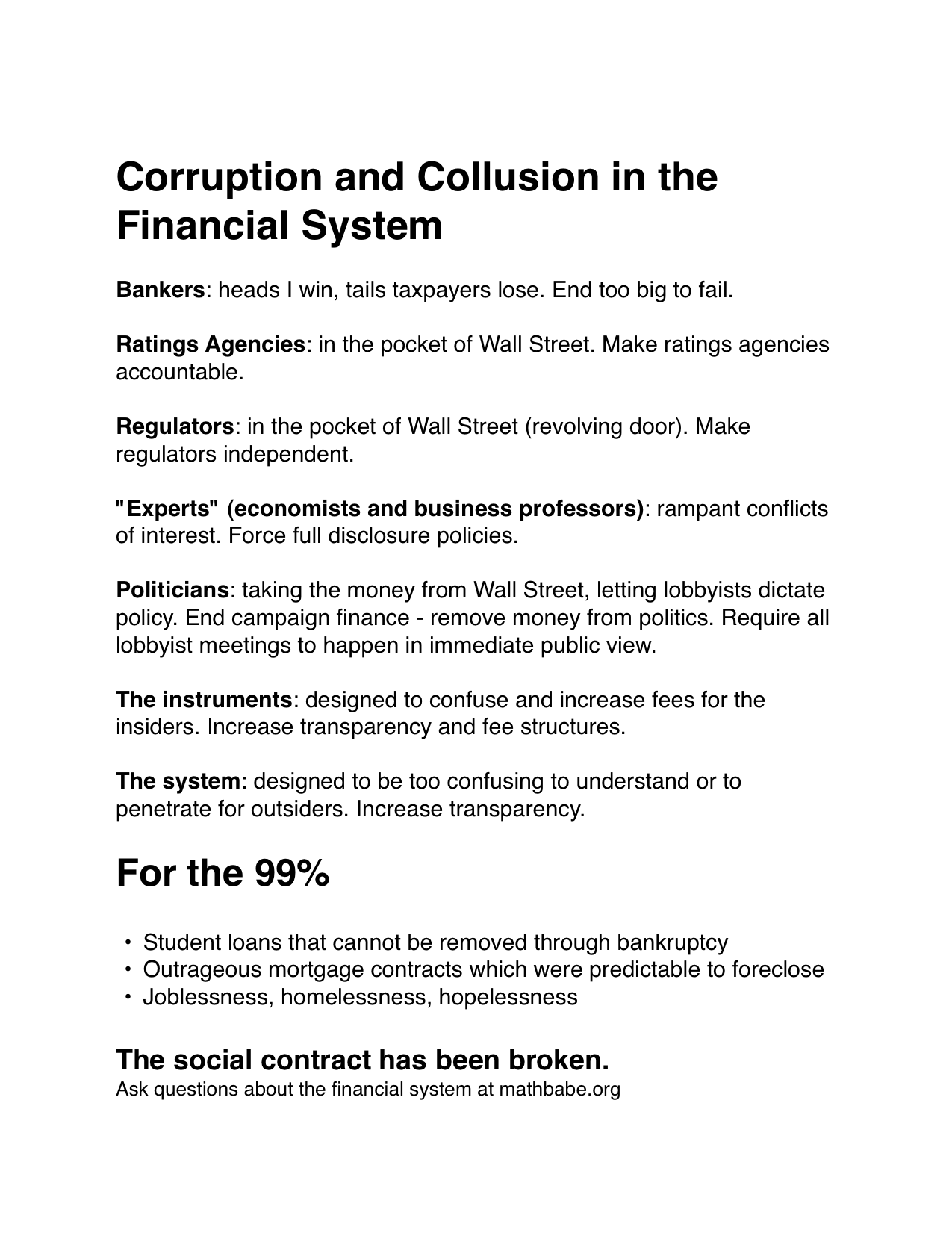
Noticed the prominent position of rating agencies on your flier. As someone who works for a rating agency on the quantitative side, I don’t believe that the rating agencies are that big of a problem. Their qualitative research is informative and predictive and for what they do, their profit margins don’t seem excessive to me. Maybe health insurance companies are a good analogy. For what the system is, health insurance companies play an invaluable role and as for-profit companies that need to compete with each other, you couldn’t expect them to be much different. The problem is the inefficiency and injustice of the system itself.
I’d like more information; certainly this isn’t the perspective I’ve heard. In particular the word is that the agencies gave just enough information to the clients to allow them to game their (mortgage) models, which weren’t keeping up with the actual complexities of the products. Do you consider this bad information?
I haven’t looked at the actual models, but in all likelihood all the incentives were to make the model as simple as possible while still pleasing the client and regulators. As for giving info to clients to let them game the models, if the model were good, letting the client understand the key drivers would be a good thing since paying attention to those drivers would help the client understand the risk. I tend to think that conventional wisdom, such as housing prices always going up, was as much to blame as individual acting unethically.
To me the real issue is that we have a system where the rest of us can be left with the tab for risky ventures of financial institutions. Don’t get me wrong, I am in favor of FDIC insurance, for example. But, we shouldn’t be backstopping gambling losses when the underlying gambling has no social benefit.


Splendid :}
LikeLike
Ditto
LikeLike
George Cooper gave a talk last night in which one of his proposals was to force the rating agencies to always have the same fraction of ratings in each category. The idea being that then good ratings would be much harder to buy because the ratings agency would need to downgrade something in order to upgrade the one in question.
LikeLike
This strikes me as not a good idea. After all, there are times when the economy is actually running well and there are fewer companies in trouble and at risk of default. Such a system would not recognize such a seasonality.
LikeLike
Noticed the prominent position of rating agencies on your flier. As someone who works for a rating agency on the quantitative side, I don’t believe that the rating agencies are that big of a problem. Their qualitative research is informative and predictive and for what they do, their profit margins don’t seem excessive to me. Maybe health insurance companies are a good analogy. For what the system is, health insurance companies play an invaluable role and as for-profit companies that need to compete with each other, you couldn’t expect them to be much different. The problem is the inefficiency and injustice of the system itself.
LikeLike
I’d like more information; certainly this isn’t the perspective I’ve heard. In particular the word is that the agencies gave just enough information to the clients to allow them to game their (mortgage) models, which weren’t keeping up with the actual complexities of the products. Do you consider this bad information?
LikeLike
I haven’t looked at the actual models, but in all likelihood all the incentives were to make the model as simple as possible while still pleasing the client and regulators. As for giving info to clients to let them game the models, if the model were good, letting the client understand the key drivers would be a good thing since paying attention to those drivers would help the client understand the risk. I tend to think that conventional wisdom, such as housing prices always going up, was as much to blame as individual acting unethically.
To me the real issue is that we have a system where the rest of us can be left with the tab for risky ventures of financial institutions. Don’t get me wrong, I am in favor of FDIC insurance, for example. But, we shouldn’t be backstopping gambling losses when the underlying gambling has no social benefit.
LikeLike