Congress Needs to Act On Facial Recognition
Here’s my newest Bloomberg column regarding the state of facial recognition.
Amazon Can’t Make Facial Recognition Go Away
That would take an act of Congress.
Read more of my Bloomberg columns here.
Let’s Fill in Dangerous Blindspots in Police Data
Here’s my newest Bloomberg column, in which I discuss the darkest, scariest kind of data, namely missing data. We are getting some of those holes filled in when it comes to police misconduct, and we need more.
Don’t Let the Police Hide Their Bad Behavior
Fixing law enforcement will require better data.
Read more of my Bloomberg columns here.
Sheryl, honey, if this is you leaning in, please lean out
My newest Bloomberg column, in which I examine how Sheryl Sandberg’s “Lean In” philosophy might be guiding her during the current Facebook shitstorm:
Maybe Sheryl Sandberg Should Be Leaning Out
Facebook needs better moral leadership.
Read more of my Bloomberg columns here.
Mass Incarceration Causes Pandemics
In my newest Bloomberg column, I make the case, using new research by Measures for Justice, that mass incarceration, inequality, and racism cause epidemics both here and worldwide:
Maybe Racism Caused the Covid-19 Crisis
Mass incarceration and other social ills made the world more vulnerable.
You can read more of my Bloomberg columns here.
Students are in a game of chicken with colleges.
I’ve got a new Bloomberg column out today, about the game of chicken that colleges are playing with students and their parents:
Covid-19 Will Make Colleges Prove Their Worth
Online education should come at an online price.
See more of my columns here.
Forget the models, follow the R(t)
In my new Bloomberg column I suggest that R(t), which is a hyperparameter in most Covid-19 models, is a much better and more trustworthy figure to follow than any other particular data set.
One reason, which didn’t get into the column, is that R(t) can be estimated from most other daily data sources like hospitalizations, cases, or even deaths, albeit with lags. That means that we can piece together a trustworthy patchwork quilt of R(t)’s that might be more trustworthy than any particular version.
Moreover, R(t) is insulated from the bias we know exists in these figures (due mostly to not enough tests) and only cares about trends, so as long as the bias is consistent we don’t care about it.
The caveat here is that we’ve seen many states performing Covid-19 data manipulation (Texas, Florida, and Georgia for example) in order to open up sooner than they honestly should. Basically, they’re juicing the numbers. That’s a kind of political bias we cannot overcome easily (unless they forget to manipulate some of the data!).
Anyway, that’s a nerdy postscript on the following:
Here’s a Covid-19 Number Worth Watching
My other Bloomberg columns are available here.
Covid-19 models: none are perfect, some are downright dumb
I wrote a Bloomberg columns which heavily relied on Jarod Alper‘s recent YouTube talk:
Meet the Covid Models That Are Running the World
See other Bloomberg columns I wrote here.
Bloomberg column: The FEMA model is a WMD
Hi all,
On my walk to work I realized that the new FEMA model – which was used to strong-arm the Arizona governor into opening early – is a WMD, i.e. important, secret, and destructive:
A Secret Algorithm Is Deciding Who Will Die in America
Decisions on reopening should involve public data and debate.
See more of my columns here.
Robot Overlords and a Eulogy to the Subway
Hi all,
Two more Bloomberg column posts to share with you. First, one from Monday:
Let’s Make a Deal With Our Robot Overlords
and here’s on from yesterday:
I’ll Miss the New York City Subway
More columns are here.
Two new Bloomberg Posts!!
Guys I’m sorry I forgot to blog last Friday about a piece I wrote:
Trump Is a Machine-Learning Algorithm Gone Wrong
His bizarre behavior suggests he’s running low on data.
Also here’s a piece that came out yesterday that I’d love to hear your thoughts about:
We Can’t Get Together Until Tests Get Better
More columns are here.
New Bloomberg Column: Let’s not make things worse for older people
I was happy to connect with my friend Ashton Applewhite, an ageism activist whom I met at TED, to discuss aging in the time of Covid-19. It led to this new Bloomberg column:
Pandemic Data Could Be Deadly for the Old
See other columns I wrote here.
New Bloomberg Column: This is Not The Flattened Curve We Were Promised
An empirical observation about models versus reality:
This Isn’t the Flattened Curve We Were Promised
See other columns I wrote here.
New Bloomberg Column: COVID-19 tracking will not work
Another skeptical column from me today:
The Covid-19 Tracking App Won’t Work
See other columns I wrote here.
New Bloomberg column: 10 Reasons to Doubt the Covid-19 Data
Hi all,
I’m back at Bloomberg, writing about reasons to doubt the daily data we keep seeing. I’ve added a few reasons since my post last week. Also, I’m preparing myself for bad data today and tomorrow delayed from Easter weekend:
10 Reasons to Doubt the Covid-19 Data
The pandemic’s true toll might never be known.
See other columns I wrote here.
Diabetics potentially have a LOT to lose by using hydroxychloroquine
This is a guest post by Gary Cornell. Gary holds a Ph.D. in mathematics from Brown University and was the co-founder of the the major technical publisher Apress. He has written or co-written numerous best selling programming books and has been a Mathematics professor, a visiting scientist at IBM’s Watson Labs and a program director at the National Science Foundation.
I’m not a doctor nor do I play one at daily press briefings. But like most mathematicians, I do know something about basic statistics. And, like most academics, I read everything that comes out about drugs I am taking. Obviously, I concentrate on the statistical sections and the list of side effects and drug interactions in these research papers. And so, this being 2020, I have a google alert for the drugs I am taking.
Anyway, one drug I am taking is the maximum dose of metformin. It is the fourth most prescribed drug in the United States and is used by more than 150,000,000 people world wide. It is the usual first drug prescribed for Type 2 diabetes. It is a good drug, the side effects are usually mild and it is even being explored (the TAME trial) as a possible “longevity” drug. A good drug…
So I was shocked to see this link popping up in my in box:
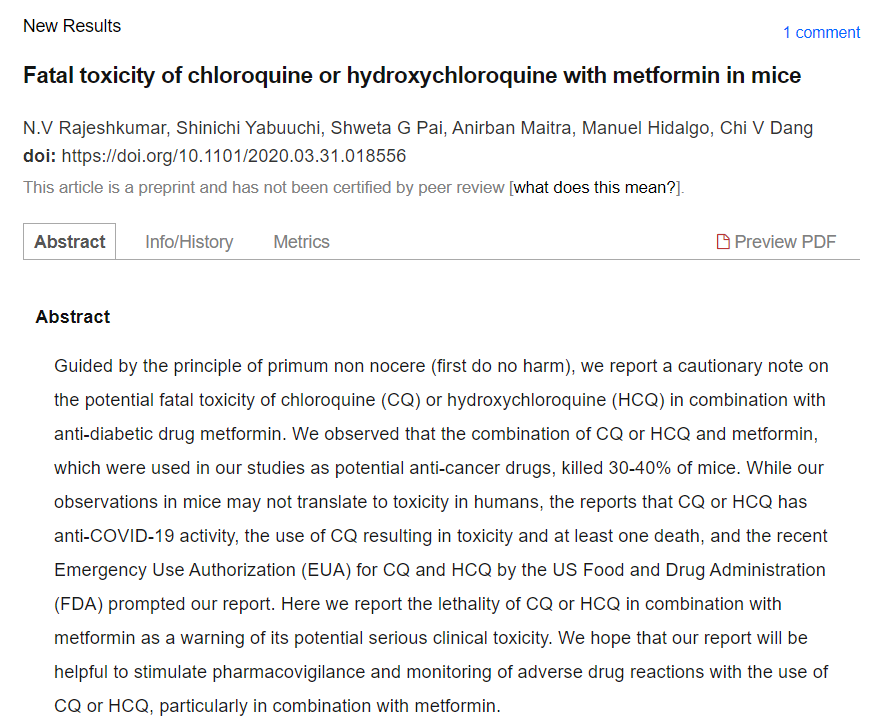
This note is from researchers at Johns Hopkins – which I hasten to point out is currently rated the #2 school in the United States for “medical research”. People there are not general considered practitioners of psycho ceramics, in other words.
Holy ^&%$#, I thought. And then I tuned in to the Sunday “briefing” where Trump doubled down on his pushing claiming that “what do you have to lose” – and prevented Fauci from tempering his response. Though mice results aren’t conclusive and perhaps fatalities are off by a factor of 10 or a 100. Who the &^%$ knows if taking this will kill me? Maybe it is much worse for people on the maximum dose of metformin like me. But, absent proof it is safe for people taking metformin, pushing it if you are taking metformin except in life or death situations would seem to me malpractice for a doctor and practically criminal for an economist or politician.
Oh, in case you are thinking that maybe except for people taking metformin, hydroxychloroquine is a “good” drug, Drugs.com says there are 332 drug interactions (59 of them being major). And here is the list of side effects
So, answer is, you have a lot to lose.
Making facemasks: a step-by-step guide
You’ll need:
- Dishcloths which some people call tea towels (could use any cotton cloth but slightly thicker is better)
- 20 gauge metal wire cut into 2.5″ pieces (could use pieces of a thin wire hanger instead)
- Elastic cord (could use rubber bands or strips of cloth instead)
- A sewing machine
- Good scissors
- Crochet needle and sharpies
- Cardboard
I’m following the pattern for “Mask 2 (large)” on this webpage. But to be honest I found it hard to follow which is why I’m going to tell you quite plainly how to do this relatively quickly.
First, download and print this pdf: mask+2+large+pattern
Or simply eyeball the following picture with the ruler as a guide:
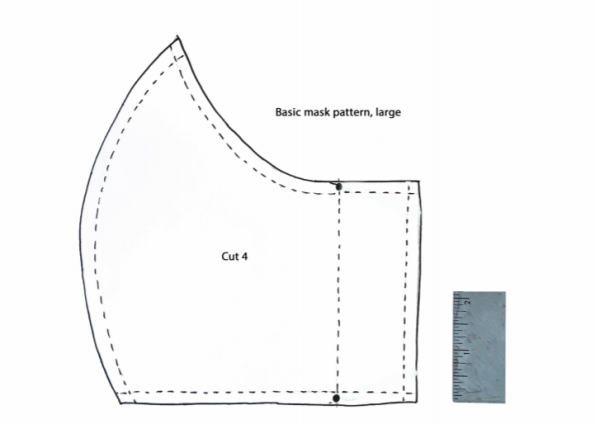
You’ll want to cut out the printed version and then outline it onto cardboard, then cut out the cardboard so you’ll have a form you can reuse a bunch of times with sharpies:
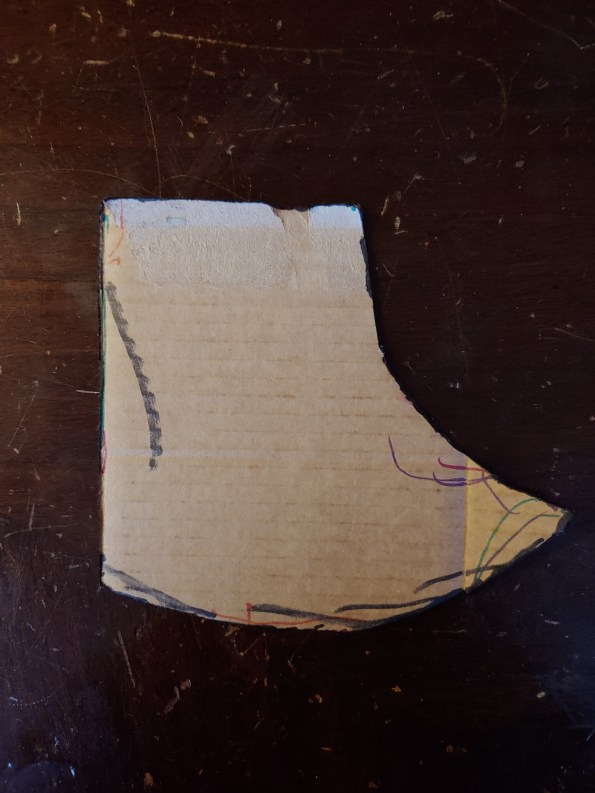
This has been used a bunch and is kind of a mess. That’s ok.
Then you outline with a sharpie on your dishcloth:

I got 12 cardboard outlines on! That means 3 masks. Be sure to avoid the hemmed edges.
Next you cut them all out:
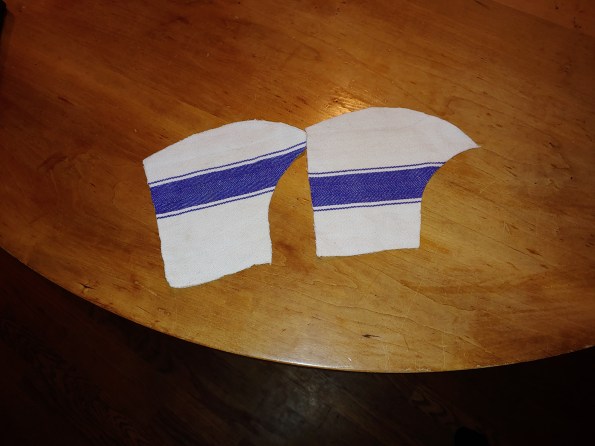
Next, pair up the cloth pieces to match:
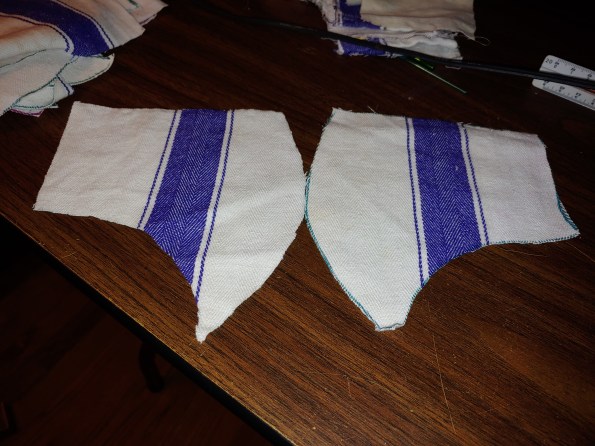
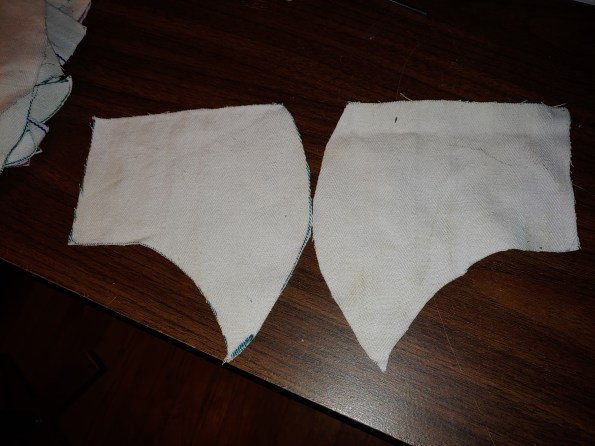
Next, sew along the foot of those matched boots for both pairs with a 1/4″ seam:
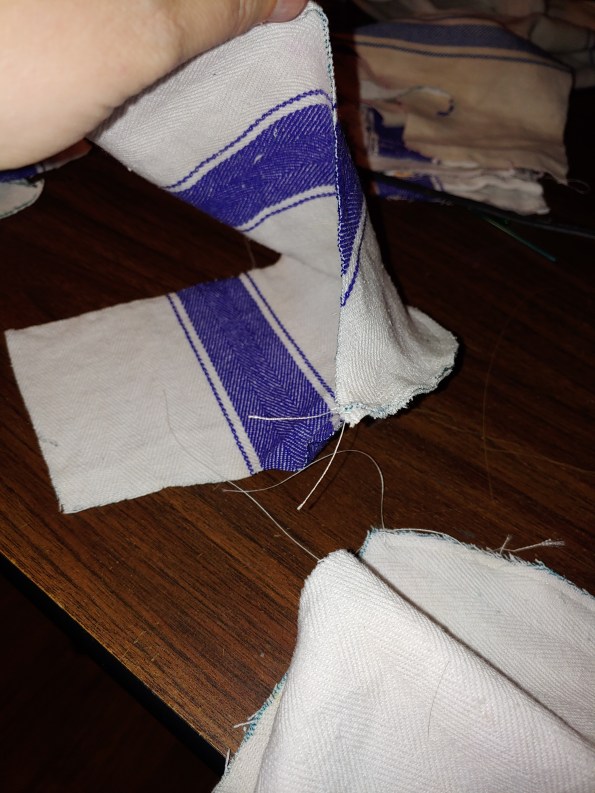
And now put those two pieces together, with the seams on the outside for both pieces:
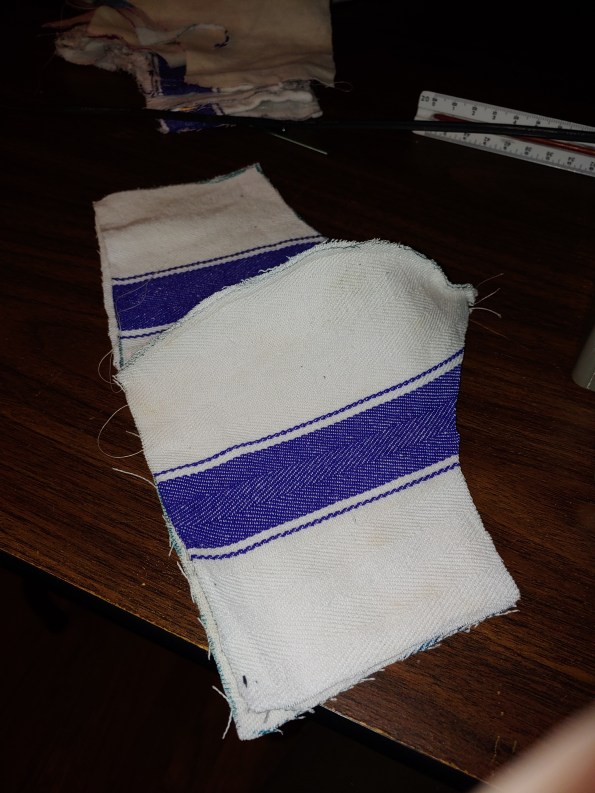
Next, sew all around the above piece (so sew the two pieces together) with a 1/4″ seam except for about two inches at the bottom seam:
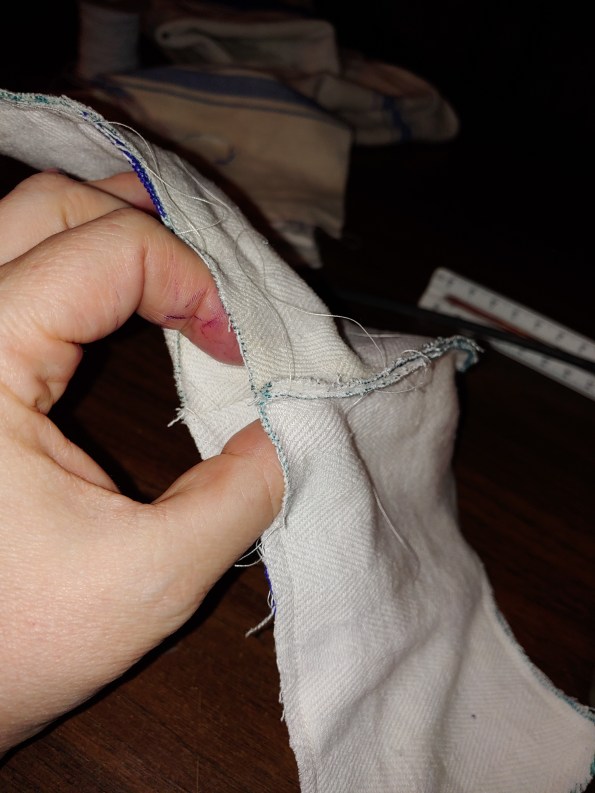
It’s time to turn this whole thing inside out by squeezing it through that two inch slit!
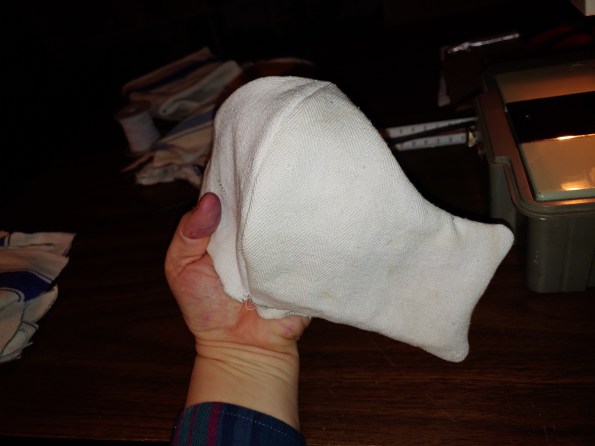
Poke your fingers into all four corners plus the nose part at the top to make sure it’s all the way inside out.
Here’s the other side:
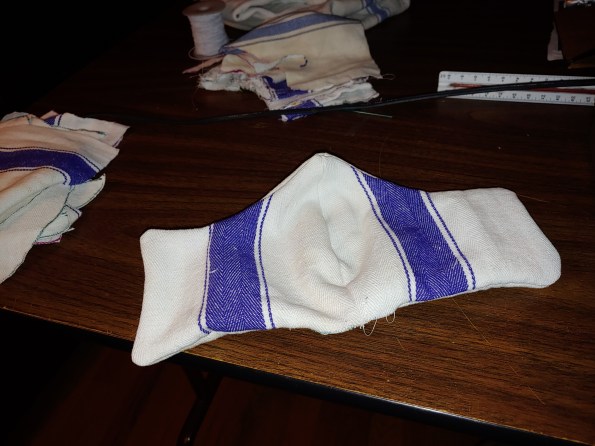
Next, sew a three inch line along the nose top (a 1″ seam) and stick the metal wire into that channel:
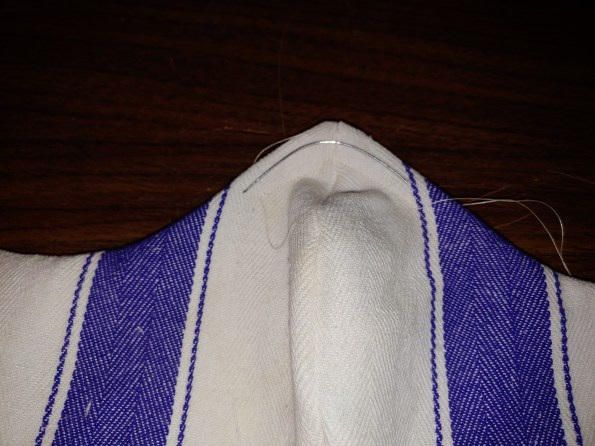
Do you see the channel? The wire has to go in this area except, of course, you need to have it on the inside.
Next, you want to sew along the entire edge (very close to the edge, maybe 1/4″), starting at one end of the nose wire channel. Halfway along you’ll carefully close the hole at the bottom:
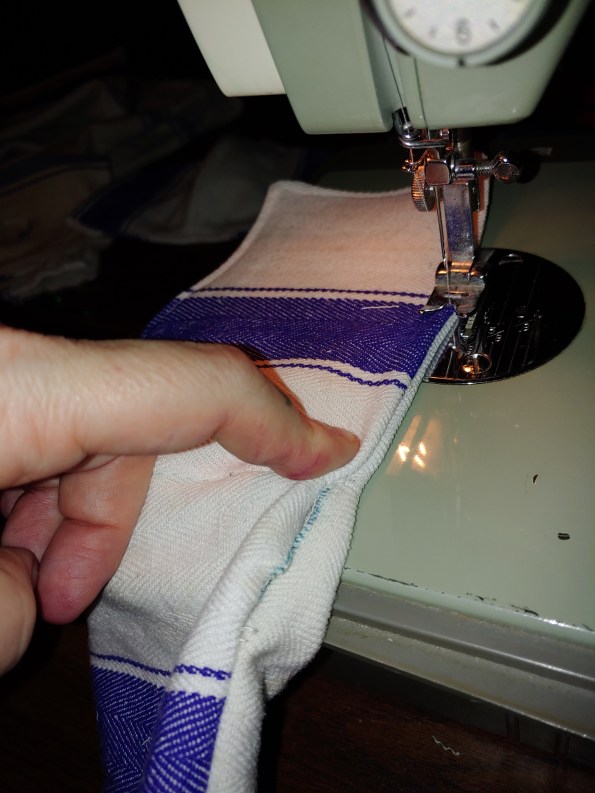
Here it is at the end:

this picture is overexposed but the idea is you close up the nose wire channel on both sides.
Next, you fold back 1.5″ of the ear flaps and sew down:
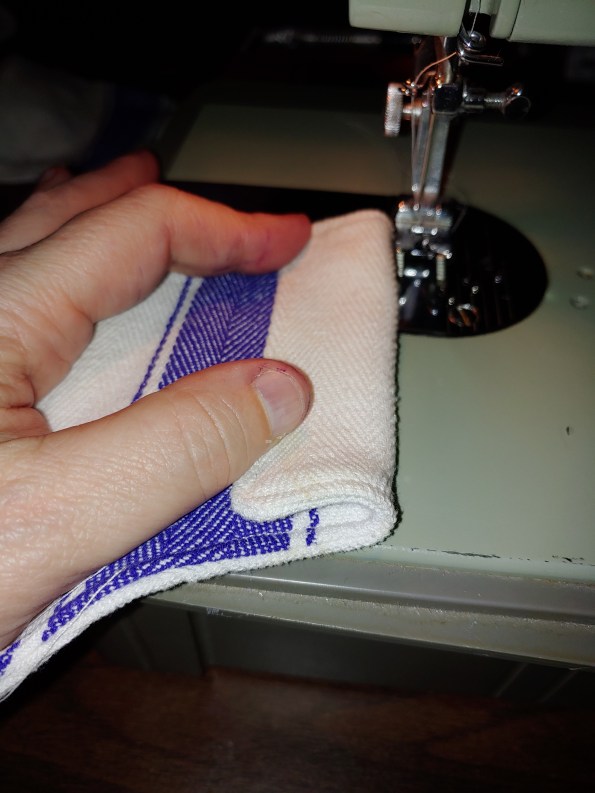
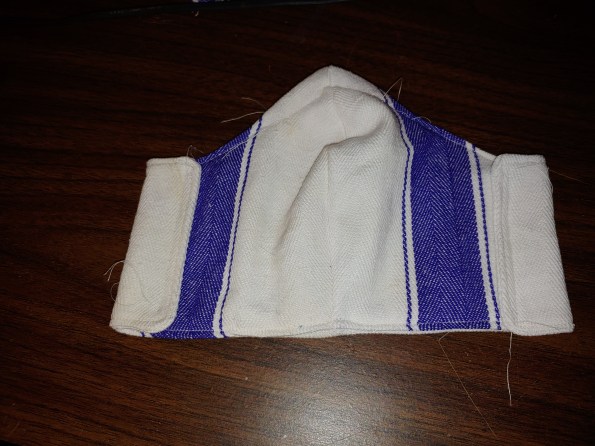
This is the back of the mask after sewing down both flaps.
Next, measure out 1 yard of elastic cord and tie together the ends:

Next, use a crochet needle to pull through flaps and then tie it together:

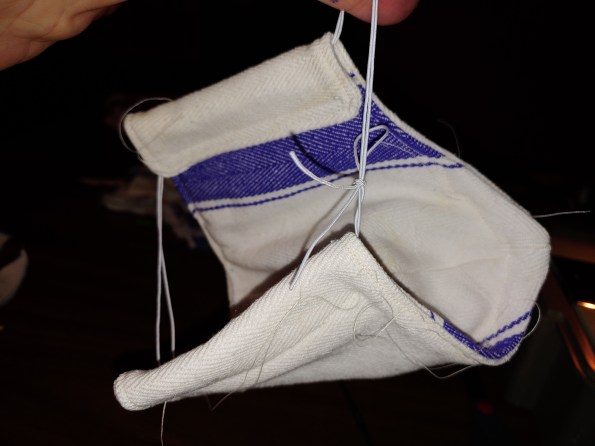
Finally, yank the elastic cord until it’s hidden inside a flap and tidy everything up by snipping off the stray threads.
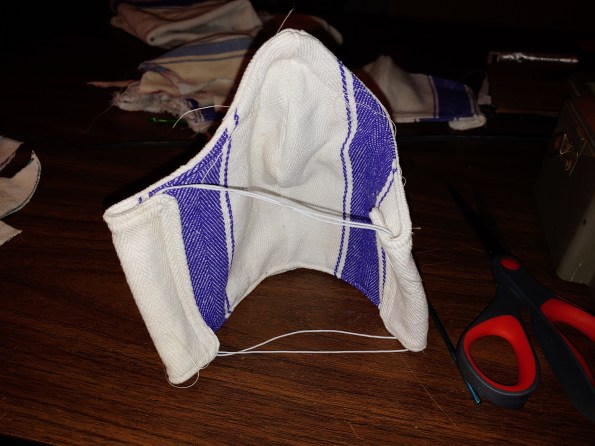
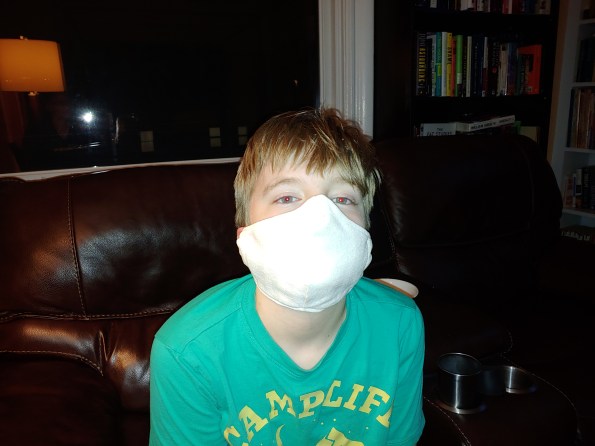
It’s ready for a cute model!

Now’s the time to squeeze the metal wire to make it fit your nose.
Comments on COVID-19
I am, like you, restless and having trouble coping with the tragedy going on. It’s especially hard to think through the logical details of issues that only two weeks ago seemed urgently important. So instead, like you, I find myself with an internal dialogue of how the publicized statistics are consistently biased or wrong. At the risk of simply supporting your own internal thoughts, here are a few of mine:
- We still aren’t testing people, even in New York, which is the most tested population in the current mostly highly infected country according to the crap data we have.
- What that means to me is that we can ballpark how many actual cases we have if we know what the condition is for actually getting tested. In New York, it’s something close to “needs hospitalization.” Considering that only about the worst 10% of cases in countries that do widespread testing actually need hospitalization, that means we can multiply our confirmed case count by 10 to get an estimated total case count.
- That means that, instead of 60K cases in New York state, which is what this webpage says this morning, we can assume it’s actually more like 600K.
- Similarly as a nation, we should multiply the confirmed case count of 143K by ten to get an estimated 1.43 million cases in the US.
- Is that an overestimate? Perhaps. It’s possible that enough testing is happening in those car wash type setups, where people are at least capable of driving a car, to make it pessimistic.
- On the other hand, we’ve seen plenty of examples in the NYC area of people calling their doctor with intensely bad symptoms who are told not to overburden the hospital system and to take care of themselves at home.
- Also, it’s worth pointing out that multiplying by 10 assumes that more than half, and perhaps up to 75% of all actual cases are entirely asymptomatic. This is something we’ve been seeing in places that have done randomized or comprehensive testing.
- All the above are ballpark reckoning, but honestly I trust my numbers more than any official ones.
- Especially because we’ve been hearing stories told in Spain and Italy that their death counts are not including horrible fucking things that have been happening in nursing homes. That means those terrible numbers are heavily underestimating actual deaths.
- Also, we should not trust China’s death count numbers, which some say are underestimating actual death counts by a factor around 15.
- And if we don’t trust their death counts, we should also not count their confirmed case count, which has been tiny recently.
- Why this matters a lot to us right now is that China closed Wuhan on January 23rd, which means they are/were under quarantine stricter than ours for more than two months, and we’d REALLY like to know what the actual situation is right now, but we don’t.
- Long story short, being a skeptical data scientist means not trusting the data whatsoever. The best we can do is use the data and our real world knowledge to ballpark what might actually be happening. We will never know the true numbers.
- One exception might be the Netherlands, which I’m keeping my eyes on. I don’t think they lie as much as most other countries.
- I could be wrong about that too.
- I hope tomorrow’s post will be more optimistic.
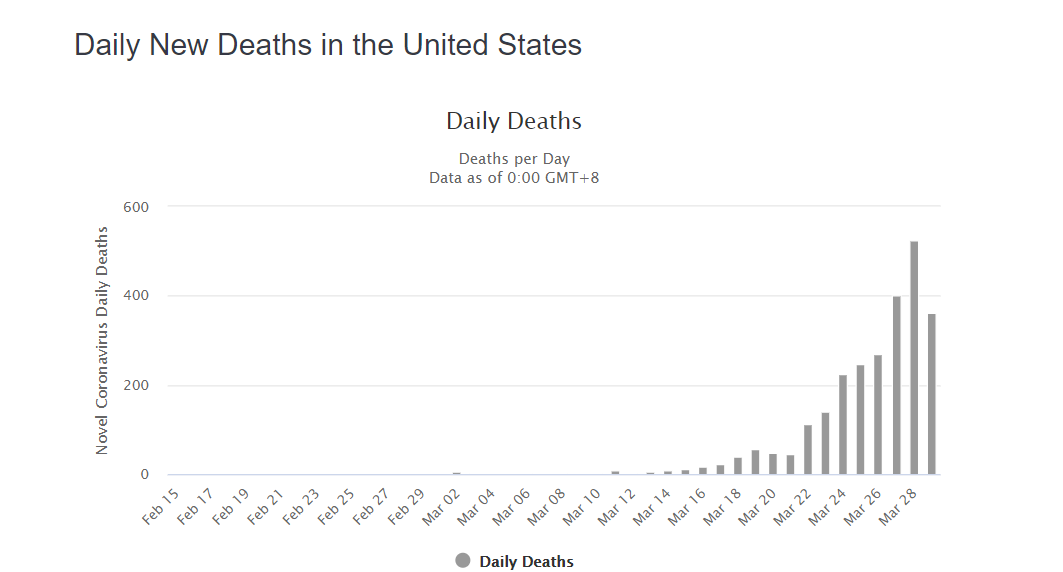
- One last comments: Sunday reported deaths are lower than other days because of the way reporting happens. Doctors and others are taking a well-deserved rest. So don’t get excited about flattening curves based on Sunday data:
A better proxy than confirmed cases for the US is hospital beds
If you’re anything like me, you’re driving yourself a bit nuts looking for information on the COVID-19 situation in the U.S. as well as internationally.
And, if you’re like me, you will have been tearing your hair out frustrated by the bad quality of data. For terrible political and cultural and of course capitalistic reasons, we are not getting tested at reasonable rates as charts like this demonstrate:
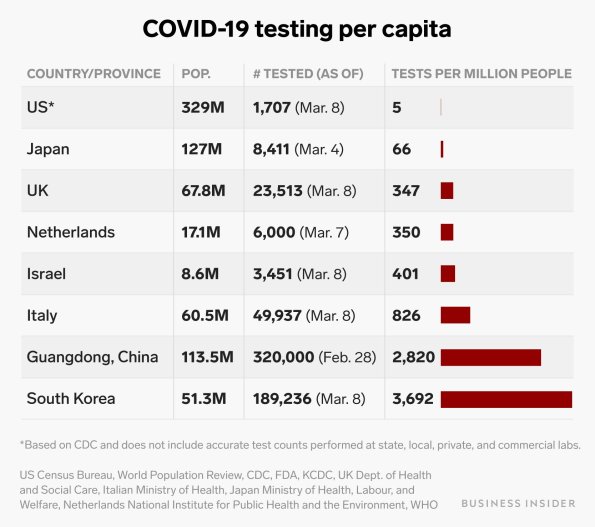
That means, as cool as websites like this or this are for up-to-date data on country and state level confirmed positive test results and deaths, we are not actually seeing enough to know how bad things really are. Note to the people who run those sites: please add columns for “number of tests administered” so we have some idea of how incomplete the data really is.
All of the above is nothing new, I’m sure you’ve already complained at length to your friends about this very topic.
The only things I really want to say is that, considering that we don’t know who is infected, we should use as a proxy of our problem not the “confirmed case” count but rather the “hospital beds used above normal” count.
It’s not perfect metric either, primarily because the virus takes days to spread and days to get people quite sick, and indeed once the hospital beds really start filling up, it’s already a much bigger problem. But I’d still argue that we should try to use this proxy, for the following reasons:
- Hospitals definitely keep track of their bed counts, you can be sure of that. So the data is available.
- It doesn’t depend on the availability of testing, which as we’ve discussed above, is very problematic. Our death count is most assuredly way too low because there have likely been plenty of people dying of coronavirus who just never got tested.
- In other words, counting beds is relatively free of political manipulation.
There are also problems with this proxy, both of which make it underestimate the problem. First, because people who have elective surgery are rescheduling for a later date. Second, because our social distancing has probably made other illnesses less common, leading to less hospital stays for other reasons.
Even so, I’d love an intrepid journalist to try to collect this statistic from many national hospital chains, and compare it to last year’s bed count, as well as yesterday’s and last week’s, to see how things compare.
Wash your hands *and* your phone
I don’t know about you but I’ve spent quite a bit of time on the phone talking to friends and family about the COVID-19 virus and bemoaning how difficult it is to get people to do simple stuff like washing their hands and not touching their face.
And, again, I’m on the phone talking about this, while copiously touching my face and my dirty phone.
And it occurred to me that washing our hands won’t be all that helpful if our phones are dirty, which they of course will be because we cannot stop using our phones even for a minute, especially when we want to check in on our loved ones and also Twitter.
Here’s the standard problem I see:
Go on subway, touch things, read phone, get to destination, touch things, put down phone, go to the bathroom, wash hands carefully, pick up phone again.
See how that works? The only germs we’re not getting on our phone is actual bathroom germs, and that’s only if you don’t bring your phone with you to the bathroom, which let’s face it people do in general.
So, how do we address this? It’s going to be tricky! We will need to clean our phones, and moreover to clean our phones without once again getting phone germs on our hands. I’m dizzy with the procedure we will have to follow assuming we have wipes that actually clean our phones and our hands.
10 Silver Linings of Having an Asshole Father
I wanted to share my words from my dad’s memorial this past weekend, which took place at UMass Boston. You can read his official obituary here.
10 silver linings of having an asshole father
- When I met Larry Summers at the hedge fund he was known as a pushy, physically imposing and intellectually arrogant bully. He was all those things. He was also a pussycat compared to my dad. My dad taught me never to be intimidated by anyone.
- My father never displayed nor expected conformity. Since he never followed inconvenient constraints of etiquette or behavior, my father role modeled for me that most norms or even laws can be interpreted as rules of thumb to be considered and held up to inspection rather than thoughtlessly followed. That’s been useful to me, especially as a female intellectual.
- My father was incredibly wrong about a bunch of things, and wrong headed to top it off. He consistently argued that men are smarter than women, even as my mom consistently helped him write his research papers, he seemed to truly believe some eugenic beliefs, and he was very into evolutionary biological explanations for why he and men like him should be entitled to unquestioned power. But to his credit, he was always willing to argue these points. He taught me the value of intellectual debate and fighting for my ideas and values.
- For the same reasons as above, he often embodied selfishness, self interest, and lazy thinking. He didn’t even believe science when it was inconvenient to his worldview, as in the case of climate change. At those moments, it made it easy for me to see and pick apart the errors of his logic. He turned me into an intellectual critic, which has made me a ton of money over the years. So thanks dad.
- My dad claimed, out loud and often, to be the smartest person in the world. He even sometimes seemed to believe it. And the truth is he was really smart, but he was also weirdly emphatic about exaggerating such things to the point of incredibility. I want to thank my dad for helping me understand our current president at a deep level.
- In terms of parenting my children, my father taught me the value of consistent kindness by displaying the wreckage of sporadic cruelty. I’m a better mother for my childhood, during which I learned what not to do. It’s a backhanded compliment but it’s real.
- Just as his brutality was never subtle, his generosity was never fake. Many of the people in this room can personally attest to my father’s impressive generosity with his home, his hospitality, his jokes, and most especially his alcohol. I thank him for teaching me to welcome people into my home with openness and love.
- Along those lines, my father taught me to love ideas for their own sake. His favorite activity was reading, and reading out loud to whomever happened to be walking through the room. To this day I cannot stand Robert Heinlein or Oscar Wilde poetry but I do love ideas and I think he’s partly why.
- When I was a little kid, my dad expected me to sing folk songs with him. One day he yelled at me to sing the harmony instead. I thought it was just something I was supposed to know how to do when I was 8. So I did it. I don’t think I’d be able to enjoy music as much as I do without that.
- My father taught me to say what I mean and mean what I say. For example, he was such an asshole he wouldn’t even mind being called an asshole. Actually I’m not sure about that but I guess the apple hasn’t fallen too far from the tree.


 mathbabe