Archive
Hip Hop’s Cambrian Explosion: Part 1
On her January 28th post entitled Does Hip Hop Still Exist? Mathbabe wrote:
“My oldest friend sent me some mixed CDs for Christmas. I listened to them at work one recent morning, and although I like a few songs, many of them were downright jarring. I mean, so syncopated! So raw and violent! What the hell is this?! It was hip-hop, I think, although that was a word from some far-away time and place. Does hip-hop still exist?”
Fortunately for me, I am that oldest friend, mixer of said CD, and guest blogger this week, here to answer Mathbabe’s question with the first of a three-part post entitled Hip Hop’s Cambrian Explosion.
______________
I discovered Hip Hop around the same time I discovered Mathbabe. In 1987, Hip Hop was a toddler living in Brooklyn while Cathy and I were teenagers living in suburban Massachusetts. As I walked home from school one afternoon, I popped Boogie Down Production’s debut cassette into my walkman and snapped to attention as KRS One delivered a high-energy critique of public schooling’s systematic omission of Black history from the curriculum. As I listened I found myself considering for the first time the ways in which I had been raised on a steady academic diet of European and American histories and literatures, with no mention of those of Africa, Latin America, or Asia. These were entire continents and peoples whose histories were tacitly deemed peripheral to the central drama of whiteness. I listened closely as KRS One, aptly known as “The Teacher,” educated me about the people studiously ignored in my history textbooks. Here is a delightfully dated video of that first song, You Must Learn: http://www.youtube.com/watch?v=RDd7UbJmdmw.
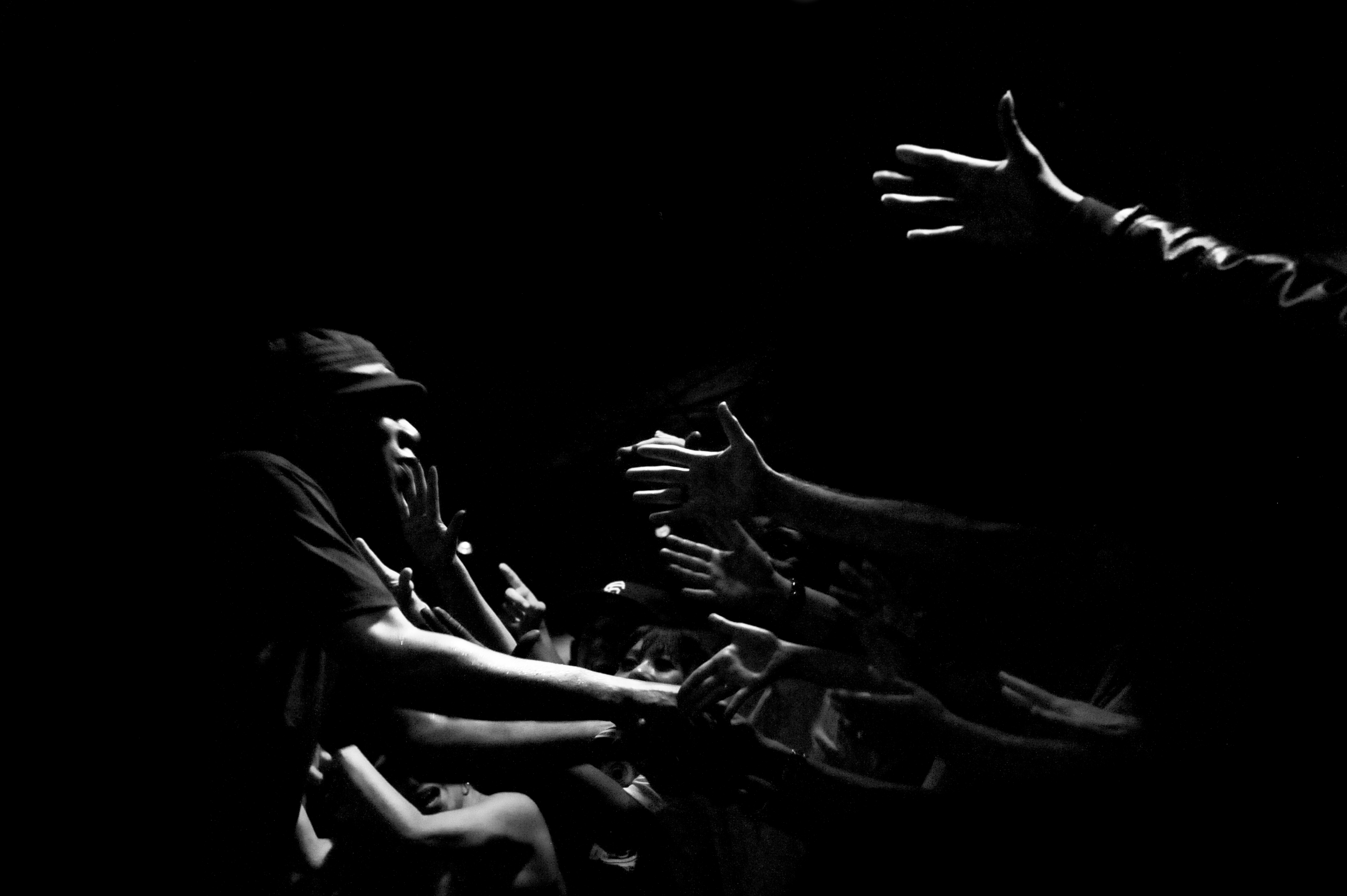
I am now nearly 40 and recently had the opportunity to meet KRS One at a concert in Berkeley, where I was able to thank him in person for supplementing my education. He is as dynamic as I remember, still using the mic as a vehicle to teach critical thinking, still building community by inviting up-and-coming rappers onto the stage to improvise with him, still innovating by rapping over electric violins spilling amplified Mozart over the surging audience. In this photo I took from stageside he reaches out to connect with the crowd:
And here I am, looking up at him.
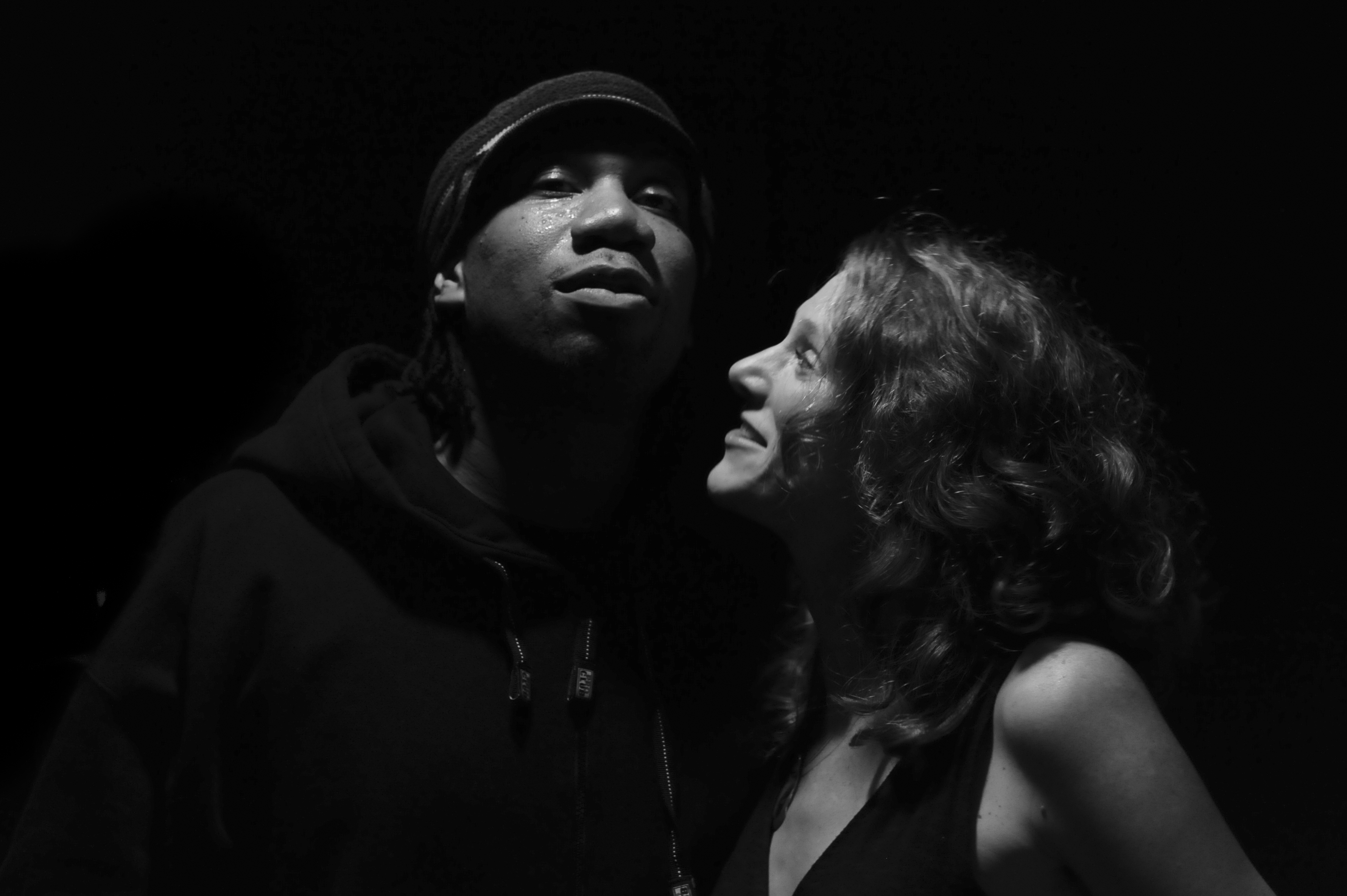
Photo by Hugo Garcia, aka Steelo
As you can see in the photo, I plainly admire him, as I do any iconoclast who has the audacity and clarity to say so when the Emperor has no clothes. So as an avid fan of Hip Hop, I’d like to appeal its case for those of you who are new to the genre or are considering giving it a second listen. Why should you bother listening to Hip Hop? And what exactly is Hip Hop anyway? I offer this primer as a paean.
1. Hip Hop is political. Hip Hop gained national attention in 1989 when Public Enemy’s Fight the Power piqued the paranoia of white America. The now-classic ghetto anthem opens with Martin Luther King’s lilting oratory, not the more tepid, politically-milktoast MLK Jr. of the official public holiday, but the radical MLK Jr, who exhorts Americans not only to refuse to serve in the U.S. Army, but to switch allegiance to fight alongside the Viet Cong.
 Chuck D and Flavor Flav at Yoshi’s in San Francisco. “Most of my heroes don’t appear on no stamps.” – Chuck D. Photo by Cherie Chavez
True to its origins, Hip Hop remains today the artistic genre of choice and the voicebox for people pushed to the margins of power by historical and social forces. And it’s not afraid to name those forces. Paramount among the themes tackled in Hip Hop is that of white supremacy, a topic — a phrase even — that tends to make white people uncomfortable. When rapper Brother Ali released Uncle Sam Goddamn, an overview of American racism — past and present — cell phone company Verizon responded by revoking its sponsorship of his tour. Corporations typically don’t profit by talking about racism, unless it’s in that “Rainbow Nation” manner of Benetton, which carefully eschews analysis of power relations. The video for Uncle Sam Goddamn includes some powerful historical footage.
Another of Hip Hop’s recurring themes is poverty. As Somalian-born rapper (and personal favorite) K’Naan explains:
…I remember when I was 7
When rap came mysteriously and made me feel 11
It understood me, and made my ghetto heaven
I understood it as the new poor people’s weapon.
Smart 7-year-old. The excerpt is from The African Way, a funky fusion of American-style rap vocals and East African drum rhythms. As K’Naan recounts in several of his autobiographical songs, he learned English by listening to rap music (it’s no coincidence he sounds so much like Eminem) in order to have a forum for speaking about the violence he experienced as a child growing up in his native Mogadishu. His beautiful Blues for the Horn is both lament and homage to the Horn of Africa. He narrates the story of Somalia himself so that no one can “make a mockery of our struggle like Hollywood plans to.” And despite the seriousness of his purpose, he carries on another of Hip Hop’s traditions: its sense of humor. Describing Mogadishu, he quips:
If you bring the world hoods to a seminar
We’re from the only place worse than Kandahar —
And that’s kinda hard!
In the song Somalia, he reminisces about his childhood:
We used to take barbed wire
Mold it around discarded bike tires,
Roll em down the hill in foot blazin’ —
Now that was our version of mountain bike racing!
Daaaaaammn!
Do you see why it’s amazing
When someone comes out of such a dire situation
And learns the English language,
Just to share his observations?
Probably get a Grammy without a grammar education.
Hip Hop has an unapologetic working class hero sensibility, like John Lennon’s Working Class Hero, but edgier. How’s this for edgier? 5 Million Ways to Kill a C.E.O.
The racism and classism that inhere in our justice system are the targets of Lauryn Hill’s epic rant in The Mystery of Iniquity. She seems to enter a poetic trance as she excoriates the American judicial system in a style that calls to mind the dogged dirge of Allen Ginsberg’s Howl. This is but a tiny excerpt of Hill’s stream-of-consciousness dressing down:
Do we expect the system made for the elect
To possibly judge correct?
Properly serve and protect?
Materially corrupt
Spiritually amuck…
Mafia with diplomas keeping us in a coma trying to own a piece
of the American Corona.
The revolving door:
Insanity every floor
Skyscraping, paper chasing,
What are we working for?
Empty traditions
Reaching social positions
Teaching ambition to support the family superstition?
With a bass voice like Barry White, rapper Lyrics Born questions our funding priorities in Stop Complaining:
I pay my taxes when I’m asked to.
I’m not enthusiastic about it, but shit, I make it happen.
Yeah, it’s last minute, but goddammit they cash it.
(“This is fiscal harassment, they keep touchin my assets!”)
Now I imagine I might be feeling different about it
If it was given outright, witness it helping somebody
But it just so happens in life, the school district’s too crowded
It ain’t no teachers in sight, that’s why the kids are so rowdy.
I just imagine some asshole with glasses on up at the Capitol
One of a thousand pawns packed in an office cramped up like animals,
Pictures of his sister, his mixture Lapso Apso-poodle
His 2.6 kids, and the missus thumbtacked to his cubicle
So damn detached from the average man’s planet, he cain’t fathom
That we could ever be anything other than stats, fat and taxable
He’s gettin his usual ritual 2 o’clock Cup of Noodles on
While he’s fuckin you on your W2, his John Denver music on.
The ongoing disparities in K-12 schooling and access to higher education are a common theme in Hip Hop. Shad K, who pursued his career in Hip Hop while simultaneously earning a Masters degree in Business, writes in Exile:
We’re taught not to question the status quo cuz the masses never get heard
unless you’re established
with expert professors in dress-shirts
and glasses that lecture to classes
from lecterns
where next term the best third will pass and
earn cash working as
desk clerks for the best firms in Manhattan.
Shad was born in Kenya, the son of Rwandan refugee Bernadette Kabango, whose autobiographical poetry he incorporates in the chilling song I’ll Never Understand. Shad’s mother reads in her own voice, telling the story of her family’s murder in the 1994 genocide, addressing those who committed violence against her, and raising questions about the possibility of forgiveness. Shad’s rap vocals interlace with his mother’s voice, interjecting questions about whose genocides matter and whose don’t. The video of I’ll Never Understand includes footage that defies commentary from the Rwandan massacres. How could one begin to talk about such atrocities but through art? As writer Victor Hugo observed, “Music expresses that which cannot be said and on which it is impossible to be silent.”
The musical conversation between mother and son brings me to Hip Hop’s next defining characteristic.
2. Hip Hop is intergenerational. One of the stylistic and structural conventions of the genre is sampling. The contemporary artist layers his/her vocal track over a repeated excerpt of a melodic track — the sample — by an older artist, alive or dead. The tradition of sampling older artists from a generation prior (e.g., Nina Simone, Ray Charles, etc.) began perhaps for practical reasons, as access to older songs was not limited by royalties and copyright. Regardless of the motivation, sampling has the effect of creating intergenerational dialogue, a musical conversation across time.
Hip Hop has its roots in the oral traditions of West Africa, where people still live in active relationship with their ancestors and respect for elders is a core cultural value. Hip Hop carries on this tradition of talking with the dead and honoring those who have paved the way. Erick Sermon’s Just Like Music is an ode to music’s healing power (“I wish music could adopt me!”), sampling musical legend Marvin Gaye. Sermon cleverly interweaves his contemporary vocals over Marvin Gaye’s melodies so that at one point they appear to be in direct conversation:
Sermon: Is that true, Marvin?
Gaye: Yeeeeeeaaah!
It’s no surprise that songs from the Civil Rights movement provide a rich pool of sampling material. Movin’ Forward by Collective Efforts samples Civil Rights song Ain’t Gonna Let Nobody Turn Me Around, and references Eyes on the Prize, the comprehensive and inspiring documentary on the history of the Civil Rights movement.
Fort Minor’s Kenji tells the story of the United States internment of Japanese Americans during World War II and honors elder survivors by incorporating original audio interviews of former internees.
I’ve talked a lot about politics here, but if Hip Hop were all politics, it would be two-dimensional, flat like a Soviet-era agitprop poster (you know the ones of the workers with the disproportionately huge fists). It is the next characteristic which gives Hip Hop its complexity, dynamism, and multi-dimensionality.
3. Hip Hop is poetry. On steroids. A bit like aural caffeine. While I first got hooked on rap for its incisive outsider critiques, I equally enjoy the verbal acrobatics and linguistic playfulness of the form. I’m a word nerd, a sesquipedalian, easily wooed by an orator who can wield an adjective, so the highly verbal genre holds a natural appeal for me.
Others have told me that they find the language of Hip Hop itself a barrier to listening, the lyrics so rapid-fire and abstruse as to be unintelligible to the uninitiated. Perhaps so, but many of us found Shakespeare difficult to parse at the beginning but ultimately worth the effort. As in any specialized field, rap has created a unique language, its own grid of intelligibility, with webs of cross-references and insider lingo that can be opaque to newcomers to the genre. Just as you would read Shakespeare with a dictionary at your side as a reference to make meaning of the text, rap music lyrics must be studied with the right reference materials at hand. The rate of word evolution in rap music is rapid, which can make it difficult to keep up with the neologisms. Fortunately, there’s Urban Dictionary, with user-entered definitions being added continuously.
Approaching Hip Hop with the same spirit of literary criticism used to analyze Shakespeare or T.S. Eliot reveals that its poets employ all of the literary devices standard in the craft: alliteration, assonance, consonance, onomatopoeia, irony, and variation. They amplify the metrical effects of diction and syntax with the percussion and syncopation provided by the music itself. It is the interplay of the two (or more often, multiple) meters – the rhythm inherent in language, and the nonvocal rhythms of layered drums, piano, trumpet, or kora – that so stimulates the linguistically-inclined mind.
What rap adds to the traditional toolbox available to written poetry is a tool only available to the spoken word artist: something called flow. Flow is a bit difficult to describe, but you know it when you hear it. Flow is that state a rapper gets into when the syllables are tumbling off the tongue in a waterfall of words, the cadences rising and falling, surprising and mesmerizing. Flow is that trance artists crave, that moment when the rational mind steps aside, time telescopes, and the artist becomes hypnotized by the presence of the muse. Flow is when the music comes through the musician rather than from the musician. Cee-Lo has it. I couldn’t agree more with his self-review in One for the Road: “Oh, his way with words! I want seconds and thirds!”
I’ll let Cee Lo have the last word for now, and will continue tomorrow with Part 2 of Hip Hop’s Cambrian Explosion.
Sausage Wall
I’m getting ready to go to Amsterdam this Sunday (get ready for an exciting guest blogger while I’m gone!).
I’ve been to Amsterdam a bunch of times since hooking up with my big-nosed Dutch husband, and I enjoy our visits to his family very much.
But it’s not what you’re thinking. I’m allergic to that stuff (I have very funny, inappropriate stories about that which you’ll have to ask me in person), plus I’m traveling with our 3 sons, so it’s all about bikes, canals, and food. I’m also allergic to art, so the museum scene is kind of irrelevant too. I know that’s blasphemous, but there you go, I just don’t get paintings.
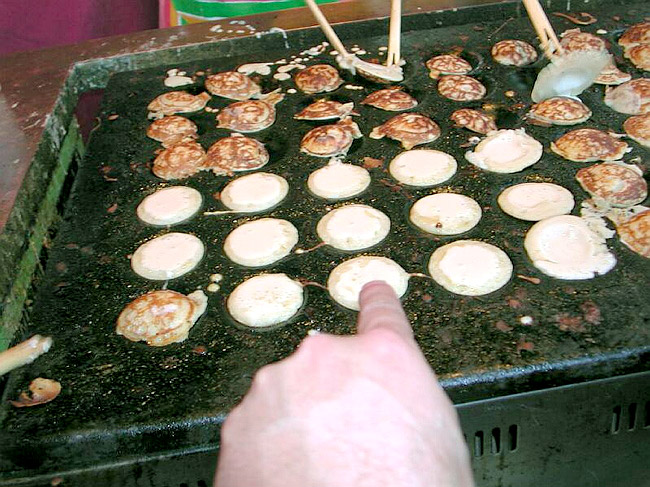
So, about the food. I’ve got street food tastes, and much to the chagrin of my in-law family, I consider true Dutch delicacies to be the stuff you find in carts along the side of the main road between the train station and the place with all the pigeons. Mostly loompjes loompjas (skinny little spring rolls), ollieballen (donuts without holes, literally translated as “balls of oil”), and poffertjes (tiny pancakes). Mmmm… poffertjes.
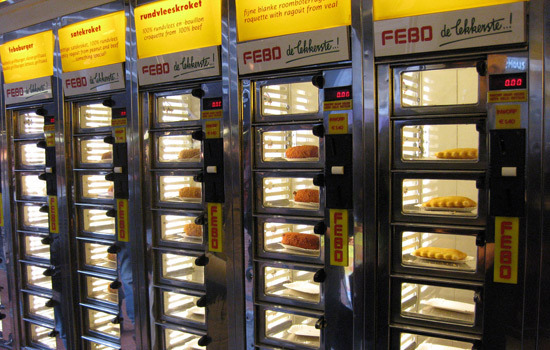
Anyhoo, what I really wanted to discuss today is the sausage wall, which I dearly dearly love. It’s near the Central Train Station, and I never know exactly where it is but I always find it like a fucking homing device. I’m the pigeon, the sausage wall is my coop.
What is a sausage wall, you ask? It’s a tiny little hole in the wall fast-food restaurant where you put coins into slots, like a vending machine, and you get to open these tiny little doors, inside of which are these delicious sausage sandwiches and other strange things. So, weird little fried things, mostly in buns but sometimes not, of all descriptions, except you never know exactly what anything is made of.
Is it delicious, you may ask? Oh yes, it is. It is, for reals, but my guess is that the crucial ingredient that makes everything so good is that you have about 40,000 high people very nearby getting the munchies, and the result of this is unbelievable turnover.
I have never been to the sausage wall when there are fewer than 15 other people vying for the best sausage windows. On the supply side, there’s an army of Dutch people on the other side of the wall feverishly preparing fresh fried sausages (if that even makes sense). Thank God for those people, and who is the genius I can thank for coming up with this brilliant idea in the first place?
I can’t wait to get to Amsterdam, folks, the sausage wall is calling me and I can hear its cry.
Sunday morning music videos
Adele spoof on Gingrich:
The House of the Rising Sun, nerdstyle (h/t Emil):
This month’s Sky Mall: a sneak peek
 I know I’m not the only person who loves Sky Mall magazine for those moments when you realize that you’re not allowed to use your electronic devices, that you have nothing at all physical to read, and that the plane won’t be airborne for 30 minutes due to runway congestion.
To tell you the truth it’s been a while since I’ve moseyed up to lean on it for psychological support so I was a bit hesitant- I didn’t know what to expect. Forgive my lack of faith.
Bottomline: Sky Mall has never disappointed me, which is more than I can say for most celebrated cultural icons. I want to share just a few of the highlights of this issue, and I hope you appreciate using up my precious 30 minutes of free in-air wifi (update: clear your cookies for another half hour) to do so:
- The Fleece Poncho With A Pillow (actual name) (see picture above). Best product description ever: The Fleece Poncho With A Pillow is an all-in-one fleece poncho-style blanket with a pillow attached.
- The Spongester (picture below). From the description: Made from the same steel as an industrial sink with labeled slots for your “good sponge” (utensils & dishes) and “evil sponge” (sink, counter, cat dish). Until now I (naively) didn’t realize that sponges had morals. I feel so… foolish.
- Touchless Sensor Seat (with video!!) (picture below): For only $159.99 you can get an automatic sensor that lifts and lowers the toilet seat for you. It may seem like this price is a bit steep but think about it some more: it sure beats a divorce attorney.


Sturgeon
In honor of Chekhov’s 152nd birthday tomorrow, I’ve just finished reading the Lady with the Dog.
Apologies to Adam Smith
Not a lot of time to write this morning what with the sledding schedule, but I thought you might like this:
#OWS data nerd
You all know I’m a data nerd. So here goes my little exploration into how #Occupy Wall Street has influenced the conversation. Go to Google trends page to try this for yourself. It’s super fun to play with and to anticipate what the graph will look like.
First, there’s the concept of “Occupy” itself.
|
|||||
|
Rank by occupy
|
I’m happy to see that more people google for “Occupy protest” than for “dirty hippies”:
|
|||||||||
|
Rank by occupy protest dirty hippies
|
Next, let’s look at how #OWS has influenced the conversation. The interest in income inequality has definitely gone up:
|
|||||
|
Rank by income inequality
|
And the idea of looking at the top 1% and bottom 99% has definitely entered into our vocabulary:
|
|||||||||
|
Rank by 1% 99%
|
People also seem to be paying more attention to policy issues:
|
|||||||||
|
Rank by volcker rule tobin tax
|
Please send me any other good search terms that you find! It’s too tempting to spend all day doing this…
Two poems
Sometimes the night falls
and I fall with it, those
inner reefs no match
for the outer currents.
Sometimes the day comes
and I’m not ready, the
sunlight streaming, too
binding for a dip in the dark.
Sometimes the rain breaks,
pouring down, washing me
out down the street past storefronts
of fruit, where my boys linger.
This is how I interact with the world,
fully engaged, and a bit unable to
loosen the harness.
This is how I make peace with the world,
too, the personal battles played out against
the ebb and flow of greater forces.
For I am a force to be reckoned with. Know that.
But even gravity finds its match in
nothingness.
by Manya Raman Sundström
For Cathy O’Neil, whom I barely met
Umeå, Nov. 7, 2010
—————————————-
This Wind
This wind
is a woman
no doubt.
She’s soft as silk,
then bold and wild.
She scolds and sulks,
bedraggles,
beguiles.
She’s the kind of wind
the palm trees bow down to:
regal, feral,
revered,
reviled.
This wind
is a flamenco temptress
staccato tempest,
her temper
flares
and subsides.
She rewards with a caress
neither tender
nor mild.
This wind
is an enraged mother,
a heart breaker,
a scorned lover, yes
but, Sister!
She’s a rabble rousing
trouble making
jailbreaker
in a dress.
She’ll rattle the gates
drum at the door
flirt with the warden
if that’s what it takes.
Freedom! my child,
Freedom! she moans.
She’s howling for you:
Woman to woman.
By Becky Jaffe
Inspired by tonight’s blustery wind, and by the kick-ass women in my life (that’s you!)
Nov. 2, 2011
In memory of Sally Hale
When I was five years old my parents moved to Lexington, Massachusetts. My first friend, so my oldest friend, was my next door neighbor Sally Hale, the mom of the twin boys next door Ezra and Caleb, two years older than me and the same age as my brother. Sally, who also had two older boys, so four altogether, took me under her wing as the daughter she never had. I understand that so well now that I have three sons and the boy downstairs from us has a sister. I want to adopt her, I want her to always feel welcome in my home and part of the Sunday morning pancakes ritual (she is).
I grew up in Lexington, not moving away until college, and Sally and her family were an essential part of my life. Looking back at it now it was pretty amazing; Sally and Ken were lefties, had parties with Noam Chomsky and other activists (Ken was a linguist at M.I.T.), they were super involved with all sorts of underrepresented groups through Ken’s field work with various undocumented and mostly dying languages. I have a story about Ken, which may be a myth but gives you an idea of the values I was exposed to.
Ken was called as an expert witness in Australia on the question of whether some indigenous people had the rights to land. The court wanted documented evidence that they had been there for so many thousands of years to grant the rights, but they didn’t have any written records. Ken, being an expert on evolution of languages, argued that due to the aspects of their language compared to the languages in the area, he could confirm their location there for much longer. They got the land.
As a child, of course, I didn’t know anything about politics or even much about human rights, so my experience with them was through their everyday life. I was always invited in to Sally’s house (it was the family’s house but it was really Sally’s house), and the warmth and kindness they bestowed on each other and me made me visit often, if not every day during certain times, especially when my brother and Caleb and Ezra regularly played D&D.
Sally introduced me to music, a gift I will always thank her for, a private world of unrestrained beauty, which was particularly precious to me because outside of this world I was a chubby, nerdy misfit. She taught me to play the penny whistle when I was 5 or 6, and encouraged me to start the piano when I was 7. She taught me to sing rounds (“hey ho nobody home”) and seemed to never get tired of singing them with me. Sometimes she’d take out her guitar and sing old 60’s folk songs about peace and love and teach me to harmonize. When I started playing the violin, I would play fiddle tunes in the evenings on the porch with Ken. We even entered fiddle contests together a few times (we never won anything but we were proud to be part of it).
Sally knitted me mittens to keep my hands warm as I went sledding in her backyard with Caleb and Ezra and my brother. She knitted during movies we would all go to together downtown. For me, listening to the click click clicks coming from her knitting needles in the complete darkness of the movie was a kind of miracle. She later taught me to knit, and we spent many hours in my adulthood talking about knitting and sharing yarn and tips.
Sally was an expert seamstress and taught me to sew, and sewed me clothes when I was little and even helped me sew a dress for myself in graduate school. She loved going to house auctions and would buy beautiful little objects which came from some old lady’s sewing kits. Later when I started sewing and knitting for my kids she gave me some of her auction buttons, collections of perfect little white pearls strung together on ancient string. I still have some.
Sally baked; she’d call us in from outside to give us kids thick slabs of bread, still warm from the oven, with butter and cinnamon sugar for a snack. We’d be sitting on the kitchen stools, eager to get back to sledding, or flashlight tag, or hanging out on the tree fort, eating our delicious bread with some hot cocoa and having no idea of how lucky we all were.
I remember when Sally decided to get a degree in nursing. In fact I thought she was already qualified for absolutely anything, considering how ridiculously competent she was at everything involving nurturing and healing, but she explained to me how much she needed to study. I remember helping her quiz herself on anatomy, with a huge book with mysterious pictures of the human body.
Sally showed me the delights of creation and creativity and of nurturing them both. When I think about how to have kids, how to have a happy family, I think about her method of making sure the basic materials are there, fostering a supporting environment, fostering the desire and the know-how, and then letting go. She did all that for me, and I’m so grateful.
I am very lucky I was able to see Sally recently. I visited her after math camp ended, and I brought my two older sons with me to see her. I also got to see Ezra with his happy family. It was nice to be able to surround her with abundance, evidence of her legacy of warmth and creation. She passed away recently and I am honored to speak at her memorial service this coming weekend. I’m honored to have been so loved by her.
Morning poem
Every morning
the world
is created.
Under the orange
sticks of the sun
the heaped
ashes of the night
turn into leaves again
and fasten themselves to the high branches —
and the ponds appear
like black cloth
on which are painted islands
of summer lilies.
If it is your nature
to be happy
you will swim away along the soft trails
for hours, your imagination
alighting everywhere.
And if your spirit
carries within it
the thorn
that is heavier than lead —
if it’s all you can do
to keep on trudging —
there is still
somewhere deep within you
a beast shouting that the earth
is exactly what it wanted —
each pond with its blazing lilies
is a prayer heard and answered
lavishly,
every morning,
whether or not
you have ever dared to be happy,
whether or not
you have ever dared to pray.
from Dream Work (1986) by Mary Oliver
Habits
This is a guest post by my friend Tara Mathur:
I don’t need to read Tiger Mother to know that I don’t have one. I don’t remember either of my parents putting a lot of pressure on me to do things – even to study, although I developed that habit on my own.
As kids we develop some habits on our own, but we pick up a lot of habits from our parents.
We learn habits from our parents in a few ways. One is by mirroring them. For example, my parents have always read in bed before going to sleep and so have I; it’s so natural to me that until I got married I thought this was something everyone did.
Another is by having our parents make us do something repeatedly. For example, when we first brushed our teeth it probably seemed like a pain to do, but our parents kept making us do it, and it became automatic.
How can we cultivate new habits as adults?
(And am I the only one who associates the word “will-power” with pain and failure? People use that word when they’re talking about doing something really hard, against their natural tendencies. I hear that word and think, how is this gonna last?)
In the last few years I’ve become a big fan of a blog called Zen Habits written by Leo Babauta. He’s made big positive changes in his life – getting out of debt, quitting smoking, running marathons, starting a successful writing career – by focusing on habits rather than goals. Even though big goals are sexy and easy to get excited about, it’s the daily habits, built up baby step by baby step, which last and which comprise most of our life. By definition, when something is a habit we don’t have to rely on willl-power to stick with it. It’s effortless, automatic behavior. Leo emphasizes starting small and focusing on one habit at a time.
This could apply to any positive change we’d like to make in our life. BJ Fogg, a human behavior expert who runs the Persuasive Technology Lab at Stanford, sums up the three steps to cultivate a new habit as follows:
- Make it tiny. To create a new habit, you must first simplify the behavior. Make it tiny, even ridiculous. (examples: floss one tooth, walk for three minutes, do two push-ups)
- Find a spot. Find a spot in your existing routine where this tiny new behavior could fit. Put it after some act that is a solid habit for you, like brushing teeth or eating lunch. One key to a new habit is this simple: you need to find what it comes after.
- Train the cycle. Now focus on doing the tiny behavior as part of your routine – every day, on cycle. At first you’ll need reminders. But soon the tiny behavior will get more automatic. Keep the behavior simple until it becomes a solid habit. That’s the secret to success.
That’s it! He says. Just keep your tiny habit going. Believe in baby steps. Eventually it will naturally expand to the bigger behavior, without much effort.
(There are other tricks too. I’ve also read that you’ll pick up a habit more quickly if you surround yourself with people who already have the habit you want — though I’m not sure if it will last when you’re no longer around those people. Try it and see what works.)


 mathbabe