Archive
Left Forum this weekend
The annual Left Forum conference is this weekend, Friday to Sunday, at the John Jay College of Criminal Justice, located on 59th at 10th. Formerly the Socialist Scholars Conference, the Left Forum brings together lefty scholars like Noam Chomsky and Cornel West as well as organizers and activists.
The theme for this year’s conference is “No Justice, No Peace: Confronting the Crises of Capitalism and Democracy.” There’s also an emphasis on the #BlackLivesMatter movement and understanding what happened in Ferguson, as well as stuff going on in Greece.

I’ll be participating in two panels. First, a Saturday panel (3:15pm-5:00pm) called What is Occupy Up To?, to be held in room1.100, with the following description:
The occupation is over but groups with roots in Zuccotti Park are working actively in many ways. Representatives of some of these groups will discuss their current efforts and we will look for a participatory discussion of how the movement can be effective. Committed at this time: OccuEvolve – Sumumba Sobukwe, Occupy the SEC – Neil Taylor, OWS Alternative Banking – Cathy O’Neil, Debt Collective / Strike Debt — Luke Herrine Copies of the book Occupy Finance will be available free to attendees while supplies last.
Second, a regular Alt Banking meeting on Sunday from 10am-noon, to be held in room 1.119, which has the following description:
Occupy Alternative Banking proposes to run one of its typical weekly Sunday meetings as a Left Forum workshop, as it did the last two years. You can learn about us at http://altbanking.net/. But in brief, we grew out of Open University sessions at the Occupy protests, and have been meeting ever since. We are open to all comers, and meet every Sunday afternoon at Columbia University to discuss current events and theory related to the dysfunction of the financial system, develop strategies, and endeavor to implement them. Our meeting-structure involves listing some topics for possible discussion, allowing attendees to add others, and then voting on two or three to discuss (in assembly-style format) during the meeting. We believe our two previous appearances at the Left Forum were very successful, both in terms of how they were received, and in their bringing some wonderful new consistent members to our weekly meetings and community. We propose to run a similar workshop this year. Other presenters will include Natasha Blakely and Thessy Mehrain, both of Occupy Alternative Banking.
Algorithms And Accountability Of Those Who Deploy Them
Slate recently published a piece entitled You Can’t Handle the (Algorithmic) Truth, written by Adam Elkus, a Ph.D. student in computational social science at George Mason University (hat tip Chris Wiggins).
In it, Elkus criticizes those who criticize unaccountable algorithms. He suggests that algorithms are simply the natural placeholders of bureaucracy, and we should aim our hatred at bureaucracy instead of algorithms. In his conclusion he goes further in defending the machines:
If computers implementing some larger social value, preference, or structure we take for granted offends us, perhaps we should do something about the value, preference, or structure that motivates the algorithm. After all, algorithms can be reprogrammed. It is much harder—but not impossible—to recode social systems and institutions than computers. Perhaps the humans who refuse to act for what they believe in while raising fear about computers are the real ones responsible for the decline of our agency, choice, and control—not the machines. They just can’t handle the (algorithmic) truth.
I’ve read this paragraph a few times and it’s still baffling to me. I think he’s suggesting that people complaining about the use of unaccountable algorithms are causing a problem by “refusing to act.” And since I count myself as one of the people in question, I’m having difficulty understanding what it is exactly that I’m refusing to do.
I’ve never met anyone in this field who imagines that algorithms sprung up out of the computers themselves, ready to act in an unaccountable way. No: it is well understood that algorithms were designed, implemented, and deployed by human beings. The unaccountability of algorithms is moreover a feature, not a bug, for such people, and is often entirely deliberate – the algos represent new ways of punishing and rewarding people without having to do it in person and without taking responsibility.
For example, think about the Value-Added Model for teachers, which I have written about extensively, or evidence-based sentencing and paroling. In the first case, the algorithms conveniently, if randomly, assesses teachers with an “objective” tool that the teachers do not understand and cannot question, in the ironic name of teacher accountability. In the case of evidence-based sentencing, the judges can use and then point to the models without fear of being held personally responsible for decisions.
Now, here’s where I’ll agree with Elkus. We can’t pretend that it’s the “algorithm’s fault.” it is most definitely the fault of the people who decide to trust the algorithm and act automatically on the basis of the algorithm’s output [1].
Where I disagree with Elkus is the idea that there’s nothing new here. Algorithms have given bureaucrats a new set of tools for their arsenals, ones that are naturally intimidating, opaque, and which carry a false sense of objectivity. We should absolutely question their use and, to be sure, the underlying goals and assumptions of the people in power who deploy them.
1. So, if we found that the Google search algorithm were racist, it would not be the algorithm’s fault. It would instead be the fault of Google employees to continue to deploy its flawed algorithm. I would add that, given the various ways that Google algorithms can go wrong, and their widespread use and impact, it is the responsibility of Google to monitor its algorithms for such flaws.
Kansas redistributes money from the poor to the banks
Take a look at this article (hat tip Felix Salmon), which has me absolutely raging this morning, about new legislation in Kansas that prevents poor people on welfare from taking out more than $25 per day using their state-issued debit cards.
To be clear, you have to round up to the nearest $20 if you want to take out money from an ATM, so that’s really the limit.
And to be clear, there’s a $1 fee to take out money, and then typically an extra $2.50 fee if you don’t have a bank account, which many of the affected people do not.
So altogether, they’re giving $3.50 for every $20 of their welfare benefits, which I’d characterize as a bank tax of 17.5%. Because poor people don’t need that money, never mind the convenience of paying their actual bills.
For fuck’s sake, Kansas.
In Camden, New Jersey
Yesterday and today I’m in Camden, New Jersey, working on a data task force for the Camden County Police Department. Yesterday we learned about how they currently run their systems and today we are hopefully going to address how they will do so in the future.
I got to see President Obama when he came here yesterday and talked about the Camden Police as a role model for the nation. The New York Times covered his visit as well and wasn’t so sure, given its record of accusations of excessive force by the police.
The way they collect those records and, to some extent, the way they respond to complaints are part of what I’m helping them think about, so I’ll know more soon, and I will be sure to write about it.
The Chief of Police, Scott Thomson, certainly says the right things. You can get to know him a bit through this interview, but I was struck yesterday by his emphasis on morality and community trust over the culture of an occupying force. Even so, Camden is a tough place, and not everything suddenly gets better even with a police force doing their best.
Another way of saying that is that, if we take the problems with the police away from a troubled city, you expose a whole pile of other problems.
Jordan’s here!
I’m excited as always to see my buddy Jordan Ellenberg, who’s in town accepting a Guggenheim Fellowship.
You might have thought that Guggenheims were awarded to starving artists, and you would be mostly right, but they also give them out to a couple of math people each year as well.
Since Jordan has kids and I have kids, we got to talking about how fantastic our kids are, which led Jordan to show me this adorable video involving him and his son C.J.:
It’s in reference to the National Math Festival, which was held in April in D.C.. Jordan spoke there about his book How Not To Be Wrong, which I reviewed a while ago. A couple of comments:
- If you look carefully, you will also see my buddy Rebecca Goldin with one of her (many) adorable kids in the video,
- My favorite part (and Jordan’s) is where he puts his head inside a Fibonacci sequence, even though that makes no sense,
- My sons would never be this math positive. They enjoy talking about how much they hate school in general and math in particular.
- I’m kind of proud of how I’m raising them to be “independent thinkers,” though, which is what I call that.
The New York Real Estate Mafia
Sometimes your conspiracy theory turns out to be absolutely true.
Over the past few years, primarily due to conversations I’ve had at my weekly Alt Banking meetings, I’ve become increasingly concerned about the crazy real estate industry in New York City and New York State. A few pertinent facts:
- There’s been a crazy luxury housing boom. Specifically, more luxury housing is being built than there are people who could reasonably afford them.
- Except perhaps the way to look at such apartments is that they are not apartments at all but financial instruments for rich people.
- Specifically, rich people who want to hide or launder their money. The disclosure laws are suspiciously lax.
- On the side of “affordable housing,” which the Alt Banking group wrote about here in our Huffington Post blog, there are ridiculous tax abatement laws that benefit builders. Specifically, the “421a” law, which Dean Skelos, Republican majority leader in the State Senate, is somehow involved with.
- Specifically, it seems that Skelos demanded money for his son in return for playing nice with developers.
- The ironic thing is how small the pay-offs are: on the level of $200K. Compare that to the $1.2 billion of taxes that have gone uncollected by the 421a law.
- In the meantime, the construction unions are being decimated by the real estate industry, even in this outrageously flush time. They are trying to organize around repealing the 421a law.
I am really hoping we can clear up this mess and end the corruption in the New York real estate market soon. Housing is a big deal.
Aunt Pythia’s advice
People! PEOPLE! Aunt Pythia needs your help!!
Here’s the thing, dear readers. Aunt Pythia screwed up royally. She told you a couple of weeks back that she had plenty of questions, and in a sense she did, but that was misleading, and moreover it has backfired tremendously.
You see, Aunt Pythia finally read all those questions, and for some reason they were almost entirely spammy, nonsense questions, and moreover none of them were at all about sex, so that’s also a terrible fact. Don’t do this to me, it’s uncalled for.
But the worst part is that, since Aunt Pythia (wrongly) declared her mailbox full, she’s not receiving new letters! In fact, it’s a dire situation, and Aunt Pythia might be shutting down the advice bus and selling it off for spare parts before the week’s end unless something is done.

Is this not the saddest sight in the whole wide world? And it’s made even sadder because it’s in black and white.
We’re talking urgent sex questions, down below, stick ’em in, and pronto. Aunt Pythia desperately loves her job and doesn’t want to stop. Her standards are low but please make it coherent and sex-related.
That request once again:
ask Aunt Pythia a made-up sex question at the bottom of the page!
By the way, if you don’t know what the hell Aunt Pythia is talking about, go here for past advice columns and here for an explanation of the name Pythia.
——
Dear Aunt Pythia,
Super Pi day = “Once in a century”?
Really?
What about in Europe where dates are written:
dd/mm/yy??
So April 31, 2015 is:
31/4/15
Dated in Europe
Dear DiE,
First, condolences for your unfortunate sign-off.
Second: hey, I was thinking the same thing – what if you write it in some other base? Like, using this online calculator, you can convert any base 10 number into whatever (integral) base you’d like. They even have the option to use “pi” or “e” or “sqrt,” because they are good nerds! That gives you a ton more “Super Pi Days,” if you’re creative enough.
And if you do it more generally, you could even choose a non-integral base! Hey, it wouldn’t surprise me to learn that, allowing the base to be arbitrary, and allowing dates to be written European or American style would mean that most dates qualify as “Super Pi Days.”
To be clear, it doesn’t mean those days becomes less super, just that almost every day is super. Or maybe pi is always super. In any case, it would be an awesome excuse to party every day whilst feasting on pie.
Love,
Aunt Pythia
——
Dear Aunt Pythia,
When I grade, I spend about 10 minutes grading. Then I spend 5 minutes thinking the world is doomed. Then I calm down a bit, and spend 5 more minutes thinking that just my students are doomed. Then I spend 5 minutes thinking about how it’s all my fault because I’m an incompetent teacher. Then I spend 5 minutes thinking about how little anything I could have done differently would have made a difference. Then I spend 5 minutes thinking about how I’m wasting my time with these idle thoughts, and 5 more minutes considering that not having these idle thoughts would be intellectually dishonest. Around this time, I’m ready to go back to grading, at which point the cycle repeats itself.
Obviously, I can’t really afford to always spend 4 hours doing grading that should really take 1 hour.
Any advice for dealing with this?
Feeling Absolutely Incompetent Looking Upon Results on Exams
Dear FAILURE,
Here’s the thing. Your expectations are all wrong. Instead of being disappointed when not everyone understands everything, you have to be overjoyed when someone understands something. Also, you need to learn how to trick yourself into a success story. Let me tell you how it’s done.
What I do when I grade is create an internal environment inside my head, kind of a suspension of disbelief zone, where I lower my expectations to to the point where I’m like, man I hope someone passed this test.
Then I charge ahead with grading like a steamroller, practically holding my breath the entire time, and I don’t let myself breath until all the grades are added up and plotted in a histogram. At that point I’m like, ok here’s the distribution of scores, I will define the grades so that, by construction, a good portion of people have passed. That way my fantasies always come true, even if the scores are crowded down around 17.
Good luck!
Aunt Pythia
——
Dear Aunt Pythia,
What is your take on what is happening in Seattle with restaurants? To me, it was predictable that restaurants would not be financially viable with $15 an hour wait staff. We apparently assumed that it would work and so forced the issue on that basis. Was this another case where our left-wing activist buddies ignored science and economics, or am I just too much in the hip pocket of rapacious big business?
Between Planets
Dear Between,
Wait are you talking about recent closures of Seattle restaurants blamed on the minimum wage hike? Well, I google “Seattle restaurants minimum wage” and immediately came upon this article arguing that it is a bogus claim.
In any case restaurants go out of business all the time, it’s a crazy industry. Anybody looking for evidence that they are going out of business for a given reason would have plenty of statistical noise ready and willing to distract them. I’d have to look at many years of data to be convinced.
Aunt Pythia
——
Dear Aunt Pythia,
I try not to pay attention to politics, but I have become increasingly worried as I can’t help but hear about things that seem threatening. I want to live in the same country that I grew up in, where we were free to think what we wanted, and if we dared, to speak about it. I also liked the fact that we voted for representatives who served in Washington, making votes for us. I don’t want to live in a new Venezuela with a new supreme leader. I hope that I am panicking needlessly. Sorry for a political topic. I am generally an insurgent, in that my first vote for president was for Eldridge Cleaver. In 1980, I voted for John Anderson. I am sorry that I voted for Ron Paul in 1988, but that is water over the dam. I would like to vote for Elizabeth Warren, if she would dare to run. What can we do?
Sonoma Soul
Sonoma,
Good news, Bernie Sanders is running. Bad news, money in politics paired with the new micro-targeting strategies probably mean that no insurgent will ever win again. This is ironic considering that Obama was an insurgent and won but also built the modern micro-targeting machine. He closed the door behind him.
Aunt Pythia
——
Congratulations, you’ve wasted yet another Saturday morning with Aunt Pythia! I hope you’re satisfied, you could have lazed about in your pajamas for longer. Oh wait, you’re still in your pajamas, I take it all back. Well done.
But as long as you’re already here, please ask me a question. And don’t forget to make an amazing sign-off, they make me very very happy.
Click here for a form or just do it now:
In defense of dowdy
I’ve been thinking recently about the definition of “civilization.” What makes a society civilized? I have some guesses, here are a few guesses, kind of in order of obviousness:
- A place where grown men don’t get harassed when they walk around minding their own business. I’m looking at you, broken windows policies.
- A place where young girls don’t get sexually harassed when they walk around minding their own business. I’m looking at you, India rape culture.
- A place where young girls and grown women aren’t constantly bombarded by messages that they are expected to conform to a male fantasy definition of beauty. I’m looking at you, almost everywhere. But specifically Brazil.
Here’s what I’d like to see: a series of articles in places like NY Magazine, that directly contrast to articles about how French women use makeup – but spend only 15 minutes on it per day – and still look amazingly sexy, or don’t diet and still look amazingly sexy, and so on.
I’d like instead an article specifically written for the woman who wants to know where they can walk around minding their own business and being utterly indifferent to their appearance, and they won’t be bothered. Let’s defend our right to be dowdy as shit.
Special kudos to places where young women can walk around dressed in anything they want and still be left alone.
So tell me, do you know of any places like that?
Sharing with whom?
I’ve been skeptical of Uber and other so-called “sharing economy” companies for a while. It seems like they are making money by skirting regulation and pretending not to have employees; they are a “platform” for matching people who want services with people willing to provide them, and as such they don’t have the legal responsibility of a traditional company. Or at least that’s the idea. Plus it is offensive to think of the word “share” in this context.
But my complaints have remained relatively vague, until this morning, when I read two articles about the issue.
First, Sharing and Caring by Tom Slee, published by Jacobin. He nailed it:
Meanwhile delivery giant DHL has launched its MyWays delivery service, powered by “people who want to deliver parcels and earn some extra money.” TaskRabbit and others call their workers “micro-entrepreneurs,” but that is a poor description of precarious piecework. The preferred phrasing of “extra money” harks back to women’s jobs of forty years ago. And like those jobs, they don’t come with things like insurance protection, job security, benefits — none of that old economy stuff.
Next, The Class-Action Lawyer Shaking Up the Share Economy, published in The Recorder (hat tip Nathalie Molina). It profiles a lawyer named Shannon Liss-Riordan who is going after the sharing economy companies to first acknowledge, then pay their employees better wages and benefits. From the article:
“Uber is what, the most highly valued startup in the world right now?” she asked. “Valued at over $40 billion? I think they can afford to pay for workers’ comp and unemployment.”
Four political camps in the big data world
Last Friday I was honored to be part of a super interesting and provocative conference at UC Berkeley’s Law School called Open Data: Addressing Privacy, Security, and Civil Rights Challenges.
What I loved about this conference is that it explicitly set out to talk across boundaries of the data world. That’s unusual.
Broadly speaking, there are four camps in the “big data” world:
- The corporate big data camp. This involves the perspective that we use data to know our customers, make our products tailored to their wants and needs, generally speaking keep our data secret so as to maximize profits. The other side of this camp is the public, seen as consumers.
- The security crowd. These are people like Bruce Schneier, whose book I recently read. They worry about individual freedom and liberty, and how mass surveillance and dragnets are degrading our existence. I have a lot of sympathy for their view, although their focus is not mine. The other side of this camp is the NSA, on the one hand, and hackers, on the other, who exploit weak data and privacy protections.
- The open data crowd. The people involved with this movement are split into two groups. The first consists of activists like Aaron Swartz and Carl Malamud, whose basic goal is to make publicly available things that theoretically, and often by law, should be publicly available, like court proceedings and scientific research, and the Sunlight Foundation, which focuses on data about politics. The second group of “open data” folks come from government itself, and are constantly espousing the win-win-win aspects of opening up data: win for companies, who make more profit, win for citizens, who have access to more and better information, and win for government, which benefits from more informed citizenry and civic apps. The other side of this camp is often security folks, who point out how much personal information often leaks through the cracks of open data.
- Finally, the camp I’m in, which is either the “big data and civil rights” crowd, or more broadly the people who worry about how this avalanche of big data is affecting the daily lives of citizens, not only when we are targeted by the NSA or by someone stealing our credit cards, but when we are born poor versus rich, and so on. The other side of this camp is represented by the big data brokers who sell information and profiles about everyone in the country, and sometimes the open data folks who give out data about citizens that can be used against them.
The thing is, all of these camps have their various interests, and can make good arguments for them. Even more importantly, they each have their own definition of the risks, as well as the probability of those risks.
For example, I care about hackers and people unreasonably tracked and targeted by the NSA, but I don’t think about that nearly as much as I think about how easy it is for poor people to be targeted by scam operations when they google for “how do I get food stamps”. As another example, when I saw Carl Malamud talk the other day, he obviously puts some attention into having social security numbers of individuals protected when he opens up court records, but it’s not obvious that he cares as much about that issue as someone who is a real privacy advocate would.
Anyway, we didn’t come to many conclusions in one day, but it was great for us all to be in one room and start the difficult conversation. To be fair, the “corporate big data camp” was not represented in that room as far as I know, but that’s because they’re too busy lobbying for a continuation of little to no regulation in Washington.
And given that we all have different worries, we also have different suggestions for how to address those worries; there is no one ideal regulation that will fix everything, and for that matter some people involved don’t believe that government regulations can ever work, and that we need citizen involvement above all, especially when it comes to big data in politics. A mishmash, in other words, but still an important conversation to begin.
I’d like it to continue! I’d like to see some public debates between different representatives of these groups.
Standardized Testing Opt-out Rally in Brooklyn Today
I just got back from Berkeley, California, which was amazing.
Listening to the radio out there, I was pleased to hear all about the growing standardized testing protest movement going on here in New York City. And although I see lots of reasons to discuss Common Core issues separately from the over-reliance on testing, I can understand why parents are wrapping all of that stuff up together.
There’s just too much time spent in our schools on testing, so pulling our kids out of that complete waste is an obvious step in the right direction. And New York parents are not the only ones complaining. In Florida, of all places, they recently limited the number of hours kids can be made to take standardized tests.
There will be a rally today at 4pm at the Prospect Park bandshell in Brooklyn for parents who are joining the New York state opt-out movement. I wish I could go.
Another huge story out there in the Bay Area, which I’ll come back to on some other day, is the racist texting and email scandal among the San Francisco police.
Aunt Pythia’s and Uncle Aristippus’ advice
Readers, Aunt Pythia has an amazing guest philosopher here with her today in sunny Berkeley, a paradise on earth and home to the Kouign Amann:

The Bay Area’s answer to the cronut. Plus they’re sexy if you look at them right.
His name is Aristippus, and he claims to be the inventor of hedonism. We’ll be the judges of that, though, shall we? His philosophy dictates a lifestyle in which he consumes delicious pastries and quality coffee on a daily basis, takes long walks by the Bay, and meets new and interesting people while basking in hot tubs. He loves you all, assuming you do not give him reason to stop.
I hope you enjoy Uncle Aristippus, and afterwards don’t forget to:
ask Aunt Pythia a question at the bottom of the page!
By the way, if you don’t know what the hell Aunt Pythia is talking about, go here for past advice columns and here for an explanation of the name Pythia.
——
Hi Aunt Pythia,
I have recently started to masturbate in front of my partner of 10 years. It’s something I have done before with other partners but not a lot.
On Saturday night we went out and got drunk we came home and ended up in bed, I went down on her as usual and she came a couple of times then I wanted to wank in front of her. We kissed and she touched me as I masturbated, I love it and find it so erotic. I pushed her hand between her legs and she started to masturbate in front of me, something she has never done before. I watched and finished myself off, with her watching me it was so good.
I now feel a little awkward in front of her, like this was a place we should never have gone, like it’s dirty or she may feel it’s dirty but just does it for me? I know I should ask her about it but I am too shy.
Your advice and advice from other would be welcome.
Thanks,
Horny UK
Dear Horny,
I’m really beginning to wonder if Aunt Pythia has just become a place where people test out their erotic writing chops. I mean, here you are, with an awesome girlfriend who is game for your deepest, dirtiest desire – not so deep, and not so dirty, I might add – and there’s really nothing wrong, and no question in sight, so you made one up. My only real advice is: “it was so good” might need some elaboration.
Aunt Pythia
Friend Horny,
I’m somewhat at a loss for words. Taking your question completely at face value, I can only suggest that you do the obvious: talk to your mate. You’ve been together ten years, you say? It’s wonderful you two are still having regular, mutually satisfying sex, even if you think sharing masturbation is dirty or kinky. Many people do that long before they have sex (my initial reaction to your letter was, “Wait, it took you ten years?”).
If this is an activity you enjoy, but that makes you uncomfortable, you have three choices. First, become desensitized and unlearn the discomfort, so you guys can just enjoy each other’s bodies without feeling that shame. Second, learn to actually enjoy the discomfort – there are definitely people who get off on doing things that feel transgressive or shameful, and if that’s you, there’s nothing wrong with that. Your kink is not my kink, but your kink is OK too! Third, well, give up masturbating in front of each other and find some other kink to enjoy. There are plenty to choose from!
Love,
Aristippus
——
Dear Aunt Pythia,
Perhaps you would indulge a break from the “Page Six” titillations to direct your prophetic vision to a math study question. Kind of like a word from our sponsor, MathBabe.
In reading this outstanding post which primarily deals with the eventual delights of not knowing, mention was also made of “Silverman and Tate,” and how it extricated you from the slough of despond. I too had tumbled into that dreaded mire (although I had substantially less to fall).
I immediately took the advice and was similarly uplifted.
So here is my question. Any mention of “Silverman and Tate” is quick to point out, pejoratively, that it is but an easy, undergraduate text. I did find it quite accessible. Now I would like to go further in studying elliptic curves. In that pursuit, I got a copy of Cassels “Lectures on EC.” I thought this would be a well-conceived next step, as one comment I saw characterized it as a “high-brow Silverman and Tate.”
But I find it difficult. Perhaps because it is quite pithy – forgive the eponymous remark. Actually my difficulties with it go far beyond that. This is one of many similar experiences I have had where standard undergrad texts (e.g., Dummit & Foote, Axler “Linear Algebra Done Right” -yuck, even the early parts of “Ireland & Rosen”) go quite well, yet Lang, “Atayah & Macdonald”, etc. are impenetrable. Plus I find it much more enjoyable to study math in action as in “S&T” rather than a catalog of definitions, theorems, and proofs. (Although some proofs are quite symphonic.)
I am a self-studier with no real math education. And I am willing to put in the work. I am in need of advice as to how to progress.
Pilgrim’s (Lack Of) Progress
PLOP
Dear PLOP,
It’s a language! You can’t just read it, you need to learn how to speak it. Seriously, very few people can just pick up a graduate text in math and understand it. It’s not a bad sign, nor is it a failure.
I’d recommend meeting up with others who are also trying to learn this stuff, and finding online resources where you can see people using this stuff. Math Overflow is also a great resource. A quick YouTube search exposes hundreds of relevant lectures. I’m sure there are also podcasts you might consider (look at this list of math podcasts for example).
Keep at it, that stuff is gorgeous!
Love,
Auntie P
Wise PLOP,
Aristippus is afraid he cannot help you with this problem, as he failed at being a real mathematician, and went off to do applied statistics instead.
Love and apologies,
A.
——
Dear Aunt Pythia,
You are all-knowing and all-seeing.
What should I think about Amazon Sales Rank figures for my Kindle books? I have only known about them since Thursday. I read a Kindle book by Steve Scott about Kindle books and so I created an Author Page in Amazon. From there, I saw the Sales Rank figures (obviously, a Big Data product). From the Amazon Author Page, I saw the link to Nielson BookScan and saw the sales figures for my hardback book (someone I know from Weight Watchers said “Oh, a coffee table book”).
Lost in Space
Dear Lost,
I have no idea. I have never looked at my Amazon sales rank. Wait, I just did. 12,215. I have no idea what that means.
If I had to guess what that means, I’d say they take a time window – maybe 48 hours – and count how many copies of books have been sold, and simply rank them in order. If they made it too much longer than 48 hours, it would not be sensitive to new hits, and if they made it too much shorter, it would be too volatile. Twitter has a kind of metric like this to define “what’s trending,” and it’s a wee bit more complicated but that’s the gist.
Aunt Pythia
Comrade LIS,
I have known and loved a few authors. Although Aunt Pythia seems to be immune to the fever, all of other writers I’ve known well fell victim, at one time or another, to a mania for checking their sales rank, feeling delighted if it improved, and despondent if it declined. But ultimately they got perspective, and realized it was more important to them to get back to writing their next book, and cash any royalty checks that came in from volumes that had earned out their advance.
So, to be frank, my advice would be to emulate Pythia’s example: don’t think about it at all.
Love,
Aristippus
——
Dear Aunt Pythia,
What is your opinion of the pickup artist community? A few of my friends (with severe social anxiety) are obsessed with pickup, crediting it for their newfound confidence and ability to talk to women. They see it as a tool for self-improvement and their dedication is almost stoic, but I see it as misogynistic and myopic.
I am happy to see my friends overcoming their fears, but am torn about the method. What are your thoughts?
Sincerely,
Silently Torn
Silently,
I have some opinions! You may not be surprised to hear this! In fact I already wrote them down more than two years ago, here. And if I do say so myself, that’s some sound advice I gave back then.
As for your friends, I’m not sure if the “you’ve overfit” argument will hold water for them. They are just so excited to finally feel in control and to get laid that nothing will penetrate (har har) their consciousness except if it stops working. I’d suggest laying off hanging out with them until they become humans.
Loverdover,
Auntie P
Quiet Thomas,
My own advice parallels Pythia’s fairly closely. Having once been a nerdy, introverted young man who had difficulty talking to the objects of my desire, I understand the appeal of the PUA community. But I think its casting of dating and mating as adversarial, and its embrace of concepts like “friendzoning,” are counter-productive, at least if your goal is a long-term, collaborative, companionate relationship.
And while PUA tactics may serve the goal of getting laid on a regular basis, there are better ways – you can get laid on a regular basis while retaining your dignity and self-respect. As to how, making yourself as intellectually and physically attractive as you reasonably can is certainly important step. Finding and contributing to a community that emphasizes sexual freedom helps a lot. In particular, if you’re a straight man, you should aim to build a culture that neither shames women for their desires nor pressures them to serve anyone else’s. Straight women’s sexual liberation is greatly to your benefit. I also have thoughts on where you can find this type of community, but that’s perhaps beyond the scope of this letter.
One point I might add to Aunt Pythia’s thoughts above: If your friends do still seem to have issues with social anxiety in situations outside of pickup bars, and you’re close enough friends that it would not be intrusive, you might suggest that talking with an actual licensed therapist about that. Social anxiety can interfere with their friendships and careers, not just their efforts to get their wicks dipped. It’s worth addressing this problem at the root, rather than trying to band-aid it with fancy hats and rote conversational routines.
Love,
Aristippus
——
Congratulations, you’ve wasted yet another Saturday morning with Aunt Pythia and Uncle Aristippus! I hope you’re satisfied, you could have made progress on that project instead.
But as long as you’re already here, please ask me a question. And don’t forget to make an amazing sign-off, they make us very very happy.
Click here for a form or just do it now:
Patent trolls
This morning I’m preparing for my weekly Slate Money podcast by trying to learn all about patents and patent trolls. To tell you the truth, so far I don’t know why patent trolls are all that bad, besides the fact that they obviously have a terrible sounding name. It seems like the patent system works in many ways for good, at least when there’s no weird extensions of the time limitations and the original patent was valid. Feel free to disagree, though, and tell me why.
Also on the slate (harhar): Amanda Palmer, Wu-Tang Clan, and Lumber Liquidators. Another typical week in the world of podcasting, in other words.
My number of the week is going to be 2063, by the way, but I’m not saying why.
Two articles on understanding statistical error
Today I want to share two articles today which call on the public to try to understand scientific error at a deeper level than we do now.
First, an academic journal called Basic and Applied Social Psychology (BASP) has decided to ban articles using p-values. This was written up in Nature news (hat tip Nikki Leger) with an excellent discussion of the good and bad things that might result. On the one hand, p-values are thoroughly gamed and too easy to achieve with repetitive testing, resulting in a corpus that is skewed towards such testing situations. On the other hand, if you get rid of p-values you have to replace them with something to give you an idea of whether a statistical result is interesting. Of course there are plenty others out there, but they too may quickly become gamed.
Second, The Big Story has an in-depth article on evidence-based sentencing and paroling models and what can go wrong there (hat tip Auros Harman). They focus on the fact that the people filling out the questionnaires can and do lie in order to game their scores and leave jail earlier. They also mention the fact that the scores are quite unrobust to small changes in input, specifically age. Finally, they punish people for being poor or for “hanging out with the wrong crowd” or even for having parents that went to jail.
Aunt Pythia’s advice
People!
Do you really hate my advice? Do you disagree with everything I ever say, and wish you had an outlet for your frustration?
If so, good news for you today. I have officially found the place in the world where you can get advice which is the exact opposite of mine, namely by watching the new TV show Sex Box and then listening to the awful and rigid suggestions from the three judges. From the entertaining review of Sex Box:
Married couples briefly describe their unfulfilling sex lives, then are sent to the box, on the theory that the release of endorphins following sex will put them in the mood for a frank postcoital discussion of their problems. In the premiere, none of the men fall asleep after leaving the box, though this is a distinct possibility for viewers of any gender.
Worst part: the sex box is actually not made from clear material. We just have to take it on faith that sex is going on in there. But if that’s already enough for you guys, then be gone! Go ahead, leave!!
For those of you who are still here, I’ma let you into my sex-related reading list as a reward of loyalty. This very week I purchased two books which I think will be excellent reads, and might be titillating as well. Namely, Sex at Dawn and Sperm Wars.

I haven’t read this yet but the TED talk was pretty good.

Some of this stuff might be pseudo-science, but I don’t care, because it’s about sex.
I’m hoping to read these both over the next few days and weeks (after I finish the first three amazing Elena Ferrante Neopolitan Novels) and then write up a comparative review. I’d love to hear from you guys if you have more book recommendations in this genre. In the meantime,
ask Aunt Pythia a question at the bottom of the page!
By the way, if you don’t know what the hell Aunt Pythia is talking about, go here for past advice columns and here for an explanation of the name Pythia.
——
Dear Aunt Pythia,
Zac Weiner claims marriage is a lot like the Dollar Auction in game theory. I get the sinking feeling that his comic is an accurate portrayal of my life.
Do you agree with him? And if so, what is the best strategy to get out of a bad marriage?
“A strange game. The only winning move is not to play. How about a nice game of chess?”
-Joshua
Dear Joshua,
Here’s the comic for anyone who doesn’t know what we’re talking about:
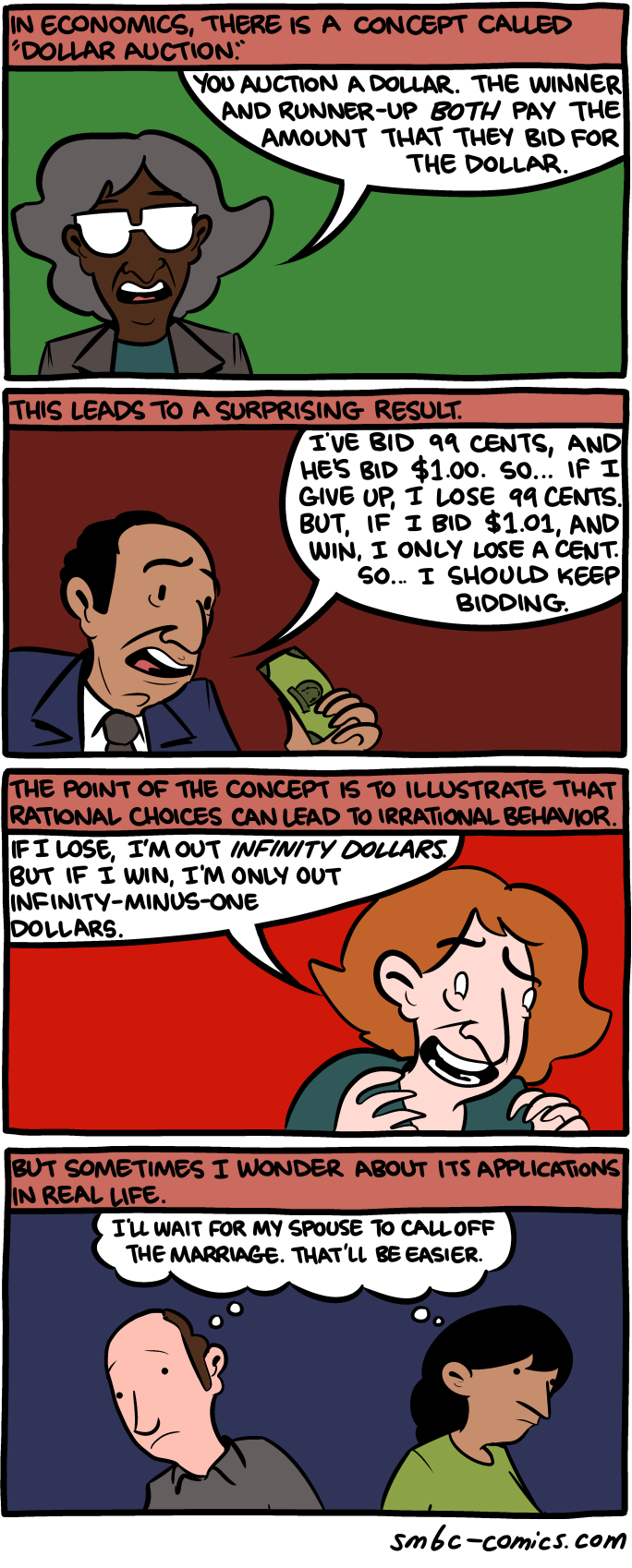
Here’s the thing. I think that people who wait for their spouse to end a marriage are cowardly. Let’s focus on that last frame, where the couple are both thinking that if the other one leaves them, it will be “easier.” Kind of the definition of cowardly to do something because it’s easier.
Also, easier in what sense? What are you trying avoid, guilt or unhappiness? I can only imagine that someone in that mindset has already accepted permanent unhappiness, barring some kind of miracle, and is focused on the last remaining issue, that of guilt.
Fuck that. Get more selfish (if you call it that) and focus on your own unhappiness, and screw the guilt. Tell your spouse you’re unhappy, because it’s more courageous, because it might be fixable, and because it will be much more likely to get fixed if you talk about it.
This is not a game, it’s your life.
Aunt Pythia
——
Dear Aunt Pythia,
I was on vacation in Utrecht the other day, and was very surprised to find a vagina, apparently abandoned. Can I keep it, or should I hand it in to the police?
Someone Not Accustomed To Commenting Here
Dear SNATCH,
Keep it, take good care of it, and I mean really good care of it, and then please return it to its rightful owner, who will be ever ever so grateful, I’m absolutely sure of it.
Aunt Pythia
p.s. I love your sign-off. And everything else about you.
——
Hello Miss Pythia,
You are quoted here about your reflections on open algorithms.
Is it possible for a firm like Google to model billions of human brains when they collectively interact with computers? And if yes, why only do marketing when you can manipulate brains?
Michaël (Toulouse)
Dear Michael,
Marketing is manipulating brains. That’s exactly what marketing is, turning brains into things that pay you for stuff.
Aunt Pythia
——
Dear Aunt Pythia,
My sister and her girlfriend came to stay with me and my family (husband, kids) at Christmas. The girlfriend was lovely and a good time was had by all.
The girlfriend has started emailing me, not including my sister on the emails, saying what a great time she had, how much she liked me, how she couldn’t wait to come back and visit again, asking me (only — no family) to come out and visit her, trying to make some inside jokes about my family, etc. Each time I wrote back, looping in my sister, and was nice but distant. The first email or two were fine but I feel like she is either seriously boundary-challenged or is hitting on me.
Should I keep responding to her emails? Say something to her? Say something to my sister?
Sincerely,
Don’t Play On Your Team, Wouldn’t Sleep With You If I Did
Dear DPOYTWSWYIID,
This one is easy. Yes, she’s hitting on you. That’s fine because you’re super gorgeous and attractive and who wouldn’t want a piece of that? Everyone should be allowed to fall in love. I’d leave it at that, and strain to feel empathy for her situation rather than judgement.
As for what you should do: don’t write back, or wait like 6 weeks and then apologize for being super busy, and even then talk about incredibly boring things like getting your washing machine fixed and buying clothes for your ever-growing kids. Oh, and of course don’t tell your sister, nothing really happened.
Auntie P.
——
Dear Aunt Pythia,
I had a book published recently (December 8). My publisher’s schedule needs caused me to have to abruptly stop working on the book and hand it over. It is a reference book with a lot of data, so that meant that there is some missing data. I had an opportunity to add some more content late in the game. That caused the publication date to slip from October 15 to December 8. The editor and publisher decided that it was more important to get the additional content than to make the original date, which was a good thing. The bad thing is that there is still missing content. I was told that I might have an opportunity, if there are additional printings, to add content and fix errors. I am back to working a 40 hour-a-week job, so that reduces the time that I have to do anything. That was the factor which slowed down the research and writing process originally. I was laid off in May, so I had time to build the index and add content. I also corrected some errors. Should I be pushing finding and adding the missing content? I had made a small start, but then the holidays hit and stopped me again.
Lost in Space
Dear Lost In Space,
Given that this is a technical book, it’s more about your integrity and reputation than it is about money. If I were you I would work on it, and I’d also maintain a webpage with the most updated links to data. When and if the time comes, add it to the book. You won’t regret doing that for your readers, and neither will they.
Aunt Pythia
——
Congratulations, you’ve wasted yet another Saturday morning with Aunt Pythia! I hope you’re satisfied, you could have made progress on that project instead.
But as long as you’re already here, please ask me a question. And don’t forget to make an amazing sign-off, they make me very very happy.
Click here for a form or just do it now:
For Profit Colleges Are The Real Villain
Scott Walker has recently made waves in Wisconsin by surreptitiously attempting to change the mission of the University of Wisconsin, and by threatening to remove $300 million of federal aid to the University of Wisconsin, citing the “laziness of professors” as a problem in need of a solution. On the one hand, he’s right to say there’s a crisis in higher education. But on the other hand, he has the wrong villain.
Instead of focusing on state schools like U of W, we should be investigating the toxic for-profit college industry. For-profit colleges have mushroomed in the last decade and tend to represent themselves as a solution to a very real problem; namely, that it’s become increasingly difficult to get a good job out of high school.
People who have been told to get a degree to pull themselves out of poverty are often faced with two options: enrolling at a nearby community college, or at a for-profit. But, partly because public funds are being diverted to for-profits, more affordable community colleges are not able to fill demand, leaving potential students with the more expensive alternative.
The results have proven to be terrible for the students. They leave with devastating debt, low graduation rates, and often no real education, often worse off than when they started.
This hasn’t gone completely unnoticed. The for-profit industry has been getting into repeated messy problems lately for fraudulent practices, including lying about graduation rates and post-graduation jobs. In the past year alone we’ve seen Corinthian, ITT, and GIBills.com get busted for fraudulent marketing practices.
This won’t be a surprise to those who know how these for-profits operate. They represent a revenue-maximizing industry which game the federal student aid programs for the poor and for veterans. Corinthian obtained $1.4 billion in federal grant and loan dollars in 2010 alone, more than the 10 University of California campuses combined for that same year. We could and should be getting more for our money.
Moreover, the industry specifically targets vulnerable, poor, minority single mothers online with misleading ads promising an easy degree and a new life. Once they have a phone number, they have trained recruiters repeatedly call and “poke the pain” of their targets.
Even when the fraudulent practices are discovered, as is the case with Corinthian, which the Consumer Financial Protection Bureau has accused of running a “predatory lending scheme,” the students haven’t gotten their money back, and neither have the taxpayers.
Obama has been making noises about a new college ranking system. Instead he should create a flat-out fraud detection system, built explicitly to be harder to game than the current watered-down regulatory framework, and particularly considering these companies are professional gamers.
Even better, the government should cut for-profits off of public assistance, and divert subsidies to struggling community colleges and institutions like the University of Wisconsin, which are better positioned to serve the common good. When education becomes a profit center, things go awry: admissions counselors become salespeople, students become consumers to be wrung for every last dime, and administrators become executives who cash out while students and taxpayers are left with the tab.
Corinthian and the other for-profits are only the worst along the spectrum of bad, and almost no college is immune to these kinds of tricks. We need to do a better job of quality control and educational goals. Beyond real punishment for the worst offenders, and refunding bilked student’s money, we should immediately increase funding for state schools, and try to once again create a country of opportunity.
Big Data Is The New Phrenology
Have you ever heard of phrenology? It was, once upon a time, the “science” of measuring someone’s skull to understand their intellectual capabilities.
This sounds totally idiotic but was a huge fucking deal in the mid-1800’s, and really didn’t stop getting some credit until much later. I know that because I happen to own the 1911 edition of the Encyclopedia Britannica, which was written by the top scholars of the time but is now horribly and fascinatingly outdated.
For example, the entry for “Negro” is famously racist. Wikipedia has an excerpt: “Mentally the negro is inferior to the white… the arrest or even deterioration of mental development [after adolescence] is no doubt very largely due to the fact that after puberty sexual matters take the first place in the negro’s life and thoughts.”
But really that one line doesn’t tell the whole story. Here’s the whole thing, it’s long:

Pages 1 and 2

Pages 3 and 4

Pages 5 and 6
As you can see, they really go into it, with all sorts of data and speculative theories. But near the beginning there’s straight up racist phrenology:

From page 1
To be clear: this was produced by a culture that was using pseudo-scientific nonsense to validate an underlying toxic and racist mindset. There was nothing more to it, but because people become awed and confused around scientific facts and figures, it seemed to work as a validating argument in 1911.
Anyhoo, I thought this was an interesting back drop to the NPR story I wanted to share with you (hat tip Yves Smith) entitled Recruiting Better Talent With Brain Games And Big Data. You can read the transcript as well, you don’t have to listen. Basically the idea is you play video games and the machine takes note of how you play and the choices you make and comes back to you with a personality profile. That profile will help you get a job or will exclude you from a job if the company believes in the results. There’s been no scientific tests to see if or how this stuff works, we’re supposed to just believe in it because, you know, data is objective and everything.
Here’s the thing. What we’ve got is a new kind of awful pseudo-science, which replaces measurements of skulls with big data. There’s no reason to think this stuff is any less biased or discriminatory either: given that there’s no actual science behind it, we might simply be replicating a selection method to get people who we like and who remind us of ourselves. To be sure, it might not be as deliberate as what we saw above, but that doesn’t mean it’s not happening.
The NPR reporter who introduced this story did so by saying, “let’s start this hour with a look at an innovation in something that’s gone unchanged, it seems, forever.” That one sentence already gets it wrong, though. This is, unfortunately, not innovative. This is just the big data version of phrenology.
Student Debt Strikers Take On Corinthian College
Fifteen students have refused to pay back their student debt to Everest College, owned by the now disgraced for-profit company Corinthian College. They call themselves “the Corinthian 15”.
Good for them. Corinthian College is a predatory and fraudulent company which was in the business of gaming the federal loan system while making false promises to its students. Those students are victims of fraud and should not be the ones paying back the government money for an education they never got. Instead, Corinthian should pay back the money.
There are articles about this in the New Yorker, Newsweek, and the Guardian, and there’s a letter of support signed by Naomi Klein and Barbara Ehrenreich, among others, which contains the following:
By declaring a strike, the Corinthian 15 are taking debt relief for themselves and challenging the Department of Education to look out for students instead of protecting rich and powerful creditors. By declaring a strike, they are taking a stand for all student debtors, by reminding us that for-profits schools are just an extreme version of our increasingly untenable system of debt-financed higher education. By declaring a strike, the Corinthian 15 are asking why the U.S. lags so far behind other industrialized societies in denying its citizenry the right to free college enrollment.
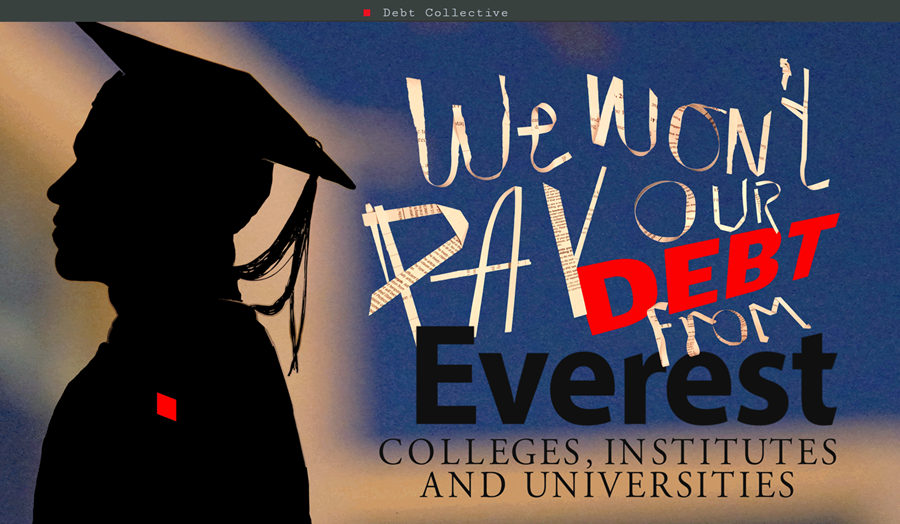
At the same time, there’s a new Rolling Jubilee initiative that just freed $13 million dollars worth of student debt, which was covered by Democracy Now. Right on.
How Big Philanthropy Undermines Democracy
I’m really looking forward to tonight’s panel on mega-foundations and democracy, organized by the Big Apple Coffee Party. I will be the moderator of the event, which takes place at 6:30 tonight at All Soul’s Church at 1157 Lexington Avenue and is open to the public.
In preparation, I’m reading the article that inspired tonight’s discussion, written by one of tonight’s three panelists, Joanne Barkan. The essay is entitled Plutocrats at Work: How Big Philanthropy Undermines Democracy and it’s published by Dissent Magazine.
Also on the panel will be Gara LaMarche, President and CEO of The Atlantic Philanthropies and a Senior Fellow at NYU’s Robert F. Wagner School of Public Service, who can be seen putting philanthropy on trial here, and Stanley Katz, Director of the Center for Arts and Policy Studies at the Woodrow Wilson School of International and Public Affairs at Princeton University, who wrote this piece called Beware Of Big Donors.
I hope I see you all there tonight!
Also, this Friday I’ll be giving a talk at Cornell Tech called Making The Case For Data Journalism. Send me an email if you want to come to that, I’ll need to get you on the list. It’s at 12:30 in the Google building.
Finally, I had a lot of fun over the weekend at the Rebellious Lawyer’s Conference at Yale, which is a yearly conference organized by law students. I was on a panel concerned with Occupy and the law profession, organized by Zorka Milin, an amazing tax lawyer and activist, and the other panelists were the amazing and inspirational Akshat Tewary of Occupy the SEC and Rebecca Wilkins, also an activist tax lawyer who is writing a book about tax law for the rest of us that I can’t wait to read.
Guest Post: Porn, Consent, and Obamneycare for Sex
This is guest post by Michael Carey. In his own words: I am a decidedly “alternative” math nerd, working in an environment where I’m on the wrong end of power and status relationships with a handful of conservatives. (Like, “willing to say nasty things about the gays in public” conservatives.) I have been an occasional pseudonymous contributor to the LGBT blog at Slate, Outward, on topics ranging from the poly closet to queer culture.
We need to make ethical porn cheaper and more convenient than its alternatives.
Lastly, because ethical production costs more — even compared to the best-behaved of today’s studios in the San Fernando Valley, let alone free stuff from Bulgaria or Thailand — you need a subsidy scheme that allows at least infrequent users to get their content for free. Citizens would be entitled to a modest annual allotment of voucher codes, cashed in through the exchange.
Producers would compete to sell what the public wants to buy, and would face continuous scrutiny from regulators. Consumers could rest assured that their objects of lust are safe, healthy, and fairly compensated.
It’s still worth thinking about the problem of how we keep sexual entertainment widely available, while ensuring that casual, occasional consumers don’t have to worry about risking “gain[ing] pleasure from an act of rape.” That risk is something that ought to bother you.
Perhaps the “exchange” idea — porno.gov! — isn’t entirely crazy. Sexual release is one of the most basic human drives. Perhaps we should consider at least a modicum of sexual gratification to be a basic need, like shelter, food, and clean water. If so, government subsidy shouldn’t be out of the question. Germany allows those with disabilities to use part of their support stipend to hire a sexual surrogate, and this practice may soon spread to other parts of Europe. We can imagine a society where sex work — even prostitution — is viewed as a valid choice of career, employing competent professionals who are treated with at least the same level of respect accorded to a gerontological nurse, a sewer technician, or anyone else who takes a demanding, sometimes-dirty job, and does it well.
In order to make that happen, though, we need high standards for health, safety, and compensation. I don’t think that’s impossible to achieve, and I’m fairly certain it would be better than the situation we live with now, where workers can’t count on the state to protect them from criminals, and sometimes face public crackdowns on their livelihood that simultaneously infantilize and vilify them. To make something like that happen, we have to first agree that we want it.


 mathbabe
