Archive
Peter Woit: The NSA, NIST and the AMS
This was crossposted from Not Even Wrong and written by Peter Woit.
Last summer I wrote here about an article in the AMS Notices which appeared to make misleading claims about the NSA’s involvement in putting a backdoor in an NIST cryptography standard known as DUAL_EC_DRBG. The article by Richard George, a mathematician who worked at the NSA, addressed the issue of the NSA doing this kind of thing by discussing an example of past history when they were accused of doing this, but were really actually strengthening the standard. He then went on to claim that:
I have never heard of any proven weakness in a cryptographic algorithm that’s linked to NSA; just innuendo.
This appears to be a denial of an NSA backdoor in the standard, while not saying so explicitly. If there is a backdoor, as most experts believe and the Snowden documents indicate, this was a fairly outrageous use of the AMS to mislead the math community and the public. At the time I argued with some at the AMS that they should insist that George address explicitly the question of the existence of the backdoor, but didn’t get anywhere with that. One of their arguments was that George was speaking for himself, not the NSA.
The question of fact here is a very simple and straightforward mathematical one: how was the choice used in the standard of points P and Q on an elliptic curve made? There is a known way to do this that provides a backdoor. Did the NSA use this method, or some other one for which no backdoor is known? The NSA refused to cooperate with the NIST investigation into this question. The only record of what happened when the NIST asked about how P and Q were chosen early on in the development of the standard is this, which indicates that people were told by the NSA that they were not allowed to publicly discuss the question.
Remarkably, the latest AMS Notices has a new article with an extensive discussion of the DUAL_EC_DRBG issue, written by mathematician Michael Wertheimer, the NSA Director of Research. At first glance, Wertheimer appears to claim that the NSA was unaware of the possibility of a backdoor:
With hindsight, NSA should have ceased supporting the dual EC_DRBG algorithm immediately after security researchers discovered the potential for a trapdoor. In truth, I can think of no better way to describe our failure to drop support for the Dual_EC_DRBG algorithm as anything other than regrettable.
On close reading though, one realizes that Wertheimer does not address at all the basic question: how were P and Q chosen? His language does not contain any actual denial that P and Q have a backdoor.
For a careful examination of the Wertheimer piece by an expert, see this from Matthew Green. Green concludes that
… it troubles me to see such confusing statements in a publication of the AMS. As a record of history, Dr. Wertheimer’s letter leaves much to be desired, and could easily lead people to the wrong understanding.
In a recent podcast on the subject Green states
I think it’s still going on… I think that the NSA has really adopted a policy of tampering with cryptographic products and they’re not going to give that up. I don’t think that this is a time that they want to go out admitting what they did in this particular case as a result of that.
Given that this is now the only official NSA statement about the DUAL_EC_DRBG issue, the Notices article has drawn a lot of attention, see for instance here. The Register summarizes the story with the headline NSA: So sorry we backed that borked crypto even after you spotted the backdoor.
The publication of the George and Wertheimer pieces by the AMS has created a situation where there are just two possibilities:
- Despite what experts believe and Snowden documents indicate, the NSA chose P and Q by a method that did not introduce a backdoor. For some reason though they are unwilling to state publicly that this is the case.
- P and Q were chosen with a backdoor, and the AMS has been now repeatedly been used to try and mislead the mathematics community about this issue.
I’ve contacted someone at the AMS to try and find out whether the question of a backdoor in P and Q was addressed in the refereeing process of the article, but been told that they won’t discuss this. I think this is an issue that now needs to be addressed by the AMS leadership, specifically by demanding assurances from Wertheimer that the NSA did not choose a backdoored P and Q. If this is the case I can see no reason why such assurances cannot be provided. If the NSA and Wertheimer won’t provide this, I think the AMS needs to immediately cut off its cooperative programs with the agency. There may be different opinions about the advisability of such programs, but I don’t think there can be any argument about the significance of the AMS being used by the NSA to mislead the mathematics community.
Representation of women and the genius myth
In a recent issue of Science, there was an article entitled Belief that some fields require ‘brilliance’ may keep women out (hat tip Gary Cornell) that absolutely resonates with my experiences, both as a mathematician and as a teacher.
Namely, it talks about the extent to which women are discouraged to go into a field because that field is somehow reserved for “geniuses,” and women are rarely if ever bestowed with that label. Mathematics is definitely one of those fields; if you are exceptionally successful in mathematics, people call you a genius, and it’s pretty hard to be successful if people don’t think you’re a genius.
But other STEM fields have less of a reputation for geniuses, and they have correspondingly more women. Biology, for example. Moreover, there are some fields outside of STEM that have way fewer women, which seems unexplained unless you have the “genius” theory. Philosophy is the obvious example here, a very macho field.
In the Science article, they were reporting on a study done by Sarah-Jane Leslie, Andrei Cimpian, Meredith Meyer, and Edward Freeland, in which they surveyed researchers from all sorts of fields in all sorts of research universities and asked them to rate, on a scale of 1-7, statements about their own discipline along the lines of, “Being a top scholar of [discipline] requires a special aptitude that just can’t be taught”. Here’s the critical graph:
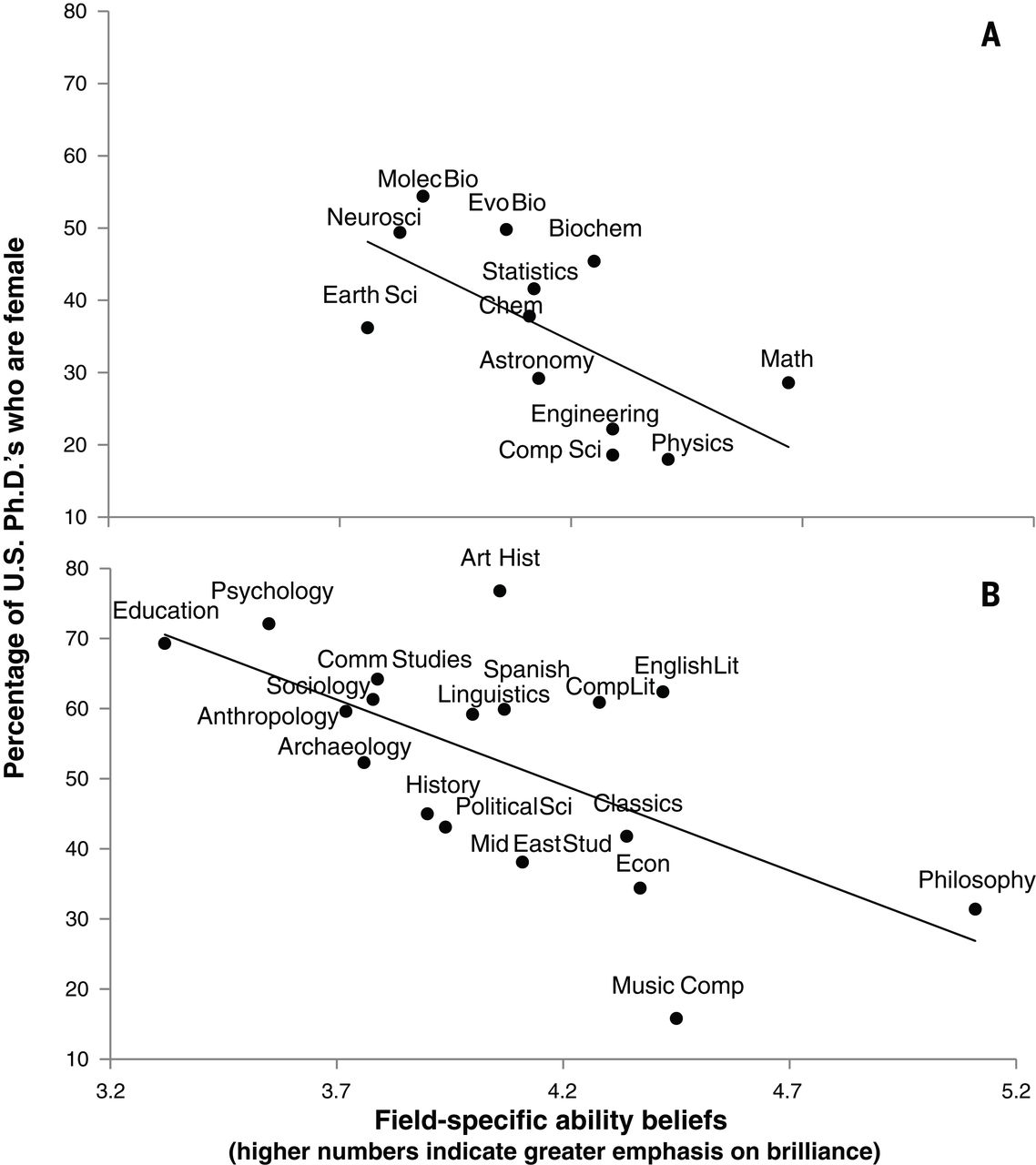
STEM subjects above, non-STEM below. The negative correlation is the key to this study. I am particularly struck by the difference between statistics and math.
It’s just one study, and the response rate was small, so the word is not final. Even so, I think this proves that we should look into this more, gather more evidence, and see where it leads.
Personally, I have already spent quite a bit of time trying to deal with this very problem in mathematics. For example, I’ve explained before how I deliberately teach kids an introduction to proof that emphasizes practice over the silly and distracting concept of having an innate gift. It works, and it’s more fun too, for both men and women.
If I were designing a curriculum for STEM subjects I would rely heavily on this idea to inform my approaches to all sorts of things, partly because I think it’s true, but partly because the other things we think might matter are harder to change.
If you think about it, it’s actually a pretty reasonable roadmap for how to attract a more diverse group of people to mathematics or other subjects. You just need to create an environment of learning that emphasizes practice over genius. Actively dispel the genius myth. Achieving that cultural shift gets harder the higher up the research ladder you go, though, partly because it’s hard for older people to give up the “genius” label they worked so hard for. But it’s worth a try.
The Black Box Society by Frank Pasquale
There’s a new book out, called The Black Box Society and written by Frank Pasquale, a lawyer focused on technology and a friend of mine. It’s published by Harvard University Press and it looks like this:

To be honest, when I first received it I was a bit worried that it would make my book, which I am utterly engaged in writing, entirely moot. After all, Frank and I had discussed his book and I’d seen earlier versions. I knew it contained information about racist secret algorithms in finance and tech, and there were also other issues in common with our two books.
Now that I’ve had a chance to read it, though, I’m not as worried. First of all, Frank’s book is aimed at a different audience, which is to say a somewhat more academic and technical audience. In particular his policy recommendations near the end of the book seem to be written for lawyers who know the current laws and need arguments to improve them.
Also, his focus is on secrecy itself as a means of power, whereas I focus on models as the object of interest.
I like a lot of what Frank says, and I think his metaphors work really well. For example, he talks about the early promise of the internet to expose information of all sorts, on powerful corporations as well as individuals. Then he talks about how reality has been a disappointment, and we’ve ended up with an internet that acts as a “one way mirror,” whereby powerful corporations can see into individual’s lives but those individuals can’t look back.
He also makes the important point that, when it comes to the NSA and other government agencies snooping around, while they might be legally prevented from gathering certain kinds of data about people, nothing prevents them from buying information and profiles from data warehouses like Acxiom, which can do the kind of collecting that they can’t. In other words, the data warehousing industry acts as a giant loophole in the set of rules protecting our civil liberties.
For another really interesting review of Frank’s book, written by a software engineer, take a look at David Auerbach’s Slate review (hat tip Jordan Ellenberg). In particular he has interesting things to say about the extent to which algorithms are intentionally evil (they’re probably not) and the extent to which engineers can fix problems (they probably can).
In any case, I recommend The Black Box Society, it’s a fascinating and important book.
Link to my JMM prezi talk
I seem to have caught a break at the San Antonio airport, with free wifi. So I will take this opportunity to offer a link to my prezi talk.

See the prezi here: http://prezi.com/makkue0d84nc/?utm_campaign=share&utm_medium=copy&rc=ex0share
One embarrassing omission from my talk is the existence of many public facing math podcasts. Embarrassing not because I knew about them – I didn’t – but because I should have, since after all I participate in a weekly podcast myself, so of course I know it’s a new and exciting medium. Luckily, the audience member who pointed out my mistake has agreed to write a guest post surveying the math podcast landscape, so stay tuned for that.
Palantir’s leaked documents and the concept of uncertainty
Did you hear about TechCrunch’s leaked documents detailing the client list of Palantir, the super secretive data mining contractor (hat tip Chris Wiggins)? Palantir, founded by uberlibertarian Peter Thiel, had clients as of 2013 including the LAPD, the CIA, DHS, NSA, the FBI, and CDC. Besides data mining for government agencies, they also work in the finance sector and the legal sector.
Here’s the scariest thing about the TechCrunch article:
Samuel Reading, a former Marine who works in Afghanistan for NEK Advanced Securities Group, a U.S. military contractor, was quoted in the document as saying It’s the combination of every analytical tool you could ever dream of. You will know every single bad guy in your area.”
That quote, if true, belies a lack of understanding of what data mining can actually do in terms of accuracy. No data mining tool can be both comprehensive and accurate – find all the bad guys with no accidental good guys getting caught in the net. It’s just not possible, unless you have DNA samples with markers for “bad guyness,” and even then DNA tests sometimes get mixed up.
It behooves an expensive and fancy consulting company to act like their tools are prophetic, however, even if that means false positives or false negatives happen all the time, which of course they do, with any algorithm.
It’s bad enough when stupid start-up companies claim big data solves everything, when what they’re doing is trying to solve a problem nobody cares about. It’s another thing altogether when it’s our military and military contractors and police and secret services, and when we don’t have any view into what it actually does. Scary stuff.
Citation as received wisdom
So I’m here at JMM, hanging out with my buddy Aaron Abrams and finagling free wifi at the Hyatt (pro tip from Jonathan Bloom: sign up to be on their gold membership plan, which is free, and as a member you get free wifi).
Aaron and I started talking about the case of MIT professor Walter Lewin, and whether his OpenCourseWorks physics lectures should or should not have been removed after he was discovered to have been a sexual harasser.
UPDATE: Here’s an article giving some idea of what Lewin did, which was basically to harass women who were taking his online class.
I’ve already asserted that it makes sense to me that they are removed, but I wasn’t happy with my explanation. I think I’ve understood it better now, and I wanted to throw it out there.
To explain it, let’s move to a more cut and dry example, or at least an older one, namely Harvard mathematician George Birkhoff. That guy was a hugely famous and powerful mathematician in his day, which was in the 1930’s. He was also a huge anti-semite, and prevented Harvard from hiring jewish mathematicians fleeing the Nazis.
When it comes to doing math, I might write a paper that uses a result he proved. Will I cite him? Personally, I would feel weird about it. Citing someone, speaking their name, is not just a mathematical shortcut, a way of avoiding proving everything from basic principles, although it is that, of course. If you have no prior knowledge about someone, you might not see that, but I’ve set it up explicitly so you see more than that.
Here’s what I see. By citing him, I am doing more than giving him credit for proving something, I’m including him in the community of mathematics, which is actually an honor. And honestly I’d rather not honor the wisdom of someone I detest.
Update: to be clear I would cite him if I needed to. I just would actively feel weird about it. I might even add a note.
Going back to Walter Lewin. Supposedly he can explain certain kinds of physics really really well. People say this, and I believe them. But of course the physics is already known, he’s not inventing something, and other people can also explain it, just not quite as well, at least right now.
Why would a given person choose to watch Lewin’s lectures instead of someone else’s lectures on the same material? Well, what is the delta between those two experiences? On the one hand, it’s a better explanation, which adds, but on the other hand, it’s the knowledge that we are honoring a man with no integrity, which subtracts. If written citation is received wisdom, then actually sitting and listening to a person is even more intimate.
For me, personally, these two opposite considerations don’t add up to a net positive. I’d rather watch someone else explain the physics.
As for MIT’s OpenCourseWorks (OCW) platform, they also had a “delta” computation to make, and they had to take into account the community they are trying to build through OCW. They want women in particular to feel welcomed to that community, and they decided that the videos’ presence made that more difficult (and it’s already difficult enough in physics). I think they made the right call.
Guest post by Tom Adams: Obama homeownership push or mortgage market share battle?
This is a guest post by Tom Adams, who spent over 20 years in the securitization business and now works as an attorney and consultant and expert witness on MBS, CDO and securitization related issues.
Good news for would-be home buyers – the Obama Administration heard your concerns and has a new tool to help make homes more affordable!
Are they going to increase wages? Or reduce the price of homes? No, they’re going to attack mortgage rates for Federal Housing Administration (FHA) borrowers. Of course, mortgage rates are already at close to all time lows, having declined significantly over the past year to about 3.7% on conventional 30 year fixed rate loans. The Administration’s main tool for doing this is to cut the insurance fee charged by the Federal Housing Authority on new mortgages by 0.50%, from 1.35% to 0.85% (on top of the interest rate charged to borrowers).
This fee is paid by borrowers into a fund that the FHA uses to protect itself against losses in case borrowers that it has insured later default. In theory, this move was somewhat controversial because the FHA’s fund had incurred higher than expected losses during the crisis and the FHA had to ask Congress for money to shore up the fund not that long ago. Around the same time, the FHA raised this insurance premium to additionally replenish the fund.
If it’s already really cheap to borrow money, is another 0.5% reduction going to make that big a difference? Probably not, because historically low interest rates haven’t been the obstacle to buying a house. I expect the number of net, new home buyers produced as a result of this change will be considerably lower than the Administration is projection (“millions of homeowners,” according to Obama’s statement today).
Rather, would-be homeowners don’t have the income to support buying the houses listed for sale in their markets – which is another way of saying that, for average Americans homes are too expensive for them to afford (or wages are too uncertain for them to want to buy).
Also note that the new lower fee is primarily aimed at new home purchasers. In order for existing FHA borrowers to get the new lower premium they would have to refinance into a new loan, which means they’d have to incur new closing costs. The new closing costs would probably eat up most of the savings for a year or more. Presumably, this would discourage many existing borrowers from refinancing for the lower premium, which helps the FHA by allowing it to retain the old, higher premium on the borrowers who don’t refinance.
This highlights one of those fundamental conundrums in the housing market. Existing homeowners and home sellers want home prices to go up. Representatives of this group are great at lobbying and have convinced many people (including, by all appearances, this Administration) that rising home prices are a good thing for America. On the other hand, potential home buyers would rather not have home prices going up – because that makes buying much harder. For whatever reason, this group has about zero lobbying juice.
Making credit cheaper is a small tool the Administration has via this reduced premium, so they used it, I guess. But it’s an action that has consequences, including potentially running the risk of not having enough in the fund down the road if losses increase (not a risk I’m especially worried about – the Urban Institute did a fine analysis of why the lower fee is probably sufficient – but it’s a reasonable concern). In addition, it is somewhat disheartening that the Administration still seems to believe that the solution to consumer issues is to have the consumers take on more debt.
The most significant impact of this change is that it will make FHA loans more competitive with Fannie Mae and Freddie Mac loans. You may recall that Mel Watt, the man in charge of the Federal Housing Finance Agency (FHFA), which manages Fannie and Freddie, made a big announcement recently that the GSE’s would offer 97% loan-to-value (LTV) ratio loans to qualified borrowers. Previously, that type of LTV had been mostly the territory of the FHA.
So, effectively, this is just a form of catch-up for the FHA. The various government housing agencies are competing for market share among the same limited universe of qualifying borrowers by trying to get them to take on bigger mortgages than they would qualify for previously. For the average would-be buyer of the average house, the new, lower FHA fee would be worth about $900 a year, equivalent to about a $75 reduction in monthly payment.
It’s hard to believe that anyone in the Administration believes that this will do much for making homes more affordable for Americans. Perhaps it is a measure, however, of how seriously the Administration is taking the issue of housing affordability. There are big issues in housing and the economy that need to be taken seriously – like resolution of Fannie and Freddie, home prices that still remain beyond the reach of many Americans, stagnant wages, on-going foreclosure and mortgage servicing problems – but the Administration seems content to tinker around the edges and try to sell it as important reform.
Going to San Antonio for JMM
Hey, so this is cool. The Alternative Banking group just came out with a second Huffington Post essay, this time on how the bailout isn’t over, how it didn’t work, and how we’re already preparing for the next one. I think it came out really well. You can read it here.
Also, I’ll be giving a talk at the Joint Math Meetings again this year, this time as an invited MAA speaker. My title is Making the Case for Data Journalism, and you can see the abstract here. I guess I’m speaking on Monday afternoon at 4pm in a place called the Lila Cockrell Theatre.
So, a few things. If you’re a math nerd planning to be in San Antonio this weekend, please don’t leave Sunday, because there are still talks on Monday! Also, if you want to hang out, leave a comment or send me email and I’ll try to figure out a way to meet up with you. I honestly feel like I don’t know too many mathematicians anymore, so it would be nice to see or meet a friendly face. I’m getting to San Antonio Friday.
P-values and power in statistical tests
Today I’m going to do my best to explain Andrew Gelman’s recent intriguing post on his blog for the sake of non-statisticians including myself (hat tip Catalina Bertani). If you are a statistician, and especially if you are Andrew Gelman, please do correct me if I get anything wrong.
Here’s his post, which more or less consists of one picture:

I decided to explain this to my friend Catalina, because she asked me to, in terms she could understand as a student of midwifery. So I invented a totally fake set-up involving breast-fed versus bottle-fed babies.
Full disclosure: I have three kids who were both breast fed and bottle fed for various lengths of time and, although I was once pretty opinionated about the whole thing, I could care less at this point and I don’t think the data is in either (check this out as an example). So I’m not actually trying to make any political point.
Anyhoo, just to make things super concrete, I want to imagine there’s a small difference in weight, say at 5 years of age, between bottle fed and breast fed children. The actual effect is like 1.7 pounds at 5 years. Let’s assume that, which is why we see a blue line in the graph above at 1.7 with the word “assumed” next to it. You can decide who weighs more and if that’s a good thing or not depending on your politics.
OK, so that’s the underlying “truth” in the situation, but the point is, we don’t actually know it. We can only devise tests to estimate it, and this is where the graph comes in. The graph is showing us the distribution of our estimates of this effect if we have a crappy test.
So, imagine we have a crappy test – something like, we ask all our neighbors who have had kids recently how they fed their kids and how much those kids weighed at 5 years, and then we averaged the two groups. That test would be crappy because we probably don’t have very many kids overall, and the 5-year check-ups aren’t always exactly at 5 years, and the scales might have been wrong, or clothes might have been confusing the scale, and people might not have reported it correctly, or whatever. A crappy test.
Even so, we’d get some answer, and the graph above tells us that, if our tests are at a certain level of crappiness, which we will go into in a second, then very likely our estimate of the difference will come in between something like -22 pounds and +24 pounds. And the “most likely” answer would be the correct one, sure, but that doesn’t mean it’s all that likely to even come close – say within 2 pounds – of the “true effect”. In fact, if you make a band of width 4 centered around the “true effect” level, you’d definitely capture a smallish percentage of the total area under the curve. In fact, it looks like a good 45% of the area under the curve is in negative territory, so the chances are really very good that the test estimate, at this level of crappiness, would give you the wrong sign. That’s a terrible test!
Let’s be a bit more precise now about what we mean by “crappy.” The crappiness of our test is measured by its power, which is defined as “the probability that it correctly rejects the null hypothesis – i.e. the hypothesis that the “true effect” is zero – when it is false.” In other words, power quantifies how well the test can distinguish between the blue line above and the line at zero. So if the bell curve were really really concentrated at the blue line, then more of the total area under the curve would be on the positive side of zero, and we’d have a much better test. Alternatively, if the true effect were much stronger, say at 25 instead of 1.7, then even with a test this imprecise, the power would be much much higher because the bulk of the bell curve would be to the right of zero.
On the one hand, power estimates are done by researchers, and they are attempting to achieve a power of at least 0.80, or 80%, so the above power of 0.06 is indeed extremely low and our test is indeed very crappy by researching standards. But on the other hand, since researchers are expected to estimate their power to be at least 0.80, there’s probably fudging going on and we might be trusting tests to be less crappy than they actually are. Also, I am no expert on how to accurately estimate the power of a test, but there’s an example here, and in general it depends on your sample size (how many kids) and the actual effect size, as we have already discussed. In general it requires way more data to produce evidence of a small effect.
OK so now we have some general sense of what “crappiness” means. But what about the red parts?
Those are the “statistically significant” parts of the distribution. If we did our neighborhood kids test and we found an effect of 20 or -20, we’d be totally convinced, even though our test was crap. There are two take-aways from this. First, that “statistically significant” in the presence of a small actual effect and a crappy test means that we are wildly overestimating the effect. Second, that the red part on the left is about a third of the size of the red part on the right, which is to say that when we get a result that seems “statistically significant,” in the presence of a crappy test, it still has a one in four chance of being totally wrong.
In other words, when we have crappy tests, we just shouldn’t be talking about statistical significance at all. But of course, nobody can publish their results without statistical significance, so there’s that.
Aunt Pythia’s advice
Greetings, friends! I’ve missed you all!
Since returning from her travels, Aunt Pythia has been continuously marveling in the wonders of flannel and wool, and has decided to knit up something along these Celtic lines:
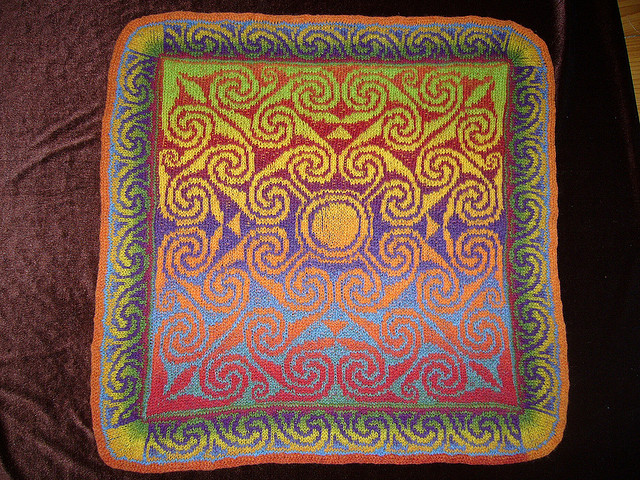
Is that not gorgeous? I love the tangled-upedness of the center. And, of course, the doubly rainbow-ic aspects.
Here’s the thing, though: the pattern comes from the excellent book Celtic Charted Designs that Aunt Pythia is absolutely sure she has somewhere in her house, but can’t find. in fact she’s spent the good part of the morning searching her house. So if the column is a wee bit short and/or frustrated today, you’ll know why.
On to business! Aunt Pythia has lots of questions to answer, given that she was away last week, and she’s eager to get through some. But before she forgets,
please think of something Celtic
to ask Aunt Pythia at the bottom of the page!
By the way, if you don’t know what the hell Aunt Pythia is talking about, go here for past advice columns and here for an explanation of the name Pythia.
——
Dear Aunt Pythia,
What are your thoughts on this 401k article?
Another Potential Pass At Legalizing Longterm Investments Not Going (well)
Dear APPALLING,
Wow, your sign off is longer than the body of you letter. Well done. OK so let me quote the heart of the problem fingered in the article:
Millions of people are clearly not using 401(k) plans as retirement accounts at all, and it’s a threat to their financial health.
I’d phrase it differently, namely:
In this day and age, working people need all their money, and 401(k) plans have proven to be saving strategies which are only realistic for well-off people, which entirely misses the point of how to deal with the older middle class in our country. Instead of relying on such wishful thinking, we should scrap the whole system, which by the way only serves to expand Wall Street’s power and give tax breaks to the rich, and we should instead expand Social Security.
Love,
Aunt Pythia
——
My Dearest Aunt Pythia,
In mid-90’s I completed class work on an MA in Applied Economics/Econometrics at a state school in California. Stupidly did not complete thesis (things got busy on political campaigns and such, and never got back to it). Like many I fell in love with economics, public policy, and their interrelations.
Now, many years later, my econometric/data/statistical modeling skills have aged with me and have become lost from my mind.
My first question is: What would you recommend as a refresher of data skills? I’m certain I don’t need to redo all I’ve done before- the skills are there but need to be refreshed and awakened (I assume/hope).
My second question is: Assuming the skills can be reawakened, what is my fastest and least costly method to enter data work? For programming many people create apps or small programs to be able to show code samples to prospective employers. Is there something analogous in data work? Should I build a model of aggregate demand changes from quantitative easing/M2 changes and shrinking consumer credit (from institutional rule changes) and post it online to show skills? I’ve also been looking at the data science certificate from Coursera/Johns Hopkins, but don’t know that it would matter on a resume. My old university requires restart for the old M.S. (which I understand), so should I pursue a new M.S. in current state school (UMUC has a Masters Data Analytics, which I think I would enjoy anyway, but is pretty pricy).
Anyway, hoping you, my dear Aunt, will have some advice for a data enthusiast with dusty data skills to freshen skills and move into analysis. Oh, I should mention that I am taking a lot of computer programming classes lately to get skills in that area as well.
Dusty Skills
Dear Dusty Skills,
Please don’t take this the wrong way, but the very first thing you need to do when applying for any data job is to use a spell-checker. I must have corrected 5 words in your letter.
Next, although I agree that a Coursera certificate might not be considered all that important, the skills you hopefully acquire with such a certificate would be. And yes, I do suggest you build something with your skills, although tackling QE seems both onerous and unlikely. I’d do something less abstract if I were you, and set up a website portfolio so everyone can see your mad skillz. Oh, and you might want to take a look at my book, Doing Data Science, although you might be past that stuff already.
Good luck!
Aunt Pythia
——
Aunt Pythia,
I’m a father whose daughter is applying to colleges. I also work at a college, as does my wife. And like many employees in academia, I’ve been following with horror the reports of college rape: the under-reporting, the Judicial review boards, the administrators eager to downplay the problem, etc.
As a father the horror easily spills over into terror. I want my daughter to grow into the challenges of living away from home; I want her to learn in a enlightening, and encouraging environment; and I want her to have fun. I also want her to be safe.
I am outraged at the clueless administration officials and public safety officers who say “girls should not go to parties, or drink,” all the while wanting to scream at my daughter “don’t go to parties or drink.”
How can I have a meaningful conversation about going off to college, learning, having fun, but be safe, without sounding like *those* administrators?
Worried In Academia
——
Dear Worried,
I went to college in the early 1990’s at UC Berkeley. My first year there was the scene of multiple Gulf War protests, and about 3 or 4 street riots, streaming by my dorm near Telegraph Ave, during which me and my two roommates didn’t dare leave our room. In my sophomore year we heard the Rodney King verdict and it was chaos in the streets for a few days.
I guess what I’m saying is that, due to the obviously volatile and threatening mood of the campus and neighboring towns back then, I was always on alert, and defensive. All of my friends took self-defense classes, and I carried around pepper spray, in my right hand, and my keys in my left, whenever I walked home at night. I biked places so I could get away more quickly. It was my assumption that I would need to protect myself and that there were people who would hurt me if I didn’t. I’m not saying there weren’t people who drank too much and got themselves vulnerable – in fact while I was there, there were multiple burning deaths in fraternities that did crazy things with couches – but that I personally would never have been involved with such stuff. For that matter there was a lot of campus rapes, which we knew about, and the police knew about, and kept us going to our self-defense classes.
Nowadays, we have a very different notion, and also a different reality, which is mostly a good thing, but has weird consequences. One of them is a sense that colleges are safe places, which they most certainly are not. College administrations have come a long way on marketing their campuses as attractive and safe, but it’s just a marketing thing, and it sends confusing and deeply mixed messages to parents and kids, which pisses me off. At the end of the day, when you go to college, you are an adult, and you need to be responsible for your safety, which means not getting out of hand, and keeping trustworthy friends close to you to make sure you don’t, and to make sure they don’t.
So, and I know this is a tough issue, but my advice is to tell your daughter to learn to size up the energy of a party, and see if dangerous things are happening, and to have a group of friends at all times that are looking out for you, and who you are looking out for, and to take self-defense classes, and to carry mace or at least a siren for when you travel alone at night.
Also, and this is actually the most important piece of advice: get your daughter to drink with you a few times, before she goes to college, so she’ll know what it feels like to have too much. The most educational night of my life was a night in the summer before college, when my dad got me and my friend Becky puking drunk. I never let that happen again, because I knew when I’d had too much. I think far too many kids get to college never having been allowed to go overboard with drinking, so they do it for the first time with strangers. Bad idea!
One last thing. I think that in the next couple of decades, the police will learn how to adequately and sensitively deal with rapes, and when that happens we won’t need to worry as much about campus police forces, which are totally inadequate and rife with conflicts of interest. But obviously you don’t have two decades to wait for that to happen, since your daughters are going to college now. Plus, I may be just being unrealistic about the progress we could make.
I hope that helps!
Aunt Pythia
——
Dear Aunt Pythia,
I keep hearing about how rampant sexism is in STEM fields, particularly in tech workplaces, where I can see myself heading toward after college. It’s really discouraging, especially since I think I experience some sort of sexism in my classes here in college (in computer science way more than in math), and even worse, I can’t seem to speak up because this kind of sexism is really subtle (i.e. a guy got angry with me for his incompetence with a certain technology. I would’ve spoke up but the assignment was worth so little.)
These hurtful incidences just build up over time, and whenever I vent to my friends, some “brush it off” as it not being serious. My parents told me that what I experience here in college won’t be any different in the workplace.
So as I search for summer internships, I carry this cloud of insecurity and doubt. Should I go forward? What’s the point? Breaking gender barriers sounds great, but my God, there are so many women out there who choose to leave because the barrier is so high and strong. I can easily see myself leaving the tech industry because its stubborn lack of support toward women and its more harmful PR farces showing that they do “support women.” Is it ever worth it? How do I reconcile with this?
Unsure of the future
Dear Unsure,
My motto is, celebrate the victories and ignore the defeats. Where by “victories” we mean “getting a computer program to work” and by “defeats” we mean “some insecure guy took out his frustration on me because I’ve got boobs.”
In other words, don’t think about yourself or your actions as A Woman In STEM. Instead, think about what your personal goals are, and what interests you, and what you’d like to learn about or accomplish. Make it an internal conversation about your wants and needs and passions, rather than an external conversation about how you look to other people. And if your internal voice is telling you to leave STEM, then by all means do it, but if not, don’t let those fuckers get you down. Do it because it’s cool and you love it, not because some assholes do or do not have an agenda for you or an ego riding on what and how you do things. Separate the two issues and it will help, because math and computer science are really cool.
And because it’s not always possible to totally ignore the defeats, I’d also encourage you to find better friends who will let you vent and will vent along with you. What’s up with them?!
Good luck, for reals! Keep me posted!
Aunt Pythia
——
Please submit your well-specified, fun-loving, cleverly-abbreviated question to Aunt Pythia!
Click here for a form.
Wanted: Dead or Alive
I came across an interesting poster that’s been put up on a few lampposts on my street. It rather pathetically offers a $2,000 reward for information leading to the arrest of George Welch for operating a bucket shop in New York.

This got me thinking about the notion of vigilante justice and the failure of the Department of Justice, or pretty much anyone else, to prosecute people on Wall Street for the financial crisis. What if more people, frustrated by the lack of prosecutorial interest in Wall Street, decided to take matters into their own hands? What if there was an outbreak of bounties being put on the heads of wrong-doing bankers so that some street justice could be applied, as the person posting this poster appeared to be seeking?
Wikipedia has a surprisingly elegant definition of vigilante justice as:
the idea that adequate legal mechanisms for criminal punishment are either nonexistent or insufficient. Vigilantes typically see the government as ineffective in enforcing the law; such individuals often claim to justify their actions as a fulfillment of the wishes of the community.
The mood of the community I follow on Twitter and around the web certainly resonates with this definition. A lot of ink has been spilled on how the government has failed to enforce the law with respect to the Financial Crisis and that a collection of the wrong-doers, big and small, have gotten away with it, at the expense of the rest of us. Occupy, obviously, was an expression of frustration about the lack of law enforcement, though it did not have a vigilante component. Growing dissatisfaction with our government is manifesting itself in many places – including the most recent anti-incumbent mid-term elections. And despite whistleblowers, such as Alayne Fleischmann or Edward Snowden naming names and institutions, nothing seems to change.
There’s a long, (not so) proud tradition of vigilante justice in our country (and, of course dating back to societies much older than our country). Vigilante justice stories in the American frontier were tales of how people bound together to fight back against lawlessness. In my youth, movies like Billy Jack, Death Wish or Rambo portrayed the desperate, yet justified (?), actions of people who had had enough with lawlessness and weren’t going to take it anymore. The real life story of Bernhard Goetz was often portrayed in a similar fashion in the tabloids. Today, vigilante themed movies and shows, like Batman or Dexter, are everywhere. In the hands of the right storyteller, vigilante justice has a visceral appeal.
Vigilantism also has an awful, dark history in the US and elsewhere, including the legacy of lynchings in our not too distant past. As angry as many of us have been about the aftermath of the financial crisis and the sense that the government has been bought by Wall Street money, the notion of vigilantism is still scary. Who will really be making decisions about right and wrong if people take law into their own hands – the downtrodden and righteous, or the powerful and corrupt?
Upon doing a little internet research into the Wanted! poster on my street, I discovered that it wasn’t exactly a call for justice from a poor aggrieved investor in some bucket shop scheme. Perhaps the name of the firm – Hooke, Lyon and Cinquer – should have given it away. Instead, this poster seems to be a reference to a piece of strange art by a early 20th Century artist named Marcel Duchamp. Duchamp was a mysterious man and many people had a hard time understanding what he was getting at with his art. He made this poster, with a picture of himself as the wanted man, but critics are unclear about what he was saying with it.

Frankly, I have no idea why someone is posting them on my street now, almost 50 years after the original artist’s death. It seems noteworthy, somehow, that Duchamp’s poster originated in the lawless, Boardwalk Empire days of the 1920s, but I’m not sure why exactly.
I realized that I had been pranked by the poster, because I was sympathetic to a story about a small investor being burned by a Wall Street con artist, and a bounty on the scammer’s head seemed like an innovative, though unlikely, solution to the failure of law enforcement. So what was the point of this prank by Duchamp and by his new imitator on my street?
I’m not an art expert in any way (particularly not an expert on Dadaism that Duchamp helped originate), but my interpretation of today’s poster is that vigilantism is, itself, a prank. Despite fantasies of lawless bankers being tarred and feathered, what I (and I assume others) really want is a justice system that works, not one where people have to take the law into their own hands. In an excellent article written in response to the Ferguson troubles, Kareem Abdul Jabbar argues that we should use our rage at injustice to work to fix the system, and he has a point. Vigilantism is an illusion of justice… but the sense that the system isn’t working is still real. Maybe there’s an alternative interpretation of Duchamp’s prank: Unless more people within the system actually start to enforce the law against the powerful (as folks like Judge Rakoff or Ben Lawsky have shown is possible), then justice and government will lose their authority and become an illusion.
It’s art, so I don’t know that there is a definitive interpretation, but Duchamp’s piece tricked me and challenged me and pushed me, so I like whichever of these interpretations I apply.
My annoying neighbor (and the banality of political corruption)
Greetings! Thanks so much to Cathy for having me in to guest blog for her while she visits Haiti! While neither a math pro nor a babe, I do, on occasion confer with Cathy about her posts and contribute a few thoughts of my own about the world on Twitter at @advisoryA. And I also play bluegrass with her most Tuesday nights – so I guess that qualifies me as a substitute.
To start, I thought I’d share some observations about my new neighbor. West 22nd Street, where my family and I live, is a lovely, tree-lined area with a mix of modest townhouses, apartments and an occasional upscale single-family home mixed in.
In early October my street was lined with pink “No Parking Tuesday” signs. Through neighborhood scuttlebutt I learned the reason: President Obama was attending a fundraiser at a home across the street from me. The location of the fundraiser was at what had been, until recently, a modest townhouse owned by an old Chelsea family for decades. In 2012 the building was bought for $4.6 million. It received a lavish renovation and was put on the market a couple of weeks ago for …. $16.5 million (yes, nearly four times the price paid less than 18 months earlier). It’s being marketed by some real estate broker guy who is a regular on a TV show called Million Dollar Listing – i.e. a home flipping show. http://ny.curbed.com/tags/460-west-22nd-street For fun, check out the comments on Curbed.com (which note that a more “reasonable” flip might be $7 or $8 million, the layout of the narrow home is awkward because the dining room is on a different floor from the kitchen and the master bath that is down the hall from the master bedroom. Plus, there’s a playground pretty much in the backyard and it’s in flood zone A – this area was hit during Hurricane Sandy).
As far as I can tell, the new owners have never lived there – I watched the renovation over the past several months and, since it was put on the market, the only people I’ve noticed inside have come from a stream of of black cars delivering their passengers to apartment viewings.
It didn’t take much effort to discover who was the mastermind behind this audacious exercise in house-flipping: the owners of this lovely home are Bill White and Bryan Eure. White manages to get his name in the paper with some regularity. He’s basically a professional fundraiser. His wiki is…interesting. http://en.wikipedia.org/wiki/Bill_White_(administrator) His big claim to fame is raising funds for, and subsequently managing, the Intrepid Museum. In 2010 he also formed a consulting company called Constellation Group for advice on charitable contributions, etc., and, within no time, he somehow got tangled up in the pay-to-play scandals. He was subpoenaed by then-Attorney General Andrew Cuomo (hmmm?) and ended up paying $1 million to resolve the mess. http://www.bloomberg.com/news/2010-09-16/ex-intrepid-president-said-to-settle-cuomo-pension-probe-for-1-million.html A million dollars sounds like a pretty big check and it came with some loss of status, including a “Disgraced” headline from the Daily News (“disgraced ex-head of the Intrepid” http://www.nydailynews.com/new-york/bill-white-disgraced-ex-head-intrepid-agrees-pay-1-million-settlement-pay-to-play-deal-article-1.443855 ). The New York pay-to-play scandal was pretty ugly and a few notables, including former New York City Comptroller Alan Hevisi, were convicted and sent to prison. White, however, was undeterred and instead, went about ramping up his political mover-and-shaker career. Within a year, his “disgrace” was fully rehabilitated.
Not one to let a romantic occasion go to waste, in 2011 White threw an elaborate, 700 guest wedding extravaganza at the Plaza to commemorate his wedding Bryan Eure. It wasn’t just any wedding – David Boies officiated! http://www.nytimes.com/2011/10/24/nyregion/wedding-of-bill-white-and-bryan-eure-is-extravagant.html http://nypost.com/2011/07/19/my-big-fab-gay-wedding/ And it was filled with luminaries and politicians, including Bill Clinton, both George Bushes, David Patterson, Scott Stringer, Christine Quinn, and, remarkably, White’s former Javert, Andrew Cuomo. Nothing like a wedding to help bury old grudges.
For some reason, White appears to be a bit fickle when it comes to his political affiliation. Despite supposedly being considered for senior military positions in the Obama Administration during Obama’s first term, White presented himself as a Romney supporter in 2012. He was back in the news for withdrawing support, and requesting his contributions back, from Romney in 2012 over Romney’s gay marriage stance http://politicalticker.blogs.cnn.com/2012/05/14/romney-donor-pulls-support-backs-obama-over-same-sex-marriage/.
White also calls on his political friends to help out the neighborhood sometimes, too. Even though he doesn’t spend much time at his 22nd Street home, White still has strong opinions on the neighborhood. He angrily petitioned Mayor Bloomberg over the CitiBikes station that would be a few feet from his front door. http://www.dnainfo.com/new-york/20140106/chelsea/mayor-bloombergs-friends-emailed-for-help-with-their-citi-bike-woes In an email to his old buddy, he argued that it was just plain unfair that the ugly bike rack would mess up the character of “his” block.
I’d estimate roughly 200 police officers and at least 50 Secret Service officers arrived on Tuesday, October 7th to prepare for the President’s arrival. Security gates were all over the place, the street was closed off to traffic and eventually the police and Secret Service required ID for anyone entering the block (the NY Times had a little commentary about the visit http://www.nytimes.com/2014/10/08/nyregion/before-a-visit-from-obama-a-chelsea-block-goes-on-lockdown.html?_r=0. At one point, the Secret Service came to my door to ask about the open window in the upstairs apartment – apparently it made the snipers (!!) uncomfortable (since my upstairs neighbor was out at the time, I’m not sure how this was resolved). Many thousands of dollars were spent securing this visit. The President showed up, hung out for about an hour and headed out to Greenwich, Connecticut for fundraiser part II. But the good news is Bill White can now say that the President (who he may or may not support, depending on the current tides) broke bread in his house, which should certainly help boost resale value – I bet they don’t have that happen every day on Million Dollar Listing!
The President’s visit was, for me, a rather sad window into the fundraising machine of rich guys and the politicians who need them. As a coda, investigative reporter Roddy Boyd provided an additional glimpse into my millionaire-next-door. As part of his many efforts to help Veterans, White worked as a fundraiser for New York City’s Veteran’s Day parade. Sadly, due to rising costs of throwing a parade, it almost didn’t happen this year. But thanks to the fundraiser with Obama at White’s house, he managed to scrape enough money together to save the parade. As Roddy notes, there’s a little more to this story. http://observer.com/2014/11/stumbling-up-fifth-avenue/ Just ten years ago, the NY Veteran’s Day parade cost about $35,000 to run. Now, a much more elaborate, televised parade costs more than a million dollars to run each year, in part due to the $570,000 fund-raising contract for our old friend Bill White. Roddy has much more on the ugly sausage-making of charitable fund raising and I highly recommend you check out his article. I eagerly await the arrival of the Russian oligarch or Chinese official who’ll buy White’s house and help make the neighborhood a little more respectable.
The Stubborn Hope of an Urban Teacher
Yesterday I read a book written by Carole Marshall which she called Stubborn Hope: Memoir of an Urban Teacher (thanks to Ernest Davis for sending it to me). Just to give you an idea of how quick this read is, I read it before class. I think it took about 1 hour and 10 minutes in all.
In a nutshell, it was the story of a really hard-working and dedicated urban school teacher who learned how to teach reading skills, and prose and poetry writing skills to her poverty-stricken students in the urban Providence, RI area. She develops curriculum, making it relevant to the kids, and gets them to read every night and to aspire to college. The school that she mostly taught at is profiled in this article from the Brown Daily Herald.
She’s a really good writer herself, and she profiles a bunch of her students with enough details to make you feel enormous empathy for their struggles. In other words, she makes this shit very very real. After reading this you stop wondering why we see a strong negative correlation between standardized tests scores and poverty levels, because it is so obvious.
You might want to check out this video to get a satirical idea of what this woman was like and what she was dealing with (hat tip Jenn Rubinovitz):
Here’s the thing. We need nice white ladies in our schools! And of course nice other people too.
But we are presently losing such dedicated people. Carole Marshall, the author of these memoirs, quit teaching after the school system she worked in was taken over by the mindless testing zombies. She describes her experience like this:
After spending years refining strategies for getting my students to become enthusiastic readers and writers on thoughtful, relevant curriculum, I was being forced to teach canned curriculum purchased for millions of dollars from textbook publishers who knew nothing about urban teaching.
School and district administrators roamed the halls and classrooms, taking notes on shiny new iPads, to make sure teachers were on the same page every day as every other teacher in our grade and subject in the district. All the activities we had used in the past to open our students to a world beyond the narrow constraints of their neighborhoods were no longer permitted; they were seen as time wasted. Every path to good teaching was effectively blocked off.
It had become impossible to do the things with students that I believe teachers need to be able to do. What was going on in the classrooms could no longer be called teaching. When I realized that, it was a sad day. At the end of that year, I left teaching.
That was in 2012, I believe. Since then she’s become more aware of the national disaster that is defined by the testing insanity. She even worked for a time with a test prep company based in Florida that was clearly scamming for the $5 million consultant fee and removing cherry-picked students from important classes so the school would look like it had improved based on the arbitrary measure of the month.
We are so used to pointing at examples of bad and defeated teachers and saying that they are the problem, and that a strict and regimented system of curriculum will improve the classrooms for the students of such teachers. And maybe in some cases that is true.
But when we do that we also push out really talented and inspirational teachers like Carole Marshall. It is painful to imagine how many great teachers have left the educational system because of No Child Left Behind and Race To The Top. Come to think of it, that would be a great data journalism project.
Gillian Tett gets it very wrong on racial profiling
Last Friday Gillian Tett ran a profoundly disturbing article in the Financial Times entitled Mapping Crime – Or Stirring Hate? (hat tip Marcos Carreira), which makes me sad to say this given how much respect I normally have for her regarding her coverage of the financial crisis.
In the article, Tett describes the predictive policing model used by the Chicago police force, which told the police where to go to find criminals based on where people had been arrested in the past.
Her article reads like an advertisement for racist profiling. First she deftly and indirectly claims the model is super successful at lowering the murder rate without actually coming out and saying so (since she actually has only correlative evidence):
And when Weis launched the programme in early 2010, together with a clever policeman-cum-computer expert called Brett Goldstein, it delivered impressive results. In the first year the murder rate fell 5 per cent and then continued to tumble. Indeed by the summer of 2011 it looked as if Chicago’s annual death toll would soon drop below 400, the lowest since 1965. “The homicide rates for that summer were just crazy low compared to what we had been,” Weis observes.
But then, following his departure from the force, the programme was wound down in late 2011. And, tragically, the murder rate immediately rose again.
Here’s the thing, it’s really hard to actually know why murder rates go up and down. In New York City we’ve been using Stop & Frisk as the violent crime rates have been steadily lowering in this city (and many others), and for a long time Bloomberg took credit for that through the Stop & Frisk practice. But when Stop & Frisk rates went down, murder rates didn’t shoot up. Just saying. And that’s ignoring how reliable the police data is, which is another issue. Let’s take a look at her evidence for a longer time frame:
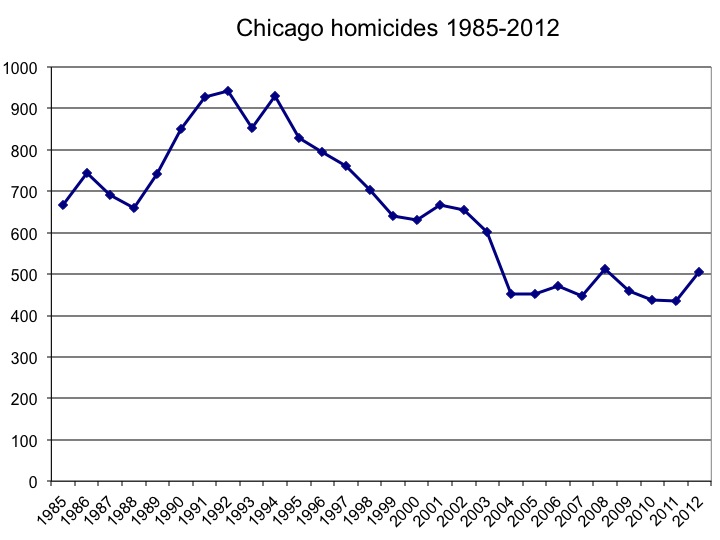
She’s talking about that small uptick at the end, which to the naked eye could well be statistical noise.
The reason I’m pointing out her bad statistics is that she needs them to set up the following, truly disturbing paragraphs (emphasis mine):
But while racism is rightly deemed unacceptable, computer programs pose more subtle questions. If a spreadsheet forecast has a racial imbalance, is this likely to reinforce existing human biases, or racial profiling? Or is a weather map of crime simply a neutral tool? To put it another way, does the benefit of using predictive policing outweigh any worries about political risk?
Personally, I think it does. After all, as the former CPD computer experts point out, the algorithms in themselves are neutral. “This program had absolutely nothing to do with race… but multi-variable equations,” argues Goldstein. Meanwhile, the potential benefits of predictive policing are profound.
No, Gillian Tett, there is no such thing as a neutral tool. No algorithm focused on human behavior is neutral. Anything which is trained on historical human behavior embeds and codifies historical and cultural practices. Specifically, this means that the fact that black Americans are nearly four times as likely as whites to be arrested on charges of marijuana possession even though the two groups use the drug at similar rates would be seen by such a model (or rather, by the people who deploy the model) as a fact of nature that is neutral and true. But it is in fact a direct consequence of systemic racism.
Put it another way: if we allowed a model to be used for college admissions in 1870, we’d still have 0.7% of women going to college. Thank goodness we didn’t have big data back then!
This is very scary to me, when even Gillian Tett, who famously predicted the financial crisis in 2006, can be fooled. We clearly have a lot of work to do.
Aunt Pythia’s advice: the sex edition
Holy crap it’s already been an eventful morning and it’s not even 10am. Aunt Pythia blew a bike tire on the George Washington Bridge and had to walk back across and find the 1 train near 181st street, which was hidden from view. Seriously, it was.
Now, if Aunt Pythia ever asked for advice herself, she would know to carry a spare tire and tools to change a flat. But does Aunt Pythia ever ask for or take advice? I think not. Shame on you, Aunt Pythia, shame on you.
In spite of that obvious flaw, Aunt Pythia is super excited to finally be warming up the advice bus engine. Vroom vroom! Put the pedal to the medal, Auntie P!
As it happens, all the questions are about sex today, and yes that was by design, things this awesomesauce don’t “just happen”. Aunt Pythia makes them happen, please keep this in mind.
After this most ridiculous and sexy ride, please don’t forget to:
please think of something to ask Aunt Pythia at the bottom of the page!
I am almost out of questions!!!
By the way, if you don’t know what the hell Aunt Pythia is talking about, go here for past advice columns and here for an explanation of the name Pythia.
——
Dearest Aunt Pythia,
I’ve been dating this guy for a couple of months, and we always have a lot of fun when we go out on dates together. We see each other at least once or twice a week, but we’ve only been intimate 4 times. Those 4 times have been great, and I don’t mind moving slowly, but a few nights ago something happened that made me question some things:
After a nice dinner-and-a-movie date, I invited him up for a drink (knowing it was a weekend and he would probably be sleeping over). We watched some Hulu, had a drink or two, and then both declared that we were tired and should move to the bedroom. I slipped into the bathroom to put on something a little more “comfortable” (read: I took my pants off), and when I came back into the room, he was in bed wearing boxers and a t-shirt. I got in bed with him, expecting things to heat up, but instead he FELL ASLEEP! That’s right: he had a smart, funny, beautiful and PANTS-LESS girl lying next to him in bed, and he made no attempts to initiate contact. He slept on one side, I slept on the other, with absolutely zero touching. When we woke up the next morning, he acted like his sweet old self and just said he “passed out” because he was “so tired.”
What’s the deal!? Was he really THAT tired? Is he gay? Is he homeless and needed a bed to crash on!? Or maybe worst of all: is he already so comfortable in this “relationship” that he no longer feels the need to be intimate every time we have a sleep over?
I like this guy a lot, but I also like when guys touch me a lot. Have you ever been through this? Any advice?
Lonely on the bathroom side of the bed
Dear Lonely,
First of all, it’s important to know if this is a one-time, “special occasion” thing or a regular occurrence. If, say, he had competed in a triathlon that day, for example, then it would actually make sense for him to be too tired. On that night.
On the other hand, if he does this regularly – and judging by the numbers you gave me, whereby he has seen you about 20 times but you guys have only gotten down 4 times, there does seem to be some regularity to his reluctance – I’m gonna have to conclude that yes, he’s gay.
Haha, no, just kidding. What it really means is that he’s less sexual than you are. Or that he’s not that into you, although since you are smart, funny, beautiful, and pants-less, it’s hard to really imagine that. There are just so many ways I start imagining that and then the imagining just doesn’t move in that direction at all. Nope, it doesn’t.
Here’s a fun theory, that I’ll just throw out there because “not as sexual as you” is so depressing and final: he’s really into kinky sex but hasn’t gotten the nerve up to tell you. Although, to tell you the truth, I’m not seeing evidence for that. Usually people really into kinky sex are agitated and nervous, and hoping you notice their leather bracelets and suchnot, and they typically don’t accidentally fall asleep. Poop.
So, here’s an idea. When you’re next with him and you want to get sexy, take off your shirt and start rubbing your boobs on him. See if that works. After all, why are you waiting for him to initiate? That’s old fashioned and silly. And that also answers the other question you asked near the end of your letter! Why wait passively when you can make it happen? So yeah, go ahead and make the first move, and see if that works.
And if it doesn’t, then you know with a clear conscience that you’ve given it a valiant effort, and he’s just Not Very Sexual. In which case I suggest you run straight for OK Cupid. Or Tinder. Or my slutty friends’ favorite, HowAboutWe.
Good luck!
Aunt Pythia
——
Dear Aunt Pythia,
I’ve recently encountered a few men who refuse to wear condoms. One actually said to me: “I’d rather never have sex again than have sex with a condom.” (Spoiler alert: I didn’t have sex with him). I’ve even had guys try to bully me into going bareback by saying things like “Come on, are we in high school?”
What’s the deal? Unless we are in a monogamous situation in which both parties have been tested AND I am regularly taking birth control (or we are ready to have children), there is no way we’re having condomless sex. Aunt Pythia, do you have any go-to sassy remarks I can whip out when confronted with this aversion to safe sex?
Not Obliging Boys Acting Bullyish In Ejaculating Situations
Dear NOBABIES,
HOLY CRAP I LOVE YOUR SIGN-OFF!!!! It’s perfect. I am ordering a plaque with that on it from zazzle.com.
I am also very in love with you for not taking that bullying crap. YOU ARE AWESOME.
And yes, I do have advice. Sex is not defined as vaginal intercourse. Tell him you guys can have sex without vaginal intercourse, and that it’s fine with you because it might even increase the probability of your overall enjoyment (read: more attention to your clitoris). And if he is super interested in vaginal intercourse, he will have to wear a condom. Because that’s how grownups who do not want to monogamous or have children have vaginal intercourse. But again, since there are lots of other ways to enjoy each others’ bodies, it’s all good.
Key phrase: “only middle schoolers define sex so narrowly as vaginal intercourse! Hahaha, can you IMAGINE!?!” Conversation over.
UPDATE: use condoms during oral sex as well to avoid oral HPV or gonorrhea!
Aunt Pythia
——
Aunt Pythia,
Thanks for all the love. I owe you many hugs. Share with me your take on an approach for the mid-life male discussing the warm-and-fuzzy male experience of age-related sexual dysfunction with a new female partner.
To maximize my affectionate partner’s satisfaction level, I’m fine with my future use of vitamin V (or Cialis or whatever’s been approved), but maybe the relationship honesty/trust thing is also served with a moment of “this stuff happens too.” My last girlfriend, a very loving, lovely, talented woman (also a clinical pharmacist) did not seem able to process the facts of male life-cycle physiology, instead framing the issue as “you’ve lost interest in me,” which cranked up the performance pressure.
Maybe that didn’t help the sex=fun equation & it definitely didn’t help the relationship. I think a plan to focus on showing more interest in multiple ways in the future is called for. But maybe it’s a good moment for some Auntie insight.
Mid-Life Laughs Every Minute
Dear Mid-Life Laughs,
First of all, here’s some more love and hugs.
Next, let’s talk about sex. Here’s the thing about Vitamin V: I’m so glad it exists. It’s another tool in the sex toolbox, sitting there right next to KY Jelly and the feather duster.

Every post needs at least one picture.
Is there a female version of Vitamin V? Not sure, and maybe I could go on a rant about that, but not today. Instead, I want to spend today appreciating just how much fun we can all have if we are understanding and forgiving and loving and sexy.
I think the new lady will – or should – understand the difference between the will and the reality of such things, especially if your words are consistently positive regarding the former, and especially if you go ahead and prepare yourself with a complete toolbox, including the above pictured feather duster. In other words, make it about her pleasure. Who can resist that? Answer: nobody.
Good luck!
Auntie P
——
Hi lovely Auntie P,
This is really good, so I thought I’d share.
Someone recently shared with me their list of “books that changed my life”. The first one I’m reading is called “Passionate Marriage” and has indeed the potential to be life-changing. It is a synthesis of sex therapy and marital counseling supposed to help one enhance their sex life. That sounds theoretical but I suggest you pick it up if you haven’t already.
Since I’m actually supposed to ask a question and cannot merely plug my latest page-turner, here are two, totally unrelated.
- Does Auntie P have a list of books that changed her life and can she, in her transfinite wisdom, share that list with her readers?
- What would you say constitutes “great sex”?
By the way, I loved your bit about everyone having crushes on one another. The world is such a beautiful place. You’re doing your part. I love you for that.
Getting Reads On Wishlist
Dear GROW,
I love you too! And thanks for the book suggestion, I will definitely check that out. After all, who doesn’t want an enhanced sex life? Answer: nobody.
As for the questions, let me think about it after I look up the word “transfinite”…
OK I’m back, and still somewhat confused, but I’ll let it pass.
- Here’s the thing, I can’t remember any book I’ve ever read. For some reason I have an excellent memory for ideas but not people, and remembering where I first heard an idea is nearly impossible for me. I know that’s crazy but it’s true. If I had to say which book affected me the most, I’d have to say The Brothers Karamazov, when I was 15, but I only remember how much I loved the book, not anything about the actual content. Well, I do remember the brothers names and their general characters, but not much more. In general, though, I like books that make me think differently and challenge my assumptions. And I don’t like books with scenes in which people are mean to children.
- This one is easy. Great sex is when both people feel great about it. It is characterized by generosity, empathy, and fun. Not so different, really, from a great dinner or a great bike ride with someone.
Hey, readers, what are your answers to these questions?
Warmly,
Aunt Pythia
——
Please submit your well-specified, fun-loving, cleverly-abbreviated question to Aunt Pythia!
Jeff Larson kills it at the Lede Program
So, Jeff Larson from ProPublica came yesterday to talk to us at the Lede Program, and damn that guy is awesome.
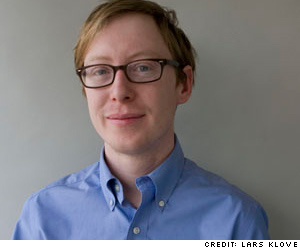
Jeff Larson, my data journalism hero!
First, he showed us his work with the ProPublica Message Machine, where they first crowdsourced, then reverse engineered Obama’s political targeting algorithm. Turns out they used decision trees for that, so we got to talk about decision trees. But since it was an awesome project important to democracy, we also got to talk about democracy.
After that lengthy discussion, Jeff told us about using clustering algorithms to find interesting emails in foreign languages (and in particular, to sort out the spam). He mentioned both cosine similarity and k-means, which was cool because the Lede students already knew about those, and for a moment the class was like, “hey we can do this!” and it was true.
But just then, he showed us how to bypass captcha pages, at least 90% of the time, using neural networks. He seemed to somehow remain humble whilst explaining that he did this over a lunch break. Then the class was like, “holy shit this guy is a crazy genius!” and that was true too.
Then Jeff led the entire program downtown to the ProPublica offices and gave us a tour of the office, and some of the other data journalists came in and told us what they were up to, which was super awesome but also top secret so I can’t tell you anything else about it. Suffice it to say they were all very awesome and that only one of them had formal CS training (Jeff was a lit major!), so the day was overall very inspiring and thought provoking.
The next time I’m a criminal
Next time I’m tried for a criminal act, I think I’d like to be tried as a big bank.
Then I can pay a smallish fine for my misdeeds – pocket change for me, a cost of doing business really – and be assured that none of my business partners will stop hanging out with me or stop doing business with me, and in fact all punishments will likely be waived.
In any case, I’d prefer not to be tried as a poor person, where I’d likely be charged money I don’t have for my free lawyer, for any time I spend in jail, and possibly extra for a full jury. And if I didn’t have the money I’d have to spend extra time in jail, until I came up with the money I don’t have.
And since all people are equal under the law, even corporations, it shouldn’t matter who I choose to be, so I choose to be a big bank.
The sun goes around the earth
Periodically you have people conducting surveys to prove how dumb people are. Questions are of the form: Is Germany in Africa? Is the earth less than 1000 years old?
I hate these surveys, and I’m usually able to ignore these obnoxious and unscientific nature of them, except when they also ask the following question: Does the sun go around the earth?
Here’s my reproduction of the imaginary conversation if I encounter such a pollster:
Pollster: Does the sun go around the earth?
Me: It depends on your frame of reference, but yes, if I’m standing on the earth, and I look up in the sky, I will observe the sun going around the earth in a wobbly path, although before I let you go I need to make the point that it would be quite a bit simpler to understand the model of the solar system whereby the earth and other planets revolve around the sun and spin while they do so.
Pollster: Yes or no question, ma’am, what’s it gonna be?
Me: Yes, I guess.
Pollster: You are so ignorant!
Big Papi is my boyfriend
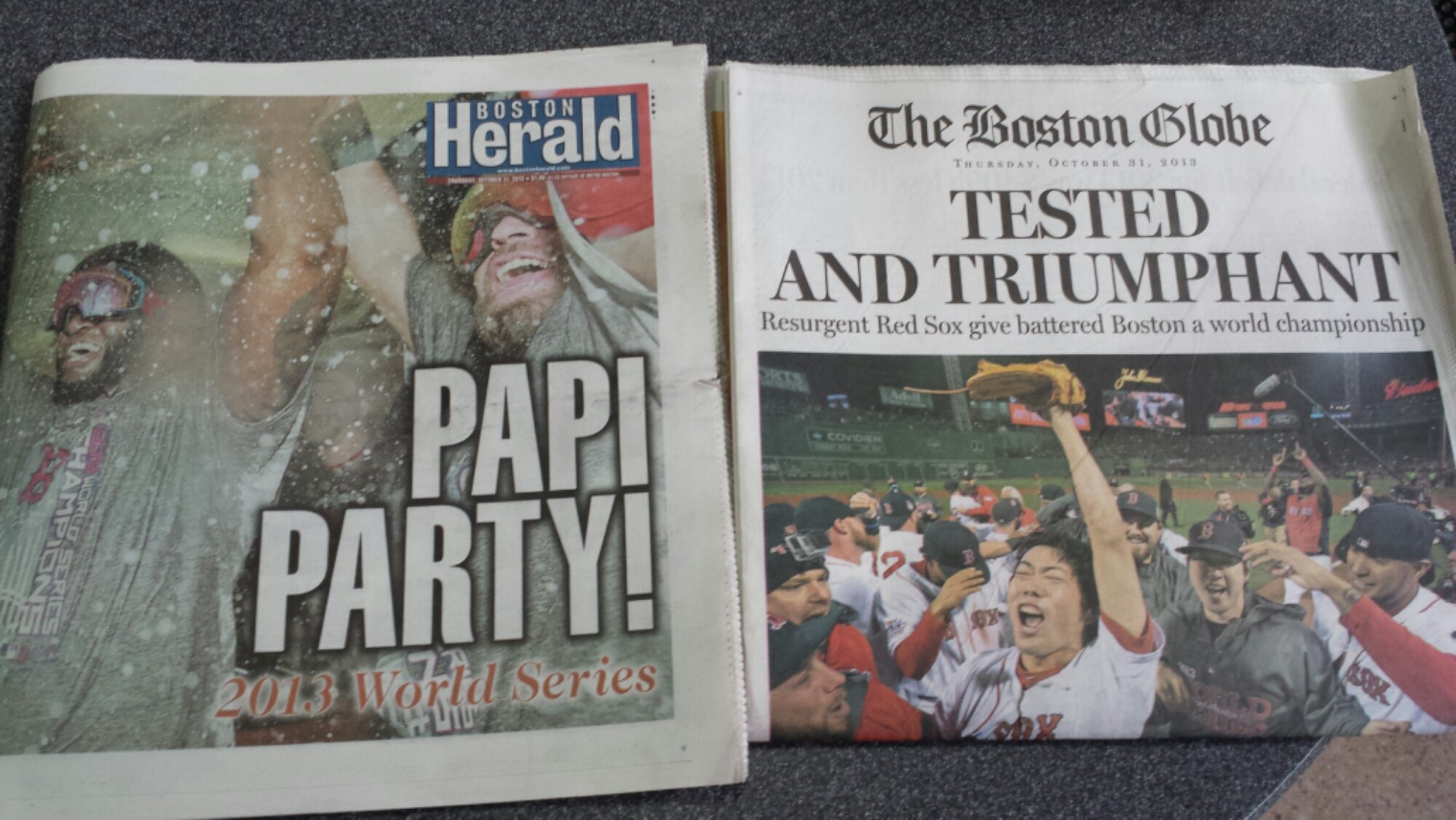
Kind of awesome to be in Boston today.
Occupy Wonder!
Now that summer is here, it’s time to unschool ourselves.
At the beginning of every school year, I ask my students to consider the question, “What is the purpose of education?” Most students understand from experience that schooling is at least in part an exercise in obedience to authority, in conformity to expectations, in bureaucracy, in knowing your place in the social and academic hierarchy. As one astute 14-year-old put it bluntly, “We’re here to be ranked and sorted.”
I shudder at the thought that my role as a teacher is to sort the winners from the losers. Like most educators, I’m aiming for a loftier mission: to unleash the curiosity and capacity for wonder that are inborn in each of us. Ironically, that mission might be best accomplished in the summer time, in the context of leisure, when the mind is at rest and at play, free from the strictures and dictates of institutional schooling.
At the end of every school year, I ask my students, “What will you think about when you are not being told what to think about? Are you prepared to trade the comforts of intellectual obedience for the risks of intellectual independence? How will you pursue your curiosities? What sets you on fire intellectually, and how will you fan those flames? What will you write feverishly in your Book of Questions?” These are the same questions we must ask ourselves as educators, as people modeling intellectual engagement, as propagandists for the Life of the Mind.
What ignites my curiosity, reliably, is insects. I just got my hands on a compound stereoscope and some live stick insects and I have the whole summer ahead of me.
What ignites your curiosity?

A girl considers insects under a microscope at the new Gallery of Natural Sciences at the Oakland Museum of California. Photo by Becky Jaffe
“The cure for boredom is curiosity. There is no cure for curiosity.” – Dorothy Parker


 mathbabe