Archive
Aunt Pythia’s advice
It’s happily time for another installment of Aunt Pythia’s advice; if you don’t know what you’re in for, go here for past advice columns and here for an explanation of the name Pythia.
And most importantly, please submit your question at the bottom of this column, I need more questions!
I forgot to give the readers something to do last time, so let’s start out fresh.
——
Dear Auntie P,
Is it possible to convince others about how excited you are in a subject in which you have little trainng, and make them give you a chance to work in this field? I’m a recent post-doc in pure mathematics trying to be a population scientist.
Hard Dreamer
Dear HD,
Credentialing is a tough thing in general, but in my experience a math Ph.D. is pretty useful in most situations. In industry it will get you an interview, especially if you also have some relevant skills like computer programming. Once you are in the interview, of course, you have to turn on the charm and communication and generally behave like a human being that people can relate to.
The exception might be other academic fields. There’s a feedback loop in academics, whereby people have a very precise idea of what makes a good researcher in their field, and they just kind of ignore people without those credentials. Since you really can’t do good research whilst being ignored (or at least it’s really hard), it’s a self-fulfilling blindspot, and the ignored people really do end up not doing very well, which reinforces the notion that one should ignore them.
One reason I think this happens less in industry is that there, people are used to the fact that they have to work in teams of people with various skills, so they know that someone who’s a proven quantitative problem solver will be useful. On the other hand, the problems they solve are typically less involved and theory-based, so it’s easier to train a smart person to be helpful. So really that’s two reasons.
My advice to you, or anyone else who wants to switch from math to a different academic research discipline, is to find someone deep in that field and ask them what the credentialing in their field looks like, and how to rebrand yourself as something closer to their ideal. Maybe you can collaborate with them on a paper, to show you are capable of bridging the communication divide.
Good luck!
Aunt Pythia
——
Aunt Pythia,
Can I remain in academia despite the crazy status-conscious, petty and grandiose nature of it?
Out on the Island
Dear OOTI,
You never get rid of your problems, you only get a new set of problems. Look into your options and their accompanying problems and decide what to do in that light. Keep in mind, academia is at least not unethical (usually).
Aunt Pythia
——
Aunt Pythia,
My friend has a new friend who is pretentious and snobby and hard to be around. Now these qualities are wearing off on my friend, one of the sweetest naturally people I know. Is there a way to make her see this?
Concerned Friend
Dear Concerned Friend,
Easy peazy lemon squeezy. Next time you are alone with your friend, complain about her friend the snob for being a snob – make sure not to mix it in with other complaints or she will just think you’re mean or jealous. So, say something like, “I generally really enjoy Martha’s company but it really embarrassed me how she treated the waiter the other day, what an elitist snob!”
It’s the oldest back-stabbing trick in the book, and it will make her aware of the snobbery, which she probably doesn’t see, and it will also make her aware that you don’t like that kind of behavior, so she will be conscious of her snobby ways near you. Problem solved!
If you are conflict-avoidant, or just think the above suggestion is rude (same diff), then you could first try making a general complaint about snobby people, and give an example very similar to something your friend’s friend did recently in her and your presence (“Don’t you hate it when people yell at flight attendants?”). But if that’s not sufficient, move on to the above.
Tell me what happens!
Aunt Pythia
——
Yo,
When I’m in polite company I sometimes feel the need to scratch my balls. How can I do so without attracting notice?
Somewhere in the world
Yoyo,
Isn’t that what pockets are for? Jeez.
AP
——
Dearest Aunt Pythia,
What’s the most important? Length, width, magic of the performer? Doesn’t matter above/below a certain threshhold?
Just wanna read you write about sex
Dear JWRYWAS,
Glad you asked. There’s been a quantitative study on the matter which I’ve been dying to share. The key visual:

Hope that helps!
Aunt Pythia
p.s. I’ll keep an eye out for a quantitative study comparing “penis” with “magic” to finish answering your question.
——
Dear Aunt Pythia,
What are the effect of alcohol on your state of mind?
Boy from Delphi
Dear Boy,
Alcohol merely allows me to say what I really want to say, as if I don’t already.
Aunt Pythia
——
Here’s a question for you. It’s rather vague but I think you guys will have something important (or funny, or pithy) to suggest:
Dear Aunt Pythia,
I was one of those kids who when asked “What do you want to be when you grow up?” said “Errrghm …” or maybe just ignored the question. Today I am still that confused toddler. I have changed fields a few times (going through a major makeover right now), never knew what I want to dive into, found too many things too interesting. I worry that half a life from now, I will have done lots and nothing. I crave having a passion, one goal – something to keep trying to get better at. What advice do you have for the likes of me?
Forever Yawning or Wandering Globetrotter
——
Please submit questions, thanks!
Aunt Pythia’s advice
After a short vacation Aunt Pythia is back to give out free advice that’s worth every penny. Go here for past advice columns and here for an explanation of the name Pythia. Please submit your question at the bottom of this column (pretty please!).
Let’s first go over last time’s question for the readers:
Aunt Pythia,
Why do some foods burn when you stir them? It doesn’t make sense that my rice or pasta should burn when there is still a lot of water in the pot just because I stirred it.
Physics-Inclined Wannabe Chef
The answer to the Chef were interesting and thoughtful, although I’m not sure anyone actually whipped out the pots and ran experiments (including me!).
Leila says it’s not because you stirred it, and moreover the lesson learned is to stir more often, but JSK disagrees and thinks you can burn your rice by stirring. From JSK’s comment:
…the remaining water settles to the bottom of the pan, gradually boiling away and preventing burning at the bottom. If you stir, you distribute the water throughout the “sponge” of cooled rice above. The bottom layer of rice then burns if the heat is hot enough and the water can’t percolate back down in time to prevent the burning.
I’m gonna have to say the jury’s out. We got direct disagreement. Anyone want to produce a Mythbusters-style rice cooking show?
——
Dear Aunt Pythia,
I’m going on the academic job market for the first time. I’ve heard a lot of advice, but I’d really like Aunt Pythia’s advice: what three adjectives should I try to embody during my Joint Math Meeting (JMM) interviews?
Nervous in Nebraska
Dear Nervous,
These are going to sound pretty typical but here goes: try to appear confident, interested, and likable.
To explain why I chose those three adjectives, keep in mind that interviewing for a job is a lot like dating. You need to figure out if you like your date while, at the same time, convince your date to like you. Those are two tasks and they are both up to you, they’re your responsibility, and it’s not enough to just do one of them.
So, although you’re nervous, you need to give off “I am not depending on this to work out because I have other interviews” vibes, because first of all it’s the truth, and second of all you need to make sure your interviewer feels obligated to sell the job to you. Otherwise the entire process is all about whether you’re good enough, which is imbalanced. It should be more a discussion of whether it’s a good fit overall. Watch this video to see how that negotiation can look if it’s an incredibly funny, inappropriate, and drunk interview.
At the same time, you need to seem interested. You can’t be indifferent to the job, because that’s the kiss of death from the perspective of an interviewer. Why would I offer a job to this jerk who doesn’t even seem to want it?
Finally, keep in mind that the real question on the interviewer’s mind is whether they’d actually want to be your colleague. You need to seem like someone who would fit in to the department, both mathematically and socially. Now’s not the time to mention weird hobbies, but it is the time to mention caring about how real analysis gets taught (although don’t be too radical). You want to give the impression that you’re fun, professional, and thoughtful about being a math nerd.
I hope that helps! See you in San Diego!
Aunt Pythia
——
Aunt Pythia,
Do you think stricter gun control laws would really prevent mass shootings?
Only in Oakland
Dear OiO,
Why, yes, I do, and even more importantly I think they’d massively cut down on all shootings. Mass shootings get lots of attention but let’s fact it, they are statistical anomalies compared to the very predictable country-wide individual shootings that we see every day. The overall death toll by shooting in countries is highly correlated to the gun ownership rate:
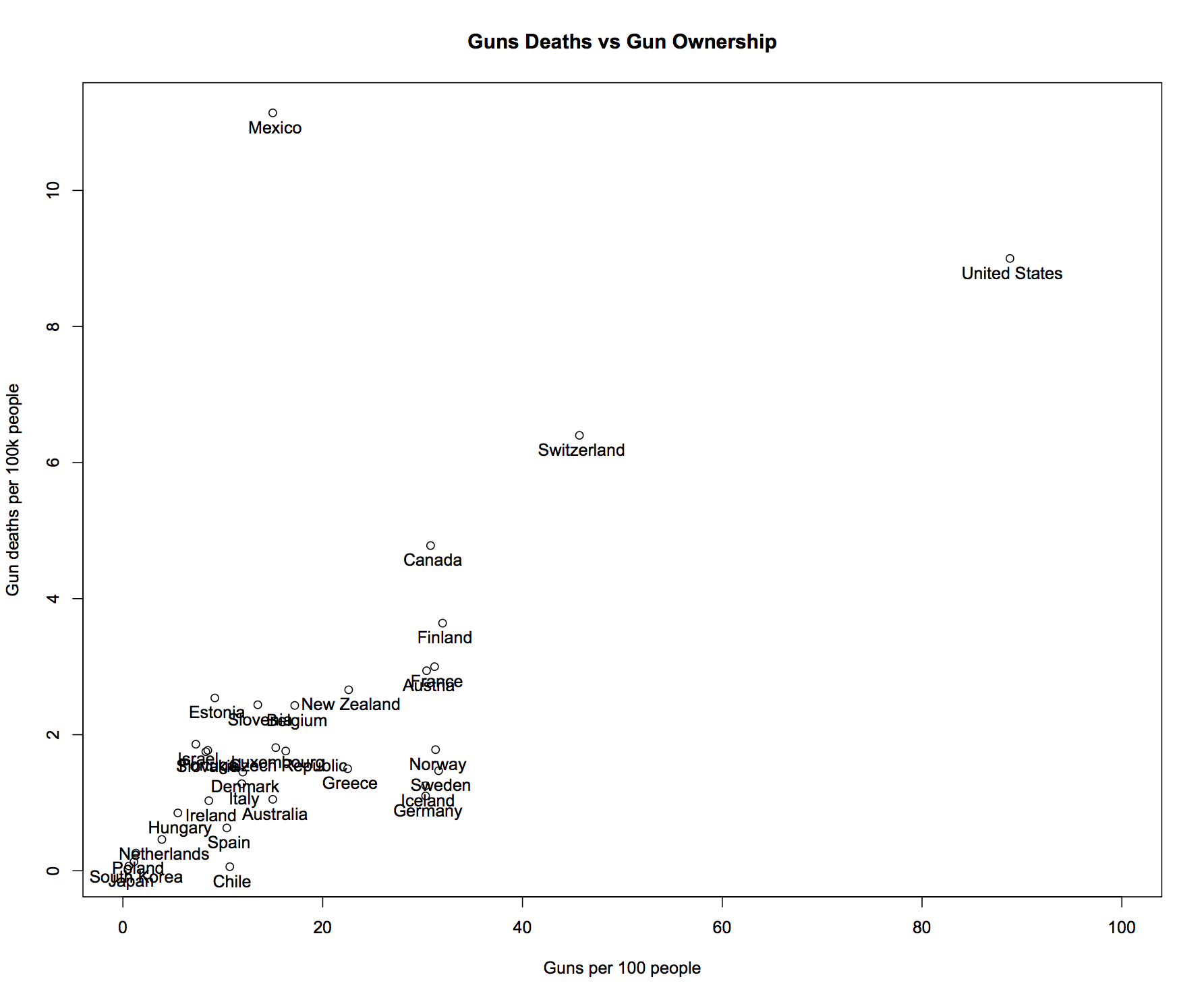
For me, that is super convincing. However, I’m pretty sure we will need a bit more than true facts to deal effectively with what has become a religion in this country. I’d love advice on strategies to this effect.
Love,
Aunt Pythia
——
Aunt Pythia,
Do you have any advice about how to tell your boss that you’re pregnant if you didn’t start the job very long before you got pregnant?
Shy pregnant woman
Dear Shy,
One of the great things about being pregnant is that it announces itself. My advice it to say nothing unless it just spontaneously feels right to do so. Just please don’t feel guilty or awkward towards your employer about being pregnant – it’s normal, natural, and protected by the law.
And please write back with questions about babies when the time comes!
Auntie Pythia
——
Finally, a question for the readers – I’m interested in what you’ll say:
Aunt Pythia,
If an editor of an Elsevier journal asks you to referee a paper, wouldn’t it be the norm to decline the request instead of leaving it unanswered, or does Gowers’s revolution includes that anyone who has not joined for one reason or another should be shunned and considered a pariah?
Trapped Editor
Please submit your questions here! I’m getting wonderful, high quality questions, but not enough of them, and I’m almost out. Please save Aunt Pythia by asking her something super ridiculous!
Aunt Pythia’s advice
Aunt Pythia has two wee bits of bad news.
First, nobody helped out NYC and Wondering from last week looking to get educated via internships past college age. Maybe if the question were worded differently it would have gotten more responses.
In the meantime, NYC and Wondering, I’d suggest you look into MOOCs on Coursera, Udacity, and the like. There are Meetup groups you can join once you’re in a course like this one.
Second, Aunt Pythia has been informed that some people are getting error messages when they try to submit questions. That’s no good! If that’s happening to you, please comment below using the phrase, “question for Aunt Pythia” and it will automatically go into my mailbox instead of getting posted.
On to this week’s questions:
——
Dear Aunt Pythia,
I am suffering from severe Facebook phobia. Is the entire phenomenon as repulsive as I think it is?
Curmudgeon Lee Luddite
Dear Curmudgeon LL,
Here’s the thing. I am totally grossed out by Facebook on so many levels. As a concerned data scientist, the shit they pull with respect to personal information, letting other people post private information about you, and selling your data makes me really uneasy. Read this recent article about the Facebook Doctrine (“What’s good for Facebook is good for you”) if you want to hear more. Mind you, that Doctrine seems to be pretty clear-cut if you modify it just a bit: “What’s good for Facebook is good for the stock price of Facebook”: the market loves the trend of information selling because it’s magnificently profitable.
Another thing that pisses me off, which I learned about in the student presentations last week at the Columbia Data Science class I was blogging: people are posting various legalese-sounding letters to Facebook on their timeline which tells Facebook to keep their hands off their personal data. Guess what, kids, it’s too late, you signed away your rights when you entered, and such crap only serves as yet another illusion of control (along with the Facebook privacy settings).
Having said all that, I use Facebook myself – but of course I never post anything remotely private on it. But for that matter I also use Google+, and I’m ready and willing to use another platform when one comes along that’s less creepy.
Curmudgeon, to answer your question, yes it’s just as repulsive as you think. I fully defend your disgust, and if anyone questions it just send that person to me, I’ll set them straight.
Best,
Aunt Pythia
——
Dear Aunt Pythia,
Should I go to the Joint Math Meetings if I’m thinking of leaving academia realllly soon?
Katydid
Dear Katydid,
It depends. Is it tough for you to go? Would you miss job opportunities by doing so? I’m assuming you are planning to leave academia but you haven’t actually gotten another job.
If the answer is that it’s relatively easy to go and that you don’t have any other plans that weekend, then by all means you should go. And you should make a plan beforehand on what information you can gather about jobs that math people do.
For example, make sure you have a good idea of what kind of jobs in academia there really are, by interviewing a bunch of people about what they do on a daily basis. But keep in mind that most of them will be drunk because it’s the Joint Math Meetings and that’s kind of the point. And also keep in mind you’re hearing much more about academia than about industry since you’re at this meeting.
But that doesn’t mean you’ll be stuck only hearing about academia! Because I’ll be there, talking about the world outside academic math, and so will a few other people. I am particularly psyched that I’ll be speaking on the first day so I can meet people after my talk and hang out with them for the next few days, getting drunk and playing bridge. It’s very serious business, of course.
See you soon I hope!
Aunt Pythia
——
Dear Aunt Pythia,
Is health insurance a sound financial investment?
Uninsured
Dear Uninsured,
Great question. It’s not really an investment, and it’s only a good idea once in a while; the problem is knowing in advance when it’s a good idea.
I say it’s not an investment because usually with an investment you can expect to make money, whereas insurance is never like that. Once you pay insurance premiums that money is gone.
Insurance can, however, be seen as a financial bet: you’re betting that losing a predictable and smallish amount of money is less painful than the overall risk of losing an unpredictable and large amount of money if you get horribly sick and need major treatment.
There are plenty of problems with this explanation though, including:
- it’s not so smallish if you don’t have work or if you have crappy work through a place like Walmart,
- you personally might be very healthy and the risk of getting super sick might not be high, say if you’re 24 and fit; this means that your money may be better spent buying high quality food than paying for health insurance, and
- the large amount of money you may get billed with if you do end up horribly sick can be discharged through bankruptcy, and in fact most of the bankruptcy proceedings happen because of medical debt of uninsured people. Keep in mind you will lose your house (if you have one) if you go this route, so only consider it if you’re willing to take that risk.
In the end it depends on your situation whether it’s worth it to buy health insurance.
I hope that helps!
Aunt Pythia
——
Aunt Pythia,
Why do some foods burn when you stir them? It doesn’t make sense that my rice or pasta should burn when there is still a lot of water in the pot just because I stirred it.
Physics-Inclined Wannabe Chef
This is a great question! Is it even true? Does it also happen with orzo? People, get out your pots and do some mythbuster-type experiments! And then comment below with your ideas and results.
I’m counting on you nerdy folks to get to the bottom of this, so to speak.
——
In the meantime, if you have a moral, personal, or emotional dilemma or somesuch, please share avec moi below on my gorgeous new form:
Aunt Pythia’s advice
Last week I asked you guys to answer this question for me:
Dear Aunt Pythia,
How should I organize my bookshelf? I have 1000+ books.
Booknerd
As usual, you guys impressed me with your various uber-nerdy answers, some by email. Here are some excellent book-organizing suggestions:
- By color
- By publisher
- Via the tool librarything.com
- By your personal history reading the book – how old were you? This might be hard for me and Little House on the Prairie, which I read numerous times as a kid, then in Dutch to learn the language when I got married to a Dutch man, and now again because I just want to
- My personal favorite:
Sort books by copyright date of first editions. This would give an insight into the development of ideas. One problem with this is that it would make locating a book more difficult so an electronic index would be a valuable supplement. My initial thought was to do this only within categories, but as I think of it, it would be interesting to see fiction interspersed with history, philosophy or science.
——
Dear Aunt Pythia,
My kid went to California last year to study number theory, computer science and physics at a highly regarded university. After getting his dream summer job with a fast growing startup known for hiring only the brightest and spoiling them with great food, good money and lots of benefits he’s starting to adopt some of the libertarian founders viewpoints on life. For next summer, he’s interviewing with some hedge funds known to recruit and “develop” talented math kids. It is looking like he’s going to the Dark Side. What can be done to turn this around and avoid the pain Mathbabe’s father must have gone through?
Failed Parent
Dear Failed Parent,
First of all, my dad was disappointed when I went into math instead of economics, psyched when I left academics for a hedge fund, and disappointed when I quit finance. So much for role modeling.
Second of all, I find your story consistent with my experience of super smart people finding it shockingly fun to be super smart and developing a viewpoint which allows them (or even encourages them) to take advantage of less smart people because they can and because it’s legal, independent of whether it’s moral.
There’s this whole machine, of which hedge funds are a large part, and some math and science camps too, which feed into this rhetoric and profit from it. I call it the fetishization of intelligence. People get so in love with their talent they think it transcends them above mere morality.
So the story isn’t good, and your son is another cog in the intelligence-as-fetish machine. And moreover, you’re not going to be able to talk him out of it, not now when most of the world is telling him he’s kind of an outsider and weak and unattractive (if he’s like most young men this is how they feel they’re treated, even if they aren’t actually unattractive or weak or outsiderish) whereas there’s this tiny contingent telling him he has super powers. Why would he listen to you?
My advice: wait it out. He’ll probably at some point realize he could be getting more out of life if he had stuff he’d done that he could be proud of. Then it’s time for you to have a list of things he might want to do that don’t involve taking advantage of “dumb money” and do involve applying his brains to discovery and solving important problems. Or at least have a pen and paper ready to help him make such a list.
One more piece of advice: if he claims that what he does is morally neutral because if he didn’t do it someone else would, please don’t pass up that opportunity to point out all the evil that has been done by otherwise decent people with that very line. I can’t tell you how many times I hear that. I refuse to help people feel comfortable with their uncomfortable choices.
Good luck, and please get back to me in 10 years to tell me how things are.
Aunt Pythia
——
Dear Aunt Pythia,
I’m a PhD candidate in Math and I’m going to get into quantitative finance. I’m wondering how hard it is these days for a quant to maintain his integrity without undermining success? Any tips in doing so? Have you seen many happy yet righteous quant?
Fish in the Forest
Dear FitF,
After having a few jobs outside academia, I’m pretty sure that you get paid extra in finance partly because you’re smart and the skills you have are rare, but partly because you’re doing something pretty iffy on the righteous scale.
I’m not saying that there are no righteous quants, but I’m saying that if everyone had a righteous score and a salary score, then there would be a negative correlation between those two lists.
So I’m on the job market, and I am not totally against working in finance, because there are all kinds of jobs, but the ones I’m interested in are doing things like making accounting reports machine-readable and consistently formatted, to promote transparency. This doesn’t pay the big bucks as you might imagine.
Here are some snarky tips for you to continue to feel righteous if you work in finance:
- Figure out what the information is that you know but other people don’t. See if that matters to you. Example: insider trading, does it make you feel dirty? Maybe not, in which case you’re good.
- Start reading Ayn Rand and develop a sense that you are entitled to be rich because you’re so smart, and that anyone who doesn’t agree must be super dumb (see previous post for how to go about this, although you may be too old to go to summer camps).
- Do you mind lying? How about omitting the truth? How about pretending to regulators that you have a firm grasp on the underlying risk of a instrument class because there’s a magical mathematical formula someone with a Ph.D. came up with who can’t explain it to anyone? Good?
Good luck, and tell me how it goes!
Aunt Pythia
——
Readers, it’s time for you to answer a question! This one is particularly outside my realm, but I have faith in you good people to help:
Aunt Pythia,
I’ve been finding it really hard as an adult who has stepped out of the higher education track because of a lack of funding to find resources for adults in the same vein as what i found as a young adult. Are there any resources out there that you would recommend for a minority woman aged 29+ looking for training opportunities that are more experiential than internship based?
NYC and Wondering
——
Please ask Aunt Pythia a question! She loves her job and can’t wait to give you unreasonable, useless, and possibly damaging counsel!
Aunt Pythia’s advice
Aunt Pythia is overwhelmed with joy today, readers, and not only because she gets to refer to herself in the third person.
The number and quality of math book suggestions from last week have impressed Auntie dearly, and with the permission of mathbabe, which wasn’t hard to get, she established a new page with the list of books, just in time for the holiday season. I welcome more suggestions as well as reviews.
On to some questions. As usual, I’ll have the question submission form at the end. Please put your questions to Aunt Pythia, that’s what she’s here for!
——
Dear Aunt Pythia,
I was one of those kids who when asked “What do you want to be when you grow up?” said “Errrghm …” or maybe just ignored the question. Today I am still that confused toddler. I have changed fields a few times (going through a major makeover right now), never knew what I want to dive into, found too many things too interesting. I worry that half a life from now, I will have done lots and nothing. I crave having a passion, one goal – something to keep trying to get better at. What advice do you have for the likes of me?
Forever Yawning or Wandering Globetrotter
Dear FYoWG,
I can relate. I am constantly yearning to have enough time to master all sorts of skills that I just know would make me feel fulfilled and satisfied, only to turn around and discover yet more things I’d love to devote myself to. What ever happened to me learning to flatpick the guitar? Why haven’t I become a production Scala programmer?
It’s enough to get you down, all these unrealized hopes and visions. But don’t let it! Remember that the people who only ever want one thing in life are generally pretty bored and pretty boring. And also remember that it’s better to find too many things too interesting than it is to find nothing interesting.
And also, I advise you to look back on the stuff you have gotten done, and first of all give yourself credit for those things, and second of all think about what made them succeed: probably something like the fact that you did it gradually but consistently, you genuinely liked doing it and learning from it, and you had the resources and environment for it to work.
Next time you want to take on a new project, ask yourself if all of those elements are there, and then ask yourself what you’d be dropping if you took it on. You don’t have to have definitive answers to these questions, but even having some idea will help you decide how realistic it is, and will also make you feel more like it’s a decision rather than just another thing you won’t feel successful at.
Good luck!
Aunt Pythia
——
Dear Aunt Pythia,
My boss lacks leadership qualities and is untrustworthy, and I will resign soon. Should I tell his boss what I think of this boss?
Novembertwentyeleven
Dear November,
In Aunt Pythia’s humble opinion, one of the great joys of life is the exit interview. Why go out with a whimper when you have the opportunity to go out with a big-ass ball of flame?
Let’s face it, it’s a blast to vent honestly and thoroughly on your way out the door, and moreover it’s expected. Why else would you be leaving? Because of some goddamn idiot, that’s why! Why not say who?
You’ll hear people say not to “burn bridges”. That’s boooooooring. I say, burn those motherfuckers to the ground!
Especially when you’re talking about people with whom you’d never ever work again, ever ever. Sometimes you just know it’ll never happen. And it feels great, trust me. I’m a pro.
That said, don’t expect anyone to listen to you, cuz that aint gonna happen. Nobody listens to people when they leave. Sadly, most people also don’t listen to people when they stay, either, so you’re shit out of luck in any case. But as long as you know that you’re good.
I hope that helped!
Aunt Pythia
——
Dear Aunt Pythia,
How should I organize my bookshelf? I have 1000+ books.
Booknerd
Readers! I want some suggestions, and please make them nerdy and/or funny! I know I can count on you.
——
Please ask Aunt Pythia a question! She loves her job and can’t wait to give you unreasonable, useless, and possibly damaging counsel!
Aunt Pythia’s advice and a request for cool math books
First, my answer to last week’s question which you guys also answered:
Aunt Pythia,
My loving, wonderful, caring boyfriend slurps his food. Not just soup — everything (even cereal!). Should I just deal with it, or say something? I think if I comment on it he’ll be offended, but I find it distracting during our meals together.
Food (Consumption) Critic
——
You guys did well with answering the question, and I’d like to nominate the following for “most likely to actually make the problem go away”, from Richard:
I’d go with blunt but not particularly bothered – halfway through his next bowl of cereal, exclaim “Wow, you really slurp your food, don’t you?! I never noticed that before.”
But then again, who says we want this problem to go away? My firm belief is that every relationship needs to have an unimportant thing that bugs the participants. Sometimes it’s how high the toaster is set, sometimes it’s how the other person stacks the dishes in the dishwasher, but there’s always that thing. And it’s okay: if we didn’t have the thing we’d invent it. In fact having the thing prevents all sorts of other things from becoming incredible upsetting. My theory anyway.
So my advice to Food Consumption Critic is: don’t do anything! Cherish the slurping! Enjoy something this banal and inconsequential being your worst criticism of this lovely man.
Unless you’re like Liz, also a commenter from last week, who left her husband because of the way he breathed. If it’s driving you that nuts, you might want to go with Richard’s advice.
——
Aunt Pythia,
Dear Aunt Pythia, I want to write to an advice column, but I don’t know whether or not to trust the advice I will receive. What do you recommend?
Perplexed in SoPo
Dear PiSP,
I hear you, and you’re right to worry. Most people only ask things they kind of know the answer to, or to get validation that they’re not a total jerk, or to get permission to do something that’s kind of naughty. If the advice columnist tells them something they disagree with, they ignore it entirely anyway. It’s a total waste of time if you think about it.
However, if your question is super entertaining and kind of sexy, then I suggest you write in ASAP. That’s the very kind of question that columnists know how to answer in deep, meaningful and surprising ways.
Yours,
AP
——
Aunt Pythia,
With global warming and hot summers do you think it’s too early to bring the toga back in style?
John Doe
Dear John,
It’s never to early to wear sheets. Think about it: you get to wear the very same thing you sleep in. It’s like you’re a walking bed.
Auntie
——
Aunt Pythia,
Is it unethical not to tell my dad I’m starting a business? I doubt he’d approve and I’m inclined to wait until it’s successful to tell him about it.
Angsty New Yorker
Dear ANY,
Wait, what kind of business is this? Are we talking hedge fund or sex toy shop?
In either case, I don’t think you need to tell your parents anything about your life if you are older than 18 and don’t want to, it’s a rule of american families. Judging by my kids, this rule actually starts when they’re 11.
Of course it depends on your relationship with your father how easy that will be and what you’d miss out on by being honest, but the fear of his disapproval is, to me, a bad sign: you’re gonna have to be tough as nails to be a business owner, so get started by telling, not asking, your dad. Be prepared for him to object, and if he does, tell him he’ll get used to it with time.
Aunt Pythia
——
Aunt Pythia,
I’m a philosophy grad school dropout turned programmer who hasn’t done math since high school. But I want to learn, partly for professional reasons but mainly out of curiosity. I recently bought *Proofs From the Book* but found that I lacked the requisite mathematical maturity to work through much of it. Where should I start? What should I read? (p.s. Thanks for the entertaining blog!)
Confused in Brooklyn
Readers, this question is for you! I don’t know of too many good basic math books, so Confused in Brooklyn is counting on you. There have actually been lots of people asking similar questions, so you’d be helping them too. If I get enough good suggestions I’ll create a separate reading list for cool math page on mathbabe. Thanks in advance for your suggestions!
——
Please take a moment to ask me a question:
Aunt Pythia’s advice
Readers, one great thing about not collecting your email addresses when I collect your questions is that I can’t contact you to edit your questions down to reasonable size, so I just go ahead and do it myself. I hope you don’t mind.
Also, new this week: Aunt Pythia lets you answer a question! See below.
Finally, if you want to ask Aunt Pythia a question (please do, and thanks!), please find the form at the bottom.
—–
Dear Aunt Pythia,
Do you think that it makes sense that people in leadership position whose extramarital affair becomes uncovered should resign?
Alpha Liberal
Dear Alpha Liberal,
Here’s what I think. In thirty years, if we haven’t seen a politician naked, people will exclaim,
“Hey, What are you hiding? Where’s the dic pic??“
I know that’s not answering your question, but I think it’s gonna happen, and I wanted to mention it.
Going back to your question: I don’t think simply having an affair should be held against somebody. Sleeping around is far too common, possibly universally pervasive among successful, powerful people; it’s like firing someone for admitting they sometimes let the elevator close when they see someone coming. Everyone does it sometimes, it’s a way of letting out our urban aggression.
But possibly even that is not a great analogy, because it implies an ethically questionable act. For all we know, the politician (or anyone, really) has an open marriage and is just plain not being shady at all.
Having said that, we do need to be able to trust our leaders and the heads of secret service; we don’t want them to be blackmail-able and to do crazy things to hide their (possibly inevitable) affair. And by firing them for letting it out, we are just giving them an even stronger incentive to hide it under any condition.
My suggestion is this: only elect politicians who have already had an affair, admitted to them, and have kept their marriages intact. That way we know they can deal with those situations like grown-ups and the world isn’t going to end when it happens again next time.
I hope that helps,
Aunt Pythia
—–
Dear Aunt Pythia,
The mortgage interest deduction is a terrible regressive policy. How can I get my liberal friends question it? Or at least talk about it? Or am I wrong?
Big Bald Guy
Dear BBG,
First of all, I agree that it’s terrible. In terms of how to talk about it, I think it kind of depends on how much time you have and how nerdy they are, but try this and write back to give me feedback on whether it works.
Start the conversation by talking about any kind of governmental policy that fixes prices. So for example you can discuss the fact that the price of milk is set by the federal government (which doesn’t mean that the price is always low or affordable).
Ask your liberal friend, who does that benefit? Since it doesn’t apply to organic milk, the answer is the poor (note: a cursory look at the organic v. conventional milk production industry reveals that it’s insanely complicated and interesting and that I’d hate to be a dairy farmer).
Next, mention that the price of houses is fixed in the opposite direction, so higher, by dint of the mortgage tax deduction – it’s easier to pay the monthly mortgage bill after figuring the tax relief, so I can afford a larger price.
And who does that benefit? The people who own houses. Moreover, a family trying to buy a house in this system of inflated housing prices has to come up with a larger 20% downpayment than they otherwise would without it.
So in other words, it benefits already rich people, or people who can borrow from their rich friends for the downpayment, and it keeps the poor out of the market with a higher-than-reasonable obstacle of entry. Once you get them there, they might see it as a bad policy, or at least might admit they have a vested interest if they own a house themselves.
I hope that helps,
AP
—–
Dear Aunt Pythia,
I like the Rolling Jubilee idea in theory, but can’t get past the random purchase of the debt. I don’t like the idea of buying the debt of someone who made choices to live beyond their means. Where do you, personally, draw the line between anger at the banking policies and capitalist focus versus the need for individuals to be responsible for making decent decisions about their own lives?
Curious
Dear Curious,
Most people declaring bankruptcy because of their debt problems do so because of their medical debt. Most people who rack up credit card debt do so because their monthly bills and living expenses overwhelm them and they end up putting groceries on their credit cards.
I used to complain about people buying flat-screen TV’s for no good reason but I haven’t seen nearly as much of that behavior since the credit crisis, have you?
Aunt Pythia
—–
Aunt Pythia,
My loving, wonderful, caring boyfriend slurps his food. Not just soup — everything (even cereal!). Should I just deal with it, or say something? I think if I comment on it he’ll be offended, but I find it distracting during our meals together.
Food (Consumption) Critic
(Readers: please leave your answer as a comment below. I’ll choose my favorite for next week as well as answering the question myself.)
—–
Aunt Pythia’s advice
I’d like to preface Aunt Pythia’s inaugural advice column by thanking everyone who has sent me their questions. I can’t get to everything but I’ll do my best to tackle a few a week. If you have a question you’d like to submit, please do so below.
—
Dear Aunt Pythia,
My friend just started an advice column just now. She says she only wants “real” questions. But the membrane between truth and falsity is, as we all know, much more porous and permeable than this reductive boolean schema. What should I do?
Mergatroid
Dear Mergatroid,
Thanks for the question. Aunt Pythia’s answers are her attempts to be universal and useful whilst staying lighthearted and encouraging, as well as to answer the question, as she sees it, in a judgmental and over-reaching way, so yours is a fair concern.
If you don’t think she’s understood the ambiguity of a given question, please do write back and comment. If, however, you think advice columns are a waste of time altogether in terms of information gain, then my advice is to try to enjoy them for their entertainment value.
Aunt Pythia
—
Aunt Pythia,
I have a friend who always shows up to dinner parties empty-handed. What should I do?
Mergatroid
Mergatroid,
I’m glad you asked a real question too. The answer lies with you. Why are you having dinner parties and consistently inviting someone you aren’t comfortable calling up fifteen minutes beforehand screaming about not having enough parmesan cheese and to grab some on the way?
The only reason I can think of is that you’re trying to impress them. If so, then either they’ve been impressed by now or not. Stop inviting people over who you can’t demand parmesan from, it’s a simple but satisfying litmus test.
I hope that helps,
Aunt Pythia
—
Aunt Pythia,
Is a protracted discussion of “Reaganomics” the new pick-up path for meeting babes?
Tactile in Texas
T.i.T,
No idea, try me.
A.P.
—
Aunt Pythia,
A big fan of your insightful blog, I am interested in data analysis. Seemingly, marketers I have recently met with tend to misunderstand that they can find or identify causation just by utilizing quantitative methods, even if statistical software will never tell us the estimation results are causal. I’m using causation here is in the sense of potential outcomes framework.
Without knowing the idea of counterfactual, marketers could make a mistake when they calculate marketing ROI, for instance. I am wondering why people teaching Business Statistics 101 do not emphasize that we need to justify causality, for example, by employing randomization. Do you have similar impressions or experiences, auntie?
Somewhat Lonely in Asia
Dear SLiA,
I hear you. I talked about this just a couple days ago in my blog post about Rachel’s Data Science class when David Madigan guest lectured, and it’s of course a huge methodological and ethical problem when we are talking about drugs.
In industry, people make this mistake all the time, say when they start a new campaign, ROI goes up, and they assume it’s because of the new campaign but actually it’s just a seasonal effect.
The first thing to realize is that these are probably not life-or-death mistakes, except if you count the death of startups as an actual death (if you do, stop doing it). The second is that eventually someone smart figures out how to account for seasonality, and that smart person gets to keep their job because of that insight and others like it, which is a happy story for nerds everywhere.
The third and final point is that there’s no fucking way to prove causality in these cases most of the time, so it’s moot. Even if you set up an A/B test it’s often impossible to keep the experiment clean and to make definitive inferences, what with people clearing their cookies and such.
I hope that helps,
Cathy
—
Aunt Pythia,
What are the chances (mathematically speaking) that our electorial process picks the “best” person for the job? How could it be improved?
Olympian Heights
Dear OH,
Great question! And moreover it’s a great example of how, to answer a question, you have to pick a distribution first. In other words, if you think the elections are going to be not at all close, then the electoral process does a fine job. It’s only when the votes are pretty close that it makes a difference.
But having said that, the votes are almost always close on a national scale! That’s because the data collectors and pollsters do their damndest to figure out where people are in terms of voting, and the parties are constantly changing their platforms and tones to accommodate more people. So by dint of that machine, the political feedback loop, we can almost always expect a close election, and therefore we can almost always expect to worry about the electoral college versus popular vote.
Note one perverse consequence of our two-party system is that, if both sides are weak on an issue (to pull one out of a hat I’ll say financial reform), then the people who care will probably not vote at all, and so as long as they are equally weak on that issue, they can ignore it altogether.
AP
—
Dear Aunt Pythia,
Would you believe your dad is doing dishes when I teach now?
Mom
Dear Mom,
If by “your dad” you mean my dad, then no.
AP
—
Hey AP,
I have a close friend who has regularly touted his support for Obama, including on Facebook, but I found out that he has donated almost $2000 to the Romney campaign. His political donations are a matter of public record, but I had to actually look that up online. If I don’t say anything I feel our relationship won’t be the same. Do I call him on this? What would you do?
Rom-conned in NY
Dear Rom-conned,
Since the elections are safely over, right now I’d just call this guy a serious loser.
But before the election, I’d have asked you why you suspected your friend in the first place. There must have been something about him that seemed fishy or otherwise two-faced; either that or you check on all your friends’ political donation situations, which is creepy.
My advice is to bring it up with him in a direct but non-confrontational way. Something like, you ask him if he’s ever donated to a politician. If he looks you in the eye and says no, or even worse lies and says he donated to the Obama campaign, then you have your answer.
On the other hand, he may fess up and explain why he donated to Romney – maybe pressure from his parents? or work? I’m not saying it will be a good excuse but you might at least understand it more.
I hope that helps,
Aunt Pythia
—
Yo Auntie,
Caddyshack or Animal House?
UpTheArsenal
Dear UTA,
Duh, Animal House. Why do you think I had the picture I did on my zit post?
Auntie
—
Again, I didn’t get to all the questions, but I need to save some for next week just in case nobody ever asks me another question. In the meantime, please submit yours! I seriously love doing this!
Ask Aunt Pythia
Readers, I’m happy to announce an experiment for mathbabe, namely a Saturday morning advice and ethics column. Honestly I’ve always wanted to have an advice column, and I just realized yesterday that I can do it on my blog, especially on Saturday when fewer people read it anyway, so what the hell!
I’m calling my advice-giving alter ego Aunt Pythia, which my friend Becky suggested since “the Pythia” were a series of women oracles of Delphi who blazed the trail for the modern advice columnist.
The classic Pythia had a whole complicated, arduous four-step process for her “supplicants” to go through:
- Journey to Delphi,
- Preparation of the Supplicant,
- Visit to the Oracle, and
- Return Home.
I’ve decided to simplify that process a bit with a google form below, which should actually work, so please feel free to submit questions right away!
Just to give you an idea of what kind of questions you can submit, here’s a short list of conditions:
- Ask pretty much anything, although it’s obviously better if it’s funny.
- Nothing about investing advice or anything I can get sued for.
I also have prepared a sample question to get things rolling.
Dear Aunt Pythia,
I’m a physics professor, and an undergrad student has asked me for a letter of recommendation to get into grad school. Although he’s worked extremely hard, and he has some talent, I’m pretty sure he’d struggle to be a successful physicist. What do I do? — Professor X
Professor X,
I’ve been there, and it’s tricky, but I do have advice.
First of all, do keep in mind that people come with all kinds of talents, and it’s actually pretty hard to predict success. I have a friend who I went to school with who didn’t strike me as awesomely good at math but has somehow migrated towards the very kind of questions he is really good at and become a big success. So you never know, actually. Plus ultimately it’s up to them to decide what to try to do with their lives.
Second of all, feel free to ask them what their plans are. I don’t think you should up and say something like “you should go into robotics, not physics!” (no offense to those who are in robotics, this is an actual example from real life) because it would be too obviously negative and could totally depress the student, which is not a great idea.
But certainly ask, “what are your plans?” and if they say their plan is to go into grad school and become a researcher and professor, ask them if they have thought about other things in addition, that the world is a big place, and people with good quantitative skills are desperately needed, blah blah blah. Basically make it clear that their options are really pretty good if they could expand their definition of success. Who knows, they might not have even considered other stuff.
Finally, write the letter honestly. Talk about how hard the person worked and what their aspirations are. Don’t talk about how you don’t think they have talent, but don’t imply they’re awesome either, because it’s not doing them any favors and your letters end up being worthless.
I hope that helps!
Aunt Pythia
————————
Here’s the form, feel free to submit! I won’t even save your email address or real name so feel free to ask away.


 mathbabe