Prime Numbers and the Riemann Hypothesis
I just finished reading a neat, new, short (128 pages) book called Prime Numbers and the Riemann Hypothesis by Barry Mazur and William Stein.

Full disclosure: Barry was my thesis advisor and William is a friend of mine, and also a skater.

But anyhoo, the book. It’s really great, I learned a lot reading it, even though I’m supposed to know these things already. But I really didn’t, and now I’m glad I do.
The book doesn’t require a Ph.D. in math to read, though. It is in fact aimed at a person who may have forgotten what the definition of a prime number is. So, there’s a description of the sieve of Eratosthenes as well as the classic proof that there are infinitely many primes.
And, it’s a great combination of authors. True to form for Barry, there are elegant, “pure thought” explanations of deep truths, as well as ample sprinklings of philosophical ruminations. And true to form for William, there are tons of computations that are carried out and expressed graphically, which really help in illustrating what they’re talking about.
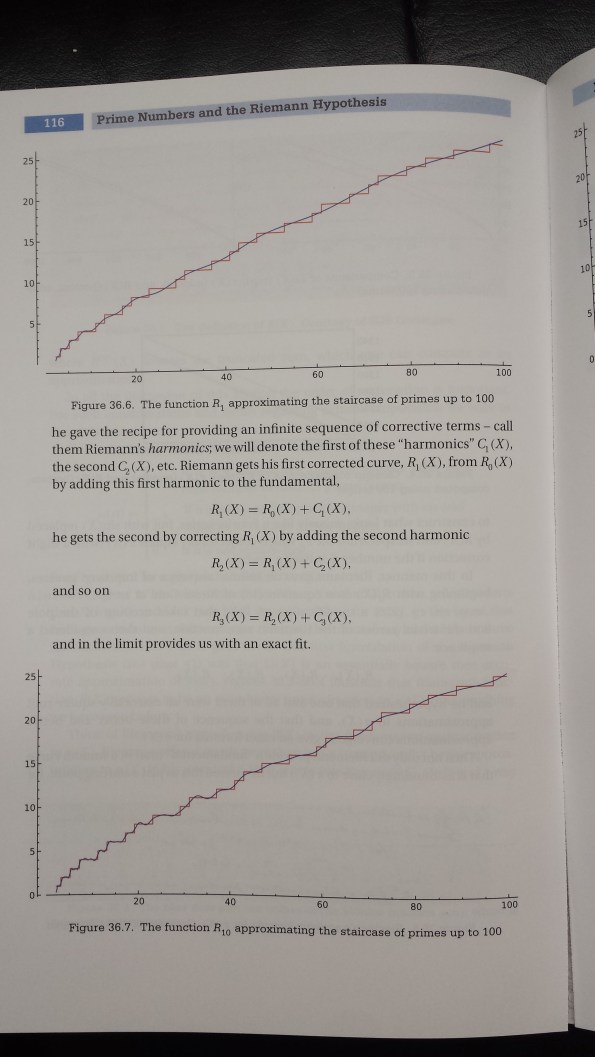
And what do they talk about? After describing basic questions about how often primes show up, the discuss such things as:
- what it means for a function to be a good approximation of another function
- Fourier transforms
- Dirac delta “generalized functions” – a seriously good explanation
- The Riemann zeta function and its zeroes, obviously
The book is set up in three parts, conveniently set up so that people who don’t know calculus know when to close the book (although they could also take a detour and read The Cartoon Guide to Calculus instead), or for people who aren’t comfortable in functions of complex variables to skim the last two parts.
Do you know what? The more I think about it, the more I realize that this book does exactly what most general audience books dare not do – including mine – which is to say, they use formulas, and graphs, and generally speaking ask the reader to work hard, in the name of enlightenment, beauty, and wonder.
Technical work for the reader such as this is, normally speaking, something of a third rail. Not in this book. In this book the authors run straight for that rail, set up a game of catch, and invite you to join their picnic in the rain, electric shock be damned. They’re having so much fun that you can’t help yourself.
If I have one complaint it’s all the pictures of white male mathematicians. Yes, I get that they did this work, and this work is amazing, and some of them are my friends, but as an educator I want to be aware of the stereotype threat that this sets up for other readers. I’m still planning to recommend it to people (please read it!) but it would have been even better if it focused on the ideas more and the people less. My two cents.
Fiscal Waterboarding & Ponzi Austerity
Last week I read Yanis Varoufakis’s book, And The Weak Suffer What They Must? Europe’s Crisis and American’s Economic Future. We were expecting Yanis to join us on Slate Money, which he did not end up doing, but I wanted to report on the highlights of the book anyway.
1. “A debt may be a debt but an unpayable debt does not get paid unless it is sensibly restructured.”
Unsurprisingly, Yanis spends a lot of the book talking about debt and debt forgiveness. In particular, he goes into the history of the post-World War II period when Germany’s debt were forgiven, and how critical that was to its growth.
He makes the point that, given that the countries in the Eurozone have no ability to set their currency exchange rates, the deficit countries like Greece, Portugal, Spain, and Italy have very little power to pay back their debts without either debt forgiveness or a “political union,” which is to say something more like the way the U.S. federal government redistributes money from Massachusetts to Mississippi.
Or, as Yanis put it, “Debt was a symptom of Europe’s awful institutional design, not its problem.”
2. “That monetary union is good for Europe’s economy and consistent with European democracy ought to be a theorem. Europe, however, decided to treat it as an axiom”
Yanis spends the bulk of the book talking about the history of modern monetary policy in Continental Europe, staring with the 1971 “Nixon Shock,” when the US kicked the European currencies off their peg to the dollar and kicked the dollar off the gold standard. This is interesting history which I personally had never learned, and after a few sputters and starts it resulted in the creation of the European Union and the Eurozone.
An interesting point that Yanis makes repeatedly (the book could do with some editing) is that the underlying structures of the European Union and the Eurozone are deeply undemocratic. This maybe seems ok when things are going well and economies seem to be humming along, but in moments of crisis, like we’ve had since 2008, the technocrats basically have all the power, and their decisions regularly and efficiently override the will of the people.
Said another way, the Eurozone was an attempt by Europeans – mostly Germans and French – to make money “apolitical” in the name of the unification of Europe. This was never going to work, according to economists, but the romance of the image was irresistible to many countries.
The one European leader who Yanis credits as seeing this basic problem beforehand is Margaret Thatcher, who was unwilling to join in an earlier version of the Eurozone because of the obvious loss of sovereignty and the lack of democratic influence.
3. “the Bundesbank ensured the European Central Bank would be created in its image, that it would be located in Frankfurt and that it would be designed so as to impose periodic, variable austerity upon weaker economies, including France.”
Yanis spends a lot of time talking about the extent to which Germany is actually in charge of everything going on in the Eurozone, and how rigid and self-interested German bankers are. The first 6 times he mentions this it’s convincing, but after 10 references I started wanting to hear what they’d say.
4. “the Troika is the oligarchs’ and the tax evaders’ best friend”
This wasn’t in the book, but Yanis made an effort while he was Greek’s Finance Minister, to datamine Greek tax returns in order to find tax evaders. He claims this effort, which would have allowed Greece to pay back some of its debt to the rest of Europe, was foiled by the Troika itself.
5. Fiscal Waterboarding & Ponzi Austerity
Yanis is a wordsmith, and he comes up, or at least uses, evocative and memorable phrases to explain complicated political situations. Specifically, he talks about the way the Greeks have been repeatedly bailed out at gunpoint as “fiscal waterboarding,” and the way that the imposed austerity is not only not creating the abundance it was supposedly intended to, but is instead sucking up resources and laying waste to communities, as “Ponzi austerity.”
Speaking of bailouts, Yanis convincingly describes most if not all of the bailouts imposed on Greece as a combination of 1) sending money to German and French banks via Greek taxpayers (and for that matter Irish taxpayers) and 2) kicking the can down the road of the inherent flaws of the Eurozone itself.
The question is, what’s going to happen next? The concept of a political union a la the United States is increasingly unlikely, and the Greek economy is in terrible shape, as we might expect after all this crazy and destined-to-fail austerity.
My guess: the debt is eventually going to be defaulted on, and the Eurozone is going to fall apart, or at the very least lose Greece. My time scale is the next 3 years. The thing I’m worried about is how bad it’s going to get, especially if China also goes bust around the same time.
Book Tour
I’m going through a couple new phases with my upcoming book (available for pre-order now!):
Sorry, I have no more galley copies in my kitchen. They were gone really fast.
Blurbs
This first and current one is “the blurb phase.” That means my publisher has sent out nearly final versions of my book to various fancy people with the hope that they have enough time in their busy lives to read it and write a blurb to go on the back cover.
It’s really an exciting time because we’ve carefully chosen people who probably won’t hate the book. Which is to say, I’ve started to get positive feedback, and not much negative feedback. That’s a nice feeling!
So pretty much I’d like to hold on to this moment for as long as possible, because when the book is reviewed more widely, the critics – at least some of them – will hate the book. That will be tough, but of course I wrote it to be provocative. So I hope my skin is thick enough for that.
Tour
The other thing that’s happening right now, book-wise, is that I’m scheduling a tour for when the book comes out in September. To be precise, the book comes out September 6th, then the tour starts, hopefully after a party, hopefully where my band plays.
So far I think I’m sticking mostly to the East Coast, but I think I have something in San Francisco as well, and perhaps a stop in the midwest in October.
So, readers, what do you think? Are there awesome places I should be sure to visit? People and communities that love books? I have no idea how this all works but I’m guessing I can add stuff if it works with the schedule.
Talking to Yanis Varoufakis on Slate Money this week
Dearest Readers,
Yanis Varoufakis, economist and former Finance Minister of Greece, is currently on a book tour promoting his new book, And the Weak Suffer What They Must? Europe’s crisis, America’s economic future. I’m busy reading it right now.
Why am I telling you this? Because the super exciting news is that he’ll be a guest this week on Slate Money, which means I get to ask him questions.
So, we’ll likely talk about his book, but also timely issues like the situation in Puerto Rico, Brexit, and of course the Greek economy.
Important Confession: I have a celebrity crush on Yanis. And given that, I’m wondering if anyone a bit more level-headed would like to come up with smart questions I should ask him.
Love,
Cathy
p.s. I think Yanis will be in a recording studio in Chicago, so it’s not like I’m going to swoon in person.
p.p.s.

Here’s Yanis killing it with a crazy shirt in the Greek parliament.
Academic Payday Lending Lobbyists
We like to think of academic researchers as fair, objective, and politically neutral. Even though we’ve all seen Inside Job and know not to trust economists, the rest of academia seems relatively safe. Right?
Well, Freakonomics has done some really great research and found evidence that researchers took money from a Payday Lending lobbyist group called Consumer Credit Research Foundation, or CCRF, in return for editing rights of their journal articles (hat tip Ernie Davis).
Here’s a list of academics, only 40% of whom are economists, that took money from CCFR or otherwise had contact with CCFR:
- Jonathan Zinman, an economist at Dartmouth,
- Jennifer Lewis Priestley, professor of data science and statistics at Kennesaw State University in Georgia,
- Marc Fusaro, economist at Arkansas Tech University,
- Todd Zywicki, law professor at George Mason School of Law (now renamed Antonin Scalia Law School), and
- Victor Stango, professor of management at University of California, Davis.
Not all the above are necessarily guilty of truly terrible stuff; FOIA requests are still pending on some of them.
But some FOIA requests have come through. In particular, email chains that show Fusaro let a lawyer from CCRF write whole paragraphs of pro-payday lending propaganda that made it verbatim into his paper, decrying the phrase “cycle of debt” as meaningless. This is in spite of Fusaro’s claim in this same paper that CCRF had held no editorial control. And it looks like CCRF funneled about $24,000 to Fusaro for his trouble, maybe more.
Also, Fusaro had a co-author on the paper who managed to talk to the Consumer Affairs Committee in Pennsylvania’s House of Representatives about the “academic research” she had done with an economics professor, which showed great things about payday lending. And since most Payday Lending regulation happens at the state level – although the Consumer Financial Protection Bureau is considering rules to create national standards – the statehouse is the end-goal for such lobbyists.
Professor Priestley also got funding for a pro-payday lending paper, and in spite of the fact that various FOIA requests are being legally blocked, one of her footnotes is exactly the same wording as we saw above:
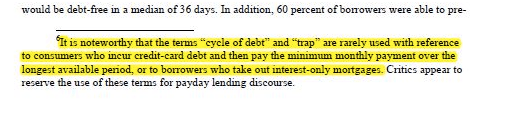
There’s more, look at the article.
I’m so glad Freakonomics is doing this kind of investigative reporting. The CFPB has enough work on its hands without so-called impartial research being compromised left and right.
Tom Slee’s What’s Yours is Mine
I’ve been a Tom Slee fan for a few years, ever since I read his delightful and illuminating book Nobody Makes You Shop at Walmart, which explains game theory and other economic tools in plain English; in particular, why Walmart is nobody’s first choice but still succeeds in taking over towns, and why a plethora of “choices” can leave you with no good options at all.
Well, Slee has done it again, this time with a well-timed and comprehensive critique of the so-called “Sharing Economy” called What’s Yours Is Mine. He exposes the hyper-capitalism behind the feel-good marketing of Uber, AirBnB, Instagram, TaskRabbit, and other companies.

Slee is a data nerd, and as such he does quite a bit of number crunching, specifically on AirBnB. For example, he was the guy who, with Murray Cox, figured out AirBnB had purged 1,000 homes from their site right before a “data release.”
Cooking the books looks bad, but it’s not the norm. Slee works out various statistics for AirBnB and compares them to its marketing pitches; most aren’t fraudulent, but they’re consistently misleading. In other words, they shared only those stats that would make themselves look more “sharing-y”, when in fact they make the bulk of their money on fake hotel-like rentals, skirting regulations.
Similarly, Slee makes a strong case, which is not new to those of us who follow this stuff, that a large part of Uber’s value is represented by skirting responsibility for safety, for avoiding insurance issues, for avoiding having capacity for wheelchairs, and the like.
Slee goes into critical quality of life questions for Uber drivers and other “sharing economy” workers and puts the boasts of the companies to the test, which they often fail. So no, Uber drivers don’t typically make $90,000 per year in New York.
There are two parts of the book which are new for us critics of the sharing economy. First, the valuable section on reputation systems. What does it mean when all reviews are 4 or 5 stars? How could a 1-star review ever compensate for something really going bad? To what extent is the rating system a form of big-brother surveillance on drivers, and how can Uber claim it doesn’t control its drivers as employees when it fires those with “bad” ratings?
And most saliently, what kind of trust does the reputation system engender when both driver and rider knows how much power there is in the ratings? As Slee says at the end of this chapter:
We trust strangers on Sharing Economy platforms for the same reason we trust hotel employees and restaurant waiters: because they are in precarious jobs where customer complaints can lead to disciplinary action. The reputation system is a way to enforce “emotional labor”; service providers are compelled to manage their feelings and present the face that the platform demands, to become that “friend with a car” or that “neighbor helping neighbors.”
Slee goes into a “Short History of Openness” that I hope every programmer reads, about the ideals that so often give way to power and control of large companies, leaving a bunch of “hollowed out middle” in their wake – think Pirate Bay.
This segues him to a discussion of the commons, and in particular the digital technological management of the commons. Sharing economy companies can be seen as providers of such, replacing old-fashioned, informal management systems, while creating billion dollar companies along the way.
Which commons is he referring to? For AirBnB, he might be talking about the cultural commons of a Barcelona’s nightlife, when it’s grappling with an inundation of AirBnB tourists. For Uber, he might be talking about the streets themselves, or various taxi cab regulation systems that, for all their clumsiness, protect both riders and drivers in various ways.
In any case, as Slee describes in thoughtful detail, these companies are imposing news kinds of commerce on the commons. This is known in Silicon Valley as “disruption,” and it’s not always an improvement. Slee goes lists ways in which the commons are eroded by commerce in its various forms (I’d excerpt this entire section if I could).
Slee wrote this book because of a pattern of betrayal he has found represented by the sharing economy companies. In his words, “what started as an appeal to community, person-to-person connections, sustainability, and sharing has become the playground of billionaires, Wall Street, and the venture capitalists extending their free-market values even further into our personal lives.”
He’s made his case really well. The only question is, how long will it take for this message to be heard?
Can we use data analysis to make policing less racist?
A couple of weeks ago there was a kerfuffle at Columbia, written up in the Columbia Spectator by Julie Chien. A machine learning course, taught in the CS department by Professor Satyen Kale, was assigned to “Help design RoboCop!” using Stop and Frisk data.
The title was ill-chosen. Kale meant it to be satirical, but his actual wording of the assignment didn’t make that clear at all, which is of course the danger with satire. Given the culture of CS, people misinterpreted and were outraged by it. This eventually led to an organized group of students called ColorCode to issue a statement in protest of the assignment, and then for Kale to issue an apology, after which ColorCode issued a second statement.
I’m really glad this conversation is finally happening, even if the assignment was a disaster. I’ve been saying for years that the CS department at Columbia, like many CS departments everywhere, has an obligation to teach and think about the ethics of machine learning as well as the mathematical techniques. And although this was an awkward way to get it started, it’s absolutely critical that it gets done. Machine learning algorithms are not objective, because the data going into them are historical artifacts of racist police practices.
In other words, we need to revive this topic, and do it right. If I were teaching data science or machine learning at Columbia, I’d want to spend a week on the Stop, Question and Frisk data, which by the way is located here; I’ve been playing around with it for a few days now and it’s really not too hard to look into.
What do I think we could accomplish? Well, here’s something I read yesterday that might be expanded upon. Namely, a paper by Sharad Goel, Maya Perelman, Ravi Shroff, and David Alan Sklansky entitled Combatting Police Discrimination in the Age of Big Data.
The idea behind this paper, and a related project housed at Stanford, is to use the Stop and Frisk data in order to:
- gather statistical evidence that the Stop and Frisk practices were racist, by for example showing that the “hit rate” of finding a weapon, for example, was much lower for blacks than it was for whites, even in “high crime” neighborhoods, and
- develop simple algorithms that the police themselves could use to determine whether their individual biases were overstating the suspiciousness of a given person in a given situation. In other words, it’s an algorithm that is meant to help officers become less racist.
One of the best things about this article is the historical context it gives about the extent to which “reasonable suspicion” is a statistical construction. Judges have been inconsistent with this idea, but there might be an emerging understanding of whether, and in what contexts, it’s considered OK to stop and frisk someone given that the chance you’ll find a weapon is 1% or less.
Personally, I’m not sure it makes sense to equip police with an algorithm to be used in real time. There are obvious issues around gaming such a model, or otherwise learning to evade undesired outcomes. Another way of implementing it, that I think might be more promising, would be at the precinct level. Imagine looking into certain types of stops and frisks and noting the hit rate is too low to warrant the imposition, which would (ideally) change the rules of stop and frisk themselves.
In other words, although I am excited about the idea of using data to track and help prevent racist practices, I don’t think we know exactly what that would look like in practice. But it’s something we desperately need to start thinking about. Let’s have the conversation!
Chicago Police Department Task Force Report
I got up early this morning to read yesterday’s Police Accountability Task Force report, or at least its Executive Summary, which reports on the Chicago Police Department. It’s really easy to read and chock full of important information and graphics. Here are a few.
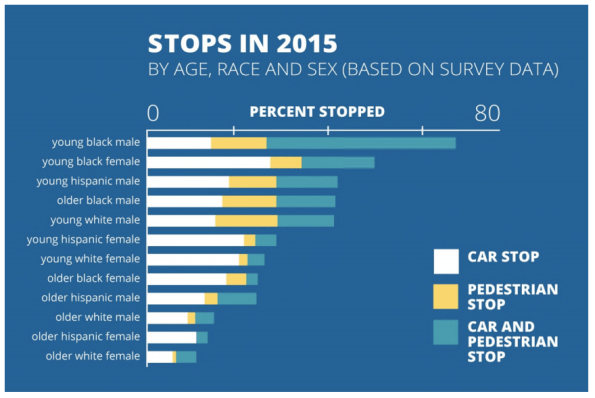
This shows how disproportionately minority and younger Chicago residents are harassed by the police. Note that the total number of stops for young black males is nearly as large as the population of young black males.
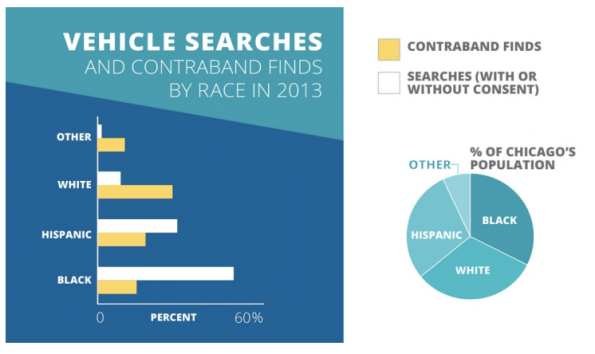
Blacks are disproportionately stopped without cause. Whites are only stopped when the probability of “finding contraband” is much higher.

There are huge numbers of complaints against officers, probably many fewer than there could be, given the climate.
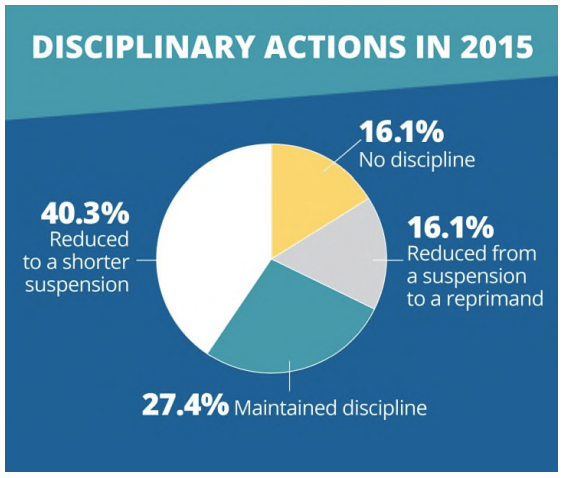
At the same time, the police officers usually get away without discipline even when it comes to complaints that are investigated (40% are not even investigated and only 7% are sustained).
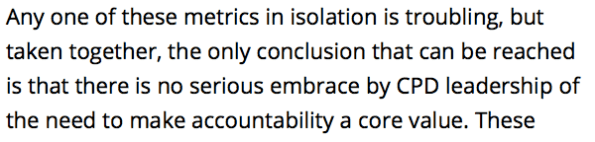
Excerpt from the report.
Finally, I wanted to excerpt from “Other Key Findings” section:
COMMUNITY-POLICE RELATIONS
The community’s lack of trust in CPD is justified. There is substantial evidence that people of color— particuarly African-Americans—have had disproportionately negative experiences with the police over an extended period of time. There is also substantial evidence that these experiences continue today through significant disparate impacts associated with the use of force, foot and traffic stops and bias in the police oversight system itself.
CPD is not doing enough to combat racial bias. Policies need further clarification, as it is not clear whether and when officers may use race as a factor when initiating stops. While CPD collects a fair amount of data, little is reported to the public. CPD still has significant work to do to diversify its ranks, especially at supervisory levels. And more needs to be done to train officers to acknowledge and address their biases and deploy officers who are culturally competent and have a proper understanding of the communities they are assigned to serve.
Historically, CPD has relied on the Community Alternative Policing Strategy (“CAPS”) to fulfill its community-policing function. The CAPS brand is significantly damaged after years of neglect. Ultimately, community policing cannot be relegated to a small, underfunded program; it must be treated as a core philosophy infused throughout CPD.
CPD officers are not adequately equipped to engage with youth. The existing relationship between CPD and youth—particularly youth of color—is antagonistic, to say the least. Children in some areas of the City are not only being raised in high-crime environments, but they are also being mistreated by those who have sworn to protect and serve them.
Finally, CPD is not doing enough to protect human and civil rights. Providing arrestees access to counsel is a particular problem. In 2014, only 3 out of every 1,000 arrestees had an attorney at any point while in police custody. In 2015, that number “doubled” to 6. The City’s youth are particularly vulnerable and often lack awareness of their rights.
LEGAL OVERSIGHT & ACCOUNTABILITY
Chicago’s police accountability system is broken. The system is supposed to hold police officers accountable to the people they serve and protect by identifying potential misconduct, investigating it and, when appropriate, imposing discipline. But at every step of the way, the police oversight system is riddled with legal and practical barriers to accountability.
IPRA is badly broken. Almost since its inception, there have been questions about whether the agency performed its work fairly, competently, with rigor and independence. The answer is no. Cases go uninvestigated, the agency lacks resources and IPRA’s findings raise troubling concerns about whether it is biased in favor of police officers. Up until recently, the agency has been run by former law enforcement, who allowed leadership to reverse findings without creating any record of the changes. IPRA has lost the trust of the community, which it cannot function without.
Imposing discipline on officers guilty of misconduct has also been a challenge. Existing policies and the woefully inadequate oversight regarding how discipline is imposed have allowed far too many officers to receive little or no discipline even after a complaint is sustained. Discipline is not handed down evenly, and there are several layers in the process where discipline is often reduced.
The collective bargaining agreements between the police unions and the City have essentially turned the code of silence into official policy. The CBAs discourage reporting misconduct by requiring affidavits, prohibiting anonymous complaints and requiring that accused officers be given the complainant’s name early in the process. Once a complaint is in the system, the CBAs make it easy for officers to lie if they are so inclined —they can wait 24 hours before providing a statement after a shooting, allowing them to confer with other officers, and they can amend statements after viewing video or audio evidence. In many cases, the CBAs also require the City to ignore or even destroy evidence of misconduct after a certain number of years.
The community has long been shut out of Chicago’s police oversight system. Meaningful engagement with the community—and giving the community power in the oversight system—is critical to ensuring that officers are held accountable for misconduct.
Finally, in the current system, there is no entity to police the police oversight system itself. There is no way to know if existing entities are performing their jobs with rigor and integrity, and no entity is equipped to identify and address systemic changes regarding patterns and practices of misconduct or bias, or to analyze policies and procedures to prevent future problems. Police inspectors general—often called auditors—have emerged nationally in response to a growing belief that traditional oversight agencies would benefit from having a second set of eyes to ensure that they perform as they should.
WMD galleys!
I’m super excited to announce that galleys for my book Weapons of Math Destruction: how big data increases inequality and threatens democracy, available for pre-order on Amazon, or from Barnes and Noble, are now out.
Galleys aren’t the real book, they’re preliminary versions made explicitly for people who might want to review the book, who might want to blurb the book, or who will spread the word about how great it is. I have some copies (technically these are proofs, and the galleys are somewhat more edited):

This pic is blurry because I immediately started drinking upon receiving the packages.
I know, I know, it’s mean of me to show you this when the actual book isn’t available until September 6th, but what can I say, I’m kind of mean. Plus, if you come over I’ll give you one, so I’m not that mean.
To celebrate I intend to go on a bike ride through Central Park, it’s a gorgeous day!
I’ll stop calling algorithms racist when you stop anthropomorphizing AI
I was involved in an interesting discussion the other day with other data scientists on the mistake people make when they describe a “racist algorithm”. Their point, which I largely agreed with, is that algorithms are simply mirroring back to us what we’ve fed them as training data, and in that sense they are no more racist than any other mirror. And yes, it’s a complicated mirror, but it’s still just a mirror.
This issue came up specifically because there was a recent Mic.com story about how, if you google image search “professional hairstyles for work,” you’ll get this:
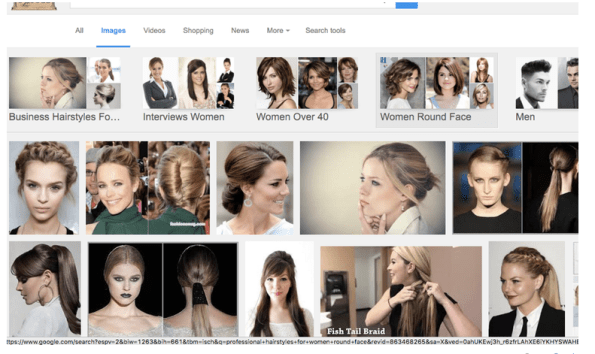
but if you google image search “unprofessional hairstyles for work” you’ll instead get this:

This is problematic, but it’s also clearly not the intention of the Google engineering team, or the google image search algorithm, to be racist. It is instead a reflection of what we as a community have presented to that algorithm as “training data.” So in that sense we should blame ourselves, not the algorithm. The algorithm isn’t (intentionally) racist, because it’s not intentionally anything.
And although that’s true, it’s also dodging some other truth about how we talk about AI and algorithms in our society (and since we don’t differentiate appropriately between AI and algorithms, I’ll use them interchangeably).
Namely, we anthropomorphize AI all the time. Here’s a screenshot of what I got when I google image searched the phrase “AI”:

Out of the above images, only a couple of them do not have some reference to human brains or bodies.
In other words, we are marketing AI as if it’s human. And since we do that, we are treating it and reacting to it as quasi-humans would. That means when it seems racist, we’re going to say the AI is racist. And I think that, all things considered, it’s fair to do this, even though there’s no intention there.
Speaking of intention and blame, I am of the mind that, even though I do not suspect any Google employee of making their algorithms prone to this kind of problem, I still think they should have an internal team that’s on the look-out for this kind of thing and address it. Just as, as a parent, I am constantly on the look-out for my kids getting the wrong ideas about racism or other prejudices; I correct their mistakes. And I know I’m anthropomorphizing the google algorithms when I talk about them like children, but what can I say, I am a sucker for marketing.
There are lots of ways to break up the big banks
I’ve been going to Alt Banking every week for almost 5 years. Here’s what I’ve learned:
There are lots of ways to break up the big banks.
First, there are ways to create incentives for banks to get smaller by themeselves. For example, we could impose more capital requirements on bigger banks than smaller ones, or more regulations, or we could say that banks beyond a specific size couldn’t engage in certain kinds of behavior, or trade certain kinds of derivatives, or we could impose taxes on those trades that are heavier for larger banks. Progressive taxes that max out at 100% profit when the bank is as big as Bank of America.
Next, we could outlaw huge banks. We could do this by simply defining a legal limit to the size of a bank, or its geographic scope, or the amount of risk it carries. We could even say that its connections to the other financial institutions has to be adequately uncomplicated that, in an event of bankruptcy, we could let it fail and it wouldn’t be a biggie. We could give banks 4 years to get compliant.
Or we could go nuts and say that banks are no longer able to “create money” at all, which is to say we could put an end to fractional reserve lending. Or, we could just do that for big banks, where reserve requirements would get larger as banks get larger. We could change accounting laws around banking to make it a lot harder for them to hide risk. We could make it illegal for them to trade derivatives, or impose a new version of Glass-Steagall to make certain things illegal. We could impose all sorts of laws that would blow them out of the water permanently.
Or we could go the other way entirely, and nationalize one of the big banks, or all of them, and let them remain big but treat them like utilities, and make them super duper boring, and pay no bonuses and have the CEO get paid something like $200K.
And I’m not saying what specific we should do – my heart’s probably closest to imposing high capital requirements and limited trading for big banks so they’ll make themselves smaller – but in any case, there are plenty of things we could do that there is no political appetite for. Once again, there’s no shortage of possible plans.
What we do have a shortage of, though, is political will. That’s why we don’t talk about this very much, and we might not have talked about it at all had Sanders not entered the race.
Which is why, when I hear people complaining about Sanders not have a specific enough plan for breaking up the big banks, I think it’s hogwash. What Sanders has, which is sorely needed, in fact is the crucial missing ingredient to any discussion around big banks, is the political will to do something. Once the political will is there, the details can be sorted out by people who think about this stuff all the time.
Guest post: Useful Math Tools
This is a guest post by Maxwell Feiner, a New York City high school kid interested in math. Maxwell and I have been having fun math conversations on Friday afternoons for a while now, and I’ve been impressed by the tools he uses, so I asked him to write up a description of them for mathbabe.
When I am doing math in my spare time there are three tools that I use heavily to aid in the process. These three being Desmos.com and Wolframalhpa.com for the aid in solving problems, and Brilliant.org for finding great problems to solve.
Brilliant

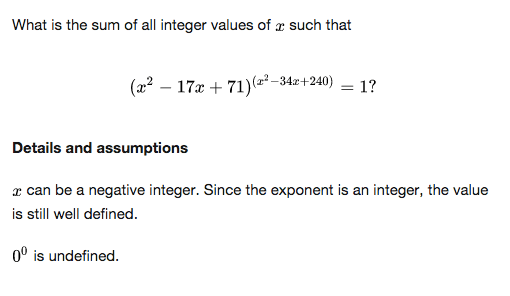
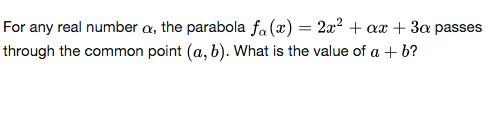
Brilliant is a fantastic site for users to obtain unique challenging problems, as well as to post solutions to problems posed by others. Think of it as a social site for math. Most of the problems are math, but there are some physics and chemistry problems as well. I like the problems a lot because they require insight beyond what is taught in school classes. They normally cannot be solved using one formula or pre-learned method, but instead require deeper thought and a combination of different concepts in order to be solved. Signing up is required to use the site. It is free. Some sample problems are shown below.

Desmos
Desmos is a great, free, and interactive online graphing calculator. It is simple to use, but at the same time very powerful. Besides just graphing equations, the user can put in adjustable values of variables and watch how the graph changes as the variables do. For example, the user could enter the equation y=a*sin(bx+c) and create adjustable values for a,b, and c, then see how changing them affects the graph of the function.

To change the values of the variables, the user can use either sliders (shown), manually input values, or put in a set of numbers or range, such as c=[1,2], where two graphs will be displayed for c=1 and c=2, or c=[1,2,…10](also shown), where 10 graphs will be displayed, for every integer from 1 to 10. The sliders can also be used to make animations by continually and smoothly incrementing the value of one of the variables. In the graph pictured below I also used the restrictions capability, allowing me to only show a certain part of the graph.

Another cool feature is movable points, which is demonstrated in two of my own graphs which have links to them below. There are so many features that it would be very hard to explain them all here, so I have provided a link to some of their tutorials on their website and a few examples of some interactive graphs I created. You can create an account and publish your work too.
Here’s a tutorial, and here are some examples of my work:
WolframAlpha

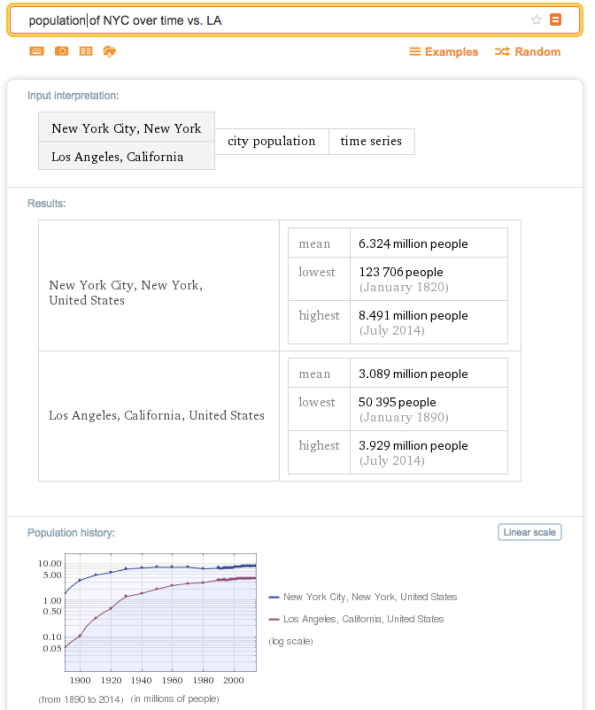
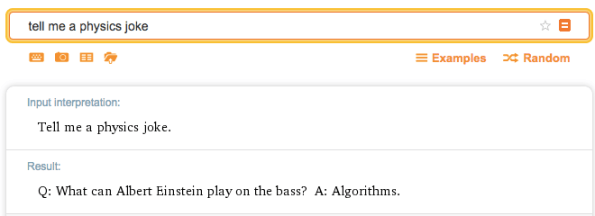
WolframAlpha is a powerful computational knowledge engine that can be used for many purposes, both math and non-math related. One thing it is particularly helpful for is graphing 3-D equations. Just type in an equation,1-D,2-D, or 3-D and it will be graphed. Once on the site, some interesting queries to try include the ones pictured below.




Other ones to try (just copy and paste into WolframAlpha or click on the links below)
- area under
from 1 to 2
- rotation of 45 degrees
- Parabola vs hyperbola
- (Population of China)/(Population of U.S.)


![\sqrt[2]{2i}](https://s0.wp.com/latex.php?latex=%5Csqrt%5B2%5D%7B2i%7D&bg=ffffff&fg=555555&s=0&c=20201002)
This is just barely scratching the surface of what can be done with the powerful tool.
Conclusion
After working with these three tools for a while, I, and many others have benefitted so much from using them. If you are looking for aids in solving problems, or more problems to solve, I highly recommend checking them out.
Four things I wanted to tell you this morning
1. Manpons:
The only thing missing from this ad is something analogous to the “And now it has 5 blades. Because you couldn’t possibly do with only 4 blades” one-upmanship of the men’s razor industry.
2. I am going to this:

The full name of the conference is The Color of Surveillance: Georgetown Law Conference to Explore Racial Bias of Government Monitoring, and I’m looking forward to it. Anyone worried about the dystopian future of government surveillance should learn about what’s happening right now to poor minority neighborhoods.
3. I’m not going to this:

Here’s a ridiculous quote from this conference which, typically, conflates what millennials “like” with what they’ve had to put up with because they were born into a world of enormous student debt and terrible job security (h/t Ernie Davis):
Game technologies are becoming increasingly popular in the workplace since they appeal to the millennial generation who have grown up playing video and computer games together with using mobile devices. But this is much more than fun! Serious games can generate up to millions of data points that can then be fed into machine-learning algorithms to help employers make smart HR decisions to win the war for talent.
4. I’m Worried About Self-driving Cars
Because won’t it encourage enormously wasteful use of cars? If I can go to sleep while I’m in my car and it’s driving to Lexington, Virginia, what will stop me from visiting my buddy Aaron every weekend?
And for that matter, why even be in the car while it’s going somewhere? I can send my car to do errands I don’t want to do, or deliver packages I don’t want to bother sending from the post office.
Apple vs. FBI: nobody won
Last night I had drinks with someone who knows a ton about the Apple vs. FBI case. He explained to me the following:
- The way the FBI eventually figured out a way into the San Bernadino shooter’s phone was extremely involved and expensive, involving things like shaving tiny pieces of hardware apart without dropping anything or exposing anything to too much heat.
- This is a good thing, because that expensive process is extremely hard to scale.
- Also, there was no legal precedent created.
- Moreover, Apple has been making iPhones increasingly secure by default, for example with default encrypted iCloud data in more recent version of its operating system.
- Which means that in a couple of years, most people using iPhones will be pretty well protected from even expensive FBI searches, again as long as there’s no legal requirement to create backdoors.
This story is interesting, but it still leaves me extremely unsatisfied. In particular, I’ve really gotten riled up by stupid media stories that “Apple won”.
I’ve maintained for a while that this story isn’t a story about Apple at all, because Apple is not accountable to the public in any real way; Tim Cook could change his mind tomorrow about whether to care about consumer security and we wouldn’t be able to do anything about it.
I think I have to amend that claim somewhat, though. Because what’s really happening is that Apple, or rather Tim Cook, is pushing through his vision of consumer protection, knowing that there will be very little the U.S. government, or any other government for that matter, will be able to do about it on a technical level, unless they’re willing to make iPhones illegal altogether.
That’s not without precedent. For example, there are some radio scanners that are illegal in the U.S. and other countries. But it’d be hard to imagine what the public’s response would be to being told that they can no longer buy iPhones.
So, the way I see it, it’s Apple vs. everyone, and Apple is feeling pretty good about its chances.
And look, I happen to agree with Apple this time. But it’s a screwed up and tenuous situation, and it’s deeply anti-democratic. We haven’t actually had the urgently needed conversation about whether Americans have the right to encrypted communication. Instead, we’re relying on a private company to make de facto policy for our benefit. What?
Here’s what I’d like to see: a real conversation about what Americans are entitled to. It’s a conversation that Obama started a couple of weeks ago at SXSW:
if the government can’t get in, then everybody is walking around with a Swiss Bank account in their pocket. There has to be some concession to the need to be able to get into that information somehow.
I’ll start. Obama’s comparing the individual’s desire for privacy with a Swiss Bank account is a smear tactic on the one hand – we’re trying to avoid taxes or something, which smacks of the tired line “don’t worry if you have nothing to hide” – and it’s disingenuous on the other hand – acting as if all information is equivalent, when we know that the government may claim access to our financial information, for tax purposes, but should never have access to our love letters. And since both kinds of information is stored on our phone, I think right there we have a pretty great argument explaining why our phones are nothing like Swiss Bank accounts.
Here’s what I’d like to see. A nuanced discussion about what types of data the government should have access to and under what circumstances, where the government has to make its case and the public gets to weigh in, since we care about terrorism too.
Grit metrics for kids: let’s not
1. The life and death of a metric
There’s a problem, or at least potentially a problem. Someone figures out how to measure the problem. The measurement isn’t perfect, and everyone admits that, but nevertheless nobody argues against using it, since knowing something is better than knowing nothing.
That metric is used a few times, and people get used to hearing it, and they mostly forget what its limitations were. Moreover, they start assigning blame to it. Instead of seeing a “bad score” as something the indicates a need for more resources and support, it becomes a moral failing: take responsibility for your terrible score and do something about it.
Stakes get high. People are measured, judged, and rewarded or punished based on their score. They start focusing on improving their score at all costs, and the small imperfections of the scoring system in the first place are magnified and distorted. Cheating happens too.
Before long, it’s all about the score, at least until dissenting voices point out that all this focus on the score hasn’t actually addressed the initial problem. In fact, it’s gotten worse over time. The focus on this metric is given up by some, held on to by others who have found other uses for it, and everyone starts looking around for a new metric to solve the initial problem.
2. Example: education reform
A few decades ago we decided to look into the international competitiveness of our nation’s children. We developed tests to see how much people in different states and different schools knew about certain things. This wasn’t a perfect process, to be sure, since the curriculums varied from state to state and school to school, but it did yield results, and they were numeric, so people trusted them.
The argument for doing this was convincing – how could anyone argue against wanting to know where we stand on education? With this knowledge in hand, surely it would be easier to know where there were struggling schools and give them help.
But instead of coming to the aid of the school systems that needed help, we ended up punishing them, blaming the principals and teachers for the problems. The fact that the scores were extremely correlated to poverty was explained away by saying our teachers had “given up on poor students.”
Thus began the era of high stakes testing for students and teachers, where teachers were “held accountable” for their students’ progress on standardized tests, if not their scores. It’s purely punitive, and a far cry from the original purpose of helping out those who need it. We haven’t equalized funding for schools, for example.
Moreover, it hasn’t helped the students and schools which are struggling. In fact scores overall seem to be going up for everyone, but the rich students, to put it bluntly, are improving faster than the poor ones. And in the meantime everyone is getting sick of all the tests.
3. What’s next in educational reform?
Recent research has shown there might be a new explanation for why some kids do well when others don’t, and it’s all about “character,” or “grit.” Kids who have it in abundance seem resilient in the face of failure, and they thrive even in tough situations.
Hallelujah! Now we can try to develop kids’ grit quotients, or better yet, we can hold teachers accountable for doing so. The only problem with this plan is that it’s actually kind of hard to consistently measure grit.
Until now. Angela Duckworth, who is one of the social scientists that has been studying grit in children and who recently wrote an opinion piece on the subject, has helped develop a scorecard, based on self-assessment, so that kids can be scored.
In her piece, Duckworth warns us that the scoring system isn’t perfect, and she has even said it’s a bad idea to use this scoring system for accountability; it could undermine the very thing we’re trying to promote.
But she’s also said that kids can improve their scores, with help from teachers, and that high scores are good signs for progress in behavioral and academic achievement.
Let’s not go there.
Flint Water Advisory Task Force Report
I haven’t been blogging much lately, partly because I’ve been recovering from a stupid bike accident from last Friday, where I fell forward over my handlebars on the West Side bikepath, and partly because, as a result of my accident, I decided to stop and smell the roses a bit, meaning I actually read a novel. It was an amazing experience, reading a novel for the first time in years, especially one this distracting. It’s called Station Eleven, by Emily St. John Mandel, and if you have time, please read it.
I’m mostly recovered now, and I have to say, my one week of detox from the normal news cycle has been freaking amazing. I feel restored. Restored enough to read the recent Flint Water Advisory Task Force Report.
And, holy crap. It’s really good, and places the blame squarely on the State of Michigan, Governor Snyder, and in particular on the Emergency Management system that cares only about money over public health. I’ve blogged about the fucked up and racist system of Emergency Managers in Michigan before.
For a summary of the time-line of events which led to the widespread lead poisoning, take a look at pages 16 through 21. After that, if you want to get something else done this morning, jump to the following excerpt from page 54 which gets to the very heart of the issue:
Environmental justice embraces two fundamental principles: (1) the fair, non-discriminatory treatment of all people; and (2) the provision for meaningful public involvement of all people— regardless of race, color, national origin or income—in government decision-making regarding environmental laws, regulations and polices. Environmental justice or injustice, therefore, is not about intent. Rather, it is about process and results—fair treatment, equal protection, and meaningful participation in neutral forums that honor human dignity.
Environmental injustice is not about malevolent intent or deliberate attacks on specific populations, nor does it come in measures that overtly violate civil rights. Environmental injustices as often occur when parties charged with the responsibility to protect public health fail to do so in the context of environmental considerations.
The facts of the Flint water crisis lead us to the inescapable conclusion that this is a case of environmental injustice. Flint residents, who are majority Black or African American and among the most impoverished of any metropolitan area in the United States, did not enjoy the same degree of protection from environmental and health hazards as that provided to other communities. Moreover, by virtue of their being subject to emergency management, Flint residents were not provided equal access to, and meaningful involvement in, the government decision-making process.
The occurrence of environmental injustice in the Flint water crisis does not indict or diminish other public and private efforts to address Flint’s many challenging circumstances. However, irrespective of the intent of the parties involved, the simple reality is that the Flint water crisis is a case of environmental injustice.
Also, there’s this on page 56:
Among African American seniors, the protracted Flint water crisis echoes the tragic Tuskegee syphilis study and the decision not to treat smallpox among freedmen in the aftermath of the American Civil War. From this perspective, it is noted that measuring blood lead levels without removing the sources of lead from the environment—in this case, lead-tainted water—appears the equivalent of using Flint’s children (and adults) as human bioassays.
I’m so glad this work was done.
Wolfie O’Neil: A Story Of A Broken Leg
Today’s guest post is by Wolfie O’Neil, my 7-year-old son whom I most recently wrote about in this post, and who learned to bike this week .





Resist the evil of the selfie password
When you think of currency in the digital age, stop thinking money, not even Bitcoin. Start thinking about data.
There’s a reason Google, Facebook, and Amazon dominate their respective markets, and it’s not just because they have lots of customers. In fact it’s the opposite: they have better products through better and more personal data about their customers.
Take Google as an example. When people have tried to argue that Google is anti-competitive, the counter-argument is that “people could just use Bing.” But that exposes the fallacy that we searchers are Google’s customers. We’re not, we’re just its product, or rather our data is. Google’s customers are the companies that buy ads on Google’s search results page and on other websites where Google places ads.
And, as Nathan Newman points out, Google’s control over people’s data is anti-competitive, and Bing or any other search engine (ad engine) cannot actually compete with Google, because Google has a corner on the currency in this particular market.
See what I mean? Google controls the world’s search and email data, and similarly Facebook controls the world’s social interaction data, including photos, and Amazon controls the world’s – or at least the country’s – purchase data and supply-chain data.
That’s why they’re so big and powerful. It’s not simply a question of how often we use their services, it’s a question of how much data they can extract from us while we do so. And that’s why the White House is trying to get them to help them fight terrorism, because they have all the resources needed.
Which brings me to my subject of today, namely Amazon’s recently filed patent for using facial recognition to authorize purchases (hat tip Mike Lawler).
This is a pure play for a new dataset, that so far only Facebook has had access to. When someone uploads a photo to Facebook, sometimes they do Facebook the service of labeling the people in the picture, which helps Facebook create a rather large database of pictures of people, and in particular how the same person can look slightly different in different pictures or at different times of their lives.
[How helpful we are to supply these companies with their data! Recently I’ve been taking to labeling my pictures with ridiculous names just as a small and useless protest against this overwhelming force.]
So, Amazon wants in on the facial recognition game, and they’re going to make it a condition to get your stuff: you want to empty your shopping cart? You’ll have to give us more data, thanks. We’ll collect it all and we’ll be able to compete with Facebook in this specific realm of data.
Do you know who else really likes the idea of good facial recognition data? People who do video surveillance. That’s why we take our pictures in passport control nowadays when we enter the country. That’s why there are cameras everywhere we walk in New York City.
So far the facial recognition technology isn’t very good, but it could get better fast if we take a selfie video every time we buy a can of coffee online. And if that happens, we won’t need the GPS in our phones to give away our locations, because just by having faces we will be doing enough.
I’ve resigned myself to lots of data collection, but this selfie stuff is going too far. I’d like us to resist, which means having a plan before it begins in earnest.
Any suggestions?
Not your namby-pamby teenage parenting advice column
I was quite annoyed this morning to read this recent advice column about parenting teenagers by Lisa Damour, entitled The Best Way to Fight With a Teenager. In first four paragraphs of this column, she never talks about what parents do, only what teenagers do. An excerpt:
Adolescents who favor either of the first two routes — escalating fights or stubbornly refusing to engage in them — are the ones most likely to be or become depressed, anxious or delinquent.
As if adolescents actually favor refusing to engage in disagreements. What a ridiculous notion.
Actually, it’s more like this: parents regularly attack and/or discipline their children for thinking differently, having dissenting voices, and generally speaking trying to establish their independence. I’m not going out on a limb when I propose the majority of teenagers who “refuse to engage” are reacting entirely rationally to being previously shut down for expressing an ounce of opinion.
Parents think that they have difficult teenagers, but the reverse is just as often the case: teenagers have difficult parents. Instead of a column for parents to think about all the dysfunctional ways their teenagers deal with disagreement, there should be a book for teenagers to learn how to deal with parents who cannot deal with being challenged. Maybe I’ll write it.
I’ll go further, in fact. Teenagers are easier to deal with if for parents who like their views challenged and who can react positively to having their hypocrisies pointed out to them. Because that’s what teenagers do, and god bless them, they are the most honest critics in the world. By the time they’re grown up they’ve learned to lie to make people feel better, but I’d rather spend time with a teenager any day of the week.
So, here’s my parenting advice, folks: listen to your teenager, because he or she is probably telling you something honest and true, in fact something so honest and so true that you can barely recognize it and it sometimes hurts. Don’t kill the messenger.
Tom Adams: The NYC real estate bubble is about to pop
This Sunday our friend Tom Adams visited the Alt Banking group and talked to us about how the high-end NYC real estate bubble is due to burst soon, if it hasn’t already.
He introduced his topic with an analogy from oil. When credit was super easy to obtain, post-crisis and during the era of quantitative easing, there was an incredible amount of investment in fracking and drilling. Everyone wanted a piece of the action, and the secondary junk bond and CLO markets were more than happy to oblige with plentiful cash.
The result was an over-supply in an economically stagnant era of low demand. Instead of seeing the economic law of supply and demand kicking in, however, we saw the opposite, at least temporarily: companies that were in need of cash to pay their creditors regularly pumped as much oil as possible to make their payments, resulting in even more supply and the collapse of the market.
According to Tom, we’re seeing a similar dynamic in NYC luxury housing, and for a similar reason: too much easy money for developers to buy and develop luxury housing, without regard for the demand. But, whereas in the case of oil the markets are relatively transparent and move quickly, the real estate market is famously opaque and sly, with information leak managed by real estate brokers who have skin in the game. And while ultra luxury condos are a “hard asset” they aren’t really a commodity: no one “needs” a $20 million condo like they need oil or wheat. It’s really more like art, where the market is whimsical and changes when a particular collector or two die or lose interest.
Even so, it’s possible to do some basic reckoning. If you count the number of very rich people who are on the market for Manhattan apartments that cost more than $100 million, or even $10 million, you’ll soon realize they mostly already bought them. That means that hundreds of units which have come on to the market in the past couple of years, and that are due to come on to the market this year (5126, the most since 2007, of which 63% are luxury, defined here as $2400/square foot or more), are essentially going to just sit there, with no buyers in sight.
Just to give you some apples to apples comparisons, there were a total of 177 apartments sold for $10m or more in 2015, down 13.7% from prior year (205 in 2014). According to streeteasy.com, there are 520 units currently listed for sale over $10m.
How could this have happened? It’s a market failure, but according to Tom it’s not that hard to believe given the availability of cheap, overseas loans and expensive land prices. Everyone and their uncle wanted a piece of the luxury real estate market, which has been a gold mine for developers for years, to the point where they’ve been building like crazy without looking around them for indications to pause.
The dynamic of success has made land prices so high that it’s become unattractive to build affordable housing, and moreover the labor with which the luxury apartment building is built is non-union to save on costs. The developers argue that they simply cannot afford to pay their builders well.
There are already signs that the bubble is bursting. First, look at the number of recently sold new apartments that are already listed as for rent. There are 6700 of them, which is a high since 2005. Also, the count of new listings are up 9% for luxury apartments – while going down 3% for non-luxury housing – to 4,055 units, and the time on the market is also way up.
There’s another connection between oil and real estate markets. Namely, the people who buy the stuff. Lots of the luxury apartments are being bought – often through shell companies – by international elite who got rich in part through their investments in oil and other commodities. So the drop in the price of oil, although great for the average consumer who buys gas (and not great at all for the environment), means that there are fewer potential buyers looking to invest in apartment-shaped commodities. The recent problems in China aren’t helping either for the supply of billionaires.
So, what can we expect? First, a wave of developer defaults, like we recently saw in Harlem, which will slow down or stop the new construction. Second, the apartments that already exist will be rented or sold at below-luxury rates, cannibalizing the market at that level. At some point we might even see land prices going down far enough for developers to consider addressing the needs of the middle class, whatever that might mean in New York City. Fingers crossed.
Most importantly, the impending luxury housing crash should be an opportunity for community groups to demand a new conversation about what land and housing are supposed to be for, hopefully convincing city officials that they represent all New Yorkers, not just the super rich.


 mathbabe