Archive
At the JMM
I spent yesterday at the Joint Math Meetings here in San Deigo and I gave my talk just before lunch. A few observations:
- Mathematicians are even nerdier than I remember
- There are way more mathematicians here than I thought exist
- A bunch of them are people I kinda remember fondly
- But there are also people I would be okay with never seeing again
- The result is an emotional random walk with a slightly positive drift as I walk down the hall (internal dialog: “oh, hey! hugs!” with probability
“I’ma turn here and walk fast” with probability
)
- The result of that is a shopping mall-like exhaustion that sets in within 30 minutes of being at the conference.
- If I have run into you at the JMM, rest assured our meeting happened with probability

I had a nice time giving my talk, though, and I accidentally invited the audience of about 140 people to have lunch with me when in fact I had already agreed to have lunch with the small group of speakers and organizer Suzy Weekes.
So for the people who are still interested in having lunch with me, meet me at noon at Bub’s, which is located right next to the ballpark on the corner of J Street and 7th Ave. See you there!
Data scientists and engineers needed for a weekend datafest exploring money and politics
I just signed up for an upcoming datafest called “Big Data, Big Money, and You” which will be co-hosted at Columbia University and Stanford University on February 2nd and 3rd.
The idea is to use data from:
- GovTrack.us,
- MapLight,
- National Institute on Money in State Politics,
- Open States,
- Pew Research Center,
- ProPublica,
- The Center for Responsive Politics,
- State Integrity, and
- The Sunlight Foundation
and open source tools such as R, python, and various api’s to model and explore various issues in the intersection of money and politics. Among those listed are things like: “look for correlation between the subject of bills introduced to state legislatures to big companies within those districts and campaign donations” and “comparing contributions per and post redistricting”.
As usual, a weekend-long datafest is just the beginning of a good data exploration: if you’re interested in this, think of this as an introduction to the ideas and the people involved; it’s just as much about networking with like-minded people as it is about finding an answer in two days.
So sign up, come on by, and get ready to roll up your sleeves and have a great time for that weekend, but also make sure you get people’s email addresses so you can keep in touch as things continue to develop down the road.
Data Science explained by the media, or: why I might just screw your wife while you’re at work
I wanted to mention two recent articles about data science. The first was in the New York Times, has a crappy title (“Big Data is Great, but Don’t Forget Intuition“), a positive outlook, and interviews skeptics like my co-author Rachel Schutt, who has the last word in the article:
“I don’t worship the machine”
The second article (hat tip Chris Wiggins) was published in Forbes, has a great title (“Data Science: Buyer Beware“), an enormously skeptical outlook, and takes quotes from data science celebrities. From the article:
Thomas Davenport and D.J. Patil’s rather hyperbolic declaration that the “data scientist is the sexiest job of the 21st century” deserves a double dose of skepticism.
These two articles are attempting to do totally different things and they both achieve them pretty well. The first brings up the need for thoughtfulness so that we don’t blindly follow algorithms:
Will Big Data usher in a digital surveillance state, mainly serving corporate interests?
…
Personally, my bigger concern is that the algorithms that are shaping my digital world are too simple-minded, rather than too smart.
The second article brings up the ideas that we’ve been through similar thought and management revolutions before, and trouble lies with anything that is considered the silver bullet. Here’s my favorite part:
…data science tries to create value through an economy of counterfeits:
- False expertise, arising as persons recognized as experts are conversant in methods and tools, and not the underlying business phenomena, thereby relegating subject matter knowledge below methodological knowledge,
- False elites, arising as persons are summarily promoted to high status (viz., “scientist”) without duly earning it or having prerequisite experiences or knowledge: functionaries become elevated to experts, and experts are regarded as gurus,
- False roles, arising as gatekeepers and bureaucrats emerge in order to manage numerous newly created administrative processes associated with data science activities, yet whose contributions to core value, efficiency, or effectiveness are questionable,
- False scarcity, arising as leaders and influencers define the data scientist role so narrowly as to consist of extremely rare, almost implausible combinations of skills, thereby assuring permanent scarcity and consequent overpricing of skills.
For the record, I’d rather define data science by what data scientists get paid to do, which is how we approached the book. Even better if we talk about data scientists as people who work on data science teams, where the “extremely rare, almost implausible combinations of skills” are represented not by one person but by the team as a whole (agreed wholeheartedly that nobody is everything a typical LinkedIn data scientist job description wants).
The only weird part of the second article is the part where writer Ray Rivera draws an analogy between data scientists and “icemen”, the guys who used to bring ice to your house daily before the invention of refrigerators. The idea here is, I guess, that you shouldn’t trust a data scientist to admit when he is not necessary because there’s better technology available, not can you trust a data scientist to invent such technology, nor can you trust a data scientist with your wife.
For whatever reason I get a thrill from the fact that I pose such a sexy threat to Rivera. I’ll end with the poem he quotes:
I don’t want no iceman
I’m gonna get me a Frigidaire …
I don’t want nobody
Who’s always hangin’ around.
The complexity feedback loop of modeling
Yesterday I was interviewed by a tech journalist about the concept of feedback loops in consumer-facing modeling. We ended up talking for a while about the death spiral of modeling, a term I coined for the tendency of certain public-facing models, like credit scoring models, to have such strong effects on people that they arguable create the future rather than forecast it. Of course this is generally presented from the perspective of the winners of this effect, but I care more about who is being forecast to fail.
Another feedback loop that we talked about was one that consumers have basically inheriting from the financial system, namely the “complexity feedback loop”.
In the example she and I discussed, which had to do with consumer-facing financial planning software, the complexity feedback loop refers to the fact that we are urged, as consumers, to keep track of our finances one way or another, including our cash flows, which leads to us worrying that we won’t be able to meet our obligations, which leads to us getting convinced we need to buy some kind of insurance (like overdraft insurance), which in turn has a bunch of complicated conditions on it.
The end result is increased complexity along with an increasing need for a complicated model to keep track of finances – in other words, a feedback loop.
Of course this sounds a lot like what happened in finance, where derivatives were invented to help disperse unwanted risk, but in turn complicated the portfolios so much that nobody understand them anymore, so we have endless discussions about how to measure the risk of the instruments that were created to remove risk.
The complexity feedback loop is generalizable outside of the realm of money as well.
In general models take certain things into account and ignore others, by their nature; models are simplified versions of the world, especially when they involve human behavior. So certain risks, or effects, are sufficiently small that the original model simply doesn’t see them – it may not even collect the data to measure it at all. Sometimes this omission is intentional, sometimes it isn’t.
But once the model is widely used, then the underlying approximation to the world is in some sense assumed, and then the remaining discrepancy is what we need to start modeling: the previously invisible becomes visible, and important. This leads to a second model tacked onto the first, or a modified version of the first. In either case it’s more complicated as it becomes more widely used.
This is not unlike saying that we’ve seen more vegetarian options on menus as restauranteurs realize they are losing out on a subpopulation of diners by ignoring their needs. From this example we can see that the complexity feedback loop can be good or bad, depending on your perspective. I think it’s something we should at least be aware of, as we increasingly interact with and depend on models.
I don’t have to prove theorems to be a mathematician
I’m giving a talk at the Joint Mathematics Meeting on Thursday (it’s a 30 minute talk that starts at 11:20am, in Room 2 of the Upper Level of the San Diego Conference Center, I hope you come!).
I have to distill the talk from an hour-long talk I gave recently in the Stony Brook math department, which was stimulating.
Thinking about that talk brought something up for me that I think I want to address before the next talk. Namely, at the beginning of the talk I was explaining the title, “How Mathematics is Used Outside of Academia,” and I mentioned that most mathematicians that leave academia end up doing modeling.
I can’t remember the exact exchange, but I referred to myself at some point in this discussion as a mathematician outside of academia, at which point someone in the audience expressed incredulity:
him: Really? Are you still a mathematician? Do you prove theorems?
me: No, I don’t prove theorems any longer, now that I am a modeler… (confused look)
At the moment I didn’t have a good response to this, because he was using a different definition of “mathematician” than I was. For some reason he thought a mathematician must prove theorems.
I don’t think so. I had a conversation about this after my talk with Bob Beals, who was in the audience and who taught many years ago at the math summer program I did last summer. After getting his Ph.D. in math, Bob worked for the spooks, and now he works for RenTech. So he knows a lot about doing math outside academia too, and I liked his perspective on this question.
Namely, he wanted to look at the question through the lens of “grunt work”, which is to say all of the actual work that goes into a “result.”
As a mathematician, of course, you don’t simply sit around all day proving theorems. Actually you spend most of your time working through examples to get a feel for the terrain, and thinking up simple ways to do what seems like hard things, and trying out ideas that fail, and going down paths that are dry. If you’re lucky, then at the end of a long journey like this, you will have a theorem.
The same basic thing happens in modeling. You spend lots of time with the data, getting to know it, and then trying out certain approaches, which sometimes, or often, end up giving you nothing interesting, and half the time you realize you were expecting the wrong thing so you have to change it entirely. In the end you may end up with a model which is useful. If you’re lucky.
There’s a lot of grunt work in both endeavors, and there’s a lot of hard thinking along the way, lots of ways for you to fool yourself that you’ve got something when you haven’t. Perhaps in modeling it’s easier to lie, which is a big difference indeed. But if you’re an honest modeler then I claim the difference in the process of getting an interesting and important result is not that different.
And, I claim, I am still being a mathematician while I’m doing it.
Sunday (late) morning reading list
I wanted to share with you some things I read this week which I really enjoyed and which made me think.
- Jordan over at Quomodocumque has written the post I wish I wrote on the recent “end of history illusion” introduced in this New York Times article. Here’s the post I did write, which isn’t nearly as nerdy, annoyed, and well thought-out.
- How to halt the terrorist money train from the New York Times.
- Point: Our absurd Fear of Fat from the New York Times. I love the attention to the weight-loss industry here.
- Counterpoint: The problem with all this ‘Overweight people live longer’ news, from the Atlantic.
Aunt Pythia’s advice
After a short vacation Aunt Pythia is back to give out free advice that’s worth every penny. Go here for past advice columns and here for an explanation of the name Pythia. Please submit your question at the bottom of this column (pretty please!).
Let’s first go over last time’s question for the readers:
Aunt Pythia,
Why do some foods burn when you stir them? It doesn’t make sense that my rice or pasta should burn when there is still a lot of water in the pot just because I stirred it.
Physics-Inclined Wannabe Chef
The answer to the Chef were interesting and thoughtful, although I’m not sure anyone actually whipped out the pots and ran experiments (including me!).
Leila says it’s not because you stirred it, and moreover the lesson learned is to stir more often, but JSK disagrees and thinks you can burn your rice by stirring. From JSK’s comment:
…the remaining water settles to the bottom of the pan, gradually boiling away and preventing burning at the bottom. If you stir, you distribute the water throughout the “sponge” of cooled rice above. The bottom layer of rice then burns if the heat is hot enough and the water can’t percolate back down in time to prevent the burning.
I’m gonna have to say the jury’s out. We got direct disagreement. Anyone want to produce a Mythbusters-style rice cooking show?
——
Dear Aunt Pythia,
I’m going on the academic job market for the first time. I’ve heard a lot of advice, but I’d really like Aunt Pythia’s advice: what three adjectives should I try to embody during my Joint Math Meeting (JMM) interviews?
Nervous in Nebraska
Dear Nervous,
These are going to sound pretty typical but here goes: try to appear confident, interested, and likable.
To explain why I chose those three adjectives, keep in mind that interviewing for a job is a lot like dating. You need to figure out if you like your date while, at the same time, convince your date to like you. Those are two tasks and they are both up to you, they’re your responsibility, and it’s not enough to just do one of them.
So, although you’re nervous, you need to give off “I am not depending on this to work out because I have other interviews” vibes, because first of all it’s the truth, and second of all you need to make sure your interviewer feels obligated to sell the job to you. Otherwise the entire process is all about whether you’re good enough, which is imbalanced. It should be more a discussion of whether it’s a good fit overall. Watch this video to see how that negotiation can look if it’s an incredibly funny, inappropriate, and drunk interview.
At the same time, you need to seem interested. You can’t be indifferent to the job, because that’s the kiss of death from the perspective of an interviewer. Why would I offer a job to this jerk who doesn’t even seem to want it?
Finally, keep in mind that the real question on the interviewer’s mind is whether they’d actually want to be your colleague. You need to seem like someone who would fit in to the department, both mathematically and socially. Now’s not the time to mention weird hobbies, but it is the time to mention caring about how real analysis gets taught (although don’t be too radical). You want to give the impression that you’re fun, professional, and thoughtful about being a math nerd.
I hope that helps! See you in San Diego!
Aunt Pythia
——
Aunt Pythia,
Do you think stricter gun control laws would really prevent mass shootings?
Only in Oakland
Dear OiO,
Why, yes, I do, and even more importantly I think they’d massively cut down on all shootings. Mass shootings get lots of attention but let’s fact it, they are statistical anomalies compared to the very predictable country-wide individual shootings that we see every day. The overall death toll by shooting in countries is highly correlated to the gun ownership rate:
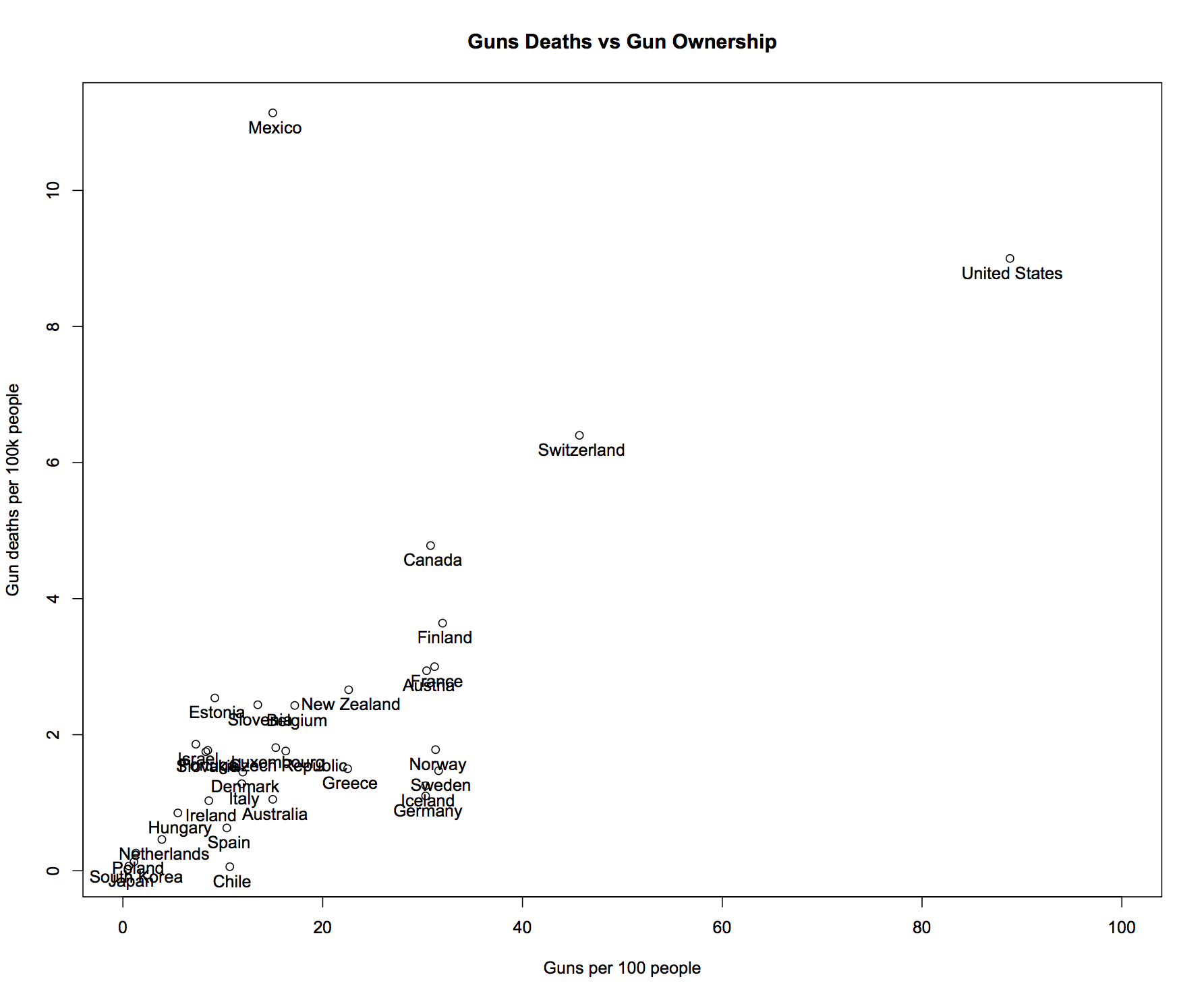
For me, that is super convincing. However, I’m pretty sure we will need a bit more than true facts to deal effectively with what has become a religion in this country. I’d love advice on strategies to this effect.
Love,
Aunt Pythia
——
Aunt Pythia,
Do you have any advice about how to tell your boss that you’re pregnant if you didn’t start the job very long before you got pregnant?
Shy pregnant woman
Dear Shy,
One of the great things about being pregnant is that it announces itself. My advice it to say nothing unless it just spontaneously feels right to do so. Just please don’t feel guilty or awkward towards your employer about being pregnant – it’s normal, natural, and protected by the law.
And please write back with questions about babies when the time comes!
Auntie Pythia
——
Finally, a question for the readers – I’m interested in what you’ll say:
Aunt Pythia,
If an editor of an Elsevier journal asks you to referee a paper, wouldn’t it be the norm to decline the request instead of leaving it unanswered, or does Gowers’s revolution includes that anyone who has not joined for one reason or another should be shunned and considered a pariah?
Trapped Editor
Please submit your questions here! I’m getting wonderful, high quality questions, but not enough of them, and I’m almost out. Please save Aunt Pythia by asking her something super ridiculous!
I wish I knew now what I’ll know then
Yesterday I read this New York Times article which explains the so-called “end of history illusion,” a fancy way of saying that as we acknowledge having changed a lot in the past, we project more of the same into the future.
I guess this is supposed to mean we always see the present moment as the end of history. From the article:
“Middle-aged people — like me — often look back on our teenage selves with some mixture of amusement and chagrin,” said one of the authors, Daniel T. Gilbert, a psychologist at Harvard. “What we never seem to realize is that our future selves will look back and think the very same thing about us. At every age we think we’re having the last laugh, and at every age we’re wrong.”
For the record I thought my teenage self was pretty awesome, and it was the moment in my life where I actually lived as best I could avoiding hypocrisy. I never laugh at my teenage self, and I’m always baffled that other people do – think of everything we had to understand and deal with all at once! But back to the end of history.
Scientists explain the phenomenon by suggesting it’s good for our egos to think we are currently perfectly evolved and won’t need to modify anything in our beliefs. Another possibility they come up with: we are too lazy to do better than this, and it’s easier to remember the past than it is to think hard about the future.
Here’s another explanation that I came up with: we have no idea what the future holds, nor whether we will become more or less conservative, more or less healthy, or more or less irritable, etc., so in expectation we will be exactly the same as we are now. Note that’s not the same as saying we actually will be the same, it’s just that we don’t know which direction we’ll move.
In other words, we are doing something different when we look into the future than when we look into the past, and the honest best guess of our future selves may well be our current selves.
After all, we don’t know what random events will occur in the future (like getting hit by a car and breaking our leg, say) that will effect us, and the best we can go is our current plans for ourselves.
Even so, it’s interesting to think about how I’ve changed over my lifetime and continue the trend into the future. If I do that, I evoke something that is clearly not an extrapolation of my current self.
In particular, I can project that I will be very different in 10 years, more patient, more joyful, doing god knows what for a living (if I’m not totally broke), even more opinionated than I am now, and much much wiser about how to raise teenage sons. Come to think of it, I can’t wait!
Planning for the robot revolution
Yesterday I read this Wired magazine article about the robot revolution by Kevin Kelly called “Better than Human”. The idea of the article is to make peace with the inevitable robot revolution, and to realize that it’s already happened and that it’s good.
I like this line:
We have preconceptions about how an intelligent robot should look and act, and these can blind us to what is already happening around us. To demand that artificial intelligence be humanlike is the same flawed logic as demanding that artificial flying be birdlike, with flapping wings. Robots will think different. To see how far artificial intelligence has penetrated our lives, we need to shed the idea that they will be humanlike.
True! Let’s stop looking for a Star Trek Data-esque android (although he is very cool according to my 10-year-old during our most recent Star Trek marathon).
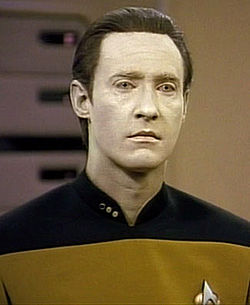
Data is very cool
Instead, let’s realize that the typical artificial intelligence we can expect to experience in our lives is the web itself, inasmuch as it is a problem-solving, decision-making system, and our interactions with it through browsing and searching is both how we benefit from artificial intelligence and how it takes us over.
What I can’t accept about the Wired article, though, is the last part, where we should consider it good. But maybe it is only supposed to be good for the Wired audience and I’m asking for too much. My concerns are touched on briefly here:
When robots and automation do our most basic work, making it relatively easy for us to be fed, clothed, and sheltered, then we are free to ask, “What are humans for?”
Here’s the thing: it’s already relatively easy for us to be fed, clothed, and sheltered, but we aren’t doing it. That doesn’t seem to be our goal. So why would it suddenly become our goal because there is increasing automation? Robots won’t change our moral values, as far as I know.
Also, the article obscures economic political reality. First imagines the audience as a land- and robot-owning master:
Imagine you run a small organic farm. Your fleet of worker bots do all the weeding, pest control, and harvesting of produce, as directed by an overseer bot, embodied by a mesh of probes in the soil. One day your task might be to research which variety of heirloom tomato to plant; the next day it might be to update your custom labels. The bots perform everything else that can be measured.
Great, so the landowners will not need any workers at all. But then what about the people who don’t have a job? Oh wait, something magical happens:
Everyone will have access to a personal robot, but simply owning one will not guarantee success. Rather, success will go to those who innovate in the organization, optimization, and customization of the process of getting work done with bots and machines.
Really? Everyone will own a robot? How is that going to work? It doesn’t seem to be a natural progression from our current system. Or maybe they mean like the way people own phones now. But owning a phone doesn’t help you get work done if there’s no work for you to do.
But maybe I’m being too cynical. I’m sure there’s deep thought being put to this question. Oh here, in this part:
I ask Brooks to walk with me through a local McDonald’s and point out the jobs that his kind of robots can replace. He demurs and suggests it might be 30 years before robots will cook for us.
I guess this means we don’t have to worry at all, since 30 years is such a long, long time.
Open data and the emergence of data philanthropy
This is a guest post. Crossposted at aluation.
I’m a bit late to this conversation, but I was reminded by Cathy’s post over the weekend on open data – which most certainly is not a panacea – of my own experience a couple of years ago with a group that is trying hard to do the right thing with open data.
The UN funded a new initiative in 2009 called Global Pulse, with a mandate to explore ways of using Big Data for the rapid identification of emerging crises as well as for crafting more effective development policy in general. Their working hypothesis at its most simple is that the digital traces individuals leave in their electronic life – whether through purchases, mobile phone activity, social media or other sources – can reveal emergent patterns that can help target policy responses. The group’s website is worth a visit for anyone interested in non-commercial applications of data science – they are absolutely the good guys here, doing the kind of work that embodies the social welfare promise of Big Data.
With that said, I think some observations about their experience in developing their research projects may shed some light on one of Cathy’s two main points from her post:
- How “open” is open data when there are significant differences in both the ability to access the data, and more important, in the ability to analyze it?
- How can we build in appropriate safeguards rather than just focusing on the benefits and doing general hand-waving about the risks?
I’ll focus on Cathy’s first question here since the second gets into areas beyond my pay grade.
The Global Pulse approach to both sourcing and data analytics has been to rely heavily on partnerships with academia and the private sector. To Cathy’s point above, this is true of both closed data projects (such as those that rely on mobile phone data) as well as open data projects (those that rely on blog posts, news sites and other sources). To take one example, the group partnered with two firms in Cambridge to build a real-time indicator of bread prices in Latin America in order. The data in this case was open, while the web-scraping analytics (generally using grocery-story website prices) were developed and controlled by the vendors. As someone who is very interested in food prices, I found their work fascinating. But I also found it unsettling that the only way to make sense of this open data – to turn it into information, in other words – was through the good will of a private company.
The same pattern of open data and closed analytics characterized another project, which tracked Twitter in Indonesia for signals of social distress around food, fuel prices, health and other issues. The project used publicly available Twitter data, so it was open to that extent, though the sheer volume of data and the analytical challenges of teasing meaningful patterns out of it called for a powerful engine. As we all know, web-based consumer analytics are far ahead of the rest of the world in terms of this kind of work. And that was precisely where Global Pulse rationally turned – to a company that has generally focused on analyzing social media on behalf of advertisers.
Does this make them evil? Of course not – as I said above, Global Pulse are the good guys here. My point is not about the nature of their work but about its fragility.
The group’s Director framed their approach this way in a recent blog post:
We are asking companies to consider a new kind of CSR – call it “data philanthropy.” Join us in our efforts by making anonymized data sets available for analysis, by underwriting technology and research projects, or by funding our ongoing efforts in Pulse Labs. The same technologies, tools and analysis that power companies’ efforts to refine the products they sell, could also help make sure their customers are continuing to improve their social and economic wellbeing. We are asking governments to support our efforts because data analytics can help the United Nations become more agile in understanding the needs of and supporting the most vulnerable populations around the globe, which in terms boosts the global economy, benefiting people everywhere.
What happens when corporate donors are no longer willing to be data philanthropists? And a question for Cathy – how can we ensure that these new Data Science programs like the one at Columbia don’t end up just feeding people into consumer analytics firms, in the same way that math and econ programs ended up feeding people into Wall Street jobs?
I don’t have any answers here, and would be skeptical of anyone who claimed to. But the answers to these questions will likely define a lot of the gap between the promise of open data and whatever it ends up becoming.
Is mathbabe a terrorist or a lazy hippy? (#OWS)
The Occupy narrative, put forth by mainstream media such as the New York Times and led by friends of Wall Street such as Andrew Ross Sorkin, is sad and pathetic. A bunch of lazy hippies, with nothing much in the way of organized demands, and, by the way, nothing much in the way of reasonable grievances either. And moreover, according to Sorkin, Occupy had fizzled as of its first anniversary.
To an earnest reader of the New York Times, in other words, there’s no there there, and we can move on. Nothing to see.
From my perspective as an active occupier, this approach of casual indifference has seemed oddly inconsistent with the interest in the #OWS Alternative Banking group from other nations. I’ve been interviewed by mainstream reporters from the UK, Belgium, Canada, France, Germany, and Japan, and none of them seemed as willing to dismiss the movement or our group quite as actively as the New York Times has.
And then there was the country-wide clearing of the parks, which seemed mysteriously coordinated, and the press (yes, the New York Times again) knowing when and where it would happen somehow, and taking pictures of the police gathering beforehand.

Police preparing to clear Zuccotti Park
Really it was enough to make one consider a conspiracy theory between the authorities and mainstream media.
I’m not one for conspiracy theories, though, so I let it pass. But other people were more vigilant than myself after the coordinated clearings, and, as I learned from this Naked Capitalism post, first Truthout attempted a FOIA request to the FBI, and was told that “no documents related to its infiltration of Occupy Wall Street existed at all”, and then the Partnership for Civil Justice filed a FOIA request which was served.
Turns out there was quite a bit of worry about Occupy among the FBI, and Homeland Security, even before Zuccotti was occupied. Occupy was dubbed a terrorist organization, for example. See the heavily redacted details here.
I guess to some extent this makes sense, as the roots of Occupy are outwardly anarchist, and there is a history of anarchist bombings of the New York Stock Exchange. I guess this could also explain the meetings the FBI and Homeland Security had with the banks and the stock exchange. They wanted to cover their asses in case the anarchists were violent.
On the other hand, by the time they cleared the park the movement was openly peaceful. You don’t get called lazy dirty hippies because you’re throwing bombs into buildings, after all. And the coordination of the clearing of the parks is no longer a conspiracy, it’s verified. They were clearly afraid of us.
So which is it, lazy hippy or scary terrorist? There’s a baffling disconnect.
The truth, in this case, is not in between. Instead, Occupy lives in a different plane altogether, as I’ll explain, and this in turn explains both the “lazy” and the “scary” narrative.
The “lazy” can be put to rest here and now, it’s just wrong. The response and relief efforts of Occupy Sandy has convincingly shown that laziness is not an underlying principle of Occupy.
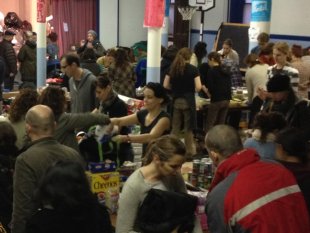
Occupy Sandy volunteers
But Occupy Sandy did expose some principles that we occupiers have known to be true since the beginning:
- that we must overcome or even ignore structured and rigid rules to help one another at a human level,
- that we must connect directly with suffering and organically respond to it as we each know how to, depending on circumstances, and
- that moral and ethical responsibilities are just plain more important than rules.
Such a nuanced concept might seem, from the outside, to be a bunch of meditating hippies, although you’d have to kind of want to see that to think that’s all it is. So that explains the “lazy” narrative to me: if you don’t understand it, and if you don’t want to bother to look carefully, then just describe the surface characteristics.
Second, the “scary” part is right, but it’s not scary in the sense of guns and bombs – but since the cops, the FBI, and Homeland Security speak in that language, the actual threat of Occupy is again lost in translation.
It’s our ideas that threaten, not our violence. We ignore the rules, when they oppress and when they make no sense and when they serve to entrench an already entrenched elite. And ignoring rules is sometimes more threatening than breaking them.
Is mathbabe a terrorist? Is the Alternative Banking group a threat to national security because we discuss breaking up the big banks without worrying about pissing off major campaign contributors?
I hope we are a threat, but not to national security, and not by bombs or guns, but by making logical and moral sense and consistently challenging a rigged system.
I’m planning to file a FOIA request on myself and on the Alt Banking group to see what’s up.


 mathbabe